Coordinates Questions and Answers Class 10 Maths Chapter 6 Kerala Syllabus Solutions

You can Download Coordinates Questions and Answers, Activity, Notes PDF, Kerala Syllabus 10th Standard Maths Solutions Chapter 6 help you to revise complete Syllabus and score more marks in your examinations.

SSLC Maths Chapter 6 Coordinates Textbook Questions and Answers

SCERT Class 10th Standard Maths Chapter 6 Coordinates Notes

Textbook Page No. 134

Coordinates Class 10 Kerala Syllabus Chapter 6 Question 1.
Find the following.
i. The y -coordinate of any point on the x-axis.
ii. The x -coordinate of any point on the y-axis.
iii. The coordinates of the origin
iv. The y-coordinate of any point on the line through (0,1), parallel to the x-axis.
v. The x- coordinate of any point on the line through (1,0), parallel to the y-axis.
Answer:
i. y-coordinate of any point on the x-axis is zero.
ii. x-coordinate of any point on the y-axis is zero.
iii. Origin is (0, 0).
iv. y = 1
v. x =1

Sslc Maths Coordinates Kerala Syllabus Chapter 6 Question 2.
Find the coordinates of the other three vertices of the rectangle below:
Coordinates Class 10 Kerala Syllabus Chapter 6
Answer:
Sslc Maths Coordinates Kerala Syllabus Chapter 6
A(0,0), B (4,0), D(0,3)

Sslc Maths Chapter 6 Kerala Syllabus Question 3.
In the rectangle shown below, the sides are parallel to the axes and origin is the midpoint:
Sslc Maths Chapter 6 Kerala Syllabus
What are the coordinates of the other three vertices?
Answer:
Sslc Coordinates Kerala Syllabus Chapter 6
B (–3, 2), C(–3, -2). D (3, –2)

Sslc Coordinates Kerala Syllabus Chapter 6 Question 4.
The triangle shown below is equilateral:
Coordinates Questions And Answers Kerala Syllabus
Find the coordinates of its vertices.
Answer:
ΔOAB is an equilateral triangle. So angles of AOCB are 30°, 60°, 90°.
∴ Its sides are in the ratio of 1: √3: 2
Sslc Coordinates Questions And Answers Kerala Syllabus
OC = 2, BC = 2 √3
Hence the coordinates are B (2, 2, √3), A (4, 0), O(0, 0)

Coordinates Questions And Answers Kerala Syllabus Question 5.
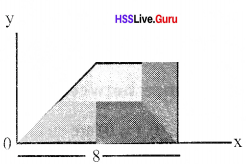
A large trapezium made up of four equal trapeziums:
Coordinates 10th Class Kerala Syllabus Chapter 6
Find the coordinates of the vertices of all these trapeziums. Draw this picture in GeoGebra.
Answer:
In trapezium (1). Coordinates of the vertices are (0, 0), (2, 2), (4, 2), (4, 0)
In trapezium (2). Coordinates of the vertices are (4,0), (4,2), (6, 2), (8, 0)
In trapezium (3), Coordinates of the vertices are (2, 2), (4, 4), (6, 4), (6, 2)
In trapezium (4). Coordinates of the vertices are (8, 0), (6, 2), (6, 4), (8, 4)
For drawing figure in GeoGebra, Put input in the sequence of input bar as [(a, a + 1), a, 0.5,0.5].
Sslc Maths Coordinates Questions And Answers Chapter 6

Sslc Coordinates Questions And Answers Kerala Syllabus Question 6.
In the picture the centre O of the circle is the origin and A, B are points on the circle. Calculate the coordinates of A and B.
Coordinate Geometry Class 10 State Syllabus Chapter 6
Answer:
As the angles are in the ratio 30 : 60: 90 the sides will be in the ratio 1: √3: 2
that is A(√3, 1), B(–1, √3)

Textbook Page No. 139

Coordinates 10th Class Kerala Syllabus Chapter 6 Question 1.
All rectangles given below have sides parallel to the axes. Find the coordinates of the remaining vertices of each.
Sslc Maths Coordinates Notes Kerala Syllabus Chapter 6
Answer:
Sslc Maths Coordinate Geometry Kerala Syllabus Chapter 6

Sslc Maths Coordinates Questions And Answers Chapter 6 Question 2.
Without drawing coordinate axes, mark each pair of points below with left-right, top-bottom position correct. Find the other coordinates of the rectangles drawn with these as opposite vertices and sides parallel to the axes.
i. (3, 5), (7, 8)
ii. (6, 2), (5, 4)
iii. (-3, 5), (-7, 1)
iv. (-1, -2), (-5, -4)
Answer:
i. If A (3, 5) and C (7, 8) then other coordinates are, B (7, 5), D (3, 8)
Sslc Maths Coordinate Geometry Notes Kerala Syllabus Chapter 6

ii. If B(6, 2) and D (5, 4) D<5,4)other coordinates are A (5, 2) & C (6, 4)
Sslc Maths Chapter 6 Solutions Kerala Syllabus

iii. If A(-7, 1) and C (-3, 5) other coordinates are B(-3, 1), D (-7, 5)
Kerala Syllabus 10th Standard Maths Solutions Chapter 6 Coordinates - 14

iv. If A(-5, -4) and C(-1, -2) other coordinates are B(-1, -4), D (-5, -2)
Kerala Syllabus 10th Standard Maths Solutions Chapter 6 Coordinates - 15

Textbook Page No. 146

Coordinate Geometry Class 10 State Syllabus Chapter 6 Question 1.
Calculate the length of the sides and diagonals of the quadrilateral on the right.
Kerala Syllabus 10th Standard Maths Solutions Chapter 6 Coordinates - 16
Answer:
in quadrilateral ABCD
Kerala Syllabus 10th Standard Maths Solutions Chapter 6 Coordinates - 17
Let AC, BD be the diagonals,
Kerala Syllabus 10th Standard Maths Solutions Chapter 6 Coordinates - 18
Length of AC = Distance between the points (-3, -2) and (0, 0)
Kerala Syllabus 10th Standard Maths Solutions Chapter 6 Coordinates - 19
Length of BD = Distance between the points (1, -2) and (-3, 1)
Kerala Syllabus 10th Standard Maths Solutions Chapter 6 Coordinates - 20

Sslc Maths Coordinate Geometry Kerala Syllabus Chapter 6 Question 2.
Prove that by joining the points (2, 1), (3, 4), (-3, 6) we get a right triangle.
Answer:
Let, A(2, 1), B(3, 4), C(-3, 6) be the vertices of the triangle ABC.
Kerala Syllabus 10th Standard Maths Solutions Chapter 6 Coordinates - 21
Using Pythogoras theorem AC2 = AB2 + BC2
50 = (√10)2 + (√40)2 = 50
∴ We obtain a right triangle.

Sslc Maths Coordinate Geometry Notes Kerala Syllabus Chapter 6 Question 3.
A circle of radius 10 is drawn with the origin as centre.
i. Check whether each of the points with coordinates (6, 9), (5, 9), (6, 8) is inside, outside or on the circle.
ii. Write the coordinates of 8 points on this circle.
Answer:
Kerala Syllabus 10th Standard Maths Solutions Chapter 6 Coordinates - 22
i. Distance of the point (5, 9) from the centre of the circle = \(\sqrt{25+81}=\sqrt{106}>10\)
Distance of the point (6, 9) from the centre of the circle = \(\sqrt{36+81}=\sqrt{117}>10\)
Distance of the point (6, 8) from the centre of the circle = \(\sqrt{36+64}=\sqrt{100}=10\)
(5, 9), (6, 9) are outside the circle (6, 8) is on the circle

ii. (10, 0), (0, 10), (–10, 0), (0, –10)
(6, 8), (–6, 8), (6, –8), (–6, –8)

Sslc Maths Chapter 6 Solutions Kerala Syllabus Question 4.
Find the coordinates of the points where a circle of radius √2, centred on the point with coordinates (1, 1) cuts the axes.
Answer:
Kerala Syllabus 10th Standard Maths Solutions Chapter 6 Coordinates - 23
It cuts at (0, 0), (2, 0) on the x-axis and at (0, 0), (0, 2) on the y-axis.

Hss Live Guru 10th Maths Kerala Syllabus Chapter 6 Question 5.
The coordinates of the vertices of a triangle are (1, 2), (2, 3), (3, 1), Find the coordinates of the centre of its circumcircle and the circumradius.
Answer:
Kerala Syllabus 10th Standard Maths Solutions Chapter 6 Coordinates - 24
Kerala Syllabus 10th Standard Maths Solutions Chapter 6 Coordinates - 25
Kerala Syllabus 10th Standard Maths Solutions Chapter 6 Coordinates - 26

Coordinates Orukkam Questions and Answers

Worksheet 1

Coordinates Class 10 Kerala Syllabus Chapter 6 Question 1.
Draw x, y axis and mark the points A(0, 5), B(0, –2), C(4, 0), D(–3, 0), E(4, 5), F(–3,–2), G(4, –2)
Answer:
Kerala Syllabus 10th Standard Maths Solutions Chapter 6 Coordinates - 27
Points on x axis = – D(–3, 0), C(4, 0)
Points on y axis = A(0, 5), B(0, –2)

Question 2.
What are the points on x-axis, on y-axis?
Answer:
Kerala Syllabus 10th Standard Maths Solutions Chapter 6 Coordinates - 28
Points on x axis = – D(–3, 0), C(4, 0)
Points on y axis = A(0, 5), B(0, -2)

Question 3.
Write coordinates of two more points on AE
Answer:
(1, 5), (2, 5)

Question 4.
Write the coordinates of two more points onCE.
Answer:
(4, 1), (4, 2)

Worksheet 2

Question 5.
Given A(2, 3), B(5, 4), C(6, 7), D(3, 6). Find the lengths AB, BC, CD, AD.
Answer:
Kerala Syllabus 10th Standard Maths Solutions Chapter 6 Coordinates - 29
Kerala Syllabus 10th Standard Maths Solutions Chapter 6 Coordinates - 30

Question 6.
Check whether AC = BD or not.
Answer:
Kerala Syllabus 10th Standard Maths Solutions Chapter 6 Coordinates - 31

Question 7.
Prove that P(4,5) the point on AC and BD.
Answer:
Kerala Syllabus 10th Standard Maths Solutions Chapter 6 Coordinates - 32
AP +PC = 4√2 = AC
∴ P (4, 5) is a point on AC .
Kerala Syllabus 10th Standard Maths Solutions Chapter 6 Coordinates - 33
BP + PD = √2 + √2 = 2√2 = BD
∴ P (4, 5) is also a point on BD.

Question 8.
Find a point on x-axis equidistant from A and B.
Answer:
Let (x, 0) be a point on the x axis which is at equal distance from A and B .
(2 – x)2 + (3 – 0)2= (5 – x)2 + (4 – 0)2
(2 – x)2 + 9 = (5 – x)2 + 16
(2 – x)2 + (5 – x)2 = 16 – 9
4 – 4x + x2 – 25 + 10x – x2 = 7
6x = 28
x = \(\frac { 28 }{ 6 }\) = \(\frac { 14 }{ 3 }\)
∴ Point on x axis is \(\left(\frac{14}{3}, 0\right)\)

Worksheet 3

Question 9.
The sides of ABCD are parallel to the coordinate axes and A(3, 7), C(7, 9) are the opposite vertices. Write the coordinates of B and D.
Answer:
Kerala Syllabus 10th Standard Maths Solutions Chapter 6 Coordinates - 34

Question 10.
Find the lengths of AB and BC.
Answer:
AB = |7 – 3| = 4 BC = |9 – 7| = 2

Question 11.
Calculate the area of the rectangle ABCD
Answer:
Area of the rectangle ABC D = AB × BC
4 × 2 = 8 m2

Question 12.
If P, Q, R, S are the midpoints of the sides write the coordinates of P, Q, R, S
Answer:
Kerala Syllabus 10th Standard Maths Solutions Chapter 6 Coordinates - 35

Question 13.
Calculate the sides of PQRS.
Answer:
Kerala Syllabus 10th Standard Maths Solutions Chapter 6 Coordinates - 36
Kerala Syllabus 10th Standard Maths Solutions Chapter 6 Coordinates - 37

Question 14.
Suggest a name suitable to PQRS
Answer:
Rhombus (SQ = 4, RP = 2, diagonals are not equal, sides are equal hence it is a rhombus)

Worksheet 4

Question 15.
If A(4, 3), B(-4, 3) are two points on the line AB write two more points on this line.
Answer:
A(4, 3), B(-4, 3)
Hence other points on AB = (-2, 3) (1, 3)

Question 16.
Write the coordinates of two more points on the line perpendicular to AB and passing through (4, 3)
Answer:
(4, 1) (4, 5)

Question 17.
Find the length AB.
Answer:
Kerala Syllabus 10th Standard Maths Solutions Chapter 6 Coordinates - 78

Question 18.
Write the coordinates of the mid point of AB.
Answer:
Coordinates of the mid point of AB = \(\left(\frac{4+-4}{2}, 3\right)=(0,3)\)

Worksheet 5

Question 19.
Without drawing coordinate axes mention the positions of A(2, 1), B(6, 1), C (6, 5) as left-right, above-below
Answer:
Kerala Syllabus 10th Standard Maths Solutions Chapter 6 Coordinates - 39

Question 20.
Draw coordinate axes, mark the points and complete triangle ABC.
Kerala Syllabus 10th Standard Maths Solutions Chapter 6 Coordinates - 40

Question 21.
Which side of the triangle is parallel to x-axis?
Answer:
AB, parallel to x-axis.

Question 22.
Which side is parallel to y-axis?
Answer:
BC, parallel to y-axis.

Question 23.
Write the coordinates of the mid point of AB
Answer:
Coordinates of the mid point of AB = \(\left(\frac{2+6}{2}, 1\right)=(4,1)\)

Question 24.
Write the coordinates of the midpoints of BC.
Answer:
Midpoints of BC = \(\left(6, \frac{5+1}{2}\right)=(6,3)\)

Question 25.
Write the coordinates of the midpoints of AC.
Answer:
Midpoints of AC = \(\left(\frac{2+6}{2}, \frac{1+5}{2}\right)=(4,3)\)

Worksheet 6

Question 26.
A (6, 0) is a point on a circle with centre (0,0). Find the radius of the circle.
Answer:
Radius of the circle = 6

Question 27.
Show that B (–3, 3√3) ,C(–3, –3√3) are the points on this circle
Answer:
Distance of B from origin \(\sqrt{(-3-0)^{2}+(3 \sqrt{3}-0)^{2}}\)
Kerala Syllabus 10th Standard Maths Solutions Chapter 6 Coordinates - 42
Distance of C from origin
Kerala Syllabus 10th Standard Maths Solutions Chapter 6 Coordinates - 41
B(–3, 3√3) and C(–3, –3√3) are on the circle.

Coordinates SCERT Questions and Answers

Question 28.
Consider an equilateral triangle ABC with A (0,3) AD is the height. If G is the centroid and D is the origin, Find the coordinates of B, C, D and G. [Score: 3, Time: 6 minutes]
Kerala Syllabus 10th Standard Maths Solutions Chapter 6 Coordinates - 43
Answer:
D is the origin coordinates is (0, 0) (1)
G divides AD in the ratio 2 : 1
∴ Coordinates of G is (0,1) (1)
Triangle ADB is a right triangle with 30°, 60°, 90°
∴ BD = \(\frac { 3 }{ √3 }\) = √3
∴ Coordinates of B is (–√3, 0) (1)
∴ Coordinates of C is (√3, 0) (1)

Question 29.
Find the coordinates of a point on the x -axis which is at a distance of 5 units from (4, -5). Find the coordinates on the y-axis [Score: 3, Time: 6 minutes]
Answer:
Thc point on x-axis which is at a distance of 5 units from (4,-5) is (4, 0).
(x – 4)2 + 52 = 25,
∴ x = 4
Point on x axis is (4, 0) (1)
Point on y axis is (0, y).
(0 – 4)2 + (y + 5)2 = 25,
∴ y = –8, –2
The point on y -axis which is at a distance of 5 units from (4, –5) are (0, –2), (0, –8)

Question 30.
Consider a rhombus ABCD whose diago¬nals meet at origin. The length of diagonals are 8 units and 6 units. Find the coordinates of the vertices. [Score: 4, Time: 4 minutes]
Answer:
Find the coordinates of the vertices by drawing the figure.
(3, 0), (–3, 0), (0, 4), (0, –4)
Kerala Syllabus 10th Standard Maths Solutions Chapter 6 Coordinates - 44

Question 31.
Find the coordinates of the vertices of a square of side 10 units whose diagonals meet at origin. [Score: 4, Time: 4 minutes]
Answer:
Kerala Syllabus 10th Standard Maths Solutions Chapter 6 Coordinates - 45

Question 32.
Consider a regular hexagon of side 6 units whose diagonals meet at the origin. Find the coordinates of the vertices. [Score: 5, Time: 8 minutes]
Kerala Syllabus 10th Standard Maths Solutions Chapter 6 Coordinates - 79
Answer:
(6, 0) (0, 6)
Find the coordinates of the vertices using the concept of right-angle triangles 30°, 60°, 90° (1)
(3, 3√3), (–3, 3√3), (3, –3√3), (–3, –3√3) (3)

Question 33.
Find the coordinates of other points.. [Score: 4, Time: 8 minutes]
Kerala Syllabus 10th Standard Maths Solutions Chapter 6 Coordinates - 47
Answer:
Points are (–2, 0), (0,2), (0, –2) (2)
Points are (3, –3), (–3, –3), (–3,3) (2)

Question 34.
Find the coordinates of the fourth vertices of the parallelogram. Find the length of the sides of the parallelogram. Write the length of diagonals. [Score: 5, Time: 8 minutes]
Kerala Syllabus 10th Standard Maths Solutions Chapter 6 Coordinates - 48
Answer:
The difference of x-coordinate of the points A, C = 2
The difference of x-coordinate of the points B, D = 2
Hence the x-coordinate of the point x = 11
The difference of y-coordinate of the points A, C = 7 – 5 = 2
The difference of y-coordinate of the points B, D = 2
Hence the y-coordinate of the point x = 10 + 2 = 12
Kerala Syllabus 10th Standard Maths Solutions Chapter 6 Coordinates - 49

Question 35.
Consider a rhombus of side 10 units whose diagonals are coordinate axis. If an angle is 120°, Find the coordinates of the other vertices. [Score: 4, Time: 6 minutes]
Answer:
A rhombus is formed by joining two equilateral triangles. Using the right triangle of 30°, 60°, 90°, find the diagonals as 10,10√3 units. Hence the coordinates of the vertices of the rhombus are(5, 0) (-5, 0)(0,5√3), (0,-5√3). (4)

Question 36.
Find the coordinates ofthe points on x-axis which are equidistant from the points (-5, 8) and (6, -4).[Score: 4,Time: 8 minutes]
Answer:
The y-coordinate of points on x-axis will be zero. Hence assume that a point on x-axis is (x, 0)
Distance between (x, 0) and (-5, 8) = \(\sqrt{(x-5)^{2}+8^{2}}\)
Distancebetween (x, 0) and (6, 4) = \(\sqrt{(x-6)^{2}+(-4)^{2}}\)
(x + 5)2 + 82 = (x – 6)2 + (–4)2
x2 + 10x + 25 + 64 = x2 – 12x + 36 + 16
22x = 36 + 16 – 25 – 64 = 52 – 89 = –37
x = \(\frac {–37 }{ 22 }\)
Coordinate \(\left(\frac{-37}{22}, 0\right)\) (4)

Question 37.
Prove that A (4,5), B (4,2), C(8,2) represents the vertices of a right angled triangle. Find the coordinate of the circumcentre. What is the radius of the circumcircle? [Score: 4, Time: 8 minutes]
Answer:
Distance between (4, 5) and (4, 2) = 5 – 2 = 3
Distance between (4, 2) and (8, 2) = 8 – 4 = 4
Distance between (4, 5) and (8, 2)
Kerala Syllabus 10th Standard Maths Solutions Chapter 6 Coordinates - 50
3, 4, 5 are sides of a right angled triangle,
since 32 + 42 = 52 (1)
The coordinates of circumcentre is (6 ,3, 5) (1)
Radius of circumcircle = 2.5 unit (1)

Question 38.
P is a point on the perpendicular bisector of the line joining (2, 5) and (6, 5). If the x coordinate and y coordinate of P are equal write the coordinate of P. [Score: 5, Time: 8 minutes]
Answer:
Understanding the concept that the distance of a point on the perpendicular bisector is equidistant from the endpoints. (1)
Assume that the coordinate of P is (a, a)
Then; Distance between (a, a) and (2, 5)
Kerala Syllabus 10th Standard Maths Solutions Chapter 6 Coordinates - 51
Coordinate of P (4, 4) (1)

Question 39.
Write the coordinate of the centre of a circle passing through the points (9, 3), (7,-1) (1,-1). Find the radius of the circle. [Score: 5, Time: 8 minutes]
Answer:
Assume that (x, y) is centre of the circle Distance between (9,3) and (x,y)
Kerala Syllabus 10th Standard Maths Solutions Chapter 6 Coordinates - 52
The coordinate of the centre of the circle is (4, 3)
∴ Radius = Distance between (4, 3) and (1,-1)
= \(\sqrt{(4-1)^{2}+(3+1)^{2}}=\sqrt{3^{2}+4^{2}}=5\) (1)

Question 40.
If (x, y) be apoint equidistant from the points (7, 5), (4, 3).then show that 6x + 4y = 49 [Score: 4, Time: 7 minutes]
Answer:
Distance between (x, y) and (7, 5)
\(\sqrt{(x-7)^{2}+(y-5)^{2}}\) (1)
Distancebetween (x, y) and (4, 3)
\(\sqrt{(x-4)^{2}+(y-3)^{2}}\) (1)
They are equal
(x – 7)2 + (y – 5)2 = (x – 4)2 + (y-3)2
by solving
6x + 4y = 49 (2)

Question 41.
Three vertices of a square are given. If the fourth vertex is (2, P) find the ratio of P. Find the area of the square. [Score: 4, Time: 7 minutes]
Kerala Syllabus 10th Standard Maths Solutions Chapter 6 Coordinates - 53
Answer:
Kerala Syllabus 10th Standard Maths Solutions Chapter 6 Coordinates - 54

Question 42.
In the figure if P (36, 48), then find the coordinates of A, B, M [Score: 4, Time: 7 minutes]
Answer:
Kerala Syllabus 10th Standard Maths Solutions Chapter 6 Coordinates - 55
Coordinates of M (36, 0) (1)
Coordinates of A (0, 75) (1)
Coordinates of B (100, 0) (1)

Coordinates Exam Oriented Questions and Answers

Short Answer Type Questions (Score 2)

Question 43.
Kerala Syllabus 10th Standard Maths Solutions Chapter 6 Coordinates - 56
Find the coordinates of die other three verti¬ces of the rectangle in the figure.
Answer:
Kerala Syllabus 10th Standard Maths Solutions Chapter 6 Coordinates - 57
The coordinates of are (0, 0), ( 5, 0), (5, 4)

Question 44.
Check whether the points P(0, 7), Q(5, 12), R(-10, -3) lie on a single line.
Answer:
Kerala Syllabus 10th Standard Maths Solutions Chapter 6 Coordinates - 58
∴ The three points are on the same line.

Question 45.
The origin in the diagram is o. The endpoints of the diameter of the circle are A and B. Find the coordinates of P. OQ is perpendicular to OP. Find out the coordinates of Q.
Kerala Syllabus 10th Standard Maths Solutions Chapter 6 Coordinates - 59
Answer:
Kerala Syllabus 10th Standard Maths Solutions Chapter 6 Coordinates - 60
30: 60: 90 = 1: √3: 2
Coordinates of p is (√3, 1)
The Coordinates of Q = (–1, √3)

Question 46.
ABCDEF is a regular hexagon. Of these points C and D are on the number line. C is three unit to the left of zero and D is 5 unit to the right. What is the length of the side EF? What is the measure of an angle of the regular hexagon?
Answer:
CD = |5– –3| = 8
∴ CD = 8 unit
EF = 8 unit
Angle of a regular hexagon = 720 ÷ 6 = 120°

Question 47.
A circle is drawn with centre at (-1, 0) and radius 5 units in a coordinate system. What are the coordinates of the points at which it cuts the x-axis and the points where it cuts the y-axis?
Answer:
Kerala Syllabus 10th Standard Maths Solutions Chapter 6 Coordinates - 61

Question 48.
A circle is drawn with centre at (0, 0) and radius 6 units in a cooredinate system. What are the coordinates of the points which it cuts the x-axis? And the points where it cuts the y-axis?
Answer:
x axis (6,0) and (–6,0)
y axis (0, 6 ) and (0, –6)

Short Answer Type Questions (Score 3)

Question 49.
Find the length of the sides of the rectangle given in the figure.
Kerala Syllabus 10th Standard Maths Solutions Chapter 6 Coordinates - 62
Answer:
Kerala Syllabus 10th Standard Maths Solutions Chapter 6 Coordinates - 63
Kerala Syllabus 10th Standard Maths Solutions Chapter 6 Coordinates - 64

Question 50.
A small rectangle is cut from the centre of the big for rectangle. Based on the perpendiculars drawn at the centre of the big rectangle, find out the coordinates of the vertices of the small rectangle cut.
Kerala Syllabus 10th Standard Maths Solutions Chapter 6 Coordinates - 65
Answer:
P(–3, –2), Q(3, –2), R(3, 2), S(–3, 2)

Question 51.
Each side of the square OPQR given in the diagram is 6 unit. Write the coordinates of the vertices of the square.
Kerala Syllabus 10th Standard Maths Solutions Chapter 6 Coordinates - 66
Answer:
P(6, 0), Q(6, 6), R(0, 6), O(0, 0)

Question 52.
a. In the figure ABCD is a square. If A is (2, 0) then find the coordinates of B,C, D. Also find the coordinates of the centre.
Kerala Syllabus 10th Standard Maths Solutions Chapter 6 Coordinates - 67
b. Classify the points (5, 0), (0, –2), (–2, 0), (2, 3), (10, 9), (0, 8) and (6, 0) according to:
i. Points on the x-axis
ii. Points on the y-axis
iii. Does not belong to the axis
Answer:
a. B(0, 2), C(–2, 0), D(0, –2) Coordinate of vertex (0,0)

b, i. (5, 0), (–2, 0), (6, 0)
ii. (0, –2), (0, 8)
iii. (2, 3), (10, 9)

Question 53.
Selecting the given pair of coordinates given below, mark the opposite corners of a rectangle whose sides are parallel to the axis. Measure the lengths of the sides. Find out the coordinates of other points.
a (4, –4), (–4, 4)
b. (2, 1), (6, 5)
Answer:
Kerala Syllabus 10th Standard Maths Solutions Chapter 6 Coordinates - 68

Long Answer Type Questions (Score 4)

Question 54.
a. Write the coordinates of the points of intersection of the circle with the axis, where circle having radius 10cm and centre at the origin.
b. Write the co-ordinates of a point which are not on the circle.
Answer:
a. (10, 0), (0, 10); (–10, 0), (0, –10)
b. (9, 6); ie, all the point which satisfies.
x2 + y2= 102 are on the circle, others are inside or outside the circle

Question 55.
Calculate the length of sides of quadrilateral.
Kerala Syllabus 10th Standard Maths Solutions Chapter 6 Coordinates - 69
Answer:
Kerala Syllabus 10th Standard Maths Solutions Chapter 6 Coordinates - 70
Kerala Syllabus 10th Standard Maths Solutions Chapter 6 Coordinates - 71

Question 56.
P is a point inside the rectangle ABCD. Prove that PA2 + PC2 = PB2 + PD2
Kerala Syllabus 10th Standard Maths Solutions Chapter 6 Coordinates - 72
Answer:
Take AB as x axis and AD as y axis, a and b are the sides of the rectangle. The coordinates of the points are marked on the picture.
PA2 + PC2 = x2 + y2 + (x – a)2 + (y – b)2
PB2 + PD2 = (x – a)2 + y2 + x2 + (y – b)2
PA2 + PC2 = PB2 + PD2

Long Answer Type Questions (Score 5)

Question 57.
In ΔABC, drawn above the x axis with ∠A=90° the coordinates of A (2,0) and that of B (8,0). The length of AC is 5 units and the area of the triangle is 12 square units. Draw a rough sketch of coordinate axis and the triangle. Find the coordinates of C.
Answer:
\(\frac { 1 }{ 2 }\) × AB × h = 12
\(\frac { 1 }{ 2 }\) × 6 × h = 12
h = 4 units
AC = 5
PC = 4 then
AP = 3
∴ OP = 5, PC = 4, C(5,4)
Kerala Syllabus 10th Standard Maths Solutions Chapter 6 Coordinates - 73

Question 58.
Find out the coordinates for the other vertices of the rectangle ABCD in the diagram. If the unit used to measure the length is 3/4cm, Find out the area of the rectangle ABCD.
Kerala Syllabus 10th Standard Maths Solutions Chapter 6 Coordinates - 74
Answer:
C(6, 2); D(2, 2)
Length of the rectangle = 4 unit,
Breadth = 2 unit
Unit= 3/4 cm,
Length = 4 × 3/4 = 3cm
Breadth = 2 × 3/4 = 3/2 = 1 1/2cm
Area = 3 × 1.5 = 4.5 cm2

Question 59.
a. From the points given below, find the pair which are on a line parallel to the x – axis and the pair which are on a line parallel to the y-axis.
A(4, 3), B(3, 5), C (–6, 3),
D(3, –2), E(5, 4)
b. Find the distance between the points given below
i. (–3, 2) and (4, 2)
ii. (5, 8) and (6, 9)
Answer:
a. Parallel to the x-axis A(4, 3) and C(–6, 3)Parallel to the y-axis B(3, 5) and D(3, –2)
b. i. Distance = |–3 –4| = 7
Kerala Syllabus 10th Standard Maths Solutions Chapter 6 Coordinates - 75

Coordinates Memory Map

Kerala Syllabus 10th Standard Maths Solutions Chapter 6 Coordinates - 76

Horizontal line is x-axis and vertical line is y-axis.

Point of intersection of the x- axis and y axis is called the origin O. Numbers which are above and to the right side of the origin O will be always positive while numbers on left and below the origin will be negative.

All points on the x – axis have y – coordinates zero and all points on y-axis have x- coordinates zero.

Kerala Syllabus 10th Standard Maths Solutions Chapter 6 Coordinates - 77

Trigonometry Questions and Answers Class 10 Maths Chapter 5 Kerala Syllabus Solutions

You can Download Trigonometry Questions and Answers, Activity, Notes PDF, Kerala Syllabus 10th Standard Maths Solutions Chapter 5 help you to revise complete Syllabus and score more marks in your examinations.

SSLC Maths Chapter 5 Trigonometry Textbook Questions and Answers

SCERT Class 10th Standard Maths Chapter 5 Trigonometry Notes

Textbook Page No. 103

Trigonometry Class 10 Kerala Syllabus Question 1.
In the triangle shown, what is the perpendicular distance from the top vertex to the bottom side? What is the area of the triangle?
Trigonometry Class 10 Kerala Syllabus
Answer:
Sslc Trigonometry Solutions Kerala Syllabus
The sides of the right angle triangle with angles 30°, 60°, 90° are proportional to the number 1 : √3 : 2
AD : BD : AB = 1 : √3 : 2
AB = 2x = 4cm
x = 2 cm
AD = 2 cm
BD = 2√3cm
Perpendicular distance from the top vertex to the bottom side = AD = 2 cm
BC = 2BD = 4√3 cm
Area of triangle = 1/2 bh
1/2 × 4√3 × 2 = 4√3 cm2

Sslc Trigonometry Solutions Kerala Syllabus Question 2.
In each of the following parallelograms, find the distance between the top and bottom side? Calculate the area of parallelogram.
Sslc Maths Chapter 5 Kerala Syllabus
Answer:
Sslc Maths Trigonometry Questions And Answers

Sslc Maths Chapter 5 Kerala Syllabus Question 3.
A rectangular board is to be cut along the diagonal and the pieces rearranged to form an equilateral triangle as shown below. The sides of the triangle must be 50 centimetres. What should be the length and breadth of the rectangle?
Sslc Maths Trigonometry Kerala Syllabus
Answer:
The sides of the right angle triangle with angles 30°, 60°, 90° are proportional to the number 1 :√3: 2
Trigonometry Sslc Kerala Syllabus

Sslc Maths Trigonometry Kerala Syllabus Question 4.
Two rectangles are cut along the diagonal and the triangles got are to be joined to an-other rectangle to make a regular hexagon as shown below:
Trigonometry Problems For Class 10 State Syllabus
If the sides of the hexagon are to be 30 centimetres, what would be the length and breadth of the rectangles?
Answer:
Trigonometry Questions For Class 10 Kerala Syllabus
The sides of the right angle triangle APF with angles 30°, 60°, 90° are proportional to the number 1 :√3: 2
Sslc Maths Trigonometry Notes Kerala Syllabus
Length of the smaller rectangle = 25.98 cm
Breadth of the smaller rectangle = 15 cm
Length of the bigger rectangle = 51.96 cm
Breadth of the bigger rectangle = 30 cm

Trigonometry Sslc Kerala Syllabus Question 5.
Calculate the area of the triangle shown.
Trigonometry Class 10 Scert Kerala Syllabus
Answer:
Angles of the first triangle are in ratio 45 : 45: 90. So sides are in ratio x : x: √2 x
Angles of the second triangle are in ratio 30 : 60: 90, sides are in ratio, y :√3y: 2y
Trigonometry Class 10 State Syllabus
Sslc Trigonometry Kerala Syllabus

Textbook Page No. 109

Trigonometry Problems For Class 10 State Syllabus Question 1.
The lengths of two sides of a triangle are 8 centimetres and 10 centimetres and the angle between them is 40°. Calculate its area. What is the area of the triangle with sides of the same length, but angle between them 140°?
Answer:
Class 10 Maths Chapter 5 Kerala Syllabus
If the angle between the sides is 140° sin 140 = sin(180 – 40) = sin 40 The area of the triangles will be same.

Trigonometry Questions For Class 10 Kerala Syllabus Question 2.
The sides of a rhombus are 5 centimetres long and one of its angles is 100°, Compute its area.
Answer:
Sslc Maths Chapter 5 Solutions Kerala Syllabus

Sslc Maths Trigonometry Notes Kerala Syllabus Question 3.
The sides of a parallelogram are 8 centimetres and 12 centimetres and the angle between them is 50°. Calculate its area.
Answer:
Hsslive Trigonometry Kerala Syllabus

Trigonometry Class 10 Scert Kerala Syllabus Question 4.
Angles of 50° and 65″ are drawn at the ends of a 5 centimetres long line to make a triangle. Calculate its area.
Answer:
If diameter is d
Maths Chapter 5 Class 10 Kerala Syllabus

Sslc Trigonometry Kerala Syllabus Question 5.
A triangle is to be drawn with one side 8 centimetres and an angle on it 40°. What should be the minimum length of the side opposite this angle?
Trigonometry Questions and Answer: The side opposite to 40° will be at least
Maths Trigonometry Class 10 State Syllabus

Textbook Page No. 114

Class 10 Maths Chapter 5 Kerala Syllabus Question 1.
The figure shows a triangle and its circumcircle: What is the radius of the circle?
Trigonometry Questions For Class 10 Scert
Answer:
∠BAC = 60°
∠BOC = 120°
The angle made by any arc of a circle on the alternate arc is half the angle made at the centre.
Kerala Syllabus 10th Standard Maths Chapter 5
The sides of the right angle triangle ΔCOD with angles 30°, 60°, 90° are proportional to the number 1 : √3: 2 .
Sslc Maths Chapter 5 Trigonometry Kerala Syllabus

Sslc Maths Chapter 5 Solutions Kerala Syllabus Question 2.
What is the circumradius of an equilateral triangle of sides 8 centimetres?
Answer:
The sides of the right angle triangle OBD with angles 30°, 60°, 90° are proportional to
Hss Live Guru 10th Maths Kerala Syllabus

Hsslive Trigonometry Kerala Syllabus Question 3.
The figure shows a triangle and its circum.
10th Standard Maths Trigonometry Kerala Syllabus
i. Computer the diameter of the circle.
ii. Compute the lengths of the other two sides of the triangle.
Answer:
10th Trigonometry Questions And Answers Kerala Syllabus
Trigonometry Hsslive Kerala Syllabus

Maths Chapter 5 Class 10 Kerala Syllabus Question 4.
A circle is to be drawn, passing through the ends of a line, 5 centimetres long; and the angle on the circle on one side of the line should be 80°. What should be the radius of the circle?
Answer:
Class 10 Maths Chapter 5 Trigonometry Kerala Syllabus

Maths Trigonometry Class 10 State Syllabus Question 5.
The picture below shows part of a circle:
Kerala Syllabus 10th Standard Maths Solutions Chapter 5 Trigonometry - 26
What is the radius of the circle?
Answer:
Kerala Syllabus 10th Standard Maths Solutions Chapter 5 Trigonometry - 27
First, complete the circle. Draw BD and join one of its end D to C. ∠BAC + ∠BDC= 180° ∠D = 40°, ∠BCD (angle on semicircle). So ABCD is right-angled.
Kerala Syllabus 10th Standard Maths Solutions Chapter 5 Trigonometry - 28

Trigonometry Questions For Class 10 Scert Question 6.
A regular pentagon is drawn with all its vertices on a circle of radius 15 centimetres. Calculate the length of the sides of this pentagon.
Answer:
Sum of angles of pentagon
= (n – 2)180
= (5 – 2)180
= 540°
One angle of regular pentagon = \(\frac { 540 }{ 5 }\) = 180°
Kerala Syllabus 10th Standard Maths Solutions Chapter 5 Trigonometry - 29

Textbook Page No. 117

Kerala Syllabus 10th Standard Maths Chapter 5 Question 1.
One angle of a rhombus is 50° and the larger diagonal is 5 centimetres. What is its area?
Answer:
In rhombus ABCD, One angle of a rhombus is 50° and one diagonal is 5 centimetres.
Kerala Syllabus 10th Standard Maths Solutions Chapter 5 Trigonometry - 30
Kerala Syllabus 10th Standard Maths Solutions Chapter 5 Trigonometry - 31

Sslc Maths Chapter 5 Trigonometry Kerala Syllabus Question 2.
A ladder leans against a wall, with its foot 2 metres away from the wall and the angle with the floor 40°. How high is the top end of the ladder from the ground?
Answer:
tan 40 = \(\frac { QR }{ 2 }\)
QR = 2 × tan 40
= 2 × 0.8391 = 1.6782
Height of the ladder from ground = 1.68m

Hss Live Guru 10th Maths Kerala Syllabus Question 3.
Three rectangles are to be cut along the diagonals and the triangles so got rearranged to form a regular pentagon, as shown in the picture. If the sides of the pentagon are to be 30 centimetres, what should be the length and breadth of the rectangles?
Kerala Syllabus 10th Standard Maths Solutions Chapter 5 Trigonometry - 32
Answer:
Kerala Syllabus 10th Standard Maths Solutions Chapter 5 Trigonometry - 33
36°, 54°, 90°
Sin 54 = \(\frac { DG }{ 30 }\)
DG = 30 × 0.8090
= 24.27 cm
Cos 54° = \(\frac { EG }{ 30 }\)
EG = 30 × 0.5878 = 17.63 cm
Length of larger rectangle = 46.17 cm.
Breadth = 15 cm
Length of smaller rectangle = 24.27 cm
Breadth = 17.63 cm

10th Standard Maths Trigonometry Kerala Syllabus Question 4.
In the picture, the vertical lines are equally spaced. Prove that their heights are in arithmetic sequence. What is the common difference?
Kerala Syllabus 10th Standard Maths Solutions Chapter 5 Trigonometry - 34
Answer:
Kerala Syllabus 10th Standard Maths Solutions Chapter 5 Trigonometry - 35

10th Trigonometry Questions And Answers Kerala Syllabus Question 5.
One side of a triangle is 6 centimetres and the angles at its ends are 40° and 65°. Calculate its area.
Answer:
∠C = 180 – (40 + 65) = 75°
Draw a perpendicular BD from B to AC
Kerala Syllabus 10th Standard Maths Solutions Chapter 5 Trigonometry - 36

Textbook Page No. 122

Trigonometry Hsslive Kerala Syllabus Question 1.
When the sun is at an elevation of 40°, the length of the shadow of a tree is 18 metres. What is the height of the tree?
Answer:
In the right triangle ΔPQR
tan 40° = \(\frac { QR }{ 18 }\)
QR = 18 × tan40° =18 × 0.8391
Height of the tree = 15.1 m
Kerala Syllabus 10th Standard Maths Solutions Chapter 5 Trigonometry - 37

Class 10 Maths Chapter 5 Trigonometry Kerala Syllabus Question 2.
When the sun is at an elevation of 35°, the shadow of a tree is 10 metres. What would be the length of the shadow of the same tree, when the sun is at an elevation of 25°?
Answer:
Kerala Syllabus 10th Standard Maths Solutions Chapter 5 Trigonometry - 38
Kerala Syllabus 10th Standard Maths Solutions Chapter 5 Trigonometry - 138

Question 3.
From the top of an electric post, two wires are stretched to either side and fixed to the ground, 25 metres apart. The wires make angles 55° and 40° with the ground. What is the height of the post?
Answer:
Kerala Syllabus 10th Standard Maths Solutions Chapter 5 Trigonometry - 40

Question 4.
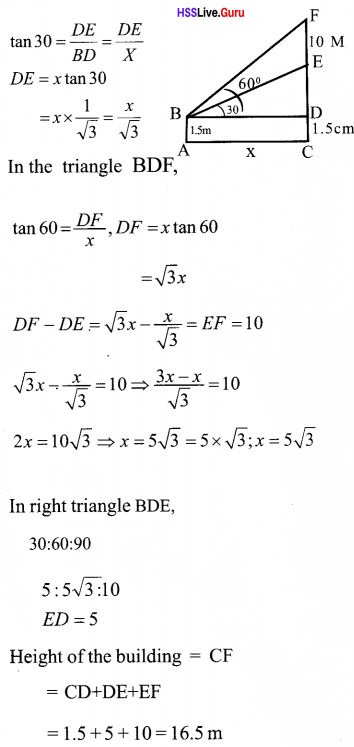
A 1.5-metre tall boy saw the top of a building under construction at an elevation of 30°. The completed building was 10 metres higher and the boy saw its top at an elevation of 60° from the same spot. What is the height of the building?
Answer:
In the right triangle BDE,
Kerala Syllabus 10th Standard Maths Solutions Chapter 5 Trigonometry - 42

Question 5.
A 1.75-metre tall man, standing at the foot of a tower, sees the top of a hill 40 metres away at an elevation of 60°. Climbing to the top of the tower, he sees it at an elevation of 50°. Calculate the heights of the tower and the hill.
Answer:
In the right triangle CEF
BD = CE = AF = HG = 40m
Kerala Syllabus 10th Standard Maths Solutions Chapter 5 Trigonometry - 43
Kerala Syllabus 10th Standard Maths Solutions Chapter 5 Trigonometry - 139AB = tower
DF = hill
Height of hill = 69.28 + 1.75 = 71.03 m
In the right triangle HGF,
\(\tan 50=\frac{G F}{H G}=\frac{G F}{40}\)
GF = 40 × tan 50= 40 × 1.1918 = 47.67 m
Height of tower = 71.03 – (47.67 + 1.75)
= 71.03 – 49.42 = 21.61 m

Question 6.
A man 1.8 metre tall standing at the top of a telephone tower, saw the top of a 10-metre high building at a depression of 40° and the base of the building at a depression of 60°. What is the height of the tower? How far is it from the building?
Answer:
Kerala Syllabus 10th Standard Maths Solutions Chapter 5 Trigonometry - 44
Height of the building = 10m
Height of the towerAG
Height of the man GF = 1.8m
AB = x
In the right triangle CHF
tan 40 = \(\frac { HF }{ x }\)
HF = x tan 40
= x × 0.8391
= 0.8391x
In the right ABF
\(\tan 60=\frac{A F}{A B}=\frac{A F}{x} \Rightarrow\)
AF = x tan 60 = 1.732x
BC = AH = AF – HF
= 1.732x – 0.8391x = 10
= o.8929x = 10
Kerala Syllabus 10th Standard Maths Solutions Chapter 5 Trigonometry - 45
Height of tower = 19.4 – 1.8 =17.6 m
Distance from building to tower = 11.2m

Trigonometry Orukkam Questions and Answers

Worksheet 1

Question 1.
Complete the table given below.
Kerala Syllabus 10th Standard Maths Solutions Chapter 5 Trigonometry - 46
Answer:
∠C = 90°
The sides of the right angle triangle with angles 30°, 60°, 90° are proportional
1 : √3: 2
Kerala Syllabus 10th Standard Maths Solutions Chapter 5 Trigonometry - 47

Question 2.
Complete the table given below.
Kerala Syllabus 10th Standard Maths Solutions Chapter 5 Trigonometry - 140
Kerala Syllabus 10th Standard Maths Solutions Chapter 5 Trigonometry - 48
Answer:
The sides of the isosceles right-angle triangle with angles 45: 45 :90 will have sides proportional to [opposite to corresponding angles] 1: 1: √2
Kerala Syllabus 10th Standard Maths Solutions Chapter 5 Trigonometry - 49

Question 3.
Calculate the perimeter of the triangle.
Kerala Syllabus 10th Standard Maths Solutions Chapter 5 Trigonometry - 50
Answer:
i. BC = 10
∴ AB = 10
Kerala Syllabus 10th Standard Maths Solutions Chapter 5 Trigonometry - 51

Question 4.
ABC Dis a square AC = 10cm . Find B, BACFind the length of AB. Find the perimeter of the square.
Answer:
∠B = 90°
∠BAC = 45° = ∠BCA
\(\mathrm{AB}=\frac{10}{\sqrt{2}}=5 \sqrt{2}\)
Perimeter of the square D
= 4 × 5√2 = 28.28 cm
Kerala Syllabus 10th Standard Maths Solutions Chapter 5 Trigonometry - 52

Question 5.
PQRS is a rectangle. Find angle SP R? Find angle PRQ. If PR = 30 then find P Qand QR. Calculate the perimeter of the rectangle.
Kerala Syllabus 10th Standard Maths Solutions Chapter 5 Trigonometry - 53
Answer:
Kerala Syllabus 10th Standard Maths Solutions Chapter 5 Trigonometry - 54
∠SPQ = 90° ( ∴ PQRS is a square, so angles are 90° each.)
∴ ∠SPR = 90 – 30 = 60°
Kerala Syllabus 10th Standard Maths Solutions Chapter 5 Trigonometry - 55

Question 6.
If C D = 5 then find ∠ACD,∠BCD . Find AB, AD, BD, BC. Find the angles of triangle ABC. If the angles are 45°, 60°, 75° find the ratio of the sides?
Kerala Syllabus 10th Standard Maths Solutions Chapter 5 Trigonometry - 56
Answer:
Kerala Syllabus 10th Standard Maths Solutions Chapter 5 Trigonometry - 57

Worksheet 2

Question 7.
In the figure BC = 12 ∠D = 90°,Find ∠CBD, ∠ACD, ∠ABC . Find BD, C D, AD, AC, AB. Find the ratio of the sides of the triangle having the angles 30°, 15°, 135° C
Kerala Syllabus 10th Standard Maths Solutions Chapter 5 Trigonometry - 58
Answer;
∠ACD = 180 – (30 + 90) = 60
∠BCD = 60 – 15 = 45 ∠CBD = 45
∠ABC = 135 [∵ 180 – (30 + 15)]
Kerala Syllabus 10th Standard Maths Solutions Chapter 5 Trigonometry - 59

Question 8.
In the figure AD = 7, CD = 8, BD = 5, ∠ADP = 50° then find ADB ?
Kerala Syllabus 10th Standard Maths Solutions Chapter 5 Trigonometry - 60
Answer:
Kerala Syllabus 10th Standard Maths Solutions Chapter 5 Trigonometry - 61

Question 9.
Find the measure of the remaining part of the triangle from the figure given below
Kerala Syllabus 10th Standard Maths Solutions Chapter 5 Trigonometry - 63
Kerala Syllabus 10th Standard Maths Solutions Chapter 5 Trigonometry - 64

Question 10.
∠AOB = 2x, radius of the circle R. Find ∠AOC? Find sin x, AC and AB
Answer:
Kerala Syllabus 10th Standard Maths Solutions Chapter 5 Trigonometry - 65

Worksheet 3

Question 11.
Using the figure find AB
Kerala Syllabus 10th Standard Maths Solutions Chapter 5 Trigonometry - 66

Question 12.
In the figure BD = 10,
Kerala Syllabus 10th Standard Maths Solutions Chapter 5 Trigonometry - 67
Find ∠BAD and ∠ADB.
AD, CD and AC
Answer:
∠ADB = 180 – 60 = 120°
∠BAD = 180 – (120 + 30) = 30
Kerala Syllabus 10th Standard Maths Solutions Chapter 5 Trigonometry - 68
The sides of the right angle triangle with angles 30°, 60°, 90° are proportional to
1 :√3: 2
AD = 2 × 5√3 = 10√3
AC = 5 √3 × √3 = 15

Question 13.
In the figure QR = 7, find ∠QRP, ∠QPR Find the length of PR, PS and RS.
Kerala Syllabus 10th Standard Maths Solutions Chapter 5 Trigonometry - 69
Answer:
Kerala Syllabus 10th Standard Maths Solutions Chapter 5 Trigonometry - 71
Kerala Syllabus 10th Standard Maths Solutions Chapter 5 Trigonometry - 141
Question 14.
In the figure BD = 10, CD = x, find the length of BC. Using tan 40, tan 50 find the length of AC.
Answer:
Kerala Syllabus 10th Standard Maths Solutions Chapter 5 Trigonometry - 72

Worksheet 4

Question 15.
In triangle ABC , AB = 7, BC = 12, ∠B = 40 Find the area of the triangle. Calculate the length of AC.
Answer:
Draw a perpendicular line
AD from A to BC.
AD = AB sin40
= 7 × 0.6428 = 4.4996 = 4.5
Area = \(\frac { 1 }{ 2 }\) × BC × AD
= \(\frac { 1 }{ 2 }\) × 12 × 4.5 = 27m2
BD = AB cos 40 = 7 x 0.7660 = 5.36
∴ CD = 12 – 5.36 = 6.64
Kerala Syllabus 10th Standard Maths Solutions Chapter 5 Trigonometry - 73
From right angled ΔADC
Kerala Syllabus 10th Standard Maths Solutions Chapter 5 Trigonometry - 74
∴ Length of AC = 8.02 units

Question 16.
In triangle ABC , AB = 7, BC = 12, ∠B = 40 Find the area of the triangle.
Answer:
See the above question

Question 17.
In the figure AD = BD = C D = 5 ∠ADC = 50° . find the area of triangle AC D, triangle ABD and triangle ABC.
Kerala Syllabus 10th Standard Maths Solutions Chapter 5 Trigonometry - 75
Answer:
AD = BD = CD, So ΔABD and ΔACD are isosceles triangles. AE is the perpendicular from D to AC
Kerala Syllabus 10th Standard Maths Solutions Chapter 5 Trigonometry - 77
Area of ΔABD = AF × DF
= 4.5 × 2.1 = 9.45
Area of ΔABC= \(\frac { 1 }{ 2 }\) × AB × AC
\(\frac { 1 }{ 2 }\) × 9 × 4.2 = 18.9m2

Question 18.
ABC D is a parallelogram, angle D = 120°, AB = 10, AC = 12. Calculate the area of the parallelogram.
Kerala Syllabus 10th Standard Maths Solutions Chapter 5 Trigonometry - 78
Answer:
Area of the parallelogram= \(\frac { 1 }{ 2 }\) × AC × BD
In ΔABD, ∠A = 60°
ΔABD is an equilateral triangle.
BD = 10
Area of the parallelogram ABCD = \(\frac { 1 }{ 2 }\) × 10 × 12 = 60m2

Question 19.
One angle of a triangle is 30°, prove that radius of the circumcircle is equal to the side opposite to 30°
Answer:
For a right-angled triangle one of the angles is 30° then other one is 60°.
Side which is opposite to the angle of 90° is twice of the side which is opposite to the angle of 30°
Center of circumcircle is the midpoint of the side, which is opposite to the angle 90° that means half.
∴ Radius of the circumcircle is equal to the side opposite to 30°.

Question 20.
O is the centre of a circle having a chord
AB. AB= 12, angle AOB = 120°. Find the radius
Answer:
AC = BC = 6
A perpendicular is drawn through center which can bisect the perpendicular line AB into half.
In ΔAOC , ∠AOC = 60°, ∠ACO = 90°
Kerala Syllabus 10th Standard Maths Solutions Chapter 5 Trigonometry - 79
Kerala Syllabus 10th Standard Maths Solutions Chapter 5 Trigonometry - 142
Question 21.
Above viewed the top of a tree at an angle of elevation 30°. He moved 10 m towards the tree and saw the top of the tree ant the angle 60° Find the height of the tree
Answer:
Kerala Syllabus 10th Standard Maths Solutions Chapter 5 Trigonometry - 80

Question 22.
In the figure BC =14, ∠5 = 40°, ∠C = 50° Find the area of triangle ABC.
Answer:
Kerala Syllabus 10th Standard Maths Solutions Chapter 5 Trigonometry - 81
Area of ΔABC =\(\frac { 1 }{ 2 }\) × AB × AC
AC = BC sin 40 = 14 × 0.6428 = 8.99
AB = BC cos 50 = 14 × 0.7660 = 10.72
Area of ΔABC = \(\frac { 1 }{ 2 }\) × 8.99 × 10.72 = 48.2 m2

Worksheet 5

Question 23.
A child observed an aeroplane flying horizontally at the height 1km at ah angle of elevation 60°at an instant. After ten seconds he saw the plane at the angle 30°. Calculate the speed of the plane.
Answer:
Kerala Syllabus 10th Standard Maths Solutions Chapter 5 Trigonometry - 82
speed = distance/time = 1150m/ 10sec = 115 m/s

Question 24.
In the figure BC = a, CD = b. Then prove that a = 3b.
Answer:
Kerala Syllabus 10th Standard Maths Solutions Chapter 5 Trigonometry - 83

Worksheet 6

Question 25.
A man observed the top of a tower at a distance a from its base at an angle of elevation 60°. He saw the top of the tower at an angle of elevation 30° from a point at the distance b from the base. Prove that height of the tower h = √ab
Answer:
Kerala Syllabus 10th Standard Maths Solutions Chapter 5 Trigonometry - 84

Trigonometry SCERT Questions and Answers

Question 26.
The diagonal of a square is 4cm long. Find its perimeter and area. [Score: 2, Time: 3 minute]
Kerala Syllabus 10th Standard Maths Solutions Chapter 5 Trigonometry - 85

Question 27.
AC and BC are two equal chords of a circle with diameter AB. If the equal chords have lengths 10cm find the area of the circle. [Score: 3, Time: 3 minute]
Kerala Syllabus 10th Standard Maths Solutions Chapter 5 Trigonometry - 86
10 Diameter AB = 10√2 cm. (1)
Radius = 5√2 cm (1)
Area = πr² = π × (5√2)2 = 5π sq. (1)

Question 28.
In ΔABC, AB = 10 cm. AC 8 cm, ∠A = 45°
a. Find the perpendicular distance from C to AB.
b. Find the area of the triangle. [Score: 2, Time: 3 minute]
Kerala Syllabus 10th Standard Maths Solutions Chapter 5 Trigonometry - 87
Answer:
Kerala Syllabus 10th Standard Maths Solutions Chapter 5 Trigonometry - 88

Question 29.
One side of a rhombus is 12 cm and one angle is 135°.
a. Find the distance between the parallel sides?
b. Find the area of the rhombus. [Score:3,Time:3minute]
Kerala Syllabus 10th Standard Maths Solutions Chapter 5 Trigonometry - 89
Answer:
a. ABCD is a rhombus
AB = AD = 12 cm, ∠B = 135° ∠A = 180 – 135 = 45°
Angles of ΔADE are 45°, 45°, 90°
Kerala Syllabus 10th Standard Maths Solutions Chapter 5 Trigonometry - 90

Question 30.
In ΔABC ∠A = 45°, BC = 6 c m. Find the diameter of the circumcircle. [Score: 4, Time:4 minute]
Kerala Syllabus 10th Standard Maths Solutions Chapter 5 Trigonometry - 91
Answer:
Draw diameter BD and Join CD. Angles of ΔBCD is 45°, 45°, 90° (1)
Kerala Syllabus 10th Standard Maths Solutions Chapter 5 Trigonometry - 92

Question 31.
12 centimetre long diagonal of a rectangle makes an angle 30° With its one side. Find its perimeter and area. [Score: 4, Time:4 minute]
Kerala Syllabus 10th Standard Maths Solutions Chapter 5 Trigonometry - 93
Answer:
ABCD is a square
AC = 12cm , ∠BAC = 30° Angles of ΔABC are 30°, 60°, 90°
Kerala Syllabus 10th Standard Maths Solutions Chapter 5 Trigonometry - 94

Question 32.
In ΔABC, AB = 20 cm ∠A = 30°, AC = 12 cm
a. Find the length of the perpendicular from C to AB.
b. Find the area of the triangle. [Score: 3, Time: 4 minute]
Kerala Syllabus 10th Standard Maths Solutions Chapter 5 Trigonometry - 95
Answer:
a. Draw CD perpendicular to AB. Angles of ΔADC are 30°, 60°, 90° (1)
Kerala Syllabus 10th Standard Maths Solutions Chapter 5 Trigonometry - 96

Question 33.
In ΔABC, AB = 8 cm , BC = 10 cm and ∠B = 60°
a. Find the area of the triangle ΔABC.
b. Find AC. [Score: 4, Time:6 minute]
Kerala Syllabus 10th Standard Maths Solutions Chapter 5 Trigonometry - 97
Answer:
Kerala Syllabus 10th Standard Maths Solutions Chapter 5 Trigonometry - 98

Question 34.
One angle of a triangle is 150° and its opposite side 3 centimetre. Find the diameter of its circumcircle. [Score: 3, Time:5 minute]
Kerala Syllabus 10th Standard Maths Solutions Chapter 5 Trigonometry - 99
Answer:
In DABC, ∠B = 150°, AC = 3 cm
Draw diameter AD and join CD (1)
∠ADC = 180 – 150 = 30°, ∠ACD = 90°
Angles of DADC are 30°, 60°, 90°
30° 60° 90°
1 : √3 : 2
↓    ↓     ↓
3 3√3 6 (1)

Diameter, AD = 6 cm (1)

Question 35.
In ΔABC AB = 12 cm, ∠A=45° and ∠B = 30°
a. Find the area of the triangle ABC.
b. Find the ratio of the sides of the triangle having angles 30°,45°,105° [Score: 5, Time:8 minute]
Kerala Syllabus 10th Standard Maths Solutions Chapter 5 Trigonometry - 143
Answer:
a. Angles of ΔABC are 45°, 45°, 90°
Angles of ΔBDC are 30°, 60°, 90°. (1)
Kerala Syllabus 10th Standard Maths Solutions Chapter 5 Trigonometry - 102

Question 36.
The diagonal of a rectangle is 12 cm and it makes an angle 35° With one side. Find the perimeter of the rectangle. [sin 35° = 0.57, cos 35° = 0.82] [Score, 3, Time: 5 minute]
Kerala Syllabus 10th Standard Maths Solutions Chapter 5 Trigonometry - 103
Answer:
Let the breadth of the rectangle = x and length = y
sin 35° = \(\frac { x }{ 12 }\) (1)
x = 12 × sin 35 = 12 × 0.57 = 6.84 cm.
cos 35° = \(\frac { y }{ 12 }\)
y = 12 × cos 35 = 12 × 0.82 = 9.84 cm. (1)
Perimeter = 2(6.84 + 9.84) = 2 × 16.68 = 33.36 cm (1)

Question 37.
In ΔABC, ∠A = 125°,BC = 8 cm. Find the diameter of the circumcircle. [sin 55 = 82] [Score: 3, Time:6 minute]
Kerala Syllabus 10th Standard Maths Solutions Chapter 5 Trigonometry - 104
Answer:
Draw diameter BD and jon CD. (1)
In ΔBCD, sin55° = \(\frac { BC }{ BD }\) (1)
Kerala Syllabus 10th Standard Maths Solutions Chapter 5 Trigonometry - 105

Question 38.
Can one cut out a triangle of one side 7 cm and its opposite angle 40° from a circular sheet of diameter 10 cm. Justify your answer. [sin 40° = 0.64]
[Score: 4, Time:7 minute]
Answer:
The diameter of the circumcircle of a triangle with one angle 40° and it’s opposite
side 7 cm = \(\frac { 7 }{ sin 40 }\) (1)
\(\frac { 7 }{ 0.64 }\) = 10.93 cm
Diameter of the paper is 10 cm, which is less than 10.93 cm.
Hence triangle cannot be cutout. (2)
Kerala Syllabus 10th Standard Maths Solutions Chapter 5 Trigonometry - 106

Question 39.
Find the area of a triangle Whose sides are a and b and the angle between those sides is C. [Score: 2,Time:3 minute]
Answer:
In ΔABC Draw AD perpendicular to BC.
sin C = \(\frac { h }{ b }\)
h = b sin C
Area = \(\frac { 1 }{ 2 }\) ah
= \(\frac { 1 }{ 2 }\) ab sin C (1)
Kerala Syllabus 10th Standard Maths Solutions Chapter 5 Trigonometry - 107

Question 40.
Find the sides of a triangle whose angles are A, B and C and its circumdiameter d. [Score: 3, Time: 5 minute]
Answer:
Draw a diameter BD and join CD
Kerala Syllabus 10th Standard Maths Solutions Chapter 5 Trigonometry - 108
∠BDC = A : BC = a (1)
sm A = \(\frac { a }{ BD }\) = \(\frac { a }{ d }\)
Similarly
b = d sin B° = AC (1)
AB = c = d sin C°. (1)

Trigonometry Exam Oriented Questions and Answers

Short Answer Type Questions (Score 2)

Question 41.
The angle of a right triangle is 30° and its hypotenuse is 4 cm. What is its area?
Kerala Syllabus 10th Standard Maths Solutions Chapter 5 Trigonometry - 144
Answer:
Triangle side ratio is 1 : : 2
Altitude = hypotenuse \(× \frac{\sqrt{3}}{2}=4 \times \frac{\sqrt{3}}{2}\)
Area = \(\frac { 1 }{ 2 }\) × 23.46 = 3.46 cm2

Question 42.
In the figure, find the length of the side represented by x.
Kerala Syllabus 10th Standard Maths Solutions Chapter 5 Trigonometry - 110
Answer:
\(\tan 50^{\circ}=\frac{\text { opposite side }}{\text { adjacent side }}=\frac{x}{24}\)
x = 2.4 × tan 50° = 2.4 × 1.1918 = 2.86

Question 43.
Calculate the area of a right-angled triangle whose one angle is 45° and hypotenuse 20 cm.
Answer:
Angle of the right 45°, 45°, 90°
Ratio of sides = 1 : 1 : √2
hypotenuse = 20cm
∴ The other two sides are \(\frac { 20 }{ √2 }\) cm each
∴ Area of the right angled triangle
\(=\frac{1}{2} \times \frac{20}{\sqrt{2}} \times \frac{20}{\sqrt{2}}=\frac{1}{2} \times \frac{20 \times 20}{2}=100 \mathrm{cm}^{2}\)

Question 44.
Different sizes of isosceles triangle are given. In the table given below some of its sides are given. Fill the table.

Answer:
a. 4. 4, √32
b. 2, 2, √8
c. 3, 3, √18
d. 10, 10, √200
e. 1, 1, √2

Question 45.
The area of a parallelogram with one side 8cm and an angle 30° is 80 cm2.
Find out the length of the other side.
Kerala Syllabus 10th Standard Maths Solutions Chapter 5 Trigonometry - 112
Answer:
Kerala Syllabus 10th Standard Maths Solutions Chapter 5 Trigonometry - 113
Area of the parallelogram = 80cm2
8h = 80
h = \(\frac { 80 }{ 8 }\)= 10cm
The angles of ΔAPD are 30°, 60° and 90°
The sides are in the ratio 1 : √3 : 2
DP = 10cm
∴ AD = 20cm

Short Answer Type Questions (Score 3)

Question 46.
In the figure, ∠BAC = 90°, AD = 6cm, CD = 9cm, ∠ACD = x.
a. What is tan x?
b. How much is ∠BA D
c. What is the length of BD?
Kerala Syllabus 10th Standard Maths Solutions Chapter 5 Trigonometry - 114
Answer:
Kerala Syllabus 10th Standard Maths Solutions Chapter 5 Trigonometry - 115

Question 47.
In the quadrilateral ABCD shown below,
∠A = ∠C = 90% ∠ABD = 45° ∠CDB = 60° and AB = 6cm.
Find out the lengths of the other sides of the quadrilateral.
Kerala Syllabus 10th Standard Maths Solutions Chapter 5 Trigonometry - 116
Answer:
In ΔABD,
The angles are 45°, 45°, 90°
As the triangle is equilateral, sides are in the ratio, 1: 1: √2
AB = 6cm
∴AD = 6cm, BD = 6√2cm
Kerala Syllabus 10th Standard Maths Solutions Chapter 5 Trigonometry - 117

Question 48.
P be a point on a circle having diameter AB. ∠ABP = 30°, BP = 6cm. Draw a rough figure.
Find the length of AP and area of circle ?
Answer:
∠P = 90°, ∠A = 60°,
AP: PB: AB = 1: √3 :2
AP = 2√3 cm,
AB = 4√3 cm
Radius of circle = 2√3 cm
Area of circle = π(2√3)2
cm = 12 π cm2
Kerala Syllabus 10th Standard Maths Solutions Chapter 5 Trigonometry - 118

Long Answer Type ? Questions (Score 4)

Question 49.
In ΔABC, ∠A = 110° and BC = 8cm Find out the radius of the circumcircle.
Kerala Syllabus 10th Standard Maths Solutions Chapter 5 Trigonometry - 119
Answer:
Draw diameter BD and Join D and C. The opposite angles of cyclic quadrilaterals are supplementary ∠D = 70°, BCD is a semicircle. ∠BCD is the angle in a semicircle, ∠BCD =90°
Kerala Syllabus 10th Standard Maths Solutions Chapter 5 Trigonometry - 120

Question 50.
Length of two sides of a triangle are 20cm and 16cm and the angle between them is 135°.
a. Draw a rough figure and mark the measurements.
b. Find the perpendicular distance of the vertices to the side of length 20cm.
c. Find the area of the triangle.
Answer:
Kerala Syllabus 10th Standard Maths Solutions Chapter 5 Trigonometry - 121

b. Now AADB is a right triangle with angles 45°, 45°, 90°. Since the side opposite to 90° angle is 16cm, the other two sides are 8√2 each.
Kerala Syllabus 10th Standard Maths Solutions Chapter 5 Trigonometry - 122
Perpendicular distance of the vertex to the side of length 20cm is 8√2 cm.

Kerala Syllabus 10th Standard Maths Solutions Chapter 5 Trigonometry - 123

Long Answer Type Questions (Score 5)

Question 51.
A girl standing on a lighthouse built on a cliff near the seashore, observes two boats due East of the lighthouse. The angles of depression of the two boats are 300 and 600. The distance between the boats is 300m.
a. Draw a rough figure based on the given details.
b. Find the distance of the top of the lighthouse from the sea level. (Boats and foot of the lighthouse are in a straight line).
Answer:
Kerala Syllabus 10th Standard Maths Solutions Chapter 5 Trigonometry - 124
Kerala Syllabus 10th Standard Maths Solutions Chapter 5 Trigonometry - 145
Distance of the top of the lighthouse from the sea level = 259.8m

Question 52.
In the figure, OR is perpendicular to OP and OP = 12cm. A, B and C are points on OR. If ∠OPA = 30°? ∠APB = 15°,and ∠BPC = 15°. Find OA, OB and OC. Also find AB: BC.
Kerala Syllabus 10th Standard Maths Solutions Chapter 5 Trigonometry - 125
Answer:
ΔOPA is a right triangle with angles 30°, 60°, 90°. Since the side opposite to 30° angle is 4√3
Kerala Syllabus 10th Standard Maths Solutions Chapter 5 Trigonometry - 126
Kerala Syllabus 10th Standard Maths Solutions Chapter 5 Trigonometry - 146
Now consider ΔOPB. It is a right triangle with angles 45°, 45°, 9Q° Since the side OP = 12cm, side OB is also 12cm.
Kerala Syllabus 10th Standard Maths Solutions Chapter 5 Trigonometry - 127
Also ΔOPC is a right triangle with angles 30°, 60°, 90°. Since the side opposite to 30° angle is 12cm, the side opposite to the 60° angle ie OC is 12√3.
Thus OA = 4√3 cm,
Kerala Syllabus 10th Standard Maths Solutions Chapter 5 Trigonometry - 128

Trigonometry Memory Map

Kerala Syllabus 10th Standard Maths Solutions Chapter 5 Trigonometry - 129

Kerala Syllabus 10th Standard Maths Solutions Chapter 5 Trigonometry - 130

Kerala Syllabus 10th Standard Maths Solutions Chapter 5 Trigonometry - 131

Kerala Syllabus 10th Standard Maths Solutions Chapter 5 Trigonometry - 132

Kerala Syllabus 10th Standard Maths Solutions Chapter 5 Trigonometry - 133

Kerala Syllabus 10th Standard Maths Solutions Chapter 5 Trigonometry - 134

Kerala Syllabus 10th Standard Maths Solutions Chapter 5 Trigonometry - 137

Production of Metals 10th Class Chemistry Notes Malayalam Medium Chapter 4 Kerala Syllabus

Students can Download Chemistry Chapter 4 Production of Metals Questions and Answers, Notes Pdf, Activity in Malayalam Medium, Kerala Syllabus 10th Standard Chemistry Solutions helps you to revise the complete Kerala State Syllabus and score more marks in your examinations.

SSLC Chemistry Chapter 4 Production of Metals Questions and Answers Malayalam Medium

SCERT 10th Standard Chemistry Textbook Chapter 4 Solutions Malayalam Medium

Sslc Chemistry Chapter 4 Notes Malayalam Medium

Sslc Chemistry Chapter 4 Malayalam Medium
10th Chemistry Notes Kerala Syllabus Malayalam Medium
Kerala Syllabus 10th Standard Chemistry Malayalam Medium

Hss Live Guru 10th Chemistry Malayalam Medium
Chemistry Class 10 Chapter 4 Kerala Syllabus
Kerala Syllabus 10th Standard Chemistry Chapter 1 Malayalam Medium

Production Of Metals Class 10 Notes Kerala Syllabus
Chemistry Solutions Class 10 Kerala Syllabus
Class 10 Chemistry Chapter 4 Notes Kerala Syllabus

Chemistry 10th Class Malayalam Pdf
10th Standard Chemistry Notes Kerala Syllabus
Sslc Chemistry Chapter 4 Notes Pdf Kerala Syllabus

Kerala Syllabus 10th Standard Chemistry Solutions Chapter 4 Production of Metals in Malayalam 14
Kerala Syllabus 10th Standard Chemistry Solutions Chapter 4 Production of Metals in Malayalam 15
Kerala Syllabus 10th Standard Chemistry Solutions Chapter 4 Production of Metals in Malayalam 16

Kerala Syllabus 10th Standard Chemistry Solutions Chapter 4 Production of Metals in Malayalam 17
Kerala Syllabus 10th Standard Chemistry Solutions Chapter 4 Production of Metals in Malayalam 18
Kerala Syllabus 10th Standard Chemistry Solutions Chapter 4 Production of Metals in Malayalam 19
Kerala Syllabus 10th Standard Chemistry Solutions Chapter 4 Production of Metals in Malayalam 20

Kerala Syllabus 10th Standard Chemistry Solutions Chapter 4 Production of Metals in Malayalam 21
Kerala Syllabus 10th Standard Chemistry Solutions Chapter 4 Production of Metals in Malayalam 22
Kerala Syllabus 10th Standard Chemistry Solutions Chapter 4 Production of Metals in Malayalam 23
Kerala Syllabus 10th Standard Chemistry Solutions Chapter 4 Production of Metals in Malayalam 24

Kerala Syllabus 10th Standard Chemistry Solutions Chapter 4 Production of Metals in Malayalam 25
Kerala Syllabus 10th Standard Chemistry Solutions Chapter 4 Production of Metals in Malayalam 26
Kerala Syllabus 10th Standard Chemistry Solutions Chapter 4 Production of Metals in Malayalam 27
Kerala Syllabus 10th Standard Chemistry Solutions Chapter 4 Production of Metals in Malayalam 28

Kerala Syllabus 10th Standard Chemistry Solutions Chapter 4 Production of Metals in Malayalam 29
Kerala Syllabus 10th Standard Chemistry Solutions Chapter 4 Production of Metals in Malayalam 30
Kerala Syllabus 10th Standard Chemistry Solutions Chapter 4 Production of Metals in Malayalam 31
Kerala Syllabus 10th Standard Chemistry Solutions Chapter 4 Production of Metals in Malayalam 32

Kerala Syllabus 10th Standard Chemistry Solutions Chapter 4 Production of Metals in Malayalam 33
Kerala Syllabus 10th Standard Chemistry Solutions Chapter 4 Production of Metals in Malayalam 34
Kerala Syllabus 10th Standard Chemistry Solutions Chapter 4 Production of Metals in Malayalam 35

Kerala Syllabus 10th Standard Chemistry Solutions Chapter 4 Production of Metals in Malayalam 36
Kerala Syllabus 10th Standard Chemistry Solutions Chapter 4 Production of Metals in Malayalam 37
Kerala Syllabus 10th Standard Chemistry Solutions Chapter 4 Production of Metals in Malayalam 38
Kerala Syllabus 10th Standard Chemistry Solutions Chapter 4 Production of Metals in Malayalam 39

Kerala Syllabus 10th Standard Chemistry Solutions Chapter 4 Production of Metals in Malayalam 40
Kerala Syllabus 10th Standard Chemistry Solutions Chapter 4 Production of Metals in Malayalam 41
Kerala Syllabus 10th Standard Chemistry Solutions Chapter 4 Production of Metals in Malayalam 42
Kerala Syllabus 10th Standard Chemistry Solutions Chapter 4 Production of Metals in Malayalam 43

Kerala Syllabus 10th Standard Chemistry Solutions Chapter 4 Production of Metals in Malayalam 44
Kerala Syllabus 10th Standard Chemistry Solutions Chapter 4 Production of Metals in Malayalam 45
Kerala Syllabus 10th Standard Chemistry Solutions Chapter 4 Production of Metals in Malayalam 46
Kerala Syllabus 10th Standard Chemistry Solutions Chapter 4 Production of Metals in Malayalam 47

Kerala Syllabus 10th Standard Chemistry Solutions Chapter 4 Production of Metals in Malayalam 48
Kerala Syllabus 10th Standard Chemistry Solutions Chapter 4 Production of Metals in Malayalam 49
Kerala Syllabus 10th Standard Chemistry Solutions Chapter 4 Production of Metals in Malayalam 50
Kerala Syllabus 10th Standard Chemistry Solutions Chapter 4 Production of Metals in Malayalam 51

Kerala Syllabus 10th Standard Chemistry Solutions Chapter 4 Production of Metals in Malayalam 52
Kerala Syllabus 10th Standard Chemistry Solutions Chapter 4 Production of Metals in Malayalam 53
Kerala Syllabus 10th Standard Chemistry Solutions Chapter 4 Production of Metals in Malayalam 54
Kerala Syllabus 10th Standard Chemistry Solutions Chapter 4 Production of Metals in Malayalam 55

Kerala Syllabus 10th Standard Chemistry Solutions Chapter 4 Production of Metals in Malayalam 56
Kerala Syllabus 10th Standard Chemistry Solutions Chapter 4 Production of Metals in Malayalam 57
Kerala Syllabus 10th Standard Chemistry Solutions Chapter 4 Production of Metals in Malayalam 58
Kerala Syllabus 10th Standard Chemistry Solutions Chapter 4 Production of Metals in Malayalam 59

Second Degree Equations 10th Class Maths Notes Malayalam Medium Chapter 4 Kerala Syllabus

Students can Download Maths Chapter 4 Second Degree Equations Questions and Answers, Notes PDF, Activity in Malayalam Medium, Kerala Syllabus 10th Standard Maths Solutions helps you to revise the complete Kerala State Syllabus and score more marks in your examinations.

SSLC Maths Chapter 4 Second Degree Equations Questions and Answers Malayalam Medium

SCERT 10th Standard Maths Textbook Chapter 4 Solutions Malayalam Medium

Sslc Maths Chapter 4 Malayalam Medium

Sslc Maths Notes Malayalam Medium Chapter 4
Sslc Maths Chapter 4 Questions And Answers Kerala Syllabus
Second Degree Equation Class 10 Kerala Syllabus

Second Degree Equation Class 10 Notes Kerala Syllabus
Sslc Maths Chapter 4 Notes Pdf Kerala Syllabus
Class 10 Maths Chapter 4 Kerala Syllabus

Maths Chapter 4 Class 10 Kerala Syllabus
Sslc Maths Notes Malayalam Medium Pdf
10th Maths Second Degree Equation Kerala Syllabus

Kerala Syllabus 10th Standard Maths Chapter 4
Sslc Maths Notes Malayalam Medium
10th Class Maths Notes Malayalam Medium

Sslc Maths Notes Malayalam Medium Pdf Download
Second Degree Equation Class 10 Questions And Answers Kerala Syllabus
Kerala Syllabus 10th Standard Maths Solutions Chapter 4 Second Degree Equations in Malayalam 17

Kerala Syllabus 10th Standard Maths Solutions Chapter 4 Second Degree Equations in Malayalam 18
Kerala Syllabus 10th Standard Maths Solutions Chapter 4 Second Degree Equations in Malayalam 19
Kerala Syllabus 10th Standard Maths Solutions Chapter 4 Second Degree Equations in Malayalam 20
Kerala Syllabus 10th Standard Maths Solutions Chapter 4 Second Degree Equations in Malayalam 21

Kerala Syllabus 10th Standard Maths Solutions Chapter 4 Second Degree Equations in Malayalam 22
Kerala Syllabus 10th Standard Maths Solutions Chapter 4 Second Degree Equations in Malayalam 23
Kerala Syllabus 10th Standard Maths Solutions Chapter 4 Second Degree Equations in Malayalam 24

Kerala Syllabus 10th Standard Maths Solutions Chapter 4 Second Degree Equations in Malayalam 25
Kerala Syllabus 10th Standard Maths Solutions Chapter 4 Second Degree Equations in Malayalam 26
Kerala Syllabus 10th Standard Maths Solutions Chapter 4 Second Degree Equations in Malayalam 27
Kerala Syllabus 10th Standard Maths Solutions Chapter 4 Second Degree Equations in Malayalam 28

Kerala Syllabus 10th Standard Maths Solutions Chapter 4 Second Degree Equations in Malayalam 29
Kerala Syllabus 10th Standard Maths Solutions Chapter 4 Second Degree Equations in Malayalam 30
Kerala Syllabus 10th Standard Maths Solutions Chapter 4 Second Degree Equations in Malayalam 31
Kerala Syllabus 10th Standard Maths Solutions Chapter 4 Second Degree Equations in Malayalam 32

Kerala Syllabus 10th Standard Maths Solutions Chapter 4 Second Degree Equations in Malayalam 33
Kerala Syllabus 10th Standard Maths Solutions Chapter 4 Second Degree Equations in Malayalam 34
Kerala Syllabus 10th Standard Maths Solutions Chapter 4 Second Degree Equations in Malayalam 35
Kerala Syllabus 10th Standard Maths Solutions Chapter 4 Second Degree Equations in Malayalam 36

Kerala Syllabus 10th Standard Maths Solutions Chapter 4 Second Degree Equations in Malayalam 37
Kerala Syllabus 10th Standard Maths Solutions Chapter 4 Second Degree Equations in Malayalam 38
Kerala Syllabus 10th Standard Maths Solutions Chapter 4 Second Degree Equations in Malayalam 39
Kerala Syllabus 10th Standard Maths Solutions Chapter 4 Second Degree Equations in Malayalam 40

Kerala Syllabus 10th Standard Maths Solutions Chapter 4 Second Degree Equations in Malayalam 41
Kerala Syllabus 10th Standard Maths Solutions Chapter 4 Second Degree Equations in Malayalam 42
Kerala Syllabus 10th Standard Maths Solutions Chapter 4 Second Degree Equations in Malayalam 43
Kerala Syllabus 10th Standard Maths Solutions Chapter 4 Second Degree Equations in Malayalam 44

Kerala Syllabus 10th Standard Maths Solutions Chapter 4 Second Degree Equations in Malayalam 45
Kerala Syllabus 10th Standard Maths Solutions Chapter 4 Second Degree Equations in Malayalam 46
Kerala Syllabus 10th Standard Maths Solutions Chapter 4 Second Degree Equations in Malayalam 47
Kerala Syllabus 10th Standard Maths Solutions Chapter 4 Second Degree Equations in Malayalam 48

Kerala Syllabus 10th Standard Maths Solutions Chapter 4 Second Degree Equations in Malayalam 49
Kerala Syllabus 10th Standard Maths Solutions Chapter 4 Second Degree Equations in Malayalam 50
Kerala Syllabus 10th Standard Maths Solutions Chapter 4 Second Degree Equations in Malayalam 51
Kerala Syllabus 10th Standard Maths Solutions Chapter 4 Second Degree Equations in Malayalam 52

Kerala Syllabus 10th Standard Maths Solutions Chapter 4 Second Degree Equations in Malayalam 53
Kerala Syllabus 10th Standard Maths Solutions Chapter 4 Second Degree Equations in Malayalam 54
Kerala Syllabus 10th Standard Maths Solutions Chapter 4 Second Degree Equations in Malayalam 55
Kerala Syllabus 10th Standard Maths Solutions Chapter 4 Second Degree Equations in Malayalam 56

Kerala Syllabus 10th Standard Maths Solutions Chapter 4 Second Degree Equations in Malayalam 57
Kerala Syllabus 10th Standard Maths Solutions Chapter 4 Second Degree Equations in Malayalam 58
Kerala Syllabus 10th Standard Maths Solutions Chapter 4 Second Degree Equations in Malayalam 59
Kerala Syllabus 10th Standard Maths Solutions Chapter 4 Second Degree Equations in Malayalam 60
Kerala Syllabus 10th Standard Maths Solutions Chapter 4 Second Degree Equations in Malayalam 61

Kerala Syllabus 10th Standard Maths Solutions Chapter 4 Second Degree Equations in Malayalam 62 Kerala Syllabus 10th Standard Maths Solutions Chapter 4 Second Degree Equations in Malayalam 63
Kerala Syllabus 10th Standard Maths Solutions Chapter 4 Second Degree Equations in Malayalam 64
Kerala Syllabus 10th Standard Maths Solutions Chapter 4 Second Degree Equations in Malayalam 65

Kerala Syllabus 10th Standard Maths Solutions Chapter 4 Second Degree Equations in Malayalam 66
Kerala Syllabus 10th Standard Maths Solutions Chapter 4 Second Degree Equations in Malayalam 67
Kerala Syllabus 10th Standard Maths Solutions Chapter 4 Second Degree Equations in Malayalam 68

Kerala Syllabus 10th Standard Maths Solutions Chapter 4 Second Degree Equations in Malayalam 69
Kerala Syllabus 10th Standard Maths Solutions Chapter 4 Second Degree Equations in Malayalam 70

Class 10 Physics Chapter 1 Effects Of Electric Current Notes Kerala Syllabus

You can Download Effects of Electric Current Questions and Answers, Summary, Activity, Notes, Kerala Syllabus 10th Standard Physics Solutions Chapter 1 help you to revise complete Syllabus and score more marks in your examinations.

SSLC Physics Chapter 1 Effects Of Electric Current Textbook Questions and Answers

SCERT Class 10th Standard Physics Chapter 1 Effects Of Electric Current Solutions

Textbook Page No. 7

SSLC Physics Chapter 1 Question 1.
Some electrical devices are shown in the house of the child. What are they?
Answer:

  • Electric bulb
  • Electric fan
  • Mixi
  • Induction cooker
  • Microwave oven
  • Storage batten,
  • Inverter

Textbook Page No. 8

HssLive Physics Chapter 1 Question 2.
Write down the energy changes in them with respect to their use.
Sslc Physics Chapter 1 Questions And Answers
Answer:
Kerala Syllabus 10th Standard Physics Chapter 1

Heating Effect of Electric Current Class 10 Question 3.
which are the devices that give heating effect of electric current?
Answer:

  • Electric iron
  • Electric stove
  • Microwave oven
  • Heating coil
  • Induction cooker

Textbook Page No. 9

Heat Chapter Class 10 Questions and Answers Question 4.
Sslc Physics Chapter 1 Questions And Answers Pdf

→ How does the ni-chrome wire become red hot while passing electricity through the circuit?
Answer:
Due to the resistance of Ni-chrome wire.

→ In this case which form of energy was converted into heat energy?
Answer:
Electrical energy

→ How does this energy change occur?
Answer:
This based on the concept that energy can neither be created nor destroyed. It can only be converted from one form to another (Law of Conservation of Energy) As the resistance of Ni-chrome is higher it produced more heat.

Lighting Effect of Electric Current Question 5.
10th Physics Chapter 1 Kerala Syllabus
If the ammeter shows a current I ampere on applying a potential difference V across the resistor of resistance R Ω
Current \(I=\frac{Q}{t}\)
Then, the charge that flows through the conductor in t second,
Q = ……………coulomb.
Answer:
Q = I × t coulomb

Heat Chapter Class 10 Question 6.
factors influencing the heat developed when a current passes through a conductor.
Answer:

  • Electric current
  • Resistance of the conductor
  • Time of current flow

Textbook Page No. 11

Sslc Physics Chapter 1 Questions And Answers Question 7.
Complete the following table on the basis of Joule’s Law. (Page no.11).
Physics Chapter 1 Class 10 Kerala Syllabus
Answer:
Effects Of Electric Current Class 10 Kerala Syllabus

Kerala Syllabus 10th Standard Physics Chapter 1 Question 8.
Analyse the table and find out the factor that influences heat the most.
Answer:
Intensity of current

Sslc Physics Chapter 1 Questions And Answers Pdf Question 9.
Experiment (Textbook Page no. 11)
Sslc Physics Chapter 1 Notes Kerala Syllabus

→ Of the water in beakers A and B which one got heated more? Why?
Answer:
since nichrome has high resistance, more heat is produced. Hence temperature of water is increased.

→ What change is observed in the temperature of water in both the beakers when the current is increased using the rheostat?
Answer:
As the current increases, the heat produced is increases.

→ What was the change that happened to the temperature of water in both the beakers on increasing the time?
Answer:
Temperature is increased more

Textbook Page No. 12

10th Physics Chapter 1 Kerala Syllabus Question 10.
Heat generated = 2400 J
If 4.2 J is one calorie then H = ……… calorie
Answer:
H = 2400 J = \(\frac{2400}{4.2}\) = 571.42 calorie

Physics Chapter 1 Class 10 Kerala Syllabus Question 11.
Let’s find out the heat developed in 3 minutes by a device of resistance 920 Ω working under 230 V.
Answer:
V = 230V,
R = 920W,
t = 3 × 60 sec
I = \(\frac { V }{ R }\) = \(\frac { 230 }{ 920 }\) = 0.25
H = I2Rt = 0.252 × 920 × 3 × 60 = 10350 J

→ Is there any difference in the amount of heat energy thus obtained?
Answer:
No

Textbook Page No. 13

→ How this problem can be solved using the relation, H = VIt.
Answer:
V = 230 V,
R=920 W,
t = 3 × 60 sec
I = \(\frac { V }{ R }\) = \(\frac { 230 }{ 920 }\) = 0.25
H = VIt = 230 × 0.25 × 3 × 60 = 10350 J

Effects Of Electric Current Class 10 Kerala Syllabus Question 12.
Let’s calculate the heat developed when 3 A current flows through an electric iron box designed to work under 230 V.
Answer:
V=230 V,
I = 3 A
t = 30 m = 30 × 60 = 1800 s
H = VIt =230 × 3 × 1800 = 1242000 J = 1242 kJ

Sslc Physics Chapter 1 Notes Kerala Syllabus Question 13.
Table 1.3
Physics 10th Class Chapter 1 Kerala Syllabus

→ Why does the heater having low resistance get heated more?
Answer:
Intensity of electric current is high.

→ In which way does the change in resistance influence the heat developed?
Answer:
As resistance increases heat decreases.

→ Find out the current in the heaters A and B and compare the heat developed.
Answer:
I = \(\frac{V}{R}\)
Heater A: I = \(\frac { 230 }{ 1150 }\) = 0.2
Heater B: I = \(\frac { 230 }{ 460 }\) = 0.5
In heater A and B, I increase H increases.

→ How do the resistors bring about a change in the current in the circuit?
Answer:
As resistance increases, I decrease.

Textbook Page No. 14

Physics 10th Class Chapter 1 Kerala Syllabus Question 14.
Consider the fig 1.4(a) and 1.4(b).
10 Physics Chapter 1 Kerala Syllabus

Physics Class 10 Chapter 1 Kerala Syllabus

→ In which circuit does the bulb glow with high intensity?
Answer:
Circuit A [figure 1.4(a)]

→ Remove one bulb from each circuit. What do you observe?
In figl.4 (a)
In figl.4 (b)
Answer:
In fig 1.4 (a) : bulb glows
In figl .4 (a) : bulb does not glow

→ Why do the bulbs in Fig 1.4 (a) glow with maximum brightness?
Ans: Low resistance

Textbook Page No. 15

10 Physics Chapter 1 Kerala Syllabus Question 15.
Table 1.4.
Sslc Physics Chapter 1 Questions Kerala Syllabus
Answer:
Class 10 Physics Chapter 1 Kerala Syllabus

Physics Class 10 Chapter 1 Kerala Syllabus Question 16.
Analyse the table and tick (✓) the best suited
Sslc Physics Chapter 1 Pdf Kerala Syllabus
Answer:
Physics Class 10 Chapter 1 Kerala Syllabus

Textbook Page No. 17

Sslc Physics Chapter 1 Questions Kerala Syllabus Question 17.
Complete Table 1.6 by analysing Tables 1.4 and 1.5.
10th Standard Physics Chapter 1 Kerala Syllabus
Answer:

Resistors in seriesResistors in parallel
1. Effective resistance increases1. Effective resistance decreases
2. The current through each resistor is same as the main current.2. The current through each resistor is different. It gets divided as per the value of resistors
3. The potential difference across each resistor is different. It gets divided as per the value of resistors.3. The potential difference across each resistor will be the same
4. Each resistor cannot be controlled by separate switch, because the circuit is broken4. Each resistor can be controlled by using separate switches.

Textbook Page No. 18

Class 10 Physics Chapter 1 Kerala Syllabus Question 18.
10 resistors of 2 Ω each are connected in parallel. Calculate the effective resistance.
Answer:
R = \(\frac { 2Ω }{ 10 }\) = 0.2 Ω

Textbook Page No. 19

Sslc Physics Chapter 1 Pdf Kerala Syllabus Question 19.
A few heating appliances are shown in the figure(1.8). Examine any one of them and answer the following questions. Record the answers in the science diary.
10th Physics 1st Chapter Kerala Syllabus

→ Name the part in which electrical energy changes into heat energy.
Answer:
Heatingcoil

→ Which material is used to make this part?
Answer:
Nichrome:
Heating coils are made of nichrome. It is an alloy of nickel, chromium and iron.

→ What are the peculiarities of such substances?
Answer:

  • High resistivity
  • High melting points
  • Ability to remain in red hot condition for a long time without getting oxidized.
  • Thermal expansion is negligible.

Textbook Page No. 20

Physics Class 10 Chapter 1 Kerala Syllabus Question 20.
Which are the circumstances that cause high electric current, leading to the melting of fuse wire?
Answer:
Overloading or short circuit

10th Standard Physics Chapter 1 Kerala Syllabus Question 21.
How is the fuse wire connected to a circuit? In series/ parallel?
Answer:
in series

10th Physics 1st Chapter Kerala Syllabus Question 22.
You know that according to Joule’s Law, more heat will be produced when electric current is increased. What happens to the fuse wire due to this?
Answer:
Fuse wire melts

Class 10 Physics Chapter 1 Kerala Syllabus Question 23.
When heat is generated, why does the fuse wire melt?
Answer:
The melting point of fuse wire is lower than that of other metals

10th Physics Chapter 1 Notes Kerala Syllabus Question 24.
When the fuse wire melts, the circuit is broken. What happens to the current in the circuit?
Answer:
The flow of current in the circuit stops simultaneously with the melting of fuse wire.

Class 10 Physics Chapter 1 Question Answer Kerala Syllabus Question 25.
Why is the? fuse used in a circuit called safety fuse? Explain.
Answer:
The current in the circuit may increase due to reasons such as short circuit, overload, excess flow of current or any problems in the insulation. As the higher temperature produced in the circuit due to these reasons makes the fuse wire to melt and the flow of current stops. Thus the circuit and the appliances are protected.

Kerala Syllabus 10th Physics Chapter 1 Kerala Syllabus Question 26.
When a fuse wire is included in a household wiring. What are the precautions to be taken?
Answer:

  • The ends of the fuse wire must be connected firmly at appropriate points.
  • The fuse wire should not project out of the carrier base.
  • Use the fuse wire of proper amperage.

Physics Class 10 Chapter 1 Notes Kerala Syllabus  Question 27.
You might have noticed the marking of 500 W on an electrical appliance. What does it indicate?
Answer:
It indicates the power of the instrument. The amount of energy consumed by an electrical appliance in unit time is its power.

10th Class Physics Chapter 1 Kerala Syllabus Question 28.
What is the unit of power?
Answer:
Watt (W)

Textbook Page No. 22

Effect Of Electric Current Class 10 Questions And Answers Question 29.
If R= V/I What will be P ?
P = IR = I × ……… = ……….
Answer:
P = I2R = I2 × \(\frac { V }{ I }\) = VI

10th Standard Physics Kerala Syllabus Question 30.
A current of 0.4 A flows through an electric bulb working at 230 V. What is the power of the bulb?
Answer:
V = 230 V
I = 4 A
P = VI
P = 230 × 4 = 92 W

Textbook Page No. 23

Class 10 Physics Chapter 1 Kerala Syllabus

Question 31.
What happens if the interior of the bulb is not evacuated?
Answer:
The interior of the bulb is evacuated to pr-event the oxidation of filament. When the tungsten comes in contact with the air in the heated condition
then it undergoes oxidation.

Question 32.
Why is the bulb filled with an inert gas or nitrogen?
Answer:
To prevent the vaporization of filament.

Question 33.
What are the advantages of using tungsten as a filament?
Answer:

  • High resistivity
  • High melting point
  • High ductility
  • Ability to emit white light in the white-hot conditions

Textbook Page No. 24

Question 34.
Nichrome is not used as filament in incandescent lamps. Why?
Answer:
It can remain only in red hot condition but it can’t give light.

Question 35.
A filament lamp is lit for a short period of time. Touch it. What do you feel?
Answer:
Heat is experienced.

Question 36.
What are the other types of lamps working on electricity? List them.
Answer:

  • Discharge lamp
  • Fluorescent lamp
  • Arc lamp
  • CFL
  • LED

Textbook Page No. 25

Question 37.
What are the advantages of using discharge lamps instead of incandescent lamps?
Answer:
Loss of electricity in the form of heat is less, more life span, no shadow formation, more light is obtained, less consumption of electricity.

Question 38.
What are the factors to be considered when you select a bulb?
Answer:
Efficiency, energy consumption, low energy loss, less environmental pollution.

Question 39.
Which are the lamps that are mostly used? Why?
Answer:
LED: Low energy consumption, low energy 1 loss, less environmental pollution.

Question 40.
LED.
Answer:

  • LED’s are Light Emitting Diodes.
  • As there is no filament, there is no loss j of energy in the form of heat.
  • Since there is no mercury in it, it is not harmful to environment
  • Very small
  • It requires only small amount of power.
  • No filaments

Effects of Electric Current Let Us Assess

Question 1.
Fuse wire is to be used by understanding the amperage correctly. Write down the amperage of the fuse wires that are currently available in the market.
Answer:
Fuse wire of suitable amperage should be selected. Amperage is the ratio of the power of an equipment to the voltage applied. Amperage increases with the thickness of the conductor. Thick wire takes more time to melt. Due to high current flow, the circuit may be damaged. If thin wire is used resistance is increased and hence current is reduced.
Amperage of available fuse : 0.1 A, 0.2 A, 0.5 A, 1.5 A, 3 A, 5 A.

Question 2.
0.5 A current flows through an electric heating device connected to 230 V supply.
a. the quantity of charge that flows through the circuit in 5 minutes is
i. 5 C
ii. 15 C
iii. 150 C
iv. 1500 C
b. How much is the resistance of the circuit?
c. Calculate the quantity of heat generated when current flows in the circuit for 5 minutes.
d. How much is the power of the heating device connected to the circuit if we ignore the resistance of the circuit wire?
Answer:
10th Physics Chapter 1 Notes Kerala Syllabus
Question 3.
According to Joule’s Law the heat generated due to the flow of current is H = I2 Rt. Will the heat developed increase on increasing the resistance without changing the voltage? Explain.
Answer:
Heat decreases.
Reason H α \(\frac { 1 }{ R }\)

Question 4.
The table shows details of an electric heating device designed to work in 230 V. Complete the table by calculating the change in the heat and power on changing the voltage and resistance of the device. Analyze the table and answer the following questions.
Class 10 Physics Chapter 1 Question Answer Kerala Syllabus
a How does the voltage under which a device works affect its functioning?
b.What change happens to power on increasing the resistance without changing the voltage?
c. What change is to be brought about in the construction of household heating devices in order to increase their power?
Answer:
a. As voltage increases, power increases
b. Power decreases
c. Use thick wire, use conductor of suitable material, use conductor of small length.

Question 5.
a. Complete the table based on the amperage of the fuse wire.
Kerala Syllabus 10th Physics Chapter 1 Kerala Syllabus
b. The amperage of the fuse wire used in a circuit that works on 230 V is 2.2 A. If so the power of the device is
i. less than 300 W
ii. 300 W to 500 W
iii. between 500 Wand 510 W
iv. more than 510 W
Answer:
iii. between 500 W and 510 W

Question 6.
A 230 V, 115 W filament lamp works in a circuit for 10 minutes,
a. What is the current flowing through the bulb?
b. How much is the quantity of charge that flows through the bulb in 10 minutes?
Answer:
a. I = \(\frac { P }{ V }\) = \(\frac { 115 }{ 230 }\) = 0.5 A

b.  Q = I × t = 0.5 × 10 × 60 = 300 c
Question 7.
An electric heater conducts 4 A current when 60 V is applied across its terminals. What will be the current if the potential difference is 120 V?
Answer:
R = \(\frac{V}{I}=\frac{60}{4}=15 Ω
If the voltage is changed to 120 V
I = [latex]\frac{V}{R}=\frac{120}{15}\) = 8 A

Question 8.
Three resistors of 2 Ω,3 Ω and 6 Ω are given in the class.
a. What is the highest resistance that you can get using all of them?
b. What is the least resistance that you can get using all of them?
c. Can you make a resistance 4.5 Ω using these three? Draw the circuit.
Answer:
a. Highest resistance
R = R + R + R = 2 + 3 + 6 = 11 Ω

b. Least resistance
Physics Class 10 Chapter 1 Notes Kerala Syllabus

c. Yes
10th Class Physics Chapter 1 Kerala Syllabus

Question 9.
A girl has many resistors of 2 Q each. She needs a circuit of 9 Q resistance. For this draw a circuit with the minimum number of resistors.
Answer:
Effect Of Electric Current Class 10 Questions And Answers

Question 10.
10th Standard Physics Kerala Syllabus
If a bulb is lit after rejoining the parts of a broken filament, what change will occur in the intensity of the light from the lamp? What will be the change in the power of the bulb?
Answer:

  • Intensity of bulb
  • Power increases.

Question 11.
Which of the following does not indicate the power of a circuit?
a. I28
b. VI
c. 1R2
d. V2/R
Answer:
c. 1R2

Question 12.
How much will be the power of a 220 V, 100 W electric bulb working at 110 V?
a. 100 W
b. 75 W
c. 50 W
d. 25 W
Answer:
d. 25 W

Question 13.
Which of the following should be connected in parallel to a device in a circuit?
a. voltmeter
b. ammeter
c. galvanometer
Answer:
a. voltmeter

Question 14.
When a 12 V battery is connected to resistor, 2.5 mA current flows through the circuit. If so what is the resistance of the resistor?
Answer:
Kerala Syllabus 10th Standard Physics Solutions Chapter 1 Effects of Electric Current image 25
Question 15.
If 0.2Ω, 0.3Ω, 0.4 Ω, 0.5 Ω, and 12Ω resistors are connected to a 9 V battery in parallel, what will be the current through the 12 Ω resistor?
Answer:
I = \(\frac{V}{R}=\frac{9}{12}\) = 0.75 A

Question 16.
How many resistors of 176 Ω should be connected in parallel to get 5A current from 220 V supply?
a. 2
b. 3
c. 6
d. 4
Answer:
4

Question 17.
Depict a figure showing the arrangement of three resistors in a circuit to get an effective resistance of
(i) 9 Ω
(ii) 4 Ω
Answer:
i.
Kerala Syllabus 10th Standard Physics Solutions Chapter 1 Effects of Electric Current image 26
ii.
Kerala Syllabus 10th Standard Physics Solutions Chapter 1 Effects of Electric Current image 27

Effects of Electric Current Extended Activities

Question 1.
Analyse and describe the working of a microwave oven.
Answer:
Microwave oven is a device which is used for heating effect of electric current. It produces heat without a heating coil. Eddy current is used in the working of microwave oven. The heat is generated as a result of microwave radiations. The water molecules are stimulated using ‘magnet one’ and thus attains high temperature. Metal utensils are avoided and the substances without water content are not heated by this.

Question 2.
How does an arc lamp help in rescue operations?
Answer:
The intense light of arc lamps are used in search lights and rescue operations during night time. It is used to rescue the victims of natural calamities, boat accidents.

Question 3.
With the help of teachers and the Internet find out the following
a. What is the percentage of nickel, chromium and iron in Nichrome?
b. How much is the melting point of nichrome in degree Celsius?
c. How much is the resistivity of Nichrome?
d Does the result of your observation justify the use of nichrome as a heating element?
Answer:
a. 61 % Ni, 15% Cr, 24% Fe
b. 1350°C
c. (1.0 – 1.5)x 10 – 6 Ωm
d. 1. High resistivity
2. High melting points
3. Ability to remain in red hot condition for a long time without getting oxidized. :
4. Thermal expansion is negligible.

Question 4.
Analyse the merits and demerits of the following lamps and find out which is best in the group. Justify your answers.
a. filament lamp
b. fluorescent lamp
c. arc lamp dCFL
e. LED bulb
Answer:
a. Filament lamp:
Demerits: Loss of energy as heat, low light, low light.
Merits: Work in both DC and AC.

b. Fluorescent lamp:
Demerits: Cause environmental pollution,
Merit: Produce more light

c. Arc lamp:
Demerits: Carbon rods are to be changed frequently.
Merit: Intense light is produced.

d. CFL:
Merit: Produce more light at low power.
Demerits: Cause environmental pollution,

e. LED Bulb :
Merit: No environmental pollution, low energy consumption, long life. The best lamp is LED.

Effects of Electric Current Orukkam Questions and Answers

Question 1.
Complete the table based on the effects of electric current and energy change.
Kerala Syllabus 10th Standard Physics Solutions Chapter 1 Effects of Electric Current image 28
Answer:
a. Light energy
b. Mechanical effect
c. Heat energy
d. Chemical effect

→ Given below questions are related with heating of an electric iron box. Answer them.
a. Which is the part that produces heat in an electric iron?
b. Which nature of this part is made use in the above situation?
c. What is the relation between intensity of electric current and heat energy generated?
d. What are the factors that affect the heat generated in such heating appliances?
e. What is the relation connecting these factors with the heat generated?
f. What is this law known as?
g. Name a device that works on this law used for ensuring safety in electric circuits?
Answer:
a. Heating coil
b. High resistivity, High melting point
c. As electric current increases, Heat energy increases.
d. Electric current, Resistance, time
e. H = I2 Rt
f. Joules law
g. Safety fuse

Question 2.
Incandescent lamp, discharge lamp, C.F.L, LED lamp, arc lamp are given for observation (Otherwise, make use of their pictures)
Answer the following questions after observing them.
a. Which metal is used to make filament of an incandescent lamp? What are the advantages of using this metal as a filament?
b. Name the lamps which belong to the group of discharge lamp.
c. The color of the light depends on the gas inside the discharge lamp. Which gases are to be filled for getting white light and yellow light?
d. Which lamps are harmful to environment because of the presence of mercury in it?
e. Which lamp is used in rescue work during night time and used in searchlights?
Answer:
a. Tungsten. Advantages of tungsten are high ductility, high resistivity, high melting point
b. Fluorescent lamp, CFL, LED, Arc lamp.
c. For white light – Mercury
For yellow light- Sodium Vapour
d. Fluorescent lamps
e. Arc Lamp

Effects of Electric Current SCERT Questions and Answers

Question 1.
Observe the circuit diagram given below and answer the following questions.
Kerala Syllabus 10th Standard Physics Solutions Chapter 1 Effects of Electric Current image 29
a. Which are the instruments labeled as P and Q in the diagram?
b. If you replace the copper wire AB with a Nichrome wire of same length and area of cross-section.
i. What change would you notice in the reading on the device Q? Why?
ii. What will happen to the heat produced in the conductor? Explain with reference to Joule’s Law.
Answer:
a. P- Rheostat.
Q- Ammeter.

b. i. Reading will decrease. Due to higher resistance current decreases
ii. Because of Nichrome’s high resistivity, the current in the circuit will decrease. According to Joules law H= I2 Rt, decrease in the amount of current will reduce the amount of heat.

Question 2.
Write down the names of four types of lamps working on the lighting effects of electricity.
Answer:
Discharge lamp, Fluorescent lamp, LED, Arc lamp.

Question 3.
Two types of lamps are given below.
1. Discharge lamp
2. Filament lamp.
a. If nitrogen gas is filled in each lamp, what change will happen to their working?
b. Why is it said that the use of filament lamp must be controlled?
Answer:
a. Nitrogen filled discharge lamp will give red light, but in a filament lamp nitrogen is filled to reduce the evaporation of the filament.

b. In a filament lamp, major part of the electrical energy we supply is converted into heat energy.

Question 4.
Kerala Syllabus 10th Standard Physics Solutions Chapter 1 Effects of Electric Current image 30
a. Identify the device shown in the picture.
b. How are such devices used in rescue ope-rations?
Answer:
a. Arc lamp

b. Light intensity in an Arc lamp is very high compared to other lamps, so Arc lamps are helpful in rescue operations even in adverse climatic conditions.

Question 5.
Observe the diagram and answer the questions below.
Kerala Syllabus 10th Standard Physics Solutions Chapter 1 Effects of Electric Current image 31
a. Which bulbs will glow when S1 switched on?
b. Which bulbs will low when S1 and S1 are switched on?
c. What change will happen to the circuit when S3 is switched on?
d. Calculate the amperage of the fuse to be used in the circuit,
e. Describe short circuit and overloading with the help of the given circuit
Answer:
a. B1
b. Bulb will not glow, (fuse burns out due to overloading)
c. The circuit breaks as fuse burns out due to short circuit.
d. Amperage
\(\frac{200}{100}=2 A(\text { more than } 2 \mathrm{A})\)
e. Short circuit happens when two wires in the mains in contact without the presen-ce of a resistance in between. Over loading is connecting appliances with more power in the circuit, that it can bear.

Question 6.
A 800W electrical device is designed to work in 200V. What will be its power if the device is working in 100 V?
Answer:
Resistance of the appliance
Kerala Syllabus 10th Standard Physics Solutions Chapter 1 Effects of Electric Current image 32
Question 7.
Bulbs marked 200V and 500W are shown in the picture.
Kerala Syllabus 10th Standard Physics Solutions Chapter 1 Effects of Electric Current image 33
a. Calculate the resistance of each bulb in the circuit.
b. What is the power with which the bulb in circuit 1 glows?
c. What is the power of the bulb in circuit 2? Why?
d. How is the power and resistance of an electrical device related to each other when the voltage is the same?
Answer:
Resistance of B1 = \(\frac { V2 }{ P }\) = \(\frac { 200 × 200 }{ 50 }\) = 800 Ω
Resistance of B2=800 Ω

b. Will work in 50 W

c. Since the 50 W bulbs are in series current will be equal and voltage will behalf. Since P=VI, Power also will become half.

d. P = \(\frac { V2 }{ R }\) (No change in resistance, Power will change)

Question 8.
Electric bulbs are connected in a 240V supply line are shown in the figure.
Kerala Syllabus 10th Standard Physics Solutions Chapter 1 Effects of Electric Current image 34
a. What is the total wattage of appliances used in the circuit?
b. Calculate the amperage of the fuse to be used in the circuit.
Answer:
a. P = 20 W+ 20 W + 20 W = 60W

Kerala Syllabus 10th Standard Physics Solutions Chapter 1 Effects of Electric Current image 35
Question 9.
Given below are the steps in the working of a fluorescent lamp. Arrange them in the proper order.
a. Ultraviolet rays are produced
b. Visible light is emitted.
c. Fastly moving electrons collide with the unionized molecules of mercury.
d. Due to electric current thorium oxide coated heating element becomes red hot.
Answer:
(d),
(c),
(a),
(b)

Question 10.
Correct the mistakes, if any:
a. Amperage decreases in proportion to the decrease in the area of cross-section of the conductor.
b. Connecting appliances in a circuit beyond its power capacity is short circuit.
c. It is to reduce the heat loss that electric lamps are filled with inert gases.
Answer:
b. Overloading is connecting appliances with more power in the circuit, than it can bear.
c. Inert gases are filled in filament lamps to reduce the rate of evaporation.

Question 11.
Power of an electric heater working in 230 V is 1000 W. Calculate the heat produced if the current passes for 5 minutes through the circuit.
Answer:
Heat = P × t
= 1000 × 5 × 60
= 300000 J

Question 12.
An electric bulb has marking 110 V, 100 W on it.
a. How much energy is used per second by the circuit?
b. What is the resistance of electric bulb?
Answer:
Kerala Syllabus 10th Standard Physics Solutions Chapter 1 Effects of Electric Current image 36

Question 13.
Fill up the blanks by finding the suitable relationship.
Kerala Syllabus 10th Standard Physics Solutions Chapter 1 Effects of Electric Current image 37
Answer:
A= Fuse wire
B= High melting point

Question 14.
If the resistance of two soldering irons working in 250 V are 500 Ω and 750 Ω.
a. Calculate which one of these will carry more current.
b. Find out which soldering iron has more power.
c. Calculate the heat produced in 5 minutes in the soldering iron having resistance 750 Ω.
Answer:
Kerala Syllabus 10th Standard Physics Solutions Chapter 1 Effects of Electric Current image 38
b. Soldering iron has less resistance
Kerala Syllabus 10th Standard Physics Solutions Chapter 1 Effects of Electric Current image 39

Question 15.
Two bulbs of 500 W and 100 W are connected parallel in a circuit of 250 V.
a. Which bulb will have more brightness?
b. Through which bulb is current greater?
c. Find out the resistance of filaments in each bulb.
d. Which of these two bulbs will glow with more brightness if they are connected in series? Explain the reason.
Answer:
a. 500 W Bulb

b. Bulb which has power 500 W (P = VI).

c. 500 W bulb
R = \(\frac { V2 }{ P }\) = \(\frac { 250 × 250 }{ 500 }\) = 125 Ω
100 W Bulb
R = \(\frac { V2 }{ P }\) = \(\frac { 100 × 100 }{ 250 }\) = 40 Ω

d. 100 W bulb — Current will be the same in series, High resistance bulb will shine more brightly.

Question 16.
Fill in the blanks suitably using the relationship in the first pair,
a. Filament: High melting point
Fuse : ………………
b. Nitrogen filled discharge lamp : Red
………………………… : Blue
Answer:
a. Low melting point

b. Hydrogen used in discharge lamp

Question 17.
Choose and write the facts related to LED lamps from the given list.
a. Require only a small quantity of power.
b. UV rays are produced due to electric discharge.
c. Not harmful to environment since there is no mercury.
d. Intense light is produced when high voltage is applied.
Answer:
a, c

Effects of Electric Current Exam Oriented Questions and Answers

Very Short Answer Type Questions (Score 1)

Question 1.
Using the relation from the first pair, complete the other.
Filament: Tungsten Heating coil:
Answer:
Nichrome

Question 2.
Which of the given material has the highest resistivity?
a. Nichrome
b.Copper
c. Aluminium
d. Silver
Answer:
Nichrome

Question 3.
What is the color of the light emitted by discharge lamp filled with nitrogen when it works ?
Answer:
Red

Question 4.
Using the relation from the first pair, complete the other.
Fuse wire : low melting point
Tungsten: …………..
Answer:
High melting point

Question 5.
Which among the following is the special characteristics of a material to be used as a heating coil in a electric heating device?
a. Low melting point
b. High resistivity
c. Large area of cross section
d. Low resistance
Answer:
High resistivity

Question 6.
Which material is used as filament of bulb?
Answer:
Tungsten

Question 7.
Find out the odd one from the following also write the reason.
[long glass tube, Mercury vapor, Fluorescent coating, Thin tungsten filament]
Answer:
Thin tungsten filament. Others are parts of a fluorescent lamp.

Question 8.
If we apply 230 V for a device having 230 V and 400 W, what will happen the power of the device ?
(increases, decreases, doesn’t change)
Answer:
decreases

Question 9.
In incandescent lamp nichrome is not used as filament. Choose the reason from the following
a. Glows brightly
b. It emit white light when it is in hot condition. ,
c. It can remain only in red hot condition but it can’t give light.
Answer:
c

Question 10.
Find out the odd one which is not suitable for the advantages of LED.
a. It requires only a small quantity of power.
b. It is not harmful to environment.
c. Ultraviolet fays are formed due to discharge.
Answer:
c

Short Answer Type Questions (Score 2)

Question 11.
A 400 W electrical device is designed to work in 100 V. What will be its power if the device is working in 100 V?
Answer:
Resistance of the appliance
R = \(\frac { V2 }{ P }\) = \(\frac { 100 × 100 }{ 400 }\) = 25 Ω
Power when connected in 100 V
P = \(\frac { V2 }{ R }\) = \(\frac { 100 × 100 }{ 25 }\) = 400 Ω
Answer:
b,
d,

Question 12.
An electric bulb marked 500 W, 250 V is connected to a 250 V supply.
a. Find the electric current through the circuit.
b. Calculate the resistance of the bulb.
Answer:
Kerala Syllabus 10th Standard Physics Solutions Chapter 1 Effects of Electric Current image 40
Question 13.
What are the advantages of fluorescent lamps over incandescent lamps.
Answer:

  1. Saves electrical energy to a greater extent.
  2. The inconvenience caused by shadow is minimized.
  3. The life of fluorescent lamp is about 5 times that of incandescent lamps.

Question 14.
Complete the table suitably.

Gas-filled in the discharge lampColour
Hydrogen(a)
(b)Orange-red
Nitrogen(c)
(d)Green

Answer:
a. Blue
b. Neon
c. Red
d. Chlorine

Short Answer Type Questions (Score 3)

Question 15.
In figure, Beakers A and B contain 100 ml water. PQ is a nichrome wire and RS is a copper wire of same length and diameter.
Kerala Syllabus 10th Standard Physics Solutions Chapter 1 Effects of Electric Current image 41
a. Water in which beaker will be at higher temperatures? What is the reason?
b. If the current is doubled using the rheostat, what happens to the quantity of heat produced in the wire PQ?
Answer:
a. Beaker A, since the combination is series, the current remain same. As nichrome has high resistance, more heat is produced in it. (H = I2 Rt)

b. Heat produced becomes 4 times.
Heat H = I2 Rt, Heat increases as current is squared.

Question 16.
Classify the following as those suitable for fluorescent lamps and for arc lamps.
a. The main part is carbon rods.
b. The heating coil is coated with thorium oxide.
c. used in searchlights.
d. more harmful for the environment.
e. more intense light.
f. ultraviolet rays are produced.
Answer:
Arc lamps: a, c, e
Fluorescent lamps : b, d, f

Question 17.
Find out the relation and complete the missing parts.
i. tungsten: ………….. (A) ……………. : high melting point
ii. alloy of suitable : fuse wire: ……….(B)……….. metals
iii (C)…….. heating coils: high melting point
Answer:
A. Filament
B. Low melting point
C. Nichrome

Question 18.
The filament of a filament lamp is broken. It is rejoined and is lit again.
a. What happens to the intensity of light from it? Describe the reason behind.
b. Incandescent lamps are filled with nitrogen at low pressure. What is the advantage of doing so?
c. You are given two filament lamps of resistance 75012 and 100012. Of these, which has more power?
Answer:
a. Increases. Because resistance decreases and current increases when length decreasing.

b. Nitrogen doesn’t expand over less change in temperature. At normal temperature it behave as a inert gas. It is plenty in atmosphere.

c. 750 Ω

Questions 19.
Choose the appropriate items from the box.
Nichrome, Tungsten, Fuse Wire, Nitrogen
a. Which is used as heating coil ?
b. Which is an alloy of tin and lead?
c. Which is used as filament ?
Answer:
a. Nichrome
b. Fuse wire
c. Tungsten

Short Answer Type Questions (Score 4)

Question 20.
a. What is meant by amperage ?
b. An appliance of power 690 W is used in a branch circuit. If the voltage is 230 V,what is its amperage?
Answer:
a. Amperage is the ratio of the power of an equipment to the voltage applied.
b. A = \(\frac { P }{ V }\) = \(\frac { 690 }{ 230 }\) = 3 A

Question 21.
Analyse the table and fill it suitably.
Kerala Syllabus 10th Standard Physics Solutions Chapter 1 Effects of Electric Current image 42
Answer:
(1) 9 times,
(2) Series,
(3) 1/16 times

Question 22.
An electric heater working at 230 V produces 1000 J energy in one second.
a. What is the power of the lamp ?
b. Calculate the resistance of the heating coil used in it.
c. Calculate the heat generated by it when it works for 5 minute.
Answer:
Kerala Syllabus 10th Standard Physics Solutions Chapter 1 Effects of Electric Current image 43
Question 23.
Write down the reasons for the following statements.
a. Don’t throw unwanted fluorescent tubes.
b. Nichrome is not used as filament in incandescent lamps.
c. Fuse wire is melt when electric current increased.
d. Why is the incandescent filled with an inert gas or nitrogen?
Answer:
a. It contains mercury which causes several environmental problems.
b. It can remain only in red hot condition but it can’t give light.
c. When current flows as the higher temperature produced in the circuit. Fuse wire has low melting point compared to other, so it melts.
d. To prevent the vaporization of filament.

Memory Map:

Kerala Syllabus 10th Standard Physics Solutions Chapter 1 Effects of Electric Current image 44

Tangents Questions and Answers Class 10 Maths Chapter 7 Kerala Syllabus Solutions

You can Download Tangents Questions and Answers, Activity, Notes PDF, Kerala Syllabus 10th Standard Maths Solutions Chapter 7 help you to revise complete Syllabus and score more marks in your examinations.

SSLC Maths Chapter 7 Tangents Textbook Questions and Answers

SCERT Class 10th Standard Maths Chapter 7 Tangents Notes

Textbook Page No. 163

Tangents Class 10 Chapter 7 Kerala Syllabus Tangents Class 10 Kerala Syllabus Question 1.
In each of the two pictures below, a triangle is formed by a tangent to a circle, the radius through the point of contact and a line through the center:
Tangents Class 10 Chapter 7 Kerala Syllabus
Tangents Class 10 Kerala Syllabus Chapter 7
Draw these in your notebook.
Answer:
Draw a circle with radius 2.5cm and center as O. Mark a point P at a distance 5cm from O. Taking OP as the diameter, draw a circle.
Sslc Maths Chapter 7 Kerala Syllabus
Mark A at the point where the two circles intersect each other. Join PA.
Radius of the circle = \(\sqrt{4^{2}-2^{2}}\)
= \(\sqrt{16-4}\) = √12 = 2√3 cm
= 2 × 1.73 = 3.46 cm ~ 3.5 cm
Draw a circle with radius 3.5 cm. OA is the radius. Draw AP = 2 cm, perpendicular to OA. Join O and P, such that PA is the tangent
Sslc Maths Chapter Tangents Kerala Syllabus Chapter 7

Tangents Class 10 Kerala Syllabus Chapter 7 Question 2.
In the picture, all sides of a rhombus are tangents to a circle.

Draw this picture in your notebook.
Class 10 Maths Tangents Kerala Syllabus Chapter 7
Answer:
Draw a circle of radius 4 cm and center O. Sdesof a rhombus are the tangents of the circa Let the angle between the tangents be 40°, then the center angle of arc between them = 180 – 40 = 140°.
Draw a rhombus by given measures.
Class 10 Tangents Kerala Syllabus Chapter 7

Sslc Maths Chapter 7 Kerala Syllabus Question 3.
Prove that the tangents drawn to a circle at the two ends of a diameter are parallel.
Answer:
Tangent Class 10 Solutions Kerala Syllabus Chapter 7
A tangent through P is perpendicular to PQ, PQ ⊥RP. A tangent through Q is perpendicular to PQ, PQ ⊥ SQ ∴∠SQP = ZRPQ = 90°. But they are co-interior angles. RP || SQ This means that RP is parallel to SQ. Hence proved.

Sslc Maths Chapter Tangents Kerala Syllabus Chapter 7 Question 4.
What sort of a quadrilateral is formed by the tangents at the ends of two perpendicular diameters of a circle?
Answer:
Let centre of the circle be O. Draw 2 mutually perpendicular diameters, PQ and SR.
Tangents drawn from a point outside to circle have equal length.
Sslc Maths Chapter 7 Notes Kerala Syllabus
AP = AS, PD = PR, CQ = CR, QB = BS
AD + BC = AP + PD + BQ + CQ = AS + DR + SB + CR
= AS + SB + DR + CR
= AB + CD
Opposite sides are equal.
Hence ABCD is a square.

Textbook Page No. 166

Class 10 Maths Tangents Kerala Syllabus Chapter 7 Question 1.
Draw a circle of radius 2.5 centimeters. Draw a triangle of angles 40°, 60°, 80° with all its sides touching the circle.
Answer:
First, draw a circle with radius 2.5cm. PCOB is a quadrilateral, ∠COB = 360 – (90 + 90 + 40) = 140°. Divide the circle into three as 100°, 120°, 140°. Draw an arc equal distance from A and B find the point R. Similarly, find P and Q. Complete the figure,
Tangents 10th Class Kerala Syllabus Chapter 7

Class 10 Tangents Kerala Syllabus Chapter 7 Question 2.
In the picture, the small (blue) triangle is equilateral. The sides of the large(red) triangle are tangents to the circumcircle of the small triangle at its vertices.
i. Prove that the large triangle is also equilateral and its sides are double those of the small triangle.
ii. Draw this picture, with sides of the smaller triangle 3 centimeters.
Sslc Tangent Questions And Answers Kerala Syllabus Chapter 7
Answer:
i. Let O be the center of the radius
In ΔAOB
OA = OB (Radius)
∴ ∠OAB = ZOBA =30°
∴ ∠AOB = 120° ⇒ ∠APB = 60°
Similarly
∠AOC = 120° ⇒ ∠ARC = 60°
∠BOC = 120° ⇒ ∠CQB = 60°
Angle in the A PQR 60° each.
ΔPQRis an equilateral triangle.
In Δ APB, AP = PB
∠APB = 60°
∠PAB = ∠PBA = 60°
∴ Δ PAB is a equilateral triangle.
PA = PB=AB Similarly
AR = RC = AC and CQ = BQ =BC
Δ ABC is a equilateral triangle. Hence
PR = PA + AR = AB + AC = 2 AC
∴ The large triangle is also equilateral and its sides are double that of the small triangle.
Hss Live Maths 10th Kerala Syllabus Chapter 7
10th Maths Tangents Kerala Syllabus Chapter 7

Tangent Class 10 Solutions Kerala Syllabus Chapter 7 Question 3.
The picture shows the tangents at two points on a circle and the radii through the points of contact
Tangent Class 10 Kerala Syllabus Chapter 7
i. Prove that the tangents have the same length.
ii. Prove that the line joining the center and the point where the tangents meet bisects the angle between the radii.
Tangent Questions And Answers Kerala Syllabus Chapter 7

iii. Prove that this line is the perpendicular bisector of the chord joining the points of contact.
Sslc Maths Tangents Model Questions Kerala Syllabus Chapter 7
Answer:
i. Δ OAP, Δ OBP are similar triangles.
In.ΔOAP
OP2=OA2+AP2
AP2=OP2 – OA2
Sslc Maths Tangents Notes Kerala Syllabus Chapter 7
Length of the tangents are equal,
Kerala Syllabus 10th Standard Maths Guide Pdf Download Chapter 7

ii. . Consider Δ AOP, ΔBOP
PA= PB
(tangents)
OA = OB (radii)
PO = PO (common side)
∴ ΔAO ~ ΔBOP (Since all the sides are same)
Hence triangles are similar.
∴ ∠OPA = ∠OPB
OP bisects ∠ APB
Kerala Syllabus 10th Standard Maths Guide Malayalam Medium Chapter 7

iii. As ΔOAP ~ ΔBOP
∠POA = ∠POB
Considering
ΔAOM, ΔBOM
OA =OB(radii)
OM = OM (common side)
∠AOM = ∠BOM
ΔAOM ~ ΔBOM (By SAS property).
∴ AM = BM, OP bisects AB
10th Class Maths Malayalam Medium Kerala Syllabus Chapter 7

Sslc Maths Chapter 7 Notes Kerala Syllabus Question 4.
Prove that the quadrilateral with sides as the tangents at the ends of a pair of perpendicular chords of a circle is cyclic.
What sort of a quadrilateral do we get if one chord is a diameter? And if both chords are diameters?
Kerala Syllabus 10th Standard Maths Solutions Chapter 7 Tangents - 19
Answer:
LetAB, AD be tangents
∠PON + ∠PCN = 180°
∠PON = ∠MOQ
∠MAQ + ∠PCN = 180°
(PQ ⊥ MN)
∠MOQ = 90°
∠MAQ = 180° – 90° = 90°,
Similarly
∠NCP = 90°, ∠AMQ || ∠NCP = 180°,
∠A+ ∠ C = 180°
ABCD is a cyclic quadrilateral. If one chord is the diameter then the quadrilateral is a trapezium. If two chords are diameters then the quadrilateral is a square.
Kerala Syllabus 10th Standard Maths Solutions Chapter 7 Tangents - 20

Textbook Page No. 172

Tangents 10th Class Kerala Syllabus Chapter 7 Question 1.
In the picture, the sides of the large triangle are tangents to the circumcircle of the small triangle, through its vertices.
Kerala Syllabus 10th Standard Maths Solutions Chapter 7 Tangents - 21
Calculate the angles of the large triangle
Answer:
In a circle, the angle which a chord makes with the tangents at its ends on any side are equal to the angle which it makes on the part of the circle on the other side.
Kerala Syllabus 10th Standard Maths Solutions Chapter 7 Tangents - 22
In Δ ABC, ∠B = 80°, ∠C = 60°
∠R = 180 – (80 + 60) = 40
∠CAR = 80°= ∠ACR
∠QBC = ∠QCB = 40°
∠P = 60°, ∠Q = 100°
∠NCP = 20°
Then the angles of bigger triangle are 60°, 100°, 20°.

Sslc Tangent Questions And Answers Kerala Syllabus Chapter 7 Question 2.
In the picture, the sides of the large triangle are tangents of the circumcircle of the smaller triangle, through its vertices.
Kerala Syllabus 10th Standard Maths Solutions Chapter 7 Tangents - 23
Calculate the angles of the smaller triangle
Answer:
Kerala Syllabus 10th Standard Maths Solutions Chapter 7 Tangents - 24
∠ACB =180-(60+ 40) = 80°
In a circle, the angle which a chord makes with the tangents at its ends on any side are equal to the angle which it makes on the part of the circle on the other side.
AP = AR ∴ ∠APR = ∠ARP = 60°
CR = CQ ∴ ∠CRQ =∠CQR = 50°
PB = BQ ∴ ∠BPQ = ∠BQP = 70°
Angles of the smaller triangle are 50°, 60°, 70°

Hss Live Maths 10th Kerala Syllabus Chapter 7 Question 3.
In the picture, PQ, RS, TU are tangents to the circumcircle of ΔABC.
Sort out the equal angles in the picture
Kerala Syllabus 10th Standard Maths Solutions Chapter 7 Tangents - 25
Answer:
∠QAB = ∠ACB = ∠ABS
∠RBC = ∠BAC = ∠BCU
∠PAC = ∠ABC = ∠TCA
Kerala Syllabus 10th Standard Maths Solutions Chapter 7 Tangents - 26

10th Maths Tangents Kerala Syllabus Chapter 7 Question 4.
In the picture, the tangent the circumcle of a regular pentagon through a vertex is shown.
calculate the angle which the tangent makes with the two sides of the pentagon through the point of contact.
Kerala Syllabus 10th Standard Maths Solutions Chapter 7 Tangents - 27
Answer:
Sides of the pentagon are equal.
Kerala Syllabus 10th Standard Maths Solutions Chapter 7 Tangents - 28
Kerala Syllabus 10th Standard Maths Solutions Chapter 7 Tangents - 82
Textbook Page No. 179

Tangent Class 10 Kerala Syllabus Chapter 7 Question 1.
In the picture, a triangle is formed by two mutually perpendicular tangents to a circle and a third tangent. Prove that the perimeter of the triangle is equal to the diameter of the circle.
Kerala Syllabus 10th Standard Maths Solutions Chapter 7 Tangents - 29
Answer:
Kerala Syllabus 10th Standard Maths Solutions Chapter 7 Tangents - 30
O is the center and OS perpendicular to PS
(Radius is perpendicular to tangent)
OQ perpendicular PQ
(Radius is perpendicular to tangent)
OS = PS = PQ = OQ
(PQRS is a square)
PS= PA + AS
AS = AM (Tangents from A is equal) PS= PB + BQ
Hence BM= BQ (Tangents from B is equal)
PQ = PB + BM
Therefore
PS+ PQ= PA+AM + PB + BM
= PA+PB+AM + BM
= PA+PB+AB = Perimeter of right angled triangle PS + PQ is diameter of the circle.
So, the perimeter of the triangle is equal to the diameter of the circle The picture shows a

Tangent Questions And Answers Kerala Syllabus Chapter 7  Question 2.
The picture shows a triangle formed by three tangents to a circle.
Kerala Syllabus 10th Standard Maths Solutions Chapter 7 Tangents - 31
Calculate the length of each tangent from the corner of the triangle to the point of contact
Answer:
Kerala Syllabus 10th Standard Maths Solutions Chapter 7 Tangents - 32
Kerala Syllabus 10th Standard Maths Solutions Chapter 7 Tangents - 83

Sslc Maths Tangents Model Questions Kerala Syllabus Chapter 7 Question 3.
In the picture, two circles touch at a point and the common tangent at this point is drawn
Kerala Syllabus 10th Standard Maths Solutions Chapter 7 Tangents - 33
i. Prove that this tangent bisects! another common tangent of these circles.
Kerala Syllabus 10th Standard Maths Solutions Chapter 7 Tangents - 34
ii. Prove that the points of contact of these two tangents from the vertices of a right triangle.
Kerala Syllabus 10th Standard Maths Solutions Chapter 7 Tangents - 35
iii. Draw the picture on the right in your notebook, using convenient lengths. What is special about the quadrilateral formed by joining the points of contact of the circles?
Kerala Syllabus 10th Standard Maths Solutions Chapter 7 Tangents - 36
Answer:
i.
Kerala Syllabus 10th Standard Maths Solutions Chapter 7 Tangents - 37
PB = PQ and AP = PQ (Since they are tangents from P). PQ is common side.
∴ PA = PB, Therefore, the first tangent bisects the second tangent

ii. AP = QP
=> ∠ PAQ = ∠ PQA = x
BP = QP
=> ∠BQP = ∠PBQ = y
In AAQB
∠QAP + ∠ABQ + ∠AQB = 180°
x + y + x + y = 180°
2(x + y) = 180°
x + y = 90°
∠AQB = 90°
Δ ABQ is a right angled triangle.
Kerala Syllabus 10th Standard Maths Solutions Chapter 7 Tangents - 38

iii. It is a rectangle
Kerala Syllabus 10th Standard Maths Solutions Chapter 7 Tangents - 39

Sslc Maths Tangents Notes Kerala Syllabus Chapter 7 Question 4.
In the picture below, AB is a diameter and p is a point on AB extended. A tangent from P touches the circle at Q.
What is the radius of the circle?
Kerala Syllabus 10th Standard Maths Solutions Chapter 7 Tangents - 84
Answer:
AP = 8 cm PQ = 4 cm
QP2 = AP × BP
Kerala Syllabus 10th Standard Maths Solutions Chapter 7 Tangents - 41
AB = AP – BP
= 8 – 2 = 6
Diameter = 6
∴ Radius = \(\frac { 6 }{ 2 }\) = 3 cm

Kerala Syllabus 10th Standard Maths Guide Pdf Download Chapter 7 Question 5.
In the first picture below, the line joining two points on a circle is extended by 4 centimeters and a tangent is drawn from this point. Its length is 6 centimeters, as shown:
Kerala Syllabus 10th Standard Maths Solutions Chapter 7 Tangents - 42
The second picture shows the same line extended by 1 centimeter more and a tangent drawn from this point. What is the length of this tangent?
Answer:
In the first circle
PC2 = PB × PA
62 = 4 x PA
PA = \(\frac { 36 }{ 4 }\) = 9
Kerala Syllabus 10th Standard Maths Solutions Chapter 7 Tangents - 43
AB = AP – PB = 9 – 4 = 5 cm In the second
PC2 = PA × PB
PC2= 10 × 5 = 50
PC= √50 = 5 √2cm
= 7.05 cm
Kerala Syllabus 10th Standard Maths Solutions Chapter 7 Tangents - 44

Textbook Rage No. 185

Kerala Syllabus 10th Standard Maths Guide Malayalam Medium Chapter 7 Question 1.
Draw a triangle of sides 4 centimetres, 5 centimetres, 6 centimetres and draw its incircle. Calculate its radius.
Answer:
Draw a line BC = 6 cm. Draw an arc with a radius of 4 cm with the B as center. Also, draw an arc with a radius of 5 cm taken C as center. Let the bisector of both arcs drawn and they meet at ‘A’. Complete Δ ABC.
Let the bisectors of ∠A and∠B be drawn and they meet at ‘O’. Draw an incircle to the triangle with center O.
Kerala Syllabus 10th Standard Maths Solutions Chapter 7 Tangents - 45

10th Class Maths Malayalam Medium Kerala Syllabus Chapter 7 Question 2.
Draw a rhombus of sides 5 centimeters and one angle 50° and draw its incircle.
Answer:
Draw AB with length 5 cm. Draw a ray from A making angle 50° with AB. Mark D at 5 cm from A. Draw a perpendicular bisector to ∠A. That is meet BD atO.
Extend line AO up to C such that AO = OC. Join BC and DC. Draw a perpendicular OP to AB through O. Draw a circle with centre as O and OP as radius.
Kerala Syllabus 10th Standard Maths Solutions Chapter 7 Tangents - 46

Question 3.
Draw an equilateral triangle and a semi-circle touching its two sides, as in the picture.
Kerala Syllabus 10th Standard Maths Solutions Chapter 7 Tangents - 47
Answer:
Draw an equilateral triangle with side 4cm.
The bisector of ∠A is passing through the midpoint of BC. Take the midpoint of AB as P. Join OP. Let draw a circle with OP as radius, we get the required one.
Kerala Syllabus 10th Standard Maths Solutions Chapter 7 Tangents - 48

Question 4.
What is the radius of the incircle of a right triangle having perpendicular sides of length 5 centimeters and 12 centimeters?
Answer:
Kerala Syllabus 10th Standard Maths Solutions Chapter 7 Tangents - 49.

Question 5.
Prove that if the hypotenuse of a right triangle is h and the radius of its incircle is r, then its area is r(h+r).
Answer:
Kerala Syllabus 10th Standard Maths Solutions Chapter 7 Tangents - 50
Let the perpendicular sides of right-angled triangle be a, d and hypotenuse be h then
Kerala Syllabus 10th Standard Maths Solutions Chapter 7 Tangents - 51
Kerala Syllabus 10th Standard Maths Solutions Chapter 7 Tangents - 52

Question 6.
Prove the radius of the incircle of an equilateral triangle is half the radius of its circumcircle.
Answer:
The center of the circumcircle and the incircle are the same.
Kerala Syllabus 10th Standard Maths Solutions Chapter 7 Tangents - 53
r = \(\frac { r }{ R }\), Hence the radius of the incircle of an equilateral triangle is half the radius of its circumcircle.

Tangents Orukkam Questions & Answers

Question 1.
ΔABC is an equilateral triangle. A circumcircle is drawn to it Prove that the triangle formed by the tangents to the circle at the vertices of ABC is another equilateral triangle.
Answer:
Kerala Syllabus 10th Standard Maths Solutions Chapter 7 Tangents - 54
∴ ∠AOB = 120° ∠BOC = 120°
∠A = ∠B = ∠c = 60° (v Equilateral triangle)
∴ ∠AQC = 180 – 120° = 60°
(Sum of opposite sides of a quadrilateral is 180°)
∠BPC = 180 – ∠BOC = 60°
∠ARB = 180 –∠AOB = 60°
Three angles of the ΔPQR is 60° each.
So ΔPQR is an equilateral triangle.

Question 2.
Δ lf the perimeter of ΔABC is 10cm, calculate the perimeter of triangle PQR?
Answer:
Perimeter of ΔPQR = 2 × 10 = 20
One side =20/3
Area of ΔPQR =
Kerala Syllabus 10th Standard Maths Solutions Chapter 7 Tangents - 55

Question 3.
What is the relation between the perimeters of ΔABC and ΔPQR?
Answer:
Area of Δ ABC = Kerala Syllabus 10th Standard Maths Solutions Chapter 7 Tangents - 56
Area of ΔPQR is four times of the area of ΔABC.

Question 4.
Draw the figure. Mark the circumcenter of AABC.
Answer:
Kerala Syllabus 10th Standard Maths Solutions Chapter 7 Tangents - 57.

Question 5.
Join OA, OB, OC. Note the cyclic quadrilaterals in it.
Answer:
OBPC, OAQC, OARB are the cyclic quadrilaterals by joining tangents and radius.

Question 6.
Since ∠B = 60°. ∠AOC will be 120° Write is ∠AOC?
Answer:
∠B = 60° hence ∠AOC = 120°
Angle made by an arc on the center which is twice the angle made by it on the alternate arc.

Question 7.
Find ∠P, ∠R . Write conclusions
Answer:
∠P = 60°, ∠R = 60°, both are equal

Question 8.
See three parallelograms like ABCQ. Find the perimeter of the outer triangle by the equality of opposite sides.
Answer:
ABCQ, CABP, CARB are three parallelograms.
In parallelogram. ABCQ , AB = CQ and BC = AQ . AB = BC
QA = QC (tangents from a outside point) = AB + BC = 2BC
PC = PB (tangents from a outside point) = 2 BC
RA = RB (tangents from a outside point) = 2 AC
∴ PQ + QR + PR =QC + PC + QA + RA + RB + PB
= 2 AB + 2 BC + 2 AC = 2(AB + BC + AC) = 2 × 10 (Perimeter of ΔABC is 10) = 20
Perimeter of ΔPQR =20

Question 9.
AC is the diagonal which divides the parallelogram by two equal triangles.
Answer:
The diagonal AC divides parallelogram ABCQ into two equal triangles.
Area of ΔACQ = Area of ΔABC
Similarly, area of ΔBPC
= Area of ΔABC
Area of ΔPQR
= Area (ΔACQ + ΔBPC + ΔABR + ΔABC)
= (4 × Area ΔABC)
∴ The perimeter of the outer triangle is twice of the perimeter of inner triangle.

Question 10.
Draw a circle and mark a point on it. Construct tangent to the circle at this point without using center.
Draw the circle and mark the point(P) DrawachordAB and joinAP and BP.
See the chord in the figure that you have drawn. This chord made the angle ∠PAB on one side. An equal angle will be formed on the other side of the chord at P with P B as one arm.(Use compass and scale method)
Answer:
Kerala Syllabus 10th Standard Maths Solutions Chapter 7 Tangents - 58
All angles in the arc PB are equal.

Worksheet 6

Question 11.
In the figure, a circle touches the sides of?
ABC at P, Q, R.
If AB =AC then prove that BR = C R
Why is AP=AQ?
Kerala Syllabus 10th Standard Maths Solutions Chapter 7 Tangents - 58
Answer:
AP = AQ
(Tangent drawn from a point A to circle have equal length)
Establish BP = C Q.
Establish BR = C R.
If AB = AC
AP + PB = AQ + QC
AP = AQ (Tangent drawn from a point A to circle have equal length)
∴ PB = QC
BP = BR (Tangent drawn from a point B to circle have equal length)
CR = CQ (Tangent drawn from a point C to circle have equal length)
∴ BR = CR

Question 12.
In the figure AP, BQ, P Qare tangents to the circle. The line AP is parallel to BQ. Find ∠POQ
Kerala Syllabus 10th Standard Maths Solutions Chapter 7 Tangents - 60
Draw figure, mark OA, OB, OC.
Establish angle OAP, angle OCP equal.
Take ∠AOP, ∠COP as x.
Triangles BOQ, and COQ are equal.
∠BOQ, ∠COQ = Y
2x + 2y = 180. Write x + y and ∠POQ
Answer:
Δ OAP, Δ OCP are equal triangles.
So, ∠AOP = ∠COP = x
ΔBOQ, ΔCOQ are equal triangles.
Kerala Syllabus 10th Standard Maths Solutions Chapter 7 Tangents - 61
So,
∠BOQ= ∠COQ = y
2x + 2y = 180°
Angle on semicircle.
So, x + y = 90°, ∠POQ = x + y = 90°

Question 13.
If a circle can be drawn by touching the sides of a parallelogram inside it will be a rhombus. Prove.
Answer:
Kerala Syllabus 10th Standard Maths Solutions Chapter 7 Tangents - 62
Draw the figure AP = AS, BP = BQ, DR= DS, CR = CQ.
Using these equations prove the statement given as the 11th point in the basic concepts.
2 × AB = 2 × AD.
Answer:
AP = AS, BP = BQ,
DR = DS, CR = CQ
(Tangent drawn from a point to circle have equal length)
Sum of opposite sides of a quadrilateral formed by joining the tangents on four points of a circle are equal.
So, 2 × AB = 3 × AD.
Therefore ABCD is a rhombus.

Question 14.
If r is the radius of the incircle of a right triangle prove that \(r=\frac{a+c-b}{2}\)
Kerala Syllabus 10th Standard Maths Solutions Chapter 7 Tangents - 63
BP = BQ = r
AP = AR = c – r
CR = CQ = b – r
b = c – r + a – r
Answer:
In figure BP = BQ = r
∴ AP = AR = c – r
(Tangent drawn from a poijt A to circle have equal length)
CR = CQ = a – r
(Tangent drawn from a point C to circle have equal length)
AC = b = c – r + a – r
= c + a – 2r,
c + a – 2r = b
∴ \(r=\frac{a+c-b}{2}\)

Question 15.
Find the inradius of an equilateral triangle of side 10cm. User r = \(\frac { A }{ s }\)
Answer:
Kerala Syllabus 10th Standard Maths Solutions Chapter 7 Tangents - 64

Tangents SCERT Questions and Answers

Question 16.
PQ is a tangent to the circle with center O.
a. Find ∠p?
b. If ∠O = 42° ,what is ∠Q? [Score: 3, Time: 5 minutes]
Kerala Syllabus 10th Standard Maths Solutions Chapter 7 Tangents - 65
Answer:
∠P = 90°, ∠Q = 90 – 42 = 48°

Question 17.
Draw this figure using the given measurements. [Score: 3, Time: 4 minutes]
Answer:
Draw a circle of radius 4 centimeters. (1)
Draw a radius and a perpendicular to it. (1)
Complete the triangle after marking angle 60° at the center.
Kerala Syllabus 10th Standard Maths Solutions Chapter 7 Tangents - 66

Question 18.
In the figure, AC and BC are tangents to the circle from C. Centre of the circle O.
i. Find ∠A
ii. If ∠C is 2 times ∠O, then what is ∠C ? [Score: 3, Time: 4 minutes]
Kerala Syllabus 10th Standard Maths Solutions Chapter 7 Tangents - 67
Answer:
i. ∠A= 90° (1)
ii. ∠C + ∠O = 180° (0)
∠C= 60° (0)

Question 19.
The radius of a circle touching all sides of an equilateral triangle is 3centimetres. Draw this triangle. [Score: 3, Time: 4 minutes]
Answer:
Draw a circle of radius 3 cm. (1)
Mark 120° at the center of circle. (2)
Complete the equilateral triangle. (2)

Question 20.
Radius of an incircle to a triangle is 3 centimeters. Two angles of this triangle are 55° and 63°. Draw this triangle. [Score: 5, Time: 8 minutes]
Answer:
Draw a circle of radius 3 cm. (1)
Mark the angles 180 – 55 = 125°, 180 – 63 = 117°, at the centre (1)
Draw the tangents.
Complete the triangle. (3)

Question 21.
In the figure PA, PB are tangents through A and B of a circle with center O. If the radius of the circle is r, then prove that OP × OQ = r2. [Score: 3, Time: 5 minutes]
Kerala Syllabus 10th Standard Maths Solutions Chapter 7 Tangents - 68
Answer:
Δ OQA, ΔOPA are triangle with equal angles.
The ratio of sides opposite to the equal angles. (1)
Kerala Syllabus 10th Standard Maths Solutions Chapter 7 Tangents - 69

Question 22.
In the figure, angles formed by the radius segment of the meeting points of the tan-gent to incircle are given. Find all angles of the triangle. [Score: 3, Time: 5 minutes]
Kerala Syllabus 10th Standard Maths Solutions Chapter 7 Tangents - 70
Answer:
Angles 180 – 120 = 60° (1)
180-130 = 50° (1)
Third angle 180 – (60 + 50) = 70° (1)

Question 23.
The incircle triangle ABC touches the tri-angle sides at P, Q& R. as shown in the figure. Find all angles of PQR [Score: 3, Time: 5 minutes]
Kerala Syllabus 10th Standard Maths Solutions Chapter 7 Tangents - 71
Answer:
The angles at the center of the circles are 180 – 70 = 110°,
180 – 80 = 100 and
360 + ( 110 + 100) = 150° (2)
The angles of triangle PQR are
Kerala Syllabus 10th Standard Maths Solutions Chapter 7 Tangents - 85
Question 24.
Find all angles of triangle AOP and OPT. [Score: 4, Time: 7 minutes]
Kerala Syllabus 10th Standard Maths Solutions Chapter 7 Tangents - 72
Answer:
The angles of ΔAOP are 32°, 32°, 116° (2)
The angles of ΔOPT are 64°, 26°, 90° (2)

Question 25.
QP is a tangent of the circle with center O. AR is a diameter. Find all angles of triangle PQR. [Score: 4, Time: 6 minutes]
Kerala Syllabus 10th Standard Maths Solutions Chapter 7 Tangents - 73
Answer:
∠PQR = ∠QAR = 30° (1)
∠PRQ = 180 – 60 = 120° (1)
∠P = 180 – (120 + 30) = 30°

Question 26.
In the figure, PQ is a diameter and O is the center of the circle. ∠R = ∠T= 90°
1. Prove that ∠PSR – ∠OSQ.
2. Prove that ΔPSR and ΔSQT are similar. [Score: 3, Time: 5 minutes]
Answer:
1. ∠PSR = ∠PQS (1)
Q is a diameter ZPSQ = 90° (1)
∠PSR = 90 – ∠OSP = ∠OSQ
Kerala Syllabus 10th Standard Maths Solutions Chapter 7 Tangents - 74
2. ∠PSR = ∠SQT (1)
∴ Triangle are similar (2 angles are same) (1)

Question 27.
Draw a circle of radiu$3 3 cm. Draw a chord AB = 4 cm of this circle. Draw tangents through A and B. [Score: 3, Time: 5 minutes]
Answer:
Kerala Syllabus 10th Standard Maths Solutions Chapter 7 Tangents - 75

Question 28.
In the figure, O is the center. C is a point on the semicircle with diameter OA.
BC is a tangent through B, If OB = 1 cm AB = 3 cm then what is BC f Find all angles of triangle OBC ? [Score: 4, Time: 6 minutes]
Kerala Syllabus 10th Standard Maths Solutions Chapter 7 Tangents - 76
Answer:
OB × AB = BC2 (1)
1 × 3 = BC2 = 3 (1)
BC = √3
The angles of ΔOBC 30°, 60°, 90°. (2)

Question 29.
In the figure, radius of the circle centered at O is 9 cm.
OA = 15 cm. Semicircle with diameter O A cuts the circle with center O at D and BC is a tangent through B.
1. What is the length of BC?
2. If the line PD is perpendicular to OA, then what is the length of PD? [Score: 4, Time: 7 minutes]
Kerala Syllabus 10th Standard Maths Solutions Chapter 7 Tangents - 77
Answer:
1. BC2 = OB × BA = 9 × 6 = 54
BC = √54cm (1)
2. OP × OA = r2
Kerala Syllabus 10th Standard Maths Solutions Chapter 7 Tangents - 78

Question 30.
Hypotenuse of a right triangle is 18 cm and its inradius 3 cm. What is its perimeter? What is its area? . [Score: 3, Time: 5 minutes]
Answer:
Kerala Syllabus 10th Standard Maths Solutions Chapter 7 Tangents - 79
Perimeter = 3 + x + x +y +y + 3
= 3 + 3 + 18 + 18 = 42 cm (1)
Area = \(\frac { 42 }{ 2 }\) × 3 = 21 × 3 = 63 sq.cm (1)

Question 31.
Area of a right triangle is 60 sq. centimetres and its inradius 3 cm. What is the length of its hypotenuse? [Score: 3, Time: 5 minutes]
Answer:
Area = 60 sq.cm, radius = 3
Kerala Syllabus 10th Standard Maths Solutions Chapter 7 Tangents - 80

Tangents Exam Oriented Questions and Answers

Short Answer Type Questions (Score 2)

Question 32.
From a point P, the length of the tangent to a circle is 24 cm and distance of P from the center is 25cm. Find radius.
Answer:
OP2 = OQ2 + QP2
Kerala Syllabus 10th Standard Maths Solutions Chapter 7 Tangents - 81
252 = OQ2 + 242
OQ2 = 252 – 242
OQ2= 625 – 576 = 49
OQ = 7 cm

Question 33.
Kerala Syllabus 10th Standard Maths Solutions Chapter 7 Tangents - 82
Let PQ be a tangent to a circle at A and AB be a chord. Let C be a point on the circle such that ∠BAC = 54° and ∠BAQ= 62°. Find ∠ABC.
Answer:
∠ABC = l80° – ( ∠BAC + ∠ACB )
∠ABC = i8o° – (54° + 62°) = 64°

Question 34.
Draw a circle of radius 3.5cm and construct an equilateral triangle intersecting all sides with this circle. What is the radius of a circumcircle?
Answer:
Kerala Syllabus 10th Standard Maths Solutions Chapter 7 Tangents - 83
Radius of circumcircle = 7 cm

Question 35.
In the figure, AB is the tangent at B of the circle centered at O. How much is ∠OBA? How much is ∠AOB?
Kerala Syllabus 10th Standard Maths Solutions Chapter 7 Tangents - 84
Answer:
∠OBA = 90°
∠AOB = 55°

Question 36.
In the figure O is the center of the circle and P, Q,R are points on it. Find the angles of the triangle formed by the tangent at P, Q,R.
Kerala Syllabus 10th Standard Maths Solutions Chapter 7 Tangents - 85
Answer:
Angle in a triangle and opposite angle in its center is supplementary. One angle is 40°, other angles are 70° each.

Question 37.
ABCD is a quadrilateral such that all of its sides touch a circle. If AB = 6cm, BC = 6.5cm and CD = 7cm, then find the length of AD.
Kerala Syllabus 10th Standard Maths Solutions Chapter 7 Tangents - 86
Answer:
We have, AP = AS
BP = BQ
CR = CQ
DR = DS
Hence,
AP + BP+CR + DR = AS + BQ + CQ + DS
AB +CD = AD + BC
AD = AB + CD – BC = 6 + 7 – 6.5 = 6.5 cm

Short Answer Type Questions (Score 3)

Question 38.
Draw a circle of radius 2cm. Also, construct a regular hexagon intersecting all sides with this circle.
Answer:
Kerala Syllabus 10th Standard Maths Solutions Chapter 7 Tangents - 87
ABCDEF is a regular hexagon.

Question 39.
AB 4cm and BC = 6cm. Find the length of AD? Draw a line segment of length √12 cm by using the same idea?
Kerala Syllabus 10th Standard Maths Solutions Chapter 7 Tangents - 88
Answer:
AB × AC = AD2
AB = 4cm
AC = AB + BC = 4 + 6= 10cm
4 × 10 = AD2
∴ AD = √40
Inorder to draw √12 , draw AC = 6cm by taking BC = 4 cm and AB = 2 cm.
When a tangent is drawn from A, its length is √12 cm.

Question 40.
The radius of a circle with center O is 8cm. P is a point outside the circle. PQ and PR are the tangents drawn from P to the circle. If ∠QOR = 60° then find the lengths of PQ, PR, and OP.
Answer:
In Δ OPQ the angles are 30°, 60°, and 90°.
∴ The sides are in the ratio 1 : √3: 2
Kerala Syllabus 10th Standard Maths Solutions Chapter 7 Tangents - 89

Question 41.
In the figure PA, PB and RS are the three tangents to the circle. Prove that the perimeter of ΔPRS is the sum of the lengths PAandPB.
Kerala Syllabus 10th Standard Maths Solutions Chapter 7 Tangents - 90
Answer:
PA = PB (Tangents from an outside point are equal)
RA = RT
ST = SB
Perimeter of ΔPRS = PR + RS + PS
= PR + (RT + ST) + PS
= (PR + RA) + (SB + PS)
(Since RT = RA, ST= SB)
= PA + PB

Question 42.
In the figure, tangents PA and PB are drawn to a circle with center O from an external point P. If CD is a tangent to the circle at E and AP=25cm, find the perimeter of ∠PCD,
Answer:
We know that the lengths of the two tangents from an exterior point to a circle are equal.
Kerala Syllabus 10th Standard Maths Solutions Chapter 7 Tangents - 91
CA = CE, DB = DE and PA = PB Now,
the perimeter of = PC + CD + DP
= PC + CE + ED + DP
= PC + CA + DB + DP
= PA + PB = 2PA(PB = PA)
Thus, the perimeter of ∠PCD = 2 × 25 = 50cm

Question 43.
In the figure, PQ is the diameter and RS is a tangent to the circle.
Kerala Syllabus 10th Standard Maths Solutions Chapter 7 Tangents - 92
If ∠SPQ = 34°,fmd
a) ∠SQP
b) ∠RSQ
c) ∠SRP
Answer:
∠PSQ = 90° (Angle in a semicircle)
∴ ∠ SQP
= 180 – (90 + 34)
= 180 – 124 = 56°
b. ∠RSQ = ∠SPQ = 34° (Angle between chord and tangent = Angle in the segment on the other side)
c. ∠SRP= 180 – (124 + 34) s = 180 – 158 = 22°
Kerala Syllabus 10th Standard Maths Solutions Chapter 7 Tangents - 93

Question 44.
Prove that the angles formed by the tangents from the endpoints of a chord are equal.
Answer:
Each angle between a chord and the tangent at one of its ends is equal to the angle in the segment on the other side of the chord. [Angles in the alternate segments are equal].
∴ ∠P = x ie ∠RBA = x.
ie ∠QAB = ∠RBA

Long Answer Type Questions (Score 4)

Question 45.
In the following figure, PQ is the tangent and PB is the scent. Prove that PQ2 = PA × PB
Kerala Syllabus 10th Standard Maths Solutions Chapter 7 Tangents - 94
Answer:
Considering the triangles PAQ and PQB.
∠APQ = ∠BPQ (Common angle)
∠PQA = ∠QBP (Angle between tangent and chord = the angle made by the chord on its . complimentary arc)
ΔPAQ ~ ΔPQB
[A.A Similarly]
Kerala Syllabus 10th Standard Maths Solutions Chapter 7 Tangents - 95
[Ratio of the similar sides are equal]
Kerala Syllabus 10th Standard Maths Solutions Chapter 7 Tangents - 96
PQ2 = PA × PB

Question 46.
AB, BC, and AC are the tangents of the circle. If AR = 5cm, BP = 4cm and BC = 10cm, find the perimeter of the triangle.
Answer:
AR = AQ = 5 cm
BP = BR = 4 cm
BC – BP = PC
∴ PC = 10 – 4 = 6cm,
PC = PQ = 6cm
∴Perimeter = 2 × 5 + 2 × 4 + 2 × 6
= 2 (5 + 4 + 6 ) = 30 cm
Kerala Syllabus 10th Standard Maths Solutions Chapter 7 Tangents - 97

Long Answer Type Questions (Score 5)

Question 47.
AB and AC are the tangents of the circle with center O.
Kerala Syllabus 10th Standard Maths Solutions Chapter 7 Tangents - 86
Show that the quadrilateral ABOC is a cyclic quadrilateral.
Answer:
AB and AC are tangents
∠B = ∠C = 90°
∠B + ∠C = 180°
The sum of the four angles of a quadrilateral is 360°. ie, ∠A + ∠O = 180°
The opposite angles of quadrilateral ABOC are complementary.
∴ ABOC is a cyclic quadrilateral.

Question 48.
AB, BC, CD and AD are the tangents of the circle. If AP = x, BP = y, CR = z, SD =w then show that the perimeter of the quadrilateral ABCD is 2(x + y + z + w).
Kerala Syllabus 10th Standard Maths Solutions Chapter 7 Tangents - 99
Answer:
AP = AS = x;
BP = BQ = y
CR = CQ = z;
SD = DR = w
ie, AB = x + y
BC = y + z;
CD = z + w
AD = x + z
∴ Perimeter = 2x + 2y + 2z + 2w = 2(x + y + z + w)

Question 49.
In the picture PQ, RS, and TU are the tan-gents of the circle with center O. Find the pairs of angles with same measures
Kerala Syllabus 10th Standard Maths Solutions Chapter 7 Tangents - 100
Answer:
∠QAB = ∠RBA ; ∠QAB = ∠ACB
∠RBA =∠ACB ; ∠SBC = ∠UCB
∠SBC = ∠BAC ; ∠UCB = ∠BAC
∠ACT = ∠PAC ; ∠ACT = ∠ABC
∠PAC = ∠ABC

Tangents Memory Map

Tangent to the circle is perpendicular to the radius through the point of tangency.
Kerala Syllabus 10th Standard Maths Solutions Chapter 7 Tangents - 101
The tangents from an exterior point to a circle and radii to the points of tangency form a cyclic quadrilateral. In figure PAOB is a cyclic quadrilateral.
Tangents from an exterior point to a circle are equal. If PA, PB are the tangents then PA=PB.
Kerala Syllabus 10th Standard Maths Solutions Chapter 7 Tangents - 102
The angle between a chord of a circle and the tangent at one end of the chord is equal to angle formed by the chord in the other side of the circle.
Kerala Syllabus 10th Standard Maths Solutions Chapter 7 Tangents - 103
If a circle touches the sides of a quadrilateral, that circle will be the incircle of that quadrilateral. Sum of the opposite sides of such quadrilateral are equal. In the figure, ABCD is a quadrilateral having incircle AB + CD = AD + BD.
Kerala Syllabus 10th Standard Maths Solutions Chapter 7 Tangents - 104
If P is an exterior point to a circle, a line from P touches the circle at T on the circle and a line intersects the circle at A and B then PA × PB = PT2.
Kerala Syllabus 10th Standard Maths Solutions Chapter 7 Tangents - 105

The center of the circle which touches two lines will be a point on the bisector of the angle between the lines. The bisectors of the angles of a triangle passes through a point. That point will be the incenter of the triangle.

The circle drawn inside a triangle which touches the sides of the triangle is called incircle. The circle drawn outside the triangle which touches the sides of the triangle are excircles.

The radius of the incircle of a triangle is obtained by dividing area of the circle by its semi perimeter.
Kerala Syllabus 10th Standard Maths Solutions Chapter 7 Tangents - 106

If a, b, c are the sides of a triangle then the area of the triangle
A= \(\sqrt{\mathrm{S}(\mathrm{S}-\mathrm{a})(\mathrm{S}-\mathrm{b})(\mathrm{S}-\mathrm{c})}, s=\frac{a+b+c}{2}\)
This is popularly known as Hero’s formula.

Refraction of Light 10th Class Physics Notes Malayalam Medium Chapter 5 Kerala Syllabus

Students can Download Physics Chapter 5 Refraction of Light Questions and Answers, Notes Pdf, Activity in Malayalam Medium, Kerala Syllabus 10th Standard Physics Solutions helps you to revise the complete Kerala State Syllabus and score more marks in your examinations.

SSLC Physics Chapter 5 Refraction of Light Questions and Answers Malayalam Medium

SCERT 10th Standard Physics Textbook Chapter 5 Solutions Malayalam Medium

Sslc Physics Chapter 5 Notes Malayalam Medium

Kerala Syllabus 10th Standard Physics Notes Malayalam Medium
Refraction Of Light Class 10 Kerala Syllabus
10th Class Physics Chapter 5 Notes Kerala Syllabus

10th Class Physics Notes Malayalam Medium
Sslc Physics Chapter 5 Solutions Kerala Syllabus
Kerala Syllabus 10th Standard Physics Notes

Sslc Physics Chapter 5 Refraction Of Light Kerala Syllabus
Sslc Physics Chapter Wise Questions And Answers Kerala Syllabus
Kerala Syllabus 10th Std Physics Solutions

10th Physics Notes Kerala Syllabus Malayalam Medium
Class 10 Physics Chapter 5 Kerala Syllabus
10th Physics Notes Kerala Syllabus

Sslc Physics Malayalam Medium
Kerala Syllabus 10th Physics Notes
Sslc Physics Chapter 5 Notes Pdf Kerala Syllabus

Hss Live Guru 10th Physics Kerala Syllabus
Kerala Syllabus 10th Standard Physics Solutions Chapter 5 Refraction of Light in Malayalam 18
Kerala Syllabus 10th Standard Physics Solutions Chapter 5 Refraction of Light in Malayalam 19

Kerala Syllabus 10th Standard Physics Solutions Chapter 5 Refraction of Light in Malayalam 20
Kerala Syllabus 10th Standard Physics Solutions Chapter 5 Refraction of Light in Malayalam 21
Kerala Syllabus 10th Standard Physics Solutions Chapter 5 Refraction of Light in Malayalam 22

Kerala Syllabus 10th Standard Physics Solutions Chapter 5 Refraction of Light in Malayalam 23
Kerala Syllabus 10th Standard Physics Solutions Chapter 5 Refraction of Light in Malayalam 24
Kerala Syllabus 10th Standard Physics Solutions Chapter 5 Refraction of Light in Malayalam 25

Kerala Syllabus 10th Standard Physics Solutions Chapter 5 Refraction of Light in Malayalam 26
Kerala Syllabus 10th Standard Physics Solutions Chapter 5 Refraction of Light in Malayalam 27
Kerala Syllabus 10th Standard Physics Solutions Chapter 5 Refraction of Light in Malayalam 28

Kerala Syllabus 10th Standard Physics Solutions Chapter 5 Refraction of Light in Malayalam 29
Kerala Syllabus 10th Standard Physics Solutions Chapter 5 Refraction of Light in Malayalam 30
Kerala Syllabus 10th Standard Physics Solutions Chapter 5 Refraction of Light in Malayalam 31

Kerala Syllabus 10th Standard Physics Solutions Chapter 5 Refraction of Light in Malayalam 32
Kerala Syllabus 10th Standard Physics Solutions Chapter 5 Refraction of Light in Malayalam 33
Kerala Syllabus 10th Standard Physics Solutions Chapter 5 Refraction of Light in Malayalam 34

Kerala Syllabus 10th Standard Physics Solutions Chapter 5 Refraction of Light in Malayalam 35
Kerala Syllabus 10th Standard Physics Solutions Chapter 5 Refraction of Light in Malayalam 36
Kerala Syllabus 10th Standard Physics Solutions Chapter 5 Refraction of Light in Malayalam 37

Class 10 Physics Chapter 7 Energy Management Notes Kerala Syllabus

You can Download Energy Management Questions and Answers, Summary, Activity, Notes, Kerala Syllabus 10th Standard Physics Solutions Chapter 7 help you to revise complete Syllabus and score more marks in your examinations.

SSLC Physics Chapter 7 Energy Management Textbook Questions and Answers

SCERT Class 10th Standard Physics Chapter 7 Energy Management Solutions

Textbook Page No. 147

Sslc Physics Chapter 7 Kerala Syllabus Question 1.
It is said that energy can neither be created nor destroyed; then how does energy crisis occur?
Answer:
When energy is transformed from one form to another, some part of it gets lost in other forms. Such a loss is the main cause for energy crisis.

Textbook Page No. 148

Energy Management Class 10 Kerala Syllabus Question 2.
List down the different forms of energy you use for various purposes from the time you wake up till you reach your school.
Answer:

  • Muscular energy – for different physical activities
  • Chemical energy – for cooking
  • Mechanical energy – for moving
  • Sound energy – to call friends.

Sslc Physics Chapter 7 Notes Kerala Syllabus Question 3.
From which sources are you getting these forms of energy?
Answer:
From different sources like sun, fuels and power stations.

Textbook Page No. 149

Sslc Physics Chapter 7 Energy Management Kerala Syllabus Question 4.
Complete the table 7.1
Sslc Physics Chapter 7 Kerala Syllabus
Answer:

SolidLiquidGas
FirewoodKeroseneBiogas
CokePetrolMethane
Wood charcoalDieselLPG
CoalFuel oilCool gas
Power keroseneC.N.G
EthanolHydrogen

Physics Chapter 7 Class 10 Kerala Syllabus Question 5.
Take three papers of the same size. Keep one stretched. Crumble the next. Make the third paper wet using water. Burn each of them over a candle flame using pincers. Compare the burning of each.
Complete the table 7.2
Energy Management Class 10 Kerala Syllabus .
Physics Chapter 7 Answer:
Sslc Physics Chapter 7 Notes Kerala Syllabus

Textbook Page No. 150

Hss Live Guru 10th Physics Kerala Syllabus Question 6.
Write down the situations/specialties for partial combustion.
Answer:

  • Partial dryness
  • Insufficient availability of O2
  • Lack of facilities for the removal of oxygen.

Sslc Physics Chapter Wise Questions And Answers Kerala Syllabus Question 7.
What are the drawbacks of partial combustion?
Answer:

  • Fuel loss
  • Wastage of time
  • Economic loss
  • Atmospheric pollution
  • More smoke is produced
  • CO2, CO (carbon monoxide) are produced as byproducts.

Sslc Physics Textbook Solutions Kerala Syllabus Question 8.
What are the advantages of using smokeless choolahs at home? Note them down in the science diary.
Answer:
Makes home neat, lung disease can be reduced, does not affect the oxygen-carrying capacity of blood. Reduces wastage of time and fuel loss.

Class 10 Physics Kerala Syllabus  Question 9.
Visit a nearby pollution testing center, interact with the staff there and prepare a note on the permissible pollution rate.
Answer:
The carbon monoxide produced as a result of combustion of fuels causes environmental pollution. More carbon monoxide may be produced if the vehicles are not working properly. Smoke testing is conducted to know what quantity of carbon monoxide is present in the smoke coming out of vehicle.

Kerala Syllabus 10th Standard Physics Question 10.
Which are the fuels that are used in vehicles and industries?
Answer:
Petrol, Diesel, LPG, CNG etc

Hss Live 10th Physics Kerala Syllabus Question 11.
Tabulate the category to which these fuels belongs to.
Sslc Physics Chapter 7 Energy Management Kerala Syllabus
Answer:

CoalPetroleumNatural Gas
CokePetrolLNG
Coal gasKeroseneMethane
Coal tarDieselPropane
AmmoniaGasolineEthane

Textbook Page No. 151

Hsslive Physics 10th Kerala Syllabus Question 12.
Which are the products obtained from fractional distillation of petroleum?
Answer:
Petrol (or gasoline), naptha, kerosene, diesel oil, lubricating oil, fuel oil, grease wax, and some residue.

Physics Class 10 Chapter 7 Kerala Syllabus Question 13.
Which is the cooking gas that we get in cylinders for domestic use?
Answer:
LPG

10th Scert Physics Solutions Kerala Syllabus Question 14.
How will you know if there is leakage in a LPG cylinder?
Answer:
The smell of LPG is felt

Physics Kerala Syllabus 10th Standard Question 15.
Never switch on or switch off electricity when there is a leakage of LPG Why?
Answer:
It is usually advised not to switch on or off any of the electric switches if you detect a gas leakage. It is because the fumes of gas are highly flammable and even smallest of sparks can ignite a huge fire.

Class 10 Kerala Syllabus Physics Solutions Question 16.
If there is a leakage of LPG does it rise up or come down in the atmosphere? Why?
Answer:
Another reason why care should be taken during storage is that LPG vapor is heavier than air, so any leakage will sink to the ground and accumulate in low lying areas and may be difficult to disperse. LPG expands rapidly when its temperature rises

Class 10 Physics Chapter 7 Kerala Syllabus Question 17.
If there is leakage of LPG it is mandatory to open the doors and windows. Why?
Answer:
Immediately open all the doors and windows to your house so that the gas can escape. Never open electrical fans or even an exhaust fan. Let the gas escape naturally. Once you do that, go outside the house and isolate the main electric supply. Be sure to evacuate yourself and others from the area.

Kerala Syllabus 10 Physics  Question 18.
What precautions are to be taken to avoid accidents due to LPG leakage? Discuss and record in the science diary.
Answer:

  • Examine the rubber tube at regular intervals and ensure that it does not have a leakage.
  • Turn on the knob of stove only after the regulator is turned on.
  • Always buy LPG cylinders from authorized franchisees only
  • Check that the cylinder has been delivered with the company seal and safety cap intact, do not accept the cylinder if the seal is broken.
  • Please look for the due date of test, which is marked on the inner side of the cylinder stay plate and if this date is over, do not accept the cylinder
  • Disconnect LPG regulator and affix safety cap on the cylinder when your gas stove is not in use for prolonged period.
  • Always store the LPG cylinder in an upright position and away from other combustible and flammable materials.
  • Check for gas leaks regularly by applying soap solution on cylinder joints and Surakshapipes.

Textbook Page No. 153

Physics Class 10 Kerala Syllabus Question 19.
If a gas leak is suspected or if the fire spreads on a cylinder, what else could be done? Think it over.
Answer:
If you are convinced that there is a gas leak, disconnect electricity from outside the home (switch off the main switches). Switch off the regulator and shift the cylinder to an empty space. Keep the windows and doors open. Request help from the Fire Force by calling in the toll-free number 108.

Well trained rescue operators can put out the fire by covering the top end of the cylinder with wet sack to prevent the contact with oxygen. If the fire is in flat or the top story, then one should not try to escape using lifts. Only staircase should be used. Cover the nose and the mouth with soft cloth to avoid the intake of smoke or gases.

Kerala Syllabus 10th Standard Physics Notes Question 20.
Haven’t you seen bio-wastes dumped in public places? Don’t you experience a putrid smell, when you pass them by? Which are the gases responsible for this smell?
Answer:
Methane gas is responsible for the putrid smell.

Physics 10th Class Notes Kerala Syllabus Question 21.
Besides air pollution, what are the problems that may arise when garbage is heaped? Discuss and record.
Answer:

  • Soil contamination
  • Air contamination
  • Water contamination
  • Bad impact on human health
  • Impact on animals and marine life.
  • Disease-carrying pests
  • Adversely affect the local economy
  • Missed recycling opportunities.

Textbook Page No. 154

Question 22.
Some of you may be using LPG in your houses. What is the weight of the LPG filled in the cylinders supplied to your homes?
Answer:
14.2 kg

Question 23.
Using this quantity of LPG for how many days can you cook?
Answer:
This must be sufficient for a month.

Question 24.
How many days can you cook using firewood of the same weight?
Answer:
14.2 kg firewood would be sufficient for a few a days only.

Question 25.
What difference do you feel in the efficiency of these two fuels?
Answer:
The LPG with more calorific value has more fuel efficiency.

Textbook Page No. 155

Question 26.
Based on its calorific value, which fuel can be considered as the most efficient?
Answer:
Hydrogen

Question 27.
Which are the instances when hydrogen is used as fuel?
Answer:
Hydrogen used as fuel in rockets.

Question 28.
Why is hydrogen not used as a domestic fuel?
Answer:
The combustion rate is very high for hydrogen, the possibility of explosion is also more. And it is also difficult to store hydrogen.

Textbook Page No. 156

Question 29.
What is the energy conversion in a generator?
Answer:
Mechanical energy → Electrical energy

Question 30.
From where do we get energy required for the working of a generator?
Answer:
The mechanical energy required can be provided by engines operating on fuels such as diesel, petrol, natural gas, etc. or via renewable energy sources such as a wind turbine, water turbine, solar-powered turbine, etc

Question 31.
Power stations can be classified based on the nature of the source providing the energy required to operate the generator.
Answer:
Flowing water -Hydroelectric power station.
Nuclear energy – Nuclear power station
Coal – Thermal power station

Textbook Page No. 157

Question 32.
On the basis of notes and discussions, complete the table :
Physics Chapter 7 Class 10 Kerala Syllabus
Answer:

Power stationsEnergy conversions
Hydroelectric power stationMoolamattom Kuttiadi Pallivasal SabarigiriPotential energy → kinetic enegy → mechanical energy → electri­cal energy
Thermal power stationNeyveli Kayamkulam Ramagundam EnnoraChemical energy → heat energy mechanical energy → electrical energy

Textbook Page No. 158

Question 33.
We get different forms of energy from the Sun. Attempts are underway now to utilize solar energy of its maximum. What are the devices used for this?
Answer:

  • Solar panel
  • Solar water heater
  • Solar cooker
  • Solar water heater
  • Solar thermal power plant

Textbook Page No. 159

Question 34.
What is the energy transformation that takes place in a solar cell?
Answer:
In a solar panel light energy is converted into electrical energy.

Question 35.
There are certain situations in which a solar panel cannot be put to use. Which are they?
Answer:
When the sky is cloudy, during the rain and night time we can not use solar panels.

Question 36.
What are the situations where solar panel alone is depended on?
Answer:
In space stations, satellite, and in remote islands where there is no electricity, etc solar panels are used.

Question 37.
Take two conical flasks. Paint the outer surface of one with black paint and the other, with white paint. Fill both of them with water and expose them to direct sunlight for the same period of time. Which one gets heated first? What may be the reason?
Answer:
The conical flask which is painted black seems to be more hot when kept under the sun for an hour because the black body absorbs more heat and do not let it out from it. It is the property of black body to absorb heat and there is no chance of heat to escape.

Textbook Page .159

Question 38.
List down the specialties of a solar cooker by examing Fig. 7.7.
Hss Live Guru 10th Physics Kerala Syllabus
1. A box with blackened interior
2. A glass cover for the box
3. A mirror outside the each? What is the function of each?
Answer:
1. A box with blackened interior:
The black color of the vessel lets it to absorb more heat as dark colors absorb more heat.
2. A glass cover for the box:
The glass lid will allow the light and heat energy of the sun to come inside but the light energy will go out but the heat will be trapped inside the cooker to cook food.
3. A mirror outside the each?:
The plane mirror will reflect the maximum light of the Sun inside the cooker.

Question 39.
Find out the working of solar cookers other than the box type and record them in the science diary.
Answer:
Panel solar cookers are inexpensive solar cookers that use reflective panels to direct sunlight to a cooking pot that is enclosed in a clear plastic bag.

Textbook Page .160

Question 40.
Sslc Physics Chapter Wise Questions And Answers Kerala Syllabus
Observe the figure. Discuss and record how hot water is formed in the tank of solar heater.
Answer:
Solar water heating (SWH) is the conversion of sunlight into heat for water heating using a solar thermal collector. A sun-facing collector heats a working fluid that passes into a storage system for later use. SWH are active (pumped) and passive (convection-driven). They use water only, or both water and a working fluid. They are heated directly or via light-concentrating mirrors. They operate independently or as hybrids with electric or gas heaters. In large- scale installations, mirrors may concentrate sunlight into a smaller collector.

Textbook Page .162

Question 41.
‘Ocean as a source of energy: its possibilities and limitations’ Prepare a seminar paper on this.
Answer:
Hints: Oceans cover 70 percent of the earth’s surface and represent an enormous amount of energy. Although currently under-utilized, Ocean energy is mostly exploited by just a few technologies: Wave, Tidal, Current Energy and Ocean Thermal Energy.
Limitations:

  • Few limited sites/places where this wave, tidal or ocean thermal energy can be obtained.
  • The cost of construction of plants is very; high
  • The efficiency of producing energy is also low.

Question 42.
Why is it said that geothermal power plants are not possible in Kerala? Discuss and record.
Answer:
There are some minor environmental is-sues associated with geothermal power. Geothermal power plants can in extreme cases cause earthquakes. There are heavy upfront costs associated with both geothermal power plants and geothermal heating/cooling systems. Very location-specific (most resources are simply not cost-competitive). Some countries have been blessed with great resources – Iceland and Philippines meet nearly one-third of their electricity demand with geothermal energy. If geothermal energy is transported long distances by the means of hot water (not electricity), significant energy losses has to be taken into account. Geothermal power is only sustainable (renewable) if the reservoirs are properly managed.

Textbook Page .164

Question 43.
What are the different methods by which energy is produced from the nucleus?
Answer:
Nuclear fusion, nuclear fission.

Question 44.
Even if the matter converted is very small, the energy produced is very large. What is the reason?
Answer:
According to Einstein’s equation E = mc2. The amount of energy produced is high, even though the transformed mass is very less. Here’ represents the converted mass, c is the speed of light (3 x 10⁸ m/s) and E is the amount of energy obtained.

Question 45.
What is the reason for an uncontrolled fission reation ending in an explosion?
Answer:
Nuclear fission is the process in which the nuclei of greater atomic mass are split into lighter nuclei using neutrons. The mass of nucleus produced in such a process is less than of its parent nuclei. Thus there will be loss of matter in fission process. The mass lost during fission converts into energy. The two or three neutrons produced during the process, bombards with other nucleus and fission process continue rapidly and ends in big explosion.

Textbook Page . 165

Question 46.
Complete the Table 7.5
Sslc Physics Textbook Solutions Kerala Syllabus
Answer:

NaturalMan-made
1. Cosmic rays from outer space1. isotopes in the medical field.
2. Radiations from radioactive materials on the Earth2. Wastes from nuclear reactors.
3. Radiations from radioactive materials on the soil, water, and vegetation.3. Televisions. Medical X-rays, Smoke detectors, Lantern mantles Nuclear medicine, Building materials
4. Internal radiations
Potassium – 40, Carbon -14, Lead – 210
4. During nuclear experiments

Textbook Page .166

Question 47.
Classify the energy from the follow-ing sources as green energy and bown energy. Solar cells, atomic reactors, tidal energy, hydroelectric power, diesel engines, windmills, thermal power stations.
Answer:

Green EnergyBrown Energy
Solar cellsAtomic reactors
WindmillsDiesel engines
Tidal energyThermal power stations
Hydroelectric power

Question 48.
What must be done to ensure maximum utilization of green energy while constructing a house?
Answer:

  • Sufficient sunlight should be available in the rooms during day time.
  • Comfortable warmth, coolness and air circulation must be available without the help of electricity.
  • Using the sun for heating through south facing windows during the winter lowers heating costs. Shading those same windows in summer lowers cooling costs.
  • Grid-tied solar photovoltaic (PV) panels currently provide the most cost- effective form of renewable energy for a zero energy home.
  • Fresh filtered air and moisture control are critical to its success. This need for ventilation has a silver lining:

Let Us Assess

Question 1.
In a way most of the important energy sources of today can be said to be solar. Which of the following does not belong to the solar energy?
a. fossil fuel
b. energy from the mind
c. nuclear energy
d. biomass
Answer:
Nuclear energy

Question 2.
Which of the following is a green energy?
a. coal
b. naptha
c. biogas
d.petroleum gas
Answer:
Biogas

Question 3.
Write down the advantages and limitations of solar cooker.
Answer:
Advantages:

  • Eco-friendliness
  • Maintain better air quality indoors, reduce carbon monoxide emissions
  • Less expensive
  • Don’t cause any environmental pollution

Limitation:

  • Cooking with solar cookers obviously requires sunlight, which makes it difficult to use during winter months and on rainy days.
  • Cooking also takes a significantly longer time compared to conventional methods.
  • Solar cookers are not as efficient at retaining heat as conventional cooking devices. Factors such as wind,  rain, and snow can seriously hinder operation, and in such weather conditions, even after the food is cooked, it  will lose its warmth very quickly.

Question 4.
Kerala has a long coastal land. Still, ocean is not considered as a major source of energy. Why?
Answer:
In Kerala usually, waves are of low. So they have less energy. Also during tides Kerala sea coasts, the sea attitude does not increasingly rise.

Question 5.
The graph regarding the calorific value of certain fuels is given below. Analyze the graph and answer the following Questions.
Class 10 Physics Kerala Syllabus
a. Which fuel has the highest calorific value? Which has the lowest?
b. How many kilogram of dried cow- dung is to be burnt to obtain the same amount of heat produced when 1 kg of LPG burns?
c. From the graph find out the most suitable fuel for household pur-pose. Justify your answer.
Answer:
a. Highest – Hydrogen
Lowest – Cowdung (Dried)
b. Energy released when 1kg LPG bums = 54000 kJ.
Dried cow-dung is to be burnt to obtain the same amount of heat \(\frac { 54000 }{ 6000 }\) = 9 kg
c. Biogas, because it is a renewable energy. Comparatively high calorific value.

Extended Activities

Question 1.
Find out the scope of hydrogen as a fuel with a high calorific value and prepare an essay.
Answer:
The amount of heat liberated by the complete combustion of 1kg of fuel is its calorific value. Hydrogen has high calorific value and also possess high combustion rate too. Hydrogen does not create much atmospheric pollution like other gases. Therefore seek method to combust it in moderate rates and use fuel cells.

Question 2.
Visit a hydroelectric power station and
try to understand different stages of the production of electricity. Make use of this principle and find out the scope of mini hydroelectric power project.
Answer:
There are only some primary expenses to build a hydrogen-electric power station. Hydroelectric power stations must be constructed only in areas of heavy rainfall and good streamflow. If these required conditions are satisfied, the production of electricity from such power station is very profitable one.

Question 3.
Visit a biogas plant and explore the possibility of establishing a community biogas plant in your region.
Answer:
Generally, the biomass required to construct a biogas plant may not be available from a single house and it is not profitable to construct separate biogas for each house. We know that the social cleanliness is equally important as personal cleanliness, due to several reasons, like.economic advantages, it is necessary to run a social biogas plant. And it will be useful to more people.

Question 4.
Write a short play to make the public aware of the need for making use of solar energy.
Answer:
Sun is the major source of energy available in earth, during photosynthesis the light energy is converted into chemical energy and is stored in plant cells. Since this plant reaches in animals as food, the stored energy reaches in animals too. The remainings of the animals hurried in earth transforms under high pressure and temperature and becomes fuels. Write drama using these hints.

Question 5.
Solar energy has an incredible future in the field of transportation. We are in its infant stage. Write an essay on the topic “Prospects of solar energy”.
Answer:
Solar energy is the ultimate energy source. All energy sources are related and connected with solar energy in one or the other way. Expand these points and complete the essay.

Question 6.
Find out the advantages and disadvantages of main energy sources and tabulate them.
Answer:

Energy sourceAdvantagesDisadvantages
Solar energyFuel profitHigh temperature
Solar power plantlow pollution rateIt is difficult con­struct a plant ca­nnot be used all the time
petrolIt provides more energy in the useful mannerMore expense creates more po­llution. It gets ov­er very soon.
coalIt provides more energy in the useful formMore expense creates more po­llution. It gets ov­er very soon
BiogasIt can be renewed less environmental pollutionMore expense space limitation

Question 7.
A nuclear reactor is about to be established in Kerala. What is your reaction to this proposal? Justify.
Answer:
Kerala is a highly populated state in India. Therefore there are not much vacant places available for the construction a nuclear reactors here. Since the radiations given out from such power plant are very harmful to human life, it may cause unpredictable effects. I strongly disagree with this opinion.

Question 8.
A man pointing at a car running on petrol says. “This car is running on solar energy”. Write down your responses about this matter.
Answer:
We use fossil fuels like petrol or diesel in cars. The plants which lived millions of year ago have also used solar energy for photosynthesis to make food. Humans and animals grew up by taking these plants and fruits. Then this humans and animals are burned in earth after their death and became fossil fuels. Fuels are formed out of them. This fuel is being used in cars so the ultimate source of energy here is the solar energy itself. The vehicles connected with solar panels uses solar energy in the direct form.

Energy Management Orukkam Questions and Answers

Question 1.
Observe the fast and complete combustion of a flat paper. Understand that combustion of a crumbled paper make more smoke.
a. List the conditions for the complete combustion.
b. Name the gases produced during complete combustion.
c. Name the gases produced during partial combustion.
d. How does the partial combustion causes environmental pollution?
e. How are the fossil fuels formed?
f. Why are they considered as non-renewable?
g. Write the full form of LNG and CNG
h. Which is the main constituent of LNG? What are the uses of CNG?
i. Name the main constituent of CNG.
Answer:
a. Conditions for complete combustion. Dryness, Fast evaporation, Materials should reach at a certain temperature that is required for combustion.
b. Carbon dioxide, Steam, Heat, and light.
c. Carbon monoxide, soot and a little of car-bondioxide.
d. Besides the fuel loss and time loss, the carbon monoxide produced during partial combustion
e. Fossil fuels are formed by the transformation of plants and animals that went under the earths crust millions of years ago. Eg: Coal, petroleum and natural gases.
f. They are not replenished or renewed in proportion to their consumption.
g. LNG – Liquefied Natural Gas CNG – Compressed Natural Gas
h. Methane. CNG is used as fuel in vehicles, thermal power stations.
i. Methane

Question 2.
1. Write the full form of LPG, what is its main constituent?
2. Why is ethyl mercaptan added to LPG?
3. Which element is the main component of coal?
4. Name the different types of coal?
5. Name the process by which the components of coal are separated?
6. Write the products obtained by the distillation of coal.
Answer:
1. Liquefied Petroleum Gas, Butane
2. To identify the leak of LPG.
3. Carbon
4. Peat, Lignite, Anthracite and Bituminous coal.
5. Distillation
6. Ammonia, Coal gas, Coal tar, and Coke.

Work Sheet:

Question 1.
Identify the relation and fill in the blanks
a. LPG: Butane
LNG ………….
b. LNG: Fuel in Vehicles
LPG …………..
Answer:
a. Methane
b. For domestic use.

Question 2.
Name the chemical used to identify the leakage of cooking gas.
Answer:
Ethyl mercaptan

Question 3.
Find the odd one out and explain the reason
(Peat, Anthracite, Bauxite, Lignite)
Answer:
Bauxite, Others are types of coal.

Question 3.
1. Is the heat produced by the combustion of different fuels the same? Discuss
2. What do you mean by fuel efficiency?
3. What is its unit?
4. List the qualities of a good fuel.
5. Compare biomass and biogas
6. Name the device that converts solar energy into electrical energy.
7. What is the reason for electric current in this device?
8. In a Solar Panel Solar energy is converted into electrical energy. What do you mean by a Solar panel?
9. Write down the situation where solar panels are used.
10. What is the energy change in a solar heater?
11. What is the difference between a solar voltaic power plant and solar thermal power plant?
Answer:
1. No, the heat produced by combustion of different fuels is not the same because their calorific value is not the same.
2. We use firewoods, kerosene, LPG etc in our homes as fuels. Each of them liberates different amounts of heat. This is indicated as fuel efficiency.
3. Kilo Joule/ Kilogram
4. Should be easily available Should be of low cost
Should cause minimum atmospheric pollution on combustion.
5. Biogas: Biogas refers to a mixture of different gases produced by the breakdown of organic mater in the absence of oxygen. Biomass: The body parts of plants and animals are known as Biomass.
6. Solar panel
7. The flow of electrons from p – region to n – region.
8. A large number of solar cells are suitably assembled to form a solar panel.
9. In lighting street lamps, In artificial satellites
10. Solar energy to heat energy
11. Both photovoltaic and solar thermal are the two established solar power technologies. Photovoltaics use semi conductor technology to directly convert sunlight into electricity. Solar thermal works by using mirrors to concentrate sunlight.

Question 4.
Watch the animation video of nuclear fission and fusion
a. Which nuclear reaction happens in an atom bomb?
b. E=mc2
E = energy, then m = ………., c = ………….
c. What will you call the nuclear reaction in which small atoms combine?
d. Which nuclear reaction is carried out in stars?
e. What is energy change in a nuclear reactor?
f. Classify the given energy sources into conventional and non-conventional energy.
(Fossil fuels, Solar energy, Nuclear energy, Biomass, Hydro-Electric Power)
g. What will call the energy sources that lead to global warming?
h. What do you mean by green energy?
i. Why is it instructed to control the use of brown energy sources?
j. List the names of renewable energy sources.
k. Write down the causes an remedies of energy crisis.
Answer:
a. Nuclear Fission
b. m = mass, c = velocity of light
c. Nuclear fusion
d. Nuclear fusion
e. Nuclear energy to electical energy
f. Conventional energy sources – Fossil fuels, Biomass, Hydroelectric power Nonconventional energy sources – Solar energy, Nuclear energy
g. Brown energy
h. Green energy is the energy produced from natural sources which does not cause environmental pollution.
i. Brown energy are the sources which cause environmental problems including global warming, so it is essential to control the use of brown energy sources.
j. Solar energy, Wind energy, energy from biomass.
k. Judicious utilization of energy, Maximum utilization of energy Timely repairing of machines

Work Sheet

Question 1.
Classify the given energy sources into renewable and nonrenewable.
(Solar energy, Petroleum, Nuclear energy, Coal, Geothermal energy)
Answer:
Renewable energy resources – Solar energy, Geothermal energy, Coal

Question 2.
Identify the relation and fill in the blanks.
a. Hydrogen bomb: Nuclear fusion
Atom bomb: …………
b. Solar energy: Green energy
Nuclear energy: ……….
Answer:
a. Nuclear fission
b. Brown energy

Question 3.
Why green energy is called clean energy?
Answer:
Green energy is the energy produced from natural sources which does not cause environmental pollution. Hence it is known as clean energy.

Question 4.
What is the fuel used in a nuclear reactor?.
Answer:
Enriched Uranium

Energy Management SCERT Question Pool Questions and Answers

Question 5.
Though energy is available in many forms we depend mostly on electrical energy.
a. Write down two forms of energy, other than electrical energy, used in daily life.
b. Electrical energy is used much in daily life. Why?
c. Does increase in population and mechanization lead to energy crisis? How?
Answer:
a. Heat energy, Light energy.
b. Electrical energy can be easily converted into many other forms.
c. Small increase in population cause large increase in the use of energy consumption, mechanization will lead to excessive use of sources of energy and leads to energy crisis

Question 6.
The heat energy obtained on burning 2 kg of hydrogen, coal and petrol are given below:
Petrol – 9 × 10⁷ J
Hydrogen- 3 × 10⁸ J
Coal – 6 × 10⁷ J
a. Which of these is the most efficient fuel?
b. How much is the calorific value of hydrogen?
c. Arrange these fuels in the ascending order of their calorific values.
d. Which of the above will you select as a good fuel? What is the basis of your selection?
Answer:
a. Hydrogen
b. 150000 kj/kg
c. Coal, petrol, hydrogen.
d. Petrol.
Easy to handle: less atmospheric pollution, Calorific value is high.

Question 7.
It is advisable to keep stirring heap of wastes while burning them.
a. Write down two essential situations for the complete burning of fuels.
b. How does the stirring help the combustion? Explain.
c. Write down two disadvantages, of partial combustion.
Answer:
a. To increase the availability of oxygen.
i. Increase the surface area exposed to air
ii. Make available the temperature needed for burning.
b. Sufficient oxygen is made available which increases the rate of combustion.
c. Partial combustion pollutes the air by giving excess of smoke, soot, carbon monoxide an carbon dioxide.

Question 8.
a. What is meant by nonrenewable sources of energy?
b. How did such fuels originate in nature?
c. Write down any two examples for it.
Answer:
a. sources that cannot be renewed.
b. The biowastes (bio residue) that went into the earth change into petroleum by undergoing chemical changes due to high temperature, in the absence of air.
c. Petrol, coal.

Question 9.
a. What are fuels? Write down the names of two fuels each from the various category of fuels.
b. How does the excessive use of fuels in-fluence global warming? Explain.
c. English the need for prohibiting diesel vehicles in our country in the context of environmental pollution.
Answer:
a. Fuels are substances that release large quantities of heat on burning; solid: logs: liquid: kerosene.
b. Excessive of fuels produce greenhouse gases which increase the temperature of atmosphere and cause global warming.
c. The amount of CO2 and SO2 released by diesel vehicles is very large. This accelerates global warming.

Question 10.
a. How does the biomass change into biogas in a biogas plant?
b. Of these which is the fuel that is advantageous?
c. What are the advantages of having community biogas plants?
Answer:
a. Biogas is formed in the biogas plants by the action of bacteria on biomass in the absence of oxygen.
b. Biogas has higher calorific value; environmental pollution is less.
c. Community biogas plants help in con-trolling environment pollution, centralised energy source minimizes expense.

Question 11.
a. On what basis are the sources of energy classified as green energy and brown energy?
b. Classify the following into green energy and brown energy Solar cell, nuclear reactor, tidal energy, hydroelectric, diesel engine, windmill, thermal power station
c. Give any two suggestions to use the green energy to the maximum level.
Answer:
a. Green energy – green energy is the energy produced from natural resources that do not cause environmental pollution Brown energy – Energy from petroleum, coal, etc., and nuclear energy.
b. Green energy: solar cell, tidal energy, electricity from water, windmill.
Brown energy: nuclear reactor, diesel engine, thermal power station.
c. i. Install biogas plants
ii. Use solar panels

Question 12.
Kerala Syllabus 10th Standard Physics
The figure indicates the fission reaction of a heavy nucleus of Uranium.
a. Write down an activity to make energy available by using lighter nucleii.
b. Calculate the energy obtained if Ig matter changes into energy during nuclear fission reaction (c = 3 x 10⁸ m/s).
c. What will be the result if the reaction shown in the above figure continues?
d. Why are we establishing nuclear reactors despite of the realization that nuclear reactors are controlled nuclear bombs?
Answer:
a. Nuclear fusion
b. E = mc2 m = lg
Hss Live 10th Physics Kerala Syllabus
c. Continuous fission reaction ends in an explosion (atom bomb).
d. Energy crisis and industrial growth promote production of energy.

Question 13.
Coal is the most abundant fossil fuel on the earth.
a. How did the fossil fuels originate?
b. Which is the main constituent of coal?
c. What are the substances obtained when coal is allowed to undergo distillation in the absence of air?
d. How does the excessive use of fossil fuels cause global warming?
Answer:
a. Plants and animals that went under the earth many years ago changed into fossil fuels by undergoing changes under high pressure, high temperature, and absence of oxygen.
b. Carbon
c. Ammonia, coal gas, coaltar, coke
d. The greenhouse gases given out by the burning of fossil fuels increase the temperature of atmosphere and causes global warming

Question 14.
LNG and CNG are made from natural gases.
a. What is the advantage of LNG over CNG?
b. Compare LNG and CNG from the point of view of fuel efficiency.
Answer:
a. LNG – liquefied natural gases can be conveniently transported by liquefaction. Can be changed into gaseous state at the same temperature and can be distributed through pipes.

Question 15.
Hydrogen is a fuel with a high calorific value.
a. What is the limitation of hydrogen as a fuel?
b. Which is the substance added to hydro-gen to make a hydrogen fuel cell? ‘
Answer:
a. Hydrogen easily catches fire and has a high chance of explosion. It is difficult to store and transport.
b. Oxygen.

Energy Management Exam Oriented Questions and Answers

Very Short Answer Type Questions (Score 1)

Question 16.
Which of the following is a renewable energy source?
(Petroleum, Solar energy, Coal)
Answer:
Solar energy

Question 17.
What is the fuel used in a nuclear reactor?
Answer:
Enriched Uranium

Question 18.
Using the relation from the first pair, complete the other.
LNG – Methane
LPG –
Answer:
Butane

Question 19.
Write the full expansion of LPG.
Answer:
Liquified Petroleum Gas

Question 20.
Which nuclear reaction is carried out in stars?
Answer:
Nuclear Fusion

Question 21.
Which material is used along with hydro-gen to make Hydrogen fuel cells?
Answer:
Oxygen

Question 22.
Using the relation from the first pair, complete the other. Solar cell – Green energy Atomic reactor –
Answer:
Brown energy

Question 23.
Find the odd one in the group and write the reason.
[Coal gas, Coaltar, Butane, Coke]
Answer:
Butane. Others are those materials got from distillation of coal.

Question 24.
Which nuclear reaction takes place in an atom bomb?
a.Nuclear fission
b. Nuclear fusion
c. Radioactivity
d. Combustion
Answer:
a.Nuclear fission

Question 25.
Using the relation from the first pair, complete the other.
Atomic bomb – Nuclear fission
Hydrogen bomb – …………….
Answer:
Nuclear fusion

Short Answer Type Questions (Score 2)

Question 26.
What is meant by Biomass? Give examples for biomass.
Answer:
The body parts of plants and animals are known as biomass. Examples for biomass are Wood, Excreta, etc.

Question 27.
L.P.G is one of the common fuel for domestic use.
a. Which is the main constituent of LPG?
b. Write full form of LPG.
Answer:
a. Butane b. Liquified Petroleum Gas

Question 28.
Calorific value of Hydrogen is 1,50,000 kj / kg. What does it mean?
Answer:
The amount of heat liberated by the complete combustion of 1 kg of hydrogen is 1,50,000 kj/kg.

Question 29.
a. Write any two qualities of hydrogen as a fuel.
b. What is the limitation of hydrogen as a domestic fuel?
Answer:
a. High calorific value, High availability b. Hydrogen easily catches fire and has a high chance of explosion. It is difficult to store and transport.

Question 30.
Complete the flowchart.
Hsslive Physics 10th Kerala Syllabus
Answer:
a. Methane
b. LNG

Short Answer Type Questions (Score 3)

Question 31.
Write down the remedies of energy crisis.
Answer:

  • Judicious utilization of energy.
  • Maximum utilization of solar energy
  • Minimizing the wastage of water
  • Making use of public transportation as far as possible
  • Construction and beautifying of houses and roads in a scientific manner.
  • Controlling of the street lamps with LDR.

Question 32.
Classify the following suitably.
Solar cell, Atomic reactor, Tidal energy, Hydroelectric power, Diesel engine, Thermal power station, Windmill, Biogas

Green energyBrown Energy
solar cellAtomic reactor
tidal energyDiesel engine
Hydroelectric powerThermal power station
WindmillLPG
Biogas

Question 33.
Physics Class 10 Chapter 7 Kerala Syllabus
Various situations which uses solar energy are given in the diagram. What are the advantages & disadvantages of solar energy list them
Answer:

AdvantagesDisadvantages
1. Fuel efficientIt is difficult to create high temperature
2. less atmospheric ‘ pollutionSolar panel can not be made pollution use all the time

Question 34.
a. What are fossil fuels?
b. Why it is called as fossil fuels?
Answer:
a. Coal, Petroleum, Natural gas
b. Fossil fuels are formed by the transformation of animals and plants that went under the earth millions of years ago.

Question 35.
High calorific value is one among the properties that a substance must possess to be considered as a good fuel.
a. What do you mean by calorific value?
b. What are the other properties a substance must have in order to be considered as a good fuel?
Answer:
a. The amount of heat liberated by the complete combustion of 1kg of fuel is its calorific value.
b. Low price, more availability, less atmospheric pollution, portability, and easiness to store, etc. are the properties of a good fuel.

Long Answer Type Questions (Score 4)

Question 36.
Firewood, Cowdung cake, Kerosene, Petrol, LPG, etc are fuels.
a. Which among these has high calorific value?
b. In which state it exists?
c. What are the qualities of a good fuel?
d. Complete the table.

FuelMain constituent
BiogasMethane
LPG….. 1 ….
LNG….. 2 …..
CNG…… 3….

Answer:
a. LPG
b. Gaseous state
c. Fuel with high calorific value is considered as good fuel
d. 1. Butane
2. Methane
3. Methane

Question 37.
A few news related to energy crisis are given below. State two reasons of energy crisis and write how we can overcome them.
10th Scert Physics Solutions Kerala Syllabus
Answer:
Reasons: Increase in population, Overexploitation of nonrenewable energy resources, Industrialisation, Urbanisation. Remedial measures:- Population control, Use of renewable energy sources, Industrialisation after finding required energy sources.

Question 38.
Choose the correct answer from the bracket
Fossil fuel, Hydrogen, electrical energy
methane, Butane, Petroleum, Solar panal
a. The most abundant element in sun is ………
b. A solar cell converts solar energy into ………..
c. ……….. is the main constituent of biogas.
d. ……….. provides the power required for artificial satellite.
Answer:
a. Hydrogen
b. Electrical energy
c. Methane
d. Solar panel

Question 39.
a. Among the energy sources identify which will give green energy.
Energy from fossil fuel. Nuclear energy, Solar energy, Energy from wind
b. What are the precautions to be taken for green energy in household buildings.
c. When fuels v are partially burned it can cause certain hazards. List out some.
Answer:
a. Solar energy, Energy from wind
b. Use solar panels, Use biogas plants.
c. Energy loss, Pollution

Question 40.
a. What are the properties that a good fuel must-have?
b. What is the full form of LNG? List out its characteristics.
Answer:
a. 1. Should be of low cost
2. Should be easily available
3. Should cause minimum atmospheric pollution on combustion.
b. Liquefied Natural gas. LNG is a natural gas that can be liquefied and transported to long distances conveniently. It can be again converted into gaseous format atmospheric temperature and distributed through pipelines.

Question 41.
a. What is the full form of LNG? List out its characteristics.
b. Compare Nuclear fission and Nuclear Fusion.
Answer:
a. Liquefied Natural gas. LNG is a natural gas that can be liquefied and transported to long distances conveniently. It can be again converted into gaseous form atmospheric temperature and distributed through pipelines.
b. Nuclear fusion: The process in which lighter nuclei are combined to form heavier ones. Nuclear Fission: The process by which the nuclei of greater mass are split into lighter nuclei, using neutrons. The mass of small nuclei is less than that of parent nucleus.


Arithmetic Sequence Questions and Answers Class 10 Maths Chapter 1 Kerala Syllabus Solutions

You can Download Arithmetic Sequences Questions and Answers, Activity, Notes PDF, Kerala Syllabus 10th Standard Maths Solutions Chapter 1 help you to revise complete Syllabus and score more marks in your examinations.

SSLC Maths Chapter 1 Arithmetic Sequence Textbook Questions and Answers

SCERT Class 10th Standard Maths Chapter 1 Arithmetic Sequences Notes

Textbook Page No. 10

Arithmetic Sequence Questions And Answers 10th Standard Question 1.
Make the following number sequences, from the sequence of equilateral triangles, squares, regular pentagons and so on, of regular polygons:
Number of sides 3, 4, 5, ………
Sum of inner angles
Sum of outer angles
One inner angle
One outer angle
Arithmetic Sequence worksheet with Answer:
No. of triangles of a regular polygon having no. of sides are 3, 4, 5 ………… n respectively is given as 1, 2, 3, 4. Sum of interior angles of a triangle is 180°.

Then the sequence of Sum of interior angles
= 180, 180 × 2, 180 × 3 …. = 180, 360, 540, ……………….
Sum of exterior angles of any geometric structure having any number of sides is always 360°.
Sum of exterior angles = 360, 360, …………..
One interior angle
= \(\frac { 360 }{ 3 }\), \(\frac { 360 }{ 4 }\), \(\frac { 360 }{ 5 }\), ……………. = 120, 90, 72, ………….

Find the sequence calculator can determine the terms (as well as the sum of all terms) of the arithmetic, geometric, or Fibonacci sequence.

Arithmetic Sequence Class 10 Kerala Syllabus Question 2.
Look at these triangles made with dots. How many dots are there in each ?
Arithmetic Sequence Questions And Answers 10th Standard
Compute the number of dots needed to make the next three triangles.
Arithmetic Sequence worksheet with Answer:
3, 6, 10
The number of dots needed to make the next three triangles will be:
10 + 5 = 15
15 + 6 = 21
21 + 7 = 28
15, 21, 28 Dots

Arithmetic Sequence Question 3.
Write down the sequence of natural numbers leaving remainder 1 on division by 3 and the sequence of natural numbers leaving remainder 2 on division by 3.
Answer:
The numbers that leave 1 as remainder when divided by 3 are 1, 4, 7, 10, 13, ………..
(Sequence each with difference of 3 and starting from 1)
The numbers that leave 2 as remainder when divided by 3 are 2, 5, 8, 11, 14, ………….
( Sequence each with difference of 3 and starting from 2)

Kerala Syllabus 10th Standard Maths Chapter 1 Question 4.
Write down the sequence of natural numbers ending in 1 or 6 and describe it in two other ways.
Answer:
1, 6, 11, 16, 21, ……………..
Numbers, each with difference of 5 and starting from 1.
Numbers, when divided by 5, leaves 1 as remainder.

SSLC Maths Arithmetic Sequence Question 5.
A tank contains 1000 litres of water and it flows out at the rate of 5 litres per second. How much water is there in the tank after each second? Write their numbers as a sequence.
Answer:
Water in the tank initially = 1000 litre
Water in the tank after first second
= 1000 – 5 = 995 litre
Water in the tank after next second
= 995 – 5 = 990 litre
Water in the tank after third second
= 990 – 5 = 9.85 litre
Sequence 1000, 995, 990, 985, 980, ………………

Textbook Page No. 15

Sslc Maths Chapter 1 Question Answer Question 1.
Write the algebraic expression for each of the sequences below:
i. Sequence of odd numbers
ii. Sequence of natural numbers which leave remainder 1 on division by 3.
iii. The sequence of natural numbers ending in 1.
iv. The sequence of natural numbers ending in 1 or 6.
Answer:
i. Sequence of odd numbers = 1, 3, 5, 7 …………
That is 2 × 1 – 1,2 × 2 – 1,
Common difference a = 2,
First term, a + b=1, b = 1
Algebraic expression xn = an + b = 2n – 1
n=1, 2, 3 ………..

ii. Sequence of natural numbers which leave remainder 1 on division by 3.
1, 4, 7, 10, 13, 16
x1 = 1
x2 = 1 + 3(1) = 4
x3 = 1 + 3(2) = 7
………………………
……………………..
xn= 1 + 3(n – l) = 3n – 2
Algebraic expression xn = 3n – 2
n = 1, 2, 3 …………..

iii. The sequence of natural numbers ending in 1 is 1, 11, 21, 31……….
That is 10 × 1 – 9, 10 × 2 – 9, ……………….
Algebraic expression xn = 10n – 9
n = 1,2,3 ………….

iv. The sequence of natural numbers ending in 1 or 6 is 1, 6, 11, 16, 21 ………….
That is 5 × 1 – 4, 5 × 2 – 4,
Algebraic expression xn = 5n – 4
n=1,2,3 ……………….

An arithmetic common difference calculator is an online free tool to find the arithmetic sequence with the given common difference.

Arithmetic Sequence Pictures Question 2.
For the sequence of regular polygons starting with an equilateral triangle, write the algebraic expressions for the sequence of the sums of inner angles, the sums of the outer angles, the measures of an inner angle, and the measure of an outer angle.
Answer:
Let n be the number of sides
Sum of interior angles: 180°, 360°, 540°, 720°, ……………
Algebraic expression xn = 180n
Sum of exterior angles 360°, 360°, 360°,………..
Algebraic expression xn = 360°
Sequence of one interior angle:
\(\frac { 180° }{ 3 }\), \(\frac { 360° }{ 4 }\), \(\frac { 540° }{ 5 }\) ………………
Algebraic expression xn = \(\frac{180^{0} n}{n+2}\)
Sequence of one exterior angle:
\(\frac { 360° }{ 3 }\), \(\frac { 360° }{ 4 }\), \(\frac { 360° }{ 5 }\), …………..
Algebraic expression xn = \(=\frac{360^{0}}{n+2}\)

Class 10 Maths Chapter 1 Kerala Syllabus Question 3.
Look at these pictures:
Arithmetic Sequence Questions And Answers Class 10 Pdf
The first picture is got by removing the small triangle formed by joining the midpoints of an equilateral triangle. The second picture is got by removing such a middle triangle from each of the red triangles of the first picture. The third picture shows the same thing done on the second.
i. How many red triangles are there in each picture?
ii. Taking the area of the original uncut triangle as 1, compute the area of a small triangle in each picture.
iii. What is the total area of all the red triangles in each picture?
iv. Write the algebraic expressions for these three sequences obtained by continuing this process.
Answer:
i. The red triangles in the first picture = 3
Red triangles in the second picture = 9
Red triangles in the third picture = 27

ii. Area of the original uncut triangle = 1
Area of the first triangle = \(\frac { 1 }{ 4 }\)
Area of red triangles in the second picture = \(\frac { 1 }{ 16 }\)
Area of red triangles in the third picture = \(\frac { 1 }{ 64 }\)

iii. Total area of red triangle in the first picture = = \(3 \times \frac{1}{4}=\frac{3}{4}\)
Total area of red triangles in the second picture = \(9 \times \frac{1}{16}=\frac{9}{16}\)
Total area of red triangles in the third picture = \(27 \times \frac{1}{64}=\frac{27}{64}\)

Kerala Syllabus 10th Standard Maths Chapter 1

This free Recursive sequence formula calculator can determine the terms (as well as the sum of all terms) of the arithmetic, geometric, or Fibonacci sequence.

Textbook Page No. 18

Arithmetic Sequence Class 10 SCERT Question 1.
Check whether each of the sequences given below is an arithmetic sequence. Give reasons. For the arithmetic sequences, write the common difference also.
i. Sequence of odd numbers.
ii. Sequence of even numbers.
iii. Sequence of fractions got as half the odd numbers.
iv. Sequence of powers of 2.
V. Sequence of reciprocals of natural numbers.
Answer:
i. Sequence of odd numbers 1, 3, 5, 7,…….
Difference of adjacent numbers = 2
Common difference = 2

ii. Sequence of even numbers 2, 4, 6, 8,…….
Difference of adjacent numbers = 2 Common difference = 2
∴ This is an arithmetic sequence.

iii. Sequence of half of the odd numbers
Sslc Maths Chapter 1 Question Answer
Difference of adjacent numbers = 1
Common difference = \(\frac{3}{2}-\frac{1}{2}=1=\frac{5}{2}-\frac{3}{2}\)
∴ This is an arithmetic sequence.

iv. Sequence of powers of 2 21, 22, 23, 24,
2, 4, 8,16, ………………
Difference of adjacent numbers = 4 – 2 ≠ 8 – 4
It does not have a common difference
∴ This is not an arithmetic sequence

v. Sequence of reciprocals of natural numbers
Arithmetic Sequence Class 10
Difference of adjacent numbers
Class 10 Maths Chapter 1 Kerala Syllabus
It does not have a common difference
∴ This is not an arithmetic sequence

SSLC Maths Chapter 1 Question 2.
Look at these pictures:
Kerala Syllabus 10th Standard Maths Solutions Chapter 1 Arithmetic Sequences img 7
If the pattern is continued, do the numbers of coloured squares form an arithmetic sequence? Give reasons.
Arithmetic Sequence Questions and Answer:
Numbers of coloured squares in each picture 8, 12, 16, ……………
Common difference =12 – 8 = 4 = 16 – 12
∴ This is an arithmetic sequence

10th Class Maths Chapter 1 Arithmetic Sequence Question 3.
See the pictures below:
Arithmetic Sequence Class 10 Kerala Syllabus
i. How many small squares are there in each rectangle?
ii. How many large squares?
iii. How many squares in all?
Continuing this pattern, is each such sequence of numbers, an arithmetic sequence?
Answer:
i. No., of small squares in the first picture = 2
No. of small squares in the second picture = 4
No. of small squares in the third picture = 6
No. of small squares in the fourth picture = 8

ii. No. of big squares in first picture = 0
No. of big squares in second picture = 1
No. of big squares in third picture = 2
No. of big squares in fourth picture = 3

iii. Total squares in first picture = 2
Total squares in second picture = 5
Total squares in third picture = 8
Total squares in fourth picture = 11
Sequence of no. of small squares 2, 4, 6, 8
This is an arithmetic sequence with common difference = 2
Sequence of no. of big squares, 0, 1, 2, 3
This is an arithmetic sequence with common difference = 1
Sequence of Total no. of squares 2, 5, 8, 11
This is an arithmetic sequence with common difference = 3

Question 4.
In the staircase shown here the height of the first step is 10 centimetres and the height of each step after it is 17.5 centimetres.
i. How high from the ground would be some-one climbing up, after each step?
ii. Write these numbers as a sequence
Sslc Arithmetic Sequence Questions And Answers
Answer:
i. High from the ground climbing up first step = 10 cm
High from the ground climbing up sec-ond step = 10 + 17.5 = 27.5cm
High from the ground climbing up third step = 27. 5+ 17.5 = 45 cm
High from the ground climbing up fourth step = 45 + 17.5 = 62.5 cm
High from the ground climbing up fourth step = 62.5 + 17.5 = 80 cm
High from the ground climbing up fourth ‘ step = 80 + 17.5 = 97.5cm

ii. Sequence of height
10, 27.5, 45, 62.5, 80, 97.5 ……………

Question 5.
In this picture, the perpendiculars to the bottom line are equally spaced. Prove that, continuing like this, the lengths of perpendiculars form an arithmetic sequence.
Maths Chapter 1 Class 10 Kerala Syllabus
Answer:
Arithmetic Sequence Class 10 Notes

In figure ΔOAB, ΔOCD are similar right-angled triangles. That is if one side and its included angles of a triangle are equal to the one side and included angles of another triangle, then the triangles are similar.
∴ sides are proportional.
\(\frac{O A}{O C}=\frac{x}{2 x}=\frac{A B}{C D} \quad \Rightarrow C D=2 A B\) similarly
EF = 3AB. Sequence of length of perpendicular AB, 2AB, 3AB,………..
That is AB is the common difference, so perpendicular lengths are in arithmetic sequence

Question 6.
The algebraic expression of a sequence is xn = n3 – 6n2 + 13n – 7
Is it an arithmetic sequence?
Answer:
Algebraic expression = n3 – 6n2 + 13n – 7
n = 1 ⇒ =1 – 6 + 13 – 7 = 1
n = 2 ⇒ = 8 – 24 + 26 – 7 = 3
n = 3 ⇒ =27 – 6 × 9 + 39 – 7
= 27 – 54 + 32 = 5
n = 4 ⇒ = 64 – 96 + 52 – 7 = 13
1, 3, 5, 13,………. This is not an arithmetic sequence.lt does not have a common difference

Textbook Page No. 21

Question 1.
In each of the arithmetic sequences below, some terms are missing and their positions are marked with Kerala Syllabus 10th Standard Maths Solutions Chapter 1 Arithmetic Sequences img 77. Find them.
Arithmetic Sequence 10th Std Questions And Answers
Answer:
Class 10 Maths Chapter 1 Arithmetic Sequences
Common difference = 42 – 24 = 18
Numbers to be found out = 42 + 18 = 60
60 + 18 = 78
Arithmetic sequence 24, 42, 60, 78, ………….
10th Class Maths Chapter 1 Arithmetic Sequence
Common difference = 42 – 24 = 18
Numbers to be found out = 24 – 18 = 6
42 + 18 = 60
24 – 18, 24, 42, 42 + 18
Arithmetic sequence 6, 24, 42, 60, ………….
Arithmetic Sequence Kerala Syllabus 10th Standard
Common difference = 18
Numbers to be found out = 24 – 18 = 6
6 – 18 = – 12 6 – 18, 24 – 18, 24, 42
Arithmetic sequence – 12, 6, 24, 42, ………
Sslc Maths Chapter 1 Questions
Common difference = 9
[(42 – 24)/2 = 18/2 = 9)
Numbers to be found out =
24 + 9 = 33, 33 + 9 = 42, 42 + 9 = 51
Arithmetic sequence 24, 33, 42, 51 ……..
Kerala Syllabus 10th Standard Maths Solutions Chapter 1 Arithmetic Sequences img 17
Common difference = (42 + 24)/2 = 18/2 = 9
Numbers to be found out = 24 – 9, 24, 24 +9, 42
Arithmetic sequence 15, 24, 33, 42
Kerala Syllabus 10th Standard Maths Solutions Chapter 1 Arithmetic Sequences img 78
Let numbers to be found out be x and y If common differences are equal = x – 24 = 42 – y
Kerala Syllabus 10th Standard Maths Solutions Chapter 1 Arithmetic Sequences img 18

Question 2.
The terms in two positions of some arithmetic sequences are given below.
Write the first five terms of each:
i. 3rd term 34
6th term 67
ii. 3rd term 43
6th term 76
iii. 3rd term 2
5th term 3
iv. 4th term 2
7th term 3
v. 2nd term 5
5th term 2
Answer:
i. Third term =34
Sixth term =67
We get the 6th term from the 3 rd term, we must add the common difference (6 – 3 = 3)3 time.
Three times of common difference 67 – 34 = 33
Common difference = \(\frac { 33 }{ 3 }\) = 11
Second term = 34 – 11 = 23
First term = 23 – 11 = 12
First five terms 12, 23, 34, 45, 56

ii. Third term =43
Sixth term = 76
Thrice the common difference = 76 – 43 = 33
Common difference = \(\frac { 33 }{ 3 }\) = 11
Second term = 43 – 11 = 32
First term =32 – 11 =21
First five terms 21, 32, 43, 54, 65.

iii. Third term = 2
Fifth term = 3
Twice the common difference= 3 – 2 = 1
Common difference = 1/2
Second term =2 – 1/2 = 1 1/2
First term = 1 1/2 – 1/2 = 1
Kerala Syllabus 10th Standard Maths Solutions Chapter 1 Arithmetic Sequences img 19

iv. Fourth term =2
Seventh term = 3
Thrice the common difference = 3 – 2 = 1
Common difference = 1/3
Kerala Syllabus 10th Standard Maths Solutions Chapter 1 Arithmetic Sequences img 20

v. Second term = 5
Fifth term = 2
Thrice the common difference = 2 – 5 = -3
Common difference = –3/3 = –1
First term = 5 – –1 = 6
First five terms 6, 5, 4, 3, 2

Question 3.
The 5th term of an arithmetic sequence is 38 and the 9th term is 66. What is its 25th term?
Fifth term = 38
Ninth term = 66
Term difference = 66 – 38 = 28
Position difference = 9 – 5 = 4 – 2 8
Common difference = 28/4 = 7
25th term = Fifth term = 20 × Common difference
25th term = Fifth term + 20 × Common difference = 38 + 20 × 7 = 38 + 140 = 178

Question 4.
Is 101 a term of the arithmetic sequence 13, 24, 35, …? What about 1001?
Answer:
13, 24, 35,………..
Common difference = 24 – 13 = 11
Difference between 101 and 13
= 101 – 13 = 88 = 8 × 11
That is we can obtained 101 by adding 8 times of common difference with 13.
So, ‘101’ is the 9th term of this arithmetic sequence
101 is the 9th term of this sequence
Difference between 1001 and 13
= 1001 – 13 = 988
This is not a multiple of 11.
Therefore ‘1oo1’ is not a term of this arithmetic sequence.

Question 5.
How many three-digit numbers are there, which leave a remainder 3 on division by 7?
Answer:
101, 108, …………………………. 997
First-term = 101
Common difference = 7
Last term = 997
Term difference = 997 – 101 = 896 = 128 × 7
Last term = First term + 128 × common difference
i. e., 997 is the 129th term.
129 three-digit numbers are there which leave remainder 3 on division by 7

Question 6.
Fill up the empty cells of the given square such that the numbers in each row and column form arithmetic sequences:
Kerala Syllabus 10th Standard Maths Solutions Chapter 1 Arithmetic Sequences img 21
What if we use some other numbers instead of 1, 4, 28 and 7?
Answer:
1. In the first row differences between 1st and 4th terrm =3
Position difference = 4 – 1 = 3
Common difference = 3/3 = 1
Arithmetic sequence 1, 2, 3,4

2. In the first coloumn Term difference = 7 – 1 = 6
Position difference = 4 – 1 = 3
Common difference = 6/3 = 2
Arithmetic sequence 1, 3, 5, 7……….

3. In the fourth row
Termdifference = 28 – 7 = 21
Position difference = 4 – 1=3
Common difference = 21/3 = 7
Arithmetic sequence 7, 14, 21, 28

4. In the second coloumn 2, –,– 14
Term difference = 14 – 2 = 12
Position difference = 4 – 1=3
Common difference = \(\frac { 14 – 2 }{ 3 }\) = 4
Arithmetic sequence 2, 6, 10, 14

5. In the third coloumn 3, –, –, 21
Term difference = 21 – 3 = 18
Position difference = 4 – 1=3
Common difference = \(\frac { 21 – 3 }{ 3 }\) = 6
Arithmetic sequence 3, 9,15, 21

6. In the fourth coloumn 4, –, –, 28
Term difference = 28 – 4 = 24
Position difference = 4 – 1=3
Common difference = \(\frac { 28 – 4 }{ 3 }\) = 8
Arithmetic sequence 4,12, 20, 28
Kerala Syllabus 10th Standard Maths Solutions Chapter 1 Arithmetic Sequences img 22

Question 7.
In the table below, some arithmetic sequences are given with two numbers against each. Check whether each belongs to the sequence or not.
Kerala Syllabus 10th Standard Maths Solutions Chapter 1 Arithmetic Sequences img 24
Answer:
i. Sequence 11, 22, 33, …………..
Difference = 22 – 11 = 11
Difference between 123 and 11.
=123 – 11 = 112
112 is not a multiple of 11, so 123 is not a term of this arithmetic series.

Difference between 132 and 11
= 132 – 11 = 121
121 is a multiple of 11, so 132 is a term of this arithmetic series.

ii. Sequence 12, 23, 34,
Common difference = 23 – 12 = 11 Difference between 100 and 12
= 100 – 12 = 88
88 is a multiple of 11, so 100 is a term of this arithmetic series.

Difference between 1000 and 12.
= 1000 – 12 = 988
988 is not a multiple of 11, so 1000 is not a term of this arithmetic series.

iii. Sequence 21, 32, 43, ……………
Common difference = 32 – 21 = 11
Difference between 100 and 21.
= 100 – 21 = 79
79 is not a multiple of 11, so 1000 is not a term of this arithmetic series.

Difference between 1000 and 21
=1000 – 21 = 979
979 is a multiple of 11, so 1000 is a term of this arithmetic series.
Kerala Syllabus 10th Standard Maths Solutions Chapter 1 Arithmetic Sequences img 25
Kerala Syllabus 10th Standard Maths Solutions Chapter 1 Arithmetic Sequences img 86
Kerala Syllabus 10th Standard Maths Solutions Chapter 1 Arithmetic Sequences img 26

Textbook Page No. 24

Question 1.
The 8th term of an arithmetic sequence is 12 and its 12th term is 8. What is the algebraic expression for this sequence?
Answer:
Difference between terms = 8 – 12 = -4
To get the 12th term from the 8td term, we must add the common difference (9 – 5 = 4) 4 times.
Common difference = – 4 / 4 = -1
Algebraic expression for arithmetic series
xn = an + b
12 = – 1 × 8 + b ⇒ 12 = – 8 + b
b = 12 + 8 = 20
Algebraic expression for arithmetic series =
xn = –1 × n + 20 = 20 – n

Question 2.
The Bird problem in Class 8 (The lesson, Equations) can be slightly changed as follows.
One bird said:
“We and we again, together with half of us and half of that, and one more is a natural number”
Write all the possible number of birds starting from the least. For each of these, write the sum told by the bird also.
Find the algebraic expression for these two sequences.
Answer:
If we take x as the number of birds
Kerala Syllabus 10th Standard Maths Solutions Chapter 1 Arithmetic Sequences img 27
∴ 11x + 4 is a multiple of 4.
⇒ 11x is a multiple of 4.
x is a multiple of 4.
No. of birds 4, 8, 12, 16 ……………
(a= 4, a+b = 4, b = 0)
Algebraic expression of the series = an + b = 4n No. of sums
\(\left(\frac{11 x}{4}+1, x=4,8,12 \ldots .\right)=12,23,34,45, \ldots \ldots\)
Algebraic expression for the series = 12 + (n -1)11 = 11 n + 1

Question 3.
Prove that the arithmetic sequence with first term 1/3 and common difference 1/6 contains all natural numbers.
Answer:
f = \(\frac { 1 }{ 3 }\)
d = \(\frac { 1 }{ 6 }\)
\(x_{n}=d n+(f-d)=\frac{1}{6} n+\frac{1}{6}=\frac{1}{6}(n+1)\)
As n = 5, 11, 17,………….
∴ All natural numbers will occur in this arithmetic sequence

Question 4.
Prove that the arithmetic sequence with first term 1/3 and common difference 2/3 contains all odd numbers, but no even number.
Answer:
Kerala Syllabus 10th Standard Maths Solutions Chapter 1 Arithmetic Sequences img 28
Value of (2n -1) is always an odd number, Therefore there is no even number.

Question 5.
Prove that the squares of all the terms of the arithmetic sequence 4,7,10,…. belong to the sequence.
Answer:
Kerala Syllabus 10th Standard Maths Solutions Chapter 1 Arithmetic Sequences img 29
This is in the form 3k + 1, so squares of all terms are in this series. (When we divide 3k + 1 by 3 get 1 as remainder)

Question 6.
Prove that the arithmetic sequence 5,8,11,……. contains no perfect squares.
Answer:
f = 5
d = 3
\(x_{n}=d n+(f-d)=3 n+(5-3)=3 n+2\)
That is when we divide a perfect square with 3 we get remainder as 1 or 0. Here we can divide 3k + 2 by 3 to get 2 as remainder and it doesn’t contain any perfect square.

Question 7.
Write the whole numbers in the arithmetic sequence \(\frac { 11 }{ 8 }\), \(\frac { 14 }{ 8 }\), \(\frac { 17 }{ 8 }\), ………..
they form an arithmetic sequence?
Answer:
Kerala Syllabus 10th Standard Maths Solutions Chapter 1 Arithmetic Sequences img 30
If ‘n’ is a multiple of 8 then 4, 7, 10, … is a sequence having whole numbers
Common difference = 3,This is an arithmetic sequence.

Textbook Page No. 28

Question 1.
Write three arithmetic sequences with 30 as the sum of the first five terms.
Answer:
If the five terms are
x, x + 1, x + 2, x +3, x + 4
x + x+ 1 + x + 2 + x + 3 + x + 4 = 30
5x + 1o = 30
5x = 20
x = 4
The arithmetic sequence is 4, 5, 6, 7, 8

If the five terms are
x, x + 2, x + 4, x +6, x + 8
x + x + 2 + x + 4 + x + 6 + x + 8 = 30
5x + 20 = 30
5x = 30 – 20 = 10
x = 2
The arithmetic sequence is 2, 4, 6, 8, 10

If the five terms are
x, x + 3, x + 6, x + 9, x + 12
x + x + 3+ x+ 6 + x + 9+ x + 12 = 30
5X + 30 = 30
5x = 0
x = 0
The arithmetic sequence is 0, 3, 6, 9,12
The arithmetic sequences whose sum of first five terms give 30 are:
4, 5, 6, 7, 8, …………..
2, 4, 6, 8, 10, …………..
0, 3, 6, 9, 12, ………….

Arithmetic Sequence Question 2.
The first term of an arithmetic sequence is 1 and the sum of the first four terms is 100.
Find the first four terms.
Answer:
First term f = 1
If first four terms are
f, f+d, f+2d, f+3d
f + f + d + f + 2d + f + 3d = 100
4f + 6d = 100
= 2f + 3d = 50
2+3d = 50
= 3d = 50 – 2 = 48
d = 16
The arithmetic sequence is 1, 17, 33, 49, ………….

Question 3.
Prove that for any four consecutive terms of an arithmetic sequence, the sum of the two terms on the two ends and the sum of the two terms in the middle are the same.
Answer:
First four terms of an arithmetic sequence is x,
x+ d, x+ 2d, x+ 3d
Sum of the two terms on the two ends = 2x + 3d
Sum of the two terms in the middle
= (x + d) +(x + 2d) = 2x + 3d
They both are equal

Question 4.
Write four arithmetic sequences with 100 as the sum of the first four terms.
Answer:
If the first four terms are
x – 3d, x – d, x + d, x + 3d
x – 3d + x – d + x + d + x + 3d = 100
4x = 100
x = 25
i. If d= 1
The arithmetic sequence is 22, 24, 26, 28

ii. If d= 2
The arithmetic sequence is 19, 23, 27, 31

iii. If d = 3
The arithmetic sequence is 16, 22, 28, 34

iv. If d = 4
The arithmetic sequence is 13, 21, 29, 37

Question 5.
Write the first three terms of each of the arithmetic sequences described below:
i. First-term 30; the sum of the first three terms is 300.
ii. First-term 30; the sum of the first four terms is 300.
iii. First-term 30; the sum of the first five terms is 300.
iv. First-term 30; the sum of the first six terms is 300.
Answer:
i. First-term = 30
Sum of first three terms = 300
In the arithmetic sequence sum of any three consecutive natural numbers is thrice the middle number
∴ Second term = \(\frac { 300 }{ 3 }\) = 100
∴ Common difference = 300 – 30 = 270
∴ Third term =100 + 70 = 170
Sequence 30, 100, 170, ……….

ii. First-term = 30
Sum of first four terms = 300
Four consecutive terms of an arithmetic sequence, the sums of the first and the last is equal to the sum of the second and the third.
First term + Fourth term = Second term + Third term = \(\frac { 300 }{ 2 }\) = 150
∴ Fourth term = 150 – 30 = 120
30, ………, ………., 120
Term difference = 120 – 30 = 90
Position difference = 4 – 1 = 3
Common difference = 90/3 = 30
∴ Sequence = 30, 60, 90, 120,………….

iii. First term = 30
Sum of first five terms = 300
Sum of the five consecutive terms of arithmetic sequence is five times of its middle term.
Third term = 300/5 = 60
Common difference = 15
∴ Sequence = 30, 45, 60, 75, 90, ……….

iv. First term =30
Sum of first six terms =300
Fist term + Sixth term = Second term + Fifth term = Third term + Fourth term = 300/3 = 100
Sixth term = 100 – First term = 100 – 30 = 70
Term difference = 70 – 30 = 40
Position difference =6 – 1 = 5
Common difference = \(\frac { 40 }{ 5 }\) = 8
Sequence = 30, 38, 46, 54, 62, 70,

Question 6.
The sum of the first five terms of an arithmetic sequence is 150 and the sum of the first ten terms is 550.
i. What is the third term of the sequence?
ii. What is the eighth term?
iii. What are the first three terms of the sequence?
Answer:
i. Sum of first five terms = 150
Sum of the five consecutive terms of arithmetic sequence is five times of its middle term.
Third term = \(\frac { 150 }{ 5 }\) = 30

ii. First term + Tenth term = Second term + Nineth term = Third term + Eighth term = Fourth term + Seventh term = Fifth term + Sixth term = \(\frac { 550 }{ 5 }\) = 110
Third term + Eighth term = 110
Eighth term =110 – Third term
= 110 – 30 = 80

iii. Third term = 30
Eighth term = 80
Term difference = 80 – 30 = 50
Position difference = 8 – 3 = 5
Common difference = \(\frac { 50 }{ 5 }\) = 10
∴ Sequence = 10, 20, 30,…………….

Question 7.
The angles of a pentagon are in arithmetic sequence. Prove that its smallest angle is greater than 36°.
Answer:
Let the smallest angle in the pentagon be x
x + x + d + x + 2d + x + 3d + x + 4d = 540
5x + 10d = 540,
x + 2d = 108
x = 36°, then
d = 36,
angles are 36, 72, 108, 144, 180.
180° will not an angle of a pentagon (Sum of exterior and interior angle is 180°).
Therefore the smallest angle in a pentagon will always be greater than 36°

Textbook Page No. 35

Question 1.
Find the sum of the first 25 terms of each of the arithmetic sequences below.
i. 11, 22, 33,….
ii. 12, 23, 34,…
iii. 21, 32, 43,….
iv. 19, 28, 37,…
vi. 1, 6, 11,….
Answer:
Kerala Syllabus 10th Standard Maths Solutions Chapter 1 Arithmetic Sequences img 31
Kerala Syllabus 10th Standard Maths Solutions Chapter 1 Arithmetic Sequences img 87
Kerala Syllabus 10th Standard Maths Solutions Chapter 1 Arithmetic Sequences img 85
Kerala Syllabus 10th Standard Maths Solutions Chapter 1 Arithmetic Sequences img 32
Kerala Syllabus 10th Standard Maths Solutions Chapter 1 Arithmetic Sequences img 84

Question 2.
What is the difference between the sum of the first 20 terms and the next 20 terms of the arithmetic sequence 6, 10, 14,…?
Answer:
Kerala Syllabus 10th Standard Maths Solutions Chapter 1 Arithmetic Sequences img 33
Differences = 2480 – 880 = 1600

Question 3.
Calculate the difference between the sums of the first 20 terms of the arithmetic sequences 6, 10, 14,… and 15, 19, 23,……
Answer:
6, 10, 14,
Algebraic expression of the above arithmetic sequence = 4n + 2
Kerala Syllabus 10th Standard Maths Solutions Chapter 1 Arithmetic Sequences img 35
15, 19, 23, …… Algebraic expression of the arithmetic sequence = 4n +11
Kerala Syllabus 10th Standard Maths Solutions Chapter 1 Arithmetic Sequences img 36
Differences = 1060 – 880 = 180

Question 4.
Find the sum of all three-digit numbers, which are multiples of 9.
Answer:
First 3 digit number divisible by 9 = 108
Last 3 digit number divisible by 9 = 999 108, 117,126, …………… 999
Kerala Syllabus 10th Standard Maths Solutions Chapter 1 Arithmetic Sequences img 37

Question 5.
The expressions for the sum to n terms of some arithmetic sequences are given below. Find the expression for the nth term of each:
i. n2 + 2n
ii. 2n2 + n
iii.n2 – 2n
iv.2n2 – n
v. n2 – n
Answer:
i. n2 + 2n, First term =12+ 2 × 1 = 3
Sum of first two terms = 22 + 2 × 2 = 8
Second term = 8 – 3 = 5
The arithmetic sequence is 3, 5,…………..
nth term = dn + (f – d) = 2n + (3 – 2)
= 2n + 1

ii. 2n2 + n
First term =2 + 1 = 3
Sum of first two terms =2 × 22 + 2
= 8 + 2 = 10
Second term = 10 – 3 =7
The arithmetic sequence is 3, 7, …………
Kerala Syllabus 10th Standard Maths Solutions Chapter 1 Arithmetic Sequences img 38

iii. n2 – 2n
First term = 1 – 2 = – 1
Sum of first two terms =22 – 4 = o
Second term = 0-(-1) = 0 + 1 = 1
The arithmetic sequence is –1, 1, ……………
Kerala Syllabus 10th Standard Maths Solutions Chapter 1 Arithmetic Sequences img 39

iv. 2n2 – n
First term = 2 – 1 = 1 Sum of first two terms = 2 – 22 – 2
=8 – 2=6
Second term = 6 – 1 = 5
The arithmetic sequence is 1, 5,……….
Kerala Syllabus 10th Standard Maths Solutions Chapter 1 Arithmetic Sequences img 40

v. n2 – n
First term = 1 – 1 = 0
Sum of first two terms = 22 – 2 = 2
Second term = 2 – 0 = 2
The arithmetic sequence is 0, 2,……….
Kerala Syllabus 10th Standard Maths Solutions Chapter 1 Arithmetic Sequences img 80

Question 6.
Calculate in head, the sums of the following arithmetic sequences.
Kerala Syllabus 10th Standard Maths Solutions Chapter 1 Arithmetic Sequences img 83
Kerala Syllabus 10th Standard Maths Solutions Chapter 1 Arithmetic Sequences img 41
Kerala Syllabus 10th Standard Maths Solutions Chapter 1 Arithmetic Sequences img 42

Question 7.
Prove that the sum of any number of terms of the arithmetic sequence 16, 24, 32,….. starting from the first, added to 9 gives a perfect square
Answer:
16, 24, 32,…………. Algebraic expression of the arithmetic sequence = 8n + 8
Kerala Syllabus 10th Standard Maths Solutions Chapter 1 Arithmetic Sequences img 43
Hence it is a perfect square

Question 8.
Kerala Syllabus 10th Standard Maths Solutions Chapter 1 Arithmetic Sequences img 44
i. Write the next two lines of the pattern above.
ii. Write the first and the last numbers of the 10th line.
iii. Find the sum of all the numbers in the first ten lines.
Answer:
i. First row contains one element, second row contains two elements, therefore j fifth row will contain five elements and j sixth row will contain six elements.
Consider the first row
1, 2, 4, …………..
1, 1+1, 2 + 2, 4 + 3, …………
Therefore
1, 1+1, 2 + 2, 4 + 3, 7 + 4, 11+5 …………..
1, 2, 4, 7, 11, 16 …………
Generally it written as
1 + 1 (1+2 + 3 + ……….)
Fist term in the fifth row = 1 + 1(1 + 2 + 3 + 4) = 1 + 10 = 11
Fist term in the sixth row= 1 + 1(1 + 2 + 3 + 4+ 5) = 1 + 15 = 16
Common differences in each row = 1
Fifth row 11, 12, 13, 14, 15.
Sixthrow 16, 17, 18, 19, 20, 21.
Kerala Syllabus 10th Standard Maths Solutions Chapter 1 Arithmetic Sequences img 45

ii. Fist term in the tenth row = 1 + 1(1 + 2 + 3+ 4 + 5 + 6+ 7 + 8 + 9) = \(=1+\frac{1 \times 9 \times 10}{2}=46\)
Last term in the tenth row = 46 + 1 × 9 = 46 + 9 = 55

iii. Numbers in the first ten lines 1, 2, 3, 4, 5, ………….. 55
Sum of all the numbers in the first ten lines = \(\frac{n(n+1)}{2}=\frac{55 \times 56}{2}=1540\)

Question 9.
Kerala Syllabus 10th Standard Maths Solutions Chapter 1 Arithmetic Sequences img 46
Write the next two lines of the pattern above. Calculate the first and last terms of the 20th line.
Answer:
4, 7, 13, 22, 34, 49,…….
(4, 4+3, 7+6, 13+9, 22 + 12, 34+15),
Generally it written as 4 + 3(1 + 2 + 3 + ………..)
First term in the fifth row = 4 + 3(1 +2 + 3+ 4) = 4 + 30 = 34
First term in the sixth row =
4 + 3(1 + 2+ 3 + 4 + 5) = 4 + 45 = 49
Common differences in each row = 3
Fifth row 34, 37, 40, 43, 46,..
Sixth row 49, 52, 55, 58, 61, 64…
4
7 10
13 16 19
22 25 28 31
34 37 40 43 46
49 52 55 58 61 64
………………………….
First term in the 20th row = 4 + 3(1 + 2 + 3 + 4 +……………. +19)
Kerala Syllabus 10th Standard Maths Solutions Chapter 1 Arithmetic Sequences img 47

Arithmetic Sequences Orukkam Questions & Answers

Worksheet 1
Answer the following questions

Question 1.
Write the sequence of natural numbers
Answer:
1,2,3,4,

Question 2.
Write the sequence of odd numbers
Answer:
1,3,5,7,

Question 3.
Write the sequence of even numbers
Answer:
2,4,6,8,10,

Question 4.
Write the sequence of multiples of 3.
Answer:
3,6,9,12,15,

Question 5.
Write the sequence of numbers which leaves the remainder 1 on dividing by 4.
Answer:
0 × 4 + 1, 1 × 4 + 1, 2 × 4 + 1, 3 × 4 + 1, 4 × 4 + 1, 5 × 4 + 1, …………
=1, 5, 9, 13, 17, 21,

Question 6.
Write the sequence of prime numbers.
Answer:
2,3,5,7,11,13,17,

Question 7.
Write the sequence of perfect squares.
Answer:
1, 4, 9, 16, 25, 36,

Question 8.
Write the sequence of numbers which leaves the remainder 0 on dividing by 6
Answer:
6, 12, 18, 24, 30, 36, ………….

Question 9.
Write the sequence starting from 1 and is added subsequently
Answer:
Kerala Syllabus 10th Standard Maths Solutions Chapter 1 Arithmetic Sequences img 48

Question 10.
Write the sequence starting from 1/2 and 3/4 is added subsequently
Answer:
Kerala Syllabus 10th Standard Maths Solutions Chapter 1 Arithmetic Sequences img 49

Question 11.
Write the sequence starting from 60 and 0 is added subsequently
Answer:
60, 60, 60,…………..

Worksheet 2

Question 12.
Write the sequence of the perimeters of the equilateral triangles having sides 1cm, 2cm, 3cm.
a. Write the sequence of area
b. Write the sequence of sum of angles.
Answer:
’If we Increase 1 cm of sides of an equilateral triangle having sides 1cm, 2cm, 3cm.
a. Area =1 cm2, Area after increasing
sides by 1 cm \(\frac{\sqrt{3} \times 2^{2}}{4}=\sqrt{3}\) cm2
Area after increasing thelength of side 2cm by
V3x32 9V3 ,
1cm = \(=\frac{\sqrt{3} \times 3^{2}}{4}=\frac{9 \sqrt{3}}{4}\) cm2
Area after increasing thelength of side 3cm by
Kerala Syllabus 10th Standard Maths Solutions Chapter 1 Arithmetic Sequences img 50

c. The sum of angles of a triangle will be 180° always for any measures of sides. Sequence of sum of angles 180, 180, 180,……..

Question 13.
Write the sequence of numbers which leaves the remainder 3 on dividing by 5 and 10.
Answer:
The number which can be divided by 5 and 10 must be divisible by 10.
∴ The sequence of numbers which leaves the remainder 3 on dividing by 5 and 10 is 3, 13, 23, 43,………

Question 14.
Look at the sequence 1 + (1 + 5), 2 + (2 + 5), 3 + (3 + 5) …….
a. Write next two terms
b. Write its algbraic form.
Answer:
a. Next two terms
4 + (4 + 5), 5 + (5 + 5),

b. Algebraic expression
xn = n + (n + 5) = n + n + 5
xn = 2n + 5

Question 15.
Write the terms of the sequence 5 × (1+6), 10 × (2+6), 15 × (3+6), 20 × (4+6) in the form :
first term 5 × 1(1 + 6),
second term 5 × 2(2 + 6).
Write its algebraic expression
Answer:
5 x (1+6), 10 x (2 + 6), 15 x (3 + 6), 20 x (4 + 6), … this sequence can be written as 5 x 1(1 + 6), 5 x 2 (2 + 6), 5 x 3 (3 + 6), 5 x 4 (4 + 6). Algebraic expression = 5 x n (n + 6)
i.e. xn = 5 n2 + 30n.

Worksheet 3

Question 16.
Write eighth terms of an arithmetic sequence using the numbers given below. (22, 15, 18, 4, 10, 14, 6, 12)
Answer:
6, 10, 14, 18, 22, ……………

Question 17.
Write the missing terms in the arithmetic sequence given below
Kerala Syllabus 10th Standard Maths Solutions Chapter 1 Arithmetic Sequences img 51

Question 18.
The difference between 12th and 8th term of an arithmetic sequence is 20. Find the common difference.
Answer:
Kerala Syllabus 10th Standard Maths Solutions Chapter 1 Arithmetic Sequences img 52

Question 19.
The tenth term of an arithmetic sequence is 65 and its 15th term is 80. Is 200 a term of this sequence?
Answer:
’To get the 15th term from the 10th term, we must add the common difference 5 times.
5 times of common difference = 80 – 65 = 15
Common difference (d) = 15/5 = 3
Dividing 65 by 3 we get the remainder as 2.
Dividing 200 by 3 we get the remainder as 2.
Therefore 200 is a term of this sequence.

Question 20.
The 20th term of an arithmetic sequence is 64 and its 21th term is 70. Can the difference between two terms 46? Why?
Answer:
20th term = 64
21th term = 70
Common difference = 70 – 64 = 6 Difference between any two terms of this sequence will be a multiple of 6.
Dividing 46 by 6 we get the remainder as 4, So difference between any two terms of the sequence will not be 46.

Question 21.
The angles of a quadrilateral are in an arithmetic sequence. The largest angle is 150°. Find other angles.
Answer:
Sum of four angles of a quadrilateral = 360° Angles are in arithmetic sequence, so first angle + 3 x common difference (d) = 150°
i.e., f + 3d= 150
Kerala Syllabus 10th Standard Maths Solutions Chapter 1 Arithmetic Sequences img 53
The four angles are f, 70, f + 2d, 150 .
\(\mathrm{f}+2 \mathrm{d}=\frac{150+70}{2}=110\)
Common difference = 110 – 70 = 40
First angle = 70 – 40 = 30
So, the four angles are 30, 70, 110, 150

Question 22.
What will be the remainder on dividing a term of the sequence 3n + 7 by its common difference?
Answer:
Dividing 3n + 7 by 3 we get the remainder as 1.

Worksheet 4

Question 23.
Write the algebra of the following sequences and its sum of n terms
1.5, 10, 15, 20, ………..
2. 6, 11, 16, 21, ………
3. 4, 9,14,19, ……….
4. 3, 8, 13, 18, …………..
Answer:
1. 5, 10, 15, 20,
First term f = 5
Common difference = d = 10 – 5 = 5
General form xn = dn + (f – d)
= 5n + (5 – 5) = 5n
Kerala Syllabus 10th Standard Maths Solutions Chapter 1 Arithmetic Sequences img 54

2. 6, 11, 16,21, …………..
First term f = 6
Kerala Syllabus 10th Standard Maths Solutions Chapter 1 Arithmetic Sequences img 55

3. 4, 9, 14, 19, ………….
First term f = 4
Kerala Syllabus 10th Standard Maths Solutions Chapter 1 Arithmetic Sequences img 56

4. 3, 8, 13, 18, …………
First term f = 3
Kerala Syllabus 10th Standard Maths Solutions Chapter 1 Arithmetic Sequences img 57

Worksheet 6

Question 24.
Write the sequence of the squares of all odd numbers. What is its algebra?
Answer:
Odd numbers = 1, 3, 5, 7, 9, 11, ………
f= l, d = 3 – 1 =2, f – d= 1 – 2 = – 1
Algebraic form of odd numbers
xn= dn+ (f – d) = 2n – 1
The sequence of the squares of all odd numbers = 1, 9, 2 5, 49,……….
Algebraic form = (2n -1 )2

Question 25.
Write the sequence formed by the number of diagonals from a vertex of a triangle, a quadrilateral, a pentagon etc. What is its algebra?
Answer:
Diagonal drawn from one vertex of a triangle = 0 = 3 – 3 = 0
Diagonal drawn from one vertex of a quadrilateral = 4 – 3 = 1
Diagonal drawn from one vertex of a pentagon = 5 – 3 = 2
Diagonal drawn from one vertex of a n sided polygon = n – 3
Sequence of number of diagonals 0, 1, 2, 3, 4, ……….
Algebraic expression xn = n – 3

Question 26.
Write the sequence of the number of diagonals in a quadrilateral, pentagon, hexagon etc. What is its algebra?
Answer:
Kerala Syllabus 10th Standard Maths Solutions Chapter 1 Arithmetic Sequences img 58

Question 27.
Can the difference between any two terms of an arithemetic sequence having common difference 6 be 2016? Justify your answer.
Answer:
\(\frac{\text { Differences of terms }}{\text { Common difference }}=\frac{2016}{6}=336\)
It is a natural number, so the difference between any two terms of an arithemetic sequence having common difference 6 be 2016.

Question 28.
Write algebra of the sum of the sequence 6n + 5. Can the sum 2000 ? Why?
Answer:
nth term = 6n + 5
1st term = 6 + 5 = 11
Sum of n terms = n/2 (11 + 6n + 5)
= n/2 (6n + 16) = n(3n + 8) = 3n2 + 8n
Algebraic form of the sum = 3n2 + 8n
To check wheater the sum is 2ooo
3n2 + 8n = 2000
i.e., 3n2 + 8n – 2000 = 0
Kerala Syllabus 10th Standard Maths Solutions Chapter 1 Arithmetic Sequences img 59
It is not a natural number. So 2000 will not be a sum.

Worksheet 7

Question 29.
Prove that the squares of the sequence 1, 3, 5,……..belongs to that sequence itself.
Answer:
Odd-numbered arithmetic sequence will be 1, 3, 5, …
Here the arithmetic sequence have common difference 2. Their squares are also odd numbers. Therefore the squares of the sequence 1, 3, 5, …belongs to that sequence itself. nth term = 2n – 1.

Question 30.
In an arithmetic sequence having terms natural numbers, prove that if one of the terms is a perfect square, it will have more that this as the perfect square term.
As we know when a definite number of common difference of an arithmetic sequence is added to a term we get another term of the same sequence. If n2 is a perfect square term, add (2n + d) times d to n2. n2 + (2n + d) x d = (n + d)2. This is nothing but a perfect square term.

Question 31.
If the angles of a right triangle are in an arithmetic sequence, find them by making suitable equations.
Answer:
Let angles be f – d, f, f + d f – d + f + f+d = 180
3f = 180, f = 60, f + d = 90, d = 30 Angles are 30, 60 and 90

Question 32.
If ten times tenth term of an arithmetic sequence is equal to fifteen times fifteenth term, find 25th term. Calculate the product of first 25th terms.
Answer:
10 × (f + 9d) = 15 × ( f + 14 d)
⇒ 10 f + 90 d = 15 f + 210 d
⇒ 5 f+ 120 d = 0
⇒ f + 24 d=0
25th term = f + 24 d = 0
25th term is 0. Product of 25 terms is 0.

Question 33.
Write the algebraic form of 1,4,7,10,… is 100 a term of this sequence. Why? Prove that the square of any term of this sequence belongs to that sequence.
Answer:
1,4, 7, 10,…
f = 1, d = 3
xn= dn + (f – d) = 3n + (1 – 3) = 3n – 2
When 4 is divided by 3 we get remainder as 1 When 100 is divided by 3 we get remainder as 1 So, 100 is a term of the arithmetic sequence.
Square = (3n – 2)2 = 9n2 – 12n + 4 (9n2 – 12n + 4) + 3
When 9n2 – 12n + 4 is divided by 3the remainder is 1.
So square of the term also in the sequence.
∴ The square of any term of this sequence belongs to that sequence.

Question 34.
Write the sequence obtained by adding two adjacent consecutive terms in counting numbers starting from 1.
Write the algebraic expression of this sequence.
[Score: 3, Time: 4 minutes]
Answer:
Counting numbers:
1, 2, 3, 4, 5, … (1)
Sequence obtained by adding:
: 1+2, 2 + 3, 3 + 4, 4 + 5, … (1) Two adjacent consecutive terms
3, 5, 7, 9, …
Algebraic expression of above sequence :
n + (n+l) = 2n + 1 (1)

Question 35.
Consider circles, points on its circumference and chords as shown in the figure. Mark two points on the circle and draw a chord. Mark one more point and draw three chords. Continue this process by adding one more point each time. [Score: 4, Time: 7 minutes]
a. Write the number of chords in each figure as a sequence.
b. Write the algebraic expression of this sequence.
c. Find the number of chords in the 10th figure.
Kerala Syllabus 10th Standard Maths Solutions Chapter 1 Arithmetic Sequences img 60
Answer:
a. No. of chords in figure 1 = 1
No. of chords in figure 2 = 1 + 2 = 3
No. of chords in figure 3 = 1+ 2 + 3 = 6 (1)
Sequence of number of chords
= 1, 3, 6, 10, … (1)

b. No. of chords in figure n
\(=1+2+3+\ldots+n=\frac{n(n+1)}{2}\) (1)

c. No. of chords in the 10th figure
\(=\frac{10 \times 11}{2}=55\) (1)

Question 36.
A pattern is formed using sticks of equal length as shown below:
[Score: 4, Time: 9 minutes]
Kerala Syllabus 10th Standard Maths Solutions Chapter 1 Arithmetic Sequences img 61
a. Write the sequence of number of sticks used in each figure.
b. Write the sequence of number of squares and rectangles in each figure,
c. Write the algebraic expression in the above two sequences.
d. Find the number of sticks and squares in the 10th figure.
Answer:
a. No of sticks in figure 1 = 1 + 3 = 4
No of sticks in figure 2
= 1 + 3 + 3 = 1+2 × 3 =7 No of sticks in the figure 3
= 1 + 3 × 3 = 10 No of sticks in the figure 4
= 1+4 × 3 = 13 Sequence of number of sticks
= 4, 7, 10, 13, … (i)

b. No of squares and rectangles in the figure 1 = 1
No of squares and rectangles in the figure 2 = 2 + 1 = 3
No of squares and rectangles in the figure 3 =3 + 2+ 1=6
No ofsquares and rectangles in the figure 4 = 4 + 3 + 2 + 1 = 10
Sequence of squares and rectangles = 1, 3, 6, 10, …. (1)

c. No of sticks in the nth figure 1
= 1+ n × 3 = 3n + 1
No of squares and rectangles in the nth figure = 1 + 2+ 3….. +n = \(=\frac{n(n+1)}{2}\) (1)

d. No of sticks in the 10th figure = 3 × 10 + 1 = 31
No of squares and rectangles in the 10th figure = \(\frac{10 \times 11}{2}=55\) = 55 (1)

37. Consider an arithmetic sequence with common difference 6 and 7th term 52. Find the 15th term of the arithmetic sequence. Is it possible, to get a difference of 100 between any two terms of this sequence?
[Score: 3, Time: 5 minutes]
Answer:
15th term can be obtained by adding 8 times the common difference to the 7th term.
x15 = x7 +8d (1)
= 52 + 8 × 6 = 100 (1)
The difference between any two terms of an Arithmetic sequence will be a multiple of com-mon difference. 100 can’t be the difference be-tween any two terms of this sequence, since it is not a multiple of 6. (1)

Question 38.
Consider an arithmetic sequence whose 7th term is 34 and 15th term is 66.
[Score: 3, Time: 5 minutes]
a. Find the common difference,
b. Find the 20th term.
Answer:
a. 15th term can be obtained by adding 7th term ‘ and 8 times the common difference.
x15 = x7 + 8d (1)
66 = 34 + 8d
8d = 66 – 34 = 32
d = \(\frac { 32 }{ 8 }\) = 4 (1)

d. 20th term can be obtained by adding 15th term and 5 times the common difference.
x20 = x15 + 8d (1)
= 66 + 5 × 4 = 86

Question 39.
Consider an arithmetic sequence \(\frac { 17 }{ 7 }\), \(\frac { 20 }{ 7 }\), \(\frac { 23 }{ 7 }\), ……….
a. Write the algebraic expression of the sequence.
b. Write the sequence of counting numbers in the above given sequence. Is the newly obtained sequence an arithmetic sequence. [Score:. 4, Time: 6 minutes]
Answer:
a. Common Difference = \(\frac { 20 }{ 7 }\) – \(\frac { 17 }{ 7 }\) = \(\frac { 3 }{ 7 }\) (1)
Algebraic expression of the sequence
Kerala Syllabus 10th Standard Maths Solutions Chapter 1 Arithmetic Sequences img 82

Kerala Syllabus 10th Standard Maths Solutions Chapter 1 Arithmetic Sequences img 62
Kerala Syllabus 10th Standard Maths Solutions Chapter 1 Arithmetic Sequences img 63

Question 40.
Let the algebraic expression of an arithmetic sequence be 5n + b. If there is no perfect square in this sequence, find the counting number less than 5 that can be the value of ‘b’. [Score:4, Time: 5minutes]
Answer:
Kerala Syllabus 10th Standard Maths Solutions Chapter 1 Arithmetic Sequences img 64
Any perfect square when divided by 5 leaves remainder 0, 1,4 So if remainder is 2 and 3 then it will not be a perfect square.
If there is no perfect square in the sequence, the only possibility for value of ‘b’ less than 5 is 2 and 3. (1)

Arithmetic Sequences Exam Oriented Questions & Answers

Short Answer Type Questions (Score 2)

Question 41.
—, 18, —, 28 are four consecutive terms of an arithmetic sequence. Fill in the blanks.
Answer:
18 + 2d = 28
2d = 28 – 18 = 10
d = 5
Sequence 13, 18, 23, 28.

Question 42.
98 is a term of the arithmetic sequence having common difference 7. is 2016 a term of this sequence. Why?
Answer:
If (2016 – 98) is a multiple of common difference 7, then 2016 is a term of the arithmetic sequence.
2016 – 98 = 1918
1918 is a multiple of 7.
(Quotient = 274, Remainder = 0)
∴ 2016 is a term of this sequence.

Question 43.
For the arithmetic sequence 6, 12, 18,………
a. What is the common difference?
b. Find the 10th term?
Answer:
a. Common difference = 6
b. 10th term = f + 9d = 6 + (9 × 6)
= 6 + 54 = 60

Question 44.
The algebraic form of an arithmetic sequence is 3 + 2n.
a What is the first form of the sequence?
b. What will be the remainder if the terms of the sequences are divided by 2?
Answer:
a. Firstterm = 3 + 2 x 1 = 5
b. d = 2 (coefficient of n be the common difference)
The remainder divided by 2 = 1

Short Answer Type Questions (Score 3)

Question 45.
The nth term of an arithmetic sequence is an = 5 – 6n. Finditssumofnterms?
Answer:

Question 46.
Consider the multiples of 7 in between 100 and 500.
a. What are the first and last numbers?
b. How many terms are there in the sequence?
Answer:
a. Firstteim=100 – 2 + 7 = 105
Last term = 500 – 3 = 497

Question 47.
For an arithmetic sequence 22, 26, 30, …………..
a. What is the common difference?
b. Will 50 be a term of this sequence? Why?
c. Can the difference between any two terms of this sequence be 50? Justify your answer?
Answer:
a. Common differenced = 26 – 22 = 4
b. \(\frac{50-22}{4}=7\)
So, 50 is a term of this sequence,
c. 50 is not a multiple of 4. So, 50 is cannot be a difference of two terms.

Question 48.
Find the smallest 3 digit number which is the multiple of 6. Find the sum of all the three-digit numbers which are the multiple of six.
Answer:
Smallest 3 digit number which is the multiple of 6 = 102,
Highest =996
Common difference = 6
Arithmetic series : 102, 108, …………….. 996
Number of three digit numbers

Question 49.

Answer:

Question 50.
Find the sum of first 24 terms of the list of numbers whose nth term is given by an = 3 + 2n.
Answer:
Kerala Syllabus 10th Standard Maths Solutions Chapter 1 Arithmetic Sequences img 81

Long Answer Type Questions (Score 4)

Question 51.
a. Write the arithmetic sequence with first term 2 and common difference 3.
b. Check whether 100 is a term in this sequence.
c. Check whether the difference of any two terms of this sequence will be 2015.
d. Find the position of the term 125 in this sequence.
Answer:
a. f = 2
d. = 3
Sequence is 2, 5, 8, 11, ……….

b. If (100 – 2) is not a multiple of common difference 3, then 100 is not a term of the arithmetic sequence.
c. 2015 is not a multiple of common difference 3, so 2015 will not be the difference of any two terms of this sequence.

d. xn= 3n – 1
3n-1 = 125
3n= 126
n = 42

Question 52.
When 60 added to the first term of an A.P, we get its 11th term. Which number should be added to its first term to get the 19th term? Can 75 be the difference between any of the two terms of this sequence?
Answer:
Differences between first term and 11th term is = 60
(11 – 1 = 10)
10 times of common difference = 60
Common difference = 60/10 = 6
Differences between first term and 19th term is = 18 x common difference = 18 x 6 = 108 When 108 is added to the first term, we get 19th
term. The difference between two terms in an A.P is the multiple of common difference. 75 is not the multiple of common difference 6. So 75 cannot be the difference between two terms in the series.

Question 53.
i. What is the sum of first 20 natural numbers?
ii. The algebraic form of an arithmetic sequence is 6n + 5. Find the sum of first 20 terms of this sequence?
Answer:

Question 54.
23rd term of an arithmetic sequence is 32. 35th term is 104. Then
a. What is the common difference?
b. Which is the middle term of first 35 terms of this sequence?
c. Find the sum of first 35 terms of this sequence.
Answer:

b. Middle term offirst 35 terms = \(\sqrt { 4 } \)
c. 18 th term = X19 = X23 – 5d = 32 -5 × 6 = 32 – 30 = 2
Sum of 35 terms = 18th term × 35 = 70

Question 55.
The difference between the 15th term and the 5th term of an A.P is 40. Which number is to be added to its 12 Answer:
The difference between the 15th term and the 5th term = 40
i.e., ten times an of a common difference = 40
Common difference = 40/10 = 4
When we add 8 x common difference we will get 20th term.
The difference between the 12th term and the 20th term = (20 – 12) × common difference
= 8 x 4 = 32
The difference between the first term and the 21th term = (21 – 1) × Common difference
= 20 × = 80

Long Answer Type Questions (Score 5)

Question 56.
Consider the arithmetic sequence 171, 167, 163,………..
i) Is ‘0’ is a term of this sequence? Why?
ii) How many positive terms are in this sequence?
Answer:
Arithmetic senes : 171, 167, 163 …………….

∴ 0 will not be a term of the sequence

Question 57.

a. How many numbers are there in the 30th row of this number pyramid?
b. Which is the last number in the 30th row?
c. Which is the first number in the 30th row?
d. What is the sum of all terms in the first 30 rows?
Answer:
a. Total numbers in each sequence can be written as 1, 3, 5, …. xn = 2n – 1
Numbers in the 30th row = 2 x 30 – 1 = 59

b. Last number in the first row = 12 = 1
Last number in the second row = 22 = 4
Last number in the third row = 32 = 9
Last number in thew 30th row = 302 = 900

c. Number of terms in the 30th row = 59
Last number in the 30th row = 900
First number in the 30th row + 58d = Last term in the 30th row
First number in the 30th row + 58 x 1 = 900 First number in the 30th row = 900 – 58 = 842

d. The sum of all terms in the first 30 rows = \(\begin{array}{l}{\frac{900 \times 901}{2}} \\ {=450 \times 901=405540}\end{array}\)

Arithmetic Sequences Memory Map

Polynomials 10th Class Maths Notes Malayalam Medium Chapter 10 Kerala Syllabus

Students can Download Maths Chapter 10 Polynomials Questions and Answers, Notes PDF, Activity in Malayalam Medium, Kerala Syllabus 10th Standard Maths Solutions helps you to revise the complete Kerala State Syllabus and score more marks in your examinations.

SSLC Maths Chapter 10 Polynomials Questions and Answers Malayalam Medium

SCERT 10th Standard Maths Textbook Chapter 10 Solutions Malayalam Medium

Sslc Maths Chapter 10 Malayalam Medium

Polynomials Class 10 Kerala Syllabus Chapter 10
Sslc Maths Malayalam Medium Chapter 10
10th Maths Notes Malayalam Medium Chapter 10

Polynomials Class 10 In Malayalam Chapter 10
Maths Class 10 Malayalam Medium Chapter 10
S.S.L.C Maths Malayalam Medium Chapter 10

Sslc Maths Polynomials Solutions Chapter 10
10th Class Maths Malayalam MediumChapter 10
Maths Malayalam Medium Chapter 10

Kerala 10th Maths Solutions Chapter 10
10th Maths Notes Kerala Syllabus Chapter 10
Kerala Syllabus 10th Std Maths Solutions Chapter 10

Sslc Maths Notes Malayalam Medium Pdf Download Chapter 10
Sslc Maths Notes Malayalam Medium Chapter 10
Hsslive Guru Maths 10 Chapter 10

Kerala Syllabus 10th Standard Maths Solutions Chapter 10 Polynomials in Malayalam 17
Kerala Syllabus 10th Standard Maths Solutions Chapter 10 Polynomials in Malayalam 18
Kerala Syllabus 10th Standard Maths Solutions Chapter 10 Polynomials in Malayalam 19

Kerala Syllabus 10th Standard Maths Solutions Chapter 10 Polynomials in Malayalam 20
Kerala Syllabus 10th Standard Maths Solutions Chapter 10 Polynomials in Malayalam 21
Kerala Syllabus 10th Standard Maths Solutions Chapter 10 Polynomials in Malayalam 22
Kerala Syllabus 10th Standard Maths Solutions Chapter 10 Polynomials in Malayalam 23

Kerala Syllabus 10th Standard Maths Solutions Chapter 10 Polynomials in Malayalam 24
Kerala Syllabus 10th Standard Maths Solutions Chapter 10 Polynomials in Malayalam 25
Kerala Syllabus 10th Standard Maths Solutions Chapter 10 Polynomials in Malayalam 26
Kerala Syllabus 10th Standard Maths Solutions Chapter 10 Polynomials in Malayalam 27

Kerala Syllabus 10th Standard Maths Solutions Chapter 10 Polynomials in Malayalam 28
Kerala Syllabus 10th Standard Maths Solutions Chapter 10 Polynomials in Malayalam 29
Kerala Syllabus 10th Standard Maths Solutions Chapter 10 Polynomials in Malayalam 30
Kerala Syllabus 10th Standard Maths Solutions Chapter 10 Polynomials in Malayalam 31

Kerala Syllabus 10th Standard Maths Solutions Chapter 10 Polynomials in Malayalam 32
Kerala Syllabus 10th Standard Maths Solutions Chapter 10 Polynomials in Malayalam 33
Kerala Syllabus 10th Standard Maths Solutions Chapter 10 Polynomials in Malayalam 34
Kerala Syllabus 10th Standard Maths Solutions Chapter 10 Polynomials in Malayalam 35

Class 10 Chemistry Chapter 1 Periodic Table and Electronic Configuration Notes Kerala Syllabus

You can Download Periodic Table and Electronic Configuration Questions and Answers, Summary, Activity, Notes, Kerala Syllabus 10th Standard Chemsitry Solutions Chapter 1 help you to revise complete Syllabus and score more marks in your examinations.

SSLC Chemistry Chapter 1 Periodic Table and Electronic Configuration Textbook Questions and Answers

SCERT Class 10th Standard Chemistry Chapter 1 Periodic Table and Electronic Configuration Solutions

Kerala Syllabus 10th Standard Chemistry Chapter 1 Text Book Page No: 7

→ What is the basis of classification of elements in the periodic table?
Answer:
Atomic Number

Sslc Chemistry Chapter 1 Questions And Answers Text Book Page No: 8

→ Atomic number of sodium is 11 Electronic configuration – 2,8,1
GroupNumber — …………..
Period number — …………
Answer:
Group Number — 1
Period number — 3

→ Is the group 1 element a metal or a nonmetal?
Answer:
Metal

→ Write the electronic configuration of sodium and argon and complete the Table.
Kerala Syllabus 10th Standard Chemistry Chapter 1
Answer:
Sslc Chemistry Chapter 1 Questions And Answers

This article mainly deals with the chemical formula of lithium oxide, the structural lithium oxide formula with its properties and uses.

Periodic Table And Electronic Configuration Class 10 Notes Text Book Page No: 9

→ How many electrons are present in the M shell, the outermost shell of argon?
Answer:
8

→ What is the maximum number of electrons that can be accommodated in the M Shell?
Answer:
18

→ The ‘K’ shell, which is the first shell, has 1 subshell. The next ‘L’ shell has 2, and so on. What will be the number of subshells in the ‘M’ shell and ‘N’
M = ……………… , N = ……………….
Answer:
M = 3, N = 4

→ Which subshell is common to all shells?
Answer:
S

Sslc Chemistry Chapter 1 Notes Kerala Syllabus Text Book Page No: 10

→ Complete the Table 1.3
Periodic Table And Electronic Configuration Class 10 Notes
Answer:
Sslc Chemistry Chapter 1 Notes Kerala Syllabus

→ Complete the Table 1.4
Periodic Table And Electronic Configuration Class 10
Answer:
Chemistry Class 10 Chapter 1 Kerala Syllabus

→ What is the maximum number of electronics that can be accommodated in the ‘s’?
Answer:
2

→ What may be the maximum number of electrons to be filled in the ‘p’ subshell?
Answer:
6

Periodic Table And Electronic Configuration Class 10 Text Book Page No: 11.

The atomic number of hydrogen is 1(1H)

→ How many electrons are present?
Answer:
1

→ In which shell is the electron filled?
Answer:
‘K’ shell

→ In which subshell?
Answer:
S

→ How many electrons are present in helium (2He)?
Answer:
2

Follow along with the alkene reactions cheat sheet.

Chemistry Class 10 Chapter 1 Kerala Syllabus Text Book Page No: 12

→ Complete the subshell electronic configuration?
Answer:
1s2

→ Write the electronic configuration of Lithium (3Li)
Answer:
1s2 2s1

→ Complete the electronic configuration of beryllium?
Answer:
Be[Z=4] -1s2 2s2

→ Write the electronic configuration of Boron
Answer:
B[Z=5] -1s1 2s2 2p1

→ Write the electronic configuration of Carbon
Answer:
C[Z=6] – 1s2 2s2 2p2

→ Complete the Table 1.6
Class 10 Chemistry Chapter 1 Periodic Table And Electronic Configuration
Answer:
Sslc Chemistry Notes Chapter 1 Kerala Syllabus

Class 10 Chemistry Chapter 1 Periodic Table And Electronic Configuration Text Book Page No: 13

→ How was the shell wise electronic configuration of potassium written?
Answer:
2, 8, 8, 1

→ Compare the energies of Is and 2s subshells. Which one has lower energy?
Answer:
1s < 2s

Sslc Chemistry Notes Chapter 1 Kerala Syllabus Question 14.
Among the 3s & 3p subshells which has higher energy?
Answer:
3s < 3p

→Among the 3d & 4s subshells which has higher energy?
Answer:
4s < 3d

→ Write down the subshells in the increasing order of their energies.
Answer:
1s <2s <2p <3s <3p <4s <3d <4p

→ Write the subshell wise electronic configu-ration of potassium.
Answer:
1s2 2s2 2p6 3s2 3p6 4s2

→The electronic configuration of scandium (2lSc) is
Answer:
s2 2s2 2p6 3s2 3p6 3d1 4s2

Periodic Table And Electronic Configuration Kerala Syllabus Text Book Page No: 14

→ Write the electronic configu ration of 22Ti, 23V, the two elements after Sc.
Answer:
22Ti — 1s2 2s2 2p6 3s2 3p6 3d2 4s2
23V — 1s2 2s2 2p6 3s2 3p6 3d3 4s2

→Which is the noble gas preceding sodium (11Na)?
Answer:
Neon(Ne)

→ Write its subshell electronic configuration.
Answer:
10Ne – 1s2 2s2 2p6

→ Subshell electronic configuration of sodium?
Answer:
11Na – 1s2 2s2 2p6 3s1

Periodic Table And Electronic Configuration Class 10 Important Questions Text Book Page No: 15

→ Using the symbol of neon, write the subshell electronic configuration of sodium?
Answer:
[Ne] 3s1

→ Complete the Table 1.7
Kerala Syllabus 10th Standard Chemistry Solutions Chapter 1 Periodic Table and Electronic Configuration 32
Answer:
Kerala Syllabus 10th Standard Chemistry Solutions Chapter 1 Periodic Table and Electronic Configuration 33

→ Write the subshell electronic configuration of 24Cr
Answer:
24Cr – 1s2 2s2 2p6 3s2 3p6 3d5 4s1

→ On the basis of this, identify the correct electronic configuration of 29Cu from those given below:
Answer:
1s2 2s2 2p6 3s2 3p6 3d9 4s2 – False
1s2 2s2 2p6 3s2 3p6 3d10 4s1 – True

Periodic Table And Electronic Configuration Class 10 Question Paper Text Book Page No: 16

If the subshell wise electronic configuration of an atom is 1s2 2s2 2p6 3s2, find answers to the following:

→ How many shells are present in this atom?
Answer:
3

→Which are the subshells of each shell?
Answer:
K — Is, L — 2s, 2p, M — 3s

→Which is the subshell to which the last electron was added?
Answer:
3s

→ What is the total number of electrons in the atom?
Answer:
12

→ What is its atomic number?
Answer:
12

→ How can the subshell electronic configuration be written in a short form?
Answer:
[Ne]3s2

Periodic Table And Electronic Configuration Class 10 Questions And Answers Text Book Page No: 17

→ Complete the Table 1.8
Kerala Syllabus 10th Standard Chemistry Solutions Chapter 1 Periodic Table and Electronic Configuration 34
Answer:
Kerala Syllabus 10th Standard Chemistry Solutions Chapter 1 Periodic Table and Electronic Configuration 35

→ Which is the subshell of lithium to which the last electron was added?
Answer:
S

→ What about the subshell to which the last electron of nitrogen was added
Answer:
p

→ What is the relation between the subshell to which the last electron was added and the block to which the element belongs?
Answer:
The subshell in which the last electron enters represent the block in which the element belongs.

→ Write the subshell electronic configuration of the following elements and find the blocks to which they belong.
a. 4Be: ………………..
b. 26Fe……………..
c. 18Ar: ……………
Answer:
a. 4Be : 1s2 2s2 — s block
b. 26Fe : Is2 2s2 2p6 3s2 3p6 3d6 4s2 — d block
c. 18Ar : 1s2 2s2 2p6 3s2 3p6 — p block

Text Book Page No: 18

→ Complete the Table 1.9
Kerala Syllabus 10th Standard Chemistry Solutions Chapter 1 Periodic Table and Electronic Configuration 36
Answer:
Kerala Syllabus 10th Standard Chemistry Solutions Chapter 1 Periodic Table and Electronic Configuration 37

→ Complete the Table 1.10
Kerala Syllabus 10th Standard Chemistry Solutions Chapter 1 Periodic Table and Electronic Configuration 38
Answer:
Kerala Syllabus 10th Standard Chemistry Solutions Chapter 1 Periodic Table and Electronic Configuration 39

→ What is the relation between number of electrons present in the last ‘s’ subshell and their group number?
Answer:
The number of electrons in the outermost ‘s’
subshell = The group number

Text Book Page No: 20

→ When the s block elements react, do they donate or accept electrons?
Answer:
They donate electrons.

→ Which type of chemical bond is usually formed?
Answer:
Ionic bonds

→ How many electrons are donated by the first group elements in chemical reactions ?-
Answer:
One

→ How many electrons are donated by the second group elements in chemical reaction?
Answer:
Two

→ Complete the table 1.11
Kerala Syllabus 10th Standard Chemistry Solutions Chapter 1 Periodic Table and Electronic Configuration 40
Answer:
Kerala Syllabus 10th Standard Chemistry Solutions Chapter 1 Periodic Table and Electronic Configuration 41

→ ‘s’ block elements are present at the extreme left side of the periodic table. Relating to their position, what other characteristics can be listed out?
Answer:

  • More metallic character s
  • Less ionization energy
  • Less electronegativity
  • Lose of electrons in chemical reaction
  • Compounds are mostly ionic
  • Oxides and hydroxides are basic in nature

Text Book Page No: 21

→ Which are the group included in the p block
Answer:
13, 14, 15, 16, 17, 18

→ In which subshell did the filling of the last electron take place?
Answer:
p subshell

→ Complete the table 1.13.
Kerala Syllabus 10th Standard Chemistry Solutions Chapter 1 Periodic Table and Electronic Configuration 42
Answer:
Kerala Syllabus 10th Standard Chemistry Solutions Chapter 1 Periodic Table and Electronic Configuration 43

Text Book Page No: 22

The outermost subshell wise electronic configuration of an element Y (Symbol is hot real) is 3s2 3p4.

→ To which period and group does this element belongs to?
Answer:
Period = 3, Group = 16

→ Write down the outermost subshell electronic configuration of the element coming just below it in the same group?
Answer:
1s2 2s2 2p6 3s2 3p6 3d10 4s2 4p4

→ Find out examples of elements in such different states with the help of the periodic tables?
Answer:
Solid – Li, Be, B, C, Na, Mg, Al, Si
Liquid – Br
Gas – H, He, N, O, F, Ne

→ Which element has the highest ionization energy in each period?
Answer:
Group 18 elements.

Text Book Page No: 23

→ The elements having the highest electronegativity is in the p block. Find its name and position?
Answer:
Fluorine F, Period – 2, p block, Group 17

→ Analyze the general characteristics of the p block elements and prepare a note on this?
Answer:

  • The outermost p subshell of the p block elements contains 1 to 6 electrons.
  • Elements showing positive oxidation state and negative oxidation state are members of this block.
  • There are metals and nonmetals in these blocks.
  • Elements in the solid, liquid and gaseous states are present in p block.

→ Complete the table 1.14
Kerala Syllabus 10th Standard Chemistry Solutions Chapter 1 Periodic Table and Electronic Configuration 44
Answer:
Kerala Syllabus 10th Standard Chemistry Solutions Chapter 1 Periodic Table and Electronic Configuration 45

→ Which element has a valency 1?
Answer:
Y

→Which element shows metallic character?
Answer:
X

→ Which element has the highest ionization energy?
Answer:
Y

→ Write the chemical formula of the compound formed by the combination of X and Y and label the oxidation states?
Answer:
Compound: X Y2
Oxidation state: X2+, Y1-

→ Where is the position of d block elements in the periodic table?
Answer:
3rd Group to 12th Group

→ From which period onwards does the d block begin?
Answer:
4

Text Book Page No: 24

→ Put a tick mark ✓’ against the statements below, which are applicable to d block elements.
Answer:
1. ‘✓’ These are metals.
2. ‘✓’ The last electron is filled in the penultimate shell.
3. ‘✗’ In the case of these elements in the 4th period, the last electron is filled in 4s.
4. ‘✓’ These are found in groups 3 to 12 of the periodic table.

Text Book Page No: 25

→ Complete the table 1.16
Kerala Syllabus 10th Standard Chemistry Solutions Chapter 1 Periodic Table and Electronic Configuration 46
Answer:
Kerala Syllabus 10th Standard Chemistry Solutions Chapter 1 Periodic Table and Electronic Configuration 47

→ How does Fe change to Fe2+?
Answer:
By losing 2 electrons from 4s valence subshell.

Text Book Page No: 26

→ Write down the subshell electronic configuration of Fe21.
Answer:
1s2 2s2 2p6 3s2 3p6 3d6

There is only a small difference of energy between the outermost s subshell and the penultimate d subshell of transition elements.

→ If so, which will be the subshell from which iron loses the third electron?
Answer:
From 3d sub-shell

→ Write the electronic configuration of Fe3+ on the basis of this.
Answer:
1s2 2s2 2p6 3s2 3p6 3d5

→ Write the subshell electronic configuration of Manganese (Mn).
Answer:
1s2 2s2 2p6 3s2 3p6 3d5 4s2

→ Complete the table 1.17
Kerala Syllabus 10th Standard Chemistry Solutions Chapter 1 Periodic Table and Electronic Configuration 48
Answer:
Kerala Syllabus 10th Standard Chemistry Solutions Chapter 1 Periodic Table and Electronic Configuration 49

Text Book Page No: 27

→ Examine these compounds available. Find more colored compounds and extend the list.
Answer:

  • Copper sulfate CuSO4.5H2O – blue,
  • Copper nitrate Cu(NO3)2.6H2O – pink.
  • Potassium permanganate KMnO4 – violet.
  • Ferrous sulfate FeSO4.7H2O – Green,
  • Ferrous nitrate (Fe(NO3)2.6H2O) – light green

Text Book Page No: 28
Kerala Syllabus 10th Standard Chemistry Solutions Chapter 1 Periodic Table and Electronic Configuration 50

→ List out the dements of the s block?
Answer:
A, B

→ Which elements shows+2 oxidation state?
Answer:
B, C, D

→ Which elements contains 5 electrons in the outermost shell?
Answer:
E

→ Which is the element that has 5 p electrons in the outermost shell?
Answer:
G

→ Which are the elements in which the last electron enters the d subshell?
Answer:
C, D

→ Which element has the highest ionization energy?
Answer:
H

→ Which is the highly reactive nonmetal?
Answer:
G

→ Which elements show -2 oxidation state?
Answer:
F

Text Book Page No: 29

The outermost electron configuration of an element in this is 2s2 2p6

→ Which is the element?
Answer:
H

→ Write down the complete subshell electronic configuration?
Answer:
Is2 2s2 2p6

→ Write any two characteristics of this element?
Answer:

  • Noble element / gases.
  • The outermost shell is completely filled

→ Write the chemical number of questions, the answer of which is an element in the table
Answer:
A G

Periodic Table and Electronic Configuration Let Us Assess

Question 1.
Based on the hints given, find out the atomic number and write down the subshell electronic configuration of elements (Symbols used are not real).
i. A – period 3 group 17
ii. B – period 4 group 6
Answer:
A17 — 1s2 2s2 2p6 3s2 3p5
B24 — 1S2 2s2 2p6 3S2 3p6 3d5 4S1

Question 2.
When the last electron of an atom was filled in the 3d subshell, the subshell electronic configuration was recorded as 3d8 Answer the questions related to this atom.
1. Complete subshell electronic configuration
2. Atomic number
3. Block
4. Period number
5. Group number
Answer:
1. Complete subshell electronic configuration:
1 s2, 2s2, 2p6, 3s2, 3p6, 3d8, 4s2
2. Atomic number: 28
3. Block : d
4. Period number: 4
5. Groupnumber : 8 + 2 = 10

Question 3.
Pick out the wrong ones from the subshell electronic configuration given below.
a. 1s2 2s2 2p7
b. 1s2 2s2 2p2
c. 1s2 2s2 2p5 3s2
d. 1s2 2s2 2p6 3s2 3p6 3d2 4s2
e. 1s2 2s2 2p6 3s2 3p6 3d2 4s2
Answer:
Wrong electronic configuration
a. 1s2, 2s2, 2p7
(2p maximum 6 electrons only)

c. 1s2, 2s2, 2p5, 3s1 (electrons are filled in 3s only after filling 6 electrons in 2p)

d. 1s2, 2s2, 2p6, 3s2, 3p6, 3d2, 4s1 (electrons are filled in 3d only after filling 2 electrons in 4s)

Question 4.
The element X in group 17 has 3 shells. If so,
a. Write the subshell electronic configuration of the element.
b. Write the period number,
c. What will be the chemical formula of the compound formed if the element X reacts with element Y of the third period which contains one electron in the p subshell?
Answer:
a. Three shells are K, L, M. The subshells are 1s, 2s, 2p, 3s, 3p, 3d
Group number: 17
Electrons in last shell: 7
Shell electronic configuration: 2,8,7
Sub-shell electronic configuration 1s2, 2s2, 2p6, 3s2, 3p5

b. Period-3

c. Y – Third period
∴ shells – 3
1 electron in p – subshell
Total electrons in valence shell 2+1=3 (2 electrons in s + 1 electron in p)
Valency of x – 1(1 electron is recieved – electro negative atom)
Valency of y – 3 (3 electrons are lost – electro positive atom)
Therefore they combine to form compounds with chemical formula YX3
(Symbol of electropositive element first followed by electro negative element).

Question 5.
The element Cu with atomic number 29 undergoes chemical reaction to formation with oxidation number +2.
a. Write down the subshell electronic configuration of this ion.
b. Can this element show variable valency? Why?
c. Write down the chemical formula of one compound formed when this element reacts with chlorine (17CI).
Answer:
a. 29Cu — 1s2, 2s2, 2p6, 3s2, 3p6, 3d10, 4s1
Cu2+ — 1s2, 2s2, 2p6, 3s2, 3p6, 3d9

b. Yes. One electron can be lost from 4s subshell and can’exist as Cu+ ion, It is a d-block element.

c. Copper react with chlorine to form two compounds Cu+, Cu2+ ions react with chlorine to form CuCl and CuCl2 respectively.

Question 6.
Certain subshells of an atom are given below. 2s, 2d, 3f, 3d, 5s, 3p
a. Which are the subshells that are not possible?
b. Give the reason.
Answer:
a. Not possible sub-shells are 2d, 3f

b. d – subshell is not possible in 2nd shell
f – subshell is not possible in 3rd shell

Periodic Table and Electronic Configuration Extended Activities

Question 1.
Prepare the comprehensive table which indicates the name, symbol, electron configuration, subshell configuration of elements having atomic number 1 to 36?
Answer:
Kerala Syllabus 10th Standard Chemistry Solutions Chapter 1 Periodic Table and Electronic Configuration 51

Question 2.
Some information related to the elements of the p bllock in the 17th group of the periodic table are given in the table below. Complete the table and analyze the following questions?
Answer:
Kerala Syllabus 10th Standard Chemistry Solutions Chapter 1 Periodic Table and Electronic Configuration 52

a. What is the family names of elements belonging to the 17th group?
Answer:
Halogen

b. What is their common valency?
Answer:
1

c. Which element has the highest electro negativity ?
Answer:
F

d. Which element has the highest ionization energy?
Answer:
F

e. List out the name and chemical formula of the compounds formed by these elements with block elements?
Answer:

  • sodium chloride – NaCl
  • potassium chloride – KCl
  • magnesium chloride- MgCl2
  • calcium chloride- CaCl2
  • magnesium fluoride- MgF2
  • calcium fluoride – Ca F2
  • sodium iodide – Nal
  • potassium iodide – KI
  • potassium bromide – KBr
  • potassium fluoride – KF

Periodic Table and Electronic Configuration Orukkam Questions and Answers

Question 1.
Complete the table of details about shells and subshells.
Kerala Syllabus 10th Standard Chemistry Solutions Chapter 1 Periodic Table and Electronic Configuration 53
a. No of electrons in KLMN shell.
b. No of electrons in each shell.
Kerala Syllabus 10th Standard Chemistry Solutions Chapter 1 Periodic Table and Electronic Configuration 54
c. Which subshell is common to all sub-shells?
d. Write names of subshells in accordance with increasing energy level,
e. Identify the incorrect subshell electronic configuration.
– 1s2
– ls2 2p6
– ls2 2s2 2p6
– 1s2 2s2 2p6 3s2 3p2
Answer:
Kerala Syllabus 10th Standard Chemistry Solutions Chapter 1 Periodic Table and Electronic Configuration 55

a, K – 2 ; L – 8 ; M – 18 ; N – 32

Kerala Syllabus 10th Standard Chemistry Solutions Chapter 1 Periodic Table and Electronic Configuration 56

c. s- Subshell

d. 1s <2s <2p <3s <3p <4s <3d <4p <5s <4d <5p <6s <4f <5s

e. 1s2 2p6

Question 2.
Atomic number of iron is 26. It exhibits Fe2+, Fe3+ oxidation state. Write the subshell electronic configuration.
Kerala Syllabus 10th Standard Chemistry Solutions Chapter 1 Periodic Table and Electronic Configuration 57
Answer:
Kerala Syllabus 10th Standard Chemistry Solutions Chapter 1 Periodic Table and Electronic Configuration 58

Question 3.
Manganese, a d-block element exhibits I different oxidation state. Why?
a. Include chemical formulae of more compounds of manganese in the table, write their ; oxidation state and subshell electronic configuration.
Kerala Syllabus 10th Standard Chemistry Solutions Chapter 1 Periodic Table and Electronic Configuration 59

b. Write the oxidation number and subshell electronic configuration K, Cl and O.
Answer:
Manganese shows different oxidation states because in manganese 4s and 3d subshell electrons take part in chemical reactions.

Kerala Syllabus 10th Standard Chemistry Solutions Chapter 1 Periodic Table and Electronic Configuration 60

Kerala Syllabus 10th Standard Chemistry Solutions Chapter 1 Periodic Table and Electronic Configuration 61

Question 4.
Find out atomic number, group, block period using subshell electronic configuration and then complete the table.
Kerala Syllabus 10th Standard Chemistry Solutions Chapter 1 Periodic Table and Electronic Configuration 62
Answer:
Kerala Syllabus 10th Standard Chemistry Solutions Chapter 1 Periodic Table and Electronic Configuration 63

Question 5.
Write down the characteristics of s,d,p, f block elements
Answer:
s-block elements:
Elements in which last electron enters into s-subshell are called s-block elements. It contains group I elements (Alkali metals) and group II elements (Alkaline earth metals).

1st group elements lose one electron during chemical combination. Therefore its oxidation state is +1.

2nd group elements lose two electrons from valence shell during chemical combination and their oxidation state is +2.

The highest shell number in a sub-shell electronic configuration is the period number of that element.

1. Group number characteristics = no.of electrons in valence sub-shell.
2. s block ionization energy & electro negativity decreases downwards.
3. Metallic character & reactivity increases downwards.
4. Lose electrons during chemical combination j and they form ionic compounds.
Their oxides and hydroxides are basic.
Their atomic radii are high in a period.

p-block elements:

  • Last electron enters into p-subshell.
  • Group 13 -18 elements.
  • Highly reactive elements are non-metals – group 17,
  • These are elements with positive and negative oxidation state.

Group number of p-block elements = electrons in last p-subshell + 12

d-block elements:

  • Last electron enters into penultimate d-subshell
  • Known as transition elements.
  • Metals
  • Shows similarity in group and period.
  • Variable oxidation states.
  • Form coloured compounds.

Group = electrons in ‘d’-subshdl + electrons in s-subshell.

f-block elements:

  • Last electron enters into antepenultimate f sub-shell.
  • Contains Lanthanoids and Actinoids.
  • Variable oxidation state.
  • Most of the Actinoids are radioactive.
  • Most of the elements are artificial.
  • U, Th, Pu are used in nuclear reactors.
  • Some elements are used as catalyst in pet-roleum industry.

Periodic Table and Electronic Configuration Evaluation Questions

Question 1.
Write down subshell electronic configuration of Cu1+ and Cu2+
Answer:
Cu1+ – 1s2 2s2 2p6 3s2 3p6 3d10
Cu2+ – 1s2 2s2 2p6 3s2 3p6 3d9

Question 2.
How many ‘s’ subshell electrons are in 1s2, 2s2, 2p6, 3s2, 3p2
Answer:
6 Electrons

Question 3.
11,17,10 are the atomic number of elements X, Y, and Z.
a. Write down their subshell electronic configuration, group, block, period,
b. Write the molecular formulae of the compound formed when any two of the above elements are combined.
c. Write down the oxidation numbers of the elements in those compounds. Write the subshell electronic configuration of both ions.
Answer:
Kerala Syllabus 10th Standard Chemistry Solutions Chapter 1 Periodic Table and Electronic Configuration 64

b. X Y

Kerala Syllabus 10th Standard Chemistry Solutions Chapter 1 Periodic Table and Electronic Configuration 65

Question 4.
Element ‘X’ is having atomic number 28, it gives two electrons to element ‘Y’.
a Write down the electronic configuration of ‘X’ and its ion
b. In which block ‘X’ belongs?
c. Write down the characteristics of that block
Answer:
a. X28 – 1s2 2s2 2p6 3s2 3p6 3d8 4s2
X2+– 1s2 2s2 2p6 3s2 3p6 3d8

b. d block Compound

c. 1. It exhibits variable oxidation states
2. Forms colored compounds
3. Last electron enters d subshell

Question 5.
Kerala Syllabus 10th Standard Chemistry Solutions Chapter 1 Periodic Table and Electronic Configuration 66
a. Write down the group and period of each element.
b. What are the use of writing electronic configuration this fashion?
Answer:
Kerala Syllabus 10th Standard Chemistry Solutions Chapter 1 Periodic Table and Electronic Configuration 67

b. Group and period of the element can be identified easily. In the Same way long electron configuration can be avoided.

Question 6.
24Cr – [Ar] 3d5 4s1
29Cu – [Ar] 3d10 4s1
Why chromium and copper exhibits such electronic configuration ?
Answer:
Half filled and completely filled subshells are most stable. Change in the electronic configuration of 24Cr &, 29Cu is due to .this. The electrons in these elements are arranged in such away to give these elements stability.

Periodic Table and Electronic Configuration SCERT Questions and Answers

Question 1.
The electronic configuration of the elements A, B, C, Dare given below.
A – 1s2 2s2 2p6 3s2 3p4
B – 1s2 2s2 2p6 3s2
C – 1s2 2s2 2p6 3s2 3p5
D – 1s2 2s2 2p6 3s1
a. Which of these elements show +2 oxidation state?
b. Which metal belongs to 17th group?
c. Which is the period number of the element A ? What is the basis of your findings?
d. Which of these elements can form basic Oxides?
Answer:
a. B

b. C

c. Period number: 3, Period number = No.of shells

d. B, D

Question 2.
Two compounds of iron are jpven below.
FeSO4 Fe2(SO4)3
(The oxidation state of sulfate radical is-2)
a. Which ofthese compounds show +2 oxidation state for Fe?
b. Which compounds has Fe3+ ion?
c. Write the subshell electronic configuration of Fe3+ ion.
d. Why do transition elements show variable oxidation states?
Answer:
a., FeSO4
b. Fe2(SO4)3
c. Fe3+ – 1s2 2s2 2p6 3s2 3p6 3d5

d. The energy difference between the outer most ‘s’ subshell and penultinate ‘d’ subshell is very small. Hence under suitable conditions, the electrons in ‘d’ subshell also take part in chemical reaction.

Question 3.
Identify the incorrect electronic configurations and correct them.
i) 1s2 2s2 2p3
ii) 1s2 2s2 2p6 3s1
iii) 1s2 2s2 2p6 2d7
iv) 1s2 2s2 2p6 3s2 3p6 3d4
Answer:
iii). 1s2 2s2 2p6 3s2 3p5 .
iv). 1s2 2s2 2p6 3s2 3p6 4s2 3d2

Question 4.
Complete the table.
Kerala Syllabus 10th Standard Chemistry Solutions Chapter 1 Periodic Table and Electronic Configuration 68
Answer:
a. – 2
b. 1
c. 17,
d. – 1
e. 12
f. +12

Question 5.
a. Two compounds XY2, XZ4 are given. The oxidation state of Z is 1. What will be the oxidation state of Y ?
b. Write the molecular formula of the compound formed by Y when it combines with aluminum (Al) having oxidation state +3.
Answer:
a. Y= – 2 (oxidation state of X is +4)
b. Al2 Y3

Question 6.
Pick out the statements which suit to f-block elements.
a. All of them are naturally occurring elements.
b. Uranium and Thorium are f block elements.
c. Last electrons is filled in the shell pre-ceding the outermost shell.
d. last electrons are filled up in the antepenultimate shell.
e. Includes some radioactive elements.
f. Some of them are used as catalyst in petroleum industry.
Answer:
b, d, e, f

Question 7.
The atomic number of four elements are given below. (The symbols ore not real)
A – 8
B – 10
C – 12
D – 18
a. Write the sub-shell electronic configuration of the elements,
b. Which of them are inert gases?
c. Write the chemical formula of the compound formed by two elements other than inert gases.
Answer:
a. A – 1s2 2s2 2p4
B – 1s2 2s2 2p6
C – 1s2 2s2 2p6 3s2
D – 1s2 2s2 2p6 3s2 3p6

b. B, D

c. CA, (C2 A2 is simplified and written as CA)

Question 8.
The subshell electronic configuration of two elements ends as follows. (Symbols are not real)
P – 3s2 Q – 3p4
a. Write the complete subshell electronic configuration.
b. Find out the oxidation state of each element.
c. The chemical formula of the compound formed by these elements is PQ. Is this statement correct? Justify your answer.
Answer:
a. P – 1s2 2s2 2p6 3s2
Q – 1s2 2s2 2p6 3s2 3p4

b. P = +2, Q = – 2 :

c. Right, valency of both P and Q is ‘2’

Question 9.
Match the following.
Kerala Syllabus 10th Standard Chemistry Solutions Chapter 1 Periodic Table and Electronic Configuration 69
Answer:
Kerala Syllabus 10th Standard Chemistry Solutions Chapter 1 Periodic Table and Electronic Configuration 70

Question 10.
The atomic number of two elements are given below.
Si – 14 Ni – 28
a. Write the subshell electronic configu-ration of these elements.
b. Find out the group and period of each element.
Answer:
a. Si – 1s2 2s2 2p6 3s2 3p2
Ni – 1s2 2s2 2p6 3s2 3p6 3d8 4s2
b. Si – Period Number – 3, Group number – 14 Ni – Period Number – 4, Group number – 10

Question 11.
The element ‘X’ has 4 shells and its 3d subshell has 6 electrons. (Symbol is not real)
a. Write the complete electronic configu-ration of the element.
b. What is its group number? Which is the block?
c. Write any two characteristics of the block to which element X belongs to.
d. From which subshell the electrons are lost when the element X shows +2 oxidation state.
Answer:
a. 1s2 2s2 2p6 3s2 3p6 3d6 4s2
b. Group number – 8, Block – d
c. All of them are metals
d – block elements are placed in group 3 to group 12
d. s – Sub shell

Question 12.
The outermost electronic configuration of the element A is 2s2 2p2. (Symbol is not real)
a. Find out the group number and block of the element.
b. Write the chemical formula of the compound formed by A when it combines with chlorine.
c. Write the complete electronic configuretion of the element just below ‘A’ in the j periodic table.
Answer:
a. Group number – 14, Block – P
b. ACl4
c. 1s2 2s2 2p6 3s2 3p2

Question 13.
The figure of an incomplete periodic table is given below.
Kerala Syllabus 10th Standard Chemistry Solutions Chapter 1 Periodic Table and Electronic Configuration 71
a. Which one of these elements shows -2 oxidation state?
b. Which of these elements have 3 electrons in their outermost p subshell?
c. Which element has the highest atomic radius? Which one has the least?
d. Which of these elements show variable oxidation state?
e. Which of these elements has the highest ionization energy?
Answer:
a. G

b.F

c. The element having highest atomic radius – A
The element having lowest Atomic radius – H

d. D, C

e. H

Question 14.
Examine the given electronic configurations.
A – 1s2 2s2 2p6 3s2 3p6 3d10 4s2
B – 1s2 2s2 2p6 3s1
C – 1s2 2s2 2p1 3s2 3p6
D – 1s2 2s2 2p6 3s2
E – 1s2 2s2 2p6 3s2 3p6 4s2
a. Which of these elements belongs to 4th period?
b. Which elements belongs to the same group ?
c. Which element doesn’t participate in chemical reactions generally ?
d. Which element has highest metallic character ?
Answer:
a. A, E
b. B, E
c. C
d. E

Question 15.
The atomic number of the elements X and Y are 20, 26 respectively. When these elements combine with chlorine, three compounds XCl2, YCl2, YCl3 are formed.
a. What is the specialty of the oxidation number of Y, compared to that of X?
b. Explain the reason for this, on the basis of the subshell based electronic configuration.
Answer:
a. Element X has constant oxidation state. Y shows variable oxidation states.
b. X20 = 1s2, 2s2, 2p6, 3s2, 3p6, 4s2
X26 = 1s2, 2s2, 2p6, 3s2, 3p6, 4s2, 3d6
Y is a transitional element. In chemical reactions only two elections in ‘ s’ subshell or besides ‘s’ subshell electrons ‘d’ sub shell electrons also take part.

Periodic Table and Electronic Configuration Exam Oriented Questions and Answers

Very Short Answer Type Questions (Score 1)

Question 1.
Arrange the following sub-shells in the in-creasing order of energy 5p, 2s, 4f, 3s, 4s, 3d, 6s
Answer:
2s < 3s < 4s < 3d < 5p < 6s < 4f

Question 2.
Last electron in f-block elements goes to
a. Which shell? Outer shell/Penultimate shell /Antepenultimate shell
b. Which sub-shell? Outer f-subshell Penultimate f-subshell/Antepenulti mate f-subshell.
Answer:
a. Antepenultimate shell
b. Antepenultimate f-sub-shell

Question 3.
Sub-shell electronic configuration of X is given below.
1s2, 2s2, 2p5
a. The element Y is coming just below the element in same group. Then write the sub-shell electronic configuration of Y.
b. Write the sub-shell electronic configuration of the element next to X in same period.
Answer:
a. 1s2, 2s2, 2p6, 3s2, 3p2
b. Is2, 2s2, 2p6

Question 4.
A compound of vanadium pentoxide (V20;) is used as catalyst.
a. What is the oxidation state of vanadium in this compound?
b. How vanadium ion is represented?
c. Write the sub-shell electronic configuration of this ion (V – 23)
Answer:
a. +5
b. V5+
c. 1s2, 2s2, 2p6, 3s2, 3p6

Short Answer Type Questions (Score 2)

Question 5.
Find the wrong electronic configurations from the following. What is wrong in these?
a. 1s2,2s2,2p6,3s2,3p6,3d9,4s2
b. 1s2
c. 1s2, 2s1, 2p6
d. 1s2, 2s2, 2p6, 3s2, 3p2
Answer:
(a) and (c) are wrong electronic con figurations.

In (a) one electron from 4s is to be trans-ferred to 3d since completely filled configu-rations are more stable. So the correct electronic configuration is 1s2, 2s2, 2p6, 3s2, 3p6, 3d10, 4s1

In (c) electrons are filled in 2p only after filling electrons in 2s.

Question 6.
Group and period number of two elements are given.
P – group 17, period – 3
Q – group 2, period – 3
a. Write the sub-shell electronic configuration of each.
b Write the chemical formula of the compound formed by their combination.
Answer:
Answer:
a. P – 1s2, 2s2, 2p6, 3s2, 3p5
Q – 1s2, 2s2, 2p6, 3s2

b. Q is electropositive. P is electro negative;
∴Chemical formula QP2

Question 7.
Write the reason for the statement given
below.
a. d-block elements in the same period show similarity.
b. Transition elements show variable oxidation state.
Answer:
a. Valence shell electrons of d-block elements in same periods are almost same. Valence shell electrons are entering in chemical reaction. Therefore they shows similarity.

b. Energy of electrons in s-subshell and inner d- subshells are almost same. Therefore s- electrons or s and d electrons take part in chemical reaction and show variable oxidation state.

Short Answer Type Questions (Score 3)

Question 8.
Write the sub-shell electronic configuration of following elements. Predict the block, group and period. (Symbols are not real)
a. M – 27 b. N – 19 c. P – 15
Answer:
a. 1s2, 2s2, 2p6, 3s2, 3p6, 3d7, 4s2
block – d; group – 9; period – 4.
b. 1s2, 2s2, 2p6, 3s2, 3p6, 4s1
block – s; group – 1; period – 4
c. 1s2, 2s2, 2p6, 3s2, 3p3
block – p; group – 15; period – 3

Question 9.
Observe the model of periodic table.
Kerala Syllabus 10th Standard Chemistry Solutions Chapter 1 Periodic Table and Electronic Configuration 72
a. Which element is having S electrons in valence shell?
b. Which elements are having 2 electrons in valence sub-shell?
c. Which element is having last electron in3p?
d. Which element ends with electronic configuration 4d5, 5s1 ?
Answer:
a. B;
b.A, C;
c. C, D;
d. E

Question 10.
Calculate oxidation state of transition elements in the following compounds.
Answer:
a. KMnO4 – Mn – 7+
b. Cr2 O3 – Cr – 3+
c. K2Cr2O7 – Cr – 6+

Question 11.
Atomic number of some elements are given. A – 15, B – 8, C – 11, D – 18, E – 20, F – 34, G – 10
a. Which are the elements in same period?
b. Which are the elements in same group?
Answer:
A -1s2, 2s2, 2p6, 3s2, 3p3
(group -15 period – 3)
B – 1s2, 2s2, 2p4 (group –16 period – 2)
C – 1s2, 2s2, 2p6, 31 (group – 1 period – 3)
D – 1s2, 2s2, 2p6, 3s2, 3p6 (group – 18 period – 3)
E – 1s2, 2s2, 2p6, 3s2, 3p6, 4s2.(group – 2 period – 4)
F – 1s2, 2s2, 2p6, 3s2, 3p6, 3d10, 4s2, 4p4 (group – 16 period – 4)
G – 1s2, 2s2, 2p6 (group – 18 period – 2)
a. A, D same period ;
B, G same period 1
b. B, F same group ;
D, G same group

Long Answer Type Questions (Score 4)

Question 12.
Electronic configuration of some elements are given. Write answers to the following questions.
i. [Ne] 3s2
ii. [Ar ] 3d2,4s2
iii. [Xe] 6s2
iv. [Ne]3s2
v [Ne] 3s2,3p5
a. Which metal is having high reactivity?
b. Which is having possibility of formation of colored compounds?
c. Which is the non-metal?
d Which element shows the possibility of +2 oxidation state?
Answer:
a. [Xe] 6s1
b. [Ar ] 3d2, 4s2
c. [Ne] 3s2, 3p5
d. [Ne] 3s2,[Ar] 3d2, 4s2

Question 13.
Pick the wrong statement from the following.
a. Elements with atomic number 5 belong to group 15.
b. Electronic configuration of scandium (Atomic number 21) is 2,8,8,3.
c. d-block elements are known as transition elements.
d. All s-block elements are metals.
Answer:
a. Wrong. It belongs to group 13.
b. Wrong. Electronic configuration
2,8,9,2 (1s2, 2s2, 2p6, 3s2, 3p6,3d1, 4s2)
c. Correct .
d. Correct

Question 14.
Look at the Bohr model of X-atom.
Kerala Syllabus 10th Standard Chemistry Solutions Chapter 1 Periodic Table and Electronic Configuration 73
a. Write the sub-shell electronic configuration of this atom.
b. Mention the compounds in which d-subshell electrons are taking part in chemical reaction during their formation.
XCl2, XO2, X2O7
c. Write the electronic configuration of X ions in the above three compounds.
Answer:
a. 1s2, 2s2, 2p6, 3s2, 3p6, 3d5, 4s2

b. XCl2 – ion X2+ (electrons in 4s only)
XO2 – ion X+4 (2 electrons in 4s and 2 electrons in 3d)
X2O7 – ion X7+ (2 electrons in 4s and 5 electrons in 3d)
XO2, X2O7 d – subshell electrons are taking part in chemical reaction during the formation of X207

c. X2+ – 1s2, 2s2, 2p6, 3s2, 3p6, 3d5
X4+ – 1s2, 2s2, 2p6, 3s2, 3p6, 3d3
X7+ – 1s2, 2s2, 2p6, 3s2, 3p6

Question 15.
Select the suitable one from the following columns A, B, C.
Kerala Syllabus 10th Standard Chemistry Solutions Chapter 1 Periodic Table and Electronic Configuration 74
Answer:
Kerala Syllabus 10th Standard Chemistry Solutions Chapter 1 Periodic Table and Electronic Configuration 75

Mathematics of Chance 10th Class Maths Notes Malayalam Medium Chapter 3 Kerala Syllabus

Students can Download Maths Chapter 3 Mathematics of Chance Questions and Answers, Notes PDF, Activity in Malayalam Medium, Kerala Syllabus 10th Standard Maths Solutions helps you to revise the complete Kerala State Syllabus and score more marks in your examinations.

SSLC Maths Chapter 3 Mathematics of Chance Questions and Answers Malayalam Medium

SCERT 10th Standard Maths Textbook Chapter 3 Solutions Malayalam Medium

Sslc Maths Chapter 3 Malayalam Medium

Mathematics Of Chance Questions And Answers
Mathematics Of Chance Questions And Answers Pdf
10th Class Maths Chapter 3 Malayalam Medium

Mathematics Of Chance Class 10 Kerala Syllabus
Samanthara Shreni 10th Malayalam
Hss Live Guru 10th Maths Malayalam Medium

Sslc Maths Chapter 3 Questions And Answers
Class 10 Maths Chapter 3 Mathematics Of Chance
Hsslive 10th Maths Malayalam Medium

Sslc Maths Chapter 3 Notes
Mathematics Of Chance Pdf
Sslc Maths Chapter 3 Solutions
Class 10 Maths Chapter 3 Kerala Syllabus

Kerala Syllabus 10th Standard Maths
Class 10 Maths Kerala Syllabus
10th Class Maths Notes Malayalam Medium
Maths Questions And Answers For Class 10 Kerala Syllabus Malayalam Medium

Kerala Syllabus 10th Standard Maths Notes
Kerala Syllabus 10th Standard Maths Solutions Chapter 3 Mathematics of Chance in Malayalam 20
Kerala Syllabus 10th Standard Maths Solutions Chapter 3 Mathematics of Chance in Malayalam 21

Kerala Syllabus 10th Standard Maths Solutions Chapter 3 Mathematics of Chance in Malayalam 22
Kerala Syllabus 10th Standard Maths Solutions Chapter 3 Mathematics of Chance in Malayalam 23
Kerala Syllabus 10th Standard Maths Solutions Chapter 3 Mathematics of Chance in Malayalam 24

Kerala Syllabus 10th Standard Maths Solutions Chapter 3 Mathematics of Chance in Malayalam 25
Kerala Syllabus 10th Standard Maths Solutions Chapter 3 Mathematics of Chance in Malayalam 26
Kerala Syllabus 10th Standard Maths Solutions Chapter 3 Mathematics of Chance in Malayalam 27

Kerala Syllabus 10th Standard Maths Solutions Chapter 3 Mathematics of Chance in Malayalam 28
Kerala Syllabus 10th Standard Maths Solutions Chapter 3 Mathematics of Chance in Malayalam 29
Kerala Syllabus 10th Standard Maths Solutions Chapter 3 Mathematics of Chance in Malayalam 30

Kerala Syllabus 10th Standard Maths Solutions Chapter 3 Mathematics of Chance in Malayalam 31
Kerala Syllabus 10th Standard Maths Solutions Chapter 3 Mathematics of Chance in Malayalam 32
Kerala Syllabus 10th Standard Maths Solutions Chapter 3 Mathematics of Chance in Malayalam 33

Kerala Syllabus 10th Standard Maths Solutions Chapter 3 Mathematics of Chance in Malayalam 34
Kerala Syllabus 10th Standard Maths Solutions Chapter 3 Mathematics of Chance in Malayalam 35
Kerala Syllabus 10th Standard Maths Solutions Chapter 3 Mathematics of Chance in Malayalam 36

Kerala Syllabus 10th Standard Maths Solutions Chapter 3 Mathematics of Chance in Malayalam 37
Kerala Syllabus 10th Standard Maths Solutions Chapter 3 Mathematics of Chance in Malayalam 38
Kerala Syllabus 10th Standard Maths Solutions Chapter 3 Mathematics of Chance in Malayalam 39

Kerala Syllabus 10th Standard Maths Solutions Chapter 3 Mathematics of Chance in Malayalam 40
Kerala Syllabus 10th Standard Maths Solutions Chapter 3 Mathematics of Chance in Malayalam 41
Kerala Syllabus 10th Standard Maths Solutions Chapter 3 Mathematics of Chance in Malayalam 42

Kerala Syllabus 10th Standard Maths Solutions Chapter 3 Mathematics of Chance in Malayalam 43
Kerala Syllabus 10th Standard Maths Solutions Chapter 3 Mathematics of Chance in Malayalam 44
Kerala Syllabus 10th Standard Maths Solutions Chapter 3 Mathematics of Chance in Malayalam 45

Kerala Syllabus 10th Standard Maths Solutions Chapter 3 Mathematics of Chance in Malayalam 46
Kerala Syllabus 10th Standard Maths Solutions Chapter 3 Mathematics of Chance in Malayalam 47

Circles 10th Class Maths Notes Malayalam Medium Chapter 2 Kerala Syllabus

Students can Download Maths Chapter 2 Circles Questions and Answers, Notes PDF, Activity in Malayalam Medium, Kerala Syllabus 10th Standard Maths Solutions helps you to revise the complete Kerala State Syllabus and score more marks in your examinations.

SSLC Maths Chapter 2 Circles Questions and Answers Malayalam Medium

SCERT 10th Standard Maths Textbook Chapter 2 Solutions Malayalam Medium

Sslc Maths Chapter 2 Malayalam Medium

Sslc Maths Notes Malayalam Medium Chapter 2
Sslc Maths Chapter 2 Circles Malayalam
10th Class Maths Notes Malayalam Medium

Sslc Maths Chapter 2 Circles Questions And Answers
Sslc Maths Chapter 2 In Malayalam
Sslc Maths Chapter 2 Circles Notes

Hss Live Guru 10th Maths Malayalam Medium
Sslc Maths Circles Questions And Answers Pdf
Maths Chapter 2 Class 10 Kerala Syllabus

10th Maths Notes Malayalam Medium
Sslc Maths Circles Notes
10th Class Malayalam Medium Maths Notes

Sslc Maths Chapter 2 Circles
Kerala Syllabus 10th Standard Maths Solutions Chapter 2 Circles in Malayalam 15
Kerala Syllabus 10th Standard Maths Solutions Chapter 2 Circles in Malayalam 16
Kerala Syllabus 10th Standard Maths Solutions Chapter 2 Circles in Malayalam 17

Kerala Syllabus 10th Standard Maths Solutions Chapter 2 Circles in Malayalam 18
Kerala Syllabus 10th Standard Maths Solutions Chapter 2 Circles in Malayalam 19
Kerala Syllabus 10th Standard Maths Solutions Chapter 2 Circles in Malayalam 20
Kerala Syllabus 10th Standard Maths Solutions Chapter 2 Circles in Malayalam 21

Kerala Syllabus 10th Standard Maths Solutions Chapter 2 Circles in Malayalam 22
Kerala Syllabus 10th Standard Maths Solutions Chapter 2 Circles in Malayalam 23
Kerala Syllabus 10th Standard Maths Solutions Chapter 2 Circles in Malayalam 24
Kerala Syllabus 10th Standard Maths Solutions Chapter 2 Circles in Malayalam 25

Kerala Syllabus 10th Standard Maths Solutions Chapter 2 Circles in Malayalam 26
Kerala Syllabus 10th Standard Maths Solutions Chapter 2 Circles in Malayalam 27
Kerala Syllabus 10th Standard Maths Solutions Chapter 2 Circles in Malayalam 28
Kerala Syllabus 10th Standard Maths Solutions Chapter 2 Circles in Malayalam 29

Kerala Syllabus 10th Standard Maths Solutions Chapter 2 Circles in Malayalam 30
Kerala Syllabus 10th Standard Maths Solutions Chapter 2 Circles in Malayalam 31
Kerala Syllabus 10th Standard Maths Solutions Chapter 2 Circles in Malayalam 32
Kerala Syllabus 10th Standard Maths Solutions Chapter 2 Circles in Malayalam 33

Kerala Syllabus 10th Standard Maths Solutions Chapter 2 Circles in Malayalam 34
Kerala Syllabus 10th Standard Maths Solutions Chapter 2 Circles in Malayalam 35
Kerala Syllabus 10th Standard Maths Solutions Chapter 2 Circles in Malayalam 36
Kerala Syllabus 10th Standard Maths Solutions Chapter 2 Circles in Malayalam 37

Kerala Syllabus 10th Standard Maths Solutions Chapter 2 Circles in Malayalam 38
Kerala Syllabus 10th Standard Maths Solutions Chapter 2 Circles in Malayalam 39
Kerala Syllabus 10th Standard Maths Solutions Chapter 2 Circles in Malayalam 40
Kerala Syllabus 10th Standard Maths Solutions Chapter 2 Circles in Malayalam 41

Kerala Syllabus 10th Standard Maths Solutions Chapter 2 Circles in Malayalam 42
Kerala Syllabus 10th Standard Maths Solutions Chapter 2 Circles in Malayalam 43
Kerala Syllabus 10th Standard Maths Solutions Chapter 2 Circles in Malayalam 44

Kerala Syllabus 10th Standard Maths Solutions Chapter 2 Circles in Malayalam 45
Kerala Syllabus 10th Standard Maths Solutions Chapter 2 Circles in Malayalam 46
Kerala Syllabus 10th Standard Maths Solutions Chapter 2 Circles in Malayalam 47
Kerala Syllabus 10th Standard Maths Solutions Chapter 2 Circles in Malayalam 48

Kerala Syllabus 10th Standard Maths Solutions Chapter 2 Circles in Malayalam 49
Kerala Syllabus 10th Standard Maths Solutions Chapter 2 Circles in Malayalam 50
Kerala Syllabus 10th Standard Maths Solutions Chapter 2 Circles in Malayalam 51
Kerala Syllabus 10th Standard Maths Solutions Chapter 2 Circles in Malayalam 52

Kerala Syllabus 10th Standard Maths Solutions Chapter 2 Circles in Malayalam 53
Kerala Syllabus 10th Standard Maths Solutions Chapter 2 Circles in Malayalam 54
Kerala Syllabus 10th Standard Maths Solutions Chapter 2 Circles in Malayalam 55
Kerala Syllabus 10th Standard Maths Solutions Chapter 2 Circles in Malayalam 56

Kerala Syllabus 10th Standard Maths Solutions Chapter 2 Circles in Malayalam 57
Kerala Syllabus 10th Standard Maths Solutions Chapter 2 Circles in Malayalam 58
Kerala Syllabus 10th Standard Maths Solutions Chapter 2 Circles in Malayalam 59
Kerala Syllabus 10th Standard Maths Solutions Chapter 2 Circles in Malayalam 60

Kerala Syllabus 10th Standard Maths Solutions Chapter 2 Circles in Malayalam 61
Kerala Syllabus 10th Standard Maths Solutions Chapter 2 Circles in Malayalam 62
Kerala Syllabus 10th Standard Maths Solutions Chapter 2 Circles in Malayalam 63
Kerala Syllabus 10th Standard Maths Solutions Chapter 2 Circles in Malayalam 64

Kerala Syllabus 10th Standard Maths Solutions Chapter 2 Circles in Malayalam 65
Kerala Syllabus 10th Standard Maths Solutions Chapter 2 Circles in Malayalam 66
Kerala Syllabus 10th Standard Maths Solutions Chapter 2 Circles in Malayalam 67
Kerala Syllabus 10th Standard Maths Solutions Chapter 2 Circles in Malayalam 68

Kerala Syllabus 10th Standard Maths Solutions Chapter 2 Circles in Malayalam 69
Kerala Syllabus 10th Standard Maths Solutions Chapter 2 Circles in Malayalam 70
Kerala Syllabus 10th Standard Maths Solutions Chapter 2 Circles in Malayalam 71
Kerala Syllabus 10th Standard Maths Solutions Chapter 2 Circles in Malayalam 72

Kerala Syllabus 10th Standard Maths Solutions Chapter 2 Circles in Malayalam 73
Kerala Syllabus 10th Standard Maths Solutions Chapter 2 Circles in Malayalam 74
Kerala Syllabus 10th Standard Maths Solutions Chapter 2 Circles in Malayalam 75
Kerala Syllabus 10th Standard Maths Solutions Chapter 2 Circles in Malayalam 76

Kerala Syllabus 10th Standard Maths Solutions Chapter 2 Circles in Malayalam 77
Kerala Syllabus 10th Standard Maths Solutions Chapter 2 Circles in Malayalam 78
Kerala Syllabus 10th Standard Maths Solutions Chapter 2 Circles in Malayalam 79
Kerala Syllabus 10th Standard Maths Solutions Chapter 2 Circles in Malayalam 80

Kerala Syllabus 10th Standard Maths Solutions Chapter 2 Circles in Malayalam 81
Kerala Syllabus 10th Standard Maths Solutions Chapter 2 Circles in Malayalam 82
Kerala Syllabus 10th Standard Maths Solutions Chapter 2 Circles in Malayalam 83
Kerala Syllabus 10th Standard Maths Solutions Chapter 2 Circles in Malayalam 84

Kerala Syllabus 10th Standard Maths Solutions Chapter 2 Circles in Malayalam 85
Kerala Syllabus 10th Standard Maths Solutions Chapter 2 Circles in Malayalam 86
Kerala Syllabus 10th Standard Maths Solutions Chapter 2 Circles in Malayalam 87
Kerala Syllabus 10th Standard Maths Solutions Chapter 2 Circles in Malayalam 88
Kerala Syllabus 10th Standard Maths Solutions Chapter 2 Circles in Malayalam 89

Statistics 10th Class Maths Notes Malayalam Medium Chapter 11 Kerala Syllabus

Students can Download Maths Chapter 11 Statistics Questions and Answers, Notes PDF, Activity in Malayalam Medium, Kerala Syllabus 10th Standard Maths Solutions helps you to revise the complete Kerala State Syllabus and score more marks in your examinations.

SSLC Maths Chapter 11 Statistics Questions and Answers Malayalam Medium

SCERT 10th Standard Maths Textbook Chapter 11 Solutions Malayalam Medium

sslc maths chapter 11 malayalam medium

sslc maths chapter 11 statistics Kerala Syllabus
statistics class 10 kerala syllabus
statistics class 10 scert solutions Kerala Syllabus

Sslc Maths Statistics Questions And Answers
Sslc Maths Chapter 11 Solutions Kerala Syllabus
S.S.L.C Maths Malayalam Medium
Statistics Class 10 State Syllabus

Kerala 10th Maths Solutions
Sslc Maths Chapter Statistics Kerala Syllabus
Sslc Maths Notes Malayalam Medium
Kerala Syllabus 10th Standard Maths Malayalam Medium

Hsslive 10th Maths Malayalam Medium
Hss Live Guru 10th Maths Kerala Syllabus
Kerala Syllabus 10th Standard Maths Solutions Chapter 11 Statistics in Malayalam 15
Kerala Syllabus 10th Standard Maths Solutions Chapter 11 Statistics in Malayalam 16

Kerala Syllabus 10th Standard Maths Solutions Chapter 11 Statistics in Malayalam 17
Kerala Syllabus 10th Standard Maths Solutions Chapter 11 Statistics in Malayalam 18
Kerala Syllabus 10th Standard Maths Solutions Chapter 11 Statistics in Malayalam 19
Kerala Syllabus 10th Standard Maths Solutions Chapter 11 Statistics in Malayalam 20

Kerala Syllabus 10th Standard Maths Solutions Chapter 11 Statistics in Malayalam 21
Kerala Syllabus 10th Standard Maths Solutions Chapter 11 Statistics in Malayalam 22
Kerala Syllabus 10th Standard Maths Solutions Chapter 11 Statistics in Malayalam 23
Kerala Syllabus 10th Standard Maths Solutions Chapter 11 Statistics in Malayalam 24

Kerala Syllabus 10th Standard Maths Solutions Chapter 11 Statistics in Malayalam 25
Kerala Syllabus 10th Standard Maths Solutions Chapter 11 Statistics in Malayalam 26
Kerala Syllabus 10th Standard Maths Solutions Chapter 11 Statistics in Malayalam 27

Kerala Syllabus 10th Standard Maths Solutions Chapter 11 Statistics in Malayalam 28
Kerala Syllabus 10th Standard Maths Solutions Chapter 11 Statistics in Malayalam 29
Kerala Syllabus 10th Standard Maths Solutions Chapter 11 Statistics in Malayalam 30

Kerala Syllabus 10th Standard Maths Solutions Chapter 11 Statistics in Malayalam 31
Kerala Syllabus 10th Standard Maths Solutions Chapter 11 Statistics in Malayalam 32
Kerala Syllabus 10th Standard Maths Solutions Chapter 11 Statistics in Malayalam 33

Kerala Syllabus 10th Standard Maths Solutions Chapter 11 Statistics in Malayalam 34
Kerala Syllabus 10th Standard Maths Solutions Chapter 11 Statistics in Malayalam 35

Electromagnetic Induction 10th Class Physics Notes Malayalam Medium Chapter 3 Kerala Syllabus

Students can Download Physics Chapter 3 Electromagnetic Induction Questions and Answers, Notes Pdf, Activity in Malayalam Medium, Kerala Syllabus 10th Standard Physics Solutions helps you to revise the complete Kerala State Syllabus and score more marks in your examinations.

SSLC Physics Chapter 3 Electromagnetic Induction Questions and Answers Malayalam Medium

SCERT 10th Standard Physics Textbook Chapter 3 Solutions Malayalam Medium

Sslc Physics Chapter 3 Malayalam Medium

Sslc Physics Chapter 3 Notes Malayalam Medium
Kerala Syllabus 10th Standard Physics Notes Malayalam Medium
10th Class Physics Notes Pdf Malayalam Medium Chapter 3

10th Physics Chapter 3 Notes Malayalam
Electromagnetic Induction Class 10 Kerala Syllabus
10th Physics Notes Malayalam Medium

10th Class Physics Notes Malayalam Medium
Kerala Syllabus 10th Standard Physics Chapter 3
10th Physics Kerala Syllabus Malayalam

Physics Chapter 3 Class 10 Kerala Syllabus
Class 10 Physics Chapter 3 Notes Pdf
10th Class Physics Notes Pdf Malayalam Medium
Physics Class 10 Malayalam Medium Chapter 3
Kerala Syllabus 10th Standard Physics Notes

Hss Live Guru 10th Physics Malayalam Medium
Kerala Syllabus 10th Standard Physics Chapter 3 Malayalam Medium
10th Class Malayalam Medium Physics Notes
Electromagnetic Induction In Malayalam
10th Physics Malayalam Medium

Kerala Syllabus 10th Standard Physics Solutions Chapter 3 Electromagnetic Induction in Malayalam 21
Kerala Syllabus 10th Standard Physics Solutions Chapter 3 Electromagnetic Induction in Malayalam 22
Kerala Syllabus 10th Standard Physics Solutions Chapter 3 Electromagnetic Induction in Malayalam 23
Kerala Syllabus 10th Standard Physics Solutions Chapter 3 Electromagnetic Induction in Malayalam 24
Kerala Syllabus 10th Standard Physics Solutions Chapter 3 Electromagnetic Induction in Malayalam 25
Kerala Syllabus 10th Standard Physics Solutions Chapter 3 Electromagnetic Induction in Malayalam 26

Kerala Syllabus 10th Standard Physics Solutions Chapter 3 Electromagnetic Induction in Malayalam 27
Kerala Syllabus 10th Standard Physics Solutions Chapter 3 Electromagnetic Induction in Malayalam 28
Kerala Syllabus 10th Standard Physics Solutions Chapter 3 Electromagnetic Induction in Malayalam 29
Kerala Syllabus 10th Standard Physics Solutions Chapter 3 Electromagnetic Induction in Malayalam 30
Kerala Syllabus 10th Standard Physics Solutions Chapter 3 Electromagnetic Induction in Malayalam 31

Kerala Syllabus 10th Standard Physics Solutions Chapter 3 Electromagnetic Induction in Malayalam 32
Kerala Syllabus 10th Standard Physics Solutions Chapter 3 Electromagnetic Induction in Malayalam 33
Kerala Syllabus 10th Standard Physics Solutions Chapter 3 Electromagnetic Induction in Malayalam 34
Kerala Syllabus 10th Standard Physics Solutions Chapter 3 Electromagnetic Induction in Malayalam 36
Kerala Syllabus 10th Standard Physics Solutions Chapter 3 Electromagnetic Induction in Malayalam 37

Kerala Syllabus 10th Standard Physics Solutions Chapter 3 Electromagnetic Induction in Malayalam 38
Kerala Syllabus 10th Standard Physics Solutions Chapter 3 Electromagnetic Induction in Malayalam 39
Kerala Syllabus 10th Standard Physics Solutions Chapter 3 Electromagnetic Induction in Malayalam 40
Kerala Syllabus 10th Standard Physics Solutions Chapter 3 Electromagnetic Induction in Malayalam 41
Kerala Syllabus 10th Standard Physics Solutions Chapter 3 Electromagnetic Induction in Malayalam 42

Kerala Syllabus 10th Standard Physics Solutions Chapter 3 Electromagnetic Induction in Malayalam 43
Kerala Syllabus 10th Standard Physics Solutions Chapter 3 Electromagnetic Induction in Malayalam 44
Kerala Syllabus 10th Standard Physics Solutions Chapter 3 Electromagnetic Induction in Malayalam 45
Kerala Syllabus 10th Standard Physics Solutions Chapter 3 Electromagnetic Induction in Malayalam 46

Kerala Syllabus 10th Standard Physics Solutions Chapter 3 Electromagnetic Induction in Malayalam 47
Kerala Syllabus 10th Standard Physics Solutions Chapter 3 Electromagnetic Induction in Malayalam 48
Kerala Syllabus 10th Standard Physics Solutions Chapter 3 Electromagnetic Induction in Malayalam 49
Kerala Syllabus 10th Standard Physics Solutions Chapter 3 Electromagnetic Induction in Malayalam 50

Kerala Syllabus 10th Standard Physics Solutions Chapter 3 Electromagnetic Induction in Malayalam 51
Kerala Syllabus 10th Standard Physics Solutions Chapter 3 Electromagnetic Induction in Malayalam 52
Kerala Syllabus 10th Standard Physics Solutions Chapter 3 Electromagnetic Induction in Malayalam 53
Kerala Syllabus 10th Standard Physics Solutions Chapter 3 Electromagnetic Induction in Malayalam 54

Kerala Syllabus 10th Standard Physics Solutions Chapter 3 Electromagnetic Induction in Malayalam 55
Kerala Syllabus 10th Standard Physics Solutions Chapter 3 Electromagnetic Induction in Malayalam 56
Kerala Syllabus 10th Standard Physics Solutions Chapter 3 Electromagnetic Induction in Malayalam 57
Kerala Syllabus 10th Standard Physics Solutions Chapter 3 Electromagnetic Induction in Malayalam 58
Kerala Syllabus 10th Standard Physics Solutions Chapter 3 Electromagnetic Induction in Malayalam 59

Kerala Syllabus 10th Standard Physics Solutions Chapter 3 Electromagnetic Induction in Malayalam 60
Kerala Syllabus 10th Standard Physics Solutions Chapter 3 Electromagnetic Induction in Malayalam 61
Kerala Syllabus 10th Standard Physics Solutions Chapter 3 Electromagnetic Induction in Malayalam 62
Kerala Syllabus 10th Standard Physics Solutions Chapter 3 Electromagnetic Induction in Malayalam 63

Kerala Syllabus 10th Standard Physics Solutions Chapter 3 Electromagnetic Induction in Malayalam 64
Kerala Syllabus 10th Standard Physics Solutions Chapter 3 Electromagnetic Induction in Malayalam 65
Kerala Syllabus 10th Standard Physics Solutions Chapter 3 Electromagnetic Induction in Malayalam 66
Kerala Syllabus 10th Standard Physics Solutions Chapter 3 Electromagnetic Induction in Malayalam 67

Kerala Syllabus 10th Standard Physics Solutions Chapter 3 Electromagnetic Induction in Malayalam 68
Kerala Syllabus 10th Standard Physics Solutions Chapter 3 Electromagnetic Induction in Malayalam 69
Kerala Syllabus 10th Standard Physics Solutions Chapter 3 Electromagnetic Induction in Malayalam 70
Kerala Syllabus 10th Standard Physics Solutions Chapter 3 Electromagnetic Induction in Malayalam 71
Kerala Syllabus 10th Standard Physics Solutions Chapter 3 Electromagnetic Induction in Malayalam 72

Kerala Syllabus 10th Standard Physics Solutions Chapter 3 Electromagnetic Induction in Malayalam 73
Kerala Syllabus 10th Standard Physics Solutions Chapter 3 Electromagnetic Induction in Malayalam 74
Kerala Syllabus 10th Standard Physics Solutions Chapter 3 Electromagnetic Induction in Malayalam 75
Kerala Syllabus 10th Standard Physics Solutions Chapter 3 Electromagnetic Induction in Malayalam 76

Kerala Syllabus 10th Standard Physics Solutions Chapter 3 Electromagnetic Induction in Malayalam 77
Kerala Syllabus 10th Standard Physics Solutions Chapter 3 Electromagnetic Induction in Malayalam 78
Kerala Syllabus 10th Standard Physics Solutions Chapter 3 Electromagnetic Induction in Malayalam 79
Kerala Syllabus 10th Standard Physics Solutions Chapter 3 Electromagnetic Induction in Malayalam 80

Kerala Syllabus 10th Standard Physics Solutions Chapter 3 Electromagnetic Induction in Malayalam 81
Kerala Syllabus 10th Standard Physics Solutions Chapter 3 Electromagnetic Induction in Malayalam 82
Kerala Syllabus 10th Standard Physics Solutions Chapter 3 Electromagnetic Induction in Malayalam 83
Kerala Syllabus 10th Standard Physics Solutions Chapter 3 Electromagnetic Induction in Malayalam 84
Kerala Syllabus 10th Standard Physics Solutions Chapter 3 Electromagnetic Induction in Malayalam 85

Kerala Syllabus 10th Standard Physics Solutions Chapter 3 Electromagnetic Induction in Malayalam 86
Kerala Syllabus 10th Standard Physics Solutions Chapter 3 Electromagnetic Induction in Malayalam 87
Kerala Syllabus 10th Standard Physics Solutions Chapter 3 Electromagnetic Induction in Malayalam 88
Kerala Syllabus 10th Standard Physics Solutions Chapter 3 Electromagnetic Induction in Malayalam 89

Kerala Syllabus 10th Standard Physics Solutions Chapter 3 Electromagnetic Induction in Malayalam 90
Kerala Syllabus 10th Standard Physics Solutions Chapter 3 Electromagnetic Induction in Malayalam 91
Kerala Syllabus 10th Standard Physics Solutions Chapter 3 Electromagnetic Induction in Malayalam 92
Kerala Syllabus 10th Standard Physics Solutions Chapter 3 Electromagnetic Induction in Malayalam 93

Kerala Syllabus 10th Standard Physics Solutions Chapter 3 Electromagnetic Induction in Malayalam 94
Kerala Syllabus 10th Standard Physics Solutions Chapter 3 Electromagnetic Induction in Malayalam 95
Kerala Syllabus 10th Standard Physics Solutions Chapter 3 Electromagnetic Induction in Malayalam 96
Kerala Syllabus 10th Standard Physics Solutions Chapter 3 Electromagnetic Induction in Malayalam 97
Kerala Syllabus 10th Standard Physics Solutions Chapter 3 Electromagnetic Induction in Malayalam 98

Kerala Syllabus 10th Standard Physics Solutions Chapter 3 Electromagnetic Induction in Malayalam 99
Kerala Syllabus 10th Standard Physics Solutions Chapter 3 Electromagnetic Induction in Malayalam 100
Kerala Syllabus 10th Standard Physics Solutions Chapter 3 Electromagnetic Induction in Malayalam 101
Kerala Syllabus 10th Standard Physics Solutions Chapter 3 Electromagnetic Induction in Malayalam 102

Kerala Syllabus 10th Standard Physics Solutions Chapter 3 Electromagnetic Induction in Malayalam 103
Kerala Syllabus 10th Standard Physics Solutions Chapter 3 Electromagnetic Induction in Malayalam 104
Kerala Syllabus 10th Standard Physics Solutions Chapter 3 Electromagnetic Induction in Malayalam 105
Kerala Syllabus 10th Standard Physics Solutions Chapter 3 Electromagnetic Induction in Malayalam 106
Kerala Syllabus 10th Standard Physics Solutions Chapter 3 Electromagnetic Induction in Malayalam 107

Kerala Syllabus 10th Standard Physics Solutions Chapter 3 Electromagnetic Induction in Malayalam 108
Kerala Syllabus 10th Standard Physics Solutions Chapter 3 Electromagnetic Induction in Malayalam 109
Kerala Syllabus 10th Standard Physics Solutions Chapter 3 Electromagnetic Induction in Malayalam 110
Kerala Syllabus 10th Standard Physics Solutions Chapter 3 Electromagnetic Induction in Malayalam 111

Kerala Syllabus 10th Standard Physics Solutions Chapter 3 Electromagnetic Induction in Malayalam 112
Kerala Syllabus 10th Standard Physics Solutions Chapter 3 Electromagnetic Induction in Malayalam 113
Kerala Syllabus 10th Standard Physics Solutions Chapter 3 Electromagnetic Induction in Malayalam 114
Kerala Syllabus 10th Standard Physics Solutions Chapter 3 Electromagnetic Induction in Malayalam 115

Kerala Syllabus 10th Standard Physics Solutions Chapter 3 Electromagnetic Induction in Malayalam 116
Kerala Syllabus 10th Standard Physics Solutions Chapter 3 Electromagnetic Induction in Malayalam 117
Kerala Syllabus 10th Standard Physics Solutions Chapter 3 Electromagnetic Induction in Malayalam 118
Kerala Syllabus 10th Standard Physics Solutions Chapter 3 Electromagnetic Induction in Malayalam 119

Kerala Syllabus 10th Standard Physics Solutions Chapter 3 Electromagnetic Induction in Malayalam 120
Kerala Syllabus 10th Standard Physics Solutions Chapter 3 Electromagnetic Induction in Malayalam 121
Kerala Syllabus 10th Standard Physics Solutions Chapter 3 Electromagnetic Induction in Malayalam 122
Kerala Syllabus 10th Standard Physics Solutions Chapter 3 Electromagnetic Induction in Malayalam 123
Kerala Syllabus 10th Standard Physics Solutions Chapter 3 Electromagnetic Induction in Malayalam 124

Kerala Syllabus 10th Standard Physics Solutions Chapter 3 Electromagnetic Induction in Malayalam 125
Kerala Syllabus 10th Standard Physics Solutions Chapter 3 Electromagnetic Induction in Malayalam 126
Kerala Syllabus 10th Standard Physics Solutions Chapter 3 Electromagnetic Induction in Malayalam 127
Kerala Syllabus 10th Standard Physics Solutions Chapter 3 Electromagnetic Induction in Malayalam 128
Kerala Syllabus 10th Standard Physics Solutions Chapter 3 Electromagnetic Induction in Malayalam 129

Kerala Syllabus 10th Standard Physics Solutions Chapter 3 Electromagnetic Induction in Malayalam 130
Kerala Syllabus 10th Standard Physics Solutions Chapter 3 Electromagnetic Induction in Malayalam 131
Kerala Syllabus 10th Standard Physics Solutions Chapter 3 Electromagnetic Induction in Malayalam 132
Kerala Syllabus 10th Standard Physics Solutions Chapter 3 Electromagnetic Induction in Malayalam 133
Kerala Syllabus 10th Standard Physics Solutions Chapter 3 Electromagnetic Induction in Malayalam 134

Kerala Syllabus 10th Standard Physics Solutions Chapter 3 Electromagnetic Induction in Malayalam 135
Kerala Syllabus 10th Standard Physics Solutions Chapter 3 Electromagnetic Induction in Malayalam 136