Class 10 Physics Chapter 5 Refraction of Light Notes Kerala Syllabus

You can Download Refraction of Light Questions and Answers, Summary, Activity, Notes, Kerala Syllabus 10th Standard Physics Solutions Chapter 5 help you to revise complete Syllabus and score more marks in your examinations.

SSLC Physics Chapter 5 Refraction of Light Textbook Questions and Answers

SCERT Class 10th Standard Physics Chapter 5 Refraction of Light Solutions

Textbook Page No. 103

Sslc Physics Chapter 5 Kerala Syllabus Question 1.
Do we observe the objects underwater at their original position?
Answer:
No.

Sslc Physics Chapter 5 Notes Kerala Syllabus Question 2.
Observe the path of light. Do you observe anything out of the ordinary? Can you de¬pict it in the science diary?
Answer:
The light rays below the water undergo deviation at the surface of water.

Textbook Page No. 104

Refraction Of Light Class 10 Kerala Syllabus Question 3.
Which are the media involved here?
Answer:
Air & Water.

Sslc Physics Refraction Of Light Kerala Syllabus Question 4.
What happens to the path of the light?
Answer:
Path of light undergoes deviation.

Sslc Physics Chapter 5 Refraction Of Light  Question 5.
Where does the deviation of the ray take place?
Answer:
At surface of water.

Physics Class 10 Chapter 5 Kerala Syllabus Question 6.
Why does the ray of light undergo a deviation here?
Answer:
The difference of speed of light rays in different media.

Physics Chapter 5 Class 10 Kerala Syllabus Question 7.
Does light pass through all the media at the same speed?
Answer:
No

Class 10 Physics Chapter 5 Kerala Syllabus Question 8.
As the optical density of a medium increases, the speed of light through it decreases.
What if the optical density decreases?
Answer:
Speed of light increases.

Class 10 Physics Chapter 5 Notes Kerala Syllabus Question 9.
Can the media given in the table be arranged in the increasing order of their optical densities?
Air<……….. <……… <……….
Answer:
Air < Water < Glass < Diamond

Textbook Page No. 105

10th Class Physics Chapter 5 Notes Kerala Syllabus Question 10.
Which is the incident ray on the surface of separation CD?
Answer:
QR

Refraction Of Light Class 10 State Board Kerala Syllabus Question 11.
The angle between the incident ray and the normal is called the angle of incidence. If so, can you explain what is angle of refraction??
Answer:|
∠r Between the refracted ray and the normal

Class 10 Physics Chapter 5 Kerala Syllabus Question 12.
Is the angle of refraction greater or lower than the angle of incidence when it goes from air to glass?
Answer:
Lower

Sslc Physics Chapter 5 Questions And Answers Kerala Syllabus Question 13.
What about from glass to air?
Answer:
Greater

Chapter 5 Physics Class 10 Kerala Syllabus Question 14.
Which is of greater optical density – air or glass?
Answer:
Glass

Physics Chapter 5 Class 10 Notes Kerala Syllabus Question 15.
While going from air to glass, the refracted ray deviates towards the normal/deviates away from the normal.
Answer:
Deviates towards the normal. While entering from air to glass (from a medium of lower optical density to that of a greater one) the refracted ray deviates away from the normal.

Textbook Page No. 106

Chapter 5 Physics Class 10 Notes Kerala Syllabus Question 16.
What happens while it goes from glass to air?
Answer:
Deviates away from the normal. Normal. While entering from glass to air (from a medium of greater optical density to that of a lower one) the refracted ray deviates away from the normal.

Physics Class 10 Refraction Of Light Solution Kerala Syllabus Question 17.
Are the angle of incidence, angle of refraction and the normal at the point of incidence on the same plane?
Answer:
Yes. The angle of incidence, angle of refraction and the normal at the point of incidence are in the same plane.

10th Class Physics Chapter 5 Kerala Syllabus Question 18.
Does refraction take place for a ray while entering a glass slab normal to it?
Answer:
No

Sslc Physics Chapter 5 Solutions Kerala Syllabus Question 19.
Examine using a ray of light from a laser torch. Ray diagrams of a light ray passing through different media are depicted. Find out the appropriate figures by observing these figures and also based on the concepts you have developed from the textbook.
Sslc Physics Chapter 5 Kerala Syllabus
Sslc Physics Chapter 5 Notes Kerala Syllabus
Answer:
Refraction Of Light Class 10 Kerala Syllabus

Textbook Page No. 107

Sslc Physics Chapter 5 Notes Pdf Kerala Syllabus Question 20.
Its an experiment, can you find out the path of light through a triangular prism using a laser torch? Record it in the science diary.
Sslc Physics Refraction Of Light Kerala Syllabus
Answer:
Sslc Physics Chapter 5 Refraction Of Light

10th Class Physics Refraction Of Light Kerala Syllabus Question 21.
What change occurs in the angle of refrac¬tion with the increase in the angle of inci¬dence when a ray enters a medium?
Answer:
Increases

Physics 10th Class Chapter 5 Kerala Syllabus Question 22.
Can you analyze the table and find out the change? What other conclusions can you arrive at from the table?
Answer:
When light passes through different pairs of media, the angle of refraction increases with the angle of incidence. The ratio of the sine of the angle of incidence to the sine of the angle of refraction \(\left(\frac{\sin i}{\sin r}\right)\) will be a constant. This constant is known as refractive index.

Textbook Page No. 108

Reflection Of Light Class 10 Kerala Syllabus  Question 23.
What specialty is observed in the value of ratio of sine of the angle of incidence to the sine of the angle of refraction, \(\left(\frac{\sin i}{\sin r}\right)\)?
Answer:
Will be a constant.

Textbook Page No. 109

Physics Class 10 Chapter 5 Notes Kerala Syllabus Question 24.
What will be refractive index n12? Refractive index, n12 =
Answer:
Physics Class 10 Chapter 5 Kerala Syllabus

Textbook Page No. 110

Question 25.
Complete the table 5.6 (a)
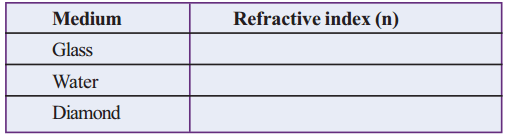
Physics Chapter 5 Class 10 Kerala Syllabus
Answer:
Class 10 Physics Chapter 5 Kerala Syllabus

Question 26.
If the speed of light in water is 2.25 x 10⁸ m/s
a. Calculate the speed of light in vacuum
b. Calculate the speed of light in glass.
Answer:
a. Speed of light in vacuum = Speed of light in water × Refractive index
Class 10 Physics Chapter 5 Notes Kerala Syllabus

Question 27.
Place a pencil in an inclined position in a glass trough and fill three fourth of the trough with water. Depict in your science diary, the changes after adding water. What shall be the reason for the change?
Don’t you see that the position of the portion of the pencil underwater has changed? What may be the reason? Discuss.
10th Class Physics Chapter 5 Notes Kerala Syllabus
Answer:
The light rays from pencil undergo deviation at the surface of water.

Textbook Page No. 111

Question 28.
Does the ray of light coming after reflection from the pencil undergo a deviation? What is the reason?
Answer:
Due to refraction

Question 29.
Now, will you be able to explain why a frog was obtained through the arrow was aimed at the fish?
Answer:
Light rays from fish and frog undergo deviation at surface of water. So they don’t see on exact place.

Question 30.
What is observed here?
Answer:
The coin seems to be lifted up.

Question 31.
What is the reason for this observation?
Answer:
As light from the coin comes from denser to rarer medium if bends away from normal so the position of the coin seems to be lifted up due to refraction.

Question 32.
Draw a thick line on a paper using a pen. Place a glass over it and observe as suggested below.
a Look from one side as shown in Fig. 5.8 (a)
Refraction Of Light Class 10 State Board Kerala Syllabus
b. Look from one side as shown in Fig. 5.8(b)
Class 10 Physics Chapter 5 Kerala Syllabus
c. Look from one side as shown in Fig. 5.8 (c)
Sslc Physics Chapter 5 Questions And Answers Kerala Syllabus
Answer:
a. The line seems to be rising on glass slab.
b. The line seems to be the surface of glass slab.
c. The line seems to be below the glass slab.

Textbook Page No. 112

Question 33.
Can you easily pick up the coin?
Answer:
We can’t easily pick up the coin.

Question 34.
What is the reason for the failure?
Answer:
Because coin’s actual place is not there. The light rays from the coin comes from denser to rarer medium it bends away from the normal, So the position of coin seems to be lifted up due to refraction.

Question 35.
Find out more examples of refraction from daily life.
Answer:
The stars in the sky appear glittering

  • We can see the sun when it falls below the horizon.
  • The bottom of water appears raised.
  • We cannot locate the position of fish in the water

Question 36.
A person who looks at an aquarium as shown in Fig. 5.10 can see the base on the surface of water. What is the reason?
Answer:
The light rays from the bottom of the aquar¬ium reflect without undergoing refraction (Due to total internal reflection)

Textbook Page No. 113

Question 37.
What will be the angle of refraction when the refracted ray passes along the surface of water?
Answer:
Angle of refraction to becomes 90°.

Question 38.
Allow light to fall at an angle of incidence greater than the critical angle. What do you observe?
Answer:
The ray is reflected back to the same medium without undergoing refraction.

Textbook Page No. 114

Question 39.
Which are the figures that show total internal reflection?
Answer:
Chapter 5 Physics Class 10 Kerala Syllabus
Physics Chapter 5 Class 10 Notes Kerala Syllabus

Question 40.
What is the critical angle of glass?
Answer:
42°

Question 41.
Will total internal reflection take place when light passing through water is inci¬dent on the surface of separation with air at an angle of incidence of 45°? Why?
Answer:
No. The critical angle of water 48.6°. You have already realized that total internal re-flection takes place only if the angle of incidence is greater than the critical angle. The total internal reflection takes place when in the incident ray is more than 48.6°

Question 42.
Find out the practical applications of total internal reflection in our day to day life.
1. Medical field – Endoscope
2. In the field of communication – Optical fiber cables.
Answer:
1. In the field of treatment- In the endoscope
2. In the field of telecommunication, optical fiber cables are used here.
3. Prism is used in the binoculars
4. Prism is used in the periscopes instead of mirrors.

Textbook Page 117

Question 43.
Complete the table 5.7
Kerala Syllabus 10th Standard Physics Solutions Chapter 5 Refraction of Light image 15
Answer:
Kerala Syllabus 10th Standard Physics Solutions Chapter 5 Refraction of Light image 16

Textbook Page 119

Question 44.
Where will the rays coining parallel to the principal axis converge?
Answer:
At principal focus

Question 45.
Where is the image formed?
Answer:
At principal focus

Question 46.
Write down the characteristics of the image.
Answer:
Position of the image: Between F and 2F
Nature of the image: Real, Inverted
Size of the image: Diminished

Textbook Page 120

Question 47.
Object at 2F
Kerala Syllabus 10th Standard Physics Solutions Chapter 5 Refraction of Light image 17
Answer:
Position of the image: At 2F on the other side Characteristic of the image: Inverted Size of the image: Same size of the object.

Question 48.
Object between F and 2F
Kerala Syllabus 10th Standard Physics Solutions Chapter 5 Refraction of Light image 18
Answer:
Position of the image: Beyond 2F
Characteristic of the image: Inverted
Size of the image: Bigger than the object

Question 49.
Object at F
Kerala Syllabus 10th Standard Physics Solutions Chapter 5 Refraction of Light image 19
Answer:
Position of the image: At the infinity
Characteristic of the image: Inverted
Size of the image: Big

Textbook Page 121

Question 50.
Object between F and Lens
Kerala Syllabus 10th Standard Physics Solutions Chapter 5 Refraction of Light image 20
Answer:
Position of the image: On the same side of the object
Characteristic of the image: direct image
Size of the image: Big in size

Question 51.
Have you observed images formed by a concave lens? What is the nature of the image?
Kerala Syllabus 10th Standard Physics Solutions Chapter 5 Refraction of Light image 21
Answer:
Images is smaller, virtual and direct

Textbook Page 122

Question 52.
Record the measurement shown in the figure as per the Cartesian System.
Kerala Syllabus 10th Standard Physics Solutions Chapter 5 Refraction of Light image 22
a. Distance of the object from the lens (u) = ………….
b. Distance of the image from the lens (v) = ………….
c. Height of object (OB) = …………..
d. Height of image (IM) = …………..
Answer:
a. u = -25cm
b. v = + 100cm
c. OB = +1cm
d. IM = -4 cm

Question 53.
Complete the Table 5.8
Kerala Syllabus 10th Standard Physics Solutions Chapter 5 Refraction of Light image 23
Answer:
Kerala Syllabus 10th Standard Physics Solutions Chapter 5 Refraction of Light image 24
Average f = 19.99 cm

Textbook Page 123

Question 54.
Is there any relation between the height of an object and the height of its image?
Can it be related to the ratio between the distance to the object and that to the image?
Answer:
The height of the object height of the image depends on the ratio of the distance to the object and distance to the image. When the object is kept at different positions, the height of the image can be varied.

Question 55.
When an object is placed at different positions in front of a lens, isn’t there a change in the height of the image?
Answer:
Yes

Question 56.
Calculate the magnification of the image formed by convex lens in Fig. 5.33
Answer:
Height of the image = (hi) = -4 cm
Height of the object = (h0) = +1 cm
Magnification = \(\frac{h_{1}}{h_{0}}=\frac{-4}{+1}=-4\)
or in another way
m = \(\frac { v }{ 4 }\)
v = +100, u = -25
m = \(\frac { 100 }{ -25 }\) = -4

Textbook Page 125

Question 57.
Find out the uses of lenses in our day to day life and record them in the science dairy.
Answer:

  • In telescope
  • In eye lenses
  • In-camera
  • In the microscope
  • In the magnifying a lenses

Question 58.
What has the doctor indicated in the prescription?
Answer:
The doctor indicated about the type and power of lens.

Question 59.
Calculate the power of a lens of focal length + 25 cm.
Answer:
Kerala Syllabus 10th Standard Physics Solutions Chapter 5 Refraction of Light image 25

Question 60.
You can guess what the +2D in the prescription stands for. What is its focal length? What kind of lens is it?
Answer:
p = + 2D
It is a convex lense
f = \(\frac { 1 }{ p }\) \(\frac { 1 }{ 2 }\) = 50cm

Question 61.
You might have seen the twinkling of stars at night. But planets do not twinkle. Why?
Answer:
Light coming from distant stars passes through different layers of air. Each layer differs from the other in their optical densities. Hence light undergoes successive refraction. Since stars, at a greater distance, they appear like a point source. The rays of light appear to come from different points on reaching the eye after refraction. This is the reason for the twinkling of stars.

Let Us Assess

Question 1.
Refractive indices of different materials are given. Find out the medium through which light passes with maximum speed.
Answer:
Water

Question 2.
The nature of images formed by two lenses are given.
i. An erect and magnified virtual image.
ii. An erect and diminished virtual image
a. What type of lens is used in each case?
b. By using which type of lens will we get an image having the same size as the object? What is the position of the object?
Answer:
a. i. Convex lense
ii. Concave lense
b. Convex lense. Object will be at 2F.

Question 3.
Kerala Syllabus 10th Standard Physics Solutions Chapter 5 Refraction of Light image 26
a. MN represents a lens. What type of lens is this?
b. What are the characteristics of the image?
c. Copy the ray diagrams in the science diary and complete it
Answer:
a. Convex
b. Magnified, real, inverted
Kerala Syllabus 10th Standard Physics Solutions Chapter 5 Refraction of Light image 27

Question 4.
What do you mean by power of a lens? What is the SI unit of the power of a lens? Calculate the power of a concave lens of focal length 25 cm.
Answer:
Power is a term related to the focal length of a lens. Power of a lens is the reciprocal of focal length expressed in meters. Power
p = 1/f
Unit of power is dioptre. It is represented by
Kerala Syllabus 10th Standard Physics Solutions Chapter 5 Refraction of Light image 28

Question 5.
Observe the figure. Light falling on two different media are shown.
Kerala Syllabus 10th Standard Physics Solutions Chapter 5 Refraction of Light image 29
a. Which medium has greater optical density? Why?
b. Which medium has greater refractive index?
Answer:
a. Medium 1. Angle of incidence is same, but angle of refraction is different. When a ray of light passes from a medium of lower density to greater density the refracted ray deviates towards the normal. Medium 1 has lowest angle of refraction compared to medium 2.
b. Medium 1

Question 6.
An object of height 3 cm is placed in front of a convex lens of focal length 20 cm at a distance of 30 cm.
a. What is the distance to the image formed?
b. What is the nature of the image?
c. What is the height of the image?
Answer:
Kerala Syllabus 10th Standard Physics Solutions Chapter 5 Refraction of Light image 30
b. Magnified, inverted, real
Kerala Syllabus 10th Standard Physics Solutions Chapter 5 Refraction of Light image 31

Question 7.
In the table, the absolute refractive indices of certain transparent media are given.

MediumRefractive index
Air1.0003
Water1.33
Kerosene1.44
Turpentine oil1.47
Crown glass1.52
Diamond2.42

a. Find out from the table the medium of highest and lowest optical densities,
b. If the speed of light in air is 3 x 10⁸ m/s, what will be the speed of light through kerosene?
c. W ill a ray of light deviates towards the normal or away from the normal when it enters from air to diamond obliquely?
d. The refractive index of diamond is 2.42. What do you mean by this? Calculate the speed of light through diamond.
Answer:
a. Highest – Diamond
Lowest – air
Kerala Syllabus 10th Standard Physics Solutions Chapter 5 Refraction of Light image 32
c. Towards the normal
d. The speed of light in air (Vaccum) is 2.42 times greater than the speed of light in diamond or other hands. Speed of light in diamond is 2.42 times lesser than speed of light in air or vacuum.
Speed of light through diamond
\(=\frac{3 \times 10^{8}}{2.42}=1.25 \times 10^{8} \mathrm{m} / \mathrm{s}\)

Extended Activities

Question 1.
Half portion of a convex lens is wrapped with a black paper. Can this lens give a complete real image of an object? Explain.
Kerala Syllabus 10th Standard Physics Solutions Chapter 5 Refraction of Light image 33
Answer:
Yes. This lens gives a complete real image of an object. However, the intensity of image may be less.

Question 2.
The refractive indices of different media are given. Analyze the table and answer the following.
In which medium will light have the highest speed?
Answer:
Water

Question 3.
Glycerine, water and sunflower oil are taken in two beakers. A glass rod is dipped in one and a pyrex glass rod is dipped in the other. Do they appear in the same way? In which media are they visible? Justify.
Kerala Syllabus 10th Standard Physics Solutions Chapter 5 Refraction of Light image 34
Answer:
Objects are visible because they reflect some of light that shines on them. Refractive index of glycerine, sunflower oil, and pyrex glass are same. Glass rod clearly visible in them. But pyrex glass is not clearly visible because light ray are passed without deviation through medium having same refractive index.

Question 4.
Kerala Syllabus 10th Standard Physics Solutions Chapter 5 Refraction of Light image 35
Take a clean mineral water bottle and fill it with water. Put a hole on one side of the bottle. Allow water to flow out while passing a laser ray through it What do you observe? Why?
Answer:
As water throws out of the opening observe the case beam remains trapped in the water stream because of total inemal reflection. As light tries to pass from the more dense water to the less dense air. it bends. In narrow column of water, the light wave continues bouncing off the boundaries of the stream of water but cannot pass through into the air.

Refraction of Light Exam Oriented Questions & Answers

Very Short Answer Type Questions (Score 1)

Question 1.
The power of a convex lens of focal length 2 m is …………..
Answer:
\(P=\frac{1}{f}=\frac{1}{2}=0.5 \text { dioptre }\)

Question 2.
What change occurs for power of a lens when it’s focal length increases?
Answer:
Power decreases

Question 3.
An object is placed at 2F in the case of a convex lens what is its magnification? (greater than 1, less than 1, zero, one)
Answer:
one

Question 4.
Figure shows a ray of light obliquely travels from air to glass. Find out the correct one.
Kerala Syllabus 10th Standard Physics Solutions Chapter 5 Refraction of Light image 36
Answer:
Figure iii
It bent towards the normal

Question 5.
Find out the relationship in the first pair and fill in the second pair appropriately.
Focal length – meter
Power of the lens – …………..
Answer:
Dioptre

Very Short Answer Type Questions (Score 2)

Question 6.
The image is direct and is above principal axis an object is kept at a distance of 30 cm away from a lens. An image of same size is formed. What is the focal length of the lens?
Answer:
Image of size is formed when the object is kept at 2F
∴ 2f = 30 cm
∴ f = 15 cm
∴ \(\frac { 30 }{ 2 }\) = 15cm

Question 7.
Write two situations when angle of refraction is 90°
Answer:
i. The angle of incidence should be equal to critical angle.
ii. Rays of light should travel from the medium of greater optical density to lesser optical density

Question 8.
Represent the image formation by a concave lens. Why the focus of this lens is called virtual?
Kerala Syllabus 10th Standard Physics Solutions Chapter 5 Refraction of Light image 37
Answer:
The rays of light pass through a concave lens do not really meet. They appear to meet. So the focus is called virtual.

Question 9.
What are the situation where total internal reflection take place?
Answer:
i. Rays of light travel from medium of greater optical density to that of lesser one.
ii. Angle of incidence should be greater than critical angle.

Question 10.
An object ‘OB’ is placed in front of lens is given below.
Kerala Syllabus 10th Standard Physics Solutions Chapter 5 Refraction of Light image 38
a. Name the lens?
b. Complete the figure, then find out the position of the image.
c. Identify the two nature of the image.
Answer:
a. Convex lens
Kerala Syllabus 10th Standard Physics Solutions Chapter 5 Refraction of Light image 39
Images formed in between F and 2F.
b. Real and inverted images formed.

Question 11.
Complete the figure then find out the principal focus of the concave lens.
Kerala Syllabus 10th Standard Physics Solutions Chapter 5 Refraction of Light image 40
Answer:
Kerala Syllabus 10th Standard Physics Solutions Chapter 5 Refraction of Light image 41

Question 12.
Terms related to lens are given below? Complete the questions using these terms?
(Pole, Focal length, Centre of curvature, Principal axis)
a. The midpoint of a lens is called …………..
b. The distance between pole to focus is called ……………
c. The center of imaginary spear of two sides of the lens is called ……………
d. Imaginary line passing through the center of curvature of the lens is called …………..
Answer:
a. Pole
b. Focal length
c. Centre of curvature
d. Principal axis

Question 13.
Corrected the wrong statement from the following.
a. Optical density of two mediums are different, it is reason for refraction.
b. Velocity of light is very high in optically denser medium.
c. Optical density of glasses lower than that of water
d. Velocity of light in vacuum is 3 × 10⁸ m/s
Answer:
Wrong statements – b, c
b. Velocity of light is comparatively low in optically denser medium.
c. Optical density of glasses higher than that of Water.

Question 14.
Calculate the power of the lens of focal length 10 cm?
Answer:
f = 10 cm = 0.1 m
\(P=\frac{1}{f}=\frac{1}{0.1}=+10 \text { dioptre }\)

Question 15.
‘IM’ is an image of the object ‘OB’. Find out the given values related to new cartesian sign conventions.
Kerala Syllabus 10th Standard Physics Solutions Chapter 5 Refraction of Light image 42
a. Distance between lens to object (u) ……………..
b. The distance between lens to image (v) …………
c. Height of the object (OB) ………….
d. Height of the image (IM) …………
Answer:
a. u = -40 cm
b. v = +24 cm
c. OB = +2 cm
d. IM = -1cm

Question 16.
The statements associated with a lens are given by the new cartesian symbol. Write the correct one?
a. All distance are measured from the focus.
b. All distances measured along the direction of incident light is positive.
c. Lightray is assumed to travel from right to left.
d. X-axis is taken as the origin.
Answer:
b. All distances measured along the direction of incident light is positive
d. X-axis is taken as the origin

Short Answer Type Questions (Score 3)

Question 17.
Observe the figure. Light rays enter from medium 1 to medium 2
Kerala Syllabus 10th Standard Physics Solutions Chapter 5 Refraction of Light image 43
a. Which medium has greater optical density?. How do you reach in such a conclusion?
b. How do optical density and velocity of light related?
c. What is the speed of light in vacuum?
Answer:
a. medium 1
When the light rays enter from medium 1 to 2, they more away from the normal. The speed of light is also greater in medium 2 then medium.
b. When optical density increases the speed of light decreases.
c. 3 × 10⁸ m/s

Question 18.
A virtual image of an object is formed at 30 cm away from a lens when an object is kept at a distance 20 cm away from it. What is the focal length of the lens? Find the magnification of the image?
Answer:
u = -20 cm, v = -30 cm
(as the image is virtual, it is formed at the same side)
Kerala Syllabus 10th Standard Physics Solutions Chapter 5 Refraction of Light image 44

Question 19.
It is written by the doctor for the eye lens as -2.50.
a. What the defect of eye of the patient?
b. What is the focal length of the lens?
c. What type of lens is it?
Answer:
a. near sightedness
b. p = -2.5 D
\(\mathrm{f}=\frac{1}{\mathrm{p}}=\frac{1}{2.5}=\frac{-10}{25}\)
= -0.4 m = -40 cm
The focal length of the lens = – 40 cm
c. Concave lens

20. Observe the figure given below.
Kerala Syllabus 10th Standard Physics Solutions Chapter 5 Refraction of Light image 45
a. Why the ray PQ reflected back as in the above figure?
b. Name this phenomenon?
c. What happens to the ray of light when angle of incident is 30°.
Answer:
a. Angle of incidence is greater than that of critical angle.
b. Total internal reflection
c. Refraction takes place when it travels from water to air.

Question 21.
Nature of some images are given below. Find out the real and virtual images and then write it in separate column.
a. Inverted image
b. Do not obtained on a screen
c. Obtained on a screen
d. If the light rays really intersect to each other.
e. Erect image
f. The image distance cannot directly
Answer:
Real images: a, c, d
Virtual images: b, e, f

Question 22.
A burning candle is placed in front of a convex lens to obtain an image on the screen.
Find out the positions of the object in each of the conditions given below?
a. We get the size of the image is equal to the size of the object.
b. The size of the image is smaller than that of the object.
c. We get large real image than the object.
Answer:
a. 2F or C
b. Beyond 2F
c. In between 2F and F.

Question 23.
A person uses a spectacle of power of lens -1.25D.
a. What type of lens is this?
b. What is meant by power of a lens?
c. Find the focal length of the lens?
Answer:
a. Power of the lens is negative. So it is a concave lens.
b. Power of a lens is the reciprocal of its focal length.
Kerala Syllabus 10th Standard Physics Solutions Chapter 5 Refraction of Light image 45a

Question 24.
Observe the figure carefully OB is an object placed in front of the convex lens.
Kerala Syllabus 10th Standard Physics Solutions Chapter 5 Refraction of Light image 46
a. Complete the ray diagram then find out the position of the image.
b. An object is placed at 2F, in which position image is formed?
c. Where we have to place an object to get a virtual image from a convex lens?
Answer:
Kerala Syllabus 10th Standard Physics Solutions Chapter 5 Refraction of Light image 47
a. Beyond 2F
b. Image is formed at 2F
c. An object is placed in between optic center and focus

Short Answer Type Questions (Score 4)

Question 25.
Combine suitable
Kerala Syllabus 10th Standard Physics Solutions Chapter 5 Refraction of Light image 48
Answer:
1 – (c)
2- (a)
3 – (e)
4 – (d)

Question 26.
Light obliquely travels from glass to air, critical angle of Glass is 42°.
a. What is mean by critical Angle?
b. Angle of incidence is 42° find its refracted angle?
c. In which phenomenon we observe the incident angle is 40°? Explain the phenomenon?
d. What happens to the ray of light when the angle of incidence is 45°? Explain the phenomenon?
Answer:
a. When a Ray of light passes from a medium of greater optical density to that of lower optical density, the angle of incidence at which the angle of refraction becomes 90° is the critical angle.
b. 90°
c. Reflection takes place when a Ray of light entering obliquely from one transfer in the medium to another its path undergoes a deviation at the surface of separation. This is called refraction of light.
d. Total internal reflection. When a Ray of light passes from a medium of higher optical density to a medium of lower optical density at an angle of incidence greater than the critical angle, the ray reflected back to the same medium without undergoing refraction this phenomenon is known as total internal reflection.

Vision and the World of Colours 10th Class Physics Notes Malayalam Medium Chapter 6 Kerala Syllabus

Students can Download Physics Chapter 6 Vision and the World of Colours Questions and Answers, Notes Pdf, Activity in Malayalam Medium, Kerala Syllabus 10th Standard Physics Solutions helps you to revise the complete Kerala State Syllabus and score more marks in your examinations.

SSLC Physics Chapter 6 Vision and the World of Colours Questions and Answers Malayalam Medium

SCERT 10th Standard Physics Textbook Chapter 6 Solutions Malayalam Medium

Sslc Physics Chapter 6 Malayalam Kerala Syllabus

Sslc Physics Chapter Wise Questions And Answers Pdf
Physics Solutions Class 10 Kerala Syllabus
Kerala Syllabus 10th Standard Physics Notes

Physics Class 10 Kerala Syllabus
Sslc Physics Chapter 6 Notes Kerala Syllabus
Sslc Physics Chapter Wise Questions And Answers Malayalam Medium

Hsslive Guru 10th Physics Kerala Syllabus
Kerala Syllabus 10th Standard Physics
Hss Live Guru 10th Physics Malayalam Medium

Sslc Physics Chapter Wise Questions And Answers Kerala Syllabus
Physics Notes For Class 10 Kerala Syllabus
Sslc Chemistry Chapter 6 Malayalam Medium

Kerala Syllabus 10th Standard Physics Solutions Chapter 6 Vision and the World of Colours in Malayalam 14
Kerala Syllabus 10th Standard Physics Solutions Chapter 6 Vision and the World of Colours in Malayalam 15
Kerala Syllabus 10th Standard Physics Solutions Chapter 6 Vision and the World of Colours in Malayalam 16
Kerala Syllabus 10th Standard Physics Solutions Chapter 6 Vision and the World of Colours in Malayalam 17

Kerala Syllabus 10th Standard Physics Solutions Chapter 6 Vision and the World of Colours in Malayalam 18
Kerala Syllabus 10th Standard Physics Solutions Chapter 6 Vision and the World of Colours in Malayalam 19
Kerala Syllabus 10th Standard Physics Solutions Chapter 6 Vision and the World of Colours in Malayalam 20
Kerala Syllabus 10th Standard Physics Solutions Chapter 6 Vision and the World of Colours in Malayalam 21
Kerala Syllabus 10th Standard Physics Solutions Chapter 6 Vision and the World of Colours in Malayalam 22

Kerala Syllabus 10th Standard Physics Solutions Chapter 6 Vision and the World of Colours in Malayalam 23
Kerala Syllabus 10th Standard Physics Solutions Chapter 6 Vision and the World of Colours in Malayalam 24
Kerala Syllabus 10th Standard Physics Solutions Chapter 6 Vision and the World of Colours in Malayalam 25

Kerala Syllabus 10th Standard Physics Solutions Chapter 6 Vision and the World of Colours in Malayalam 26
Kerala Syllabus 10th Standard Physics Solutions Chapter 6 Vision and the World of Colours in Malayalam 27
Kerala Syllabus 10th Standard Physics Solutions Chapter 6 Vision and the World of Colours in Malayalam 28

Kerala Syllabus 10th Standard Physics Solutions Chapter 6 Vision and the World of Colours in Malayalam 29
Kerala Syllabus 10th Standard Physics Solutions Chapter 6 Vision and the World of Colours in Malayalam 30
Kerala Syllabus 10th Standard Physics Solutions Chapter 6 Vision and the World of Colours in Malayalam 31
Kerala Syllabus 10th Standard Physics Solutions Chapter 6 Vision and the World of Colours in Malayalam 32

Kerala Syllabus 10th Standard Physics Solutions Chapter 6 Vision and the World of Colours in Malayalam 33
Kerala Syllabus 10th Standard Physics Solutions Chapter 6 Vision and the World of Colours in Malayalam 34
Kerala Syllabus 10th Standard Physics Solutions Chapter 6 Vision and the World of Colours in Malayalam 35
Kerala Syllabus 10th Standard Physics Solutions Chapter 6 Vision and the World of Colours in Malayalam 36

Kerala Syllabus 10th Standard Physics Solutions Chapter 6 Vision and the World of Colours in Malayalam 37
Kerala Syllabus 10th Standard Physics Solutions Chapter 6 Vision and the World of Colours in Malayalam 38
Kerala Syllabus 10th Standard Physics Solutions Chapter 6 Vision and the World of Colours in Malayalam 39

Kerala Syllabus 10th Standard Physics Solutions Chapter 6 Vision and the World of Colours in Malayalam 40
Kerala Syllabus 10th Standard Physics Solutions Chapter 6 Vision and the World of Colours in Malayalam 41

Class 10 Physics Chapter 6 Vision and the World of Colours Notes Kerala Syllabus

You can Download Vision and the World of Colours Questions and Answers, Summary, Activity, Notes, Kerala Syllabus 10th Standard Physics Solutions Chapter 6 help you to revise complete Syllabus and score more marks in your examinations.

SSLC Physics Chapter 6 Vision and the World of Colours Textbook Questions and Answers

SCERT Class 10th Standard Physics Chapter 6 Vision and the World of Colours Solutions

Text Book Page No. 133

Sslc Physics Chapter 6 Kerala Syllabus Question 1.
Place a lighted candle at a distance 13 cm from the lens. Do you get a clear image of the candle on the screen?
Answer:
No

Sslc Physics Chapter 6 Notes Kerala Syllabus Question 2.
Place lenses of focal length 10 cm, 15cm and 20cm on the lens holder without changing the distance between the lens and the screen. On using which lens is the image clear?
Answer:
Lens of focal length 10 cm

Text Book Page No. 134

Vision And The World Of Colours Kerala Syllabus Question 3.
Given below are the ray diagrams of image formation in the eye.
i. Where is the image formed in each case?
ii. In which case is the image formed on the retina itself ?
Sslc Physics Chapter 6 Kerala Syllabus
Answer:
(i) a) In front of retina
b) Behind the retina
c) On retina
ii.
Sslc Physics Chapter 6 Notes Kerala Syllabus

World of Vision Question 4. Will an image be formed on the retina when the object is at the near point
Vision And The World Of Colours Kerala Syllabus
Will it be possible to see a clear image?
Answer:
No. It will not be possible to see a clear image.

Textbook Page No. 135

Physics Chapter 6 Class 10 Kerala Syllabus Question 5.
Will an image be formed on the retina when the object is at a far distance
Vision And World Of Colours Kerala Syllabus
Will a clear image be formed?
Answer:
Yes. A clear image will be formed.

Sslc Physics Chapter Wise Questions And Answers Question 6.
What shall be the reasons behind this defect?
1. Can you find out a reason based on the size of the eyeball?
Size larger/ smaller?
Answer:
Size larger

2. What if it is related to the focal length (or power)?
Power is high/ low
Answer:
Power low

Physics Class 10 Chapter 6 Kerala Syllabus Question 7.
What is the remedy for long – sight-edness?
Answer:
This can be rectified by using a convex lens of suitable power.

Text Book Page No. 136

Class 10 Physics Chapter 6 Kerala Syllabus Question 8.
Where is the image formed in these cases? Write down the answer analysing.
Physics Chapter 6 Class 10 Kerala Syllabus
1. When the object at O is away from the eye, where will be the image formed? Can the object be seen clearly?
Answer:
In front of retina. Objects cann’t be seen clearly.

2. Can the object be seen clearly when it is at O1?
Answer:
Yes

3. Why is it not possible to see objects placed at long distances?
Answer:
dmages are formed in front of retina.

4. What is its remedy?
Answer:
This can be overcome by using concave lens of suitable power.

Physics Chapter 6 Question 9. When a person suffering from problem in vision met a doctor, he wrote in his prescription the following figures. +1.5 D, -2D

1. What has the doctor indicated in the prescription?
Answer:
+1.5 D, -2D indicates the power of lense they required. The power of a lens is defined as the ability of the lens to converge or diverge a beam of light falling on it.

2. Which are the types of lenses prescribed here?
Answer:
The power of a convex lens is positive while the power of a concave lens is neg-ative.
+1.5D represents convex lense.
-2D represents concave lense.

Sslc Physics Chapter 6 Notes Pdf Kerala Syllabus Question 10.
For a healthy vision, what is the dis-tance to the near point?
Answer:
25cm

Text Book Page No. 137

Kerala Syllabus 10 Physics Chapter 6 Question 11.
Pass sunlight through a prism and allow it to fall on a screen. What are the colours seen on the screen?
Sslc Physics Chapter Wise Questions And Answers
Answer:
Violet, Indigo, Blue, Green, Yellow, Orange, Red.

Text Book Page No. 138

Hss Live Guru 10th Physics Kerala Syllabus Question 12.
The beam of white light from a torch is allowed to fall obliquely on the prism.

1. Which are the colours formed on the screen?
Answer:
Violet, Indigo, Blue, Green, Yellow, Orange, Red.

2. Aren’t these colours the same as the component colours obtained from the sunlight?
Answer:
Yes

Hsslive Guru 10th Physics Kerala Syllabus Question 13.
Physics Class 10 Chapter 6 Kerala Syllabus

1. Which colour deviates the most due to dispersion?
Answer:
Violet

2. Which colour deviates at least?
Answer:
Red.

3. What may be the reason behind this difference in deviation?
Answer:
Differences in wavelength

Physics 10th Class Notes Kerala Syllabus Question 14.
Class 10 Physics Chapter 6 Kerala Syllabus

1. Which colour has the shortest wavelength?
Answer:
Violet.

2. Which one has the longest?
Answer:
Red

Question 3.
When light passes through the prism, as the wavelength increases, how does the deviation change? Will it increase or decrease?
Answer:
The deviation of colours is minimum for the colours with more wavelength when the composite light passes through the prism. When the wavelength of the colour decreases, the deviation increases.

Text Book Page No. 139

Question 15.
When is the rainbow formed?
Answer:
In the morning and in the evening.

Question 16.
Where will be the sun when the rainbow is seen in the east?
Answer:
In the opposite direction (west)

Question 17.
Where will be the sun when the rainbow is seen in the west?
Answer:
East
Sslc Physics Chapter 6 Notes Pdf Kerala Syllabus

Question 18.
How many times does a ray of light undergo refraction when it passes through a water droplet?
Answer:
The sunlight undergoes two times refraction in the water drop.

Question 19.
What about internal reflection?
Answer:
One time

Question 20.
What is the colour seen at the upper edge of the rainbow?
Answer:
Red

Question 21.
What is the colour seen at the lower edge?
Answer:
Violet

Text Book Page No. 140

Kerala Syllabus 10 Physics Chapter 6

Question 22.
What happened to the light when it passed through the first prism?
Answer:
The white light separates into its component colours when it passes through the first prism

Question 23.
What happened when it passed through the second one?
Answer:
The colours formed by the first prism recombine to form white light when it passes through the second prism.

Text Book Page No. 141

Make a Newton’s disc by painting the constituent colours of white col-our of white light in the same order and proportion.

Question 24.
In which colour does the disc appear when rotated fast?
Answer:
Very near to the white colour

Question 25.
Give Reason.
Answer:
Light from the seven colours of the colour disc falls continuously on the retina and due to the persistence of vision, disc appears as white.

Question 26.
The disc appeared white due to persistence of vision. Find out more examples of persistence of vision and write them down.
Answer:

  • A torch rotated rapidly appears as an illuminated circle.
  • Sparkler’s trail effect.
  • Colour – top
  • Thaumatrope.
  • Kaleidoscopic colour-top.
  • Rubber pencil trick.
  • LED POV displays
  • Revolving wheels,
  • Rotation of fan leafs

Question 27.
During sunset, you might have no- I ticed that the western horizon becomes reddish. Why is it so?
Answer:
During sunset, the sunlight travels I maximum distance through the atmosphere to reach in our eyes. So red also I undergo scattering. So the horizon appears red.

Text Book Page No. 142

Hss Live Guru 10th Physics Kerala Syllabus

Question 28.
Is the reflection of light here regular or irregular?
Answer:
Irregular

Question 29.
Is the distribution of sunlight to all regions made possible by this type of scattering. Discuss.
Answer:
Yes, scattering is the partial and irregular reflection of light. The colours in sunlight undergo scattering when they fall on the particles in the atmosphere. Sunlight reaches in the rooms and under the trees by this method.

Text Book Page No. 143

Question 30.
When hydrochloric acid was added to the solution, which colour did spread first in the solution?
Answer:
Blue colour spreads first in the solution when acid was added.

Question 31.
Write down the colour changes observed on the screen in the order it occurred.
Answer:
Violet → indigo
blue → green → yellow
orange → red

Question 32.
What was the final colour observed on the screen?
Answer:
Red colour is seen at the end.

Question 33.
Which component colour in white light does undergo maximum scattering?
Answer:
Blue has the maximum scattering

Question 34.
During sunset, the horizon appears to have red colour. What may be the reason?
Answer:
During sunrise and sunset, light reaching us from the horizon has to travel long distances through the atmosphere. During this long journey, colours of shorter wavelength would be almost fully lost due to scattering. Then, the red light which undergoes only less amount of scattering decides the colour of the horizon. That is why the sun appears red during sunset and sunrise.

Text Book Page No. 144

Question 35.
Which are the occasions when sun-light has to travel greater distance through the atmosphere before reaching the eyes of ait observer on the earth?
Answer:
Morning and evening.

Question 36.
As sunlight passes through the atmosphere, which colour in it undergoes maximum scattering? Which colour undergoes minimum scattering?
Answer:
Colour in it undergoes maximum scattering: Violet
Colour in it undergoes minimum scattering: Red

Question 37.
When light reaches the observer after travelling long distances through the atmosphere, which colour reaches the eye? What is the reason?
Answer:
Red, it has highest wavelength and least scattering.

Question 38.
The western horizon remains reddish for some more time even after sunset. Why?
Answer:
During sunset, the sunlight travels maximum distance through the atmosphere to reach in our eyes. So red also undergoes scattering. So the horizon appears red.

Question 39.
Can you now guess why red colour has been given to the tail lamps of vehicles and signal lights? Discuss and note it down in your science diary.
Answer:
The primary reason why the colour red is used for danger signals is that red light is scattered the least by air molecules. So red light is able to travel the longest distance through fog, rain, and the like.

Text Book Pace No. 145

Question 40.
Write down what else can be ‘done to minimize the light pollution.
Answer:

  • Start with the light switch
  • Check with your power company to see if you’re paying for outdoor lighting.
  • Consider replacing outdoor lights with intelligently designed, low- glare fixtures.
  • Place motion sensors on essential outdoor lamps.
  • Replace conventional high-energy bulbs with efficient outdoor CFLs and LED floodlights.
  • Reduce the use decorative lighting.
  • Use of covered bulbs that light facing downwards.
  • The use of automatic systems to turn off street light at certain times.
  • Have all information arid facts about light pollution.
  • Use of glare-free bulbs, installing low hanging bulbs, having the lights facing downwards, and covering the bulbs to reduce bright skies at night.
  • Share with family and friends.

Let Us Assess

Question 1.
How is the condition of the ciliary muscles while watching a distant object? How does this influence the focal length of the eye lens?
Answer:
While looking at far objects the ciliary muscles are relaxed and the curvature of the lens decreases. The focal length of the lens increases.

Question 2.
A child sitting at the backbench of a classroom is unable to see the letters on the board clearly. What is the defect of the eye of the child? How can it be remedied? Draw its ray diagram.
Answer:
Myopia or Nearsightedness. This can be rectified by using a concave lens of suitable power.
Hsslive Guru 10th Physics Kerala Syllabus

Question 3.
A person is not able to see objects beyond 1.3 m. What remedy can you suggest for this defect?
Answer:
Myopia or Nearsightedness. This can be rectified by using a concave lens of suitable power.

Question 4.
In what colour does the sky appear for an astronaut?
Answer:
Black

Question 5.
Red light is used as signal lamps to indicate danger. Explain.
Answer:
The primary reason why the colour red is used for danger signals is that red light is scattered the least by air molecules. So red light is able to travel the longest distance through fog, rain, and the a like.

Question 6.
What is the reason for using yellow light as fog lamps?
Answer:
Yellow lights are strictly used for fog situations, and for construction, so you can tell what is what on the road. Yellow has high wavelength, so yellow light is scattered the least by air molecules.

Question 7.
Which is the phenomenon behind dispersion of light?
a. Reflection
b. Refraction
c. Tyndal Effect
d. Scattering
Answer:
b. Refraction

Question 8.
During dispersion, different colours deviate differently. Explain why.
Answer:
The rate of refraction for different col-ours during dispersion is different due to the difference in wavelength of the colours. The rate of refraction decreases with increase in wavelength. Dispersion. is the phenomenon of splitting of light into its component colours.

Question 9.
The telescope called ‘Chandra X-ray Observatory’ is placed in the outer space. What is the advantage of placing it there? Explain with reference to the scattering of light in the atmosphere.
Answer:
Light can reach the telescope which is kept in space without scattering as there are no gases and tiny particles in space. So we can observe the heavenly bodies clearly there. The pictures may not be clear on earth due to the scattering of light.

Extended Activities

Question 1.
White light is allowed to fall on the bright side of a compact disc (CD). The reflected light is allowed to fall on a white wall. Observe the colours available in the spectrum and write them down in your science diary.
Answer:
Violet, indigo, blue, green, yellow, Orange, Red.

Vision and the World of Colours Orukkam Questions and Answers

Question 1.
Observe the figure
Kerala Syllabus 10th Standard Physics Solutions Chapter 6 Vision and the World of Colours image 13
a. Which are the colours formed on the sc-reen?
b. Explain the phenomenon that causes the formation of array of colours
c. Which are the colours denoted by ‘A’ and ‘B’?
d. Which colour deviates the most?
e. Which colour deviates at least?
f. Different colours undergo different deviation. Why?
Answer:
a. Violet, Indigo, Blue, Green, Yellow, Orange, Red
b. Dispersion. The phenomenon of splitting, of a composite light into its constituent colours is known as dispersion of light.
c. A – Violet B – Red
d. Violet
e. Red
f. Different colours undergo different deviation due to difference in wavelength

Question 2.
Newton’s colour disc is made by painting the constituent colours of white light in the same order and proportion.
a. In which colour does the disc appear when rotated fast?
b. The reason behind such an appearance is a phenomenon related to our eyes. What is it explain?
c. If the disc is rotated slowly, what will be the observation?
d. Why does a torch rotated appear as an illuminated circle?
Answer:
a. White colour
b. Persistence of vision. When a person views an object, its image remains in the retina of the eye for a time interval of 0.0625 s
c. If the disc is rotated slowly it is easy to identify the different colours.
d. Due to the Persistence of vision.

Evaluation Activities

Question 3.
The figure shows a ray of sunlight falls obliquely on a water drop.
Kerala Syllabus 10th Standard Physics Solutions Chapter 6 Vision and the World of Colours image 14
a. Complete the figure
b. How many times does the ray of light undergo refraction?
c. A natural phenomenon is there that connected with this figure. Name it?
Answer:
Kerala Syllabus 10th Standard Physics Solutions Chapter 6 Vision and the World of Colours image 15
b. Twice
c. Rainbow

Question 4.
Match columns. A, B and C suitably.

Colour of lightComplementary colourColour obtained
Green……. (a) ……White light
YellowBlue…… (b) ……
Red……. (d) ……White light

Answer:
a.Magenta
b. White light
c. Cyan

Question 5.
The telescope ‘Chandra’ is placed in the space. What is the advantage of placing it there?
Answer:
Light can reach the telescope which is kept in space without scattering as there are no gases and tiny particles in space. So we can observe the heavenly bodies clearly there. The pictures may not be clear on. earth due to the scattering of light.

Vision and the World of Colours SCERT Questions and Answers

Question 6.
The figure shows a ray of light falling obliquely on a droplet of water for the formation of rainbow.
Kerala Syllabus 10th Standard Physics Solutions Chapter 6 Vision and the World of Colours image 16
a. Copy the figure and complete the unfinished part.
b. What is the phenomenon that took place inside the droplet?
c. What is the colour of ‘X’?
d. What is the reason behind the red app-earing at the outer edge of a rainbow?
Answer:
Kerala Syllabus 10th Standard Physics Solutions Chapter 6 Vision and the World of Colours image 17
b. Internal reflection
c. Violet
d. Sunlight undergoes refraction and internal reflection while passing through drops of water. All the drops that appear in the same colour are seen in the same arc. Thus red having highter wavelength is seen in the outer edge at higher angle.

Question 7.
Analyse the following statements and find out the reason behind them.
a. Stars can be seen even in day time while viewed from the moon
b. Raindrops falling down during rain appear like a glass rod.
c. A rainbow is seen in the shape of a circle when viewed from a height.
d. The sky of cities mostly appears in grey colour.
Answer:
a. There is no scattering for the light around the moon since there is no atmosphere around it. Hence the sky of moon appears dark.
b. Raindrops come down faster during rain. The distance travelled by a drop in 1/16 of a second appears like a glass rod due to persistence of vision.
c. When viewed from a height the observer can see points at 42.70 upwards, downwards as well as sideways. Hence rainbow is seen as a circle.
d. In cities there will be large particles in the atmosphere. Hence all colours of light scatter equally.

Question 8.
Two teams A and Bare taking part in a volley ball competition held on a ground illuminated by a sodium vapour lamp (yellow light). Team A is wearing white jersey and blue shorts while Team B is wearing yellow jersey and black shorts.
a. Can you distinguish between the teams based on the colour of their dress?
b. Justify your answer.
Answer:
a. Cannot be distinguished
b. In yellow light the white jersey and yell-ow jersey appear in yellow colour. This is because both white and yellow surfaces can reflect yellow light. The black shorts appears black itself and blue shorts appears dark since both of them absorb yellow light.

Question 9.
A disc painted with different colours is shown
Kerala Syllabus 10th Standard Physics Solutions Chapter 6 Vision and the World of Colours image 18
a. Which colour is X if the disc appears white on rotating fast?
b. Why did the disc appear white on being rotated fast?
c. In what colour will the disc appear if green light alone is made to fall on the disc when it is being rotated fast?
Answer:
a. Cyan
b. Due to persistence of vision
c. In green colour
On rotating the disc faster, the disc app-ears white due to persistence of vision. The cyan appears as green since it reflects green light.

Question 10.
Colour filters are materials that will allow only certain colours of light to pass.
a. What is the colour of the filter that can transmit blue and red colours of light?
b. Which are the radiations that will be absorbed completely by an infrared filter?
c. Write down:
(i) Two specialities of infrared rays
(ii) Two uses of infrared rays
Answer:
a. Magenta
b. Visible light, ultra violet radiations
c. (i) Higher wavelength than that of visible light; becomes the reason for the heat . of the sunlight.
(ii) Used to take photograph of distant objects, remote sensing, secret signalling, for controlling robots.

Question 11.
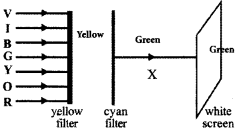
The figure shows sunlight falling on a white screen after being passed through yellow and cyan filters.
Kerala Syllabus 10th Standard Physics Solutions Chapter 6 Vision and the World of Colours image 19
a. Supply the omitted portion and complete the diagram
b. Which colours is‘X’?
c. (i) What is the complementary colour of this colour?
(ii) What do you mean by complementary colours?
Answer:
a.
Kerala Syllabus 10th Standard Physics Solutions Chapter 6 Vision and the World of Colours image 20
b. Green
c. (i) Magenta
(ii) If a primary colour and a secondary colour can given white light on mixi-ng, then they are complementary colours.

Question 12.
Match the columns A, B and C suitably

ABC
Light makes tiny particles visible due to scatteringDispersionPictures on a TV screen keep on chang­ing and give an illusion of motion.
The effect of seeing an object is re­tained by the eye for 1/16 of a second.Tyndal EffectFormation of rainbow on the horizon
Composite light splits up into co­mponent coloursPersistence of visionOn foggy morning the path of sunlight becomes clearly visible.   ‘

Answer:

ABC
Light makes tiny particles visible due to scatteringTyndal EffectThe path of sunlight becomes visible foggy mornings.
The effect of seeing an object is re­tained by the eye for 1/16 of a second.Persistence of visionThe pictures of a TV screen continuously change giving the Illusion effect of mo­tion of them
Composite light splits up into co­mponent coloursDispersionRainbow appears on the horizon

Question 13.
A spectrum is obtained by passing white light from a torch through a glass prism.
a. Write down the steps of this experiment.
b. Draw a figure that represents the experiment.
Answer:
a. Fix a black paper in from of a torch. Put a small hole in the middle of the paper. Arrange a screen on the other side. Make the beam of light fall obliquely on the prism.
Kerala Syllabus 10th Standard Physics Solutions Chapter 6 Vision and the World of Colours image 21

Question 14.
The telescope ‘Chandra’ is installed on the outer space. Identify the correct statements related to it.
a. There is no scattering of light in the outer space
b. There is a greater scattering in the outer space
c. The vision is more accurate and clear
d. Presence of dust in the outer space helps in better vision and clarity
Answer:
Correct statements: a and c

Question 15.
Which of the following does not belong to the group?
a. red, yellow, blue, green
b. visible light, sound, X-rays, radio waves
Answer:
a. Yellow – it is a secondary colour
The rest are primary colours
b. Sound- it is a mechanical wave The rest are electromagnetic waves

Question 16.
Find out the relation between the first pair and complete the other accordingly:
a. Black: absorbs all colours of light white:
Answer:
a. Reflects all colours of light.

Vision and the World of Colours Exam Oriented Questions and Answers

Very Short Answer Type Questions (Score 1)

Question 17.
Find the odd one in the group and write the reason. [Red, Green, Blue, Yellow]
Answer:
Yellow. Others are primary colours

Question 18.
Using the relation from the first pair, complete the other.
Tyndal effect – scattering
Dispersion – ………………
Answer:
Refraction

Question 19.
Which of the following causes skin cancer,
a. Ultraviolet
b. Infrared
c. Radio
d. Microwave
Answer:
Ultraviolet

Question 20.
What is the colour seen at the inner edge of a rainbow?
Answer:
Violet

Question 21.
Fill in the blanks.
Green + ………. = Yellow
Answer:
Red –

Question 22.
What is the change in the deviation of those rays having lesser wavelength compared to those rays having higher wavelength? (more, less, no change)
Answer:
less

Question 23.
Name the phenomenon responsible for dispersion of light.
Answer:
Refraction

Question 24.
In the given figure which is correct.
Kerala Syllabus 10th Standard Physics Solutions Chapter 6 Vision and the World of Colours image 22
Answer:
Kerala Syllabus 10th Standard Physics Solutions Chapter 6 Vision and the World of Colours image 23

Question 25.
Distance to the near point of a healthy person is? (10 cm, 50 cm, 100 cm, 25 cm)
Answer:
25cm

Short Answer Type Questions (Score 2)

Question 26.
Arrange the following colours in the in-creasing “order of their wavelengths.
Violet, Red, Green, Blue
Answer:
Violet, Blue, Green, Red

Question 27.
Kerala Syllabus 10th Standard Physics Solutions Chapter 6 Vision and the World of Colours image 24
Yellow light from a torch falls on a green paper and then falls on a white screen.
a. Which colour is seen on the screen?
b. Write the reason in two or three sentences.
Answer:
a. Green colour
b. When yellow light falls on a green paper it absorbs yellow and reflects green. So . the green colour is seen on the screen.

Question 28.
Myopia and Hypermetropia are the eye defect of human beings, identify the given statement then separate the reason for Myopia and Hypermetropia.
a. Image is formed behind the retina
b. Images formed in front of the retina
c. Power of the eye lens decreases
d. Power of the eye lens increases
e. Suitable power of concave lens is used to solve this problem
f. Suitable power of convex lens is used to solve this problem
Answer:
Myopia -b, d, e
Hypermetropia -a, c, f

Question 29.
Why concave lens always create virtual and erect image of the object?
Answer:
In this case, refracted Ray do not actually intersect to each other. It appears to intersect the images formed the same side of the lens.

Short Answer Type Questions (Score 3)

Question 30.
Kerala Syllabus 10th Standard Physics Solutions Chapter 6 Vision and the World of Colours image 25
a. Complete the ray diagrams in the figures A and B when the rays of light passes through the prisms and reach out of them with the changes occurred to them.
b. If there are differences between the figures explain the reason
Answer:
Kerala Syllabus 10th Standard Physics Solutions Chapter 6 Vision and the World of Colours image 26
b. There is only one colour in laser. Sunlight is the composite light of seven colours and so undergoes refraction

Question 31.
Explain the reason for the following.
a. At the time of sunset, western horizon is seen red.
b. Sky in the moon ha» a dark colour
Answer:
a. At the time of sunset, Light rays have to travel very long distances through air. Hence Light rays are scattered. Light rays like blue with shorter wavelength get lost due to scattering but rays with longer wavelength remain because it gets less scattering.
b. In moon there is no atmosphere and therefore scattering of light does not take place.

Question 32.
The figure shows a ray of light falling obliquely on a drop of water in atmosphere
Kerala Syllabus 10th Standard Physics Solutions Chapter 6 Vision and the World of Colours image 27
a. Copy the diagram and complete it show-ing the internal reflection and refractions.
b. How does the sunlight appear as rainbow in water droplets?
Answer:
Kerala Syllabus 10th Standard Physics Solutions Chapter 6 Vision and the World of Colours image 28
b. All the water droplets of the same colour appear to be in a same arc of a circle. The rays of light incident on the water droplets must be parallel to the line of vision. Each colour ray emerging from the water drop makes a definite angle from 40.8° to 42.7°. Red makes the higher angle of 42.7° and violet ma-kes a lower angle of 40.8°. Hence red colour is seen at the outer edge and violet colour at the inner edge. The other colours are seen in between depending on their wavelengths.

Question 33.
The image formation of a defected eye is given below
Kerala Syllabus 10th Standard Physics Solutions Chapter 6 Vision and the World of Colours image 29
a. In which position images formed on a normal eye?
b. What is this eye defect?
c. How to solve this defect? Draw the diagram.
Answer:
a. On the retina.
b. Near-sightedness(Myopia).
c. Suitable power of concave lenses is used to solve this problem.
Kerala Syllabus 10th Standard Physics Solutions Chapter 6 Vision and the World of Colours image 30

Short Answer Type Questions (Score 4)

Question 34.
Find the appropriate terms from the box for the statements given below.
Red, Scattering, Refraction, Dispersion
a. Phenomenon responsible for Rainbow.
b. Phenomenon responsible for Tyndal effect.
c. Colour seen at the outer edge of the rainbow.
d. Phenomenon responsible for Dispersion of Light.
Answer:
a. Dispersion
b. Scattering
c. Red
d. Refraction

Question 35.
Rearrange the table given below correctly.

DispersionMore WavelengthGreen colour
White col­ourTiny particlesUsed in remote controls
ScatteringLess wavelengthVitamin D
Infrared ‘Magenta colourSunlight
UltravioletWhite colourVisible spectrum

Answer:

DispersionWhite colourVisible spectrum
White colourMagenta colourGreen colour
ScatteringTiny particlesSunlight
InfraredMore WavelengthUsed in remote controls
UltravioletLess wavelengthVitamin D

Question 36.
Analyse the picture and answer the questions.
Kerala Syllabus 10th Standard Physics Solutions Chapter 6 Vision and the World of Colours image 31
a. What is the colour of the light falling on the white screen?
b. What colour is obtained on the screen if blue filter is used instead of green filter?
Answer:
a. Green
b. When blue filter paper is used, no light will fall on the screen. The yellow, green and red colours coming out of the yellow filter will not pass through blue filter paper.

Question 37.
When Newton’s colour disc rotates fast it appears white.
a. Which phenomenon is responsible for this?
b. Define this phenomenon.
c. Write another example related to this phenomenon.
Answer:
a. Persistence of Vision.
b. When an object is viewed by a person, the image remains in the retina for a time interval of 1/16 second. This phenomenon is called persistence of vision.
c. Raindrops look like glass rods during rain.

Reflection of Light 10th Class Physics Notes Malayalam Medium Chapter 4 Kerala Syllabus

Students can Download Physics Chapter 4 Reflection of Light Questions and Answers, Notes Pdf, Activity in Malayalam Medium, Kerala Syllabus 10th Standard Physics Solutions helps you to revise the complete Kerala State Syllabus and score more marks in your examinations.

SSLC Physics Chapter 4 Reflection of Light Questions and Answers Malayalam Medium

SCERT 10th Standard Physics Textbook Chapter 4 Solutions Malayalam Medium

Sslc Physics Chapter 4 Notes Malayalam Medium Kerala Syllabus

Sslc Physics Chapter 4 Malayalam Kerala Syllabus
Reflection Of Light Class 10 Kerala Syllabus
Physics Chapter 4 Class 10 Kerala Syllabus

Class 10 Physics Chapter 4 Kerala Syllabus
Physics Class 10 Chapter 4 Kerala Syllabus
Sslc Physics Chapter 4 Questions And Answers Kerala Syllabus
Sslc Physics Chapter 4 Malayalam Medium Kerala Syllabus

Class 10 Physics Kerala Syllabus
Kerala Syllabus 10th Standard Physics Notes
Sslc Physics Chapter 4 Notes Kerala Syllabus

Sslc Physics Textbook Solutions Kerala Syllabus
Sslc Physics Chapter 4 Reflection Of Light Kerala Syllabus
Kerala Syllabus 10th Standard Physics Solutions Chapter 4 Reflection of Light in Malayalam 14

Kerala Syllabus 10th Standard Physics Solutions Chapter 4 Reflection of Light in Malayalam 15
Kerala Syllabus 10th Standard Physics Solutions Chapter 4 Reflection of Light in Malayalam 16
Kerala Syllabus 10th Standard Physics Solutions Chapter 4 Reflection of Light in Malayalam 17

Kerala Syllabus 10th Standard Physics Solutions Chapter 4 Reflection of Light in Malayalam 18
Kerala Syllabus 10th Standard Physics Solutions Chapter 4 Reflection of Light in Malayalam 19
Kerala Syllabus 10th Standard Physics Solutions Chapter 4 Reflection of Light in Malayalam 20
Kerala Syllabus 10th Standard Physics Solutions Chapter 4 Reflection of Light in Malayalam 21

Kerala Syllabus 10th Standard Physics Solutions Chapter 4 Reflection of Light in Malayalam 22
Kerala Syllabus 10th Standard Physics Solutions Chapter 4 Reflection of Light in Malayalam 23
Kerala Syllabus 10th Standard Physics Solutions Chapter 4 Reflection of Light in Malayalam 24
Kerala Syllabus 10th Standard Physics Solutions Chapter 4 Reflection of Light in Malayalam 25

Kerala Syllabus 10th Standard Physics Solutions Chapter 4 Reflection of Light in Malayalam 26
Kerala Syllabus 10th Standard Physics Solutions Chapter 4 Reflection of Light in Malayalam 27
Kerala Syllabus 10th Standard Physics Solutions Chapter 4 Reflection of Light in Malayalam 28
Kerala Syllabus 10th Standard Physics Solutions Chapter 4 Reflection of Light in Malayalam 29

Kerala Syllabus 10th Standard Physics Solutions Chapter 4 Reflection of Light in Malayalam 30
Kerala Syllabus 10th Standard Physics Solutions Chapter 4 Reflection of Light in Malayalam 31
Kerala Syllabus 10th Standard Physics Solutions Chapter 4 Reflection of Light in Malayalam 32
Kerala Syllabus 10th Standard Physics Solutions Chapter 4 Reflection of Light in Malayalam 33

Kerala Syllabus 10th Standard Physics Solutions Chapter 4 Reflection of Light in Malayalam 34
Kerala Syllabus 10th Standard Physics Solutions Chapter 4 Reflection of Light in Malayalam 35
Kerala Syllabus 10th Standard Physics Solutions Chapter 4 Reflection of Light in Malayalam 36
Kerala Syllabus 10th Standard Physics Solutions Chapter 4 Reflection of Light in Malayalam 37

Kerala Syllabus 10th Standard Physics Solutions Chapter 4 Reflection of Light in Malayalam 38
Kerala Syllabus 10th Standard Physics Solutions Chapter 4 Reflection of Light in Malayalam 39
Kerala Syllabus 10th Standard Physics Solutions Chapter 4 Reflection of Light in Malayalam 40

Chemical Reactions of Organic Compounds 10th Class Chemistry Notes Malayalam Medium Chapter 7 Kerala Syllabus

Students can Download Chemistry Chapter 7 Chemical Reactions of Organic Compounds Questions and Answers, Notes Pdf, Activity in Malayalam Medium, Kerala Syllabus 10th Standard Chemistry Solutions helps you to revise the complete Kerala State Syllabus and score more marks in your examinations.

SSLC Chemistry Chapter 7 Chemical Reactions of Organic Compounds Questions and Answers Malayalam Medium

SCERT 10th Standard Chemistry Textbook Chapter 7 Solutions Malayalam Medium

Sslc Chemistry Chapter 7 Malayalam Medium

Sslc Chemistry Chapter 7 Kerala Syllabus
Sslc Chemistry Chapter 7 Notes Kerala Syllabus
Class 10 Chemistry Chapter 7 Notes Kerala Syllabus

Chemistry 10th Class Malayalam Pdf
7th Class Malayalam Textbook Answers
Kerala Syllabus 10th Standard Chemistry Notes

Kerala Syllabus 10th Standard Chemistry Chapter 1
Chemistry Notes For Class 10 Kerala Syllabus
Chemistry Notes Class 10 Kerala Syllabus

Hss Live Guru 10 Chemistry Kerala Syllabus
Chemistry Class 10 Kerala Syllabus
Hss Live Guru Class 10 Chemistry Kerala Syllabus

Chemistry 10th Class Malayalam Kerala Syllabus
Kerala Syllabus 10th Standard Chemistry Solutions Chapter 7 Chemical Reactions of Organic Compounds in Malayalam 15
Kerala Syllabus 10th Standard Chemistry Solutions Chapter 7 Chemical Reactions of Organic Compounds in Malayalam 16
Kerala Syllabus 10th Standard Chemistry Solutions Chapter 7 Chemical Reactions of Organic Compounds in Malayalam 17

Kerala Syllabus 10th Standard Chemistry Solutions Chapter 7 Chemical Reactions of Organic Compounds in Malayalam 18
Kerala Syllabus 10th Standard Chemistry Solutions Chapter 7 Chemical Reactions of Organic Compounds in Malayalam 19
Kerala Syllabus 10th Standard Chemistry Solutions Chapter 7 Chemical Reactions of Organic Compounds in Malayalam 20

Kerala Syllabus 10th Standard Chemistry Solutions Chapter 7 Chemical Reactions of Organic Compounds in Malayalam 21
Kerala Syllabus 10th Standard Chemistry Solutions Chapter 7 Chemical Reactions of Organic Compounds in Malayalam 22
Kerala Syllabus 10th Standard Chemistry Solutions Chapter 7 Chemical Reactions of Organic Compounds in Malayalam 23

Kerala Syllabus 10th Standard Chemistry Solutions Chapter 7 Chemical Reactions of Organic Compounds in Malayalam 24
Kerala Syllabus 10th Standard Chemistry Solutions Chapter 7 Chemical Reactions of Organic Compounds in Malayalam 25
Kerala Syllabus 10th Standard Chemistry Solutions Chapter 7 Chemical Reactions of Organic Compounds in Malayalam 26
Kerala Syllabus 10th Standard Chemistry Solutions Chapter 7 Chemical Reactions of Organic Compounds in Malayalam 27

Kerala Syllabus 10th Standard Chemistry Solutions Chapter 7 Chemical Reactions of Organic Compounds in Malayalam 28
Kerala Syllabus 10th Standard Chemistry Solutions Chapter 7 Chemical Reactions of Organic Compounds in Malayalam 29
Kerala Syllabus 10th Standard Chemistry Solutions Chapter 7 Chemical Reactions of Organic Compounds in Malayalam 30
Kerala Syllabus 10th Standard Chemistry Solutions Chapter 7 Chemical Reactions of Organic Compounds in Malayalam 31

Kerala Syllabus 10th Standard Chemistry Solutions Chapter 7 Chemical Reactions of Organic Compounds in Malayalam 32
Kerala Syllabus 10th Standard Chemistry Solutions Chapter 7 Chemical Reactions of Organic Compounds in Malayalam 33
Kerala Syllabus 10th Standard Chemistry Solutions Chapter 7 Chemical Reactions of Organic Compounds in Malayalam 34

Kerala Syllabus 10th Standard Chemistry Solutions Chapter 7 Chemical Reactions of Organic Compounds in Malayalam 35
Kerala Syllabus 10th Standard Chemistry Solutions Chapter 7 Chemical Reactions of Organic Compounds in Malayalam 36
Kerala Syllabus 10th Standard Chemistry Solutions Chapter 7 Chemical Reactions of Organic Compounds in Malayalam 37

Kerala Syllabus 10th Standard Chemistry Solutions Chapter 7 Chemical Reactions of Organic Compounds in Malayalam 38
Kerala Syllabus 10th Standard Chemistry Solutions Chapter 7 Chemical Reactions of Organic Compounds in Malayalam 39
Kerala Syllabus 10th Standard Chemistry Solutions Chapter 7 Chemical Reactions of Organic Compounds in Malayalam 40

Kerala Syllabus 10th Standard Chemistry Solutions Chapter 7 Chemical Reactions of Organic Compounds in Malayalam 41
Kerala Syllabus 10th Standard Chemistry Solutions Chapter 7 Chemical Reactions of Organic Compounds in Malayalam 42
Kerala Syllabus 10th Standard Chemistry Solutions Chapter 7 Chemical Reactions of Organic Compounds in Malayalam 43

Kerala Syllabus 10th Standard Chemistry Solutions Chapter 7 Chemical Reactions of Organic Compounds in Malayalam 44
Kerala Syllabus 10th Standard Chemistry Solutions Chapter 7 Chemical Reactions of Organic Compounds in Malayalam 45
Kerala Syllabus 10th Standard Chemistry Solutions Chapter 7 Chemical Reactions of Organic Compounds in Malayalam 46

Kerala Syllabus 10th Standard Chemistry Solutions Chapter 7 Chemical Reactions of Organic Compounds in Malayalam 47
Kerala Syllabus 10th Standard Chemistry Solutions Chapter 7 Chemical Reactions of Organic Compounds in Malayalam 48
Kerala Syllabus 10th Standard Chemistry Solutions Chapter 7 Chemical Reactions of Organic Compounds in Malayalam 49

Kerala Syllabus 10th Standard Chemistry Solutions Chapter 7 Chemical Reactions of Organic Compounds in Malayalam 50
Kerala Syllabus 10th Standard Chemistry Solutions Chapter 7 Chemical Reactions of Organic Compounds in Malayalam 51
Kerala Syllabus 10th Standard Chemistry Solutions Chapter 7 Chemical Reactions of Organic Compounds in Malayalam 52
Kerala Syllabus 10th Standard Chemistry Solutions Chapter 7 Chemical Reactions of Organic Compounds in Malayalam 53

Kerala Syllabus 10th Standard Chemistry Solutions Chapter 7 Chemical Reactions of Organic Compounds in Malayalam 54
Kerala Syllabus 10th Standard Chemistry Solutions Chapter 7 Chemical Reactions of Organic Compounds in Malayalam 55
Kerala Syllabus 10th Standard Chemistry Solutions Chapter 7 Chemical Reactions of Organic Compounds in Malayalam 56

Statistics and Algebra Questions and Answers Class 10 Maths Chapter 11 Kerala Syllabus Solutions

You can Download Statistics and Algebra Questions and Answers, Activity, Notes PDF, Kerala Syllabus 10th Standard Maths Solutions Chapter 11 help you to revise complete Syllabus and score more marks in your examinations.

SSLC Maths Chapter 11 Statistics and Algebra Textbook Questions and Answers

SCERT Class 10th Standard Maths Chapter 11 Statistics and Algebra Notes

Textbook Page No. 245

Statistics Class 10 Kerala Syllabus Questions 1.
The distance covered by an athlete in long jump practice are
6.10, 6.20, 6.18, 6.20, 6.25, 6.21, 6.15, 6.10
in meters. Find the mean and median. Why is it that there is not much difference between these?
Answer:
Mean = \(\begin{array}{l}{=\frac{6.10+6.20+6.18+6.20+6.25+6.21+6.15+6.10}{8}} \\ {=\frac{49.39}{8}=6.17}\end{array}\)
If distances are written in ascending order
6.10, 6.15, 6.18, 6.20, 6.21, 6.25
Median = \(\frac{6.18+6.20}{2}=6.19 \mathrm{m}\)
Mean and median are gives the average dis¬tance covered by a person. Hence they will not have much difference..

Polynomial in Descending Order Calculator is a free online tool that determines the descending order of a polynomial in just a few taps.

Sslc Maths Statistics Kerala Syllabus Questions 2.
The table below gives the rainfall during one week of September 2015 in various districts of Kerala.

DistrictRainfall (mm)
Kasaragod66.7
Kannur56.9
Kozhikode33-5
Wayanad20.5
Malappuram13-5
Palakkad56.9
Thrissur53-4
Ernakulam70.6
Kottayam50.3
Idukki30.5
Pathanamthitta56.4
Alapuzha45-5
Kollam56.3
Thiruvananthapuram89.0

Calculate the mean and median rainfall in Kerala during this week. Why is the mean less than median?
Answer:
Mean = Total amount of rain / No. of districts
= \(\frac { 700 }{ 14 }\) = 50
In ascending order:
13.5, 20.5, 30.5, 33.5, 45.5, 50.3, 53.4, 56.3, 56.4, 56.9, 56.9, 66.7, 70.6, 89
Median \(=\frac{53.4+56.3}{2}=54.85\)
The mean is less than median because the number contains are far small and large numbers than mean.

Use this number sequence calculator to easily calculate the n-th term of an arithmetic, geometric or fibonacci sequence.

Sslc Statistics Solutions Kerala Syllabus Questions 3.
Prove that for a set of numbers arithmetic sequence, the mean and median are equal.
Answer:
Let a, a+d, a+3d, a+4d are the numbers of an arithmetic sequence, then median = \(\frac{a+a+4 d}{2}=\frac{2 a+4 d}{2}=a+2 d\)
Median will be the term which is at center = a + 2d
∴ A set of numbers in arithmetic sequence, the mean and median are equal.

Textbook Page No. 248

Sslc Maths Statistics Notes Kerala Syllabus  Questions 1.
35 households in a neighborhood are sorted according to their monthly income in the table below.

Monthly income (Rs)Number of households
40003
50007
60008
70005
80005
90004
100003

Calculate the median income.
Answer:

Monthly income (Rs)Number of households
up to 40003
up to500010
up to 600018
up to 700023
up to 800028
up to 900032
up to1000035

In the table monthly income up to 18th place be 6000 rupees.
That is 18th place family also includes in the middle of total number of families.
∴ Median of the income = Rs. 6000

Sslc Maths Chapter 11 Statistics Kerala Syllabus Questions 2.
The table below shows the workers in a factory sorted according to their daily wages.

Daily wages (Rs)Number of workers
4002
5004
6005
7007
8005
9004
10003

Calculate the median daily wage.
Answer:

Daily wages (Rs)Number of workers
up to 4002
up to 5006
up to 60011
up to 70018
up to 80023
up to 90027
up to 100030

Total number of workers = 30
Half= 15
So median is the wage of 15th worker.
The daily wages between the place 11 and 18 = 700 rupees
Median of daily wages = 700 rupees

Sslc Maths Chapter 11 Kerala Syllabus Questions 3.
The table below gives the number of babies born in a hospital during a week, sorted according to their birth weight.

Weight (kg)Number of babies
2.5004
2.6006
2.7508
2.80010
3.00012
3-i5o10
3-2508
3-3007
3-5°o5

Calculate the median birth-weight
Answer:

Weight (kg)Number of babies
up to 2.5004
up to 2.60010
up to 2.75018
up to 2.80028
up to 3.00040
up to 3.15050
up to 3.25058
up to 3.30065
up to 3.50070

Total number of babies = 70
Half =35
So median is the weight of 35th baby.
The weight of 35 111 child be in between 29 and 40 placed child, its weight will be 3 kg.
∴ Median of the weight = 3 kg.

Textbook Page No. 254

Sslc Statistics Notes Kerala Syllabus Questions 1.
The table shows some households sorted according to their usage of electricity:

Electricity usage (units)Number of households
80 – 903
90 – 1006
100 – 1107
110 – 12010
120 – 1309
130 – 1404

Calculate the median usage of electricity.
Answer:

Usage of electricity (units)Number of households
less than 903
less than 1009
less than 11016
less than 12026
less than 13035
less than 14039

Half of the number of houses = 20
We have to find the electricity usage of the 20th house. According to this, we can divide

Statistics Class 10 State Syllabus Question 2.
Answer:

WeightNumber
less than 45.55
less than 50.512
less than 55.522
less than 60.530
less than 65.534

Total number of children = 34
It is an even number, so we will take the half of sum of weight of the children, those are in the 17 and 18 positions. According to this child between 13 and 22 have weight between 50.5 and 55.5. Our required children (between and 17 and 18) are in these positions. Divide 5 years from 50.5 to 55.5 into 10 equal, parts. Let consider each part have one child.

Weight of each part = \(\frac { 5 }{ 10 }\) = \(\frac { 1 }{ 2 }\).
Hence weight of a child in 13th place is in middle of 50.5 and 51. That is 50.75. Further, each student’s weight is increased by 5.
Hence weight of the man in the 17th position
Kerala Syllabus 10th Standard Maths Solutions Chapter 11 Statistics 1
Median \(=\frac{52.75+53.25}{2}=53\)

Statistics 10th Standard State Syllabus Question 3.
The workers of a company are arranged as given below. Calculate median

Income (Rs)Number of workers
4502
5003
5505
6008
6506
7005
7501

Answer:

Income (Rs)Number of workers
up to 4502
up to 5005
up to 55010
up to 60018
up to 65024
up to 70029
up to 75030

Total number of workers = 30
Half = 15
So median is the wage of 15th worker.
The daily wage between the place 10 and 18 = 600 rupees
Median of daily wage = 600 rupees

Statistics SCERT Questions & Answers

Scert Class 10 Maths Statistics Kerala Syllabus Question 5.
10 households in a neighborhood are sorted according to their monthly income are given below
16500, 21700, 18600, 21050, 19500, 17000, 21000, 18000, 22000, 75000
a. What is the mean income of these 10 families?
b. How many families have monthly incomes less than the mean income? Prove that in such situation this average is suitable or not?
Answer:
a. Mean = \(\frac { sum }{ number }\) = \(\frac { 248000 }{ 10 }\) = 24800
b. 9 families have monthly income less than the mean income. So in this situation this is not a suitable average.

Sslc Maths Statistics Questions And Answers Kerala Syllabus Question 6.
Number of members in 10 families, collected by mathematics club survey are given. Calculate mean; median and explain. Which is the suitable average?.
4, 2, 3, 5, 4, 3, 2, 20, 4, 3
Answer:
a. Mean = 5
b. Median = 3.5
Suitable average median = 3.5

Sslc Statistics Questions Kerala Syllabus Question 7.
Weekly Wages of 9 persons Working in a factory are given. Find the median 2100; 3500, 2100, 2500, 2800, 4900, 2300, 2200, 3300
Answer:
Write the number in order.
2100, 2100, 2200, 2300, 2500, 2800, 3300, 3300, 3500 (1)

Median = 2500

Statistics Class 10 State Board Kerala Syllabus Question 8.
The table shows the workers doing different jobs in a factory according to their daily wages.

Daily wages(Rs)Number of workers
2254
2507
2709
3005
3503
4002

Calculate median of daily wages.

Answer:

Daily wages(Rs)Number of workers
up to 2254
up to 25011
up to 27020
up to 30025
up to 35028
upto40030

The worker in the 12th position to 20th position has daily wage 270 ie, Median
Kerala Syllabus 10th Standard Maths Solutions Chapter 11 Statistics 2

Sslc Maths Chapter 11 Solutions Kerala Syllabus Question 9.
The table below shows the 60 children in a class sorted according to their heights

Height (cm)Number of children’s
140-1455
145-1508
150-15512
155-16016
160-16511
165-1705
170-1753

Find the median height?
Answer:

Height (cm)Number of children’s
Belowl455
Below 15013
Below 15525
Below 16041
Below 16552
Below 17057
Below 17560 1

Kerala Syllabus 10th Standard Maths Solutions Chapter 11 Statistics 3

Sslc Maths Chapter Statistics Kerala Syllabus  Question 10.
Answer:
a. 100
b. 25
c.

Mid value (x)No.of Workers (y)x, y
130162080
150111650
170203400
190285320
210183780
23071610

Mean = \(\frac { 17840 }{ 100 }\) = 178.4

Hss Live Guru 10th Maths Kerala Syllabus Question 11.
The mean of the frequency table given below is 50. Then find out the values of a and b.
Kerala Syllabus 10th Standard Maths Solutions Chapter 11 Statistics 4
Answer:
Kerala Syllabus 10th Standard Maths Solutions Chapter 11 Statistics 5
mean = 50
∴ \(\frac{3480+30 a+70 b}{120}=50\)
30a + 70b = 6000 – 3480
30a + 70b = 2520 (1)
17 + 32 + 19 + a + b = 120
68 + a + b = 120,
a + b = 52 (2)
(2) x 30 => 30a + 30b = 1560
30a + 70b = 2520,
30a + 30b = 1560,
40b = 960,
b = \(\frac { 960 }{ 40 }\) = 24,
a + 24 = 52
a = 52 – 24 = 28,
∴ a = 28, b = 24

Long Answer Type Questions (Score 5)

10th Standard Maths Statistics Kerala Syllabus Question 21.
The table below shows groups of children in a class according to their heights:

Height (cm)Number of children
135-1405
140-1458
145 – 15010
150-1559
155-1606
160-1653

a. If the children are lined up according to their heights, the median is the height of the child in which position?
b. According to the table, the height of this child is between what limits?
c. What are the assumptions used to compute the median?
d. What is the median height according to these assumptions?
Answer:

Height (cm)Number of children
Below 1405
Below 14513
Below 15023
Below 15532
Below 16038
Below 16541

a. Height of the 21st child is the median height.
b. Height of the 21st child is between 145 cm and 150 cm.
c. Methods to find the median are.
1. Divide 5cm in between 145 cm and 150 cm into 10 equal sections.
2. Consider that the height of each sub-group is exactly on the midpoint of the subgroup.
Height of the 14th child is in between 145 cm and 145 \(\frac { 5 }{ 10 }\) cm.
i.e., 145 \(\frac { 5 }{ 20 }\) cm.
Similarly, the height of the 15th student is in between 145 \(\frac { 5 }{ 10 }\) cm and
Kerala Syllabus 10th Standard Maths Solutions Chapter 11 Statistics 6
Hence height of each child can be increased by \(\frac { 5 }{ 10 }\) cm.
There are 7 children to reach the 21st child from 14th child.
i.e., 14 th term is 145 \(\frac { 5 }{ 20 }\) and common difference is \(\frac { 5 }{ 10 }\).
Mean is the 21 st term of the arithmetic sequence.
Kerala Syllabus 10th Standard Maths Solutions Chapter 11 Statistics 7

Use our simple online Limit Of Sequence Calculator to find the Limit with step-by-step explanation.

Statistics Menton Map

Arithmetic mean is the sum divided by the number of terms.

Mean = \(\frac { sum of terms }{ Number of terms }\)

When the numbers are arranged in a ascending order, then the middle term is the median.
i.e., half of the total frequency will give the median.

Circles Questions and Answers Class 10 Maths Chapter 2 Kerala Syllabus Solutions

You can Download Circles Questions and Answers, Activity, Notes PDF, Kerala Syllabus 10th Standard Maths Solutions Chapter 2 help you to revise complete Syllabus and score more marks in your examinations.

SSLC Maths Chapter 2 Circles Textbook Questions and Answers

SCERT Class 10th Standard Maths Chapter 2 Circles Notes

Textbook Page No, 42

Circles Class 10 Kerala Syllabus Question 1.
Suppose we draw a circle with the bottom side of the triangles in the picture as diameter. Find out whether the top corner of each triangle is inside the circle, on the circle or outside the circle.
Circles Class 10 Kerala Syllabus
Answer:
Angle of the first triangle =110°
As 110° > 90° the top comer will be inside the circle
Angle of second triangle = 90°
∴ The top comer will be on the circle.
Angle of the third triangle = 70°
70° > 90°
∴ The top comer will be outside the circle

Sslc Maths Circles Questions And Answers Question 2.
For each diagonal of the quadrilateral shown, check whether the other two corners are inside, on or outside the circle with that diagonal as diameter
Sslc Maths Circles Questions And Answers
Answer:
The fourth angle in ABCD
= 360 – (110 + 105 + 55) = 360
Sslc Maths Chapter 2 Kerala Syllabus
Drawing diagonal AC and taking it as diameter of a circle As, ∠D = 90°
D will be on the circle. ∠B = 55° (90 > 55°)
∴ B will be outside the circle
Drawing diagonal BD and taking it as diameter of a circle.
∠A = 105°, ∠C = 110°
As both angles are greater than 90, they lie inside the circle.

Sslc Maths Chapter 2 Kerala Syllabus Question 3.
If circles are drawn with each side of a triangle of sides 5 centimetres, 12 centimetres and 13 centimetres, as diametres, then with respect to each circle, where would be the third vertex?
Answer:
As the sides are 5, 12, 13 cm and also
52 + 122 = 25 + 144 = 169 = 132
∴ ABC is a right triangle
Circles Class 10 Scert Solutions Kerala Syllabus
Taking BC as diameter and drawing a circle, ∠A (<90°), A will be outside the circle.
Taking AB as diameter and drawing a circle ∠C (<90°) C will be outside the circle.
Taking AC as diameter and drawing a circle, ∠B = 90°, B will be on the circle.

Circles Class 10 Scert Solutions Kerala Syllabus Question 4.
In the picture, a circle is drawn with a line as diameter and a smaller circle with half the line as diameter. Prove that any chord of the larger circle through the point where the circles meet is bisected by the small circle.
Sslc Maths Circles Questions And Answers Pdf
Answer:
∠ADO = ∠APB = 90°
(angle subtended by diameter is always 90°)
⇒ OD\\PB
Maths Chapter 2 Class 10 Kerala Syllabus
AO = OB (Radius of bigger circle)
(If in a triangle, the line drawn from midpoint of one side, is parallel to another side, then the line will bisect the third side)
Therefore AD = DP
(AB’s midpoint is ‘O’ and OD\\PB)

Sslc Maths Circles Questions And Answers Pdf Question 5.
Sslc Maths Circles Notes Kerala Syllabus
Use a calculator to determine up to two decimal places, the perimeter and the area of the circle in the picture.
Answer:
Sslc Maths Chapter 2 Circles Questions And Answers

Maths Chapter 2 Class 10 Kerala Syllabus Question 6.
The two circles in the picture cross each other at A and B. The points P and Q are the other ends of the diameters through A.
Sslc Maths Chapter 2 Circles Notes Kerala Syllabus
i. Prove that P, B, Q lie on a line.
ii. Prove that PQ is parallel to the line joining the centres of the circles and is twice as long as this line.
Answer:
Circles Class 10 Notes Pdf Kerala Syllabus
i. ∆ PAB (angle subtended by semicircle)
∠PBA = 90°
∆ ABQ be a triangle on the semi¬circle of centre D.
∴ ∠ABQ = 90°
∠PBA + ∠ABQ = 180 (Linear pair)
As AP, AQ are diameters of the circle. PQ be the line drawn through B per¬pendicularly to AB. Therefore P, B, Q lies on the same line.

ii.
Class 10 Maths Chapter 2 Circles Kerala Syllabus

Sslc Maths Circles Notes Kerala Syllabus Question 7.
Prove that the two circles drawn on the two equal sides of an isosceles triangle as diameters pass through the midpoint of the third side.
Answer:
10th Class Maths Chapter 2 Circles Kerala Syllabus
∠ADB= 90° (AABD angle subtended by semicircle)
∠CDA = 90°
∴ ∠ADB +∠CDA = 180° (linear pair)
∆ ABD ∆ ADC are right angled triangles.
In ∆ ABD
BD2 = AB2 – AD2 ( AB = AC )
= AC2 – AD2 = DC2
BD = CD

Sslc Maths Chapter 2 Circles Questions And Answers Question 8.
Prove that all four circles drawn with the sides of a rhombus as diameters pass through a common point.
Sslc Maths Chapter 2 Circles Kerala Syllabus
Prove that this is true for any quadrilat¬eral with adjacent sides equal, as in the picture.
Circles Class 10 Notes Kerala Syllabus
Answer:
Class 10 Maths Chapter 2 Kerala Syllabus
ABCD is a rhombus so diameter are perpendicular bisectors.
∠AOD = 90°
O be on the circle having diameter AD.
∠AOB = 90°, therefore
O be on the circle having diameter AB.
∠BOC= 90°, therefore
O be on the circle having diameter BC
∠DOC= 90°, therefore
O be on the circle having diameter DC
O be the common point on the circle.
∠A0D = ∠AOB and
∠COD = ∠BOC and,
AD = AB,
AO be the common side.
Circles Class 10 Notes State Syllabus
Δ AOD, Δ AOB are equal triangles.
OD = OB
Both the circles can passed through O.
A BCD is an isosceles triangle.
Those circles having diameters CD and BC are passing through midpoint of BD.
∴ O be common for the four circles. (Diameter)

Sslc Maths Chapter 2 Circles Notes Kerala Syllabus Question 9.
A triangle is drawn by joining a point on a semicircle to the ends of the diameter. Then semicircles are drawn with the other two sides as diameter.
Kerala Syllabus 10th Standard Maths Chapter 2
Prove that the sum of the areas of the blue and red crescents in the second picture is equal to the area of the triangle.
Answer:
Kerala Syllabus 10th Standard Maths Circles
Area of triangle = \(\frac { 1 }{ 2 }\) × 2r × h = rh
Area of the semicircle = \(\frac{\pi r^{2}}{2}\)
Area of the rest of the figure
Kerala Syllabus 10th Standard Maths Solutions Chapter 2 Circles 19
The diameters of the red and blue semi-circles are the sides of the two triangles.
∴ Their areas
Kerala Syllabus 10th Standard Maths Solutions Chapter 2 Circles 20
Area of red and blue crescents
Kerala Syllabus 10th Standard Maths Solutions Chapter 2 Circles 21
= area of the triangle

Textbook Page No. 53

Circles Class 10 Notes Pdf Kerala Syllabus  Question 1.
In all the pictures given below, O is the centre of the circle and A, B, C are points on it. Calculate all angles of Δ ABC and Δ OBC in each.
Circles Class 10 State Syllabus Kerala Syllabus
Answer:
a.
Kerala Syllabus 10th Standard Maths Solutions Chapter 2 Circles 23
OA = OB (radii)
∴ ∠OAB = 20° ; (∠OAB = ∠OBA)
OC = OA (radii) ;
∠OAC = 30°
∠BAC = ∠OAB + ∠OAC
= 20 + 30 = 50°
∠BOC = 2x ∠BAC = 100°
OB = OC (radii)
∴ ∠OBC = ∠OCB = 40°
Kerala Syllabus 10th Standard Maths Solutions Chapter 2 Circles 24
Angles of triangle ABC are ∠BAC = 50° ∠ABC = 60°, ∠ACB = 70°
Angles of ∆ BOC are
∠OBC = 40°, ∠OCB = 40°, ∠BOC = 100°

b.
Kerala Syllabus 10th Standard Maths Solutions Chapter 2 Circles 25
Angles of ∆ ABC are ∠ABC = 50°, ∠BAC = 60°, ∠BCA = 70°
Angles of ∆ AOC are
∠OAC = 40°, ∠AOC = 100°, ∠OCA = 40°

c.
Kerala Syllabus 10th Standard Maths Solutions Chapter 2 Circles 26
∠ACB = 180 – 55 = 125° ; OA = OC
∠CAO = ∠ACO = 70° ; ∠OBC = ∠BCO = 55° Angles of A OBC are
∠OBC = 55° ∠COB = 70° ∠BCO = 55°
Angles of ∆ ABC
Kerala Syllabus 10th Standard Maths Solutions Chapter 2 Circles 27

Class 10 Maths Chapter 2 Circles Kerala Syllabus Question 2.
The numbers 1,4,8 on a clock’s face are joined to make a triangle.
Kerala Syllabus 10th Standard Maths Solutions Chapter 2 Circles 28
Calculate the angles of this triangle.
How many equilateral triangles can we make by joining numbers on the clock’s face?
Answer:
The angle subtended by two adjacent numbers at the centre of the clock is 30°
Kerala Syllabus 10th Standard Maths Solutions Chapter 2 Circles 29
We can make 4 equilateral triangles by joining the numbers on the clock (1. 5, 9), (2, 6, 10), (3. 7, 11), (4, 8, 12)

10th Class Maths Chapter 2 Circles Kerala Syllabus Question 3.
In each problem below, draw a circle and a chord to divide it into two parts such that the parts are as specified.
i. All angles on one part 80°.
ii. All angles on one part 110°.
iii. All angles on one part half of all angles on the other.
iv. All angles on one part, one and a half times the angles on the other.
Answer:
i. ∠AOB = 160°
Therefore all angles in the are ACB arc 80°.
Kerala Syllabus 10th Standard Maths Solutions Chapter 2 Circles 30

ii. Draw angle as central angle 220° so angle on the small arc AB will be 110°.
Kerala Syllabus 10th Standard Maths Solutions Chapter 2 Circles 31

iii. Draw angle as central angle 120° or 240° All angles on one part will be 120°, and other part be 60°.
Kerala Syllabus 10th Standard Maths Solutions Chapter 2 Circles 32

iv. Draw a circle and draw central angle 144° All angles on the part APB will be 120° and All angles on the part AQB will be 108°.
Kerala Syllabus 10th Standard Maths Solutions Chapter 2 Circles 33

Sslc Maths Chapter 2 Circles Kerala Syllabus Question 4.
A rod bent into an angle is placed with its corner at the centre of a circle and it is found that \(\frac { 1 }{ 10 }\) of the circle lies within it. If
it is placed with its corner on another circle, what part of the circle would be within it?
Kerala Syllabus 10th Standard Maths Solutions Chapter 2 Circles 34
Answer:
Kerala Syllabus 10th Standard Maths Solutions Chapter 2 Circles 35

Circles Class 10 Notes Kerala Syllabus Question 5.
In the picture, O is the centre of the circle and A, B, C are points on it. Prove that
∠OAC + ∠ABC = 90°
Kerala Syllabus 10th Standard Maths Solutions Chapter 2 Circles 36
Answer:
Kerala Syllabus 10th Standard Maths Solutions Chapter 2 Circles 37

Class 10 Maths Chapter 2 Kerala Syllabus Question 6.
Draw a triangle of circumradius 3 centimetres and two of the angles 32\(\frac { 1° }{ 2 }\) and 37\(\frac { 1° }{ 2 }\)
Answer:
Draw a circle with radius 3 cm and central angle 65°.
Half of 65° is 32\(\frac { 1° }{ 2 }\) Similarly we can draw 75°
Join the points A, B and C Halfof75°is 373\(\frac { 1° }{ 2 }\) Complete the triangle.
Kerala Syllabus 10th Standard Maths Solutions Chapter 2 Circles 38

Circles Class 10 Notes State Syllabus Question 7.
In the picture, AB and CD are mutually perpendicular chords of the circle. Prove that the arcs APC and BQD joined together would make half the circle.
Kerala Syllabus 10th Standard Maths Solutions Chapter 2 Circles 39
Answer:
If ∠ADC = x
∠AOC =2x
(Angle subtended on the alternate arc is half of the central angle of arc )
If ∠BAD = y
∠BOD= 2y
∠AOC + ∠BOD = 2x + 2y
= 2 (x + y) = 2 × 90 = 180°
∴ The arcs APC and BQD joined together will make half the circle.
Kerala Syllabus 10th Standard Maths Solutions Chapter 2 Circles 40

Kerala Syllabus 10th Standard Maths Chapter 2  Question 8.
In the picture, A, B, C, D are points on a circle centred at O. The lines AC and BD are extended to meet at P. The line and BC intersect at Q. Prove that the angle which the small are AB makes at O is the sum of the angles it makes at P and Q.
Kerala Syllabus 10th Standard Maths Solutions Chapter 2 Circles 41
Answer:
Kerala Syllabus 10th Standard Maths Solutions Chapter 2 Circles 42

Textbook Page No. 59

Kerala Syllabus 10th Standard Maths Circles Question 1.
Calcula te the angles of the quadrilateral in the picture and also the angles between their diagonals:
Kerala Syllabus 10th Standard Maths Solutions Chapter 2 Circles 43
Answer:
Since
∠ACD = 30°
∠ABD = 30°
(Angle in the same segment of a circle)
Since ZCBD = 45°
∠CAD = 45°
Since ZBDC = 50°
∠BAC = 50°
∠ABC + ∠ADC = 180 (cyclic quadrilateral)
∠ABC = 75°
∴ ∠ADC = 180 – 75 = 105°
Kerala Syllabus 10th Standard Maths Solutions Chapter 2 Circles 44
∠ADB = 105 – 50 = 55°
As, ∠BAD = 95°
∠DCB = 180 – 95 = 85°
∴ ∠ACB = 85 – 30 = 55°

Circles Class 10 State Syllabus Kerala Syllabus Question 2.
Prove that any outer angle of a cyclic quadrilateral is equal to the inner angle at the opposite vertex.
Answer:
Kerala Syllabus 10th Standard Maths Solutions Chapter 2 Circles 45
PQRS is cyclic Quadrilateral
∠PSR + ∠PQR = 180°
(sum of opposite angles)
∠PQR + ∠RQT = 180° (linear pair)
From this we get ∠PSR = ∠RQT

Maths Circles Class 10 State Syllabus Question 3.
Prove that a parallelogram which is not a rectangle is not cyclic.
Answer:
PQRS is cyclic quadrilateral.
∠P + ∠R = 180
Also in a parallelogram opposite angles will be equal.
∠P + ∠R = 180°
∠P = ∠R = 90°
This means that PQRS must be a rectangle, otherwise, it is not cyclic.
Kerala Syllabus 10th Standard Maths Solutions Chapter 2 Circles 46

Sslc Maths Chapter 2 Notes Kerala Syllabus Question 4.
Prove that any non-isosceles trapezium is not cyclic.
Answer:
Kerala Syllabus 10th Standard Maths Solutions Chapter 2 Circles 47
opposite angles are not supplementary.
∴ ABCD is not cyclic. Non-isosceles trapezium is not cyclic.

10th Class Maths Notes Kerala Syllabus Question 5.
In the picture, bisectors of adjacent angles of the quadrilateral ABCD intersect at P, Q, R, S.
Kerala Syllabus 10th Standard Maths Solutions Chapter 2 Circles 48
Prove that PQRS is a cyclic quadrilateral.
Answer:
Kerala Syllabus 10th Standard Maths Solutions Chapter 2 Circles 49
2x + 2y + 2z + 2w = 360°;
x + y + z + w = 180°
Δ DPC; ∠DPC = 180 – (w + z)
Δ ARB ; ∠ARB =180 – (x + y)
∠R + ∠P = 360 – (x + y + z + w) = 360 – 180 = 180°
In ΔBQC ZQ = m – (w + x)
In Δ ASD ∠S = 180 – (r + y)
Similarily ∠S +∠Q = 180.
PQRS is a cyclic quadrilateral.

Question 6.
i) The two circles below intersect at P, Q and lines through these points meet the circles at A, B, C, D. The lines AC and BD are not parallel. Prove that if these lines are of equal length, then ABDC is a cyclic quadrilateral.
Kerala Syllabus 10th Standard Maths Solutions Chapter 2 Circles 50
ii) In the picture, the circle on the left and right intersect the middle circle at P, Q, R, S; the lines joining them meet the left and right circles at A, B, C, D. Prove that ABDC is a cyclic quadrilateral.
Kerala Syllabus 10th Standard Maths Solutions Chapter 2 Circles 51
Answer:
i.
Kerala Syllabus 10th Standard Maths Solutions Chapter 2 Circles 52
∴ ABCD is a cyclic quadrilateral.
Kerala Syllabus 10th Standard Maths Solutions Chapter 2 Circles 53
ABCD is a cyclic quadrilateral.

Question 7.
Kerala Syllabus 10th Standard Maths Solutions Chapter 2 Circles 54
In the picture, points P, Q, R are marked on the sides BC, CA, AB of AABC and the circumcircles of ΔAQR and ΔBRP are drawn. M is a point where these circles intersect.

Prove that the circumcircle of ΔCPQ also passes through M.
Answer:
Kerala Syllabus 10th Standard Maths Solutions Chapter 2 Circles 55
Let M be a common point which three circles can passed.
Kerala Syllabus 10th Standard Maths Solutions Chapter 2 Circles 56
Therefore the circumcircle of ACPQ also passes through M

Textbook Page No. 67

Question 1.
In the picture, chords AB and CD of the circle are extended to meet at P.
Kerala Syllabus 10th Standard Maths Solutions Chapter 2 Circles 57
i. Prove that the angles of Δ APC and Δ PBD, formed by joining AC and BD, are the same.
ii. Prove that PA × PB = PC × PD.
iii. Prove that if PB = PD, then ABDC is an isosceles trapezium.
Answer:
Kerala Syllabus 10th Standard Maths Solutions Chapter 2 Circles 58
i. As ABCD is a cyclic quadrilateral.
If ∠BAC = x° then
∠BDC = 180 – x ∠BDP = x°
If ∠ACD = y° then ∠PBD = y°
As ∠APC is common angle.
Angles of Δ APC and Δ PBD are same
Kerala Syllabus 10th Standard Maths Solutions Chapter 2 Circles 59
iii. If PB = PD ; AP= PC
In ABCD
ABDC is a cyclic quadrilateral, so their opposite angles are supplementary.
If AP = PC, in ∆ APC
∠A =∠C
Kerala Syllabus 10th Standard Maths Solutions Chapter 2 Circles 60
As AB = CD
AC || BD
Adjacent angles are supplementary
∴ ABCD will be an isosceles trapezium

Question 2.
Draw a rectangle of width 5 centimetres and height 3 centimetres.
i. Draw a rectangle of the same area with width 6 centimetres.
ii. Draw a square of the same area.
Answer:
i. Draw a rectangle of length 5 cm and width 3cm.
Kerala Syllabus 10th Standard Maths Solutions Chapter 2 Circles 61
Extend AB up to 6cm.
(AE = 6cm) Draw an arc having radius as AE and A as centre. Extend DA and mark the point F.
Kerala Syllabus 10th Standard Maths Solutions Chapter 2 Circles 62
Extend BA towards left. Mark G as AD = AG
Draw Δ GFB.
Kerala Syllabus 10th Standard Maths Solutions Chapter 2 Circles 63
Circum circle of Δ GFB meets AD at D.
∴ AG × AB = AF × AH.
That is area of the rectangle having length AB and width AD is equal to the area of rectangle having length AE and width AH.
Kerala Syllabus 10th Standard Maths Solutions Chapter 2 Circles 64

ii. Draw a rectangle of length 5cm and width 3cm. Area = 5 x 3 = 15 cm2.
Therefore side of a square will be √15.
Kerala Syllabus 10th Standard Maths Solutions Chapter 2 Circles 65
Draw a semicircle of diameter AH.
Extend BC, and mark the point F.
AB × BH = 5 × 3 = 15
AB × BH = BF2 ; BF = √5 cm
Area of BEGF = √15 × √15 = 15 cm2

Question 3.
Draw a square of area 15 square centimetres.
Answer:
Draw a rectangle of length 5cm and width 3cm. Area = 3 × 5 cm2 = 15 cm2. Side of the square is √15.Kerala Syllabus 10th Standard Maths Solutions Chapter 2 Circles 66
Draw a semicircle of diameter AH.
BC can touch the point F.
AB × BH = BF2 = √152 = 15 cm2.
Area of BEGF = 15 cm2.

Question 4.
Draw a square of area 5 square centimetres in three different ways. (Recall Pythagoras theorem)
Answer:
i. Draw a rectangle of length 5cm and width 1 cm.
Kerala Syllabus 10th Standard Maths Solutions Chapter 2 Circles 67
Draw a semicircle of diameter AE. Extend BC up to F. √5 is the side of the square BGHF.

ii. Draw a right-angled triangle of perpendicular sides 2 cm and 1cm.
Kerala Syllabus 10th Standard Maths Solutions Chapter 2 Circles 68
Hypotenuse will be y is cm. The area of the square ACDE is 5 cm2, because here we take the hypotenuse as sides of the square.

iii. Draw a right-angled triangle of hypotenuse 3 cm and one side 2cm.
Third side = \(\sqrt{3^{2}-2^{2}}=\sqrt{5} \mathrm{cm}\)
Draw a square having side BC, then area of the square BEDC will be 5cm2
Kerala Syllabus 10th Standard Maths Solutions Chapter 2 Circles 69

Question 5.
In the picture, a line through the centre of a circle cuts a chord into two parts:
Kerala Syllabus 10th Standard Maths Solutions Chapter 2 Circles 70
What is the radius of the circle?
Answer:
Kerala Syllabus 10th Standard Maths Solutions Chapter 2 Circles 71
The intersection may be with in the circle.
Chords AB & CD intersect at P i. e.,
AP × PB = CP × PD
(The intersection will be inside the circle)
AP × PB = CP × PD
4 × 6 = CP × (OP + OD)
24 = CP × (OP + OC)
24 = CP × (OP + OP + CP)
24 = CP × (5 + 5 + CP)
24 = CP × (10 + CP)
CP =2
Radius = CP + OP = 2 + 5 = 7cm

Question 6.
In the picture, a line through the centre of a circle meets a chord of the circle:
Kerala Syllabus 10th Standard Maths Solutions Chapter 2 Circles 72
What are the lengths of the two pieces of the chord?
Answer:
Kerala Syllabus 10th Standard Maths Solutions Chapter 2 Circles 73
Kerala Syllabus 10th Standard Maths Solutions Chapter 2 Circles 74
CP= 13 – PB
Therefore equation (1)
(13 – PB)PB = 40
PB = 5, 8
If PB = 5cm then PC = 8cm
If PB = 8cm then PC = 5cm
In figure PB > PC
PB = 8 cm, PC = 5 cm

Circles Orukkam Questions & Answers

Worksheet 1

Question 1.
In triangle ABC, AB = 8cm, BC = 6cm , AC = 10cm.
1. What kind of triangle is this?
2. What is the position of B based on the circle with AC as the diameter? Why?
3. What is the position of A based on the circle with BC as the diameter? Why?
4. What is the position of the point C based on the circle with diameter AB?
Answer:
In Δ ABC
AB2 + BC2 = 82 + 62 = 64 + 36 = 100 = AC2
Δ ABC is a right angled triangle.
If we draw a circle taken in a AC as diameter, ∠B = 90°, Therefore the point B on the circle.
Δ ABC is a right-angled triangle.
If we draw a circle taking BC as diameter, ∠A < 90°, Therefore the position of point A will be outside the circle.
If we draw a circle taking AB as diameter, ∠C < 90°, Therefore the position of point C will be outside the circle.

Question 2.
Three vertices of a parallelogram are on a circle and the fourth vertex is at the center. Find the angles of the parallelogram.

Mark a point P on the top of the figure on the circle, join AP and CP. If angle AP C = x then write? AOC
Write ABC?
Write ∠ABC + ∠APC ?
What is APC?
Find the angles
Answer:
Kerala Syllabus 10th Standard Maths Solutions Chapter 2 Circles 76
The angles of a parallelogram are 60, 120, 60 and 120.

Question 3.
In triangle ABC ,AB = AC, angle BAC = 30, BC = 5cm Find the radius of ABC
Draw the figure
Mark the center, BO and CO
Find the measure of angle BOC
Write the angles of triangle OBC
What kind of angle is triangle OBC
Write the radius of the circumcircle
Answer:
Kerala Syllabus 10th Standard Maths Solutions Chapter 2 Circles 77
∠OBC= 75 – 15 = 60 = OCB (∵OB = OC)
Angle of Δ OBC are: 60, 60, 60
ΔOBC is an equilateral triangle.
Radius of circum circle of Δ OBC = OB = OC = BC = 5 cm.

Question 4.
P QRS is cyclic.
∠P = 3x, ∠Q = y, ∠R = x, ∠ = 5 v
Find the angles
Draw circle , mark P, Q, R, S on it, complete PQRS Enter the given angles.
What is 3x + x? Find x
What is y + 5y? Find y
Find the angles
Answer:
Kerala Syllabus 10th Standard Maths Solutions Chapter 2 Circles 78
3x + x = 180° (Sum of the opposite angles of a cyclic quadrilateral is 180″)
=> 4x = 180° => 4x = 45°
y + 5y = 180 (Sum of the opposite angles of a cyclic quadrilateral is 180°)
Kerala Syllabus 10th Standard Maths Solutions Chapter 2 Circles 79

Question 5.
In the figure ABC D is a trapezium. If the vertices are on a circle, prove that it is an isosceles trapezium draw figure
What is ∠A + ∠C?
Kerala Syllabus 10th Standard Maths Solutions Chapter 2 Circles 80
What is ∠B + ∠C?
Write the relation between A and B. Write the conclusion.
Answer:
Kerala Syllabus 10th Standard Maths Solutions Chapter 2 Circles 81
∠A + ∠C = 180° (Sum of the opposite angles of a cyclic quadrilateral is 180°)
∠B + ∠C = 180° (AB || CD)
(Sum of the alternate angles of a cyclic quadrilateral is 180″)
∠A + ∠C = ∠B + ∠C
∴ ∠A = ∠B
∴ ABC’D is an isoceles trapezium

Question 6.
In ABC AB = AC . P is the midpoint of AB and Q is the midpoint of AC. Prove that BPQC is cyclic?
Draw figure. Mark PQ and complete BP QC?
Is PQ parallel to BC?
Note that ∠B = ∠C?
What is ∠C + ∠Q?
What is ∠B + ∠Q?
Write conclusion.
Answer:
Kerala Syllabus 10th Standard Maths Solutions Chapter 2 Circles 82
PQ || BC
(The line joining midpoints of two sides of a circle will be parallel to the third side).
∠B = ∠C (1)
(∵ AB = AC are given )
∠C + ∠Q = 180° (2)
(∵ PQ || BC, QC is the bisector, so the sum of alternate angles are 180°)
∠B + ∠Q = 180° .
From (1) and (2) we conclude that BPQC is an cyclic trapezium

Worksheet 2

Question 7.
Prove that ABCD given in the figure is cyclic
Kerala Syllabus 10th Standard Maths Solutions Chapter 2 Circles 83
Draw figure and mark PQ
If ∠BAP =xthen
what is ∠BQP?
Find ∠PQD
Find ∠PDC? Why?
What is ∠A + ∠C?
Answer:
i. Quadrilateral ABPQ is cyclic
If ∠A = x, then ∠BQP = 1 80 – x
If ∠B = y, then ∠APQ = 180 – y
Quadrilateral PQCD is cyclic, SO
∠QCD = 180 – x (∠DPQ = x )
∠PDC = 180 – x (∠PQC = y)
∴ ABCD is a cyclic quadrilateral.

Worksheet 3

Question 8.
In the figure AB, C Dare extended and intersect at P. If AB = 5, BP = 3, P D = 2 then find CD? Draw the figure.
Kerala Syllabus 10th Standard Maths Solutions Chapter 2 Circles 84
Write the relation between PA, PB, PC, PD
Find C D
Answer:
PA x PB = PCxPD
If CD = x, then
⇒ 8 × 3 = (2 + x)2 ⇒ 24 = 4 + 2x
⇒ 2x = 20 ⇒ x = \(\frac { 20 }{ 2 }\) = 10
∴ CD= 10

Question 9.
In the figure AB is the diameter and CD is parallel to the diameter. AB = 8cm,BD = 2cm, find CD
Kerala Syllabus 10th Standard Maths Solutions Chapter 2 Circles 85
Answer:
If we draw a perpendicular DP to AB from D. Then PAxPB = PD2.
Here PB = x, then PA = 8 – x.
Kerala Syllabus 10th Standard Maths Solutions Chapter 2 Circles 86
x(8 – x) = PD2, 22 = x2 + PD2
x(8 – x) = 4 – x2, 8x – x2 = 4 – x2
8x = 4, x = \(\frac { 1 }{ 2 }\)
Similarly, let us draw a perpendicular CQ to AB from C
AQ = ,PQ = 8– \(\left(\frac{1}{2}+\frac{1}{2}\right)\) = 7
CD = 7cm

Question 10.
Draw a rectangle of length 6cm and width 4cm. Draw another rectangle whose area equal to area of the first rectangle and one of the sides is 8cm.
Ans: Draw ABCD as in the given measurement. Mark E by extending AB 2cm more. AE = 8 will be 8cm. WithAas centre and AE radius draw an arc. This arc cut DA produced at F. Extend BA such that AD = AG and mark G. Draw triangle GF B and construct a circumcircle. The circle meets AD at H . Complete the rectangle AHIE
Kerala Syllabus 10th Standard Maths Solutions Chapter 2 Circles 87

Worksheet 4

Question 11.
Draw an equilateral triangle of height 3cm. What is the length of a side?
Kerala Syllabus 10th Standard Maths Solutions Chapter 2 Circles 88
Write the principle of construction. Students are advised to construct as in the steps given below.
Answer:
Draw a circle of radius 2cm and mark a diameter AB which is 4cm. Mark a point P from one end A is 3 cm apart on the diameter.
Draw a chord C D perpendicular to AB. Complete triangle C AD.
Using PA x PB = PD2, PD= √3.
Now we get AD = AC = C D = 2√3
Height AP = 3cm.

Worksheet 5

Question 12.
In the figure, PA is a tangent and O is the centre of the circle. P A = 17, ∠OPA = 30° then calculate the radius of the circle and distance from centre to the point P Triangle OAP with 30°, 60°, 90° is right triangle. Using the property of this special right triangle find the radius and the distance.
Kerala Syllabus 10th Standard Maths Solutions Chapter 2 Circles 89
Answer:
Δ OAP is a right-angled triangle having sides 30°, 60°and 90°.
Length of side which is opposite to the angle 90°, is twice the side which is opposite to the angle 30°.
Length of side which is opposite to the
angle 60°, is √3 times of the side which is opposite to the angle 30°
That is radius of the circle , OA = \(\frac { 17 }{ √3 }\)
Distance from centre to the point P
Kerala Syllabus 10th Standard Maths Solutions Chapter 2 Circles 89a
Worksheet 7

Question 13.
Draw a circle and construct 30°, 150° angles on it.
Answer:
Kerala Syllabus 10th Standard Maths Solutions Chapter 2 Circles 90

Question 14.
Draw a circle and construct \(22 \frac{1}{2}^{0}\) on it.
Answer:
Kerala Syllabus 10th Standard Maths Solutions Chapter 2 Circles 91

Question 15.
In triangle ABC the radius of the circumcircle is 6 cm, ∠A = 70°, ∠B = 80°. Construct the triangle
Answer:
Kerala Syllabus 10th Standard Maths Solutions Chapter 2 Circles 92

Question 16.
Draw a rectangle of length 7cm, and width 5cm and construct a square whose area is same as the area of this rectangle.
Answer:
Draw a rectangle of length 7cm, and width 5cm. Area = 7 × 5 = 35 cm2.
Therefore length of one side of the square is √35.
Kerala Syllabus 10th Standard Maths Solutions Chapter 2 Circles 93
Draw a semicircle taking AH as diameter Extend BC, and mark a point F.
AB × BH = 7× 5 = 35
AB × BH = BF2 ;
BF = √35cm
Area of BEGF= √35 × √35 = 35 cm2

Question 17.
Draw a rectangle of one side 5cm, width 7cm. Construct another rectangle whose one side is 8cm and area equal to the area of the first rectangle.
Answer:
Draw a rectangle of length 7cm and width 5cm.
Kerala Syllabus 10th Standard Maths Solutions Chapter 2 Circles 94
Extend AB up to 8 cm (AE = 8cm) Draw an arc taking A as centre and AE as radius. Extend DA and mark the point F.
Kerala Syllabus 10th Standard Maths Solutions Chapter 2 Circles 95
Elongate BA towards left, and mark G such that AD = AG.
Draw Δ GFB
Kerala Syllabus 10th Standard Maths Solutions Chapter 2 Circles 96
Circumcircle of A GFB will meet side AD on H.
AG × AB = AF × AH.
That is area of the rectangle having length AB and width AD is equal to the area of rectangle having length AE and width AH.
Kerala Syllabus 10th Standard Maths Solutions Chapter 2 Circles 97

Question 18.
Draw a square of side 5cm and construct a rectangle having one side 7cm and area equal to area of the square.
Answer:
Draw a square of side 5cm.
Kerala Syllabus 10th Standard Maths Solutions Chapter 2 Circles 98
Extend AB to 7 cm
(AE = 7cm) Draw an arc taking A as centre and AE a radius. Extend DA and mark the point F.
Kerala Syllabus 10th Standard Maths Solutions Chapter 2 Circles 99
Elongate BA towards left, and mark G such that AD = AG.
Draw Δ GFB.
Kerala Syllabus 10th Standard Maths Solutions Chapter 2 Circles 100
Circumcircle of A GFB will meet side AD on H.
AG × AB = AF × AH.
That is area of the rectangle having length AB and width AD is equal to the area of rectangle having length AE a width AH.
Kerala Syllabus 10th Standard Maths Solutions Chapter 2 Circles 101

Question 19.
What is the position of the vertex of an equilateral triangle with opposite side as the diameter?
Answer:
Kerala Syllabus 10th Standard Maths Solutions Chapter 2 Circles 102
Angles of an equilateral triangle is 60° each. Position of the vertex of triangle with opposite side as the diameter is outside of the circle, because the angle is less than 90°.

Circles SCERT Questions & Answers

Question 20.
In the figure “ ABC is a right triangle
a. If a circle is drawn with AC as diameter find the position of B.
b. If a circle is drawn with BC as diameter, find the position of A. [ Score: 3 Time: 5 minutes]
Kerala Syllabus 10th Standard Maths Solutions Chapter 2 Circles 103
Answer:
a. On the circle (1)
∠B = 90°

b. Outside the circle (1)
Position of the vertex of an triangle with opposite side as the diameter is outside the circle, because. ∠A <9o°.

Question 21.
A circle is drawn with AB as diameter. Find the positions of the points C, D, E related to the circle.
Kerala Syllabus 10th Standard Maths Solutions Chapter 2 Circles 104
[ Score: 3 Time: 5 minute]
Answer:
C inside the circle (1)
∠C > 90°.
D on the circle (1)
∠D = 90°.
E outside the circle (i)
∠E <90°.

Question 22.
In Δ ABC and Δ PQR, BC = QR, ∠ A = ∠P, ∠Q = 90°, QR = 5 cm, PQ = 12 cm.
Kerala Syllabus 10th Standard Maths Solutions Chapter 2 Circles 105
Find the diameter of the circumcircle of Δ ABC. [ Score: 4 Time: 6 minute]
Answer:
QR = BC (1)
∠A = ∠P (1)
PR Diameter of the circumcircle of Δ ABC (1)
Diameter = PR= \(\sqrt{12^{2}+5^{2}}=\sqrt{169}=13 \mathrm{cm}\) .(1)

Question 23.
PQ and RS are two mutually prependicular chords of a circle. < QPR=50° find< PQS. [ Score: 3, Time: 6 minute]
Answer:
∠PRS = 90 – 50 = 40° (1)
∠PQS = 40° (1)
Kerala Syllabus 10th Standard Maths Solutions Chapter 2 Circles 106

Question 24.
O is the centre of the circle. If ∠BOC = 130° and ∠AOB = 110°. What is ∠AOC?
Find all angles of Δ ABC
Kerala Syllabus 10th Standard Maths Solutions Chapter 2 Circles 107 [ Score: 3, Time: 3 minute]
Answer:
Kerala Syllabus 10th Standard Maths Solutions Chapter 2 Circles 108

Question 25.
Find all angles of the hexagon ABCDEF
Kerala Syllabus 10th Standard Maths Solutions Chapter 2 Circles 109 [ Score: 4 Time:5 minute]
Answer:
∠ EFD = ∠EAD = 30°
∠ FE A = ∠FDA = 40°
∠FDE = ∠FAE = 35° (1)
∠BAC= ∠BDC = 45°
∠ABD= ∠ACD = 62°
∠ACB = ∠ADB= 35° (1)
∠A = 1480, ∠B = 100°
∠C = 97° ∠D= 155° (1)
∠E= 115° ∠F= 105° (1)

Question 26.
O is the centre of the circle and AB is a chord. AC is the bisector of ∠OAB. ∠OAB = 56°.
a. Prove that OC and AB are parallel,
b. Find ∠ABC and ∠OBE.
Kerala Syllabus 10th Standard Maths Solutions Chapter 2 Circles 110
Answer:
Kerala Syllabus 10th Standard Maths Solutions Chapter 2 Circles 111

Question 27.
O is the centre of the circle. AD and BC are perpendicular to XY. CB cuts the circle at E. Prove that –CE = AD.
Kerala Syllabus 10th Standard Maths Solutions Chapter 2 Circles 112
Answer:
∠AEB = 90° (Angle in a semi circle) ( 1)
∠AEC=90°
∴ AECD is a rectangle
∴ AD = CE (2)

Question 28.
ABCD is a parallelogram. A, B, E, F are the points on a circle. ∠DEF = 80° Find out the angles of the quadrilateral AEFB.
Kerala Syllabus 10th Standard Maths Solutions Chapter 2 Circles 113 [ Score: 4, Time: 4 minute]
Answer:
∠AEF = 180 – 80 = 100° (1)
∠ABF = 180 – 100 = 80° (1)
∠A = 180 – 80 = 100° (1)
∠EFB = 180 – 100 = 80° (1)

Question 29.
Kerala Syllabus 10th Standard Maths Solutions Chapter 2 Circles 114
O is the centre of the circle. ? ∠OCA = x °.
a. Find ∠OAC
b. Prove that ∠OCA + ∠ABC = 90°
c. Prove that ∠ADC – ∠OCA = 90° [Score: 4, Time: 4 minute]
Answer:
Kerala Syllabus 10th Standard Maths Solutions Chapter 2 Circles 115

Circles Exam Oriented Questions & Answers

Short Answer Type Questions (Score 2)

Question 30.
In the figure AB is the diameter. PC is perpendicular to AB. PC = 6cm, PB = 3cm. Find the radius of the semi-circle.
Kerala Syllabus 10th Standard Maths Solutions Chapter 2 Circles 116
Answer:
AP × PB = PC2
AP × 3 = 62
AP = 36/3 = 12 .
AB = 12 + 3 = 15
ie Radius = 15/2 = 7.5 cm

Question 31.
In Δ PQR, ZP = 60°, ∠R = 30° find whether the vertex Q on the circle with PR as diameter.
Answer:
∠P + ∠R = 60 + 30 = 90°.
∴ ∠Q = 180 – 90 = 90°.
So point Q on the circle.

Question 32.
In Δ ABC, ∠A = 60°, ∠B = 70°. Find whether the vertex C is inside or outside the circle with AB as diameter.
Answer:
The vertex C is outside the circle Since ∠C = 180 – (60 + 70) = 50° ∠90°

Question 33.
In the diagram, the central angle of arc ABC is 100° and ∠OAD is 30°. Find ∠OCD.
Answer:
Kerala Syllabus 10th Standard Maths Solutions Chapter 2 Circles 117
∠D = 50°
As ∠OAD
is an isosceles triangle.
∠ODA = 30°
∠ODC = 20°
∴∠OCD = 20°

Question 34.
In the figure, find ∠PQB, O is the centre.
Kerala Syllabus 10th Standard Maths Solutions Chapter 2 Circles 118
Answer:
Kerala Syllabus 10th Standard Maths Solutions Chapter 2 Circles 119

Short Answer Type Questions (Score 3)

Question 35.
The central angle of arc ABC is 60°, then find out the following,
i) ∠D
ii) Central angle of arc AEC,
iii) ∠B
Kerala Syllabus 10th Standard Maths Solutions Chapter 2 Circles 120
Answer:
i. ∠D = 30°
ii. Then central angle of arc AEC = 300°.
iii. ∠B = 150°

Question 36.
Show that the arcs APC, BQD when joined make a semicircle?
Kerala Syllabus 10th Standard Maths Solutions Chapter 2 Circles 121
Answer:
∠ADC is the half of the central angle of arc APC
The central angle of are APC = 2 ∠ADC
The central angle of arc BQD = 2 ∠DAB
In triangle AOD, CD ⊥ AB, ∠AOD = 90°,
∠DAO + ∠ADO = 180 – 90° =90°,
ie, ∠DAB + ∠ADC = 90°
2( ∠DAB + ∠ADC ) = 90° × 2 = 180°

Question 37.
The central angle of the complementary arc of a circle is 40° more than 3 times the central angle of the arc. Find out the central angles of each arc?
Kerala Syllabus 10th Standard Maths Solutions Chapter 2 Circles 122
Answer:
x + 3x + 40 = 360
4x + 40 = 360
4x = 360 – 40 = 320
x = \(\frac { 320 }{ 4 }\) = 80
∴ central angle of arc
ABC = 80
central angle of arc ADC = 360 – 80 = 280°

Question 38.
ABCD in the diagram is a rectangle. Then find out the area of the circle.
Kerala Syllabus 10th Standard Maths Solutions Chapter 2 Circles 123
Answer:
ABCD is a rectangle ∠B = ∠D = 90°
AC in the diameter of the circle
AC = \(\sqrt{8^{2}+6^{2}}=\sqrt{64+36}=\sqrt{100}=10\)
∴ radius = 5cm
∴ Area of the circle = πr² = π × 5² = 25πcm²

Question 39.
In the figure, AD = 16cm, BD = 6cm, CD = 2cm. Find the length EF.
Kerala Syllabus 10th Standard Maths Solutions Chapter 2 Circles 124
Answer:
Kerala Syllabus 10th Standard Maths Solutions Chapter 2 Circles 125

Question 40.
In the given figure, O is the centre of the circle. If ∠OAP = 35° and ∠OBP = 40°, find the value of ∠x.
Kerala Syllabus 10th Standard Maths Solutions Chapter 2 Circles 126
Answer:
Join OP
Since OA = OP and
∠APO = ∠OAP=35°
Similarly, OB = OP and ∠OPB = ∠OBP = 40°
∠APB = 35°+ 40° = 75°
∠AOB = 2 × 750 = 150°

Long Answer Type Questions (Score 4)

Question 41.
In the figure find ∠APB,∠ABQ ; where O is the centre of the circle ∠OAP = 32° and  ∠OBP = 47° .
Kerala Syllabus 10th Standard Maths Solutions Chapter 2 Circles 127
Answer:
JoinOP.
In OAP, OA = OP = Radius
∠OAP = ∠OPA = 32°
In OPR, OB = OP = radius
∠OBP = ∠OPB =47°
∠APB = 32°+ 47°= 79°
∠AQB = 180° – 79°= 10°

Question 42.
Draw a line of √7 cm.
Answer:
Kerala Syllabus 10th Standard Maths Solutions Chapter 2 Circles 128

Question 43.
Ois the centre of the circle as shown in the figure.
Find ∠CBD.
Kerala Syllabus 10th Standard Maths Solutions Chapter 2 Circles 129
Answer:
Kerala Syllabus 10th Standard Maths Solutions Chapter 2 Circles 130
Takeapoint E on the circle, join AE and CE.
∠AEC= \(\frac { 100 }{ 2 }\) = 50°
∠AEC + ∠ABC = 180° (Opposite angles of a cyclic quadrilaterals)
∠ABC = 130°
∠ABC + ∠CBD = 180° (linearpair)
130°+ ∠CBD = 180°
∠CBD = 50°

Long Answer Type Questions (Score 5)

Question 44.
In the figure O is the centre of the circle. Central angle of arc AXB is 60°, arc CYD is 80°. Then find all the angles of ΔAPD.
Kerala Syllabus 10th Standard Maths Solutions Chapter 2 Circles 131
Answer:
Central angle of arc AXB = 60°
i.e., ∠AOB = 60°
i.e., ∠ADP = 30°
Central angle of arc CYD = 80°
i.e., ∠COD = 80°
i e., ∠DPA = 40°
i e., ∠APD = 180° – (30 + 40) = 110°
Angles of = 30°, 40°, 110°

Question 45.
‘O’ is the centre of the circle ∠D = 80°, find the following measurements.
Kerala Syllabus 10th Standard Maths Solutions Chapter 2 Circles 132
a. ∠C
b. ∠ABC
c. ∠BAC
d. ∠F
Answer:
∠D = 80°
a. ∠C = 80° (∠D and ∠C are angled on a same arc So, both are equal)

b. ∠ABC = 90°
(AC is diameter, Angle of a hemisphere is right)

c. ∠BAC = 180 – (80 + 90)
= 180 – 170 = 100

d. ∠F= 180 – 80 = 100° (Opposite angles of a cyclic quadrilateral are equal)

Circles Memory Map

Kerala Syllabus 10th Standard Maths Solutions Chapter 2 Circles 133
Angle in a semicircle is right:
The angle made by any arc of a circle on the alternate arc is half the angle made at the centre.
Kerala Syllabus 10th Standard Maths Solutions Chapter 2 Circles 134
Kerala Syllabus 10th Standard Maths Solutions Chapter 2 Circles 135

All angles in an arc is equal:
Kerala Syllabus 10th Standard Maths Solutions Chapter 2 Circles 136
If AB, CD are two chords, then
PA × PB = PC × PD

The area of the rectangle formed of parts into which a diameter of a circle is cut by a perpendicular chord is equal to the area of the square formed by half the chord.
PA × PB = PC2
Kerala Syllabus 10th Standard Maths Solutions Chapter 2 Circles 137

Gas Laws Mole Concept 10th Class Chemistry Notes Malayalam Medium Chapter 2 Kerala Syllabus

Students can Download Chemistry Chapter 2 Gas Laws Mole Concept Questions and Answers, Notes Pdf, Activity in Malayalam Medium, Kerala Syllabus 10th Standard Chemistry Solutions helps you to revise the complete Kerala State Syllabus and score more marks in your examinations.

SSLC Chemistry Chapter 2 Gas Laws Mole Concept Questions and Answers Malayalam Medium

SCERT 10th Standard Chemistry Textbook Chapter 2 Solutions Malayalam Medium

Sslc Chemistry Chapter 2 Notes Malayalam Medium

Chemistry 10th Class Malayalam Pdf
Sslc Chemistry Chapter 2 Malayalam Medium
Sslc Chemistry Chapter 2 Questions And Answers Malayalam Medium

10th Class Chemistry Chapter 2 Malayalam Medium
Kerala Syllabus 10th Standard Chemistry Chapter 2 Malayalam Medium
Kerala Syllabus 10th Standard Chemistry Chapter 2

Chemistry Class 10 Kerala Syllabus
Chemistry Class 10 Chapter 2 Kerala Syllabus
Chemistry Notes For Class 10 Kerala Syllabus
Chemistry 10th Kerala Syllabus

Gas Laws And Mole Concept Questions And Answers Pdf
Sslc Chemistry Chapter 2 Questions And Answers
Sslc Chemistry Chapter 2 Notes Pdf

10th Class Chemistry Chapter 2
Kerala Syllabus 10th Standard Chemistry Solutions Chapter 2 Gas Laws Mole Concept in Malayalam 16
Kerala Syllabus 10th Standard Chemistry Solutions Chapter 2 Gas Laws Mole Concept in Malayalam 17
Kerala Syllabus 10th Standard Chemistry Solutions Chapter 2 Gas Laws Mole Concept in Malayalam 18

Kerala Syllabus 10th Standard Chemistry Solutions Chapter 2 Gas Laws Mole Concept in Malayalam 19
Kerala Syllabus 10th Standard Chemistry Solutions Chapter 2 Gas Laws Mole Concept in Malayalam 20
Kerala Syllabus 10th Standard Chemistry Solutions Chapter 2 Gas Laws Mole Concept in Malayalam 21

Kerala Syllabus 10th Standard Chemistry Solutions Chapter 2 Gas Laws Mole Concept in Malayalam 22
Kerala Syllabus 10th Standard Chemistry Solutions Chapter 2 Gas Laws Mole Concept in Malayalam 23
Kerala Syllabus 10th Standard Chemistry Solutions Chapter 2 Gas Laws Mole Concept in Malayalam 24
Kerala Syllabus 10th Standard Chemistry Solutions Chapter 2 Gas Laws Mole Concept in Malayalam 25

Kerala Syllabus 10th Standard Chemistry Solutions Chapter 2 Gas Laws Mole Concept in Malayalam 26
Kerala Syllabus 10th Standard Chemistry Solutions Chapter 2 Gas Laws Mole Concept in Malayalam 27
Kerala Syllabus 10th Standard Chemistry Solutions Chapter 2 Gas Laws Mole Concept in Malayalam 28
Kerala Syllabus 10th Standard Chemistry Solutions Chapter 2 Gas Laws Mole Concept in Malayalam 29

Kerala Syllabus 10th Standard Chemistry Solutions Chapter 2 Gas Laws Mole Concept in Malayalam 30
Kerala Syllabus 10th Standard Chemistry Solutions Chapter 2 Gas Laws Mole Concept in Malayalam 31
Kerala Syllabus 10th Standard Chemistry Solutions Chapter 2 Gas Laws Mole Concept in Malayalam 32
Kerala Syllabus 10th Standard Chemistry Solutions Chapter 2 Gas Laws Mole Concept in Malayalam 33

Kerala Syllabus 10th Standard Chemistry Solutions Chapter 2 Gas Laws Mole Concept in Malayalam 34
Kerala Syllabus 10th Standard Chemistry Solutions Chapter 2 Gas Laws Mole Concept in Malayalam 35
Kerala Syllabus 10th Standard Chemistry Solutions Chapter 2 Gas Laws Mole Concept in Malayalam 36
Kerala Syllabus 10th Standard Chemistry Solutions Chapter 2 Gas Laws Mole Concept in Malayalam 37

Kerala Syllabus 10th Standard Chemistry Solutions Chapter 2 Gas Laws Mole Concept in Malayalam 38
Kerala Syllabus 10th Standard Chemistry Solutions Chapter 2 Gas Laws Mole Concept in Malayalam 39
Kerala Syllabus 10th Standard Chemistry Solutions Chapter 2 Gas Laws Mole Concept in Malayalam 40
Kerala Syllabus 10th Standard Chemistry Solutions Chapter 2 Gas Laws Mole Concept in Malayalam 41

Kerala Syllabus 10th Standard Chemistry Solutions Chapter 2 Gas Laws Mole Concept in Malayalam 42
Kerala Syllabus 10th Standard Chemistry Solutions Chapter 2 Gas Laws Mole Concept in Malayalam 43
Kerala Syllabus 10th Standard Chemistry Solutions Chapter 2 Gas Laws Mole Concept in Malayalam 44

Kerala Syllabus 10th Standard Chemistry Solutions Chapter 2 Gas Laws Mole Concept in Malayalam 45
Kerala Syllabus 10th Standard Chemistry Solutions Chapter 2 Gas Laws Mole Concept in Malayalam 46
Kerala Syllabus 10th Standard Chemistry Solutions Chapter 2 Gas Laws Mole Concept in Malayalam 47
Kerala Syllabus 10th Standard Chemistry Solutions Chapter 2 Gas Laws Mole Concept in Malayalam 48

Kerala Syllabus 10th Standard Chemistry Solutions Chapter 2 Gas Laws Mole Concept in Malayalam 49
Kerala Syllabus 10th Standard Chemistry Solutions Chapter 2 Gas Laws Mole Concept in Malayalam 50
Kerala Syllabus 10th Standard Chemistry Solutions Chapter 2 Gas Laws Mole Concept in Malayalam 51
Kerala Syllabus 10th Standard Chemistry Solutions Chapter 2 Gas Laws Mole Concept in Malayalam 52

Kerala Syllabus 10th Standard Chemistry Solutions Chapter 2 Gas Laws Mole Concept in Malayalam 53
Kerala Syllabus 10th Standard Chemistry Solutions Chapter 2 Gas Laws Mole Concept in Malayalam 54
Kerala Syllabus 10th Standard Chemistry Solutions Chapter 2 Gas Laws Mole Concept in Malayalam 55
Kerala Syllabus 10th Standard Chemistry Solutions Chapter 2 Gas Laws Mole Concept in Malayalam 56

Kerala Syllabus 10th Standard Chemistry Solutions Chapter 2 Gas Laws Mole Concept in Malayalam 57
Kerala Syllabus 10th Standard Chemistry Solutions Chapter 2 Gas Laws Mole Concept in Malayalam 58
Kerala Syllabus 10th Standard Chemistry Solutions Chapter 2 Gas Laws Mole Concept in Malayalam 59
Kerala Syllabus 10th Standard Chemistry Solutions Chapter 2 Gas Laws Mole Concept in Malayalam 60

Kerala Syllabus 10th Standard Chemistry Solutions Chapter 2 Gas Laws Mole Concept in Malayalam 61
Kerala Syllabus 10th Standard Chemistry Solutions Chapter 2 Gas Laws Mole Concept in Malayalam 62
Kerala Syllabus 10th Standard Chemistry Solutions Chapter 2 Gas Laws Mole Concept in Malayalam 63
Kerala Syllabus 10th Standard Chemistry Solutions Chapter 2 Gas Laws Mole Concept in Malayalam 64

Kerala Syllabus 10th Standard Chemistry Solutions Chapter 2 Gas Laws Mole Concept in Malayalam 65
Kerala Syllabus 10th Standard Chemistry Solutions Chapter 2 Gas Laws Mole Concept in Malayalam 66
Kerala Syllabus 10th Standard Chemistry Solutions Chapter 2 Gas Laws Mole Concept in Malayalam 67
Kerala Syllabus 10th Standard Chemistry Solutions Chapter 2 Gas Laws Mole Concept in Malayalam 68
Kerala Syllabus 10th Standard Chemistry Solutions Chapter 2 Gas Laws Mole Concept in Malayalam 69

Kerala Syllabus 10th Standard Chemistry Solutions Chapter 2 Gas Laws Mole Concept in Malayalam 70
Kerala Syllabus 10th Standard Chemistry Solutions Chapter 2 Gas Laws Mole Concept in Malayalam 71
Kerala Syllabus 10th Standard Chemistry Solutions Chapter 2 Gas Laws Mole Concept in Malayalam 72
Kerala Syllabus 10th Standard Chemistry Solutions Chapter 2 Gas Laws Mole Concept in Malayalam 73

Kerala Syllabus 10th Standard Chemistry Solutions Chapter 2 Gas Laws Mole Concept in Malayalam 74
Kerala Syllabus 10th Standard Chemistry Solutions Chapter 2 Gas Laws Mole Concept in Malayalam 75
Kerala Syllabus 10th Standard Chemistry Solutions Chapter 2 Gas Laws Mole Concept in Malayalam 76
Kerala Syllabus 10th Standard Chemistry Solutions Chapter 2 Gas Laws Mole Concept in Malayalam 77

Kerala Syllabus 10th Standard Chemistry Solutions Chapter 2 Gas Laws Mole Concept in Malayalam 78
Kerala Syllabus 10th Standard Chemistry Solutions Chapter 2 Gas Laws Mole Concept in Malayalam 79
Kerala Syllabus 10th Standard Chemistry Solutions Chapter 2 Gas Laws Mole Concept in Malayalam 80
Kerala Syllabus 10th Standard Chemistry Solutions Chapter 2 Gas Laws Mole Concept in Malayalam 81

Kerala Syllabus 10th Standard Chemistry Solutions Chapter 2 Gas Laws Mole Concept in Malayalam 82
Kerala Syllabus 10th Standard Chemistry Solutions Chapter 2 Gas Laws Mole Concept in Malayalam 83
Kerala Syllabus 10th Standard Chemistry Solutions Chapter 2 Gas Laws Mole Concept in Malayalam 84
Kerala Syllabus 10th Standard Chemistry Solutions Chapter 2 Gas Laws Mole Concept in Malayalam 85

Kerala Syllabus 10th Standard Chemistry Solutions Chapter 2 Gas Laws Mole Concept in Malayalam 86
Kerala Syllabus 10th Standard Chemistry Solutions Chapter 2 Gas Laws Mole Concept in Malayalam 87
Kerala Syllabus 10th Standard Chemistry Solutions Chapter 2 Gas Laws Mole Concept in Malayalam 88
Kerala Syllabus 10th Standard Chemistry Solutions Chapter 2 Gas Laws Mole Concept in Malayalam 89


Class 10 Chemistry Chapter 3 Reactivity Series and Electrochemistry Notes Kerala Syllabus

You can Download Reactivity Series and Electrochemistry Questions and Answers, Summary, Activity, Notes, Kerala Syllabus 10th Standard Chemsitry Solutions Chapter 3 help you to revise complete Syllabus and score more marks in your examinations.

SSLC Chemistry Chapter 3 Reactivity Series and Electrochemistry Textbook Questions and Answers

SCERT Class 10th Standard Chemistry Chapter 3 Reactivity Series and Electrochemistry Solutions

Reactivity Series And Electrochemistry Kerala Syllabus Text Book Page No: 48

→ Which metal reacts vigorously?
Answer:
Sodium.

→ Which gas is formed as a result of this reaction?
Answer:
Hydrogen.

→ Write down its chemical equation.
Answer:
2Na + 2H2O → 2NaOH + H2

→ Complete the table (3.1) given below.
Reactivity Series And Electrochemistry Kerala Syllabus
Answer:
Sslc Chemistry Chapter 3 Kerala Syllabus

→ Based on your observation, arrange these metals in the decreasing order of their reactivity.
Answer:
Sodium > Magnesium > Copper
→ 2Mg + O2 →
Answer:
2Mg + O2 → 2MgO

Sslc Chemistry Chapter 3 Kerala Syllabus Text Book Page No: 49

→ Which metal among magnesium, copper, gold, sodium and aluminium, loses its lustre at a faster rate?
Answer:
Sodium

→ List the above metals in the decreasing order of their reactivity with air and thereby losing lustre
Answer:
Sodium > Magnesium > Aluminium > Copper > Gold.

Text Book Page No: 50

→ What happened to the Zn rod?
Answer:
Before the experiment the Zn rod was colourless. After the experiment Zn rod became blue due to the deposition of copper.

→ What is the reason for this?
Answer:
When the Zn rod is dipped in CuSO4 solution, the Cu2+ ions in the solution get deposited at the Zn rod as Cu atoms.

→ What is the reason for the change in intensity of the colour of CuSO4 solution?
Answer:
The blue colour of CuSO4 solution is due to the presence of Cu2+ ions. The change in intensity of the colour of CuSO4 solution because when the Zn rod is dipped in CuSO4 solution, the Cu2+ ions in the solution get, deposited at the Zn rod as Cu atoms.

→ Which is the metal that gets displaced here?
Answer:
Copper

→ Which is more reactive Zn or Cu?
Answer:
Zn

→ On the basis of the position of Zn and Cu in the reactivity series, can you explain why Cu had been displaced?
Answer:
Zn is placed above Cu in the reactivity series because Zn has a higher reactivity than Cu.

→ Isn’t it due to the higher reactivity of zinc (Zn) when compared to copper (Cu)?
Answer:
Yes.

Chemistry Class 10 Chapter 3 Kerala Syllabus Text Book Page No: 51

→ Is this reaction oxidation or reduction? Why?
Answer:
Oxidation. Because the losing of electrons is called oxidation.

→ The change that happened to Cu2+
Answer:
Cu–2+ + 2e → Cu

→ What is the name of this reaction? Why?
Answer:
Reduction. The gaining of electrons is called reduction.

Kerala Syllabus 10th Standard Chemistry Solutions Chapter 3 Reactivity Series and Electrochemistry 29
Complete this chemical equation by assigning oxidation numbers.
Answer:
2 Ag+1 NO31–+ Cu°→ Cu2+ (NO3)–12 + 2Ag0

→ Which metal was oxidised in this case? Which metal was reduced?
Answer:
Metal which was oxidised: Cu
Metal ion which was reduced: Ag+

→ Write equations showing oxidation and reduction.
Answer:
Oxidation : Cu0 → Cu2+ + 2e
Reduction : Ag++ le → Ag0

Reactivity Series And Electrochemistry Sslc NotesText Book Page No: 52

→ Complete the table 3.3.
Sslc Chemistry Chapter 3 Notes Kerala Syllabus
Answer:
Chemistry Class 10 Chapter 3 Kerala Syllabus

Sslc Chemistry Chapter 3 Notes Pdf Kerala Syllabus Text Book Page No: 53

→ Which electrode has the ability to donate electrons in a cell constructed using these metals?
Answer:
Zn

→ Which one can gain electrons?
Answer:
Cu

→ Identify the chemical reaction that takes place at the Zn electrode. Tick ✓ the right one.
Answer:
Zn(s) → Zn2+ (aq) + 2e  (✓)
Zn2+(aq) + 2e → Zn(s)   (✘)

→ What is the reaction taking place here?
Answer:
Oxidation.

→ Write the chemical equation for the reaction taking place at the Cu electrode.
Answer:
Cu2+ (aq) + 2e → Cu(s)

→ Sketch the cell constructed.
Answer:
Reactivity Series And Electrochemistry Sslc Notes

→ Note down the reaction of the Galvanic cell.
Answer:
Cu(s) + 2Ag+(aq) → Cu2+ (aq) + 2Ag(s)
Cu(s) → Cu2+(aq) + 2e (Anode)
Ag+(aq) + le → Ag(s) (Cathode)

→ Direction of flow of electrons From Cu to Ag
Answer:
Mark the direction of electron how in the cell illustrated.

→ write the reactions taking place at cathode and anode.
Answer:
At cathode : Ag+ + le → Ag
At anode : Cu → Cu2+ + 2e

Hss Live Guru 10th Chemistry Kerala Syllabus Text Book Page No: 55

→ You have used three metals Zn, Cu and Ag. How many cells can be produced using these?
Answer:
Three.

→ Complete the Table 3.4 by writing anode and cathode in each.
Sslc Chemistry Chapter 3 Notes Pdf Kerala Syllabus
Answer:
Hss Live Guru 10th Chemistry Kerala Syllabus

→ What are the substances obtained when electricity is passed through acidified water?
Answer:
Hydrogen, Oxygen.

→ Do such type of chemical changes happen when electricity is passed through metals?
Answer:
Yes.

Sslc Chemistry Chapter 3 Questions And Answers Kerala Syllabus Text Book Page No: 56

→ To which electrodes are the positive ions attracted during electrolysis?
Answer:
Towards negative electrodes(Cathode)

→ To which electrodes are the negative ions attracted?
Answer:
Towards positive electrodes(Anode),

→ What changes happen to the ions which N are attracted to cathode?
Answer:
Reduction

→ What about the changes happening to the ions attracted to anode?
Answer:
Oxidation

→ Which ion is attracted to the positive electrode (anode)?
Answer:
Chloride ion (Cl)

→ What is the chemical reaction taking place there?
Answer:
2Cl (aq) → Cl2(g) + 2e

Text Book Page No: 57

→ Which is the gas liberated at the anode?
Answer:
Chlorine(Cl2)

→ Which is the ion attracted to the negative electrode (cathode)? Write the change happening to it?
Answer:
Na+ ions. These ions accept one electron and changes to sodium atom. That is sodium ions are reduced.

→ Which is the metal deposited at the cathode?
Answer:
Sodium (Na)

→ Which are the ions attracted to the positive electrode?
Ans.
Cl,OH

→ Which are the ions attracted to the negative electrode?
Answer:
Na+,
H3O+,
H2O.

Text Book Page No: 59

→ Which metal is connected to the negative terminal of the battery?
Answer:
Iron.

→ Which metal is connected to the positive terminal of the battery?
Answer:
Copper.

→ Which solution is used as the electrolyte?
Answer:
Copper sulphate solution.

→ What happens to Cu2+ ions at the cathode? Complete the equation.
Answer:
Cu2+ + 2e → Cu

→ What happened to the copper ions? Oxidation/Reduction?
Answer:
Reduction.

→ Complete the equation given below.
Answer:
Cu → Cu2+ + 2e

Text Book Page No: 60

→ Find out more examples and extend the list.
Answer:

  • Chromium plating is used in motor car etc.
  • To make metal coating easily corroding metals to prevent corrosion.
  • In ICs (Integrated Circuits) coating of gold /silver is made by electroplating.

Reactivity Series and Electrochemistry Let Us Assess

Kerala Genetics Question 1.
The solutions of ZnSO4, FeSO4, CuSO4 and AgNO3 are taken in four different test tubes. Suppose, an iron nail is kept immersed in each one
In which test tube the iron nail undergoes a colour change?
What is the reaction taking place here?
Justify your answer. (Refer reactivity series of metals).
Answer:
Iron nail immersed in solution of CuSO4 and AgNO3 undergoes a colour change.
i. Fe(s) + CuSO4(aq) →
FeSO4 (aq) + Cu (s).
ii. Fe(s) + 2AgNO3 (aq) →
Fe(NO3)2(aq) + 2Ag(s).
Iron displaces Cu from CuSO4 and Ag from AgNO3 because Fe has higher reactivity than Cu and Ag.

Genetic Engineering Syllabus Question 2.
Compare the electrolysis of molten potassium chloride and solution of potassium chloride. What are the processes taking place at the cathode and the anode?
Answer:
Molten KCl
KCl (s) → K+ + Cl
At the negative electrode:
K+ + le → K (reduction – cathode)
At the positive electrode:
2Cl → Cl2 + 2e (oxidation- anode)
Solution of potasium chloride.
At the negative electrode:
2H2O + 2e → H2 + 2OH (cathode).
At the positive electrode:
2Cl → Cl2 + 2e (anode).

Future Diary 10th Question 3.
You are given a solution of AgNO3, a solution of MgSO4, a Ag rod and a Mg ribbon. How can you arrange a Galvanic cell using these? Write down the reactions taking place at the cathode and the anode.
Answer:
At anode,
Mg (s) → Mg2+ (aq) + 2e
At cathode,
Ag (aq) + le → Ag (s)
Sslc Chemistry Chapter 3 Questions And Answers Kerala Syllabus

Reactivity Series and Electrochemistry Extended Activities

The Reactivity Question 1.
1. Keep two carbon rods immersed in copper sulphate solution. Then pass electricity through the solution.
i. At which electrode does colour change occur anode or cathode?
ii. Is there any change in the blue colour of the copper sulphate solution?
iii. Write down chemical equations for the changes occurring here.
Answer:
i. At cathode
ii. Colour fades
iii.At cathode: Cu2+ (aq) + 2e → Cu (s)
At anode: 2H2O → O2(g) + 4H+ (aq) + 2e

SSLC Chemistry Chapter 4 Question 2.
When acidified copper sulphate solution is electrolysed oxygen is obtained at the anode. What arrangements are to be made for this? Find the element deposited at the cathode.
Answer:
Kerala Syllabus 10th Standard Chemistry Chapter 3
Element deposited at the cathode: Copper.

Question 3.
a. When Galvanic cells are made using the metals like Mg, Cu, Zn and Ag, what will be the nature of reactions in each cell?
(Reactivity: Mg > Zn > Cu >Ag)
b. How many Galvanic cells can be made by using the metals Ag, Cu, Zn and Mg?
Chapter 7 Biology test Answers:
a. i. Cu-Ag cell
Anode: Cu (s) → Cu2+ (aq) + 2e
Cathode: Ag+ (aq) + le → Ag(s)
ii.Zn-Ag cell
Anode: Zn (s) → Zn2+ (aq) + 2e
Cathode: Ag+ (aq) + le → Ag (s)
(iii) Mg-Ag cell
Anode: Mg (S) → Mg2+ (aq) + 2e
Cathode: Ag+ (aq) + le → Ag (s)
(iv) Zn – Cu cell
Anode: Zn (s) → Zn2+ (aq) + 2e
Cathode: Cu2+ (aq)+ 2e → Cu(s)
(v) Mg-Cu cell
Anode: Mg (s) → Mg2+ (aq) + 2e
Cathode: Cu2+ (aq) + 2e → Cu (s)
(vi) Mg-Zn cell
Anode: Mg (s) → Mg2+ (aq) + 2e
Cathode: Zn2+(aq) + 2e → Zn(s)
b. 6 cells

Reactivity Series and Electrochemistry Orukkam Questions and Answers

Scope of Genetic Engineering Question 1.
1. Take cold water and Hot water in two test tubes, Add one or two drops of phenolphtha lein in it. Drop equally sized Mg ribbon in it.
a. In which test tube pink colour occured sharply?
b.Why did pink colour appear in that test tube so early?
c. Which gas evolved out from both test tubes?
d. Write balanced equation for the above mentioned reaction.
Answer:
a. Pink colour occurred sharply in the test tube with hot water.
b. Temperature is a factor that affects the rate of a reaction. When heated the kinetic energy of molecules increases and hence the rate of chemical reaction also increases which causes the pink colour to appear early.
c. Hydrogen
d. Mg(s) + 2H2O(l) → Mg(OH)2(aq) + H2(g)

SCERT Question Pool 2017 Question 2.
Cut a small sodium metal piece into two, watch it.
a. What change occurred on the surface of sodium metal?
b.Write one word for the process of this type of decomposition.
c. Write down the equations for this.
Answer:
a. After some time the cut piece of sodium will turn dull.
b.Corrosion.
c. 4Na(s) + O2(g) → 2Na2O
2Na(s) + 2H2O(l) → 2NaOH(s) + H2(g)
2NaOH (s) + CO2(g) → Na2CO3(s) + H2O(l)

Question 3.
Take equal quantities of dil HCl in five test tubes. Drop Mg, Zn, Fe, Cu in each test tube. Watch carefully.
a. Arrange metals in decreasing order of reactivity.
b.Write balanced equations for each reaction.
SCERT Question Pool Answer:
a. Mg > Zn > Fe > Cu
b. Zn + 2HCl → ZnCl2 + H2
Fe + 2HCl → FeCl2 + H2
Cu + HCl → No reaction
Mg + 2HCl → Mg Cl2 + H2

SCERT Question Pool Question 4.
Some metals and metallic compounds are given in the table. If the metal substitute the metal in the compound put a tick mark in the corresponding column and otherwise a cross mark in the column. Write down correct answer based on the table given below.

MetalsolutionMgCuZnAgFe
CuSO4××
ZnSO4××××
AgNO4×
MgSO4×

a. Correct the table if necessary.
b. Is it possible to substitute lower positioned metals by top positioned metals in the reactivity series?
c. What type of reaction is this?
d. Write down balanced equations for all the true sign given in the table.
Answer:
a.

MetalsolutionMgCuZnAgFe
CuSO4××
ZnSO4××××
AgNO4×
MgSO4×

b.Yes. It is possible.
c. Substitution reactions.
d.CuSO4 + Mg → Cu + MgSO4
CuSO4 + Zn → ZnSO4+ Cu
CuSO4 + Fe → FeSO4 + Cu
ZnSO4 + Mg → MgSO4 + Zn
AgNO3 + Mg → Ag + MgNO3
AgNO3 + Cu → CuNO3 + Ag
AgNO3 + Zn → ZnNO3 + Ag
AgNO3 + Fe → FeNO3 + Ag

Human Insulin Gene Question 5.
Draw maximum number of Galvanic cell using substances given in the table.
Salt bridge, Zinc rod, Copper rod, Voltmeter, Aluminium chloride, Copper sulphate, Zinc sulphate, Silver nitrate, Silver rod, Calcium chloride
a. Complete the table based on the figures drawn.

Galvanic CellElectrode which Gives ElectronElectrode which Gain Electron

B. Write down the general names used for an electrode which gives electrons,
c. Metals in that electrode in the reactivity series is (in the Top, Bottom)
d. General name of the Electrode which accepts electron.
e. Process of giving electron is
f. Process of Accepting electron is
g.Direction of the flow of Electron
h.Write down the balanced equation taking place in both electrodes.

Galvanic Cell

Electrode which Gives Electron

Electrode which accepts Electron

Answer:
Sslc Chemistry 3rd Chapter Notes Kerala Syllabus
Zn-Ag cell is also possible.
a.
Reactivity Series And Electrochemistry Questions And Answers
b. Anode.
c. In the top.
d. Cathode.
e. Oxidation.
f. Reduction.
g. From Anode to Cathode.
Hsslive 10th Chemistry Kerala Syllabus

Chemistry Reactivity Series Question 6.
Take Cupric chloride (CuCl2) solution in a beaker. Dip two graphic rod in it. Pass 5V electricity through it.
a. Why electricity passes through cupric chloride solution?
b.Which gas evolved out through positive electrode? How did you identify that gas?
c. Which product formed in negative electrode?
d. In which electrode oxidation and reduction take place?
e. Write one word for the process of chemical change happening in a Electrolyte while passing Electricity?
Answer:
a. Electrolytes are substances which conduct electricity in molten states or in aqueous solutions. In molten state ions of CuCl2 can more freely. These ions are responsible for the Conduction of electricity by electrolytes.
b.Chlorine.
c. Copper.
d.Oxidation takes place at the positive electrode and Reduction takes place at the negative electrode.
e. Electrolysis.

Reactivity Series Class 10 Question 7.
Take 25 ml water in a beaker and the pass electricity through it. Then add little sulphuric acid in it.
a. Why electricity didn’t pass through pure water?
b. What happens when dil H2SO4 is added?
c. Which type of ion formed more when sulphuric acid is added in water?
d. Complete the equation of the Ionization 0f H2SO4
H2SO4 → 2H+ +
Based on the equation given below write down the correct answers.
2H+ +  + 2H2O → 2H3O +  + SO42–
e. Complete the equation.
f. Write down the name of H3O+ ion?
g.Which ion is moving towards negative ion?
h.Complete the reaction taking place in the negative electrode.
2H3O+(aq) + 2e →  +
i. Whicfrion is having highest oxidation potential?
j. Complete the reaction taking place in positive electrode.
2H2O →  + 4H+
k. Ions remain in the beaker after the electrolysis are
I. What product form when these two combined together
Answer:
a. Since the number of ions is less, pure water does not allow the passage of electricity.
b. When dil H2SO4 is added the water becomes a good electrolyte. Hence electricity passes through it. When a little dilute sulphuric acid is mixed with water large quantity of hydronium ions are formed.
c. Hydronium ion (H3O+)
d. H2SO4 → 2H+ + SO42–
e. 2H+ + S042– + 2H2O → 2H3O+ + SO42–
f. Hydronium ion
g. H3O+
h. 2H3O+(aq) + 2e → H2(g) + 2H2O
i. H2O has the highest oxidation potential when compared to SO42–
j. 2H2O → O2(g) + 4H+ + 4e
k. 4H+, SO42–ions.
l. H2SO4 is formed when these 2 combine together.

Reactivity Series Chemistry Question 8.
a. Complete the table based on the Electrolysis of molten sodium chloride.

Electrodes

Reaction taking place

product

Anode
Cathode

b. Write down the reaction taking place in each electrodes and products formed in the electrolysis of sodium chloride solution.

ElectrodesReaction taking placeproduct
Anode
Cathode

c. Why is hydrogen formed in the cathode instead of sodium?
d. Write one word for a solution undergoes chemical change when electricity passes through it.
e. Write the name of the above process.
f. Write down the uses of above type of reaction.
Answer:
Hsslive Chemistry 10th Kerala Syllabus
c. When Na+ ion and water are compared reduction occurs to water. Hence H2 is liberated at cathode.
H++ e → H,
H + H → H2.
d. Electrolyte.
e. Electrolysis.
f. Electroplating, Production of chemicals, Purification of metals.

Reactivity Series and Electrochemistry Evaluation Questions

Take little water in a test tube add two drops of phenolphthalein in it Same quantity of Kerosene is added to the mixture and a small piece of sodium is dipped in it.

Insulin Gene Question 1.
What kind of colour formed in the test tube? Why?
Answer:
Water become pink in colour. Because when phenolphthalein is added to water it becomes alkaline.

Question 2.
Which gas is bubbled on the surface of sodium metal?
Answer:
Hydrogen

Question 3.
Write balanced equation of the reaction between sodium and water.
Answer:
2Na(s) + 2H2O(l) → 2NaOH (aq) + H2(g).

Question 4.
What products occurs when Iron reacts with water vapour?
Answer:
Fe3O4 (Iron Oxide) and Hydrogen gas.

Question 5.
Lustre of magnesium disappeared fast when it placed in open space why?
Answer:
When Magnesium is kept in open space it reacts with atmosphere air and a light coat of magnesium oxide is formed. This is the reason for Magnesium to lose its lustre.

Question 6.
Verdigris formed on copper utensils disappeared after some days why?
Answer:
The copper in copper utensils react with atmospheric air and forms copper oxide. Due to this verdigris are formed on Copper utensils.

Question 7.
Lustre of aluminium utensils disappear after some days. Why?
Answer:
Aluminium reacts with atmospheric air and Aluminium oxide is formed. This process takes place slowly. Hence Aluminium utensils loose their lustre.

Question 8.
Write down the equation for the reaction between CuSO4 and iron nail? What type of reaction is this?
Answer:
CuSO4 + Fe → FeSO4 + Cu.
Redox reaction.

Reactivity Series and Electrochemistry SCERT Questions and Answers

Question 1.
5ml water is taken in 3 test tubes. Copper, sodium and magnesium of equal mass are dropped in different test tubes. Test tubes having copper and magnesium are heated.
a. Write the observations in the heated test tubes.
b. Write the equation for the reaction in the test tube in which sodium is dropped,
c. Arrange these metals in the decreasing order of their reactivity.
Answer:
a. Mg reacts with hot water liberating hydrogen, Copper does not react with hot water.
b. 2Na + 2H2O → 2NaOH + H2.
c. Na > Mg > Cu.

Question 2.
a. Which metal among copper, aluminium and gold loose its metallic lustre at a faster rate? Write the equation of the reaction.
b. Sodium is kept in Kerosene. Why?
Answer:
a. Aluminium, Al + 3O2 → 2Al2O3
b. Na reacts with air (oxygen) and water.

Question 3.
An experimental setup is made to compare the reactions of Mg, Zn and Cu with dilute hydrochloric acid.
a. Write the procedure and observation of the reaction.
b. Which is the gas evolved when zinc reacts with dilute hydrochloric acid?
Answer:
a. Take Mg, Zn and Cu in different test tubes and add dilute HCl to each.
Observation: Magnesium and Zinc reacts with dilute hydrochloric acid copper does not react with the acid.
b.Hydrogen.

Question 4.
Reactivity Series And Electrochemistry Notes Pdf Kerala Syllabus
a. What are the changes that can be observed with the iron rod and the colour of copper sulphate solution?
b. Write the equations of the oxidation and reduction reactions.
c. What will be the change if silver rod is used instead of iron rod? What is the reason?
Answer:
a. Copper is deposited on iron and the blue.colour of copper sulphate solution decreases.
b. Cathode – Cu2+(aq) + 2e → Cu (s) (Reduction)
Anode – Fe (s) → Fe2+(aq) + 2e (Oxidation)
c. No change occurs, Reactivity of silver is less than that of copper. In the reactivity series, the position of silver is below copper.

Question 5.
Sodium reacts with water.
a. Identify the gas evolved in the reaction h If two drops of phenol[ihthaloin is added to the water, what will be colour change of the resultant solution? Explain the reason?
Answer:
a. Hydrogen.
b. Colour changes to pink. Due to the presence of sodium hydroxide (alkaline nature).

Question 6.
Three Galvanic cells are given.
Hss Live Chemistry 10th Kerala Syllabus
a. Find out the most reactive metal and least reactive metal among them.
b. In cell, which electrode undergoes oxidation why?
c. Write the equation of the redox reaction occurring in cell 3 (Valency of A, B are 2.)
Answer:
a. Most reactive metal A, Least reactive metal B.
b. A Reactivity of A is higher than B.
c. A+ 2e → A2+,
C2+ + 2e → C ,
A + C2+ → A2+ C .

Question 7.
Some metals and salt solutions are given (Cu, Zn, Ag, ZnSO4, AgNO3, MgCl2)
a. Draw the diagram of a Galvanic cell that can be made using these substances.
b. Find out the anode and cathode of this cell and write the chemical equation for the reaction at cathode.
Answer:
Hsslive Chemistry Class 10 Kerala Syllabus
b. Anode – Zn,
Cathode – Ag
2Ag++ 2e→ 2Ag

Question 8.
Give reasons for the following.
a. Iron vessels are not used a boilers that are used to boil water.
b. Blue vitriol solution is not kept in iron vessels.
Answer:
a. Iron reacted with steam-heated to high temperature

Question 9.
Examine the given electrolytic cell.
Hss Live 10th Chemistry Kerala Syllabus
a. Which gas is evolved at the positive electrode?
b. Write the oxidation and reduction reactions of this cell.
c. What is the difference in the energy transformation of a Galvanic cell and an electrolytic cell?
Answer:
a. Chlorine / Cl2
b. 2Cl → Cl2 + 2e
Cu2+ + 2e → Cu
c. Galvanic cell – Chemical energy is converted to electrical energy.
Electrical Cell – Electrical energy is changed to chemical energy.

Question 10.
The solutions in the given table electrolyzed.
Hss Live Guru Class 10 Chemistry Kerala Syllabus
List any two areas in which electrolysis is made use of?
Answer:
a. i. Hydrogen.
ii. Chlorine.
iii.Chlorine.
iv. Hydrogen.
b.

  • Purification of metals.
  • Electroplating.
  • Production of chemicals.

Question 11.
The position of iron is below that of zinc in reactivity series. The cell formed by them is given. Correct the mistakes and redraw.
Sslc Chemistry Chapter 3 Notes English Medium Kerala Syllabus
Answer:
Kerala Syllabus 10th Standard Chemistry Solutions Chapter 3 Reactivity Series and Electrochemistry 20

Question 12.
Sodium chloride solution is electrolysed using platinum electrodes.
a. Write the chemical equation of the reaction at cathode.
b. What happens when phenolphthalein is added to the solution? State the reason?
Answer:
a. 2H2O + 2e → H2 + 2OH
b. Colour turns pink. Presence of sodium hydroxide in the solution.

Question 13.
The anode and cathode of two Galvanic cells are given.

Galvanic Cell

Anode

Cathode

Cell 1MgZn
Cell 1ZnAg

A. Mg → Mg2+ + 2e
B. Zn2++2e → Zn
C. Ag+ +le → Ag
D. Zn → Zn2+ + 2e
E. Ag → Ag+ + le
F. Mg2+ +2e → Mg
a. Find out the reactions at the anode and cathode for each cell from the above.
b. Which metal can act only as cathode? Why?
Answer:
a. Cell 1: Anode Mg → Mg2+ + 2e
Cathode Zn2+ + 2e → Zn
Cell 2: Anode Zn → Zn2+ + 2e
Cathode Ag+ + le → Ag
b. Ag. Lesser tendency to give up electron that is it is a less reactive metal.

Question 14.
The chemical reactions of various Galvanic cells are given as incomplete in the table. Complete them.
Kerala Syllabus 10th Standard Chemistry Solutions Chapter 3 Reactivity Series and Electrochemistry 21
Answer:
a. Zn → Zn2++ 2e
b. Zn+Cu2+ → Zn2+ + Cu
c. Fe → Fe2+ + 2e
d. 2Ag+ + 2e- → 2Ag
e. Pb2++ 2e → Pb
f. Mg + Pb2+ → Mg2+ + Pb

Question 15.
The picture of a Galvanic Cell is given below.
Kerala Syllabus 10th Standard Chemistry Solutions Chapter 3 Reactivity Series and Electrochemistry 22
a. Identify A and B.
b. Give the direction of electron flow?
c. Write the chemical equation at the anode and cathode.
Answer:
a. A – Zn,
B – FeSO4Solution
b. From Zn to Fe
c. Anode Zn → Zn2+ + 2e
Cathode Fe2+ + 2e → Fe

Question 16.
An incomplete table about the electrolysis of different electrolytes are given below. Complete it.
Kerala Syllabus 10th Standard Chemistry Solutions Chapter 3 Reactivity Series and Electrochemistry 23
Answer:
a. Cu2+,
Cl,
H2O.
b. 2H2O → O2 + 4H+ + 4e
c. Na+,
Cl
d. Na+ + le → Na
e. 2Cl → Cl2 + 2e
f. 2H2O + 2e→ H2 + 2OH

Question 17.
5mI AgNO3 is taken in a test tube and a copper rod is dipped into
a. Identify the changes occurring with the copper rod and the solution?
b. Complete the equation of the reaction.
Cu + 2AgNO3 →  +
c. Write the equations of the oxidation and reduction reactions.
Answer:
a. Silver is deposited in copper rod. Colour of solution changes to blue.
b. Cu + 2 AgNO3 → Cu(NO3)2 + 2Ag
c. 2Ag+ + 2e → 2Ag (Reduction)
Cu → Cu2+ + 2e (Oxidation)

Reactivity Series and Electrochemistry Exam Oriented Questions and Answers

Very Short Answer Type Questions (Score 1)

Question 1.
The symbols of certain metals are given below. Arrange them as they are given in the reactivity series.
Mg, Pb, Ag, Cu, Zn, Fe, Au, Sn.
Answer:
Mg, Zn, Fe, Sn, Pb, Cu, Ag, Au.

Question 2.
Analyse the table given below and answer the questions.
Kerala Syllabus 10th Standard Chemistry Solutions Chapter 3 Reactivity Series and Electrochemistry 24
a. Find out the metals which are likely to be A, B and C from the box given below.
Kerala Syllabus 10th Standard Chemistry Solutions Chapter 3 Reactivity Series and Electrochemistry 25
b. Write down the chemical equation between metal ‘B’ and water.
Answer:
a. A – Mg,
B – Cu,
C – Ca
b. Cu (s) + 2H2O (l) → Cu OH2 (aq) + H2 (g)

Very Short Answer Type Questions (Score 2)

Question 3.
Certain metals are given below:
Ag, Zn, Pb, Sn, Fe
a. When a galvanic cell is constructed using these metals, which one acts only as anode? Give the reason.
b. Draw Zn-Fe cell. Mark the direction of electron flow and write the chemical equation anode.
Answer:
a. Zn. Because Zn has a higher reactivity than the other 4 metals.
Kerala Syllabus 10th Standard Chemistry Solutions Chapter 3 Reactivity Series and Electrochemistry 26
Direction of electron flow from Zn to Fe Chemical reaction at anode:
Zn(s) → Zn2+(aq) + 2e

Question 4.
Zn (s) + 2AgNO3 (aq) →
Zn(NO3)2 (aq) + 2Ag
a. Write the oxidation state of each element in this displacement reaction.
b. Write the chemical equation for oxidation and reduction.
Answer:
a. Zn° (s) + 2Ag1+N5+ O32– (aq)
→ Zn2+(N5+O2–3)2 (aq) + 2Ag°

b.Oxidation:
Zn° (s) → Zn2+ (aq) + 2e
(Oxidation means losing of electrons)

Reduction:
Ag1+ (aq) + le → Ag (s)
(Reduction means gaining of electrons)

Question 5.
Based on the reactions given below, answer the following questions.
i. Aqueous solution of CuCl2 undergoes electrolysis using graphite rods.
ii. Molten KCl undergoes electrolysis.
iii. Aqueous solution of NaCI undergoes electrolysis.
a. In which all reactions Cl2 gas is formed? At which electrode is Cl2 gas formed?
b. In which reaction H2 gas is formed? Write the chemical equation of this reaction.
Answer:
a. Cl2 gas is formed in all the three reactions. Chlorine gas is formed at anode.

b. When aqueous solution of NaCI undergoes electrolysis, hydrogen gas is formed at cathode.
Equation: 2H2O + 2e → H2 + 2OH

Very Short Answer Type Questions (Score 3)

Question 6.
Take water in 4 different beakers and add a small piece of sodium, lead, iron and copper in each.
a. In which all solutions gas bubbles will be formed? Which gas is formed?
b. Which solution will turn pink on adding phenolphthalein? Why?
c. Write the chemical equation between this metal and water.
Answer:
a. Gas bubbles are formed in the beaker containing sodium. Hydrogen is tlie gas formed.

b. Beaker containing sodium turns pink because sodium reacts with water and forms an alkali, sodium hydroxide. Alkalies turn phenolphthalein pink.

c. 2Na (s) + 2H2O (l) → 2NaOH (aq) + H2 (g)

Question 7.
Analyse the picture given below.
Kerala Syllabus 10th Standard Chemistry Solutions Chapter 3 Reactivity Series and Electrochemistry 27
a. Identify ‘A’.
b. Write the chemical equation at ‘B’.
c. Add few drops of phenolphthalein to the remaining solution after electrolysis. What change will take place? Why?
Answer:
a. A – cathode.

b. Chemical equation at ‘B’:
2Cl → Cl2 + 2e

c. Solution turns pink. Because, after electrolysis K+ and OH ions are present in the remaining solution. That means KOH, an alkali is formed.

Question 8.
The flow of electron in certain galvanic cells are given below:
i. Cu → Ag
ii. Ag → Zn
iii.Na → Mg
iv.Fe → K
a. Choose the incorrect ones.
b. Explain your answer.
Answer:
a. ii. Ag → Zn,
iv. Fe → K are the incorrect ones.

b. Zn has a higher reactivity than Ag. Hence Zn undergoes oxidation (loses electrons). So the direction of electron flow is from Zn to Ag. Similarly, K has higher reactivity than Fe. Hence direction of electron flow is from K → Fe.

Question 9.
Which of the chemical reactions given below are wrong? Explain the reason.
a. Cu (s) + 2HCl (aq) →
CuCl2(aq) + H2 (g)
b. Mg(s) + Pb(NO3)2 (aq) →
Mg(N03)2 (aq) + Mg (s)
c. 3Fe (s) + 4H2O (l) →
Fe3O4(s) + 4H2(g)
Answer:
Equations (a) and (c) are wrong.
a. Copper cannot displace hydrogen from acids because it is placed below hydrogen in the reactivity series.

c. Fe reacts only with superheated steam. Fe does not react with water in liquid state.

Question 10.
Write the chemical equation of the electrolysis of water to which little sulphuric acid (H2SO4) is added.
Answer:
H2SO4 (l) + 2H2O (l) → 2H3O (aq) + SO22–(aq)
at cathode:
2H3O+ (aq) + 2e → H2(g) + 2H2O (l) (reduction)
at anode:
2H2O (l) → O2(g) + 4H (aq) + 4e (oxidation)

Long Answer Type Questions (Score 4)

Question 11.
Analyse the reactions and answer the following questions:
Kerala Syllabus 10th Standard Chemistry Solutions Chapter 3 Reactivity Series and Electrochemistry 28
a. Which among the following test tubes will undergo a chemical reaction?
b. What are these chemical reactions called?
c. Explain the oxidation and reduction reactions taking place here including the chemical equation?
Answer:
a. Chemical reaction takes place in test tube (ii) only.
b. These chemical reactions are called displacement reactions. .
c. Chemical equation: (including oxidation states)
Mg° (s) + Fe2+S6+O42– (aq) →
Mg2+S6+O2–4 (aq) + Fe° (s)
At Mg : Mg°(s) → Mg2+(aq) + 2e (oxidation)
At Fe2+, Fe2+ (aq) + 2e →  Fe°(s) (reductipn)

Question 12.
A students observation is given below:
i. When Zn is put in salt solution, Na gets deposited over Zn.
ii. Au reacts with water vapour and hydrogen gas is formed.
iii. Al reacts with acid and forms hydrogen gas.
iv. Mg reacts with hot water and forms hydrogen gas.
a. Which statements are incorrect?
b. Give reason for your answer.
Answer:
a. Statements (i) and (ii) are wrong.

b. i. Zn cannot displace sodium. Because sodium has a higher reactivity than Zn.
ii. Au does not react with water vapour.

Question 13.
“Sodium cannot be kept open in atmospheric air, and cannot be stored in water. So it is stored in kerosene.” Give explanation for the above statement with its chemical equation.
Answer:
Sodium which is placed above in the reactivity series reacts vigorously with water and oxygen.
4Na (s) + O2 (g) → 2Na2O (s)
2Na (s) + 2H2O (l) →
2NaOH (aq) + H2(g)
This NaOH reacts with CO2 in the atmospheric air and forms sodium carbonate.
2NaOH (s) + CO2 (g) → Na2CO3 + H2O (l)
To avoid the reaction with O2, H2O and CO2, sodium is stored in kerosene.

Question 14.
The direction of electron flow in certain galvanic cells are given below. (Symbols are not real)
i. B → A,
ii. E → C,
iii.D → E,
iv.A → D.
a. Arrange the metals A, B, C, D and E in the decreasing order of their reactivity.
b. Choose the reaction taking place at ‘C’ in cell (ii) E → C. Give the reason.
i. C+ (aq) + le → C(s)
ii. C (s) → C+ (aq) + le
iii.C (s) → C+ (aq) + le
Answer:
a. B,
A,
D,
E,
C.
b.C+ (aq) + le → C (s) is the correct equation. Because ‘E’ has higher reactivity than. So ‘C’undergoes reduction.

Question 15.
Give reason for the following.
a. CuSO4 solution is not stored in iron vessels.
b. Buttermilk is not stored in aluminium vessels.
Ans.
a. Fe displaces copper from copper sulphate solution and forms FeSO4.
b. Aluminium reacts with acid in the buttermilk.

Arithmetic Sequence 10th Class Maths Notes Malayalam Medium Chapter 1 Kerala Syllabus

Students can Download Maths Chapter 1 Arithmetic Sequences Questions and Answers, Notes PDF, Activity in Malayalam Medium, Kerala Syllabus 10th Standard Maths Solutions helps you to revise the complete Kerala State Syllabus and score more marks in your examinations.

SSLC Maths Chapter 1 Arithmetic Sequence Questions and Answers Malayalam Medium

SCERT 10th Standard Maths Textbook Chapter 1 Solutions Malayalam Medium

Sslc Maths Chapter 1 Malayalam Medium

10th Class Maths Notes Malayalam Medium Chapter 1
10th Class Maths Chapter 1 Malayalam
Sslc Maths Chapter 1 Question Answer Malayalam Medium

10th Maths Notes Malayalam Medium Chapter 1
Samanthara Shreni 10th Malayalam Chapter 1
Maths Questions And Answers For Class 10 Kerala Syllabus Malayalam Medium

Sslc Maths Chapter 1 Question Answer Kerala Syllabus
Class 10 Maths Chapter 1 Malayalam Medium Kerala Syllabus
Sslc Maths Notes Malayalam Medium Kerala Syllabus Chapter 1

Kerala Syllabus 10th Standard Maths Chapter 1
Sslc Maths Notes Malayalam Medium Pdf Download Chapter 1
Arithmetic Sequence Questions And Answers Class 10 Pdf Malayalam Chapter 1

10th Maths Chapter 1 In Malayalam Kerala Syllabus
Sslc Maths Chapter 1 Malayalam Medium Notes
10th Maths First Chapter Question Answer Malayalam Medium Chapter 1

Kerala Syllabus 10th Standard Maths Chapter 1 Malayalam Medium Chapter 1
Sslc Maths Arithmetic Sequence Questions And Answers Pdf Malayalam Chapter 1
Hss Live Guru 10th Maths Malayalam Medium Chapter 1

Sslc Maths Notes Malayalam Medium Pdf Chapter 1

10th Class Maths Malayalam Medium Chapter 1 10th Maths First Chapter Question Answer Chapter 1 10th Malayalam Medium Maths Notes Chapter 1

Kerala Syllabus 10th Standard Maths Solutions Chapter 1 Arithmetic Sequences in Malayalam 24
Kerala Syllabus 10th Standard Maths Solutions Chapter 1 Arithmetic Sequences in Malayalam 25
Kerala Syllabus 10th Standard Maths Solutions Chapter 1 Arithmetic Sequences in Malayalam 26
Kerala Syllabus 10th Standard Maths Solutions Chapter 1 Arithmetic Sequences in Malayalam 27

Kerala Syllabus 10th Standard Maths Solutions Chapter 1 Arithmetic Sequences in Malayalam 28
Kerala Syllabus 10th Standard Maths Solutions Chapter 1 Arithmetic Sequences in Malayalam 29
Kerala Syllabus 10th Standard Maths Solutions Chapter 1 Arithmetic Sequences in Malayalam 30

Kerala Syllabus 10th Standard Maths Solutions Chapter 1 Arithmetic Sequences in Malayalam 31
Kerala Syllabus 10th Standard Maths Solutions Chapter 1 Arithmetic Sequences in Malayalam 32
Kerala Syllabus 10th Standard Maths Solutions Chapter 1 Arithmetic Sequences in Malayalam 33

Kerala Syllabus 10th Standard Maths Solutions Chapter 1 Arithmetic Sequences in Malayalam 34
Kerala Syllabus 10th Standard Maths Solutions Chapter 1 Arithmetic Sequences in Malayalam 35
Kerala Syllabus 10th Standard Maths Solutions Chapter 1 Arithmetic Sequences in Malayalam 36
Kerala Syllabus 10th Standard Maths Solutions Chapter 1 Arithmetic Sequences in Malayalam 37

Kerala Syllabus 10th Standard Maths Solutions Chapter 1 Arithmetic Sequences in Malayalam 38
Kerala Syllabus 10th Standard Maths Solutions Chapter 1 Arithmetic Sequences in Malayalam 39
Kerala Syllabus 10th Standard Maths Solutions Chapter 1 Arithmetic Sequences in Malayalam 40

Kerala Syllabus 10th Standard Maths Solutions Chapter 1 Arithmetic Sequences in Malayalam 41 Kerala Syllabus 10th Standard Maths Solutions Chapter 1 Arithmetic Sequences in Malayalam 42 Kerala Syllabus 10th Standard Maths Solutions Chapter 1 Arithmetic Sequences in Malayalam 43
Kerala Syllabus 10th Standard Maths Solutions Chapter 1 Arithmetic Sequences in Malayalam 44

Kerala Syllabus 10th Standard Maths Solutions Chapter 1 Arithmetic Sequences in Malayalam 45
Kerala Syllabus 10th Standard Maths Solutions Chapter 1 Arithmetic Sequences in Malayalam 46
Kerala Syllabus 10th Standard Maths Solutions Chapter 1 Arithmetic Sequences in Malayalam 47
Kerala Syllabus 10th Standard Maths Solutions Chapter 1 Arithmetic Sequences in Malayalam 48

Kerala Syllabus 10th Standard Maths Solutions Chapter 1 Arithmetic Sequences in Malayalam 49
Kerala Syllabus 10th Standard Maths Solutions Chapter 1 Arithmetic Sequences in Malayalam 50
Kerala Syllabus 10th Standard Maths Solutions Chapter 1 Arithmetic Sequences in Malayalam 51
Kerala Syllabus 10th Standard Maths Solutions Chapter 1 Arithmetic Sequences in Malayalam 52

Kerala Syllabus 10th Standard Maths Solutions Chapter 1 Arithmetic Sequences in Malayalam 53
Kerala Syllabus 10th Standard Maths Solutions Chapter 1 Arithmetic Sequences in Malayalam 54
Kerala Syllabus 10th Standard Maths Solutions Chapter 1 Arithmetic Sequences in Malayalam 55
Kerala Syllabus 10th Standard Maths Solutions Chapter 1 Arithmetic Sequences in Malayalam 56

Kerala Syllabus 10th Standard Maths Solutions Chapter 1 Arithmetic Sequences in Malayalam 57
Kerala Syllabus 10th Standard Maths Solutions Chapter 1 Arithmetic Sequences in Malayalam 58
Kerala Syllabus 10th Standard Maths Solutions Chapter 1 Arithmetic Sequences in Malayalam 59
Kerala Syllabus 10th Standard Maths Solutions Chapter 1 Arithmetic Sequences in Malayalam 60

Kerala Syllabus 10th Standard Maths Solutions Chapter 1 Arithmetic Sequences in Malayalam 61 Kerala Syllabus 10th Standard Maths Solutions Chapter 1 Arithmetic Sequences in Malayalam 62
Kerala Syllabus 10th Standard Maths Solutions Chapter 1 Arithmetic Sequences in Malayalam 63
Kerala Syllabus 10th Standard Maths Solutions Chapter 1 Arithmetic Sequences in Malayalam 64

Kerala Syllabus 10th Standard Maths Solutions Chapter 1 Arithmetic Sequences in Malayalam 65
Kerala Syllabus 10th Standard Maths Solutions Chapter 1 Arithmetic Sequences in Malayalam 66
Kerala Syllabus 10th Standard Maths Solutions Chapter 1 Arithmetic Sequences in Malayalam 67

Kerala Syllabus 10th Standard Maths Solutions Chapter 1 Arithmetic Sequences in Malayalam 68
Kerala Syllabus 10th Standard Maths Solutions Chapter 1 Arithmetic Sequences in Malayalam 69
Kerala Syllabus 10th Standard Maths Solutions Chapter 1 Arithmetic Sequences in Malayalam 70

Kerala Syllabus 10th Standard Maths Solutions Chapter 1 Arithmetic Sequences in Malayalam 71
Kerala Syllabus 10th Standard Maths Solutions Chapter 1 Arithmetic Sequences in Malayalam 72
Kerala Syllabus 10th Standard Maths Solutions Chapter 1 Arithmetic Sequences in Malayalam 73

Kerala Syllabus 10th Standard Maths Solutions Chapter 1 Arithmetic Sequences in Malayalam 74
Kerala Syllabus 10th Standard Maths Solutions Chapter 1 Arithmetic Sequences in Malayalam 75
Kerala Syllabus 10th Standard Maths Solutions Chapter 1 Arithmetic Sequences in Malayalam 76
Kerala Syllabus 10th Standard Maths Solutions Chapter 1 Arithmetic Sequences in Malayalam 77

Kerala Syllabus 10th Standard Maths Solutions Chapter 1 Arithmetic Sequences in Malayalam 78
Kerala Syllabus 10th Standard Maths Solutions Chapter 1 Arithmetic Sequences in Malayalam 79
Kerala Syllabus 10th Standard Maths Solutions Chapter 1 Arithmetic Sequences in Malayalam 80
Kerala Syllabus 10th Standard Maths Solutions Chapter 1 Arithmetic Sequences in Malayalam 81

Kerala Syllabus 10th Standard Maths Solutions Chapter 1 Arithmetic Sequences in Malayalam 82
Kerala Syllabus 10th Standard Maths Solutions Chapter 1 Arithmetic Sequences in Malayalam 83
Kerala Syllabus 10th Standard Maths Solutions Chapter 1 Arithmetic Sequences in Malayalam 84
Kerala Syllabus 10th Standard Maths Solutions Chapter 1 Arithmetic Sequences in Malayalam 85

Kerala Syllabus 10th Standard Maths Solutions Chapter 1 Arithmetic Sequences in Malayalam 86
Kerala Syllabus 10th Standard Maths Solutions Chapter 1 Arithmetic Sequences in Malayalam 87
Kerala Syllabus 10th Standard Maths Solutions Chapter 1 Arithmetic Sequences in Malayalam 88
Kerala Syllabus 10th Standard Maths Solutions Chapter 1 Arithmetic Sequences in Malayalam 89

Kerala Syllabus 10th Standard Maths Solutions Chapter 1 Arithmetic Sequences in Malayalam 90
Kerala Syllabus 10th Standard Maths Solutions Chapter 1 Arithmetic Sequences in Malayalam 91
Kerala Syllabus 10th Standard Maths Solutions Chapter 1 Arithmetic Sequences in Malayalam 92
Kerala Syllabus 10th Standard Maths Solutions Chapter 1 Arithmetic Sequences in Malayalam 93

Kerala Syllabus 10th Standard Maths Solutions Chapter 1 Arithmetic Sequences in Malayalam 94
Kerala Syllabus 10th Standard Maths Solutions Chapter 1 Arithmetic Sequences in Malayalam 95
Kerala Syllabus 10th Standard Maths Solutions Chapter 1 Arithmetic Sequences in Malayalam 96
Kerala Syllabus 10th Standard Maths Solutions Chapter 1 Arithmetic Sequences in Malayalam 97

Kerala Syllabus 10th Standard Maths Solutions Chapter 1 Arithmetic Sequences in Malayalam 98
Kerala Syllabus 10th Standard Maths Solutions Chapter 1 Arithmetic Sequences in Malayalam 99
Kerala Syllabus 10th Standard Maths Solutions Chapter 1 Arithmetic Sequences in Malayalam 100

Coordinates Questions and Answers Class 10 Maths Chapter 6 Kerala Syllabus Solutions

You can Download Coordinates Questions and Answers, Activity, Notes PDF, Kerala Syllabus 10th Standard Maths Solutions Chapter 6 help you to revise complete Syllabus and score more marks in your examinations.

SSLC Maths Chapter 6 Coordinates Textbook Questions and Answers

SCERT Class 10th Standard Maths Chapter 6 Coordinates Notes

Textbook Page No. 134

Coordinates Class 10 Kerala Syllabus Chapter 6 Question 1.
Find the following.
i. The y -coordinate of any point on the x-axis.
ii. The x -coordinate of any point on the y-axis.
iii. The coordinates of the origin
iv. The y-coordinate of any point on the line through (0,1), parallel to the x-axis.
v. The x- coordinate of any point on the line through (1,0), parallel to the y-axis.
Answer:
i. y-coordinate of any point on the x-axis is zero.
ii. x-coordinate of any point on the y-axis is zero.
iii. Origin is (0, 0).
iv. y = 1
v. x =1

Sslc Maths Coordinates Kerala Syllabus Chapter 6 Question 2.
Find the coordinates of the other three vertices of the rectangle below:
Coordinates Class 10 Kerala Syllabus Chapter 6
Answer:
Sslc Maths Coordinates Kerala Syllabus Chapter 6
A(0,0), B (4,0), D(0,3)

Sslc Maths Chapter 6 Kerala Syllabus Question 3.
In the rectangle shown below, the sides are parallel to the axes and origin is the midpoint:
Sslc Maths Chapter 6 Kerala Syllabus
What are the coordinates of the other three vertices?
Answer:
Sslc Coordinates Kerala Syllabus Chapter 6
B (–3, 2), C(–3, -2). D (3, –2)

Sslc Coordinates Kerala Syllabus Chapter 6 Question 4.
The triangle shown below is equilateral:
Coordinates Questions And Answers Kerala Syllabus
Find the coordinates of its vertices.
Answer:
ΔOAB is an equilateral triangle. So angles of AOCB are 30°, 60°, 90°.
∴ Its sides are in the ratio of 1: √3: 2
Sslc Coordinates Questions And Answers Kerala Syllabus
OC = 2, BC = 2 √3
Hence the coordinates are B (2, 2, √3), A (4, 0), O(0, 0)

Coordinates Questions And Answers Kerala Syllabus Question 5.
A large trapezium made up of four equal trapeziums:
Coordinates 10th Class Kerala Syllabus Chapter 6
Find the coordinates of the vertices of all these trapeziums. Draw this picture in GeoGebra.
Answer:
In trapezium (1). Coordinates of the vertices are (0, 0), (2, 2), (4, 2), (4, 0)
In trapezium (2). Coordinates of the vertices are (4,0), (4,2), (6, 2), (8, 0)
In trapezium (3), Coordinates of the vertices are (2, 2), (4, 4), (6, 4), (6, 2)
In trapezium (4). Coordinates of the vertices are (8, 0), (6, 2), (6, 4), (8, 4)
For drawing figure in GeoGebra, Put input in the sequence of input bar as [(a, a + 1), a, 0.5,0.5].
Sslc Maths Coordinates Questions And Answers Chapter 6

Sslc Coordinates Questions And Answers Kerala Syllabus Question 6.
In the picture the centre O of the circle is the origin and A, B are points on the circle. Calculate the coordinates of A and B.
Coordinate Geometry Class 10 State Syllabus Chapter 6
Answer:
As the angles are in the ratio 30 : 60: 90 the sides will be in the ratio 1: √3: 2
that is A(√3, 1), B(–1, √3)

Textbook Page No. 139

Coordinates 10th Class Kerala Syllabus Chapter 6 Question 1.
All rectangles given below have sides parallel to the axes. Find the coordinates of the remaining vertices of each.
Sslc Maths Coordinates Notes Kerala Syllabus Chapter 6
Answer:
Sslc Maths Coordinate Geometry Kerala Syllabus Chapter 6

Sslc Maths Coordinates Questions And Answers Chapter 6 Question 2.
Without drawing coordinate axes, mark each pair of points below with left-right, top-bottom position correct. Find the other coordinates of the rectangles drawn with these as opposite vertices and sides parallel to the axes.
i. (3, 5), (7, 8)
ii. (6, 2), (5, 4)
iii. (-3, 5), (-7, 1)
iv. (-1, -2), (-5, -4)
Answer:
i. If A (3, 5) and C (7, 8) then other coordinates are, B (7, 5), D (3, 8)
Sslc Maths Coordinate Geometry Notes Kerala Syllabus Chapter 6

ii. If B(6, 2) and D (5, 4) D<5,4)other coordinates are A (5, 2) & C (6, 4)
Sslc Maths Chapter 6 Solutions Kerala Syllabus

iii. If A(-7, 1) and C (-3, 5) other coordinates are B(-3, 1), D (-7, 5)
Kerala Syllabus 10th Standard Maths Solutions Chapter 6 Coordinates - 14

iv. If A(-5, -4) and C(-1, -2) other coordinates are B(-1, -4), D (-5, -2)
Kerala Syllabus 10th Standard Maths Solutions Chapter 6 Coordinates - 15

Textbook Page No. 146

Coordinate Geometry Class 10 State Syllabus Chapter 6 Question 1.
Calculate the length of the sides and diagonals of the quadrilateral on the right.
Kerala Syllabus 10th Standard Maths Solutions Chapter 6 Coordinates - 16
Answer:
in quadrilateral ABCD
Kerala Syllabus 10th Standard Maths Solutions Chapter 6 Coordinates - 17
Let AC, BD be the diagonals,
Kerala Syllabus 10th Standard Maths Solutions Chapter 6 Coordinates - 18
Length of AC = Distance between the points (-3, -2) and (0, 0)
Kerala Syllabus 10th Standard Maths Solutions Chapter 6 Coordinates - 19
Length of BD = Distance between the points (1, -2) and (-3, 1)
Kerala Syllabus 10th Standard Maths Solutions Chapter 6 Coordinates - 20

Sslc Maths Coordinate Geometry Kerala Syllabus Chapter 6 Question 2.
Prove that by joining the points (2, 1), (3, 4), (-3, 6) we get a right triangle.
Answer:
Let, A(2, 1), B(3, 4), C(-3, 6) be the vertices of the triangle ABC.
Kerala Syllabus 10th Standard Maths Solutions Chapter 6 Coordinates - 21
Using Pythogoras theorem AC2 = AB2 + BC2
50 = (√10)2 + (√40)2 = 50
∴ We obtain a right triangle.

Sslc Maths Coordinate Geometry Notes Kerala Syllabus Chapter 6 Question 3.
A circle of radius 10 is drawn with the origin as centre.
i. Check whether each of the points with coordinates (6, 9), (5, 9), (6, 8) is inside, outside or on the circle.
ii. Write the coordinates of 8 points on this circle.
Answer:
Kerala Syllabus 10th Standard Maths Solutions Chapter 6 Coordinates - 22
i. Distance of the point (5, 9) from the centre of the circle = \(\sqrt{25+81}=\sqrt{106}>10\)
Distance of the point (6, 9) from the centre of the circle = \(\sqrt{36+81}=\sqrt{117}>10\)
Distance of the point (6, 8) from the centre of the circle = \(\sqrt{36+64}=\sqrt{100}=10\)
(5, 9), (6, 9) are outside the circle (6, 8) is on the circle

ii. (10, 0), (0, 10), (–10, 0), (0, –10)
(6, 8), (–6, 8), (6, –8), (–6, –8)

Sslc Maths Chapter 6 Solutions Kerala Syllabus Question 4.
Find the coordinates of the points where a circle of radius √2, centred on the point with coordinates (1, 1) cuts the axes.
Answer:
Kerala Syllabus 10th Standard Maths Solutions Chapter 6 Coordinates - 23
It cuts at (0, 0), (2, 0) on the x-axis and at (0, 0), (0, 2) on the y-axis.

Hss Live Guru 10th Maths Kerala Syllabus Chapter 6 Question 5.
The coordinates of the vertices of a triangle are (1, 2), (2, 3), (3, 1), Find the coordinates of the centre of its circumcircle and the circumradius.
Answer:
Kerala Syllabus 10th Standard Maths Solutions Chapter 6 Coordinates - 24
Kerala Syllabus 10th Standard Maths Solutions Chapter 6 Coordinates - 25
Kerala Syllabus 10th Standard Maths Solutions Chapter 6 Coordinates - 26

Coordinates Orukkam Questions and Answers

Worksheet 1

Coordinates Class 10 Kerala Syllabus Chapter 6 Question 1.
Draw x, y axis and mark the points A(0, 5), B(0, –2), C(4, 0), D(–3, 0), E(4, 5), F(–3,–2), G(4, –2)
Answer:
Kerala Syllabus 10th Standard Maths Solutions Chapter 6 Coordinates - 27
Points on x axis = – D(–3, 0), C(4, 0)
Points on y axis = A(0, 5), B(0, –2)

Question 2.
What are the points on x-axis, on y-axis?
Answer:
Kerala Syllabus 10th Standard Maths Solutions Chapter 6 Coordinates - 28
Points on x axis = – D(–3, 0), C(4, 0)
Points on y axis = A(0, 5), B(0, -2)

Question 3.
Write coordinates of two more points on AE
Answer:
(1, 5), (2, 5)

Question 4.
Write the coordinates of two more points onCE.
Answer:
(4, 1), (4, 2)

Worksheet 2

Question 5.
Given A(2, 3), B(5, 4), C(6, 7), D(3, 6). Find the lengths AB, BC, CD, AD.
Answer:
Kerala Syllabus 10th Standard Maths Solutions Chapter 6 Coordinates - 29
Kerala Syllabus 10th Standard Maths Solutions Chapter 6 Coordinates - 30

Question 6.
Check whether AC = BD or not.
Answer:
Kerala Syllabus 10th Standard Maths Solutions Chapter 6 Coordinates - 31

Question 7.
Prove that P(4,5) the point on AC and BD.
Answer:
Kerala Syllabus 10th Standard Maths Solutions Chapter 6 Coordinates - 32
AP +PC = 4√2 = AC
∴ P (4, 5) is a point on AC .
Kerala Syllabus 10th Standard Maths Solutions Chapter 6 Coordinates - 33
BP + PD = √2 + √2 = 2√2 = BD
∴ P (4, 5) is also a point on BD.

Question 8.
Find a point on x-axis equidistant from A and B.
Answer:
Let (x, 0) be a point on the x axis which is at equal distance from A and B .
(2 – x)2 + (3 – 0)2= (5 – x)2 + (4 – 0)2
(2 – x)2 + 9 = (5 – x)2 + 16
(2 – x)2 + (5 – x)2 = 16 – 9
4 – 4x + x2 – 25 + 10x – x2 = 7
6x = 28
x = \(\frac { 28 }{ 6 }\) = \(\frac { 14 }{ 3 }\)
∴ Point on x axis is \(\left(\frac{14}{3}, 0\right)\)

Worksheet 3

Question 9.
The sides of ABCD are parallel to the coordinate axes and A(3, 7), C(7, 9) are the opposite vertices. Write the coordinates of B and D.
Answer:
Kerala Syllabus 10th Standard Maths Solutions Chapter 6 Coordinates - 34

Question 10.
Find the lengths of AB and BC.
Answer:
AB = |7 – 3| = 4 BC = |9 – 7| = 2

Question 11.
Calculate the area of the rectangle ABCD
Answer:
Area of the rectangle ABC D = AB × BC
4 × 2 = 8 m2

Question 12.
If P, Q, R, S are the midpoints of the sides write the coordinates of P, Q, R, S
Answer:
Kerala Syllabus 10th Standard Maths Solutions Chapter 6 Coordinates - 35

Question 13.
Calculate the sides of PQRS.
Answer:
Kerala Syllabus 10th Standard Maths Solutions Chapter 6 Coordinates - 36
Kerala Syllabus 10th Standard Maths Solutions Chapter 6 Coordinates - 37

Question 14.
Suggest a name suitable to PQRS
Answer:
Rhombus (SQ = 4, RP = 2, diagonals are not equal, sides are equal hence it is a rhombus)

Worksheet 4

Question 15.
If A(4, 3), B(-4, 3) are two points on the line AB write two more points on this line.
Answer:
A(4, 3), B(-4, 3)
Hence other points on AB = (-2, 3) (1, 3)

Question 16.
Write the coordinates of two more points on the line perpendicular to AB and passing through (4, 3)
Answer:
(4, 1) (4, 5)

Question 17.
Find the length AB.
Answer:
Kerala Syllabus 10th Standard Maths Solutions Chapter 6 Coordinates - 78

Question 18.
Write the coordinates of the mid point of AB.
Answer:
Coordinates of the mid point of AB = \(\left(\frac{4+-4}{2}, 3\right)=(0,3)\)

Worksheet 5

Question 19.
Without drawing coordinate axes mention the positions of A(2, 1), B(6, 1), C (6, 5) as left-right, above-below
Answer:
Kerala Syllabus 10th Standard Maths Solutions Chapter 6 Coordinates - 39

Question 20.
Draw coordinate axes, mark the points and complete triangle ABC.
Kerala Syllabus 10th Standard Maths Solutions Chapter 6 Coordinates - 40

Question 21.
Which side of the triangle is parallel to x-axis?
Answer:
AB, parallel to x-axis.

Question 22.
Which side is parallel to y-axis?
Answer:
BC, parallel to y-axis.

Question 23.
Write the coordinates of the mid point of AB
Answer:
Coordinates of the mid point of AB = \(\left(\frac{2+6}{2}, 1\right)=(4,1)\)

Question 24.
Write the coordinates of the midpoints of BC.
Answer:
Midpoints of BC = \(\left(6, \frac{5+1}{2}\right)=(6,3)\)

Question 25.
Write the coordinates of the midpoints of AC.
Answer:
Midpoints of AC = \(\left(\frac{2+6}{2}, \frac{1+5}{2}\right)=(4,3)\)

Worksheet 6

Question 26.
A (6, 0) is a point on a circle with centre (0,0). Find the radius of the circle.
Answer:
Radius of the circle = 6

Question 27.
Show that B (–3, 3√3) ,C(–3, –3√3) are the points on this circle
Answer:
Distance of B from origin \(\sqrt{(-3-0)^{2}+(3 \sqrt{3}-0)^{2}}\)
Kerala Syllabus 10th Standard Maths Solutions Chapter 6 Coordinates - 42
Distance of C from origin
Kerala Syllabus 10th Standard Maths Solutions Chapter 6 Coordinates - 41
B(–3, 3√3) and C(–3, –3√3) are on the circle.

Coordinates SCERT Questions and Answers

Question 28.
Consider an equilateral triangle ABC with A (0,3) AD is the height. If G is the centroid and D is the origin, Find the coordinates of B, C, D and G. [Score: 3, Time: 6 minutes]
Kerala Syllabus 10th Standard Maths Solutions Chapter 6 Coordinates - 43
Answer:
D is the origin coordinates is (0, 0) (1)
G divides AD in the ratio 2 : 1
∴ Coordinates of G is (0,1) (1)
Triangle ADB is a right triangle with 30°, 60°, 90°
∴ BD = \(\frac { 3 }{ √3 }\) = √3
∴ Coordinates of B is (–√3, 0) (1)
∴ Coordinates of C is (√3, 0) (1)

Question 29.
Find the coordinates of a point on the x -axis which is at a distance of 5 units from (4, -5). Find the coordinates on the y-axis [Score: 3, Time: 6 minutes]
Answer:
Thc point on x-axis which is at a distance of 5 units from (4,-5) is (4, 0).
(x – 4)2 + 52 = 25,
∴ x = 4
Point on x axis is (4, 0) (1)
Point on y axis is (0, y).
(0 – 4)2 + (y + 5)2 = 25,
∴ y = –8, –2
The point on y -axis which is at a distance of 5 units from (4, –5) are (0, –2), (0, –8)

Question 30.
Consider a rhombus ABCD whose diago¬nals meet at origin. The length of diagonals are 8 units and 6 units. Find the coordinates of the vertices. [Score: 4, Time: 4 minutes]
Answer:
Find the coordinates of the vertices by drawing the figure.
(3, 0), (–3, 0), (0, 4), (0, –4)
Kerala Syllabus 10th Standard Maths Solutions Chapter 6 Coordinates - 44

Question 31.
Find the coordinates of the vertices of a square of side 10 units whose diagonals meet at origin. [Score: 4, Time: 4 minutes]
Answer:
Kerala Syllabus 10th Standard Maths Solutions Chapter 6 Coordinates - 45

Question 32.
Consider a regular hexagon of side 6 units whose diagonals meet at the origin. Find the coordinates of the vertices. [Score: 5, Time: 8 minutes]
Kerala Syllabus 10th Standard Maths Solutions Chapter 6 Coordinates - 79
Answer:
(6, 0) (0, 6)
Find the coordinates of the vertices using the concept of right-angle triangles 30°, 60°, 90° (1)
(3, 3√3), (–3, 3√3), (3, –3√3), (–3, –3√3) (3)

Question 33.
Find the coordinates of other points.. [Score: 4, Time: 8 minutes]
Kerala Syllabus 10th Standard Maths Solutions Chapter 6 Coordinates - 47
Answer:
Points are (–2, 0), (0,2), (0, –2) (2)
Points are (3, –3), (–3, –3), (–3,3) (2)

Question 34.
Find the coordinates of the fourth vertices of the parallelogram. Find the length of the sides of the parallelogram. Write the length of diagonals. [Score: 5, Time: 8 minutes]
Kerala Syllabus 10th Standard Maths Solutions Chapter 6 Coordinates - 48
Answer:
The difference of x-coordinate of the points A, C = 2
The difference of x-coordinate of the points B, D = 2
Hence the x-coordinate of the point x = 11
The difference of y-coordinate of the points A, C = 7 – 5 = 2
The difference of y-coordinate of the points B, D = 2
Hence the y-coordinate of the point x = 10 + 2 = 12
Kerala Syllabus 10th Standard Maths Solutions Chapter 6 Coordinates - 49

Question 35.
Consider a rhombus of side 10 units whose diagonals are coordinate axis. If an angle is 120°, Find the coordinates of the other vertices. [Score: 4, Time: 6 minutes]
Answer:
A rhombus is formed by joining two equilateral triangles. Using the right triangle of 30°, 60°, 90°, find the diagonals as 10,10√3 units. Hence the coordinates of the vertices of the rhombus are(5, 0) (-5, 0)(0,5√3), (0,-5√3). (4)

Question 36.
Find the coordinates ofthe points on x-axis which are equidistant from the points (-5, 8) and (6, -4).[Score: 4,Time: 8 minutes]
Answer:
The y-coordinate of points on x-axis will be zero. Hence assume that a point on x-axis is (x, 0)
Distance between (x, 0) and (-5, 8) = \(\sqrt{(x-5)^{2}+8^{2}}\)
Distancebetween (x, 0) and (6, 4) = \(\sqrt{(x-6)^{2}+(-4)^{2}}\)
(x + 5)2 + 82 = (x – 6)2 + (–4)2
x2 + 10x + 25 + 64 = x2 – 12x + 36 + 16
22x = 36 + 16 – 25 – 64 = 52 – 89 = –37
x = \(\frac {–37 }{ 22 }\)
Coordinate \(\left(\frac{-37}{22}, 0\right)\) (4)

Question 37.
Prove that A (4,5), B (4,2), C(8,2) represents the vertices of a right angled triangle. Find the coordinate of the circumcentre. What is the radius of the circumcircle? [Score: 4, Time: 8 minutes]
Answer:
Distance between (4, 5) and (4, 2) = 5 – 2 = 3
Distance between (4, 2) and (8, 2) = 8 – 4 = 4
Distance between (4, 5) and (8, 2)
Kerala Syllabus 10th Standard Maths Solutions Chapter 6 Coordinates - 50
3, 4, 5 are sides of a right angled triangle,
since 32 + 42 = 52 (1)
The coordinates of circumcentre is (6 ,3, 5) (1)
Radius of circumcircle = 2.5 unit (1)

Question 38.
P is a point on the perpendicular bisector of the line joining (2, 5) and (6, 5). If the x coordinate and y coordinate of P are equal write the coordinate of P. [Score: 5, Time: 8 minutes]
Answer:
Understanding the concept that the distance of a point on the perpendicular bisector is equidistant from the endpoints. (1)
Assume that the coordinate of P is (a, a)
Then; Distance between (a, a) and (2, 5)
Kerala Syllabus 10th Standard Maths Solutions Chapter 6 Coordinates - 51
Coordinate of P (4, 4) (1)

Question 39.
Write the coordinate of the centre of a circle passing through the points (9, 3), (7,-1) (1,-1). Find the radius of the circle. [Score: 5, Time: 8 minutes]
Answer:
Assume that (x, y) is centre of the circle Distance between (9,3) and (x,y)
Kerala Syllabus 10th Standard Maths Solutions Chapter 6 Coordinates - 52
The coordinate of the centre of the circle is (4, 3)
∴ Radius = Distance between (4, 3) and (1,-1)
= \(\sqrt{(4-1)^{2}+(3+1)^{2}}=\sqrt{3^{2}+4^{2}}=5\) (1)

Question 40.
If (x, y) be apoint equidistant from the points (7, 5), (4, 3).then show that 6x + 4y = 49 [Score: 4, Time: 7 minutes]
Answer:
Distance between (x, y) and (7, 5)
\(\sqrt{(x-7)^{2}+(y-5)^{2}}\) (1)
Distancebetween (x, y) and (4, 3)
\(\sqrt{(x-4)^{2}+(y-3)^{2}}\) (1)
They are equal
(x – 7)2 + (y – 5)2 = (x – 4)2 + (y-3)2
by solving
6x + 4y = 49 (2)

Question 41.
Three vertices of a square are given. If the fourth vertex is (2, P) find the ratio of P. Find the area of the square. [Score: 4, Time: 7 minutes]
Kerala Syllabus 10th Standard Maths Solutions Chapter 6 Coordinates - 53
Answer:
Kerala Syllabus 10th Standard Maths Solutions Chapter 6 Coordinates - 54

Question 42.
In the figure if P (36, 48), then find the coordinates of A, B, M [Score: 4, Time: 7 minutes]
Answer:
Kerala Syllabus 10th Standard Maths Solutions Chapter 6 Coordinates - 55
Coordinates of M (36, 0) (1)
Coordinates of A (0, 75) (1)
Coordinates of B (100, 0) (1)

Coordinates Exam Oriented Questions and Answers

Short Answer Type Questions (Score 2)

Question 43.
Kerala Syllabus 10th Standard Maths Solutions Chapter 6 Coordinates - 56
Find the coordinates of die other three verti¬ces of the rectangle in the figure.
Answer:
Kerala Syllabus 10th Standard Maths Solutions Chapter 6 Coordinates - 57
The coordinates of are (0, 0), ( 5, 0), (5, 4)

Question 44.
Check whether the points P(0, 7), Q(5, 12), R(-10, -3) lie on a single line.
Answer:
Kerala Syllabus 10th Standard Maths Solutions Chapter 6 Coordinates - 58
∴ The three points are on the same line.

Question 45.
The origin in the diagram is o. The endpoints of the diameter of the circle are A and B. Find the coordinates of P. OQ is perpendicular to OP. Find out the coordinates of Q.
Kerala Syllabus 10th Standard Maths Solutions Chapter 6 Coordinates - 59
Answer:
Kerala Syllabus 10th Standard Maths Solutions Chapter 6 Coordinates - 60
30: 60: 90 = 1: √3: 2
Coordinates of p is (√3, 1)
The Coordinates of Q = (–1, √3)

Question 46.
ABCDEF is a regular hexagon. Of these points C and D are on the number line. C is three unit to the left of zero and D is 5 unit to the right. What is the length of the side EF? What is the measure of an angle of the regular hexagon?
Answer:
CD = |5– –3| = 8
∴ CD = 8 unit
EF = 8 unit
Angle of a regular hexagon = 720 ÷ 6 = 120°

Question 47.
A circle is drawn with centre at (-1, 0) and radius 5 units in a coordinate system. What are the coordinates of the points at which it cuts the x-axis and the points where it cuts the y-axis?
Answer:
Kerala Syllabus 10th Standard Maths Solutions Chapter 6 Coordinates - 61

Question 48.
A circle is drawn with centre at (0, 0) and radius 6 units in a cooredinate system. What are the coordinates of the points which it cuts the x-axis? And the points where it cuts the y-axis?
Answer:
x axis (6,0) and (–6,0)
y axis (0, 6 ) and (0, –6)

Short Answer Type Questions (Score 3)

Question 49.
Find the length of the sides of the rectangle given in the figure.
Kerala Syllabus 10th Standard Maths Solutions Chapter 6 Coordinates - 62
Answer:
Kerala Syllabus 10th Standard Maths Solutions Chapter 6 Coordinates - 63
Kerala Syllabus 10th Standard Maths Solutions Chapter 6 Coordinates - 64

Question 50.
A small rectangle is cut from the centre of the big for rectangle. Based on the perpendiculars drawn at the centre of the big rectangle, find out the coordinates of the vertices of the small rectangle cut.
Kerala Syllabus 10th Standard Maths Solutions Chapter 6 Coordinates - 65
Answer:
P(–3, –2), Q(3, –2), R(3, 2), S(–3, 2)

Question 51.
Each side of the square OPQR given in the diagram is 6 unit. Write the coordinates of the vertices of the square.
Kerala Syllabus 10th Standard Maths Solutions Chapter 6 Coordinates - 66
Answer:
P(6, 0), Q(6, 6), R(0, 6), O(0, 0)

Question 52.
a. In the figure ABCD is a square. If A is (2, 0) then find the coordinates of B,C, D. Also find the coordinates of the centre.
Kerala Syllabus 10th Standard Maths Solutions Chapter 6 Coordinates - 67
b. Classify the points (5, 0), (0, –2), (–2, 0), (2, 3), (10, 9), (0, 8) and (6, 0) according to:
i. Points on the x-axis
ii. Points on the y-axis
iii. Does not belong to the axis
Answer:
a. B(0, 2), C(–2, 0), D(0, –2) Coordinate of vertex (0,0)

b, i. (5, 0), (–2, 0), (6, 0)
ii. (0, –2), (0, 8)
iii. (2, 3), (10, 9)

Question 53.
Selecting the given pair of coordinates given below, mark the opposite corners of a rectangle whose sides are parallel to the axis. Measure the lengths of the sides. Find out the coordinates of other points.
a (4, –4), (–4, 4)
b. (2, 1), (6, 5)
Answer:
Kerala Syllabus 10th Standard Maths Solutions Chapter 6 Coordinates - 68

Long Answer Type Questions (Score 4)

Question 54.
a. Write the coordinates of the points of intersection of the circle with the axis, where circle having radius 10cm and centre at the origin.
b. Write the co-ordinates of a point which are not on the circle.
Answer:
a. (10, 0), (0, 10); (–10, 0), (0, –10)
b. (9, 6); ie, all the point which satisfies.
x2 + y2= 102 are on the circle, others are inside or outside the circle

Question 55.
Calculate the length of sides of quadrilateral.
Kerala Syllabus 10th Standard Maths Solutions Chapter 6 Coordinates - 69
Answer:
Kerala Syllabus 10th Standard Maths Solutions Chapter 6 Coordinates - 70
Kerala Syllabus 10th Standard Maths Solutions Chapter 6 Coordinates - 71

Question 56.
P is a point inside the rectangle ABCD. Prove that PA2 + PC2 = PB2 + PD2
Kerala Syllabus 10th Standard Maths Solutions Chapter 6 Coordinates - 72
Answer:
Take AB as x axis and AD as y axis, a and b are the sides of the rectangle. The coordinates of the points are marked on the picture.
PA2 + PC2 = x2 + y2 + (x – a)2 + (y – b)2
PB2 + PD2 = (x – a)2 + y2 + x2 + (y – b)2
PA2 + PC2 = PB2 + PD2

Long Answer Type Questions (Score 5)

Question 57.
In ΔABC, drawn above the x axis with ∠A=90° the coordinates of A (2,0) and that of B (8,0). The length of AC is 5 units and the area of the triangle is 12 square units. Draw a rough sketch of coordinate axis and the triangle. Find the coordinates of C.
Answer:
\(\frac { 1 }{ 2 }\) × AB × h = 12
\(\frac { 1 }{ 2 }\) × 6 × h = 12
h = 4 units
AC = 5
PC = 4 then
AP = 3
∴ OP = 5, PC = 4, C(5,4)
Kerala Syllabus 10th Standard Maths Solutions Chapter 6 Coordinates - 73

Question 58.
Find out the coordinates for the other vertices of the rectangle ABCD in the diagram. If the unit used to measure the length is 3/4cm, Find out the area of the rectangle ABCD.
Kerala Syllabus 10th Standard Maths Solutions Chapter 6 Coordinates - 74
Answer:
C(6, 2); D(2, 2)
Length of the rectangle = 4 unit,
Breadth = 2 unit
Unit= 3/4 cm,
Length = 4 × 3/4 = 3cm
Breadth = 2 × 3/4 = 3/2 = 1 1/2cm
Area = 3 × 1.5 = 4.5 cm2

Question 59.
a. From the points given below, find the pair which are on a line parallel to the x – axis and the pair which are on a line parallel to the y-axis.
A(4, 3), B(3, 5), C (–6, 3),
D(3, –2), E(5, 4)
b. Find the distance between the points given below
i. (–3, 2) and (4, 2)
ii. (5, 8) and (6, 9)
Answer:
a. Parallel to the x-axis A(4, 3) and C(–6, 3)Parallel to the y-axis B(3, 5) and D(3, –2)
b. i. Distance = |–3 –4| = 7
Kerala Syllabus 10th Standard Maths Solutions Chapter 6 Coordinates - 75

Coordinates Memory Map

Kerala Syllabus 10th Standard Maths Solutions Chapter 6 Coordinates - 76

Horizontal line is x-axis and vertical line is y-axis.

Point of intersection of the x- axis and y axis is called the origin O. Numbers which are above and to the right side of the origin O will be always positive while numbers on left and below the origin will be negative.

All points on the x – axis have y – coordinates zero and all points on y-axis have x- coordinates zero.

Kerala Syllabus 10th Standard Maths Solutions Chapter 6 Coordinates - 77

Trigonometry Questions and Answers Class 10 Maths Chapter 5 Kerala Syllabus Solutions

You can Download Trigonometry Questions and Answers, Activity, Notes PDF, Kerala Syllabus 10th Standard Maths Solutions Chapter 5 help you to revise complete Syllabus and score more marks in your examinations.

SSLC Maths Chapter 5 Trigonometry Textbook Questions and Answers

SCERT Class 10th Standard Maths Chapter 5 Trigonometry Notes

Textbook Page No. 103

Trigonometry Class 10 Kerala Syllabus Question 1.
In the triangle shown, what is the perpendicular distance from the top vertex to the bottom side? What is the area of the triangle?
Trigonometry Class 10 Kerala Syllabus
Answer:
Sslc Trigonometry Solutions Kerala Syllabus
The sides of the right angle triangle with angles 30°, 60°, 90° are proportional to the number 1 : √3 : 2
AD : BD : AB = 1 : √3 : 2
AB = 2x = 4cm
x = 2 cm
AD = 2 cm
BD = 2√3cm
Perpendicular distance from the top vertex to the bottom side = AD = 2 cm
BC = 2BD = 4√3 cm
Area of triangle = 1/2 bh
1/2 × 4√3 × 2 = 4√3 cm2

Sslc Trigonometry Solutions Kerala Syllabus Question 2.
In each of the following parallelograms, find the distance between the top and bottom side? Calculate the area of parallelogram.
Sslc Maths Chapter 5 Kerala Syllabus
Answer:
Sslc Maths Trigonometry Questions And Answers

Sslc Maths Chapter 5 Kerala Syllabus Question 3.
A rectangular board is to be cut along the diagonal and the pieces rearranged to form an equilateral triangle as shown below. The sides of the triangle must be 50 centimetres. What should be the length and breadth of the rectangle?
Sslc Maths Trigonometry Kerala Syllabus
Answer:
The sides of the right angle triangle with angles 30°, 60°, 90° are proportional to the number 1 :√3: 2
Trigonometry Sslc Kerala Syllabus

Sslc Maths Trigonometry Kerala Syllabus Question 4.
Two rectangles are cut along the diagonal and the triangles got are to be joined to an-other rectangle to make a regular hexagon as shown below:
Trigonometry Problems For Class 10 State Syllabus
If the sides of the hexagon are to be 30 centimetres, what would be the length and breadth of the rectangles?
Answer:
Trigonometry Questions For Class 10 Kerala Syllabus
The sides of the right angle triangle APF with angles 30°, 60°, 90° are proportional to the number 1 :√3: 2
Sslc Maths Trigonometry Notes Kerala Syllabus
Length of the smaller rectangle = 25.98 cm
Breadth of the smaller rectangle = 15 cm
Length of the bigger rectangle = 51.96 cm
Breadth of the bigger rectangle = 30 cm

Trigonometry Sslc Kerala Syllabus Question 5.
Calculate the area of the triangle shown.
Trigonometry Class 10 Scert Kerala Syllabus
Answer:
Angles of the first triangle are in ratio 45 : 45: 90. So sides are in ratio x : x: √2 x
Angles of the second triangle are in ratio 30 : 60: 90, sides are in ratio, y :√3y: 2y
Trigonometry Class 10 State Syllabus
Sslc Trigonometry Kerala Syllabus

Textbook Page No. 109

Trigonometry Problems For Class 10 State Syllabus Question 1.
The lengths of two sides of a triangle are 8 centimetres and 10 centimetres and the angle between them is 40°. Calculate its area. What is the area of the triangle with sides of the same length, but angle between them 140°?
Answer:
Class 10 Maths Chapter 5 Kerala Syllabus
If the angle between the sides is 140° sin 140 = sin(180 – 40) = sin 40 The area of the triangles will be same.

Trigonometry Questions For Class 10 Kerala Syllabus Question 2.
The sides of a rhombus are 5 centimetres long and one of its angles is 100°, Compute its area.
Answer:
Sslc Maths Chapter 5 Solutions Kerala Syllabus

Sslc Maths Trigonometry Notes Kerala Syllabus Question 3.
The sides of a parallelogram are 8 centimetres and 12 centimetres and the angle between them is 50°. Calculate its area.
Answer:
Hsslive Trigonometry Kerala Syllabus

Trigonometry Class 10 Scert Kerala Syllabus Question 4.
Angles of 50° and 65″ are drawn at the ends of a 5 centimetres long line to make a triangle. Calculate its area.
Answer:
If diameter is d
Maths Chapter 5 Class 10 Kerala Syllabus

Sslc Trigonometry Kerala Syllabus Question 5.
A triangle is to be drawn with one side 8 centimetres and an angle on it 40°. What should be the minimum length of the side opposite this angle?
Trigonometry Questions and Answer: The side opposite to 40° will be at least
Maths Trigonometry Class 10 State Syllabus

Textbook Page No. 114

Class 10 Maths Chapter 5 Kerala Syllabus Question 1.
The figure shows a triangle and its circumcircle: What is the radius of the circle?
Trigonometry Questions For Class 10 Scert
Answer:
∠BAC = 60°
∠BOC = 120°
The angle made by any arc of a circle on the alternate arc is half the angle made at the centre.
Kerala Syllabus 10th Standard Maths Chapter 5
The sides of the right angle triangle ΔCOD with angles 30°, 60°, 90° are proportional to the number 1 : √3: 2 .
Sslc Maths Chapter 5 Trigonometry Kerala Syllabus

Sslc Maths Chapter 5 Solutions Kerala Syllabus Question 2.
What is the circumradius of an equilateral triangle of sides 8 centimetres?
Answer:
The sides of the right angle triangle OBD with angles 30°, 60°, 90° are proportional to
Hss Live Guru 10th Maths Kerala Syllabus

Hsslive Trigonometry Kerala Syllabus Question 3.
The figure shows a triangle and its circum.
10th Standard Maths Trigonometry Kerala Syllabus
i. Computer the diameter of the circle.
ii. Compute the lengths of the other two sides of the triangle.
Answer:
10th Trigonometry Questions And Answers Kerala Syllabus
Trigonometry Hsslive Kerala Syllabus

Maths Chapter 5 Class 10 Kerala Syllabus Question 4.
A circle is to be drawn, passing through the ends of a line, 5 centimetres long; and the angle on the circle on one side of the line should be 80°. What should be the radius of the circle?
Answer:
Class 10 Maths Chapter 5 Trigonometry Kerala Syllabus

Maths Trigonometry Class 10 State Syllabus Question 5.
The picture below shows part of a circle:
Kerala Syllabus 10th Standard Maths Solutions Chapter 5 Trigonometry - 26
What is the radius of the circle?
Answer:
Kerala Syllabus 10th Standard Maths Solutions Chapter 5 Trigonometry - 27
First, complete the circle. Draw BD and join one of its end D to C. ∠BAC + ∠BDC= 180° ∠D = 40°, ∠BCD (angle on semicircle). So ABCD is right-angled.
Kerala Syllabus 10th Standard Maths Solutions Chapter 5 Trigonometry - 28

Trigonometry Questions For Class 10 Scert Question 6.
A regular pentagon is drawn with all its vertices on a circle of radius 15 centimetres. Calculate the length of the sides of this pentagon.
Answer:
Sum of angles of pentagon
= (n – 2)180
= (5 – 2)180
= 540°
One angle of regular pentagon = \(\frac { 540 }{ 5 }\) = 180°
Kerala Syllabus 10th Standard Maths Solutions Chapter 5 Trigonometry - 29

Textbook Page No. 117

Kerala Syllabus 10th Standard Maths Chapter 5 Question 1.
One angle of a rhombus is 50° and the larger diagonal is 5 centimetres. What is its area?
Answer:
In rhombus ABCD, One angle of a rhombus is 50° and one diagonal is 5 centimetres.
Kerala Syllabus 10th Standard Maths Solutions Chapter 5 Trigonometry - 30
Kerala Syllabus 10th Standard Maths Solutions Chapter 5 Trigonometry - 31

Sslc Maths Chapter 5 Trigonometry Kerala Syllabus Question 2.
A ladder leans against a wall, with its foot 2 metres away from the wall and the angle with the floor 40°. How high is the top end of the ladder from the ground?
Answer:
tan 40 = \(\frac { QR }{ 2 }\)
QR = 2 × tan 40
= 2 × 0.8391 = 1.6782
Height of the ladder from ground = 1.68m

Hss Live Guru 10th Maths Kerala Syllabus Question 3.
Three rectangles are to be cut along the diagonals and the triangles so got rearranged to form a regular pentagon, as shown in the picture. If the sides of the pentagon are to be 30 centimetres, what should be the length and breadth of the rectangles?
Kerala Syllabus 10th Standard Maths Solutions Chapter 5 Trigonometry - 32
Answer:
Kerala Syllabus 10th Standard Maths Solutions Chapter 5 Trigonometry - 33
36°, 54°, 90°
Sin 54 = \(\frac { DG }{ 30 }\)
DG = 30 × 0.8090
= 24.27 cm
Cos 54° = \(\frac { EG }{ 30 }\)
EG = 30 × 0.5878 = 17.63 cm
Length of larger rectangle = 46.17 cm.
Breadth = 15 cm
Length of smaller rectangle = 24.27 cm
Breadth = 17.63 cm

10th Standard Maths Trigonometry Kerala Syllabus Question 4.
In the picture, the vertical lines are equally spaced. Prove that their heights are in arithmetic sequence. What is the common difference?
Kerala Syllabus 10th Standard Maths Solutions Chapter 5 Trigonometry - 34
Answer:
Kerala Syllabus 10th Standard Maths Solutions Chapter 5 Trigonometry - 35

10th Trigonometry Questions And Answers Kerala Syllabus Question 5.
One side of a triangle is 6 centimetres and the angles at its ends are 40° and 65°. Calculate its area.
Answer:
∠C = 180 – (40 + 65) = 75°
Draw a perpendicular BD from B to AC
Kerala Syllabus 10th Standard Maths Solutions Chapter 5 Trigonometry - 36

Textbook Page No. 122

Trigonometry Hsslive Kerala Syllabus Question 1.
When the sun is at an elevation of 40°, the length of the shadow of a tree is 18 metres. What is the height of the tree?
Answer:
In the right triangle ΔPQR
tan 40° = \(\frac { QR }{ 18 }\)
QR = 18 × tan40° =18 × 0.8391
Height of the tree = 15.1 m
Kerala Syllabus 10th Standard Maths Solutions Chapter 5 Trigonometry - 37

Class 10 Maths Chapter 5 Trigonometry Kerala Syllabus Question 2.
When the sun is at an elevation of 35°, the shadow of a tree is 10 metres. What would be the length of the shadow of the same tree, when the sun is at an elevation of 25°?
Answer:
Kerala Syllabus 10th Standard Maths Solutions Chapter 5 Trigonometry - 38
Kerala Syllabus 10th Standard Maths Solutions Chapter 5 Trigonometry - 138

Question 3.
From the top of an electric post, two wires are stretched to either side and fixed to the ground, 25 metres apart. The wires make angles 55° and 40° with the ground. What is the height of the post?
Answer:
Kerala Syllabus 10th Standard Maths Solutions Chapter 5 Trigonometry - 40

Question 4.
A 1.5-metre tall boy saw the top of a building under construction at an elevation of 30°. The completed building was 10 metres higher and the boy saw its top at an elevation of 60° from the same spot. What is the height of the building?
Answer:
In the right triangle BDE,
Kerala Syllabus 10th Standard Maths Solutions Chapter 5 Trigonometry - 42

Question 5.
A 1.75-metre tall man, standing at the foot of a tower, sees the top of a hill 40 metres away at an elevation of 60°. Climbing to the top of the tower, he sees it at an elevation of 50°. Calculate the heights of the tower and the hill.
Answer:
In the right triangle CEF
BD = CE = AF = HG = 40m
Kerala Syllabus 10th Standard Maths Solutions Chapter 5 Trigonometry - 43
Kerala Syllabus 10th Standard Maths Solutions Chapter 5 Trigonometry - 139AB = tower
DF = hill
Height of hill = 69.28 + 1.75 = 71.03 m
In the right triangle HGF,
\(\tan 50=\frac{G F}{H G}=\frac{G F}{40}\)
GF = 40 × tan 50= 40 × 1.1918 = 47.67 m
Height of tower = 71.03 – (47.67 + 1.75)
= 71.03 – 49.42 = 21.61 m

Question 6.
A man 1.8 metre tall standing at the top of a telephone tower, saw the top of a 10-metre high building at a depression of 40° and the base of the building at a depression of 60°. What is the height of the tower? How far is it from the building?
Answer:
Kerala Syllabus 10th Standard Maths Solutions Chapter 5 Trigonometry - 44
Height of the building = 10m
Height of the towerAG
Height of the man GF = 1.8m
AB = x
In the right triangle CHF
tan 40 = \(\frac { HF }{ x }\)
HF = x tan 40
= x × 0.8391
= 0.8391x
In the right ABF
\(\tan 60=\frac{A F}{A B}=\frac{A F}{x} \Rightarrow\)
AF = x tan 60 = 1.732x
BC = AH = AF – HF
= 1.732x – 0.8391x = 10
= o.8929x = 10
Kerala Syllabus 10th Standard Maths Solutions Chapter 5 Trigonometry - 45
Height of tower = 19.4 – 1.8 =17.6 m
Distance from building to tower = 11.2m

Trigonometry Orukkam Questions and Answers

Worksheet 1

Question 1.
Complete the table given below.
Kerala Syllabus 10th Standard Maths Solutions Chapter 5 Trigonometry - 46
Answer:
∠C = 90°
The sides of the right angle triangle with angles 30°, 60°, 90° are proportional
1 : √3: 2
Kerala Syllabus 10th Standard Maths Solutions Chapter 5 Trigonometry - 47

Question 2.
Complete the table given below.
Kerala Syllabus 10th Standard Maths Solutions Chapter 5 Trigonometry - 140
Kerala Syllabus 10th Standard Maths Solutions Chapter 5 Trigonometry - 48
Answer:
The sides of the isosceles right-angle triangle with angles 45: 45 :90 will have sides proportional to [opposite to corresponding angles] 1: 1: √2
Kerala Syllabus 10th Standard Maths Solutions Chapter 5 Trigonometry - 49

Question 3.
Calculate the perimeter of the triangle.
Kerala Syllabus 10th Standard Maths Solutions Chapter 5 Trigonometry - 50
Answer:
i. BC = 10
∴ AB = 10
Kerala Syllabus 10th Standard Maths Solutions Chapter 5 Trigonometry - 51

Question 4.
ABC Dis a square AC = 10cm . Find B, BACFind the length of AB. Find the perimeter of the square.
Answer:
∠B = 90°
∠BAC = 45° = ∠BCA
\(\mathrm{AB}=\frac{10}{\sqrt{2}}=5 \sqrt{2}\)
Perimeter of the square D
= 4 × 5√2 = 28.28 cm
Kerala Syllabus 10th Standard Maths Solutions Chapter 5 Trigonometry - 52

Question 5.
PQRS is a rectangle. Find angle SP R? Find angle PRQ. If PR = 30 then find P Qand QR. Calculate the perimeter of the rectangle.
Kerala Syllabus 10th Standard Maths Solutions Chapter 5 Trigonometry - 53
Answer:
Kerala Syllabus 10th Standard Maths Solutions Chapter 5 Trigonometry - 54
∠SPQ = 90° ( ∴ PQRS is a square, so angles are 90° each.)
∴ ∠SPR = 90 – 30 = 60°
Kerala Syllabus 10th Standard Maths Solutions Chapter 5 Trigonometry - 55

Question 6.
If C D = 5 then find ∠ACD,∠BCD . Find AB, AD, BD, BC. Find the angles of triangle ABC. If the angles are 45°, 60°, 75° find the ratio of the sides?
Kerala Syllabus 10th Standard Maths Solutions Chapter 5 Trigonometry - 56
Answer:
Kerala Syllabus 10th Standard Maths Solutions Chapter 5 Trigonometry - 57

Worksheet 2

Question 7.
In the figure BC = 12 ∠D = 90°,Find ∠CBD, ∠ACD, ∠ABC . Find BD, C D, AD, AC, AB. Find the ratio of the sides of the triangle having the angles 30°, 15°, 135° C
Kerala Syllabus 10th Standard Maths Solutions Chapter 5 Trigonometry - 58
Answer;
∠ACD = 180 – (30 + 90) = 60
∠BCD = 60 – 15 = 45 ∠CBD = 45
∠ABC = 135 [∵ 180 – (30 + 15)]
Kerala Syllabus 10th Standard Maths Solutions Chapter 5 Trigonometry - 59

Question 8.
In the figure AD = 7, CD = 8, BD = 5, ∠ADP = 50° then find ADB ?
Kerala Syllabus 10th Standard Maths Solutions Chapter 5 Trigonometry - 60
Answer:
Kerala Syllabus 10th Standard Maths Solutions Chapter 5 Trigonometry - 61

Question 9.
Find the measure of the remaining part of the triangle from the figure given below
Kerala Syllabus 10th Standard Maths Solutions Chapter 5 Trigonometry - 63
Kerala Syllabus 10th Standard Maths Solutions Chapter 5 Trigonometry - 64

Question 10.
∠AOB = 2x, radius of the circle R. Find ∠AOC? Find sin x, AC and AB
Answer:
Kerala Syllabus 10th Standard Maths Solutions Chapter 5 Trigonometry - 65

Worksheet 3

Question 11.
Using the figure find AB
Kerala Syllabus 10th Standard Maths Solutions Chapter 5 Trigonometry - 66

Question 12.
In the figure BD = 10,
Kerala Syllabus 10th Standard Maths Solutions Chapter 5 Trigonometry - 67
Find ∠BAD and ∠ADB.
AD, CD and AC
Answer:
∠ADB = 180 – 60 = 120°
∠BAD = 180 – (120 + 30) = 30
Kerala Syllabus 10th Standard Maths Solutions Chapter 5 Trigonometry - 68
The sides of the right angle triangle with angles 30°, 60°, 90° are proportional to
1 :√3: 2
AD = 2 × 5√3 = 10√3
AC = 5 √3 × √3 = 15

Question 13.
In the figure QR = 7, find ∠QRP, ∠QPR Find the length of PR, PS and RS.
Kerala Syllabus 10th Standard Maths Solutions Chapter 5 Trigonometry - 69
Answer:
Kerala Syllabus 10th Standard Maths Solutions Chapter 5 Trigonometry - 71
Kerala Syllabus 10th Standard Maths Solutions Chapter 5 Trigonometry - 141
Question 14.
In the figure BD = 10, CD = x, find the length of BC. Using tan 40, tan 50 find the length of AC.
Answer:
Kerala Syllabus 10th Standard Maths Solutions Chapter 5 Trigonometry - 72

Worksheet 4

Question 15.
In triangle ABC , AB = 7, BC = 12, ∠B = 40 Find the area of the triangle. Calculate the length of AC.
Answer:
Draw a perpendicular line
AD from A to BC.
AD = AB sin40
= 7 × 0.6428 = 4.4996 = 4.5
Area = \(\frac { 1 }{ 2 }\) × BC × AD
= \(\frac { 1 }{ 2 }\) × 12 × 4.5 = 27m2
BD = AB cos 40 = 7 x 0.7660 = 5.36
∴ CD = 12 – 5.36 = 6.64
Kerala Syllabus 10th Standard Maths Solutions Chapter 5 Trigonometry - 73
From right angled ΔADC
Kerala Syllabus 10th Standard Maths Solutions Chapter 5 Trigonometry - 74
∴ Length of AC = 8.02 units

Question 16.
In triangle ABC , AB = 7, BC = 12, ∠B = 40 Find the area of the triangle.
Answer:
See the above question

Question 17.
In the figure AD = BD = C D = 5 ∠ADC = 50° . find the area of triangle AC D, triangle ABD and triangle ABC.
Kerala Syllabus 10th Standard Maths Solutions Chapter 5 Trigonometry - 75
Answer:
AD = BD = CD, So ΔABD and ΔACD are isosceles triangles. AE is the perpendicular from D to AC
Kerala Syllabus 10th Standard Maths Solutions Chapter 5 Trigonometry - 77
Area of ΔABD = AF × DF
= 4.5 × 2.1 = 9.45
Area of ΔABC= \(\frac { 1 }{ 2 }\) × AB × AC
\(\frac { 1 }{ 2 }\) × 9 × 4.2 = 18.9m2

Question 18.
ABC D is a parallelogram, angle D = 120°, AB = 10, AC = 12. Calculate the area of the parallelogram.
Kerala Syllabus 10th Standard Maths Solutions Chapter 5 Trigonometry - 78
Answer:
Area of the parallelogram= \(\frac { 1 }{ 2 }\) × AC × BD
In ΔABD, ∠A = 60°
ΔABD is an equilateral triangle.
BD = 10
Area of the parallelogram ABCD = \(\frac { 1 }{ 2 }\) × 10 × 12 = 60m2

Question 19.
One angle of a triangle is 30°, prove that radius of the circumcircle is equal to the side opposite to 30°
Answer:
For a right-angled triangle one of the angles is 30° then other one is 60°.
Side which is opposite to the angle of 90° is twice of the side which is opposite to the angle of 30°
Center of circumcircle is the midpoint of the side, which is opposite to the angle 90° that means half.
∴ Radius of the circumcircle is equal to the side opposite to 30°.

Question 20.
O is the centre of a circle having a chord
AB. AB= 12, angle AOB = 120°. Find the radius
Answer:
AC = BC = 6
A perpendicular is drawn through center which can bisect the perpendicular line AB into half.
In ΔAOC , ∠AOC = 60°, ∠ACO = 90°
Kerala Syllabus 10th Standard Maths Solutions Chapter 5 Trigonometry - 79
Kerala Syllabus 10th Standard Maths Solutions Chapter 5 Trigonometry - 142
Question 21.
Above viewed the top of a tree at an angle of elevation 30°. He moved 10 m towards the tree and saw the top of the tree ant the angle 60° Find the height of the tree
Answer:
Kerala Syllabus 10th Standard Maths Solutions Chapter 5 Trigonometry - 80

Question 22.
In the figure BC =14, ∠5 = 40°, ∠C = 50° Find the area of triangle ABC.
Answer:
Kerala Syllabus 10th Standard Maths Solutions Chapter 5 Trigonometry - 81
Area of ΔABC =\(\frac { 1 }{ 2 }\) × AB × AC
AC = BC sin 40 = 14 × 0.6428 = 8.99
AB = BC cos 50 = 14 × 0.7660 = 10.72
Area of ΔABC = \(\frac { 1 }{ 2 }\) × 8.99 × 10.72 = 48.2 m2

Worksheet 5

Question 23.
A child observed an aeroplane flying horizontally at the height 1km at ah angle of elevation 60°at an instant. After ten seconds he saw the plane at the angle 30°. Calculate the speed of the plane.
Answer:
Kerala Syllabus 10th Standard Maths Solutions Chapter 5 Trigonometry - 82
speed = distance/time = 1150m/ 10sec = 115 m/s

Question 24.
In the figure BC = a, CD = b. Then prove that a = 3b.
Answer:
Kerala Syllabus 10th Standard Maths Solutions Chapter 5 Trigonometry - 83

Worksheet 6

Question 25.
A man observed the top of a tower at a distance a from its base at an angle of elevation 60°. He saw the top of the tower at an angle of elevation 30° from a point at the distance b from the base. Prove that height of the tower h = √ab
Answer:
Kerala Syllabus 10th Standard Maths Solutions Chapter 5 Trigonometry - 84

Trigonometry SCERT Questions and Answers

Question 26.
The diagonal of a square is 4cm long. Find its perimeter and area. [Score: 2, Time: 3 minute]
Kerala Syllabus 10th Standard Maths Solutions Chapter 5 Trigonometry - 85

Question 27.
AC and BC are two equal chords of a circle with diameter AB. If the equal chords have lengths 10cm find the area of the circle. [Score: 3, Time: 3 minute]
Kerala Syllabus 10th Standard Maths Solutions Chapter 5 Trigonometry - 86
10 Diameter AB = 10√2 cm. (1)
Radius = 5√2 cm (1)
Area = πr² = π × (5√2)2 = 5π sq. (1)

Question 28.
In ΔABC, AB = 10 cm. AC 8 cm, ∠A = 45°
a. Find the perpendicular distance from C to AB.
b. Find the area of the triangle. [Score: 2, Time: 3 minute]
Kerala Syllabus 10th Standard Maths Solutions Chapter 5 Trigonometry - 87
Answer:
Kerala Syllabus 10th Standard Maths Solutions Chapter 5 Trigonometry - 88

Question 29.
One side of a rhombus is 12 cm and one angle is 135°.
a. Find the distance between the parallel sides?
b. Find the area of the rhombus. [Score:3,Time:3minute]
Kerala Syllabus 10th Standard Maths Solutions Chapter 5 Trigonometry - 89
Answer:
a. ABCD is a rhombus
AB = AD = 12 cm, ∠B = 135° ∠A = 180 – 135 = 45°
Angles of ΔADE are 45°, 45°, 90°
Kerala Syllabus 10th Standard Maths Solutions Chapter 5 Trigonometry - 90

Question 30.
In ΔABC ∠A = 45°, BC = 6 c m. Find the diameter of the circumcircle. [Score: 4, Time:4 minute]
Kerala Syllabus 10th Standard Maths Solutions Chapter 5 Trigonometry - 91
Answer:
Draw diameter BD and Join CD. Angles of ΔBCD is 45°, 45°, 90° (1)
Kerala Syllabus 10th Standard Maths Solutions Chapter 5 Trigonometry - 92

Question 31.
12 centimetre long diagonal of a rectangle makes an angle 30° With its one side. Find its perimeter and area. [Score: 4, Time:4 minute]
Kerala Syllabus 10th Standard Maths Solutions Chapter 5 Trigonometry - 93
Answer:
ABCD is a square
AC = 12cm , ∠BAC = 30° Angles of ΔABC are 30°, 60°, 90°
Kerala Syllabus 10th Standard Maths Solutions Chapter 5 Trigonometry - 94

Question 32.
In ΔABC, AB = 20 cm ∠A = 30°, AC = 12 cm
a. Find the length of the perpendicular from C to AB.
b. Find the area of the triangle. [Score: 3, Time: 4 minute]
Kerala Syllabus 10th Standard Maths Solutions Chapter 5 Trigonometry - 95
Answer:
a. Draw CD perpendicular to AB. Angles of ΔADC are 30°, 60°, 90° (1)
Kerala Syllabus 10th Standard Maths Solutions Chapter 5 Trigonometry - 96

Question 33.
In ΔABC, AB = 8 cm , BC = 10 cm and ∠B = 60°
a. Find the area of the triangle ΔABC.
b. Find AC. [Score: 4, Time:6 minute]
Kerala Syllabus 10th Standard Maths Solutions Chapter 5 Trigonometry - 97
Answer:
Kerala Syllabus 10th Standard Maths Solutions Chapter 5 Trigonometry - 98

Question 34.
One angle of a triangle is 150° and its opposite side 3 centimetre. Find the diameter of its circumcircle. [Score: 3, Time:5 minute]
Kerala Syllabus 10th Standard Maths Solutions Chapter 5 Trigonometry - 99
Answer:
In DABC, ∠B = 150°, AC = 3 cm
Draw diameter AD and join CD (1)
∠ADC = 180 – 150 = 30°, ∠ACD = 90°
Angles of DADC are 30°, 60°, 90°
30° 60° 90°
1 : √3 : 2
↓    ↓     ↓
3 3√3 6 (1)

Diameter, AD = 6 cm (1)

Question 35.
In ΔABC AB = 12 cm, ∠A=45° and ∠B = 30°
a. Find the area of the triangle ABC.
b. Find the ratio of the sides of the triangle having angles 30°,45°,105° [Score: 5, Time:8 minute]
Kerala Syllabus 10th Standard Maths Solutions Chapter 5 Trigonometry - 143
Answer:
a. Angles of ΔABC are 45°, 45°, 90°
Angles of ΔBDC are 30°, 60°, 90°. (1)
Kerala Syllabus 10th Standard Maths Solutions Chapter 5 Trigonometry - 102

Question 36.
The diagonal of a rectangle is 12 cm and it makes an angle 35° With one side. Find the perimeter of the rectangle. [sin 35° = 0.57, cos 35° = 0.82] [Score, 3, Time: 5 minute]
Kerala Syllabus 10th Standard Maths Solutions Chapter 5 Trigonometry - 103
Answer:
Let the breadth of the rectangle = x and length = y
sin 35° = \(\frac { x }{ 12 }\) (1)
x = 12 × sin 35 = 12 × 0.57 = 6.84 cm.
cos 35° = \(\frac { y }{ 12 }\)
y = 12 × cos 35 = 12 × 0.82 = 9.84 cm. (1)
Perimeter = 2(6.84 + 9.84) = 2 × 16.68 = 33.36 cm (1)

Question 37.
In ΔABC, ∠A = 125°,BC = 8 cm. Find the diameter of the circumcircle. [sin 55 = 82] [Score: 3, Time:6 minute]
Kerala Syllabus 10th Standard Maths Solutions Chapter 5 Trigonometry - 104
Answer:
Draw diameter BD and jon CD. (1)
In ΔBCD, sin55° = \(\frac { BC }{ BD }\) (1)
Kerala Syllabus 10th Standard Maths Solutions Chapter 5 Trigonometry - 105

Question 38.
Can one cut out a triangle of one side 7 cm and its opposite angle 40° from a circular sheet of diameter 10 cm. Justify your answer. [sin 40° = 0.64]
[Score: 4, Time:7 minute]
Answer:
The diameter of the circumcircle of a triangle with one angle 40° and it’s opposite
side 7 cm = \(\frac { 7 }{ sin 40 }\) (1)
\(\frac { 7 }{ 0.64 }\) = 10.93 cm
Diameter of the paper is 10 cm, which is less than 10.93 cm.
Hence triangle cannot be cutout. (2)
Kerala Syllabus 10th Standard Maths Solutions Chapter 5 Trigonometry - 106

Question 39.
Find the area of a triangle Whose sides are a and b and the angle between those sides is C. [Score: 2,Time:3 minute]
Answer:
In ΔABC Draw AD perpendicular to BC.
sin C = \(\frac { h }{ b }\)
h = b sin C
Area = \(\frac { 1 }{ 2 }\) ah
= \(\frac { 1 }{ 2 }\) ab sin C (1)
Kerala Syllabus 10th Standard Maths Solutions Chapter 5 Trigonometry - 107

Question 40.
Find the sides of a triangle whose angles are A, B and C and its circumdiameter d. [Score: 3, Time: 5 minute]
Answer:
Draw a diameter BD and join CD
Kerala Syllabus 10th Standard Maths Solutions Chapter 5 Trigonometry - 108
∠BDC = A : BC = a (1)
sm A = \(\frac { a }{ BD }\) = \(\frac { a }{ d }\)
Similarly
b = d sin B° = AC (1)
AB = c = d sin C°. (1)

Trigonometry Exam Oriented Questions and Answers

Short Answer Type Questions (Score 2)

Question 41.
The angle of a right triangle is 30° and its hypotenuse is 4 cm. What is its area?
Kerala Syllabus 10th Standard Maths Solutions Chapter 5 Trigonometry - 144
Answer:
Triangle side ratio is 1 : : 2
Altitude = hypotenuse \(× \frac{\sqrt{3}}{2}=4 \times \frac{\sqrt{3}}{2}\)
Area = \(\frac { 1 }{ 2 }\) × 23.46 = 3.46 cm2

Question 42.
In the figure, find the length of the side represented by x.
Kerala Syllabus 10th Standard Maths Solutions Chapter 5 Trigonometry - 110
Answer:
\(\tan 50^{\circ}=\frac{\text { opposite side }}{\text { adjacent side }}=\frac{x}{24}\)
x = 2.4 × tan 50° = 2.4 × 1.1918 = 2.86

Question 43.
Calculate the area of a right-angled triangle whose one angle is 45° and hypotenuse 20 cm.
Answer:
Angle of the right 45°, 45°, 90°
Ratio of sides = 1 : 1 : √2
hypotenuse = 20cm
∴ The other two sides are \(\frac { 20 }{ √2 }\) cm each
∴ Area of the right angled triangle
\(=\frac{1}{2} \times \frac{20}{\sqrt{2}} \times \frac{20}{\sqrt{2}}=\frac{1}{2} \times \frac{20 \times 20}{2}=100 \mathrm{cm}^{2}\)

Question 44.
Different sizes of isosceles triangle are given. In the table given below some of its sides are given. Fill the table.

Answer:
a. 4. 4, √32
b. 2, 2, √8
c. 3, 3, √18
d. 10, 10, √200
e. 1, 1, √2

Question 45.
The area of a parallelogram with one side 8cm and an angle 30° is 80 cm2.
Find out the length of the other side.
Kerala Syllabus 10th Standard Maths Solutions Chapter 5 Trigonometry - 112
Answer:
Kerala Syllabus 10th Standard Maths Solutions Chapter 5 Trigonometry - 113
Area of the parallelogram = 80cm2
8h = 80
h = \(\frac { 80 }{ 8 }\)= 10cm
The angles of ΔAPD are 30°, 60° and 90°
The sides are in the ratio 1 : √3 : 2
DP = 10cm
∴ AD = 20cm

Short Answer Type Questions (Score 3)

Question 46.
In the figure, ∠BAC = 90°, AD = 6cm, CD = 9cm, ∠ACD = x.
a. What is tan x?
b. How much is ∠BA D
c. What is the length of BD?
Kerala Syllabus 10th Standard Maths Solutions Chapter 5 Trigonometry - 114
Answer:
Kerala Syllabus 10th Standard Maths Solutions Chapter 5 Trigonometry - 115

Question 47.
In the quadrilateral ABCD shown below,
∠A = ∠C = 90% ∠ABD = 45° ∠CDB = 60° and AB = 6cm.
Find out the lengths of the other sides of the quadrilateral.
Kerala Syllabus 10th Standard Maths Solutions Chapter 5 Trigonometry - 116
Answer:
In ΔABD,
The angles are 45°, 45°, 90°
As the triangle is equilateral, sides are in the ratio, 1: 1: √2
AB = 6cm
∴AD = 6cm, BD = 6√2cm
Kerala Syllabus 10th Standard Maths Solutions Chapter 5 Trigonometry - 117

Question 48.
P be a point on a circle having diameter AB. ∠ABP = 30°, BP = 6cm. Draw a rough figure.
Find the length of AP and area of circle ?
Answer:
∠P = 90°, ∠A = 60°,
AP: PB: AB = 1: √3 :2
AP = 2√3 cm,
AB = 4√3 cm
Radius of circle = 2√3 cm
Area of circle = π(2√3)2
cm = 12 π cm2
Kerala Syllabus 10th Standard Maths Solutions Chapter 5 Trigonometry - 118

Long Answer Type ? Questions (Score 4)

Question 49.
In ΔABC, ∠A = 110° and BC = 8cm Find out the radius of the circumcircle.
Kerala Syllabus 10th Standard Maths Solutions Chapter 5 Trigonometry - 119
Answer:
Draw diameter BD and Join D and C. The opposite angles of cyclic quadrilaterals are supplementary ∠D = 70°, BCD is a semicircle. ∠BCD is the angle in a semicircle, ∠BCD =90°
Kerala Syllabus 10th Standard Maths Solutions Chapter 5 Trigonometry - 120

Question 50.
Length of two sides of a triangle are 20cm and 16cm and the angle between them is 135°.
a. Draw a rough figure and mark the measurements.
b. Find the perpendicular distance of the vertices to the side of length 20cm.
c. Find the area of the triangle.
Answer:
Kerala Syllabus 10th Standard Maths Solutions Chapter 5 Trigonometry - 121

b. Now AADB is a right triangle with angles 45°, 45°, 90°. Since the side opposite to 90° angle is 16cm, the other two sides are 8√2 each.
Kerala Syllabus 10th Standard Maths Solutions Chapter 5 Trigonometry - 122
Perpendicular distance of the vertex to the side of length 20cm is 8√2 cm.

Kerala Syllabus 10th Standard Maths Solutions Chapter 5 Trigonometry - 123

Long Answer Type Questions (Score 5)

Question 51.
A girl standing on a lighthouse built on a cliff near the seashore, observes two boats due East of the lighthouse. The angles of depression of the two boats are 300 and 600. The distance between the boats is 300m.
a. Draw a rough figure based on the given details.
b. Find the distance of the top of the lighthouse from the sea level. (Boats and foot of the lighthouse are in a straight line).
Answer:
Kerala Syllabus 10th Standard Maths Solutions Chapter 5 Trigonometry - 124
Kerala Syllabus 10th Standard Maths Solutions Chapter 5 Trigonometry - 145
Distance of the top of the lighthouse from the sea level = 259.8m

Question 52.
In the figure, OR is perpendicular to OP and OP = 12cm. A, B and C are points on OR. If ∠OPA = 30°? ∠APB = 15°,and ∠BPC = 15°. Find OA, OB and OC. Also find AB: BC.
Kerala Syllabus 10th Standard Maths Solutions Chapter 5 Trigonometry - 125
Answer:
ΔOPA is a right triangle with angles 30°, 60°, 90°. Since the side opposite to 30° angle is 4√3
Kerala Syllabus 10th Standard Maths Solutions Chapter 5 Trigonometry - 126
Kerala Syllabus 10th Standard Maths Solutions Chapter 5 Trigonometry - 146
Now consider ΔOPB. It is a right triangle with angles 45°, 45°, 9Q° Since the side OP = 12cm, side OB is also 12cm.
Kerala Syllabus 10th Standard Maths Solutions Chapter 5 Trigonometry - 127
Also ΔOPC is a right triangle with angles 30°, 60°, 90°. Since the side opposite to 30° angle is 12cm, the side opposite to the 60° angle ie OC is 12√3.
Thus OA = 4√3 cm,
Kerala Syllabus 10th Standard Maths Solutions Chapter 5 Trigonometry - 128

Trigonometry Memory Map

Kerala Syllabus 10th Standard Maths Solutions Chapter 5 Trigonometry - 129

Kerala Syllabus 10th Standard Maths Solutions Chapter 5 Trigonometry - 130

Kerala Syllabus 10th Standard Maths Solutions Chapter 5 Trigonometry - 131

Kerala Syllabus 10th Standard Maths Solutions Chapter 5 Trigonometry - 132

Kerala Syllabus 10th Standard Maths Solutions Chapter 5 Trigonometry - 133

Kerala Syllabus 10th Standard Maths Solutions Chapter 5 Trigonometry - 134

Kerala Syllabus 10th Standard Maths Solutions Chapter 5 Trigonometry - 137

Production of Metals 10th Class Chemistry Notes Malayalam Medium Chapter 4 Kerala Syllabus

Students can Download Chemistry Chapter 4 Production of Metals Questions and Answers, Notes Pdf, Activity in Malayalam Medium, Kerala Syllabus 10th Standard Chemistry Solutions helps you to revise the complete Kerala State Syllabus and score more marks in your examinations.

SSLC Chemistry Chapter 4 Production of Metals Questions and Answers Malayalam Medium

SCERT 10th Standard Chemistry Textbook Chapter 4 Solutions Malayalam Medium

Sslc Chemistry Chapter 4 Notes Malayalam Medium

Sslc Chemistry Chapter 4 Malayalam Medium
10th Chemistry Notes Kerala Syllabus Malayalam Medium
Kerala Syllabus 10th Standard Chemistry Malayalam Medium

Hss Live Guru 10th Chemistry Malayalam Medium
Chemistry Class 10 Chapter 4 Kerala Syllabus
Kerala Syllabus 10th Standard Chemistry Chapter 1 Malayalam Medium

Production Of Metals Class 10 Notes Kerala Syllabus
Chemistry Solutions Class 10 Kerala Syllabus
Class 10 Chemistry Chapter 4 Notes Kerala Syllabus

Chemistry 10th Class Malayalam Pdf
10th Standard Chemistry Notes Kerala Syllabus
Sslc Chemistry Chapter 4 Notes Pdf Kerala Syllabus

Kerala Syllabus 10th Standard Chemistry Solutions Chapter 4 Production of Metals in Malayalam 14
Kerala Syllabus 10th Standard Chemistry Solutions Chapter 4 Production of Metals in Malayalam 15
Kerala Syllabus 10th Standard Chemistry Solutions Chapter 4 Production of Metals in Malayalam 16

Kerala Syllabus 10th Standard Chemistry Solutions Chapter 4 Production of Metals in Malayalam 17
Kerala Syllabus 10th Standard Chemistry Solutions Chapter 4 Production of Metals in Malayalam 18
Kerala Syllabus 10th Standard Chemistry Solutions Chapter 4 Production of Metals in Malayalam 19
Kerala Syllabus 10th Standard Chemistry Solutions Chapter 4 Production of Metals in Malayalam 20

Kerala Syllabus 10th Standard Chemistry Solutions Chapter 4 Production of Metals in Malayalam 21
Kerala Syllabus 10th Standard Chemistry Solutions Chapter 4 Production of Metals in Malayalam 22
Kerala Syllabus 10th Standard Chemistry Solutions Chapter 4 Production of Metals in Malayalam 23
Kerala Syllabus 10th Standard Chemistry Solutions Chapter 4 Production of Metals in Malayalam 24

Kerala Syllabus 10th Standard Chemistry Solutions Chapter 4 Production of Metals in Malayalam 25
Kerala Syllabus 10th Standard Chemistry Solutions Chapter 4 Production of Metals in Malayalam 26
Kerala Syllabus 10th Standard Chemistry Solutions Chapter 4 Production of Metals in Malayalam 27
Kerala Syllabus 10th Standard Chemistry Solutions Chapter 4 Production of Metals in Malayalam 28

Kerala Syllabus 10th Standard Chemistry Solutions Chapter 4 Production of Metals in Malayalam 29
Kerala Syllabus 10th Standard Chemistry Solutions Chapter 4 Production of Metals in Malayalam 30
Kerala Syllabus 10th Standard Chemistry Solutions Chapter 4 Production of Metals in Malayalam 31
Kerala Syllabus 10th Standard Chemistry Solutions Chapter 4 Production of Metals in Malayalam 32

Kerala Syllabus 10th Standard Chemistry Solutions Chapter 4 Production of Metals in Malayalam 33
Kerala Syllabus 10th Standard Chemistry Solutions Chapter 4 Production of Metals in Malayalam 34
Kerala Syllabus 10th Standard Chemistry Solutions Chapter 4 Production of Metals in Malayalam 35

Kerala Syllabus 10th Standard Chemistry Solutions Chapter 4 Production of Metals in Malayalam 36
Kerala Syllabus 10th Standard Chemistry Solutions Chapter 4 Production of Metals in Malayalam 37
Kerala Syllabus 10th Standard Chemistry Solutions Chapter 4 Production of Metals in Malayalam 38
Kerala Syllabus 10th Standard Chemistry Solutions Chapter 4 Production of Metals in Malayalam 39

Kerala Syllabus 10th Standard Chemistry Solutions Chapter 4 Production of Metals in Malayalam 40
Kerala Syllabus 10th Standard Chemistry Solutions Chapter 4 Production of Metals in Malayalam 41
Kerala Syllabus 10th Standard Chemistry Solutions Chapter 4 Production of Metals in Malayalam 42
Kerala Syllabus 10th Standard Chemistry Solutions Chapter 4 Production of Metals in Malayalam 43

Kerala Syllabus 10th Standard Chemistry Solutions Chapter 4 Production of Metals in Malayalam 44
Kerala Syllabus 10th Standard Chemistry Solutions Chapter 4 Production of Metals in Malayalam 45
Kerala Syllabus 10th Standard Chemistry Solutions Chapter 4 Production of Metals in Malayalam 46
Kerala Syllabus 10th Standard Chemistry Solutions Chapter 4 Production of Metals in Malayalam 47

Kerala Syllabus 10th Standard Chemistry Solutions Chapter 4 Production of Metals in Malayalam 48
Kerala Syllabus 10th Standard Chemistry Solutions Chapter 4 Production of Metals in Malayalam 49
Kerala Syllabus 10th Standard Chemistry Solutions Chapter 4 Production of Metals in Malayalam 50
Kerala Syllabus 10th Standard Chemistry Solutions Chapter 4 Production of Metals in Malayalam 51

Kerala Syllabus 10th Standard Chemistry Solutions Chapter 4 Production of Metals in Malayalam 52
Kerala Syllabus 10th Standard Chemistry Solutions Chapter 4 Production of Metals in Malayalam 53
Kerala Syllabus 10th Standard Chemistry Solutions Chapter 4 Production of Metals in Malayalam 54
Kerala Syllabus 10th Standard Chemistry Solutions Chapter 4 Production of Metals in Malayalam 55

Kerala Syllabus 10th Standard Chemistry Solutions Chapter 4 Production of Metals in Malayalam 56
Kerala Syllabus 10th Standard Chemistry Solutions Chapter 4 Production of Metals in Malayalam 57
Kerala Syllabus 10th Standard Chemistry Solutions Chapter 4 Production of Metals in Malayalam 58
Kerala Syllabus 10th Standard Chemistry Solutions Chapter 4 Production of Metals in Malayalam 59

Second Degree Equations 10th Class Maths Notes Malayalam Medium Chapter 4 Kerala Syllabus

Students can Download Maths Chapter 4 Second Degree Equations Questions and Answers, Notes PDF, Activity in Malayalam Medium, Kerala Syllabus 10th Standard Maths Solutions helps you to revise the complete Kerala State Syllabus and score more marks in your examinations.

SSLC Maths Chapter 4 Second Degree Equations Questions and Answers Malayalam Medium

SCERT 10th Standard Maths Textbook Chapter 4 Solutions Malayalam Medium

Sslc Maths Chapter 4 Malayalam Medium

Sslc Maths Notes Malayalam Medium Chapter 4
Sslc Maths Chapter 4 Questions And Answers Kerala Syllabus
Second Degree Equation Class 10 Kerala Syllabus

Second Degree Equation Class 10 Notes Kerala Syllabus
Sslc Maths Chapter 4 Notes Pdf Kerala Syllabus
Class 10 Maths Chapter 4 Kerala Syllabus

Maths Chapter 4 Class 10 Kerala Syllabus
Sslc Maths Notes Malayalam Medium Pdf
10th Maths Second Degree Equation Kerala Syllabus

Kerala Syllabus 10th Standard Maths Chapter 4
Sslc Maths Notes Malayalam Medium
10th Class Maths Notes Malayalam Medium

Sslc Maths Notes Malayalam Medium Pdf Download
Second Degree Equation Class 10 Questions And Answers Kerala Syllabus
Kerala Syllabus 10th Standard Maths Solutions Chapter 4 Second Degree Equations in Malayalam 17

Kerala Syllabus 10th Standard Maths Solutions Chapter 4 Second Degree Equations in Malayalam 18
Kerala Syllabus 10th Standard Maths Solutions Chapter 4 Second Degree Equations in Malayalam 19
Kerala Syllabus 10th Standard Maths Solutions Chapter 4 Second Degree Equations in Malayalam 20
Kerala Syllabus 10th Standard Maths Solutions Chapter 4 Second Degree Equations in Malayalam 21

Kerala Syllabus 10th Standard Maths Solutions Chapter 4 Second Degree Equations in Malayalam 22
Kerala Syllabus 10th Standard Maths Solutions Chapter 4 Second Degree Equations in Malayalam 23
Kerala Syllabus 10th Standard Maths Solutions Chapter 4 Second Degree Equations in Malayalam 24

Kerala Syllabus 10th Standard Maths Solutions Chapter 4 Second Degree Equations in Malayalam 25
Kerala Syllabus 10th Standard Maths Solutions Chapter 4 Second Degree Equations in Malayalam 26
Kerala Syllabus 10th Standard Maths Solutions Chapter 4 Second Degree Equations in Malayalam 27
Kerala Syllabus 10th Standard Maths Solutions Chapter 4 Second Degree Equations in Malayalam 28

Kerala Syllabus 10th Standard Maths Solutions Chapter 4 Second Degree Equations in Malayalam 29
Kerala Syllabus 10th Standard Maths Solutions Chapter 4 Second Degree Equations in Malayalam 30
Kerala Syllabus 10th Standard Maths Solutions Chapter 4 Second Degree Equations in Malayalam 31
Kerala Syllabus 10th Standard Maths Solutions Chapter 4 Second Degree Equations in Malayalam 32

Kerala Syllabus 10th Standard Maths Solutions Chapter 4 Second Degree Equations in Malayalam 33
Kerala Syllabus 10th Standard Maths Solutions Chapter 4 Second Degree Equations in Malayalam 34
Kerala Syllabus 10th Standard Maths Solutions Chapter 4 Second Degree Equations in Malayalam 35
Kerala Syllabus 10th Standard Maths Solutions Chapter 4 Second Degree Equations in Malayalam 36

Kerala Syllabus 10th Standard Maths Solutions Chapter 4 Second Degree Equations in Malayalam 37
Kerala Syllabus 10th Standard Maths Solutions Chapter 4 Second Degree Equations in Malayalam 38
Kerala Syllabus 10th Standard Maths Solutions Chapter 4 Second Degree Equations in Malayalam 39
Kerala Syllabus 10th Standard Maths Solutions Chapter 4 Second Degree Equations in Malayalam 40

Kerala Syllabus 10th Standard Maths Solutions Chapter 4 Second Degree Equations in Malayalam 41
Kerala Syllabus 10th Standard Maths Solutions Chapter 4 Second Degree Equations in Malayalam 42
Kerala Syllabus 10th Standard Maths Solutions Chapter 4 Second Degree Equations in Malayalam 43
Kerala Syllabus 10th Standard Maths Solutions Chapter 4 Second Degree Equations in Malayalam 44

Kerala Syllabus 10th Standard Maths Solutions Chapter 4 Second Degree Equations in Malayalam 45
Kerala Syllabus 10th Standard Maths Solutions Chapter 4 Second Degree Equations in Malayalam 46
Kerala Syllabus 10th Standard Maths Solutions Chapter 4 Second Degree Equations in Malayalam 47
Kerala Syllabus 10th Standard Maths Solutions Chapter 4 Second Degree Equations in Malayalam 48

Kerala Syllabus 10th Standard Maths Solutions Chapter 4 Second Degree Equations in Malayalam 49
Kerala Syllabus 10th Standard Maths Solutions Chapter 4 Second Degree Equations in Malayalam 50
Kerala Syllabus 10th Standard Maths Solutions Chapter 4 Second Degree Equations in Malayalam 51
Kerala Syllabus 10th Standard Maths Solutions Chapter 4 Second Degree Equations in Malayalam 52

Kerala Syllabus 10th Standard Maths Solutions Chapter 4 Second Degree Equations in Malayalam 53
Kerala Syllabus 10th Standard Maths Solutions Chapter 4 Second Degree Equations in Malayalam 54
Kerala Syllabus 10th Standard Maths Solutions Chapter 4 Second Degree Equations in Malayalam 55
Kerala Syllabus 10th Standard Maths Solutions Chapter 4 Second Degree Equations in Malayalam 56

Kerala Syllabus 10th Standard Maths Solutions Chapter 4 Second Degree Equations in Malayalam 57
Kerala Syllabus 10th Standard Maths Solutions Chapter 4 Second Degree Equations in Malayalam 58
Kerala Syllabus 10th Standard Maths Solutions Chapter 4 Second Degree Equations in Malayalam 59
Kerala Syllabus 10th Standard Maths Solutions Chapter 4 Second Degree Equations in Malayalam 60
Kerala Syllabus 10th Standard Maths Solutions Chapter 4 Second Degree Equations in Malayalam 61

Kerala Syllabus 10th Standard Maths Solutions Chapter 4 Second Degree Equations in Malayalam 62 Kerala Syllabus 10th Standard Maths Solutions Chapter 4 Second Degree Equations in Malayalam 63
Kerala Syllabus 10th Standard Maths Solutions Chapter 4 Second Degree Equations in Malayalam 64
Kerala Syllabus 10th Standard Maths Solutions Chapter 4 Second Degree Equations in Malayalam 65

Kerala Syllabus 10th Standard Maths Solutions Chapter 4 Second Degree Equations in Malayalam 66
Kerala Syllabus 10th Standard Maths Solutions Chapter 4 Second Degree Equations in Malayalam 67
Kerala Syllabus 10th Standard Maths Solutions Chapter 4 Second Degree Equations in Malayalam 68

Kerala Syllabus 10th Standard Maths Solutions Chapter 4 Second Degree Equations in Malayalam 69
Kerala Syllabus 10th Standard Maths Solutions Chapter 4 Second Degree Equations in Malayalam 70

Class 10 Physics Chapter 1 Effects Of Electric Current Notes Kerala Syllabus

You can Download Effects of Electric Current Questions and Answers, Summary, Activity, Notes, Kerala Syllabus 10th Standard Physics Solutions Chapter 1 help you to revise complete Syllabus and score more marks in your examinations.

SSLC Physics Chapter 1 Effects Of Electric Current Textbook Questions and Answers

SCERT Class 10th Standard Physics Chapter 1 Effects Of Electric Current Solutions

Textbook Page No. 7

SSLC Physics Chapter 1 Question 1.
Some electrical devices are shown in the house of the child. What are they?
Answer:

  • Electric bulb
  • Electric fan
  • Mixi
  • Induction cooker
  • Microwave oven
  • Storage batten,
  • Inverter

Textbook Page No. 8

HssLive Physics Chapter 1 Question 2.
Write down the energy changes in them with respect to their use.
Sslc Physics Chapter 1 Questions And Answers
Answer:
Kerala Syllabus 10th Standard Physics Chapter 1

Heating Effect of Electric Current Class 10 Question 3.
which are the devices that give heating effect of electric current?
Answer:

  • Electric iron
  • Electric stove
  • Microwave oven
  • Heating coil
  • Induction cooker

Textbook Page No. 9

Heat Chapter Class 10 Questions and Answers Question 4.
Sslc Physics Chapter 1 Questions And Answers Pdf

→ How does the ni-chrome wire become red hot while passing electricity through the circuit?
Answer:
Due to the resistance of Ni-chrome wire.

→ In this case which form of energy was converted into heat energy?
Answer:
Electrical energy

→ How does this energy change occur?
Answer:
This based on the concept that energy can neither be created nor destroyed. It can only be converted from one form to another (Law of Conservation of Energy) As the resistance of Ni-chrome is higher it produced more heat.

Lighting Effect of Electric Current Question 5.
10th Physics Chapter 1 Kerala Syllabus
If the ammeter shows a current I ampere on applying a potential difference V across the resistor of resistance R Ω
Current \(I=\frac{Q}{t}\)
Then, the charge that flows through the conductor in t second,
Q = ……………coulomb.
Answer:
Q = I × t coulomb

Heat Chapter Class 10 Question 6.
factors influencing the heat developed when a current passes through a conductor.
Answer:

  • Electric current
  • Resistance of the conductor
  • Time of current flow

Textbook Page No. 11

Sslc Physics Chapter 1 Questions And Answers Question 7.
Complete the following table on the basis of Joule’s Law. (Page no.11).
Physics Chapter 1 Class 10 Kerala Syllabus
Answer:
Effects Of Electric Current Class 10 Kerala Syllabus

Kerala Syllabus 10th Standard Physics Chapter 1 Question 8.
Analyse the table and find out the factor that influences heat the most.
Answer:
Intensity of current

Sslc Physics Chapter 1 Questions And Answers Pdf Question 9.
Experiment (Textbook Page no. 11)
Sslc Physics Chapter 1 Notes Kerala Syllabus

→ Of the water in beakers A and B which one got heated more? Why?
Answer:
since nichrome has high resistance, more heat is produced. Hence temperature of water is increased.

→ What change is observed in the temperature of water in both the beakers when the current is increased using the rheostat?
Answer:
As the current increases, the heat produced is increases.

→ What was the change that happened to the temperature of water in both the beakers on increasing the time?
Answer:
Temperature is increased more

Textbook Page No. 12

10th Physics Chapter 1 Kerala Syllabus Question 10.
Heat generated = 2400 J
If 4.2 J is one calorie then H = ……… calorie
Answer:
H = 2400 J = \(\frac{2400}{4.2}\) = 571.42 calorie

Physics Chapter 1 Class 10 Kerala Syllabus Question 11.
Let’s find out the heat developed in 3 minutes by a device of resistance 920 Ω working under 230 V.
Answer:
V = 230V,
R = 920W,
t = 3 × 60 sec
I = \(\frac { V }{ R }\) = \(\frac { 230 }{ 920 }\) = 0.25
H = I2Rt = 0.252 × 920 × 3 × 60 = 10350 J

→ Is there any difference in the amount of heat energy thus obtained?
Answer:
No

Textbook Page No. 13

→ How this problem can be solved using the relation, H = VIt.
Answer:
V = 230 V,
R=920 W,
t = 3 × 60 sec
I = \(\frac { V }{ R }\) = \(\frac { 230 }{ 920 }\) = 0.25
H = VIt = 230 × 0.25 × 3 × 60 = 10350 J

Effects Of Electric Current Class 10 Kerala Syllabus Question 12.
Let’s calculate the heat developed when 3 A current flows through an electric iron box designed to work under 230 V.
Answer:
V=230 V,
I = 3 A
t = 30 m = 30 × 60 = 1800 s
H = VIt =230 × 3 × 1800 = 1242000 J = 1242 kJ

Sslc Physics Chapter 1 Notes Kerala Syllabus Question 13.
Table 1.3
Physics 10th Class Chapter 1 Kerala Syllabus

→ Why does the heater having low resistance get heated more?
Answer:
Intensity of electric current is high.

→ In which way does the change in resistance influence the heat developed?
Answer:
As resistance increases heat decreases.

→ Find out the current in the heaters A and B and compare the heat developed.
Answer:
I = \(\frac{V}{R}\)
Heater A: I = \(\frac { 230 }{ 1150 }\) = 0.2
Heater B: I = \(\frac { 230 }{ 460 }\) = 0.5
In heater A and B, I increase H increases.

→ How do the resistors bring about a change in the current in the circuit?
Answer:
As resistance increases, I decrease.

Textbook Page No. 14

Physics 10th Class Chapter 1 Kerala Syllabus Question 14.
Consider the fig 1.4(a) and 1.4(b).
10 Physics Chapter 1 Kerala Syllabus

Physics Class 10 Chapter 1 Kerala Syllabus

→ In which circuit does the bulb glow with high intensity?
Answer:
Circuit A [figure 1.4(a)]

→ Remove one bulb from each circuit. What do you observe?
In figl.4 (a)
In figl.4 (b)
Answer:
In fig 1.4 (a) : bulb glows
In figl .4 (a) : bulb does not glow

→ Why do the bulbs in Fig 1.4 (a) glow with maximum brightness?
Ans: Low resistance

Textbook Page No. 15

10 Physics Chapter 1 Kerala Syllabus Question 15.
Table 1.4.
Sslc Physics Chapter 1 Questions Kerala Syllabus
Answer:
Class 10 Physics Chapter 1 Kerala Syllabus

Physics Class 10 Chapter 1 Kerala Syllabus Question 16.
Analyse the table and tick (✓) the best suited
Sslc Physics Chapter 1 Pdf Kerala Syllabus
Answer:
Physics Class 10 Chapter 1 Kerala Syllabus

Textbook Page No. 17

Sslc Physics Chapter 1 Questions Kerala Syllabus Question 17.
Complete Table 1.6 by analysing Tables 1.4 and 1.5.
10th Standard Physics Chapter 1 Kerala Syllabus
Answer:

Resistors in seriesResistors in parallel
1. Effective resistance increases1. Effective resistance decreases
2. The current through each resistor is same as the main current.2. The current through each resistor is different. It gets divided as per the value of resistors
3. The potential difference across each resistor is different. It gets divided as per the value of resistors.3. The potential difference across each resistor will be the same
4. Each resistor cannot be controlled by separate switch, because the circuit is broken4. Each resistor can be controlled by using separate switches.

Textbook Page No. 18

Class 10 Physics Chapter 1 Kerala Syllabus Question 18.
10 resistors of 2 Ω each are connected in parallel. Calculate the effective resistance.
Answer:
R = \(\frac { 2Ω }{ 10 }\) = 0.2 Ω

Textbook Page No. 19

Sslc Physics Chapter 1 Pdf Kerala Syllabus Question 19.
A few heating appliances are shown in the figure(1.8). Examine any one of them and answer the following questions. Record the answers in the science diary.
10th Physics 1st Chapter Kerala Syllabus

→ Name the part in which electrical energy changes into heat energy.
Answer:
Heatingcoil

→ Which material is used to make this part?
Answer:
Nichrome:
Heating coils are made of nichrome. It is an alloy of nickel, chromium and iron.

→ What are the peculiarities of such substances?
Answer:

  • High resistivity
  • High melting points
  • Ability to remain in red hot condition for a long time without getting oxidized.
  • Thermal expansion is negligible.

Textbook Page No. 20

Physics Class 10 Chapter 1 Kerala Syllabus Question 20.
Which are the circumstances that cause high electric current, leading to the melting of fuse wire?
Answer:
Overloading or short circuit

10th Standard Physics Chapter 1 Kerala Syllabus Question 21.
How is the fuse wire connected to a circuit? In series/ parallel?
Answer:
in series

10th Physics 1st Chapter Kerala Syllabus Question 22.
You know that according to Joule’s Law, more heat will be produced when electric current is increased. What happens to the fuse wire due to this?
Answer:
Fuse wire melts

Class 10 Physics Chapter 1 Kerala Syllabus Question 23.
When heat is generated, why does the fuse wire melt?
Answer:
The melting point of fuse wire is lower than that of other metals

10th Physics Chapter 1 Notes Kerala Syllabus Question 24.
When the fuse wire melts, the circuit is broken. What happens to the current in the circuit?
Answer:
The flow of current in the circuit stops simultaneously with the melting of fuse wire.

Class 10 Physics Chapter 1 Question Answer Kerala Syllabus Question 25.
Why is the? fuse used in a circuit called safety fuse? Explain.
Answer:
The current in the circuit may increase due to reasons such as short circuit, overload, excess flow of current or any problems in the insulation. As the higher temperature produced in the circuit due to these reasons makes the fuse wire to melt and the flow of current stops. Thus the circuit and the appliances are protected.

Kerala Syllabus 10th Physics Chapter 1 Kerala Syllabus Question 26.
When a fuse wire is included in a household wiring. What are the precautions to be taken?
Answer:

  • The ends of the fuse wire must be connected firmly at appropriate points.
  • The fuse wire should not project out of the carrier base.
  • Use the fuse wire of proper amperage.

Physics Class 10 Chapter 1 Notes Kerala Syllabus  Question 27.
You might have noticed the marking of 500 W on an electrical appliance. What does it indicate?
Answer:
It indicates the power of the instrument. The amount of energy consumed by an electrical appliance in unit time is its power.

10th Class Physics Chapter 1 Kerala Syllabus Question 28.
What is the unit of power?
Answer:
Watt (W)

Textbook Page No. 22

Effect Of Electric Current Class 10 Questions And Answers Question 29.
If R= V/I What will be P ?
P = IR = I × ……… = ……….
Answer:
P = I2R = I2 × \(\frac { V }{ I }\) = VI

10th Standard Physics Kerala Syllabus Question 30.
A current of 0.4 A flows through an electric bulb working at 230 V. What is the power of the bulb?
Answer:
V = 230 V
I = 4 A
P = VI
P = 230 × 4 = 92 W

Textbook Page No. 23

Class 10 Physics Chapter 1 Kerala Syllabus

Question 31.
What happens if the interior of the bulb is not evacuated?
Answer:
The interior of the bulb is evacuated to pr-event the oxidation of filament. When the tungsten comes in contact with the air in the heated condition
then it undergoes oxidation.

Question 32.
Why is the bulb filled with an inert gas or nitrogen?
Answer:
To prevent the vaporization of filament.

Question 33.
What are the advantages of using tungsten as a filament?
Answer:

  • High resistivity
  • High melting point
  • High ductility
  • Ability to emit white light in the white-hot conditions

Textbook Page No. 24

Question 34.
Nichrome is not used as filament in incandescent lamps. Why?
Answer:
It can remain only in red hot condition but it can’t give light.

Question 35.
A filament lamp is lit for a short period of time. Touch it. What do you feel?
Answer:
Heat is experienced.

Question 36.
What are the other types of lamps working on electricity? List them.
Answer:

  • Discharge lamp
  • Fluorescent lamp
  • Arc lamp
  • CFL
  • LED

Textbook Page No. 25

Question 37.
What are the advantages of using discharge lamps instead of incandescent lamps?
Answer:
Loss of electricity in the form of heat is less, more life span, no shadow formation, more light is obtained, less consumption of electricity.

Question 38.
What are the factors to be considered when you select a bulb?
Answer:
Efficiency, energy consumption, low energy loss, less environmental pollution.

Question 39.
Which are the lamps that are mostly used? Why?
Answer:
LED: Low energy consumption, low energy 1 loss, less environmental pollution.

Question 40.
LED.
Answer:

  • LED’s are Light Emitting Diodes.
  • As there is no filament, there is no loss j of energy in the form of heat.
  • Since there is no mercury in it, it is not harmful to environment
  • Very small
  • It requires only small amount of power.
  • No filaments

Effects of Electric Current Let Us Assess

Question 1.
Fuse wire is to be used by understanding the amperage correctly. Write down the amperage of the fuse wires that are currently available in the market.
Answer:
Fuse wire of suitable amperage should be selected. Amperage is the ratio of the power of an equipment to the voltage applied. Amperage increases with the thickness of the conductor. Thick wire takes more time to melt. Due to high current flow, the circuit may be damaged. If thin wire is used resistance is increased and hence current is reduced.
Amperage of available fuse : 0.1 A, 0.2 A, 0.5 A, 1.5 A, 3 A, 5 A.

Question 2.
0.5 A current flows through an electric heating device connected to 230 V supply.
a. the quantity of charge that flows through the circuit in 5 minutes is
i. 5 C
ii. 15 C
iii. 150 C
iv. 1500 C
b. How much is the resistance of the circuit?
c. Calculate the quantity of heat generated when current flows in the circuit for 5 minutes.
d. How much is the power of the heating device connected to the circuit if we ignore the resistance of the circuit wire?
Answer:
10th Physics Chapter 1 Notes Kerala Syllabus
Question 3.
According to Joule’s Law the heat generated due to the flow of current is H = I2 Rt. Will the heat developed increase on increasing the resistance without changing the voltage? Explain.
Answer:
Heat decreases.
Reason H α \(\frac { 1 }{ R }\)

Question 4.
The table shows details of an electric heating device designed to work in 230 V. Complete the table by calculating the change in the heat and power on changing the voltage and resistance of the device. Analyze the table and answer the following questions.
Class 10 Physics Chapter 1 Question Answer Kerala Syllabus
a How does the voltage under which a device works affect its functioning?
b.What change happens to power on increasing the resistance without changing the voltage?
c. What change is to be brought about in the construction of household heating devices in order to increase their power?
Answer:
a. As voltage increases, power increases
b. Power decreases
c. Use thick wire, use conductor of suitable material, use conductor of small length.

Question 5.
a. Complete the table based on the amperage of the fuse wire.
Kerala Syllabus 10th Physics Chapter 1 Kerala Syllabus
b. The amperage of the fuse wire used in a circuit that works on 230 V is 2.2 A. If so the power of the device is
i. less than 300 W
ii. 300 W to 500 W
iii. between 500 Wand 510 W
iv. more than 510 W
Answer:
iii. between 500 W and 510 W

Question 6.
A 230 V, 115 W filament lamp works in a circuit for 10 minutes,
a. What is the current flowing through the bulb?
b. How much is the quantity of charge that flows through the bulb in 10 minutes?
Answer:
a. I = \(\frac { P }{ V }\) = \(\frac { 115 }{ 230 }\) = 0.5 A

b.  Q = I × t = 0.5 × 10 × 60 = 300 c
Question 7.
An electric heater conducts 4 A current when 60 V is applied across its terminals. What will be the current if the potential difference is 120 V?
Answer:
R = \(\frac{V}{I}=\frac{60}{4}=15 Ω
If the voltage is changed to 120 V
I = [latex]\frac{V}{R}=\frac{120}{15}\) = 8 A

Question 8.
Three resistors of 2 Ω,3 Ω and 6 Ω are given in the class.
a. What is the highest resistance that you can get using all of them?
b. What is the least resistance that you can get using all of them?
c. Can you make a resistance 4.5 Ω using these three? Draw the circuit.
Answer:
a. Highest resistance
R = R + R + R = 2 + 3 + 6 = 11 Ω

b. Least resistance
Physics Class 10 Chapter 1 Notes Kerala Syllabus

c. Yes
10th Class Physics Chapter 1 Kerala Syllabus

Question 9.
A girl has many resistors of 2 Q each. She needs a circuit of 9 Q resistance. For this draw a circuit with the minimum number of resistors.
Answer:
Effect Of Electric Current Class 10 Questions And Answers

Question 10.
10th Standard Physics Kerala Syllabus
If a bulb is lit after rejoining the parts of a broken filament, what change will occur in the intensity of the light from the lamp? What will be the change in the power of the bulb?
Answer:

  • Intensity of bulb
  • Power increases.

Question 11.
Which of the following does not indicate the power of a circuit?
a. I28
b. VI
c. 1R2
d. V2/R
Answer:
c. 1R2

Question 12.
How much will be the power of a 220 V, 100 W electric bulb working at 110 V?
a. 100 W
b. 75 W
c. 50 W
d. 25 W
Answer:
d. 25 W

Question 13.
Which of the following should be connected in parallel to a device in a circuit?
a. voltmeter
b. ammeter
c. galvanometer
Answer:
a. voltmeter

Question 14.
When a 12 V battery is connected to resistor, 2.5 mA current flows through the circuit. If so what is the resistance of the resistor?
Answer:
Kerala Syllabus 10th Standard Physics Solutions Chapter 1 Effects of Electric Current image 25
Question 15.
If 0.2Ω, 0.3Ω, 0.4 Ω, 0.5 Ω, and 12Ω resistors are connected to a 9 V battery in parallel, what will be the current through the 12 Ω resistor?
Answer:
I = \(\frac{V}{R}=\frac{9}{12}\) = 0.75 A

Question 16.
How many resistors of 176 Ω should be connected in parallel to get 5A current from 220 V supply?
a. 2
b. 3
c. 6
d. 4
Answer:
4

Question 17.
Depict a figure showing the arrangement of three resistors in a circuit to get an effective resistance of
(i) 9 Ω
(ii) 4 Ω
Answer:
i.
Kerala Syllabus 10th Standard Physics Solutions Chapter 1 Effects of Electric Current image 26
ii.
Kerala Syllabus 10th Standard Physics Solutions Chapter 1 Effects of Electric Current image 27

Effects of Electric Current Extended Activities

Question 1.
Analyse and describe the working of a microwave oven.
Answer:
Microwave oven is a device which is used for heating effect of electric current. It produces heat without a heating coil. Eddy current is used in the working of microwave oven. The heat is generated as a result of microwave radiations. The water molecules are stimulated using ‘magnet one’ and thus attains high temperature. Metal utensils are avoided and the substances without water content are not heated by this.

Question 2.
How does an arc lamp help in rescue operations?
Answer:
The intense light of arc lamps are used in search lights and rescue operations during night time. It is used to rescue the victims of natural calamities, boat accidents.

Question 3.
With the help of teachers and the Internet find out the following
a. What is the percentage of nickel, chromium and iron in Nichrome?
b. How much is the melting point of nichrome in degree Celsius?
c. How much is the resistivity of Nichrome?
d Does the result of your observation justify the use of nichrome as a heating element?
Answer:
a. 61 % Ni, 15% Cr, 24% Fe
b. 1350°C
c. (1.0 – 1.5)x 10 – 6 Ωm
d. 1. High resistivity
2. High melting points
3. Ability to remain in red hot condition for a long time without getting oxidized. :
4. Thermal expansion is negligible.

Question 4.
Analyse the merits and demerits of the following lamps and find out which is best in the group. Justify your answers.
a. filament lamp
b. fluorescent lamp
c. arc lamp dCFL
e. LED bulb
Answer:
a. Filament lamp:
Demerits: Loss of energy as heat, low light, low light.
Merits: Work in both DC and AC.

b. Fluorescent lamp:
Demerits: Cause environmental pollution,
Merit: Produce more light

c. Arc lamp:
Demerits: Carbon rods are to be changed frequently.
Merit: Intense light is produced.

d. CFL:
Merit: Produce more light at low power.
Demerits: Cause environmental pollution,

e. LED Bulb :
Merit: No environmental pollution, low energy consumption, long life. The best lamp is LED.

Effects of Electric Current Orukkam Questions and Answers

Question 1.
Complete the table based on the effects of electric current and energy change.
Kerala Syllabus 10th Standard Physics Solutions Chapter 1 Effects of Electric Current image 28
Answer:
a. Light energy
b. Mechanical effect
c. Heat energy
d. Chemical effect

→ Given below questions are related with heating of an electric iron box. Answer them.
a. Which is the part that produces heat in an electric iron?
b. Which nature of this part is made use in the above situation?
c. What is the relation between intensity of electric current and heat energy generated?
d. What are the factors that affect the heat generated in such heating appliances?
e. What is the relation connecting these factors with the heat generated?
f. What is this law known as?
g. Name a device that works on this law used for ensuring safety in electric circuits?
Answer:
a. Heating coil
b. High resistivity, High melting point
c. As electric current increases, Heat energy increases.
d. Electric current, Resistance, time
e. H = I2 Rt
f. Joules law
g. Safety fuse

Question 2.
Incandescent lamp, discharge lamp, C.F.L, LED lamp, arc lamp are given for observation (Otherwise, make use of their pictures)
Answer the following questions after observing them.
a. Which metal is used to make filament of an incandescent lamp? What are the advantages of using this metal as a filament?
b. Name the lamps which belong to the group of discharge lamp.
c. The color of the light depends on the gas inside the discharge lamp. Which gases are to be filled for getting white light and yellow light?
d. Which lamps are harmful to environment because of the presence of mercury in it?
e. Which lamp is used in rescue work during night time and used in searchlights?
Answer:
a. Tungsten. Advantages of tungsten are high ductility, high resistivity, high melting point
b. Fluorescent lamp, CFL, LED, Arc lamp.
c. For white light – Mercury
For yellow light- Sodium Vapour
d. Fluorescent lamps
e. Arc Lamp

Effects of Electric Current SCERT Questions and Answers

Question 1.
Observe the circuit diagram given below and answer the following questions.
Kerala Syllabus 10th Standard Physics Solutions Chapter 1 Effects of Electric Current image 29
a. Which are the instruments labeled as P and Q in the diagram?
b. If you replace the copper wire AB with a Nichrome wire of same length and area of cross-section.
i. What change would you notice in the reading on the device Q? Why?
ii. What will happen to the heat produced in the conductor? Explain with reference to Joule’s Law.
Answer:
a. P- Rheostat.
Q- Ammeter.

b. i. Reading will decrease. Due to higher resistance current decreases
ii. Because of Nichrome’s high resistivity, the current in the circuit will decrease. According to Joules law H= I2 Rt, decrease in the amount of current will reduce the amount of heat.

Question 2.
Write down the names of four types of lamps working on the lighting effects of electricity.
Answer:
Discharge lamp, Fluorescent lamp, LED, Arc lamp.

Question 3.
Two types of lamps are given below.
1. Discharge lamp
2. Filament lamp.
a. If nitrogen gas is filled in each lamp, what change will happen to their working?
b. Why is it said that the use of filament lamp must be controlled?
Answer:
a. Nitrogen filled discharge lamp will give red light, but in a filament lamp nitrogen is filled to reduce the evaporation of the filament.

b. In a filament lamp, major part of the electrical energy we supply is converted into heat energy.

Question 4.
Kerala Syllabus 10th Standard Physics Solutions Chapter 1 Effects of Electric Current image 30
a. Identify the device shown in the picture.
b. How are such devices used in rescue ope-rations?
Answer:
a. Arc lamp

b. Light intensity in an Arc lamp is very high compared to other lamps, so Arc lamps are helpful in rescue operations even in adverse climatic conditions.

Question 5.
Observe the diagram and answer the questions below.
Kerala Syllabus 10th Standard Physics Solutions Chapter 1 Effects of Electric Current image 31
a. Which bulbs will glow when S1 switched on?
b. Which bulbs will low when S1 and S1 are switched on?
c. What change will happen to the circuit when S3 is switched on?
d. Calculate the amperage of the fuse to be used in the circuit,
e. Describe short circuit and overloading with the help of the given circuit
Answer:
a. B1
b. Bulb will not glow, (fuse burns out due to overloading)
c. The circuit breaks as fuse burns out due to short circuit.
d. Amperage
\(\frac{200}{100}=2 A(\text { more than } 2 \mathrm{A})\)
e. Short circuit happens when two wires in the mains in contact without the presen-ce of a resistance in between. Over loading is connecting appliances with more power in the circuit, that it can bear.

Question 6.
A 800W electrical device is designed to work in 200V. What will be its power if the device is working in 100 V?
Answer:
Resistance of the appliance
Kerala Syllabus 10th Standard Physics Solutions Chapter 1 Effects of Electric Current image 32
Question 7.
Bulbs marked 200V and 500W are shown in the picture.
Kerala Syllabus 10th Standard Physics Solutions Chapter 1 Effects of Electric Current image 33
a. Calculate the resistance of each bulb in the circuit.
b. What is the power with which the bulb in circuit 1 glows?
c. What is the power of the bulb in circuit 2? Why?
d. How is the power and resistance of an electrical device related to each other when the voltage is the same?
Answer:
Resistance of B1 = \(\frac { V2 }{ P }\) = \(\frac { 200 × 200 }{ 50 }\) = 800 Ω
Resistance of B2=800 Ω

b. Will work in 50 W

c. Since the 50 W bulbs are in series current will be equal and voltage will behalf. Since P=VI, Power also will become half.

d. P = \(\frac { V2 }{ R }\) (No change in resistance, Power will change)

Question 8.
Electric bulbs are connected in a 240V supply line are shown in the figure.
Kerala Syllabus 10th Standard Physics Solutions Chapter 1 Effects of Electric Current image 34
a. What is the total wattage of appliances used in the circuit?
b. Calculate the amperage of the fuse to be used in the circuit.
Answer:
a. P = 20 W+ 20 W + 20 W = 60W

Kerala Syllabus 10th Standard Physics Solutions Chapter 1 Effects of Electric Current image 35
Question 9.
Given below are the steps in the working of a fluorescent lamp. Arrange them in the proper order.
a. Ultraviolet rays are produced
b. Visible light is emitted.
c. Fastly moving electrons collide with the unionized molecules of mercury.
d. Due to electric current thorium oxide coated heating element becomes red hot.
Answer:
(d),
(c),
(a),
(b)

Question 10.
Correct the mistakes, if any:
a. Amperage decreases in proportion to the decrease in the area of cross-section of the conductor.
b. Connecting appliances in a circuit beyond its power capacity is short circuit.
c. It is to reduce the heat loss that electric lamps are filled with inert gases.
Answer:
b. Overloading is connecting appliances with more power in the circuit, than it can bear.
c. Inert gases are filled in filament lamps to reduce the rate of evaporation.

Question 11.
Power of an electric heater working in 230 V is 1000 W. Calculate the heat produced if the current passes for 5 minutes through the circuit.
Answer:
Heat = P × t
= 1000 × 5 × 60
= 300000 J

Question 12.
An electric bulb has marking 110 V, 100 W on it.
a. How much energy is used per second by the circuit?
b. What is the resistance of electric bulb?
Answer:
Kerala Syllabus 10th Standard Physics Solutions Chapter 1 Effects of Electric Current image 36

Question 13.
Fill up the blanks by finding the suitable relationship.
Kerala Syllabus 10th Standard Physics Solutions Chapter 1 Effects of Electric Current image 37
Answer:
A= Fuse wire
B= High melting point

Question 14.
If the resistance of two soldering irons working in 250 V are 500 Ω and 750 Ω.
a. Calculate which one of these will carry more current.
b. Find out which soldering iron has more power.
c. Calculate the heat produced in 5 minutes in the soldering iron having resistance 750 Ω.
Answer:
Kerala Syllabus 10th Standard Physics Solutions Chapter 1 Effects of Electric Current image 38
b. Soldering iron has less resistance
Kerala Syllabus 10th Standard Physics Solutions Chapter 1 Effects of Electric Current image 39

Question 15.
Two bulbs of 500 W and 100 W are connected parallel in a circuit of 250 V.
a. Which bulb will have more brightness?
b. Through which bulb is current greater?
c. Find out the resistance of filaments in each bulb.
d. Which of these two bulbs will glow with more brightness if they are connected in series? Explain the reason.
Answer:
a. 500 W Bulb

b. Bulb which has power 500 W (P = VI).

c. 500 W bulb
R = \(\frac { V2 }{ P }\) = \(\frac { 250 × 250 }{ 500 }\) = 125 Ω
100 W Bulb
R = \(\frac { V2 }{ P }\) = \(\frac { 100 × 100 }{ 250 }\) = 40 Ω

d. 100 W bulb — Current will be the same in series, High resistance bulb will shine more brightly.

Question 16.
Fill in the blanks suitably using the relationship in the first pair,
a. Filament: High melting point
Fuse : ………………
b. Nitrogen filled discharge lamp : Red
………………………… : Blue
Answer:
a. Low melting point

b. Hydrogen used in discharge lamp

Question 17.
Choose and write the facts related to LED lamps from the given list.
a. Require only a small quantity of power.
b. UV rays are produced due to electric discharge.
c. Not harmful to environment since there is no mercury.
d. Intense light is produced when high voltage is applied.
Answer:
a, c

Effects of Electric Current Exam Oriented Questions and Answers

Very Short Answer Type Questions (Score 1)

Question 1.
Using the relation from the first pair, complete the other.
Filament: Tungsten Heating coil:
Answer:
Nichrome

Question 2.
Which of the given material has the highest resistivity?
a. Nichrome
b.Copper
c. Aluminium
d. Silver
Answer:
Nichrome

Question 3.
What is the color of the light emitted by discharge lamp filled with nitrogen when it works ?
Answer:
Red

Question 4.
Using the relation from the first pair, complete the other.
Fuse wire : low melting point
Tungsten: …………..
Answer:
High melting point

Question 5.
Which among the following is the special characteristics of a material to be used as a heating coil in a electric heating device?
a. Low melting point
b. High resistivity
c. Large area of cross section
d. Low resistance
Answer:
High resistivity

Question 6.
Which material is used as filament of bulb?
Answer:
Tungsten

Question 7.
Find out the odd one from the following also write the reason.
[long glass tube, Mercury vapor, Fluorescent coating, Thin tungsten filament]
Answer:
Thin tungsten filament. Others are parts of a fluorescent lamp.

Question 8.
If we apply 230 V for a device having 230 V and 400 W, what will happen the power of the device ?
(increases, decreases, doesn’t change)
Answer:
decreases

Question 9.
In incandescent lamp nichrome is not used as filament. Choose the reason from the following
a. Glows brightly
b. It emit white light when it is in hot condition. ,
c. It can remain only in red hot condition but it can’t give light.
Answer:
c

Question 10.
Find out the odd one which is not suitable for the advantages of LED.
a. It requires only a small quantity of power.
b. It is not harmful to environment.
c. Ultraviolet fays are formed due to discharge.
Answer:
c

Short Answer Type Questions (Score 2)

Question 11.
A 400 W electrical device is designed to work in 100 V. What will be its power if the device is working in 100 V?
Answer:
Resistance of the appliance
R = \(\frac { V2 }{ P }\) = \(\frac { 100 × 100 }{ 400 }\) = 25 Ω
Power when connected in 100 V
P = \(\frac { V2 }{ R }\) = \(\frac { 100 × 100 }{ 25 }\) = 400 Ω
Answer:
b,
d,

Question 12.
An electric bulb marked 500 W, 250 V is connected to a 250 V supply.
a. Find the electric current through the circuit.
b. Calculate the resistance of the bulb.
Answer:
Kerala Syllabus 10th Standard Physics Solutions Chapter 1 Effects of Electric Current image 40
Question 13.
What are the advantages of fluorescent lamps over incandescent lamps.
Answer:

  1. Saves electrical energy to a greater extent.
  2. The inconvenience caused by shadow is minimized.
  3. The life of fluorescent lamp is about 5 times that of incandescent lamps.

Question 14.
Complete the table suitably.

Gas-filled in the discharge lampColour
Hydrogen(a)
(b)Orange-red
Nitrogen(c)
(d)Green

Answer:
a. Blue
b. Neon
c. Red
d. Chlorine

Short Answer Type Questions (Score 3)

Question 15.
In figure, Beakers A and B contain 100 ml water. PQ is a nichrome wire and RS is a copper wire of same length and diameter.
Kerala Syllabus 10th Standard Physics Solutions Chapter 1 Effects of Electric Current image 41
a. Water in which beaker will be at higher temperatures? What is the reason?
b. If the current is doubled using the rheostat, what happens to the quantity of heat produced in the wire PQ?
Answer:
a. Beaker A, since the combination is series, the current remain same. As nichrome has high resistance, more heat is produced in it. (H = I2 Rt)

b. Heat produced becomes 4 times.
Heat H = I2 Rt, Heat increases as current is squared.

Question 16.
Classify the following as those suitable for fluorescent lamps and for arc lamps.
a. The main part is carbon rods.
b. The heating coil is coated with thorium oxide.
c. used in searchlights.
d. more harmful for the environment.
e. more intense light.
f. ultraviolet rays are produced.
Answer:
Arc lamps: a, c, e
Fluorescent lamps : b, d, f

Question 17.
Find out the relation and complete the missing parts.
i. tungsten: ………….. (A) ……………. : high melting point
ii. alloy of suitable : fuse wire: ……….(B)……….. metals
iii (C)…….. heating coils: high melting point
Answer:
A. Filament
B. Low melting point
C. Nichrome

Question 18.
The filament of a filament lamp is broken. It is rejoined and is lit again.
a. What happens to the intensity of light from it? Describe the reason behind.
b. Incandescent lamps are filled with nitrogen at low pressure. What is the advantage of doing so?
c. You are given two filament lamps of resistance 75012 and 100012. Of these, which has more power?
Answer:
a. Increases. Because resistance decreases and current increases when length decreasing.

b. Nitrogen doesn’t expand over less change in temperature. At normal temperature it behave as a inert gas. It is plenty in atmosphere.

c. 750 Ω

Questions 19.
Choose the appropriate items from the box.
Nichrome, Tungsten, Fuse Wire, Nitrogen
a. Which is used as heating coil ?
b. Which is an alloy of tin and lead?
c. Which is used as filament ?
Answer:
a. Nichrome
b. Fuse wire
c. Tungsten

Short Answer Type Questions (Score 4)

Question 20.
a. What is meant by amperage ?
b. An appliance of power 690 W is used in a branch circuit. If the voltage is 230 V,what is its amperage?
Answer:
a. Amperage is the ratio of the power of an equipment to the voltage applied.
b. A = \(\frac { P }{ V }\) = \(\frac { 690 }{ 230 }\) = 3 A

Question 21.
Analyse the table and fill it suitably.
Kerala Syllabus 10th Standard Physics Solutions Chapter 1 Effects of Electric Current image 42
Answer:
(1) 9 times,
(2) Series,
(3) 1/16 times

Question 22.
An electric heater working at 230 V produces 1000 J energy in one second.
a. What is the power of the lamp ?
b. Calculate the resistance of the heating coil used in it.
c. Calculate the heat generated by it when it works for 5 minute.
Answer:
Kerala Syllabus 10th Standard Physics Solutions Chapter 1 Effects of Electric Current image 43
Question 23.
Write down the reasons for the following statements.
a. Don’t throw unwanted fluorescent tubes.
b. Nichrome is not used as filament in incandescent lamps.
c. Fuse wire is melt when electric current increased.
d. Why is the incandescent filled with an inert gas or nitrogen?
Answer:
a. It contains mercury which causes several environmental problems.
b. It can remain only in red hot condition but it can’t give light.
c. When current flows as the higher temperature produced in the circuit. Fuse wire has low melting point compared to other, so it melts.
d. To prevent the vaporization of filament.

Memory Map:

Kerala Syllabus 10th Standard Physics Solutions Chapter 1 Effects of Electric Current image 44