Plus Two Computer Science Chapter Wise Previous Questions Chapter 2 Concepts of Object-Oriented Programming

Kerala State Board New Syllabus Plus Two Computer Science Chapter Wise Previous Questions and Answers Chapter 2 Concepts of Object-Oriented Programming.

Kerala Plus Two Computer Science Chapter Wise Previous Questions and Answers Chapter 2 Concepts of Object-Oriented Programming

Question 1.
Compare static and dynamic polymorphism. [MARCH – 2016] (3)
Answer:
There are 2 types of polymorphism they are static and dynamic.
a) Compile time (early binding/static) polymorphism It is the ability of the compiler to relate or bind a function call with the function definition during compilation time itself.

Examples are Function overloading and operator overloading

b) Run time (late binding/dynamic) polymorphism It is the ability of the compiler to relate or bind a function call with the function definition during mn time. It uses the concept of pointers and inheritance.

Question 2.
Differentiate between Data Abstraction and Data Encapsulation. [MARCH – 2017] (3)
Answer:
Data Abstraction: Data abstraction refers to the act of representing essential features without including the background details

Data Encapsulation: The wrapping up of data and functions into a single unit. It is the mechanism that associates the code and the data it manipulates and keep them safe from external interference and misuse.

Plus Two Computer Science Chapter Wise Previous Questions Chapter 1 Structures and Pointers

Kerala State Board New Syllabus Plus Two Computer Science Chapter Wise Previous Questions and Answers Chapter 1 Structures and Pointers.

Kerala Plus Two Computer Science Chapter Wise Previous Questions and Answers Chapter 1 Structures and Pointers

Question 1.
Represent a structure named student with types and give the advantages of using structure. [March -2016] (3)
Answer:

struct student
{
int regno;
char name [25];
struct
{
short dd;
short mm;
short yy;
} dob;
char sex;
};

the structure is a group of different types of logically related data referenced by a single name.

Question 2.
Structure within a structure is termed as__ [March -2016]
Answer:
Nested structure

Question 3.
Orphaned memory blocks are undesirable. How can they be avoided [March -2016]
OR
Discuss problems created by memory leaks. (2)
Answer:
Proper use of delete operator is heeded
0R
1) It causes orphaned memory blocks
2) wastage of memory
3) insufficient memory
4) due to this sometimes system may be hanged

Question 4.
Explain the use of for loop with an appropriate example. [March -2016] (3)
Answer:
For loop is used to execute a statement more than once.
Refer 5 Mark Question 2

Question 5.
a) How will you free the allocated memory? [MAY-2016] (1)
b) Define a structure called time to group the hours, minutes and seconds. Also write a statement that declares two variables current-time and next-time which are of type struct time. (2)
Answer:
a) delete operator is used to free the allocated memory.

b)

struct time
{
int hours;
int minutes;
int seconds;
};
time current, next;

Question 6.
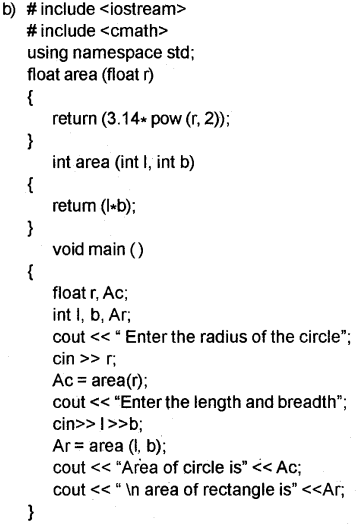
A program is implemented to find the area of a circle and area of a rectangle with two functions having same name but with different signature. [MAY-2016]
a) Name the concept (1)
b) Explain this concept by writing the above program. (2)
Answer:
a) Polymorphism
Plus Two Computer Science Chapter Wise Previous Questions Chapter 1 Structures and Pointers 1
Here the function names are same but the return type and number of parameters are different hence distinguish the functions.

Question 7.
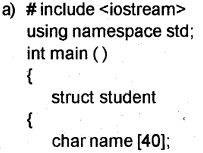
a) Write a C++ program to store and print information (name, roll and marks) of a student using structure. [MAY-2016] (3)
OR
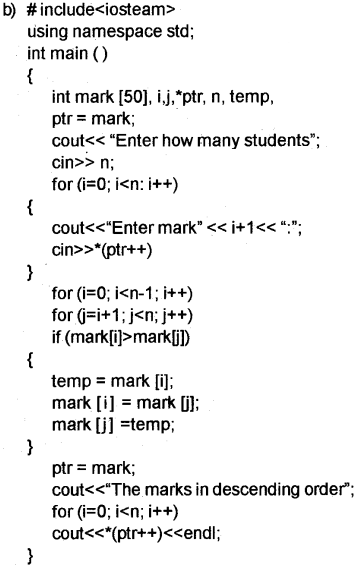
b) Write a program in C++ to input the total marks obtained by a group of students in a class and dis-play them in descending order using pointer. (3)
Answer:
Plus Two Computer Science Chapter Wise Previous Questions Chapter 1 Structures and Pointers 2
Plus Two Computer Science Chapter Wise Previous Questions Chapter 1 Structures and Pointers 3
OR
Plus Two Computer Science Chapter Wise Previous Questions Chapter 1 Structures and Pointers 4

Question 8.
Compare the aspects of arrays and structures. [March – 2017] (3)
Answer:
Array-: An array is a collection of elements with same data fypeOr with the same name we can store many elements, the first or second or third etc can be distinguished by using the index(subscript). The first element’s index is 0, the second elements index is 1, and so on.

To store 100 numbers the array declaration is as follows

int n[100]; By this we store 100 numbers. The index of the first element is O and the index of last element is 99.

Structure -: But a Structure is a group of different types of Ipgically related data referenced by a single name.
Eg. The collection of details of a student that may contain various data with different data types.

Eg.

struct student
{
int adm_no;
char name[40];
float weight;
};

OR

StructureArray
Differences
1. It is a user-defined data type
Predefined data type
2. It is a collection of different types of logically related data under one name.Collection of data elements of same data type having a common name.
3. Elements referenced using dot operator(.)Elements reference using its subscripts (position value)
4. When an element of a structure becomes another structure nested structure and complex structures are formed.When an element of another becomes another array, multidimensional arrays are formed.
5. Structure contains array as its elementsArray of structure can be formed.

Question 9.
Run time allocation of memory is triggered by the operator. [March – 2017] (1)
Answer:
new

Question 10.
Represent the names of 12 months as an array of strings. [March – 2017]
OR
A structure can contain another structure. Discuss. (2)
Answer:
char month(1 2)[]={ “Jan”,”Feb”,”Mar”, “Apr”,May”,“Jun”,”July”,”Aug”, “Sep”,Oct”,“Nov”,”Dec”};
OR
Yes It is possible. This is called nested structure.
Eg.

struct date
{
short day,month,year’
};
struct student
{
inl reg_no;
char name[40];
date dob;
};

Plus Two Computer Science Chapter Wise Practice Questions Chapter 1 Structures and Pointers

Question 1.
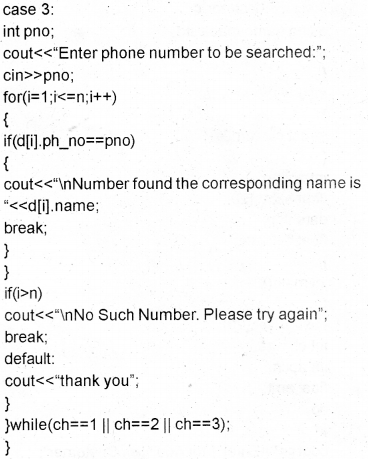
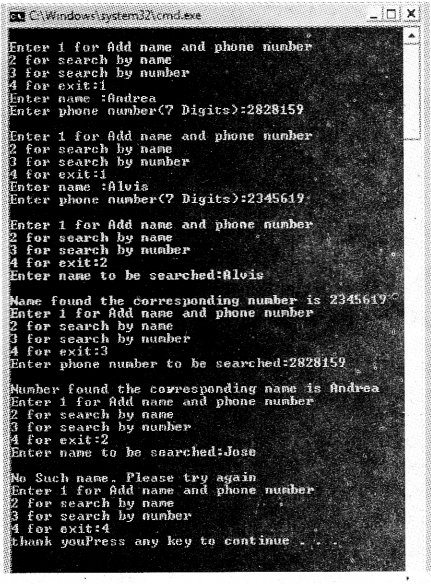
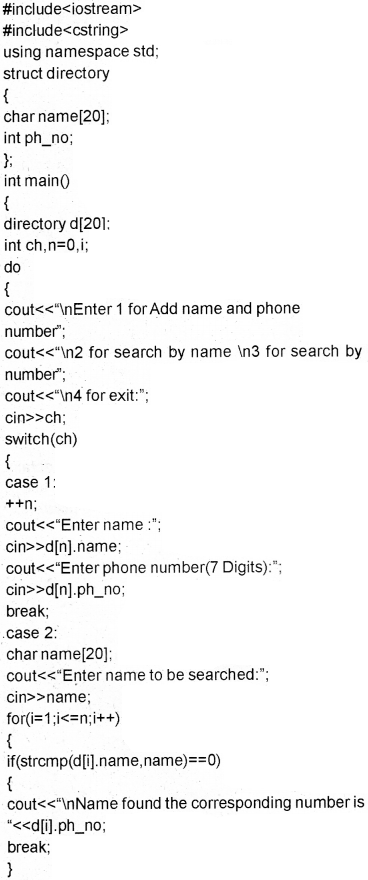
Define a structure to represent the details of telephone subscribers which include name of the subscriber and telephone number. Write a menu driven program to store the details of some subscribers with options for searching the name for a given number, and the number for a given name.
Answer:
Plus Two Computer Science Chapter Wise Previous Questions Chapter 1 Structures and Pointers 5
Plus Two Computer Science Chapter Wise Previous Questions Chapter 1 Structures and Pointers 6
Plus Two Computer Science Chapter Wise Previous Questions Chapter 1 Structures and Pointers 7
Plus Two Computer Science Chapter Wise Previous Questions Chapter 1 Structures and Pointers 8

Question 2.
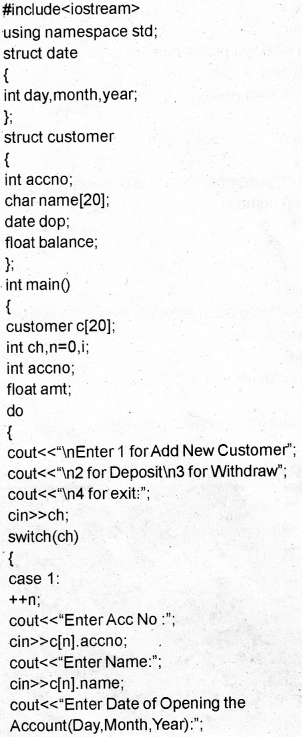
Define a structure to represent the details of customers in a bank. The details include account number, name, date of opening the account and balance amount. Write a menu driven program to input the details of a customer and provide options to deposit, withdraw and view the details. During deposit and withdrawal, proper update is to be made in the balance amount. A minimum balance of Rs. 1000/- is a must in the account.
Answer:
Plus Two Computer Science Chapter Wise Previous Questions Chapter 1 Structures and Pointers 9
Plus Two Computer Science Chapter Wise Previous Questions Chapter 1 Structures and Pointers 10
Plus Two Computer Science Chapter Wise Previous Questions Chapter 1 Structures and Pointers 11

Question 3.
Write a program to input the TE scores obtained by a group of students in Computer Science and display them in the descending order using pointers.
Answer:
Plus Two Computer Science Chapter Wise Previous Questions Chapter 1 Structures and Pointers 12
Plus Two Computer Science Chapter Wise Previous Questions Chapter 1 Structures and Pointers 13

Question 4.
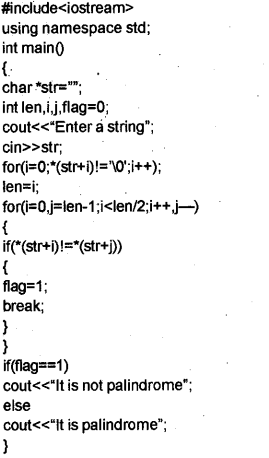
Write a program to input a string and check whether it is palindrome or not using character pointer.
Answer:
Plus Two Computer Science Chapter Wise Previous Questions Chapter 1 Structures and Pointers 14

Question 5.
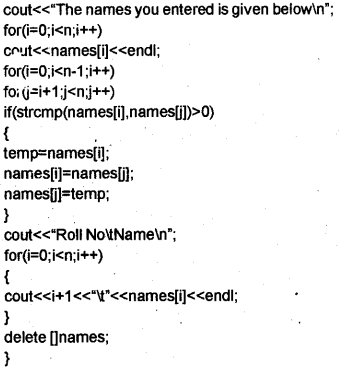
Write a program to input the names of students in a class using pointers and create a roll list in which the names are listed in alphabetical order with roll number starting from 1.
Answer:
Plus Two Computer Science Chapter Wise Previous Questions Chapter 1 Structures and Pointers 15
Plus Two Computer Science Chapter Wise Previous Questions Chapter 1 Structures and Pointers 16

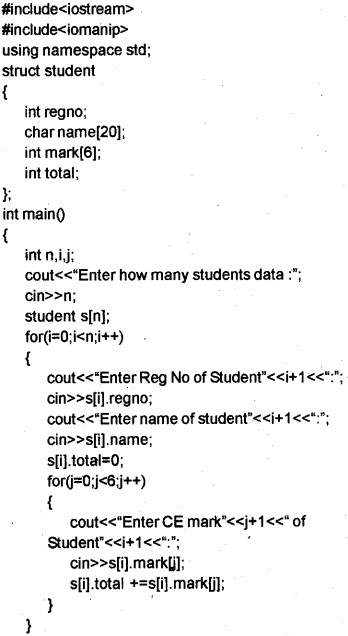
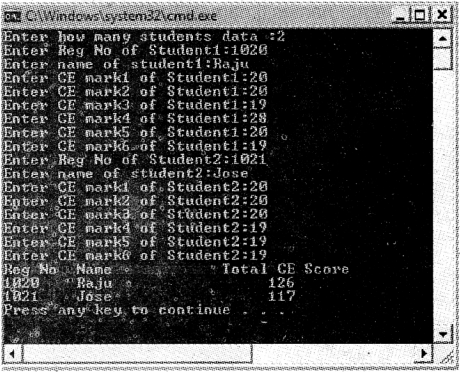
Question 6.
Define a structure student with the details register number, name and CE marks of six subjects. Using a structure pointer, input the details of a student and display register number, name and total CE score.
Answer:
Plus Two Computer Science Chapter Wise Previous Questions Chapter 1 Structures and Pointers 17
Plus Two Computer Science Chapter Wise Previous Questions Chapter 1 Structures and Pointers 18
Plus Two Computer Science Chapter Wise Previous Questions Chapter 1 Structures and Pointers 19

Plus Two Computer Science Assess Question and Answers

Question 1.
Compare array arid structure in C++.
Answer:

StructureArray
Differences
1. It is a user defined data type
2. It is a collection of different types of logically related data under one name.
3. Elements referenced using dot operator(.)
4.When an element of a structure becomes another structure nested structure and complex structures are formed.
5. Structure contains array as its elements
Predefined data type
Collection of data elements of same data type having a common name.
Elements reference using its subscripts (position value).
When an element of another becomes another array, multidimensional arrays are formed.
Array of structure can be formed.

Question 2.
Identify the errors in the following structure definition and write the reason for each:

struct
{
int roll, age;
float fee= 1000:
};

Answer:
Errors
1) No name for the structure.
The correct structure is as follows

struct student
{
short roll.age:;
float fee=1000;
}

Question 3.
Read the following structure definition and answer the following questions:

Struct Book
{
int book_no;
char bk_name [20];
struct
{
short dd;
short mm;
short yy;
} dI_of_purchase;
float price;
};

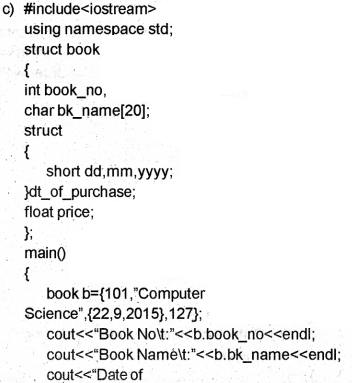
a) Write a C++ statement to declare a variable to refer to the details of a book. What is the memory requirement of this variable? Justify your answer.
b) Write a C++ statement to initialize this variable with the details of your Computer Science text book.
c) Write C++ statement (s) to display the details of the book.
d) The missing of structure tag in the inner structure does not cause any error. State whether this is true or false. Give reason.
Answer:
a) Book b;
The memory requirements are as follows

variable Memory Size
book_no 4
bk_name 20
dt_of_purchase 2+2+2=6
price 4

A total of 34 Bytes allocated to the variable b.

b) book b={101 .”Computer Science”,{22,9,2015},127};

Plus Two Computer Science Chapter Wise Previous Questions Chapter 1 Structures and Pointers 20
Plus Two Computer Science Chapter Wise Previous Questions Chapter 1 Structures and Pointers 21

d) This is true. There is no need to mention the structure tag because it is declared inside the structure.

Question 4.
“Structure is a user-defined data type”. Justify this statement with the help of an example.
Answer:
Yes it is true. A user can give define according to his needs.
Plus Two Computer Science Chapter Wise Previous Questions Chapter 1 Structures and Pointers 22

Question 5.
Read the following statements:
i) While defining a structure in C++, tag may be omitted.
ii) The data contained in a structure variable can be copied into another variable only if both of them are declared using the same structure tag.
iii) Elements of a structure is referenced by stmcture_name. element
iv) A structure can contain another structure.
Now, Choose the correct option from the following:
a) Statements (i) and (ii) are true
b) Statements (ii) and (iv) are true
c) Statements (i), (ii) and (iv) are true
d) Statements (i) and (iii) are true jtyg
Answer:
d) Statements (i) and (iii) are true.

Question 6.
Read the following C++ statements:
int * p, a=5
p=&a;
a) What is the speciality of the variable p?
b) What will be the content of p afterthe execution of the second statement?
c) Howdo the expressions *p+1 and* (p+1) differ?
Answer:
a) p is special variable and it is called a pointer.
b) p contains the address of the variable a

Plus Two Computer Science Chapter Wise Previous Questions Chapter 1 Structures and Pointers 23

Here p+1 returns (address of the variable a) +4(4 is the size of int data type in Geany C++). *(p+1) returns the content of this next address location.

Question 7.
Identify the errors in the following C++ code segment and give the reason for each.

int p, *q a=5;
float b2;
p=&a;
cout<<p<<*p<<*a;
if (p<q)coLit<<p;
cout<<cp *a;

Answer:
Following are the errors
1) Here q is an integer pointer it can not store the address of float variable b.
2) Cannot print *a.
3) The pointers p and q are different data types so cannot use relational operator.

The correct code is as given below.
Plus Two Computer Science Chapter Wise Previous Questions Chapter 1 Structures and Pointers 24

Question 8.
While writing a program, the concept of dynamic memory allocation is applied. But the program does not contain a statement with delete operator and it creates a problem. Explain the problem.
Answer:
If the memory allocated using new operator is not de allocated using delete, that memory is left unused and not released forfurtherallocation. Such memory blocks are called orphaned memory. On each execution the amount of orphaned block is increased. This situation is called memory leak.

Question 9.
Read the C++ statements given below and answer the following questions: •
int ar[] = {34,12, 25,56, 38};
int *p = ar;
a) What will be the content of p?
b) What is the output of the expression: *p + *(ar+2)?
c) The statement ar++; is invalid. Why? How does it differ from p++;?
Answer:
a) 34
b) *p=34 and *(ar+2)=25
then *p+*(ar+2)=34+25=59.
c) ar++ is invalid but p++ valid, p is the pointer, pointer arithmetic is allowed.

Question 10.
Explain the working of the following code segment and predict the output:
char *str = “Tobacco Kills”;
for (int i=0; str [i] !=’\0’; i++)
if (i>8)
* (str +i) = toupper (*(str+i);
cout«str;
Answer:
The output is “Tobacco KILLS”. The toupperO function convert the characters into upper case from ninth characteronwards.

Question 11.
Observe the following C++ statements:
int ar [ ] = {14, 29, 32,63, 30};
One of following expressions cannot be used to access the element 32. Which is that?
a) ar [2] b)ar[*ar%3] c)*ar+2 d)*(ar+2)
Answer:
c) *ar+2.
*ar returns 14 and *ar+2 gives 14+2=16.

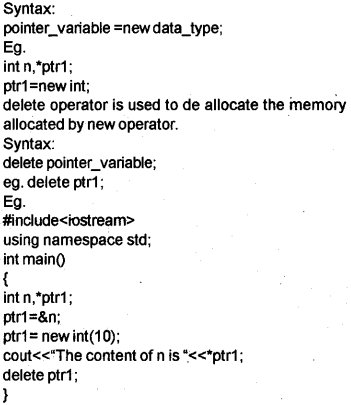
Question 12.
Explain the operations performed by the operators new and delete with the help of examples.
Answer:
new operator is used to allocate memory dynamically

Syntax:
pointer_variable =newdata_type;
Plus Two Computer Science Chapter Wise Previous Questions Chapter 1 Structures and Pointers 25

Question 13.
What is meant by memory leak? What are the reasons for it? How can we avoid such a situation?
Answer:
If the memory allocated using new operator is not de allocated using delete , that memory is left unused and not released for further allocation. Such memory blocks are called orphaned memory. On each execution the amount of orphaned block is increased. This situation is called memory leak. Use delete operator to avoid this.

Question 14.
Compare the following two statements, int a=5;
int*a=newint(5);
Answer:
int a=5; This means ‘a’ is an integer variable that is initialized with the integer value 5.
int *a=new int(5). Here ‘a’ is a pointer variable and it allocates memory dynamically and stores a value 5.

Question 15.
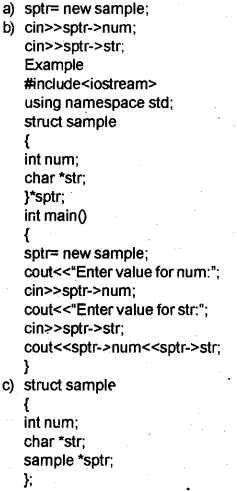
Read the structure definition given below and answer the following questions:

struct sample
{
int num;
char *str;
} *sptr

a) Write C++ statements to dynamically allocate a location for sample type data and store its address in sptr.
b) Write C++ statements to input data into the location pointed to by sptr.
c) Modify this structure into a self-referential structure.
Answer:
Plus Two Computer Science Chapter Wise Previous Questions Chapter 1 Structures and Pointers 26

Plus Two Business Studies Notes Chapter 13 Entrepreneurial Development

Kerala State Board New Syllabus Plus Two Business Studies Notes Chapter 13 Entrepreneurial Development.

Kerala Plus Two Business Studies Notes Chapter 13 Entrepreneurial Development

Meaning

All activities undertaken by an entrepreneur to bring a business unit into existence are collectively known as entrepreneurship. An entrepreneur is a person who undertakes the risk of a new enterprise. The business unit is called an enterprise.

Characteristics of Entrepreneurship

  • It is a systematic and purposeful activity.
  • The object of entrepreneurship is a lawful business.
  • Entrepreneurship is a creative response to the environment and the ability to exploit an economic opportunity.
  • It is concerned with employing, managing, and developing the factors of production.
  • Entrepreneurship involves risk. Profit is the reward of risk taking.

Relationship between Entrepreneurship and Management

Entrepreneurship:

  • The main motive of an entrepreneur is to start a venture by setting up an enterprise.
  • An entrepreneur is the owner of the enterprise.
  • An entrepreneur assumes all risks and uncertainty.
  • An entrepreneur gets profit.
  • An Entrepreneur acts as an innovator.
  • Entrepreneur is self motivated

Management:

  • The main motive of a manager is to render his services in an enterprise already set up by someone.
  • A manager is the servant in the enterprise.
  • A manager does not bear any risk involved in the enterprise.
  • A manager gets salary.
  • Manager executes the plans prepared by the entrepreneur.
  • Manager is motivated by entrepreneur.

Functions (Role) of Entrepreneurs in Relation to Economic Development

1) Contribution to GDP: Entrepreneurs explore and exploit opportunities, encourage effective resource mobilisation of capital and skill, bring in new products and services and develops markets for growth of the economy. In this way, they help increasing gross national product (GDP) as well as per capita income of the people in a country.

2) Capital Formation: Entrepreneurs promote capital formation by mobilising the idle savings of public. They employ these resources for setting up an enterprise.

3) Generation of Employment: With the setting up of more andmore business units by entrepreneurs, a large number of employment opportunities are created.

4) Promotes Balanced Regional Development: Entrepreneurs help to remove regional disparities through setting up of industries in less developed and backward areas.

5) Reduces Concentration of Economic Power: A large number of entrepreneurs needs to be developed, which will help reduce the concentration of economic power amongst the population.

6) Improvement in the Standard of Living: Entrepreneurs enables the people to avail better quality goods at lower prices which results in the improvement of their standard of living.

7) Promotes Export Trade: Entrepreneurs help in promoting a country’s export-trade, which is an important ingredient of economic development.

8) Facilitates Overall Development: The entrepreneurs multiply their entrepreneurial activities, thus creating an environment of enthusiasm and invite others for overall development of the area.

Role of Entrepreneurs in Relation to their Enterprise

  • Perceiving market opportunities
  • Gaining command over scarce resources.
  • Marketing of the products.
  • Face the competition
  • Dealing with public bureaucracy (concession, licenses and taxes)
  • Managing the human relation within the firm.
  • Managing customer and supplier relations.
  • Managing finance.
  • Acquiring and overseeing assembly of the factory.
  • Improve the quality of the products

Process of Setting up a Business

Plus Two Business Studies Notes Chapter 13 Entrepreneurial Development 1

Entrepreneurial Competencies

  • He has the ability to take or initiate the first move towards setting up of an enterprise.
  • He is always on the lookout or searching for opportunity and is ready to exploit it in the best interest of the enterprise.
  • Successful entrepreneur finds ways to do things faster with fewer resources at tower costs.
  • He belives in systematic planning and its proper execution to reach goals.
  • An entrepreneur is never disheartened by failures. He follows try-try again for overcoming the obstacles.
  • An entrepreneur is always in search of new ideas from various sources.
  • He has the ability to understand and solve business problems.
  • He must be optimistic

Qualities of an entrepreneur can be summarised as follows

Plus Two Business Studies Notes Chapter 13 Entrepreneurial Development 2

Entrepreneurial Motivation

The entrepreneurial motivation may be defined as the process that activates and motivates the entrepreneur to exert higher level of efforts for the achievement of organisational goals.

1) Need for Achievement (N-Ach.): Need for achievement implies a desire to accomplish something difficult. They are intrinsically motivated. They prefer work that has a moderate chance for success (about 50/50) and tend to avoid situations that are low-risk and those that are high-risk.

2) Need for Power (N-Pow): Need for Power is the concern for influencing people or the behaviour of others for moving in the chosen direction and attaining the envisioned objectives.

3) Need for Affiliation (N-Aff.): The need for affiliation is characterised by a desire to belong, an enjoyment of teamwork, a concern about interpersonal relationships, etc.

4) Need for Autonomy (N-Aut.): The need for autonomy is a desire for independence and being responsible and accountable to oneself rather than some external authority for performance.

Entrepreneurial Values and Attitudes

Entrepreneurial values and attitudes refer to the behavioural choices of individuals make for success in entrepreneurship.

Plus Two Business Studies Notes Chapter 12 Consumer Protection

Kerala State Board New Syllabus Plus Two Business Studies Notes Chapter 12 Consumer Protection.

Kerala Plus Two Business Studies Notes Chapter 12 Consumer Protection

Meaning

There is a need for providing adequate protection to consumers against unscrupulous, exploitative and unfair trade practices of the sellers.

Importance of Consumer Protection

1) From Consumers’ point of view:

  • It is necessary to educate the customers about their rights.
  • Consumers need to be organised in the form of consumer organisations that would take care of their interests.
  • To protect consumers from unscrupulous, exploitative, and unfair trade practices.

2) From the Point of View of Business:

  • Business firms should aim at long-term profit maximization through customer satisfaction.
  • Business organisations use resources that belong to society.
  • A business has social responsibilities towards various interest groups.
  • It is the moral duty of any business to take care of consumer’s interest and avoid any form of their exploitation.
  • A business engaging in any form of exploitative trade practices would invite government intervention or action.

Legal Protection to Consumers

The Indian legal framework consists of a number of regulations which provide protection to consumers.
They are:

  • The Consumer Protection Act 1986
  • The Indian Contract Act 1812
  • The Sale of Goods Act 1930
  • The essential commodities Act 1955
  • The Agricultural Produce (Grading & Marketing) Act 1937
  • The Prevention of Food Adulteration Act 1954
  • The Standards of Weights and Measures Act 1976
  • The Trade Marks Act of 1999
  • The Competition Act 2002
  • The Bureau of Indian Standards Act 1986.

The Consumer Protection Act, 1986 (CPA): The Consumer Protection Act was passed in 1986 and it came into force from 1 July 1987. The main objectives of the Act are to provide better and all-round protection to consumers and effective safeguards against different types of exploitation. It also makes provisions for simple, speedy, and inexpensive machinery for redressal of consumers’ grievances.

Features of Consumer Protection Act 1986:

  • It applies to all goods and services except the goods exempted by the government.
  • Public, private and the co-operative sectors are covered by the Act.
  • It safeguards consumers against different types of exploitation.
  • It covers important consumer rights.

Consumer Rights

  • Right to Safety: The consumer has a right to be protected against goods and services which are hazardous to life and health.
  • Right to be Informed: The consumer has a right to have complete information about the product he intends to buy including its ingredients, date of manufacture, price, quantity, directions for use, etc.
  • Right to Choose: The consumer has the freedom to choose from a variety of products at competitive prices.
  • Right to be Heard: The consumer has a right to file a complaint and to be heard in case of dissatisfaction with goods or services.
  • Right to seek Redressal: The consumer has a right to get relief in case the product or service falls short of his expectations.
  • Right to Consumer Education: The consumer must be educated about the rights and remedies available under different laws.

Consumer’s Responsibilities

  • Be aware of various goods and services available in the market.
  • Buy only standardised goods as they provide quality assurance.
  • Learn about the risks associated with products and services, follow the manufacturer’s instructions and use the products safely.
  • Read labels carefully so as to have information about prices, net weight, manufacturing and expiry dates, etc.
  • Choose only from legal goods and services.
  • Ask for a cash memo on purchase of goods or services.
  • File a complaint in an appropriate consumer forum in case of poor quality of goods or services.
  • Form consumer societies which would play an active part in educating consumers.

Ways and Means of Consumer Protection

  • Self Regulation by Business: Many firms have set up their customer service and grievance cells to redress the problems and grievances of their consumers.
  • Business Associations: The Associations of trade, commerce and business like Federation of Indian Chambers of Commerce of India (FICCl) and Confederation of Indian Industries (Cl I) have laid down their code of conduct for their members in their dealings with the customers.
  • Consumer Awareness: A consumer, who is well informed about his rights, responsibilities and the reliefs available to him, would be in a position to raise his voice against any unfair trade practices or unscrupulous exploitation.
  • Consumer Organisations: Consumer organisations play an important role in educating consumers about their rights and providing protection to them.
  • Government: The government can protect the interests of the consumers by enacting various legislations.

Redressal Agencies under the Consumer Protection Act 1986

For the redressal of consumer grievances, the Consumer Protection Act provides for setting up of a three-tier enforcement machinery at the District, State, and the National levels. They are:

  1. District Forum
  2. State Commission
  3. National Commission

1) District Forum: This is established in each district by the state government. The District Forum consists of a president and two other members. A complaint can be made to the appropriate District Forum when the value of the goods or services and compensation claimed does not exceed Rs. 20 lakh. In case the aggrieved party is not satisfied with the order of the District Forum, he can appeal before the State Commission within 30 days of the passing of the order.

2) State Commission: It is established by the state government. The State Commission consists of a president and not less than two other members. A complaint can be filed before the State Commission where the value of goods or services and the compensation claimed exceeds Rs. 20 lakh but does not exceed Rs. 1 crore.ln case the aggrieved party is not satisfied with the order of the State Commission he can appeal to the National Commission within 30 days of passing of the order.

3) National Commission: The National Commission was constituted by the central government. The National Commission consists of a president and at least four other members. It is the apex body in the three-tier judicial machinery set up by the government for the redressal of consumer grievances. All complaints pertaining to those goods or services and compensation whose value is more than Rs. 1 crore can be filed directly before the National Commission. An appeal can be filed against the order of the National Commission to the Supreme Court within 30 days from the date of order passed.

Relief Available to Consumers (Remedies)

  • To remove the defect in goods or deficiency in service.
  • To replace the defective product with a new one, free from any defect.
  • To refund the price paid for the product.
  • To pay a reasonable amount of compensation for any loss or injury suffered by the consumer.
  • To discontinue the unfair/restrictive trade practice.
  • Not to offer hazardous goods for sale.
  • To withdraw the hazardous goods from sale.
  • To issue corrective advertisement to neutralise the effect of a misleading advertisement.

Role of Consumer Organisations and Non-governmental Organizations (NGOs.)

  • Educating the general public about consumer rights by organising training programmes, seminars, and workshops.
  • Publishing periodicals and other publications.
  • Collecting various samples of different goods and testing their quality.
  • Encouraging consumers to protest against exploitative and unfair trade practices of sellers.
  • Providing legal assistance to consumers by way of providing aid, legal advice, etc.
  • Filing complaints inappropriate consumer courts on behalf of the consumers.
  • Encouraging consumers to boycott defective goods.
  • Encouraging consumers to purchase consumer-friendly products.
  • Taking an initiative in filing cases in consumer courts in the interest of the general public.

Some of the important consumer organisations and NGOs engaged in consumer protection are:

  • Consumer Co-ordination Council, Delhi.
  • Voluntary Organisation in Interest of Consumer Education (VOICE).
  • Common Cause, Delhi.
  • Consumer Protection Council, Ahmedabad.
  • Consumer Guidance Society of India, Mumbai.
  • Consumer’s Association, Kolkatta, etc.

Consumer

Under the Consumer Protection Act, a consumer is defined as:

  1. Any person who buys any goods for consideration.
  2. Any person who hires or avails of any service, for a consideration.

Who can File a Complaint?: Complaint before the appropriate consumer forum can be made by

  • Any consumer.
  • The Central Government or any State Government.
  • One or more consumers, on behalf of numerous consumers having the same interest.
  • A legal heir or representative of a deceased consumer.

Plus Two Business Studies Notes Chapter 11 Marketing Management

Kerala State Board New Syllabus Plus Two Business Studies Notes Chapter 11 Marketing Management.

Kerala Plus Two Business Studies Notes Chapter 11 Marketing Management

Market

It refers to a place where the buyers and sellers meet each other for sale and purchase of the commodity.

Marketing

Marketing may be defined as all activities that are facilitating the movement of goods and services from producer to the ultimate consumer.

Features of Marketing

  • Needs and Wants: Marketing focuses on satisfaction of the needs and wants of consumers.
  • Creating a Market Offering: It refers to providing complete information about the product and services like name, type, price, size, etc.
  • Customer Value: A buyer analyses the cost and the satisfaction that a product provides before buying it. The seller should manufacture the product keeping in view this tendency of the customer.
  • Exchange Mechanism: The process of marketing involves exchange of products and services. Exchange is the essence of marketing.

Marketer

Any person, who takes more active role in the exchange process is called marketer.

Marketing Management

It refers to planning, organising, directing and controlling of the activities which facilitate exchange of goods and services between producers and consumers.

Differences between Marketing and Selling

Marketing:

  1. Marketing is a wider term consisting of number of activities.
  2. It is concerned with product planning and development.
  3. It focuses on maximum satisfaction of the customer.
  4. It aims at profits through consumer satisfaction.
  5. Marketing begins before actual production.
  6. It is customer oriented. Customer is important.
  7. The principle of “let the seller beware” is followed.

Selling:

  1. It is a narrow concept.
  2. It is concerned with sale of goods already produced.
  3. It focuses on the maximum satisfaction of the sellers through the exchange of products.
  4. It aims at maximum profit through maximisation of sales.
  5. Selling takes place after the production.
  6. It is product oriented. Product is more important.
  7. The principle of “let the buyer” beware is followed.

Marketing Concepts

1) The Production Concept: This concept believed that profits could be maximised by producing at large scale, thereby reducing the cost of production. Here greater emphasis was given on improving the production and distribution.
2) The Product Concept: According to this concept quality of the product is more important than quantity. Product improvement became the key to profit maximisation of a firm, under the concept of product orientation.
3) The Selling Concept: This concept focuses on the sale of products through aggressive selling and promotional techniques to persuade the buyers to buy the products,
4) The Marketing Concept: Marketing concept implies that focus on satisfaction of customer’s needs is the key to the success of any organisation in the market. Customer’s satisfaction becomes the focal point of all decision making in the organisation.
5) The Societal Marketing Concept: This concept stresses not only the customer satisfaction but also gives importance to the welfare of the society.

Functions of Marketing

1) Marketing Research: Marketing Research is a process of collecting and analysing market information to identify the needs and wants of the customers.
2) Marketing Planning: Another function of marketing is to develop appropriate marketing plans so that the marketing objectives of the organisation can be achieved.
3) Product Designing and Development: The products are designed and developed according to the needs and wants of the consumers. It requires decision making on various aspects such as the product to be manufactured, its packing, selling price, quality of the product, etc.
4) Standardisation and Grading: Standardisation refers to producing goods of predetermined specifications. Grading is the process of classification of products info different groups, on the basis of quality, size, etc.
5) Packaging and Labelling: Packaging refers to designing and developing the package forthe products. Packaging gives protection to goods. Also it attracts the consumers to buy the product. Labelling refers to designing and developing the label to be put on the package.
6) Branding: A brand is a name, term, sign, symbol, design or some combination of them, used to identify the products of one seller and to differentiate them from those of the competitors.
7) Customer Support Services: An important function of the marketing management is to develop customer support services such as after sales services, handling customer complaints, etc. which provides maximum satisfaction to the customers.
8) Pricing: Price of a product refers to the amount of money which customers have to pay to obtain a product. Price is an important factor affecting the success or failure of a product in the market. Price is fixed after taking into account the cost of production, desired profit, competitor’s price, govt, policy, etc.
9) Promotion: Promotion of products and services involves informing the customers about the firm’s product, its features, etc. and persuading them to purchase these products. It includes Advertising, Personal Selling, Publicity and Sales Promotion.
10) Physical Distribution: It includes decision regarding channels of distribution and physical movement of the product from the production centre to the consumption centre.
11) Transportation: Transportation involves physical movement of goods from one place to another. It removes the hindrance of place and creates time utility.
12) Storage or Warehousing: In order to maintain smooth flow of products in the market, there is a need for proper storage of the products. It stabilizes the prices of products and keep the product without damage until they are sold.

Role/Objectives of Marketing

1) Role in a Firm: Modern marketing emphasises that customer satisfaction is the key to the survival and growth of an organization. A satisfied customer is the most valuable asset of any firm. So product must be designed according to the needs and wants of the consumers, ensure fair distribution and determine an appropriate pricing strategy.

2) Role in the Economy: Marketing plays a significant role in the economic development of a nation. Marketing helps to increase the standard of living of the people by providing quality goods at reasonable prices. Marketing accelerates the economic activity leading to higher incomes, more consumption and increased savings and investment.

Marketing Mix

It refers to the combination of four basic marketing tools (Product, Price, Place and Promotion) that a firm uses to pursue its marketing objectives in a target market.

Plus Two Business Studies Notes Chapter 11 Marketing Management 1

Elements/4 P’s of Marketing Mix

1) Product: Product means goods or services or ‘anything of value’, which is offered to the market for sale. The important product decisions include deciding about the features, quality, packaging, labelling and branding of the products.

2) Price: Price is the amount of money paid by the customers to pay to obtain the product. In most of the products, price affects the demand of the products. Desired profits, cost of production, competition, demands, etc. must be considered before fixing the price of a product.

3) Place: Place or Physical Distribution includes activities that make firm’s products available to the target customers. Important decision areas in this respect include selection of dealers, storage, warehousing and transportation of goods from the place of production to the place of consumption.

4) Promotion: Promotion includes activities that communicate availability, features, merits, etc. of the products to the target customers and persuade them to buy it. It includes advertising, personal selling, sales promotion and publicity to promote the sale of products.

Product

Product may be defined as anything that can be offered to a market to satisfy a want or need. Products may broadly be classified into two categories.

  1. Consumers products
  2. Industrial products

Consumers’ products

Products, which are purchased by the ultimate consumers for satisfying their personal needs and wants are referred to as consumer products.
Consumer products are classified as
a) Shopping efforts involved
b) Durability of products

a) Shopping Efforts Involved: On the basis of the time and effort, buyers are willing to spend in the purchase of a product, we can classify the consumer product into three.
1) Convenience Products: Those consumer products, which are purchased frequently, immediately and with least time and efforts are referred to as convenience goods, e.g. ice creams, medicines, newspaper, stationery items, toothpaste, etc.

2) Shopping Products: Shopping products are those consumer goods, which buyers devote considerable time, to compare the quality, price, style, suitability, etc., at several stores, before making final purchase, e.g. clothes, shoes, jewellery, furniture, etc.

3) Speciality Products: Speciality products are those consumer goods which have certain special features because of which people make special efforts in their purchase. The buyers are willing to spend a lot of time and efforts on the purchase of such products. The demand for these goods is inelastic.

b) Durability of Products: On the basis of their durability, the consumer products have been classified into three. They are:

1) Durable Products: Durable goods are used for a long period. Such goods generally require more personal selling efforts, have high profit margin, and require aftersales service.
e g. refrigerator, car, washing machine, etc.

2) Non-durable Products: The consumer products which are normally consumed in one or few uses are called non-durable products, e.g. toothpaste, detergents, bathing soap and stationery products, etc.

3) Services: Services are essentially intangible activities which provide want or need satisfaction, e.g. Medical treatment, postal, banking and | insurance services, etc.

Industrial Products

Industrial products are those products, which are used as inputs in producing other products. The examples of such products are raw materials, engines, lubricants, machines, tools, etc.

Types of industrial products:

  1. Materials and Parts: These include goods that enter the manufacture’s products completely.
  2. Capital Items: These goods are used in the production of finished goods.
  3. Supplies and Business Services: These are short lasting goods and services that facilitate developing or managing the finished product.

Branding

The process of giving a name or a sign or a symbol, etc. to a product is called branding. Terms related with branding

  • Brand: A brand is a name, term, sign, symbol, design or some combination of them, used to identify the products of one seller or group of sellers and to differentiate them from those of the competitors.
  • Brand Name: That part of a brand, which can be vocalized i.e., can be spoken is called a brand name, e.g. Asian Paints, Maggie, Lifebuoy, Dunlop, etc.
  • Brand Mark: A brand mark is that part of a brand which can be recognized but cannot be vocalized, i.e., non-utterable. It appears in the form of a symbol, design or distinct colour scheme. For example:‘Girl’of Amul.
  • Trade Mark: A brand or part of a brand that is given legal protection against its use by other firms is called trade mark. The firm which got its brand registered with the government, gets the exclusive right for its use.-/*

Advantages of Branding

Advantages to the Firm:

  • Branding helps a firm in distinguishing its product from that of its competitors.
  • It helps in advertising and display Programmes.
  • Branding enables a firm to charge competitive price for its products than that charged by its competitors.
  • It helps in Introduction of new product in the market.

Advantages to Customers:

  • Branding helps the customers in identifying the products.
  • Branding ensures a particular level of quality of the product.
  • Some brands become status symbols because of their quality. It creates a feeling of proud and satisfaction in the consumers.

Qualities of a Good Brand Name

  • The brand name should be short, easy to pronounce, spell, recognise and remember.
  • A brand should suggest the product’s benefits and qualities.
  • A brand name should be distinctive.
  • Brand name should be adaptable to packing or labelling requirements, to different advertising media and to different languages.
  • The brand name should be sufficiently versatile to accommodate new products.
  • It should be capable of being registered and protected legally.

Packaging

Packaging refers to the act of designing and producing the container or wrapper of a product. Packaging plays a very important role in the marketing success or failure of products.

Levels of Packaging:

  • Primary Package: It refers to the product’s immediate container, e.g. toothpaste tube, match box, etc.
  • Secondary, Packaging: It refers to additional layers of protection that are kept till the product is ready for use.
  • Transportation Packaging: It refers to further packaging components necessary for storage, identification or transportation.

Functions of Packaging:

  • Packaging helps in identification of the products.
  • Packaging protects the product from spoilage, breakage, leakage, etc.
  • It facilitates easy transfer of goods to customers.
  • Packaging provides convenience in the storage of the product.
  • It attracts the consumers to purchase the product.

Labelling

Labelling means putting identification marks on the package. It is a simple tag attached to the product.

Functions of Labelling:

  • It describes the product, its usage, cautions in use, etc. and specify its contents.
  • It helps in identifying the product.
  • It helps grading the products into different categories.
  • It helps in promotion of products.
  • It provides information required by law.

Pricing

Price may be defined as the amount of money paid by a buyer in consideration of the purchase of a product or a service.

Factors Affecting Price Determination:
1) Product Cost: One of the most important factors affecting price of a product or service is its cost of production and distribution. Fixed Costs, Variable Costs and Semi- Variable Costs are to be considered for determining the price.

2) Demand: The price of a product is affected by the elasticity of demand of the product. If the demand of a product is inelastic, the firm is in a better position to fix higher prices.

3) Competition: Competitors’ prices and their anticipated reactions must be considered before fixing the price of a product. In case of high competition, it is desirable to keep price low.

4) Government and Legal Regulations: In order to protect the interest of public against unfair practices, prices of some essential products are regulated by the government under the Essential Commodities Act., e.g. Medicines.

5) Pricing Objectives: Another important factor affecting the fixation of price of a product is pricing objectives, e.g. maximisation of profit, market share, etc.

Place (Physical Distribution)

The third element of marketing mix is physical distribution of products and services. In order to ensure availability of products at the right place, two factors require consideration.

  1. Channels of distribution
  2. Physical distribution

Channels of Distribution

A channel of distribution refers to the pathway used by the manufacturer for transfer of the ownership of goods and its physical transfer to the consumers.

Types of Channels:

  1. Direct channel (Zero level): Producer → Consumer
  2. One level channel: Producer → Retailer → Consumer
  3. Two level channel: Producer → Wholesaler → Retailer → Consumer
  4. Three level channel: Producer → Agent → Wholesaler → Retailer → Consumer

Physical Distribution

Physical distribution covers all the activities required to physically move goods from manufacturers to the customers.

Components of Physical Distribution

  • Order Processing
  • Transportation
  • Warehousing
  • Inventory Control

Promotion Mix

Promotion mix refers to combination of promotional tools such as Advertising, Personal Selling, Sales Promotion, and Publicity used by an organisation to achieve its communication objectives.

Plus Two Business Studies Notes Chapter 11 Marketing Management 2

Advertising

Advertising may be defined as “any paid form of non-personal presentation and promotion of ideas, goods or service of an identified sponsor”.

Merits of Advertising:
1. Advantages to Manufacturers and Traders

  • Advertising helps in introducing new products.
  • It stimulates the consumers to purchase the new products.
  • Advertisement helps to increase the sales of new and existing products.
  • It helps to increase the goodwill of the firm.
  • It helps to face the competition in the market.
  • It increases profit of the firm through large sales.

2. Advantages to Consumers:

  • It helps the consumers to know about the various products and their prices.
  • Consumers can purchase the better products easily.
  • It helps in maintaining high standard of living.
  • It educates the consumers about the various uses of products.

3. Advantages to the Society:

  • Advertisement helps to create more employment opportunities.
  • It provides an important source of income to the press, radio, T.V., etc.
  • It is a source of encouragement to artists.
  • It plays an important role in economic development of the country.
  • It reduces number of middlemen and consumers get quality products at lower cost.

Disadvantages/Objections to Advertising

  • Advertisement encourages consumers to buy unwanted goods.
  • Most of the advertisements are misleading.
  • Advertisement may lead to monopoly of a brand.
  • Advertisement is a costly affair. So, ultimately it increases the price of the product.
  • Advertisement persuades people to purchase even the inferior products.
  • It undermines social and ethical values.

Personal Selling

Personal selling involves face to face contact between the seller and prospective customer with an intension of selling some products. It is a personal form of communication.

Features of Personal Selling:

  • It is a direct presentation of the product to the consumers.
  • Develop personal relationships with the prospective customers.
  • The sales presentation can be adjusted according to the specific needs of the individual customers.
  • It is possible to take a direct feedback from the customer.

Role of Personal Selling:

1) Importance to Businessmen:

  • It helps in influencing the prospects about the merits of a product and thereby increasing its sale.
  • Personal selling helps to develop lasting relationship between the sales persons and the customers.
  • Personal selling plays very important role in the introduction stage of a new product.
  • Personal selling increases the competitive strength of a business organisation.

2) Importance to Customers:

  • Personal selling helps the customers in identifying their needs and wants.
  • Customers get latest market information.
  • Customers get expert advice and guidance in purchasing various goods and services.
  • Personal selling induces customers to purchase new products.

3) Importance to Society:

  • Personal selling offers greater employment opportunities.
  • Personal selling provides attractive career with greater opportunities.
  • Personal selling increases product standardisation and uniformity in consumption pattern.

Sales Promotion

It refers to those marketing activities other than personal selling, advertising and publicity that stimulate short term sales. Sales promotion activities include offering cash discounts, sales contests, free gift offers, and free sample distribution, etc.

Merits of Sales Promotion:

  • Sales promotion activities attract attention of the people.
  • Sales promotion tools can be very effective at the time of introduction of a new product in the market.
  • Sales promotion helps to increase sales.
  • It creates new customers and retains existing customers.
  • Consumers can purchase quality products at low cost.

Limitations of Sales Promotion:

  • If a firm frequently relys on sales promotion, it creates doubts in the minds of consumers about the quality of the product.
  • Use of sales promotion tools may affect the image of a product.
  • It is a short term incentive.

Techniques of Sales Promotion:

  • Rebate : Offering products at special prices, to clear off excess inventory.
  • Discount: Offering products at less than maximum retail price.
  • Refund: The seller offers to refund a part of the price paid by the customer on production of some proof of purchase.
  • Free gifts: Offering another product as gift along with the purchase of a product.
  • Quantity Gift: Offering extra quantity of the product.
  • Contests: Prize contests are organized for the consumers and winners are given attractive prizes.
  • Money refund: There are certain manufacturers who promise to refund the price of the product, if it does not satisfy the consumer.
  • Samples: Offer of free samples of a product to customers at the time of introduction of a new product.

Publicity

Publicity is a non-paid form of non personal communication. The tools of publicity are press conference, publication and news in the electronic media, etc. It is published or broadcasted without charging any money from the firm.

Features of Publicity:

  1. Publicity is an unpaid form of communication.
  2. There is no identified sponsor for the communication

Difference between Personal Selling and Advertising

Advertising:

  • It is an impersonal form of communication.
  • It is inflexible.
  • Same message is sent to all the customers in a market segment.
  • Advertising lacks direct feedback.
  • The cost per person is very low.

Personal Selling:

  • It is a personal form of communication.
  • It is highly flexible.
  • The sales talk is adjusted according to the customer’s background and needs.
  • Personal selling provides direct and immediate feedback.
  • The cost per person is very high.
Plus Two Business Studies Notes Chapter 10 Financial Markets

Kerala State Board New Syllabus Plus Two Business Studies Notes Chapter 10 Financial Markets.

Kerala Plus Two Business Studies Notes Chapter 10 Financial Markets

Financial Market is a market for creation and exchange of financial assets such as Shares, Debentures, Treasury Bills, Commercial Paper, etc. It helps in mobilisation and channelising the savings into most productive uses.

A financial market also helps in price discovery and provides liquidity to financial assets.

Functions of Financial Market

  • Mobilisation of Savings: Financial markets mobilise savings of investors and channelise it into the most productive use.
  • Facilitating Price Discovery: Financial Market helps in the determination of prices of the financial assets.
  • Providing Liquidity: Financial market facilitates easy purchase and sale of financial assets. Thus, it provides liquidity.
  • Reducing the Cost of Transactions: Financial market provides valuable information about securities which helps in saving time, efforts and money and thus it reduces cost of transactions.

Money Market

The money market is a market for short-term funds, which deals in financial assets whose period of maturity is up to one year. It enables in raising short term fund for meeting day-to-day requirements. The major participants in the money market are the Reserve Bank of India, Commercial Banks, Non-Banking Finance Companies, State Governments, Large Corporate Houses and Mutual Funds.

Money Market Instruments

1) Treasury Bill: They are issued by the RBI on behalf of the Central Government to meet its short¬term requirement of funds. They are issued at a discount on the face value of the instruments and repayable at par. They are issued in the form of promissory notes. They are also known as Zero Coupon Bonds as no interest is paid on such bills. They are highly liquid. The maturity period of these bills may be between 14 to 364 days.

2) Commercial Paper: Commercial paper is a short-term unsecured promissory note, negotiable and transferable by endorsement and delivery with a maturity period of 15 days to one year. It is sold at a discount and redeemed at par.

3) Call Money: Call money is short term finance repayable on demand, with a maturity period of one day to fifteen days, used for inter-bank transactions.

4) Certificate of Deposit: Certificates of Deposit (CDs) are short-term instruments issued by Commercial Banks and Special Financial Institutions (SFIs), which are freely transferable from one party to another. The maturity period of CDs ranges from 91 days to one year.

5) Commercial Bill: A commercial bill is a Bill of Exchange used to finance the working capital requirements of business firms. When goods are sold in credit, the seller draws the bill and the buyer accepts it. The seller can discount the bill before its maturity with the bank. When a trade bill is accepted by a commercial bank it is known as commercial bills.

Capital Market

It is a market for long term funds where debt and equity are traded. It consists of development banks, commercial banks and stock exchanges. The capital market can be divided into:

  1. Primary Market.
  2. Secondary Market

Primary Market

The primary market is also known as the new issues market. It deals with new securities being issued for the first time. A company can raise capital through the primary market in the form of equity shares, preference shares, debentures, loans and deposits. Funds raised may be for setting up new projects, expansion, diversification, etc. of existing enterprises. The investors in this market are banks, financial institutions, insurance companies, mutual funds and individuals.

Methods of flotation

There are various methods of floating new issues in the primary market. They are:
1. Offer through Prospectus: Prospectus is an invitation to the public for the subscription of shares and debentures of a company. The issues may be underwritten and also are required to be listed on at least one stock exchange.

2. Offer for Sale: Under this method new securities are not offered directly to the public. Initially the entire lots of securities are sold to an intermediary at a fixed price. The intermediary sells these securities to the public at a higher price.

3. Private Placement: Private placement is the allotment of securities by a company to institutional investors or some selected individuals. It is less expensive and saves time.

4. Rights Issue: According to the Companies Act, if a public company wants to issue additional shares, it must first be offered to the existing shareholders, in proportion to the amount paid up on their shares. This right is known as ‘Pre-emptive right’ and such an issue is called right issue.

5. Electronic Initial Public Offer (e-IPOs): It is a method of issuing securities through on-line system of stock exchange. Such a company has to enter into an agreement with the stock exchange. This is called an e-initial public offer.

Difference between capital market and money market

Capital Market:

  1. Market deals only long term fund.
  2. It arranges large amount of fund.
  3. Return is high.
  4. The instruments used are equity shares, preference shares, debentures and bonds.
  5. SEBI is the market regulator.
  6. Capital market instruments are highly risky.

Money Market:

  1. Market deals only short term fund.
  2. It arranges small amount of fund.
  3. Return is law.
  4. The instruments used are call money, treasury bills, trade bills, commercial paper and certificate of deposit.
  5. RBI is the market regulator.
  6. Money market instruments are safe.

Differences between Primary Market and Secondary Market

Primary Market:

  1. It deals with new securities
  2. It promotes capital formation directly.
  3. Investors can only buy. securities.
  4. Prices of the securi¬ties are determined by the management of the company.
  5. Companies sell securities directly

Secondary Market:

  1. It deals with exisitng securities
  2. It promotes capital formation indirectly.
  3. Investors can buy and sell the securities.
  4. Prices are determined by the demand and supply of securities.
  5. Securities are exchanged between investors

Secondary market

The secondary market is also known as the stock market or Stock exchange. It is a market for the purchase and sale of existing securities. It also provides liquidity and marketability to existing securities

Stock Exchange

According to Securities Contracts (Regulation) Act 1956, stock exchange means any body of individuals, whether incorporated or not, constituted for the purpose of assisting, regulating or controlling the business of buying and selling or dealing in securities.

Functions of a Stock Exchange:

  • Providing Liquidity and Marketability to Existing Securities: Stock Exchange provides
    a ready and continuous market for the sale and purchase of securities.
  • Pricing of Securities: A stock exchange is a mechanism of constant valuation through which the prices of securities are determined. It is based on the forces of demand and supply.
  • Safety of Transaction: Stock exchange has its own well-defined rules and regulations. This ensures safety and fair dealings to investors.
  • Contributes to Economic Growth: Stock exchange provides a platform by which savings are channelised into the most productive investment proposals, which leads to capital formation and economic growth.
  • Providing Scope for Speculation: Stock exchange provides scope within the provisions of Law for speculation in a restricted and controlled manner.
  • Economic barometer: A stock exchange serves as a barometer of a country’s economic condition. Price trends in stock exchange indicate whether economy is going through boom or depression.

Trading Procedure on a Stock Exchanges

  • Selection of a broker.
  • Opening Demat account with the Depository Participant (D.P.).
  • Placing order for the purchase or sale of securities with the broker.
  • Purchase or sale of securities through on-line.
  • Delivery of the contract note to the investor.
  • Effecting changes in the Demat account.
  • Making payment or receiving of money.

Advantages of electronic trading system (Screen based on line trading)

On line trading means buying and selling of shares and debentures are done through a computer terminal.

  • On line trading ensures transparency in dealing.
  • It helps in fixing prices of securities efficiently.
  • It increases efficiency of operations by reducing time, cost and risk of errors.
  • People from all over the country can buy or sell securities through brokers.
  • All trading centres have been brought into one trading platform.

Dematerialisation

It is a process by which physical share certificates are converted into an equivalent number of securities to be held in electronic form and credited in the investors’ account. For this, the investor has to open a Demat account with an organisation called a depository.

Working of the Demat System

  • A depository participant (DP), either a bank, broker, or financial services company, may be identified.
  • An account opening form and documentation (PAN card details, photograph, power of attorney) may be completed.
  • The physical certificate is to be given to the DP along with a dematerialisation request form.
  • If shares are applied in a public offer, details of DP and demat account are to be given to the depository registrar.
  • If shares are to be sold through a broker, the DP is to be instructed to debit the account with the number of shares.
  • The broker then gives instruction to his DP for delivery of the shares to the stock exchange.
  • The broker then receives payment and pays the person for the shares sold.
  • Alt these transactions are to be completed within 2 days, i.e., delivery of shares and payment received from the buyer is on a T + 2 basis, settlement period.

Depository

A depository is an organization where the securities of a shareholder are held in electronic form at the request of the shareholder. All transactions of the investors are settled with greater speed, efficiency and use as all securities are entered in a book entry mode.

Benefits of Depository Services and Demat Account

  • Sale and Purchase of shares and stocks of any company make easy.
  • Saves time.
  • No paperwork.
  • Lower transaction costs.
  • Ease in trading.
  • Transparency in transactions.
  • No counterfeiting of security certificate.
  • Physical presence of investor is not required in stock exchange.

National Stock Exchange of India (NSE)

NSE is the most modern stock exchange in India. It was incorporated in 1992 and was recognised as a stock exchange in April 1993. It commenced operations in 1994. NSE has set up a nationwide fully automated screen based trading system.

Objectives of NSE

  • Establishing a nationwide trading facility for all types of securities.
  • Ensuring equal access to investors all over the country.
  • Providing a transparent securities market using electronic trading system.
  • Enabling shorter settlement cycles and book entry settlements.
  • Meeting international benchmarks and standards.

Over the Counter Exchange of India (OTCEI)

The OTCEI is a company incorporated under the Companies Act 1956. It was set-up to provide smalt and medium companies an access to the capital market. It is fully computerised, transparent, single window exchange which provides quicker liquidity to securities at a fixed and fair price, liquidity for less traded securities. It is commenced trading in 1992.

Objectives of OTCEI

  • Provide a trading platform to smaller and less liquid companies.
  • Provide online trading facilities to the investors.
  • Ensure a transparent system of trading.
  • Ensure liquidity to the listed securities.
  • Help the investors to exchange the securities at minimum cost.

Bombay Stock Exchange (BSE)

BSE was established in 1875 and was Asia’s first Stock Exchange. In 1995 it introduces screen based trading called BOLT (BSE Online Trading).

Objectives of BSE

  • To provide an efficient and transparent market for trading in securities.
  • To provide a trading platform for equities of small and medium enterprises.
  • To educate the investors and brokers
  • To provide other services to capital market participants, like risk management, clearing, settlement, market data, etc.
  • To conform to international standards.

Securities and Exchange Board of India (SEBI)

In order to protect the investors and to promote the development of stock market, the Govt, of India established the Securities and Exchange Board of India (SEBI) in 1988. In 1992 it becomes a statutory body under a special law of the Parliament. SEBI is the supervisory body for regulation and promotion of securities market in the country. Investor protection is the major responsibility of SEBI. It’s head office is at Mumbai.

Objectives of SEBI

  • To regulate stock exchange and the securities market to promote their orderly functioning.
  • To protect the rights and interests of investors and to guide and educate them.
  • To prevent trade malpractices.
  • To regulate and develop a code of conduct to intermediaries like brokers, merchant bankers etc.

Functions of SEBI

1. Regulatory Functions:

  • Registration of brokers and sub brokers and other players in the market.
  • Registration of Mutual Funds.
  • Regulation of stock brokers, portfolio exchanges, underwriters, etc.
  • Regulation of takeover bids by companies
  • Calling for information by undertaking inspection, conducting enquiries and audits of stock exchanges and intermediaries.
  • Levying fee or other charges for carrying out the purposes of the Act.

2) Development Functions:

  • Training of intermediaries of the securities market.
  • Conducting research and publishing information useful to all market participants.
  • Undertaking measures to develop the capital markets by adapting a flexible approach.

3) Protective Functions:

  • Prohibition of fraudulent and unfair, trade practices.
  • Controlling insider trading price rigging etc. and imposing penalties for such practices.
  • Undertaking steps for investor protection.
  • Promotion of fair practices and code of conduct in securities market.

Plus Two Business Studies Notes Chapter 9 Financial Management

Kerala State Board New Syllabus Plus Two Business Studies Notes Chapter 9 Financial Management.

Kerala Plus Two Business Studies Notes Chapter 9 Financial Management

Business Finance

Money required for carrying out business activities is called business finance. Finance is needed to establish a business, to run it, to modernize it, to expand or diversify it.

Financial Management

Financial Management is concerned with optimal procurement as well as usage of finance. For optimal procurement, different available sources of finance are identified and compared in terms of their costs and associated risks. Financial Management aims at reducing the cost of funds procured and ensuring availability of enough funds whenever required.

Objectives of Financial Management

The primary aim of financial management is to maximise shareholder’s wealth. It means maximisation of the market value of equity shares. It is the responsibility of the company to pay reasonable dividend and also to maximize the value of its shares.

Finance Functions

The finance function is concerned with three broad decisions which are:
Plus Two Business Studies Notes Chapter 9 Financial Management 1

1. Finance Decision: It relates to the amount of finance to be raised from various long term sources. The main sources of funds for a firm are shareholders’ funds (equity capital and the retained earnings) and borrowed funds (debentures or other forms of debt). A firm needs to have a judicious mix of both debt and equity in making financing decisions.

2. Investment Decision: The investment decision relates to how the firm’s funds are invested in different assets. Investment decision can be long-term or short-term. A long-term investment decision is also called a Capital budgeting decision.

Short-term investment decisions (also called working capital decisions) are concerned with the decisions about the levels of cash, inventory and receivables.

3. Dividend Decision: Dividend is that portion of profit which is distributed to shareholders. The decision involved here is how much of the profit earned by company (after paying tax) is to be distributed to the shareholders and how much of it should be retained in the business.

Financial Planning

The process of estimating the fund requirement of a business and specifying the sources of funds is called financial planning. It ensures that enough funds are available at right time.
The twin objectives of financial planning are

  1. To ensure availability of fund at the right time and its possible sources.
  2. To see that firm does not raise fund unnecessarily.

Importance of Financial Planning

  • It ensures adequate funds from various sources.
  • It reduces the uncertainty about the availability of funds.
  • It integrates the financial policies and procedures.
  • It helps the management to eliminate waste of funds and reduce cost.
  • It helps to achieve a balance between the inflow and outflow of funds and ensure liquidity.
  • It serves as the basis of financial control
  • It helps to reduce cost of financing to the minimum.
  • It helps to ensure stability and profitability of business.
  • It makes the firm better prepared to face the future.

Factors Affecting Capital Budgeting Decisions

  1. Cash flows of the project: Cash flows are in the form of a series of cash receipts and payments over the life of an investment. The amount of these cash flows should be carefully analysed before considering a capital budgeting decision.
  2. The rate of return: The expected returns and risk from each proposal should be taken into account to select the best proposal.
  3. Investment criteria involved: The various investment proposals are evaluated on the basis of capital budgeting techniques.

Factors Affecting Financing Decision

  • Cost: The cost of raising funds from different sources is different. The cheapest source should be selected.
  • Risk: The risk associated with each of the sources is different.
  • Floatation costs: Higher the floatation cost, less attractive the source.
  • Cash flow position of the business: In case the cash flow position of a company is good enough, then it can easily use borrowed funds.
  • Fixed operating costs: If a business has high fixed operating costs, lower debt financing is better.
  • Control considerations: Issues of more equity may lead to dilution of management’s control over the business.

Factors Affecting Dividend Decision

  • Stability Earnings: A company having stable earnings can declare higher dividends. Otherwise, pay lower dividend.
  • Stability of Dividends: Companies generally follow a policy of stabilising dividend per share. Dividend per share is not altered if the change in earnings is small.
  • Growth Opportunities: Companies having good growth opportunities retain more money out of their earnings to finance the required investment. In such a case, they can declare dividend at a lower rate.
  • Cash Flow Positions: Availability of enough cash in the company is necessary for declaration of dividend.
  • Shareholders’ Preference: While declaring dividends, managements must keep in mind the preferences of the shareholders in this regard.
  • Taxation Policy: A company is required to pay tax on dividend declared by it. If tax on dividend is higher, company will prefer to pay less by way of dividends whereas if tax rates are lower, then more dividends can be declared by the company.
  • Capital Market: Reputed companies have easy access to the capital market and, therefore, they can pay higher dividends than the smaller companies.
  • Legal Constraints: The companies Act has laid down certain restrictions regarding payment of dividend. No dividend can be paid out of capital.

Capital Structure

Capital structure refers to the mix between owners funds and borrowed funds. Owners fund consists of equity share capital, preference share capital and reserves and surpluses or retained earnings. Borrowed funds can be in the form of loans, debentures, public deposits, etc.

A capital structure will be said to be optimal when the proportion of debt and equity is such that it results in an increase in the value of the equity share.

Factors Affecting Capital Structure

  • Trading on Equity (Financial Leverage): It refers to the use of fixed income securities such as debentures and preference capital in the capital structure so as to increase the return of equity shareholders.
  • Stability of Earnings: If the company is earning regular and reasonable income, the management can rely on preference shares or debentures. Otherwise issue of equity shares is recommended.
  • Cost of Debt: A firm’s ability to borrow at lower rate, increases its capacity to employ higher debt.
  • Interest Coverage Ratio (ICR): The interest coverage ratio refers to the number of times earnings before interest and taxes of a company covers the interest obligation. Higher the ratio, better is the position of the firm to raise debt.
  • Desire for control: If the management has a desire to control the business, it will prefer preference shares and debentures in capital structure because they have no voting rights.
  • Flexibility: Capital structure should be capable of being adjusted according to the needs of changing conditions.
  • Capital Market Conditions: In depression, debentures are considered good. In a booming situation, issue of shares will be more preferable.
  • Period of Finance: If funds are required for short period, borrowing from bank should be preferred. If funds are required for longer period company can issue shares and debentures.
  • Taxation Policy: interest on loan and debentures is deductible item under the Income Tax Act whereas dividend is not deductible. In order to take advantage of this provision, companies may issue debentures.
  • Legal Requirements: The structure of capital of a company is also influenced by the statutory requirements. For example, Banking Regulation Act, Indian CompaniesAct, SEBI, etc.

Fixed Capital

Fixed capital refers to the capital needed for the the acquisition of fixed assets to be used for a longer period.

Factors affecting Fixed Capital

  • Nature of Business: A trading concern needs lower investment in fixed assets compared with a manufacturing organization.
  • Scale of Operations: An organisation operating on large scale require more fixed capital as compared to an organisation operating on small scale.
  • Choice of Technique: A capital-intensive organisation requires more amount of fixed capital than labour intensive organisations.
  • Technology Upgradation: Organisations using assets which become obsolete faster require more fixed capital as compared to other organisations.
  • Growth Prospects: Higher growth of an organisation generally requires higher investment in fixed assets.
  • Diversification: The firms dealing in number of products (Diversification) requires more investment in fixed capital.
  • Use of Fixed Assets: Companies acquiring fixed assets on hire purchase or lease system require lesser amount as against cash purchases.

Working Capital

Working capital is that portion of capital required for investing in current assets for meeting day to day working of an organization. Current assets can be converted into cash within a period of one year. They provide liquidity to the business.

Working capital is of two types:

  1. Gross working capital = Total of current asset
  2. Net working capital = Current assets – Current Liabilities

Factors Affecting Working Capital

  • Nature of Business: A trading organisation usually needs a smaller amount of working capital as compared to a manufacturing organisation.
  • Scale of Operations: A large scale organisation requires large amount of working capital as compared to the organisations which operate on a lower scale.
  • Business Cycle: In the boom period larger amount of working capital is needed to meet the demand. In case of depression, demand for goods declines so less working capital is required.
  • Seasonal Factors: During peak season demand of a product will be high and thus high working capital will be required as compared to lean season.
  • Production Cycle: Production cycle is the time span between the receipt of raw material and their conversion into finished goods. Working capital requirement is higher in firms with longer processing cycle and lower in firms with shorter processing cycle.
  • Credit Policy: A liberal credit policy results in higher amount of debtors, increasing the requirement of working capital.
  • Operating Efficiency: If cash, debtors and inventory are efficiently managed, working capital requirement can be reduced.
  • Availability of Raw Materials: If the raw materials are easily available in the market and there is no shortage, huge amount need not be blocked in inventories, so it needs less working capital.

Plus Two Business Studies Notes Chapter 8 Controlling

Kerala State Board New Syllabus Plus Two Business Studies Notes Chapter 8 Controlling.

Kerala Plus Two Business Studies Notes Chapter 8 Controlling

Meaning

Controlling is the process of ensuring that actual performance conform to planned performance. It also ensures that an organisation’s resources are being used effectively for the achievement of predetermined goals. So controlling is a goal oriented function. The controlling functions measure actual performance against standards, find out the deviations, analyse the causes of such deviations and take corrective actions.

Importance of Controlling

  1. Accomplishing organisational goals: The controlling function measures progress towards the organisational goals and brings to light the deviations, if any, and indicates corrective action.
  2. Judging accuracy of standards: A good control system enables management to verify whether the standards set are accurate.
  3. Making efficient use of resources: By exercising control, a manager seeks to reduce wastage of resources.
  4. Improving employee motivation: A good control system motivates the employees and helps them to give better performance.
  5. Ensuring order and discipline: Controlling creates an atmosphere of order and discipline in the organisation.
  6. Facilitating co-ordination: An efficient system of control helps to co-ordinate all the activities in the organisation.

Limitations of Controlling

  • Difficulty in setting quantitative standards: Control system loses some of its effectiveness when standards cannot be defined in quantitative terms.
  • Little control on external factors: Generally an enterprise cannot control external factors such as government policies, technological changes, competition, etc.
  • Resistance from employees: Control is often resisted by employees. They see it as a restriction on their freedom.
  • Costly affair: Control is a costly affair as it involves a lot of expenditure, time and effort.

Relationship between Planning and Controlling

  • Planning and control are interdependent and inseparable functions of management.
  • Planning is a prerequisite for controlling.
  • Planning initiates the process of management and controlling complete the process.
  • Planning is prescriptive where as controlling is evaluative.
  • Planning and controlling are both backward looking as well as forward looking functions.
  • Planning based on facts makes controlling easier and effective.

Controlling Process

Controlling is a systematic process involving the following steps.

  1. Setting performance standards
  2. Measurement of actual performance
  3. Comparison of actual performance with standards
  4. Analysing deviations
  5. Taking corrective action

1. Setting Performance Standards: Standards are the criteria against which actual performance would be measured. Standards can be set in both quantitative as well as qualitative terms.
2. Measurement of Actual Performance: After establishing standards, the next step is measurement of actual performance. Performance should be measured in an objective and reliable manner.
3. Comparing Actual Performance with Standards: This step involves comparison of actual performance with the standard. Such comparison will reveal the deviation between actual and desired results.
4. Analysing Deviations: The deviations from the standards are assessed and analysed to identify the causes of deviations.
5. Taking Corrective Action: The final step in the controlling process is taking corrective action. No corrective action is required when the deviations are within the acceptable limits.

Techniques of Managerial Control

1) Traditional Techniques:
i) Personal Observation: It creates a psychological pressure on the employees to perform well as they are aware that they are being observed personally on their job.

ii) Statistical Reports: Statistical analysis in the form of averages, percentages, ratios, correlation, etc., present useful information to the managers regarding performance of the organisation.

iii) Break Even Analysis: Break even analysis is a technique used by managers to study the relationship between costs, volume and profits. The sales volume at which there is no profit, no loss is known as break even point. It helps in estimating profits at different levels of activities.

B.E.P = \(\frac{F}{S-V}\)
F = Fixed cost
S = Selling price per unit
V = Variable cost per unit

iv) Budgetary Control: Budgetary control is a technique of managerial control in which all operations are planned in advance in the form of budgets and actual results are compared with budgetary standards.

2) Modern Techniques:
i) Return on Investment: Return on Investment (ROI) can be used to measure overall performance of an organisation. It helps to know the invested capital has been used effectively for generating reasonable amount of return.
Return on investment = \(\frac{\text { Net Income }}{\text { Total Investment }}\)

ii) Ratio Analysis: Ratio Analysis refers to analysis of financial statements through computation of ratios.

iii) Responsibility Accounting: Responsibility accounting is a system of accounting in which different sections, divisions and departments of an organisation are set up as ‘Responsibility Centres’. The head of the centre is responsible for achieving the target set for his centre. E.g. Cost centre, Revenue centre, Profit centre, Investment centre, etc.

iv) Management Audit: Management audit may be defined as evaluation of the functioning, performance and effectiveness of management of an organisation.

v) PERT and CPM: PERT (Programme Evaluation and Review Technique) and CPM (Critical Path Method) are important network techniques useful in planning and controlling.

Plus Two Business Studies Notes Chapter 7 Directing

Kerala State Board New Syllabus Plus Two Business Studies Notes Chapter 7 Directing.

Kerala Plus Two Business Studies Notes Chapter 7 Directing

Meaning

Directing refers to the process of instructing, guiding, counseling, motivating and leading people in the organisation to achieve its objectives.

Features

  • Directing initiate action
  • Directing takes place at every level of management
  • Directing is a continuous process
  • Directing flows from top to bottom

Importance of Directing

  1. Directing helps to initiate action by people in the organisation towards attainment of desired objectives.
  2. Directing integrates employees efforts in the organisation in such a way that every individual effort contributes to the organizational performance.
  3. Directing guides employees to fully realise their potential and capabilities by motivating and providing effective leadership.
  4. Directing facilitates introduction of needed changes in the organization.
  5. Effective directing helps to bring stability and balance in the organization.

Principles of Directing

  1. Maximum Individual Contribution: This principle emphasises that directing techniques must help every individual in the organization to contribute to his maximum potential for achievement of organisational objectives.
  2. Harmony of Objectives: The objectives of individual and organization must be in harmony with each other.
  3. Unity of Command: This principle insists that a person in the organisation should receive instructions from one superior only.
  4. Appropriateness of Direction Technique: According to this principle, appropriate motivational and leadership techniques should be used while directing the people.
  5. Managerial Communication: Effective managerial communication across all the levels in the organisation makes direction effective.
  6. Use of informal organization: Managers must make use of informal structure in the formal organisation forgetting correct and real feedback.
  7. Leadership: While directing the subordinates, managers should exercise good leadership.
  8. Follow through: Managers must continuously review whether the instructions are being understood and followed by the employees or not.

Elements of Direction

  1. Supervision
  2. Motivation
  3. Leadership
  4. Communication

Plus Two Business Studies Notes Chapter 7 Directing 1

Supervision

Supervision means overseeing the subordinates at work. Supervision is instructing, guiding and controlling the workforce with a view to see that they are working according to plans, policies, programmes and instructions.

Importance of Supervision:

  • A good supervisor acts as a guide, friend and philosopher to the workers.,
  • Supervisor acts as a link between workers and management. It helps to avoid misunderstandings and conflicts among the management and workers.
  • Supervisor provides good On the Job training to the workers and employees.
  • A supervisor with good leadership qualities can build up high morale among workers.
  • A good supervisor analyses the work performed and gives feedback to the workers.
  • Supervisors help to maintains harmony among workers.

Motivation

Motivation is the process of stimulating people to action to accomplish desired goals. Motivation depends upon satisfying needs of people.

Features of Motivation:

  • Motivation is an internal feeling.
  • Motivation produces goal directed behaviour.
  • Motivation can be either positive or negative.
  • It is a complex and difficult process.

Importance of Motivation:

  • Motivation helps to improve performance levels of employees as well as the organisation.
  • Motivation helps to change negative attitudes of employee to positive attitudes.
  • Motivation helps to reduce employee turnover.
  • Motivation helps to reduce absenteeism in the organisation.
  • Motivation helps managers to introduce changes smoothly.

Maslow’s Need Hierarchy Theory of Motivation

Abraham Maslow’s Need Hierarchy Theory is considered fundamental to understanding of motivation. His theory was based on human needs. Various human needs are:

  1. Physiological Needs: These are the basic needs which include food, clothes, hunger, thirst, shelter, sleep and sex. If physiological needs are not satisfied, the higher level needs will not be emerged.
  2. Safety/Security Needs: These needs provide security and protection from physical and emotional harm. These needs include job security, stability of income, pension plans, etc.
  3. Social Needs: These needs refer to affection, sense of belongingness, acceptance and friendship. Informal organisation helps to satisfy the social needs of an individual.
  4. Esteem Needs: These include factors such as self-respect, autonomy status, recognition and attention.
  5. Self Actualisation Needs: It is the highest level of need in the hierarchy. Self actualisation is the need to maximise one’s potential, whatever it may be. These needs include growth, self-fulfilment and achievement of goals.

Plus Two Business Studies Notes Chapter 7 Directing 2

Financial and Non-Financial Incentives

Incentive means all measures which are used to motivate people to improve performance. These incentives may be

1. Financial Incentives: Financial incentives refer to incentives which are in direct monetary form or measurable in monetary term and serve to motivate people for better performance. Financial incentives are:

  • Pay and allowances: It includes basic pay, dearness allowances and other allowances.
  • Commission: Under this system, a sales person is guaranteed a minimum wage as well as commission on sales. A commission plan motivates him to work better.
  • Bonus: Bonus is an incentive offered over and above the wages/salary to the employees.
  • Profit Sharing: Profit sharing is meant to provide a share to employees in the profits of the organisation.
  • Co-partnership/ Stock option: Under these incentive schemes, employees are offered company shares at a price which is lower than market price.
  • Retirement Benefits: Several retirement benefits such as provident fund, pension, and gratuity provide financial security to employees after their retirement.
  • Perquisites: It includes car allowance, housing, medical aid, and education to the children, etc., over and above the salary.

2. Non-Financial Incentives : Incentives which are not measurable in Terms of money are called Non-Financial Incentives. These incentives are essential for satisfying physiological, social and emotional needs. Some of the important non-financial incentives are:

  • Status: status means ranking of positions in the organisation. Physiological, social and esteem needs of an individual are satisfied by status given to their job.
  • Organisational Climate: It includes individual autonomy, reward orientation, consideration to employees, etc. These characteristics influence the behaviour of individuals in the organization.
  • Career Advancement Opportunity: Managers should provide opportunity to employees to improve their skills and be promoted to the higher level jobs.
  • Job Enrichment: It is a method of motivating employee by making the task to be performed by him more interesting and challenging.
  • Employee Recognition Programmes: It includes Congratulating the employee for good performance, Displaying on the notice board about the achievement of employee, installing award or certificate for best performance and Distributing mementos or complimentaries etc.
  • Employee Participation: It means involving employees in decision making of the issues related to them.

Leadership

Leadership can be defined as the process of influencing the behaviour of employees at work towards the accomplishment of organisational objectives.

Features of Leadership:

  • Leadership indicates ability of an individual to influence others.
  • Leadership tries to bring change in the behaviour of others.
  • Leadership indicates interpersonal relations between leaders and followers.
  • Leadership is exercised to achieve common goals of the organization.
  • Leadership is a continuous process.

Importance of Leadership:

  • A leader inspires, supports and influences the behaviour of subordinates to achieve the organisational objective.
  • Effective leadership helps to achieve a harmonious relation between the management and subordinates.
  • Leadership helps to create job satisfaction among employees by providing good working condition.
  • A good leader persuades the people to accept t and carry out the desired change.
  • A leader handles conflicts effectively.
  • Leader provides training to their subordinates.
  • Effective leadership helps to increase efficiency and productivity.

Qualities of Good Leader:

  • Physical Features: Physical features like height, weight, health, appearance determine the physical personality of a leader.
  • Knowledge: A good leader should have required knowledge and competence.
  • Honesty: A leader should possess high level of honesty.
  • Initiative: A leader should have courage and initiative.
  • Communication Skills: A leader should have the capacity to clearly explain the ideas.
  • Motivation Skills: The leader should have the ability to motivate the subordinates by satisfying their needs.
  • Self Confidence: A leader should have high level of self confidence.

Leadership Style:

  1. Autocratic or Authoritarian Leader: An autocratic leader gives orders and expects his subordinates to obey those orders. Here communication is only one-way with the subordinate.
  2. Democratic or Participative Leader: A democratic leader encourages subordinates to participate in decision-making. They respect the other’s opinion and support subordinates to perform their duties.
  3. Laissez Faire or Free-rein Leader: Here the followers are given a high degree of independence to formulate their own objectives and ways to achieve them.

Communication

Communication may be defined as an exchange of facts, ideas, opinions or emotions between two or more persons to create mutual understanding.

Elements of Communication Process:

  • Sender: The sender is the person who sends message or idea to the receiver.
  • Message: Message is the subject matter of communication.
  • Encoding: It is converting the message into communication symbols such as words, pictures, etc.
  • Media: It is the path through which encoded message is transmitted to receiver.
  • Decoding: It is the process of converting encoded symbols of the sender.
  • Receiver: Receiver is the person who receives the message.
  • Feedback: It includes all those actions of receiver indicating that he has received and understood message of sender.
  • Noise: Noise means some obstruction or hindrance to communication.

Importance of Communication:

  • Acts as basis of co-ordination: Communication acts as the basis of co-ordination.
  • Helps in smooth working of an enterprise: it is only communication, which makes smooth working of an enterprise possible.
  • Acts as basis of decision making: Comm Plication provides needed information for decision making.
  • Increases managerial efficiency: Communication lubricates the entire organisation and keeps the organisation at work with efficiency.
  • Promotes co-operation and industrial peace: Communication promotes co-operation and mutual understanding between the management and workers.
  • Establishes effective leadership: Communication is the basis of leadership. Effective communication helps to influence subordinates.
  • Boosts morale and provides motivation: An efficient system of communication enables management to motivate, influence and satisfy the subordinates. It helps to boost morale of employees and managers.

Formal Communication

Communication through the official chain of command is called formal communication. It flows through the scalar chain of authority. Formal communication may be of two types:

  1. Vertical Communication
  2. Horizontal Communication

1. Vertical Communication: Vertical communication flows vertically i.e., upwards or downwards through formal communication channels.

  • Downward Communication : Downward communication refers to flow of communication from a superior to subordinate. E.g. Notices, circulars, memos, reports, etc.
  • Upward Communication: It refers to flow of communication from a subordinate to superior. E.g. application for leave, submission of progress report, suggestions, complaints, etc.

2. Horizontal or Lateral communication: The flow of communication between persons holding position at the same level of the organisation is known as horizontal communication.

Communication Network

The pattern through which communication flows within the organisation is generally indicated through communication network. Some of the communication networks are:
Plus Two Business Studies Notes Chapter 7 Directing 3
1) Single Chain: This network exists between a supervisor and his subordinates. Here communication flows from every superior to his subordinate through single chain.
Plus Two Business Studies Notes Chapter 7 Directing 4

2) Wheel: In wheel network, all subordinates under one superior communicate through him only. The subordinates are not allowed to communicate among themselves.
Plus Two Business Studies Notes Chapter 7 Directing 5

3) Circular: In circular network, the communication moves in a circle. Each person can communicate with his adjoining two persons.
Plus Two Business Studies Notes Chapter 7 Directing 6

4) Free flow: In this network, each person can communicate with others freely.
Plus Two Business Studies Notes Chapter 7 Directing 7

5) Inverted V: In this network, a subordinate is allowed to communicate with his immediate superior as well as his superior’s superior.
Plus Two Business Studies Notes Chapter 7 Directing 8

Advantages of Formal Communication:

  • It is systematic and ensures orderly flow of information.
  • It facilitates the location of the source of information.
  • It provides authority relationship between the superior and subordinate.
  • It helps in fixing responsibilities.
  • It facilitates control

Disadvantages of Formal Communication:

  • It is time consuming as it passes through scalar chain only.
  • It is impersonal; based on authority.
  • Accurate and full information may not be transmitted.
  • It obstructs free and uninterrupted flow of information.

Informal Communication

Communication that takes place without following the formal lines of communication is said to be informal communication. It results from the social interaction among the members. It satisfies the social needs of members in the organisation. The network of informal communication is known as Grapevine. It is so called because the origin and direction of flow of communication cannot be easily traced out.

Types of Informal Communication/Grapevine Network:

  1. Single Strand Network: In single strand network, each person communicates to the other in sequence.
  2. Gossip Network: In gossip network, each person communicates with all on non-selective basis.
  3. Probability Network: In probability network, the individual communicates randomly with other individual.
  4. Cluster Network: In cluster, the individual communicates with only those people whom he trusts.

Plus Two Business Studies Notes Chapter 7 Directing 9

Advantages of Informal Communication:

  • Employees can develop friendly relationship.
  • It is very flexible and faster than formal communication.
  • Employees attitudes, reactions, etc. to the plans and policies can be easily ascertained.
  • It reduces tension in employer-employee relations.
  • It can be used in conveying certain information which cannot be passed through official channel.
  • Special efforts and expenses are not necessary for informal communication.

Disadvantages of Informal Communication:

  • It tends to carry inaccurate information.
  • Its origin cannot be traced and responsibility cannot be fixed.
  • It is unsystematic and cannot be relied upon.
  • It leads to leakage of confidential information.
  • It often carries rumours and misunderstandings.

Barriers to Communication

1) Semantic barriers: Semantic barriers are concerned with problems and obstructions in the process of encoding and decoding of message into words or impressions. Semantic barriers are:

  • Badly expressed message: The badly expressed messages may be an account of inadequate vocabulary, usage of wrong words, omission of needed words, etc.
  • Symbols with different meanings: People may interpret the same message differently depending upon their attitude, education, social and cultural backgrounds.
  • Faulty Translations: If the translator is not proficient with both the languages, mistakes may arise causing different meanings to the communication.
  • Technical jargon: Technical words may not be understood by the workers.

2) Psychological Barriers: Emotional or psychological factors act as barriers to communicators. Psychological barriers are:

  • Premature evaluation: People evaluate the meaning of message before the sender completes his message.
  • Lack of attention: The preoccupied mind of receiver and the resultant non-listening of message acts as a major psychological barrier.
  • Loss by transmission and poor retention: When communication passes through various levels, there is a chance of distortion of the message.
  • Distrust: Distrust between communicator and communicatee acts as a barrier.

3) Organisational Barriers: Organisation’s policies, Number of levels of management, rigid rules, etc., are the examples of organisational barriers.

  • Organisational policy: If the organisational policy is complex, it restricts the free flow of communication.
  • Rules and regulations: Rigid Rules and regulations may be a hurdle to communication
  • Status: Status differences of people in communication chain also adversely affect the effectiveness of communication.
  • Complex organisational structure: If there are number of managerial levels, communication gets delayed and distorted.

4) Personal barriers: It includes fear of challenge to authority, lack of confidence, lack of incentives, etc.

  • Fear of challenge to authority: If a superior perceives that a particular communication may affect his authority, then he withholds such communication.
  • Lack of confidence: If superiors do not have confidence on the competency of subordinates they may not seek their advice.
  • Lack of incentives: If there is no motivation or incentive for communication, subordinates may not take initiative to communicate.

Measures to overcome barriers to communication

  • The entire problem to be communicated should be studied in depth, analysed and stated in such a manner that it is clearly conveyed to subordinates.
  • Communication must be according to the education and understanding levels of subordinates.
  • Before communicating the message, it is better to consult with others.
  • The contents of the message, tone, language used, etc. are important aspects of effective communication.
  • While conveying message to others, it is better to know the interests and needs of the receiver.
  • Ensure proper feedback.
  • Manager should be a good listener.

Differences Between Formal and Informal Communication

Formal CommunicationInformal Communication
1.Communication through the official chain of command1. Communication through the informal communication network.
2. It is rigid2. It is flexible
3. The messages can be kept as records for future reference.3. No messages can be kept as records
4. The responsibility of the sender can be fixed4. The responsibility of the sender cann’t be fixed

Plus Two Business Studies Notes Chapter 6 Staffing

Kerala State Board New Syllabus Plus Two Business Studies Notes Chapter 6 Staffing.

Kerala Plus Two Business Studies Notes Chapter 6 Staffing

Meaning

Staffing is concerned with determining the manpower requirement of enterprise and includes functions like recruitment, selection, placement, promotion, training, growth and development and performance appraisal of employees in the organization.

Importance of Staffing

  • Helps in discovering and obtaining competent personnel for various jobs.
  • Makes for higher performance, by putting right person on the right job.
  • Ensures continuous survival and growth of the enterprise.
  • Helps to ensure optimum utilization of the human resources.
  • Improves job satisfaction and morale of employees.

Staffing as a part of Human Resources Management (HRM)

Staffing is an inherent part of human resource management. It is a function which all managers need to perform. Human resource management involves planning, procurement and development of human resources.

Functions of Human Resource Management:

  • Recruitment, i.e., search for qualified people.
  • Analysing jobs, collecting information about jobs to prepare job descriptions.
  • Developing compensation and incentive plans.
  • Training and development of employees.
  • Maintaining labour relations
  • Handling grievances and complaints.
  • Providing for social security and welfare of employees.
  • Maintaining relation with trade unions.

Staffing Process

1) Manpower planning: It is concerned with forecasting the future manpower needs of the organisation, i.e. finding out number and type of employees need by the organisation in future.
2) Recruitment: Recruitment may be defined as the process of searching for prospective employees and stimulating them to apply for jobs in the organisation.
3) Selection: Selection is the process of selecting the most suitable candidates from a large number of applicants.
4) Placement and Orientation: Placement refers to putting the right person on the right job. Orientation is introducing the selected employee to other employees and familiarising him with the rules and policies of the organisation.
5) Training and Development: The process of training helps to improve the job knowledge and skill of the employees. It motivates the employees and improve their efficiency.
6) Performance Appraisal: Performance appraisal means evaluating an employee’s current and past performance as against certain predetermined standards.
7) Promotion and Career Planning: Promotion means movement of an employee from his present job to a higher level job.
8) Compensation: Compensation refers to all forms of pay or rewards going to employees. It may be in the form of direct financial payments like wages, salaries, commissions and indirect payments like employer paid insurance and vacation.

Sources of Recruitment

There are two sources of recruitment.

  1. Internal sources
  2. External sources

Internal Sources

It refers to the recruitment for jobs from within the organisation.
It includes:
1) Transfer: It involves shifting of an employee from one job to another without change in responsibility or compensation.
2) Promotion: It refers to shifting of a person from lower position to a higher position carrying higher status, responsibility and more salary.

Merits of Internal Sources:

  • It motivate the employees for better performance.
  • The existing employees get an opportunity for promotion.
  • It establishes better employer-employee relationship.
  • It creates a sense of security and loyalty among employees.
  • Internal recruitment is less time – consuming.

Limitations of Internal Sources:

  • It encourages favouritism and nepotism
  • There is no opportunity for efficient outsiders.
  • There will be absence of competition.
  • It may give rise to conflict in the organisation among employees.
  • Frequent transfers of employees may often reduce the productivity of the organisation

External Sources

Selection of employees from outside the enterprise is known as external recruitment. The important external sources of recruitment are:
1) Direct Recruitment: Under the direct recruitment, a notice is placed on the notice-board of the enterprise specifying the details of the jobs available. Jobseekers assemble outside the premises of the organisation on the specified date and selection is done on the spot. It is suitable for filling casual vacancies.
2) Casual callers: Many reputed business organisations keep a database of unsolicited applicants in their office. This list can be used for recruitment.
3) Advertisement: Advertisement in newspapers or trade and professional journals is generally used when a wider choice is required.
4) Employment Exchange: Employment exchanges keep records of job seekers and will be supplied to business concern on the basis of their requisition.
5) Placement Agencies and Management Consultants: These agencies compile bio-data of a large number of candidates and recommend suitable names to their clients.
6) Campus Recruitment: Business enterprises may conduct campus recruitment in educational institutions for selecting young and talented candidates.
7) Recommendations of Employees: Applicants introduced by present employees, ortheirfriends and relatives may prove to be a good source of recruitment.
8) Labour Contractors: Labour contractors maintain close contacts with labourers and they can provide the required number of unskilled workers at short notice.
9) Web Publishing: There are certain websites specifically designed and dedicated forthe purpose of providing information to the job seekers.

Merits of External Sources:

  • It attracts qualified and trained people to apply for the vacant job in the organisation.
  • The management has a wider choice of selecting the people for employment.
  • Best and talented employees can be selected.
  • If a company taps external sources, the staff will have to compete with the outsiders.

Limitations of External Sources:

  • It may cause dissatisfaction among the employees.
  • Employees may feel that their chances of promotion are reduced.
  • It is time – consuming process.
  • It is costly.

Selection

Selection is the process of identifying and choosing the best person out of a number of prospective candidates for a job.

Process of Selection:
1) Preliminary Screening: Preliminary screening helps the manager to eliminate unqualified job seekers.

2) Selection Tests: Various tests are conducted to know the level of ability, knowledge, interest, aptitude, etc. of a particular candidate. The various types of tests are:

  • Intelligence Tests: This is one of the important psychological tests used to measure the level of intelligence quotient (IQ) of an individual.
  • Aptitude Test: It is a measure of individual’s potential for learning new skills.
  • Personality Tests: Personality tests provide clues to a person’s emotions, reactions, maturity and value system, etc.
  • Trade Test: These tests measure the existing skills of the individual.
  • Interest Tests: Interest tests are used to know the pattern of interests or involvement of a person.

3) Employment Interview: Interview is a formal, in-depth conversation conducted to evaluate the applicant’s suitability for the job.

4) Reference and Background Checks: Many employers request names, addresses, and telephone numbers of references for the purpose of verifying information and, gaining additional information on an applicant.

5) Final Selection: The final decision has to be made from among the candidates who pass the tests, interviews and reference checks.

6) Medical Examination: After selection, the candidates are required to appear for a medical examination for ensuring that he is physically fit for the job.

7) Job Offer: After a candidate has cleared all the hurdles in the selection procedure, he is formally appointed through an order. It contains the terms and conditions of the employment, pay scale, joining time, etc.

8) Employment Contract: Basic information that should be included in a written contract of employment are job title, duties, responsibilities, date of joining, pay and allowances, hours of work, leave rules, disciplinary procedure, work rules, termination of employment, etc.

Difference between Recruitment and Selection

Recruitment:
1) It is the process of searching for candidates and making them apply for the job
2) It is a positive process
3) It is simple
4) It is less expensive
5) Recruitment is the first stage

Selection:
1) It is the process of selection of most suitable candidates
2) It is a negative process
3) It is complex
4) It is more expensive
5) Selection follows the recruitment

Training

Training is any process by which the aptitudes, skills and abilities of employees to perform specific jobs are increased.

Importance of Training:

A. Benefits to the Organisation:

  • It enhances employee productivity both in terms of quantity and quality, leading to higher profits.
  • Training reduces absenteeism and employee turnover.
  • It helps to obtaining effective response to the changing environment.
  • Training increases employee morale.
  • If the employees are given adequate training, the need for supervision is minimum.
  • Trained employees can use materials and machines economically. It helps to reduce cost of production.

B. Benefits to the Employee:

  • Training helps in securing promotion and career growth.
  • Increased performance by the individual helps him to earn more.
  • Training helps to reduce the chances of accident and wastages.
  • Training increases the satisfaction of employees.

Training methods

There are two methods of training

  1. On the job training.
  2. Off the job training.

1. On the Job Method: Under this method the employee is given training when he is on the job. It means learning while doing. The important On the Job Methods are:

  • Apprenticeship Programme: Under apprenticeship training, a trainee is put under the supervision of a master worker.
  • Coaching: In this method, the superior guides and instructs the trainee as a coach.
  • Internship Training: It is a joint programme of training in which vocational and professional institutes enter into an agreement with business enterprises for providing practical knowledge to its students.
  • Job Rotation: Here the trainee is transferred from one job to another job or from one department to another department so that he can learn the working of various sections.

2. Off the Job Method: It refers to those methods under which an individual is provided training away from the work place. It means learning before doing. The important Off the Job Methods are:

  • Classroom Lectures/Conferences: The lecture approach is well adapted to convey specific information such as rules, procedures or methods. The use of audio-visuals can often make a formal classroom.
  • Films: They can provide information and demonstrate skills.
  • Case Study: Trainee studies the cases to determine problems, analyses causes, develop alternative solutions and select the best solution to implement.
  • Computer Modelling: It stimulate the work environment by programming a computer to imitate the realities of the job and allows learning to take place without the risk or high cost.
  • Vestibule Training: Under this method, separate training centres are setup to give training to the new employees. Actual work environment is created in that centre and employees used the same material, equipment, etc. which they use while doing the actual job.
  • Programmed Instruction: Here information is broken into meaningful units and these units are arranged in a proper way to form a logical and sequential learning package.

Development

Development refers to the overall growth of the employee. It includes personality development, motivation for growth, career planning, n etc. Development equip the employees to take up future responsibilities of the organisation.

Differences between training and development

Training:

  1. It means imparting skills and knowledge for doing a particular job
  2. It increases job skills
  3. It has a short term perspective
  4. It is job centred
  5. The role of supervisor is very important

Development:

  1. It means the growth of am employee in all respects
  2. It shapes the attitude
  3. It has long term perspective
  4. It is career centred
  5. It is self driven

Plus Two Business Studies Notes Chapter 5 Organising

Kerala State Board New Syllabus Plus Two Business Studies Notes Chapter 5 Organising.

Kerala Plus Two Business Studies Notes Chapter 5 Organising

Organising

Organising is one of the most important functions of management, which includes

  1. Identifying and grouping the work to be performed.
  2. Defining and delegating authority and responsibility.
  3. Establishing relationships for the purpose of accomplishing objectives.

Step in the Process of Organising

1) Division of Work: The first step in the process of organising involves identifying and dividing the work that has to be done. Division of work leads to specialisation!
2) Departmentation: The second step is to group similar or related jobs into larger units, called departments. The grouping of activities is known as departmentation.
3) Assignment of duties: The next step is to allocate the work to various employees according to their ability and competencies.
4) Establishing authority – responsibility relationship: The last step is creation of authority – responsibility relationship among the job positions. It helps in the smooth functioning of the organisation.

Importance of Organising

  • Specialisation: Since the activities are divided into convenient jobs, and are assigned to a particular employee, it leads to specialisation, more productivity and efficiency.
  • Clarity in working relationship: It helps in creating well defined jobs and also clarifying authority – responsibility relationship between the superior and subordinates.
  • Optimum utilisation of resources: The proper assignment of jobs avoids overlapping of work and also makes possible the best use of resources.
  • Adaptation of change: It allows a business enterprise to adapt itself according to changes in the business environment.
  • Effective administration: Clarity in working relationships enables proper execution of work and brings effectiveness in administration.
  • Development of personnel: Organising stimulates creativity amongst the managers and subordinates.
  • Expansion and growth: Organising helps in the growth and diversification of an enterprise by adding more job positions, departments and product lines.

Organisational Structure

The organisation structure can be defined as the framework within which managerial and operating tasks are performed. It specifies the relationships between people, work and resources.

Span of Management: Span of management or span of control refers to the number of subordinates that can be effectively managed by a superior.

Types of Organisation Structures

The organisational structure can be classified under two categories.

  1. Functional Organisation
  2. Divisional Organisation

1. Functional Structure: The functional structure is formed by grouping together the entire work to be done into functional departments. Eg. Production department, marketing department, etc.

Plus Two Business Studies Notes Chapter 5 Organising 1

Advantages:

  • It promotes division of work which leads to specialisation.
  • It promotes control and coordination within a department.
  • It helps in increasing managerial and operational efficiency and this results in increased profit.
  • It helps to reduce duplication of effort.
  • It makes training of employees easier.
  • It ensures that different functions get due attention

Disadvantages:

  • Each departmental head gives more importance to their departmental objectives than overall organisation objectives.
  • In large functional organisations, taking quick decisions and co-ordination become difficult.
  • Inter departmental conflicts may arise in the absence of clear separation of responsibility.

2. Divisional Structure: Grouping of activities on the basis of different product manufactured are known as divisional structure of organisation. Each division has a divisional manager responsible for performance. Each division is multifunctional because within each division functions like production, marketing, finance etc. are performed together to achieve a common goal.

Plus Two Business Studies Notes Chapter 5 Organising 2

Advantages:

  • Each division functions as an autonomous unit which leads to faster decision making.
  • It helps in fixation of responsibility in cases of poor performance of the division
  • It helps to develop the skill of the divisional head.
  • It facilitates expansion and growth as new divisions can be added without interrupting the existing operations.

Disadvantages:

  • Conflict may arise among different divisions with reference to allocation of funds.
  • It may lead to increase in costs since there may be a duplication of activities across products.
  • It is not suitable for small organisations.

Differences between Functional and Divisional Structure

Functional Structure:

  1. Formation is based on functions
  2. Functional specialisation
  3. Difficult to fix responsibility on a department
  4. It is economical
  5. Suitable for small organisation

Divisional Structure:

  1. Formation is based on product lines.
  2. Product specialisation
  3. Easy to fix responsibility for performance
  4. It is costly.
  5. Suitable for big organisation

Formal Organisation

Formal organisation refers to an organisation structure which is deliberately created by the management to achieve the objectives. It is a system of well-defined job in terms of authority, responsibility and accountability.

Features:

  • It is deliberately created by the top management to achieve the objectives.
  • It is based on division of labour and specialisation.
  • It is impersonal – Does not take into consideration emotional aspect of employees.
  • It clearly defines the authority and responsibility of every individual.
  • The principle of scalar chain is followed in formal organisation.

Advantages:

  • It is easier to fix responsibility since mutual relationships are clearly defined.
  • Clear determination of duties, authorities and responsibilities. It helps in avoiding duplication of effort.
  • Unity of command is maintained through an established chain of command.
  • It provides stability to the organisation.
  • Co-ordination and control become easy.

Disadvantages:

  • While following scalar chain and chain of command, actions get delayed in formal structure
  • Formal organisational structure does not give importance to psychological and social need of employees.
  • Formal organisation structure is very rigid. It reduces the creativity of employees in the organisation

Informal Organisation

Informal organisation refers to relationship between individuals in the organisation based on interest, personal attitude, emotions, likes, dislikes etc. The network of social groups based on friendship is called informal organisation.

Features:

  • It originates from within the formal organisation as a result of personal interaction among employees.
  • It has no written rules and procedures.
  • It does not have fixed lines of communication.
  • It is not deliberately created by the management.
  • It has no definite structure.

Advantages:

  • There can be faster spread of communication.
  • It helps to fulfil the social needs of the members and this enhances their job satisfaction.
  • Top level managers can know the real feedback of employees on various policies and plans.

Disadvantages:

  • It spreads rumours.
  • If informal organisation opposes the policies and changes of management, then it becomes very difficult to implement them in organisation.
  • Informal organizations lead to conflicts among employees.

Difference between Formal Organisation and Informal Organisation

Formal organisationInformal organisation
1) It is deliberately created by top level management.1) It arises automatically as a result of social interaction among the employees.
2) It has pre-determined purpose.2) It has no pre­determined purpose.
3) It is highly rigid.3) It is more flexible.
4) Communication is allowed through the scalar chain.4) Communication is allowed through all channels networks.
5) Managers are leaders.5) Leaders are chosen voluntarily by the members.
6) It is based on authority and responsibility.6) There is no authority and responsibility relationship.

Delegation of Authority

Delegation means the granting of authority to subordinates to operate within the prescribed limits. It enables the manager to distribute his workload to others so that he can concentrate on important matters.

Elements of Delegation:

  • Authority: Authority refers to the right of an individual to command his subordinates and to take action within the scope of his position. Authority flows from top to bottom. Authority determines the superior subordinate relationship in an organisation.
  • Responsibility: Responsibility is the obligation of a subordinate to properly perform the assigned duty. Responsibility flows upwards, i.e., a subordinate will always be responsible to his superior.
  • Accountability: Accountability implies being answerable for the final outcome, i.e., subordinate will be accountable to a superior for satisfactory performance of work.

Importance of Delegation of Authority:

  • Reduces the work load of managers: The managers are able to function more efficiently as they get more time to concentrate on important matters.
  • Employee development: Delegation empowers the employees by providing them the chance to use their skills, gain experience and develop themselves for higher positions.
  • Motivation of employees: Responsibility for work builds the self-esteem of an employee and improves his confidence. He feels encouraged and tries to improvers performance.
  • Facilitation of growth: Delegation helps in the expansion of an organisation by providing a ready workforce to take up leading positions in new ventures.
  • Superior-subordinate relations: Delegation of authority establishes superior-subordinate relationships, which are the basis of hierarchy of management.
  • Better co-ordination: The elements of delegation – authority, responsibility and accountability help to avoid overlapping of duties and duplication of effort.

Difference between Authority, Responsibility and Accountability

AuthorityResponsibilityAccountability
Right to commandObligation to perform an assigned taskAnswerability for outcome of the assigned task
Can be delegatedCannot be entirely delegatedCannot be delegated at all
Arises from formal positionArises from delegated authorityArises from responsibility
Flows downward from superior to subordinateFlows upward from subordinate to superiorFlows upward from subordinate to superior

Decentralisation

Decentralisation refers to a systematic dispersal of authority to the lower levels of the organisation. Here decision making authority is shared with lower levels in the organisation.

Centralisation and Decentralisation: An organisation is centralised when decision-making authority is retained by higher management levels whereas it is decentralised when such authority is delegated to lower levels of management. There must be a balance between centralisation and decentralisation.

Importance of Decentralisation:

  1. Decentralisation helps to promote confidence amongst the subordinates.
  2. It is a means of trained manpower
  3. It helps in quick decision making.
  4. It reduces the burden of top executives.
  5. It helps to increase productivity and more returns.
  6. It helps in maintaining effective control.

Difference between Delegation and Decentralisation

DelegationDecentralisation
1. It is the entrustment of authority and responsibility from one individual to another.1. It is a systematic delegation of authority from one level to another level.
2. Responsibility cannot be delegated.2. Responsibility can be delegated.
3. Delegation is a compulsory act.3. Decentralisation is an optional policy decision.
4. More control by superiors hence less freedom to take own decisions. it is individualistic.4. Less control over executives hence greater freedom of action. It is totalistic.

Plus Two Business Studies Notes Chapter 4 Planning

Kerala State Board New Syllabus Plus Two Business Studies Notes Chapter 4 Planning.

Kerala Plus Two Business Studies Notes Chapter 4 Planning

Planning – Meaning

Planning is deciding in advance what to do and how to do. It is one of the basic managerial functions. Planning is closely connected with creativity and innovation. Planning involves setting objectives and developing appropriate courses of action to achieve these objectives.

Importance of Planning

  • Planning provides directions: By stating in advance how work is to be done planning provides direction for all actions.
  • Planning reduces the risk of uncertainty: Planning enables an organisation to predict future events and prepare to face unexpected events.
  • Planning reduces wasteful activities: Planning serves as the basis of co-ordinating the activities and efforts of different departments and individuals. It helps to eliminate useless and redundant activities.
  • Planning promotes innovative ideas: Since planning is thinking in advance, there is scope for finding better and different methods to achieve the desired objectives.
  • Planning facilitates decision making: Planning helps in decision making by selecting the best alternative among the various alternatives.
  • Facilitates control: Planning provides the basis for control. Planning specifies the standard with which the actual performance is compared to find out deviation and taking corrective action.

Features of Planning

  • Planning is goal oriented
  • It is the primary function of management
  • It is required at all levels of management
  • Planning is a continuous process
  • Planning is futuristic (forward looking)
  • It is a decision making function
  • It is a mental process

Limitations of Planning

  • Planning makes the activities rigid.
  • Long term plans are insignificant in the rapidly changing business environment.
  • It reduces creativity.
  • It involves cost.
  • It involves a lot of time.
  • Planning does not guarantee success.

Planning Process (Steps in Planning)

1) Setting Objectives: The first step in planning is setting objectives. Objectives may be set for the entire organisation and for each department. The objective must be specific and clear.
2) Developing premises: Planning is based on certain assumptions about the future. These assumptions are called planning premises. Forecasting is important in developing planning premises.
3) Identifying alternative courses of action: The next step in planning is to identify the alternative courses of action to achieve the objectives.
4) Evaluating alternative Courses: The pros and cons of various alternatives must be evaluated in terms of their expected cost and benefits.
5) Selecting an alternative: After evaluating the alternatives the manager will select that alternative which gives maximum benefit at minimum cost.
6) Implement the plan: Implementation of plan means putting plans, into action so as to achieve the objectives of the business.
7) Follow up action: Plans are to be evaluated regularly to check whether they are being implemented and activities are performed according to schedule.

Plus Two Business Studies Notes Chapter 4 Planning 1

Types of Plans

1) Single use plan: A single use plan is developed for a one-time event or project. Such plans are not to be repeated in future. E.g. budgets, programmes, projects, etc.
2) Standing plan: A standing plan is used for activities that occur regularly over a period of time. E .g. policies, procedures, methods and rules.

Plans can be classified as Objectives, Strategy, Policy, Procedure, Method, Rule, Programme and Budget.

  • Objectives: Objectives are the ends, towards which activity is aimed at for the accomplishment of organizational goals. Objective should be measurable in quantitative terms.
  • Strategy: Strategy is a comprehensive plan for accomplishing an organization objectives. This comprehensive plan will include determining long term objectives, adopting a particular course of action and allocating resources.
  • Policy: Policy is a broad statement formulated to provide guidelines in decision making.
  • Procedure: Procedure is a chronological sequence or steps to be undertaken to enforce a policy.
  • Method: Methods provide detailed and specific guidance for day-to-day action.
  • Rule: Rules are prescribed guidelines for conducting an action.
  • Programme: Programme includes all the activities necessary for achieving a given objective Programmes are the combination of goals, policies, procedures and rules.
  • Budget: A budget is a statement of expected results expressed in numerical terms.

Plus Two Business Studies Notes Chapter 3 Business Environment

Kerala State Board New Syllabus Plus Two Business Studies Notes Chapter 3 Business Environment.

Kerala Plus Two Business Studies Notes Chapter 3 Business Environment

Meaning of Business Environment

The term ‘business environment’ means the sum total of all individuals, institutions and other forces that are outside the control of a business enterprise but that may affect its performance.

Features of Business Environment

  • Totality of external forces: Business environment is the sum total of all the forces/ factors external to a business firm.
  • Specific and general forces: Specific forces includes investors, competitors, customers, etc. who influence business firm directly while general forces includes social, political, economic, legal and technological conditions which affect a business firm indirectly.
  • Interrelatedness: All the factors of a business environment are closely interrelated.
  • Dynamic: Business environment is dynamic in nature which keeps on changing with the change in technology, consumers fashion and tastes etc.
  • Uncertainty: Business environment is uncertain as it is difficult to predict the future environmental changes.
  • Complexity: Environment is a complex phenomenon that is relatively easier to understand in parts but difficult to grasp in its totality.
  • Relativity: Business environment is a relative concept since it differs from country to country and region to region.

Importance of Business Environment

  1. Identification of opportunities: Environment provides numerous opportunities for business success. Early identification of opportunities helps an enterprise to be the first to exploit them.
  2. Identification of threats: Environmental awareness help managers to identify various threats on time and serves as an early warning signal.
  3. Tapping useful resources: Business environment helps to know the availability of resources and making them available on time.
  4. Coping with rapid changes: Environmental scanning enables the firms to adapt themselves to the changes in the market.
  5. Assistance in planning and policy formulation: Environmental understanding and analysis is the basis for planning and policy making.
  6. Improving performance: Environment scanning helps an organisation in improving its performance

Dimensions of Business Environment

Plus Two Business Studies Notes Chapter 3 Business Environment 1

1) Economic Environment: Interest rates, inflation rates, changes in disposable income of people, stock market indices and the value of rupee are some of the economic factors that can affect the business enterprise.
2) Social Environment: The social environment of business includes the social forces like customs and traditions, values, social trends, literacy rate, educational levels, lifestyle, etc.
3) Technological Environment: Technological environment consists of new products, new technologies, new approaches to product, new methods and equipments, etc.
4) Political Environment: Political environment includes constitution, political parties and their ideology, types of govt., political stability, attitude towards business, etc,
5) Legal Environment: Legal environment includes various legislations passed by the central, state or local government.

Economic Environment in India

As a part of economic reforms, the Government of India announced a new industrial policy in July 1991. The broad features of this policy were as follows.

  • The government reduced number of industries under compulsory licensing to six.
  • The role of public sector was limited only to four industries.
  • Disinvestment was carried out in case of many public sectors industrial enterprises
  • Policy towards foreign capital was liberalized
  • Automatic permission was granted for technology agreements with foreign component.
  • Foreign Investment Promotion Board (FIPB) was set up to promote and channelize foreign investment in India.

Liberalisation

Liberalization of economy means to free it from direct control imposed by the government. Liberalisation of the Indian industry has taken place with respect to the following.

  • Abolishing licensing requirement in most of the industries
  • Freedom in deciding the scale of business activities
  • Removal of restrictions on the movement of goods and services
  • Freedom in fixing the prices of goods and services
  • Reduction in tax rates
  • Simplifying procedures for imports and exports
  • Attract foreign capital and technology to India.

Privatisation

Privatisation means transfer of the public sector enterprises to the private sector. The role of private sector is encouraged.

This can be done in two ways.

  1. Disinvestment of a part of the shares held by the government in public sector units.
  2. Dereservatiion of areas formerly reserved for the public sector.

Globalization

Globalisation means the integration of the various economies of the world leading towards the emergence of a cohesive global economy.

Features of Globalisation:

  1. Free flow of goods and services across nations
  2. Free flow of capital across nations
  3. Free flow of information and technology
  4. Free movement of people across borders

Impact of Government Policy Changes on Business and Industry

The government policy of liberalisation, privatisation and globalisation has made a definite impact on the working of enterprises in business and industry in terms of the following.

  • Competition for Indian firms has increased.
  • The customer’s wider choice in purchasing better quality of goods and services.
  • Rapid technological advancement has changed/ improved the production process.
  • Enterprises are forced to continuously modify their operations.
  • Need for Developing Human Resources arise.
  • There is a shift from production oriented concept to market oriented concept.

Plus Two Business Studies Notes Chapter 2 Principles of Management

Kerala State Board New Syllabus Plus Two Business Studies Notes Chapter 2 Principles of Management.

Kerala Plus Two Business Studies Notes Chapter 2 Principles of Management

Nature of Principles of Management

Principles of management are statements of fundamental truth which provides guidelines for management decision making and action. The nature of management principles are:

  1. Universal applicability: Management principles ha/e universal application in all types of organizations.
  2. General guidelines: The principles are guidelines to action.
  3. Formed by practice and experimentation: The principles of management are formed by experience and experimentation of managers.
  4. Flexible: The principles of management are not rigid. They are flexible and can be modified according to the situation.
  5. Influencing human behaviour: Management principles aim at influencing behaviour of human beings.
  6. Cause and effect relationship: The principles of management establish the relation between the cause and effect.

Significance of the Principles of Management

1) Increase efficiency: The understanding of the management principles provides guidelines to the managers for handling effectively the complex problems.
2) Optimum utilization of resources: The principles of management helps in the optimum utilization of resources through division of work, delegation of authority, etc.
3) Scientific decision: Management principles help in thoughtful decision-making. Such decisions are free from bias and prejudices.
4) Meeting the changing environmental requirements: Management principles are flexible and can be modified to meet changing requirements of environment.
5) Fulfilling social responsibility: Management principles help the managers to fulfill the social responsibilities towards the society.

Taylor’s Scientific Management

Fredrick Winslow Taylor (1856-1915) is known as the Father of Scientific Management. His book ‘Principles of Scientific Management’was published in 1911.

In the words of Taylor, “Scientific management means knowing exactly what you want men to do and seeing that they do it in the best and cheapest way”.

Principles of Scientific Management

1) Science and not the rule of thumb: The first principle of scientific management requires scientific study and analysis of each element of job in order to replace old rule of thumb approach.

2) Harmony, not discord: As per this principle, there should be complete harmony between the management and workers. Taylor called for complete mental revolution on the part of both management and workers. Both the parties should realize each other’s importance and work towards the profits of the firm.

3) Co-operation not individualism: There should be complete co-operation between the labour and the management instead of individualism. According to Taylor, there should be an almost equal division of work and responsibility between workers and management.

4) Development of each and every person to his or her greatest efficiency and prosperity: The growth and development of an organisation depends on the efficiency and prosperity of employees. The efficiency of employees can be developed by giving proper training and development. This ensure the growth of an organisation.

Techniques of Scientific Management

1) Functional foremanship: Functional foremanship is a technique in which planning and execution are separated. He classified 8 specialist foremen into two departments viz. Planning and Production department. Both departments have four foremen each. Functional foremanship is based on the principle of division of work.

Planning Department:

  • Route Clerk
  • Instruction Card Clerk
  • Time and Cost Clerk
  • Shop Disciplinarian

Production Department:

  • Gang Boss
  • Speed Boss
  • Repair Boss
  • Inspector

Plus One Business Studies Notes Chapter 2 Forms of Business Organisation 1

a) Route clerk: To lay down the sequence of operations through which the raw materials have to pass in the production process.
b) Time & cost clerk: To lay down the standard time for completion of the work.
c) Instruction card clerk: He is expected to deal the instructions to be followed by workers in handling the job.
d) Disciplinarian: He maintains proper discipline in the factory.
e) Gang boss: He arranges material, machine, tool, etc. for operation.
f) Speed boss: He supervises matters relating to the speed of work.
g) Repair boss: He ensures repairs and maintenance of the tools and machines.
h) Inspector: He checksthe quality of work done.

2) Standardisation and simplification of work: Standardisation refers to the process of setting standards for every business activity. It includes use of standard tools and equipments, methods, working conditions, etc., for the maximization of output. Simplification aims at eliminating unnecessary diversity of products. It results in savings of cost of labour, machines and tools.

3) Method study: The objective of method study is to find out one best way of doing the job. The main objective is to minimize the cost of production and maximize the quality of the work.

4) Motion study: Motion study involves close observation of the movements of the workers and machines to perform a particular job. It helps to eliminate unnecessary movements of men, materials and machine.

5) Time study: It determines the standard time taken to perform a well-defined job. The objective of time study is to determine the number of workers to be employed, frame suitable incentive schemes and determine labour costs.

6) Fatigue study: Fatigue study seeks to determine the amount and frequency of rest intervals in completing a task.

7) Differential piece wage system: Under this system of wage payment, two kinds of rates are laid down.

  • Higher rates are offered to those workers who produce more than standard output.
  • Lower rates for those who produce below standard output.

8) Mental revolution: It involves a change in the mental attitude of workers and management towards each other. Both the parties should realise each other’s importance and work towards the profit of the firm.

Fayol’s Principles of Management

Henry Fayol (1841-1925) is known as the ‘Father of General Management’. The 14 principles of management given by him are:
1) Division of Work: This principle states that a complex work should be divided into small tasks, and each task should be assigned a particular employee. Division of work leads to specialization.

2) Authority and Responsibility: Authority is the right to give orders to the subordinates and responsibility is the obligation to perform the work in the manner directed by authority. There should be a balance between authority and responsibility.

3) Discipline: it is the obedience to organizational rules and employment agreement which are necessary for working of the organization.

4) Unity of Command: The principle of unity of command states that each employee should receive orders from one superior only. It helps to avoid confusion and conflict in the employees.

5) Unity of Direction: Each group of activities having the same objective must have one head and one plan. This ensures unity of action and co-ordination.

6) Subordination of Individual Interest to General Interest: The Interest of an organization should take priority over the interests of anyone individual employee.

7) Remuneration of Employees: Remuneration should be just, equitable and fair to both employees and the organization.

8) Centralization and Decentralization: Centralisation means concentration of authority at the top management. Decentralization means dispersal of authority to the lower levels in the organisation. There should be a balance between Centralisation and decentralization.

9) Scalar Chain: The formal lines of authority from highest to lowest ranks are known as scalar chain. According to this principle, communication should pass through the established chain of command. It ensures unity of command and effective communication.

Gang Plank : According to the concept of gang plank persons of the same rank can communicate with each other especially in emergency situations. It helps to save a lot of time in communication and possibility of distortion of messages can be reduced.

Plus One Business Studies Notes Chapter 2 Forms of Business Organisation 2

10. Order: According to Fayol, “People and materials must be in suitable places at appropriate time for maximum efficiency.”

11. Equity: This principle requires the managers to be kind and just to workers. Superiors should be impartial while dealing with their subordinates.

12.Stability of Personnel: According to Fayol, workers should not be moved from one job to another frequently. It helps to minimise labour turnover in the organization.

13.Initiative: Workers should be encouraged to develop and carry out their plans for improvements.

14. Espirit De Corps (Union is strength): According to Fayol, Management should promote a team spirit of unity and harmony among employees.

Fayol VS. Taylor – A Comparison

Henri FayolF.W. Taylor
1. Father of General Management1. Father of Scientific Management
2. Focuses on top level management2. Focuses on shop floor level of a factory
3. Unity of command – A worker received orders from one superior only3. Functional foremanship- A worker received orders from eight specialists.
4. Applicable universally4. Applicable to specialised situations
5. Formulated principles from personal experience5. Formulated principles from Observations and Experimentation
6. It focuses on improving overall administration6. It focuses on increasing productivity

Plus Two Business Studies Notes Chapter 1 Nature and Significance of Management

Kerala State Board New Syllabus Plus Two Business Studies Notes Chapter 1 Nature and Significance of Management.

Kerala Plus Two Business Studies Notes Chapter 1 Nature and Significance of Management

Management – Meaning & Definition

Management is a group activity which co-ordinates human resources and non – human resources in order to attain the objectives of an organization. It includes ‘ planning, organizing, staffing, directing, coordinating and controlling.

Definitions:
“Management is the art of getting things done through other people.” – Mary Parker Follet
“Management is what a manager does.” – Peter F. Drucker
Management is Essential for the success of an organization. It ensures proper use of factors of production like men, material, machinery, methods and money.

Efficiency and Effectiveness of Management

Efficiency and effectiveness are both commonly used management terms. Efficiency means whatever we produce or perform; it should be done in a perfect way. Efficiency refers to doing things in a right manner. It is defined as the output to input ratio and focuses on getting the maximum output with minimum resources. Effectiveness has a broader approach, which means the extent to which the actual results have been achieved to fulfill the desired outcome, ie, doing accurate things. Being Effective is about doing the right things, while being efficient is about doing things right.

Difference between Efficiency and Effectiveness:

EfficiencyEffectiveness
1) Work is to be done in a correct manner1) Doing accurate work only
2) Emphasis is on inputs and outputs2) Emphasis on means and ends
3) Short run objective3) Long run objective
4) Narrow concept (Introverted)4) Wide concept (Extroverted)
5) Aims at strategy implementation5) Aims at strategy formulation

Characteristics/Nature of Management

1. Management is goal oriented.
2. Management is universal in character.
3. Management is multidimensional, which include

  • Management of works
  • Management of people
  • Management of operations

4. It is a continuous process.
5. It is a group activity.
6. It is a dynamic function
7. It is an intangible force.

Objectives of Management

Management fulfills three basic objectives like organisational, social and personal.
1. Organisational Objectives: Management is responsible for setting and achieving objectives forthe organisation. It includes:

  • Survival: Management must strive to ensure the survival of the organization.
  • Profit: Management has to ensure that the organization makes reasonable profit.
  • Growth: management must exploit fully the growth potential of the organization.

2. Social objectives: Social objectives are defined as the fulfillment of responsibility of an organisation towards society. They are:

  • Providing quality goods to consumers at reasonable price.
  • Using environmental friendly methods of production.
  • Giving employment opportunities to the society.
  • Providing basic amenities like hospitals, schools, etc., to the employees and general public.
  • Payment of taxes to the government.

3. Personal objectives: It refers to the objectives to be determined with respect to employees of the organisation. They are:

  • Giving adequate remuneration.
  • Providing good working environment.
  • Participation in management and providing a share in the profit.
  • Opportunities for training and development.

Management has to reconcile personal objectives with organisational objectives for harmony in the organisation.

Need and Importance of Management

1. Achieving Group Goals: Efficient management co-ordinates all the activities for the achievement of organisational goals.
2. Increases Efficiency: Management helps to reduce costs and increase productivity through better planning, organising, directing, staffing and controlling the activities of the organisation.
3. Creates Dynamic Organisation: A good management enables the business to adapt and adjust according to the changes in the business environment.
4. Achieving Personal Objectives: Through motivation and leadership, the management helps individuals to develop team spirit, co-operation and commitment to group success.
5. Development of Society: Management helps to provide good quality products and services, creates employment opportunities, adopts new technology, etc., for the good of the people and the society.

Management as an Art

Management is an art. Art is the skilful and personal application of existing knowledge to achieve desired results.
The basic features of an art are as follows:

  1. Existence of theoretical knowledge
  2. Personal skill
  3. Based on practice and creativity

Management can be said to be an art since it satisfies the following criteria.

  • There is a lot of literature available in various areas of Management like marketing, finance etc. which gives the critical knowledge.
  • A manager uses his personal skill and knowledge in the area of management.
  • Management is one of the most creative arts as it is concerned with getting work done through others by motivating them.
  • Like other arts, managerial efficiency is developed through practice.

That is why management can be said as an art.

Management as a Science

Science is a systematised body of knowledge that is based on general truths. The features of science are as follows.

  1. Science is a systematic body of knowledge.
  2. Scientific principles are developed through experiments.
  3. Universal validity and application.

Management can be treated as a science because:

  • Management has a systematized body of knowledge.
  • Management principles are developed after scientific enquiry, experimentation and observation.
  • Management principles are applicable to all types of organizations.

So management is also called a science.

Management as a Profession

Profession means an occupation for which specialized knowledge and skills are required. The main features of profession are as follows.

  1. Well defined body of knowledge
  2. Formal education and training
  3. Professional Associations

Management is a profession because:

  • Management is based on a systematic body of knowledge comprising well defined principles.
  • A manager acquires management skills through formal education and training.
  • All professions are affiliated to a professional association which regulates entry and frame code of conduct relating to the profession.

Levels of Management

There are three levels in the hierarchy of an organisation. They are:

  1. Top-Level Management
  2. Middle-Level Management
  3. Lower-Level Management

Plus Two Business Studies Notes Chapter 1 Nature and Significance of Management 1

1. Top Management: It consists of chairman, the Chief Executive Officer, Board of Directors, Managing Director, etc.

Functions of Top Level Management:

  • Lays down the objectives of the business
  • Prepares strategic plans and policies
  • Appoint middle level managers
  • Issues necessary instructions to departmental heads.
  • To maintain relations with outside agencies like govt, public, trade unions, etc.
  • Co-ordinate and control all the departments in the organisation

2. Middle Management: All the functional department heads and branch managers come under the category of middle level managers. E.g. Production manager, Sales manager, Finance manager, etc.,

Functions of Middle Level Management:

  • Carry out the plans formulated by the top managers.
  • To act as a link between Top Level Management and Lower Level Management.
  • Assign necessary duties and responsibilities to the subordinates.
  • Motivate them to achieve desired objectives.
  • Co-operate with other departments.
  • Reporting to top level management.

3. Lower/Supervisory/Operational Management: This level includes foremen, supervisors, finance and accounts officers, sales officers, etc. This level of managers have direct contact with employees.

Functions of Lower Level Management:

  • Plan day-to-day production activities.
  • Assign workers to different jobs
  • Solve the problems of workers
  • Provide job training to workers
  • Looking after safety of workers.
  • Send periodical reports to middle level management.
  • Act as a link between management and employees.

Functions of Management

1. Planning: Planning is the function of determining in advance what is to be done and who is to do it.
2. Organising: It is the management function of assigning duties, grouping tasks, establishing authority responsibility relationship and allocating resources required to carry out a specific plan.
3. Staffing: Staffing means finding the right people with the right qualifications to accomplish the goals of the organisation. It involves activities such as recruitment, selection, placement and training of personnel.
4. Directing: Directing involves leading, supervising, communicating and motivating the employees to perform the tasks assigned to them.
5. Controlling: It means monitoring organizational performance towards the attainment of organisational goals.

Co-ordination

The process by which a manager synchronises the activities of different departments is known as co-ordination. Co-ordination is the force that binds all the other functions of management.

Characteristics of Co-ordination:

  • Co-ordination integrates group efforts of different departments
  • Co-ordination ensures unity of action
  • Co-ordination is a continuous process
  • Co-ordination is an all pervasive function
  • Co-ordination is the responsibility of all managers
  • Co-ordination is a deliberate function

Importance of Co-ordination:

  • It increases efficiency: Co-ordination increases organisational efficiency.
  • Key to other functions: Co-ordination is the key to other managerial functions. Co-ordination makes planning more effective, organisation more well-knit and control more regulative.
  • Functional differentiation: The process of linking the activities of various departments is accomplished by co-ordination.
  • Unity in diversity: In an organization, there are large numbers of employees with different ideas, culture, etc. Co-ordination brings unity in diversity.
  • Specialisation: Co-ordination helps to co-ordinate the efforts of various specialists in ah organisation.