Plus One Physics Notes Chapter 1 Physical World

Students can Download Chapter 1 Physical World Notes, Plus One Physics Notes helps you to revise the complete Kerala State Syllabus and score more marks in your examinations.

Kerala Plus One Physics Notes Chapter 1 Physical World

Summary
What is Physics?

a. Science And Scientific Method
Science is exploring, experimenting and predicting from what we see around us. ie. It is basically an systematic attempt to understand natural phenomena.

b. Physics
Two approaches are used in Physics: unification and reduction. In unification diverse physical phenomena are explained in terms of a few concepts or laws. For example all electric and magnetic phenomena can be explained by laws of electromagnetism (Maxwell’s equations).

Plus One Physics Notes Chapter 1 Physical World

In reduction, we derive properties of complex (bigger) system from properties and interactions of constituent parts. For example, the temperature of system is related to average kinetic energy of molecule of system.

Scope And Excitement Of Physics
The different subdisciplines of physics belongs to two domains: microscope domain and macroscopic domain. The macroscopic domain includes phenomena at laboratory, terrestrial and astronomic scales.

The microscopic domain of physics deals with constitution and structure of matter and their interaction with elementary particles like electron, proton, photon etc.

Physics covers a wide range of magnitude of physical quantities like length, time, mass, energy, etc. Physics includes phenomena involving elementary particles like electron, proton etc. whose range is 10-14m.

It also deals with astronomical phenomena at the scale of even the entire universe (10+26m). The range of time extends from 10-22 s to 1018s. The range of mass goes from 10-30 kg (mass of electron) to 1055kg (mass of entire universe).

Plus One Physics Notes Chapter 1 Physical World

Physics, Technology And Society
The relation between Physics, technology and society can be seen in many examples. The steam engine has an important role in the Industrial Revolution in England in eighteenth century. The discovery of basic laws of electricity and magnetism contributed wireless communication technology.

Fundamental Forces Of Nature
There occur four fundamental forces in nature. They are gravitational force, electromagnetic force, strong nuclear force and weak nuclear force.

1. Gravitational Force:
It is a universal force. Gravitational force is the attractive force existing between any two bodies by virtue of its mass.

2. Electromagnetic Force:
The electromagnetic force exist between charged bodies. The electrostatic force of attraction or repulsion exist between charges at rest. A moving charge has magnetic effect in addition to electric effect. The electric and magnetic effects are inseparable and hence force experienced by charge is called electromagnetic force.

3. Strong Nuclear Force:
The strong nuclear force binds the nucleons (protons and neutrons) inside the nucleus. It is the strongest of all fundamental forces. The range of nuclear force is 1o-15m (fermi) and it is charge independent.

Plus One Physics Notes Chapter 1 Physical World

4. Weak Nuclear Force:
The range of weak nuclear force is 10-16m. This force exists only in few nuclear, reactions like b-decay.

5. Towards Unification of Forces:
Isac Newton unified terrestrial and celestial domain by applying law of gravitation in two domains. Oersted and Faraday showed that electric and magnetic phenomena are inseparable. Maxwell unified electromagnetism and optics by showing light is an electromagnetic wave.

1.5 Nature Of Physical Laws
The physical quantity that remains unchanged in process is called conserved quantity. Some of the conservation laws in nature are laws of conservation of mass, energy, linear momentum, angular momentum, charge etc.

Conservation laws have a deep connection with symmetries of nature. The symmetry of nature w.r.t. translation in time is equivalent to conservation of energy. Similarly the symmetry of nature w.r.t. translation in space is equivalent to conservation of linear momentum.

Symmetries of space and time and other types of symmetry play an important role n modern theories of fundamental forces in nature.

Plus One Physics Chapter Wise Questions and Answers Chapter 15 Waves

Students can Download Chapter 15 Waves Questions and Answers, Plus One Physics Chapter Wise Questions and Answers helps you to revise the complete Kerala State Syllabus and score more marks in your examinations.

Kerala Plus One Physics Chapter Wise Questions and Answers Chapter 15 Waves

Plus One Physics Waves One Mark Questions and Answers

Question 1.
Velocity of sound in vacuum is
(a) 330ms-1
(b) 165ms-1
(c) zero
(d) 660ms-1
Answer:
(c) zero
Sound requires a material medium for propation. Hence, velocity of sound in vacuum is zero.

Question 2.
The physical quantity that remains unchanged when a sound wave goes from one medum to another is
(a) amplitude
(b) speed
(c) wavelength
(d) frequency
Answer:
(d) frequency
When a sound wave goes from one medium to another the frequency of the wave remains unchanged.

Plus One Physics Chapter Wise Questions and Answers Chapter 15 Waves

Question 3.
What is the range of frequency of audible sound?
Answer:
20Hz to 20KHz.

Question 4.
Why does sound travel faster in iron than in air?
Answer:
Because solids are more elastic compared to air.

Question 5.
What kind of waves help the bats to find their way in dark?
Answer:
Ultrasonic wave

Question 6.
In which gas, hydrogen and oxygen will the sound have greater velocity?
Answer:
As velocity, v α \(\sqrt{1 / ρ}\), velocity of sound will be greater in hydrogen gas.

Plus One Physics Chapter Wise Questions and Answers Chapter 15 Waves

Question 7.
Why transverse waves can not setup in gas?
Answer:
The rigidity modulus of gas is zero.

Question 8.
What is the effect of pressure on the velocity of sound waves?
Answer:
No effect

Question 9.
Why bells are made up of metal and not wood?
Answer:
The wood causes high damping.

Question 10.
What is the velocity of sound in perfect rigid body?
Answer:
The velocity is infinite cause young’s modulus of perfect rigid body is infinite.

Plus One Physics Waves Two Mark Questions and Answers

Question 1.
If a tuning fork is held above a resonance column, then maximum sound can be heard at certain height of the air column.

  1. Name the type of wave produced in the air col¬umn.
  2. What do you mean by beats?

Answer:

  1. Longitudinal
  2. Periodic variation of intensity of sound is called beats.

Plus One Physics Chapter Wise Questions and Answers Chapter 15 Waves

Question 2.
Why bells of colleges and temple are of large size?
Answer:
Larger, the area of source of sound more is the energy transmitted into the medium. Hence intensity of sound is more and loud sound is heard.

Plus One Physics Waves Three Mark Questions and Answers

Question 1.
A sound wave of frequency 400 Hz is travelling in air at a speed of 320m/s.

  1. The speed of sound wave in vaccum is______
    • 320m/s
    • more than 320m/s
    • less than320m/s
    • Zero
  2. What is the wavelength of the above wave?
  3. Calculate the diffference in phase between two points on the wave 0.2m apart in the direction of travel.

Answer:
1. Zero

2. v = fλ
λ = \(\frac{v}{f}=\frac{320}{400}\) = 0.8m

3. At 0.2 m apart, the phase differnce’is given by
∆Φ = \(\frac{0.2}{0.8} \times 2 \pi=\frac{\pi}{2} \mathrm{rad}\).

Plus One Physics Chapter Wise Questions and Answers Chapter 15 Waves

Question 2.
A string fixed one end is suddenly brought in to up and down motion.

  1. What is the nature of the wane produced in the string and name the wave.
  2. A brass wire 1 m long has a mass 6 × 10⁻³ kg. If it is kept at a tension 60N, What is the speed of the wave on the wire.

Answer:
1. Transverse wave

2.
Plus One Physics Waves Three Mark Questions and Answers 1

Plus One Physics Waves Four Mark Questions and Answers

Question 1.
A sonometer wire of length 30cm vibrates in the second overtone

  1. Represent it pictorially
  2. What is the distance between two points in the string which has a phase difference of n
  3. A violin string resonates in its fundamental frequency of 196hz. Where along the string must you place your finger so that the fundamental frequency becomes 440Hz, If the length of violin string is 40cm.

Answer:
1.
Plus One Physics Waves Four Mark Questions and Answers 2

2. 0.30 = \(\frac{3}{2}\)λ
λ = \(\frac{2 \times 0.3}{3}\) = 0.2
We know 2π = λ
ie. π radian = \(\frac{λ}{2}\) wave length
= \(\frac{0.2}{2}\) = 0.1m
∴ The distance between two points is 0.1 m (for a a phase difference of π radian).

3. For fundamental mode of vibration.
Plus One Physics Waves Four Mark Questions and Answers 3
The finger must be placed 37.5 from one end.

Plus One Physics Chapter Wise Questions and Answers Chapter 15 Waves

Question 2.
A horizontal metal wire is fixed on a state of tension between two vertical supports when plucked it gives a fundamental frequency fO.

  1. Obtain a mathematical expression for fO
  2. A 5.5 m wire has a mass of 0.035 kg. If the tension of the string is 77N, the speed of wave on the string is
    • 110 ms-1
    • 11\(\sqrt{10}\)ms-1
    • 77 ms-1
    • 11 ms-1
    • 102 ms-1
  3. What change, if any, will be observed in the fundamental frequency if the wire is now immersed in water and plucked again?

Answer:
We know velocity on a string, V = \(\sqrt{T / m}\)
But V = λf
Plus One Physics Waves Four Mark Questions and Answers 4

2. Mass per unit length,m = \(\frac{M}{\ell}=\frac{0.035}{5.5}\)
= 6.36 × 10⁻³kg/m
T = 77N
Plus One Physics Waves Four Mark Questions and Answers 5

3. Frequency does not change.

Plus One Physics Chapter Wise Questions and Answers Chapter 15 Waves

Question 3.
When a pebble is dropped to the surface of water, certain waves are formed on the water surface.

  1. What type of wave is it?
  2. Is it a progressive wave? Explain?
  3. The equation for such a wave is y = 4sinπ (2t – 0.01x). where ‘y’ and ‘x’ are in cm. and ‘t’ in sec. find its
    • Amplitude
    • Wavelength
    • initial phase
    • Frequency

Answer:
1. Transverse wave.

2. It is a progressive wave. It moves from one point to another point.

3. y = 4sinπ(2t – 0.01x)
y = 4 sin (2πt-0.01πx)
= -4 sin (0.01 πx – 2πt)
Comparing with standard wave equation, y = A sin (kx – ωt), we get

  • Amplitude A = 4 m
  • Kx = 0.01 × πx
    \(\frac{2 \pi}{\lambda}\)x = 0.01 πx, λ = 200m
  • Initial phase = 0
  • ωt = 2 πt, 2 π f t = 2 πt, f = 1 Hz.

Plus One Physics Chapter Wise Questions and Answers Chapter 15 Waves

Question 4.
The speed of a wave along a stretched string depends only on the tension and the linear mass density of the string and does not dependent on the frequency of the wave.

  1. Give the equation of speed of transverse wave along a stretched string.
  2. Why the speed does not depend on the frequency of the wave.
  3. A steel wire 0.72 long has a mass of 5 × 10⁻³Kg. If the wire is under a tension 60N, what is the speed of transverse wave on the wire?

Answer:

  1. v = \(\sqrt{\frac{T}{m}}\) Where T is the tension and m is the mass per unit length.
  2. The frequency of the wave is determined by the source that generates the wave.
  3. Plus One Physics Waves Four Mark Questions and Answers 6

Question 5.
While discussing the propagation of sound through atmospheric air, one argued that the velocity of sound is 280 ms-1 and said that he calculated it using Newton’s formula. But another learner argued that velocity of sound is 330 ms1. He justified his argument by saying that he has applied Laplace corrected formula.

  1. Write the formula used by the second learner.
  2. Using the above relation, show that velocity depends on temperature and humidity while is independent of pressure.
  3. “Sound can be heard over longer distance on rainy days.” Justify.

Answer:
1. a = \(\sqrt{\frac{2 \lambda P}{\rho}}\)

2.
Plus One Physics Waves Four Mark Questions and Answers 7
If temperature remain same
PV = constant
∴ v is independent of p.

3. During rainy day as ρ decreases. Hence v increase and sound propagate longer distance.

Plus One Physics Chapter Wise Questions and Answers Chapter 15 Waves

Question 6.
When a stone is dropped in to the river, certain waves are formed on its surface.

  1. What type of wave it is?
  2. Is it a progressive wave? Explain.
  3. If yes, derive a mathematical expression for the above wave.

Answer:
1. Transverse wave.

2. Yes, because each particles of the medium vi¬brates simple harmonically.

3. Consider a harmonic wave travelling along the +ve x-direction with a speed V. Let ‘0’ be the particle in the medium. Its displacement at any instant of time may be written as y = A sin ωt
Plus One Physics Waves Four Mark Questions and Answers 8
Consider another particle ‘p’ at a distance x from ‘0’ to its right. The displacement of p at any instant.
y = A sin (ωt – α) ______(1)
α is the phase difference between 0 and P. Here
α = \(\frac{2 \pi}{\lambda}\)x equation (1) becomes
Plus One Physics Waves Four Mark Questions and Answers 9

Plus One Physics Waves Five Mark Questions and Answers

Question 1.
A boy standing near a railway track found that the pitch of the siren of a train increases as it approaches him

  1. State the phenomenon behind it?
  2. List any two applications of the same Phenomenon
  3. Obtain an expression for the apparent frequency of the siren as heard by the boy.

Answer:
1. Doppler effect.

2. Doppler effect can be used to find the speed of moving object. Dopplar effect in light is used to find speed of galaxies.

3. The apparent change in the frequency of sound wave due to the relative motion of source or listener or both is called Doppler effect. It was proposed by John Christian Doppler and it was experimentally tested by Buys Ballot.
Plus One Physics Waves Five Mark Questions and Answers 10
Considers source is producing sound of frequency v. Let V be the velocity of sound in the medium and λ the wavelength of sound when the source and the listener are at rest.

The frequency of sound heard by the listener is ν = \(\frac{v}{\lambda}\). Let the source and listener be moving with velocities vs and vl in the direction of propogation of sound from source to listener. (The direction S to L is taken as positive).

Plus One Physics Chapter Wise Questions and Answers Chapter 15 Waves

The relative velocity of sound wave with respect to the source = V – Vs
Apparent wavelength of sound,
λ1 = \(\frac{V-V_{s}}{v}\) _____(1)
Since the listener is moving with velocity v^, the relative velocity of sound with respect to the listener,
V1 = V – Vl ______(2)
Apparent frequency of sound as heard by the listener is given by
ν = \(\frac{v^{1}}{\lambda^{1}}\) ______(3)
Sub (1) and (2) in eq.(3) we get
Plus One Physics Waves Five Mark Questions and Answers 11

Question 2.

  1. Waves are means of transferring energy from one point to another. Distinguish between longitudinal and transverse waves.
  2. What is a plane progressive wave? Arrive at an expression for the displacement of a particle on the path of the wave, advancing in the positive x-direction.
  3. The velocity of sound is greater in solids than in gases. Explain.

Answer:
1.

Longitudinal waveTransverse wave
1. Can’t be polarized
2. Direction of propagation is parallel to the direction of vibration of particles.
1. Can be polarized
2. Direction of propagation is perpendicular to the direction of vibration of particles.

2. Out of syllabus

3. Solids are highly elastic as compared to liquids and gases.

Plus One Physics Chapter Wise Questions and Answers Chapter 15 Waves

Question 3.

  1. Sound produced by an open pipe contains:
    • Fundamental component only
    • Odd harmonics only
    • All the harmonics
    • Even harmonics only
  2. A pipe 30 cm long is open at both ends. Which harmonic mode of the pipe is resonantly exerted by a 1.1 kHz source?
  3. Will resonance with the same source be observed if one end of the pipe is closed? (Take the speed
    of sound in air to be 330 ms-1)

Answer:
1. All the harmonics.

2. We know frequency of oscillation in the Pipe, f = \(\frac{n V}{2 L}\)
Substituting the values v, L and f we get
Plus One Physics Waves Five Mark Questions and Answers 12
n = 2 means that the oscillation is second harmonics.

3. The condition for second harmonics in closed pipe is
Plus One Physics Waves Five Mark Questions and Answers 13
The frequency required for resonance in a closed pipe is 825 Hz. Hence we do not get resonance at 1.1 Khz.

Plus One Physics Chapter Wise Questions and Answers Chapter 15 Waves

Question 4.
A boy plucks at the centre of a stretched string of length 1 m and abserves a wave pattern.

  1. Which type of wave is produced on the string?
  2. What are the conditions for the formation of the above mentioned wave?
  3. The distance between consecutive nodes is
    1. λ
    2. λ/2
    3. λ/4
  4. A steel rod100 cm long is clamped at its middle. The fundamental frequency of longitudiral vibrations of the rod is given to be 2.5kHz. What is the speed of sound in steel?

Answer:
1. Standing wave (or) stationary wave

2. Same frequency, same amplitude, travelling in opposite direction.

3. λ/2

4. Length of the rod l = \(\frac{\lambda_{1}}{2}\)
λ1 = 2l =2m
v = ν1λ1
v = 2500 × 2 = 5000 m/s.

Plus One Physics Waves NCERT Questions and Answers

Question 1.
A string of mass 2.50kg is under a tension of200N. The length of the stretched string is 20.0m. If the transverse jerk is struck at one end of the string, how long does the disturbance take to reach the other end?
Answer:
Tension T = 200N
Length I = 20.0m; Mass M = 2.50kg
Plus One Physics Waves NCERT Questions and Answers 14

Plus One Physics Chapter Wise Questions and Answers Chapter 15 Waves

Question 2.
A stone droped from the top of a tower of height 300m high splashes into the water of a pond near the base of the tower. When is the splash heard at the top. Given that the speed of sound in air is 340ms-1? (g = 9.8ms-2)
Answer:
Time after which the splash is heard at the top is equal to the sum of the time t1 taken by the stone to fall down and the time t2 taken by the sound to travel from bottom to top.
Using S = ut + \(\frac{1}{2}\) at2, we 9et S = \(\frac{1}{2}\)gt12
(∵ u = 0 and a =g)
Plus One Physics Waves NCERT Questions and Answers 15

Question 3.
A hospital uses an ultrasonic scanner to locate tumours in a tissue. What is the wavelength of sound in the tissue in which the speed of sound is 1.7kms-1? The operating frequency of the scanner is 4.2MHz.
Answer:
λ = ? u = 1.7kms-1 = 1700ms-1
v = 4.2 × 10⁶ Hz, u = vλ = or λ = \(\frac{u}{v}\)
or λ = \(\frac{1700}{4.2 \times 10^{6}}\) m = 4.05 × 10⁻⁴ m = 0.405mm.

Plus One Physics Chapter Wise Questions and Answers Chapter 15 Waves

Question 4.
A wire stretched between two rigid supports vibrates in its fundamental mode with a frequency of 45Hz. The mass of the wire is 3.5 × 10⁻²kg and its linear mass density is 4.0 × 10⁻²kgm-1. What is

  1. the speed of a transverse wave on the string and
  2. the tension in the string?

Answer:
mass of wire M = 3.5 × 10⁻²kg
Linear density µ = mass / length
= M/l = 4.0 × 10⁻²kg
∴ Length of wire l = \(\frac{M}{\mu}=\frac{3.5 \times 10^{-2}}{4 \times 10^{-2}}\) m = 0.875m
In the fundamental mode,
λ =2l = 2 × 0.875m = 1.75m

1. Speed of transverse vyaves u = v λ
= 45 × 1.75ms-1 = 78.75ms-1

2. u= \(\sqrt{\frac{T}{\mu}}\) or T = µu2 = 4 × 10⁻²(78.75)2N
= 278.06N.

Plus One Physics Chapter Wise Questions and Answers Chapter 15 Waves

Question 5.
A steel rod 100cm long is clamped at its middle. The fundemental frequency of longitudinal vibrations of the rod are given to be 2.53kHz. What is the speed ‘ of sound in steel?
Answer:
l = 1m, v = 2.53 × 10³HZ, \(\frac{\lambda}{2}\) = I or λ = 2m
u = v λ = 2.53 × 103 × 2ms3-1 = 5.06 × 10³ ms-1
= 5.06kms-1

Plus One Computer Science Notes Chapter 2 Data Representation and Boolean Algebra

Students can Download Chapter 2 Data Representation and Boolean Algebra Notes, Plus One Computer Science Notes helps you to revise the complete Kerala State Syllabus and score more marks in your examinations.

Kerala Plus One Computer Science Notes Chapter 2 Data Representation and Boolean Algebra

Number System:
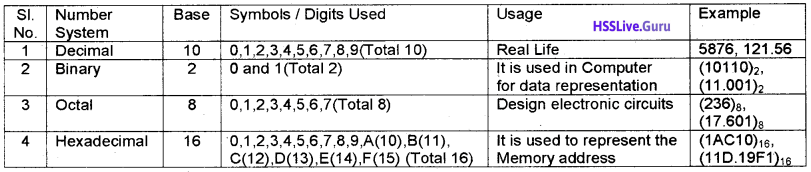
It is a systematic way to represent numbers in different ways. Each number system has its own Base, that is a number and that number of symbols or digits used.
Plus One Computer Science Notes Chapter 2 Data Representation and Boolean Algebra 1

  1. Most Significant Digit (MSD): The digit with most weight is called MSD. MSD is also called Left Most Digit(LMD)
  2. Least Significant Digit (LSD): The digit with least weight is called LSD. LSD is also called Right Most Digit(RMD)
    • eg: 106 : Here MSD : 1 and LSD : 6
    • 345.78: Here MSD : 3 and LSD : 8
  3. A Binary Digit is also called a bit.
  4. The weight of each digit of a number can be represented by the power of its base.

Plus One Computer Science Notes Chapter 2 Data Representation and Boolean Algebra

Number conversions:
In general, to convert a decimal number into another number system(binary or octal or hexadecimal) do the following. Divide the number successively by the base of the number system do you want to convert and write down the remainders from bottom to top.

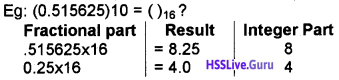
To convert a decimal fraction into another number system .multiply the number by the base of the number system do you want to convert then integer part and fractional part are separated again multiply the fractional part by the base and do the steps repeatedly until the fractional part becomes zero. Finally write down the integer part from top to bottom.

Decimal to Binary:
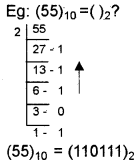
Divide the number by the base 2 successively and write down the remainders from bottom to top.
Plus One Computer Science Notes Chapter 2 Data Representation and Boolean Algebra 2

Decimal fraction to binary:
multiply the number by the base 2 then integer part and fractional part are separated again multiply the fractional part by the base 2 and do the steps repeatedly until the fractional part becomes zero. Finally write down the integer part from top to bottom.
Plus One Computer Science Notes Chapter 2 Data Representation and Boolean Algebra 3

Decimal to Octal:
Divide the number by the base 8 successively and write down the remainders from bottom to top.
Plus One Computer Science Notes Chapter 2 Data Representation and Boolean Algebra 4
Decimal fraction to octal:
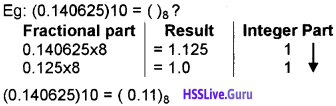
multiply the number by the base 8 then integer part and fractional part are separated again multiply the fractional part by the base 8 and do the steps repeatedly until the fractional part becomes zero. Finally write down the integer part from top to bottom.
eg: (55)10 = ()8
Plus One Computer Science Notes Chapter 2 Data Representation and Boolean Algebra 5
(0.140625)10 = (0.11)8

Decimal to Hexadecimal:
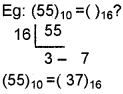
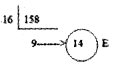
Divide the number by the base 16 successively and write down the remainders from bottom to top.
Plus One Computer Science Notes Chapter 2 Data Representation and Boolean Algebra 6
Decimal fraction to hexadecimal:
multiply the number by the base 16 then integer part and fractional part are separated again multiply the fractional part by the base 16 and do the steps repeatedly until the fractional part becomes zero. Finally write down the integer part from top to bottom.
Plus One Computer Science Notes Chapter 2 Data Representation and Boolean Algebra 7
Converting a number from any number system into decimal: For this multiply each digit by its corresponding weight and sum it up.

Plus One Computer Science Notes Chapter 2 Data Representation and Boolean Algebra

Binary to decimal conversion:
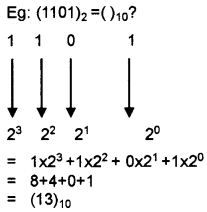
For this multiply each bit by its corresponding weight and sum it up. The weights are power of 2.
Plus One Computer Science Notes Chapter 2 Data Representation and Boolean Algebra 8
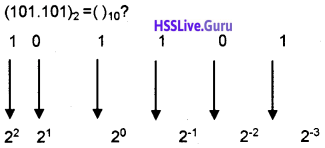
Converting binary fraction to decimal
Plus One Computer Science Notes Chapter 2 Data Representation and Boolean Algebra 9
101.101 = 1 × 22 + 0 × 21 + 1 × 20 + 1 × 2-1 + 0 × 2-2 + 1 × 2-3
= 4 + 0 + 1 + 1/2 + 0 + 1/8
= 5 + 0.5 + 0.125
(101.101)2 = (5.625)10

Octal to decimal conversion:
For this multiply each bit by its corresponding weight and sum it up. The weights are power of 8.
Eg: (1007)8 =()10?
Plus One Computer Science Notes Chapter 2 Data Representation and Boolean Algebra 10
1 × 83 + 0 × 82 + 0 × 81 + 7 × 80
= 512 + 0 + 0 + 7
=(519)10
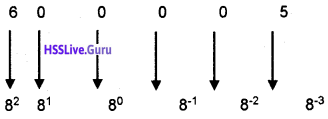
Converting octal fraction to decimal (600.005)8 =()10?

Plus One Computer Science Notes Chapter 2 Data Representation and Boolean Algebra 11

= 6 × 82 + 0 × 81 + 0 × 80 + 0 × 8-1 + 0 × 8-2 + 5 × 8-3
= 384 + 0 + 0 + 0 + 0 + 0.009765625
= (384.009765625)10

Hexadecimal to decimal conversion:
For this multiply each bit by its corresponding weight and sum it up. The weights are power of 16.
Eg: (100)16 = ()10?
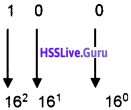
Plus One Computer Science Notes Chapter 2 Data Representation and Boolean Algebra 12
= 1 × 162 + 0 × 161 + 0 × 160
= 256 + 0 + 0
= (256)10
Converting Hexadecimal fraction to decimal (60A.4)8 =()10?
Plus One Computer Science Notes Chapter 2 Data Representation and Boolean Algebra 13
= 6 x 162 + 0 x 161 + 10 x 160 + 4 x 16-1
= 1536 + 0 + 0 + .25
= (1536.25)10

Plus One Computer Science Notes Chapter 2 Data Representation and Boolean Algebra

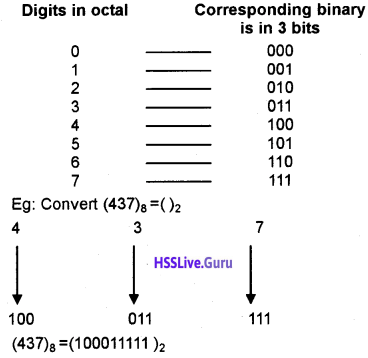
Octal to binary conversion:
Convert each octal digit into its 3 bit binary equivalent. Consider the following table
Plus One Computer Science Notes Chapter 2 Data Representation and Boolean Algebra 14

Hexadecimal to binary conversion:
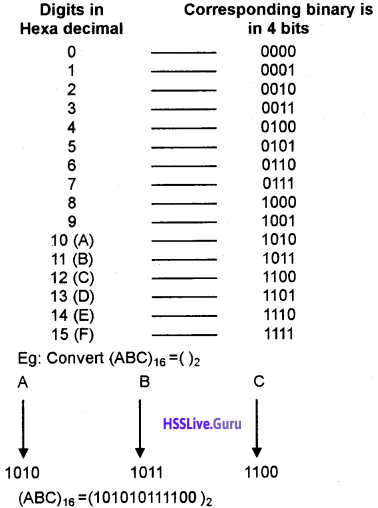
Convert each Hexadecimal digit into its 4 bit binary equivalent. Consider the following table
Plus One Computer Science Notes Chapter 2 Data Representation and Boolean Algebra 15

1010 1011 1100 (ABC)16=(101010111100)2

Binary to octal conversion
Divide the binary number into groups of 3 bits starting from the right to left(But in the fractional part start dividing from left to right). Insert necessary zeros in the left side(or right side in the case of fractional part)if needed and write down the corresponding octal equivalent.
eg: (10100110)2= ()8?
Insert one zero in the left side to form 3 bits group
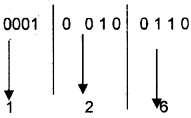
Plus One Computer Science Notes Chapter 2 Data Representation and Boolean Algebra 16
(10100110)2= (246)8

Plus One Computer Science Notes Chapter 2 Data Representation and Boolean Algebra

Binary to Hexadecimal conversion:
Divide the binary number into groups of 4 bits starting from the right to left(But in the fractional part start dividing from left to right). Insert necessary zeros in the left side(or right side in the case of fractional part)if needed and write down the corresponding Hexadecimal equivalent.
eg: (100100110)2 = ()16?
Insert 3 zeros in the left side to form 4 bits group
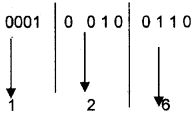
Plus One Computer Science Notes Chapter 2 Data Representation and Boolean Algebra 17
(100100110)2 = (126)16

Octal to Hexadecimal conversion:
First convert octal number into binary(see 1.6.7), then convert this binary into hexadecimal(also see 1.6.10)
eg: Convert (67)8 = ( )16
Step I: First convert this number into binary equivalent for this do the following:
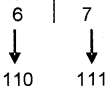
Plus One Computer Science Notes Chapter 2 Data Representation and Boolean Algebra 18
Step II: Next convert this number into hexadecimal equivalent for this do the following.
Plus One Computer Science Notes Chapter 2 Data Representation and Boolean Algebra 19
So the answer is (67)8 = ( 37)16

Hexadecimal to octal conversion:
First convert Hexadecimal to binary(see 1.6.8), then covert this binary into octal(also see 1.6.9)
eg: Convert (A1)16 = ( )8?
Step I: First convert this number into binary equivalent. For this do the following
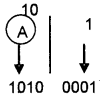
Plus One Computer Science Notes Chapter 2 Data Representation and Boolean Algebra 20
Step II. Next convert this number into octal equivalent. For this do the following.
So the answer is (A1)16 = (241)8

Data representation:
The data stored in the computer memory is in the form of binary.

Representation of integers
There are three ways to represent integers in computer. They are as follows:

  1. Sign and Magnitude Representation (SMR)
  2. 1’s Complement Representation
  3. 2’s Complement Representation

1. SMR:
Normally a number has two parts sign and magnitude, eg: Consider a number+5. Here + is the sign and 5 is the magnitude. In SMR the most significant Bit (MSB) is used to represent the sign. If MSB is 0 sign is +ve and MSB is 1 sign is -ve. eg: If a computer has word size is 1 byte then
Plus One Computer Science Notes Chapter 2 Data Representation and Boolean Algebra 21
Here MSB is used for sign then the remaining 7 bits are used to represent magnitude. So we can , represent 27 = 128 numbers. But there are negative and positive numbers. So 128 + 128 = 256 number. The numbers are 0 to +127 and 0 to -127. Here zero is repeated. So we can represent 256 – 1 = 255 numbers.

2. 1’s Complement Representation:
To get the 1’s complement of a binary number, just replace every 0 with 1 and every 1 with 0. Negative numbers are represented using 1’s complement but +ve number has no 1 ’s complement,
eg:
(i) To find the 1’s complement of -21
+21 = 00010101
To get the 1’s complement change all 0 to 1 and.all 1 to 0.
-21 = 11101010
1’s complement of-21 is 11101010

Plus One Computer Science Notes Chapter 2 Data Representation and Boolean Algebra

(ii) Find the 1’s complement of +21. Positive numbers are represented by using SMR.
+21 = 00010101 (No need to take the 1’s complement)

3. 2’s Complement Representation:
To get the 2’s complement of a binary number, just add 1 to its 1’s complement +ve number has no 2’s complement.
eg: To find the 2’s complement of -21
+21 = 00010101
First take the 1’s complement for this change all 1 to 0 and all 0 to 1
Plus One Computer Science Notes Chapter 2 Data Representation and Boolean Algebra 22
2’s complement of -21 is 1110 1011

Representation of floating point numbers:
A real number consists of an integer part and fractional part and represent by using Exponent and Mantissa method. This method is also used to represent too big numbers as well as too small numbers.
Eg: .0000000000000000000000001 can be represented easily as 1 × 10-25. Here T is the Mantissa and -25 is the exponent.

A computer with 32 bit word length is used 24 bits for mantissa and the remaining 8 bits used to store exponent.

Representation of characters:
1. ASCII(American Standard Code for Information Interchange):
It is 7 bits code used to represent alphanumeric and some special characters in computer memory. It is introduced by U.S. government. Each character in the keyboard has a unique number.

Eg: ASCII code of ‘a’ is 97, when you press ‘a’ in the keyboard , a signal equivalent to 1100001 (Binary equivalent of 97 is 1100001) is passed to the computer memory. 27 = 128, hence we can represent only 128 characters by using ASCII. It is not enough to represent all the characters of a standard keyboard.

2. EBCDIC(Extended Binary Coded Decimal Interchange Code):
It is an 8 bit code introduced by IBM(lnternational Business Machine). 28 = 256 characters can be represented by using this.

3. ISCII(lndian Standard Code for Information Interchange):
It uses 8 bits to represent data and introduced by standardization committee and adopted by Bureau of Indian Standards(BIS).

4. Unicode:
The limitations to store more characters is solved by the introduction of Unicode. It uses 16 bits so 216 = 65536 characters (i.e, world’s all written language characters) can store by using this.

Binary arithmetic:
Binary addition:
The rules for adding two bits
Plus One Computer Science Notes Chapter 2 Data Representation and Boolean Algebra 23
eg: Find the sum of binary numbers 110011 and 100001.
Plus One Computer Science Notes Chapter 2 Data Representation and Boolean Algebra 24

Binary subtraction:
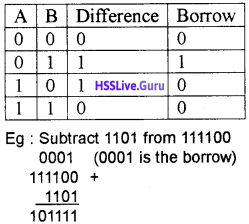
The rules for subtracting a binary digit from another digit.
Plus One Computer Science Notes Chapter 2 Data Representation and Boolean Algebra 25

Plus One Computer Science Notes Chapter 2 Data Representation and Boolean Algebra

Subtraction using 1’s complement:
The steps are given below:

Step 1: Add 0s to the left of the subtrahend, to make two numbers with same number of bits.
Step 2: Find 1’s complement of subtrahend.
Step 3: Add the complement with minuend.
Step 4: If there is a carry, ignore the carry, the result is positive then add the carry 1 to the result.
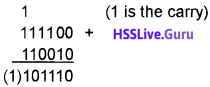
eg: Subtract 1101 from 111100 using 1’s complement method.
Step 1: Insert two Os to the left of 1101. Hence the subtrahend is 001101.
Step 2: 1’s complement of 001101 is 110010
Step 3: Add this to the minuend.
Plus One Computer Science Notes Chapter 2 Data Representation and Boolean Algebra 26
Step 4: Ignore the carry the result is positive and add add the carry 1 to 101110
Plus One Computer Science Notes Chapter 2 Data Representation and Boolean Algebra 27
Hence the result is 101111.

Subtraction using 2’s complement:
The steps are given below :
Step 1: Add 0s to the left of the subtrahend, to make two numbers with same number of bits.
Step 2: Find 2’s complement of subtrahend.
Step 3: Add the complement with minuend.
Step 4: If there is a carry, ignore the carry, the result is positive.
eg: Subtract 1101 from 111100 using 2’s complement method.
Step 1: Insert two 0s to the left of 1101. Hence the subtrahend is 001101.
Step 2: Find the 2’s complement of 001101.
1’s complement is 110010.
2’s complement is 110010 + 1 = 110011
Step 3: Add this to the minuend.
Plus One Computer Science Notes Chapter 2 Data Representation and Boolean Algebra 28
Step 4: Ignore the carry the result is positive. Hence the result is 101111.

Introduction to Boolean algebra:
The name Boolean Algebra is given to honour the British mathematician George Boole. Boolean algebra deals with two states true or false otherwise Yes or No and numerically either 0 or 1.

Plus One Computer Science Notes Chapter 2 Data Representation and Boolean Algebra

Binary valued quantities:
A logical decision which gives YES or No values is a binary decision, A statement which gives YES or NO values(TRUE or FALSE) is a logical statement or truth function. A variable which can assign TRUE or FALSE (1 or 0) values is a logical variable

Boolean operators and logic gates:
Logical Operators are AND, OR and NOT. A logical gate is a physical device (electronic circuit)that can perform logical operations on one or more logical inputs and produce a single logical output. A table represents the set f all possible values and the corresponding results in a statement is called truth table.
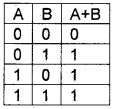
1. The OR operator and OR gate:
The OR operator gives a 1 either one of the operands is 1. If both operands are 0, it produces 0. The truth table of X OR Y is
Plus One Computer Science Notes Chapter 2 Data Representation and Boolean Algebra 29
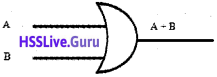
The logical OR gate is given below.
Plus One Computer Science Notes Chapter 2 Data Representation and Boolean Algebra 30
The truth table and the gate for the Boolean expression Y = A + B + C
Plus One Computer Science Notes Chapter 2 Data Representation and Boolean Algebra 31

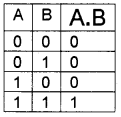
2. The AND operator and AND gate:
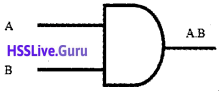
The AND operator gives a 1 if and only if both operands are 1. If either one of the operands is 0, it produces 0 The truth table of X AND Y is
Plus One Computer Science Notes Chapter 2 Data Representation and Boolean Algebra 32
The logical AND gate is given below.
Plus One Computer Science Notes Chapter 2 Data Representation and Boolean Algebra 33
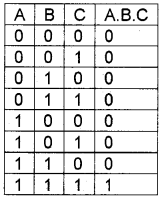
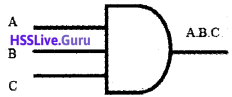
The truth table and the gate for the Boolean expression Y = A . B . C
Plus One Computer Science Notes Chapter 2 Data Representation and Boolean Algebra 34
Plus One Computer Science Notes Chapter 2 Data Representation and Boolean Algebra 35

3. The NOT operator and NOT gate:
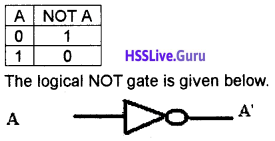
It produces the vice versa. NOT gate is also called inverter. It is a unary operator that means it has only one input and one output. The truth table of NOT X is
Plus One Computer Science Notes Chapter 2 Data Representation and Boolean Algebra 36

Plus One Computer Science Notes Chapter 2 Data Representation and Boolean Algebra

Basic postulates of Boolean algebra:
Boolean algebra consists of some fundamental laws. These laws are called postulates.
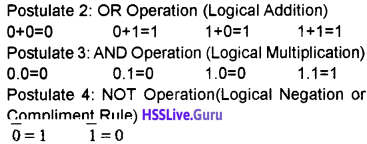
Postulate 1: Principles of 0 and 1
If A ≠ 0 , then A = 1 and A 1, then A = 0
Plus One Computer Science Notes Chapter 2 Data Representation and Boolean Algebra 37

Principle of Duality:
When changing the OR(+) to AND(.), AND (.) to OR(+), 0 to 1 and 1 to 0 in a Boolean expression we will get another Boolean relation which is the dual of the first, this is the principle of duality.

Basic theorems of Boolean algebra:
There are some standard and accepted rules in every theory, these rules are known as axioms of the theory.

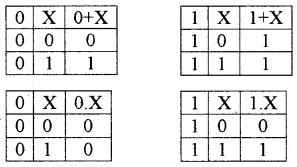
Identity law:
If X is a Boolean variable, the law states that

  1. 0 + X = X
  2. 1 + X = 1 (these are additive identity law)
  3. 0 . X = 0
  4. 1 . X = X (these are multiplicative identity law)

Following are the truth tables
Plus One Computer Science Notes Chapter 2 Data Representation and Boolean Algebra 38

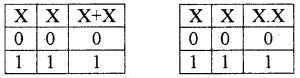
Idempotent law:
This law states that

  1. X + X = X
  2. X . X = X

Plus One Computer Science Notes Chapter 2 Data Representation and Boolean Algebra 39

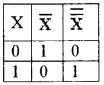
Involution law:
This states that
\(\overline{\overline{\mathrm{X}}}=\mathrm{x}\)
The compliment of compliment of a number is the number itself.
Plus One Computer Science Notes Chapter 2 Data Representation and Boolean Algebra 40

Complimentary law:
This law states that

  1. \(x+\bar{x}=1\)
  2. \(x \cdot \bar{x}=0\)

The truth table is given below
Plus One Computer Science Notes Chapter 2 Data Representation and Boolean Algebra 41

Plus One Computer Science Notes Chapter 2 Data Representation and Boolean Algebra

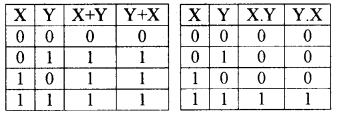
Commutative law:
This law allows to change the position of variable in OR and AND

  1. X + Y = Y + X
  2. X . Y = Y . X

The truth table is given below
Plus One Computer Science Notes Chapter 2 Data Representation and Boolean Algebra 42

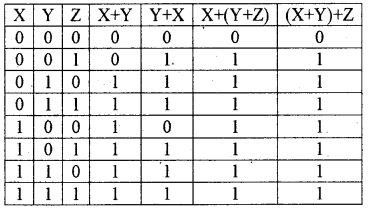
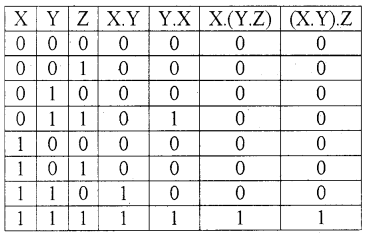
Associative law:
It allows grouping of variables differently

  1. X + (Y + Z) = (X + Y) + Z
  2. X . (Y . Z) = (X . Y) . Z

The truth table is given below
Plus One Computer Science Notes Chapter 2 Data Representation and Boolean Algebra 43
Plus One Computer Science Notes Chapter 2 Data Representation and Boolean Algebra 44

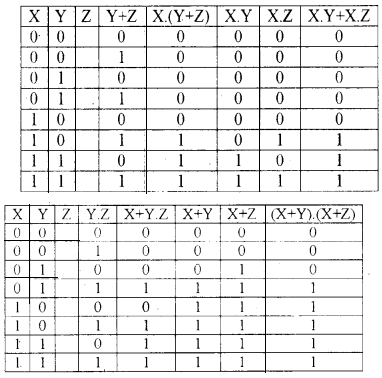
Distributive law:
This law allows expansion of multiplication over addition and also allows addition operation over multiplication.

  1. X . (Y + Z) = X . Y + X . Z
  2. X + Y . Z = (X + Y) . (X + Z)

The truth table is given below
Plus One Computer Science Notes Chapter 2 Data Representation and Boolean Algebra 45

Plus One Computer Science Notes Chapter 2 Data Representation and Boolean Algebra

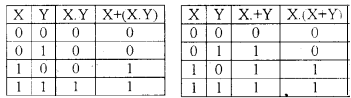
Absorption law:
It is a kind of distributive law in which two variables are used and result will be one of them

  1. X + (X . Y) = X
  2. X . (X + Y) = X

The truth table is given below
Plus One Computer Science Notes Chapter 2 Data Representation and Boolean Algebra 46

De Morgan’s theorem:
Demorgan’s first theorem states that
\(\overline{\mathrm{X}+\mathrm{Y}}=\overline{\mathrm{X}} \cdot \overline{\mathrm{Y}}\)
ie. the compliment of sum of two variables equals product of their compliments.

The second theorem states that
\(\overline{\mathrm{X} . {\mathrm{Y}}}=\overline{\mathrm{X}}+\overline{\mathrm{Y}}\)
ie. The compliment of the product of two variables equals the sum of the compliment of that variables.

Circuit designing for simple Boolean expressions:
By using basic gates such as AND, OR and NOT gates we can create logic circuits.

Universal gates:
By using NAND and NOR gates only we can create other gate hence these gates are called Universal gate.

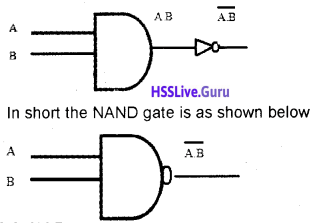
NAND gate:
The output of AND gate is inverted by NOT gate is the NAND gate
Plus One Computer Science Notes Chapter 2 Data Representation and Boolean Algebra 47

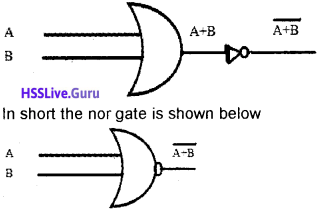
NOR gate:
The output of OR gate is inverted by NOT gate is the NOR gate.
Plus One Computer Science Notes Chapter 2 Data Representation and Boolean Algebra 48

Plus One Physics Chapter Wise Questions and Answers Chapter 14 Oscillations

Students can Download Chapter 14 Oscillations Questions and Answers, Plus One Physics Chapter Wise Questions and Answers helps you to revise the complete Kerala State Syllabus and score more marks in your examinations.

Kerala Plus One Physics Chapter Wise Questions and Answers Chapter 14 Oscillations

Plus One Physics Oscillations One Mark Questions and Answers

Question 1.
Fill in the blanks :
A girl is swinging on a swing in a sitting position. When she stands up, the period of the swing will______.
Answer:
Decreases

Question 2.
A particle executes a simple harmonic motion with a frequency f. What is the frequency with which its kinetic energy oscillates?
Answer:
Frequency of oscillation of kinetic energy is 2f.
Plus One Physics Chapter Wise Questions and Answers Chapter 14 Oscillations - 1

Plus One Physics Chapter Wise Questions and Answers Chapter 14 Oscillations

Question 3.
Plus One Physics Chapter Wise Questions and Answers Chapter 14 Oscillations - 2
Answer:
a. 7/2R
b. ω = \(\sqrt{k / m}\)

Question 4.
Can a simple pendulum vibrate at centre of earth?
Answer:
No. Because ‘g’ at centre of earth is zero.

Question 5.
A glass window may be broken by a distant explosion. Why?
Answer:
The sound waves can cause forced vibrations in glass due to difference between frequency of sound wave and natural frequency of glass. This can break the glass window.

Plus One Physics Oscillations Two Mark Questions and Answers

Question 1.
A simple pendulum is transferred from earth to moon. Will it go faster or slower?
Answer:
The value of g at moon is low compared to earth. The decrease in g will increase time period of simple pendulum. Hence pendulum will vibrate slower.

Plus One Physics Chapter Wise Questions and Answers Chapter 14 Oscillations

Question 2.
Here five examples of accelerated motion are given in first column. Match each examples given in the second column.
Plus One Physics Chapter Wise Questions and Answers Chapter 14 Oscillations - 3
Answer:
Plus One Physics Chapter Wise Questions and Answers Chapter 14 Oscillations - 4

Plus One Physics Chapter Wise Questions and Answers Chapter 14 Oscillations

Question 3.
A girl is swinging a swing in sitting position. What shall be the effect of frequency of oscillation if

  1. if she stands up
  2. if another girl sits gently by her side

Answer:
1. If the system is considered as simple pendulum, length of pendulum is reduced as girl stands up.
Plus One Physics Chapter Wise Questions and Answers Chapter 14 Oscillations - 5
So frequency of oscillation is increased.

2. The time period and hence frequency of simple pendulum is independent of mass. Hence there is no change in frequency.

Plus One Physics Oscillations Three Mark Questions and Answers

Question 1.
A student is advised to study the variation of period of oscillation with the length of a simple pendulum in the laboratory. According he recorded the period of oscillation for different lengths of the pendulum.

  1. If he plots a graph between the length and period of oscillation, what will be the shape of the graph?
  2. How would you determine the value of acceleration due to gravity using l – T2 graph?

Answer:
1.
Plus One Physics Chapter Wise Questions and Answers Chapter 14 Oscillations - 6
This is the equation parabola. Hence the shape of graph between period(T) and length (l) will be parabola.

2. Find slope of l – T2 graph. The acceleration due to gravity can be found using formula g = 4P2 × slope of (l – T2) graph.

Plus One Physics Chapter Wise Questions and Answers Chapter 14 Oscillations

Question 2.
A simple pendulum has a bob of mass m is suspended from the ceiling of a lift which is lying at the ground floor of a multistoried building.

  1. Find the period of oscillation of pendulum when the lift is stationary.
  2. What is the tension of the string of the pendulum when it is ascending with an acceleration ‘a’?
  3. What is the period of oscillation of the pendulum while the lift is ascending?

Answer:

  1. T = \(2 \pi \sqrt{l /g}\)
  2. Tension, T= m (g + a)
  3. T = 2π\(\sqrt{\frac{\ell}{g+a}}\)

Question 3.
A body tied a spherical pot with a string and suspended it on a clamp. He then filled it with water. Length of the string if 90 cm and diameter of the pot is 20 cm. The pot is slightly displaced to one side and leave it to oscillate. Considering the above example as a simple pendulum (g = 9.8 ms-2)

  1. What is the length of the Pendulum
  2. Calculate the period of oscillation of the pendulum.

Answer:
1. Length of pendulum l = 90 + 10 = 100 cm

2.
Plus One Physics Chapter Wise Questions and Answers Chapter 14 Oscillations - 7

Question 4.

  1. Motion repeated at regular intervals of time is called periodic. Explain the simple harmonic motion with a figure.
  2. A particle executes a simple harmonic motion with a period 2 seconds, starting from its equilibrium at time t = 0. Find the minimum time in which it is displaced by half the amplitude.

Answer:
1. A periodic motion in which acceleration is directly proportional to displacement but opposite in direction is called SHM.
Plus One Physics Chapter Wise Questions and Answers Chapter 14 Oscillations - 8
The graphical variation of simple harmonic motion with time given above.

2. y = a sin wt
Plus One Physics Chapter Wise Questions and Answers Chapter 14 Oscillations - 9
Sin π/6 = sin wt
wt = π/6
\(\frac{2 \pi}{T}\)t = π/6
But T = 2s. Hence we get
Plus One Physics Chapter Wise Questions and Answers Chapter 14 Oscillations - 10

Plus One Physics Chapter Wise Questions and Answers Chapter 14 Oscillations

Question 5.
A spring of spring constant ‘k’ is used to suspend a mass ‘m’ at its free end while the other end of the spring is rigidly fixed.

  1. If the mass is slightly depressed and released, then name the motion of the mass.
  2. Write down the expression for the period of oscillation of the mass.
  3. If this system is taken into outer space then what happens to its period? Why?

Answer:

  1. Simple Harmonic Motion
  2. T = \(2 \pi \sqrt{m / k}\)
  3. Period of oscillation does not change.

Plus One Physics Oscillations Four Mark Questions and Answers

Question 1.
A simple harmonic motion is represented by x(t) = Acosωt.

  1. What do you mean by simple harmonic motion.
  2. An SHM has amplitude A and time period T, What is the time taken to travel from x = A to x = A/2

Answer:
1. Simple harmonic motion is the simplest form of oscillatory motion. The oscillatory motion is said to be simple harmonic motion if the displacement ‘x’ of the partide from the origin varies with time as
Plus One Physics Chapter Wise Questions and Answers Chapter 14 Oscillations - 11

2. x = Acosωt
Plus One Physics Chapter Wise Questions and Answers Chapter 14 Oscillations - 12

Plus One Physics Chapter Wise Questions and Answers Chapter 14 Oscillations

Question 2.

  1. Define simple harmonic motion for a particle moving in a straight line.
  2. Use your definition to explain how simple harmonic motion can be represented by the equation.
  3. Show that the above equation is dimensionally correct.
  4. A mechanical system is known to perform simple harmonic motion. What quantity must be measured in order to determine frequency for the system?

Answer:

  1. A periodic motion in which acceleration is directly proportional to displacement and opposite in direction is called simple harmonic oscillation.
  2. Mathematically, a simple harmonic oscillation can be expressed as
    y = a sin wt (or) y = a cos wt
  3. y = a sin w t
    Sin wt has no dimension. Hence we need to consider dimension of ‘a’ only, ie, y = a, L = L
  4. Its period is determined.

Question 3.
A particle executes simple harmonic motion according to the equation x = 5sin\(\left(\frac{2 \pi}{3} t\right)\)

  1. find the period of the oscillation
  2. What is the minimum time required for the particle to move between two points 2.5cm on either side of the mean position?

Answer:
1. x = 5sin\(\left(\frac{2 \pi}{3} t\right)\), when we compare this equation
with standard S.H.M, x = a sin wt.
We get wt = \(\frac{2 \pi}{3} t\)
Plus One Physics Chapter Wise Questions and Answers Chapter 14 Oscillations - 13

2. y = a sin wt
2.5 = 5 sin w × t
Plus One Physics Chapter Wise Questions and Answers Chapter 14 Oscillations - 14
Time taken to travel 2.5 from the mean position is 0.25 sec. Hence time taken to travel 2.5 cm on either side of the mean position is 0.5 sec.

Plus One Physics Chapter Wise Questions and Answers Chapter 14 Oscillations

Question 4.
A mass m is suspended at one end of a spring and the other end of the spring is firmly fixed on the ceiling. If the mass is slightly depressed and released it will execute oscillation.

  1. Write down the expression for the frequency of oscillation of the mass.
  2. If the spring is cut into two equal halves and one half of the spring is used to suspend the same mass then obtain an expression for the ratio of periods of oscillation in two cases.
  3. If this system is completely immersed in water then what happens to the oscillation?

Answer:
1. f = \(\frac{1}{2 \pi} \sqrt{k / m}\)

2. f1 = [atex]\frac{1}{2 \pi} \sqrt{k / m}[/latex] ____(1)

3. When spring is cut in to half,spring constant becomes 2k. Hence frequency,
Plus One Physics Chapter Wise Questions and Answers Chapter 14 Oscillations - 15

4. If this system is immersed in water, the amplitude of oscillation decrease quickly. Hence system comes to rest quickly.

Question 5.
Starting from the origin, a body oscillates simple harmonically with an amplitude of 2m and a period of 2s.

  1. What do you mean simple harmonic motion.
  2. Draw the variation of displacement with time for the above motion.
  3. After what time, will its kinetic energy be 75% of the total energy?

Answer:
1. The oscillatory motion is said to be simple harmonic motion if the displacement ‘x’ of the particle from the origin varies with time as
Plus One Physics Chapter Wise Questions and Answers Chapter 14 Oscillations - 16
where
x(t) = displacement x as a function of time t
A = amplitude
ω = angular frequency
(ω t + Φ) = phase (time-dependent)
Φ = phase constant or initial phase

2.
Plus One Physics Chapter Wise Questions and Answers Chapter 14 Oscillations - 17

3. y = a sin ω t
ν = aω cos ωt
Kinetic energy,
Plus One Physics Chapter Wise Questions and Answers Chapter 14 Oscillations - 18
Plus One Physics Chapter Wise Questions and Answers Chapter 14 Oscillations - 19

Plus One Physics Chapter Wise Questions and Answers Chapter 14 Oscillations

Question 6.
A body of mass 16 kg is oscillating on a spring of force constant 100 N/m.

  1. What do you mean by spring constant.
  2. Derive a general expression for period of oscillating spring.

Answer:
1. Spring constant is the force required for unit extension.

2.
Plus One Physics Chapter Wise Questions and Answers Chapter 14 Oscillations - 20
Consider a body of mass m attached to a massless spring of spring constant K. The other end of spring is connected to a rigid support as shown in figure. The body is placed on a frictionless horizontal surface.

If the body be displaced towards right through a small distance Y, a restoring force will be developed.
Plus One Physics Chapter Wise Questions and Answers Chapter 14 Oscillations - 21
Comparing this equation with standard differential equation \(\frac{d^{2} x}{d t^{2}}\) + ω2x = 0
We get ω2 = k/m
Plus One Physics Chapter Wise Questions and Answers Chapter 14 Oscillations - 22

Question 7.
A particle execute simple harmonic motion according to the equation, x = 5sin \(\left(\frac{2 \pi}{3}\right) t\)

  1. What is the period of the oscillation?
  2. Write an expression for velocity and acceleration of the above particle.

Answer:
1. When x = 5sin\(\left(\frac{2 \pi}{3}\right) t\) with standard equation.
x = asin ω t we get
Plus One Physics Chapter Wise Questions and Answers Chapter 14 Oscillations - 23

2. Velocity V = \(\frac{d}{d t}\) 5sin\(\left(\frac{2 \pi}{3}\right) t\)
Plus One Physics Chapter Wise Questions and Answers Chapter 14 Oscillations - 24

Plus One Physics Chapter Wise Questions and Answers Chapter 14 Oscillations

Question 8.

  1. Arrive the differential equation of SHM.
  2. What do you mean by seconds pendulum.

Answer:
1. The force acting simple harmonic motion is proportional to the displacement and is always directed towards the centre of motion.
Plus One Physics Chapter Wise Questions and Answers Chapter 14 Oscillations - 25
Comparing this equation with standard differential equation \(\frac{d^{2} x}{d t^{2}}\) + ω2x = 0,
We get ω2 = k/m.

2. A pendulum having period 2 sec is called seconds pendulum.

Question 9.
SHM is a type of motion in which both speed and acceleration change continuously.

  1. Which of the following condition is sufficient for SHM?
    • a = ky,
    • a = ky
    • a = ky2
  2. Draw a graph of SHM between
    • displacement-time
    • speed – time
    • acceleration -time

Answer:
1. a = ky

2. Variation of displacement Y with time t
Plus One Physics Chapter Wise Questions and Answers Chapter 14 Oscillations - 26
Variation of velocity Y with time t
Plus One Physics Chapter Wise Questions and Answers Chapter 14 Oscillations - 27
Variation of acceleration with time
Plus One Physics Chapter Wise Questions and Answers Chapter 14 Oscillations - 28

Plus One Physics Chapter Wise Questions and Answers Chapter 14 Oscillations

Question 10.

  1. Is oscillation of a mass suspended by a spring is simple harmonic?
  2. Write period of oscillation of the spring?
  3. There are two springs, one delicate and another stout. For which spring, the frequency of oscillation will be more?
  4. Two un equal springs of same material are loaded with same load, which one will have large value of time period?

Answer:
1. Yes

2. T = \(2 \pi \sqrt{\frac{m}{k}}\)

3. When a stout spring loaded with mass ‘m’, the extension (l) produced is large.
∴ T is large, because T = \(2 \pi \sqrt{\frac{m}{k}}\),
T is small, i.e, frequency is large. Stout spring oscillate with larger frequency.

4. When a longer spring is locked with weight mg, the extension T is more
∴ T is large, because T = \(2 \pi \sqrt{\frac{l}{g}}\)
So longer spring will have a large value of period.

Question 11.
A simple pendulum consists of a metallic bob suspended from a long straight thread whose one
end is fixed to a rigid support.

  1. What is the time period of second’s pendulum?
  2. Derive an expression for period of simple pendulum.

Answer:
1. 2 sec

2.
Plus One Physics Chapter Wise Questions and Answers Chapter 14 Oscillations - 29
Consider a mass m suspended from one end of a string of length L fixed at the other end as shown in figure. Suppose P is the instantaneous position of the pendulum. At this instant its string makes an angle θ with the vertical.

The forces acting on the bob are (1) weight of bob Fg(mg) acting vertically downward. (2) Tension T in the string.

The gravitational force Fg can be divided into a radial component FgCosθ and tangential component FgSinθ. The tangential component FgSinθ produces a restoring torque.
Restoring torque τ = – Fg sinθ . L
τ = – mg sinθ . L _____(1)
-ve sign shown that the torque and angular displacement θ are oppositely directed. For rotational motion of bob,
τ = Iα ______(2)
Where I is moment of inertia about the point of suspension and α is angular acceleration. From eq (1) and eq (2).
Iα = – mgsinθ . L
If we assume that the displacement θ is small, sinθ ≈ θ
∴ Iα = -mgθ . L
Iα + mgθ L = 0
Plus One Physics Chapter Wise Questions and Answers Chapter 14 Oscillations - 30

Plus One Physics Chapter Wise Questions and Answers Chapter 14 Oscillations
Comparirig eq (3) with standard differential equation
Plus One Physics Chapter Wise Questions and Answers Chapter 14 Oscillations - 31
Plus One Physics Chapter Wise Questions and Answers Chapter 14 Oscillations - 32
∴ period of simple pendulum,
Plus One Physics Chapter Wise Questions and Answers Chapter 14 Oscillations - 33
for simple pendulum I = mL2
Substituting I = mL2 we get
Plus One Physics Chapter Wise Questions and Answers Chapter 14 Oscillations - 34
The above equation gives that T is indepent of mass.

Plus One Physics Oscillations Five Mark Questions and Answers

Question 1.

  1. Which of the following condition is sufficient for the simple harmonic motion?
    • a = ky
    • a = ky2
    • a = -ky
    • a = -ky2
      Where ‘a’ – acceleration, y – displacement
  2. Prove that simple harmonic motion is the projection of uniform circular motion on any diameter of the circle.
  3. Represent graphically the variations of potential energy, kinetic energy and total energy as a function of position ‘x’ for a linear harmonic oscillator. Explain the graph.

Answer:
1. a = -ky

2.
Plus One Physics Chapter Wise Questions and Answers Chapter 14 Oscillations - 35
Consider a particle moving along the circumference of a circle of radius ‘a’ and centre O, with uniform angular velocity w. AB and CD are two mutually perpendicular diameters along X and Y axis. At time t = 0.

let the particle be at P0 so that ∠P0OB = Φ. After time ‘t’ second, let the particle reach P so that ∠POP0 = ω t. N is the foot of the perpendicular drawn from P on the diameter CD.

Similarly M is the foot of the perpendicular drawn from P to the diameter AB. When the particle moves along the circumference of the circle, the foot of the perpendicular executes to and fro motion along the diameter CD or AB with O as the mean position.

From the right angle triangle O MP, we get
Cos (ωt + Φ) = \(\frac{O M}{O P}\)
∴ OM = OPcos(ωt + Φ)
X= a cos (ωt + Φ) _______(1)
Similarly, we get
Sin (ωt + Φ) = \(\frac{y}{a}\) (or)
Y = a sin (ωt + Φ) _______(2)
Equation (1) and (2) are similar to equations of S.H.M. The equation(1) and (2) shows that the projection of uniform circular motion on any diameter is S.H.M.

3. KE = PE
\(\frac{1}{2}\)mω2(a2 – x2) = \(\frac{1}{2}\) = mω2x2
Solving we get, x = \(\frac{a}{\sqrt{2}}\)
where a is the amplitude of oscillation.

Plus One Physics Chapter Wise Questions and Answers Chapter 14 Oscillations

Question 2.
The spring has a scale that reads from zero to 30 kg. The length of the scale is 30cm.

  1. Calculate the force constant K
  2. If the period of oscillation is 1 sec. Calculate mass of the body attached to the spring.
  3. If the spring is cut into two halves, What is the force constant of each half?

Answer:
1. 30 cm = 30kg
1 cm = \(\frac{30}{30}\) = 1kg
∴ Spring constant K = 1 kg/cm = 10N/cm =1000N/m.

2.
Plus One Physics Chapter Wise Questions and Answers Chapter 14 Oscillations - 36

3. If spring of spring constant K is cut in to half, spring constant of each half became, 2K

Plus One Physics Oscillations NCERT Questions and Answers

Question 1.
Which of the following examples represent periodic motion?
(a) A swimmer completing one (return) trip from one bank of a river to the other and back.
(b) A freely suspended bar magnet displaced from its N-S direction and released.
(c) A hydrogen molecule rotating about its centre of mass.
(d) An arrow released from a bow.
Answer:
(b) A freely suspended bar magnet displaced from its N-S direction and released and
(c) A hydrogen molecule rotating about its centre of mass

Question 2.
Which of the following relationships between the acceleration a and the displacement x of a particle involve simple harmonic motion?
(a) a = 0.7x
(b) a = 200x2
(c) a = 10x
(d) a = 100x2
Answer:
Only (c) ie. a = -10x represent SHM. This is because acceleration is proportional and opposite to displacement (x).

Plus One Physics Chapter Wise Questions and Answers Chapter 14 Oscillations

Question 3.
A spring having spring constant 1200Nm-1 is mounted on a horizontal table as shown in figure. A mass of 3 kg is attached to the free end of the spring. The mass is the pulled sideways to a distance of 2.0cm and released.
Plus One Physics Chapter Wise Questions and Answers Chapter 14 Oscillations - 37
Determine

  1. the frequency of oscillations,
  2. maximum acceleration of the mass and
  3. the maximum speed of the mass.

Answer:
k = 1200Nm-1, m = 3kg, a = 2.0cm = 2 × 10⁻²m
1.
Plus One Physics Chapter Wise Questions and Answers Chapter 14 Oscillations - 38

2. Maximum acceleration = ω2 a = \(\frac{k}{m}\)a
Plus One Physics Chapter Wise Questions and Answers Chapter 14 Oscillations - 39

3. Maximum speed = aω = a\(\sqrt{\frac{K}{m}}\)
Plus One Physics Chapter Wise Questions and Answers Chapter 14 Oscillations - 40

Question 4.
The piston in the cylinder head of a locomotive has a stroke (twice the amplitude) of 1.0m. If the position moves with simple harmonic motion with an angular frequency of 200 rev/min, what is its maximum speed?
Answer:
a = \(\frac{1}{2}\)m, ω = 200 rev/min
Umax = aω = \(\frac{1}{2}\) × 200m/min = 100 m/min.

Plus One Physics Chapter Wise Questions and Answers Chapter 14 Oscillations

Question 5.
A circular disc of mass 10kg is suspended by a wire attached to its centre. The wire is twisted by rotating the disc and released. The period of torsional oscillations is found to be 1.5s. The radius of the disc is 15cm. Determine the torsional spring constant of the wire. (Torsional spring constant α is defined by the relation J = -αθ, where J is the restoring couple and θ the angle of twist).
Answer:
Plus One Physics Chapter Wise Questions and Answers Chapter 14 Oscillations - 41

Plus One Computer Science Notes Chapter 1 The Discipline of Computing

Students can Download Chapter 1 The Discipline of Computing Notes, Plus One Computer Science Notes helps you to revise the complete Kerala State Syllabus and score more marks in your examinations.

Kerala Plus One Computer Science Notes Chapter 1 The Discipline of Computing

Summary
Computing milestones and machine evolution:
People used pebbles and stones for counting earlier days. They draw lines to record information. eg: 1 line for one, 2 lines for two, 3 lines for three, etc. In this number system the value will not change if the lines are interchange. This type of number system is called non positional number system.

Counting and the evolution of the positional number system:
In positional number system, each and every number has a weight. Earlier sticks are used to count items such as animals or objects. Around 3000 BC the Egyptians use number systems with radix 10(base-the number of symbols or digits used in the number system) and they write from right to left.

Plus One Computer Science Notes Chapter 1 The Discipline of Computing

Later Sumerian/Babylonian use number system with largest base 60 and were written from left to right. They use space for zero instead of a symbol, 0. In 2500 BC, the Chinese use simple and efficient number system with base 10 very close to number system used in nowadays.

In 500 BC, the Greek number system known as Ionian, it is a decimal number system and used no symbols for zero. The Roman numerals consists of 7 letters such as l, V, X, L, C, D, M. The Mayans used number system with base 20 because of the sum of the number of fingers and toes is 10 + 10 = 20.

It is called vigesimal positional number system. The numerals are made up of three symbols; zero (shell shape, with the plastron uppermost), one (a dot) and five (a bar or a horizontal line). To represent 1 they used one dot, two dots for 2, and so on
Plus One Computer Science Notes Chapter 1 The Discipline of Computing 1
The Hindu – Arabic number system had a symbol(0)for zero originated in India 1500 years ago. Consider the table to compare the number system

Roman NumeralsDecimal / Hindu – Arabic number
I1
V5
X10
L50
C100
D500
M1000

Evolution of the computing machine:
(a) Abacus:
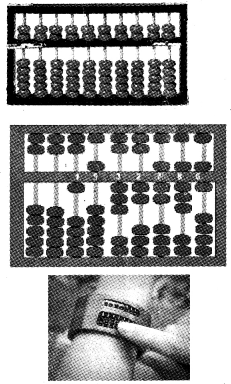
In 3000 BC Mesopotamians introduced this and it means calculating board or frame. It is considered as the first computer for basic arithmetical calculations and consists of beads on movable rods divided into two parts. The Chinese improved the Abacus with seven beads on each wire. Different Abacus are given below.

Plus One Computer Science Notes Chapter 1 The Discipline of Computing 2
Plus One Computer Science Notes Chapter 1 The Discipline of Computing 2.1

Plus One Computer Science Notes Chapter 1 The Discipline of Computing

(b) Napier’s bones:
A Mathematician John Napier introduced this in AD 1617.

(c) Pascaline:
A French mathematician Blaise Pascal developed this machine that can perform arithmetical operations.

(d) Leibniz’s calculator:
In 1673, a German mathematician and Philosopher Gottfried Wilhelm Von Leibniz introduced this calculating machine.

(e) Jacquard’s loom:
In 1801, Joseph Marie Jacquard invented a mechanical loom that simplifies the process of manufacturing textiles with complex pattern. A stored program in punched cards was used to control the machine with the help of human labour. This punched card concept was adopted by Charles Babbage to control his Analytical engine and later by Hollerith.

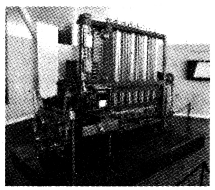
(f) Difference engine:
The intervention of human beings was eliminated by Charles Babbage in calculations by using Difference engine in 1822. It could perform arithmetic operations and print results automatically
Plus One Computer Science Notes Chapter 1 The Discipline of Computing 3

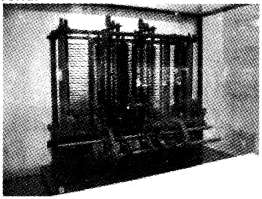
(g) Analytical engine:
In 1833. Charles Babbage introduced this. Charles Babbage is considered as the “Father of computer It is considered as the predecessor of today’s computer. This engine was controlled by programs stored in punched cards. These programs were written by Babbage’s assistant, Augusta Ada King, who was considered as the first programmer in the World.
Plus One Computer Science Notes Chapter 1 The Discipline of Computing 4

(h) Hollerith’s machine:
In 1887, Herman Hollerith an American made first electromechanical punched cards with instructions for input and output. The.card contained holes in a particular pattern with special meaning. The Us Census Bureau had large amount of data to tabulate, that will take nearly 10 years.

By this machine this work was completed in one year. In 1896, Hollerith started a company Tabulating Machine Corporation. Now it is called International Business Machines(IBM).

Plus One Computer Science Notes Chapter 1 The Discipline of Computing

(i) Mark-1:
In 1944 Howard Aiken manufactured automatic electromechanical computer in collaboration with engineers at IBM that handled 23 decimal place numbers and can perform addition, subtraction, multiplication and subtraction.

Generations of computers:
There are five generations of computers from 16th century to till date.
Plus One Computer Science Notes Chapter 1 The Discipline of Computing 5

First generation computers (1940 – 1956):
Vacuum tubes were used in first generation computers. The input was based on punched cards and paper tapes and output was displayed on printouts. The Electronic Numerical Integrator and Calculator(ENIAC) belongs to first generation was the first general purpose programmable electronic computer built by J. Presper Eckert and John V. Mauchly.

It was 30-50 feet long, weight 30 tons, 18,000 vacuum tubes, 70,000 registers, 10,000 capacitors and required 1,50,000 watts of electricity. It requires Air Conditioner. They later developed the first commercially successful computer, the Universal Automatic Computer(UNIVAC) in 1952. Von Neumann architecture
Plus One Computer Science Notes Chapter 1 The Discipline of Computing 6
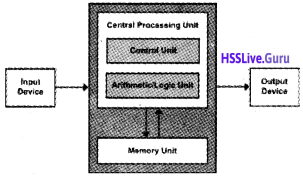
The mathematician John Von Neumann designed a computer structure that structure is in use nowadays. Von Neumann structure consists of a central processing unit(CPU), Memory unit, Input and Output unit. The CPU consists of arithmetic logical unit(ALU) and control unit(CU).

The instructions are stored in the memory and follows the “Stored Program Concept”. Colossus is the secret code breaking computer developed by a British engineer Tommy Flowers in 1943 to decode German messages.

Second generation computers (1956 -1963):
Transistors, instead of Vacuum tubes, were used in 2nd generation computers hence size became smaller, less expensive, less electricity consumption and heat emission and more powerful and faster.

A team contained John Bardeen, Walter Brattain and William Shockley developed this computer at Bell Laboratories. In this generation onwards the concept of programming language was developed and used magnetic core (primary) memory and magnetic disk(secondary) memory.

These computers used high level languages(high level language means English like statements are used)like FORTRAN (Formula translation) and COBOL(Common Business Oriented Language). The popular computers were IBM 1401 and 1620.

Third generation computers (1964 – 1971):
Integrated Circuits(IC’s) were used. IC’s or silicon chips were developed by Jack Kilby, an engineer in Texas Instruments. It reduced the size again and increased the speed and efficiency. The high level language BASIC(Beginners All purpose Symbolic Instruction Code) was developed during this period.

Plus One Computer Science Notes Chapter 1 The Discipline of Computing

The popular computers were IBM 360 and 370. Due to its simplicity and cheapness more people were used. The number of transistors on IC’s doubles approximately every two years. This law is called Moore’s Law, it is named after Gordon E Moore. It is an observation and not a physical or natural law.

Fourth generation computers (1971 onwards):
Microprocessors are used hence computers are called microcomputers. Microprocessor is a single chip which contains Large Scale of IC’s(LSI) like transistors, capacitors, resistors,etc due to this a CPU can place on a single chip. Later LSI were replaced by Very Large Scale Integrated Circuits(VLSI). The popular computers are IBM PC and Apple II.

Fifth generation computers (future):
Fifth generation computers are based on Artificial Intelligence(AI). Al is the ability to act as human intelligence like speech recognition, face recognition, robotic vision and movement etc. The most common Al programming language are LISP and Prolog.

Evolution of computing:
Computing machines are used for processing or calculating data, storing and displaying information. In 1940’s computer were used only for single tasks like a calculator. But nowadays computer is capable of doing multiple tasks at a time.

The “Stored Program Concept” is the revolutionary innovation by John Von Neumann helped storing data and information in memory. A program is a collection of instructions for executing a specific job or task.

Augusta Ada Lowelace: She was the Countess of Lowelace and she was also a mathematician and writer. She is considered as the first lady computer programmer.

Programming languages:
The instructions to the computer are written in different languages. They are Low Level Language(Machine language), Assembly Language(Middle level language) and High Level Language(HLL).

In Machine Language 0’s and 1 ’s are used to write program. It is very difficult but this is the only language which is understood by the computer. In assembly language mnemonics (codes) are used to write programs
Plus One Computer Science Notes Chapter 1 The Discipline of Computing 7
Electronic Delay Storage Automatic Calculator(EDSAC) built during 1949 was the first to use assembly language. In HLL English like statements are used to write programs. A-0 programming language developed by Dr. Grace Hopper, in 1952, for UNIVAC-I is the first HLL.

Plus One Computer Science Notes Chapter 1 The Discipline of Computing

A team lead by John Backus developed FORTRAN @IBM for IBM 704 computer and ‘Lisp’ developed by Tim Hart and Mike Levin at Massachusetts Institute of Technology. The other HLLs are C, C++, COBOL, PASCAL, VB, Java etc. HLL is very easy and can be easily understood by the human being.

Usually programmers prefer HLL to write programs because of its simplicity. But computer understands only machine language. So there is a translation needed. The program which perform this job are language processors.

Algorithm and computer programs:
The step-by-step procedure to solve a problem is known as algorithm. It comes from the name of a famous Arab mathematician Abu Jafer Mohammed Ibn Musaa Al-Khowarizmi, The last part of his name Al-Khowarizmi was corrected to algorithm.

Theory of computing:
It deals with how efficiently problems can be solved by algorithm and computation. The study of the effectiveness of computation is based upon a mathematical abstraction of computers is called a model of computation, the most commonly used model is Turing Machine named after the famous computer scientist Alan Turing.

1. Contribution of Alan Turing:
He was a British mathematician, logician, cryptographer and computer scientist. He introduced the concept of algorithm and computing with the help of his invention Turing Machine.

He asked the question Can machines think’ led the foundation for the studies related to the computing machinery and intelligence. Because of these contributions he is considered as the Father of Modern Computer Science as well as Artificial Intelligence.

2. Turing Machine:
In 1936 Alan Turing introduced a machine, called Turing Machine. A Turing machine is a hypothetical device that manipulates symbols on a strip of tape according to a table of rules. This tape acts like the memory in a computer. The tape contains cells which starts with blank and may contain 0 or 1.

So it is called a 3 Symbol Turing Machine. The machine can read and write, one cell at a time, using a tape head and move the tape left or right by one cell so that the machine can read and edit the symbol in the neighbouring cells. The action of a Turing machine is determined by

  1. the current state of the machine
  2. the symbol in the cell currently being scanned by the head and
  3. a table of transition rules, which acts as the program.

Plus One Computer Science Notes Chapter 1 The Discipline of Computing

3. Turing Test:
The Turing test is a test of a machine’s ability to exhibit intelligent behaviour equivalent to, or indistinguishable from, that of a human. The test involves a human judge engages in natural language conversations with a human and a machine designed to generate performance indistinguishable from that of a human being.

All participants are separated from one another. If the judge cannot reliably tell the machine from the human, the machine is said to have passed the test. The test does not check the ability to give the correct answer to questions; it checks how closely the answer resembles typical human answers. Turing predicted that by 2000 computer would pass the test.

Plus One Physics Chapter Wise Questions and Answers Chapter 13 Kinetic Theory

Students can Download Chapter 13 Kinetic Theory Questions and Answers, Plus One Physics Chapter Wise Questions and Answers helps you to revise the complete Kerala State Syllabus and score more marks in your examinations.

Kerala Plus One Physics Chapter Wise Questions and Answers Chapter 13 Kinetic Theory

Plus One Physics Kinetic Theory One Mark Questions and Answers

Question 1.
The value of \(\frac{P V}{T}\) for one mole of an ideal gas is nearly equal to
(a) 2 Jmol-1K-1
(b) 8.3 Jmol-1K-1
(c) 4.2 Jmol-1K-1
(d) 2 cal mol-1K-1
Answer:
(d) 2 cal mol-1K-1
The value of \(\frac{P V}{T}\) for one mole of an ideal gas = gas constant = 2 cal mol-1K-1.

Question 2.
Mean free path of a gas molecule is
(a) inversely proportional to number of molecules per unit volume
(b) inversely proportional to diameter of the molecule
(c) directly proportional to the square root of the absolute temperature
(d) directly proportional to the molecular mas
Answer:
(a) inversely proportional to number of molecules per unit volume.

Plus One Physics Chapter Wise Questions and Answers Chapter 13 Kinetic Theory

Question 3.
If for a gas \(\frac{R}{C_{v}}\) = 0.67, this gas is made up of molecules which are
(a) monoatomic
(b) diatomic
(c) Polyatomic
(d) mixture of diatomic and polyatomic molecules
Answer:
(a) monoatomic
For a gas, we know \(\frac{R}{C_{v}}\) = γ – 1
or, 0.67 = γ – 1, or γ = 1.67
Hence the gas is monoatomic.

Question 4.
According to kinetic theory of gases, molecules of a gas behave like
(a) inelastic spheres
(b) perfectly elastic rigid spheres
(c) perfectly elastic non-rigid spheres
(d) inelastic non-rigid spheres
Answer:
(b) According to kinetic theory of gases, gas molecules behave as a perfectly elastic rigid spheres.

Question 5.
Which one of the following is not an assumption of kinetic theory of gases?
(a) The volume occupied by the molecules of the gas is negligible.
(b) The force of attraction between the molecules is negligible.
(c) the collision between the molecules are elastic.
(d) All molecules have same speed.
Answer:
(d) Molecules of an ideal gas moves randomly with different speeds.

Question 6.
What is the shape of graph between volume and temperature, if pressure is kept constant?
Answer:
PV = nRT. Hence graph will be straight line.

Question 7.
What is the shape of graph between pressure p and I/V for a perfect gas at constant temperature?
Answer:
Straight line

Plus One Physics Chapter Wise Questions and Answers Chapter 13 Kinetic Theory

Question 8.
Identify the minimum possible temperature at which all molecular motion ceases.
Answer:
Absolute temperature (OK or – 273.15°C).

Question 9.
What is the formula for average translational kinetic energy of a gas molecule?
Answer:
3/2 KBT

Plus One Physics Kinetic Theory Two Mark Questions and Answers

Question 1.
Mention the conditions under which the real gases obey ideal gas equation.
Answer:
Low pressure and high temperature.

Question 2.
Why the temperature rises when gas is suddenly compressed?
Answer:
The work done on gas during compression increases the kinetic energy of molecules and hence temperature of gas rises.

Plus One Physics Chapter Wise Questions and Answers Chapter 13 Kinetic Theory

Question 3.
Why evaporation causes cooking?
Answer:
During evaporation, fast moving molecules escape from liquid. Hence average kinetic energy of molecules left behind is decreaesd. This will reduce temperature & causes cooling.

Question 4.
When automobile travels long distance air pressure in tyres increases slightly. Why?
Answer:
As automobile moves, work is being done against force of friction. This work is converted in to heat and it increases the temperature. As P a T, increase in temperature will increase pressure.

Question 5.
PV = µ RT is the ideal gas equation. Real gas obeys ideal behaviour at high temperature and at low pressure.

  1. Give an example for ideal gas
  2. Why real gases obey ideal gas equation at high temperature and at low pressure.

Answer:

  1. Hydrogen
  2. The interaction between molecules can be neglected at high T and at low temperature.

Plus One Physics Chapter Wise Questions and Answers Chapter 13 Kinetic Theory

Question 6.
A vessel of volume V contains a gas of µ moles at a temperature T.

  1. What is the ideal gas equation if gas is considered to be ideal one?
  2. The variation of pressure P with number of moles per unit volume in a vessel is shown in the graph. Analyse the graph and choose the correct one and justify your answer.

Plus One Physics Kinetic Theory Two Mark Questions and Answers 1
(i) The temperature inside the vessel decreases.
(ii) The temperature inside the vessel increases.
Answer:
1. PV = µRT

2. P = \(\frac{1}{3}\)nmc-2
In this case, when n increases, (mc-2) decreases to maintain P as constant. Temperature is directly proportional to mc-2. Hence we can say that temperature inside the vessel decreases.

Plus One Physics Kinetic Theory Three Mark Questions and Answers

Question 1.
1 mole of ideal gas is taken in vessel.

  1. State the following statements as true or false.
    • In gas equation R is constant.
    • All real gas obeys gas equation at all temperature and pressures.
  2. Draw the variation of R with pressure for the above ideal gas.
  3. Draw the variation of R with volume for this ideal gas.

Answer:
1. Following statements as true or false:

  • True
  • False

2.
Plus One Physics Kinetic Theory Three Mark Questions and Answers 2

3.
Plus One Physics Kinetic Theory Three Mark Questions and Answers 3

Plus One Physics Chapter Wise Questions and Answers Chapter 13 Kinetic Theory

Question 2.

  1. Air pressure in a car tyre increase during driving. Why?
  2. Air is filled in a vessel at 60°C. To what temperature should it be heated in order that 1/3rd of air may escape out of the vessel? (Expansion of air may be neglected).

Answer:
1. During driving the temperature of air inside the tyre increases due to motion.

2. T1 = 60 + 273 = 333K
V1 = V; T2 = ? V2 = V+ V/3
V2 = \(\frac{4}{3}\)V
Plus One Physics Kinetic Theory Three Mark Questions and Answers 4

Plus One Physics Chapter Wise Questions and Answers Chapter 13 Kinetic Theory

Question 3.
Find the degrees of freedom of the following.

  1. A body is confined to move in a straight line
  2. A body moves in a plane
  3. A body moves in a space

Answer:

  1. 1
  2. 2
  3. 3

Plus One Physics Kinetic Theory Four Mark Questions and Answers

Question 1.
An enclosed vessel contains many number of molecules moving in random direction.

  1. Explain the term pressure in terms molecular concept.
  2. Derive an expression for the pressure exerted by the gas molecules by assuming postulates of kinetic theory of gases.

Answer:
1. Pressure P = \(\frac{2}{3} n \overline{K E}\)
Where ‘n’ is the number of gas molecules per unit volume. \(\overline{\mathrm{KE}}\) is the average kinetic energy of a gas molecules moving in random direction.

2.
Plus One Physics Kinetic Theory Four Mark Questions and Answers 5
Consider molecules of gas in a container. The molecules are moving in random directions with a velocity V. This is the velocity of a molecule in any direction.

The velocity V can be resolved along x, y and z directions as Vx, Vy, and Vz respectively. If we assume a molecule hits the area A of container with velocity Vx and rebounds back with -Vx.

The change in momentum imparted to the area A by the molecule = 2mVx. The molecules covers a distance Vxt along the x-direction in a time t. All the molecules within the volume AVxt will collide with the area in a time t.

If ‘n’ is the number of molecules per unit volume, the total number of molecules hitting the area A, N = AVxt n.
But on an average, only half of those molecules will be hitting the area, and the remaining molecules will be moving away from the area. Hence the momentum imported to the area in a time t.

Plus One Physics Chapter Wise Questions and Answers Chapter 13 Kinetic Theory
Q = 2mvx × \(\frac{1}{2}\) AVxt n.
= nmVx2 At
The rate of change of momentum,
\(\frac{Q}{t}\) = nmVx2 A
But rate of change of momentum is called force, ie. force F = nmVx2A
∴ pressure P =nmVx 2 (P = \(\frac{F}{A}\))
Different molecules move with different velocities. Therefore, the average value V2x is to be taken. If \(\overline{\mathbf{V}}_{\mathbf{x}}^{2}\) isthe average value then the pressure.
p = nm\(\overline{\mathbf{V}}_{\mathbf{x}}^{2}\) ………(1)
\(\overline{\mathbf{V}}_{\mathbf{x}}^{2}\) is known as the mean square velocity.
Since the gas is isotropic (having the same properties in all directions), we can write
Plus One Physics Kinetic Theory Four Mark Questions and Answers 6
Hence the eq (1) can be written as
Plus One Physics Kinetic Theory Four Mark Questions and Answers 7
But nm = ρ, the density of gas
∴ P = \(\frac{F}{A}\) ρ\(\overline{\mathbf{V}}^{2}\).

Plus One Physics Chapter Wise Questions and Answers Chapter 13 Kinetic Theory

Question 2.
1. Fill in the blanks
Plus One Physics Kinetic Theory Four Mark Questions and Answers 8
2. What happens to the value of ratio of specific heat capacity, if we consider all rotational degrees of freedom of a 1-mole diatomic molecule?
Answer:
1.
Plus One Physics Kinetic Theory Four Mark Questions and Answers 9

2. Total degrees of freedom = 3 (trans) + 3 (Rot) = 6
∴ CV = 3R, CP = 4R
Ratio of specific heat γ = \(\frac{4}{3}\)
Ratio of specific heat capacity decreases.

Plus One Physics Kinetic Theory NCERT Questions and Answers

Question 1.
Molar volume is the volume occupied by 1 mol of any (ideal) gas at standard temperature and pressure (STP: 1 atmospheric pressure, 0°C). Show that it is 22.4 litres.
Answer:
PV= µRT or V = \(\frac{\mu \mathrm{RT}}{\mathrm{P}}\)
Plus One Physics Kinetic Theory NCERT Questions and Answers 10
= 22.4 × 10⁻³ m3 = 22.4 litre.

Question 2.
Estimate the total number of air molecules (inclusive of oxygen, nitrogen, water vapour and other constituents) in a room of capacity 25.0m3 at a temperature of 27°C and 1-atmosphere pressure.
Answer:
V = 25.0m3, T = (27 + 273), K = 300 K, k = 1.38 × 10⁻²³JK-1
PV= nRT = n(Nk)T = (nN)kT = NtkT
Here Nt represents the total number of air molecules in the given gas.
Plus One Physics Kinetic Theory NCERT Questions and Answers 11

Plus One Physics Chapter Wise Questions and Answers Chapter 13 Kinetic Theory

Question 3.
From a certain apparatus, the diffusion rate of hydrogen has an average value of 28.7 cm3s-1. The diffusion of another gas under the same conditions is measured to have an average rate of 7.2 cm3s-1. Identify the gas.
Answer:
According to Graham’s law of diffusion of gases, the rate of diffusion of a gas is inversely proportional to the square root of its molecular mass. If R1 and R2 be the rates of diffusion of two gases having molecular masses M1 and M2 respectively, then
Plus One Physics Kinetic Theory NCERT Questions and Answers 12

Plus One Physics Chapter Wise Questions and Answers Chapter 13 Kinetic Theory

Question 4.
Estimate the fraction of molecular volume to the actual volume occupied by oxygen gas at STP. Take the diameter of an oxygen molecule to be 3Å.
Answer:
Consider one mole of oxygen gas at STP. It occupies 22.4 litre of volume which will contain 6.023 × 10²³. (ie. Avogadro number) molecules. Considering spherical shape of molecule, volume of oxygen molecule
Plus One Physics Kinetic Theory NCERT Questions and Answers 13
Volume of 6.023 × 10²³ molecules
= \(\frac{4}{3}\) × 3.142(1.5)3 × 10-30 × 6.02 × 1023 m3
= 85.1 × 10⁻⁷m3
= 8.51 × 10⁻⁶m3 = 8.51 × 10⁻³
litre Molecular volume of one mole of oxygen (∵ 1m3 = 103 litre)
∴ Molecular volume of one mole of oxygen = 8.51 × 10⁻³ litre
Actual volume occupied by one mole of oxygen at STP = 22.4 litre
Fraction of molecular volume to actual volume
Plus One Physics Kinetic Theory NCERT Questions and Answers 14

Plus One Computer Science Chapter Wise Questions and Answers Chapter 7 Control Statements

Students can Download Chapter 7 Control Statements Questions and Answers, Plus One Computer Science Chapter Wise Questions and Answers helps you to revise the complete Kerala State Syllabus and score more marks in your examinations.

Kerala Plus One Computer Science Chapter Wise Questions and Answers Chapter 7 Control Statements

Plus One Control Statements One Mark Questions and Answers

Question 1.
An if statement contains another if statement completely. Then it is known as _________.
Answer:
Nested if

Plus One Computer Science Chapter Wise Questions and Answers Chapter 7 Control Statements

Question 2.
From the following which is not optional with switch statement.
(a) break
(b) default
(c) case
(d) none of these
Answer:
(c) case.

Question 3.
To exit from a switch statement _______ is used.
(a) quit
(b) exit
(c) break
(d) none of these
Answer:
(c) break

Question 4.
From the following which statement is true for switch statement.
(a) switch is used to test the equality
(b) switch is used to test relational or logical expression
(c) switch can handle real numbers case data
(d) none of these
Answer:
(a) switch is used to test the equality

Question 5.
Sonet wants to execute a statement more than once. From the following which is exactly suitable.
(a) if
(b) loop
(c) switch
(d) if else if ladder
Answer:
(b) loop

Question 6.
Odd one out
(a) for
(b) if
(c) switch
(d) if-else if ladder
Answer:
(a) for. It is a loop the others are branching statement.

Question 7.
Odd one out
(a) for
(b) if
(c) while
(d) do-while
Answer:
(b) if. It is a branching statement and the others are loops.

Question 8.
From the following which loop does the three things, initialisation, checking and updation.
(a) while
(b) do-while
(c) for
(d) none of these
Answer:
(c) for

Question 9.
Predict the output Output
(a) 10
(b) 1 to 10
(c) 11
(d) none of these
Answer:
(c) 11.

Plus One Computer Science Chapter Wise Questions and Answers Chapter 7 Control Statements

Question 10.
From the following which is exit controlled loop
(a) for
(b) while
(c) do-while
(d) None of these
Answer:
(c) do-while

Question 11.
_____________ statement is used for unconditional jump from one location to another.
Answer:
goto.

Question 12.
Sunitha wants to skip one iteration. From the following which will help her?
(a)continue
(b) break
(c) for
(d) case
Answer:
(a) continue

Question 13.
To terminate a program, from the following which is used.
(a) break
(b) continue
(c) end()
(d) exit()
Answer:
(d) exit()

Question 14.
Which header file is needed to use exit() function in a program?
(a) iostream
(b) cstdlib
(c) math
(d) iomanip
Answer:
(b) cstdlib

Question 15.
In while loop, the loop variable should be updated?
(a) along with while statement
(b) after the while statement
(c) before the while statement
(d) inside the body of while
Answer:
(d) Inside the body of while

Question 16.
How many times the following loop will execute?
int S = 0, i = 0;
do
{
S + = i;
i++;
} while(i < 5);
Answer:
5 times

Plus One Computer Science Chapter Wise Questions and Answers Chapter 7 Control Statements

Question 17.
1. statement takes the program control out of the loop even though the test expression is true.

2. Consider the following code fragment. How many times will the character be printed on the screen?
for (i=0; i< 10; i =i+2);
cout <<“*”;
}
Answer:

  1. break or goto
  2. Only one time because of semicolon(;) in the end of the for(i=0;i<10;i=i+2);

Question 18.
Which selection statement tests the value of a variable or an expression against a list of integers or character constants? (SAY-2015) (1)
(a) For
(b) If
(c) Switch
(d) Conditional expression
Answer:
(c) switch

Question 19.
How many times the following loop will execute? (MARCH-2016) (1)
int m = 2
do
{
cout<<“Welcome”; m++ ;
} while (m>10);
Answer:
Only one time

Question 20.
________ statement takes the program control outside a loop even though the test expression is true. (SCERT SAMPLE – II) (1)
Answer:
break

Question 21.
Read the following C++ statement for (int n = 1; n<10; n+=2); cout<<n
Now, choose the correct output from the following options. (SCERT SAMPLE – II)(1)
(a) 1
(b) 13579
(c) 11
(d) 10
Answer:
(c) 11. This is because of for statement is end with; (semi colon). Here cout<<n; executes only once.

Question 22.
____________ search method is an example for ‘divide and conquer method’.
Answer:
goto.

Plus One Computer Science Chapter Wise Questions and Answers Chapter 7 Control Statements

Question 23.
1. Name the type or loop which can be used to ensure that the body of the loop will surely be executed at least once.

2. Consider the code given below and predict the output. (MARCH-2017) (1)
for (int i=1; i<=9;i=i+2)
{
if (i==5) continue;
cout<<i<< ” “;
}
Answer:

  1. do while loop(Exit controlled loop)
  2. 1 3 7 9. It bypasses one iteration of the loop when i = 5.

Plus One Control Statements Two Mark Questions and Answers

Question 1.
Your friend Arun asked you that is there any loop that will do three things, initialization, testing and updation. What is your answer. Explain?
Answer:
Yes. There is only one loop namely for loop that will do this three things. The other loops will do the checking only, initialisation must be do before the loop and updation must be inside the loop.
The syntax of for loop is given below For(initialisation; testing; updation)
{
Body of the for loop;
}

Question 2.
While writing a program Geo uses while loop but forgets to update the loop variable. What will happen?
Answer:
The loop variable inside the while loop must be updated otherwise the loop will not be terminated. The loop will be work infinitely.

Question 3.
Draw the flow chart of if statement.
Answer:
Plus One Computer Science Chapter Wise Questions and Answers Chapter 7 Control Statements 1

Plus One Computer Science Chapter Wise Questions and Answers Chapter 7 Control Statements

Question 4.
Draw the flow chart of if else statement
Answer:
Plus One Computer Science Chapter Wise Questions and Answers Chapter 7 Control Statements 2

Question 5.
Write a while loop that display numbers from 500 to 550.
Answer:
int i = 500
while (i<=550)
{
cout<<i;
i = i + 1;
}

Question 6.
Distinguish between exit(0) function and return statement
Answer:
Both are used to terminate the program but both are different. Return is a keyword and exit(0) is a function. The difference is, we can use more than one exit(0) function but we can use only one return statement in a scope. To use exit(0), the header file cstdlib should be used.

Question 7.
Draw the flowchart of for loop
Answer:
Plus One Computer Science Chapter Wise Questions and Answers Chapter 7 Control Statements 3

Question 8.
How many time the following for loop will execute? Justify.
for(i = 0; ; i ++)
{
if(i > 5)
cout<<“continue”;
else
cout<<“over”;
}
Answer:
Here the loop becomes infinite because the check condition is missing.

Question 9.
Predict the output.
#include<iostream.h>
int main()
{
int a = 0;
start:
cout<<endl<< ++a;
if(a < 5)
goto start;
}
Answer:
1
2
3
4
3

Plus One Computer Science Chapter Wise Questions and Answers Chapter 7 Control Statements

Question 10.
for(int i=2, sum=0; i <= 20; i=i+2)
sum += i;
Rewrite the above code using while loop.
Answer:
int i = 2; sum=0;
while (i<=20)
{
sum += i;
i = i + 2;
}

Question 11,.
Rewrite the following code using switch case statement.
if(day == 1)
cout<<“Sunday”;
else if(day == 2)
cout<<“Monday”;
else if(day == 7)
cout<<“Saturday”;
else
cout <<“Wednesday”;
Answer:
switch (day)
{
case 1: cout<<“Sunday”;break;
case 2: cout<<“Monday”;break;
case 7: cout<<“Saturday”;break;
default : cout<<“Wednesday”;
}

Question 12.
Pick the odd one out from the following. Give reason.

  1. for, while, do….while
  2. if, switch, for

Answer:

  1. do…..while. It is an exit controlled loop while others are entry controlled loop
  2. for. It is a loop while others are branching statements.

Question 13.
State whether the following statements are True or False. In either case justify your answer.

  1. Break statement is essential in switch
  2. For loop is an entry controlled loop
  3. Do…while loop is an entry controlled loop
  4. Switch is a selection statement

Answer:

  1. False. It is not essential in single case statement
  2. True. Because it will first check the condition. If it is true then only the body will be executed.
  3. False. It is an exit controlled loop.
  4. True.

Plus One Computer Science Chapter Wise Questions and Answers Chapter 7 Control Statements

Question 14.
Write the equivalent code for the following statement. R = (P<Q?P:Q)
Answer:
if(P<Q)
R = P;
else
R = Q;

Question 15.
Examine the following code snippet and find out the output? What will happen if the statement int ch; is replaced by char ch;
int ch;
for(ch=’A’;ch<=’Z’;++ch)
cout<<ch<<”;
Answer:
This code snippet will print 65, 66, 67,……., 90. If the statement int ch; is replaced by char ch; it prints A, B, C, ……., Z.

Question 16.

  1. _______ is an entry control loop.
  2. _______ Explain the memory allocation for the following declaration statement. int A[10] [10];

Answer:

  1. while or for loop
  2. To store an integer 4 bytes is used in Geany Editor. int A[10] [10]; → It needs 10 × 10 × 4 = 400 bytes

Question 17.
Differentiate between break and continue statements in C++. (SAY -2016) (2)
Answer:
break statement:
It is used to skip over a part of the code i.e. we can premature exit from a loop such as while, do-while, for or switch.
Syntax:
while (expression)
{
if (condition)
break;
}

continue statement:
It bypasses one iteration of the loop. That is it skips one iteration and continue the loop with next iteration value.
Syntax :
while (expression)
{
if (condition)
continue;
}

Plus One Control Statements Three Mark Questions and Answers

Question 1.
Compare if else and conditional operator?
Answer:
We can use conditional operator as an alternative of if-else statement. The conditional operator is a ternary operator.
The syntax of if-else
if (expression 1)
expression 2;
else
expression 3;

First expression 1 is evaluated if it is true expression 2 will be executed otherwise expression 3 will be executed. Instead of this, we can be written as follows using conditional operator Expression 1 ? expression 2: expression 3;

Plus One Computer Science Chapter Wise Questions and Answers Chapter 7 Control Statements

Question 2.
Plus One Computer Science Chapter Wise Questions and Answers Chapter 7 Control Statements 4
Answer:
Plus One Computer Science Chapter Wise Questions and Answers Chapter 7 Control Statements 5
Plus One Computer Science Chapter Wise Questions and Answers Chapter 7 Control Statements 6

Question 3.
Rewrite the program following program using if else.
#include<iostream>
using namespace std;
int main()
{
int a,b,big;
cout<<“Enter two integers”;
cin>>a>>b;
big = (a>b)?a:b;
cout<<“Biggest number is “<<big<<endl;
return 0;
}
Answer:
Plus One Computer Science Chapter Wise Questions and Answers Chapter 7 Control Statements 7

Plus One Computer Science Chapter Wise Questions and Answers Chapter 7 Control Statements

Question 4.
Plus One Computer Science Chapter Wise Questions and Answers Chapter 7 Control Statements 43
Plus One Computer Science Chapter Wise Questions and Answers Chapter 7 Control Statements 8
Is it possible to rewrite the above program using switch statement? Distinguish between switch and if else if ladder.
Answer:
No. It is not possible to write the above code using switch statement. Following are the difference between switch and if else if ladder.

  1. Switch can test only for equality but if can evaluate a relational or logical expression
  2. If else is more versatile
  3. If else can handle floating values but switch cannot
  4. If the test expression contains more variable if-else is used
  5. Testing a value against a set of constants switch is more efficient than if-else.

Question 5.
Rewrite the following using nested switch construct.
Plus One Computer Science Chapter Wise Questions and Answers Chapter 7 Control Statements 9
Answer:
Plus One Computer Science Chapter Wise Questions and Answers Chapter 7 Control Statements 10

Plus One Computer Science Chapter Wise Questions and Answers Chapter 7 Control Statements

Question 6.
Consider the following output and write down the code for the same.
*
* *
* * *
* * * *
Answer:
#include<iostream>
using namespace std;
int main()
{
int i,j;
for(i=1;i<5;i++)
{
for(j=1;j<=i;j++)
cout<<n*”;
cout<<endl;
}
}

Question 7.
Consider the following output and write down the code for the same.
1
1 2
1 2 3
1 2 3 4
Answer:
#include<iostream>
using namespace std;
int main()
{
int ij;
for(i=1;i<5;i++)
{
for(j=l;j<=i;j++)
cout<<j<<“”;
cout<<endl;
}
}

Question 8.
Consider the following output and write down the code for the same.
1
2 2
3 3 3
4 4 4 4
Answer:
#include<iostream>
using namespace std;
int main()
{
int ij;
for(i=1;i<5;i++)
{
for(j=1;j<=i;j++)
cout<<i<<””;
cout<<endl;
}
}

Question 9.
Consider the following output and write down the code for the same.
1
2 3
4 5 6
7 8 9 10
Answer:
#include<iostream>
using namespace std;
int main()
{
int ij,k=0;
for(i=1;i<5;i++)
{
for(j=l;j<=i;j++)
cout<<++k<<“”;
cout<<endl;
}
}

Plus One Computer Science Chapter Wise Questions and Answers Chapter 7 Control Statements

Question 10.
Consider the following output and write down the code for the same.
1
1 3
1 3 5
1 3 5 7
Answer:
#include<iostream>
using namespace std;
int main()
{
int i,j;
for(i=1;i<5;i++)
{
for(j=1;j<=i;j++)
cout<<j × 2-1<<”
cout<<endl;
}
}

Question 11.
Consider the following output and write down the code for the same.
2
4 4
6 6 6
8 8 8 8
Answer:
#include<iostream>
using namespace std;
int main()
{
int i,j;
for(i=1;i<5;i++)
{
for(j=1;j<=i;j++)
cout<<i × 2<<“”;
cout<<endl;
}
}

Question 12.
Write a program to print the sum of first n natural numbers.
Answer:
#include<iostream>
using namespace std;
int main()
{
int n,i,sum=0;
cout<<“Enter a value for n”;
cin>>n;
for(i=1;i<=n;i++)
{
sum = sum + i;
}
cout<<“The sum of first ” <<n<<” numbers is “<<sum;
}

Question 13.
Write a program to read a number and check whether it is palindrome or not.
Answer:
Plus One Computer Science Chapter Wise Questions and Answers Chapter 7 Control Statements 11

Plus One Computer Science Chapter Wise Questions and Answers Chapter 7 Control Statements

Question 14.
Write a program to print the factorial of a number.
Answer:
#include<iostream>
using namespace std;
int main()
{
int n,i;
long fact = 1;
cout<<“Enter a number”;
cin>>n;
for(i=1;i<=n;i++)
fact = fact × i;
cout<<“The factorial of “<<n<<” is “<<fact;
}

Question 15.
Write a program to print the Fibonacci series.
Answer:
#include<iostream>
using namespace std;
int main()
Plus One Computer Science Chapter Wise Questions and Answers Chapter 7 Control Statements 12

Question 16.
Write a program to read a number and check whether the given number is Armstrong or not.
Answer:
Plus One Computer Science Chapter Wise Questions and Answers Chapter 7 Control Statements 13

Question 17.
Write down the code for the following output using while loop.
*
* *
* * *
* * * *
Answer:
Plus One Computer Science Chapter Wise Questions and Answers Chapter 7 Control Statements 14

Question 18.
Distinguish between entry controlled loop and exit controlled loop.
Answer:
An entry controlled loop first checks the condition and execute(or enters in to) the body of loop only if it is true. But exit control loop first execute the body of the loop once even if the condition is false then check the condition. The for loop and while loop are entry controlled loops but do-while loop is an exit controlled loop.

Plus One Computer Science Chapter Wise Questions and Answers Chapter 7 Control Statements

Question 19.
Write a program to find the largest of 3 numbers.
Answer:
Plus One Computer Science Chapter Wise Questions and Answers Chapter 7 Control Statements 15

Question 20.
Check whether a given number is prime or not.
Answer:
Plus One Computer Science Chapter Wise Questions and Answers Chapter 7 Control Statements 16

Question 21.
Write a program to print the prime numbers less than 100.
Answer:
Plus One Computer Science Chapter Wise Questions and Answers Chapter 7 Control Statements 17

Question 22.
Write a program to read number and display its factors.
Answer:
#include<iostream>
using namespace std;
int main()
{
int n,i;
cout<<“Enter a number greater than zero”;
cin>>n;
cout<<“The factors are”;
for(i=1;i<=n;i++)
if(n%i==0)
cout<<i<<“,”;
}

Plus One Computer Science Chapter Wise Questions and Answers Chapter 7 Control Statements

Question 23.
Write a program to print the Armstrong numbers less than 1000.
Answer:
Plus One Computer Science Chapter Wise Questions and Answers Chapter 7 Control Statements 18

Question 24.
Char result;
float marks;
cin>>marks;
if (marks >= 50)
result = ’P’;
else
result = ’F’;
cout<<result;
Rewrite the above code without using if statement.
Answer:
result=(marks>=50) ? ’P’: ’F’;

Question 25.
The output of a program is given below.
1
3
5
7
9
The sum is 25
Write a C++ program for obtaining the above output.
Answer:
#include<iostream>
using namespace std;
int main()
{
int sum=0,i;
for (i=1; i<=9; i+=2)
{
cout<<i<<endl;
sum = sum + i;
}
cout<<“The sum is”<<sum;
}

Question 26.
Find out the error in syntax if any and correct it?
Answer:
1. while (test condition);
{
}

2. do (condition)
{
}while

3. switch (condition)
{
Case 1:
Case 2:
Case 3:
Case 4:
}
Answer:
1. No need of semi colon. The corrected toop is given below
while (test condition)
{
}

2. In do … while loop the while must be end with semicolon.
do (condition)
{
}while;

3. switch contains expression instead of condition switch(expression)
{
Case 1:
Case 2:
Case 3:
Case 4:
}

Plus One Computer Science Chapter Wise Questions and Answers Chapter 7 Control Statements

Question 27.
Given the total mark of each student in SSLC examination. Write a C++ code fragment to find the grades.
Answer:
Plus One Computer Science Chapter Wise Questions and Answers Chapter 7 Control Statements 19

Question 28.
You are given the heights of 3 students. Write the relevant code segment to find the maximum height?
Answer:
Plus One Computer Science Chapter Wise Questions and Answers Chapter 7 Control Statements 20

Question 29.
Write the easiest code snippet for printing your name 1000 times. Explain.
Answer:
#include<iostream>
using namespace std;
int main()
{
int i;
char name[20];
cout<<“Enter your name:
cin>>name;
for(i=0;i<1000;i++)
cout<<name<<endl;
}

Question 30.
Given a code segment for(i=1; i<10; i++)
cout<<i;

  1. Rewrite the code using do….while loop
  2. What will be the output when i = 0? Give reason.

Answer:
1. i = 1;
do{
cout<<i; i++;
}while(i<10);

2. When i = 0, it will execute one more time. ie. the for loop execute 9 times but here this loop executes 10 times.

Question 31.
Whenever a string is entered the inverse of that string is displayed( eg: if we enter ‘CAR’ the output is ‘RAC’). Write a suitable programme for the output.
Answer:
Plus One Computer Science Chapter Wise Questions and Answers Chapter 7 Control Statements 21

Plus One Computer Science Chapter Wise Questions and Answers Chapter 7 Control Statements

Question 32.
Write a C++ program to display as follows
A
A B
A B C
A B C D
A B C D E
Answer:
Plus One Computer Science Chapter Wise Questions and Answers Chapter 7 Control Statements 22

Question 33.
Write C++ program forgetting the following output. (SAY-2016) (3)
1
1 2
1 2 3
1 2 3 4

OR

Consider the following C++ program and answer the following questions.
#include<iostream.h>
int main()
{
int a, p = 1;
for(a=1;a<=5;a+=2)
p = p × a;
cout<<p;
}

(a) Predict the output of the above code.
(b) Rewrite the above program using while loop.

Answer:
Plus One Computer Science Chapter Wise Questions and Answers Chapter 7 Control Statements 23

Plus One Control Statements Five Mark Questions and Answers

Question 1.
“We know that the execution of a program is sequential”. Is it possible to change this sequential manner and explain different jump statements in detail.
Answer:
The execution of a program is sequential but we can change this sequential manner by using jump statements. The jump statements are
1. goto statement:
By using goto we can transfer the control anywhere in the program without any condition. The syntax is goto label;
Example:
Plus One Computer Science Chapter Wise Questions and Answers Chapter 7 Control Statements 24
Plus One Computer Science Chapter Wise Questions and Answers Chapter 7 Control Statements 25

2. break statement:
It is used to skip over a part of the code i.e. we can premature exit from a loop such as while, do-while, for or switch.
Plus One Computer Science Chapter Wise Questions and Answers Chapter 7 Control Statements 26

Plus One Computer Science Chapter Wise Questions and Answers Chapter 7 Control Statements

3. continue statement:
It bypasses one iteration of the loop.
Plus One Computer Science Chapter Wise Questions and Answers Chapter 7 Control Statements 27
Plus One Computer Science Chapter Wise Questions and Answers Chapter 7 Control Statements 28

4. exit(0) function:
It is used to terminate the program. For this the header file cstdlib must be included.

Question 2.
Mr. X wants to get an output 9 when inputting 342 and he also wants to get 12 when inputting 651. Write the program and draw a suitable flowchart for X?
Answer:
Plus One Computer Science Chapter Wise Questions and Answers Chapter 7 Control Statements 29
Plus One Computer Science Chapter Wise Questions and Answers Chapter 7 Control Statements 30
Plus One Computer Science Chapter Wise Questions and Answers Chapter 7 Control Statements 31

Question 3.
Explain conditional statements in detail?
Answer:
1. Simple if:
The syntax is given below if(expression)
statement;

or

if(expression)
{
Block of statements
}
First expression evaluates if it is true then only statement will be executed.
eg: if (n>0)
cout<<n<<” is positive”;

2. if else:
The syntax is given below, if (expression)
statement 1;
else
statement 2;

or

if (expression)
{
statement block 1;
}
else
{
statement block 2;
}
First expression evaluates if it is true statement block 1 will be executed otherwise statement block 2 will be executed. Only one block will be executed at a time so it is called branching statement.
eg:
if (n>0)
cout<<n<<” is positive”;
else
cout<<n<<” is negative”;

3. if else if ladder:
The syntax will be given below
if (expression!)
{
statement block 1;
}
else if (expression 2)
{
statement block 2;
}
else if (expression 3)
{
statement block 3;
}
else
{
statement block n;
}
Here first expression 1 will be evaluated if it is true only the statement blockl will be executed otherwise expression 2 will be executed if it is true only the statement block 2 will be executed and so on. If all the expression evaluated is false then only statement block n will be evaluated .
eg:
If (mark>=90)
cout<<“Your grade is A+”;
else if (mark>=80)
cout<<“Your grade is A”;
else if (mark>=70)
cout<<“Your grade is B+”;
else if (mark>=60)
cout<<“Your grade is B”;
else if (mark>=50)
cout<<”Your grade is C+”;
else if (mark>=40)
cout<<“Your grade is C”;
else if (mark>=30)
cout<<“Your grade is D+”;
else
cout<<“Your grade is D”;

Plus One Computer Science Chapter Wise Questions and Answers Chapter 7 Control Statements

4. conditional operator:
It is a ternary operator and it is an alternative for if else construct. The syntax is given below.
expression 1? expression 2: expression 3;

or

expression 1? Value if true : value if false;
Here expression 1 will be evaluated if it true expression 2 will be executed otherwise expression 3 will be executed.
eg:
n>0?cout<<n<<” is positive”:cout<<n<<” is negative”;

5. Switch:
It is a multiple branch statement. Its syntax is given below.
switch(expression)
{
case value: statements;break;
……..
default : statements;
}
First expression evaluated and selects the statements with matched case value.
eg:
switch (n)
{
case 1: cout<< “Sunday”;break;
case 2: cout<< “Monday”;break;
case 3: cout<< “Tuesday”;break;
case 4: cout<< “Wedesday”;break;
case 5: cout<< “Thursday”;break;
case 6: cout<< “Friday”;break;
case 7: cout<< “Saturday”;break;
default : cout<< “lnvalid”
}

Question 4.
Explain different loops in detail?
1. For loop:
The syntax of for loop is for(initialization; checking ; update loop variable)
{
Body of loop;
}
First part, initialization is executed once, then checking is carried out if it is true the body of the for loop is executed. Then loop variable is updated and again checking is carried out this process continues until the checking becomes false. It is an entry controlled loop.
eg: for(i=1,j=1;i<=10;i++,j++)
cout<<i<<” × “<<j<<” = “<<i × j;

2. While loop:
It is also an entry controlled loop The syntax is given below
Loop variable initialised while(expression)
{
Body of the loop;
Update loop variable;
}
Here the loop variable must be initialised outside the while loop. Then the expression is evaluated if it is true then only the body of the loop will be executed and the loop variable must be updated inside the body. The body of the loop will be executed until the expression becomes false.
eg:
i = 1;
j = 1;
while(i<=10)
{
cout<<i<<” × “<<j<<” = “<<i × j; i++;
j++;
}

3. do While loop:
It is an exit controlled loop. The syntax is given below
do
{
Statements
}while(expression);
Here the body executes atleast once even if the condition is false. After executing the body it checks the expression if it false it quits the body otherwise the process will be continue.

Plus One Computer Science Chapter Wise Questions and Answers Chapter 7 Control Statements

Question 5.
Write a program to do the following:

  1. Inputs the values for variables ‘n’ and ‘m’.
  2. Prints the numbers between ‘m’ and ‘n’ which are exactly divisible by ‘m’.
  3. Checks whether the numbers divisible by ‘m’ are odd or even.

OR

Write a program using nested loop that inputs a number ‘n’ which generates an output as follows. Hint: if the value of ‘n’ is 5, the output will be as ‘n’
Answer:
1.
25
25 16
25 16 9
25 16 9 4
25 16 9 4 1

2.
#include<iostream.h>
#include<conio.h>
void main()
{
clrscr();
int i,n,m;
cout<<“Enter values for n and m”;
cin>>n>>m;
for(i=1;i<=n;i++)
if(i%m == 0)
cout<<i<<“,”;
getch();
}

3.
#include<iostream.h>
#include<conio.h>
void main()
{
clrscr();
int i,n,m;
cout<<“Enter values for n and m”;
cin>>n>>m;
for(i=1;i<=n;i++)
if(i%m == 0)
{
cout<<i<<“\t”;
if(i%2 == 0)
cout<<“even”<<endl;
else
cout<<“odd”<<endl;
}
getch();
}

OR

#include<iostream.h>
#include<conio.h>
#include<string.h>//for strlen()
main()
{
clrscr();
int n,i,j;
cout<<“enter a value for n:”;
cin>>n;
for(i=n;i>0;i- -)
{
for(j=n;j>=i;j~)
cout<<j × j<<“\t”;
cout<<endl;
}
getch();
}

Plus One Computer Science Chapter Wise Questions and Answers Chapter 7 Control Statements

Question 6.
Write a C++ program to display Fibonacci series. (SAY-2015)
Answer:
Plus One Computer Science Chapter Wise Questions and Answers Chapter 7 Control Statements 32
Plus One Computer Science Chapter Wise Questions and Answers Chapter 7 Control Statements 33

Question 7.
1. Write a C++ program to accept an integer number and check whether it is an Armstrong number or not. (Hint: Sum of the cubes of the digits of an Armstrong number is equal to that number itself)

OR

2. rite a C++ program to accept an integer number and print its reverse (Hint: If 234 is given, the output must be 432).
Answer:
1.
Plus One Computer Science Chapter Wise Questions and Answers Chapter 7 Control Statements 34
2. #include<iostream>
void main()
Plus One Computer Science Chapter Wise Questions and Answers Chapter 7 Control Statements 35


Question 8.
1. Write a menu driven program which accepts 3 numbers and show options to find and display.

  • the biggest number
  • the smallest number
  • the sun of the numbers
  • the product of the numbers

OR

2. Write a C++ program to check whether a number is palindrome or not.
Answer:
1.
Plus One Computer Science Chapter Wise Questions and Answers Chapter 7 Control Statements 36
Plus One Computer Science Chapter Wise Questions and Answers Chapter 7 Control Statements 37

OR
2.
Plus One Computer Science Chapter Wise Questions and Answers Chapter 7 Control Statements 38

Plus One Computer Science Chapter Wise Questions and Answers Chapter 7 Control Statements

Question 9.
Answer any one question from 22(a) and 22(b).
1. Write a C++ program to display all leap years between 1000 and 2000 excluding all century years.

OR

2. Write a C++ program to find the sum of the first 10 numbers of Fibonacci series. (Fibonacci series is 0, 1, 1,2, 3, 5, 8, 15 where 0 and 1 are the first two terms and reamaining terms are obtained by the sum of the two preceding terms.)
Answer:
1.
Plus One Computer Science Chapter Wise Questions and Answers Chapter 7 Control Statements 39

OR
2.

Plus One Computer Science Chapter Wise Questions and Answers Chapter 7 Control Statements 40

Question 10 (MARCH-2017)
Write a program to check whether the given number is palindrome or not. (MARCH-2017) (5)

OR

Write a program to print the leap years between 2000 and 3000.
(A century year is leap year only if it is divided by 400 and a noncentury year is leap year only if it is divided by 4).
Answer:
Plus One Computer Science Chapter Wise Questions and Answers Chapter 7 Control Statements 41

OR

Plus One Computer Science Chapter Wise Questions and Answers Chapter 7 Control Statements 42

Plus One Physics Chapter Wise Questions and Answers Chapter 12 Thermodynamics

Students can Download Chapter 12 Thermodynamics Questions and Answers, Plus One Physics Chapter Wise Questions and Answers helps you to revise the complete Kerala State Syllabus and score more marks in your examinations.

Kerala Plus One Physics Chapter Wise Questions and Answers Chapter 12 Thermodynamics

Plus One Physics Thermodynamics One Mark Questions and Answers

Question 1.
If the pressure and the volume of certain quantity of ideal gas are halved, then its temperature
(a) is doubled
(b) becomes one-fourth
(c) remains constant
(d) is halved
Answer:
(b) becomes one-fourth
According to ideal gas law
Plus One Physics Thermodynamics One Mark Questions and Answers 1

Plus One Physics Chapter Wise Questions and Answers Chapter 12 Thermodynamics

Question 2.
The ideal gas equation connecting pressure (P), volume (V) and absolute temperature (T) is
Plus One Physics Thermodynamics One Mark Questions and Answers 2
where kB is the Boltzmann constant and N is the number of molecules.
Answer:
c) PV = kBNT
According to ideal gas equation,
PV = NkBT.

Question 3.
Which of the following laws of thermodynamics forms the basis for the definition of temperature?
(a) First law
(b) Zeroth law
(c) Second law
(d) Third’law
Answer:
(b) Zeroth law
The Zeroth law of thermodynamics gives the definition of temperature.

Question 4.
Which of the following is a true statement?
(a) The total entropy of thermally interacting systems is conserved
(b) Carnot engine has 100% efficiency
(c) Total entropy does not change in a reversible process.
(d) Total entropy in an irreversible process can either increase or decrease.
Answer:
(c) Total entropy does not change in a reversible process.

Plus One Physics Chapter Wise Questions and Answers Chapter 12 Thermodynamics

Question 5.
In a given process of an ideal gas, dW = 0 and dQ < 0. Then for the gas
(a) the temperature will decrease,
(b) the volume will increase
(c) the pressure will remain constant
(d) the temperature will increase
Answer:
(a) From first law of thermodynamics
dQ = dU + dW
dQ = dU (if dW = 0)
Since, dQ < 0
dU < 0
or Ufinal < Uintial
Hence, temperature will decrease.

Question 6.
An electric fan is switched on in a closed room will the air of the room be cooled?
Answer:
No. Infact speed of air molecules will increase and this results in increase in temperature.

Question 7.
When an iron nail is hammered, if becomes hot. Why?
Answer:
The kinetic energy of hammer gets converted in to heat energy which increases temperature of iron nail.

Question 8.
Identify the thermodynamic process in which temperature of system may increase even when no heat is supplied to the system.
Answer:
Adiabatic process.

Plus One Physics Chapter Wise Questions and Answers Chapter 12 Thermodynamics

Question 9.
Which thermodynamic variable is defined by first law of thermodynamics?
Answer:
Internal energy

Question 10.
The door of an operating refrigerator kept open in a closed room. Will it make the room cool?
Answer:
No. The room will be slightly warmed.

Plus One Physics Thermodynamics Two Mark Questions and Answers

Question 1.
A Carnot engine working between 300K and 600K has a work output of 800J per cycle. Find the amount of energy consumed per cycle

  • 800J
  • 400J
  • 1600J
  • 1200J
  • 3200J

Answer:
Efficiency of carrots engine
Plus One Physics Thermodynamics Two Mark Questions and Answers 3
Efficiency also can be written as
Plus One Physics Thermodynamics Two Mark Questions and Answers 4
∴ input power = 1600 J.

Plus One Physics Chapter Wise Questions and Answers Chapter 12 Thermodynamics

Question 2.
A carnote’s engine is made to work between 200°C and 0°C first and then between 0°C and minus 200°C. Compare the values of efficiencies in the two cases.
Answer:
Case -1:
Plus One Physics Thermodynamics Two Mark Questions and Answers 5
= 1 – 0.577
= 0.42 = 42%
Case – 2:
η = 1 – \(\frac{73}{473}\)
T2 = -200 = 73k
= 1 – 0.26 = 0.73
= 73%
T1 = 0 = 273k.

Question 3.
Match the following
Plus One Physics Thermodynamics Two Mark Questions and Answers 6
Answer:
Plus One Physics Thermodynamics Two Mark Questions and Answers 7

Plus One Physics Chapter Wise Questions and Answers Chapter 12 Thermodynamics

Question 4.
What is the value of specific heat capacity of gas in

  1. Isothermal process
  2. Adiabatic process

Answer:

  1. Infinite
  2. Zero

Question 5.
Is the function of refrigerator against the second law of thermodynamics? Explain.
Answer:
No. The refrigerator transfers heat from the inside space to outer atmosphere, at the expense of external work supplied by the compresser fed by electric supply.

Plus One Physics Thermodynamics Three Mark Questions and Answers

Question 1.
Heat is supplied to a system, but its internal energy does not increase

  1. Which process is involved in this case? (1)
  2. Obtain an expression for the work done in the above process (2)

Answer:
1. Isothermal process.

2. Work done by adiabatic process
Let an ideal gas undergoes adiabatic charge from (P1, V1, T1) to (P2, V2, T2). The equation for adiabatic charge is
PVγ = constant = k
ie; P1V1γ = P2V2γ = k _____(a)
The work done by
Plus One Physics Thermodynamics Three Mark Questions and Answers 8
from equation (a) P1V1γ = P2V2γ = k
Plus One Physics Thermodynamics Three Mark Questions and Answers 9
Substituting ideal gas equation.
Plus One Physics Thermodynamics Three Mark Questions and Answers 10

Plus One Physics Chapter Wise Questions and Answers Chapter 12 Thermodynamics

Question 2.
A heat engine is a device which effectively converts heat energy into mechanical energy.

  1. State the law which describes this principle. (1)
  2. Derive an expression for the efficiency of a Carnot engine. (2)

Answer:
1. Kelvin – Plank statement:
No process is possible whose sole result is the absorption of heat from a reservoir and complete conversion of heat into work.

Clausius statement:
No process is possible whose sole result is the transfer of heat from a colder object to hotter object.

2. Carnot’s cycle:
The Carnot cycle consists of two isothermal processes and two adiabatic processes.
Plus One Physics Thermodynamics Three Mark Questions and Answers 11
Let the working substance in Carnot’s engine be the ideal gas.
Step 1: The gas absorbs heat Q1 from hot reservoir at T1 and undergoes isothermal expansion from (P1, V1, T1) to (P2, V2, T1).

Step 2: Gas undergoes adiabatic expansion from (P2, V2, T1) to (P3, V3, T2)

Step 3: The gas release heat Q2 to cold reservoir at T2, by isothermal compression from (P3, V3, T2) to (P4, V4, T2).

Step 4: To take gas into initial state, work is done on gas adiabatically [(P4, V4, T2) to (P1, V1, T1)]. Efficiency of Carnot’s engine:
Plus One Physics Thermodynamics Three Mark Questions and Answers 12

Plus One Physics Chapter Wise Questions and Answers Chapter 12 Thermodynamics

Question 3.
A thermo flask contains coffee. It is violently shaken. Considering the coffee as a system:

  1. does its temperature rise?
  2. has heat been added to its?
  3. has internal energy changed?

Explain your answers.
Answer:

  1. Yes
  2. Heat is added to coffee
  3. Internal energy is changed
  4. When we shake, the mechanical energy is added to the liquid contained in a flask.

Question 4.
It is predicted by the meteorologists that global warming will result in the flooding of oceans due to the melting of ice caps on the earth.

  1. Name the thermodynamic process involved in the melting of ice.
  2. Determine the heat energy required to melt 5kg of ice completely at 0°C. Latent heat of fusion of water is 3336 × 103 J Kg-1.
  3. During the melting process, what change will occur to its internal energy?

Answer:

  1. Isothermal process
  2. ∆Q = mL = 5 × 33.36 × 105 = 16.68 × 10⁶J
  3. Internal energy increases

Plus One Physics Chapter Wise Questions and Answers Chapter 12 Thermodynamics

Question 5.
Water is heated in an open vessel.

  1. This process is
    • isothermal
    • isobaric
    • isochoric
    • adiabatic
  2. Which law of thermodynamics is suitable to explain the transfer of heat here?
  3. Draw the heat-temperature graph of ice below 0°C heated up to steam above 100°C.

Answer:
1. Isobaric
2. First law of thermodynamics
3.
Plus One Physics Thermodynamics Three Mark Questions and Answers 13

Question 6.

  1. The molar heat capacity of oxygen at constant volume is 20J mol-1K-1. What do you mean by molar heat capacity at constant volume (CV)?
  2. The difference between CP and CV is always a constant. Give a mathematical proof.

Answer:
1. Molar specific heat at constant volume is the heat required to raise the temperature of I mol substance by IK at constant volume.

2. According to 1st law of thermodynamics
∆Q = ∆U + PAV
If ∆Q heat is absorbed at constant volume (∆V = 0).
Plus One Physics Thermodynamics Three Mark Questions and Answers 14
From ideal gas equation for one mole PV = RT. Differentiating w.r.t. temperature (at constant pressure
Plus One Physics Thermodynamics Three Mark Questions and Answers 15
Equation (4) – Equation (1), we get
CP – CV = R.

Plus One Physics Chapter Wise Questions and Answers Chapter 12 Thermodynamics

Question 7.
A heat engine is a device which converts heat energy into work.

  1. What is the working substance in an ideal heat engine.
  2. A Carnot engine is working between in melting point and steam point. What is its efficiency?

Answer:
1. Ideal gas.

2. T2 = 0°C = 273K
T1 = 100°C = 373K
Efficiency η = I – \(\frac{T_{2}}{T_{1}}=I-\frac{273}{373}\)
η = 0.27
η = 27%.

Question 8.
A gas is taken in a cylinder. The walls of the cylinder is insulated from the surroundings

  1. The gas in a cylinder is suddenly compressed. Which thermo dynamic process involves in this statement. Explain the thermo dynamic process.
  2. If gas is suddenly compressed to 1/4th of its, original volume. Calculate the rise in temperature. The initial temperature was 27°C and γ = 1.5.

Answer:
1. Adiabatic. A thermo dynamic process in which no heat enters or leaves the system.

2. T. = 27°C = 27 + 273 = 300k
Plus One Physics Thermodynamics Three Mark Questions and Answers 16
= 300 × 41.5 – 1
= 300 × 41/2
= 600K
rise in temperature = 600K – 300K = 300K.

Question 9.
Raju brought a motor pump from a shop. The efficiency of the motor pump is printed on the label as 60%.

  1. The efficiency of a water pump is 60%. What is . meant by this?
  2. Can you design an engine of 100% efficiency? Justify your answer.

Answer:
1. Efficiency means that, 60% of the total energy received is converted into useful work.

2. The efficiency of heat engine η = 1 – \(\frac{T_{2}}{T_{1}}\). The efficiency will be 100% if T2 = OK, both those conditions cannot be attained practically. So art engine can’t have 100% efficiency.

Plus One Physics Chapter Wise Questions and Answers Chapter 12 Thermodynamics

Question 10.
Categorise into reversible and irreversible process

  1. Waterfall
  2. rusting of iron
  3. electrolysis
  4. slow compression
  5. diffusion of gas
  6. melting of ice
  7. dissolving NaCl in water
  8. flow of heat from hot body to cold body
  9. slow compression of spring
  10. heat produced by friction.

Answer:
Reversible process → (3), (4), (6) and (9)
Irreversible process → (1), (2), (5), (7), (8) and (10)

Plus One Physics Thermodynamics NCERT Questions and Answers

Question 1.
A geyser heats water flowing at the rate of 3.0 litres per minute from 27°C to 77°C. If the geyser operates on a gas burner, what is the rate of consumption of the fuel if its heat of combustion is 4.0 × 10⁴ Jg-1?
Answer:
Volume of water heated = 3.0 litre per minute
mass of water heated, m = 3000 g per minute
increase in temperature, ∆T = 77°C – 27°C = 50°C
specific heat of water, c= 4.2Jg-1 °C-1
amount of heat used, Q = mc ∆T
or Q = 3000 g min-1 × 4.2Jg-1
°C-1 × 50°C
= 63 × 104J min-1
rate of combustion of fuel = \(\frac{63 \times 10^{4} \mathrm{Jmin}^{-1}}{4.0 \times 10^{4} \mathrm{Jg}^{-1}}\)
= 15.75gmin-1.

Plus One Physics Chapter Wise Questions and Answers Chapter 12 Thermodynamics

Question 2.
What amount of heat must be supplied to 2.0 x 10⁻² kg of nitrogen (at room temperature) to raise its temperature by 45°C at constant pressure? (Molecular mass of N2 = 28, R = 8.3 J mol-1 K-1).
Answer:
m = 2 × 10³ kg-1 = 20g,
∆T = 45°C, M = 28
R = 8.3 J mol-1 K-1, M = 28
Number of moles, n = \(\frac{m}{M}=\frac{20}{28}=\frac{5}{7}\)
Since nitrogen is diatomic,
∴ CP = \(\frac{7}{2}\)
R = \(\frac{7}{2}\) × 8.3 J mol-1K-1
Now, ∆Q = nCP ∆T
= \(\frac{5}{2}\) × \(\frac{7}{2}\) × 8.3 × 45J = 933.75J.

Question 3.
A cylinder with a movable piston contains 3 moles of hydrogen at standard temperature and pressure. The walls of the cylinder are made of a heat insulator, and the piston is insulated by having a pile of sand on it. By what factor does the pressure of the gas increase if the gas, is compressed to half its original volume?
Answer:
P2V2γ = P1V1γ
Plus One Physics Thermodynamics NCERT Questions and Answers 17

Question 4.
A steam engine delivers 5.4 × 10⁸ J of work per minute and services 3.6 × 10⁹J of heat per minute from its boiler. What is the efficiency of the engine? How much heat is wasted per minute?
Answer:
Work done per minute, output = 5.4 × 10⁸J
Heat absorbed per minute, input = 3.6 × 10⁹J
Efficiency, η = \(\frac{5.4 \times 10^{8}}{3.6 \times 10^{9}}\) = 0.15
%η = 0.15 × 100 = 15
Heat energy wasted/ minute = Heat energy absorbed/minute – Useful work done/minute
= 3.6 × 10⁹ – 5.4 × 108
= (3.6 – 0.54) × 109 = 3.06 × 10⁹J.

Plus One Physics Chapter Wise Questions and Answers Chapter 12 Thermodynamics

Question 5.
An electric heater supplies heat to a system at a rate of 100W. If system performs work at a rate of 75 joule per second, at what rate is the internal energy increasing?
Answer:
Heat supplied, ∆Q = 100W = 10OJs-1
Useful work done, ∆W = 75J s-1
Using first law of thermodynamics
∆Q = ∆U+ ∆W
∆U = ∆Q – ∆W
= 100Js-1 – 75Js-1 = 25Js-1.

Question 6.
A refrigerator is to maintain eatables kept inside at 9°C. If room temperature is 36°C, calculate the coefficient of performance.
Answer:
T1 = 36°C = (36 + 273) K = 309 K
T2 = 9°C = (9 + 273) K = 282 K
Coefficient of performance = \(\frac{T_{2}}{T_{1}-T_{2}}\)
Plus One Physics Thermodynamics NCERT Questions and Answers 18

Plus One Physics Chapter Wise Questions and Answers Chapter 12 Thermodynamics

Question 7.
Molar volume is the volume occupied by 1 mol of any (ideal) gas at standard temperature and pressure (STP: 1 atmospheric pressure, 0°C). Show that it is 22.4 litres.
Answer:
PV = µRT or V = \(\frac{\mu \mathrm{RT}}{\mathrm{P}}\)
Plus One Physics Thermodynamics NCERT Questions and Answers 19
= 22.4 × 10⁻³ m3 = 22.4 litre.

Plus One Physics Chapter Wise Questions and Answers Chapter 11 Thermal Properties of Matter

Students can Download Chapter 11 Thermal Properties of Matter Questions and Answers, Plus One Physics Chapter Wise Questions and Answers helps you to revise the complete Kerala State Syllabus and score more marks in your examinations.

Kerala Plus One Physics Chapter Wise Questions and Answers Chapter 11 Thermal Properties of Matter

Plus One Physics Thermal Properties of Matter One Mark Questions and Answers

Question 1.
In which of the following processes, convection does nottake place primarily?
(a) Sea and land breeze
(b) Boiling of water
(c) Warming of glass of bulb due to filament
(d) Heating air around a furnace
Answer:
(c) Warming of glass of bulb due to filament
In convection process, the heat is transferred by the bodily motion of the heated particles. It is not so in case of warming of glass bulb due to filament heating. In fact, warming of glass bulb is due to radiation.

Question 2.
\(\frac{\text { Watt }}{\text { Kelvin }}\) a unit of
(a) Stefan’s constant
(b) Wien’s constant
(c) Cooling’s constant
(d) Thermal conductance
Answer:
(d) Thermal resistance
Plus One Physics Thermal Properties of Matter One Mark Questions and Answers 1

Plus One Physics Chapter Wise Questions and Answers Chapter 11 Thermal Properties of Matter

Question 3.
For measuring temperatures in the range of 2000°C, we should employ
(a) gas thermometer
(b) platinum-rhodium thermometer
(c) barometer
(d) pyrometer
Answer:
(d) pyrometer

Question 4.
There is a hole in metal disc. What happens to the size of metal disc if the metal disc is heated?
Answer:
The size of hole increases.

Question 5.
Which has more specific heat capacity, water, and sand?
Answer:
Water.

Question 6.
Two solid spheres of the same material have the same radius but one is hollow while the other is solid. Both spheres are heated to same temperature. Then
(a) the solid sphere expands more
(b) the hollow sphere expands more
(c) expansion is same for both
(d) nothing can be solid about their relative expansion if their masses are not given
Answer:
(c) expansion is same for both

Plus One Physics Chapter Wise Questions and Answers Chapter 11 Thermal Properties of Matter

Question 7.
The sprinkling of water reduces slightly the temperature of a closed room because
(a) temperature of water is less than that of the room.
(b) specific heat of water is high
(c) water has large latent heat of vaporisation
(d) water is a bad conductor of heat
Answer:
(c) water has large latent heat of vaporisation
When water is sprinkled over a large area, evaporation takes place. As the latent heat of vaporisation is large cooling takes place.

Question 8.
Why specific heat of gas at constant pressure (Cp) is greater than specific heat at constant volume?
Answer:
More heat is required to raise the temperature of gas at constant pressure than at constant volume.

Question 9.
A body is heated. But there is no change in its temperature. Is it possible?
Answer:
Yes. During change of state, there will be no increase in temperature even when heat is supplied.

Question 10.
When boiling water is put in glass tumbler, the tumbler cracks. Why?
Answer:
Glass is poor conductor of heat. So inner and outer surfaces of tumbler suffer uneven expension. Hence it breaks.

Question 11.
A small space is left between two rails on railway track. Why?
Answer:
If no space is left, the rails would bend due to thermal expansion in summer. So small space is left between two rails to allow thermal expansion.

Plus One Physics Chapter Wise Questions and Answers Chapter 11 Thermal Properties of Matter

Question 12.
The pendulum of clock is made of invar, Why?
Answer:
Invar has low value of coefficient of linear expansion. So length of pendulum remains almost same in all seasons. (The change in length affects time period of pendulum).

Question 13.
Tea gets cooled, when sugar is added to it. Why?
Answer:
When sugar is added, heat content of tea gets shared with sugar & hence’ temperature decreases.

Question 14.
Ice covered in gunny bag does not melt for a long time. Why?
Answer:
A gunny bag is poor conduct of heat & hence it does not allow external heat to enter.

Question 15.
Why two layers of cloth of equal thickness provide warmer covering than a single layer of cloth of double the thickness?
Answer:
Because air between two layers of clothes is a bad ‘ conductor of heat.

Plus One Physics Chapter Wise Questions and Answers Chapter 11 Thermal Properties of Matter

Question 16.
On winter nights, we feel warmer when clouds cover the sky than the sky is clear. Why?
Answer:
The clouds are bad conductor of heat. So heat of earth’s atmosphere is not conducted out.

Plus One Physics Thermal Properties of Matter Two Mark Questions and Answers

Question 1.
1. Two bodies at different temperatures T1K and T2K are brought in contact with each other

  • Is the resultant temperature be necessarily (T1 + T2)/2? If not, Why?
  • Should the resultant temperature be between T1 and T1 only? If not, Why?

Answer:
1. Two bodies at different temperatures:

  • The resultant temperature may not be necessarily \(\left(\frac{T_{1}+T_{2}}{2}\right)\). Because specific heat capacity is different for all substances.
  • If heat is not lost to the surroundings, resultant temperature must lie in between T1 and T2.

Plus One Physics Chapter Wise Questions and Answers Chapter 11 Thermal Properties of Matter

Question 2.
A Patient is admitted to hospital. The temperature of the patient is measured by nurse and is found to be 97.6°F

  1. What is meant by temperature?
  2. Convert the temperature (97.6°F) is to centigrade

Answer:
1. Temperature is the degree of hotness.

2.
Plus One Physics Thermal Properties of Matter Two Mark Questions and Answers 2

Question 3.
Why iron rims are heated red hot before being put on the cart wheels?
Answer:
The radius of iron rim is smaller than radius of cart wheel. When iron rim is heated, its radius increases due to thermal expansion. After rim has planted on the wheel, iron rim is allowed to cool. Then it fits tightly on the wheel due to thermal contraction.

Plus One Physics Chapter Wise Questions and Answers Chapter 11 Thermal Properties of Matter

Question 4.
How woolen clothes helps us in winter against cold?
Answer:
Wool is a heat insulator. Moreover, it contains a layer of dry air in it. This air, which is bad conductor of heat does not allow the body heat to escape & it also does not allow external cold to come in. The rough surface of woollen clothes absorbs more and reflects less heat falling on it.

Plus One Physics Thermal Properties of Matter Three Mark Questions and Answers

Question 1.
A Solid material is supplied with heat at constant rate. The temperature of the material is changing with the heat input as shown in figure.

  1. What do the horizontal region AB and CD represent?
  2. What does the slope of DE represent?
  3. The slope of OA is greater than the slope of BC. What does this indicate?

Answer:
Plus One Physics Thermal Properties of Matter Three Mark Questions and Answers 3

  1. Latent heat of fusion, Latent heat of vaporization
  2. It indicates that, the material is in vapour state
  3. It indicates that latent heat of vaporization of the material is greater than the latent heat of fusion.

Plus One Physics Thermal Properties of Matter Four Mark Questions and Answers

Question 1.
A copper block of mass 2.5kg is heated in a furnace to a temperature of 500°C and then placed on a large ice block. What is the maximum amount of ice that can melt? (Specific heat of copper = 0.39Jg-1 K-1; latent heat of fusion of water = 335 Jg-1).
Answer:
Mass, m = 2.5kg
= 2.5 × 10³ g;
Change in temperature, ∆T = 500°C
Specific heat, c = 0.39 Jg-1K-1;
Latent heat of fusion, L = 335Jg-1
If m’ be the mass of ice melted, then m’L = mc ∆T
or m’ × 335 = 2.5 × 103 × 0.39 × 500 2.5 × 103 × 0.39 × 500
or m’ = \(\frac{2.5 \times 10^{3} \times 0.39 \times 500}{335} \mathrm{g}\)
= 1.5 kg.

Plus One Physics Chapter Wise Questions and Answers Chapter 11 Thermal Properties of Matter

Question 2.
Heat from the sun reaches the earth.

  1. Write the method of transmission of heat.
  2. Thermal conductivity of Aluminium is 205 Jm-1s-1deg-1. What do you mean by this?
  3. Birds swell feathers in winter. Why?

Answer:
1. Radiation, conduction, convenction.

2. The coefficient of thermal conductivity of a substance is defind as the quauitity of heat conducted normally persecond through unit area of the substance per unit temperature gradient when the substance attains steady state.

3. By doing so the birds enclose air between the feathers. Air being a poor conductor, prevents the loss of heat from the body of the bird to the cold surroundings.

Question 3.
Two accidents are happened. The first one with water at 100°C and the second one with steam at 100°C.

  1. Which is dangerous burn due to water at 100°C, and bum due to steam at 100°C? Why?
  2. Latent heat of vapourisation of water to 536 cal/g. Explain the idea of latent heat of vopourisation.
  3. Find the heat required to convert 1g of ice at 0°C to steam at 100°C is

Answer:
1. Burn due to steam is more dangerous, because heat content in steam is very high compared to 100°C water.

2. Latent heat of vapourisation is the amount of heat required to change the state of 1 kg water in to vapour.

3. Q = ML + MC∆Q + ML1
Plus One Physics Thermal Properties of Matter Four Mark Questions and Answers 4
= 716 cal.

Plus One Physics Chapter Wise Questions and Answers Chapter 11 Thermal Properties of Matter

Question 4.
When a fluid is heated, the particle rises up.

  1. Name the phenomonon behind it.
  2. Explain the formation of land breeze and sea breeze.

Answer:
1. Convection

2. During the day, land heats up more quickly than, water in lake (due to high specific heat capacity of water). The air on the surface of earth gets heated, expands, becomes less dense and rises up. The colder air (wind) replaces the space created by hot air.

It creates a sea breeze. At night the land loses its heat very quickly than water. So water remains more warmer at night.

Plus One Physics Thermal Properties of Matter NCERT Questions and Answers

Question 1.
A 10kW drilling machine is used to drill a bore in a small aluminium block of mass 8.0kg. How much is the rise in temperature of the block in 2.5 minutes, assuming 50% of power is used up in heating the machine itself or lost to the surroundings? Specific heat of aluminium = 0.19Jg-1 K-1.
Answer:
Power, P = 10 kW
= 10 × 103W
= 104W
Mass, m = 8 kg; Time, t = 2.5min = 150s
Specific heat, c = 0.91Jg-1K-1
= 0.91 × 10³Jkg-1K-1
Energy, Q = pt = 104 × 150J = 1.5 × 10⁶J
It is given that 50% of energy is lost to the. surroundings. So, energy absorbed by the block is given by
Q = \(\frac{1}{2}\) × 1.5 × 10⁶J = 0.75 × 10⁶J
But Q = mc∆T
∴ ∆T
Plus One Physics Thermal Properties of Matter NCERT Questions and Answers 5

Plus One Physics Chapter Wise Questions and Answers Chapter 11 Thermal Properties of Matter

Question 2.
A brass boiler has a base area of 0.15m2 and thickness 1.0cm. It boils water at the rate of 6.0 kg/min when placed on a gas stove. Estimate the temperature of the part of the flame in contact with the boiler. Thermal conductivity of brass = 109 J s-1 m-1K-1;
Heat of vaporisation of water = 2256 × 103 J kg-1.
Answer:
A = 0.15m2, d = 10-2m,
\(\frac{m}{t}=\frac{6}{60}\) kgs-1 = 0.1kgs-1,
K = 109J s-1 m-1 K-1, L = 2256 × 103 Jkg-1,
θ1 = ?,
θ2 = 100°C
Plus One Physics Thermal Properties of Matter NCERT Questions and Answers 6

Plus One Physics Chapter Wise Questions and Answers Chapter 11 Thermal Properties of Matter

Question 3.
Explain why?
(a) A body with large reflectivity is a poor emitter.
(b) A brass tumbler feels much colder than a wooden tray on a chilly day.
(c) An optical pyrometer (for measuring high temperature) calibrated for an ideal black body radiation gives too low a value for the temperature of a red hot iron piece in the open, but gives a correct value for the temperature when the same piece is in the furnace.
(d) The earth without its. atmosphere would be inhospitably cold?
(e) Heating systems based on circulation of steam are more efficient in warming a building than heating system based on circulation of hot water.
Answer:
(a) a body whose reflectivity is large would naturally absorb less heat. So, a body with large reflectivity is a poor.

(b) The thermal conductivity of brass is high i.e., brass „ is a good conductor of heat. So, when a brass tumbler is touched, heat quickly flows from human body to tumbler. Consequently, the tumbler appears colder. On the other hand, wood is a bad conductor, so, heat does not flow from the human body to the wooden tray in this case. Thus, it appears comparatively hotter.

(c) Let T the temperature of the hot iron in the furnace. Heat radiated per second per unit area, E = σT4

Plus One Physics Chapter Wise Questions and Answers Chapter 10 Mechanical Properties of Fluids

Students can Download Chapter 10 Mechanical Properties of Fluids Questions and Answers, Plus One Physics Chapter Wise Questions and Answers helps you to revise the complete Kerala State Syllabus and score more marks in your examinations.

Kerala Plus One Physics Chapter Wise Questions and Answers Chapter 10 Mechanical Properties of Fluids

Plus One Physics Mechanical Properties of Fluids One Mark Questions and Answers

Question 1.
Water is flowing through a very narrow tube. The velocity of water below which the flow remains a streamline flow is known as
(a) relative velocity
(b) terminal velocity
(c) critical velocity
(d) particle velocity
Answer:
(c) critical velocity
Critical velocity is that velocity of liquid flow, upto which the flow of liquid is a streamlined and above which its flow becomes turbulent.

Question 2.
Bernoulli’s equation for steady, non-viscous, imcompressible flow expresses the
(a) conservation of angular momentum
(b) conservation fo density
(c) conservation of momentum
(d) conservation of energy
Answer:
(d) conservation of energy

Plus One Physics Chapter Wise Questions and Answers Chapter 10 Mechanical Properties of Fluids

Question 3.
When cooking oil is heated in a frying pan, the oil moves around in the pan more easily when it is hot. The main reason for this is that with rise in temperature, there is a decrease in
(a) surface tension
(b) viscosity
(c) angle of contact
(d) density
Answer:
(d) density

Question 4.
At what temperature density of air is maximum?
Answer:
4°C

Question 5.
A thin glass plate is lying on a wet marble floor, It is difficult to pull the glass plate because of
(i) surface tension
(ii) Viscosity
(iii) friction
(iv) atmosphere
(v) Gravity
Answer:
(i) Viscosity

Question 6.
Why do clouds float in the sky?
Answer:
Zero terminal velocity

Plus One Physics Chapter Wise Questions and Answers Chapter 10 Mechanical Properties of Fluids

Question 7.
A spinning cricket ball does not follow parabolic path. Why?
Answer:
Due to the magnus effect.

Question 8.
The deep water runs slow. Why?
Answer:
According to equation of continuity velocity is inversly proportional to velocity (AV = constant). Hence deep water runs slow.

Question 9.
Why dust generally settles down in closed room?
Answer:
The dust particles (tiny spheres) acquire terminal velocity as it fall through air. The terminal velocity is directly proportional to square of radius. Hence terminal velocity of dust particle is very small. So they settle down gradually.

Question 10.
Why more viscous oil is used in summer than in winter in scooters?
Answer:
The viscosity decreases with increase in temperature.

Question 11.
Why is sand drier than clay?
Answer:
Capillary action

Plus One Physics Chapter Wise Questions and Answers Chapter 10 Mechanical Properties of Fluids

Question 12.
Why cotton dress is preferred in summer?
Answer:
Cotton dresses have fine pores which act as capillaries for the sweat.

Question 13.
Why oil is poured to calm the sea?
Answer:
When oil is poured in water, the surface tension of water is reduced and water spreads over large area of sea.

Question 14.
How plants draw water from ground?
Answer:
The capillary action.

Question 15.
How do insects run on the surface of water?
Answer:
Because of surface tension, the surface of water behaves like stretched membrane hence it can support weight of small insects.

Question 16.
How ploughing a field helps to retain moisture?
Answer:
When field is ploughed, capillaries are broken and hence water can not rise up and retains moisture.

Plus One Physics Chapter Wise Questions and Answers Chapter 10 Mechanical Properties of Fluids

Question 17.
Hot soup tastes better than cold soup. Why?
Answer:
The surface tension of hot soap is less compared to cold soap. So hot soap spreads larger area.

Plus One Physics Mechanical Properties of Fluids Two Mark Questions and Answers

Question 1.
Remya found that a piece of metal weighs 210 g in air and 180 g when it is immersed in water. Determine the density of the metal piece.
Answer:
Relative density,
R.D = \(\frac{\text { Weight in air }}{\text { Loss of Weight in water }}\)
= \(\frac{210}{30}\) = 7.

Question 2.
Why is hot soup tastier than cold one?
Answer:
When temperature increases, the surface tension of soap decrease. Hence hot soap can enter into tiny pours of taste buds.

Plus One Physics Chapter Wise Questions and Answers Chapter 10 Mechanical Properties of Fluids

Question 3.
Why straws are used to drink soft drinks?
Answer:
When we suck the straw, pressure inside straw becomes lower than atmospheric pressure. This pressure difference cause the soft drink to rise through the straw.

Question 4.
Why new earthen pots keeps water more cool than old earthen pots?
Answer:
The capillaries of old earthen pots will get blocked with passage of time. For new earthen pots, water oozes out through capillaries, gets evaporated at the surface and makes it cool.

Plus One Physics Mechanical Properties of Fluids Three Mark Questions and Answers

Question 1.
Air is blown in between two pith balls suspended freely.

  1. What will happen to the balls?
    • They repel each other
    • They attract each other
    • They start oscillating
    • They remain in their initial position They fall on the ground
  2. Give your explanation

Answer:

  1. They attract each other
  2. When air is blown in between two pith balls, the pressure between the balls decreases. Due to this decrease in pressure between the balls, they attract each other.

Plus One Physics Chapter Wise Questions and Answers Chapter 10 Mechanical Properties of Fluids

Question 2.
A child dipped two identical capillary tubes, one in a beaker containing mercury. He observed that water and mercury have risen through the tubes to a certain heights.

  1. Name this phenomenon.
  2. What difference did he observe in the shape of the meniscus of the two liquids in the tubes?
  3. If he plots a graph connecting the radius of the capillary tube and capillary height, what will be the shape of the graph?

Answer:
1. Capillary rise.

2. The shape of the water meniscus in the tube becomes concave upwards. But the shape of mercury measures in the tube become convex upward.

3. h α \(\frac{1}{r}\), this is in the form y α \(\frac{1}{x}\)
Hence when we draw graph between ‘h’ and ‘r’ we get a graph of hyperbola.
Plus One Physics Chapter Wise Questions and Answers Chapter 10 Mechanical Properties of Fluids - 1

Question 3.
Bernoulli’s theorem is a consequence of energy conservation principle. Using this theorem explain the working of atomiser.
Answer:
Atomiser (application of Bernoulli’s theorem)
Plus One Physics Chapter Wise Questions and Answers Chapter 10 Mechanical Properties of Fluids - 2
Atomizer is used for getting a fine spray of perfumer or insecticide. It consists of a cylinder with a piston. A small vessel containing liquid to be sprayed is attached to the cylinder. When the piston is moved forward air is blown out through a small opening of the cylinder.

As the velocity of flow of air increases, the pressure at the opening decreases. Due to the lower pressure at the opening, the liquid rises through the narrow tube and gets sprayed out along with air.

Plus One Physics Chapter Wise Questions and Answers Chapter 10 Mechanical Properties of Fluids

Question 4.
Surface tension is numerically equal to the surface energy.

  1. Difine surface tension.
  2. Derive an expression for the rise of liquid in a capillary tube.

Answer:
1. Liquids acquire a free surface when poured in a container. These surfaces possess some additional energy. This phenomenon is known as surface tension.

2. When a drop is split into tiny droplets, the surface area increases. So work has to be done for splitting the drop. Let R be radius of the drop and r the radius of the droplets: R = 1 × 10⁻³m
surface area of the drop = 4πR2
= 4π × (1 × 10-3)2
= 4π × 10-6m2
Volume of the drop = Volume of 106 droplets
Plus One Physics Chapter Wise Questions and Answers Chapter 10 Mechanical Properties of Fluids - 3
∴ Surface area of million droplets =106 × 4π2
= 106 × 4π(1 × 10⁻⁵)2
= 4π × 10-4 m2
∴ Increase in surface area = 4π × 10-4 – 4π × 10-6
= 3.96π × 10-4m2
∴ Energy expended = 3.967π × 10-4 × S
= 3.96π × 10-4 × 72 × 10-3J
= 8.95 × 10⁻⁵J.

Plus One Physics Chapter Wise Questions and Answers Chapter 10 Mechanical Properties of Fluids

Question 5.
Match the following

1. Pascal’s lawa. \( \sqrt{2 g h}\)
2. Bernoulli’s theoremb. a1v1= a2v2
3. Surface tensionc. Hydraulic jack
4. Velocity of effluxd. Reynolds number
5. Equation of continuitye. Angle of contact
6.  Viscosityf. Ventiurimeter

Answer:
1 – C, 2 – f, 3 – e, 4 – a, 5 – b, 6 – d.

Plus One Physics Chapter Wise Questions and Answers Chapter 10 Mechanical Properties of Fluids

Question 6.
Give reasons for the following cases.

  1. It is easier to swim in sea water than in river walls.
  2. The passangers are advised to remove ink from pen while going up in an aeroplane.

Answer:
1. The density of sea water is more than that of river water due to the presence of salt. Hence sea water offers more upthrust and only a very small portion of human body will be in sea water compared to river water.

2. In ink pen, ink is filled in atmospheric pressure. As we go higher pressure decreases and hence ink will have a tendancy to come out in order to equalise the pressure.

Plus One Physics Mechanical Properties of Fluids Four Mark Questions and Answers

Question 1.
A large tank containing water has a small hole near the bottom of the tank 1.5 m below the surface of water.

  1. What is the velocity of the water flowing from the hole?
  2. Explain the principle used in deriving the velocity of water flowing from the hole.
  3. Where must a second hole to be drilled so that the velocity of water leaving this hole is half of water flowing through the first hole.

Answer:
1. Velocity of water flowing through the hole
u = \( \sqrt{2 g h}\)
= \(\sqrt{2 \times 10 \times 1.5}\) = 5.47m/s.

2. Bernoulli’s theorem
As we move along a streamline the sum of the pressure (p), the kinetic energy per unit volume \(\frac{\rho v^{2}}{2}\) and the potential energy per unit volume (ρgh) remains a constant.

(OR)

Mathematically Bernoulli’s theorem can be written as
P + \(\frac{1}{2}\)ρv2 + ρgh = constant.

3.
Plus One Physics Chapter Wise Questions and Answers Chapter 10 Mechanical Properties of Fluids - 4
h2 = \(\frac{1.5}{4}\) m = 0.375 m, from the top side of tank.

Plus One Physics Chapter Wise Questions and Answers Chapter 10 Mechanical Properties of Fluids

Question 2.
Rain drops have an average size of 1 mm when it is formed at the upper atmosphere.

  1. Why the velocity of the rain drop is uniform?
  2. Derive an expression for the terminal velocity of the drop in terms of coefficient of viscosity of air.
  3. If the size of the rain drop become half, then what happens to its terminal speed?

Answer:
1. Due to viscous force acting on the raindrop, it moves with uniform speed.

2. Viscous force, boyancy force and weight of the body
Expression for terminal velocity:
Consider a sphere of radius ‘a’ densitity σ falling through a liquid of density a and viscocity η. The viscous force acting on the sphere can be written as
F = 6πaηv
Where v is the velocity of sphere. This force is acting in upward direction. When the viscous force is equal to the weight of the body in the medium, the net force on the body is zero. It moves with a constant velocity called the terminal velocity.
The weight of a body in a medium,
Plus One Physics Chapter Wise Questions and Answers Chapter 10 Mechanical Properties of Fluids - 5
When body has terminal velocity, we can write.
Plus One Physics Chapter Wise Questions and Answers Chapter 10 Mechanical Properties of Fluids - 6

Question 3.

  1. Fill in the blanks using the word from the list appended with each statement.
    • Viscosity of gases_____with temperature (increase/decrease)
    • For a fluid in steady flow, the increase in flow speed at a constriction follows from_____ (conservation of mass/Bernoulli’s theorem)
    • The working of a hydraulic lift is based on (Pascal’s Law/ principle of Conservation of Energy)
    • Small insects can walk over the surface of water. It is due to the_____(surface tension of water/viscosity of water)
  2. A girl dips a thin capillary tube in water. Water rises through it.
    • Name the phenomenon.
    • How does this rise vary with the diameter of the tube?

Answer:
1. Fill in the blanks :

  • increases
  • Conservation of mass
  • Pascals law
  • Surface tension

2. A girl dips a thin capillary tube in water:

  • Capillary rise
  • h α \(\frac{1}{r}\) ie. when diameter of tube increases, the. capillary rise decreases.

Plus One Physics Chapter Wise Questions and Answers Chapter 10 Mechanical Properties of Fluids

Question 4.
The schematic diagram of a sprayer or atomiser is given below.
Plus One Physics Chapter Wise Questions and Answers Chapter 10 Mechanical Properties of Fluids - 7

  1. Name the principle of working of this device from the following:
    • Surface tension
    • Viscosity
    • Bernoulli’s principle
    • Archimedes’ principle
  2. Write its mathematical expression.
  3. Wings of an aeroplane are curved outwards while flattened inwards. Why?

Answer:
1. Bernollis principle

2. P + \(\frac{1}{2}\)ρv2 + ρgh = constant.

3. When the aeroplane moves forward, the air blown in the form of stream lines over the wings of aeroplane is shown figure.
Plus One Physics Chapter Wise Questions and Answers Chapter 10 Mechanical Properties of Fluids - 8
As the upper surface of wing is more curved than its lower surface, the speed of air above the wings is larger than the speed of the air below the wings.

Hence the pressure above the wings becomes less than the pressure below the wings. Due to this pressure difference the aeroplane will get upward force to overcome gravitational force.

Question 5.
During windstorms, roofs of certain houses are blown off without damaging other parts of the houses.

  1. Name the theorem which explains this phenomenon.
  2. State the theorem.
  3. Explain this phenomenon on the basis of this theorem.

Answer:

  1. Bernoulli’s theorem
  2. For a small amount of liquid in stream line flow, between two points, the total energy is constant.
  3. When windstorm blown off, the pressure on the top side of roof decreases. Hence a pressure difference is developed in between roof. Due to this pressure difference, roof of certain houses are blown off.

Plus One Physics Chapter Wise Questions and Answers Chapter 10 Mechanical Properties of Fluids

Question 6.
Two thin evacuated (one end closed) glass take A and B are carefully immersed in a beaker containing mercury such a way that there is no chance to get air in to the tubes. A is stand vertically and B is making an angle θ with the vertical.
Plus One Physics Chapter Wise Questions and Answers Chapter 10 Mechanical Properties of Fluids - 9

  1. Is any rise of mercury in the tubes?
  2. Is any height difference of mercury levels in tube A and B? Justify your answer.
  3. When the doctors are measuring body pressure, it is advisable to lie on a table. Why?

Answer:

  1. Yes
  2. No. Pressure is same at same level. To get same pressure, height of mercury becomes same.
  3. When we lie on the table, the pressure of our body will be same at all points.

Plus One Physics Chapter Wise Questions and Answers Chapter 10 Mechanical Properties of Fluids

Question 7.
A small metal sphere is falling through a caster oil.

  1. Name the forces acting on the metal sphere?
  2. Which of these forces change? Why?
  3. Name the velocity of the sphere when the unbalanced force on it is zero?
  4. Write down the expression for this velocity in terms of coefficient of viscosity?

Answer:

  1. forces acting on the metal sphere:
    • Weight of the body (mg)
    • Buoyant force or up thrust
    • Viscous force
  2. Viscous force. Viscous force is the friction offered by the liquid. It is a self adjusting force.
  3. Terminal velocity
  4. Terminal velocity, V = \(\frac{2}{9} a^{2}\left(\frac{f-N}{\eta}\right) g\).

Plus One Physics Mechanical Properties of Fluids Five Mark Questions and Answers

Question 1.
A capillary tube when dipped into water, it is commonly observed that water will rise through the tube.

  1. Which of the following is responsible for this?
    • Gravitational force
    • Viscous force
    • Nuclear force
    • Surface tension
    • Elastic force
  2. Derive an expression for the capillary rise.
  3. If the radius of the tube becomes doubled, then what happens to the height of water column in the tube?

Answer:
1. Surface tension.

2.
Plus One Physics Chapter Wise Questions and Answers Chapter 10 Mechanical Properties of Fluids - 10
Consider a capillary tube of radius ‘a’ dipped in a liquid of density ρ and surface tension S. If the liquid has a concave meniscus it will rise in the capillary tube. Let h be the rise of the liquid in the tube. Let p1 be the pressure on the concave side of the meniscus and p0, that on the other side. The excess pressure on the concave side of the meniscus can be written as
p1 – p0 = \(\frac{2 \mathrm{S}}{\mathrm{R}}\)
Where R is the radius of the concave meniscus. The tangent to the meniscus at the point A makes an angle θ with the wall of the tube.
In the right angled triangle ACO
Plus One Physics Chapter Wise Questions and Answers Chapter 10 Mechanical Properties of Fluids - 11
substituting the values of R in the equation (1)
Plus One Physics Chapter Wise Questions and Answers Chapter 10 Mechanical Properties of Fluids - 12
Considering two points M and N in the same horizontal level of a liquid at rest,
pressure at N = pressure at M
But pressure at M = pi, the pressure over the concave meniscus and pressure at N = po + hρg
∴ Pi = Po + hρg
or Pi – Po = hρg ……..(3)
From equations (2) and (3), we get
Plus One Physics Chapter Wise Questions and Answers Chapter 10 Mechanical Properties of Fluids - 13

3. We know
Plus One Physics Chapter Wise Questions and Answers Chapter 10 Mechanical Properties of Fluids - 14
The capillary rise decreases to half of the original value.

Plus One Physics Chapter Wise Questions and Answers Chapter 10 Mechanical Properties of Fluids

Question 2.

  1. Find the odd one out and justify your answer Atomiser, venturi meter, aeroplane, hydraulic lift
  2. Mention one use of venturi meter.
  3. Explain the working of the odd one which you have selected in question (a)

Answer:
1. Hydraulic lift – It is based on pascals law.

2. Venturimeter can be used to find velocity of flow of fluid through a pipe.

3.
Plus One Physics Chapter Wise Questions and Answers Chapter 10 Mechanical Properties of Fluids - 15
A hydraulic lift is used to lift heavy load. Consider a liquid enclosed in a vessel with two cylinders C1 and C2 attached as shown in the figure. The cylinders are provided with two pistons having areas A1 and A2 respectively.
If F1 is the force exerted on the area A1,
pressure P1 = \(\frac{F_{1}}{A_{1}}\).
If F2 is the force exerted on the area A2,
pressure P2 = \(\frac{F_{2}}{A_{2}}\).
According to pascal’s law P1 = P2.
Plus One Physics Chapter Wise Questions and Answers Chapter 10 Mechanical Properties of Fluids - 16
Using this method we can lift heavy load by applying small force.

Question 3.
When a capillary tube of radius ‘r’ is dipped in water, the water rises through it up to height ‘h’.

  1. Which of the following is responsible for the above phenomenon?
    • Viscous force
    • elastic force
    • surface tension
    • gravitational force
    • negative force
  2. To what height will water rise in a glass tube with a bore of radius 0.1 mm (take the angle of contact of glass with 0°, surface tension S = 0.0728 N/m)
  3. If the length of tube is less that the length of capillary rise, will it overflow. Justify your answer.

Answer:
1. Surface tension

2.
Plus One Physics Chapter Wise Questions and Answers Chapter 10 Mechanical Properties of Fluids - 17

3. The water will never overflow. If the tube is of insufficient length, the radius of curvature of liquid meniscus goes on increasing, making it more and more flat till water is in equilibrium.

Plus One Physics Chapter Wise Questions and Answers Chapter 10 Mechanical Properties of Fluids

Question 4.
A steel ball of radius 1 mm is falling vertically through a tank of oil at 30°C.

  1. After some time the ball attains a constant velocity called_____
  2. What are the forces acting on the ball and give their directions?
  3. Write down the expression for resultant force acting on the ball?)
  4. If the density of oil is 2 × 10³kg/m3, density of steel is 8 × 10² Kg/m3 and ‘η’of oil 2NS/m2, What will be the constant velocity attained by the ball?

Answer:
1. Terminal velocity.

2. Weight of body (down ward), bouyanant force (up ward), Viscous force (upward).

3. Resultant force = weight of body – buoyant force.

4. Terminal velocity,
Plus One Physics Chapter Wise Questions and Answers Chapter 10 Mechanical Properties of Fluids - 18

Plus One Physics Mechanical Properties of Fluids NCERT Questions and Answers

Question 1.
A 50 kg girl wearing high heel shoes balances on a single heel. The heel is circular with a diameter 1.0 cm. What is the pressure exerted by the heel on the horizontal floor?
Answer:
Force, F = Weight of girl
= mg = 50 × 9.8N = 490N
Radius, r = 0.5 × 10⁻²m
Area A = πr2 = \(\frac{22}{7}\)(0.5 × 10⁻²)2 m2
Pressure
Plus One Physics Chapter Wise Questions and Answers Chapter 10 Mechanical Properties of Fluids - 19

Plus One Physics Chapter Wise Questions and Answers Chapter 10 Mechanical Properties of Fluids

Question 2.
Torricelli’s barometer used mercury. Pascal duplicated it using French wine of density 984 kg m-3. Determine the height of the wine column for normal atmospheric pressure.
Answer:
p = hρg, h = \(\frac{p}{\rho g}=\frac{1.01 \times 10^{5}}{984 \times 9.8}\)m = 10.47m.

Question 3.
A U-tube contains water and methylated spirit separated by mercury. The mercury columns in the two arms are in level with 10.0 cm of water in one arm and 12.5 of spirit in the other. What is the specific gravity of spirit?
Plus One Physics Chapter Wise Questions and Answers Chapter 10 Mechanical Properties of Fluids - 20
Answer:
Since the mercury columns in the two arms are at the same level,
∴ pressure due to water column = pressure due to spirit column
∴ hwρwg = hsρsg
or hwρw = hsρ
But hw = 10 cm,
ρw = 1 gcm-3,
hs = 12.5cm
∴ 10 × 1 = 12.5 × ρs
or ρs = \(\frac{10}{12.5}\)gcm-3
= 0.8cm-3
∴ Specific gravity of spirit = 0.8.

Plus One Physics Chapter Wise Questions and Answers Chapter 10 Mechanical Properties of Fluids

Question 4.
Figs, (a) and (b) refer to the steady flow of a non-viscous liquid. Which of the two figures is incorrect? Why?
Plus One Physics Chapter Wise Questions and Answers Chapter 10 Mechanical Properties of Fluids - 21
Answer:
Fig (a) is incorrect. This is because at a constriction (ie., where the area of cross-section of the tube is smaller), the flow speed is larger due to mass conservation. Consequently, pressure there is smaller according to Bernoulli’s equation. We assume the fluid to be incompressible.

Question 5.
What is the prssure inside the drop of mercury of radius 3.00 mm at room temperature? Surface tension of mercury at that temperature (20°C) is 4.65 × 10⁻¹Nm-1. The atmospheric pressure is 1.01 × 10⁵ Pa. Also give the excess pressure inside the drop.
Answer:
Excess pressure = \(\frac{2 \sigma}{R}\)
Plus One Physics Chapter Wise Questions and Answers Chapter 10 Mechanical Properties of Fluids - 22
Total pressure = 1.01 × 10⁵ + \(\frac{2 \sigma}{R}\)
= 1.01 × 10⁵ + 310
= 1.0131 × 10⁵Pa
Since data is correct upto three significant figures. We should write total pressure inside the drop as 1.1 × 10⁵Pa.

Plus One Physics Chapter Wise Questions and Answers Chapter 10 Mechanical Properties of Fluids

Question 6.
During blood transfusion, the needle is inserted in a vein where the guage pressure is 2000 Pa, at what height must the blood container be placed so that blood may just enter the vein? Given: density of whole blood = 1.06 × 10³kgm-3
Answer:
Guage pressure,
p = hρg, h
Plus One Physics Chapter Wise Questions and Answers Chapter 10 Mechanical Properties of Fluids - 23
= 0.19m.

Plus One Computer Science Chapter Wise Questions and Answers Chapter 8 Arrays

Students can Download Chapter 8 Arrays Questions and Answers, Plus One Computer Science Chapter Wise Questions and Answers helps you to revise the complete Kerala State Syllabus and score more marks in your examinations.

Kerala Plus One Computer Science Chapter Wise Questions and Answers Chapter 8 Arrays

Plus One Arrays One Mark Questions and Answers

Question 1.
From the following which is not true for an array.
(a) It is easy to represent and manipulate array variable
(b) Array uses a compact memory structure
(c) Readability of program will be increased
(d) Array elements are dissimilar elements
Answer:
(d) Array elements are dissimilar elements

Plus One Computer Science Chapter Wise Questions and Answers Chapter 8 Arrays

Question 2.
Consider the following declaration.
int mark(50) Is it valid? If no give the correct declaration
Answer:
It is not valid. The correct declaration is as follows, int mark[50]. Use square brackets instead of parenthesis

Question 3.
Consider the following declaration.
int mark[200]
The index of the last element is ________.
Answer:
199

Question 4.
Consider the following declaration int mark[200]. The index of the first element is ________.
Answer:
0

Question 5.
Consider the following int age[4] = {15,16,17,18};
From the following which type of initialisation is this.
(a) direct assignment
(b) along with variable declaration
(c) multiple assignment
(d) None of these
Answer:
(b) along with variable declaration

Question 6.
From the following which is used to read and display array elements.
(a) loops
(b) if
(c) switch
(d) if else ladder
Answer:
(a) loops

Question 7.
Write down the corresponding memory consumption in bytes

  1. int age[10] = ——-
  2. charname[10] = ——-
  3. int age[10][10]= ——–

Answer:

  1. 2 × 10 = 20 bytbs (2 bytes for one integer)
  2. 1 × 10 = 10 (one byte for each character)
  3. 2 × 10 ×10 = 200 (2 × (100 elements))

Plus One Computer Science Chapter Wise Questions and Answers Chapter 8 Arrays

Question 8.
A two dimensional array is having ________ number of subscript
(a) one
(b) two
(c) three
(d) none of these
Answer:
(b) two

Question 9.
Consider the following
int age[10][10];
In this array how many elements will contain.
Answer:
10 × 10 = 100 elements

Question 10.
Consider the following int age[4] = {12, 13, 14};
cout<<age[3];
What will be the output?
(а) 14
(b) 12
(c) 13
(d) 0
Answer:
(d) 0

Question 11.
The elements of 2 dimensional array can be read using _________ loop.
Answer:
nested loop

Question 12.
________ is the process of reading/visiting elements of an array.
Answer:
traversal

Plus One Computer Science Chapter Wise Questions and Answers Chapter 8 Arrays

Question 13.
Anjali wants to read the 10 marks that already stored in an array and find the total. This process is known as ________.
(a) insertion
(b) deletion
(c) traversal
(d) linear search
Answer:
(c) traversal

Question 14.
Mani wants to check a number from 100 numbers already stored in an array. This process is called ___________.
(a) insertion
(b) deletion
(c) searching
(d) None of these
Answer:
(c) searching

Question 15.
Divide and conquer method used in ____________ search.
Answer:
binary

Question 16.
“Each element of the array is composed with value to be searched from the beginning of the array”. This method is adopted by _____________ search.
Answer:
linear search

Question 17.
____________ search requires a sorted array as input.
Answer:
binary search

Question 18.
___________ searching is slower for larger array.
Answer:
linear searching

Question 19.
____________ is a simple sorting algorithm.
(a) bubble sort
(b) selection sort
(c) linear search
(d) binary search
Answer:
(a) bubble sort

Question 20.
Adjacent elements are checked and inter changed in _____________ sort.
Answer:
bubble sort

Question 21.
The array is divided into sorted part and unsorted part in ____________ sort.
selection.

Plus One Computer Science Chapter Wise Questions and Answers Chapter 8 Arrays

Question 22.
The elements of an array of size ten are numbered from _____ to _______.
Answer:
0 to 9

Question 23.
Element mark[6] is which element of the array?
(a) The sixth
(b) the seventh
(c) the eighth
(d) impossible to tell
Answer:
(b) the seventh

Question 24.
When a multidimensional array is accessed, each array index is ________.
(a) Separated by column.
(b) Surrounded by brackets and separated by commas.
(c) Separated by commas and surrounded by brackets.
(d) Surrounded by brackets,
Answer:
(d) surrounded by brackets

Question 25.
You have used a 2D array with the Name Mat representing a matrix. Write the C++ expression to access the 3rd element in the 2nd row.
Answer:
mat[1] [2];

Question 26.
Write a C++ statement that defines a string variable called ‘name’ that can hold a string of upto 20 characters.
Answer:
char name[21j;

Question 27.
Given some array declaration. Pick the odd man out.
Float a[+40], int num[0-10], double [50], char name[50], amount[20] of float.
Answer:
char name[50]. It is a valid array decalaration the remaining are not valid.

Question 28.
__________ is a collection of elements with same datatype.
Answer:
Array

Plus One Computer Science Chapter Wise Questions and Answers Chapter 8 Arrays

Question 29.
int num[10];
The above C++ statement declares an array named num that can store maximum ________ integer numbers. (SEP-2015 (IMP) (1)
(а) 9
(b) 10
(c) N
(d) none of these
Answer:
(b) 10

Question 30.
Declare a two dimensional array to store the elements of a matrix with order 3 × 5. (MARCH-2016) (1)
Answer:
int m[3] [5]; or float m[3] [5]

Question 31.
_________ search method is an example for ‘divide and conquer method’. (SEP-2016) (1)
Answer:
Binary

Question 32.
Read the following C++ statement:
int AR[10]
How many bytes will be allocated for this array? (1)
Answer:
To store an integer 4 bytes needed so AR[10] needs 10 × 4 = 40 bytes

Question 33.
Find the value of score [4] based on the following declaration statement. int score [5] = {988,87,92,79,85}; (MARCH-2017) (1)
Answer:
Plus One Computer Science Chapter Wise Questions and Answers Chapter 8 Arrays 1
Hence (158)10 = (9E)16

Plus One Arrays Two Mark Questions and Answers

Question 1.
Whether the statement char text[] = “COMPUTER”; is True/False? Justify.
Answer:
It is a single dimensional array. If the user doesn’t specify the size the operating system allocates the number of characters + one (for null character for text) bytes of memory. So here OS allocates 9 bytes of memory.

Question 2.
Given a word ” Mathematics”. How will you locate this word in a standard dictionary. What are the steps used for this purpose
Answer:
In the standard dictionary the words are arranged in sorted order so binary search method is more suitable to find the word “MATHEMATICS”.

Plus One Computer Science Chapter Wise Questions and Answers Chapter 8 Arrays

Question 3.
How can you find out the word “MATHEMATICS” from a text book. Which is the most convenient method? Justify your answer.
Answer:
In a text book the words are not arranged in sorted order so linear search method is convenient.

Question 4.
Consider the statement char str[] = “PROGRAM” What will be stored in last location of this array. Justify.
Answer:
The last location is the null character(\0) because each string must be appedend by a null character.

Question 5.
Explain different array operations in detail.
Answer:

  1. Traversal: All the elements of an array is visited and processed is called traversal
  2. Search: Check whether the given element is present or not
  3. Sorting: Arranging elements in an order is called sorting

Question 6.
Read the following C++ statement: int MAT[5][4];

  1. How many bytes will be allocated for this array?
  2. Suppose MAT[4][4] is a 2D array that contains the elements of a square matrix. Write C++ statements to find the’ sum of all the elements in the array. (MARCH – 2015) (1)

Answer:
Plus One Computer Science Chapter Wise Questions and Answers Chapter 8 Arrays 2

Plus One Computer Science Chapter Wise Questions and Answers Chapter 8 Arrays

Question 7.
Declare an array of size 5 and intitialize it with the numbers 8, 7, 2, 4 and 6. (MARCH-2016) (2)
Answer:
int n[5] = {8, 7, 2, 4, 6};

Question 8.
Predict the output of the following C++ program.
#include <iostream.h>
int main()
{
int array[] = {1, 2, 4, 6,7,5};
for (int n =1; n<=5; n++)
array [n] = array [n – 1 ];
for (n = 0; n <= 5; n++)
cout<< array [n];
return 0;
}
Answer:
1, 1, 1, 1, 1, 1

Question 9.
Suppose M[5][5] is a 2D array that contains the elements of a square matrix. Write C++ statements to find the sum of the diagonal elements. (SCERT SAMPLE – II) (2)
Answer:
for (i = 0; i < 5, i++)
for (j = 0; j < 5; j++)
if (i == j)
S = S + M[i][j];

Question 10.

  1. Write C++ program for sorting a list of numbers using Bubble Sort Method. (2)
  2. Write the different passes of sorting the following numbers using Bubble Sort.
    32, 21, 9, 17, 5

Answer:
1. Example for Bubble sort is given below
Plus One Computer Science Chapter Wise Questions and Answers Chapter 8 Arrays 3

2. Bubble sort (ascending order):
Consider the first 2 elements of the numbers and compare it. 32 is greater than 21 then interchange both of them. Then the numbers are
21, 32, 9, 17, 5
Next compare 32 and 9. Here 32 is greater so interchange both of them. Then the numbers are
21, 9, 32, 17, 5
Next compare 32 and 7. Then interchange and the numbers are
21, 9, 17, 32, 5
Next compare 32 and 5. Then interchange and the numbers are
21, 9, 17, 5, 32.
After the first phase the largest number is on the right side. Similarly do the remaining. At last we will get the result as follows.
5, 9, 17, 21, 32

Plus One Computer Science Chapter Wise Questions and Answers Chapter 8 Arrays

Question 11.
Suppose M[5] [5] is a 2D array that contains the elements of a square matrix. Write C++ statements to find the sum of the diagonal elements. (MARCH-2017)
Answer:
Plus One Computer Science Chapter Wise Questions and Answers Chapter 8 Arrays 4

Plus One Arrays Three Questions and Answers

Question 1.
Suppose you are given Total mark of 50 students in a class

  1. How will you store these values using ordinary variable?
  2. Is there any other efficient way to store these values? Give reason.

Answer:
We have to declare 50 variables individually to store total marks of 50 students. It is a laborious work. Hence we use array, it is an efficient way to declare 50 variables. With a single variable name we can store multiple elements.
eg: int mark[50]. Here we can store 50 marks. The first mark is in mark[0], second is in mark[1]…. etc the fiftieth mark is in mark[49],

Question 2.
Four friends are in a queue for watching a movie. How can you locate a particular person from that queue? Write all the steps sequentially.
Answer:
Locate a particular person from a queue can be carried out by using two ways.
1. Linear search:
In this method each element of the array is compared with the element to be searched starting from the first element. If it finds the position of the element in the array is returned.

2. Binary search:
It uses a technique called divide and conquer method. It can be performed only on sorted arrays. First we check the element with the middle element. There are 3 possibilities. The first possibility is the searched element is the middle element then search can be finished.

The second possibility is the element is less than the middle value so the upper bound is the middle element. The third possibility is the element is greater than the middle value so the lower bound is the middle element. Repeat this process.

Plus One Computer Science Chapter Wise Questions and Answers Chapter 8 Arrays

Question 3.
Total mark of 50 students in a class are given in an array. A bonus of 10 marks is awarded to all of them. Write the program code for making such a modification.
Answer:
Plus One Computer Science Chapter Wise Questions and Answers Chapter 8 Arrays 5

Question 4.
In School Assembly, try to arrange all the students in your class according to the increasing order of their heights separately for male/female students. Smallest one will be in front and tallest one at the last position. Write sequential steps for doing this, in two different methods.
Answer:
Arranging elements from smallest to largest (ascending) or largest to smallest(descending) is called sorting. There are two sorting methods
1. Bubble sort:
It is a simple sorting method. In this sorting considering two adjacent elements if it is out of order, the elements are interchanged. After the first iteration the largest(in the case of ascending sorting) or smallest(in the case of descending sorting) will be the end of the array. This process continues.

2. Selection sort:
In selection sort the array is divided into two parts, the sorted part and unsorted part. First smallest element in the unsorted part is searched and exchanged with the first element. Now there is 2 parts sorted part and unsorted part. This process continues.

Question 5.
Using the concept obtained from algorithms in question number (9), write complete program for the two types of sorting.
Answer:
Plus One Computer Science Chapter Wise Questions and Answers Chapter 8 Arrays 6
Plus One Computer Science Chapter Wise Questions and Answers Chapter 8 Arrays 7
Plus One Computer Science Chapter Wise Questions and Answers Chapter 8 Arrays 8

Question 6.
Collect the heights of 12 students from your class in which 7 students are male and others are female students. Suppose these male and female students be seated in two separate benches and you are given a place which is used for sitting these 12 students in linear form. How will you combine and make them sit without mixing male/female students. Write a program for the same.
Answer:
Plus One Computer Science Chapter Wise Questions and Answers Chapter 8 Arrays 9
Plus One Computer Science Chapter Wise Questions and Answers Chapter 8 Arrays 10

Plus One Computer Science Chapter Wise Questions and Answers Chapter 8 Arrays

Question 7.
Collect the heights of 12 students from your class in which 7 students are male and others are female students. Suppose you are given the heights according to a sorted order separately for male/female students. How will you combine these group according to the same order in linear form. Write a program for the same.
Answer:
Plus One Computer Science Chapter Wise Questions and Answers Chapter 8 Arrays 11
Plus One Computer Science Chapter Wise Questions and Answers Chapter 8 Arrays 12

Plus One Computer Science Chapter Wise Questions and Answers Chapter 8 Arrays

Question 8.
Write the program code for counting the number of vowels from your school name.
Answer:
Plus One Computer Science Chapter Wise Questions and Answers Chapter 8 Arrays 13
Plus One Computer Science Chapter Wise Questions and Answers Chapter 8 Arrays 14

Question 9.
Write the program code for counting the number of words from the given string.” Directorate of Higher Secondary Examination”
Answer:
Plus One Computer Science Chapter Wise Questions and Answers Chapter 8 Arrays 15
Plus One Computer Science Chapter Wise Questions and Answers Chapter 8 Arrays 16

Plus One Computer Science Chapter Wise Questions and Answers Chapter 8 Arrays

Question 10.
Given a word like “ECNALUBMA” Write the program code for arranging it in into a meaningful word.
Answer:
Plus One Computer Science Chapter Wise Questions and Answers Chapter 8 Arrays 17

Question 11.
Explain the needs for arrays Array
Answer:
Array is collection of same type of elements. With the same name we can store more elements. The elements are distinguished by using its index or subscript. To store 50 marks of 50 students we have to declare 50 variables, it is a laborious work.

Hence the need for arrays arise. By using array this is very easy as follows int mark[50]. Here the index of first element is 0, then 1, 2, 3, etc upto 49.

Question 12.
Explain different types of arrays.
Answer:
There are two tyes of array
1. Single dimensional:
It contains only one index or subscript. The index starts from 0 and ends with size-1.
eg: int n[50];
char name[10];

2. Multi-dimensional:
It contains more than one index or subscript. The two dimensional array contains two indices, one for rows and another for columns. The row index starts from 0 and end at row size-1 and column index starts at 0 and ends at colunn size-1.
eg: int n[10][10] can store 10 × 10 = 100 elements. The index of the first element is n[0][0] and index of the 100th element is n[9][9],

Question 13.
Write a program to read the 5 marks of a students and display the marks and total
Answer:
Plus One Computer Science Chapter Wise Questions and Answers Chapter 8 Arrays 18

Question 14.
Write a program to read 3 marks of 5 students and find the total and display it.
Answer:
Plus One Computer Science Chapter Wise Questions and Answers Chapter 8 Arrays 19

Plus One Computer Science Chapter Wise Questions and Answers Chapter 8 Arrays

Question 15.
Differentiate linear search and binary search
Answer:
1. Linear search:
In this method each element of the array is compared with the element to be searched starting from the first element. If it finds the position of the element in the array is re¬turned.

2. Binary search:
It uses a technique called divide and conquer method. It can be performed only on sorted arrays. First we check the element with the middle element. There are 3 possibilities. The first possibility is the searched element is the middle element then search can be finished.

The second possibility is the element is less than the middle value so the upper bound is the middle element. The third possibility is the element is greater than the middle value so the lower bound is the middle element. Repeat this process.

Question 16.
Differentiate bubble sort and selection sort.
Answer:
1. Bubble sort:
It is a simple sorting method. In this sorting considering two adjascent elements if it is out of order, the elements are interchanged. After the first iteration the largest(in the case of ascending sorting) or smallest (in the case of descending sorting) will be the end of the array. This process continues.

2. Selection sort:
In selection sort the array is divided into two parts, the sorted part and unsorted part. First smallest element in the unsorted part is searched and exchanged with the first element. Now there is 2 parts sorted part and unsorted part. This process continues.

Question 17.
Write a program to read a string and a character and find the character by using linear search.
Answer:
Plus One Computer Science Chapter Wise Questions and Answers Chapter 8 Arrays 20

Question 18.
Write a program to read marks of 10 students and read a mark and check whether it is in the array or not using binary search
Answer:
Plus One Computer Science Chapter Wise Questions and Answers Chapter 8 Arrays 21
Plus One Computer Science Chapter Wise Questions and Answers Chapter 8 Arrays 22
Plus One Computer Science Chapter Wise Questions and Answers Chapter 8 Arrays 23

Plus One Computer Science Chapter Wise Questions and Answers Chapter 8 Arrays

Question 19.
Write a program reverse a string without using a function.
Answer:
Plus One Computer Science Chapter Wise Questions and Answers Chapter 8 Arrays 24

Question 20.
Write a program to read a string and find the no. of vowels .consonents and special characters.
Answer:
Plus One Computer Science Chapter Wise Questions and Answers Chapter 8 Arrays 25

Question 21.
Given a word “COMPUTER”, write a C++ program to reverse the word without using any string functions.
Answer:
#include<iostream>
using namespace std;
int main(()
{
char a[9] = “COMPUTER”;
inti;
for (i=8; i>=0; i- -)
{
cout<<a[i];
}
}

Question 22.
Write a program to accept marks of 10 students and find out the largest and smallest mark from the list.

OR

C++ program to store the scores of 10 batsmen of a school cricket team and find the largest and smallest score.
Answer:
Plus One Computer Science Chapter Wise Questions and Answers Chapter 8 Arrays 26

Plus One Computer Science Chapter Wise Questions and Answers Chapter 8 Arrays

Question 23.
Write the names of two searching methods in arrays. Prepare a chart that shows the comparisons of two searching methods. (MARCH-2015)
Answer:
It is the process of finding the position of the given element.
1. Linear search:
In this method each element of the array is compared with the element to be searched starting from the first element. If it finds the position of the element in the array is returned.

2. Binary search:
It uses a technique called divide and conquer method. It can be performed only on sorted arrays. First we check the element with the middle element. There are 3 possibilities. The first possibility is the searched element is the middle element then search can be finished.

The second possibility is the element is less than the middle value so the upper bound is the middle element. The third possibility is the element is greater than the middle value so the lower bound is the middle element. Repeat this process.

Question 24.
Write a C++ program to illustrate array traversal. (SAY-2015 (IMP) (3)
Answer:
#include<iostream>
using namespace std;
int main()
{
int i, mark[50];
for(i=0;i<50; i++)
{
cout<<“Enter mark “<<i + 1<<“: cirt>>mark[i];
}
cout<<“\nThe mark of 50 students after adding bonus mark 10 is given below \n”; for(i=0;i<50; i++)
cout<<mark[i] + 10<<endl;
}

Question 25.
Define an array. Also write an algorithm for searching an element in the array using any one method that you are familiar with. (MARCH-2016) (3)
Answer:
An array is a collection of elements with same data type. The index of first element is 0 (zero) and the index of last element is size -1. There are 2 methods linear search and binary search.

Searching: It is the process of finding the position of the given element.
1. Linear search:
In this method each element of the array is compared with the element to be searched starting from the first element. If it finds the position of the element in the array is returned.

2. Binary search:
It uses a technique called divide and conquer method. It can be performed only on sorted arrays. First we check the element with the middle element. There are 3 possibilities. The first possibility is the searched element is the middle element then search can be finished.

The second possibility is the element is less than the middle value so the upper bound is the middle element. The third possibility is the element is greater than the middle value so the lower bound is the middle element. Repeat this process.8.3 Two dimensional (2D) arrays.

Some occasions we have to store 6 different marks of 50 students. For this we use 2D arrays. An array with two subscripts is used, eg. int mark[r][c]; Here r is the row and c is the column.

Question 26.

  1. Finding sum of all elements in an array is an example of _________ operation.
  2. If 24, 45, 98, 56, 76, 24, 15 are the elements of an array, illustrate the working of selection sort for arranging the elements in descending order. (SCERT SAMPLE -1) (3)

Answer:
1. Traversal

2. In selection sort the array is divided into two parts the sorted part and unsorted part. First smallest elemant in the unsorted part in searched and exchanged with the first elemant now there is 2 parts sorted part and unsorted part. This process continues.
Plus One Computer Science Chapter Wise Questions and Answers Chapter 8 Arrays 27

Question 27.
Read the following C++ statement:

  1. How many bytes will be allocated for this array?
  2. Write algorithm to sort this array using bubble sort method. (SCERT SAMPLE – II) (3)

Answer:
1. To store an integer 4 bytes needed so AR[10] needs 10 × 4 = 40 bytes.

2. Sorting – Arranging elements of an array in an order(ascending or descending).
(a) Bubble sort:
It is a simple sorting method. In this sorting considering two adjascent elements if it is out of order, the elements are interchanged. After the first iteration the largest(in the case of ascending sorting) or smallest(in the case of descending sorting) will be the end of the array. This process continues.

(b) Selection sort:
In selection sort the array is divided into two parts, the sorted part and unsorted part. First smallest element in the unsorted part is searched and exchanged with the first element. Now there is 2 parts sorted part and unsorted part. This process continues.

Plus One Computer Science Chapter Wise Questions and Answers Chapter 8 Arrays

Question 28.
Explain ‘Call by Value’ and ‘Call by Reference’ methods of function calling with the help of a suitable example. (SEP-2016) (3)
Answer:
Two types are call by value and call by reference.
1. Call by value:
In call by value method the copy of the original value is passed to the function, if the function makes any change will not affect the original value.
Example
Plus One Computer Science Chapter Wise Questions and Answers Chapter 8 Arrays 28

2. Call by reference:
In call by reference method the address of the original value is passed to the function, if the function makes any change will affect the original value.
Example
Plus One Computer Science Chapter Wise Questions and Answers Chapter 8 Arrays 29
Plus One Computer Science Chapter Wise Questions and Answers Chapter 8 Arrays 30

Plus One Computer Science Chapter Wise Questions and Answers Chapter 8 Arrays

Question 29.
What is an array? Write C++ program to declare and use a single dimensional array for storing the computer science marks of all students in your
class. (SEP-2016) (3)
Answer:
An array is a collection of elements with same data type or with the same name we can store many elements, the first or second or third etc can be distinguished by using the index(subscript). The first element’s index is 0, the second elements index is 1, and so on.
Plus One Computer Science Chapter Wise Questions and Answers Chapter 8 Arrays 31

Question 30.
Write an algorithm for arranging elements of an array in ascending order using bubble sort. (MARCH-2017) (3)
Answer:
Plus One Computer Science Chapter Wise Questions and Answers Chapter 8 Arrays 32
Plus One Computer Science Chapter Wise Questions and Answers Chapter 8 Arrays 33

Plus One Arrays Five Mark Questions and Answers

Question 1.
Write a program to perform matrix addition, multiplication, subtraction.
Answer:
Plus One Computer Science Chapter Wise Questions and Answers Chapter 8 Arrays 34
Plus One Computer Science Chapter Wise Questions and Answers Chapter 8 Arrays 35
Plus One Computer Science Chapter Wise Questions and Answers Chapter 8 Arrays 36
Plus One Computer Science Chapter Wise Questions and Answers Chapter 8 Arrays 37
Plus One Computer Science Chapter Wise Questions and Answers Chapter 8 Arrays 38

Plus One Computer Science Chapter Wise Questions and Answers Chapter 10 Functions

Students can Download Chapter 10 Functions Questions and Answers, Plus One Computer Science Chapter Wise Questions and Answers helps you to revise the complete Kerala State Syllabus and score more marks in your examinations.

Kerala Plus One Computer Science Chapter Wise Questions and Answers Chapter 10 Functions

Plus One Functions One Mark Questions and Answers

Question 1.
The process of dividing big programs into small programs are called __________.
Answer:
Modularization

Plus One Computer Science Chapter Wise Questions and Answers Chapter 10 Functions

Question 2.
The big programs are divided into smaller programs. This smaller programs are called __________.
Answer:
Functions

Question 3.
The execution of the program begins at __________ function.
Answer:
main function

Question 4.
One of the following is not involved in the creation and usage of a user defined function.
(a) Define a function
(b) Declare a function
(c) invoke a function
(d) None of these
Answer:
(d) None of these

Question 5.
The default data type returned by a function is ________.
(a) float
(b) double
(c) int
(d) char
Answer:
(c) int

Question 6.
After the execution of a function, it is returned back to the main function by executing _________ keyword.
Answer:
return

Question 7.
Supplying data to a function from the called func-tion by using _________.
Answer:
parameters (arguments)

Question 8.
_________ keyword is used to give a value back to the called function.
Answer:
return.

Question 9.
_________ key word is used to specify a function returns nothing.
Answer:
void

Plus One Computer Science Chapter Wise Questions and Answers Chapter 10 Functions

Question 10.
One of the following is not necessary in the function declaration. What is it?
(a) name of the function
(b) return type
(c) number and type of arguments
(d) name of the parameters
Answer:
(d) name of the parameters

Question 11.
A function declaration is also called _________.
Answer:
prototype

Question 12.
Consider the following declaration
int sum(int a , int b)
{
return a+b;
}
From the following which is the valid function call.
(a) n = sum(10)
(b) n = sum(10,20)
(c) n = sum(10,20,30)
(d) n = sum()
Answer:
(b) n = sum(10,20)

Question 13.
The ability to access a variable or a function from some where in a program is called ________.
Answer:
scope

Question 14.
A variable or a function declared within a function is have ______ scope.
Answer:
local

Question 15.
A variable or a function declared out side of all the functions is have __________ scope.
Answer:
global

Question 16.
State True/False

  1. A local variable exist till the end of the program
  2. A global variable destroyed when the sub function terminates

Answer:

  1. False
  2. False

Question 17.
consider the following declaration
int x;
void main()
{
……..
}
Here x is a _____ variable.
Answer:
global

Plus One Computer Science Chapter Wise Questions and Answers Chapter 10 Functions

Question 18.
consider the following declaration
void main()
{
int x;
}
Here x is a _______ variable
Answer:
local

Question 19.
__________ parameter is used when the function call does not supply a value for parameters
Answer:
default

Question 20.
The parameter used to call a function is called ____________.
Answer:
Actual parameter

Question 21.
The parameters appear in a function definition are ___________.
Answer:
formal parameters

Question 22.
After the distribution of answer scripts, the teacher gives the Photostat copy of the mark list to the students to check the marks. If the students make any change that do not affect the original mark list. There is a similar situation to pass the arguments to a function. What is this method?
(a) call by value
(b) call by reference
(c) call by address
(d) none of these
Answer:
(a) call by value

Question 23.
Your class teacher gives you the original mark list to check the mark. If you make any change it will affect the original mark list. There is a similar situation to pass the arguments to a function. What is this method?
(a) call by value
(b) call by reference
(c) call by function
(d) none of these
Answer:
(b) call by reference

Question 24.
Consider the following function declaration
int sum(int,a, int b)
{
Body
}
Here the arguments are passed by __________.
Answer:
call by value method

Plus One Computer Science Chapter Wise Questions and Answers Chapter 10 Functions

Question 25.
Consider the following function declaration
int sum(int &a, int &b)
{
Body
}
Here the arguments are passed by __________.
Answer:
call by reference method

Question 26.
A function calls it self is known as ____________.
Answer:
recursive function

Question 27.
Varun wants to copy a string by using strcpy() function. From the following which header file is used for this?
(a) cstdio
(b) cmath
(c) cstring
(d) cctype
Answer:
(c) cstring

Question 28.
__________ is a named group of statements to perform a job/task and returns a value.
Answer:
Function

Question 29.
In his C++ program Ajith wants to accept a lengthy text of more than one line. Which function in C++ can be used in this situation.
Answer:
gets() function can be used to accept a lengthy text.

Question 30.
A function can call itself for many times and return a result. What is the name given to such a function? (MARCH-2016)
Answer:
Recursive function

Question 31.
How many values can a C++ function return? (SCERT SAMPLE-I) (1)
Answer:
One Value

Question 32.
A function may require data to perform the task assigned to it. Which is the component of function prototype that serves this purpose? (SCERT SAMPLE – II) (1)
Answer:
Arguments (Parameters)

Question 33.
“Arguments used in call statement are formal arguments”. State true or false. (SAY-2016) (1)
Answer:
False

Plus One Computer Science Chapter Wise Questions and Answers Chapter 10 Functions

Question 34.
Name the built-in function to check whether a character is alphanumeric or not. (MARCH-2017)
Answer:
pisalnum()

Plus One Functions Two Mark Questions and Answers

Question 1.
How does C++ support modularity in programming C++
Answer:
The process of converting big programs into smaller programs is known as modularisation. This small programs are called modules or sub programs or functions. C++ supports modularity in programming called functions.

Question 2.
Consider the following code snippet
charch;
cout << “Enter an alphabet”;
cin>>ch;
cout<<toupper (ch);
What is the output of the above code? Give a sample output.
If the above code is used in a computer that has no cctype file, how will you modify the code to get the same output?
Answer:
It reads a character and convert it into upper case.
eg:
Enter an alphabet: a
The output is A.
If a computer has no cctype header file the code is as follows,
char ch;
cout<< “Enter an alphabet”;
cin»ch;
if (ch >= 97 && ch<<122)
cout<<ch – 32;

Question 3.
The following assignment statement will generate a compilation error.
char str[20];
str = “Computer”
Write a correct C++ statement to perform the same task
Answer:
char str[20] = “Computer”;

OR

char str[20];
strcpy(str,”Computer”); (The header file <string.h> should be included)

Question 4.
float area(const float pi = 3.1415, const float r)
{
r = 10;
return pi*r;
}
Is there any problem? If yes what is it?
Answer:
There is an error. The error is ‘r’ is a constant V must be initialised and cannot be changed during execution.

Question 5.
Match the following

a. strcmp()1. cctype
b. tolower()2. iomanip
c. sqrt()3. iomanip
d. abort()4. cstdlib
e. setw()5. cmath

Answer:
a. 3
b. 1
c. 5
d. 4
e. 2

Plus One Computer Science Chapter Wise Questions and Answers Chapter 10 Functions

Question 6.
What are the jobs of a return statement in a program?
Answer:
In the case of a sub function a return statement helps to terminate the sub function and return back to the main function or called function. But in the case of a main function it terminates the program.

Question 7.
How to invoke a function in C++ program?
Answer:
function can be called or invoked by providing the name of the function followed by the arguments in parenthesis.
eg: sum(m,n);

Question 8.
Briefly explain constant arguments
Answer:
By using the keyword const we can make argument (parameter) of a function as a constant argument. The value of the const argument cannot be modified within the function.

Question 9.
Short notes on header files
Answer:
A header file is a prestored file that helps to use some operators and functions. To write C++ pro-grams the header files are must. Following are the header files
alloc
iostream
iomanip
cstdio
cctype
cmath
cstring
The syntax for including a header file is as follows
#include<name of the header file>
eg: #include<iostream>

Question 10.
Identify the appropriate header files for the following.

  1. setw()
  2. cout
  3. toupper()
  4. exit()
  5. strcpy()

Answer:

  1. setw() – iomanip.h
  2. cout – iostream
  3. toupper() – cstring
  4. exit() – process
  5. strcpy() – cstring

Question 11.
Construct the function prototypes for the following functions.

  1. The function Display() accepts one argument of type double and does not return any value.
  2. Total () accepts two arguments of type int, float respectively and returns a float type value. (MARCH-2015) (2)

Answer:

  1. void Display(double);
  2. float Total(int, float);

Plus One Computer Science Chapter Wise Questions and Answers Chapter 10 Functions

Question 12.
Explain two types of variable according to its scope and life. (SAY-2015) (2)
Answer:
Scope and life of variables and functions
1. Local scope:
A variable declared inside a block can be used only in the block. It cannot be used any other block.
eg:
#include<iostream>
using namespace std;
int sum(int n1 ,int n2)
{
int s;
s = n1 + n2;
return (s);
}
int main()
{
int n1 ,n2;
cout<<“Enter 2 numbers cin>>n1>>n2;
cout<<“The sum is “<<sum(n1 ,n2);
}
Here the variable s is declared inside the function sum and has local scope;

2. Global scope:
A variable declared outside of all blocks can be used any where in the program.
#include<iostream>
using namespace std;
int s;
int sum(int n1,int n2)
{
s = n1 + n2;
return(s);
}
int main()
{
int n1 ,n2;
cout<<“Enter 2 numbers cin>>n1>>n2;
cout<<“The sum is “<<sum(n1,n2);
}
Here the variable s is declared out side of all functions and we can use variable s any where in the program.

Plus One Computer Science Chapter Wise Questions and Answers Chapter 10 Functions

Question 13.
There is a way to pass more than one value to the calling function from the called function. Explain how? (SCERT SAMPLE – I) (2)
Answer:
Methods of calling functions
Two types call by value and call by reference.
1. Call by value:
In call by value method the copy of the original value is passed to the function, if the function makes any change will not affect the original value.
Example
#include<iostream.h>
#include<conio.h> void
swap(int a, int b)
{
int temp;
temp = a;
a = b;
b = temp;
}
main()
{
clrscr();
int a,b;
cout<<“Enter values for a and b:-“;
cin>>a>>b;
cout<<“The values before swap a =”<<a<<“ and
b =”<<b;
swap(a,b);
cout<<“\nThe values before swap a =”<<a«“ and
b =”<<b;
getch();
}

2. Call by reference:
In call by reference method the address of the original value is passed to the function, if the function makes any change will affect the original value.
Example
#include<iostream.h>
#include<conio.h>
void swap(int &a, int &b)
{
int temp;
temp = a;
a = b;
b = temp;
}
main()
{
clrscrO;
int a,b;
cout<<“Enter values for a and b:- “; cin>>a>>b;
cout<<“The values before swap a =”<<a<<“ and
b=”<<b;
swap(a,b);
cout<<“\nThe values before swap a =”<<a<<“ and
b =”<<b;
getch();
}

Question 14.
A
Answer:
int sum (int N, int Start_No) .
{
int i, S = 0;
for (i = Start_No; i < = N + Start_No; i++)
S = S + i;
reurn S;
}

Question 15.
Differentiate between the string functions strcmp() and strcmpi(). (SAY-2016) (2)
Answer:
strcmp(): It is used to compare two strings and returns an integer.
Syntax:
strcmp(string1,string2)

  • if it is 0 both strings are equal.
  • if it is greater than 0(i.e. +ve) stringl is greater than string2
  • if it is less than 0(i.e. -ve) string2 is greater than string1

strcmpi():
It is same as strcmp() but it is not case sensitive. That means uppercase and lowercase are treated as same.
eg: “ANDREA” and “Andrea” and “andrea” these are same.

Question 16.
Read the function definition given below. Predict the output, if the function is called as convert (7). (MARCH-2017) (2)
void convert (int n)
{
if (n>1)
convert (n/2);
cout<<n%2;
}
Answer:
The out put is 111. convert() is a recursive function.

Plus One Functions Three Mark Questions and Answers

Question 1.
Consider the following function declaration with optional (default) arguments and state legal or illegal and give the reasons

  1. int sum(int x = 10, int y, int z)
  2. int sum(int x = 10, int y = 20, int z)
  3. int sum(int x = 10, int y = 20, int z = 30)
  4. int sum(int x, int y = 20, int z)
  5. int sum(int x, int y = 20, int z = 30)
  6. inf sum(int x, int y, int z = 30)
  7. int sum(int x = 10, int y, int z = 30)

Answer:
There is a rule to make an argument as default argument,i.e., to set an argument with a value that must be in the order from right to left. All the arguments in the right side of an argument must be set first to make an argument as a default argument.

  1. illegal, because y and z are not have values
  2. illegal, because z has no value
  3. legal
  4. illegal, because z has no value
  5. legal
  6. legal
  7. illegal, because x has a value but y has no value

Plus One Computer Science Chapter Wise Questions and Answers Chapter 10 Functions

Question 2.
A list of C++ built-in functions are given. Classify them based on the usage and prepare a table with proper group names.
Plus One Computer Science Chapter Wise Questions and Answers Chapter 10 Functions 1
Answer:
Plus One Computer Science Chapter Wise Questions and Answers Chapter 10 Functions 2

Question 3.
Read the following program
#include<iostream>
using namespace std;
int main()
{
cout<<sum(2,3);
}
int sum(int x, int y)
{return (x + y);}
On compilation on the program, an error will be displayed. Identify and explain the reason. How can you rectify the problem
Answer:
The compilation of the program starts from the first line arid next line and so on( i.e. line by line). While compiling the line cout<<sum(2,3); The compiler does not understand the word sum(2,3) because it is not declared yet hence the error prototype required. To rectify this problem there are two methods

First method:
Give the function definition just before the main function as follows.
#include<iostream>
using namespace std;
int sum(intx, int y)
{return (x + y);}
int main()
{
cout<<sum(2,3);
}

Second Method:
Give the function declaration(prototype only) in the main function as follows.
#include<iostream>
using namespace std;
int main()
{
int sum(int.int);
cout<<sum(2,3);
}
int sum(int x, int y)
{return (x + y);}

Question 4.
Considering the following function definition.
{
for (int f = 1; n>0; n-)
f = f*n;
return f;
}
void main()
{
int a = 5, ans;
ans = fact (a);
cout<< a << “! = ” << ans;
}
The expected, desired output is 5! = 120
What will be the actual output of the program? It is not the same as above, why? What modification are required in the program to get the desired output.
Answer:
The output is 0! = 120
Because the address of variable ’a’ is given to the variable ‘n’ of the function fact(call by reference method). So the function changes its value (i.e. n-) to 0. Hence the result.
To get the desired result call the function as call by value method in this method the copy of the value of the variable ‘a’ is given to the function. So the actual value of ‘a’ will not changed. So instead of int fact(int &n) just write int fact(int n), i.e., no need of & symbol.

Plus One Computer Science Chapter Wise Questions and Answers Chapter 10 Functions

Question 5.
A function is defined as follows
int sum (int a, int b = 2)
{return (a + b);}
Check whether each of the following function calls is correct or wrong, Justify your answer

  1. cout << sum (2,3);
  2. cout << sum( 2) ;
  3. cout << sum();

Answer:
Here the function is declared with one optional argument. So the function call with minimum one argument is compulsory.

  1. It is valid. Here a becomes 2 and b becomes 3.
  2. It is also valid . Here a becomes 2 and b takes the default value 2.
  3. It is not a valid call. One argument is compulsory.

Question 6.
The factorial of a number, say N is the product of first N natural numbers. Thus, factorial of 5 can be obtained by taking the product of 5 and factorial of 4. Similarly factorial of 4 be found out by taking the product of 4 and factorial of 3. At last the factorial of 1 is 1 itself.

Which technique is applicable to find the factorial of a number in this fashion? Write a C++ function to implement this technique. Also explain the working of the function by giving the number 5 as input.
Answer:
A function calls itself is known as recursion.
#include<iostream>
using namespace std;
int fac(int);
int main()
{
int n;
cout<<“enter a number”;
cin>>n;
cout<<fac(n);
}
int fac(int n)
{
if (n == 1) return (1);
else
return (n × fac(n – 1));
}
The working of this program is as follows If the value of n is 5 then it calls the function as fa. The function returns value 5 × fac(4), That means this function calls the function again and returns 5 ×4 × fac(3). This process continues until the value n = 1. So the result is 5 × 4 × 3 × 2 × 1 = 120.

Question 7.
How do two functions exchange data between them? Compare the two methods of data transfer from calling function to called function
Answer:
There are two methods they are call by value and call by reference
1. call by value:
In call by value method, a copy of the actual parameters are passed to the formal parameters. If the function makes any change it will not affect the original value.

2. call by reference:
In call by reference method, the reference of the actual parameters are passed to the formal parameters. If the function makes any change it will affect the original value.

Question 8.
Read the following program
#include<iostream>
using namespace std;
int a = 0;
int main()
{
int showval(int);
cout<< a; a++;
cout << showval (a);
cout<< a;
}
int showval(int x)
{
int a = 5;
return (a + x);
}
Write down the value displayed by the output of the above program with suitable explanation. What are the inferences drawn regarding the scope of variables?
Answer:
The output is 061.
Global variable: A variable declared out side of all functions it is known as global variable.
Local variable: A variable declared inside of a function it is known as local variable.
If a variable declared inside a function(main or other) with the same name of a global variable. The function uses the value of local variable and does not use the value of the global variable.

Here int a = 0 is a global variable. In the main function the global variable ‘a’ is used. There is no local variable so the value of ‘a’, 0 is displayed. The statement ‘a++’ makes the value of ‘a’ is 1. It calls the function showval with argument ‘a = T.

The argument ‘x’ will get this value i.e. ‘x = 1 But in the function showval there is a local variable ‘a’ its value is 5 is used. So this function returns 6 and it will be displayed. After this the value 1 of the global variable ‘a’ will be displayed. Hence the result 061.

Plus One Computer Science Chapter Wise Questions and Answers Chapter 10 Functions

Question 9.
The following are function calling statements. Some of them will be executed, while some other generate compilation error. Write down your opinion on each of them with proper justification Function

  1. har ch =
  2. sqrt(25);
  3. strcat (“Computer”, “Program”);
  4. double num = pow(2,3,5)
  5. putchar(getchar());

Answer:

  1. getch get a character from the console(keyboard) but does not echo to the screen. So we can’t read a character from the console.
  2. It returns the square root of 25.
  3. It concatenates Program to computer, i.e. we will get a string “computer program”
  4. The function pow should contains only two arguments. But here it contains 3 arguments so it is an error. We can write this function as follows Double num = pow(pow(2,3),5)
  5. It reads a character from the console and display it on the screen.

Question 10.
Write down the operation performed by the following statements.

  1. int l = strlen(“Computer Program”);
  2. char ch[ ] = tolower(“My School”);
  3. cout <<(strcmp(“High”, “Low”)>0 ? toupper(“High”):tolower(“Low”));

Answer:

  1. The built in function strlen find the length of the string i.e. 16 and assigns it to the variable I.
  2. This is an error because tolower is a character function.
  3. This is also an error because tolower and toupper are character functions.

Question 11.
A line of given length with a particular character is to be displayed. For example, ********** js a line with ten asterisks (*). Define a function to achieve this output.
Answer:
Plus One Computer Science Chapter Wise Questions and Answers Chapter 10 Functions 3

Question 12.
Read the following function
int fib(int n)
{
if (n<3)
return 1;
else
return (fib(n – 1) + fib(n – 2));
}

  1. What is the speciality of this function
  2. How does it work?
  3. What will be the output of the following code?

Answer:

  1. This function is a recursive function. That means the function calls itself.
  2. It works as follows
    • if i = 1, The function fib calls with value 1. i.e. fib(1) returns 1
    • if i = 2, The function fib calls with value 2. i.e. fib(2) returns 1
    • if i = 3, The function fib calls with value 3. i.e. fib(3) returns fib(2) + fib(1) i.e. it calls the function again.
      So the result is 1 + 1 = 2
    • if i = 4, The function fib calls with value 4. i.e. fib(4) returns fib(3) + fib(2) i.e. it calls the function again.
      So the result is 2 + 1 = 3
  3. The output will be as follows 1 1 2 3

Question 13.
Explain scope rules of functions and variables in a C++ program
Answer:
Local variable or function:
A variable or function declared inside a function is called local variable or function. This cannot be accessed by the out-side of the function.
eg:
main()
{
int k; // local variable
cout<<sum(a,b); // local function
}

Global variable or function:
A variable or function declared out side of a function is called global variable or function. This can be accessed by any statements.
eg:
int k; // global variable
int sum(int a, int b); // global function
main()
{
}

Plus One Computer Science Chapter Wise Questions and Answers Chapter 10 Functions

Question 14.
Briefly explain default arguments Default arguments.
Answer:
A default value can be set for a parameter (argument) of a function. When the user does not give a value the function will take the default value. An important thing remember,is an argument cannot have a default value unless all arguments on its right side must have default value.
Functions with valid default arguments are given below

  • float area(int x, int y, int z = 30);
  • float area(int x, int y = 20, int z = 30);
  • float area(int x = 10, int y = 20, int z = 30);

Functions with invalid default arguments are given below

  • float area(int x = 10, int y, int z);
  • float area(int x, int y = 20, int z);
  • float area(int x = 10, int y = 20, int z);

Question 15.
How to pass an array to function.
Answer:
By using call by reference method we can send an array as argument. We have to send only the array name and its data type. The array name holds the starting address and will access the subsequent elements of an array.
The following example shows this
Plus One Computer Science Chapter Wise Questions and Answers Chapter 10 Functions 4

Question 16.
How to pass a structure to a function.
Answer:
A structure can be passed as argument to a function either call by value or call by reference method. An example is given below to read name and age of a structure and pass it to a function.
Plus One Computer Science Chapter Wise Questions and Answers Chapter 10 Functions 5

Question 17.
Write a program to read a character and check whether it is alphabet or not. If it is an alphabet check whether it is upper case or lower case?
Answer:
Plus One Computer Science Chapter Wise Questions and Answers Chapter 10 Functions 6

Question 18.
Write a program to read 2 strings and join them 2 string.
Answer:
Plus One Computer Science Chapter Wise Questions and Answers Chapter 10 Functions 7

Question 19.
Write a program to read 2 strings and compare it 2 string.
Answer:
Plus One Computer Science Chapter Wise Questions and Answers Chapter 10 Functions 8
Plus One Computer Science Chapter Wise Questions and Answers Chapter 10 Functions 9

Question 20.
Write a program to read a string and display the number of alphabets and digits and special characters.
Answer:
Plus One Computer Science Chapter Wise Questions and Answers Chapter 10 Functions 10

Question 21.
Write a program to perform the following opera-tions on a string

  1. Length of a string
  2. Search a character
  3. Display the string

Answer:
Plus One Computer Science Chapter Wise Questions and Answers Chapter 10 Functions 11
Plus One Computer Science Chapter Wise Questions and Answers Chapter 10 Functions 13

Plus One Computer Science Chapter Wise Questions and Answers Chapter 10 Functions

Question 22.
Write short notes about conversion functions.
Answer:
The header file stdlib.h is used for conversion functions.Following are the important conversion functions
1. itoa():
It is used to convert an integer into a string.
eg:
int n = 100;
charstr[20];
itoa(n,str,10);

2. Itoa():
It is used to convert an long into a string.
eg:
long n = 1002345L
char str[20];
ltoa(n,str,10);

3. atoi():
It is used to convert a string into integer
eg:
int n;
str[] = “123”
n = atoi(str);

4. atoll():
It is used to convert a string into long
eg:
long n;
str[] = “123456”
n = atol(str);

Question 23.
Plus One Computer Science Chapter Wise Questions and Answers Chapter 10 Functions 14

  1. Predict the output of both programs.
  2. Justify your predictions.

Answer:
1. A. Output
value = 40

B. output
value = 0

2. In the first case (A) the argument x is passed by reference method. So the changes made in the function reflects in main()

In the second case (B) the argument x is passed by value method. So the changes made in the function will not reflect in main()

Question 24.
Consider the following C++ function.
int recfact(int x)
{
if(x == 0)
return 1;
else
return x * recfact(x – 1);
}

  1. What type of function is this? Explain. (2 Scores)
  2. What is the output of the above function when x = 5

Answer:

  1. recursive function. The abilty of a function to call itself is called recursion. A function is said to be recursive if a statement in the body of the function calls itself.
  2. Output 120

Plus One Computer Science Chapter Wise Questions and Answers Chapter 10 Functions

Question 25.
void initialise()
{
int k = 10;
}
int main()
{
int a, b;
float marks;
a = 20;
cout<<“First value =”<< a;
initialise();
b = k + a;
cout<<“New value =”<<b;
}

  1. Identify the error in the above code and explain its reasons.
  2. Correct the errors.

Answer:

  1. K is a local variable in the function initialize 0. It is not accessible in main()
  2. Making the variable K as global we can correct the error.

Question 26.
Write a program to read 2 strings and join them using string function.
Answer:
#include<iostream>
#include<cstring>
#include<cstdio>
using namespace std;
int main()
{
char str1 [50],str2[50],str[100];
cout<<“Enter a string:”; gets(strl);
cout<<“Enter another string:”; gets(str2);
strcat(str,str1);
strcat(str,str2);
cout<<“The concatenated string is”<<str;
}

Plus One Computer Science Chapter Wise Questions and Answers Chapter 10 Functions

Question 27.
Consider the following code.
#include<iostream>
#include<cstdlib>
using namespace std;
int main()
{
char str1 [] = “123”,str2[] = “45”;
int a,b;
a = atoi(str1);
b = atoi(str2);
cout<<a + b;
}
What will be the output and give the reason?
Answer:
The output is 123 + 45 = 168. Here the conversion function atoi is used to convert the string “123” into integer 123 and “45” into integer 45 so the result.

Question 28.
Name the different methods used for passing arguments to a function. Write the difference between them with examples. (MARCH-2015)
Answer:
Methods of calling functions:
Two types call by value and call by reference.
1. Call by value:
In call by value method the copy of the original value is passed to the function, if the function makes any change will not affect the original value.
Example
Plus One Computer Science Chapter Wise Questions and Answers Chapter 10 Functions 15
Plus One Computer Science Chapter Wise Questions and Answers Chapter 10 Functions 16

2. Call by reference:
In call by reference method the address of the original value is passed to the function, if the function makes any change will affect the original value.
Example
Plus One Computer Science Chapter Wise Questions and Answers Chapter 10 Functions 17

Question 29.
Write a C++ program to display the simple interest using function. (SAY-2015) (3)
Answer:
include < iostream>
using namespace std;
float Simplelnt (float p, int n, float r)
{
return (p*n*r/100);
}
int main()
{
float p, r, SI;
int n;
cout<<“Enter values for p,n,r:”; cin>>p>>n>>r;
SI = Simplelnt (p,n,r); cout<<“simple interest is”<<SI;
}

Plus One Computer Science Chapter Wise Questions and Answers Chapter 10 Functions

Question 30.
Write a function’s definition of the above type to find the sum of matural numbers from 1 to N. (Hint: If the value of N is 5, the answer will be 1 + 2 + 3 + 4 + 5 = 15). (MARCH – 2016) (3)
Answer:
int sum (int n)
{
if (n == 0)
return 0;
else
return (n + sum (n – 1));
}

Question 31.
A program requires functions for adding 2 numbers, 3 numbers and 4 numbers, How can you provide a solution by writing a single functio0n? (SCERT SAMPLE -1) (3)
Answer:
It can be solved by writing function with default values.
eg: int add (int n1, int n2, int n3 = 0, int n4 = 0)
{
return (n1 + n2 + n3 + n4);
}
This function can be invoked by the following function calling
1. add (5,2);
2. add (5,2,7);
3. add (5,2,7,10);

The 1. Call returns 5 + 2 = 7
2. Call returns 5 + 2 + 7 = 14
3. Call returns 5 + 2 + 7 + 10 = 24

Question 32.
Explain the difference between call-by-value method and call-by-reference method with the help of examples. (SCERT SAMPLE – II) (3)
Answer:
Methods of calling functions:
Two types call by value and call by reference.
1. Call by value:
In call by value method the copy of the original value is passed to the function, if the ’ function makes any change will not affect the original value.
Example
Plus One Computer Science Chapter Wise Questions and Answers Chapter 10 Functions 18
Plus One Computer Science Chapter Wise Questions and Answers Chapter 10 Functions 19

2. Call by reference:
In call by reference method the address of the original value is passed to the function, if the function makes any change will affect the original value.
Example
Plus One Computer Science Chapter Wise Questions and Answers Chapter 10 Functions 20

Plus One Computer Science Chapter Wise Questions and Answers Chapter 10 Functions

Question 33.
Explain recursive functions with the help of a suitable example. (SAY-2016) (3)
Answer:
A function calls itself is called recursive function.
#include<iostream>
using namespace std;
void convert(int n)
{
if(n>1)
convert(n/2);
cout<<n % 2;
}
int main()
{
convert(7);
}
Here the function convert is a recursive function, that means it calls itself and output of the above program is 111.

Question 34.
Name the built-in function to check whether a character is alphanumeric or not. (MARCH-2017) (3)
Answer:
isalnum()

Question 35
Briefly explain the three components in the structure of a C++ program. (MARCH-2017) (3)
Answer:
1. Preprocessor directives:
A C++ program starts with the preprocessor directive i.e., # .include, #define, #undef, etc, are such a preprocessor directives. By using #include we can link the header files that are needed to use the functions. By using #define we can define some constants.
eg: #define x 100. Here the value of x becomes 100 and cannot be changed in the program. No semicolon is needed.

2. Header files:
A header file is a pre stored file that helps to use some operators and functions. To write C++ programs the header files are must. Following are the header files iostream

  • iomanip
  • cstdio
  • cctype
  • cmath
  • cstring

The syntax for including a header file is as follows
#include<name of the header file>
eg: #include<iostream>

3. The main function:
The main function is the first function which is invoked at the time of execution and the program ends within main(). The other functions are invoke from main().

Question 36.
Explain the difference between call by value method and call by reference method with the help of examples. (MARCH-2017) (3)
Answer:
Two types are call by value and call by reference.
1. Call by value:
In call by value method the copy of the original value is passed to the function, if the function makes any change wilt not affect the original value.
Example
Plus One Computer Science Chapter Wise Questions and Answers Chapter 10 Functions 21

2. Call by reference:
In call by reference method the address of the original value is passed to the function, if the function makes any change will affect the original value.
Example
Plus One Computer Science Chapter Wise Questions and Answers Chapter 10 Functions 22
Plus One Computer Science Chapter Wise Questions and Answers Chapter 10 Functions 23

Plus One Functions Five Mark Questions and Answers

Question 1.
Short notes about character functions and string functions
Answer:
A. Character functions:
1. isalnum():
t is used to check whether a character is alphabet or digit. It returns a non zero value if it is an alphabet or digit otherwise it returns zero.

2. isalpha():
It is used to check whether a character is alphabet or not. It returns a non zero value if it is an alphabet otherwise it returns zero.

3. isdigit():
It is used to check whether a character is digit or not. It returns a non zero value if it is digit otherwise it returns zero.

4. islower():
It is used to check whether a character is lower case alphabet or not. It returns a non zero value if it is a lowercase alphabet otherwise it returns zero.

5. isupper():
It is used to check whether a character is upper case alphabet or not. It returns a non zero value if it is an upper case alphabet otherwise it returns zero.

6. tolower():
It is used to convert the alphabet into lower case

7. toupper():
It is used to convert the alphabet into upper case

B. String functions:

1. strcpy():
This function is used to copy one string into another

2. strcat():
This function is used to concatenate(join) second string into first string

3. strlen():
This function is used to find the length of a string.

4. strcmp():
This function is used to compare 2 strings. If the first string is less than second string then it returns a negative value. If the first string is equal to the second string then it returns a value zero and if the first string is greater than the second string then it returns a positive value.

Plus One Computer Science Chapter Wise Questions and Answers Chapter 10 Functions

Question 2.
Write functions to perform the following operations

  1. sqrt()
  2. power of 2 numbers
  3. sin
  4. cos

Answer:
Plus One Computer Science Chapter Wise Questions and Answers Chapter 10 Functions 24
Plus One Computer Science Chapter Wise Questions and Answers Chapter 10 Functions 25

Question 3.
Write a C++ program to display the roots of quadratic equation. (SAY-2015) (5)
Answer:
#include<iostream>
#include<cmath>
Plus One Computer Science Chapter Wise Questions and Answers Chapter 10 Functions 26

Question 4.
Explain ‘Call by Value’ and ‘Call by Reference’ methods of function calling with the help of a suitable example. (SAY-2016)
Answer:
Two types are call by value and call by reference.
1. Call by value:
In call by value method the copy of the original value is passed to the function, if the function makes any change will not affect the original value.
Example
Plus One Computer Science Chapter Wise Questions and Answers Chapter 10 Functions 27
Plus One Computer Science Chapter Wise Questions and Answers Chapter 10 Functions 29

2. Call by reference:
In call by reference method the address of the original value is passed to the function, if the function makes any change will affect the original value.
Example
Plus One Computer Science Chapter Wise Questions and Answers Chapter 10 Functions 30

Plus One Computer Science Chapter Wise Questions and Answers Chapter 10 Functions

Question 5.
Define network topology. Explain any four network topologies in detail. (SAY-2016)
Answer:
Network topologies:
Physical or logical arrangement of computers on a network is called structure or topology. It is the geometrical arrangement of computers in a network. The major topologies developed are star, bus, ring, tree and mesh

1. Star Topology:
A star topology has a server all other computers are connected to it. If computer A wants to transmit a message to computer B. Then computer A first transmit the message to the server then the server retransmits the message to the computer B.

That means all the messages are transmitted through the server. Advantages are add or remove workstations to a star network is easy and the failure of a workstation will not effect the other. The disadvantage is that if the server fails the entire network will fail.

2. Bus Topology:
Here all the computers are attached to a single cable called bus. Here one computer transmits all other computers listen. Therefore it is called broadcast bus. The transmission from any station will travel in both the direction. The connected computers can hear the message and check whether it is for them or not.

Advantages are add or remove computer is very easy. It requires less cable length and the installation cost is less. Disadvantage is fault detection is very difficult because of no central computer.

3. Ring Topology:
Here all the computers are connected in the shape of a ring and it is a closed loop. Here also there is no central computer. Here a computer transmits a message, which is tagged along with its destination computer’s address. The message travels in one direction and each node check

whether the message is for them. If not, it passes to the next node. FIt requires only short cable length. If a single node fails, at least a portion of the network will fail. To add a node is very difficult.

4. Hybrid Topology:
It is a combination of any two or more network topologies. Tree topology and mesh topology can be considered as hybrid topology.
(a) Tree Topology:
The structure of a tree topology is the shape of an inverted tree with a central node and branches as nodes. It is a variation of bus topology. The data transmission takes place in the way as in bus topology. The disadvantage is that if one node fails, the entire portion will fail.

(b) Mesh Topology:
In this topology each node is connected to more than one node. It is just like a mesh (net). There are multiple paths between computers. If one path fails, we can transmit data through another path.

Plus One Computer Science Chapter Wise Questions and Answers Chapter 9 String Handling and I/O Functions

Students can Download Chapter 9 String Handling and I/O Functions Questions and Answers, Plus One Computer Science Chapter Wise Questions and Answers helps you to revise the complete Kerala State Syllabus and score more marks in your examinations.
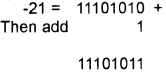
Kerala Plus One Computer Science Chapter Wise Questions and Answers Chapter 9 String Handling and I/O Functions

Plus One String Handling and I/O Functions One Mark Questions and Answers

Question 1.
To read a single character for gender i.e. ‘m’ or ‘f’ ________ function is used.
Answer:
(a) getch()
(b) getchar()
(c) gets()
(d) getline()
Answer:
(b) getchar()

Plus One Computer Science Chapter Wise Questions and Answers Chapter 9 String Handling and I/O Functions

Question 2.
To use getchar(), putchar(), gets() and puts(), which header file is used?
(a) iostream
(b) cstdio
(c) input
(d) output
Answer:
(b) cstdio

Question 3.
To use cin and cout, which header file is needed?
(a) iostream
(b) cstdio
(c) input
(d) output
Answer:
(a) iostream

Question 4.
Predict the output of the following code snippet.
#include<cstdio>
int mainO
{
char name[ ] = “ADELINE”;
for(int i=0; name[i]!=’\0′;i++)
putchar(name[i]);
}
Answer:
The output is “ADELINE”.

Question 5.
From the following which is equivalent to the function getc(stdin).
(a) putchar()
(b) gets()
(c) getchar()
(d) puts()
Answer:
(c) getchar()

Question 6.
From the following which is equivalent to the function putc(ch, stdout).
(a) putchar(ch)
(b) ch = gets()
(c) ch = getchar()
(d) puts(ch )
Answer:
(a) putchar(ch)

Plus One Computer Science Chapter Wise Questions and Answers Chapter 9 String Handling and I/O Functions

Question 7.
To print a single character at a time which function is used?
(a) puts()
(b) putchar()
(c) gets()
(d) getchar()
Answer:
(b) putchar()

Question 8.
To read a string _______ function is used.
(a) puts()
(b) putchar()
(c) gets()
(d) getchar()
Answer:
(b) gets()

Question 9.
To print a string _______ function is used.
(a) puts()
(b) putchar()
(c) gets()
(d) getchar()
Answer:
(b) puts()

Question 10.
Consider the following code snippet.
main()
{
char str[80];
gets(str);
for(int i=0. len=0;str[il!=’\0′;i++.len++);
cout<<“The length of the string is ” <<len;
}
Select the equivalent forthe under lined statement from the following
(a) int len = strlen(str)
(b) int len = strcmp(str)
(c) int len = strcount(str)
(d) None of these
Answer:
(a) int len = strlen(str)

Plus One Computer Science Chapter Wise Questions and Answers Chapter 9 String Handling and I/O Functions

Question 11.
Arjun wants to read a string with spaces from the following which is suitable.
(а) cin>>
(b) cin.getline(str,80)
(c) str = getc(stdin)
(d) none of these
Answer:
(b) cin.getline(str,80)

Question 12.
State whether the following statement is true or false. The ‘<<‘ insertion operator stops reading a string when it encounters a space.
Answer:
True

Question 13.
_________ function is used to copy a string to another variable. (SAY-2016) (1)
Answer:
strcpy();

Question 14.

  1. Write the declaration statement for a variable ‘name’ in C++ to store a string of maximum length 30.
  2. Differentiate between the statement cin>>name and gets (name) for reading data to the variable ‘name’. (SAY-2016)

Answer:
1. char name[31];(One for null(\0) character).

OR

cin>> does not allows space. It will take characters up to the space and characters after space will be truncated . Here space is the delimiter. Consider the following code snippet that will take the input upto the space.
#include<iostream>
using namespace std;
int main()
{
char name[20];
cout<<“Enter your name:”;
cin>>name;
cout<<“Hello “<<name;
}
If you input a name “Alvis Emerin” then the output will be Hello Alvis. The string after space is truncated.

2. gets(): This function is used to get a string from the keyboard including spaces. Considerthe following code snippet that will take the input including the space.
#include<iostream>
#include<cstdio>
using namespace std;
int main()
{
char name[20];
cout<<“Enter your name:”;
gets(name);
cout<<“Hello “<<name;
}
If you input a name “Alvis Emerin” then the output will be Hello Alvis Emerin.

Question 15.
What is the advantage of using gets() function in the C++ program to input string data? Explain with an example.
Answer:
gets() function is used to get a string from the keyboard including spaces. Consider the following code snippet that will take the input including the space.
#include<iostream>
#include<cstdio>
using namespace std;
int main()
{
char name[20];
cout<<“Enter your name:”;
gets(name);
cout<<“Hello “<<name;
}
If you input a name “Alvis” then the output is Hello Alvis.

Plus One String Handling and I/O Functions Two Mark Questions and Answers

Question 1.
In a C++ program, you forgot to include the header file iostream. What are the possible errors occur in that Program? Explain?
Answer:
Prototype error. To use cin and cout the header file iostream is a must.

Plus One Computer Science Chapter Wise Questions and Answers Chapter 9 String Handling and I/O Functions

Question 2.
Categorise the following into three according to their relationship
iostream, cstdio, gets(), puts(), getchar(), putchar(), getline(), write(), cin, cout.
Answer:
Plus One Computer Science Chapter Wise Questions and Answers Chapter 9 String Handling and IO Functions 1

Question 3.
Pick the odd one out from the following and give reason.
gets(), getline(), getch() getchar().
Answer:
getline() – It is a stream function whereas the others are console functions.

Question 4.
My_name is a variable contains a string. Write two different C++ statements to display the string. (SAY-2016) (2)
Answer:

  1. cout<<my_name;
  2. puts(my_name);

Question 5.
Suggest most suitable built-in function in C++ to perform the following tasks: (MARCH-2016) (2)

  1. To find the answer for 53
  2. To find the number of characters in the string “KERALA” “HAPPY NEW YEAR”
  3. To get back the number 10 if the argument is 100.

Answer:

  1. pow(5,3);
  2. strlen(“KERALA”)
  3. tolower(‘M’)
  4. sqrt(100);

Question 6.
Read the following C++ statements:
charstr[50];
cin>>str;
cout<<str;
During execution, if the string given as input is “GREEN COMPUTING”, the output will be only the word “GREEN”. Give reason for this. What modification is required to get the original string as output? (SCERT SAMPLE -1) (2)
Answer:
cin>>word;
cout<<word;
It displays “HAPPY” because cin takes characters upto the space. That is space is the delimiter for cin. The string after space is truncated. To resolve this use gets() function.

Because gets() function reads character upto the enter key.
Hence gets(word);
puts(word);
Displays “HAPPY NEW YEAR”

Question 7.
Suppose M[5][5] is a 2D array that contains the elements of a square matrix. Write C++ statements to find the sum of the diagonal elements. (2)
Answer:
gets() function is used to get a string from the keyboard including spaces. To use gets () function the header file cstdio must be included. It reads the characters upto the enter key pressed by the user.
eg:
char name[20];
cout << “Enter your name”;
gets(name);
cout<< “Hello”<< name;
When the user gives Alvis Emerin. It displays as “Hello Alvis Emerin”.

Plus One String Handling and I/O Functions Three Mark Questions and Answers

Question 1.
Suresh wants to print his name and native place using a C++ program. The program should accept name and native place first.
Name is: Suresh Kumar
Address is: Alappuzha
Answer:
#include<iostream>
#include<cstdio>
using namespace std;
int main()
{
char name[20],place[20];
cout<<“Enter your name”;
cin.getline(name,80);
cout<<“Enter your place”;
cin.getline(place,80);
cout<<“Your name is puts(name);
cout<<“Your place is puts(place);
}

Plus One Computer Science Chapter Wise Questions and Answers Chapter 9 String Handling and I/O Functions

Question 2.
“Programming is Fun”. Write a C++ program to read a string like this in lower case and print it in UPPER CASE. With out using toupper() library function.
Answer:
using namespace std;
#include<cstdio>
int main()
{
char line[80];
int i;
puts(Enter the string to convert”);
gets(line);
for(i=0;line[i]!=’\0′;i++)
if (Iine[i]>=97 && line[i]<=122)
line[i]=line[i] – 32;
puts(line);
}

Question 3.
An assignment Kumar has written a C++ program which reads a line of text and print the number of vowels in it. What will be his program code?
Answer:
#include<cstdio>
#include<cctype>
#include<iostream>
using namespace std;
int main()
{
char line[80];
int i,vowel=0;
puts(Enter a string”);
gets(line);
for(i=0;line[i]!=’\0′;i++)
switch(tolower(line[i]))
{
case ‘a’:
case ‘e’:
case ‘i’:
case ‘o’:
case ‘u’:
vowel++;
}
cout<<“The number of vowels is “<<vowel;

Question 4.
What will be the output of the following code if the user enter the value “GOOD MORNING”.
1. char string [80];
gets(string);
cout<<string;

2. char string [80];
cin>>string;
cout<<string;

3. charch;
ch = getchar();
cout<<ch;

4. char string [80];
cin.getline(string,9);
cout<<string;
Answer:

  1. GOOD MORNING
  2. GOOD
  3. G
  4. GOOD MORN

Question 5.
Consider the following code snippet.
int main()
{
int n;
cout<<“Enter a number”;
cin>>n;
cout<<“The number is “<<n;
}
Write down the names of the header files that must be included in this program
Answer:
Here cin and cout are used so the header file iostream must be included.

Plus One Computer Science Chapter Wise Questions and Answers Chapter 9 String Handling and I/O Functions

Question 6.
Write a program to display the following output.
A
BB
CCC
#include<iostream>
using namespace std;
int main()
{
char str[]=”ABC”;
int i,j;
for(i=0;i<3;i++)
{
for(j=0;j<=i;j++)
cout<<str[i];
cout<<endl;
}
}

Question 7.
Distinguish getchar and gets.
Answer:
getchar is a character function but gets is a string function. The header file cstdio.h must be included. It reads a character from the keyboard.
Eg.
char ch;
ch = getchar();
cout<<ch;
gets is used to read a string from the keyboard. It reads the characters upto enter key. The header file cstdio must be included.
char str[80J;
cout<<“Enter a string”;
gets(str);

Question 8.
Distinguish putch and puts.
Answer:
putch is a character function but puts is a string function. The header file cstdio must be included. It prints a character to the monitor.
Eg:
char ch;
ch = getc(stdin);
putch(ch);
puts is used to print a string. The header file stdio.h must be included.
charstr[80];
puts(“Entera string”);
gets(str);
puts(str);

Question 9.
Write a program to check whether a string is palindrome or not. (A string is said to be palindrome if it is the same as the string constituted by reversing the characters of the original string. eg: “MALAYALAM”, “MADAM”, “ARORA”, “DAD”, etc.)
Answer:
#include<iostream>
using namespace std;
int main()
{
char str[40];
int len,i,j;
cout<<“Enter a string:”;
cin>>str;
for(len=0;str[len]!-\0′;len++);
for(i=0,j=len-1;i<len/2;i++,j–)
if(str[i]!=str[j])
break;
if(i==len/2) .
cout<<str<<” is palindrome”;
else
cout<<str<<” is not palindrome”;
}

Question 10.
Explain multi-character function.
Answer:
getline() and write() functions are multi character functions:
1. getline() It reads a line of text that ends with a newline character. It reads white spaces also.
eg:
char line[80];
cin.getline(line,80);

2. write() It is used to display a string.
Eg.
char line[80];
cin.getline(line,80);
cout.write(line,80);

Plus One Computer Science Chapter Wise Questions and Answers Chapter 9 String Handling and I/O Functions

Question 11.
Read a string and print the number of vowels.
Answer:
#include<cstdio>
#include<cctype>
#include<iostream>
using namespace std;
int main()
{
char line[80];
int i,vowel=0;
puts(“Enter a string”);
gets(line);
for(i=0;line[i]!=’\0′;i++)
switch(tolower(line[i]))
{
case ‘a’:
case ‘e’:
case ‘i’;
case ‘o’:
case ‘u’:
vowel++;
}
cout<<“The number of vowels is in the string is “<< vowel;
}

Question 12.
Distinguish between get() and put() functions.
Answer:
get() function:
get() is an input function. It is used to read a single character and it does not ignore the white spaces and newline character.
Syntax is cin.get(variable);
eg: char ch;
cin.get(ch);

put() function:
put() is an output function. It is used to print a character.
Syntax is cout.put(variable);
eg:
charch;
cin.get(ch);
cout.put(ch);

Question 13.
Write a program to read a string and print the number of consonants.
Answer:
#include<iostream>
#include<cstdio>
#include<cctype>
using namespace std;
int main()
{
char str[40],ch;
int consonent = 0,i;
cout<<“Enter a string:”;
gets(str);
for(i=0;str[i]!=’\0′;i++)
{
ch = toupper(str[i]);
if(ch>=’B’ && ch<=’Z’)
if(ch!=’E’&& ch!=’I’&& ch!=’0’&& ch!=’U’)
consonent++;
}
cout<<“The number of consonents is “<<consonent;
}

Plus One Computer Science Chapter Wise Questions and Answers Chapter 9 String Handling and I/O Functions

Question 14.
Write a program to read a string and print the number of spaces.
Answer:
#include<iostream>
#include<cstdio>
using namespace std;
int main()
{
char str[40];
int space=0,i;
cout<<“Enter a string:”;
gets(str);
for(i=0;str[i]!=’\0′;i++)
if(str[i]==32)
space++;
cout<<“The number of spaces is “<<space;
}

Question 15.
Describe in detail about the unformatted console I/O functions.
Answer:
1. Single character functions: This function is used to read or print a character at a time,
(i) getchar():
It reads a character from the keyboard and store it in a character variable.
eg:
char ch;
ch=getchar();

(ii) putchar():
This function is used to print a character on the screen.
eg:
char ch;
ch = getchar();
putchar(ch);

2. String functions This function is used to read or print a string.
(i) gets():
This function is used to read a string from the keyboard and store it in a character variable.
eg:
charstr[80];
gets(str);

(ii) puts():
This function is used to display a string on the screen.
eg:
char str[80];
gets(str);
puts(str);

Question 16.
Write a program to input a string and find the number of uppercase letters, lowercase letters, digits, special characters and white spaces.
Answer:
#include<iostream>
#include<cstdio>
using namespace std;
int main()
{
char str[100];
int i,digit=0, Ualpha=0, Lalpha=0, special=0, wspace=0;
cout<<“Enter a string:”;
gets(str);
for(i=0;str[i]!=’\0′;i++)
if(str[i]>=48 && str[i]<=57)
digit++;
else if(str[i]>=65 && str[i]<=90)
Ualpha++;
else if(str[i]>=97 && str[i]<=122)
Lalpha++;
else if(str[i]==’ ‘ || str[i]==’\t’)
wspace++;
else
special++;
cout<<“The number of alphabets is “<<Ualpha+Lalpha<<
” the number of Uppercase letters is “<<Ualpha<< ” the number of Lowercase letters is “<<Lalpha<<” the number of digits is “<<digit<<” the special characters is “<<special<<” and the number of white spaces is “<<wspace;
}

Plus One Computer Science Chapter Wise Questions and Answers Chapter 9 String Handling and I/O Functions

Question 17.
Write a program to count the number of words in a sentence.
Answer:
#include<iostream>
#include<cstdio>
using namespace std;
int main()
{
int i,words=1;
char str[80];
cout<<“Enter a string\n”;
gets(str);
for(i=0;str[i]!=’\0′;i++)
if(str[i]==32)
words++;
cout<<“The number of words is “<<words;
}

Question 18.
Write a program to input a string and replace all lowercase vowels by the corresponding uppercase letters.
Answer:
#include<iostream>
#include<cstdio>
using namespace std;
int main()
{
char str[100];
int i;
cout<<“Enter a string:”;
gets(str);
for(i=0;str[i]!=\0′;i++)
if(str[i]>=65 && str[i]<=90 || str[i]> = 97 && str[i]<=122)
switch(str[i])
{
case ‘a’:
str[i] = str[i]-32;
break;
case ‘e’:
str[i] = str[i]-32;
break;
case ‘i’:
str[i] = str[i]-32;
break;
case ‘o’: .
str[i] = str[i]-32;
break;
case ‘u’:
str[i] = str[i]-32;
}
cout<<str;
}

Question 19.
Write a program to input a string and display its reversed string using console I/O functions only. For example if the input is “AND” the output should “DNA”.
Answer:
#include<iostream>
using namespace std;
int main()
{
char str[40],rev[40];
int len.ij;
cout<<“Enter a string:”;
cin>>str;
for(len=0;str[len]!=’\0′;len++);
for(i=0,j=len-1 ;i<len;i++,j–)
rev[il=str[j];
rev[i]=’\0′;
cout<<“The reversed string is “<<rev;
}

Plus One Computer Science Chapter Wise Questions and Answers Chapter 9 String Handling and I/O Functions

Question 20.
Write a program to input a word(say COMPUTER) and create a triangle as follows.
C
C O
C O M
C O M P
C O M P U
C O M P U T
C O M P U T E
C O M P U T E R
Answer:
#include<iostream>
#include<cstring>//for strlen()
using namespace std;
int main()
{
charstr[20];
cout<<“enter a word(eg.COMPUTER):”;
cin>>str;
int ij;
for(i=0;i<strlen(str);i++)
{
for(j=0;j<=i;j++)
cout<<str[j]<<“\t”;
cout<<endl;
}
}

Question 21.
Write a program to input a line of text and display the first characters of each word. Use only console I/O functions. For example, if the input is “Save Water, save Nature”, the output should be “SWSN”.
Answer:
#include<iostream>
#include<cstdio>
using namespace std;
int main()
{
int i;
charstr[80];
cout<<“Enter a string\n”;
gets(str);
if(str[0]!=32)
cout<<str[0];
for(i=0;str[i]!=’\0′;i++)
if(str[i]==32 && str[i+1]!=32)
cout<<str[i+1];
}

Plus One Computer Science Chapter Wise Questions and Answers Chapter 6 Data Types and Operators

Students can Download Chapter 6 Data Types and Operators Questions and Answers, Plus One Computer Science Chapter Wise Questions and Answers helps you to revise the complete Kerala State Syllabus and score more marks in your examinations.

Kerala Plus One Computer Science Chapter Wise Questions and Answers Chapter 6 Data Types and Operators

Plus One Data Types and Operators One Mark Questions and Answers

Question 1.
___________ is the main activity carried out in computers.
Answer:
Data processing

Plus One Computer Science Chapter Wise Questions and Answers Chapter 6 Data Types and Operators

Question 2.
The data used in computers are different. To differentiate the nature and size of data ___________ is used.
Answer:
Data types

Question 3.
Classify the following data types,
int, array, function, char, pointer, void, float, double, structure
Answer:

Fundamental data typesDerived data types
intarray
floatfunction
doublepointer
voidstructure
char

Question 4.
Sheela wants to store her age. From the following which is the exact data type.
(a) void
(b) char
(c) int
(d) double
Answer:
(c) int

Question 5
Integer data type uses ________ bytes of memory.
(a) 5
(b) 2
(c) 3
(d) 4
Answer:
(d) 4

Question 6.
char data type ________uses bytes of memory.
(a) 1
(b) 3
(c) 7
(d) 8
Answer:
(a) 1

Plus One Computer Science Chapter Wise Questions and Answers Chapter 6 Data Types and Operators

Question 7.
From the following which data type uses 4 bytes of memory.
(a) float
(b) short
(c) char
(d) double
Answer:
(a) float

Question 8.
Full form of ASCII is ___________
Answer:
American Standard Code for Information Interchange

Question 9.
Ramu wants to store the value of From the following which is correct declaration.
(a) char pi = 3.14157
(b) int pi = 3.14157
(c) float pi = 3.14157
(d) long pi = 3.14157
Answer:
(c) float pi = 3.14157

Question 10.
From the following which is not true, to give a variable name.
(a) Starting letter must be an alphabet
(b) contains digits
(c) Cannot be a keyword
(d) special characters can be used
Answer:
(d) special characters can be used

Question 11.
Pick a valid variable name from the following.
(а) 9a
(b) float
(c) age
(d) date of birth
Answer:
(c) age.

Question 12.
To perform a unary operation how many number of operands needed?
(a) 2
(b) 3
(c) 1
(d) None of these.
Answer:
(c) 1 (Unary means one)

Plus One Computer Science Chapter Wise Questions and Answers Chapter 6 Data Types and Operators

Question 13.
To perform a binary operation how many number of operands needed?
(а) 2
(b) 3
(c) 1
(d) None of these.
Answer:
(a) 2 (binary means two)

Question 14.
To perform a ternary operation how many number of operands needed?
(a) 2
(b) 3
(c) 1
(d) None of these.
Answer:
(b) 3 (eg: ternary means three)

Question 15.
In C++ 13 % 26 =
(a) 26
(b) 13
(c) 0
(d) None of these
Answer:
(b) % is a mod operator i.e. it gives the remainder. Here the remainder is 13.

Question 16.
In C++ 41/2 =
(a) 20.5
(b) 20
(c) 1
(d) None of these
Answer:
(b) 20. (The actual result is 20.5 but both 41 and 2 are integers so .5 must be truncated)

Question 17.
++ is a __________ operator.
(a) Unary
(b) Binary
(c) Ternary
(d) None of these
Answer:
(a) Unary.

Question 18.
Conditional operator is _________ operator.
(a) Unary
(b) Binary
(c) Ternary
(d) None of these
Answer:
(c) Ternary

Question 19.
% is a _______ operator
(a) Unary
(b) Binary
(c) Ternary
(d) None of these
Answer:
(b) Binary

Question 20.
State True/False

  1. Multiplication, division, modulus have equal priority
  2. Logical and (&&) has less priority than logical or ()

Answer:

  1. True
  2. False

Plus One Computer Science Chapter Wise Questions and Answers Chapter 6 Data Types and Operators

Question 21.
_______is composed of operators and operands.
(a) expression
(b) Keywords
(c) Identifier
(d) Punctuators
Answer:
(a) expression

Question 22.
Supply value to a variable at the time of declaration is known as __________.
Answer:
Initialisation

Question 23.
From the following which is initialisation.
(a) int k;
(b) int k = 100;
(c) int k[10];
(d) None of these
Answer:
(b) int k = 100;

Question 24.
State True/False
In an expression all the operands having lower size are converted(promoted) to the data type of the highest sized operand.
Answer:
True

Question 25.
Classify the following as arithmetic/Logical expression.
(a) x + y * z
(b) x < y && y > z
(c) x / y
(d) x > 89 || y < 80
Answer:
(a) and (c) are Arithmetic, (b) and (d) are Logical

Question 26.
Suppose x = 5 and y = 2 then what will be cout<<(float)x/y
Answer:
2.5 The integer x is converted to float hence the result.

Question 27.
Consider the following.
a = 10;
a* =10;
Then a =
(a) a = 100
(b) a = 50
(c) a = 10
(d) a = 20
Answer:
(a) a = 100. This short hand means a = a*10

Question 28.
Consider the following.
a = 10;
a+ = 10;
Then a =
(a) a = 30
(b) a = 50
(c) a = 10
(d) a = 20
Answer:
(d) a = 20. This short hand means a = a + 10

Question 29.
Pick the odd one out
(a) structure
(b) Array
(c) Pointer
(d) int
Answer:
(d) int, it is fundamental data type the others are derived data types

Plus One Computer Science Chapter Wise Questions and Answers Chapter 6 Data Types and Operators

Question 30.
From the following select not a character of C++ language
(a) A
(b) 9
(c) \
(d) @
Answer:
(d) @

Question 31.
Consider the following
float x = 25.56;
cout<<(int)x;
Here the data type of the variable is converted. What type of conversion is this?
(a) type promotion
(b) type casting
(c) implicit conversion
(d) None of these
Answer:
(b) type casting (explicit conversion);

Question 32.
Identify the error in the following C++ statement and correct it.
short population = 68000;
Answer:
The maximum number that can store in short type is less than 32767. So to store 68000 we have to use long data type.

Question 33.
Consider the following statements in C++ if(mark>=18)
cout<<“Passed”;
else
cout<<“Failed”;
Suggest an operator in C++ using which the same output can be produced.
Answer:
Conditional operator (?:)

Plus One Data Types and Operators Two Mark Questions and Answers

Question 1.
Analyses the following statements and write True or False. Justify

  1. There is an Operator in C++ having no special character in it
  2. An operator cannot have more than 2 operands
  3. Comma operator has the lowest precedence
  4. All logical operators are binary in nature
  5. It is not possible to assign the constant 5 to 10 different variables using a single C++ expression
  6. In type promotion the operands with lower data type will be converted to the highest data type in expression.

Answer:

  1. True (sizeof operator)
  2. False(conditional operator can have 3 operands)
  3. True
  4. False
  5. False(Multiple assignment is possible)
    eg: a = b = c ==5
  6. True

Question 2.
Consider the following declaration.
const int bp;
bp = 100;
Is it valid? Explain it?
Answer:
This is not valid. This is an error. A constant variable cannot be modified. That is the error and a constant variable must be initialised. So the correct declaration is as follows, const int bp = 100;

Question 3.
Consider the following statements in C++

  1. cout<<41/2;
  2. cout<<41/2.0;

Are this two statements give same result? Explain?
Answer:
This two statements do not give same results. The first statement 41/2 gives 20 instead of 20.5. The reason is 41 and 2 are integers. If two operands are integers the result must be integer, the real part must be truncated.

To get floating result either one of the operand must be float. So the second statement gives 20.5. The reason 41 is integer but 2.0 is a float.

Plus One Computer Science Chapter Wise Questions and Answers Chapter 6 Data Types and Operators

Question 4.
If mark = 70 then what will be the value of variable result in the following
result = mark > 50? ’P’: ’F’;
Answer:
The syntax of the conditional operator is given below
Condition ? Value if true : Value if false;
Here the conditional operator first checks the condition i.e., 70 > 50 it is true. So ’P’ is assigned to the variable result.
So the result is ’P’;

Question 5.
Is it possible to initialise a variable at the time of execution. What kind of initialisation is this? Give an example
Answer:
Yes it is possible. This is known as Dynamic initialisation. The example is given below
eg: int a = 10, b = 5; int c = a*b; here the variable c is declared and initialised with the value 10*5.

Question 6.
Boolean data type is used to store True/False in C++. Is it true? Is there any data type called Boolean in C++?
Answer:
No there is no data type for storing boolean value true/false. But in C++ non -zero (either negative or positive) is treated as true and zero is treated as false

Question 7.
Consider the following
n=-15;
if (n)
cout<<“Hello”;
else
cout<<“hai”;
What will be the output of the above code?
Answer:
The output is Hello, because n = -15 a non zero number and it is treated as true hence the result.

Question 8.
Is it possible to declare a variable in between the program as and when the need arise? Then what is it?
Answer:
Yes it is possible to declare a variable in between the program as and when the need arise. It is known as dynamic initialisation.
eg. int x = 10, y = 20;
int z = x*y;

Question 9.
char ch;
cout<<“Enter a character”;
cin>>ch;
Consider the above code, a user gives 9 to the variable ‘ch’. Is there any problem? Is it valid?
Answer:
There is no problem and it is valid since 9 is a character. Any symbol from the key board is treated as a character.

Question 10.
“With the same size we can change the sign and range of data”. Comment on this statement.
Answer:
With the help of type modifiers we can change the sign and range of data with same size. The important modifiers are signed, unsigned, long and short.

Question 11.
Write short notes about C++ short hands?
Answer:
x = x + 10 can be represented as x + = 10, It is called shorthands in C++. It is faster. This is used with all the arithmetic operators as follows.

Arithmetic Assignment ExpressionEquivalent Arithmetic Expression
x+ = 10x = x + 10
x- = 10x = x -10
X* = 10x = x * 10
x/ = 10x = x /10
x% = 10x = x % 10

Question 12.
What is the role of ‘const’ modifier?
Answer:
This ‘const’ keyword is used to declare a constant.
eg: const int bp=100;
By this the variable bp is treated as constant and cannot be possible to change its value during execution.

Plus One Computer Science Chapter Wise Questions and Answers Chapter 6 Data Types and Operators

Question 13.
Specify the most appropriate data type for handling the following data.

  1. Roll no. of a student.
  2. Name of an employee.
  3. Price of an article.
  4. Marks of 12 subjects

Answer:

  1. short Roll no;
  2. char name[20];
  3. float price;
  4. short marks[12];

Question 14.
Write C++ statement for the following,

  1. The result obtained when 5 is divided by 2.
  2. The remainder obtained when 5 is divided by 2.

Answer:

  1. 5/2
  2. 5 % 2

Question 15.
Predict the output of the following code. Justify.
int k = 5;
b = 0;
b = k++ + ++k;
cout<<b;
Answer:
Output is 12. In this statement first it take the value of k in 5 then increment it K++. So first operand for + is 5. Then it becomes 6. Then ++k makes it 7. This is the second operand. Hence the result is 12.

Question 16.
Predict the output.
1. int sum = 10, ctr = 5;
sum = sum + ctr–;
cout<<sum;

2. int sum = 10, ctr = 5;
sum = sum + ++ctr;
cout<<sum;
Answer:

  1. 15
  2. 16

Question 17.
Predict the output.
int a;
float b;
a = 5;
cout<<sizeof(a + b/2);
Answer:
Output is 4. Result will be the memory size of floating point number

Plus One Computer Science Chapter Wise Questions and Answers Chapter 6 Data Types and Operators

Question 18.
Predict the output.
int a, b, c;
a = 5;
b = 2;
c = a/b;
cout<<c;
Answer:
Output is 2. Both operands are integers. So the result will be an integer

Question 19.
Explain cascading of i/o operations
Answer:
The multiple use of input or output operators in a single statement is called cascading of i/o operators.
eg: To take three numbers by using one statement is as follows
cin>>x>y>>z;
To print three numbers by using one statement is as follows
cout<<x<<y<<z;

Question 20.
Trace out and correct the errors in the following code fragments

  1. cout<<“Mark =”45;
  2. cin<<“Hellow World!”;
  3. cout>>”X + Y;
  4. Cout<<‘Good,<<‘Morning’

Answer:

  1. cout<<“Mark = 45”;
  2. cout<<“Hellow World!”;
  3. cout<<X + Y;
  4. Cout<<“Good Morning”;

Question 21.
Raju wants to add value 1 to the variable ‘p’ and store the new value in ‘p’ itself. Write four different statements in C++ to do the task.
Answer:

  1. P=P+1;
  2. p++;(post increment)
  3. ++p;(pre increment)
  4. p+=1;(short hand in C++)

Question 22.
Read the following code
char str [30];
cin>>str;
cout<<str;
If we give the input “Green Computing”, we get the output “Green”. Why is it so? How can you correct that? (2)
Answer:
The input statement cin>> cannot read the space. It reads the text up to the space, i.e. the delimiter is space. To read the text up to the enter key gets() or getline() is used.

Question 23.

NameSymbol
(a) Modulus operator(i) ++
(b) Logical Operator(ii) ==
(c) Relational Operator(iii) =
(d) Assignment operator(iv) ?:
(e) Increment operator(v) &&
(f) Conditional Operator(vi) %

Answer:

NameSymbol
(a) Modulus operator(vi) %
(b) Logical Operator(v) &&
(c) Relational Operator(ii) ==
(d) Assignment operator(iii) =
(e) Increment operator(i) ++
(f) Conditional Operator(iv) ?:

Plus One Computer Science Chapter Wise Questions and Answers Chapter 6 Data Types and Operators

Question 24.
Write a C++ expression to. calculate the value of the following equation.
Plus One Computer Science Chapter Wise Questions and Answers Chapter 6 Data Types and Operators 1
Answer:
x = (-b + sqrt(b*b – 4*a*c)/(2*a)

Question 25.
A student wants to insert his name and school address in the C++ program that he has written. But this should not affect the compilation or execution of the program. How is it possible? Give an example.
Answer:
He can use comments to write this information. In C++ comments are used to write information such as programmer’s name, address, objective of the codes etc. in between the actual codes. This is not the part of the programme. There are two types of comments

  1. Single line (//) and
  2. Multi-line (/* and *f)

1. Single line (if):
Comment is used to make a single line as a comment. It starts with //.
eg: /./programme starts here.

2. Multi-line (/* and */):
To make multiple lines as a comment. It starts with /* and ends with */.
Eg: /* this programme is used to find sum of two numbers */

Question 26.
Consider the following C++ statements:
char word [20];
cin>>word;
cout<<word;
gets(word);
puts(word);
If the string entered is “HAPPY NEW YEAR”, predict the output and jsutify your answer.
Answer:
cin>>word;
cout<<word;
It displays “HAPPY” because cin takes characters upto the space. That is space is the delimiter for cin. The string after space is truncated. To resolve this use gets () function. Because gets () function reads character upto the enter key.
Hence
gets(word);
puts(word);
Displays “HAPPY NEW YEAR”

Plus One Computer Science Chapter Wise Questions and Answers Chapter 6 Data Types and Operators

Question 27.
Write the difference between x = 5 and x == 5 in C++.
Answer:
x = 5 means the value 5 of the RHS is assigned to the LHS variable x . Here = is the assignment operator. But x == 5, == this is the relational (comparison) operator. Here it checks whether the value of RHS is equal to the value of LHS and this expression returns a boolean value as a result. It is the equality operation.

Question 28.
1. What is the output of the following program?
# include <iostream.h>
void main ()
{
int a;
a = 5 + 3*5;
cout << a;
}

2. How do 9, ‘9’ and “9” differ in C++ program?
Answer:
Here multiplication operation has more priority than addition.
hence
1. a = 5 + 15 = 20

2. Here 9 is an interger
‘9’ is a character
“9” is a string

Question 29.
Read the following C++ program and predict the output by explaining the operations performed.
#include<iostream.h>
void main ()
{
int a = 5, b = 3;
cout<<a++ /–b;
cout<<a/ (float) b;
}
Answer:
Here a = 5 and b = 3
a++ /– b = 5/2 = 2
That is a++ uses the value 5 and next it changes its value to 6
So a/(float) b = 6/(float)2
= 6/2.0
= 3
So the output is 2 and 3

Question 30.
What is the preprocessor directive statement? Explain with an example.
Answer:
A C++ program starts with the preprocessor directive i.e., # include, #define, #undef, etc, are such a preprocessor directives. By using #include we can link the header files that are needed to use the functions. By using #define we can define some constants.
eg. #define x 100. Here the value of x becomes 100 and cannot be changed in the program. No semicolon is needed.

Plus One Computer Science Chapter Wise Questions and Answers Chapter 6 Data Types and Operators

Question 31.
The following C++ code segment is a part of a program written by Smitha to find the average of 3 numbers.
int a, b, c;
float avg;
cin>>a>>b>>c;
avg = (a + b + c)/3;
cout<<avg; .
What will be the output if she inputs 1, 4 and 5? How can you correct it?
Answer:
= (1 + 4 + 5)/3
= 10/3
= 3.3333
Instead of this 3.3333 the output will be 3. This is because if both operands are integers an integer division will be occurred, that is the fractional part will be truncated. To get the correct output do as follows
case 1: int a,b,c; is replaced by float a,b,c;

OR

case 2: Replace (a + b + c)/3 by (a + b + c)/3.0;

OR

case 3: Type casting.
Replace avg = (a + b + c)/3;
by avg = (float)(a + b + c)/3;

Plus One Data Types and Operators Three Mark Questions and Answers

Question 1.
In a panchayath or municipality all the houses have a house number, house name and members. Similar situation is in the case of memory. Explain
Answer:
The named memory locations are called variable. A variable has three important things

  1. variable name: A variable should have a name
  2. Memory address: Each and every byte of memory has an address. It is also called location (L) value
  3. Content: The value stored in a variable is called content.lt is also called Read(R) value.

Question 2.
Briefly explain constants.
Answer:
A constant or a literal is a data item its value doe not change during execution. The keyword const is used to declare a constant. Its declaration is as follows
const data type variable name = value;
eg.const int bp = 100;
\const float pi = 3.14157;
const char ch = ‘a’;
const char[]=”Alvis”;

1. Integer literals:
Whole numbers without fractional parts are known as integer literals, its value does not change during execution. There are 3 types decimal, octal and hexadecimal.
eg: For decimal 100, 150, etc.
For octal 0100, 0240, etc.
For hexadecimal 0x100, 0x1A, etc.

2. Float literals:
A number with fractional parts and its value does not change during execution is called floating point literals.
eg: 3.14157, 79.78, etc

3. Character literal:
A valid C++ character enclosed in single quotes, its value does not change during execution.
eg: ‘m’, ‘f, etc.

4. String literal:
One or more characters enclosed in double quotes is called string constant. A string is automatically appended by a null character(‘\0’)
eg: “Mary’s”, “India”, etc.

Plus One Computer Science Chapter Wise Questions and Answers Chapter 6 Data Types and Operators

Question 3.
Consider the following statements
int a = 10, x = 20;
float b = 45000.34, y = 56.78;
1. a = b;
2. y = x;
Is there any problem for the above statements? What do you mean by type compatibility?
Answer:
Assignment operator is used to assign the value of RHS to LHS. Following are the two chances
(a) The size of RHS is less than LHS. So there is no problem and RHS data type is promoted to LHS. Here it is compatible.

(b) The size of RHS is higher than LHS. Here comes the problem sometimes LHS cannot possible to assign RHS. There may be a chance of wrong answer. Here it is not compatible.
Here
1. a = b; There is an error since the size of LHS is 2 but the size of RHS is 4.
2. y = x; There is no problem because the size of LHS is 4 and RHS is 2.

Question 4.
A company has decided to give incentives to their salesman as perthe sales. The criteria is given below.
If the total sales exceeds 10,000 the incentive is 10%

  1. If the total sales >= 5,000 and total sales <10,000, the incentive is 6 %
  2. If the total sales >= 1,000 and total sales <5,000, the incentive is 3 %

Write a C++ program to solve the above problem and print the incentive after accepting the total sales of a salesman. The program code should not make use of ‘if’ statement.
Answer:
#include<iostream>
using namespace std;
int mainO
{
float sales,incentive;
cout<<“enter the sales”;
cin>>sales;
incentive = (sales>10000 ? sales*.10: (sales > =5000 ? sales * .06 : (sales >= 1000 ? sales * -03: 0)));
cout<<“\nThe incentive is ” << incentive;
}

Question 5.
A C++ program code is given below to find the value of X using the expression
\(x=\frac{a^{2}+b^{2}}{2 a}\)
where a and b are variables

#include<iostream>
using namespace std;
int main()
{
int a;b;
float x
cout<<“Enter the values of a and b;
cin>a>b;
x = a*a + b*b/2*a;
cout>>x;
}
Predict the type of errors during compilation, execution and verification of the output. Also write the output of two sets of input values

  1. a = 4, b = 8
  2. a = 0, b = 2

Answer:
This program contains some errors and the correct program is as follows.
#include<iostream>
using namespace std;
int main()
{
int a,b;
float x; .
cout<<“Enterthe values of a and b”;
cin>>ab;
x=(a*a + b*b)/(2*a);
cout<<x;
}
The output is as follows

  1. a = 4 and b = 8 then the output is 10
  2. a = 0 and b = 2 then the output is an error divide by zero error(run time error)

Plus One Computer Science Chapter Wise Questions and Answers Chapter 6 Data Types and Operators

Question 6.
A list of data items are given below
45, 8.432, M, 0.124,8 , 0, 8.1 × 1031, 1010, a, 0.00025, 9.2 × 10120, 0471,-846, 342.123E03

  1. Categorise the given data under proper headings of fundamental data types in C++.
  2. Explain the specific features of each data type. Also mention any other fundamental data type for which sample

data is not given
Answer:
1.
Plus One Computer Science Chapter Wise Questions and Answers Chapter 6 Data Types and Operators 2

2. The specific features of each data type.
(i) int data type:
It is used to store whole numbers without fractional (decimal point) part. It can be either negative or positive. It con¬sumes 4 bytes (32 bits) of memory.i.e. 232 . numbers. That is 231 negative numbers and 231 positive numbers (0 is considered as +ve ) So a total of 232 numbers. We can store a number in between -231 to + 231-1.

(ii) char data type:
Any symbol from the keyboard, eg. ‘A’ , ‘?’, ‘9’,…. It consumes one byte( 8 bits) of memory. It is internally treated as integers, i.e. 28 = 256 characters. Each character is having a ASCII code, ‘a’ is having ASCII code 97 and zero is having ASCII code 48.

3. float data type:
It is used to store real numbers i.e. the numbers with decimal point. It uses 4 bytes(32 bits) of memory.
eg: 67.89, 89.9 E-15.

4. double data type:
It is used to store very large real numbers. It uses 8 bytes(64 bits) of memory.

5. void data type:
void means nothing. It is used to represent a function returns nothing.

Question 7.
Write valid reasons after reading the following statements in C++ and comment on their correctness by give reasons.

  1. char num = 66;
    char num = B’;
  2. 35 and 35L are different
  3. The number 14, 016 and OxE are one and the same
  4. Char data type is often said to be an integer type
  5. To store the value 4.15 float data type is preferred over double

Answer:

  1. The ASCII number of B is 66. So it is equivalent.
  2. 35 is of integer type but 35L is Long
  3. The decimal number 14 is represented in octal is 016 and in hexadecimal is OXE.
  4. Internally char data type stores ASCII numbers.
  5. To store the value 4.15 float data type is better because float requires only 4 bytes while double needs 8 bytes hence we can save the memory.

Plus One Computer Science Chapter Wise Questions and Answers Chapter 6 Data Types and Operators

Question 8.
Suggest most suitable derived data types in C++ for storing the following data items or statements

  1. Age of 50 students in a class
  2. Address of a memory variable
  3. A set of instructions to find out the factorial of a number
  4. An alternate name of a previously defined variable.
  5. Price of 100 products in a consumer store
  6. Name of a student

Answer:

  1. Integer array of size 50
  2. Pointer variable
  3. Function
  4. Reference
  5. Float array of size 100
  6. Character array

Question 9.
Considering the following C++ statements. Fill up the blanks

  1. If p = 5 and q = 3 then q%p is _______
  2. If E1 is true and E2 is False then E1 && E2 will be _______
  3. If k = 8, ++k < = 8 will be ________
  4. If x = 2 then (10* ++x) % 7 will be ________
  5. If t = 8 and m = (n=3,t-n), the value of m will be ______
  6. If i = 12 the value i after execution of the expres¬sion i+ = i- – + – -i will be ______

Answer:

  1. 3
  2. False
  3. False(++k makes k = 9. So 9<=8 is false)
  4. 2(++x becomes 3 ,so 10 * 3 = 30%7 = 2)
  5. 5( here m = (n = 3,8-3) = (n = 3,5), so m = 5, The maximum value will take)
  6. Here i = 12

i + = i- – + – -i
here post decrement has more priority than pre decrement. So “i- -” will be evaluated first. Here first uses the value then change so it uses the value 12 and i becomes 11
i + = 12 + – -i
now i = 11.
Here the value of i will be changed and used so “i- -” becomes 10
i + = 12 + 10 = 22
So, i = 22 +10
i = 32
So the result is 32.

Question 10.
The Maths teacher gives the following problem to Riya and Raju.
x = 5 + 3 * 6.
Riya got x = 48 and Raju got x = 23. Who is right and why it is happened? Write down the operator precedence in detail?
Answer:
Here the answer is x = 23. It is because of precedence of operators. The order of precedence of operators are given below.
Plus One Computer Science Chapter Wise Questions and Answers Chapter 6 Data Types and Operators 8
Here multiplication has more priority than addition

Plus One Computer Science Chapter Wise Questions and Answers Chapter 6 Data Types and Operators

Question 11.
Explain the data types’ in C++. (3)
Answer:
Fundamental data types:
It is also called built-in data type. They are int, char, float, double and void
1. int data type:
It is used to store whole numbers without fractional (decimal point) part. It can be either negative or positive. It consumes 4 bytes (32 bits) of memory. i.e. 232 numbers. That is 231 negative numbers and 231 positive numbers (0 is considered as +ve) So a total of 232 numbers. We can store a number in between -231 to + 2311.

2. char data type Any symbol from the keyboard, eg. ‘A’,‘9’, …. It consumes one byte( 8 bits) of memory. It is internally treated as integers, i.e. 28 = 256 characters. Each character is having an ASCII code, ‘a’ is having ASCII code 97 and zero is having ASCII code 48.

3. float data type:
It is used to store real numbers i.e. the numbers with decimal point. It uses 4 bytes(32 bits) of memory.
eg: 67.89, 89.9 E-15.

4. double data type:
It is used to store very large real numbers. It uses 8 bytes(64 bits) of memory.

5. void data type:
Void means nothing. It is used to represent a function returns nothing.

  • User defined Data types: C++ allows programmers to define their own data type. They are Structure(struct), enumeration (enum), union, class, etc.
  • Derived data types: The data types derived from fundamental data types are called Derived data types. They are Arrays, pointers, functions, etc

Question 12.
Predict the output of the following C++ statements.
int a = -5, b = 3, c = 4;
C+ = a++ + –b;
cout<<a<<b<<c;
Answer:
a = -4, b = 2 and c = 1.

Question 13.
Match the following
Plus One Computer Science Chapter Wise Questions and Answers Chapter 6 Data Types and Operators 9
Answer:
Plus One Computer Science Chapter Wise Questions and Answers Chapter 6 Data Types and Operators 10

Question 14.
Write any five unary operators of C++. Why are they called so?
Answer:
A unary operator is an operator that need only one operand to perform the operation. The five unary operators of C++ are given below.
Unary +, Unary -, ++, – – and ! (not)

Plus One Computer Science Chapter Wise Questions and Answers Chapter 6 Data Types and Operators

Question 15.
Write C++ examples for the following:

  1. Declaration statement
  2. Assignment statement
  3. Type casting

Answer:

  1. int age;
  2. age = 16;
  3. avg = (float)a + b + c/3;

Plus One Data Types and Operators Five Mark Questions and Answers

Question 1.

  • Name: Jose
  • Roil no: 20
  • Age: 17
  • Weight: 45.650

Consider the above data, we know that there are different types of data are used in the computer. Explain different data types used in C++.
Answer:
1. int data type:
It is used to store whole numbers without fractional (decimal point) part. It can be either negative or positive. It consumes 4 bytes (32 bits) of memory, i.e. 232 numbers. That is 231 negative numbers and 231 positive numbers (0 is considered as +ve) So a total of 232 numbers. We can store a number in between -231 to + 2311.

2. char data type:
Any symbol from the keyboard, eg. A’,’9′,…. It consumes one byte( 8 bits) of memory. It is internally treated as integers, i.e. 28 = 256 characters. Each character is having a ASCII code, ‘a’ is having ASCII code 97 and zero is having ASCII code 48.

3. float data type:
It is used to store real numbers i.e, the numbers with decimal point. It uses 4 bytes(32 bits) of memory.
eg: 67.89, 89.9 E-15.

4. double data type:
It is used to store very large real numbers. It uses 8 bytes(64 bits) of memory.

5. void data type:
void means nothing. It is used to represent a function returns nothing.

Plus One Computer Science Chapter Wise Questions and Answers Chapter 6 Data Types and Operators

Question 2.
Define an operator and explain operator in detail.
Answer:
An operator is a symbol that performs an operation. The data on which operations are carried out are called operands. Following are the operators
1. lnput(>>) and output(<<):
These operators are used to perform input and output operation.
eg: cin>>n;
cout<<n;

2. Arithmetic operators:
It is a binary operator. It is used to perform addition(+), subtraction(-), division (/), multiplication (*) and modulus (%- gives the remainder) operations.
eg: If x = 10 and y = 3 then
Plus One Computer Science Chapter Wise Questions and Answers Chapter 6 Data Types and Operators 3
x/y = 3, because both operands are integer. To get the floating point result one of the operand must be float.

3. Relational operator:
It is also a binary operator. It is used to perform comparison or relational operation between two values and it gives either true(1) or false(O). The operators are <,<=,>,>=,== (equality)and !=(not equal to)
eg: If x = 10 and y = 3 then
Plus One Computer Science Chapter Wise Questions and Answers Chapter 6 Data Types and Operators 4

4. Logical operators:
Here AND(&&), OR(||) are binary operators and NOT(!) is a unary operator. It is used to combine relational operations and it gives either true(1) or false(O). If x=True and y=False then
Plus One Computer Science Chapter Wise Questions and Answers Chapter 6 Data Types and Operators 5
Both operands must be true to get a true value in the case of AND(&&) operation If x = True and y = False then
Plus One Computer Science Chapter Wise Questions and Answers Chapter 6 Data Types and Operators 6
Either one of the operands must be true to get a true value in the case of OR(||) operation If x = True and y = False then
Plus One Computer Science Chapter Wise Questions and Answers Chapter 6 Data Types and Operators 7

5. Conditional operator:
It is a ternary operator hence it needs three operands. The operator is ?:
Syntax: expression ? value if true : value if false. First evaluates the expression if it is true the second part will be executed otherwise the third part will be executed.
eg: If x = 10 and y = 3 then x>y ? cout<<x : cout<<y;. Here the output is 10

6. sizeof():
This operator is used to find the size used by each data type.
eg. sizeof(int) gives 2.

7. Increment and decrement operator:
These are unary operators.
(a) Increment operator (++): It is used to incre¬ment the value of a variable by one i.e., x++ is equivalent to x = x + 1;
(b) Decrement operator (–): It is used to decre¬ment the value of a variable by one i.e., x-is equivalent to x = x – 1.

8. Assignment operator (=):
lt is used to assign the value of a right side to the left side variable.
eg: x = 5; Here the value 5 is assigned to the variable x.

Plus One Computer Science Chapter Wise Questions and Answers Chapter 5 Introduction to C++ Programming

Students can Download Chapter 5 Introduction to C++ Programming Questions and Answers, Plus One Computer Science Chapter Wise Questions and Answers helps you to revise the complete Kerala State Syllabus and score more marks in your examinations.

Kerala Plus One Computer Science Chapter Wise Questions and Answers Chapter 5 Introduction to C++ Programming

Plus One Introduction to C++ Programming One Mark Questions and Answers

Question 1.
IDE means _____________
Answer:
Integrated Development Environment

Plus One Computer Science Chapter Wise Questions and Answers Chapter 5 Introduction to C++ Programming

Question 2.
We know that C++ is a high level language. From the following which statement is true.
(a) C++ contains English like statements.
(b) C++ contains mnemonics
(c) C++ contains only 0 and 1
(d) None of these
Answer:
(a) C++ contains English like statements.

Question 3.
C++ is a ______ language.
(a) High level
(b) Low level
(c) Middle level
(d) None of these
Answer:
(a) High level

Question 4.
C++ was developed at ___________
(a) AT & T Bell Laboratory
(b) Sanjose Laboratory
(c) Kansas University Lab
(d) None of these
Answer:
(a) AT & T Bell Laboratory

Question 5.
C++ is a successor of ___________ language
(a) C#
(b) C
(c) java
(d) None of these
Answer:
(b) C

Question 6.
The most adopted and popular approach to write programs is __________
Answer:
Structured programming

Question 7.
From the following which uses OOP concept
(a) C
(b) C++
(c) Pascal
(d) Fortran
Answer:
(b) C++

Question 8.
______________ is the smallest individual unit
Answer:
Token

Question 9
Pick the odd one out
(a) float
(b) void
(c) break
(d) Alvis
Answer:
(d) Alvis, the others are keywords.

Plus One Computer Science Chapter Wise Questions and Answers Chapter 5 Introduction to C++ Programming

Question 10.
Reserved words for the compiler is ____________
(a) Literals
(b) Identifier
(c) Keywords
(d) None of these
Answer:
(c) Keywords

Question 11.
Pick an identifier from the following
(а) auto
(b) age
(c) float
(d) double
Answer:
(b) age

Question 12.
Pick the invalid identifier
(a) name
(b) Date of birth
(c) age
(d) joining time
Answer:
(b) Date of birth, because it contains space.

Question 13.
Pick the octal integer from the following
(a) 217
(b) 0 X 217
(c) 0217
(d) None of these
Answer:
(c) 0217, an octal integer precedes 0

Question 14.
Pick the hexadecimal integer from the following
(a) 217
(b) 0 × 217
(c) 0217
(d) None of these
Answer:
(b) 0 × 217, a hexadecimal integer precedes 0×

Question 15.
From the following pick a character constant
(a) ‘A’
(b) ‘ALL’
(c) ‘AIM’
(d) None of these
Answer:
(a) ‘A’, a character enclosed between single quote

Question 16.
Non graphic symbol can be represented by using ___________
Answer:
Escape Sequence

Plus One Computer Science Chapter Wise Questions and Answers Chapter 5 Introduction to C++ Programming

Question 17.
Manish wants to write a program to produce a beep sound. Which escape sequence is used to get an alert (sound)
(a) \a
(b) \d
(c) Vs
(d) None of these
Answer:
(a) \a.

Question 18.
Ajo wants to print a matter in a new line. Which escape sequence is used for this?
(a) \a
(b) \n
(c) \s
(d) None of these
Answer:
(b) \n

Question 19.
To represent null character is used ______
(a) \n
(b) \0
(c) \f
(d) As
Answer:
(b) \0

Question 20.
State True/ False a string is automatically appended by a null character.
Answer:
True

Question 21.
From the following pick a string constant
(a) ‘a’
(b) “abc”
(c) ‘abc’
(d) None of these
Answer:
(b) “abc”, a character constant must be enclosed between double quotes.

Question 22.
C++ was developed by __________
(a) Bjarne Stroustrup
(b) James Gosling
(c) Pascal
(d) None of these
Answer:
(a) Bjarne stroustrup

Plus One Computer Science Chapter Wise Questions and Answers Chapter 5 Introduction to C++ Programming

Question 23.
From the following which is not a character constant.
(а) ‘c’
(b) ‘e’
(c) ‘d’
(d) “c”
Answer:
(d) “c”, It is a string constant the others are character constant.

Question 24.
From the following which is a valid declaration.
(a) int 91;
(b) int x;
(c) int 9x;
(d) int “x”;
Answer:
(b) int x;

Question 25.
Symbols used to perform an operation is called ____________
(a) Operand
(b) Operator
(c) Variable
(d) None of these
Answer:
(b) Operator

Question 26.
Consider the following
C = A + B. Here A and B are called
(a) Operand
(b) Operator
(c) Variable
(d) None of these,
Answer:
(b) Operand

Question 27.
The execution of a program starts at ________ function
Answer:
main()

Question 28.
The execution of a program ends with ________ function
Answer:
main()

Question 29.
______ is used to write single line comment
(a) //
(b) /*
(c) */
(d) None of these
Answer:
(a) //

Question 30.
const k = 100 means
(a) const float k = 100
(b) const double k = 100
(c) const int k = 100
(d) const char k = 100
Answer:
(c) const int k = 100

Plus One Computer Science Chapter Wise Questions and Answers Chapter 5 Introduction to C++ Programming

Question 31.
Each and every statement in C++ must be end with ________
(а) Semicolon
(b) Colon
(c) full stop
(d) None of these
Answer:
(a) Semicolon

Question 32.
From the following select the input operator
(а) >>
(b) <<
(c) >
(d) <
Answer:
(a) >>

Question 33.
From the following select the output operator
(a) >>
(b) <<
(c) >
(d) <
Answer:
(b) <<

Question 34.
From the following which is known as a string terminator.
(а) ‘\0’
(b) ‘\a’
(c) ‘As’
(d) ‘\t’
Answer:
(a) ‘\0’

Question 35.
Adeline wrote a C++ program namely sum.cpp and she compiled the program successfully with no error. Some files are generated. From the following which file is a must to run the program
(a) sum.exe
(b) sum.obj
(c) sum.vbp
(d) sum.htm
Answer:
(a) sum.exe

Question 36.
Adeline wrote a C++ program namely sum.cpp and she compiled the program successfully with no error. Some files are generated namely sum.obj and sum.exe. From this which file is not needed to run the program
Answer:
sum.obj is not needed and can be deleted.

Question 37.
From the following which is ignored by the compiler
(a) statement
(b) comments
(c) loops
(d) None of these
Answer:
(b) comments

Plus One Computer Science Chapter Wise Questions and Answers Chapter 5 Introduction to C++ Programming

Question 38.
To write a C++ program, from the following which statement is a must
(a) sum()
(b) main()
(c) #include<iostream>
(d) #include<iomanip>
Answer:
(b) main(). A C++ program must contains at least one main() function

Question 39.
State True / False
Comment statements are ignored by the compiler
Answer:
True

Question 40.
More than one input/output operator in a single statement is called _______
Answer:
Cascading of I/O operator

Question 41.
Is 0X85B a valid integer constant in C++? If yes why?
Answer:
Yes. It is a hexadecimal number.

Plus One Introduction to C++ Programming Two Mark Questions and Answers

Question 1.
Mr. Dixon declared a variable as follows
int 9age. Is it a valid identifier. If not briefly explain. the rules for naming an identifier.
Answer:
It is not a valid identifier because it violates the rule
The rules for naming an identifier is as follows:

  1. It must be start with a letter(alphabet)
  2. Under score can be considered as a letter
  3. White spaces and special characters cannot be used.
  4. Key words cannot be considered as an identifier

Question 2.
How many bytes used to store ‘\a’.
Answer:
To store ‘\a’ one byte is used because it is an escape sequence. An escape sequence is treated as one character. To store one character one byte is used.

Question 3.
How many bytes used to store “\abc”.
Answer:
A string is automatically appended by a null character.

  • Here one byte for \a (escape sequence).
  • One byte for character b.
  • One byte for character c.
  • And one byte for null character.
  • So a total of 4 bytes needed to store this string.

Question 4.
How many bytes used to store “abc”.
Answer:
A string is automatically appended by a null character.

  • Here one byte for a.
  • One byte for character b.
  • One byte for character c.
  • And one byte for null character.
  • So a total of 4 bytes needed to store this string.

Plus One Computer Science Chapter Wise Questions and Answers Chapter 5 Introduction to C++ Programming

Question 5.
Consider the following code
int main()
{
cout<<“welcome to C++”;
}
After you compile this program there is an error called prototype error. Why it is happened? Explain.
Answer:
Here we used the output operator cout<<. It is used to display a message “welcome to C++” to use this operator the corresponding header file <iostream> must be included. We didn’t included the header file hence the error.

Question 6.
In C++ the size of the string “book” is 5 and that of “book\n” is 6. Check the validity of the above statement. Justify your answer.
Answer:
A string is automatically added by a null character(\0). The null character is treated as one character. So the size of string “book” is 5. Similarly, a null character (\0) is also added to “book\n”. \n and \0 is treated as single characters. Hence the size of the string “book\n” is 6.

Question 7.
Pick the odd man out. Justify
TOTSAL, TOT_SAL, totsal5, Tot5_sal, SALTOT, tot.sal
Answer:
tot.sal. Because it contains a special character dot(.). An identifier cannot contain a special character. So it is not an identifier. The remaining satisfies the rules of naming identifier. So they are valid identifiers.

Question 8.
Write a C++ statement to print the following sentence. Justify.
“\ is a special character”
answer:
cout<<“\\ is a special character”
\\ is treated as an escape sequence.

Question 9.
A student type a C++ program and saves it in his personal folder as Sample.cpp. After getting the output of the program, he checks the folder and finds three files namely Sample.cpp, Sample.obj and Sample.exe. Write the reasons for the generation of the two files in the folder.
Answer:
After the compilation of the program sample.cpp, the operating system creates two files if there is no error. The files are one object file (sample.obj) and one executable file(sample.exe). Now the source file(sample.cpp) and object file(sample.obj) are not needed and can be deleted. To run the program sample.exe is only needed.

Question 10.
Mention the purpose of tokens in C++. Write names of any four tokens in C++. (2)
Answer:
Token: It is the smallest individual units similar to a word in English or Malayalam language. C++ has 5 tokens.

  1. Keywords
  2. Identifier
  3. Literals (Constants)
  4. Punctuators
  5. Operators

Question 11.
The following are some invalid identifiers. Specify its reason.

  1. Sum of digits
  2. 1 year
  3. First jan
  4. For

Answer:

  1. Sum of digits → space not allowed hence it is invalid
  2. 1 year → First character must be an alphabet hence it is invalid
  3. First.jan → special characters such as dot (.) not allowed hence it is invalid.
  4. For → It is valid. That is it is not the keyword for

Question 12.
Some of the literals in C++ are given below. How do they differ?(5, ‘5’, 5.0, “5”)
Answer:

  • 5 – integer literal
  • ‘5’ – Character literal
  • 5.0 – floating point literal
  • “5”- string literal

Question 13.
Identify the invalid literals from the following and write reason for each:

  1. 2E3.5
  2. “9”
  3. ‘hello’
  4. 55450 (2)

Answer:
1. 2E3.5 → The mantissa part (3.5) will not be a floating point number. Hence it is invalid

3. ‘hello’ → It is a string hence it must be enclosed in double quotes instead of single quotes. It is invalid.

Question 14.
Which one of the following is a user defined name?
(a) Keyword
(b) Identifier
(c) Escape sequences
(d) All of these
Answer:
(b) Identifier

Plus One Computer Science Chapter Wise Questions and Answers Chapter 5 Introduction to C++ Programming

Question 15.
Identify whether the following are valid identifiers or not? If not give the reason.

  1. Break
  2. Simple.interest (2)

Answer:

  1. Break – It is valid( break is the keyword, not Break);
  2. Simple.interest – It is not valid, because dot(.) is used.

Question 16.
Identify the invalid literals from the following and write a reason for each:

  1. 2E3.5
  2. “9”
  3. ‘hello’
  4. 55450 (2)

Answer:
1. Invalid, because exponent part should not be a floating point number

2. valid

Plus One Introduction to C++ Programming Three Mark Questions and Answers

Question 1.
Rose wants to print as follows
\n is used for New Line. Write down the C++ statement for the same.
Answer:
#include<iostream>
using namespace std;
int main()
{
cout<<“\\n is used for New Line”;
}

Question 2.
Alvis wants to give some space using escape sequence as follows
Welcome to C++. Write down the C++ statement for the same
Answer:
#include<iostream>
using namespace std;
int main()
{
cout<<“Welcome to \t C++”;
}

Question 3.
We know that the value of pi = 3.14157, a constant (literal). What is a. constant? Explain it.
Answer:
A constant or a literal is a data item its value doe not change during execution.
1. Integer literals:
Whole numbers without fractional parts are known as integer literals, its value does not change during execution. There are 3 types decimal, octal and hexadecimal.
Eg. For decimal “100, 150, etc

  • For octal 0100, 0240, etc
  • For hexadecimal 0 × 100, 0x1 A, etc

2. Float literals:
A number with fractional parts and its value does not change during execution is called floating point literals.
eg: 3.14157,79.78, etc

3. Character literal:
A valid C++ character enclosed in single

Plus One Computer Science Chapter Wise Questions and Answers Chapter 5 Introduction to C++ Programming

Question 4.
Write a program to print the message “TOBACCO CAUSES CANCER” on screen.
Answer:
#include<iostream>
using namespace std;
int main()
{
cout<<” TOBACCO CAUSES CANCER”;
}

Question 5.
You are supplied with a list of tokens in C++ program, Classify and Categorise them under proper headings.
Explain each category with its features. tot_mark, age, M5, break, (), int, _pay, ;, cin.
Answer:
Plus One Computer Science Chapter Wise Questions and Answers Chapter 5 Introduction to C++ Programming 1

Question 6.
Write a program to print the message “SMOKING IS INJURIOUS TO HEALTH” on screen.
Answer:
#include<iostream>
using namespace std;
int mainO
{
cout<<” SMOKING IS INJURIOUS TO HEALTH”;
}

Plus One Introduction to C++ Programming Five Mark Questions and Answers

Question 1.
Consider the following code
The new line character is \n. The output of the following code does not contain the \n. Why it is happened? Explain.
Answer:
\n is a character constant and it is also known as escape sequence. This is used to represent the non graphic symbols such as carriage return key(enter key), tab key, backspace, space bar, etc. It consists of a backslash symbol and one more characters.
Plus One Computer Science Chapter Wise Questions and Answers Chapter 5 Introduction to C++ Programming 2

Plus One Computer Science Chapter Wise Questions and Answers Chapter 5 Introduction to C++ Programming

Question 2.
You are about to study the fundamentals of C++ programming Language. Do a comparative study of the basics of the new language with that of a formal language like English or Malayalam to familiarize C++? Provide sufficient explanations for the compared items in C++ Language.
Answer:
1. Character set:
To study a language first we have to familiarize the character set. For example, to study English language first we have to study the alphabets. Similarly here the character set includes letters(A to Z & a to z), digits(0 to 9), special characters(+, -, ?, *, /, …..) white spaces(non printable), etc.

2. Token:
It is the smallest individual units similar to a word in English or Malayalam language. C++ has 5 tokens

  • Keywords: These are reserved words for the compiler. We can’t use for any other purposes.
    Eg: float is used to declare variable to store numbers with decimal point. We can’t use this for any other purpose
  • Identifier: These are user defined words. Eg: variable name, function name, class name, object name, etc…
  • Literals (Constants): Its value does not change during execution
    eg: In maths % = 3.14157 and boiling point of water is 100.
  • Punctuators: In English or Malayalam language punctuation mark are used to increase the readability but here it is used to separate the tokens.
    eg:{,}, (,), ……..
  • Operators: These are symbols used to perform an operation(Arithmetic, relational, logical, etc…).