Kerala Syllabus 9th Standard Goegraphy Notes Malayalam Medium Chapter 5 Ocean and Man Solutions

Students can Download Social Science Part 2 Chapter 5 Ocean and Man Questions and Answers, Summary, Notes Pdf, Activity in Malayalam Medium, Kerala Syllabus 9th Standard Social Science Solutions helps you to revise the complete Kerala State Syllabus and score more marks in your examinations.

Kerala State Syllabus Class 9th Standard Social Science Goegraphy Chapter 5 Notes Malayalam Medium സമുദ്രവും മനുഷ്യനും

Ocean and Man Questions and Answers in Malayalam

Ocean And Man Class 9 Kerala Syllabus

Hsslive 9 Social Science Kerala Syllabus
9th Standard Social Science Notes Pdf Kerala Syllabus

Kerala Syllabus 9th Standard Geography Notes
Hss Live Guru 9th Geography Kerala Syllabus
Hss Live Guru 9th Social Science Kerala Syllabus

9th Class Social Science Malayalam Medium
Social State Syllabus 9th Standard Kerala Syllabus
9th Standard Social Science Notes Kerala Syllabus
Kerala Syllabus 9th Standard Social Science Notes
Kerala Syllabus 8th Standard Social Science Notes Chapter 5

9th Standard Social Science Notes Pdf Malayalam Medium
Hsslive Guru 9th Social Science Kerala Syllabus
Social Science Class 5 Kerala Syllabus
9th Class Social Science Notes Kerala Syllabus

Kerala Syllabus 9th Standard Social Science Notes Pdf
Hss Live Guru Social Science 9th Kerala Syllabus
Hsslive 9th Standard Social Science Kerala Syllabus
Kerala Syllabus 9th Standard Social Science Guide

Kerala Syllabus 9th Standard Social Science Notes Malayalam Medium
9th Social Science Notes Kerala Syllabus
Hss Live Class 9 Social Science Kerala Syllabus
Hsslive Social Science 9th Kerala Syllabus

Class 5 Science Notes Pdf Kerala Syllabus
Kerala Syllabus 9th Standard Social Science Solutions Chapter 5 Ocean and Man in Malayalam 25
Kerala Syllabus 9th Standard Social Science Solutions Chapter 5 Ocean and Man in Malayalam 26
Kerala Syllabus 9th Standard Social Science Solutions Chapter 5 Ocean and Man in Malayalam 27

Kerala Syllabus 9th Standard Social Science Solutions Chapter 5 Ocean and Man in Malayalam 28
Kerala Syllabus 9th Standard Social Science Solutions Chapter 5 Ocean and Man in Malayalam 29
Kerala Syllabus 9th Standard Social Science Solutions Chapter 5 Ocean and Man in Malayalam 30
Kerala Syllabus 9th Standard Social Science Solutions Chapter 5 Ocean and Man in Malayalam 31

Kerala Syllabus 9th Standard Social Science Solutions Chapter 5 Ocean and Man in Malayalam 32
Kerala Syllabus 9th Standard Social Science Solutions Chapter 5 Ocean and Man in Malayalam 33
Kerala Syllabus 9th Standard Social Science Solutions Chapter 5 Ocean and Man in Malayalam 34
Kerala Syllabus 9th Standard Social Science Solutions Chapter 5 Ocean and Man in Malayalam 35

Kerala Syllabus 9th Standard Social Science Solutions Chapter 5 Ocean and Man in Malayalam 36
Kerala Syllabus 9th Standard Social Science Solutions Chapter 5 Ocean and Man in Malayalam 37
Kerala Syllabus 9th Standard Social Science Solutions Chapter 5 Ocean and Man in Malayalam 38

Kerala Syllabus 9th Standard Goegraphy Notes Malayalam Medium Chapter 4 By the Hands of the Nature Solutions

Students can Download Social Science Part 2 Chapter 4 By the Hands of the Nature Questions and Answers, Summary, Notes Pdf, Activity in Malayalam Medium, Kerala Syllabus 9th Standard Social Science Solutions helps you to revise the complete Kerala State Syllabus and score more marks in your examinations.

Kerala State Syllabus Class 9th Standard Social Science Goegraphy Chapter 4 Notes Malayalam Medium പ്രകൃതിയുടെ കൈകളാൽ

By the Hands of the Nature Questions and Answers in Malayalam

By The Hands Of The Nature Notes Pdf Kerala Syllabus 9th

Kerala Syllabus 9th Standard Social Science Notes Malayalam Medium
Kerala Syllabus 9th Standard Social Science Notes English Medium

Kerala Syllabus 9th Standard Geography Notes
Hss Live Class 9 Social Science
Hss Live Guru 9th Social Science

Kerala Syllabus 9th Standard Social Science Notes
Kerala Syllabus 9th Standard Social Science Notes Pdf
Hss Live Guru Social Science 9th
Kerala Syllabus 9th Standard Social Science

Class 9 Social Science Notes Kerala Syllabus
9th Standard Social Science Notes Pdf
Kerala Syllabus 9th Standard Social Science Solutions Chapter 4 By the Hands of the Nature in Malayalam 13
Kerala Syllabus 9th Standard Social Science Solutions Chapter 4 By the Hands of the Nature in Malayalam 14
Kerala Syllabus 9th Standard Social Science Solutions Chapter 4 By the Hands of the Nature in Malayalam 15

Kerala Syllabus 9th Standard Social Science Solutions Chapter 4 By the Hands of the Nature in Malayalam 16
Kerala Syllabus 9th Standard Social Science Solutions Chapter 4 By the Hands of the Nature in Malayalam 17
Kerala Syllabus 9th Standard Social Science Solutions Chapter 4 By the Hands of the Nature in Malayalam 18
Kerala Syllabus 9th Standard Social Science Solutions Chapter 4 By the Hands of the Nature in Malayalam 19
Kerala Syllabus 9th Standard Social Science Solutions Chapter 4 By the Hands of the Nature in Malayalam 20

Kerala Syllabus 9th Standard Social Science Solutions Chapter 4 By the Hands of the Nature in Malayalam 21
Kerala Syllabus 9th Standard Social Science Solutions Chapter 4 By the Hands of the Nature in Malayalam 22
Kerala Syllabus 9th Standard Social Science Solutions Chapter 4 By the Hands of the Nature in Malayalam 23
Kerala Syllabus 9th Standard Social Science Solutions Chapter 4 By the Hands of the Nature in Malayalam 24

Kerala Syllabus 9th Standard Social Science Solutions Chapter 4 By the Hands of the Nature in Malayalam 25
Kerala Syllabus 9th Standard Social Science Solutions Chapter 4 By the Hands of the Nature in Malayalam 26

Ocean and Man Notes | Class 9 Geography Chapter 5 Notes Kerala Syllabus

You can Download Ocean and Man Questions and Answers, Summary, Activity, Notes, Kerala Syllabus 9th Standard Social Science Solutions Part 2 Chapter 5 help you to revise complete Syllabus and score more marks in your examinations.

Kerala State Syllabus 9th Standard Social Science Part 2 Chapter 5 Ocean and Man Questions and Answers

SSLC Geography Chapter 5 Notes

Ocean And Man Class 9 Kerala Syllabus Question 1.
Identify the location of each ocean from the world map. List the straits, bays and the seas of each ocean with the help of an atlas.
Answer:
Ocean And Man Class 9 Kerala Syllabus

Kerala Syllabus 9th Standard Social Science Notes Question 2.
The following table contains the names of some major islands and peninsulas in the world. With the help of an atlas find out the names of the oceans to which they below.
Answer:
Kerala Syllabus 9th Standard Social Science Notes

  1. Indian Ocean
  2. Indian Ocean
  3. Pacific Ocean
  4. Atlantic Ocean
  5. Atlantic Ocean

Kerala Syllabus 9th Standard Social Science Notes Pdf Question 3.
Complete the table using fig. 5.7 in textbook
Kerala Syllabus 9th Standard Social Science Notes Pdf
9th Standard Social Science Notes Pdf Kerala Syllabus
Answer:
9th Standard Social Science Notes Kerala Syllabus
9th Standard Social Science Notes Pdf Kerala Syllabus Question 4.
The equatorial regions; record a high amount of salinity as compared to the polar regions why?
Answer:
The temperature is high in equatorial regions compared to polar regions. Density increases as temperature rises. High density is associated with high salinity. There is possibility of high evaporation in equatorial regions. That is why equatorial regions record high amount of salinity.

9th Standard Social Science Notes Kerala Syllabus  Question 5.
Why is salinity is less at river mouths?
Answer:
Salinity is less at river mouths because of huge amount of freshwater added from hundred of rivers.

9th Std Social Science Notes Kerala Syllabus Question 6.
Which are the warm and cold currents of the Atlantic Ocean? Identify the continents near which they flow.
9th Std Social Science Notes Kerala Syllabus
Answer:

Warm currentsContinents near which they flow
1. North Atlantic current1. Europe
2. Gulf Stream2. North America
3. Florida current3. North America
4. North equatorial currents4. South America & Africa
5. Equatorial counter currents5. South America & Africa
6. South Equatorial currents6. South America & Africa
7. Brazilian current7. South America
Cold currentContinent near which they flow
1. Labrador current1. North America
2. West wind drift2. South America
3. Benguela current3. Africa
4. Canaries current4. Europe of Africa

Kerala Syllabus 9th Standard Social Science Notes English Medium Question 7.
Complete the following table based on the currents of the Indian Ocean.
Kerala Syllabus 9th Standard Social Science Notes English Medium
Kerala Syllabus 9th Standard Social Science Solutions Part 2 Chapter 5 Ocean and Man 8
Answer:

CurrentsWarm/ColdDirection
1. South equatorial current1. Warm1. From East to West
5. South West Monsoon current5. Warm2. From West to East
6. Agulhas current6. Warm3. From North to West
7. West Australian current7. Cold4. From South to North
8. West wind Drift8. Cold5. From West to East

Kerala Syllabus 9th Standard Social Science Notes Malayalam Medium Question 8.
You have learnt the uses of Oceans. Conduct a seminar on the topic ‘influence of Oceans in human life’.
Answer:
“Influence of Oceans in Human Life”
Oceans play significant role in the life of human beings. We cannot neglect oceans because oceans are useful in

  • Influencing our climate.
  • Providing mineral deposits.
  • Helping power generation.
  • Providing source of food.

We shall now explain the influence of Ocean in detail.
Climate:
Oceans have a decisive role in controlling the climate along the coastal regions. The sea breeze during the day and the land breeze in the night regulate the temperature over the coasts. Oceans play a part in the formation of weather phenomena like rain, wind, and cyclones. Generally, the coastal regions have moderate climate, whereas severe summer and winter prevail in regions away from the sea.
Oceans as a source of food:
Fish is an important item of food. Fishing is major
activity in Japan, Peru, China, Norway, and the United States of America. Marine organisms are the source of many medicines. They are used for the production of antibiotics, steroids, and vitamins.

Ocean and Man Model Questions and Answers

9th Standard Social Science Notes Pdf In English Kerala Syllabus Question 9.
Nearly ………… % of earth’s surface area is covered with water.
Answer:
71%

9th Class Social Science Textbook Kerala Syllabus Question 10.
Name the Oceans
Answer:
a) The Pacific Ocean
b) The Atlantic Ocean
c) The Indian Ocean
d) The Artie Ocean
e) The Antarctic Ocean

9th Standard Social Science Textbook Kerala Syllabus Question 11.
Match the following

AB
Pacific oceanSouthern ocean
Atlantic oceanWarton trench
Indian oceanPuerto Rico
Antarctic oceanChallenger Deep

Answer:

AB
Pacific oceanChallenger Deep
Atlantic oceanPuerto Rico
Indian oceanWarton trench
Antarctic oceanSouthern ocean

Kerala Syllabus 9th Standard Social Science English Medium Question 12.
Distinguish between bay and strait.
Answer:
The portion of the sea surrounded by land on three sides is called a bay. On the other hand, the narrow stretch of sea between two landmasses is known as strait.

Question 13.
Complete the table

IslandsPeninsula
Sri Lanka
Maldives
Green land
Sumatra

Answer:

IslandsPeninsula
Sri LankaIndian Peninsula
MaldivesArabian Peninsula
Green landAlaska Peninsula
SumatraLabrador Peninsula

Question 14.
Define Peninsula
Answer:
The landmasses surrounded by sea on three sides are called peninsula.

Question 15.
Identify the important features of seawater.
Answer:

  • Temperature
  • Salinity
  • Density

Question 16.
Where do you find the highest Ocean temperature?
Answer:
Between 10° latitudes on either side of the equator

Question 17.
As we more away from the equator, temperature considerably.
a) Increases
b) Decreases
c) First increases and then decreases
d) Remains constant
Answer:
a) Increases

Question 18.
What is the reason for the variation in temperature over different latitudinal zones?
Answer:
Variation in the amount of insolation received on the earth is the major reason, The Ocean currents and winds also influence the temperature of seawater.

Question 19.
Define Salinity?
Answer:
The concentration of salt content in seawater is known as salinity.

Question 20.
The average amount of saltiness of seawater is
a) 2.5%
b) 3.5%
c) 4.5%
d) 5.5%
Answer:
b) 3.5%

Question 21.
Name the major contents of seawater
Answer:

  • Sodium chloride
  • Magnesium chloride
  • Magnesium Sulphate

Question 22.
Point out the conditions leading to variations in salinity.
Answer:

  • Salinity will be more in landlocked seas.
  • Salinity increases in areas of high evaporation.
  • Salinity decreases in areas where snow meltwater reaches in large quantity.
  • Salinity decreases at river mouths.
  • Heavy rainfall leads to reduction in salinity.

Question 23.
What causes movements in seawater.
Answer:
The density of seawater is not uniform everywhere. This is due to the variations in salinity and temperature of sea water. Density decreases as temperature increases, and it increases as salinity increases. You have understood that the temperature, salinity and the density of seawater are not uniform everywhere. These variations lead to movements in seawater.

Question 24.
Which are the movements of seawater.
Answer:

  • Waves
  • Tides
  • Ocean currents

Question 25.
What are sea waves?
Answer:
The up and down motion of the water along the surface of the sea is called sea waves.

Question 26.
Mark the missing portion.
Kerala Syllabus 9th Standard Social Science Solutions Part 2 Chapter 5 Ocean and Man 9
Answer:

  1. WaveLength
  2. Crest
  3. Wave height
  4. Trough

Question 27.
Name the following:
(i) The summit of the wave
(ii) Bottom part of the wave
(iii) Distance between 2 adjacent crests
(iv) Vertical distance between the crest and the trough
Answer:
(i) Wave crest
(ii) Wave trough
(iii) Wavelength
(iv) Wave height

Question 28.
………. is the reason for waves.
Answer:
The friction exerted by winds on the ocean surface

Question 29.
As the speed of the wind increases, the strength of the wave
a) Decreases
b) Increases
c) Remains constant
Answer:
b) Increases

Question 30.
Name two damages caused by strong waves
Answer:

  • Cyclones
  • Shelving of shores

Question 31.
Some measures are taken to prevent damage and to protect the lives of people living in the coastal areas. Identify the measures.
Answer:

  • Depositing boulders along the seashore.
  • Construction of interlocking concrete structures (Pulimuttu)
  • Planting of mangroves.

Question 32.
Name the sea waves generated by earthquakes and volcanos
Answer:
Seismic sea waves or tsunami waves.

Question 33.
Prepare a note on mud bank
Answer:
Mudbank is a phenomenon that develops in the Arabian Sea during the onset or the end of the monsoon season. Planktons grow luxuriantly in the turbulent muddy water along the seashore during the monsoon rains. Schools of fish such as shrimp, sardine, and mackerel arrive to feed on the planktons and the mud, giving fishermen a good catch. This phenomenon is known as mud bank.

Question 34.
What do you mean by tides?
Answer:
Tides are he periodic rise and fall of water level in the ocean.

Question 35.
Distinguish between high tide and low tide
Answer:
The rise in the level of ocean water is the high tide and the lowering of the water level is known as the low tide.

Question 36.
What are the reasons for tides?
Answer:
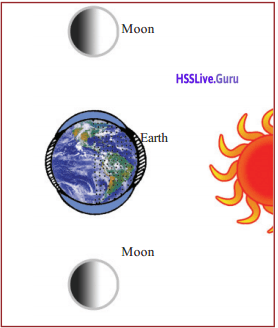
Tides are formed as a result of the gravitational pull exerted by the moon and the sun along with the centrifugal force due to the earth’s rotation.

Question 37.
‘ Illustrate with the help of a figure the occurrence of high tide and low tide.
Kerala Syllabus 9th Standard Social Science Solutions Part 2 Chapter 5 Ocean and Man 10
Answer:
The water level on the part of the earth facing the moon rises. The rise in water level due to the gravitational pull exerted by the moon leads to high tide. You might have noticed that the water level at the opposite side also has risen. The centrifugal force due to the earth’s rotation is the reason for the rise in water level here. It can be seen that the water level goes down at places located 90° away from the places of tidal influence. This is due to the draining of water towards the tidal regions. The phenomenon of fall of water level is known as low tide.

Question 38.
Point out the important effects of tides.
Answer:
High tides and low tides have many effects. Let’s have a look at them.

  • The debris dumped along the seashores and ports are washed off to the deep sea.
  • The formation of deltas is disrupted due to strong tides.
  • Brackish water can be collected in salt pans during high tides.
  • The fishermen make use of the tides for going and returning from the sea in catamarans.
  • Tidal energy can be used for power generation.
  • Ships can be brought to shallow harbors during high tides.

Question 39.
Prepare a note on ocean currents
Answer:
It is a type of seawater movement. Ocean currents are the continuous flow of seawater from one direction to another. They can be classified as warm currents and cold currents. Warm currents are the currents that flow from the tropical or subtropical regions towards the polar or subpolar regions. The water that flows in will be warmer than the water at the destination.

Similarly, cold currents are the currents that flow in from the polar or the subpolar regions towards the tropical or subtropical regions.In this case, the water that flow in will be colder than the water at the destination. The temperature and salinity of seawater varies from ocean to ocean. This difference leads to density difference in seawater. The difference in density is one of the factors that cause ocean currents.

Question 40.
Complete the chart.
Kerala Syllabus 9th Standard Social Science Solutions Part 2 Chapter 5 Ocean and Man 11
Answer:

  1. Warm currents
  2. Cold currents

Question 41.
What are the effects of ocean currents?
Answer;

  • Influence the climate of coastal regions.
  • Fog develops in the regions where warm and cold currents meet.
  • The regions where the warm and cold currents meet provide favorable conditions for the growth of fish.

Question 42.
Which are the mineral deposits in ocean.
Answer;

  • Iron ore
  • Coal
  • Petroleum
  • Natural gas

Question 43
The oil field started in 1974 in Mumbai is known as
Answer:
Mumbai High

Question 44.
Name some countries where fishing is an important activity.
Answer:

  • Japan
  • Peru
  • China
  • Norway
  • USA

Question 45.
What are the medicinal user of marine organisms?
Answer:
Marine organisms help in production of :-

  • antibiotics
  • steroids
  • vitamines

Question 46.
Prepare a flow chart showing method of purifying seawater.
Answer:
Kerala Syllabus 9th Standard Social Science Solutions Part 2 Chapter 5 Ocean and Man 12

Let Us Assess

Question 47.
Which among the following statements is not related to the Indian Ocean?
a. The southern part of this ocean extends up to the Antarctic Ocean.
b. The average depth is more than that of the Atlan tic Ocean.
c. The Puerto Rico trench is situated in this ocean.
d. It ranks third in area.
Answer:
B & C are not related

Question 48.
which among the following places record the least salinity? why?
1. Land-locked sea,
2. Areas of heavy rainfall
3. Areas of high evaporation
Answer;
Landlocked sea. Because salinity increases in landlocked seas.

Question 49.
Is there any relation between the intensity of waves and the wavelength? substantiate
Answer:
The Intensity of waves is defined as the power delivered per unit area. The unit of intensity will be W.m2. The wave energy comes from simple harmonic motion of its particles. The total energy will equal the maximum kinetic energy. As intensity of waves increases the wavelength also increases.

Question 50.
High tide occurs twice a day. Explain this statement.
Answer:
The rise in water level due to the gravitational pull exerted by the moon leads to high tide. Tides can occur as two high waters and two low water each day. The tides are occurred by the gravitational. The moon’s gravity pulls the ocean surface closer to it and the moon makes two trips around the earth each day. Hence there in high tide twice a day.

Question 51.
Explain spring tides and neap tides with the help of diagrams.
Kerala Syllabus 9th Standard Social Science Solutions Part 2 Chapter 5 Ocean and Man 13
The sun, moon, and earth come in a straight line on full moon and new moon days. The tidal force will be intense due to the combined influence of sun and moon. As a result, the tides formed on these days will be stronger. These are known as spring tides. The moon and the sun will be at an angular distance of 90° from the earth after seven days from the full moon and new moon days. As the sun and the moon attract the earth from an angular distance of 90° the tides casued are weak. Such weak tides are known as neap tides. Note the positions of the earth, moon, and sun in the given diagram.

Question 52.
Oceans play an important role in human life and environment. Justify.
Answer:
Influence of Oceans in human life
Oceans play significant role in the life of human beings. We cannot neglect oceans because oceans are useful in

  • Influencing our climate.
  • Providing mineral deposits.
  • helping power generation.
  • Providing source of food.

We shall now explain the influence of ocean in detail.

Kerala: From Eighth to Eighteenth-Century Notes | Class 9 History Chapter 7 Notes Kerala Syllabus

You can Download Kerala: From Eighth to Eighteenth-Century Questions and Answers, Summary, Activity, Notes, Kerala Syllabus 9th Standard Social Science Solutions Part 1 Chapter 7 help you to revise complete Syllabus and score more marks in your examinations.

Kerala State Syllabus 9th Standard Social Science Part 1 Chapter 7 Kerala: From Eighth to Eighteenth Century Questions and Answers

SSLC History Chapter 7 Notes

Kerala From Eighth To Eighteenth Century 9th Kerala Syllabus Question 1.
The chief of Kudi was …………..
Answer:
Kudipathi

Examine The Characteristics Of The Rule Of Perumals 9th Kerala Syllabus Question 2.
Prepare a note on Perumal rule and its characteristics.
Answer:
The Nadus were under the Perumalswho ruled Kerala with their capital at Mahodayapuram (present Kodungaloor). All the 14 nadus from Kolathunadu in the north to the Venad in the south accepted the rule of the Perumal’s. It was during this period that a centralized rule came into being in Kerala for the first time. Rulers from Rajasekharan to Ramakulasekharan ruled during 800 -1122 CE with Mahodayapuram as their capital. Let us examine the characteristics of the rule of the Perumal’s.

  • Perumal’s had representatives called Koyiladhikarikal.
  • In the matters of administration, the Perumals were assisted by Naluthali, the council of Brahmins.
  • Perumal’s had a militia called Ayiram (Thousand).
  • Perumal’s levied taxes from the Nadus, Nagaras (Towns), Brahmin Gramas, Temples, etc.

HSSLive.Guru

List Out The Names Of The Nadus Of Medieval Kerala 9th Kerala Syllabus Question 3.
Name major Naduvazhi Swaroopams.
Answer:
Kola Swaroopam (Kolathunadu)
Nediyiruppu Swaroopam (Eranadu)
Perumpadappu Swaroopam (Kochi)
Thrippapur Swaroopam (Venadu)

Kerala Syllabus 9th Standard Social Science Guide 9th Kerala Syllabus Question 4.
Analyze the political history of Kerala from the eighth to the eighteenth century.
Answer:
Until the 18th century, the Naduvazhi Swaroopams continued without much change. By the second half of the 18th century is Sultans of Mysore, Hyder Ali and Tipu Sultan led military campaigns which created frenzy among the Naduvahis of northern Kerala. Nediyiruppu, Kola and other smaller Swaroopams quickly came under the Mysore Sultans. Fearing the attack from Mysore Sultans many Naduvazhis and Desavazhis fled to Venado. The Perumpadappu Swaroopam of Kochi soon accepted the suzerainty of the Mysore Sultans. Only Travancore resisted the attacks.

It was during this period that Kerala was divided into three regions namely Travancore, Kochi, and Malabar. By the close of the 18th century, the East India Company defeated Tipu Sultan. As a result of this, the Malabar region which was under Tipu Sultan came completely under the British rule. With this, the independent rule of the Naduvazhis of Malabar came to an end. Travancore and Kochi continued to be princely states.

9th Standard Social Science Notes Pdf Kerala Syllabus Question 5.
Which were the 3 types of lands based on ownership rights?
Answer:

  1. Cherikkal,
  2. Brahmswam
  3. Devaswam

9th Standard Social Science Notes Pdf Malayalam Medium Question 6.
Match the following

AB
CherikkalTemples
BrahmswamBrahmins
DevaswamNaduvazhis

Answer:

AB
CherikkalNaduvazhis
BrahmswamBrahmins
DevaswamTemples

Scert Class 9 Social Science Notes Pdf Kerala Syllabus Question 7.
Prepare a note on the system of tax developed by Mysore sultans.
Answer:
The system of tax, the Mysore Sultans had developed was based on the total production from the land, of which a share was fixed to be collected as tax. Later the British conducted a land survey, divided the land in terms of acres and cents, and allotted them survey numbers. Similar land surveys were conducted in Kochi and Travancore. In Kochi, it was known as Kettezhuthu and in Travancore, Kandezhuthu. Accordingly, tax was fixed on the assessed land.

Kerala Syllabus 9th Standard History Notes Question 8.
Identify different occupational groups during the medieval period.
Answer:

  • People engaged in agriculture and the making of agricultural equipment.
  • People involved in handicrafts and the making of metal types of equipment.
  • People engaged in trade.
  • People involved in weaving and oil production.
  • People involved in temple rituals.
  • Officials connected to the Naduvazhi Swaroopams.

Kerala Syllabus 9th Standard Social Science Notes Question 9.
Discuss how the caste system formed in Kerala.
The descendants of those who were engaged in a particular occupation followed the same occupation. People engaged in the same occupation evolved into one caste. The Adiyalars who used to farm during the medieval times occupied the lowest rung in the caste hierarchy whereas the Brahmins were at the top.

Based on the family occupation, all other castes came in between these two categories. On the basis of the caste, the concept of purity and impurity sprang up.
By the beginning of the 19th century, the population of Malabar, Kochi, and Travancore were officially categorized on the basis of caste. Subsequently, caste came to be decided on the basis of birth irrespective of the occupation.

HSSLive.Guru

Kerala Syllabus 9th Standard Social Science Notes Pdf Question 10.
Which were the major trade centers in Kerala during the Medieval period?
Answer:

  • Kodungalloor
  • Kozhikode
  • Madayi

Scert Class 9 Social Science Notes Malayalam Medium Question 11.
Examine different kinds of trade prevailed in the medieval period.
Answer:
Regional Trade:
Chanthas and Angadies were major regional trade centers. Commodities used daily such as paddy, rice, vegetables, betal nut, salt, fish, etc, were the major items exchanged.
Long-distance Trade:
Long-distance trade was mainly with Tamil Nadu, Karnataka, Andhra Pradesh and Orrisa. Tamil Brahmins and Chettis were the main traders. Rice, Chilli, Cotton, other cloth materials, silk, and horses were brought to Kerala. Black pepper and other spices were taken from here.
Foreign Trade:
The arabs, Chinese, Europeans, etc. were the main foreign traders. Black pepper, ginger, cardamom, cinnamon, other spices, coconut, etc. were taken from here. Gold, copper, silver, china clay pottery, silk, etc. were brought to Kerala.

Scert Class 9 Social Science Notes Kerala Syllabus Question 12.
What do you mean by salais?
Answer:
The centres where the vedas were taught in the medieval Kerala were known as ‘Salas’

Hsslive Class 9 Social Science Kerala Syllabus Question 13.
By 14th Century, books were written in
Answer:
Manipravalam

9th Social Science Notes Kerala Syllabus Question 14.
List the literary works of the missionaries.
Answer:

  • Samkshepavedartham
  • Puthan Pana by Arnos Pathiri
  • Varthamanapusthakam of Paremakkal Thoma Kathanar.

9th Std Social Science Notes Kerala Syllabus Questions 15.
Prepare a note on the administrative system of medieval Kerala.
Answer:
During the period of Perumals, a centralized rule came into being in Kerala. By the 12th century, the Perumal rule came to an end. The Nadus became independent. The positions of power that developed in the Nadus were known as Naduvazhi Swaroopams. Until the 18th century, the Naduvazhi Swaroopams continued without much change.

HSSLive.Guru

9th Class Social Science Notes Kerala Syllabus Question 16.
Malayalam language literature, art, forms, and sciences flourished during the medieval period. Substantiate.
Answer:
Influence of Malayalam is more evident in the works after the 12th century. By the 14th century, books were written in Manipravalam. Bhakti literature was present in the 17th century. District art forms developed during the period. During the medieval period, there was progress in the fields of Ayurveda, Mathematics, Astrology, and Architecture.

Question 17.
What were the features of Swaroopams?
Answer:
The positions of power that developed in the Nadus were known as Naduvazhi Swaroopams. Swaroopams were the ruling families with the right of self-rule and the followed matrilineal system of inheritance. The Swaroopams had their own military.

Question 18.
Elucidate what is Anjuvannam and Manigramam?
Answer:
Anjuvannam and Manigramam are the trade guilds existed in medieval Kerala till the 14th century. They were active in both sea and land trade.

Question 19.
List out various Maryadas existed in medieval Kerala.
Answer:

  • Desamaryada
  • Thozhilmaryada
  • Swaroopa maryada
  • Shudramaryada
  • Jathimaryada

Question 20.
Identify the distinct art forms of Kerala that developed during medieval period.
Answer:

  • Mohiniyattam
  • Ottanthullal
  • Padayani
  • Mangamkali
  • Parichamuttukali
  • Chakyarkoothu
  • Kathakali
  • Theyyam
  • Oppana
  • Duffmuttu
  • Koodiyattam
  • Chavittunatakam

HSSLive.Guru

Question 21.
How did Arab-Malayalm develop?
Answer:
Malayalam was influenced by the language of the people who had come through the sea route for trade. Influence of the Arabs led to the development of Arab- Malayalam literature.

Election and Democracy Notes | Class 9 History Chapter 8 Notes Kerala Syllabus

You can Download Election and Democracy Questions and Answers, Summary, Activity, Notes, Kerala Syllabus 9th Standard Social Science Solutions Part 1 Chapter 8 help you to revise complete Syllabus and score more marks in your examinations.

Kerala State Syllabus 9th Standard Social Science Part 1 Chapter 8 Election and Democracy Questions and Answers

SSLC History Chapter 8 Notes

Kerala Syllabus 9th Standard Social Science Notes Pdf Question 1.
Elections are indespensible in a democracy. Substantiate.
Answer:
Elections are indispensable in a democracy due to the following reasons.

  • Elections reflect the aspirations of the people.
  • People can select the rulers of their choice through elections.
  • People can participate and respond in democratic process.
  • Election is a good reason for the rulers to act according to the aspirations of people.

9th Standard Social Science Notes Pdf Question 2.
Complete the Flow Chart.
Kerala Syllabus 9th Standard Social Science Notes Pdf
Answer:
9th Standard Social Science Notes Pdf

9th Standard Social Science Notes Pdf Malayalam Medium Question 3.
Narrate the procedure of simple majority system.
Answer:
According to this system, elections are held in the following manner.

  • The country is divided into various electral districts known as constituencies.
  • One representative is elected from one constituency.
  • Any number of candidates can contest.
  • The candidate who gets the highest number of votes is elected.

Kerala Syllabus 9th Standard Social Science Guide Question 4.
Proportional representation is adopted to elect
a) President
b) Vice president
c) Members of Rajya Sabha
d) All the above
Answer:
All the above

Kerala Syllabus 9th Standard Social Science Notes Malayalam Medium Question 5.
Match the following

ElectionAge limit
President30 years
Member of Rajya Sabha21 Years
Member of Lok Sabha35 Years
Member of Panchyat25 Years

Answer:

ElectionAge limit
President35 years
Member of Rajya Sabha30 Years
Member of Lok Sabha25 Years
Member of Panchyat21 Years

9th Standard Social Science Notes Pdf In English Medium Question 6.
Point out the functions of Election Commission.
Answer:
The Functions of Election Commission:

  • Supervise the election.
  • Prepare voters list.
  • Declare the dates of different stages of election.
  • Allot election symbols.
  • Frame code of conduct.
  • The appointment and training of election officials.
  • Voting, counting of votes and declaration of results.
  • Examine election expenses of candidates.

Kerala Syllabus 9th Standard Social Science Notes English Medium Question 7.
Name the first election commissioner of India.
Answer:
SukumarSen

9th Standard Social Science Notes Pdf In English Question 8.
Examine the drawbacks of India’s electroal system
Answer:
Drawbacks of India’s electroal system are given below
i) Influence of money

  • Voters are influenced by offer of money.
  • Political parties spend large amount of money for election campaigns.

ii) Election-related violence

  • Violence on the polling day.
  • Bogus voting and booth capturing.

(ii) influence of caste and religion
Caste and religious considerations influence selection of candidates.
(iv) Lack of representation of women

  • Women do not get due consideration during the selection of candidates.
  • Poor representation of women in the parliament and legislative assemblies

9th Standard Social Science Notes  Question 9.
Negative vote is casted by using button.
Answer:
NOTA

9th Standard Social Science Textbook Kerala Syllabus Question 10.
Define political parties. What are their functions?
Answer:
Political parties are organization formed on the basis of an ideology which works continuously for attaining political power. Their main functions are given below.

  • Connect the government and the people.
  • Form public opinion.
  • Create political awareness.
  • Context elections and the party attains majority of seats form the government.
  • The parties which do not get majority of seats, function as responsible opposition.
  • Correct wrong policies of government.
  • Put forward various policies and programmes.

History 9th Class Kerala Syllabus Question 11.
Differentiate between national parties and state parties.
Answer:
National parties and state/regional parties are functioning in India. The Election Commission has set the criteria for political parties to be a national or state party.

Generally, those parties which function across the nation and have influence in more than one state are called national parties. Political parties which have influenced, only one state are called state parties.

9th Class Social Science Malayalam Medium Question 12.
What is meant by Psephology
Answer:
Psephology is the science of predicting election results before the declaration of results, after analyzing the possibilities of political parties and coalition fronts.

9th Class Social Science Notes Kerala Syllabus Question 13.
Who allots the symbols for the candidates who contest election?
Answer:
Election Commission

9th Class Social Science Malayalam Medium Notes Question 14.
What is the minimum age for contesting elections to different representative bodies?
Answer:
18 years

Scert Class 9 Social Science Notes Malayalam Medium Question 15.
Indian election system has drawbacks. Find ways to rectify them.
Answer:

  • Identify card with voter’s photo.
  • Limit on the election expenses of candidates.
  • Code of conduct for political parties and candidates.
  • Electronic voting machine.
  • Voters’ list with photo of the electors.
  • Negative voting system.
  • Photo of candidates on ballot paper.

Question 16.
How is direct election different from indirect election? Find examples.
Answer:

  • People directly elect their representatives. This method is called direct election.
    e.g: Loksabha, State legislative assembly, Local self-government.
  • The method of election in which representatives are chosen by the elected representatives of people is indirect election.
    e.g: President, Vice President, Rajya Sabha

Question 17.
Elucidate what is proportional representation.
Answer:
In India, proportional representation is adopted where we follow indirect election. In India, MLAs of State Legislative Assemblies from each state elect members of the Rajyasabha. In proportion to their strength in the state legislative assemblies at each political party can elect representatives to Rajyasabha.

Kerala Syllabus 9th Standard History Notes Malayalam Medium Chapter 3 Indian Constitution: Rights and Duties Solutions

Students can Download Social Science Part 1 Chapter 3 Indian Constitution: Rights and Duties Questions and Answers, Summary, Notes Pdf, Activity in Malayalam Medium, Kerala Syllabus 9th Standard Social Science Solutions helps you to revise the complete Kerala State Syllabus and score more marks in your examinations.

Kerala State Syllabus Class 9th Standard Social Science History Chapter 3 Notes Malayalam Medium ഇന്ത്യൻ ഭരണഘടന: അവകാശങ്ങളും കടമകളും

Indian Constitution: Rights and Duties Textual Questions and Answers in Malayalam

Indian Constitution Rights And Duties 9th Class
Hsslive Guru Class 9 Social Science

Kerala Syllabus 9th Standard Social Science Notes
9th Standard Social Science Notes Pdf Malayalam Medium
9th Class History Notes Kerala Syllabus

Kerala Syllabus 9th Standard Social Science Notes Pdf
Kerala Syllabus 9th Standard History Notes

Class 9 Social Science Notes Kerala Syllabus
Kerala Syllabus 9th Standard Social Science Notes Malayalam Medium
Std 9 History Notes Kerala Syllabus

9th History Notes Kerala Syllabus
Kerala Syllabus Class 9 Social Science Notes
Kerala Syllabus 9th Standard Social Science Solutions Chapter 3 Indian Constitution Rights and Duties in Malayalam 13

Kerala Syllabus 9th Standard Social Science Solutions Chapter 3 Indian Constitution Rights and Duties in Malayalam 14
Kerala Syllabus 9th Standard Social Science Solutions Chapter 3 Indian Constitution Rights and Duties in Malayalam 15
Kerala Syllabus 9th Standard Social Science Solutions Chapter 3 Indian Constitution Rights and Duties in Malayalam 16
Kerala Syllabus 9th Standard Social Science Solutions Chapter 3 Indian Constitution Rights and Duties in Malayalam 17

Kerala Syllabus 9th Standard Social Science Solutions Chapter 3 Indian Constitution Rights and Duties in Malayalam 18
Kerala Syllabus 9th Standard Social Science Solutions Chapter 3 Indian Constitution Rights and Duties in Malayalam 19
Kerala Syllabus 9th Standard Social Science Solutions Chapter 3 Indian Constitution Rights and Duties in Malayalam 20

Kerala Syllabus 9th Standard Social Science Solutions Chapter 3 Indian Constitution Rights and Duties in Malayalam 21
Kerala Syllabus 9th Standard Social Science Solutions Chapter 3 Indian Constitution Rights and Duties in Malayalam 22
Kerala Syllabus 9th Standard Social Science Solutions Chapter 3 Indian Constitution Rights and Duties in Malayalam 23

Kerala Syllabus 9th Standard Social Science Solutions Chapter 3 Indian Constitution Rights and Duties in Malayalam 24
Kerala Syllabus 9th Standard Social Science Solutions Chapter 3 Indian Constitution Rights and Duties in Malayalam 25
Kerala Syllabus 9th Standard Social Science Solutions Chapter 3 Indian Constitution Rights and Duties in Malayalam 26
Kerala Syllabus 9th Standard Social Science Solutions Chapter 3 Indian Constitution Rights and Duties in Malayalam 27

Kerala Syllabus 9th Standard Social Science Solutions Chapter 3 Indian Constitution Rights and Duties in Malayalam 28
Kerala Syllabus 9th Standard Social Science Solutions Chapter 3 Indian Constitution Rights and Duties in Malayalam 29
Kerala Syllabus 9th Standard Social Science Solutions Chapter 3 Indian Constitution Rights and Duties in Malayalam 30

Kerala Syllabus 9th Standard History Notes Malayalam Medium Chapter 1 Medieval World: Centres of Power Solutions

Students can Download Social Science Part 1 Chapter 1 Medieval World: Centres of Power Questions and Answers, Summary, Notes Pdf, Activity in Malayalam Medium, Kerala Syllabus 9th Standard Social Science Solutions helps you to revise the complete Kerala State Syllabus and score more marks in your examinations.

Kerala State Syllabus Class 9th Standard Social Science History Chapter 1 Notes Malayalam Medium മധ്യകാല ലോകം: ശക്തി കേന്ദ്രങ്ങൾ

Medieval World: Centres of Power Textual Questions and Answers in Malayalam

Kerala Syllabus 9th Standard Social Science Notes Pdf

Kerala Syllabus 9th Standard Social Science Notes English Medium
Kerala Syllabus 9th Standard Social Science Notes Malayalam Medium

Kerala Syllabus 9th Standard Social Science Notes
9th Standard Social Science Notes Pdf Malayalam Medium
Kerala Syllabus 9th Standard History Notes

Kerala Syllabus 9th Standard Social Science Guide
Scert Class 9 Social Science Notes Pdf
9th Standard Social Science Notes Pdf

9th Class History Notes Kerala Syllabus
9th History Notes Kerala Syllabus
Hsslive Guru Social Science 9th Kerala Syllabus

Kerala Syllabus 9th Standard Social Science English Medium
9th Standard History Notes Kerala Syllabus

Kerala Syllabus 9th Standard Social Science Solutions Chapter 1 Medieval World Centres of Power in Malayalam 15
Kerala Syllabus 9th Standard Social Science Solutions Chapter 1 Medieval World Centres of Power in Malayalam 16
Kerala Syllabus 9th Standard Social Science Solutions Chapter 1 Medieval World Centres of Power in Malayalam 17

Kerala Syllabus 9th Standard Social Science Solutions Chapter 1 Medieval World Centres of Power in Malayalam 18
Kerala Syllabus 9th Standard Social Science Solutions Chapter 1 Medieval World Centres of Power in Malayalam 19
Kerala Syllabus 9th Standard Social Science Solutions Chapter 1 Medieval World Centres of Power in Malayalam 20

Kerala Syllabus 9th Standard Social Science Solutions Chapter 1 Medieval World Centres of Power in Malayalam 21
Kerala Syllabus 9th Standard Social Science Solutions Chapter 1 Medieval World Centres of Power in Malayalam 22

Kerala Syllabus 9th Standard Social Science Solutions Chapter 1 Medieval World Centres of Power in Malayalam 23
Kerala Syllabus 9th Standard Social Science Solutions Chapter 1 Medieval World Centres of Power in Malayalam 24
Kerala Syllabus 9th Standard Social Science Solutions Chapter 1 Medieval World Centres of Power in Malayalam 25

Kerala Syllabus 9th Standard Social Science Solutions Chapter 1 Medieval World Centres of Power in Malayalam 26
Kerala Syllabus 9th Standard Social Science Solutions Chapter 1 Medieval World Centres of Power in Malayalam 27
Kerala Syllabus 9th Standard Social Science Solutions Chapter 1 Medieval World Centres of Power in Malayalam 28
Kerala Syllabus 9th Standard Social Science Solutions Chapter 1 Medieval World Centres of Power in Malayalam 29

Kerala Syllabus 9th Standard Social Science Solutions Chapter 1 Medieval World Centres of Power in Malayalam 30
Kerala Syllabus 9th Standard Social Science Solutions Chapter 1 Medieval World Centres of Power in Malayalam 31

Civic Consciousness Notes | Class 10 History Chapter 10 Notes Kerala Syllabus

You can Download Civic Consciousness Questions and Answers, Summary, Activity, Notes, Kerala Syllabus 10th Standard Social Science Solutions Part 1 Chapter 10 help you to revise complete Syllabus and score more marks in your examinations.

Kerala Syllabus 10th Standard Social Science Part 1 Chapter 10 Civic Consciousness Questions and Answers

SSLC History Chapter 10 Notes

Civic consciousness is an important’ idea in the contemporary world. A society lacking civic consciousness will become weak. For maintaining the unity and integrity of a nation, people having civic consciousness are unavoidable. A society with civic consciousness can only solve the problems of die society.

10th Standard Social Question 1.
Point out factors determining civic consciousness.
Answer:

  • Family
  • Education
  • Organizations
  • Social system
  • Political system

HSSLive.Guru

Civic Consciousness Question 2.
Consider the following issues in your society and suggest remedial measures using your civic consciousness

IssuesWhat can be done?
Water scarcity
Environmental Pollution
Corruption

Answer:

IssuesWhat can be done?
Water scarcity1. Efficient use of water
2. Rainwater harvesting
3. Protection of water bodies
4. Give awareness to friends
Environmental Pollution1. Waste disposal at sources
2. Afforestation
3. Do not litter waste
4. Keep surroundings clean
5. Do not bum plastics
Corruption1. Giving awareness about evils of corruption
2. Complaining
3. Do not give bribe

Kerala SSLC Social Science Notes 2017 Question 3.
How can children be educated about Civic consciousness?
Answer:
Children need to be taught civic consciousness early because unlike a specific skill, civic consciousness is a school of thought in itself. It is belief in hygiene, respect for other members of society, and humane behavior. Begin by teaching children to keep their immediate surroundings clean and tidy. If they learn to appreciate cleanliness, they will be able to practice it outside of home as well. Explain to them that just because other people dirty their surroundings do not mean them should too.

10th Standard Science Syllabus Question 4.
Suggest the activities that can be initiated by the school for developing civic consciousness in students.
Answer:

  • Environmental day observation
  • Planting of trees
  • Class on importance of blood donation
  • Visit of orphanages
  • Awareness on storage of water and rainwater harvesting.

Civic Consciousness Example Question 5.
Analyze the role played by organizations in developing civic consciousness. ‘
Answer:

  • Develops political sense
  • Develops nationalism
  • Teacher human rights,\olerance, etc.
  • Participates in environment protection.

Question 6.
Give examples of great personalities who had shown civic consciousness
Answer:

  • APJ Abdul Kalam
  • Mother Theresa
  • Mayilamma
  • Dasharath Manjhi

Social Science Activity for Class 10 Question 7.
Find out relationship between civic sense and morality.
Answer:
Civic consciousness means social ethics. It reflects the actual personality and shows the responsibility of any person. Morality refers to those principles concerning the distinction between right and wrong or good and bad behavior.

Social Science Class 10 Kerala Syllabus Question 8.
Describe the role of democracy in developing civic consciousness.
Answer:
Democracy plays significant role in developing civic consciousness. Democracy is the base of all factors contributing to civic consciousness. Rather than an administrative system, democracy is a lifestyle. In each and every human activity, there should be a democratic approach. It is the requirement of a democratic society to develop a group of people having co-operation and tolerance. So democracy will enable us to think about one fellow man, and protect their freedom, equality, and human rights. In short, democracy is the key element of civic sense.

10 Standard Science Question 9.
There are instances of moral and immoral activities in our society. Identify them and fill the following table.

Moral activitiesImmoral activities
1.1.
2.2.

Answer:

Moral activitiesImmoral activities
1. Earn money by hard work1. Earns money by exploiting others
2. Protects public properties2. Spoils public properties
3. Helps fellow beings3. Hurts fellow beings
4. Plant trees4. Cut trees

These are many factors which help the formation of civic consciousness. Family, education, democratic system, etc., help the formation of the civic consciousness. There is a close relation between civic consciousness and morality.

Question 10.
Given below-some activities with civic sense and with-out civic consciousness. Mark (✓) against the one having civic sense an (✗) against the one having no civic sense.

StatementHave conscio­usnessHave no conscio­usness
1. Traffic rules should be obeyed while driving in rush roads.
2. There is nothing wrong in littering domestic wastes in public places
3. It is my responsibility too to protect historical monuments
4. It is my duty to protect nature.
5. There is no need to complain against injustice
6. In unavoidable/ necessary circumstances, correction is permissible
7. The elders should be respected and protected.

Answer:

StatementHave civic consciousnessHave no civic consc­iousness
1. Traffic rules should be obeyed while driving in rush roads.
2. There is nothing wrong in littering domestic wastes in public places
3. It is my responsibility too to protect historical monuments
4. It is my duty to protect nature.
5. There is no need to. complaint against injustice
6. In unavoidable/necessary circumstances, correction is permissible
7. The elders should be respected and protected.

Civic consciousness faces many challenges. The basis of civic consciousness is the activities for the betterment of the society. Media also play an important role in fostering civic consciousness.

Civic Consciousness Model Questions & Answers

Question 11.
What do you mean by civic consciousness?
Answer:
Civic consciousness means social ethics. It reflects the actual personality and shows the responsibility of any person.

HSSLive.Guru

Question 12.
Why is civic consciousness important?
Answer:
Separatism, vandalism, intolerance, racism, road rage etc. are all examples of lack of civic consciousness. People are becoming less and less tolerant of each other, of other’s cultures, backgrounds, and other similar traits. India has really diverse people and the need of the hour is general civic sense. It is not uncommon to read or hear about communal friction. Even living in the city has become difficult because people have no consideration whatsoever for fellow city-dwellers.

When civic consciousness is absent in a society, it leads to a lot of problems. Disregard for the law is a primary cause for lacking civic sense. A person who has high civic values does not resort to shortcuts and unethical tactics to get his work done. And being unethical in daily activities does not benefit anyone, as the behavior only gets emulated by other members of society. Ultimately, the situation will reach a point where hardly anything can be done to restore it.

For example, being inconsiderate towards fellow society members will only come right back at you. You have to be social, mature and unbiased when it comes to situations in public. The current state of public transport, for example, is disheartening. And we have no one to blame but ourselves for this condition. There are spit marks, urine, vulgar graffiti, random garbage and overflowing sewers at every nook and corner of India. No city in this country has managed to fight the menace. It is easy to pin everything on the government, but people must first question themselves and their own civic sense. Roads are not dirty because nobody cleaned it, but because somebody dirtied it in the first place.

And such dirt and grime is not acceptable to anybody; it exists only because everybody does it. Even swine flu, which is quickly spreading across the coun: try, was caused by the absence of hygiene. It does not help that people are irresponsible with the disposal of bio-waste. And people continue to indulge in such behavior in spite of knowing the harmful effect. Using everybody does it is an excuse. In India, even prominent personalities indulge in proud displays of lack of civic sense. Take, for example, ministers who delay planes with complete disregard for other passengers or companies that freely pollute rivers and lakes. Itis difficult for a country to change its mindset when its leaders themselves are setting bad examples, round the clock, all the time.

Question 13.
Point out the evils that will be developed in the absence of civic sense.
Answer:
Separatism, vandalism, intolerance, racism, road rage

Question 14.
Point out the I importance of family values in Life
Answer:

  • A family is a unit of parents and the children. Value is defined as the quality or worth of a thing.
  • Social standards and customs defined by a family prove the emotional and physical basis for a child.
  • Values developed by a family are the foundation for how children learn, grow and function in the world. These beliefs transmit the way of life a child lives and changes into an individual in a
  • society.
  • These values and morals guide the individual every time in his actions. Children tun out to be a good person because of the value taught and given by his family members.
  • Ideas passed down from generation to generation make up a family values. It answers the basic question of how one want to like the family life. Family values enhance the character and turn the children to be good human beings.
  • Beliefs and trusts built around a family helps the children to be responsible and conscientious adults.
  • A child has a strong sense of what is right and wrong and are less likely to become victim of deviant influences.
  • Children who are influenced by strong moral values identify them in others quickly which then produces a new generation with similar beliefs.

Question 15.
Where and how does civic education take place? Many institutions help develop citizens’ knowledge and skills and shape their civic character and commitments. Family, religious institutions, the media, and community groups exert important influences. Schools, however, bear a special and historic responsibility for the development of civic competence and civic responsibility. Schools fulfill that responsibility through both formal and informal education beginning in the earliest years and continuing through the entire educational process.

Question 16.
What is the major challenge of civic consciousness?
Answer:
Standing for one’s own interest by neglecting general interests of the society is the major challenge of civic consciousness.

Let Us Assess

Question 17.
Point out the characteristics of persons having civic consciousness.
Answer:

  • Social commitment.
  • Tolerance.
  • Helping Mentality
  • Environmental concerns
  • Moral values
  • Sympathy

Question 18.
Explain Civic consciousness?
Answer:
Civic sense is nothing but social ethics. It is considered by the people for the unspoken norms of society. A lot of people assume that civic sense is just about keeping the roads, streets and public property clean. But civic sense is more than that; it has to do with law-abiding, respect for fellow men and maintaining decorum in public places. A lot of foreign countries function in a smooth manner because of the strong civic sense amongst its people.

Question 19.
Discuss the role of family in inculcating civic consciousness.
Answer:
The family is important in developing the moral values of child. There is a close contact between the parents and children, which determines the personality of child.
Family is the foundation on which values are built. Moral values like truthfulness, happiness, peace, justice are instilled in children’s thoughts, feelings and actions and they function as ideals and standards that govern their actions in their life.

The value system practiced in the family becomes automatic to the young family embers if they are taught moral values systematically. The family, shapes the child’s attitude towards people and society, and helps in mental growth in the child and supports his ambitions and values. Blissful and cheerful atmosphere in the family will develop the love, affection, tolerance, and generosity.

A child learns his behavior by modeling what he sees around him. Family plays a major role in helping a child socialize and has great influence and bearing on the progress of the child. Joint family stem, the presence of elders in the family plays the effective . role in social and moral development of the children. It will also help young generation of the family to imbibe human values and eradicate their negative mental tendencies when they are among elders. Children identify themselves with their parents, other family elders and adopt them as their personal models for emulation and imitation and hero-worship them.

The behavioral problems are set correct only by the involvement of family in the child’s life as they spend most of their time in adolescence with the parents. Family is the first social organization that provides the immediate proximity from which the kid can learn his behavior.


Question 20.
What is civic education?
Answer:
Civic Education in a democracy is education in self-government. Democratic self-government means that citizens are actively involved in their own governance; they do not just passively accept the dictums of others or acquiesce to the demands of others. As Aristotle put it in his Politics (c 340 BC), “If liberty and equality, as is thought by some, are chiefly to be found in democracy, they will be attained when all persons alike share in the government to the utmost. “In other words, the ideals of democracy are most completely realized when every member of the political community shares in its governance.

Members of the political community are its citizens, hence citizenship in a democracy in membership in the body politic. Membership implies participation, but not participation for participation’s sake. Citizen participation in a democratic society must be based on informed, critical reflection, and on the understanding and acceptance of the rights and responsibilities that go with that membership.

Question 21.
Suggest methods for overcoming the challenges feed by civic consciousness.
Answer:
i) Critically evaluate one’s own activities.
ii) Stand for own interests without hurting public interests.
iii) Develop democratic approach.
iv) Give equal consideration to rights and duties.

Question 22.
Discuss the role of education and media in developing civic consciousness.
Answer:
The aim of education is to enable a person to practice the knowledge he learnt from various subjects in the society. In this way, education helps in developing tolerance, values, leadership qualities, scientific awareness, and environmental awareness. A society with great civic sense can be produced by value-based education.

Media also play important role in developing civic sense. Both print and electronic media influence the society. News and information are brought to the society by these media. Correct and fact-based in-formation will help in creative idea dorm action. Thus media should be free and impartial. Their role should also be evaluated critically.

HSSLive.Guru

Question 23.
Prepare a note on “Social science learning and civic consciousness”.
Answer:
The study of social science helps in developing civic sense in people. Social science itself deals with studies related to man and society. The study of social studies help in civic sense development in the following ways.

  • Social science studies help individuals to behave will in a society and respect the diversities of the nation wittolerance.
  • Social studies helps to understand the socio-political-economic and environmental issues under various
  • situations.
  • Social studies studies enable a person to suggest creative and effective solutions to solve social issues.
  • Social studies being the message of peace and coexistence into the propel.
  • Social studies familiarise examples of great personalities and thereby enrich the society with great civic sense.

Question 24. (Qn. Pool-2017)
What is meant by civic consciousness?
Answer:
Civic consciousness is the awareness that each citizen is for the society and the best interests of the society are same that of the interests of the citizen.

Question 25. (Qn. Pool-2017)
Write two problems in society due to the lack of civic consciousness. Suggest two measures to rectify them.
Answer:
Problems — Measures to rectify
Water scarcity — Rainwater harvesting
Environmental pollution — Garbage treatment of source
Corruption — Awareness against corruption
Epidemics — Awareness, cleaning
Poisoned vegetables — Organic farming (Any two)

Question 26.
What are the important factors that formulate civic consciousness?
Answer:
Family, education, associations, social system, political system.

Question 27. (Qn. Pool-2017)
Family and education play significant role in fostering civil consciousness. Substantiate.
Answer:
Family:

  • Respect elders
  • Foster responsibility in members
  • Encourage social-services

Education:

  • Equips to utilize knowledge for the benefit of society.
  • Creates value-based education, environmental awareness, scientific awareness, tolerance, etc.

Question 28. (Qn. Pool-2017)
Explain the role of media and democratic system in fostering civic consciousness.
Answer:
Media:

  • Truthful news and information made possible to reaches the people.
  • Do independent and impartial media work.
  • Evaluate information critically.

Democratic system:

  • Inevitable component of civic consciousness.
  • Democracy is a way of life. Foster co-operation and create awareness about liberty, equality and right.
  • Democracy is based on the rule of law.

Question 29. (Qn. Pool-2017)
Mother Teresa and Kallen Pokkudan became role models of civic consciousness based on their style of life. Substantiate.
Answer:
Mother Teresa: Nursing the destitute and charity work
Kallen Pokkudan: Planted mangroves and created environmental awareness

Question 30. (Qn. Pool-2017)
What is meant by morality?
Answer:
Morality means executing one’s duties as responsible persons with discretion to choose right from the wrong.

Question 31. (Qn. Pool-2017)
Those who tries to foster civic consciousness in society faces a number of challenges. Write two measures to overcome them.
Answer:

  • Should take up work without denying public interest.
  • Act democratically with tolerance. (Similar answers should be considered)

Question 32. (Qn. Pool-2017)
How can we utilize the study of social science in formulating civic consciousness?
Answer:

  • Respects diversity through study to social science.
  • Behave intolerance.
  • Helps to understand the various backgrounds of political, social, economic and environmental problems.
  • Equips the individual to suggest comprehensive solutions to different problems.
  • Disseminate the message of peace and co-operation among the people in society.

10 Standard Science Part Question 33. (Qn. Pool -2017)
What are the problems faced by people due to the absence of civic consciousness?
Answer:
Selfishness, absence of peace and insecurity.

Question 34. (Qn. Pool-2017)
Civic consciousness helps to solve several problems faced by society. Substantiate.
Answer:
Problems — Measures to rectify
Scarcity of water — Rainwater harvesting
Environmental pollution — Garbage disposal at source
Corruption —Awareness against corruption

Question 35. (Qn. Pool-2017)
Associations can promote environmental awareness and awareness on human rights in individuals. Substantiate.
Answer:
Possible. Several associations are working in the fields of environmental protection, human rights protection, charity, etc.,

Question 36. (Orukkam – 2017)
Kerala Syllabus 10th Standard Social Science Solutions Part 1 Chapter 10 Civic Consciousness 1
Answer:
Kerala Syllabus 10th Standard Social Science Solutions Part 1 Chapter 10 Civic Consciousness 2

Question 37. (Orukkam – 2017)
The main challenge faced by civic consciousness is the mindset to do anything for the sake of one’s own personal interest by.negating public interest. Find out the ways to overcome the challenges of civic consciousness.
Kerala Syllabus 10th Standard Social Science Solutions Part 1 Chapter 10 Civic Consciousness 3
Answer:
Kerala Syllabus 10th Standard Social Science Solutions Part 1 Chapter 10 Civic Consciousness 4

HSSLive.Guru

Question 38. (Orukkam – 2017)
Prepare a table and classify the following statements as activities with civic consciousness and without civic consciousness.
1. Obey traffic rules even if you are busy.
2. There is nothing wrong in disposing of garbage in public places.
3. Don’t complain against injustice.
4. It is my duty to protect historical monuments.
5. Corruption is permissible during crucial situations.
Answer:

Civic ConsciousnessAbsence of Civic ’ Consciousness
1. Obey traffic rules even if you are ‘ busy.1. There is nothing wrong in disposing garbage in public places.
2. It is my duty to protect historical monuments.2. Don’t complain against injustice.
3. Corruption is permissible during crucial situations.

Kerala Syllabus 10th Standard History Notes Malayalam Medium Chapter 8 Kerala towards Modernity Solutions

Students can Download Social Science Part 1 Chapter 8 Kerala towards Modernity Questions and Answers, Summary, Notes Pdf, Activity in Malayalam Medium, Kerala Syllabus 10th Standard Social Science Solutions helps you to revise the complete Kerala State Syllabus and score more marks in your examinations.

Kerala State Syllabus Class 10th Standard Social Science History Chapter 8 Notes Malayalam Medium കേരളം ആധുനികതയിലേക്ക്

Kerala towards Modernity Textbook Questions and Answers in Malayalam

Hsslive Class 10 Social Science

Kerala Syllabus 10th Standard Social Science Notes
Hsslive Social Science 10th

Kerala Syllabus 10th Standard Social Science Textbook Pdf
Hsslive 10 Social Science
Kerala Syllabus 10th Standard Social Science Chapter 8 Notes

Kerala Syllabus 10th Standard Social Science Solutions Chapter 8 Kerala towards Modernity in Malayalam 8
Kerala Syllabus 10th Standard Social Science Notes Pdf Download
10th Social Science Notes Pdf Malayalam Medium Chapter 8

Kerala Syllabus 10th Standard Social Science Solutions Chapter 8 Kerala towards Modernity in Malayalam 11
Kerala Syllabus 10th Standard Social Science Solutions Chapter 8 Kerala towards Modernity in Malayalam 12

Class 10 Social Science Hsslive
Kerala Syllabus 10th Standard Social Science Solutions Chapter 8 Kerala towards Modernity in Malayalam 14
Kerala Syllabus 10th Standard Social Science Solutions Chapter 8 Kerala towards Modernity in Malayalam 15

10th Social Science Notes Kerala Syllabus
Kerala Syllabus 10th Standard Social Science Solutions Chapter 8 Kerala towards Modernity in Malayalam 17
Kerala Syllabus 10th Standard Social Science Solutions Chapter 8 Kerala towards Modernity in Malayalam 18

Kerala Syllabus 10th Standard Social Science Solutions Chapter 8 Kerala towards Modernity in Malayalam 19
Kerala Syllabus 10th Standard Social Science Solutions Chapter 8 Kerala towards Modernity in Malayalam 20
Kerala Syllabus 10th Standard Social Science Solutions Chapter 8 Kerala towards Modernity in Malayalam 21
Social Science Class 10 Notes Kerala Syllabus
Kerala Syllabus 10th Standard Social Science Solutions Chapter 8 Kerala towards Modernity in Malayalam 23

Kerala Syllabus 10th Standard Social Science Solutions Chapter 8 Kerala towards Modernity in Malayalam 24
Kerala Syllabus 10th Standard Social Science Solutions Chapter 8 Kerala towards Modernity in Malayalam 25
Kerala Syllabus 10th Standard Social Science Solutions Chapter 8 Kerala towards Modernity in Malayalam 26
Kerala Syllabus 10th Standard Social Science Solutions Chapter 8 Kerala towards Modernity in Malayalam 27

Hsslive Guru 10 Social Science

Kerala Syllabus 10th Standard Social Science Solutions Chapter 8 Kerala towards Modernity in Malayalam 29
Kerala Syllabus 10th Standard Social Science Solutions Chapter 8 Kerala towards Modernity in Malayalam 30
Kerala Syllabus 10th Standard Social Science Solutions Chapter 8 Kerala towards Modernity in Malayalam 31
Kerala Syllabus 10th Standard Social Science Solutions Chapter 8 Kerala towards Modernity in Malayalam 32
Kerala Syllabus 10th Standard Social Science Solutions Chapter 8 Kerala towards Modernity in Malayalam 33

Kerala Syllabus 10th Standard Social Science Solutions Chapter 8 Kerala towards Modernity in Malayalam 34
Kerala Syllabus 10th Standard Social Science Solutions Chapter 8 Kerala towards Modernity in Malayalam 35
Kerala Syllabus 10th Standard Social Science Solutions Chapter 8 Kerala towards Modernity in Malayalam 36
Kerala Syllabus 10th Standard Social Science Solutions Chapter 8 Kerala towards Modernity in Malayalam 37

Kerala Syllabus 10th Standard Social Science Solutions Chapter 8 Kerala towards Modernity in Malayalam 38
Kerala Syllabus 10th Standard Social Science Solutions Chapter 8 Kerala towards Modernity in Malayalam 39
Kerala Syllabus 10th Standard Social Science Solutions Chapter 8 Kerala towards Modernity in Malayalam 40
Kerala Syllabus 10th Standard Social Science Solutions Chapter 8 Kerala towards Modernity in Malayalam 41

Kerala Syllabus 10th Standard Social Science Solutions Chapter 8 Kerala towards Modernity in Malayalam 42
Kerala Syllabus 10th Standard Social Science Solutions Chapter 8 Kerala towards Modernity in Malayalam 43
Kerala Syllabus 10th Standard Social Science Solutions Chapter 8 Kerala towards Modernity in Malayalam 44
Kerala Syllabus 10th Standard Social Science Solutions Chapter 8 Kerala towards Modernity in Malayalam 45

Kerala Syllabus 10th Standard Social Science Solutions Chapter 8 Kerala towards Modernity in Malayalam 46
Kerala Syllabus 10th Standard Social Science Solutions Chapter 8 Kerala towards Modernity in Malayalam 47
Kerala Syllabus 10th Standard Social Science Solutions Chapter 8 Kerala towards Modernity in Malayalam 48

Kerala Syllabus 9th Standard History Notes Malayalam Medium Chapter 7 Kerala: From Eighth to Eighteenth Century Solutions

Students can Download Social Science Part 1 Chapter 7 Kerala: From Eighth to Eighteenth Century Questions and Answers, Summary, Notes Pdf, Activity in Malayalam Medium, Kerala Syllabus 9th Standard Social Science Solutions helps you to revise the complete Kerala State Syllabus and score more marks in your examinations.

Kerala State Syllabus Class 9th Standard Social Science History Chapter 7 Notes Malayalam Medium കേരളം: എട്ടാം നൂറ്റാണ്ട് മുതൽ പതിനെട്ടാം നൂറ്റാണ്ട് വരെ

Kerala: From Eighth to Eighteenth Century Textual Questions and Answers in Malayalam

Kerala From Eighth To Eighteenth Century

Scert Class 9 Social Science Notes Malayalam Medium
9th Class History Notes Kerala Syllabus
Kerala Syllabus 9th Standard Social Science Guide

Class 7 Social Science Notes Kerala Syllabus
Kerala Syllabus 8th Standard Social Science Notes
7th Social Science Notes Kerala Syllabus

Kerala Syllabus 8th Standard Social Science Notes Pdf
9th Standard Social Science Notes Pdf Malayalam Medium
Kerala Syllabus 8th Standard Social Science Notes Chapter 7
Kerala Syllabus 7th Standard Social Science Notes

7th Social Science Notes Kerala Syllabus Malayalam Medium
Kerala Syllabus 8th Standard Social Science Notes Pdf Malayalam Medium
8th Class Social Science Notes Kerala Syllabus
Social Science Textbook Class 9 Kerala Syllabus

Social Science Class 7 Kerala Syllabus
Kerala Syllabus 9th Standard Social Science Notes English Medium
Kerala Syllabus 9th Standard Social Science Notes Pdf
Social Science Class 9 Malayalam Medium
Kerala Syllabus 9th Standard Social Science Solutions Chapter 7 Kerala From Eighth to Eighteenth Century in Malayalam 20

Kerala Syllabus 9th Standard Social Science Solutions Chapter 7 Kerala From Eighth to Eighteenth Century in Malayalam 21
Kerala Syllabus 9th Standard Social Science Solutions Chapter 7 Kerala From Eighth to Eighteenth Century in Malayalam 22
Kerala Syllabus 9th Standard Social Science Solutions Chapter 7 Kerala From Eighth to Eighteenth Century in Malayalam 23

Kerala Syllabus 9th Standard History Notes Malayalam Medium Chapter 4 Medieval India Concept of Kingship and Nature of Administration Solutions

Students can Download Social Science Part 1 Chapter 4 Medieval India Concept of Kingship and Nature of Administration Questions and Answers, Summary, Notes Pdf, Activity in Malayalam Medium, Kerala Syllabus 9th Standard Social Science Solutions helps you to revise the complete Kerala State Syllabus and score more marks in your examinations.

Kerala State Syllabus Class 9th Standard Social Science History Chapter 4 Notes Malayalam Medium മധ്യകാല ഇന്ത്യാ ഭരണസങ്കല്പവും ഭരണത്തിൻ്റെ സ്വഭാവവും

Medieval India: Concept of Kingship and Nature of Administration Textual Questions and Answers in Malayalam

9th History Notes Kerala Syllabus

9th Class Social Science Malayalam Medium Notes
Medieval India Concept Of Kingship And Nature Of Administration Pdf

Kerala Syllabus 9th Standard Social Science Notes
Kerala Syllabus 9th Standard Social Science Notes Pdf
9th Standard Social Science Notes Pdf

9th Standard Social Science Notes Pdf Malayalam Medium
Class 9 Social Science Notes Kerala Syllabus
Kerala Syllabus 9th Standard Social Science Notes Malayalam Medium

Kerala Syllabus 6th Standard Social Science Notes Pdf
Social Science Class 9 Notes State Syllabus
Social Notes For Class 9 State Syllabus

Std 9 Social Science Notes Kerala Syllabus
Kerala Syllabus 9th Standard Geography Notes
Kerala Syllabus 9th Standard Social Science Solutions Chapter 4 Medieval India Concept of Kingship and Nature of Administration in Malayalam 15

Kerala Syllabus 9th Standard Social Science Solutions Chapter 4 Medieval India Concept of Kingship and Nature of Administration in Malayalam 16

Kerala Syllabus 9th Standard Social Science Solutions Chapter 4 Medieval India Concept of Kingship and Nature of Administration in Malayalam 17
Kerala Syllabus 9th Standard Social Science Solutions Chapter 4 Medieval India Concept of Kingship and Nature of Administration in Malayalam 18
Kerala Syllabus 9th Standard Social Science Solutions Chapter 4 Medieval India Concept of Kingship and Nature of Administration in Malayalam 19

Kerala Syllabus 9th Standard Social Science Solutions Chapter 4 Medieval India Concept of Kingship and Nature of Administration in Malayalam 20
Kerala Syllabus 9th Standard Social Science Solutions Chapter 4 Medieval India Concept of Kingship and Nature of Administration in Malayalam 21
Kerala Syllabus 9th Standard Social Science Solutions Chapter 4 Medieval India Concept of Kingship and Nature of Administration in Malayalam 22

Kerala Syllabus 9th Standard Social Science Solutions Chapter 4 Medieval India Concept of Kingship and Nature of Administration in Malayalam 23
Kerala Syllabus 9th Standard Social Science Solutions Chapter 4 Medieval India Concept of Kingship and Nature of Administration in Malayalam 24
Kerala Syllabus 9th Standard Social Science Solutions Chapter 4 Medieval India Concept of Kingship and Nature of Administration in Malayalam 25
Kerala Syllabus 9th Standard Social Science Solutions Chapter 4 Medieval India Concept of Kingship and Nature of Administration in Malayalam 26

Kerala Syllabus 10th Standard History Notes Malayalam Medium Chapter 5 Culture and Nationalism Solutions

Students can Download Social Science Part 1 Chapter 5 Culture and Nationalism Questions and Answers, Summary, Notes Pdf, Activity in Malayalam Medium, Kerala Syllabus 10th Standard Social Science Solutions helps you to revise the complete Kerala State Syllabus and score more marks in your examinations.

Kerala State Syllabus Class 10th Standard Social Science History Chapter 5 Notes Malayalam Medium സംസ്കാരവും ദേശീയതയും

Culture and Nationalism Textbook Questions and Answers in Malayalam

Kerala Syllabus 10th Standard Social Science Notes

Kerala Syllabus 10th Standard Social Science Notes Malayalam Medium
Sslc Social Science Notes Malayalam Medium Pdf

Kerala Syllabus 8th Standard Social Science Notes Chapter 5
Social Science Class 5 Kerala Syllabus
Malayalam 10th Textbook Questions And Answers

Kerala Syllabus 8th Standard Social Science Notes
Kerala Syllabus 5th Standard Social Science Notes
7th Social Science Notes Kerala Syllabus Malayalam Medium

Kerala Syllabus 7th Standard Social Science Notes
10th Class History Notes Kerala Syllabus
7th Social Science Notes Kerala Syllabus
Kerala Syllabus 10th Standard Notes

Kerala Syllabus 10th Standard Social Science Solutions Chapter 5 Culture and Nationalism in Malayalam 14
Kerala Syllabus 10th Standard Social Science Solutions Chapter 5 Culture and Nationalism in Malayalam 15
Kerala Syllabus 10th Standard Social Science Solutions Chapter 5 Culture and Nationalism in Malayalam 16
Kerala Syllabus 10th Standard Social Science Solutions Chapter 5 Culture and Nationalism in Malayalam 17
Kerala Syllabus 10th Standard Social Science Solutions Chapter 5 Culture and Nationalism in Malayalam 18

Kerala Syllabus 10th Standard Social Science Solutions Chapter 5 Culture and Nationalism in Malayalam 19
Kerala Syllabus 10th Standard Social Science Solutions Chapter 5 Culture and Nationalism in Malayalam 20
Kerala Syllabus 10th Standard Social Science Solutions Chapter 5 Culture and Nationalism in Malayalam 21
Kerala Syllabus 10th Standard Social Science Solutions Chapter 5 Culture and Nationalism in Malayalam 22

Kerala Syllabus 10th Standard Social Science Solutions Chapter 5 Culture and Nationalism in Malayalam 23
Kerala Syllabus 10th Standard Social Science Solutions Chapter 5 Culture and Nationalism in Malayalam 24
Kerala Syllabus 10th Standard Social Science Solutions Chapter 5 Culture and Nationalism in Malayalam 25
Kerala Syllabus 10th Standard Social Science Solutions Chapter 5 Culture and Nationalism in Malayalam 26
Kerala Syllabus 10th Standard Social Science Solutions Chapter 5 Culture and Nationalism in Malayalam 27

Kerala Syllabus 10th Standard Social Science Solutions Chapter 5 Culture and Nationalism in Malayalam 28
Kerala Syllabus 10th Standard Social Science Solutions Chapter 5 Culture and Nationalism in Malayalam 29
Kerala Syllabus 10th Standard Social Science Solutions Chapter 5 Culture and Nationalism in Malayalam 30
Kerala Syllabus 10th Standard Social Science Solutions Chapter 5 Culture and Nationalism in Malayalam 31
Kerala Syllabus 10th Standard Social Science Solutions Chapter 5 Culture and Nationalism in Malayalam 32

Kerala Syllabus 10th Standard Social Science Solutions Chapter 5 Culture and Nationalism in Malayalam 33
Kerala Syllabus 10th Standard Social Science Solutions Chapter 5 Culture and Nationalism in Malayalam 34
Kerala Syllabus 10th Standard Social Science Solutions Chapter 5 Culture and Nationalism in Malayalam 35
Kerala Syllabus 10th Standard Social Science Solutions Chapter 5 Culture and Nationalism in Malayalam 36
Kerala Syllabus 10th Standard Social Science Solutions Chapter 5 Culture and Nationalism in Malayalam 37
Kerala Syllabus 10th Standard Social Science Solutions Chapter 5 Culture and Nationalism in Malayalam 38

Kerala Syllabus 10th Standard Social Science Solutions Chapter 5 Culture and Nationalism in Malayalam 39
Kerala Syllabus 10th Standard Social Science Solutions Chapter 5 Culture and Nationalism in Malayalam 40
Kerala Syllabus 10th Standard Social Science Solutions Chapter 5 Culture and Nationalism in Malayalam 41
Kerala Syllabus 10th Standard Social Science Solutions Chapter 5 Culture and Nationalism in Malayalam 42
Kerala Syllabus 10th Standard Social Science Solutions Chapter 5 Culture and Nationalism in Malayalam 43

Kerala Syllabus 10th Standard Social Science Solutions Chapter 5 Culture and Nationalism in Malayalam 44
Kerala Syllabus 10th Standard Social Science Solutions Chapter 5 Culture and Nationalism in Malayalam 45
Kerala Syllabus 10th Standard Social Science Solutions Chapter 5 Culture and Nationalism in Malayalam 46
Kerala Syllabus 10th Standard Social Science Solutions Chapter 5 Culture and Nationalism in Malayalam 47

Resource Wealth of India Notes | Class 10 Geography Chapter 8 Notes Kerala Syllabus

You can download Resource Wealth of India Questions and Answers, Summary, Activity, Notes, Kerala Syllabus 10th Standard Social Science Solutions Part 2 Chapter 8 help you to revise complete Syllabus and score more marks in your examinations.

Kerala State Syllabus 10th Standard Social Science Part 2 Chapter 8 Resource Wealth of India Questions and Answers

SSLC Geography Chapter 8 Notes

Resource wealth of India Question 1.
Name the different sectors that are the basis of Indian economy
Answer:

  • Agriculture
  • Transport
  • Communication
  • Energy production
  • Mining

HSSLive.Guru

Zaid Crops Examples Question 2.
Observe the map and identify major rice producing states in India.
Kerala Syllabus 10th Standard Social Science Solutions Part 2 Chapter 8 Resource Wealth of India 1
Answer:

  1. West Bengal
  2. Assam
  3. Odisha
  4. UP
  5. Bihar
  6. Andra Pradesh
  7. Telangana
  8. Tamil Nadu

Universal Fiber Crop Question 3.
What are the favorable conditions for the cultivation of diverse agricultural crops in India?
Answer:

  • Suitable agricultural climate that extends throughout the year
  • Fertile soil
  • Suitable physiography
  • Irrigation facilities

Which Crop is Known as Universal Fiber Question 4.
…………. is called golden fiber
Answer:
Jute

Question 5.
Complete the following chart.
Kerala Syllabus 10th Standard Social Science Solutions Part 2 Chapter 8 Resource Wealth of India 2
Answer:

  1. Cash crops
  2. Fibre crops
  3. Plantation crops
  4. Beverages

Universal Fibre Crop Question 6.
Match the following.

AB
Food cropRubber
Cash cropJute
Fiber cropCotton
Plantation cropWheat

Answer:

AB
Food cropWheat
Cash cropCotton
Fibre cropJute
Plantation cropRubber

Coffee Raw Material Question 7.
Distinguish between Kharif crops, Rabi crops and Zaid crops. Give examples for each
Answer:
Kharif crops: Crops that are cultivated at the beginning of monsoon and harvested by the end of monsoon.
Eg. rice, cotton.
Rabi crops: Crops that are cultivated by the beginning of winter season and harvested by the beginning of summer.
Eg. wheat
Zaid crops: Crops that are cultivated by the beginning of summer and harvested by the beginning of monsoon.
Eg. fruits, vegetables.

Electroplating Plant Question 8.
Which crop is called universal fibre? Why?
Answer:
Cotton is called universal fibre. Cotton is widely used all over the world as the raw material for textile industry. Hence it is known as ‘Universal fibre’.

Rubber Industry Question 9.
Categories the following crops into food crops and cash crops
Rice, wheat, cotton, tea, coffee, pulses, tobacco, maize, ragi, rubber
Kerala Syllabus 10th Standard Social Science Solutions Part 2 Chapter 8 Resource Wealth of India 3
Answer:

Food cropsCash crops
1. Rice1. Cotton
2. wheat2. Tea
3. Pulses3. Coffee
4. Maiza4. Tobacco
5. Ragi5. Rubber

Question 10.
Observe the map of India and name the major wheat-producing states in India.
Answer:

  • Punjab
  • U.P.
  • Hariyana
  • Himachal Pradesh
  • Utterakhand
  • M.P
  • Rajastan
  • Bihar

Question 11.
What are the geographical conditions suitable for wheat cultivation?
Answer:
The geographical conditions suitable for wheat cultivation are:

  • Fertile plain lands.
  • Temperate regions conducive for wheat cultivation
  • Availability of porous or well-drained fertile soil with content of lime.
  • Average temperatures of 10°C during planting and 15°C to 26°C during harvesting period and 75 cm of rainfall are needed for wheat cultivation. These conditions are available in these states.
  • Rainfall received from western disturbance is suitable for the cultivation of rabi crops like wheat.

Question 12.
Wheat is not cultivated in Kerala. Why?
Answer:
Wheat cultivation is not possible in Kerala because,

  • Scarcity of alluvial soil
  • High temperature
  • Poor irrigation facilities

HSSLive.Guru

Question 13.
Which are the soils ideal for cotton cultivation?
Answer:

  • Black soil of Deccan plateau
  • Alluvial soil of North Indian Plain.

Question 14.
What are the raw materials for iron and steel industry?
Answer:

  • Irone ore
  • Manganese
  • Coal
  • Limestone

Question 15.
Distinguish between metallic minerals and non- metallic minerals.
Answer:

  • Minerals with metallic content are called metallic minerals. Eg. iron ore.
  • Minerals without metallic content are called non-metallic minerals. Eg. Mica.

Question 16.
Iron is considered as the basis of all industries. Why?
Answer:

  • Machines and tools made of iron are used widely.
  • The amount of iron used in a country determines its standard of living.

Question 17.
Which are the four varieties of iron ore?
Answer:

  • Magnetite
  • Hematite
  • Limonite
  • Siderite

Question 18.
Name the non-metallic minerals.
Answer:

  • Limestone
  • Mica
  • Gypsum
  • Coal
  • Petroleum

Question 19.
Is there any metro project in Kerala?
Answer:
Yes, Kochi metro

Question 20.
How many international airports are there in Kerala? Which are they?
Answer:
4 airports.

  1. Thiruvananthapuram
  2. Nedumpasseri
  3. Kozhikode (Karipur)
  4. Kannur

Question 21.
Which are the major iron and steel industries in India?
Answer:

  • Tata Iron and Steel factor (TISCO)
  • Visvesvaraya Iron and steel factory limited (VISL)
  • Bhilai Steel Plant
  • Durgapur Steel Plant
  • Rourkela Steel Plant
  • Bokaro Steel Plant
  • Indian Iron and Steel Company
  • Visakhapatnam Steel Plant.

Question 22.
Describe the two agro-based industries in India. Agro-based industries are those that use agricultural products as raw material. The two major agro-based industries of India are cotton textile industry and sugar industry.

Cotton textile industry: This is the biggest agro-based industry in India. India has been renowned for cotton clothes since very old times. The first cotton mill in India was established at Fort Gloster near Kolkata in 1818. The large scale cotton textile industry began to function at Mumbai in 1854. Mumbai is the largest cotton textile manufacturing centre in India. Though cotton textile mills function in various parts of the country, the majority of them are located in the states of Maharashtra and Gujarat.

Sugar industry: Among agro-based industries, sugar holds the second place. If sugarcane is kept for a longer period after their cropping, the content of sugar (sucrose) in it decreases. Therefore all sugar factories have been located near sugar fields. About 60% of the sugar being manufactured in India is from the states of Uttar Pradesh, Bihar, and Maharashtra. Uttar Pradesh leads both in the production of sugarcane and sugar. The majority of the sugar industries in India are concentrated in the states of Uttar Pradesh and Bihar. So these states are known as the sugar belt of India.

Question 23.
Compared to road transport, what are the advantage of rail, water, and air transport?
Answer:
Each means of transport has its own advantage. Road transport is the best for short distances. But the other means of transport have certain advantages over road transport.
Rail transport:

  • Suitable for long-distance travel and cargo.
  • Can rest while traveling.

Water transport:

  • Less air pollution.
  • Less sound pollution.
  • Less cost for construction and maintenance of water transport route.
  • Transportation of heavy cargo.
  • Helps international trade.

Air transport:

  • Suitable for rugged terrain and in places which cannot be reached by roads and railways.
  • Most speedy form of transport.

Question 24.
Which are the Indian states leading in spice production?
Answer:
Kerala, Karnataka, Tamil Nadu

Question 25.
The states of Uttar Pradesh and Bihar are known as the ‘Sugar Belt of India’. Why?
Answer:
Among the sugar industries in India, majority of them are set up in Uttar Pradesh and Bihar.

Question 26.
Complete the chart

Cash cropsAgro-based industries
1. Cotton
2. Jute
3. Rubber
4. Oilseeds

Answer:

Cash cropsAgro-based industries
1. Cotton1. Cotton textile industry
2. Jute2. Jute industry
3. Rubber3. Footwear, Sports goods, Cables, Cushions
4. Oilseeds4. Paint, Varnish, Soap, Lubricants, Spices

Question 27.
All sugar industries have been located near sugar fields, Why?
Answer:
The juice is to be extracted immediately after the harvest of sugarcane. Otherwise, the quantity of juice and the amount of sucrose in the juice will be less. That is why sugar industries are located near sugar fields.

HSSLive.Guru

Question 28.
What are the raw materials for agro-based industries?
Answer:
Sugarcane, cotton, jute, rubber, oil seeds

Question 29.
Which are the major agro-based industries in In-dia?
Answer:
Sugar industry, cotton textile industry, jute industry, paper industry, woollen industry, silk industry, paint industry, varnish industry, soap industry, rubber industry, etc.

Question 30.
Identify the Indian states where sugar factories are located.
Answer:
Punjab, Haryana, Uttar Pradesh, Bihar, Maharashtra, Andhra Pradesh, Karnataka, Tamil Nadu.

Question 31.
Name major tea producing states in India.
Answer:

  • Assam
  • West Bengal
  • Kerala
  • Tamil Nadu

Question 32.
Complete the flow chart of industries in India.
Kerala Syllabus 10th Standard Social Science Solutions Part 2 Chapter 8 Resource Wealth of India 4
Answer:
Kerala Syllabus 10th Standard Social Science Solutions Part 2 Chapter 8 Resource Wealth of India 5

Question 33.
Match the following.}

AB
CottonopolisSugarcane
Universal fibreMumbai
ArabicaRubber
KeralaCotton
U.P.Coffee

Answer:

AB
CottonopolisMumbai
Universal fibreCotton
ArabicaCoffee
KeralaRubber
U.P.Sugarcane

Question 34.
Rail and road transports are not developed in north-east states of India and in the regions lying close to the Himalayas. Why?
Idukki and Wayanad districts in Kerala have no railway lines. Why?
Answer:
The construction of road and railway network is difficult in mountainous regions, hilly areas, valleys, and slopes. The above-said regions belong to such places.

Question 35.
What is the importance of agro-based industries?
Answer:
These industries contribute substantially to India’s national income.
They are a base for huge employment potential

Question 36.
What are the conclusions to be drawn on the analysis of the location of the agro-based industries in relation to agricultural regions?
Answer:
All the agro-based industries of India are located near to places where the raw materials for them are cultivated. This enables to get raw materials cheaply and in plenty. For eg: Mumbai and Ahmedabad, the centers of cotton textile industry in India are located near to places where cotton is cultivated on a large scale.

Question 37.
Which are the fossil fuels?
Answer:

  • Coal
  • Petroleum
  • Natural gas

Question 38.
Point-out conditions required for rubber cultivation.
Answer:
Temperature raging from 25°C to 35°C and annual rainfall of over 150 cm are ideal. Laterite soil is ideal.
Kerala, Karnataka and Tamil Nadu are the leading producers.

Question 39.
Mumbai is the largest cotton textile manufacturing center in India. What are the reasons for this?
Answer:

  • Availability of abundant raw materials
  • Humid climate
  • Availability of electricity at cheaper rate
  • Availability of freshwater
  • Nearness to harbor

Question 40.
Classify the roads in India
Kerala Syllabus 10th Standard Social Science Solutions Part 2 Chapter 8 Resource Wealth of India 6
Answer:
Kerala Syllabus 10th Standard Social Science Solutions Part 2 Chapter 8 Resource Wealth of India 7

Question 41.
Which is the largest mineral-based industry in India? Why is it called basic industry?
Answer:
Iron and steel industry is the largest mineral-based industry in India. The measuring rode of the industrial progress of any nation is calculated on the basis of the production and consumption of iron. The present progress in the country is due to the growth of iron and steel industry. Many other industries depend on this industry. It laid the foundation for rapid industrialization in India. So it is called the basic industry.

Question 42.
Consider the map showing parts of India
Kerala Syllabus 10th Standard Social Science Solutions Part 2 Chapter 8 Resource Wealth of India 8
Answer:
Name the important ports

  1. Kandla
  2. Mumbai
  3. Goa
  4. Mangalore
  5. Kochi
  6. Thoothukudi
  7. Chennai
  8. Vishakhapatnam
  9. Vishakhapatnam
  10. Paradweep
  11. Kolkatta

Let Us Assess

Question 43.
Starting cultivation by the end of winter season and take harvest before rainy season’. Which agricultural season is mentioned here? Which are the main crops of this season?
Answer:
Zaid season
Main crops: Fruits and vegetables

Question 44.
Prepare short notes
i) Golden quadrangle
ii) Universal fibre
Answer:
Golden quadrangle: Golden quadrangle is the Express Highway that links the four metropolitan cities of India. In addition to this, the Government of India has planned under the category of Expressways, a North-South (Srinagar to Kanyakumari) and east-West (Silcharto Porbandar) corridor.

Universal fibre: Cotton is called universal fibre. Cotton is widely used all over the world as the raw material for textile industry. Hence it is known as ‘Universal fibre’.

Question 45.
Identify the following ports.
i) Port at southern end
ii) Main port of Karnataka
iii) Important port in West Bengal other than Kolkotta
Answer:
i) Thoothukudi
ii) Mangalore
iii) Haldia

HSSLive.Guru

Question 46.
During which season are crops like Maize, Cotton and Jute are cultivated.
Answer:
Kharif

Question 47.
Which one of the following is a winter crop?
a. Wheat
b. Sugarcane
c. Groundnut
d. Millet
Answer:
a. Wheat

Question 48.
Name the agricultural season that starts in June and ends in June.
Answer:
Zaid

Question 49.
Differentiate food crops and cash crops.
Answer:
The crops which can directly be consumed as food are called food crops. Cash crops are those having industrial and commercial significance.

Question 50.
Explain the geographical factors required for rice cultivation.
Answer:
Alluvial soil is most suitable for rice cultivation. Rice requires high temperature (24°C) and a good amount of Rainfall (more than 150cm) Rice is being cultivated on regions with less rainfall with the aid of irrigation.

Question 51.
Why is it said that maize is a suitable crop for In-dia?
Answer:

  1. In India Maize is cultivated in both summer and winter.
  2. Cultivated in regions receiving an annual average rainfall of 75cm.
  3. Well drained fertile soil is ideal.

Question 52.
How are roads classified in India?
Answer:
Roads in India are classified based on the con-struction and management.

Question 53.
What is Golden Quadrilateral Superhighway?
Answer:
The six lane superhighways connecting the metropolitan cities in India such as Delhi, Mumbai, Chennai, Kolkata are together named as the golden quadrangle superhighway.

Question 54.
Which type of waterways are used for inland navigation?
Answer:
Rivers, Backwaters, Canals, etc.

Question 55.
Which are the major inland waterways in India?
Answer:

  1. Godavari – Krishna rivers and itstributories
  2. Buckingham canal of Andhra-Tamilnadu Region
  3. Mandovi and Zuvari rivers of Goa
  4. Back water of Kerala.

Question 56.
Through which mineral, the following places are known
i) Neyveli
ii) Jharia
iii) Digboy
Answer:
i) Lingnite
ii) Coal
iii) Petroleum

Question 57. (Qn. Pool-2017)
Prepare a note on any three cash crops cultivated in India, its geographical requirements and the states where it is cultivated.
Answer:
Cotton: Forest free growing seasons, 200 to 30°C temperature small amount of rainfall. Black soil in the best soil. Jute: Hot and humid conditions. High temperature and rainfall above 150cm is essential well-drained alluvial soil is suitable.
Sugareane: 4 tropical crop, requires hot and humid climate. Black soil and alluvial soil are ideal.

Question 58. (Qn. Pool-2017)
Presence of mineral resources has made some regions industrial centers. Substantiate this statement based on two industrial centers and the factors responsible for it.
Answer:
Iron and steel industry, Aluminium industry availability of raw materials, transport facilities.

Question 59. (Qn. Pool-2017)
Write the favorable geographical factors required for the cultivation of major cash crops – cotton and jute and the states in which they are cultivated.
Answer:
Cotton — Jute
1. Frost-free growing season — Hot and humid conditions
2. 20°C to 30°C temperature — High temperature
3. Black soil — Rainfall above 150cm
4. GujratMaharastra — Well drained alluvial soil
5. Andrapradesh, Tamilnadu — West Bengal,

Question 60.
(Qn. Pool-2017)
Write any two mineral-based industries in India. Find out the favorable factors for their development and prepares short note.
Answer:
Iron and steel industries, Aluminium industries. Availability of new materials, transport facilities, cheap power, availability of water.

Question 61. (Orukkam – 2017)
Complete the following flow chart about the major Minerals in India.
Kerala Syllabus 10th Standard Social Science Solutions Part 2 Chapter 8 Resource Wealth of India 9
Answer:
a) Ferrous metals
b) Non-ferrous metals
c) Other minerals
d) Iron ore manganese
e) Gold silver copper
f) Coal, Petroleum
g) Mica

Question 62. (Orukkam – 2017)
Complete the following table of Major Iron and Steel Industry in India.
Answer:

Iron and steel IndustryLocationCharacteristics
Tata Iron and Steel IndustryJamshedpurFirst public sector iron and steel company
Visweswarayya Iron and Steel Ltd.BhadravatiFirst iron and steel plant in south India
Bhilai Steel PlantDurgapurEstablished in collaborations with Russia in 1959
Rourkela Steel PlantSundargarhEstablished in Collaboration with Germany in 1954
Durgapur Steel PlanDurgapurEstablished in collaboration with the UK in 1962
Bokaro steel plantBokaroEstablished in collaboration with Russia in 1964

Question 63. (Orukkam- 2017)
Complete the table about the major Minerals in India, Uses, and the major state that produce these minerals.
Answer:

MineralsUsesMajor producing States
GoldFor making jewelryKarnataka
SilverFor making jewelry in electroplating, photographsRajasthan, Jharkhand, Karnataka
CopperUsed conductor in electrical industriesJharkhand, Rajasthan Madhyapradesh-
BauxiteOre of Aluminium used for making aircraft, electrical equipment, domestic utensilsJharkhand, Chattisgarh, Madhya Pradesh, Orissa, Andrapradesh, Rajasthan, Jharkhand, Bihar

Question 64. (Orukkam – 2017)
Classify and write the Characteristics of Mineral
Fuels
Coal:
1. The major Thermal energy source in India
2. …………………..
3. …………………..
4. …………………..
5. …………………..
Petroleum and Natural gas:
1. Main energy source of Bus, Rail and Air transport
2. ………………..
3. ………………..
4. ……………….
Non – Conventional energy source:
1. Comparatively cheap
2. …………………
3. …………………
Answer:
Coal:

  1. Coal is a major industrial fuel
  2. Most of coal of fund in India is of medium grade of bituminous type.
  3. West Bengal, Jharkhand, Odisha, Chattisgarh are the major states producing coal.
  4. The largest coalfield in India is Jharia in Jharkhand.
  5. The less energy-efficient coal is lignite.

Petroleum and Natural gas:

  1. Other than petrol and diesel etc. numerous by-products are also obtained.
  2. Petroleum mining in India started at Digboi in Assam.
  3. Petroleum producing states in India are Assam Gujrat and Maharashtra.
  4. Natural gas is the fuel obtained along with petroleum.

Non – Conventional energy source:

  1. Environment-friendly
  2. Renewable

Question 65. (Orukkam – 2017)
Classify Roads in India and list down the features. National Highways
1. Major roads of the country
2. ………………..
3. ………………..
State Highways
1. ……………..
2. …………….
3. …………….
District roads
1. ……………
2. …………..
3. …………..
Village Roads
1. ……………
2. …………..
3. …………..
Answer:
National Highways:

  1. Major roads of the country
  2. Maintained and constructed by the central government
  3. Links the state capitals, major cites, etc.

State Highways:

  1. Major roads of the state.
  2. Links state capital with the district headquarters.
  3. Construction and maintenance by the government

District roads:

  1. Major roads in the district.
  2. links district headquarters with important places with in the roads

Village Roads:

  1. Built and maintained by the district panchayath
  2. Ensures the domestic movements both in the state
  3. Construction and maintenance by local self-government

HSSLive.Guru

Question 66. (Orukkam – 2017)
List down the characteristics of Water Transport.
1. Cheapest mode of transport
2. …………………
3. …………………
4. …………………
5. …………………
Answer:
2. Suitable for large scale cargo transport
3. Does not cause environmental pollution.
4. Does not cause environmental pollution.
5. Most suitable for international trade.

Question 67. (Orukkam-2017)
List down the areas where inland navigation is more
1. The rivers Ganges, Brahmaputra, and its tributaries.
2. ………………..
3. ………………..
4. ………………..
5. ………………..
Answer:
2. Godavari – Krishna and their tributaries.
3. Buckingham canal of Andhra – Tamilnadu region
4. Mandovi and Zuari rivers of Goa
5. Backwaters of Kerala

Question 68. (Orukkam – 2017)
List down the major National Waterways in India
Answer:

National waterwaysArea through which it passes
National waterway 1Allahabad to Haldia
National waterwaySadia to Dubri in the river Brahmaputra
National waterway 3The west coastal canal in. Kerala from Kollam to Kottapuram
National waterway 4Canal from Kakinada to Pondicherry linking Godavari and Krishna
National waterway 5Brahmini – Mahanadi delta river system

Economic Systems and Economic Policies Notes | Class 9 Geography Chapter 9 Notes Kerala Syllabus

You can Download Economic Systems and Economic Policies Questions and Answers, Summary, Activity, Notes, Kerala Syllabus 9th Standard Social Science Solutions Part 2 Chapter 9 help you to revise complete Syllabus and score more marks in your examinations.

Kerala State Syllabus 9th Standard Social Science Part 2 Chapter 9 Economic Systems and Economic Policies Questions and Answers

SSLC Geography Chapter 9 Notes

9 Class Social Science Notes Kerala Syllabus Question 1.
Name the different economic systems
Answer:

  • Capital economy
  • Socialist economy
  • Mixed economy

9th Standard Social Science Notes Pdf In English Question 2.
What do you mean by capitalist economy? Point out its important features.
Answer:
Capitalist economy is the economy in which the ownership of means of production is with private individuals who work with the motive of making profits. Other features of capitalist economy are as follows:

  • Freedom for the entrepreneurs to produce any commodity
  • Right to private property
  • Profit motive
  • Transfer of wealth to legal heir
  • Free market with no control over price
  • Consumers sovereignty
  • Competition among entrepreneurs to sell products.

9th Standard Social Science Guide Kerala Syllabus Question 3.
In a capitalist economy, major economic decisions are taken by
Answer:
Price Mechanism

Scert Class 9 Social Science Notes Malayalam Medium Question 4.
Define socialist economy. What are the features of a socialist economy?
Answer:
Socialist economy is an economic system in which the means of production are owned by the public sector. This economic system works on centralised planning. Let us analyse other features of a socialist economy:

  • Activities aimed at social welfare
  • Absence of private entrepreneur
  • Absence of private ownership of wealth and transfer of wealth to legal heir
  • Economic equality

Scert Class 9 Social Science Notes Pdf Kerala Syllabus Question 5.
Point out demerits of socialism
Answer:

  • Less investment.
  • Absence of private ownership of wealth
  • Limited choice of products.

Social Science Class 9 Notes State Syllabus  Question 6.
What is mixed economy? What are its features?
Answer;
Mixed economy is the economy that has certain features of both the capitalist economy and socialist economy. India has adopted mixed economy. Let us analyse some of the features of a mixed economy.

  • Existence of both private and public sectors.
  • Economy works on the principle of planning
  • Importance to welfare activities
  • Existence of both freedom of private ownership of wealth and economic control.

9th Standard Social Science Notes Pdf Kerala Syllabus Question 7.
Categorise the following countries into different economic systems.
1. USA
2. China
3. Cuba
4. India
5. Sri lanka
6. U.K.
Answer:
Capitalist economy:
1. USA
6 U.K.
Socialist economy
2. China
3. Cuba
Mixed Economy
4. India
5. Sri lanka

Class 9 Social Science Notes Kerala Syllabus Question 8.
Relaxation of government control and influence over the economic activities in a country is:
a) Privatisation
b) Liberalisation
c) Globalisation
d) Marketisation
Answer:
b) Liberalisation

Social Notes For Class 9 State Syllabus Question 9.
India adopted new economic policy in
Answer:
1991

9 Class Social Science Notes Malayalam Medium Question 10.
Mention the changes that were brought about as a result of liberalisation.
Answer:

  • Relaxation of control in setting up industries.
  • Reduction of import tariff and tax.
  • Changes in foreign exchange rules.
  • Abolition of market control
  • Permission of foreign investment in many sectors.
  • Reduced the role of government in the basic industries and basic infrastructure development.

Social Guide For Class 9 State Syllabus Question 11.
Prepare a note on globalization.
Answer
Globalisation is the economic integration and interdependence of nations as a result of free flow of capital, labour, goods and services, and exchange of technology irrespective of boundaries.

Towards the end of the twentieth century, developments in computer, mobile phones, internet, etc helped in improved communication. Container ships, flights, bullet trains, etc. contributed to the fast means of transportation these changes helped globalization.

Social Science Textbook Class 9 Kerala Syllabus Pdf Download Question 12.
WTO was formed on
Answer;
1st January 1995

Social Science Class 9 Kerala Syllabus Question 13.
Name Bretton woods twins
Answer;
IMF and World Bank

Let Us Assess

Social Science Class 9 Malayalam Medium Question 14.
Why is the capitalist economy known as Market economy?
Answer;
Capital economy functions aiming profit, complete each other and there is no control over prices. So capital economy is also called market economy.

State Syllabus Class 9 Social Science  Question 15.
Elucidate the concept of police state.
Answer;
In capital economy there is very little government intervention in the economic activities in capitalist economy. The main functions of the nation are to maintain law and order and to defend the country from foreign invasion. Such nations are known as police state.

9th Class Social Science Notes Kerala Syllabus Question 16.
Planning is the main feature of the socialist economy. Explain.
Answer;
It is through planning that the basic problems of an economy are solved by the socialist economy. Regarding what to produce, how to produce and for whom to produce is done to ensure social welfare. Goods and services are produced and distributed accordingly. The amount of goods and services required for the society is calculated and production is done accordingly.

Std 9 Geography Kerala Syllabus Question 17.
Today, purely capitalist and socialist economies can not be found in the world. Substantiate.
Answer;
Pure form of capitalist or socialist economies can not be seen anywhere today. There is government intervention in capitalist economies like those in the United Kingdom and the United States of America. Private ownership of wealth and freedom of market have been permitted in socialist countries like China and Cuba.

Class 9 Social Science Notes State Syllabus Question 18.
List the actions taken by the government of India as a part of liberalisation.
Answer:

  • Relaxation of control in setting up industries.
  • Reduction of import tariff and tax
  • Changes in foreign exchange rules
  • Abolition of market control
  • Permission of foreign investment in many sectors.
  • Reduced the role of government in the basic industries and basic infrastructure development.

Question 19.
Make a note on the working of multinational companies.
Answer:
Multinational companies are those companies registered in the home country but operating in many countries. These companies with high technology and huge capital viewed neoliberalisation as an opportunity. Instead of producing goods in a country and exporting it to other countries, the multinational companies have invested their capital in developing countries so that raw materials, labour and market available there can be used in their favour.

Question 20.
Do you support globalisation policies? Why?
Answer:
Globalisation have its own merits and demerits. As part of globalisation a wide variety of products, ability to use the most advanced technology, increased competition in the market, more employment opportunities and increase in national income are possible and at the same time increase economic disparity, excess exploitation of natural resources, fall in the price of domestic products lose of government control over economic system happens. Even though globalisation is good for developed nations but it has adverse effect for developing nations.

Question 21.
What are the features of mixed economy?
Answer:

  • Existence of both public and private sectors.
  • Economy works on the principle of planning.
  • Importance to welfare activities.
  • Existence of both freedom of private ownership of wealth and economic control.

Question 22.
What is known as globalisation?
Answer:
Globalisation is the economic integration and inter-dependence of nations as a result of free flow of capital, labour, goods and services and exchange of technology irrespective of boundaries.

Sun: The Ultimate Source Notes | Class 9 Geography Chapter 1 Notes Kerala Syllabus

You can Download Sun: The Ultimate Source Questions and Answers, Summary, Activity, Notes, Kerala Syllabus 9th Standard Social Science Solutions Part 2 Chapter 1 help you to revise complete Syllabus and score more marks in your examinations.

Kerala State Syllabus 9th Standard Social Science Part 2 Chapter 1 Sun: The Ultimate Source Questions and Answers

SSLC Geography Chapter 1 Notes

Sun The Ultimate Source Class 9 Kerala Syllabus Question 1.
Sun The Ultimate Source Class 9 Kerala Syllabus
Look at the above maps showing the atmospheric temperatures of a few cities in India.
i) Is the temperature the same at different places on the same day?
ii) Is the temperature experienced at a particular place the same in all seasons?
Answer:
i) The temperature is not the same at different places on the same day.
ii) The temperature at a place will be different in summer season and winter season. It can be seen from the above figures. Figure A shows winter season and figure B shows summer season in India. Thus at a place temperature in different in both the seasons.

Sun The Ultimate Source Class 9 Notes Kerala Syllabus Question 2.
Some gases present in the atmosphere can absorb terrestrial radiation. Which are those gases? What is the consequence of such absorption?
Answer:
Carbon dioxide, methane, and ozone are the gases that can absorb terrestrial radiation. The atmosphere is heated by terrestrial radiation.

Kerala Syllabus 9th Standard Social Science Notes Pdf Question 3.
Terrestrial radiation occurs mostly at night. Why?
Answer:
The sun rays coming from the sun to the earth is insolation. It can take place only in the day time. The surface of the earth is heated by the process of terrestrial radiation and this heat is transferred to the atmosphere. This transfer takes place mostly at night.

Hss Live Guru 9th Social Science Kerala Syllabus Question 4.
What is the difference between insolation and terrestrial radiation?
Answer:
The earth receives energy from the sun. The incom¬ing solar radiation is called insolation. The sun’s rays reach the earth as short waves. They do not heat the atmosphere directly. Heat is transferred from the surface of the earth to the outer space in the form of long waves. This process is terrestrial radiation. The atmosphere is heated by this process.

Kerala Syllabus 9th Standard Social Science Notes English Medium Question 5.
Discuss why are the maximum and minimum temperatures being recorded at 2 pm and just before sunrise respectively?
Answer:
The maximum intensity of the sun’s rays is at 12 noon. But the maximum temperature of the atmosphere is felt at about 2 in the afternoon because it takes about two hours to heat the atmosphere by the terrestrial radiation. That is why the maximum temperature of the day is recorded at 2 in the afternoon.

Similarly, the atmospheric temperature decreases very slowly. It is only after 4 in the morning that the atmospheric temperature falls. The minimum temperature of a day is recorded at 5 in the morning (just before sunrise).

Kerala Syllabus 9th Standard Geography Notes Kerala Syllabus Question 6.
Which instrument is used to measure temperature?
Answer:
Thermometer

9th Std Social Science Notes Kerala Syllabus Question 7.
Calculate diurnal range and daily mean temperature of the places shown in the picture.
Sun The Ultimate Source Class 9 Notes Kerala Syllabus
Answer:
Kerala Syllabus 9th Standard Social Science Notes Pdf

Kerala Syllabus 9th Standard Social Science Notes Question 8.
How is sunlight distributed in temperate and frigid zones?
Answer:
The regions between the tropic of cancer and arctic circle in the northern hemisphere and tropic of Capricorn and antarctic circles in southern hemisphere are the temperate zones. Slanting sunrays fall on temperate zones. So less heat is experienced here. The summer is warm, mild and comfortable but the winter is severe.

The regions between the arctic circle and north pole and antarctic circle and south pole are the frigid zones. Here the sun’s rays are very much inclined and so, the heat received by this region is comparatively very low.

Kerala Syllabus 9th Standard Social Science Guide Question 9.
The temperature in the atmosphere decreases approximately at the rate of 1°C per 165 m of altitude. What is this process called?
Answer:
Normal Lapse Rate

Kerala Syllabus 9th Standard Social Notes Question 10.
The temperature experience in places like Idukki and Wayanad is much lower than that of the neighboring districts Ernakulam and Kozhikode respectively. Why?
Answer:

  • Idukki and Wayanad are located in the Western Ghat Zone.
  • Temperature decreases with height.
  • As these regions have high altitude, the temperature there is very low.
  • Ernakulam and Kochi are located in a low altitude.
  • So these districts experience more temperatures.

Kerala Syllabus 9th Standard Social Science English Medium Question 11.
Generally, Kerala experiences moderate temperature. Why?
Answer:
It can be inferred that the range of temperatures will be higher at places away from the sea and vice versa. Temperature remains moderate at places close to the sea. This is because the heating of land causes wind to blow from sea to land and cooling of land causes wind to blow from land to sea. Since Kerala in located near to sea, the state experiences moderate temperatures.

Social Science Notes Class 9 Kerala Syllabus Question 12.
Explain the influence of winds in regulating the temperature of a region.
Answer:
The winds influence the temperature of a place. While the hot winds raise the temperature of a place and the cold winds reduce the temperature.

Std 9 Geography Kerala Syllabus Question 13.
Hss Live Guru 9th Social Science Kerala Syllabus
Observe the above figure. The smooth curved lines represent the temperature recorded at different places throughout the earth’s surface. What are these lines called?
Answer:
Isotherms

Hss Live Class 9 Social Science Kerala Syllabus Question 14.
Isotherms in the southern hemisphere are almost parallel to the Equator compared to those in the northern hemisphere. Why?
Answer;
During summer, high temperature prevails over the land compared to the sea and during winter, the condition is reversed. The bending of isotherms is due to the differential heating of land and water.

9th Geography Notes Kerala Syllabus Question 15.
In the weather maps for summer and winter, the iso-therms behave differently. Why?
Answer:
During summer, high temperature prevails over the land compared to the sea and in winter, low temperature is experienced. The bending of isotherms is due to the differential heating of land and water. Inland areas during summer the isotherms bend facing the poles, and in the oceanic region, isotherms bend facing the equator. During winter the condition is reversed.

Hss Live Guru 9th History Kerala Syllabus Question 16.
What is the role of temperature in bringing water con-tent to the atmosphere?
Answer:

  • Evaporation is the process that brings water content to the atmosphere. Temperature affects the rate of evaporation.
  • Evaporation is high when temperature is high.

Question 17.
Is humidity uniform at all places?
Answer:
No, humidity is not uniform at all places. Humidity varies not only with place, but also with time.

Question 18.
Can you suggest a suitable experiment to demon demonstrate the condensation process?
Answer:
Take a steel glass. Fill it with lime juice. Add an ice cube and stir the glass gently. Continue the process. After some time, drops of water begin to form on the side of the glass. Water drops appear on the cold side (outside) of the glass due to the process of condensation.

Question 19.
Dew disappears as the sun rises. Why?
Answer:
Dew is the Atmospheric vapor condensing in small drops on cool surfaces at night. When the sun rises the atmospheric temperature increases and the waterdrops in the form of dew become moisture.

Question 20.
Observe the sky and try to identify the different types of clouds.
Answer:
When we observe the sky, we can identify 4 types of clouds. They are

  1. Cirrus clouds
  2. Stratus clouds
  3. Cumulus clouds
  4. Nimbus clouds

Question 21.
Which form of precipitation is most familiar to you?
Answer:
Most familiar and common form of precipitation is water drops. This is the rainfall.

Question 22.
When Kerala receives southwest monsoon rainfall the western parts of Tamil Nadu remain dry. Why?
Answer:

  • South West Monsoon rainfall is an example to orographic rain.
  • Kerala is located in the western part of the West- em Ghat.
  • Kerala lies in the windward side of the mountain.
  • So Kerala receives good rainfall.
  • This is orographic rainfall
  • After shedding rains on the windward side, the dry wind then reaches on the leeward side, which fail to give rain in this area. It is a rain-shadow region.
  • Tamil Nadu lies in the rain shadow region. When Kerala receives rain, Tamil Nadu does not get rain.

Question 23.
Due to high-temperature air gets heated and rises up. What is this process of heat transfer called?
Answer:
Convection

Sun: The Ultimate Source Model Questions and Answers

Question 24.
What is meant by insolation?
Answer:
Solar energy reaches earth in the form of short waves. This is termed as insolation.

Question 25.
Kerala Syllabus 9th Standard Social Science Notes English Medium
The given diagrams indicate the processes of heat transfer in the atmosphere. Analyse the diagrams and write a note.
Answer:
Heat transfer in the atmosphere takes place due to four processes:
Conduction – The sun’s rays reach the earth as short waves. The incoming solar radiation is called as insolation. Insolation does not heat the atmosphere directly as it passes through. The earth’s surface gets heated due to insolation. This heat is transferred to the part of the atmosphere close to the hot surface of the earth.
Convection- Heated air expands and rises up. Cold air in the upper part of the atmosphere comes down, gets heated and rises up again. This circular process heats the atmosphere.
Advection – It is the horizontal transfer of heat through wind. Hot wind that blows to a region increases the temperature in that region. Similarly, cold wind that blows to a region reduces the temperature in that region.
Terrestrial Radiation- The re-radiation of energy from the surface of the earth back to the outer space in the form of long waves is called terrestrial radiation.

Question 26.
Define heat budget.
Answer:
The balance between insolation and terrestrial radiation is called heat budget.

Question 27.
Write the terms:
(i) Maximum temperature – Minimum temperature
Kerala Syllabus 9th Standard Geography Notes Kerala Syllabus
Answer:
(i)Diurnal range temperature
(ii) Daily mean temperature

Question 28.
9th Std Social Science Notes Kerala Syllabus
Based on the picture given above, complete the table given below. Supposing the amount of insolation as 100 units.

What does the picture show?a
Amount of energy reflected by the atmospheric particles and earth’s surfaceb
Energy reaching the earth’s surfacec
Energy held by the atmosphered
Direct terrestrial radiatione
Radiation from the atmospheref
Total energy received by the atmosphere and surface of the earthg
Total energy radiated back from the earth’s surface and the atmosphere.h

Answer:
a) Heat Budget
b) 35 units
c) 51 units
d) 14 units
e) 17 units
f) 48 units
g) 65 units
h) 65 units

Question 29.
What do you mean by thermal equator?
Answer:
If isotherms are plotted by connecting the places having the highest temperature on earth it will run almost parallel to the equator. Such an imaginary line is called thermal equator.

Question 30
What would happen if there was no heat balancing process?
Answer:
Through the heat balancing process, the surface temperature of the earth is kept balanced. The highest heat in the day and the highest cold at night would . have experienced if there was no heat balancing process. Flora and fauna on earth could not have existed.

Question 31.
Is the presence of water content the same in all regions in the atmosphere?
Answer:

  • Water content is greater in the atmosphere near the coastal areas where the temperature is high.
  • The reason is the high rate of evaporation.
  • In the atmosphere over the deserts, there is very little water content. It is because only very little water is available there.
  • The drier the air, the greater is the rate of evaporation.

Question 32.
Point out the atmospheric phenomena taken place due to fluctuations in atmospheric temperature.
Answer:

  • Pressure
  • Cloud
  • Wind
  • Precipitation

Question 33.
What is humidity?
Answer:
Water content in the atmosphere is called humidity.

Question 34.
Prepare a note on the working of the maximum-mini-mum thermometer.
Answer:

  • The maximum-minimum thermometer is the instrument for measuring the maximum and minimum temperature in a day.
  • Here the two thermometers are connected using a U – shaped glass tube.
  • The mercury-filled in the maximum thermometer expands with rise in temperature and pushes up the metal indicator.
  • The indicator remains at the position showing the maximum temperature of the day.
  • According to the position of the indicator the maximum temperature can be read at any time during a day.
  • The minimum thermometer has alcohol-filled above the indicator.
  • When the temperature falls the indicator is pushed up as the alcohol contract.
  • The minimum temperature can bread from the position of the indicator at any time.

Question 35.
What is the difference between Absolute Humidity and Relative Humidity?
Answer:
The actual amount of water present in the atmosphere is called absolute humidity. It is measured as the amount of water vapor present per cubic meter volume of air (g/m3).

Question 36.
Define in solution
Answer:
The earth receives energy from the sun. The incoming solar radiation is called insolation.

Question 37.
Relative humidity is measured by using
a) thermometer
b) seismograph
c) wet and dry bulb thermometer
Answer:
c) wet and dry bulb thermometer

Question 38.
Identify different forms of condensation
Answer:

  • Dew
  • Mist/fog
  • Frost
  • Cloud

Question 39.
Clouds can be classified according to their and ………..
Answer:
form and height

Question 40.
Clouds are classified into four types. Name them.
Answer:

  1. Cirrus clouds
  2. Stratus clouds
  3. Cumulus clouds
  4. Nimbus clouds

Question 41.
Rewrite the items given in column B to suit the items in column A.

AB
IsothermsHorizontal transfer of heat through wind
InsolationRays in the form of long waves
AdvectionLines that join places of equal atmospheric temperature
TerrestrialRays in the form of short waves

Answer:

AB
IsothermsLines that join places of equal atmospheric temperature
InsolationRays in the form of long waves
AdvectionHorizontal transfer of heat through wind
TerrestrialRays in the form of short waves

Question 42.
Name the following clouds
i) feather-like clouds
ii) dark rain clouds
iii) combination of cumulus and nimbus clouds
Answer:
i) Cirrus clouds
ii) Nimbus clouds
iii) Cumulo-nimbus clouds

Question 43.
Name 3 forms of precipitation
Answer:

  1. Rainfall
  2. Snowfall
  3. Hailstones

Question 44.
Distinguish between snowfall and hailstones.
Answer:
When the temperature falls below 0° Celsius, precipitation reaches the earth in the form of tiny crystals of ice. This is snowfall. If the water droplets released from the clouds happen to passthrough colder layers of the atmosphere, they may reach the earth in the form of ice pellets. This form of precipitation is called hailstones.

Question 45.
Which are the different types of rainfall?
Answer:

  • Orographic rain
  • Convectional rain
  • Border rain

Let Us Assess

Question 46.
Explain how latitudinal location influences the distribution of temperature on earth.
Answer:

  • As the shape of the earth is round all places on the earth do not get the same amount of solar energy.
  • The places in between the tropic of cancer and tropic of Capricorn get vertical rays of the sun.
  • The temperature will be high in this region.
  • The places in between the tropic of cancer and arctic circle in northern hemisphere and tropic of Capricorn and antarctic circle in southern hemisphere get slanting rays.
  • So the temperature will not be high.
  • The places in between the arctic circle and north pole and antarctic circle and south pole get very much inclined rays of the sun.
  • So these regions experience very low temperatures.

Question 47.
The isotherms in the northern hemisphere are more curved while those in the southern hemisphere are almost parallel to the Equator. Why?
Answer:

  • There are both continents and oceans in the northern hemisphere. There exists difference in the heating of land and water. Compared to the oceans, the land area becomes hot soon. So the isotherms in the northern hemisphere are more curved.
  • Oceans constitute the most part of the southern hemisphere. Land area is very small there.
  • So the isotherms in the southern hemisphere are almost parallel to the Equator.

Question 48.
Suppose the relative humidity is 100%. Write your inferences regarding the atmospheric condition.
Answer:
If the relative humidity is 100%, the condensation process begins and cloud formation takes place. When the number and size of water droplets increase in the cloud, they cannot remain in the air. So they fall on the earth. It is called precipitation.

Question 49.
Differentiate between
a) Dew and frost
b) Fog and mist
Answer:
The land absorbs heat during the day, and at night the land becomes cold soon. The result is that the cooled air deposits its moisture on the surface of objects which come into contact with it. This deposit of water is called dew.
Frost: There are places on the earth where the night temperature falls below 0° Celsius. Tiny ice crystals are formed in such places. This form of condensation is called frost.

Fog and mist:
Fog or mist is the result of condensation around the minute dust. Particles in the lower atmosphere. If the range of visibility is less than one kilometer, it is termed fog. If the rate of visibility is more than one kilometer, it is called mist.

Question 50.
Illustrate the concept of orographic rainfall with the help of a diagram.
Answer:
Kerala Syllabus 9th Standard Social Science Notes