Kerala Syllabus 8th Standard Maths Solutions Chapter 10 Statistics

You can Download Equal Triangles Questions and Answers, Activity, Notes, Kerala Syllabus 8th Standard Maths Solutions Chapter 10 help you to revise complete Syllabus and score more marks in your examinations.

Kerala State Syllabus 8th Standard Maths Solutions Chapter 10 Statistics

Statistics Text Book Questions and Answers

Textbook Page No 184

Class 8 Maths Chapter Statistics Kerala Syllabus Question 1.
The number of members in 50 households of a village are listed below.
8th Standard Maths Statistics Kerala Syllabus
Make a frequency table and answer these questions:
i. How many households have just two members?
ii. How many households have four or less?
iii. How many households have ten or more?
iv. Households of what size occurs the most?
Solution:
8th Standard Maths Guide Kerala Syllabus
i. 5
ii. 5 + 11 + 9 = 25
iii. 1 + 1 = 2
iv. 3

8th Standard Maths Statistics Kerala Syllabus Question 2.
There are 44 children in class 8B. The list shows how far they come from, in kilometres.
Statistics Class 8 Notes Kerala Syllabus
Make a frequency table and answer these questions:
i. How many children are from exactly 1 kilometre away?
ii. How many are from more than 5 kilometres?
iii. How many are from between 5 and 10 kilometres?
iv. How many are from more than 10 kilometres?
Solution:
8th Class Maths Statistics Kerala Syllabus
Hss Live Guru Maths 8th Kerala Syllabus

i. 3
ii. 21
iii. 23
iv. 4

Kerala Syllabus 8th Standard Maths Solutions Chapter 10 Statistics

8th Standard Maths Guide Kerala Syllabus  Question 3.
The scores of 35 children in a test are given below:
Hsslive Guru Maths 8th Standard Kerala Syllabus
Make a frequency table and answers these questions:
i. How many children scored 20?
ii. How many children got scores between 10 and 20?
iii. How many scored less than 10?
iv. What is the score most number of children got?
Solution:
Score Tally Number of children
Hss Live Std 8 Maths Kerala Syllabus
i. 1
ii. 32
iii. 0
iv. 15

Textbook Page No 188

Statistics Class 8 Notes Kerala Syllabus Question 4.
Given below are the highest temperatures (in degree Celsius) one day in 40 towns. Make a frequency table.

Hsslive Guru 8th Class Maths Kerala Syllabus
Solution:
Kerala Syllabus 8th Standard Maths Notes

8th Class Maths Statistics Kerala Syllabus Question 5.
The heights (in centimeters) of 45 people who look part in a physical fitness test are given below? Make a frequency table.
8th Standard Maths Kerala Syllabus
Solution:
Kerala Syllabus 8th Standard Maths Solutions Chapter 10 Statistics 10
Textbook Page No 190

Hss Live Guru Maths 8th Kerala Syllabus Question 6.
The table shows the times 30 children took to complete a long distance race. Draw a histogram of this.
Kerala Syllabus 8th Standard Maths Solutions Chapter 10 Statistics 11
Solution:
Kerala Syllabus 8th Standard Maths Solutions Chapter 10 Statistics 12
Kerala Syllabus 8th Standard Maths Solutions Chapter 10 Statistics

Hsslive Guru Maths 8th Standard Kerala Syllabus Question 7.
The table shows the daily incomes of 6o households in a locality.
Kerala Syllabus 8th Standard Maths Solutions Chapter 10 Statistics 13
Draw a histogram.
Solution:
Kerala Syllabus 8th Standard Maths Solutions Chapter 10 Statistics 14

Hss Live Std 8 Maths Kerala Syllabus Question 8.
Detail of rainfall in June and July are given in the table below. Draw a histogram.
Kerala Syllabus 8th Standard Maths Solutions Chapter 10 Statistics 15
Solution:
Kerala Syllabus 8th Standard Maths Solutions Chapter 10 Statistics 16

Hsslive Guru 8th Class Maths Kerala Syllabus Question 9.
The time taken by 25 women and 23 men to complete a race are given in the table below. Draw separate histograms for men and women.
Kerala Syllabus 8th Standard Maths Solutions Chapter 10 Statistics 17
Solution:
Kerala Syllabus 8th Standard Maths Solutions Chapter 10 Statistics 18
Kerala Syllabus 8th Standard Maths Solutions Chapter 10 Statistics

Kerala Syllabus 8th Standard Maths Notes Question 10.
The weights of 45 children in a class are listed below.
Kerala Syllabus 8th Standard Maths Solutions Chapter 10 Statistics 19
Kerala Syllabus 8th Standard Maths Solutions Chapter 10 Statistics 192
Make a frequency table and draw a histogram.
Solution:
Kerala Syllabus 8th Standard Maths Solutions Chapter 10 Statistics 21
Additional Questions And Answers

8th Standard Maths Kerala Syllabus Question 1.
Complete the table below on the basis of the histogram.

Kerala Syllabus 8th Standard Maths Solutions Chapter 10 Statistics 23
Kerala Syllabus 8th Standard Maths Solutions Chapter 10 Statistics 24
Solution:
Kerala Syllabus 8th Standard Maths Solutions Chapter 10 Statistics 25
Kerala Syllabus 8th Standard Maths Solutions Chapter 10 Statistics

8th Class Maths Notes Kerala Syllabus Question 2.
Teacher conducted a test in her class of 45 students. Their score out of a total of 10 are given below.
Kerala Syllabus 8th Standard Maths Solutions Chapter 10 Statistics 26
a. Construct a frequency table representing these details?
b. Construct a bar graph?
Solution:
Kerala Syllabus 8th Standard Maths Solutions Chapter 10 Statistics 27
Kerala Syllabus 8th Standard Maths Solutions Chapter 10 Statistics

Hss Live Guru Class 8 Maths Kerala Syllabus Question 3.
The list below gives the daily wages earned by 30 laboures. Prepare a frequency table of these.
Kerala Syllabus 8th Standard Maths Solutions Chapter 10 Statistics 28
a. What is the daily wages of most labourers?
b. How many get 250 rupees a day?
c. How many get the least amount of wages?
Solution:
Kerala Syllabus 8th Standard Maths Solutions Chapter 10 Statistics 29
a. 225
b. 6
c. 5

Class 8 Maths Chapter 10 Kerala Syllabus Question 4.
The table shows daily expenditure of 60 household in a locality. Draw histrogram.
Kerala Syllabus 8th Standard Maths Solutions Chapter 10 Statistics 35
Solution:
Kerala Syllabus 8th Standard Maths Solutions Chapter 10 Statistics 36
Kerala Syllabus 8th Standard Maths Solutions Chapter 10 Statistics

8th Standard Maths Notes Kerala Syllabus Question 5.
Given below are the amount of rainfall (in mm) one day in 61 towns. Make a frequency table.
Kerala Syllabus 8th Standard Maths Solutions Chapter 10 Statistics 32
Kerala Syllabus 8th Standard Maths Solutions Chapter 10 Statistics 33
Solution:
Kerala Syllabus 8th Standard Maths Solutions Chapter 10 Statistics 34

8th Std Maths Solution Guide Kerala Syllabus Question 6.
The runs that a batsman got in 40 one – day cricket matches are given below. Make a frequency table and answer these questions.
Kerala Syllabus 8th Standard Maths Solutions Chapter 10 Statistics 38
a. How many centuries did he get?
b. How many half centimes?
c. In how many games did he score less than 50?
Solution:
Kerala Syllabus 8th Standard Maths Solutions Chapter 10 Statistics 39
Kerala Syllabus 8th Standard Maths Solutions Chapter 10 Statistics 40

Kerala Syllabus 8th Standard Maths Solutions Chapter 10 Statistics

Question 7.
The height of 30 childrens in a class are listed below. Mark a frequency table and draw a histogram.
Kerala Syllabus 8th Standard Maths Solutions Chapter 10 Statistics 41
Solution:
Kerala Syllabus 8th Standard Maths Solutions Chapter 10 Statistics 42

Kerala Syllabus 9th Standard Hindi Solutions Unit 5 Chapter 1 मेरी ममतामई माँ

You can Download मेरी ममतामई माँ Questions and Answers, Summary, Activity, Notes, Kerala Syllabus 9th Standard Hindi Solutions Unit 5 Chapter 1 help you to revise complete Syllabus and score more marks in your examinations.

Kerala State Syllabus 9th Standard Hindi Solutions Unit 5 Chapter 1 मेरी ममतामई माँ (संस्मरण)

मेरी ममतामई माँ Textual Questions and Answers

मेरी ममतामई माँ विश्लेषणात्मक प्रश्न

Kerala Syllabus 9th Standard Hindi Solutions Unit 5 Chapter 1 प्रश्ना 1.
एकल परिवार और संयुक्त परिवार की अपनी – अपनी विशेषताएँ हैं। चर्च करें।
Kerala Syllabus 9th Standard Hindi Solutions Unit 5 Chapter 1 मेरी ममतामई माँ 1
उत्तर:
कल परिवार का अर्थ है कि एक ऐसा परिवार जिसमें पति, पत्नी और उनके बच्चे ही रहते हैं। एक ऐसा परिवार जहाँ माता – पिता, बेटे – बहू, पोते – पोती, चाचा-चाची और ताऊ- ताई आदि एकसाथ रहते हैं उसे हम संयुक्त परिवार कहते हैं।
विशेषताएँ:
1. एकल परिवार छोटे होते हैं जबकि संयुक्त परिवार बड़े होते हैं।
2. एकल परिवार में खर्च कम होते हैं जबकि संयुक्त में अधिक खर्चे होते हैं।
3. एकल परिवार में लोगों को एकांत अधिक मिल पाता है जबकि संयुक्त परिवार में इस चीज़ की कमी होती है।
4. एकल परिवार में बच्चे अपने दादा-दादी, नाना-नानी के प्यार से वंचित रह जाते हैं जबकि संयुक्त परिवार में उन्हें अपने दादा – दादी, नाना – नानी आदि का भरपूर प्यार और संस्कार मिल पाते हैं ।
5. एकल परिवार में अच्छा-बुरा सलाह के लिए किसी बड़े अनुभवी का साथ नहीं मिल पाता जबकि संयुक्त में अनुभवी व्यक्ति की सलाह से कई समस्याएँ चुटकियो में सुलझ जाती है।
6. एकल परिवार में बच्चे संस्कृति और संस्कारो में पीछे रह जाते हैं जबकि संयुक्त परिवार में बच्चों को अच्छे संस्कार और संस्कृति को जानने का मौका मिल पाता है।
7. एकल परिवार में यदि कोई एक व्यक्ति बीमार हो जाता है तो देखभाल के लिए कोई भी नहीं होता है जबकि संयुक्त परिवार में यदि कोई बीमार हो जाता है तो सहायता और देखभाल के लिए कई लोग मिल जाते हैं और बड़ों का अनुभव भी मिलता है।

Kerala Syllabus 9th Standard Hindi Notes प्रश्ना 2.
‘शहर में सबसे पहले मैं ही लोगों तक समाचार-पत्र पहूँचाता था।’- इस प्रस्ताव से बालक कलाम का कौन-सा मनोभाव प्रकट होता है?
Kerala Syllabus 9th Standard Hindi Solutions Unit 5 Chapter 1 मेरी ममतामई माँ 2
Kerala Syllabus 9th Standard Hindi Solutions Unit 5 Chapter 1 मेरी ममतामई माँ 3
उत्तर:
कलाम एक ईमानदार बालक है। वह अपना दायित्व ठीक तरह से निभानेवाला है। समय की पाबंदी लगाने में वह सफल रहा। वह हमेशा मेहनती नज़र आता है।

9th Hindi Notes Kerala Syllabus प्रश्ना 3.
“उन्होंने अपने हिस्से की भी सारी रोटियाँ तुम्हें दे दी”-भाई की इस बात पर बालक कलाम की प्रतिक्रिया क्या होगी?
Kerala Syllabus 9th Standard Hindi Solutions Unit 5 Chapter 1 मेरी ममतामई माँ 4
उत्तर:
बालक कलाम को अपनी माँ के प्रति ममता के मारे सिहरन आ गई। वह अपने आपको रोक नहीं पाया। दौड़कर माँ के पास गया और भावावेश में उनसे लिपट गया।

Std 9 Hindi Notes Kerala Syllabus प्रश्ना 4.
‘नारी ईश्वर की सुंदर रचना है।’ कलाम को ऐसा क्यों लगा?
Kerala Syllabus 9th Standard Hindi Solutions Unit 5 Chapter 1 मेरी ममतामई माँ 5
उत्तर:
कलाम नारी को आदर करनेवाले है। कलाम अपनी माँ को ईश्वर समान मानते हैं। माँ ही उनके लिए सबकुछ है। माँ की ममता कलाम को सदा लिपटती थी। उनकी हर उन्नति पर माँ का हाथ रहा था। वे अपनी माँ के नाश्ते के बारे में अग्नि की उडान’ पर याद करते हैं। शायद इसीलिए उन्हें ऐसा लगा होगा।

मेरी ममतामई माँ Text Book Activities

Class 9 Hindi Notes Kerala Syllabus प्रश्ना 1.
मिलान करें:

महायुद्ध का प्रभाव रामेश्वरम में भी हुआ। इसलिए भाई-बहनों की तुलना में विरोष भोजन मिलता था।
बालक कलाम पढ़ाई और कमाई एक साथ करता था।वह भावावेश में उनसे लिपट गया।
बालक कलाम संयुक्त परिवार में रहता था।सभी वस्तुओं की किल्लत हुई।
 माँ का प्यार समझकर बालक कलाम को सिहरन की अनुभूति हुई।वहाँ खुशी और ग़म का अनुभव होता था।

उत्तर:

महायुद्ध का प्रभाव रामेश्वरम में भी हुआ।सभी वस्तुओं की किल्लत हुई।
बालक कलाम पढ़ाई और कमाई एक साथ करता था।इसलिए भाई-बहनों की तुलना में करता था। विरोष भोजन मिलता था।
बालक कलाम संयुक्त परिवार में रहता था।वहाँ खुशी और ग़म का अनुभव होता था।
 माँ का प्यार समझकर बालक कलाम को सिहरन की अनुभूति हुई।वह भावावेश में उनसे लिपट गया।

9th Class Hindi Notes Kerala Syllabus प्रश्ना 2.
बातचीत लिखें।
‘उस दिन पहली बार मुझे सिहरन की अनुभूति हुई। मैं अपने आपको रोक नहीं सका। दौड़कर अपनी माँ के पास गया और भावावेश में उनले लिपट गया।’ इस प्रसंग पर बालक कलाम और माँ के बीच क्या-क्या बातें हुई होंगी?
Kerala Syllabus 9th Standard Hindi Solutions Unit 5 Chapter 1 मेरी ममतामई माँ 6
उत्तर:
कलाम : (दौडकर आता हुआ) माँ ………… ओ माँ ……..
माँ . : (लिपटती हुई) क्या हुआ बेटा?
कलाम : यह आपने क्या कर दिया? मुझे सिहरन हुई।
माँ : क्या बात है?
कलाम : आज आपने अपने हिस्से की रोटियाँ भी मुझे दे दी!
माँ : हाँ, तुम तो भूखा था न, इसलिए।
कलाम : तो आप स्वयं भूखी रहकर मुझे दे दिया?
माँ : तुम तो पढ़ाई और कमाई एकसाथ करते है न।
कलाम : इतनी कुरबानी मेरे लिए क्यों माँ?
माँ : क्योंकि मैं तेरी माँ हूँ और तुम मेरे लाडले हो।
कलाम : हमारे घर की हालत उतनी अच्छी नहीं है माँ।
माँ : मैं संभालूँगी बेटा। तुम फिकर मत कर।
कलाम : आप भूखों मत मरेगी। यह मेरी वादा है।
माँ : (प्यार से सहलाती हुई) जा जाकर कुछ पढ़ाई कर।

Kerala Syllabus 9th Standard Hindi प्रश्ना 3.
नमूने के अनुसार बदलकर लिखें।

बालक कलाम पढ़ाई के साथ कमाई भी करता था।बालक कलाम पढ़ाई के साथ कमाई भी करता है।
गणित-शिक्षक पाँच छात्रों को पढ़ाते थे।

उत्तर:

बालक कलाम पढ़ाई के साथ कमाई भी करता था।बालक कलाम पढ़ाई के साथ कमाई भी करता है।
गणित-शिक्षक पाँच छात्रों को पढ़ाते थे।गणित-शिक्षक पाँच छात्रों को पढ़ाते है।

मेरी ममतामई माँ विधात्मक प्रश्न

Hindi Kerala Syllabus 9th Standard प्रश्ना 1.
“उन्होंने अपने हिस्से की भी सारी रोटियाँ तुम्हें दे दी। एक ज़िम्मेदार बेटा बनो और अपनी माँ को भूखों मत मारों।” बड़े भाई ने कलाम को डाँटा तो उसे क्या लगा होगा? उसकी डायरी कल्पना करके लिखें।
Kerala Syllabus 9th Standard Hindi Solutions Unit 5 Chapter 1 मेरी ममतामई माँ 7
उत्तर:
25 जून 2019
बडे भाई का डाँट सुनकर आज पहली बार मुझे सिहरन की अनुभूति हुई। मैं अपने आपको रोक नहीं सका। मैं दोडकर अपनी माँ के पास गया। फिर भावावेश में उनसे लिपट गया। माँ की कुरबानी इतनी क्यों? घर की हालत उतनी अच्छी नहीं थी। युद्ध : के कारण सभी वस्तुओं की किल्लत हो गई थी। विशाल संयुक्त परिवार में रोटियों की भी कमी महसूस हुई थी। फिर भी माँ स्वयं भूखी रहकर उनकी सारी रोटियाँ मुझे दे दी। सिर्फ माँ ऐसा कर सकती है। वे कितने दयालू, स्नेहशील और धार्मिक प्रवृत्ति की महिला थीं। सदा मैं उनसे प्रेरित थी। मेरी माँ ही सबकुछ है। आगे मेरी दृष्टि उनके स्वास्थ्य पर भी होगा। अगले दिन की प्रतीक्षा में….

मेरी ममतामई माँ Additional Questions and Answers

9th Standard Hindi Notes Kerala Syllabus प्रश्ना 1.
‘कलाम के घर में खुशी और गम का आना जाना लगा रहता था’- इसका कारण क्या होगा?
Kerala Syllabus 9th Standard Hindi Solutions Unit 5 Chapter 1 मेरी ममतामई माँ 8
उत्तर:
कलाम का परिवार संयुक्त परिवार है। संयुक्त परिवार में सदस्यों की संख्य ज़्यादा है। तो हमेशा कुछ खुशी या कुछ गम आते जाते रहेंगे।

9th Std Hindi Notes Kerala Syllabus प्रश्ना 2.
कलाम के गणित के शिक्षक की शिक्षण रीति कैसी थी?
Kerala Syllabus 9th Standard Hindi Solutions Unit 5 Chapter 1 मेरी ममतामई माँ 9
उत्तर:
गणित के शिक्षक श्री स्वामियार निःशुल्क ट्यूशन पढ़ाते थे। वे एक साल में पाँच ही छात्रों को पढ़ाते थे। उनका एक ही शर्त था कि बच्चे स्नान करके पाँच बजे कक्षा में उपस्थित हो जाएँ।

Kerala Syllabus 9th Standard Notes Hindi प्रश्ना 3.
कलाम की चरित्रगत विशेषताओं पर टिप्पणी तैयार करें।
Kerala Syllabus 9th Standard Hindi Solutions Unit 5 Chapter 1 मेरी ममतामई माँ 10
उत्तर:
सुबह पाँच बजे उठकर श्री स्वामियार के पास गणित पढ़ने जाते थे। साढ़े पाँच बजे घर वापस लौटता। बाद में नमाज़ उदा करने को और कुरान शरीफ़ सीखने के लिए पिता के साथ जाता। उसके बाद तीन किलोमीटर दूरी पर रामेश्वरम रोड़ रेलवेस्टेशन पैदल जाता था। प्रस्तुत पंक्तियों से बालक कलाम बहुत ही परिश्रमी जान पडता है और ईमानदार भी धनुष्कोडी मेल से समाचार पत्रों का बंडल लेता और तेज़ी से शहर के लोगों तक पहुँचाता था। कलाम की समय पर पाबंदी यहाँ बहुत ही स्पष्ट है। वह अपनी ज़िम्मेदारी ठीक तरह से निमाने वाला भी है। वह अपनी माँ को बहुत प्यार करता है। जब उसका भाई उसे डाँटा तो तुरंत ही दौडकर जाते हुए माँ को लिपट लेता है। वह नारी को ईश्वर की सुंदर रचना मानता है। स्त्रियों को आदर करने में वह सदा आगे है। इसप्रकार स्वाभिमानी, परिश्रमी, सेवाव्रती, ज़िम्मेदार एवं मानवता के व्यक्तित्व है बालक कलाम।

मेरी ममतामई माँ Summary in Malayalam and Translation

Hindi Notes 9th Class Kerala Syllabus
Hindi 9th Standard Kerala Syllabus
Mamtamayi Meaning In Hindi
Kerala Syllabus 9th Std Hindi Notes

मेरी ममतामई माँ शब्दार्थ

9th Standard Meaning In Hindi

Kerala Syllabus 8th Standard Hindi Solutions Unit 3 Chapter 3 दोहे

You can Download दोहे Questions and Answers, Summary, Activity, Notes, Kerala Syllabus 8th Standard Hindi Solutions Unit 3 Chapter 3 help you to revise complete Syllabus and score more marks in your examinations.

Kerala State Syllabus 8th Standard Hindi Solutions Unit 3 Chapter 3 दोहे (कविता)

दोहे Summary in Malayalam and Translation

बड़ा हुआ तो क्या हुआ, जैसे पेड़ खजूर।
पंथी को छाया नाहिं, फल लागै अतिदूर।।
Kerala Syllabus 8th Standard Hindi Notes
Kabir Ke Dohe Hindi Poem 8th Standard भावार्थ :
इस दोहे में कबीरदास कहते हैं कि खजूर के पड़ के समान बडा होने से कोई फायदा नहीं है। बहुत लंबा होने के कारण पथिक को छाया नहीं मिलती है। फल भी बहुत ऊँचाई पर लगते हैं। वह भी लोगों केलिए अप्राप्य है। मतलब है कि हम बड़े होकर भी दूसरों को कोई उपकार नहीं करते तो उस बडप्पन से किसी को कोई लाभ नहीं। दूसरों की भलाई करनेवाले ही सच्चे अर्थ में बडे होते हैं।
8th Standard Kabir Ke Dohe Kerala Syllabus

HSSLive.Guru

रहीम वे नर धन्य हैं, पर उपकारी अंग।
बाँटन पारे को लगे, ज्यों मेहंदी को रंग।।
Plus One Hindi Kabir Das Dohe Kerala Syllabus
8th Class Hindi Dohe Kerala Syllabus भावार्थ :
रहीस कहते हैं – वे नर धन्य है जिनका शरीर सदा सबका उपकार है। जिसप्रकार मेहंदी बाँटनेवाले के अंग पर भी मेहंदी का रंग लगा जाता है उसी प्रकार परोपकारी का शरीर भी सुशोभित होता है। .
Kerala Syllabus 8th Standard Hindi Textbook

Rahim Ke Dohe Question Answer Kerala Syllabus दोहे शब्दार्थ Word meanings

8th Standard Hindi Notes Pdf 2021 Kerala Syllabus

Plus One History Chapter Wise Questions and Answers Chapter 3 An Empire Across Three Continents

You can Download An Empire Across Three Continents Questions and Answers, Notes, Plus One History Chapter Wise Questions and Answers Kerala Chapter 3 help you to revise complete Syllabus and score more marks in your examinations.

Kerala Plus One History Chapter Wise Questions and Answers Chapter 3 An Empire Across Three Continents

Class 11 History Chapter 3 Extra Questions And Answers Question 1.
It is usual to divide the history of the Roman Empire into two phases. What are they? Explain.
Answer:
The history of the Roman Empire is usually divided into two phases the Early Empire and the Late
Empire. The Early Empire is the history up to the end of the 3rd century. The later period from the 4th to the 7th century is the. Late Empire. It is also called the Late Antiquity.

An Empire Across Three Continents Question Answers Question 2.
Raju said that there were big differences between the Roman Empire and the Iran Empire. Do you agree with this opinion? Why?
Answer:
Yes, I do. There were many differences between the Roman Empire and the Iran Empire. In the Roman Empire, there was more cultural diversity than in the Iran Empire. The majority of the Iran people belonged to the ‘Iranian’ race. But in the Roman Empire, there were many regions and different cultures. In the Roman Empire, many different kinds of people stayed together under one common government.

In the Roman Empire, there was also much diversity in languages. The Iranians used Aramaic language. But in the Roman Empire, there were different languages. Latin and Greek were the administrative languages. The upper classes in the Eastern part of the Empire used Greek whereas those in the Western part used Latin in their writing. Different from Iran, all the people who lived in the Roman Empire were the subjects of a single Emperor.

Class 11 History Chapter 3 Extra Questions And Answers In English Question 3.
Augusts Caesar was the first Emperor of Rome. Explain.
Answer:
The Roman Republic lasted 500 years (BC 509 – 27). Towards the end period of the Republic, military officials like Julius Caesar had established their dominance in the Empire. In BC 27, Octavian, the adopted son, and heir of Julius Caesar overturned the Republic and got into power. He ruled by the name Augustus Caesar and he became the first Emperor of Rome.

The administration established by Augustus was known as the Principate. He ruled by taking the title ‘Princeps’which means the first citizen. The only ruler and centre of authority in the Roman Empire was Emperor Augustus. He took the title Princeps just because of his admiration for the Senate. It was a strategy to please the Senate and make it dance to his tunes.

An Empire Across Three Continents Extra Questions Question 4.
In the history of Rome, the Senate had much significance. Examine the validity of this statement.
Answer:
Senate was a body representing rich landowners and other wealthy people in Rome. In administration, the Senate had the second place after the Emperor. Most of Roman history is written by historians who were closely associated with the Senate. Even Emperors were evaluated on the basis of their relations with the senate.

All the emperors who were angry with the Senate or refused to cooperate with it were depicted as bad emperors. Some Senators were interested in going back to the old Republican times, but they knew it was an impossibility.

An Empire Across Three Continents Important Questions Question 5.
In the history of Rome, Army had much significance. Examine the validity of this statement.
Answer:
The army of Rome was quite different from that of the Persians, who were the adversaries of Rome. Recruitment to the Persian Army was done by force. For sections of the society, military service was compulsory. But the Roman army was a professional one.

The soldiers were appointed with the expectation that they would serve the army for at least 25 years and they were paid wages for their service. This army was a special feature for the Roman army. It was one of the most powerful and organized institutions in the Roman Empire. It had the power even to decide the fate of the emperors.

Class 11 History Chapter 3 Important Questions Question 6.
It was urbanization in the Roman Empire that enabled the Emperor to rule and control it. Prepare a seminar paper on this topic.
Answer:
It was urbanization that enabled the Emperor to rule and control the vast Roman Empire which had 60 million people and extensive and diverse regions. The real strength of the imperial administration was . the great urban centres in the Mediterranean shores. Carthage, Alexandria, and Antioch were big urban centres of those times. It was through the cities that taxes from the rural areas of the provinces were collected by the Government. A good measure of the income of the empire came from rural areas.

The Upper classes in the Provinces cooperated with the Roman Administration in administering their areas and to collect taxes. The Provinces and the Upper classes there were an integral part of the Roman administration. In the 2ndand 3rd centuries it was the Upper Classes in the Provinces that supplied the Cadres and army commanders for the Provincial administration.

Gradually, they became a new elite class of administrators and army commanders. Since they had the backing of the Emperors, they were able to become stronger than the senators. Emperors like Gallienus helped the new elite class to establish. themselves. Gallienus avoided senators from any position in the army. Thus he prevented the imperial administration falling into their hands. This strengthened the hands of the elite class.

In short, during the Early Roman Empire period, the importance of the Provinces increased tremendously. The majority of the Cadres in the administration as well as in the army were from the Provinces. As the power of the Provinces increased, the importance of Italy was lost.

Even her dominance in the Senate was lost. Until the 3rd century Italy had dominated the Senator As the members from the Provinces increased in the Senate, Italy’s position became weak. Thus Italy degenerated politically and economically and an urbanized and new elite class began to come up.

Urban centres which contained villages and which had their own magistrates and corporations were called “Cities” by the Romans. Villages were under, the jurisdiction of the Citie. Some Villages were able to raise themselves to the status of cities. The reverse also happened. Cities became villages.lt all depended on the sweet will of the government.

Living in cities had an advantage. Curing famine the distribution of food in the cities was far better than in villages. Public baths were another important feature of the. Roman urban life. The people in the Roman cities used to enjoy entertainment of high standards. One Roman calendar shows that there were shows of various kinds on 176 days a year.

Chapter 3 History Class 11 Questions And Answers Question 7.
The 3rd century was a time of crisis for the Roman Empire. Do you agree with this view? Clarify.
Answer:
As far as the Roman Empire was concerned, the 1st and 2nd centuries were those of peace, development and economic growth. But in the 3rd century the Empire began to show signs of trouble. It was foreign attacks that-caused the problem. In 225 AD the Sassanian Dynasty came to power in Iran and this was a great threat to the Roman Empire. When the Irani an army marched forward with Euphrates in sight, it became a big crisis for the Roman Empire.

In one of his famous stone inscriptions, it is written that Shapurl, who was the ruler of Iran, destroyed a  Roman army numbering 60,000 and captured Antioch, the Eastern capital of the Roman Empire. The Roman Empire faced attacks by Barbarians. The Romans scornfully called the Tribal people who lived in the northern border of the Roman Empire as Barbarians to mean that they were uncivilized. These Tribal Groups belonged to the Germanic race and inducted Alamanni’s, Franks and Goths. They started infiltrating into the Rhine-Danube boundaries.

Between 233 and 280 they attacked the Roman Provinces that lay between Black Sea and Alps in Southern Germany. The Romans were forced to quit from areas on the other side of River Danube. During this period Emperors had to spend a lot of time in the battlefronts. In 47 years, 25 emperors ascended the throne and this shows the extent of the Crisis the Roman Empire faced.

An Empire Across Three Continents Class 11 Important Questions Question 8.
“In the Roman Empire, women had a high place.” Anwar.
“In the Roman Empire, the condition of women was bad.” Hassan.
This was part of a classroom debate. Which one do you support? Why?
Answer:
The Roman society was a patriarchal one. Women were under the power and control of their husbands. Husbands would even physically abuse their women. Fathers had legal control over their children. They had even the right to Rill the children whom they did not like by leaving them in the terrible cold.

Women, however, had the right to own and handle property. Women did not give their family property which they got during marriage to their husbands. They would give whatever money they got as dowry to their husbands, but they retained their other properties as they had the right to keep them and use them the way they wanted.

An Empire Across Three Continents Class 11 Extra Questions Question 9.
In the Roman Empire, there were a lot of cultural diversities. Explain.
Answer:
In the Roman Empire, there were a lot of cultural diversities. We could see these cultural diversities in their different religious beliefs, their deities, their languages, their dresses, their food, their organizational forms whether Tribal or non-Tribal and their dwellings. In short the cultural diversities in the – Roman Empire were reflected in many things and in many ways.

Ch 3 History Class 11 Important Questions Question 10.
Present a seminar paper on the economic development of the Roman Empire.
Areas to be considered: Production, trade, agriculture, technology, and other factors.
Answer:
In the Roman Empire, there were many ports, mines, quarries, brick-making kilns, factories producing olive oil, etc. Things like wheat, wine, olive oil, etc. were manufactured in a large scale. But they also got more from outside. They imported them from Spain, the Gallic provinces, North-Africa, Egypt and Italy. Wines and olive oil were brought in huge amphorae (tall jar or jug). Plenty of broken pieces of these jars and jugs have been found by archaeologists.

In the Roman Empire trade in Spanish olive oil. had achieved great progress. In the 140-160 period, the trade had reached its peak. During this period the Spanish olive oil was taken in jars called Dressel 20. From the Mediterranean sites, plenty of such jars have been found.

It shows that Spanish olive oil was much traded. Evidence shows that the Spanish producers of olive oil were able to capture the market from Italian competitors. They succeeded as they gave high-quality olive oil at cheaper prices.

The success the Spanish producers of olive gained in the olive oil market was repeated by North African producers of olive oil. In the 3rd and 4th centuries, the olive oil market was under the control of the olive estates of this region. But in the 5th and 6th centuries the monopoly of the North African producers was lost. Oriental countries like Egypt, Southern Asia Minor (Turkey), Syria arid Palestine captured the olive oil and wine markets.

In the Roman Empire, there were extraordinarily fertile places. Strabo and Pliny point out that Compariia (Italy), Cicily, Faiyum (Egypt), Galilee, Byzantia (Tunisia), Southern Gaul and Baetica (Southern Spain) were very rich and they had dense populations. , The best wine came from Compania, Cicily, and Byzantia exported wheat to Rome in large quantities. People cultivated every inch of land in Galilee. Spanish olive oil came mainly from the estates in southern Spain.

Romans were much advanced in technology. They developed the technology to use water power to work mills. They also developed the water-energy technique to mine gold and silver in the mines of Spain. Roman Empire also had an organized commercial banking chain. Cash was extensively used, All these are proofs of the strength Of Roman economy. There were also problems like the exploitation of workers and the use of slaves.

Question 11.
Slavery was a very deep-rooted evil system that was prevalent in the ancient times. Based on this statement, write about the slavery in the Roman Empire.
Answer:
Slavery was a very deep-rooted evil system that was prevalent in the ancient times. In the Mediterranean region and in the Near East, slavery had deep roots. Even Christianity did not challenge slavery. But it is wrong to assume that all the work in the Roman Economic System was carried out by slaves.

During the Republican times, in most of the areas of Italy, slaves were made to do all the work. Under Augustus, there were 3 million slaves. In those days the Italian population was only 7.5 million. But slaves were not used in all areas of the Empire. In many places, work was got done by giving wages to people. Slaves were considered an investment. The upper classes of the Roman society did not show any mercy to the slaves.

question 12.
For managing labour, agricultural writers and owners gave much attention. Explain.
Answer:
For managing labour, agricultural writers and owners gave much attention. They gave the greatest importance to supervision. The owners of land believed that unless the workers are supervised. nothing would work out properly.

Writers like Cato, Columella, Varro, and Palladius wrote handbooks on farming practice. To make the supervision on the paid workers and slaves, they were divided into smaller teams called gangs. Columella recommended that workers should be divided into teams of 10. If you divided them into smaller teams, it would be easy to find out who are really working and who are not. It shows a lot of importance was given to the management of labour.

Question 13.
In the Roman society, there were different social. groups. On the basis of this statement, evaluate the social hierarchy in Rome.
Answer:
In the Roman society there were different social groups, Historian Tacitus divides the. main social groups into 5:

  1. The Senators (Paters)
  2. The top class cavalry men (Equites)
  3. The Respectable Middle Class
  4. The Lower Class people who were interested in circus and colorful shows (Plebs sordida or humiliores).
  5. Slaves

Question 14.
There was no stable currency system in Rome. Discuss.
Answer:
In the first 3 centuries, the currencies used were based on silver. But this system failed completely in the later period of the Empire. The reason was the lack of silver in the Spanish mines. Because of the shortage of silver, the government could not maintain a stable silver currency. Emperor Constantine started a new currency system based on gold. During the Late Roman Empire, a lot of gold coins were in circulation throughout the Empire.

Question 15.
Corruption and dictatorship were the. trademarks of the Roman government. Evaluate this statement.
Answer:
Corruption was rampant in the empire. This was especially so in the judiciary and in the army administration. The greed of higher officials in the army and the governors of the provinces was notorious. The government had to frequently interfere to stop such corruption. Legislation against corruption and the criticisms against corruption made by historians and intellectuals help us in knowing more about the corruption prevalent in the empire. Criticism is an important aspect of the classical world. Roman Administration was a despotic one. Government never tolerated any criticism or opposition against it. Such criticisms or oppositions were brutally suppressed by the government.

Question 16.
Diocletian and Constantine were two rulers that brought revolutionary changes in the Roman Empire. This is what Honey wrote in her seminar paper. Justify this statement.
Answer:
During the time of Constantine, there were revolutionary changes in the religious life of the people in the Empire. He made Christianity the official religion of the empire. In the 7th century, Islam came into being. There were great changes in the structure of the nation. It was Diocletian (244-305) who brought changes here.

The large areas created administrative inconveniences and therefore Diocletian took steps to solve the problem. He reduced the size of his Empire by removing the strategically and economically unimportant regions. He protected the boundaries by building fortresses. He reorganized the provincial boundaries. He exempted citizens from military service. The Duces (army commanders) were given autonomy.

Constantine (306-334) Was the successor of Diocletian. He brought great changes in the administrative setup. The most important among them were the new currency system, new capital, and economic reforms. He brought out new gold coins called Solidus which weighed 4 1/2 grams of gold. A lot of these coins were minted. Millions of such coins circulated in the empire.

Even after the fall of the Roman Empire, these coins remained valuable. Constantine made Constantinople (old Byzantium) his second capital. It was in the modem Istanbul in Turkey and it was covered on all the three sides by oceans. He also formed a new Senate for the new capital. The emperor invested heavily in the oil mills and crystal factories in villages. Screw-making machines and watermills were introduced. He also re-established the trade relations with the East.

Question 17.
The Romans were polytheists (worshippers of many gods). Based on this statement, write a note on the religious practices of the Romans.
Answer:
The Romans were polytheists. They worshipped many gods and goddesses like Jupiter, Juno, Minerva, and Mars. They built temples and other places of worship for their deities. Their faith did not have any special name or label.

Judaism was another religion in Rome. It was also not monolithic as the different ancient Jewish communities followed different ways. By the 4th and 5th century Christianity began to spread in Rome. Constantine was the first Emperor to become Christian. Later Christianity was made the state religion.

Question 18.
The reason for the fall of the Western European Empire was internal differences. Do you agree with this statement? Examine.
Answer:
In the 4th century AD, the Roman Empire was divided into two-the Eastern and the Western Empire. They were under two Emperors. In the Eastern Roman Empire, there was general prosperity. It not only survived the great plague of the 540s which made the Mediterranean area a vast graveyard, but the population went on increasing. But, at the same time, the Western Roman Empire faced political crises. The attacks of the germanic tribes were the reason for that.

Kerala Syllabus 8th Standard Hindi Solutions Unit 4 Chapter 3 जल-बैंक

You can Download जल-बैंक Questions and Answers, Summary, Activity, Notes, Kerala Syllabus 8th Standard Hindi Solutions Unit 4 Chapter 3 help you to revise complete Syllabus and score more marks in your examinations.

Kerala State Syllabus 8th Standard Hindi Solutions Unit 4 Chapter 3 जल-बैंक

जल-बैंक पाठ्यपुस्तक के प्रश्न और उत्तर

Jal Bank Hindi Story Kerala Syllabus 8th प्रश्ना 1.
‘चप्पे-चप्पे पर जल बैंक खुल गए हैं।’ लेखक की इस कल्पना के पीछे भविष्य का कौन-सा संकेत है?
Kerala Syllabus 8th Standard Hindi Solutions Unit 4 Chapter 3 जल-बैंक 1
उत्तर:
पानी की कमी एक गंभीर समस्या बनती जा रही है। अब भी हम इस दिशा पर ध्यान न रखेंगे तो भविष्य बड़ी आपत्ति हो जाएगी। पानी के लिए हमें किसी जल बैंक जैसी व्यवस्थाओं का आश्रय लेना पड़ेगा।

Hss Live Guru 8 Hindi Kerala Syllabus प्रश्ना 2.
‘पानी-पानी होना’, ‘पानीदार होना’ आदि प्रयोगों का मतलब क्या है?
Kerala Syllabus 8th Standard Hindi Solutions Unit 4 Chapter 3 जल-बैंक 2
उत्तर:
‘पानी-पानी होना’ का मतलब है- अत्यंत लज्जित होना और ‘पानीदार होना’ का मतलब होना- धनी होना।

Hss Live Guru Hindi 8th Kerala Syllabus प्रश्ना 3.
‘घर में पीने के वास्ते भी एक बूंद नहीं है’ लोग ऐसा झूठ क्यों कहते हैं?
Kerala Syllabus 8th Standard Hindi Solutions Unit 4 Chapter 3 जल-बैंक 3
उत्तर:
पानी की कमी बहुत है। लेकिन कुछ लोग उसके उपयोग में सावधानी नहीं बरते। कुछ लोग पानी के बिना तरसते हैं। उनके सामने लोग झूठ बोलते हैं कि पीने के लिए भी एक बूंद पानी नहीं है। यहाँ लोगों की संकुचित भाव की ओर संकेत है।

Hss Live Guru 8th Hindi Kerala Syllabus प्रश्ना 4.
‘चारों उँगलियाँ पानी में’ इस प्रयोग से आप क्या समझते हैं?
Kerala Syllabus 8th Standard Hindi Solutions Unit 4 Chapter 3 जल-बैंक 4
उत्तर:
‘चारों उँगलियाँ पानी में’ का मतलब है- जीवन में बड़ा नुकसान होना।

जल-बैंक Textbook Activities

Hsslive Guru Hindi Class 8 Kerala Syllabus प्रश्ना 1.
चर्चा करें।
जल बैंक की संकल्पना कैसी लगी?
वर्तमान समाज में इसकी प्रासंगिकता क्या है?
Kerala Syllabus 8th Standard Hindi Solutions Unit 4 Chapter 3 जल-बैंक 5
उत्तर:
जल दुर्लभता आज की विकट समस्या है। ऐसी स्थिति में जलबैंक की संकल्पना उचित है।

Hsslive Guru 8th Hindi Kerala Syllabus प्रश्ना 2.
जल-संरक्षण की आवश्यकता पर नारे बनाएँ।
Kerala Syllabus 8th Standard Hindi Solutions Unit 4 Chapter 3 जल-बैंक 6
जल है तो कल है।
जल जीवन का आधार।
जल नहीं तो हम नहीं।
जल ही जीवन है।
बूंद-बूंद का संरक्षण, जीवन का संरक्षण।
आज संजोएँ हरेक बूंद, कल को बनाएँ खूब सुहाना।

Hsslive Guru 8th Class Hindi Kerala Syllabus प्रश्ना 3.
उपर्युक्त नारों की मदद से पोस्टर तैयार करें।
Kerala Syllabus 8th Standard Hindi Solutions Unit 4 Chapter 3 जल-बैंक 11
Hss Live Guru Class 8 Hindi Kerala Syllabus

जल-बैंक Summary in Malayalam and Translation

Hss Live Guru Hindi Kerala Syllabus 8th
Pank Meaning In Hindi Kerala Syllabus 8th

 जल-बैंक शब्दार्थ Word meanings

Hsslive Guru Hindi Kerala Syllabus 8th

Kerala Syllabus 8th Standard Basic Science Solutions Chapter 19 Sound

You can Download Sound Questions and Answers, Summary, Activity, Notes, Kerala Syllabus 8th Standard Basic Science Solutions Chapter 19 help you to revise complete Syllabus and score more marks in your examinations.

Kerala State Syllabus 8th Standard Basic Science Solutions Chapter 19 Sound

Sound is a form of energy which is familiar to us and necessary for communication. Three components are essential to experience the sound. Source of sound, medium, and the ear.

Source of sound

The sources that produce sound is called sources of sound. We can classify the sources of sound into two. Natural sources of sound and manmade sources of sound. Sound is produced by the vibration of object. The object that produces sound is called the source of sound.

Hss Live Guru 8th Physics Kerala Syllabus Natural frequency

When a body is set into vibration it vibrates with particular frequency of its own. This frequency is called its natural frequency. The unit of frequency is hertz (Hz). The constituents those affect the natural frequency of an object are the nature of the object, length of the object, surface area, tension of the object, etc.
Frequency (f) = Number of vibration(n)/ time(f)

Pitch and loudness

The sharpness of the sound heard is called the pitch. It depends on its frequency of sound. Cuckoo’s cry, female voice etc have high pitch and male voice, duck’s sound, lion’s roar, etc have low pitch. Loudness is the measure of audibility of a person. This depends mainly on frequency of sound and the sensory ability of the ear. Its unit is decibel (dB).

Kerala Syllabus 8th Standard Physics Notes Propagation of sound

A medium is necessary for sound to propagate. Sound is propagated not only through air but also through other substances. Loss of hearing is a disability of the ear. The people having damage to ear by birth effect many difficulties for commu¬nication, for ability to speak, vulnerability to danger, etc.

Class 8 Physics Notes Kerala Syllabus Limit of audibility

We cannot here sound of all frequencies. We can hear the sound of frequency in between 20 Hz and 20000Hz. Sounds with frequency less than 20 Hz are called infrasonic and that greater than 20000Hz are called ultrasonic. Ultrasonic sounds are used in the instrument sonar and in medical field.

Hss Live Guru 8th Basic Science Kerala Syllabus Noise pollution

Kerala is one of the places which is highest noise pollution in the world. Noise effects not only ear but mental, emotional level, and physical problems. Reduce the use of air horns, use silencers in vehicles, planting trees, etc are some ways to reduce noise pollution.

Sound Textbook Questions & Answers

Hsslive Guru Physics 8th Standard Kerala Syllabus Question 1.
If a tuning fork vibrates 480 times in one second, what would be its natural frequency?
Answer:
Natural frequency = 480Hz

Kerala Syllabus 8th Standard Chemistry Notes Question 2.
If a simple pendulum oscillates 10 times in 10 seconds, what would be its frequency?
Answer:
n = 10
t = -10 s
\(\mathrm{f}=\frac{n}{t}=\frac{10}{10 s}=1 \mathrm{Hz}\)

Hsslive Guru 8th Class Physics Kerala Syllabus Question 3.
What are the factors influencing the natural frequency of a body?
Answer:
i. Nature of the object
ii. Length
iii. Tention
iv. Surface area
v. Area of cross-section

Hss Live Physics Class 8 Kerala Syllabus Question 4.
The frequencies of certain tuning forks are given below. Find out which among these have the highest and the smallest pitches.
(256 Hz, 512 Hz, 480 Hz, 288 Hz)
Answer:
High pitch = 512 Hz
Low pitch = 256 Hz

Kerala Syllabus 8th Standard Basic Science Notes Question 5.
In the sources of sound given below, vibration in which main part produces sound?
a. Chenda
b. Flute
c. Vocal cord
Answer:
a. Chenda – Diaphragm
b. Flute-Air
c. Vocal box – vocal cord

Kerala Syllabus 8th Standard Chemistry Notes Malayalam Medium Question 6.
Design an activity to prove that sound can he propagated even through solid substances.
Answer:
Answer:
Press the ear on one end of a iron rod and beat on the other end with another iron rod or, toy telephone

8th Standard Physics Notes Kerala Syllabus Question 7.
Say whether the following statements given below are true or false.
If false, rewrite it by making necessary changes.
a. Sound cannot travel through vacuum.
b. When frequency of sound increases, pitch decreases.
Answer:
a. correct
b. false, when frequency decreases pitch decreases

Kerala Syllabus 8th Standard Physics Question 8.
‘Bats can catch prey even in the dark’. Do you agree with this statement? Explain your inference.
Answer:
Agree. Bats can produce and hear ultrasonic waves. The sound they produced reflects by hitting on objects. The bats can analyze the returning sounds.

8th Class Biology Notes Pdf Kerala Syllabus Question 9.
How do human beings contribute to noise pollution?
Answer:

  • Air horn
  • Loudspeaker
  • The sounds of vehicles etc

8th Standard Chemistry Notes Pdf Kerala Syllabus Question 10.
Which unit represents loudness? (Hz, m/s, dB, W)
Answer:
dB

Sound Additional Questions & Answers

8th Standard Chemistry Notes Kerala Syllabus Question 1.
Complete the table

Source of soundThe main part which produces sound by vibrationThe part which vibrates with the main part
Voicebox….. a ……..Throat, lips
FluteAir column…. b …..
ChendaLeather, diaphragm…… c …….
Violine……… d ……….Frame, air

Answer:

Source of soundThe main part which produces sound by vibrationThe part which vibrates with the main part
VoiceboxVocal cordThroat, lips
fluteAir columnThroat, air
chendaLeather, diaphragmwooden frame, cord
ViolineMetal WireFrame air

Basic Science Class 8 Sound Kerala Syllabus Question 2.
Fill suitably
Frequency – hertz; Loudness- ………….
Answer:
decibel (dB)

Class 8 Science Notes Kerala Syllabus Question 3.
Table the following as those having high pitch and low pitch separately.
Cuckoo’s cry, lion’s roar, female voice, duck’s sound, male voice, air horn
Answer:

high pitchlow pitch
Cuckoo’s cryLion’s roar
Female voiceDuck’s sound
Air hornMale voice

Class 8 Physics Kerala Syllabus Question 4.
Table the natural source and manmade source from the following. Lips, chenda, flute, tabla, violin, vocal cord, sound of birds
Answer:

NaturalMan-made
LipsChenda
Vocal cordFlute
Sound of birdTabala
Violin

Vibration Solutions Question 5.
What is the relation between the length of the pendulum and frequency?
Answer:
When the length of the pendulum increases, the frequency decreases.

Question 6.
Will the intensity of sound increase when the instrument like chenda and maddalam are beaten strongly? Justify your answer.
Answer:
Yes. When beaten strongly the diagram vibrates with greater amplitude and increases frequency and loudness

Question 7.
What are the demerits of sound pollution?
Answer:

  • Causes mental stress.
  • Causes emotional strain
  • Causes deafness
  • Increase the blood pressure

Question 8.
Write the ways to reduce sound pollution.
Answer:

  • Ban the air horn
  • Control loudspeakers
  • Use silencers in vehicles
  • Control the sound having more than 50 dB near the hospitals

Question 9.
Write two uses of ultrasonic sound.
Answer:
Use in SONAR
To find out the disease and treatment in medical field

Question 10.
Can we hear the sound from Galton whistle having a frequency of 30000Hz? Why?
Answer:
No. We cannot hear the sound having a frequency greater than 20000Hz

Question 11.
What are the problem faced by deaf people?
Answer:
The people having damage to hereby birth effect many difficulties for com¬munication, for ability to speak, vulnerability to danger, etc.

Question 12.
Complete the table.

No of vibrationstimeFrequency
10….. a ….2
153…… b …..
……. c …..54

Answer:
a. 5
b. 5
c. 20

Question 13.
An object vibrates 200 times in one second. What is its frequency?
Answer:
frequency = \(\frac{n}{t}=\frac{200}{1}=200 \mathrm{Hz}\)

Question 14.
How many times vibrate a body of frequency 290 Hz in 12 seconds.
Answer:
n = f × t
f = 290 Hz,
t = 12 s
n = 290 × 12 = 3480 times

Question 15.
Name the sounds of frequency below 20 Hz and above 20000 Hz.
Answer:
below 20 Hz = Infrasonic
Above 20000 Hz = ultrasonic

Kerala Syllabus 8th Standard Hindi Solutions Unit 5 Chapter 1 सफेद गुड़

You can Download सफेद गुड़ Questions and Answers, Summary, Activity, Notes, Kerala Syllabus 8th Standard Hindi Solutions Unit 5 Chapter 1 help you to revise complete Syllabus and score more marks in your examinations.

Kerala State Syllabus 8th Standard Hindi Solutions Unit 5 Chapter 1 सफेद गुड़

सफेद गुड़ पाठ्यपुस्तक के प्रश्न और उत्तर

Safed Gud Story In Hindi Kerala Syllabus 8th प्रश्ना 1.
माँ के आसमान की ओर देखने का क्या कारण होगा?
Kerala Syllabus 8th Standard Hindi Solutions Unit 5 Chapter 1 सफेद गुड़ 1
उत्तर:
माँ चाहती होगी कि बेटे को पैसा दें। लेकिन वह विवश है। वह अपनी विवशता के कारण आकाश की ओर ताकती है। पैसे के अभाव में वह हमेशा ऐसा करती है। शायद वह ईश्वर से विनती करती होगी।

Safed Gud Kahani Ka Saransh Likho Kerala Syllabus 8th प्रश्ना 2.
वह अपने को धिक्कारने लगा और इस बुरे ख्याल के लिए ईश्वर से क्षमा माँगने लगा’ -यहाँ लड़के का कौन-सा मनोभाव प्रकट है?
Kerala Syllabus 8th Standard Hindi Solutions Unit 5 Chapter 1 सफेद गुड़ 2
उत्तर:
इससे बच्चे का विवेकशीलता प्रकट होता है। उसकी सच्चाई और गलती पर पछताने का भाव यहाँ स्पष्ट है।

Gud In Hindi Kerala Syllabus 8th प्रश्ना 3.
वह एक अठन्नी ही नहीं थी, उस गरीब पर ईश्वर की कृपा थी -ऐसा क्यों कहा है?
Kerala Syllabus 8th Standard Hindi Solutions Unit 5 Chapter 1 सफेद गुड़ 3
उत्तर:
वह पैसे के लिए बहुत तरसता था। बहुत प्रार्थना भी किया था। इसी अवसर पर उसे यह अठन्नी मिली। इसलिए उसे लगा कि वह ईश्वर की कृपा है।

सफेद गुड़ Textbook Activities

सफेद गुड कहानी का सारांश Kerala Syllabus 8th प्रश्ना 1.
निम्न्लिखित वाक्य पर घ्यान दें —
Kerala Syllabus 8th Standard Hindi Solutions Unit 5 Chapter 1 सफेद गुड़ 4
माँ बैठी फटे कपड़े सिल रही थी।
Kerala Syllabus 8th Standard Hindi Solutions Unit 5 Chapter 1 सफेद गुड़ 5
बताएँ, रेखांकित शब्दों में क्या संबंध है?
Kerala Syllabus 8th Standard Hindi Solutions Unit 5 Chapter 1 सफेद गुड़ 6
उत्तर:
Kerala Syllabus 8th Standard Hindi Solutions Unit 5 Chapter 1 सफेद गुड़ 7

Kerala Syllabus 8th Standard Hindi Solutions Unit 5 Chapter 1 सफेद गुड़ 8

Gud Meaning In Hindi Kerala Syllabus 8th प्रश्ना 4.
इस प्रकार आपसी संबंध रखनेवाले शब्द पाठ से चुनकर लिखें।
Kerala Syllabus 8th Standard Hindi Solutions Unit 5 Chapter 1 सफेद गुड़ 9
उत्तर:
Kerala Syllabus 8th Standard Hindi Solutions Unit 5 Chapter 1 सफेद गुड़ 10

Prarthana Poem In Hindi 8th Class Summary Kerala Syllabus 8th प्रश्ना 5.
लड़के की गुड़ खाने की इच्छा सफल नहीं हुई। उसके विचारों को डायरी के रूप में लिखें।
Kerala Syllabus 8th Standard Hindi Solutions Unit 5 Chapter 1 सफेद गुड़ 11
उत्तर:
25 जनवरी 2016
बहुत दिनों से गुड़ खाने की इच्छा थी। आज सोचा कि वह सफल हो गया। लेकिन क्या कहूँ, वह सपना सपना ही रह गया। नमक खरीदने बाज़ार जाते समय एक पैसे के लिए प्रार्थना करता रहा। ठीक उसी समय ज़मीन से एक अठन्नी पड़ी मिली। खुशी का ठिकाना न था। अफ़सोस है कि दुकानदार को देते समय वह हाथ से खिसक गया, धनिया के डिब्बे में। ढूँढ़ने से चिकना-सा पत्थर मिला। दुकानदार ने कहा कि मुफ्त में ले लो। लेकिन मन नहीं हुआ। नमक खरीद कर दुखी मन से वापस चला आया।

सफेद गुड़ Summary in Malayalam and Translation

8th Class Hindi Prarthana Question Answer Kerala Syllabus
8th Standard Hindi Poem Prarthana Kerala Syllabus
Prarthana Poem In Hindi 8th Class Kerala Syllabus
Baat Athani Ki Kahani Ka Saransh Kerala Syllabus 8th
Hindi Mein Safed Kerala Syllabus 8th
Kerala Syllabus 8th Standard Hindi Solutions Unit 5 Chapter 1 सफेद गुड़ 17
Kerala Syllabus 8th Standard Hindi Solutions Unit 5 Chapter 1 सफेद गुड़ 18

सफेद गुड़ शब्दार्थ Word meanings

Kerala Syllabus 8th Standard Hindi Solutions Unit 5 Chapter 1 सफेद गुड़ 19

Kerala SSLC Maths Previous Year Question Paper March 2019 English Medium

Students can Download Kerala SSLC Maths Previous Year Question Paper March 2019 English Medium, Kerala SSLC Maths Model Question Papers helps you to revise the complete Kerala State Syllabus and score more marks in your examinations.

Kerala SSLC Maths Previous Year Question Paper March 2019 English Medium

Time: 2½ Hours
Total Score: 80 Marks

Instructions

  • Read each question carefully before writing the answer.
  • Give explanations wherever necessary.
  • First 15 minutes is Cool-off time. You may use the time to read the questions and plan your answers.
  • No need to simplify irrationals like √2, √3, π etc., using approximations unless you are asked to do so.

Answer any three questions from 1 to 4. Each question carries 2 scores. (3 × 2 = 6)

Question 1.
In the figure, O is the centre of the circle. ∠AOC = 80°
a) What is the measure of ∠ABC?
b) What is the measure of ∠ADC?
Kerala SSLC Maths Previous Year Question Paper March 2019 English Medium 1
Answer:
a) \(\angle \mathrm{ABC}=\frac{1}{2} \times \angle \mathrm{AOC}=\frac{1}{2} \times 80=40^{\circ}\)
b) ∠ADC = 180 – ∠ABC = 180 – 40 = 140°

Question 2.
a) Write the first integer term of the arithmetic sequence \(\frac{1}{7}, \frac{2}{7}, \frac{3}{7} \ldots\)
b) What is the sum of the first 7 terms of this se-quence?
Answer:
a) First integer term is \(\left(\frac{7}{7}\right)=1\)
b) Sum of first 7 terms = \(\frac { 1 }{ 7 }\) (1 + 2 + 3 + ….. + 7)
= \(=\frac{1}{7} \times \frac{7 \times 8}{2}=4\)

Kerala SSLC Maths Previous Year Question Paper March 2019 English Medium

Question 3.
a) If C(-1, k) is a point on the line passing through the points A(2, 4) and B(4, 8). Which number is k?
b) What is the relation between the x coordinate and the y coordinate of any point on this line?
Answer:
a) Since C is on the line AC,
slope of AB = slope of BC
\(\begin{aligned}
\frac{8-4}{4-2} &=\frac{8-k}{4–1} \\
\frac{4}{2} &=\frac{8-k}{5}
\end{aligned}\)
⇒ 4 × 5 = 2 (8 – k) = 20
⇒ 20 = 16 – 2k
⇒ 2k = 16 – 20 = -4
⇒ k = -2
b) Let (x, y) be a point on the line
\(\begin{aligned}
&\frac{y-4}{x-2}=\frac{8-4}{4-2}\\
&\frac{y-4}{x-2}=\frac{4}{2}
\end{aligned}\)
⇒ 2 (y – 4) = 4(x – 2)
⇒ 2y – 8 = 4x – 8
⇒ 4x – 2y – 8 + 8 = 0
⇒ 4x – 2y = 0
⇒ 2x – y = 0
⇒ y = 2x

Question 4.
a) Find P(1) if P(x) = x2 + 2x + 5
b) If (x – 1) is a factor of x2 + 2x + k, What number is k?
Answer:
a) P(1) = 12 + 2 × 1 + 5 = 1 + 2 + 5 = 8
b) Since x – 1 is a factor
P(1) = 0
⇒ 12 + 2 × 1 + k = 0
⇒ 1 + 2 + k = 0
⇒ k = -3

Answer any five questions from 5 to 11. Each question carries 3 scores. (5 × 3 = 15)

Question 5.
a) What is the remainder on dividing the terms of the arithmetic sequence 100, 107, 114.. by 7?
b) Write the sequence of all three digit numbers. Which leaves remainder 3 on division by 7? Which is the last term of this sequence?
Answer:
a) 100 = 7 × 14 + 2
107 = 7 × 15 + 2
Remainder on dividing the terms by 7 is 2
b) x1 = 101, x2 = 108, ……
Sequence : 101, 108, 115 ….
xn = dn + (f – d) = 7n + 94
To find largest 3 digit terms
7n + 94 < 1000
7n < 906
n < \(\frac { 906 }{ 7 }\) = 129.4 = 129
x129 = 7 × 129 + 94 = 997

Kerala SSLC Maths Previous Year Question Paper March 2019 English Medium

Question 6.
AB is the diameter of the. circle. D is a point on the circle. ∠ACB + ∠ADB + ∠AEB = 270°. The measure of one among ∠ACB, ∠ADB, ∠AEB is 110°. Write the measures of ∠ADB, ∠ACB, and ∠AEB.
Kerala SSLC Maths Previous Year Question Paper March 2019 English Medium 2
Answer:
Since AB is the diameter, ∠ADC = 90°
∠ACB is obtuse.
∴ ∠ACB = 110°
∴ ∠AEB = 270 – (90 + 110) = 270 – 200 = 70°
∴ ∠ADB = 90°, ∠ACB = 110°, ∠AEB = 70°

Question 7.
If x is a natural number
a) What number is to be added to x2 + 6x to get a perfect square?
b) If x2 + ax + 16 is a perfect square which number is ‘a’?
c) If x2 + ax + b is a perfect square prove that a2 = 4b.
Answer:
a) x2 + 6x = x2 + 2 × x × 3
Add 32 to it we get
x2 + 2x × 3 + 9 = (x + 3)2
b) x2 + ax + 16 = x2 + ax + 42
ax = 2 × x × 4 = 8x
∴ a = 8 or a = -8
c) x2 + ax + b is a perfect square
\(x^{2}+2 \times x \times \frac{a}{2}+\left(\frac{a}{2}\right)^{2}\) is a perfect square
\(\begin{aligned}
&b=\left(\frac{a}{2}\right)^{2}\\
&b=\frac{a^{2}}{4}, a^{2}=4 b
\end{aligned}\)

Question 8.
In the figure ∠B = 90°, ∠C = 44°
Kerala SSLC Maths Previous Year Question Paper March 2019 English Medium 3
a) What is the measure of ∠A?
b) Which among the following is tan 44°?
\(\left(\frac{\mathrm{AB}}{\mathrm{BC}}, \frac{\mathrm{AB}}{\mathrm{AC}}, \frac{\mathrm{BC}}{\mathrm{AB}}, \frac{\mathrm{BC}}{\mathrm{AC}}\right)\)
c) Prove that tan 44° × tan 46° = 1.
Answer:
a) ∠A = 90 – 44 = 46°
b) \(\frac{A B}{B C}\)
c) \(\tan 44^{\circ} \times \tan 46^{\circ}=\frac{\mathrm{AB}}{\mathrm{BC}} \times \frac{\mathrm{BC}}{\mathrm{AB}}=1\)

Question 9.
Draw a circle of radius 3 centimetres. Mark a point P at a distance 6 centimetres from the centre of the circle. Draw tangents from P to the circle.
Answer:

  • Draw the circle having radius 3 cm, mark the centre C, and point P at the distance 6 cm from the centre.
  • Draw perpendicular bisector of CP and mark midpoint of CP as O.
  • Draw a circle with centre O and radius OP. The circle cut the first circle at A and B
  • PA and PB are the tangents
    Kerala SSLC Maths Previous Year Question Paper March 2019 English Medium 4

Kerala SSLC Maths Previous Year Question Paper March 2019 English Medium

Question 10.
a) Find the coordinates of the point on the x-axis, which is at a distance 4 units from (3, 4).
b) Find the coordinates of the points on the x-axis at a distance 5 units from (3, 4).
Answer:
a) The point on x axis at the distance 4 cut from (3, 4) is (3, 0)
b) Let P (x, 0) be the point
(x – 3)2 + (0 – 4)2 = 52
⇒ (x – 3)2 = 25 – 16
⇒ (x – 3)2 = 9
⇒ x – 3 = 3, -3
If x – 3 = 3, x = 6
If x – 3 = -3, x = 0
Points : (0, 0), (6, 0)

Question 11.
The given figure is the lateral face of a square pyramid. AB = AC = 25 centimetres and BD = DC = 15 centimetres.
a) What is the length of its base edge?
b) Find the lateral surface area of the pyramid.
Kerala SSLC Maths Previous Year Question Paper March 2019 English Medium 5
Answer:
a) a = 30 cm
b) AD2 + CD2 = AC2
AD2 + 152 = 252
AD2 = 625 – 225 = 400
AD = 20
Latral face area = 2al = 2 × 30 × 20 = 1200 cm2

Answer any 7 questions from 12 to 21. Each question carries 4 scores. (7 × 4 = 28)

Question 12.
In triangle ABC, ∠A = 30°, ∠B = 80°, circumradius of the triangle is 4 centimetres. draw the triangle. Measure and write the length of its smallest side.
Answer:

  • Draw the circle of radius 4 cm and a radius OA.
  • Mark a point Bon the circle such that ∠COB = 60° and draw OB.
  • Mark a point C on the circle such that ∠AOC = 160°
  • Join AB, BC and AC, and complete ∆ABC.

Question 13.
Find the following sums:
a) 1 + 2 + 3 + ……………. + 100
b) 1 + 3 + 5 + ………….. + 99
c) 2 + 4 + 6 + ………….. + 100
d) 3 + 7 + 11 + ……………. + 199
Answer:
Kerala SSLC Maths Previous Year Question Paper March 2019 English Medium 6

Question 14.
A box contains some green and blue balls. 7 red balls are put into it. Now the probability of getting a
red ball from the box is \(\frac{7}{24}\) and that of a blue ball is \(\frac{1}{6}\)
a) How many balls are there in the box?
b) How many of them are blue?
c) What is the probability of getting a green ball from the box?
Answer:
a) Total number of balls = 24
b) Let x be the number of blue balls
\(\frac{x}{24}=\frac{1}{3}\)
⇒ 3x = 24
⇒ x = 8
c) Number of green balls = 24 – (7 + 8) = 24 – 15 = 9
Probability of. getting green ball \(=\frac{9}{24}=\frac{3}{8}\)

Kerala SSLC Maths Previous Year Question Paper March 2019 English Medium

Question 15.
The land is acquired for road widening from a square ground, as shown in the figure. The width of the acquired land is 2 metres. Area of the remaining, ground is 440 square metres.
Kerala SSLC Maths Previous Year Question Paper March 2019 English Medium 7
a) What is the shape of the remaining ground?
b) What is the length of the remaining ground?
Answer:
a) Rectangle
b) x (x – 2) = 440
⇒ x2 – 2x = 440
⇒ x2 – 2x + 1 = 441
⇒ (x – 1)2 = 212
⇒ x – 1 = 21
⇒ x = 1 + 21 = 22
Length 22m, width 20m

Question 16.
In the figure, P is the centre of the circle. A, B and D are points on the circle. ∠P = 90°, AD = 5 centimetres.
Kerala SSLC Maths Previous Year Question Paper March 2019 English Medium 8
a) What is the measure of ∠A?
b) What is the area of triangle APD?
c) Find the area of the parallelogram ABCD
Answer:
a) AP = PD, ∠A = 45°
b) Area of APD = \(\frac { 1 }{ 2 }\) × AP × PD
\(\begin{aligned}
&=\frac{1}{2} \times \frac{5}{\sqrt{2}} \times \frac{5}{\sqrt{2}}\\
&=\frac{25}{4}
\end{aligned}\)
= 6.25 cm2
c) Area of ABCD = AB × PD
\(=2 \times \frac{5}{\sqrt{2}} \times \frac{5}{\sqrt{2}}\)
= 25 cm2

Question 17.
a) Draw the coordinate axes and mark the points A(1, 1), B(7, 1)
b) Draw an isosceles right triangle ABC with AB as hypotenuse.
c) Write the coordinates of C.
Answer:
a) A(1, 1) and B(7, 1)
b) The midpoint of AB is E (4, 1)
AE = 3 unit
Move 3 unit up from E and mark C (4, 4).
ABC will be an isosceles right triangle.
Kerala SSLC Maths Previous Year Question Paper March 2019 English Medium 9
c) Coordinates of C = (4, 1 + 3) = (4, 4)

Kerala SSLC Maths Previous Year Question Paper March 2019 English Medium

Question 18.
In the figure chord, BC is extended to P. Tangent from P to the circle is PA. AQ is the bisector of ∠BAC
Kerala SSLC Maths Previous Year Question Paper March 2019 English Medium 10
a) Write one pair of equal angles from the figure.
b) If ∠PAC = x and ∠PCA = y prove that ∠BAC = y – x
c) Prove that ∠PAQ = \(\frac{y+x}{2}\)
Answer:
a) ∠ABC = ∠CAP
b) ∠B = ∠PAC = x
∠B = ∠BAC = ∠ACP = y
x + ∠BAC = y
∠BAC = y – x
c) ∠PAQ = ∠PAC + ∠CAQ
Kerala SSLC Maths Previous Year Question Paper March 2019 English Medium 11

Question 19.
If x – 1 is a factor of the second degree polynomial P(x) = ax2 + bx + c and P(0) = -5.
a) What is the value of c?
b) Prove that a + b = 5.
c) Write a second degree polynomial whose one factor is x = 1.
Answer:
a) P(0) = -5 , c = -5
b) P(1) = 0, a + b + c = 0
a + b – 5 = 0
a + b = 5
c) If x – 1 is a factor, sum of the coefficients willbe zero.
P(x) = 3x2 + 2x – 5 = 0

Question 20.
A circular sheet of paper is divided into two sectors. The central angle of one of them is 160°.
a) What is the centre of the remaining sector?
b) These sectors are bent into cones of maximum volume. If the radius of the small cone is 8 centimetres, what is the radius of the other?
c) What is the slant height of the cones?
Answer:
a) Central angle of second sectoral plate = 360 – 160 = 200°
l × 160 = 360 × 8
\(\ell=\frac{360 \times 8}{160}\) = 18 cm
Radii of sectors are equal .
\(\begin{aligned}
&\frac{r}{18}=\frac{200}{360}\\
&\begin{aligned}
r &=18 \times \frac{200}{360} \\
&=10 \mathrm{cm}
\end{aligned}
\end{aligned}\)
Radius of the big cone = 10 cm
c) 18 cm (Equal to radius of the circle)

Kerala SSLC Maths Previous Year Question Paper March 2019 English Medium

Question 21.
Equation of the line AB is 3x – 2y = 6. P is a point on the line. The line intersects the y-axis at A and the x-axis at B.
a) What is the x coordinate of A?
b) What is the length of OA?
c) What is the length of OB?
d) The x coordinate and the y coordinate of P are the same. Find the coordinates of P.
Kerala SSLC Maths Previous Year Question Paper March 2019 English Medium 12
Answer:
a) x coordinate of A = 0
b) When x = 0,
3x – 2y = 6, y = -3
Coordinates of A (0, -3)
OA = 3 unit
c) y coordinate of B is 0
3x – 2 × 0 = 6, x = 2
Coordinates of B (2, 0)
OB = 2 unit
d) Since coordinates fo P are (x, x)
3x – 2x = 6
x = 6
P (6, 6)

Answer any five questions from 22 to 28. Each question carries 5 score. (5 × 5 = 25)

Question 22.
If the terms of the arithmetic sequence \(\frac{2}{9}, \frac{3}{9}, \frac{4}{9}, \frac{5}{9} .\) are represented as x1, x2, x3, ….. then
a) x1 + x2 + x3 = ______
b) x4 + x5 + x6 = _______
c) Find the sum of first 9 terms.
d) What is the sum of first 200 terms?
Answer:
Kerala SSLC Maths Previous Year Question Paper March 2019 English Medium 13
d) Sum of 300 terms = 1 + 2 + 3 + ….. + 100
\(=\frac{100 \times 101}{2}\)
= 5050

Question 23.
Draw a rectangle of area 12 square centimetres. Draw a square having the same area.
Answer:

  1. Draw rectangle ABCD of side AB = 6 cm, BC = 2 cm.
  2. Produce AB to E such that BC = BE
  3. Mark the midpoint of AB as O
  4. Draw a semicircle with O as the centre and OE as the radius.
  5. BC, when produced meet the semicircle at G.
  6. Draw a square wit

Kerala SSLC Maths Previous Year Question Paper March 2019 English Medium

Question 24.
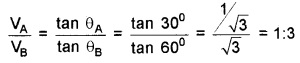
A boy standing at one bank of a river sees the top of a tree on the other bank directly opposite to the boy pt an elevation of 60°. Stepping 40 metres back, he sees the top at an elevation of 30°.
a) Draw a rough figure and find the height of the tree
b) What is the width of the river?
Answer:
a) PC = 40 m
∠BPC = 30°
∠BCA = 60°
Kerala SSLC Maths Previous Year Question Paper March 2019 English Medium 14
In ΔPCB, ∠PCB = 120°
∠PBC = 30°
ΔPCB is an isoscles triangle
BC = PC = 40 cm
Consider ΔCBA
This is a 30° – 60° – 90° triangle side opposite to 30° in ΔCAB is = 20 m
AB = 2 × \frac{40}{\sqrt{3}} = 20√3 m
b) Width of the river is 20 m

Question 25.
Circle with centre O touches the sides of the triangle at P, Q and R, AB = AC, AQ = 4 centimetres and CQ = 6 centimetres.
Kerala SSLC Maths Previous Year Question Paper March 2019 English Medium 15
a) What is the length of CP?
b) Find the perimeter and the area of the triangle.
c) What is the radius of the circle?
Answer:
a) CP = CQ = 6 cm
b) AC = AQ + QC = 4 + 6 = 10 cm
AB = AC = 10 cm
AR = AQ = 4 cm
BR = AB – AR = 10 – 4 = 6 cm
BP = BR = 6 cm
BC = BP + PC = 6 + 6 = 12 cm
Perimeter of ∆ABC = AB + BC + AC = 10 + 12 + 10 = 32 cm
Area of ∆ABC = \(\frac { 1 }{ 2 }\) × BC × AP
= \(\frac { 1 }{ 2 }\) × 12 × 8
= 48 cm2 \([\mathrm{AP}=\sqrt{\mathrm{AB}^{2}-\mathrm{BP}^{2}}]\)
c) \(r=\frac{A}{S}=\frac{48}{16}=3 \mathrm{cm}\)

Kerala SSLC Maths Previous Year Question Paper March 2019 English Medium

Question 26.
The radius of a cylinder is equal to its height. If the radius is taken as r, the volume of the cylinder is πr2 × r = πr3. Like this find the volumes of the solids, with the following measures.

SolidsMeasuresVolume
ConeRadius = height = r
HemisphereRadius = r
SphereRadius = r

a) What is the ratio of the volumes of the cone, hemisphere, cylinder and the sphere?
b) A solid metal sphere of radius 6 centimetres is melted and recast into solid cones of radius 6 centimetres and height 6 centimetres. Find the number of cones.
Answer:
Kerala SSLC Maths Previous Year Question Paper March 2019 English Medium 16

Question 27.
C is the centre of the circle passing through the origin. Circle cuts the y-axis at A(0, 4) and the x-axis at B(4, 0)
Kerala SSLC Maths Previous Year Question Paper March 2019 English Medium 17
a) Write coordinates of C
b) Write the equation of the circle.
c) (0, 0) is the point on the circle. There is one more point on the circle with x and y coordinates equal. Which is that point?
Answer:
a) \(C\left(\frac{0+4}{2}, \frac{4+0}{2}\right)=C(2,2)\)
b) Radius \(=\frac{A B}{2}=\frac{4 \sqrt{2}}{2}=2 \sqrt{2}\) Unit [1 : 1 : √2 ]
Equation = (x – 2)2 + (y – 2)2 = (2√2)2
= x2 – 4x + 4 + y2 – 4y + 4 = 8
= x2 + y2 – 4x – 4y = 0
c) If x = y
x2 + x2 – 4x – 4x = 0
2(x2 – 4x) = 0
x2 – 4x = 0
x(x – 4) = 0
x = 0, x = 4
The required point is (4, 4)

Question 28.
The table below shows the number of children in a class, sorted according to their heights.

Height
(Centimetres)
Number of Children
130 – 1407
140 – 1509
150 – 16010
160 – 17010
170 – 1809

If the students are directed to stand in a line according to the order of their heights starting from the smallest, then
a) The height of the child at what position is taken as the median?
b) What is the assumed height of the child in the 17th position?
c) Find the median height.
Answer:
n = 7 + 9 + 10 + 10 + 9 = 45 (odd)

Height (cm)No. of children
Less than 1407
Less than 15016
Less than 16026
Less than 17036
Up to 18045

a) \(\frac{45+1}{2}\) = 23rd chil’s height comes in the middle.
the median when 10 cm height in divided into 10 children, each one’s share is \(\frac{10}{10}=1\)
Height of 17th child = 150 + \(\frac { 1 }{ 2 }\) = 150.5
b) Take 150.5 as the fist term and 1 as the common difference 7th term is the height of 23rd child.
c) Median = 150.5 + 6 × 1 = 150.5 + 6 = 156.5 cm.

Read the following. Understand the Mathemati¬cal concepts in it and answer the questions. (6 × 1 = 6)

Question 29.
The remainders obtained on dividing the powers of two by 7 have an interesting property. We can understand it from the table given below.
Kerala SSLC Maths Previous Year Question Paper March 2019 English Medium 18
If the powers are 1, 4, 7, … the remainder is 2
If the powers are 3, 6, 9,.. the remainder is 1
a) What is the remainder on dividing 28 by 7?
b) Write the sequence of powers of 2 leaving remainder 1 on division by 7.
c) Check whether 2019 is a term f the arithmetic sequence 3, 6, 9,…
d) What is the remainder on dividing 22019 by 7?
e) Write the algebraic form of the arithmetic sequence 1, 4, 7 …
f) Write the algebraic form of the sequence 21, 24, 27, ……. (powers of two leaving remainder 2 on division by 7).
Answer:
a) 4
b) 20, 23, 26, 29, ….. (1, 8, 64, 512)
c) Since 2019 is a multiple of 3, it is a term of the sequence 3, 6, 9, …..
d) Remainder = 1
e) xn = 2n – 2
f) xn = 23n-2

Kerala Syllabus 10th Standard Biology Solutions Chapter 7 Genetics for the Future

You can Download Genetics for the Future Questions and Answers, Summary, Activity, Notes, Kerala Syllabus 10th Standard Biology Solutions Chapter 7 help you to revise complete Syllabus and score more marks in your examinations.

Kerala State Syllabus 10th Standard Biology Solutions Chapter 7 Genetics for the Future

Genetics for the Future Text Book Questions and Answers

Sslc Biology Chapter 7 Kerala Syllabus Question 1.
Observe illustration on the various stages in the production of bacteria that are capable of producing insulin. Analyze it based on the indicators and write down the inferences.
Sslc Biology Chapter 7 Kerala Syllabus
a) How insulin-producing bacteria are created?
b) What is the change that occurred in the genetic constitution of the bacteria that can produce insulin?
c) Will the future generation of this bacteria have the ability to produce insulin? Why?
Answer:
a) Insulin-producing bacteria are created through Genetic Engineering. Cutting the gene responsible for the production of insulin and joining it with bacterial DNA (plasmid).
b) The gene responsible for the production of insulin become part of the bacterial DNA.
c) Yes, the bacteria containing genes that the ability which controlling insulin production They replicates and forms more in number.

10th Class Biology 7th Lesson Kerala Syllabus Question 2.
Observe the collage given below analysis and prepare notes about it.
10th Class Biology 7th Lesson Kerala Syllabus
Answer:
It is criticized that genetically modified varieties are threat to indigenous varieties and may cause health issues to human. There are possibilities to use the genetically modified organisms are bioweapons that might be applied any country to their enemies is called Bioware. This becomes a threat to the existence of human beings.

Genetic Engineering

The use of microorganisms and biological processes for various human requisites is called biotechnology. The ability of fungi and bacteria to convert sugar into alcohol was utilized to make wine, appam and cake. These can be considered as traditional methods of biotechnology. Genetic engineering is the modern form of biotechnology. Genetic engineering is the technology of controlling traits of Organisms by bringing about desirable changes in the genetic constitution of organisms.

Biology Class 10 Kerala Syllabus Question 3.
What is the basis of genetic engineering?
Answer:
The basis of genetic engineering is the discovery of the fact that genes can be cut and joined.

  • Restriction Endonuclease: The enzyme used to cut DNA at specific sites. This enzyme is known as genetic scissors.
  • Liqase: The enzyme ligase is used for joining DNA at specific sites, this enzyme is called as genetic glue.
  • Vectors: Plasmids in bacteria are generally used as vectors. A gene from one cell is transferred to another cell by using suitable vectors.

Kerala Syllabus 10th Standard Biology Notes Pdf Question 4.
How is the new genes become a part of the genetic constitution of target cells?
Answer:
DNA with ligated genes enter the target cell. Thus the new genes become a part of the genetic constitution of target cells.

10th Standard Biology Malayalam Medium Question 5.
Scope of genetic engineering
Answer:
a) Gene therapy
b) Genetically modified animals and crops
c) Forensic test

Gene Therapy

Kerala Syllabus 10th Standard Biology Pdf Question 6.
Why is gene therapy essential?
Gene therapy is the method of curing genetic diseases by removing disease-causing genes from the genome and inserting normal functional genes. Gene therapy is beneficial for the sustenance of humankind.

Human Genome Project

Hss Live 10th Biology Kerala Syllabus Question 7.
What is the significance of the human genome project?
Answer:
The human genome includes about 30000 genes present in his 46 chromosomes. The secret of human genome is revealed through a project, known as the Human Genome Project started in 1990 and ended in 2003 in various laboratories of the world. The Gene mapping technology helped us to identify the location of a gene in the DNA.

10th Biology Notes Malayalam Medium Kerala Syllabus Question 8.
What is the benefit of gene mapping ?
Answer:
Gene mapping is a technology by which we can locate a specific gene in the DNA responsible for a particular trait.

10th Class Biology Notes Kerala Syllabus Question 9.
What is Junk genes ?
Answer:
In human DNA, majority of genes, except the genes that code for protein are non-functional. They are called junk genes.
The relevance of the Human Genome Project:

  • Human genome has about 24000 functional genes.
  • Major share of human DNA includes junk genes
  • There is only 0.2 percent difference in DNA among humans.
  • About 200 genes in human genome are identical to those in bacteria.

Genetically Modified Animals& Crops

10th Biology Guide Kerala Syllabus Question 10.
Proteins that can be used for the treatment of diseases in humans are produced through genetic engineering.
Answer:

Protein required for treatmentDisease/Symptom
InterferonsViral diseases
InsulinDiabetes
EndorphinPain
SomatotropinGrowth disorders

Sslc Biology Notes Pdf Kerala Syllabus Question 11.
One of the future promises of genetic engineering is pharm animals. What do you mean by pharm animals?
Answer:
Genes responsible for the production of human insulin and growth hormones etc. are identified and inserted in animals like cows or pigs to transform them into ‘pharm animals’ (animals providing pharmaceuticals or medicines). Medicines thus produced can be extracted from the blood or milk of such animals.

Sslc Biology Textbook Solutions Kerala Syllabus Question 12.
Instead of bacteria, animals like cows or pigs are used as medicinal animals or pharm animals. Why?
Answer:
It is easy to rear animals like cows or pigs than the culturing of bacteria. Moreover, medicines can be extracted from their blood or milk.

Dna Finger Printing

The arrangement of nucleotides in the DNA of each person differs. This finding leads to the DNA testing. The technology of testing the arrangement of nucleotides in each person also differs. Hence this technology is also called DNA fingerprinting. Alec Jeffrey in 1984 paved the way for DNA testing.

Sslc Biology Notes Malayalam Medium Pdf Question 13.
How are persons identified through DNA testing?
Answer:
The arrangement of nucleotides in the DNA of each person differs.

Question 14.
What is the basis of DNA testing?
Answer:
The arrangement of nucleotides in the DNA of each person differs. This finding lead to the DNA testing.

Question 15.
How is it possible to identify the person’s blood relatives?
Answer:
The arrangement of nucleotides among close relatives have many similarities. So DNA fingerprinting is helpful to find out hereditary characteristics, to identify real parents in cases of parental dispute.

Question 16.
What is the scope of DNA testing?
Answer:
DNA fingerprinting helpful to find out hereditary characteristics to identify real parents in cases of parental is missing due to natural calamities or wars. DNA of the skin hair, nail blood and other body fluids obtained from the place of murder, robbery, etc. is compared with the DNA of suspected persons. Thus the real culprit can be identified from among the suspected persons through this method.

Question 17.
Observe the collage given below analysis and prepare notes about it.
Biology Class 10 Kerala Syllabus
Answer:
It is criticized that genetically modified varieties are threat to indigenous varieties and may cause health issues to humans. There are possibilities to use the genetically modified organisms are bioweapons that might be applied any country to their enemies is called Bioware. This becomes a threat to the existence of human beings.

Question 18.
We should utilize science and technologies for the well being of man and other living beings. On the basis of the above statement, should we favor gene technology, which has a few demerits? Share your thought.
Answer:
Though there are certain possibilities of misuse, gene technology has many merits. Hence, we should utilize science and technologies for the well being of man and other living beings.

Question 19.
Is it right to misuse technologies that are used for human progress? As such possibilities prevail, can we promote genetic engineering, organize a debate in the class on this topic.

Let Us Assess

Question 1.
Which of the following is not a part of modern genetic engineering?
a) DNA profiling
b) Gene mapping,
c) DNA fingerprinting.
d) X-ray diffraction.
Answer:
d) X-ray diffraction.

Question 2.
Gene therapy is an example of the benefits of science for human existence.
a) What is gene therapy?
b) What was the discovery that led to gene therapy?
c) How does gene therapy become useful to human beings?
Answer:
a) Gene therapy is the method of curing genetic diseases by removing disease-causing genes from the genome and inserting normal functional genes.
b) Gene mapping
c) We can cure genetic diseases and disorders by gene therapy.

Question 3.
‘Since genetic engineering has many harmful effects, it can’t be promoted’. Do you agree to this statement? Why?
Answer:
No. Though there are certain possibilities of misuse, gene technology has many merits (like medicines, vaccines, treatment of genetic diseases, production of high yield and resistant varieties of food crops). Hence, we should utilize science and technologies for the well being of man and other living beings.

Extended Activities

Question 1.
Prepare a slide presentation including the stages of production of insulin through genetic engineering.
Answer:
Kerala Syllabus 10th Standard Biology Notes Pdf

Question 2.
Prepare a science excerpt collecting pictures and news related to genetic engineering.

Genetics for the Future More Questions And Answers

Question 1.
Traditionally, human beings adopted and utilized various methods of biotechnology. Substantiate this statement with suitable examples.
Answer:

  • Yeast (a fungus) was used to prepare food items like bread.
  • Bacteria and fungi were utilized to convert sugar into alcohol or acids.
  • Practiced the method of selecting and rearing of cattle or crops of superior hybrid variety

Question 2.
Give example for modern biotechnological practices.
Answer:

  • Development of human insulin-producing bacteria.
  • Production of ‘pharm animals’, that yielding medicines or vaccines.

Question 3.
The scope of modem biotechnology is endless. Substantiate this statement providing apt examples.
Answer:
The statement is true. Organisms that can withstand adverse conditions, beautiful flowers, amazing animals, effective vaccines, food crops, etc. can be developed through biotechnology.

Question 4.
Describe the stages in the production of human insulin bacteria through the process of genetic engineering.
Answer:

  • From human DNA, cut the gene responsible for the production of insulin.
  • This gene is joined with cutting of bacterial DNA (plasmid)
  • Insert the joined DNA in the bacterial cell.

Question 5.
Both the genetic scissors and genetic glue are used in the process of genetic engineering. What do you mean by these?
Answer:
The enzymes like Restriction endonuclease, used to cut DNA at specific sites, are generally called as ‘genetic scissors’. The enzymes like Ligase, used for joining DNA at specific sites, are generally called as ‘genetic glue’.

Question 6.
Observe the given illustration and answer to the following questions
10th Standard Biology Malayalam Medium
a) Name the technology indicated here.
b) Name the general term for enzymes that use to cut genes.
c) Which is the vector used in this process?
Answer:
a) Genetic engineering
b) Genetic scissor
c) Bacterial DNA (plasmid)

Question 7.
Define ‘vectors’ in genetic engineering.
Answer:
Vectors are other DNA (usually bacterial DNA), by which genes can be transferred from one cell to another.

Question 8.
Paravur Fire Tragedy: The remnants of body parts sent for DNA test to identify missed persons.
What is the test indicating in this news? How is it possible to identify any person from minute remnants of their body parts?
Answer:
DNA fingerprinting (DNA profiling or DNA Testing). DNA of the skin, hair, nail, blood and other body fluid obtained from the place is compared through DNA profiling with the DNA of suspected person’s blood relatives.

Question 9.
Identify this person. What is the technology that he put forwarded in 1984? Mention its importance.
Kerala Syllabus 10th Standard Biology Pdf
Answer:
Alec Jeffrey.
He paved the way for DNA testing, by which we can find out hereditary characteristics, identify real parents in the case of parental dispute and also can identify persons found after long periods of missing.

Question 10.
Genetic engineering caused tremendous changes in medicinal field, how? Answer with examples.
Answer:

  • Human insulin-producing bacteria.
  • Pharm animals, which produce human insulin and growth hormones
  • Medicine producing plants

Question 11.
Instead of bacteria, animals like cows or pigs are used as medicinal animals or pharm animals. Why?
Answer:
It is easy to rear animals like cows or pigs than the culturing of bacteria. Moreover, medicines can be extracted from their blood or milk.

Question 12.
Explain briefly about the merits of genetic engineering in the fields of food and agriculture?
Answer:
Genetic engineering influenced in the production of genetically modified disease resistant and high yield varieties of animals, food crops and cash crops.

Question 13.
Bioweapons are crucial threat to human beings. What are bioweapons? Which is the technology behind biowar?
Answer:
Bioweapons are genetically modified pathogens that might be applied any country to their enemies. Genetic engineering is the technology behind this kind of BioWare.

Question 14.
Make a few logo sentences that can be used for the awareness programme against the misuse of science and technology.
Answer:

  • Genetic modification can be allowed only for the benefit of mankind.
  • Avoid all weapons including bioweapons, save life.
  • Science and technologies are meant for protection, not for destruction.

Question 15.
“Genetic engineering is the branch of Science that transforms the living world”.
a) What is your opinion on the above statement?
b) Give reason to substantiate your opinion.
Answer:
a) I agree with this statement
b) In agriculture, medicine, use of superbugs, DNA fingerprinting, misuses

Question 16.
BT Brinjal is less subject to pest attacks. (March 2013)
a) How is it possible?
b) What are the advantages of genetic modifications?
c) What are the harmful effects of genetic modifications?
Answer:
a) The gene which introduced in these plants causes the production of a protein since this protein can destroy pests.
b) Today insulin without any side effects is being manufactured through genetic engineering.

  • Superbugs are one of the products of genetic engineering
  • Bt cotton and Bt Brinjal are produced.
  • The DNA fingerprinting which is used to prove disputed parentage and criminal offenses.

c) A possibility to the pathogens which will not yield to any medicine.

  • Superbugs introduced in oil fields destroy oil fields

Genetics for the Future Questions & Answers

Question 1.
Analyze the word pair relationship and fill in the blanks: (Question Pool-2017)
a) Restriction endonuclease: genetic scissors
……………………………………..: genetic glue
b) DNA profiling: Tests the arrangement of nucleotides
………………………………………: Identifies the loca tionofageneinthe DNA
Answer:
a) Ligase
b) Gene mapping

Question 2.
Choose the right statement from those given below: (Question Pool – 2017)
i) Gene mapping is a technology that identifies the location of a gene in the DNA.
ii) The sum of genetic material presents in an organism is called its DNA.
iii) Enzyme Ligase is used to join the genes.
iv) Gene therapy is the technology that tests the arrangement of nucleotides.
Answer:
i) Gene mapping is a technology that identifies the location of a gene in the DNA.
iii) Enzyme Ligase is used to join the genes.

Question 3.
‘Pharm animals’ is one of the promises of genetic engineering. What is the significance of this concept? (Question Pool-2017)
Answer:

  • Genes responsible for the production of insulin and growth hormones are inserted into animals, transforming
  • them into pharm animals.
  • These animals are easy to be reared and cared when compared to bacteria.
  • Medicines can be extracted from their blood or milk.

Question 4.
Observe the logo given below. What does it indicate? (Question Pool-2017)
Kerala Syllabus 10th Standard Biology Solutions Chapter 7 Genetics for the Future - 7
Answer:
Human Genome Project

Question 5.
“Gene therapy becomes the remedy for genetic diseases.” (Question Pool-2017)’
This is a note in Sethu’s science diary.
Do you agree to this note? Justify your opinion. (2)
Answer:

  • Yes
  • Gene therapy is the treatment for curing genetic diseases by removing disease-causing genes and inserting functional genes in the genome.

Question 6.
Suma murder case – trace of hair obtained from the site of incidence enabled to identify killer. (Question Pool-2017)
a) Read the above news. Name the technology that helped to find the killer?
b) Cite two other uses of this technology
Answer:
a) DNA fingerprinting
b) 1. to solve parental dispute
2. to identify culprits
3. to identify persons

Question 7.
“Insulin-producing bacteria created” – news report Santhosh raises the following doubts about the news. What explanations would you give as a student of Genetics? ‘
a) Which is the technology that helped to create insulin-producing bacteria?
b) Will the next generation of this bacteria be able to produce insulin? Give reason.
Answer:
a) Genetic Engineering
b) 1. Yes
2. Because the gene responsible for the production of insulin is there in the next generations

Question 8.
Given below are the various steps involved in the production of insulin through genetic engineering, Arrange them appropriately. (Question Pool – 2017)
a) Producing active insulin from this
b) Cutting the gene responsible for the production of insulin from human DNA.
c) Bacteria produce inactive form of insulin.
d) Isolating bacterial DNA.
e) Joining the gene with bacterial DNA and inserting it into the bacterial cell.
f) Providing a favorable medium for the multiplication of bacterial
Answer:
b → d → c → f → c → a

Question 9.
A debate has been organized in the topic. ‘Genetic Engineering – scope and challenges’. (Question Pool – 2017)
List out 3 scopes encountered in the field of Genetic Engineering for Anoop and 3 challenges for Safa respectively.
Answer:
Scopes: In the field of medicine, food crops, cash crops, cattle management, nature conservation, gene therapy, etc.
Challenges: Genetic modifications – violation of rights, bioweapons, BioWare, threat to indigenous varieties, health problems in man, superbugs, etc.

Question 10.
Identify the odd one and write the common feature of others: (1) (Question Pool – 2017)
DNA profiling, Electrocardiogram, gene mapping, gene therapy
Answer:
a) Electrocardiogram
Others related to genetic engineering

Question 11.
Given below is a word tree prepared by Appu for classroom presentation. Help him to complete the tree by choosing the words given in the box: (2) (Question Pool-2017)
Junk genes, Ligase, Gene therapy DNA profiling, Restriction endonuclease, Gene mapping, Plasmid, Genetic engineering.
Kerala Syllabus 10th Standard Biology Solutions Chapter 7 Genetics for the Future - 8
Answer:
a) Restriction endonuclease
b) Ligase
c) DNA profiling
d) junk genes
e) Gene mapping
f) Gene therapy

Question 12.
Observe the table and form matching pairs. (2) (Question Pool-2017)

a) DNA Profilingi) Treatment for genetic dis­eases
b) Gene mappingii) Testing the arrangement of nucleotides
c) Gene therapyiii) The sum of genetic mate­rial presents in an organism
d) Genomeiv) Locating the position of a gene in the DNA

Answer:
a) ii
b) iv,
c) i,
d) ii

Question 13.
Kerala Syllabus 10th Standard Biology Solutions Chapter 7 Genetics for the Future - 9
Didn’t you read the news report? (Question Pool -2017)
a) What is the basis of DNA test?
b) How is it possible to identify relations through DNA test?
Answer:
a) The arrangement of nucleotides in the DNA differs in different individuals
b) The arrangement of nucleotides among close relatives have many similarities.

Question 14.
Analyse the table given below and answer the following questions. (Orukkam – 2017)

CropProductivityResistance to the disease
AHighLow
BLowHigh

a) What are the desirable characters that you like from hybridization between crop A and B?
b) Is there any chance for getting plants with undesirable characters in the same hybridization? Explain the reason for this chance in the light of Mendel’s experiment in pea plant?
c) Can you suggest a remedy for this problem?
Answer:
a) More productivity, and resistance to the disease.
b) Yes. Four different types of plants may forms in the ratio of. 9 : 3 : 3 : 1, as a result of the self-pollination of plants A and B.
c) Genetically modified plants is the remedy for this.

Question 15.
Read the statement given below and answer the following questions. (Orukkam – 2017)
Gene mapping is the method to identify the location of gene in the DNA responsible for a particular trait.
a) How does gene mapping help in insulin production?
b) What is the significance of pharm animals?
c) What is meant by gene therapy?
Answer:
a) We can locate the correct position of gene responsible for insulin production.
b) Pharmammals produce medicines, growth ‘ hormones, human insulin, etc.
c) The process in which new active gene is added in the place of diseased or inactive genes to rectify genetic diseases is known as gene therapy.

Question 16.
Complete the illustration which represents the scope and misuses of genetic engineering. (Orukkam – 2017)
Kerala Syllabus 10th Standard Biology Solutions Chapter 7 Genetics for the Future - 10
Answer:
A) Food crops and cash crops with high productivity and disease resistance
B) Medicines: From pharm animals, plants and microorganism
C) DNA fingerprinting: To identify person in disputes.
D) Possibility of BioWare: Using genetically modified organisms as bioweapons
F) Violation of rights: Genetic modification is intrusion upon the freedom of organisms.

Question 17.
Explain the difference between”traditional biotechnology and modern biotechnology with suitable examples (Orukkam – 2017)
Answer:
In traditional biotechnology process, we select and use organisms having desirable qualities, eg. Yeasts were used in bread making.

Question 18.
What are the scope of DNA fingerprinting and gene mapping? (Orukkam – 2017)
Answer:
DNA fingerprinting:

  • To identify. real parents
  • To find out hereditary characteristics
  • To identify apt persons found after a long period of missing.

Gene mapping:

  • To identify the correct position of genes in DNA responsible for each characteristic.
  • To rectify genetic disorders through gene therapy.
  • To produce new varieties of organisms with desirable qualities.

Question 19.
Write down any two arguments that evolved during the debate about the topic “Is genetic engineering for human progress?” From support and against group. (Orukkam – 2017)
Answer:
Environment: Neutralizing substances that cause pollution to nature, Gene therapy, New desirable varieties.
Misuses: Threat to indigenous varieties: Genetically modified varieties cause harm to indigenous varieties.

Kerala Syllabus 8th Standard Basic Science Solutions Chapter 17 Fibres and Plastics

You can Download Fibres and Plastics Questions and Answers, Summary, Activity, Notes, Kerala Syllabus 8th Standard Basic Science Solutions Chapter 17 help you to revise complete Syllabus and score more marks in your examinations.

Kerala State Syllabus 8th Standard Basic Science Solutions Chapter 17 Fibres and Plastics

We have variety of substances around us for improving our lifestyle. The natural resources are utilised to produce a variety of modern materials.

Fibres And Plastics Class 8 Kerala Syllabus Polymers

Cotton. Silk, jute, wool, rubber etc are the molecules belonging the group of polymers. Polymers are macromolecules formed by the combination of large number of simple molecules called monomers. Fibres are the polymers suitable for the manufacture of strong threads. Plastics are the polymers which can be moulded into different shapes. Rubber is an elastic polymer.

Manmade polymers

In order to overcome the demerits like less availability, less durability etc several synthetic polymers have been prepared through chemical methods. Synthetic threads have demerits too. Some of them are low aeration, low ability to absorb water, high inflammability etc

Basic Science Class 8 Chapter 17 Kerala Syllabus Plastic

These are the substances that changed the very face of human life which are having different properties.

Thermoplastics and thermosetting plastics

The plastic that gets softened on heating and hardened on cooling is thermoplastics. The plastic which remains soft when heated during its manufacture, and gets hardened permanently on cooling is thermosetting plastics.

Plastics and Pollution

Even though plastics are very useful substance, the careless use and misuse lead to environmental pollution. Plastics give many benefits to mankind. Forest conservation, household utility etc are some of the benefits. There are many ways to reduce pollution due to plastics. Some of them reduce the use of dispo¬sable plastics, reduce; the overuse of plastic materials, use other material like glass, ceramic materials instead of plastic etc.

Fibres and Plastics Textbook Questions and Answers

Basic Science For Class 8 Chapter 17 Kerala Syllabus Questions 1.
Polymers are macromolecules formed by the combination of many monomers.
a. How are polymers classified?
b. Classify the following:
Cotton, Wool, Nylon, Silk, Terylene, Jute, Polyester
Answer:
a. i. On the basis of its formation as natural and man-made.
ii. On the basis of structure as linear branches chain, cross-linked chain
iii. On the basis of process as addition polymer and condensation polymer.
iv. On the basis of molecular strength as fibres and plastics
b. Natural: wool, silk, jute, cotton Man-made: Nylon, Terylene, Polyester

Kerala Syllabus 8th Standard Physics Notes Questions 2.
Some monomers and polymers are given in the following table:

MonomerPolymer
EthenePolyethene
PropenePolypropene
Styrene VinylPolystyrene
chloridePolyvinyl chloride

a. What is meant by the terms ‘monomer’ and ‘polymer’?
b. What is the common system of nomenclature of polymers?
Analyse the table and find out.
Answer:
a. Monomer: A Simple molecule having a particular structure
Polymer: Macromolecules formed by combination of large number of monomers.
b. Add the word ‘poly’ before the name of monomer.

Kerala Syllabus 8th Standard Chemistry Notes Question 3.
Natural fibres and synthetic fibres are used in the field of textile manufacturing.
a. Compare their merits and demerits and tabulate.
b. Which of these clothes is most suited for the following situations? Give reason.
i. While cooking in the kitchen
ii. To wear during summer
Answer:
a. Merits:

  • Comfortable to wear
  • Not inflammable
  • Ability to absorb water
  • High aeration

Demerits:

  • Less available
  • Less durability
  • Wrinkle easily
  • Cannot dry easily on getting wet

b. Natural fibres:- Because they are not inflammable, have ability to absorb sweat, high aeration

8th Class Biology Notes Pdf Kerala Syllabus Question 4.
You know what thermoplastics and thermosetting plastics are.
a. Which of these plastics cannot be recycled?
b.You might have noticed that those who collect old plastics do not accept certain type of plastic articles. What are they? What may be the reason for this?
Answer:
a. Thermoplastic
b. Thermosetting plastic. Because they can’t be recycled.

Kerala Syllabus 8th Standard Biology Notes Question 5.
Some argue that plastics are to be completely banned as they cause environmental pollution. What is your view?
Answer:
No. Without plastic, we cannot manage daily life. Control the use of plastic. avoid disposable plastic products and use thermoplastic materials.

8th Class Biology Notes Pdf Malayalam Medium Question 6.
The school science club has N decided to conduct a poster propaganda for creating awareness about pollution due to plastics. Prepare some posters for this.
Answer:
Avoid disposable plastic products use glass, ceramic utensils or natural substances
Use paper or natural materials fo decorations
Don’t dump plastic materials in soil.

8th Standard Basic Science Textbook Kerala Syllabus Question 7.
What suggestions can you propose to realise the concept of ‘plastic waste-free school’? List your findings.
Answer:
Reduce: Buy only what you need because a better way to reduce waste is by not creating it.
Reuse: Instead of throwing out plastic product you no longer think you need, try repurposing them because plastics exist for long time. Eg: use refill in ball pens, use thick plastics which can be reused, reuse the plastic bottle. The banning of plastics below the thickness of 30 micron aims at this. When thickness increases a tendency will arise to use it again.

Recycling: Is the process by which the plastics which is rendered useless is heated and subjected to certain processes to produces new materials. Recycling the rate of environmental pollution

Refuse: We can avoid the use of plastic when it is not necessary. Avoid thin plastic covers when things are bought. Use cloth bag, paper bag or thick plastic covers which can be used for long time

Fibres and Plastics Additional Questions and Answers

8th Biology Notes Malayalam Medium Kerala Syllabus Question 1.
Differentiate between thermoplastic and thermosetting plastic.
Answer:
The plastic that gets softened on heating and hardened on cooling is thermoplastic. When heating physical change occurs.
The plastic which remains soft when heated and gets hardened permanently on cooling is thermosetting plastics. Chemical change occurs when heating.

Kerala Syllabus 8th Standard Biology Notes Malayalam Medium Question 2.
Given some occasions of using plastic. Find the peculiarity of plastic used and fill the table.
Answer:

OccasionPeculiarity
As the covering of con­ductor
To make the handles of cooking vessels
To keep chemicals
To make water tanks
To make household materials

Answer:

OccasionPeculiarity
As the. covering of conductorPlastics are insulators
To make the hand­les of cooking vesselsNot conducting heat
To keep chemicalsDo not react with che­mical
To make water tanksNo rusting. Less weight
To make household materialsEasy to use. Less wei­ght

Kerala Syllabus 8th Standard Chemistry Notes Malayalam Medium Question 3.
Write 4 occasions which plastic is harmful to daily life.
Answer:

  1. Environmental pollution when it is thrown without any control.
  2. When burning it cause air pollution.
  3. Hindrance in drainages
  4. The water absorption property of soil decreases when plastics are dumped in soil.

Kerala Syllabus 8th Standard Notes Question 4.
What are the uses of plastic in the field of human health?
Answer:
To produce IV tubes, bottles To produce heart valves To produce packets

Synthetic Fibres And Plastics Class 8 Notes Kerala Syllabus Question 5.
What are the uses of plastic in the field of production of house building?
Answer:
To produce roof materials, doors, plumbing and wiring materials.

Class 8 Chemistry Notes Kerala Syllabus  Question 6.
List the peculiarities of plastic.
Answer:
Can mould in any shape, longlasting, insulator, do not conduct heats, not reacting with chemicals and water, will burn.

Question 7.
Separate natural and artificial polymer from the list
Rubber, wool, Pvc, Bakelite, nylon, rayon cellulose, silk, polythene, polyester
Answer:

NaturalArtificial
RubberP.V.C
WoolPolythene
CelluloseNylon
SilkRayon
Polyester

Question 8.
List the merits of natural and artificial polymer
Answer:

MeritsDemerits
Comfortable to wearLess availability
More aeration Absorbwrinkle easily
water, sweat Nothigh cost not
easily burnsdurable

Question 9.
If we heat polyethene cover can we convert into earlier stage? Justify.
Answer:
No. Undergoes chemical change because it is thermosetting plastic.

Question 10.
Filling in the blanks.
1. Natural polymer is ……………
2. Insulin is a ………….
3. is a monomer of polythene. …………..
4. Nylon is type of plastic. …………….
5. Bakelite is an example for plastic. …………..
6. Natural polymer which has elastic nature is ……………
7. Inflammable tendency is higher in …………….
8. Thermoplastic is a ……………. type polymer.
9. The constituent unit of polymer is called
10. Polymers of plant origin are made up of …………..
Answer:
1. Starch
2. Protein
3. Ethylene
4. thermoplastic
5. thermosetting
6. Rubber
7. Synthetic fibres.
8. linear
9. monomer
10. cellulose

Question 11.
Give examples for natural fibres.
Answer:
Coconut husk, cotton, hemp, silk etc.

Question 12.
What is vulcanization? What is the use of it?
Answer:
’The process of heating rubber with sulphur is called vulcanization. By vulcanization rubber retains its form and to increase the hardness, Moreover, tensile strength, elasticity keeping stability at high temperature etc. are increased.

Question 13.
Give four difference between natural rubber and synthetic rubber.
Answer:
1. Synthetic rubber is harder than natural rubber.
2. Natural rubber is easily flammable.
3. The elasticity of natural rubber is lower than that of synthetic rubber.
4. Synthetic rubber keeps stability at higher temperature.

Question 14.
Classify the following into thermoplastic and thermosetting plastics.
Bakelite, polyvinyl chloride, nylon, celluloid, urea-formaldehyde, Teflon, polyester, polythene.
Answer:

ThermoplasticsThermosetting
Nylonplastics
Polyvinyl chlorideBakelite
polytheneurea formaldehyde
celluloidpolyester
Teflon

Question 15.
Find out odd one and give reason. Bakelite, polyester, polythene, melamine formaldehyde.
Answer:
Polythene: All the others are thermosetting plastics.

Kerala Syllabus 10th Standard Biology Solutions Chapter 8 The Paths Traversed by Life

You can Download The Paths Traversed by Life Questions and Answers, Summary, Activity, Notes, Kerala Syllabus 10th Standard Biology Solutions Chapter 8 help you to revise complete Syllabus and score more marks in your examinations.

Kerala State Syllabus 10th Standard Biology Solutions Chapter 8 The Paths Traversed by Life

The Paths Traversed by Life Text Book Questions and Answers

The Paths Traversed By Life Kerala Syllabus 10th Question 1.
Analyze the following illustration and prepare a note on the theory of chemical evolution.
The Paths Traversed By Life Kerala Syllabus 10th
Answer:
Gases like hydrogen, ammonia, water vapor and methane which present in the atmosphere of primitive earth reacted together to form simple organic molecules like amino acids. Thunder and lightning ultraviolet radiations, volcanic eruptions are energy sources. Condensation of water vapor present in the atmosphere and the resulting incessant rain led to the formation of oceans. Simple organic molecules are formed first in the primitive ocean. By further reactions, complex molecules were found including genetic material to evolve the first primitive cell.

Urey – Miller Experiment

The Path Traversed By Life Kerala Syllabus 10th Question 2.
Which were the conditions of the primitive earth, recreated by Stanley Miller and Harold Urey?
Answer:
Stanley Miller and Harold Urey re-created the experimental setup, in which the glass flask considered as the primitive atmosphere that contained methane, ammonia, hydrogen and water vapor. Instead of lightning or other energy sources, they passed high voltage electricity through the gaseous mixture. The condensed water from this gaseous mixture was considered as the primitive ocean.

Sslc Biology Chapter Wise Questions And Answers Question 3.
The organic substances synthesized through Urey- Miller experiment?
a) Amino acids
b) Nucleic acids
c) Nucleotides
d) DNA
Answer:
a) Amino acids.

Kerala Syllabus 10th Standard Biology Notes Pdf Question 4.
Observe the illustration and answer the questions that follow:
The Path Traversed By Life Kerala Syllabus 10th
a) Name the scientists who set up this experiment.
b) What was the aim of their experiment?
c) Name the gases which are filled within the ‘A’ of the figure.
d) Which type of organic molecules did they synthesize through this experiment?
Answer:
a) Stanley Miller and Harold Urey.
b) To prove the theory of chemical evolution (Oparin- Haldane hypotheses) scientifically.
c) Methane, ammonia, hydrogen and water vapor.
d) Amino acids

Hsslive Guru 10th Biology Kerala Syllabus Question 5.
Analyze the major events related to the origin of life?
Sslc Biology Chapter Wise Questions And Answers
Answer:
Eukaryotes are originated from primitive prokaryotic cell. Gradually colonies of membrane-bound eukaryotic cells are formed. This led to the emergence of multicellular organisms.

Evolution – Through Theories

A) Lamarckism:

Biology Class 10 Kerala Syllabus Question 6.
Explain the ideas of J.B. Lamarck about organic evolution.
Answer:
Theory of Inheritance of Acquired Characters. Continuous use or disuse of an organ results variations to develop changes in the structure of that organ (Acquired characters). These will be transmitted to the next generation to form new species.

Hss Live Guru 10th Biology Kerala Syllabus Question 7.
Why did scientists criticize Lamarck’s view?
Answer:
The changes in the body (Acquired characters) that occur in the lifetime of an organism do not affect its genetic constitution and hence not possible to transmit to the next generation.

B) Darwinism:

Hss Live Guru Biology 8 Kerala Syllabus Question 8.
The items given in the box indicates a scientist.
a) Identify the scientist.
b) What idea did he put forward in the field of evolution?
1. The origin of species
2. HMS Beagle
3. Galapagos Islands
4. Survival of the favorable ones.
Answer:
a) Charles Darwin.
b) Theory of Natural Selection

Kerala Syllabus 10th Standard Biology Pdf Question 9.
Given below is the illustration of the ‘Darwin’s finches’ on the basis of indicators, analyze illustration.
Kerala Syllabus 10th Standard Biology Notes Pdf
a) Which peculiarity of the finches attracted Darwin.
b) How do these peculiarities help finches in their survival?
Answer:
The differences in the beaks of finches attracted Darwin.
The finches of Darwin’s had beaks adapted to their feeding habits insectivore finches have small beaks, cactus feeding finches have long and sharp beaks, woodpecker finches feed on worms in tree trunks have sharp beaks and ground finches feed on seeds have large beaks.

10th Standard Biology Malayalam Medium Question 10.
Complete the table of Darwin finches which showed differences in food and food habits.
Answer:

Type of finchesFoodDiversity of the beaks
Insectivorous finchInsectsSmall beaks
Cactus eating finchCactus plantLong sharp beaks
Woodpecker FinchwormsSharp beak

Sslc Biology Chapter Wise Questions Kerala Syllabus Question 11.
Compare the ideas of Thomas Robert Malthus and main concepts of Theory of Natural Selection’ put forward by Darwin.
Answer:

Theory of Robert MalthusTheory of Darwin
Rate of food production is not proportionate to the growth of human population and when scarcity of food led to diseases starvation and struggle for existenceEvery species produce more number of offsprings than that can survive on earth. They compete with one another for food, space, and mate.

The Theory Of Natural Selection

Hsslive Guru 10th Biology Kerala Syllabus

Hss Live Guru Biology 10 Kerala Syllabus Question. 12
Describe the theory of Natural Selection proposed by Charles Darwin.
Answer:
Variations develop in each species. Only those variations, which are favorable to that nature, survive and those which are unfavorable get eliminated, According to Darwin, organisms of one kind, when produced in large numbers (Over Production), compete for food, space, mate, and other limited resources (Struggle for Existence). In this struggle, only organisms with favorable variations survive in that nature (Survival of the Fittest). Over a long period, the favorable variations accumulate, resulting the formation of new species.

Hss Live Guru 10 Biology Kerala Syllabus  Question 13.
What was the limitation in Darwin’s theory? Who gave sufficient explanations to this?
Answer:
Darwin could not explain the reasons for continuous variations in organisms. However, Hugo deVries explained that one of the reasons for variations in organisms is mutation (sudden changes that occur in genes).

Scert Class 10 Biology Notes Kerala Syllabus Question 14.
Describe Neo Darwinism.
Answer:
Neo Darwinism is the modified version of Darwin’s theory in the light of new information from the branches of genetics, cytology, geology, and paleontology about the reasons of variations occurred in organisms. Hugo deVries first supported Darwin by his theory of mutation.

Sslc Biology Notes Malayalam Medium Pdf Mutation

Sudden changes that occur in genes are called mutation.

Mutation Theory:
Mutation theory explains that new species are formed by the inheritances of sudden changes that occur in genes. This theory formulated by a Dutch scientist Hugo de Vries.

Evidence Of Evolution

Sslc Biology Notes Pdf Kerala Syllabus Question 15.
Mention the branches of science which provide evidence to organic evolution.
Answer:

  • Paleontology (fossil study)
  • Comparative morphological studies
  • Biochemistry-physiology
  • Molecular biology

Kerala Syllabus 10th Standard Biology Question 16.
Define fossils.
Answer:
Fossils are remnants of primitive organisms preserved in earth crust.

Scert Biology Class 10 Kerala Syllabus Question 17.
Analyze the following illustration.
Biology Class 10 Kerala Syllabus
Answer:
The study of fossils reveals that complex structured organisms are evolved from primitive simple organisms.
Certain linking fossils reveal the evolution of one form of organisms from another form.
Extinction of some species as well as the emergence of new species.

Comparative Morphological Studies

Question 18.
‘Comparative study of structure gives evidence to evolution’. Evaluate this statement.
Answer:
Though there are differences in the external structure (morphology) among different organisms, there are certain similarities in their internal structure (anatomy). The evidence from the comparative morphological studies justifies the inferences that all organisms were evolved from a common ancestor.

Question 19.
The morphological and anatomical structure of forelimbs in lizard, bat and sea cow are shown here. Observe the illustration and answer to the following questions.
Hss Live Guru 10th Biology Kerala Syllabus
a) Are these forelimbs differ morphologically or anatomically or both? What is the reason behind this difference?
b) What is the term used for such organs that are similar in structure but different in function?
Answer:
a) Only morphological differences are there among these organs. Reason for these differences are their adaptations to live their own habitats.
b) Homologous organs.

Question 20.
Homologous organs are seen among reptiles, birds, and mammals. What do you mean by homologous organs?
Answer:
Organs that are similar in structure but perform different functions are called homologous organs.

Biochemistry And Physiology

Question 21.
Observe the illustration and write the inference.
Hss Live Guru Biology 8 Kerala Syllabus
Answer:
All organisms are made up of cells with protoplasm. There are similarities among the cell organelles and cellular activities. Enzymes control chemical reactions and energy is stored in ATP molecules in all organisms. Hereditary factors are gene , seen in DNA and the structure of DNA is alike in all. Carbohydrates, proteins, and fats are the basic substances. There are similarities in growth, excretion, etc.

Question 22.
What evolutionary interference can be arrived from the evidence from the comparative morphological, Biochemical and physiological studies?
Answer:
The evidence from the comparative morphological, Biochemical and physiological studies justify the inferences that all organisms were evolved from a common ancestor.

Molecular Biology

Question 23.
What evidences of organic evolution do the study of molecular biology provide us?
Answer:
Through a comparative study of protein molecules in different species, the evolutionary relationship (similarity/difference) among organisms can be identified. For instance, we can analyze the similarities or differences in the sequence of amino acids in the beta chain of hemoglobin molecules of different mammals and thereby we can understand about the evolutionary relationship among them.

Question 24.
The differences of the sequential arrangement of amino acids in the beta chain of hemoglobin of man with other animals are given below.

ChimpanzeeNo difference
GorillaDifference of 1 amino acid
RatDifference of 31 amino acids

Which animal is so close to human beings? What is the reason for this?
Answer:
Chimpanzee.
There is no difference in the sequential arrangement of amino acids in the beta chain of hemoglobin in man and chimpanzee.

Question 25.
How molecular studies can infer the period of separation of different groups from their ancestors?
Answer:
Mutations are the main reason for evolutionary changes. Through the molecular studies, we can find out how mutation occurs in the genes that determine amino acid sequences in protein molecules. From this, we can infer the period of separation of different group of organisms from their ancestors.

Evolution Of Human Beings

Question 26.
An evolutionary tree relating to certain organisms including humans is given below. Analyze and prepare a note.
Answer:
Kerala Syllabus 10th Standard Biology Pdf

Question 27.
Which organisms is the closest to humans in specific characters?
Answer:
Chimpanzee

Question 28.
Do you agree with the statement that man is evolved from monkeys? What is your opinion?
Answer:
This statement is wrong. Man come under the group Hominoidea while monkeys are included in Cercopithecoidea. It is believed that both the ancestors of man and monkeys are evolved from a common ancestor.

Question 29.
Name of a few animals are given in the box. Out of these which one is more similar to man? Mention any two peculiarities of the other animals.
Baboons, Chimpanzees, Monkeys

Question 30.
Analyze the following illustration which shows the evolutionary history of modern man.
10th Standard Biology Malayalam Medium
Answer:

AB
a) Ardipithecus ramidusMost primitive human race
b) Australopithecus AfarensisSlender body
c) Homo habilisMade weapons from stones and bones
d) Homo erectusThick chin and large teeth, ability to stand erect
e) Homo neanderthalensisContemporary to modern man
f) Homo sapiensModern man

Question 31.
The primitive man might be lived in African continent Do you agree this statement? What is your opinion?
Answer:
This statement might be right, because, fossils of Ardipithecus ramidus, Australopithecus afarensis, Homo habilis, and Homo erectus were discovered ” from African continent.

Question 32.
How do modern men differ from the other groups of human beings?
Answer:
Modern man have developed brains and equipped with advanced technologies.

Question 33.
Do the interventions of modern man cause any change to natural evolutionary process? How?
Answer:
Yes. Biodiversity is on a dangerous decline due to the interference of human beings in nature and natural resources. By human interventions, climatic changes brought in as well as the extinction of many organisms.

Question 34.
Here is an incomplete illustration of human evolutionary tree. Find out the missing links.
Sslc Biology Chapter Wise Questions Kerala Syllabus
Answer:
A: Australopithecus
B: Homo habilis
C: Homo neanderthalensis.

Let Us Assess

Question 1.
Which concept is put forward by the theory of natural selection?
a) Origin of life
b) Origin of species
c) Origin of eukaryotes
d) Chemical evolution of life
Answer:
b) Origin of species

Question 2.
List the main concepts that indicate how the biodiversity seen today has been developed from prokaryotes.
Answer:
Origin of prokaryotes 3500 million years ago
Origin of eukaryotes 1500 million years ago
Origin of multicellular organisms 1000 million years ago

Question 3.
How does the interference of human beings in nature influence the process of evolution? How do these affect the existence of other organisms?
Answer:
Biodiversity is on a dangerous decline due to the interference of human beings in nature and natural resources. By human interventions, climatic changes brought in as well as the extinction of many organisms.

Extended Activities

Question 1.
Prepare and exhibit a model of the experimental set up constructed by Urey-Millerto scientifically prove the theory of chemical evolution.

Question 2.
Prepare a chart illustrating the evolutionary tree of man. (See Question 70)

The Paths Traversed by Life More Questions And Answers

Question 1.
The hypothesis which explain how do the evolution occur in living beings is illustrated below:
Hss Live Guru Biology 10 Kerala Syllabus
a) Write the name of scientist who proposed this hypothesis.
b) This hypothesis was not fully accepted. Give reason. (Model 2014)
Answer:
a) Lamarck
b) variations affect genetic constitution only transferred to next generation

Question 2.
Rearrange the following based on the relationship between different Primates. Chimpanzee – Gorilla – Gibbon – Orangutan (March 2014)
Answer:
Gibbon → Orange → Orangutan → Gorilla → Chimpanzee

Question 3.
DDT was sprayed on some insects as an experiment. Among them some died and some 3 survived A second generation was created by mating the survived ones. Again DDT sprayed. This process was repeated on five generations. The result is given in the table. Analyze it arid answer the following questions.

GenerationsPercentage of survived insects
110
220
330
440
550

a) Interpret the result given in the table.
b) What scientific explanation can you give for this result?
c) What may be the result if the experiment is continued? (March 2014)
Answer:
a) After each generation’s resistance to DDT increases, ie. variation increases.
b) It is an example for Darwin’s theory of Natural selection. Due to struggle existence variations will arises and transmitted into next generations.
c) The total population becomes resistant to DDT / Evolution of DDT resistant species.

Question 4.
Name of certain animals belong to primates is given below.
a) Loris,
b) Gibbon,
c) Monkey
i) Which among them is closest to human beings according to the theory of evolution.
ii) Write down any two characteristics of the others. (March 2013)
Answer:
i) b) Gibbon
ii) Lorin
1. Noctural
2. Solitary
Monkey
1. Diurnal
2. Colonial life

Question 5.
Even though chemicals are used continuously, mosquitoes can’t be destructed completely. Write down scientific explanations for this statement on the basis of the theory of evolution. (March 2013)
Answer:
Mosquitoes develop resistant power in them against the chemicals. This is the survival of the fittest. Those mosquitoes which have the ability to resist the action of the chemicals survive, the others die.

Question 6.
Rearrange the following animals according to the evolutionary series.
Kerala Syllabus 10th Standard Biology Solutions Chapter 8 The Paths Traversed by Life - 13
b) List out any two evidences of organic evolution.
c) Man is involved in the evolution of other living beings. Substantiate your answer. (Model 2012)
Answer:
a) Gibbon, Orang-utan, Gorilla, Chimpanzee, Man.
b) Morphological similarities among animals and similar biochemical reactions indicate about a common ancestor/Different type of fossils are available / Scientific classification or taxonomy and molecular biology indicate that organisms are evolved from common ancestor and how they are interrelated or different, (any 2 points)
c) Yes. The involvement of man in his environment altered the natural evolutionary processes. Human influence may lead to mutation and other natural calamities which lead to evolution or extinction of certain species. Genetic engineering processes caused the production of new species, (any 2 points)

The Paths Traversed by Life Questions & Answers

Question 1.
Identify the odd one from those given below, and write the feature common to others. (Question Pool – 2017)
a) Monkey, gibbon, orangutan, gorilla.
b) acquired characters, overproduction, struggle for existence, favorable variations.
Answer:
a) 1. Monkey
2. Others belong to Hominoidea
b) 1. Acquired characters
2. Others are related to the theory of natural section

Question 2.
Analyze the word pair relationship and fill in the blanks.
a) Monkey: Cercopithecoidea
Chimpanzee:………………….
b) Theory of Natural Selection: Charles Darwin
Mutation theory:………………
Answer:
a) Hominoidea
b) Hugo deVries

Question 3.
The stages related to the origin of life are given below, b Analyse and arrange them correctly. (Question Pool – 2017)
a) Organic compounds
b) Prokaryotic cells
c) Chemical evolution
d) eukaryotic cells
e) Multicellular organism
f) Colonies of eukaryotic cells.
Answer:
(c) → (a) → (b) → (d) → (f) → (e)

Question 4.
Match the following

a) Lamarcki) Natural selection
b) Darwinii) Chemical evolution
c) Opariniii) Acquired characters

Answer:
a) (iii)
b) (i)
c) (ii)

Question 5.
An illustration related to chemical evolution is given below. Complete the illustration using the information given in the box. (Question Pool – 2017)
i) RNA, DNA
ii) polysaccharides, peptides, fats
iii) Presence of H2, N2, CO2
iv) Monosaccharides, aminoacids
Kerala Syllabus 10th Standard Biology Solutions Chapter 8 The Paths Traversed by Life - 14
Answer:
A – (iii)
B – (i)
C – (iv)
D – (ii)

Question 6.
Identify the statements that are related to chemical evolution:
i) Life originated in some other planets in the universe and accidentally reached the earth.
ii) Life originated as a result of the changes that occurred in the chemical substances in water, under specific conditions of primitive earth.
iii) The theory is supported by the organic substances found in the meteors that fell on earth.
iv) A.I.Oparin and J.B.S.Haldane are the proponents of the theory.
Answer:
ii) Life originated as a result of the changes that occurred in the chemical substances in water, under specific conditions of primitive earth.
iv) A.I.Oparin and J.B.S.Haldane are the proponents of the theory.

Question 7.
Tabulate the data appropriately in the box given below.
i) Chemical evolution
ii) Natural selection
iii) Panspermia theory
iv) Mutation theory
Kerala Syllabus 10th Standard Biology Solutions Chapter 8 The Paths Traversed by Life - 15
Answer:
Origin of life i) Chemical evolution and iii) Panspermia theory
Evolution – ii) Natural selection and iv) Mutation theory

Question 8.
Complete the illustration related to the evolution of human beings appropriately. (Question Pool – 2017)
Kerala Syllabus 10th Standard Biology Solutions Chapter 8 The Paths Traversed by Life - 16
Answer:
a) Cercopithecidae
b) Hominoidea
c) Small brain

Question 9.
Complete the table using the data given in the box. (Question Pool – 2017)
Most primitive members of the human race, cranial capacity is 460cm3, made weapons from stones and bone pieces, cranial capacity is 1000 cm3, thick chin, and large teeth, cranial capacity is 1700cm3, slender body, cranial capacity 610cm3, cranial capacity 325cm3, contemporary of modem man.

OrganismCranial capacityCharacteristic
Homo erectus
Homo habilis
Australopithecus
Ardipithecus

Answer:

OrganismCranial capacityCharacteristic
Homo erectus1000cm3thick chin and large teeth
Homo habilis610 cm3made weapons from stones and bone pieces.
Australopithecus460cm2slender body
Ardipithecus325 cm3most primitive members of the human race.

Question 10.
Given below is an illustration of the differences observed by Darwin in the beaks of the finches in the Galapagos island. (Question Pool-2017)
Kerala Syllabus 10th Standard Biology Solutions Chapter 8 The Paths Traversed by Life - 17
Finches with different beaks emerged from the ancestor finch. Substantiate the statement.
Answer:
Though the finches were similar in sound and nesting habits, only they showed differences in food and food habits. (Insectivore finches have small beaks, cactus feeding finches have long and sharp beaks, woodpecker finches feed on worms in tree trunks have sharp beaks and ground finches feed on seeds have latg beaks, etc.) So, Darwin thought that they were evolved from a common ancestor.

Question 11.
The links in the evolutionary history of modern man are given in the box. Complete the illustration choosing the appropriate ones from the box. (Question Pool – 2017)
Ardipithecus ramidus, Homo neanderthalensis, Homohabilis, Homo erectus, Homo sapiens, Australopithecus afarensis
Kerala Syllabus 10th Standard Biology Solutions Chapter 8 The Paths Traversed by Life - 18
Answer:
a) Australopithecus afarensis
b) Homohabilis
c) Homoneanderthalensis

Question 12.
‘The constant use of antibiotics develops resistance in bacteria”. (Question Pool-2017)
Substantiate the above statement on the basis of the theory of natural selection.
Answer:
The constant use of antibiotics develops resistance in bacteria. It is an example for Darwin’s theory of natural selection. Due to struggle for existence variations will arise and transmitted to next generation. So bacteria become resistant to antibiotic.

Question 13.
Complete the illustration given below, related to the evidences that support the evolution of new species. (Question Pool – 2017)
Kerala Syllabus 10th Standard Biology Solutions Chapter 8 The Paths Traversed by Life - 19
Answer:
B – Comparative morphology
D – Molecular biology

Question 14.
Scientific study of the remnants, body parts and imprints of primitive organisms are evidences on evolution.
a) What inferences do we arrive at, through such scientific studies?
b) How will you explain these inferences as evidences on evolution?
Answer:
a) 1. Primitive fossils have simple structure
2. Recently formed fossils have complex structure
3. Certain fossils are connecting links between different species.
b) 1. Organisms with complex structures are formed from those with simple structures.
2. Certain fossils indicate the evolution of one species from another species.

Question 15.
The forelimbs of the organisms shown in the picture below, do not show any similarity. Hence they do not have any evolutionary relationship. (Question Pool-2017)
Kerala Syllabus 10th Standard Biology Solutions Chapter 8 The Paths Traversed by Life - 20
How will you respond to this statement? Substantiate
Answer:
Do not agree

  • The similarity in blood vessels, nerves, muscles and bones.
  • Such anatomical resemblances indicate that they evolved from a common ancestor
  • Differences in their external appearance are their adaptations to like in different habitats

Question 16.
Arrange the following links in human evolution in the ascending order of their cranial capacity. (Question Pool-2017)
Homo sapiens, Ardipithecus,
Homo erectus. Homo habilis
Answer:
Ardipithecus → Homo habilis → Homo erectus → Homo sapiens

Question 17.
Arrange the links in human evolution appropriately: (Question Pool – 2017)
Kerala Syllabus 10th Standard Biology Solutions Chapter 8 The Paths Traversed by Life - 21
Answer:
A -Ardipithecus
B-Australopithecus
C- Homo erectus
D-Homo sapiens

Question 18.
There is a common ancestor for all the different species that exist today.
Explain how Biochemical and Physiological studies substantiate the above statement?
Answer:
All organisms are made up of cells with protoplasm, There are similarities among the cell organelles and cellular activities. Enzymes control chemical reactions and energy is stored in ATP molecules in all organisms. Hereditary factors are gene, seen in DNA and the structure of DNA is alike in all. Carbohydrates, proteins, and fats are the basic substances. There are similarities in growth, excretion, etc.

Question 19.
An excerpt from the article “Darwin view of evolution” is given below. (Question Pool – 2017)
Variations often occur in organisms. New species arise when these variations are subjected to natural selection. But Darwin could not explain the reason for these variations.
a) Explain the reason for variations on the basis of Genetics.
b) How was Darwinism revised later?
Answer:
a) Mutations taking place in gene, chromosome; This brings about variations,
b) Darwinism was revised as Neodarwinism in the light of new information form the branches of genetics, cytology, geology, and paleontology.

Question 20.
The table given below shows the difference in amino acids obtained from a comparative study of the (3 chains of hemoglobin of different organisms Analyse the table and answer the questions. (Qn. Pool-2017)

OrganismDifference from the aminoacids in the p chain of hemoglobin in man
Chimpanzee0
Gorilla1
Rat31

a) Which organism is more closely related to man on the basis of evolution? Substantiate your observation.
b) Explain the reason for the difference in amino acids of hemoglobin of the organisms listed in the table on biochemical basis.
Answer:
a) 1. Chimpanzee
2. No difference in the amino acid sequence in the Beta-chain of hemoglobin
b) 1. Mutations may occur in the genes that determine amino acid sequence
2. This causes changes in amino acid sequence.

Question 21.
A few concepts of scientists like Darwin and Malthus are given below. Classify them in the table given below. (Question Pool – 2017)
a) Selection by nature leads to the diversity of species.
b) Rate of food production does not increase proportionately to the increase in population.
c) Those organisms that overcome the unfavourable situations will survive.
d) Scarcity of food and starvation leads to struggle for existence.
Kerala Syllabus 10th Standard Biology Solutions Chapter 8 The Paths Traversed by Life - 22
Answer:
Concepts of Darwin – a, c
Concepts of Malthus – b, d

Question 22.
An excerpt from the science article. ‘Man and Evolution’ is given below. Analyze the excerpt and answer the questions. (Question Pool -2017)
Certain evolutionary features make man different from other animals included in evolutionary history. This helped him in his dominance over nature and other organisms. His interference had created a negative impact on the existence of other organisms.
a) What are the features that make man different from other animals?
b) Has man’s interference led to Biodiversity deterioration as mentioned in the excerpt? Evaluate.
Answer:
a) High cranial capacity, ability to stand erect, ability to walk in two legs, ability to make and use machines and tools, cultural development
b) Yes, Climate changes, deteriorating habitats, extinction.

Question 23.
Observe the illustration and answer the questions given below. (Orukkam – 2017)
Kerala Syllabus 10th Standard Biology Solutions Chapter 8 The Paths Traversed by Life - 23
a) What are the characteristic features of Cercopithecidae group?
b) Name the group which includes man and gorilla. What are the characteristics features of this group?
c) Which organism is close to man from the evolutionary point of view?
Give explanation for this on the basis of molecular biology?
Answer:
a) Small brain, Longtail
b) Hominoidea
c) Developed brain, free moving hands
d) Chimpanzee
The amino acid sequencing in the beta chain of hemoglobin in both chimpanzees and man is almost same.

Question 24.
There exist certain scientific proofs about the formation of different species by evolution. Justify this statement. (Orukkam – 2017)
(Hints – Fossils, Comparative morphological studies, Molecular biology)
Answer:
a) Evidence from fossil studies-Agradual change from simple structure to complex structure, Linking between two groups of organisms.
b) Comparative study of homologous organs Reveals the existence of a common ancestor.
c) Molecular biology proves the evolutionary relationship among different groups of organism.

Question 25.
The different views regarding the evolution of species are given below. (Orukkam – 2017)
Kerala Syllabus 10th Standard Biology Solutions Chapter 8 The Paths Traversed by Life - 24
a) Name the scientists who proposed those views.
b) Name the view which was not accepted by scientific world. Why?
Answer:
a) A – Gene Lamarck,
B – Hugo devices
C – Charles Darwin
b) Theory of Lamarck was not accepted. The acquired characters described by him, make no change in genes, to affect evolutionary change.

Question 26.
Fill in the blanks by observing the relationship in the first pair. (Orukkam – 2017)
a) Cranial capacity 610 cu.cm: Homo habilis
Cranial capacity 1430 cu.cm : ……………………
b) Gibbon: Hominoidea
Monkey:………………….
Answer:
a) Homoneanderthalansis
b) Cercopithecidae

Question 27.
What do you mean by homologous organs? What evidences do they give for evolution? (Orukkam – 2017)
Answer:
Organs which are different in external structure and function, but similar in internal structure are called homologous organs. The comparative study of homologous organs reveals the possibility of a common ancestor to such animals.

Kerala Syllabus 8th Standard Basic Science Solutions Chapter 14 For the Continuity of Generations

You can Download For the Continuity of Generations Questions and Answers, Summary, Activity, Notes, Kerala Syllabus 8th Standard Basic Science Solutions Chapter 14 help you to revise complete Syllabus and score more marks in your examinations.

Kerala State Syllabus 8th Standard Basic Science Solutions Chapter 14 For the Continuity of Generations

For the Continuity of Generations Textbook Questions and Answers

For The Continuity Of Generations Biology Kerala Syllabus 8th Reproduction

In nature, there are various methods of reproduction to produce new generations.

For The Continuity Of Generations Kerala Syllabus 8th Budding

This is a method of asexual reproduction seen in Hydra, Yeast etc. The buds formed from the parent body detaches from it when mature and develop into a new organism.

Basic Science Class 8 Chapter 14 Kerala Syllabus Binary fission

Binary fission is seen in prokaryotes. Existing cell divides to form 2 new cells. In favorable conditions, bacteria-like organisms reproduce by binary fission

Kerala Syllabus 8th Standard Chemistry Notes Spore formation

This type of asexual reproduction is seen mainly in fungus. Spores are microscopic cells that can survive unfavourable conditions and develop into new organism on the return of favourable season.

Basic Science For Class 8 Chapter 14 Kerala Syllabus Pollination, Fertilization

Flowers are the sex organs in plants. Pollination is the process of transfer of pollen grains to the stigma of the flower. After pollination pollen tube grows towards the ovary. Simultaneously generative nucleus in the pollen grain divides at the pollen tube and two sperms are formed.
One of the sperms fuses with the ovum and forms the zygote. This process is called fertilization. The second sperm fuses with the polar nucleus in the ovary and forms the endosperm. Zygote develops into embryo and endosperm becomes the stored food for the growth of embryo.

Indicators (Text Book Page No:200)

Kerala Syllabus 8th Standard Chemistry Notes Malayalam Medium Questions 1.
Formation of male gametes
Answer:
After the pollination pollen tube grows towards the ovary. Simultaneously generative nucleus in the pollen grain divides at the pollen tube and two sperms are formed.

8th Class Biology Notes Pdf Malayalam Medium Questions 2.
Formation of embryo
Answer:
One of the sperms fuses with the ovum and forms the zygote. This process is called fertilization.

8th Class Biology Notes Pdf Kerala Syllabus Questions 3.
Formation of endosperm and its function
Answer:
The second sperm fuses with the polar nucleus in the ovary and forms the endosperm. Zygote develops into embryo and endosperm becomes the stored food for the growth of embryo.

8th Standard Chemistry Textbook Kerala Syllabus Male Reproductive system

The main parts of male reproductive system are Vas deferens, prostate gland, penis, testis etc.

Basic Science Class 8 Chapter 14 Solution Kerala Syllabus Vas deferens

Carries sperms from testis to urinary tract.

8th Standard Chemistry Textbook Kerala Syllabus Prostate gland

Secretes a fluid that contains factors required for the movement and nourishment of sperms.

Biology Class 8 Malayalam Medium Kerala Syllabus Penis

Deposits sperms into vagina

Basic Science Question Answer Chapter Wise Class 8 Testis

Produces sperms and male hormones.

Class 8 Science Notes Pdf State Syllabus  Sperm

Sperm is motile. It has a head, middle piece and tail. Mitochondria present in the middle piece provides energy for movement. In the head, nucleus containing paternal chromosomes are present.

Indicators (Text Book Page No:201)

Questions 4.
Characteristics of sperms
Answer:
Sperms:- Sperms are motile. It has a head, middle piece and tail. Mitochondria present in the middle piece provide energy for movement. In the head, nucleus containing paternal chromosomes is present.

Questions 5.
Location of testes and the production of sperms
Answer:
Testis are found in the scrotal sac outside abdominal cavity. Sperms are produced in the testis.

Questions 6.
Importance of glands
Answer:
Sperms reach the penis along with the fluid produced by accessory glands and they are secreted to outside. Secretions provide a medium for the movement of sperms and nourishment

Female Reproductive System

Ovaries, Oviduct, Uterus, Endometrium, Vagina, etc., are the parts of female reproductive system.
Ovary – Produces Ovum and female hormones.
Oviduct – Fertilization takes place in oviduct.
Uterus – Foetus completes its development in uterus.
Endometrium – Inner layer of Uterus. Foetus attach the endometrial wall.
Vagina – Uterus opens out through Vagina. Sperms are deposited here.

Ovum

Ovum is larger than sperms. They are non-motile. There are specified membranes outside the cell membrane of ovum.

Indicators (Text Book Page No:202)

Questions 7.
Characteristics of ovum
Answer:
Ovum is larger than sperms. They are non-motile. There are specified membranes outside the cell membrane of ovum.

Questions 8.
Function of ovary
Answer:
Produces ovum and female hormones.

Questions 9.
Completing the table (Text Book Page No:202)
For The Continuity Of Generations Biology Kerala Syllabus 8th
Answer:

CharacteristicsSpermovum
SizeMicroscopic cellsLarger than sperms
Movement (motility)yesNo
Morpho logyParts like head, middle piece and tail are presentSpecialized protective coverings Outside the Cell membrane

Menstruation

With the onset of ovulation, there are certain preparations in the uterus to facilitate embryonic development. Endometrium becomes thickened, and more capillary are formed. But if fertilization does not take place the newly formed tissues disintegrate and peel off from the uterine wall. These get eliminated to outside along with blood and mu¬cus through vagina. This process is called menstruation.

Fertilization

Fertilization is the process of fusion of ovum, that releases from the ovary with the sperm in the oviduct.

Placenta

It is the part that connects embryo with the endometrium. Oxygen and nutrients are supplied to the foetus through the umbilical cord formed from the placenta. Waste materials from the foetus are also eliminated through placenta.

Questions 10.
Completing the table (Text Book Page NO:204)
For The Continuity Of Generations Kerala Syllabus 8th
Answer:

PartFunction
EndometriumAttachment of Embryo
UterusComplete development of foetus.
PlacentaProvides oxygen and nour­ishment to the foetus. Rem- oves wastes.
oves wastes.Connects foetus with moth­er. Oxygen and nutrients are carried through um­bilical cord.
AmnionAmniotic fluids inside am­nion present dehydration of focus and protects from external shocks

Indicators (Text Book Page No:206)

Question 11.
What is adolescence?
Answer:
Adolescence is the period between puberty and adulthood.

Question 12.
How does adolescence influence the physical and mental development of an individual?
Answer:
The characteristics of adolescence like brain development, rapid increase in the height and weight, growth of reproduction organs, increased efficiency of glands, etc., influence the physical and natural development of individuals.

Question 13.
Why is the rate of adolescence growth higher in girls than in boys?
Answer:
In girls, the parts of brain that control physical and mental changes develop fast.

Question 14.
Is there any need to be anxious about the physical changes during adolescence? Why?
Answer:
No Adolescence is only a stage in growth. Bodily changes are part of development into a fully mature organism.

Adolescence and Food

Indicators (Text Book Page No:206)

Question 15.
What is the circumstance that led to the supply of iron-folic acid tablets to students?
Answer:
In adolescence severe anemia, due to deficiency of Iron was reported.

Question 16.
What is the role of food habits to overcome this situation?
Answer:
Including leafy vegetables, eggs, amaranthus, liver, etc., in the diet will help to check diseases like anemia.

Question 17.
How should the food habits be regularised so as to ensure the availability of nutrients for the rapid growth of body in adolescence?
Answer:
Vegetables, leafy vegetables, milk, egg, cereals, pulses, etc., should be included in the diet.

Need for assertiveness

Question 18.
What is your response towards this statement?
Answer:
Agree

Question 19.
Can you cite such instances?
Answer:
Invitation to practice alcohol, drugs, sex abuse, etc., temptation to do the dont’s, instances of crimes, etc.

Question 20.
How will you respond if such instances occur in your life?
Answer:
Say ‘No’.

Let us assess (Text Book Page No:211)

Question 21.
Which of the following activities takes place after fertilization in plants?
A. Pollen tube grows
B. Egg is formed in the ovary
C. Ovule becomes the seed
D. Male gametes are formed
Answer:
C. Ovule becomes the seed

Question 22.
Which part helps in the transportation of materials without mixing maternal and foetal blood?
A. Endometrium
B. Uterus
C. Placenta
D. Amni
Answer:
C. Placenta

Question 23.
Sequentially arrange the process that takes place after pollination in plants.
1. Embryo is formed
2. Pollen tube grows
3. Fertilization takes place
4. Male gametes are formed
5. Zygote is formed
6. Generative nucleus divides
Answer:
1. Pollen tube grows
2. Generative nucleus divides
3. Sperms are formed
4. Fertilization takes place
5. Zygote is formed
6. Foetus is developed

Question 24.
Substantiate the statement: “Excessive likes and dislikes of food materials adversely affects the health”.
Answer:
Avoiding food in order to become slim causes many diseases like anorexia. Overeating causes obesity and other chronic diseases.

Question 25.
Home hygiene and social hygiene are as important as personal hygiene for health. Do you agree with this opinion of the doctor who led an awareness class on health? Why?
Answer:
Definitely, unhygienic environment helps in the proliferation of pathogens. The dangers caused by pollution is much dreaded. Therefore home hygienic and social hygiene are very important as personal hygiene.

Question 26.
“Adolescence is full of challenges and possibilities”.
a. What are the challenges faced by adolescents?
b. What are your suggestions to overcome these challenges?
Answer:

  • Causes mental and emotional disturbances.
  • Confusion about his/her role in the society.
  • Poor understanding about hygiene, immaturity.
  • Possibility to addiction to bad habits.
  • To survive these challenges
  • Practice to say ‘No’ to wrong ways
  • Parents should take care to make the environment in home pleasant
  • Be careful while choosing friends.
  • Take part in social services.
  • Participate in co-curricular activities in the school.

Question 27.
It is easy to be addicted to drugs. But to escape from it is not that easy.
a. What should be our approach towards drugs?
b. What are the harmful effects of drugs?
Answer:
Never use drugs in your life. A single-use may push us to its addiction.

Harmful Effects

• Disease that leads to cancer are caused.
• Loss of social recognition
• Breaks interpersonal relationships. Loss of peace in the family and distortion of family relationship.
• Financial crisis arise
• Possibility to indulge in crimes

For the Continuity of Generations Additional Questions & Answers

Question 28.
Prepare a short note on the mode of reproduction in the organisms mentioned below. (Hydra, Bacteria, Fungi)
Answer:
Hydra: reproduces by budding. Buds are formed on the parent body. When it grows it gets detached from the parent and develops into new organisms.
Bacteria: reproduces by binary fission. An existing cell divides to two new cells.
Fungi: reproduces by spore formation.

Question 29.
Night-blooming flowers are while and having intense fragrance why?
Answer:
The smell and color of flowers is to attract insects.

Question 30.
“The disappearance of certain plants caused the extinction of some insects”- substantiate this statement.
Answer:
Certain insects depend only specific plants for their food and reproductive purposes; especially butterflies. Hence their destruction way leads to the extinction of the dependant species.

Question 31.
What is the function of tube nucleus and generative nucleus?
Answer:
Generative nucleus divides to form sperms. Tube nucleus disintegrates.

Question 32.
How does endosperm form?
Answer:
The second sperm fuses with the polar nucleus in the ovary and forms the endosperm.

Question 33.
What is the fate of Zygote, endo spermete?
Answer:
Zygote develops into embryo and endosperm forms the stored food for the development of embryo.

Question 34.
Find out the parts of the male reproductive system that performs the following functions?
1. Secrets the fluid containing nutrients for sperms
2. Secretes male hormones.
3. Carries sperms from the testis to ureter.
Answer:
1. Prostate gland
2. Testis
3. Vas deferens

Question 35.
Arrange the following state¬ments under the headings sperm Ovum.
1. Nonmotile
2. Parts like head, middle piece and tail are present.
3. Nucleus is present in the head,
4. Mitochondria is in middle piece.
Answer:

Question 36.
Are Ovulation and menstruation the same process?
Answer:
No. Ovulation is the process of release of mature ovum from the ovary. If fertilization does not take place the newly formed tissues in the uterine wall peel off and come, out along with blood and mucus through vagina. This process is called menstruation.

Question 37.
Find the odd one. Write the reason.
Endometrium, androgen, Oes-trogen, progesterone.
Answer:
Endometrium – Inner layer of uterus. Others are hormones.

Question 38.
How does placenta form? What is its function?
Answer:
Placenta is formed of fetal tissues and uterine tissues. Oxygen and nutrients are supplied to the fetus and waste materials are eliminated through the umbilical cord formed from placenta.

Question 39.
Fill in the blanks
1. Mushrooms are plants that reproduce by means of
2. During favorable conditions amoeba reproduces by
3. In tapeworm, both the male and female sex organs are found in the same organism. So it is said to be a
4. Each in man contains about eight hundred or more long coiled, minute tubules called seminiferous tubules.
5. The intimate mechanical and
physiological connection between fetal and maternal tissue is provided by
6. A cord containing blood vessels which connect the placenta with the fetus is called.
7.0n an average the length of menstrual cycle in females is completed in days.
8. A person infected with AIDS loses his
9. Male gamete fuse with ovule to form
10. The period of sexual maturity in human beings called
Answer:
1. spores
2. binary fission
3. hermaphrodite
4. testis
5. placenta
6. umbilical cord
7. 28
8. immunity
9. zygote
10. puberty

Question 40.
What is ‘after-birth’?
Answer:
About 15 minutes after the delivery of the baby, the placenta detaches from the uterine wall and is expelled out as ’after-birth’.

Question 41.
The lungs of the foetus are filled with fluid so it cannot breathe. But it doesn’t feel breathlessness. Why?
Answer:
A special tissue develops between uterine wall and the embryo called placenta. The growing foetus gets nutrients and oxygen from the mother’s blood through the placenta and umbilical cord. So it doesn’t feel breathlessness.

Question 42.
How is the structure of sperms adapted for fertilization?
Answer:
The vibrating tail of sperm helps to reach up to to ovum. The mitochondria present in the sperm provides energy for this movement. The enzyme produced by the acrosome present on the head of the sperm helps the sperm nucleus in penetrating the sheath of the ovum and entering the. ovum.

Kerala Syllabus 8th Standard Maths Solutions Chapter 9 Negative Numbers

You can Download Equal Triangles Questions and Answers, Activity, Notes, Kerala Syllabus 8th Standard Maths Solutions Chapter 9 help you to revise complete Syllabus and score more marks in your examinations.

Kerala State Syllabus 8th Standard Maths Solutions Chapter 9 Negative Numbers

Negative Numbers Text Book Questions and Answers

Textbook Page No 165

Negative Numbers Class 8 Kerala Syllabus Question 1.
Using the principles above, compute the following:
i. 5 – 10
ii. -10 + 5
iii. -5 – 10
iv. -5 – 5
vi. \(-\frac{1}{2}+1 \frac{1}{2}\)
vii. \(-\frac{1}{2}-1 \frac{1}{2}\)
viii. \(-\frac{1}{2}+\frac{1}{2}\)
Solution:
i. 5 – 10 = – (10 – 5) = -5
(since for x – y = -(y – x ))

ii. – 10 + 5 = 5 – 10 = – (10 – 5) = -5
(since for -x + y = y – x and x – y = – (y – x))

iii. -5 – 10 = – (5 + 10 ) = -15
(since for – x – y = -(x + y))

iv. -5 – 5 = – (5 + 5) = -10
(since for -x – y = -(x + y))

v. -5 + 5 = 5 – 5 = 0
(since for -x + y = y – x)
Kerala Syllabus 8th Standard Maths Solutions Chapter 9 Negative Numbers 1

Kerala Syllabus 8th Standard Maths Notes Pdf Question 2.
Take as x different positive numbers, negative numbers and zero, and compute x + 1, x – 1, 1 – x. Check whether the equations below hold for all numbers.
i. (1 + x) + (1 – x) = 2
ii. x – (x – 1) = 1
iii. 1 – x = -(x – 1)
Solution:
If x = 1
x + 1 = 1 + 1 = 2
x – 1 = 1 – 1 = 0
1 – x = 1 – 1 = 0
If x = 2
x + 1 = 2 + 1 = 3
x – 1 = 2 – 1 = 1
1 – x = 1 – 2 – 1
If x = o
x + 1 = 0 + 1
x – 1 = 0 – 1 = -1
1 – x = 1 – 0 = 1
If x =-1
x + 1 = -1 + 1 = 1 – 1 = 0
x – 1 = -1 – 1 = -2
1 – x = 1 – (-1) = 1 + 1 = 2
If x = -2
x + 1 = -2 + 1 = -1
x – 1 = -2 – 1 = -3
1 – x = 1 – (-2) = 1 + 2 = 3

i. (1 + x) + (1 – x)
In x = 1, (1 + x) + (1 – x) = 2 + 0 = 2
In x = 2, (1 + x) + (1 – x) = 3 + (-1) = 3 – 1 = 2
In x = o, (1 + x) + (1 – x) = 1 + 1 = 2
In x = -1, (1 + x) + (1 – x) = 0 + 2 = 2
In x – 2, (1 + x) + (1 – x) – 1 + 3 = 3 – 1 = 2
(1 + x) + (1 – x) = 2 , for all values of x

ii. x – (x – 1)
In x = 1, x – (x – 1) = 1 – 0 = 1
In x = 2, x – (x – 1) = 2 – 1 = 1
In x = o, x – (x – 1) = 0 – (-1) = 1
In x = -1, x – (x – 1) = -1 – (-2) = -1 + 2 = 1
In x =-2, x – (x – 1) = -2 – (-3) = -2 + 3 = 1
x – (x – 1) = 1, for all values of x

iii. 1 – x
In x = 1, 1 – x = o = -(x – 1)
In x = 2, 1 – x = -1 = -(1) = -(x – 1)
In x = o, 1 – x = 1 = -(-1) = -(x – 1)
In x = -1, 1 – x = 2 = -(-2) = -(x – 1)
In x = -2, 1 – x = 3 = -(-3) = -(x – 1)
1 – x = -(x – 1), for all values of x

Hsslive Guru Maths 8th Standard Kerala Syllabus Question 3.
Taking different numbers as x, y and compute x + y, x – y. Check whether the following hold for all kinds of numbers.
i. (x + y) – x = y
ii. (x + y) – y = x
iii. (x – y) + y = x
Solution:
If we take x = 6 and y = 2, x + y = 6 + 2 = 8 and x – y = 6 – 2 = 4
If x = -6 and y = 2, x + y = -6 + 2 = -4 and x – y = -6 – 2 = -8
If x = 6 and y = -2, x + y = 6 + (-2) = 4
and x – y = 6 – (-2) = 8
If x = -6 and y = -2, x + y = (-6) + (-2)
= -8 and x – y = (-6) – (-2 ) = -4

i. (x + y) – x
If x = 6 and y = -2, (x + y) – x
= 8 – 6 = 2 = y
If x = -6 and y = 2, (x + y) – x
= -4 – (-6) = -4 + 6 = 2 = y
If x = 6 and y = -2, (x + y) – x
= 4 – 6 = – 2 = y
If x = -6 and y = -2, (x + y) – x
= -8 – (-6) = -8 + 6 = -2 = y
(x + y) – x = y, for all values of x and y

ii. (x + y) – y
If x = 6 and y = 2, (x + y) – y
= 8 – 2 = 6 = x
If x = -6 and y = 2, (x + y) – y
= -4 – 2 = -6 = x
If x = 6 and y = -2, (x + y) – y
= 4 – (-2) = 4 + 2 = 6 = x
If x = -6 and y = -2, (x + y) – y
= -8 – (-2) = -8 + 2 = -6 = x
(x + y) – y = x, for all values of x and y

iii. (x – y) + y
If x = 6 and y = 2, (x – y) + y
= 4 + 2 = 6 = x
If x = -6 and y = 2, (x – y) + y
= -8 + 2 = -6 = x
If x = 6 and y = -2, (x – y) + y
= 8 + (-2) = 8 – 2 = 6 = x
If x = -6 and y =- 2, (x – y) + y
= -4 + (-2) = -6 = x
(x – y) + y = x, for all values of x and y

8th Standard Maths Notes Kerala Syllabus Question 4.
Check whether the equation are identities. Write the patterns got from each, on taking x = 1, 2, 3, 4, 5 and x = -1, -2, -3, -4, -5.
i. -x + (x + 1) = 1
ii. -x + (x + 1) + (x + 2) – (x + 3) = o
iii. -x – (x + 1) + (x + 2) + (x + 3) = 4
Solution:
i) -x + (x + 1) = 1
If x = 1, -x + (x + 1)
= -1 + (1 + 1) = -1 + 2 = 1
If x = 2, -x + (x + 1)
= -2 + (2 + 1) = -2 + 3 = 1
If x = 3, -x + (x + 1)
= -3 + (3 + 1) = -3 + 4 = 1
If x = 4 -x + (x + 1)
= 4 + (4 + 1) = -4 + 5 = 1
If x = 5, -x + (x + 1)
= -5 + (5 + 1) = -5 + 6 = 1
If x = -1, -x + (x + 1)
= -(-1) + (-1 + 1) = 1 +0 = 1
If x = -2, -x + (x + 1)
= -(-2) + (-2 + 1) = 2 + (-1) = 1
If x = -3, -x + (x + 1)
= -(-3) + (-3 + 1) = 3 + (-2) = 1
If x = -4, -x + (x + 1)
= -(-4) + (-4 + 1) = 4 + (-3) = 1
If x = -5, -x + (x + 1)
= -(-5) + (-5 + 1) = 5 + (-4) = 1
It is an identity.

ii. -x + (x + 1) + (x + 2) – (x + 3) = 0
If x = 1, -x + (x + 1) + (x + 2) – (x + 3)
= -1 + (1 + 1) + (1 + 2) – (1 + 3)
= -1 + 2 + 3 – 4 = 0
If x = 2, -x + (x + 1) + (x + 2) – (x + 3)
= -2 + (2 + 1) + (2 + 2) – (2 + 3)
= -2 + 3 + 4 – 5 = 0
If x = 3, -x + (x + 1) + (x + 2) – (x + 3)
= -3 + (3 + 1) + (3 + 2) – (3 + 3)
= -3 + 4 + 5 – 6 = o
If x = 4 -x + (x + 1) + (x + 2) – (x + 3)
= -4 + (4 + 1) + (4 + 2) – (4 + 3)
= -4 + 5 + 6 – 7 = 0
If x = 5, -x + (x + 1) + (x + 2) – (x + 3)
= -5 + (5 + 1) + (5 + 2) – (5 + 3)
= -5 +6 +7 -8= 0
If x = -1, -x + (x + 1) + (x + 2) – (x + 3)
= -(-1) + (-1 + 1) + (-1 + 2) – (-1 + 3)
= 1 + 0 + 1 – 2 = 0
If x = -2, -x + (x + 1) + (x + 2) – (x + 3)
= 2 + (-2 + 1) + (-2 + 2) – (-2 + 3)
= 2 + -1 + 0 – 1 = 0
If x = -3, -x + (x + 1) + (x + 2) – (x + 3)
= 3 + (-3 + 1) + (-3 + 2) – (-3 + 3)
= 3 + -2 + -1 – 0 = 0
If x = -4, -x + (x + 1) + (x + 2) – (x + 3)
= 4 + (-4 + 1) + (-4 + 2) – (-4 + 3)
= 4 + -3 + -2 – (-1) = 0
If x = -5, -x + (x + 1) + (x + 2) – (x + 3)
= 5 + (-5 + 1) +(-5 + 2) – (-5 + 3)
= 5 + -4 + -3 – (-2) = o
It is an identity.

iii. -x – (x + 1) + (x + 2) + (x + 3) = 4
If x = 1, -x – (x +1) + (x + 2) + (x + 3)
= -1 – (1 + 1) + (1 + 2) + (1 + 3)
= -1 – 2 + 3 + 4 = 4
If x = 2, -x – (x + 1) + (x + 2) + (x + 3)
= -2 – (2 + 1) +(2 + 2) + (2 + 3)
= -2 – 3 + 4 + 5 = 4
If x = 3, -x – (x + 1) + (x + 2) + (x + 3)
= -3 – (3 + 1) + (3 + 2) + (2 + 3)
= -3 – 4 + 5 + 6 = 4
If x = 4 -x – (x + 1) + (x + 2) + (x + 3)
= -4 – (4 + 1) + (4 + 2) + (4 + 3)
= -4 – 5 + 6 + 7 = 4
If x = 5, -x – (x + 1) + (x + 2) + (x + 3)
= -5 – (5 + 1) + (5 + 2) +(5 + 3)
= -5 – 6 + 7 + 8 = 4
If x = -1, -x – (x + 1) + (x + 2) + (x + 3)
= -(-1) – (-1 + 1) + (-1 + 2) + (-1 + 3)
= 1 – 0 + 1 + 2 = 4
If x = -2, -x – (x + 1) + (x + 2) + (x + 3)
= 2 – (-2 + 1) + (-2 + 2) + (-2 + 3)
= 2 – (-1) + 0 + 1 = 4
If x = -3, -x – (x + 1) + (x + 2) + (x + 3)
= 3 – (-3 + 1) + (-3 + 2) + (-3 + 3)
= 3 – (-2) + – 1 + 0 = 4
If x = -4, -x – (x + 1) + (x + 2) + (x + 3)
= 4 – (-4 + 1) + (-4 + 2) + (-4 + 3)
= 4 – (-3) + – 2 + (-1) = 4
If x = -5, -x – (x + 1) + (x + 2) + (x + 3)
= 5 – (-5 + 1) + (-5 + 2) + (-5 + 3)
= 5 – (-4) + -3 + (-2) = 4
It is an identity.

Kerala Syllabus 8th Standard Maths Notes Question 5.
Taking different numbers, positive, negative and zero, as x, y, z and compute x + (y + z) and (x + y) + z. Check whether the equation, x + (y + z) = (x + y) + z holds for all these numbers.
Solution:
Negative Numbers Class 8 Kerala Syllabus
Textbook Page No 178

Class 8 Maths Kerala Syllabus Question 6.
Take various positive and negative numbers as x, y, z and compute (x + y) z and xz + yz. Check whether the equation (x + y) z = xz + yz holds for all these.
Solution:
Kerala Syllabus 8th Standard Maths Notes Pdf

Kerala Syllabus 8th Standard Maths Guide Question 7.
In each of the following equations, take x as the given numbers and compute the numbers y.
i. y = x2, x = -5, x = 5
ii. y = x2 + 3x + 2, x = -2
iii. y =x2 + 5x + 4, x = -2, x = -3
iv. y = x3 + 1, x = -1
v. y = x3 + x2 + x + 1
Solution:
i. y = x2 , x = -5 , x = 5
If x =-5, y = x2 = (-5 )2 = -5 × -5 = 25
If x = 5, y = x2 = (5)2 = 5 × 5 = 25

ii. y = x2 + 3x + 2, x = -2
If x = -2, y = x2 + 3x + 2 = (-2)2 + 3x(-2) + 2
= 4 – 6 + 2 = -2 + 2 = 0

iii. y = x2 + 5x + 4, x = -2 , x = -3
If x = -2, y = x2 + 5x + 4 = (-2 )2 + 5x(-2) + 4
= 4 – 10 + 4 = -6 + 4 = -2
If x = -3, y = x2 + 5x + 4 = (-3)2 + 5x(-3) + 4
= 9 – 15 + 4 = -6 + 4 = -2

iv. y = x3 + 1, x = -1
If x = -1, y = x3 + 1 = (-1 )3 + 1
= (-1)(-1)(-1) + 1 = 1 × (-1) + 1 = 0

v. y = x3 + x2 + x + 1, x = -1
If x = -1, y = x3 + x2 + x + 1 = (-1)3 +(-1)2 + (-1) + 1 = -1 + 1 – 1 + 1 = o

Kerala Syllabus 8th Standard Maths Question 8.
For a point starting at a point P and travelling along a straight line, time of travel is taken as t and the distance from P as s. The relation between s and t is found to be s = 12t – 2t2, where distances to the right are taken as positive numbers and to the left as negative numbers.
i. Is the position of the point to the right or left of P, till 6 seconds?
ii. Where is the position at 6 seconds?
iii. After 6 seconds?
(Here it is convenient to write 12t – 2t2 = 2t(6 – t).
Solution:
i. S = 12t – 2t2
Distance to the point when time is 1 second = 12t – 2t2 = 12 × 1 – 2 × 12 = 12 – 2 = 10 m
Distance to the point when time is 5 second = 12t – 2t2 = 12 × 5 – 2 × 52 = 60 – 50 = 10 m
Since the distance to the point till 6 seconds is positive. So the position of the point is on the right of P.
ii. Distance to the point when time is 6 second = 12t – 2t2 = 12 × 6 – 2 × 62 = 72 – 72 = o
At the 6th second, the point is at P.
iii. Distance to the point when time is 7 second (after 6 sec)= 12t – 2t2 = 12 × 7 – 2 × 72
= 84 – 2 × 49 = 84 – 98 = -14 metres
This is a negative number, So the position of the point is on the left of P.

Textbook Page No 179

8th Std Maths Guide Kerala Syllabus Question 9.
Natural numbers, their negatives and zero are together called integers. How many pair of integers are there, satisfying the equation. x2 + y2 = 25?
Solution:
It is convenient to write it as a table
Hsslive Guru Maths 8th Standard Kerala Syllabus
Textbook Page No 180

Kerala Syllabus 8th Standard Maths Notes Malayalam Medium Question 10.
Kerala Syllabus 8th Standard Maths Solutions Chapter 9 Negative Numbers 51
Solution:
Kerala Syllabus 8th Standard Maths Solutions Chapter 9 Negative Numbers 52
8th Standard Maths Notes Kerala Syllabus

Class 8 Kerala Syllabus Maths Question 11.
Kerala Syllabus 8th Standard Maths Notes
Solution:
Class 8 Maths Kerala Syllabus

Class 8 Maths Scert Solutions Kerala Syllabus Question 12.
In the equation \(z=\frac{x}{y}-\frac{y}{x}\), take x as the numbers given below and calculate the number z.
i. x = 10, y = -5
ii. x = -10, y = 5
iii. x = -10, y = -5
iv. x = 5, y = -10
v. x = -5, y = 10
Solution:
Kerala Syllabus 8th Standard Maths Guide
Kerala Syllabus 8th Standard Maths

Additional Questions and Answers

Maths Class 8 Kerala Syllabus  Question 1.
Match the following
8th Std Maths Guide Kerala Syllabus
Solution:
Kerala Syllabus 8th Standard Maths Notes Malayalam Medium

8th Class Maths Notes Kerala Syllabus Question 2.
Kerala Syllabus 8th Standard Maths Solutions Chapter 9 Negative Numbers 60
Solution:
Class 8 Kerala Syllabus Maths

Question 3.
Which of the following number is the largest (-1)6, (-1)10, (-1)2, (-1)50
Solution:
If the power of (-1) is even then answer will be 1
If the power of (-1) is odd then answer will be -1
(-1)6 = 1
(-1)10 = 1
(1)2 = 1
(-1)50 = 1
All the given numbers are equal.

Question 4.
Kerala Syllabus 8th Standard Maths Solutions Chapter 9 Negative Numbers 62
Solution:
Kerala Syllabus 8th Standard Maths Solutions Chapter 9 Negative Numbers 63

Question 5.
Complete the following table
Kerala Syllabus 8th Standard Maths Solutions Chapter 9 Negative Numbers 64
Solution:
Kerala Syllabus 8th Standard Maths Solutions Chapter 9 Negative Numbers 65

Question 6.
Write whether the answer got on doing the following operations are positive number or negative number.
Kerala Syllabus 8th Standard Maths Solutions Chapter 9 Negative Numbers 66
Solution:
Kerala Syllabus 8th Standard Maths Solutions Chapter 9 Negative Numbers 67

Question 7.
Kerala Syllabus 8th Standard Maths Solutions Chapter 9 Negative Numbers 68
Solution:
Kerala Syllabus 8th Standard Maths Solutions Chapter 9 Negative Numbers 69

Question 8.
Kerala Syllabus 8th Standard Maths Solutions Chapter 9 Negative Numbers 698
Solution:
Kerala Syllabus 8th Standard Maths Solutions Chapter 9 Negative Numbers 70

Question 9.
Calculate (-1)10 + (-1)17 + (-1)21 + (-1)26 + (-1)77
Solution:
(-1)10 + (-1)17 + (-1)21 + (-1)26 + (-1)77
= 1 + (-1) + (-1) + 1 + (-1)
= 1 – 1 – 1 + 1 – 1 = 2 – 3 = -1

Question 10.
Simplify [(-4) × (-5)] + [-16 × \(\frac{-1}{2}\) ]
Solution:
-4 × -5 = 20
Kerala Syllabus 8th Standard Maths Solutions Chapter 9 Negative Numbers 71

Question 11.
If x = 8 and y = -3; find the values of x + y, y + x, x – y, y – x, -x – y and – y – x
Solution:
x + y = 8 + -3 = 5
y + x = -3 + 8 = 5
x – y = 8 – (-3) = 8 + 3 = 11
y – x = -3 – 8 = -11
– x – y = -8 – (-3) = -8 + 3 = -5
-y – x = -(-3) – 8 = 3 – 8 = -5

Question 12.
If x = 7, y = -6 and z = -2, find the value of
i. (x + y) + z
ii. x + (y + z)
iii. xyz
iv. (x + y)z
v. xy + xz
Solution:
i. (x + y) + z = (7 + -6) + -2 = 1 – 2 = -1
ii. x + (y + z) = 7 + (-6 + -2)
= 7 – 8 = -1
iii. xyz = 7 × -6 × -2 = 84
iv. (x + y)z = (7 + -6) × -2
= 1 × -2 = -2
v. xy + xz = (7 × -6) + (7 × -2)
= -42 – 14
= -56

Question 13.
Compute y = x2 + 9x – 5, for take x as the given number,
i. x = 5
ii. x = -2
iii. x = o
iv. x = -3
Solution:
i. x = 5
y = x2 + 9x – 5
= 52 + 9 × 5 – 5 = 25 + 45 – 5
= 20 + 45 = 65

ii. x = -2
y = x2 + 9x – 5
=(2)2 + 9 × (-2) -5
= 4 – 18 – 5 = 4 – 23 = – 19

iii. x = 0
y = x2 + 9x – 5
= 0 + 9 × 0 – 5 = -5

iv. x = -3
y = x2 + 9x – 5
= (-3)2 + 9 × (-3) – 5
= 9 – 27 – 5 = 9 – 32 = -23

Question 14.
Find y = x4 + x3 + x2 + x + 1, If x = -1
Solution:
y = x4 + x3 + x2 + x + 1
= (-1)4 + (-1)3 + (-1)2 + (-1) + 1
= 1 + (-1) + 1 + (-1) + 1
= 1 – 1 + 1 – 1 + 1
= 0 + 0 + 1 = 1

Question 15.
Complete the table
Kerala Syllabus 8th Standard Maths Solutions Chapter 9 Negative Numbers 75
Solution:
Kerala Syllabus 8th Standard Maths Solutions Chapter 9 Negative Numbers 80

Kerala Syllabus 8th Standard Hindi Solutions Unit 4 Chapter 2 इस बारिश में

You can Download इस बारिश में Questions and Answers, Summary, Activity, Notes, Kerala Syllabus 8th Standard Hindi Solutions Unit 4 Chapter 2 help you to revise complete Syllabus and score more marks in your examinations.

Kerala State Syllabus 8th Standard Hindi Solutions Unit 4 Chapter 2 इस बारिश में

इस बारिश में पाठ्यपुस्तक के प्रश्न और उत्तर

इस बारिश में कविता Kerala Syllabus 8th Chapter 2 प्रश्ना 1.
‘उसी के पास अब मेरी / बारिश भी चली गई’ से आपने क्या समझा?
Hss Live Guru Hindi 8th Kerala Syllabus Chapter 2
उत्तर:
यह एक किसान का रोदन है। यह रोदन किसान की हालत की ओर संकेत करता – है। आजकल किसानों की ज़मीन छीन ली जाती है। यहाँ किसान यह व्यक्त करता है कि ज़मीन के साथ बारिश भी चली गई है। यहाँ खेती और बारिश के घने संबंध स्पष्ट होते हैं।

Is Barish Mein Kerala Syllabus 8th Chapter 2 प्रश्ना 2.
जिसकी नहीं कोई ज़मीन/उसका नहीं कोई आसमान’ इन पंक्तियों का क्या तात्पर्य है?
टिप्पणी Meaning In Malayalam Kerala Syllabus Chapter 2
उत्तर:
इन पंक्तियों का मतलब है कि किसानों का ज़मीन से अटूट संबंध है। ज़मीन नष्ट होने पर किसान का अस्तित्व नष्ट हो जाता है। यह उस से जीने के सब सपने नष्ट हो जाते हैं।

इस बारिश में Textbook Activities

इस बारिश में कविता Meaning In Malayalam Chapter 2 प्रश्ना 1.
कविता में ‘उसी के लिए’ दोहराया गया है। यह प्रयोग किन-किन की ओर संकेत करता है?
Barish Poem In Hindi Kerala Syllabus Chapter 2
उत्तर:
किसानों का शोषण करनेवालों की ओर यहाँ संकेत है।

इस बारिश में कविता का सारांश Kerala Syllabus 8th Chapter 2 प्रश्ना 2.
‘हल नहीं / बैल नहीं’ -इसमें ‘हल’ और ‘बैल’ किन-किनके प्रतीक हैं?
Hsslive Guru 8th Hindi Kerala Syllabus Chapter 2
उत्तर:
हल’ और ‘बैल’ खेती और किसानी ज़िंदगी के प्रतीक हैं।

Hss Live Guru 8 Hindi Kerala Syllabus Chapter 2  प्रश्ना 3.
निम्नलिखित आशयवाली पंक्तियाँ चुनकर लिखें।
Hss Live Guru Class 8 Hindi Kerala Syllabus Chapter 2
फसल होने पर कर्ज चुकाने की किसान की झूठी प्रतीक्षा भी नहीं रह गई।
Kerala Syllabus 8th Standard Hindi Solutions Unit 4 Chapter 2 इस बारिश में 6
उत्तर:
अगली फसल होते ही सब चुकता कर दूंगा/अब तो मेरी झूठी/ये गुज़ारिश भी चली गई।

Hss Live Guru 8th Hindi Kerala Syllabus Chapter 2 प्रश्ना 4.
आस्वादन टिप्पणी तैयार करें।
Hsslive Hindi Class 8 Kerala Syllabus Chapter 2
उत्तर:
नरेश सक्सेना समकालीन हिंदी कविता के समर्पित कार्यकर्ताओं की अग्रिम पंक्ति में हैं। ‘इस बारिश में’ नामक कविता में किसान की ज़मीन छीन जाने की कथा है। यह एक किसान का बारिश के मौसम का शोकगीत है। आकाश में कई दूर छा जानेवाले बादलों को देखकर किसान आह भरता है। अपनी ज़मीन छिन जाने पर किसान खेती न कर सकता। भूमंडलीकरण के दौर के किसानों की सिसकियाँ यहाँ हम देख सकते हैं। इस कविता क द्वारा कवि किसान लोगों की त्रासदी की ओर हमारा ध्यान आकर्षित करते हैं। कवि का कहना है कि अब बारिश भी ज़मीन के पीछे चली गई है। धरती की छाती से सौंधी सुगंध भी छिन गई मिट्टी के लिए उठती है।

अब किसान के लिए हल और बैल नहीं, खेतों के बीच का रास्ता नहीं, कहीं हरियाली की बूंद भी दिखाई न देता। किसान के जीवन का ताल, प्रतीक्षा का नक्षत्र सब नष्ट हो चुकी है। फसल होने पर कर्ज चुकाने की किसान की प्रतीक्षा भी नहीं रह गई। किसान की अपनी खेत – खलिहानों से दूर रहने की विवशत इस कविता में हम देख सकते हैं। ज़मीन छिन जाने पर किसान भयानक शोषण का शिकार बन जाता है। कवि . इस कविता दवारा यही कहना चाहता है। एक कविता तभी समसामयिक मानी जाती है जब वह तत्कालीन समस्याओं का
संबोधन करती है। इस बारिश में’ नामक यह कविता इस कसौटी पर खरा उतरता है।

इस बारिश में Summary in Malayalam and Translation

Aswadan Tippani In Hindi Kerala Syllabus Chapter 2

इस बारिश में शब्दार्थ Word meanings

Hsslive 8th Class Hindi Kerala Syllabus Chapter 2

Plus One Physics Chapter Wise Questions and Answers Chapter 3 Motion in a Straight Line

Students can Download Chapter 3 Motion in a Straight Line Questions and Answers, Plus One Physics Chapter Wise Questions and Answers helps you to revise the complete Kerala State Syllabus and score more marks in your examinations.

Kerala Plus One Physics Chapter Wise Questions and Answers Chapter 3 Motion in a Straight Line

Plus One Physics Motion in a Straight Line One Mark Questions and Answers

Plus One Physics Motion In A Straight Line Questions And Answers Chapter 3 Question 1.
Which of the followig curves does not represent motion in one dimension?

Answer:
(b) In one dimensional motion, the body can have at a time one value of velocity but not two values of velocities.

Plus One Physics Chapter 3 Questions And Answers  Question 2.
Free fall of an object (in vacuum) is a case of motion with
(a) Uniform velocity
(b) Uniform acceleration
(c) Variable acceleration
(d) Uniform speed
Answer:
(b) Uniform acceleration:
Free fall of an object (in vacuum) is a case of motion with uniform acceleration.

Motion In A Straight Line Questions And Answers Pdf Chapter 3 Question 3.
The area under velocity-time graph fora particle in a given interval of time represents
(a) velocity
(b) acceleration
(c) work done
(d) displacement
Answer:
(d) displacement:
Area under velocity-time graph represents displacement of a particle in a given interval of time.

Plus One Physics Chapter 3 Previous Year Questions And Answers Question 4.
The velocity-time graph of a body moving in straight line is shown in the figure. The displacement and distance travelled by the body in 6s are respectively
Plus One Physics Motion In A Straight Line Questions And Answers Chapter 3
(a) 8, 16m
(b) 16m, 8m
(c) 16m, 16m,
(d) 8m, 8m
Answer:
(a) 8, 16m
Plus One Physics Chapter 3 Questions And Answers
Displacement is equal to area under the velocity time graph with proper sign.
∴ Displacement = 4 × 2 – 2 × 2 + 2 × 2 = 8m
Distance is equal to total area under the speed time graph.
∴ Distance = 4 × 2 + 2 × 2 + 2 × 2 = 16m.

Motion Straight Line Question Bank Pdf Download Chapter 3 Question 5.
A cartravels half the distance with constant velocity of 40 kmph and the remaining half with a constant velocity 60 kmph. The average velocity of the car in kmph is
(a) 40
(b) 45
(c) 48
(d) 50
Answer:
(c) 48
Average velocity = νav = \(\frac{s}{\frac{s}{80}+\frac{s}{120}}\) = 48kmph.

Plus One Physics Chapter Wise Questions And Answers Chapter 3 Question 6.
Two objects A and B travel from P to Q through two different paths as shown in figure. If both A and B takes the same time interval to travel from P to Q, then which of the following statements are true?
Motion In A Straight Line Questions And Answers Pdf Chapter 3
(a) A and B have same speed.
(b) A and B have same velocity
(c) A and B have same average velocity.
(d) The speed of A is greater than that of B
(e) The speed of B isgreaterthanthatofA
Answer:
(d) The speed of A is greater than that of B.

Plus One Physics Motion In A Straight Line Chapter 3 Question 7.
The acceleration of a moving object is equal to the
(a) gradient of a displacement-time graph
(b) gradient of a velocity-time graph
(c) area below a speed-time graph
(d) area below a displacement – time graph
(e) area below a velocity-time graph
Answer:
(b) Gradient of a velocity-time graph.

Plus One Physics Important Questions And Answers Pdf Chapter 3 Question 8.
A ball is thrown vertically upwards and comes back. Which of the following graph represents the velocity-time graph of the ball during its flight?
Plus One Physics Chapter 3 Previous Year Questions And Answers
Answer:
Motion Straight Line Question Bank Pdf Download Chapter 3

Hsslive Plus One Physics Chapter Wise Questions And Answers Chapter 3 Question 9.
The magnitude of average velocity is equal to average speed. In which case this condition is satisfied?
Answer:
When a particle is moving with constant velocity, the magnitude of its average velocity is equal to average speed.

Motion In A Straight Line Previous Year Questions Chapter 3 Question 10.
Can a body be said to be at rest as well as in motion at the.same time?
Answer:
Yes, rest and motion are relative terms. A body at rest with respect to one body may be in motion with respect to another body.

Motion In A Straight Line Problems With Solutions Pdf Chapter 3 Question 11.
What conclusion can you draw if the average velocity is equal to instantaneous velocity?
Answer:
The particle is moving with constant velocity.

Motion Straight Line Question Bank Pdf Chapter 3 Question 12.
Two cars are moving in such a way that their relative velocity is zero. Which of the following graph represent this situation?
Plus One Physics Chapter Wise Questions And Answers Chapter 3
Answer:
(a) b

Motion In A Straight Line Class 11 Solutions Chapter 3 Question 13.
The speed-time graph is shown in figure. Is it possible.
Plus One Physics Motion In A Straight Line Chapter 3
Answer:
No speed cannot be negative.

Motion In A Straight Line Objective Questions Pdf Chapter 3 Question 14.
Why the speed of the object can never be negative?
Answer:
Speed is distance covered per unit time. Since distance cannot be negative, speed cannot be negative.

Motion In A Straight Line Class 11 Pdf Chapter 3 Question 15.
Is it possible that the velocity of an object be in a direction other than the direction of acceleration? If yes, give an example.
Answer:
Yes. A body is moving with decreasing velocity.

Plus One Physics Chapter Wise Questions And Answers Pdf Hsslive Question 16.
Is it possible to have the rate of change of velocity constant while the velocity itself changes both in magnitude and direction? If yes, give an example.
Answer:
Yes. Projectile motion.

Plus One Physics Chapter Wise Questions And Answers Pdf Question 17.
If the acceleration of the particle is constant in magnitude but not in direction, what type of path does the body flow?
Answer:
Circular path.

Class 11 Physics Chapter 3 Extra Questions Question 18.
Two stones of different sizes are dropped simultaneously from the top of a building. Which stone would reach earlier? Why?
Answer:
Both reach at ground simultaneously. Acceleration is same for both stones.

Question 19.
A piece of paper and iron piece are dropped simultaneously from the same point in vacum. Which one will reach at ground earlier?
Answer:
Both reach at ground simultaneously.

Question 20.
Is it possible that your cycle has a southward velocity but northward acceleration? If yes, give an example.
Answer:
Yes, when brakes are applied to a moving cycle, the directions of velocity and acceleration becomes opposite.

Plus One Physics Motion in a Straight Line Two Mark Questions and Answers

Question 1.
An ant is moving through a graph paper along x-axis. A boy observes that the ant covers 1mm in every second.

  1. What type of motion is this?
  2. When the boy is in school bus he observe the speedometer of the bus. Which speed is observed by the speedometer?

Answer:

  1. Uniform motion or uniform velocity
  2. Instantaneous speed (Ratio of the displacement to small interval of time).

Question 2.
Match the following
Plus One Physics Important Questions And Answers Pdf Chapter 3
Answer:
a. (c)
b. (d)
c. (b)
d. (a)

Question 3.
Some examples of motion are given below. State in each case if the motion is one, two or three dimension

  1. A Kite flying on a windy day.
  2. A speeding car on a long straight highway.
  3. A carrom coin rebounding from the side of the board.
  4. A planet revolving around its star.

Answer:

  1. 3 Dimensional motion
  2. 1 Dimensional motion
  3. 2 Dimensional motion
  4. 2 Dimensional motion

Plus One Physics Motion in a Straight Line Three Mark Questions and Answers

Question 1.
Two bodies start moving in the same straight line at the same instant of time from the same origin. The first body moves with a constant velocity of 40 m/s and the second starts from rest with a constant acceleration of 4 m/s2.

  1. What is uniform speed?
  2. Find the time that elapses before the second catches the first body.

Answer:
1. A body is said to be uniform if it travels equal displacements in equal intervals of time.

2. Distance travelled by first body in a time t
S1 = Vt
S1 = 40 × t
Distance travelled by second body in a time t
S2 = ut + \(\frac{1}{2}\) at2
S2 = \(\frac{1}{2}\) × 4 × t2
When these two bodies meet,
S1 = S2
40 × t = \(\frac{1}{2}\) × 2
t = 20 s.

Question 2.
Velocity time graph of a moving object is shown below.
Plus One Physics Chapter Wise Questions and Answers Chapter 3 Motion in a Straight Line - 9

  1. What is the acceleration of the object?
  2. Draw displacement – time graph for the above motion shown in the graph.

Answer:
1. Acceleration = 0

2.
Plus One Physics Chapter Wise Questions and Answers Chapter 3 Motion in a Straight Line - 10

Question 3.
Two straight lines drawn on the same displacement time graph make angles 30° and 60° with time axis respectively in the figure.
Plus One Physics Chapter Wise Questions and Answers Chapter 3 Motion in a Straight Line - 11

  1. Which line represents greater velocity?
  2. What is the ratio of the velocity of line A to the velocity of line B?

Answer:
1. B

2.
Plus One Physics Chapter Wise Questions and Answers Chapter 3 Motion in a Straight Line - 12

Question 4.
A particle starts from rest and its acceleration a plotted against time t is shown below.
Plus One Physics Chapter Wise Questions and Answers Chapter 3 Motion in a Straight Line - 13

  1. This body is at
    • constant acceleration
    • variable acceleration
    • constant velocity
    • rest
  2. Plot the corresponding velocity (V) against time (t)
  3. Plot the corresponding displacement (S) against time (t)

Answer:
1. Constant acceleration

2.
Plus One Physics Chapter Wise Questions and Answers Chapter 3 Motion in a Straight Line - 14

3.
Plus One Physics Chapter Wise Questions and Answers Chapter 3 Motion in a Straight Line - 15

Question 5.
Displacement is a vector quantity which distance is a scalar quantity.

  1. Distinguish between scalar and vector quantities.
  2. An athlete runs along a circular track of radius 50m. Find the distance travelled and the displacement of the athlete when he coveres % of the circle.
  3. What is the distance travelled by a body in a time t having an initial velocity u and moving with uniform acceleration ‘a’?

Answer:
1. A physical quantity having both magnitudes and direction is called vecter. A physical quantity having only magnitude is called scalar.

2.
Plus One Physics Chapter Wise Questions and Answers Chapter 3 Motion in a Straight Line - 16
Displacement AD
Plus One Physics Chapter Wise Questions and Answers Chapter 3 Motion in a Straight Line - 17
Distance, ABCD = AB + BC + CD
Plus One Physics Chapter Wise Questions and Answers Chapter 3 Motion in a Straight Line - 18
Distance = \(\frac{3}{2}\) πr

3. c = ut + \(\frac{1}{2}\) at2

Question 6.
“The aerial distance between two towers is 4km. But speedometer of car shows 5.6km when travel from one tower to another”

  1. By reading this statement explain the concept of distance and displacement.
  2. What is the numerical ratio of displacement of object to distance? Explain.
  3. A particle is moving along a circular trace of radius ‘R’. What is the distance travelled and displacement of the particle in half revolution?

Answer:
1. Distance os the length of the path covered by the object. It is a scalar quantity. Displacement is the length between initial point and final point.

2. \(\frac{\text { displacement }}{\text { distance }} \leq 1\)
For the straight-line path, displacement is equal to the distance travelled. But for the curved path displacement is less than the distance travelled.

3. distance = πR
displacement = R + R = 2R.

Plus One Physics Motion in a Straight Line Four Mark Questions and Answers

Question 1.
A stone is thrown upwards from the ground with a velocity ‘u’.

  1. What is the maximum height attained by the stone?
  2. Check the correctness of the equation obtained in (a) using the method of dimensional analysis.
  3. Draw the position-time graph of the stone during its return journey. (g = 10m/s2)

Answer:
1. V2 = u2 + 2as
0 = u2 + 2gH
H = u2/2g

2. H = \(\frac{u^{2}}{2 g}\)
When we write the above equation in terms of dimension, we get
Plus One Physics Chapter Wise Questions and Answers Chapter 3 Motion in a Straight Line - 19
This means that, H= \(\frac{u^{2}}{2 g}\) is dimensionally correct.

3.
Plus One Physics Chapter Wise Questions and Answers Chapter 3 Motion in a Straight Line - 20

Question 2.
Gopal dropped an apple from the top of his flat at a height of 10m. He told his sister Seetha on the ground below that it will reach the ground in 2 seconds after he drops it.

  1. Can she catch it after 2 seconds?
  2. Derive suitable relation for time of fall.
  3. Draw the velocity-time graph of the above body (assume the body rebounds from the floor)

Answer:
1. No.
Plus One Physics Chapter Wise Questions and Answers Chapter 3 Motion in a Straight Line - 21

2. S = ut + 1/2at2
h = 0 + 1/2gt2
If ball is dropped from a height ‘h’, we can write.
\(\sqrt{\frac{2 h}{g}}\) = t.

3.
Plus One Physics Chapter Wise Questions and Answers Chapter 3 Motion in a Straight Line - 22

Question 3.
A car of mass 1000 kg starts from rest at t = 0 and under goes acceleration as shown in figure.
Plus One Physics Chapter Wise Questions and Answers Chapter 3 Motion in a Straight Line - 23

  1. Draw the corresponding velocity-time graph.
  2. What is the retarding force acting on the car?
  3. What is the total distance travelled by the car during t = 0 to t = 4 sec.

Answer:
1.
Plus One Physics Chapter Wise Questions and Answers Chapter 3 Motion in a Straight Line - 24

2. Retarding acceleration, a = -3m/s2
∴ Retarding force F = ma
= 1000 × 3 = 3000N.

3. Area of velocity time gives distance.
∴ Area = \(\frac{1}{2}\)bh = \(\frac{1}{2}\) × 4 × 6
Distance = 12m.

Question 4.
A tow rope used to pull the car of mass 700kg will break if the tension exceeds 1500N.

  1. Calculate the maximum acceleration with which the car can be pulled through a level road
  2. Calculate the minimum time required to bring the car to work station 500m away from the break point

Answer:
1. T = ma
1500= 700 × a
a = \(\frac{1500}{700}\) = 2.14 m/s2.

2. S = ut + 1/2 at2
500= 0 + 1/2 × (2.14) × t2
t = \(\sqrt{\frac{2 \times 500}{2.14}}\) = 21.61sec.

Question 5.
1. Figure shows the position-time graph of one-dimensional motion of a particle. Is it correct to say from the graph that the particle moves in a straight line for t ≤ 0 and on a parabolic path fort> 0? Justify your answer.
Plus One Physics Chapter Wise Questions and Answers Chapter 3 Motion in a Straight Line - 25
2. Can a body have an acceleration without velocity? Justify your answer with a physical situation.
3. The table given below shows the velocity of a car at different times.
Plus One Physics Chapter Wise Questions and Answers Chapter 3 Motion in a Straight Line - 26
a. Draw acceleration time graph
b. Find the distance travelled by the car in 6 sec.
Answer:
1. No. initially the body remains at rest and then the body moves with constant acceleration in a straight line.

2. Yes, considerthe oscillation of simple pendulum. At extreme position, velocity becomes zero and acceleration is non – zero value.

3. The velocity of a car at different times:
a. acceleration a = \(\frac{16-4}{1-0}\) = 5 m/s2
This value (acceleration is constant through-out the motion. Hence the acceleration time graph will be a straight line parallel to time axis.
Plus One Physics Chapter Wise Questions and Answers Chapter 3 Motion in a Straight Line - 27

b. S = ut + \(\frac{1}{2}\) + 2at2
= 11 × 6 + \(\frac{1}{2}\) × 5 × 62
S = 156m.

Question 6.
The relative velocity of a body A with respect to a body B is the time rate at which body A changes its position with respect to body B.

  1. If VA and VB are the velocities of A and B moving in opposite directions, what is the relative velocity of A with respect to B?
  2. Two trains along the same straight rails are moving with constant velocity of 60 km/h and 30 km/b towards each other. If at time t = 0, the distance between them is 90km, find the time when they collide.
  3. The velocity-time graph of two bodies A and B make angles of 30° and 60° with the time axis, what is the ratio of their acceleration?

Answer:
1. VBA = VA + VB

2. Relative velocity = 60 + 30
= 90km/h
∴ Hence t = \(\frac{\text { displacement }}{\text { relative velocity }}\)
= \(\frac{90}{90}\) = 1h.

3. Slope of velocity time graph gives acceleration. Hence
Plus One Physics Chapter Wise Questions and Answers Chapter 3 Motion in a Straight Line - 28

Plus One Physics Motion in a Straight Line Five Mark Questions and Answers

Question 1.
A balloon is ascending at the rate of 14 ms-1 and at a height of 98 m above the ground. A stone is dropped from it.

  1. State whether the motion of the balloon is accelerated or retarded.
  2. After how much time does the stone reach the ground?
  3. Determine the velocity with which the stone strikes the ground.

Answer:
1. The motion of balloon is uniform motion. It has neither acceleration nor retardation.

2. u = 14m/s, a = -9.8, S = -98 m.
S = ut + \(\frac{1}{2}\) at2
98 = 14 t – \(\frac{1}{2}\) × 9.8 t2
4.9 t2 – 14 t – 98 = 0
Solvingthisweget t = 6.123 sec

3. ν2 = u2 + 2as
ν2 = (14)2 + 2 x 9.8 x 98
= 196 + 1920.8
ν2 = 2116.8
ν2 = \(\sqrt{2116.8}\) = 45.99 m/s.

Question 2.
A particle is moving along x-axis with a uniform positive acceleration.

  1. Draw the position-time graph for its motion.
  2. Obtain the expression for the displacement by drawing velocity-time graph.
  3. A ball is thrown vertically upwards with a velocity of 20 ms-1 from the top of the tower of height 25m from the ground. How long does it remain in air?(g = 10 ms-2)

Answer:
1.
Plus One Physics Chapter Wise Questions and Answers Chapter 3 Motion in a Straight Line - 29

2.
Plus One Physics Chapter Wise Questions and Answers Chapter 3 Motion in a Straight Line - 30
Consider a body moving with an acceleration ‘a’. Let ‘u’ be the initial velocity at t = 0 and final velocity ‘v’ at t = t. The area of velocity-time graph gives displacement. This is a quadratic equation. Hence t can be found using this formula
Plus One Physics Chapter Wise Questions and Answers Chapter 3 Motion in a Straight Line - 31

Question 3.

  1. State the difference between speed and velocity. Can a body move with uniform speed but with variable velocity? Explain with the help of an example.
  2. Show that a body thrown vertically upwards returns with the same magnitude of velocity.

Answer:
1. Speed is scalar quantity but velocity is a vector quantity. If a body moving along the circumstance of a circle with uniform speed, its velocity changes continuously with time.

2.
Plus One Physics Chapter Wise Questions and Answers Chapter 3 Motion in a Straight Line - 32
Consider a body projected upward from a point A with a velocity ‘u’. If the body reaches at B, the displacement becomes zero. Hence time taken to reach at B can be found.
S = ut + 1/2 at2
0 = ut + 1/2 × 10 t2
ut = 5t2
t = \(\frac{u}{5}\) ____(1)
The velocity at B can be found using the formula
VB = u + at _____(2)
substitute eq(1) in eq(2)
VB = u + 10\(\frac{u}{5}\)
= u – 2u
VB = -u
∴ VA = -VB

Plus One Physics Motion in a Straight Line NCERT Questions and Answers

Question 1.
In which of the following examples of motion, can the body be considered approximately a point object:
(a) a railway carriage moving without jerks between two stations.
(b) a monkey sitting on top of a man cycling smoothly on a circular track.
(c) a spinning cricket ball that turns sharply on hitting the ground.
(d) a tumbling beaker that has slipped off the edge of a table.
Answer:
(a) (b)

Question 2.
The position time (x-t) graphs for two children A and B returning from their school O to their homes P and Q respectively are shown in the following figure Choose the correct entries in the brackets as follows:
Plus One Physics Chapter Wise Questions and Answers Chapter 3 Motion in a Straight Line - 33

  1. (A/B) lives closer to the school than (B/A)
  2. (A/B) starts from the school earlier than (B/A)
  3. (A/B) walks faster than (B/A)
  4. A and B reach home at the (same/different) time
  5. (A/B) overtakes (B/A) on the road (once/twice).

Answer:
1. It is clear from the graph that OQ > OP. So, A lives closer to the school than B.

2. The position-time graph of A starts from the origin (t = 0) while the position-time graph of B starts from C which indicates that B started later than A after a time interval OC. So, A started earlier than B.

3. The speed is represented by the steepness (or slope) of the position-time graph. Since the position-time graph of B is steeper than the position-time of graph A, therefore, we conclude that B is faster than A.

4. Corresponding to both P and Q, the time interval is the same, i.e., OD. This indicates that both A and B reach their homes at the same time.

5. The position-time graphs intersect at the point K. This indicates that B crosses A. Since there is only one point of intersection, therefore, the two cyclists cross each other only once.
Plus One Physics Chapter Wise Questions and Answers Chapter 3 Motion in a Straight Line - 35

Question 3.
A car moving along a straight highway with speed of 126 kmh-1 is brought to a stop within a distance of 200m. What is the retardation of the car (assumed uniform), and how long does it take for the car to stop?
Answer:
Initial velocity,
u = 126kmh-1 = 126 × \(\frac{5}{18}\) ms-1 = 35m-1
Final velocity, ν = 0;
Distance, S = 200m
Using ν2 – u2 = 2aS,
02 – 35 × 35 = 2a × 200
or
a = \(-\frac{35 \times 35}{400}\)ms-2
= 3.06ms-2
So, the retardation of the car is 3.06 ms-2
Using ν = u + at,
0 = 35-3.06 × t
or
3.06t = 35
t = \(\frac{35}{3.06}\)s = 11.4s.

Question 4.
On a two-lane road, car A is travelling with a speed of 36kmh-1 Two cars B and C approach car A in opposite directions with a speed of 54 kmh-1 each. At a certain instant, when the distance AB is equal to AC, both being I km, B decides to overtake A before C does. What minimum acceleration of car B is required to avoid an accident?
Answer:
νA = 36kmh-1
= 36 × \(\frac{5}{18}\)ms-1 = 10ms-1
νB = νC = 54ms-1
= 54 × \(\frac{5}{18}\)ms-1 = 15ms-1
Plus One Physics Chapter Wise Questions and Answers Chapter 3 Motion in a Straight Line - 36
Relative velocity of B w.r.t. A, νBA = 5 ms-1
Relative velocity of C w.r.t.A, νCA= 25ms-1
Time taken by C to cover distance AC
= \(\frac{1000 m}{25 m s-1}\) = 40s
Now, forB, 1000 = 5 × 40 + \(\frac{1}{2}\)a × 40 × 40
On simplification, a = 1 ms-2.

Question 5.
Read each statement below carefully and state with reasons and examples, if it is true or false; A particle in one-dimensional motion.

  1. with zero speed at an instant may have non-zero acceleration at that instant,
  2. with zero speed may have non-zero velocity,
  3. with constant speed must have zero accelera¬tion,
  4. with positive value of acceleration must be speed-ing up.

Answer:

  1. True
  2. False
  3. True
  4. False

For (1), consider a ball thrown up. At the highest point, speed is zero but the acceleration is non-zero, For (2), if a particle has non-zero velocity, it must have speed, For (3), if the particle rebounds instantly with the same speed, it implies infinite acceleration which is physically impossible. For (4), true only when the chosen positive direction is along the direction of motion.

Question 6.
A man walks on a straight road from his home to a market 2.5 km away with a speed of 5kmh-1. Finding the market closed, he instantly turns and walks back home with a speed of 7.5kmh-1. What is the magnitude of average velocity, and average speed of the man over the following intervals of time:

  1. 0 to 30 min,
  2. 0 to 50 min,
  3. 0 to 40 min?

Answer:
Average speed overthe interval of time from 0 to 30min
= \(\frac{2.5 \mathrm{km}}{30 \mathrm{min}}=\frac{2.5 \mathrm{km}}{\frac{1}{2} \mathrm{h}}\)
= 5kmh-1
Magnitude of average velocity overthe interval of time from 0 to 30 min is 5kmh-1. This is because the “distance travelled” and the ‘magnitude of displacement’ over the interval of time from 0 to 30 min are equal. Distance covered from 30 to 50 minutes
= 7.5kmh-1 × \(\frac{20}{60}\) h = 2.5km
Total distance covered from 0 to 50 minute
= 2.5 km+ 2.5 km = 5km
Total time = 50min = \(\frac{50}{60}\) h = \(\frac{5}{6}\) h
Average speed overthe interval of time from 0 to 50min
= \(\frac{5 \mathrm{km}}{5 / 6 \mathrm{h}}\) = 6kmh-1
The displacement overthe interval of time from 0 to 50 min is zero. So the magnitude of average velocity is zero. Distance covered from 30 to 40 min
= 7.5kmh-1 × \(\frac{1}{6}\) h = 1.25km
Total distance covered from 0 to 40 minute
= 2.5 km + 1.25 km = 3.75km
Average speed overthe interval of time from 0 to 40min
= \(\frac{3.75 \mathrm{km}}{\frac{40}{60} \mathrm{h}}\) = 5.625kmh-1
The “magnitude of displacement” is (2.5 -1.25) km, i.e., 1.25 km.
Time interval = \(\frac{2}{3}\)h
The ‘magnitude of average velocity’ = \(\frac{1.25 \mathrm{km}}{2 / 3 \mathrm{h}}\),
= 1.875 kmh-1.

Question 7.
Look at the graphs (a) to (d) in the following figure carefully and state, with reasons, which of these cannot possibly represent one-dimensional motion of the particle.
Plus One Physics Chapter Wise Questions and Answers Chapter 3 Motion in a Straight Line - 37
Answer:
None of the four graphs can represent one-dimensional motion of the particle. In fact, all the four graphs are impossible.

  1. A particle cannot have two different positions at the same time.
  2. A particle cannot have velocity in opposite directions at the same time.
  3. Speed is always positive (non-negative).
  4. Total path length of a particle can never decrease with time.

Note: The arrows on the graphs are meaningless.

Question 8.
The x-t plot of one-dimensional motion of a particle. Is it correct to say from the graph that the particle moves in a straight line for t < 0 and on a parabolic path for t > 0? If not, suggest a suitable physical context for this graph.
Plus One Physics Chapter Wise Questions and Answers Chapter 3 Motion in a Straight Line - 38
Answer:
No, wrong, x-t plot does not show the trajectory of a particle. Context: A body is dropped from a tower (x = 0) at t = 0.

Question 9.
The velocity-time graph of a particle in one-dimensional motion is shown below. Which of the following formulae are correct for describing the motion of the particle over the time interval from t1 to t2?
Plus One Physics Chapter Wise Questions and Answers Chapter 3 Motion in a Straight Line - 39
(a) x(t2) = x(t1) + ν(t1)(t2 – t1) + \(\frac{1}{2}\) a(t2 – t1)2
(b) ν(t2) = ν(t1) + a(t2 – t1)
(c) νaverage = [x(t2) – x(t1)]/(t2 – t1)
(d) aaverage = [ν(t2) – ν(t1)]/(t2 – t1)
(e) x(t2) = x(t1)+ νav (t21) +\(\frac{1}{2}\) aav(t2 – t1)2
(f) x(t2) – x(t1) = Area underthe ν – 1 curve bounded by t-axis and the dotted lines.
Answer:
(c), (d), (f)
Explanation: It is clear from the shape of ν – t graph that acceleration of the particle is not uniform between time intervals t1 and t2. [Note that the given ν – t graph is not straight.] The equations (a), (b) and (e) represent uniform acceleration.