Plus Two Zoology Notes Chapter 8 Biodiversity and Conservation

Students can Download Chapter 8 Biodiversity and Conservation Notes, Plus Two Zoology Notes helps you to revise the complete Kerala State Syllabus and score more marks in your examinations.

Kerala Plus Two Zoology Notes Chapter 8 Biodiversity and Conservation

Biodiversity
The diversity is not only at the species level but at all levels from macromolecules within cells to biomes. Edward Wilson has described the biodiversity as follows

(i) Genetic diversity:
It is diversity at the genetic level. For example the Rauwolfia vomitoria growing in different Himalayan ranges shows the genetic variation i.e due to the concentration of the active chemical (reserpine) that the plant produces.

India has more than 50,000 genetically different strains of rice, and 1,000 varieties of mango.

(ii) Species diversity:
It is the diversity at the species level. For example, the Western Ghats have a greater amphibian species diversity than the Eastern Ghats.

Plus Two Zoology Notes Chapter 8 Biodiversity and Conservation

(iii) Ecological diversity:
It is the diversity at the ecosystem level. For example, the different type of ecosystems within India are deserts, rain forests, mangroves, coral reefs, wetlands, estuaries.

Alpine meadows has a greater ecosystem diversity than a Scandinavian country like Norway. Internationally, the biodiversity and its conservation are vital environmental issues because it is important for survival of human beings.

1. How Many Species are there on Earth and How Many in India?
According to the IUCN (2004), the total number of plant and animal species described is slightly more than 1.5 million.

But several species of plants and animals would have to be discovered in tropics and temperate regions.

More than 70 per centAnimals
22 per centplants (including algae, fungi, bryophytes, gymnosperms and angiosperms)

Among animals, insects are the most species-rich, it is more than 70 per cent of the total. This indicates that out of every 10 animals on this planet, 7 are insects.

The number of fungi species in the world is more than the combined total of the species of fishes, amphibians, reptiles, and mammals.

Indian land area occupies 2.4 per cent of the world’s land area and possess 8.1 per cent of global species diversity. So India is the one of the 12 mega diversity countries of the world.

Nearly 45,000 species of plants and twice as many of animals have been recorded from India.
May’s global estimates shows that 22 percent of the total species have been recorded so far and more than 1,00,000 plant species and more than 3,00, 000 animal species yet to be discovered.

Plus Two Zoology Notes Chapter 8 Biodiversity and Conservation

Representing global biodiversity: proportionate number of species of major taxa of plants, invertebrates and vertebrates:
Plus Two Zoology Notes Chapter 8 Biodiversity and Conservation 1

2. (i) Latitudinal gradients:
The species diversity decreases from the equator towards the poles. Tropics (latitudinal range of 23.5° N to 23.5° S) have more species than temperate or polar areas.

Colombia (near the equator) has nearly 1,400 species of birds while New York at 41° N has 105 species and Greenland at 710 N only 56 species.

India (tropical latitudes) has more than 1,200 species of birds. Equador forest in a tropical region has 10 times species of vascular plants than temperate region, the Midwest of the USA.

Topical Amazonian rain forest in South America has the greatest biodiversity on earth. It possess more than 40,000 species of plants, 3,000 of fishes, 1,300 of birds, 427 of mammals, 427 of amphibians, 378 of reptiles and of more than 1,25,000 invertebrates. About two million insect species have to be discovered in rain forests.

Plus Two Zoology Notes Chapter 8 Biodiversity and Conservation

The reason for the greatest biodiversity in tropics

(a) Temperate regions subjected to frequent glaciations in the past but the tropics undisturbed for millions of years, so in tropics evolution leads to species diversification.
(b) Tropical environments are less seasonal, constant, and predictable. Such constant environments promote niche specialisation and lead to a greater species diversity.
(c) The availability of more solar energy in the tropics causes higher productivity, so it leads to greater diversity.

(ii) Species-Area relationships:
German naturalist and geographer, Alexander von Humboldt observed that relation between species richness and area to be a rectangular hyperbola. It is a straight line in logarithmic-spate. The relationship is given below as equation.

log S = log C + Z log A whereS = Species richness A = Area Z = slope of the line (regression coefficient) C = Y-intercept

The value of Z lies in the range of 0.1 to 0.2, (whether it is the plants in Britain, birds in California or molluscs in New York state, the slopes of the regression line are similar).

But, the species-area relationships among large areas like continents, the slope of the line to be much steeper.

Here the Z value lies in the range of 0.6 to 1.2. For example, for fruit-eating birds and mammals in the tropical forests of different continents, the slope is found to be 1.15.

3. The importance of Species Diversity to the Ecosystem:
The communities with more species are more stable than those with less species. The stable community shows much variation in productivity from year to year; they are resistant to disturbances and spreading of foreign species.

David Tilman found that plots with more species showed less year-to-year variation in total biomass. He also showed that increased diversity leads to higher productivity. The rich biodiversity is not only for ecosystem health but helpful to the survival of the human race.

4. Loss of Biodiversity:
The colonisation of tropical Pacific Islands by humans led to the extinction of more than 2,000 species of native birds.

The IUCN Red List (2004) included 784 species undergoes extinction.

Including 338 vertebrates, 359 invertebrates and 87 plants.
Some examples are the dodo (Mauritius), quagga(Africa), thylacine (Australia), Steller’s Sea Cow (Russia) and three subspecies (Bali, Javan, Caspian) of tiger.

It was noticed that the disappearance of 27 species in recent days. The 12 per cent of all bird species, 23 per cent of all mammal species, 32 per cent of all amphibian species and 31 per cent of all gymnosperm species in the world face the threat of extinction. Here amphibians are more vulnerable to extinction.

Plus Two Zoology Notes Chapter 8 Biodiversity and Conservation

The study fossil records indicates the mass extinction. It is estimated to be 100 to 1,000 times faster than in the pre-human times.

(a) reduction in plant production,
(b) lowered resistance to environmental factors such as drought and
(c) increased variability in ecosystem processess such as plant productivity, water use, and pest and disease cycles.

Causes of biodiversity losses: It is mainly due to human activities.
There are four major causes

(i) Habitat loss and fragmentation:
This is the most important cause of extinction of animals and plants. This was mainly in tropical rain forests. More than 1000 hectares of rain forest have been lost in recent decades.

The Amazon rain forest is cleared for cultivating soya beans or for conversion to grasslands for raising beef cattle.

The degradation of many habitats by pollution affects the survival of many species. It results large habitats are broken up into small fragments. So the mammals and birds requiring large areas are affected, it leads to the reduction in population.

Plus Two Zoology Notes Chapter 8 Biodiversity and Conservation

(ii) Over-exploitation:
It leads to the over-exploitation of natural resources. For example the extinction of Steller’s sea cow, passenger pigeon was due to humans. The overexploitation of marine fish populations leads to the reduction of commercially important species.

(iii) Alien species invasions:
The introduction of foreign species cause the reduction or extinction of indigenous species. The Nile perch introduced into Lake Victoria in east Africa led to the extinction of more than 200 species of cichlid fish in the lake.

The introduction of weed species like carrot grass (Parthenium), Lantana and water hyacinth (Eicchomia) seriously affected the land and aquatic population respectively.

Introduction of African catfish Clarias gariepinus for aquaculture purposes is a threat to the indigenous catfishesin river.

(iv) Co-extinctions:
If two species are in obligatory relation ship the extinction of one species affect the other. Eg-coevolved plant-pollinator mutualism where extinction of one species leads to the extinction of the other

Biodiversity conservation
1. Why Should We Conserve Biodiversity?
It is mainly based on three concepts narrowly utilitarian, broadly utilitarian, and ethical.

(1) Narrowly utilitarian:
Humans get economic benefits from nature food (cereals, pulses, fruits), firewood, fibre, construction material, industrial products (tannins, lubricants, dyes, resins, perfumes) and products of medicinal importance.

More than 25 per cent of the drugs are obtained from plants. Many medicinally useful plants would have to be discovered from the tropical rain forests.

(2) Broadly utilitarian:
Biodiversity plays a major role in ecosystem services . Amazon forest is through photosynthesis produce 20 per cent of the total oxygen in the earth’s atmosphere.

Pollination is another ecosystems service by bees, bumblebees, birds and bats. Nature provides aesthetic pleasures of watching spring flowers in full bloom and bulbul’s song in the morning.

Plus Two Zoology Notes Chapter 8 Biodiversity and Conservation

(3) Ethical:
Every species has an intrinsic value so they are conserved for future generations.

2. How do we conserve Biodiversity?
It is through in situ (on site) conservation and ex situ (off site) conservation
In situ conservation:
Some areas of country are identified as ‘biodiversity hotspots’ These region shows high species richness and high degree of endemism.

In world the total number of biodiversity hotspots is 34. In India biodiversity hot spot identified as western Ghats and Sri Lanka, Indo-Burma and Himalaya. All the biodiversity hotspots cover less than 2 percent of the earth’s land area
In India, biodiversity-rich regions are protected as biosphere reserves, national parks and sanctuaries. India has 14 biosphere reserves, 90 national parks and 448 wildlife sanctuaries.

Besides these the sacred groves such as in Khasi and Jaintia Hills in Meghalaya, Aravalli Hills of Rajasthan, Western Ghat regions of Karnataka and Maharashtra and the Sarguja, Chanda and Bastar areas of Madhya Pradesh conserve and protect large number of rare and threatened plants.

Ex-situ Conservation:
It is the conservation of threatened animals and plants outside their natural habitat. Examples are Zoological parks, botanical gardens and wildlife safari parks.

As a part of conservation gametes of threatened species can be preserved in viable and fertile condition for long periods using cryopreservation techniques. In this technique, fertilized eggs, embryos, seeds etc are also stored.

Plus Two Zoology Notes Chapter 8 Biodiversity and Conservation

In the Convention on Biological Diversity (The Earth Summit’) held in Rio de Janeiro in 1992, nations taken measures for conservation of biodiversity and its sustainable utilisation.

In a follow-up, the World Summit on Sustainable Development held in 2002 in Johannesburg, South Africa, 190 countries taken the decision to achieve biodiversity at 2010 and decrease the current rate of reduction.

Plus Two Zoology Notes Chapter 7 Microbes in Human Welfare

Students can Download Chapter 7 Microbes in Human Welfare Notes, Plus Two Zoology Notes helps you to revise the complete Kerala State Syllabus and score more marks in your examinations.

Kerala Plus Two Zoology Notes Chapter 7 Microbes in Human Welfare

Microbes In Household Products
Plus Two Zoology Notes Chapter 7 Microbes in Human Welfare 1
The traditional drink ‘Toddy’ is made by fermenting sap from palms.
Plus Two Zoology Notes Chapter 7 Microbes in Human Welfare 2

Plus Two Zoology Notes Chapter 7 Microbes in Human Welfare
Plus Two Zoology Notes Chapter 7 Microbes in Human Welfare 3

Microbes In Industrial Products
Microbes are used to synthesise a number of products such as beverages and antibiotics. These are produced in large scale by using large vessels called fermentors.

1. Fermented Beverages:
Fermentors:
Plus Two Zoology Notes Chapter 7 Microbes in Human Welfare 4
Fermentation plant:
Plus Two Zoology Notes Chapter 7 Microbes in Human Welfare 5
Yeasts ( brewer’s yeast-Saccharomyces cerevisiae) is used for the production of beverages like wine, beer, whisky, brandy or rum.

Plus Two Zoology Notes Chapter 7 Microbes in Human Welfare

Different type of alcoholic drinks are made depending on the type of the raw material used for fermentation and the type of processing.

Wine and beer are produced without distillationWhisky, brandy and rum are produced by distillation of the fermented broth

2. Antibiotics:
Antibiotics are chemical substances, they are isolated form some microbes and used to kill or destroy the growth of other (disease-causing) microbes.

Penicillin was the first discovered antibiotic from the mould Penicillium notatum. Alexander Fleming while working on Staphylococci bacteria, observed a mould growing in one of his unwashed culture plates around which Staphylococci could not grow. It was due to a chemical produced by the mould and he named it as Penicillin.

Chain and Florey developed penicillin for commercial use. This antibiotic was used to treat American soldiers wounded in World War II. Fleming, Chain and Florey were awarded the Nobel Prize in 1945, for this discovery. Many antibiotics are used to treat diseases such as plague, whooping cough, diphtheria leprosy etc.

3. Chemicals, Enzymes and other Bioactive Molecules:

  • Aspergillus niger(a fungus)- citric acid
  • Acetobacter aceti(a bacterium) – acetic acid
  • Clostridium butylicum (a bacterium)- butyric acid
  • Lactobacillus (a bacterium)- lactic acid
  • Yeast (Saccharomyces cerevisiae)- ethanol

1. Lipases:
They are used in detergent, helpful in removing oily stains from the laundry.

2. Streptokinase:
It is obtained from bacterium Streptococcus used as a ‘clot buster’ for removing clots from the blood vessels of patients.

Plus Two Zoology Notes Chapter 7 Microbes in Human Welfare

3. Cyclosporin A (Immunosuppressive agent):
It is produced by the fungus Trichodermapolysporum. It is helpful to patients subjected to organ-transplant.

4. Statins:
It is obtained from yeast Monascus purpureus used to lower blood-cholesterol level It acts by competitively inhibiting the enzyme responsible for synthesis of cholesterol.

Microbes In Sewage Treatment
The waste water generated in cities and towns contain large quantity of human excreta and waste materials called as sewage. It contains organic matter and microbes. It is treated in sewage treatment plants (STPs). It is done by two stages.

Primary treatment:
It is the removal of large and small particles from the sewage through filtration and sedimentation.; Initially, floating debris is removed by sequential filtration. Then the grit (soil and small pebbles) are removed by sedimentation. All solids that settle form the primary sludge, and the supernatant forms the effluent.

The effluent ready for secondary treatment:
Secondary treatment:
Plus Two Zoology Notes Chapter 7 Microbes in Human Welfare 6
An aerial view of sewage plant:
Plus Two Zoology Notes Chapter 7 Microbes in Human Welfare 7

Plus Two Zoology Notes Chapter 7 Microbes in Human Welfare

Secondary treatment or Biological treatment:
The primary effluent is passed into large aeration tanks that is agitated and air is pumped into it. It results the vigorous growth of useful aerobic microbes into floes (bacteria associated with fungal filaments forms mesh like structures).

The growing microbes consume the organic matter in the effluent. It reduces the BOD (biochemical oxygen demand) of the effluent.

This treatment is continued till the BOD is reduced. After reducing the BOD, the effluent is passed into a settling tank where the bacterial ‘floes’ are allowed to sediment. This sediment is called activated sludge.

A small part of the activated sludge is pumped back into the aeration tank to.serve as the inoculum. The remaining major part of the sludge is pumped into large tanks called anaerobic sludge digesters. Here the bacteria and the fungi are digested. This process releases gases such as methane, hydrogen sulphide and carbon dioxide.

These gases form biogas and used as source of energy Later the effluent is released into natural water bodies like rivers and streams.

The Ministry of Environment and Forests has initiated Ganga Action Plan and Yamuna Action Plan to save these major rivers of our country from pollution.

Plus Two Zoology Notes Chapter 7 Microbes in Human Welfare

Microbes In Production Of Biogas
Bacteria which grow anaerobically on cellulosic material, produce large amount of methane along with CO2 and H2. They are called as methanogens. eg Methanobacterium.

These bacteria are commonly found in the anaerobic sludge during sewage treatment and in the rumen (a part of stomach) of cattle.

The excreta (dung) of cattle is rich in these bacteria. It is used for generation of biogas, commonly called gobar gas.

The biogas plant consists of a concrete tank (10 – 15 feet deep) in which bio-wastes are collected and a slurry of dung is fed. The biogas plant has an outlet, which is connected to a pipe to supply biogas to nearby houses. The spent slurry is removed through another outlet and used as fertiliser.
A typical biogas plant:
Plus Two Zoology Notes Chapter 7 Microbes in Human Welfare 8
The biogas thus produced is used for cooking and lighting.

The technology of biogas production was developed in India by the joint efforts of Indian Agricultural Research Institute (IARI) and Khadi and Village Industries Commission (KVIC).

Plus Two Zoology Notes Chapter 7 Microbes in Human Welfare

Microbes As Biocontrol Agents
Biocontrol is controlling of plant diseases and pests by biological methods instead of using insecticides pesticides and weedicides.

Biological control of pests and diseases:
In agriculture, natural predation is practiced instead of using chemicals. So it is called sustainable agriculture

1. The beetle with red and black markings – the Ladybird, and Dragonflies are useful to eliminate aphids and mosquitoes, respectively.

2. Bacillus thuringiensis is used to control butterfly caterpillars is an example of microbial biocontrol. Here cry gene of bacteria introduced into cotton plant and it is called as Bt cotton.

If these plants are eaten by the insect larvae. In the gut of the larvae, the oxin is released and the larvae get killed.

3. Trichoderma species are free-living fungi that are very common in the root ecosystems. They are effective bio control agents of several plant pathogens.

4. Baculoviruses are pathogens that attack insects and other arthropods.

5. The genus Nucleopolyhedrovirus are species-specific and have narrow spectrum insecticidal applications

This is better in the area having beneficial insects that are coming under integrated pest management (IPM) programme.

Plus Two Zoology Notes Chapter 7 Microbes in Human Welfare

Microbes As Biofertilisers
1. For example, the root nodules of leguminous plants have the symbiotic association of Rhizobium. These bacteria fix atmospheric nitrogen which is used by the plant as nutrient. Other bacteria can fix atmospheric nitrogen eg- Azospirillum and Azotobacter( free-living in the soil) enriching the nitrogen content of the soil.

2. Fungi form symbiotic associations with plants (mycorrhiza). The genus Glomus form mycorrhiza. The fungal symbiont absorbs phosphorus from soil and passes it to the plant. In addition to these plants are resistance to root-borne pathogens, tolerance to salinity and drought, and an overall increase in plant growth and development.

3. Cyanobacteria which can fix atmospheric nitrogen, eg. Anabaena, Nostoc, Oscillatoria, etc. In paddy fields, cyanobacteria serve as an important biofertiliser. These add organic matter to the soil and increase its fertility. Biofertilisers are used to reduce dependence on chemical fertilisers.

Kerala Syllabus 8th Standard Basic Science Solutions Chapter 19 Sound in Malayalam

Students can Download Basic Science Chapter 19 Sound Questions and Answers, Notes Pdf, Activity in Malayalam Medium, Kerala Syllabus 8th Standard Basic Science Solutions helps you to revise the complete Kerala State Syllabus and score more marks in your examinations.

Kerala State Syllabus 8th Standard Basic Science Solutions Chapter 19 Sound in Malayalam

Sound Text Book Questions and Answers

Kerala Syllabus 8th Standard Basic Science Solutions Chapter 19 Sound in Malayalam 1

Kerala Syllabus 8th Standard Basic Science Solutions Chapter 19 Sound in Malayalam 2
Kerala Syllabus 8th Standard Basic Science Solutions Chapter 19 Sound in Malayalam 3
Kerala Syllabus 8th Standard Basic Science Solutions Chapter 19 Sound in Malayalam 4

Kerala Syllabus 8th Standard Basic Science Solutions Chapter 19 Sound in Malayalam 5
Kerala Syllabus 8th Standard Basic Science Solutions Chapter 19 Sound in Malayalam 6
Kerala Syllabus 8th Standard Basic Science Solutions Chapter 19 Sound in Malayalam 7

Kerala Syllabus 8th Standard Basic Science Solutions Chapter 19 Sound in Malayalam 8
Kerala Syllabus 8th Standard Basic Science Solutions Chapter 19 Sound in Malayalam 9
Kerala Syllabus 8th Standard Basic Science Solutions Chapter 19 Sound in Malayalam 10

Kerala Syllabus 8th Standard Basic Science Solutions Chapter 19 Sound in Malayalam 11
Kerala Syllabus 8th Standard Basic Science Solutions Chapter 19 Sound in Malayalam 12
Kerala Syllabus 8th Standard Basic Science Solutions Chapter 19 Sound in Malayalam 13
Kerala Syllabus 8th Standard Basic Science Solutions Chapter 19 Sound in Malayalam 14
Kerala Syllabus 8th Standard Basic Science Solutions Chapter 19 Sound in Malayalam 15

Kerala Syllabus 8th Standard Basic Science Solutions Chapter 18 Reflection of Light in Spherical Mirrors in Malayalam

Students can Download Basic Science Chapter 18 Reflection of Light in Spherical Mirrors Questions and Answers, Notes Pdf, Activity in Malayalam Medium, Kerala Syllabus 8th Standard Basic Science Solutions helps you to revise the complete Kerala State Syllabus and score more marks in your examinations.

Kerala State Syllabus 8th Standard Basic Science Solutions Chapter 18 Reflection of Light in Spherical Mirrors in Malayalam

Reflection of Light in Spherical Mirrors Text Book Questions and Answers

Kerala Syllabus 8th Standard Basic Science Solutions Chapter 18 Reflection of Light in Spherical Mirrors in Malayalam 1

Kerala Syllabus 8th Standard Basic Science Solutions Chapter 18 Reflection of Light in Spherical Mirrors in Malayalam 2
Kerala Syllabus 8th Standard Basic Science Solutions Chapter 18 Reflection of Light in Spherical Mirrors in Malayalam 3
Kerala Syllabus 8th Standard Basic Science Solutions Chapter 18 Reflection of Light in Spherical Mirrors in Malayalam 4

Kerala Syllabus 8th Standard Basic Science Solutions Chapter 18 Reflection of Light in Spherical Mirrors in Malayalam 5
Kerala Syllabus 8th Standard Basic Science Solutions Chapter 18 Reflection of Light in Spherical Mirrors in Malayalam 6
Kerala Syllabus 8th Standard Basic Science Solutions Chapter 18 Reflection of Light in Spherical Mirrors in Malayalam 7

Kerala Syllabus 8th Standard Basic Science Solutions Chapter 18 Reflection of Light in Spherical Mirrors in Malayalam 8
Kerala Syllabus 8th Standard Basic Science Solutions Chapter 18 Reflection of Light in Spherical Mirrors in Malayalam 9
Kerala Syllabus 8th Standard Basic Science Solutions Chapter 18 Reflection of Light in Spherical Mirrors in Malayalam 10

Kerala Syllabus 8th Standard Basic Science Solutions Chapter 18 Reflection of Light in Spherical Mirrors in Malayalam 11
Kerala Syllabus 8th Standard Basic Science Solutions Chapter 18 Reflection of Light in Spherical Mirrors in Malayalam 12
Kerala Syllabus 8th Standard Basic Science Solutions Chapter 18 Reflection of Light in Spherical Mirrors in Malayalam 13
Kerala Syllabus 8th Standard Basic Science Solutions Chapter 18 Reflection of Light in Spherical Mirrors in Malayalam 14

Kerala Syllabus 8th Standard Basic Science Solutions Chapter 18 Reflection of Light in Spherical Mirrors in Malayalam 15
Kerala Syllabus 8th Standard Basic Science Solutions Chapter 18 Reflection of Light in Spherical Mirrors in Malayalam 16
Kerala Syllabus 8th Standard Basic Science Solutions Chapter 18 Reflection of Light in Spherical Mirrors in Malayalam 17
Kerala Syllabus 8th Standard Basic Science Solutions Chapter 18 Reflection of Light in Spherical Mirrors in Malayalam 18

Kerala Syllabus 8th Standard Basic Science Solutions Chapter 17 Fibres and Plastics in Malayalam

Students can Download Basic Science Chapter 17 Fibres and Plastics Questions and Answers, Notes Pdf, Activity in Malayalam Medium, Kerala Syllabus 8th Standard Basic Science Solutions helps you to revise the complete Kerala State Syllabus and score more marks in your examinations.

Kerala State Syllabus 8th Standard Basic Science Solutions Chapter 17 Fibres and Plastics in Malayalam

Fibres and Plastics Text Book Questions and Answers

Kerala Syllabus 8th Standard Basic Science Solutions Chapter 17 Fibres and Plastics in Malayalam 1

Kerala Syllabus 8th Standard Basic Science Solutions Chapter 17 Fibres and Plastics in Malayalam 2
Kerala Syllabus 8th Standard Basic Science Solutions Chapter 17 Fibres and Plastics in Malayalam 3
Kerala Syllabus 8th Standard Basic Science Solutions Chapter 17 Fibres and Plastics in Malayalam 4

Kerala Syllabus 8th Standard Basic Science Solutions Chapter 17 Fibres and Plastics in Malayalam 5
Kerala Syllabus 8th Standard Basic Science Solutions Chapter 17 Fibres and Plastics in Malayalam 6
Kerala Syllabus 8th Standard Basic Science Solutions Chapter 17 Fibres and Plastics in Malayalam 7

Kerala Syllabus 8th Standard Basic Science Solutions Chapter 17 Fibres and Plastics in Malayalam 8
Kerala Syllabus 8th Standard Basic Science Solutions Chapter 17 Fibres and Plastics in Malayalam 9
Kerala Syllabus 8th Standard Basic Science Solutions Chapter 17 Fibres and Plastics in Malayalam 10
Kerala Syllabus 8th Standard Basic Science Solutions Chapter 17 Fibres and Plastics in Malayalam 11
Kerala Syllabus 8th Standard Basic Science Solutions Chapter 17 Fibres and Plastics in Malayalam 12

Kerala Syllabus 8th Standard Basic Science Solutions Chapter 16 Water in Malayalam

Students can Download Basic Science Chapter 16 Water Questions and Answers, Notes Pdf, Activity in Malayalam Medium, Kerala Syllabus 8th Standard Basic Science Solutions helps you to revise the complete Kerala State Syllabus and score more marks in your examinations.

Kerala State Syllabus 8th Standard Basic Science Solutions Chapter 16 Water in Malayalam

Water Text Book Questions and Answers

Kerala Syllabus 8th Standard Basic Science Solutions Chapter 16 Water in Malayalam 1

Kerala Syllabus 8th Standard Basic Science Solutions Chapter 16 Water in Malayalam 2
Kerala Syllabus 8th Standard Basic Science Solutions Chapter 16 Water in Malayalam 3
Kerala Syllabus 8th Standard Basic Science Solutions Chapter 16 Water in Malayalam 4

Kerala Syllabus 8th Standard Basic Science Solutions Chapter 16 Water in Malayalam 5
Kerala Syllabus 8th Standard Basic Science Solutions Chapter 16 Water in Malayalam 6
Kerala Syllabus 8th Standard Basic Science Solutions Chapter 16 Water in Malayalam 7

Kerala Syllabus 8th Standard Basic Science Solutions Chapter 16 Water in Malayalam 8
Kerala Syllabus 8th Standard Basic Science Solutions Chapter 16 Water in Malayalam 9
Kerala Syllabus 8th Standard Basic Science Solutions Chapter 16 Water in Malayalam 10

Kerala Syllabus 8th Standard Basic Science Solutions Chapter 16 Water in Malayalam 11
Kerala Syllabus 8th Standard Basic Science Solutions Chapter 16 Water in Malayalam 12
Kerala Syllabus 8th Standard Basic Science Solutions Chapter 16 Water in Malayalam 13
Kerala Syllabus 8th Standard Basic Science Solutions Chapter 16 Water in Malayalam 14
Kerala Syllabus 8th Standard Basic Science Solutions Chapter 16 Water in Malayalam 15

Kerala Syllabus 8th Standard Basic Science Solutions Chapter 15 Solutions in Malayalam

Students can Download Basic Science Chapter 15 Solutions Questions and Answers, Notes Pdf, Activity in Malayalam Medium, Kerala Syllabus 8th Standard Basic Science Solutions helps you to revise the complete Kerala State Syllabus and score more marks in your examinations.

Kerala State Syllabus 8th Standard Basic Science Solutions Chapter 15 Solutions in Malayalam

Solutions Text Book Questions and Answers

Kerala Syllabus 8th Standard Basic Science Solutions Chapter 15 Solutions in Malayalam 1

Kerala Syllabus 8th Standard Basic Science Solutions Chapter 15 Solutions in Malayalam 2
Kerala Syllabus 8th Standard Basic Science Solutions Chapter 15 Solutions in Malayalam 3
Kerala Syllabus 8th Standard Basic Science Solutions Chapter 15 Solutions in Malayalam 4

Kerala Syllabus 8th Standard Basic Science Solutions Chapter 15 Solutions in Malayalam 5
Kerala Syllabus 8th Standard Basic Science Solutions Chapter 15 Solutions in Malayalam 6
Kerala Syllabus 8th Standard Basic Science Solutions Chapter 15 Solutions in Malayalam 7

Kerala Syllabus 8th Standard Basic Science Solutions Chapter 15 Solutions in Malayalam 8
Kerala Syllabus 8th Standard Basic Science Solutions Chapter 15 Solutions in Malayalam 9
Kerala Syllabus 8th Standard Basic Science Solutions Chapter 15 Solutions in Malayalam 10

Kerala Syllabus 8th Standard Basic Science Solutions Chapter 15 Solutions in Malayalam 11
Kerala Syllabus 8th Standard Basic Science Solutions Chapter 15 Solutions in Malayalam 12
Kerala Syllabus 8th Standard Basic Science Solutions Chapter 15 Solutions in Malayalam 13
Kerala Syllabus 8th Standard Basic Science Solutions Chapter 15 Solutions in Malayalam 14

Kerala Syllabus 8th Standard Basic Science Solutions Chapter 15 Solutions in Malayalam 15
Kerala Syllabus 8th Standard Basic Science Solutions Chapter 15 Solutions in Malayalam 16

Kerala Syllabus 8th Standard Basic Science Solutions Chapter 11 Magnetism in Malayalam

Students can Download Basic Science Chapter 11 Magnetism Questions and Answers, Notes Pdf, Activity in Malayalam Medium, Kerala Syllabus 8th Standard Basic Science Solutions helps you to revise the complete Kerala State Syllabus and score more marks in your examinations.

Kerala State Syllabus 8th Standard Basic Science Solutions Chapter 11 Magnetism in Malayalam

Magnetism Text Book Questions and Answers

Kerala Syllabus 8th Standard Basic Science Solutions Chapter 11 Magnetism in Malayalam 1

Kerala Syllabus 8th Standard Basic Science Solutions Chapter 11 Magnetism in Malayalam 2
Kerala Syllabus 8th Standard Basic Science Solutions Chapter 11 Magnetism in Malayalam 3
Kerala Syllabus 8th Standard Basic Science Solutions Chapter 11 Magnetism in Malayalam 4

Kerala Syllabus 8th Standard Basic Science Solutions Chapter 11 Magnetism in Malayalam 5
Kerala Syllabus 8th Standard Basic Science Solutions Chapter 11 Magnetism in Malayalam 6
Kerala Syllabus 8th Standard Basic Science Solutions Chapter 11 Magnetism in Malayalam 7

Kerala Syllabus 8th Standard Basic Science Solutions Chapter 11 Magnetism in Malayalam 8
Kerala Syllabus 8th Standard Basic Science Solutions Chapter 11 Magnetism in Malayalam 9
Kerala Syllabus 8th Standard Basic Science Solutions Chapter 11 Magnetism in Malayalam 10

Kerala Syllabus 8th Standard Basic Science Solutions Chapter 11 Magnetism in Malayalam 11
Kerala Syllabus 8th Standard Basic Science Solutions Chapter 11 Magnetism in Malayalam 12
Kerala Syllabus 8th Standard Basic Science Solutions Chapter 11 Magnetism in Malayalam 13
Kerala Syllabus 8th Standard Basic Science Solutions Chapter 11 Magnetism in Malayalam 14

Kerala Syllabus 8th Standard Basic Science Solutions Chapter 11 Magnetism in Malayalam 15
Kerala Syllabus 8th Standard Basic Science Solutions Chapter 11 Magnetism in Malayalam 16
Kerala Syllabus 8th Standard Basic Science Solutions Chapter 11 Magnetism in Malayalam 17
Kerala Syllabus 8th Standard Basic Science Solutions Chapter 11 Magnetism in Malayalam 18

Kerala Syllabus 8th Standard Basic Science Solutions Chapter 11 Magnetism in Malayalam 19
Kerala Syllabus 8th Standard Basic Science Solutions Chapter 11 Magnetism in Malayalam 20
Kerala Syllabus 8th Standard Basic Science Solutions Chapter 11 Magnetism in Malayalam 21
Kerala Syllabus 8th Standard Basic Science Solutions Chapter 11 Magnetism in Malayalam 22

Plus Two Zoology Notes Chapter 5 Evolution

Students can Download Chapter 5 Evolution Notes, Plus Two Zoology Notes helps you to revise the complete Kerala State Syllabus and score more marks in your examinations.

Kerala Plus Two Zoology Notes Chapter 5 Evolution

Origin Of Life
In the solar system, earth was originated 4.5 billion years back. There was no atmosphere on early earth.

Water vapour, methane, carbondioxide and ammonia are found on the surface

The UV rays from the sun broke up water into Hydrogen and Oxygen. Oxygen combined with ammonia and methane to form water, CO2 and others.

Life originated four billion years. Earlier it was believed that life originated from non living things. This is the theory of spontaneous generation.

Plus Two Zoology Notes Chapter 5 Evolution

Later Louis Pasteur demonstrated that life comes only from pre-existing life. He showed that in presterilised flasks, life did not come from killed yeast while in another flask open to air, new living organisms arose from ‘killed yeast’.

Oparin and Haldane proposed that the first form of life that arose from pre-existing non-living organic molecules (e.g. RNA, protein, etc.) and it is followed by chemical evolution.

In 1953, S.L. Miller, an American scientist created similar conditions in a laboratory He created electric discharge in a closed flask containing CH4, H2, NH3 and water vapaur at 800°C. He observed the formation of amino acids.

The first non-cellular forms of life could have originated 3 billion years back i.e RNA, Protein, Polysaccharides, etc…

Later the first cellular forms (single-celled) were originated. These were occurred in water environment only.
Diagrammatic Representation of Miller’s Experiment:
Plus Two Zoology Notes Chapter 5 Evolution 1

Evolution Of Life Forms – A Theory
Charles Darwin was conducted a voyage ship called H.M.S. Beagle round the world and reach the conclusion that existing living forms share similarities not only among themselves but also with life forms that existed millions of years ago. There has been gradual evolution of life forms.

According to the concept of reproductive fitness, those who are better fit in an environment, produce more progeny than others and survived more. He called it as natural selection an important mechanism of evolution.

In the same time Alfred Wallace naturalist of Malay Archepelago had the same conclusion as Darvin, that all the existing life forms share similarities and share common ancestors.

Plus Two Zoology Notes Chapter 5 Evolution

What Are The Evidences For Evolution?
Evidence of evolution of life comes from fossils that found in sedimentary rocks. Different-aged rock sediments contain fossils of different life-forms. They represent extinct organisms (e.g., Dinosaurs).This type of evidence is called paleontological evidence.

Analysing the comparative anatomy and morphology, shows similarities and differences among organisms of today and those that existed years ago.
Plus Two Zoology Notes Chapter 5 Evolution 2
Example of homologous organs in (a) Plants and (b) Animals:
Plus Two Zoology Notes Chapter 5 Evolution 3

For example whales, bats, Cheetah and human share similarities in the pattern of bones of forelimbs (similar anatomical structure).

It contains the bones like humerus, radius, ulna, carpals, metacarpals and phalanges. The same structure developed along different directions due to adaptions to different needs. So they have different functions.

These structures are homologous. This type of evolution is called divergent evolution. Other examples are vertebrate hearts or brains and the thorn and tendrils of Bougainvillea.

Wings of butterfly and of birds anatomically dissimilar but they perform similar functions. These are analogous structures arise due to convergent evolution.

Other examples are the eye of the octopus and of mammals or the flippers of Penguins and Dolphins: Sweet potato (root modification) and potato (stem modification) etc.
Plus Two Zoology Notes Chapter 5 Evolution 4

Plus Two Zoology Notes Chapter 5 Evolution

Another evidence supporting evolution by natural selection comes from England. Before industrialisation there are more white-winged moths on trees than dark-winged.

This is due to white-coloured lichen covered the trees – in that background the white winged moth survived But after industrialisation, there were more dark-winged moths in the same area because the tree trunks became dark due to industrial smoke and soots.

Under this condition the white-winged moth did not survive due to predators, dark-winged or melanised moth survived.

Lichen are pollution indicators they cannot grow in areas that are polluted. Hence, moths that were able to camouflage themselves.

What Is Adaptive Radiation?
In this, the small black birds -Darwin’s Finches are examples. Darwin found that there were many varieties of finches in the same island.

Their original seed-eating features are changed and become insectivorous and Variety of beaks of finches that Darwin found in Galapagos Island vegetarian finches.

Here the evolution starting from a point and radiating to other areas of geography (habitats) is called adaptive radiation.

Another example is Australian marsupials. A number of different marsupials evolved from an ancestral stock within the Australian island.

Placental mammals in Australia also exhibit adaptive radiation i.e they evolved into varieties (e.g., Placental wolf and Tasmanian wolf marsupial).

Variety of beaks of finches that Darwin found in Galapagos Island:
Plus Two Zoology Notes Chapter 5 Evolution 5

Plus Two Zoology Notes Chapter 5 Evolution

Biological Evolution
The importance of Darwinian theory of evolution lies in natural selection.

A colony of bacteria (say A) growing on a given medium show variation in terms of feed component. A change in the medium composition results the population (say B) that can survive under the new conditions.

Here the fitness of B is better than that of A under the new conditions. Nature selects for fitness. Adaptive ability is inherited. It has a genetic basis. Fitness is the ability to adapt and get selected by nature.

Branching descent and natural selection are the two key concepts of Darwinian Theory of Evolution Before Darwin, Lamarck had conducted experiments and proposed the use and disuse of organs.

He gave the examples of Giraffes who in an attempt to forage leaves on tall trees had to adapt by elongation of their necks. As they passed on this acquired character of elongated neck to succeeding generations.

The work of Thomas Malthus on populations was influenced Darwin For example, natural resources are limited, populations are stable in size except for seasonal fluctuation.

The population size grow exponentially if reproduced maximally. Darwin was pointed that variations which are heritable, when the resource utilisation better for few, they reproduce more progeny. Hence for a period of time survivors leave more progeny and there would be a change in population characteristics.

Plus Two Zoology Notes Chapter 5 Evolution

Mechanism Of Evolution
Mendel had studied only inheritable ‘factors’ influencing phenotype, But Hugo deVries conducted experiments on evening primrose and proposed the idea of mutation. Mutations are random and directionless while Darwinian variations are small and directional.

Mutation leads to speciation called as saltation (single step large mutation).

Hardy-Weinberg Principle
Diagrammatic representation of the operation of natural selection on different traits:

(a) Stabilising
(b) Directional and
(c) Disruptive
Plus Two Zoology Notes Chapter 5 Evolution 6
According to Hardy-Weinberg principle allele frequencies in a population are stable and is constant from generation to generation. This is called genetic equilibrium. Sum total of all the allelic frequencies is 1.

For example, p and q represent the frequency of allele A and allele a. The frequency of AA individuals in a population is simply p2. The frequency of p appear on both the chromosomes of a diploid individual, Similarly of aa is q2, and of Aa is 2pq.

Hence, p2 + 2pq + q2 = 1. This is a binomial expansion of (p+q)2.

Disturbance in genetic equilibrium, or Hardy – Weinberg equilibrium, i.e., change of frequency of alleles in a population affected by five factors.

Plus Two Zoology Notes Chapter 5 Evolution

These are gene migration or gene flow, genetic drift, mutation, genetic recombination and natural selection.

When migration of population occurs, gene frequencies change in the original as well as in the new population. If the same change occurs by chance, it is called genetic drift.

Sometimes the change in allele frequency is different in the new sample of population that they become a different species. The original drifted population becomes founders and the effect is called founder effect.

The variation due to mutation or variation due to recombination during gametogenesis, or due to gene flow or genetic drift results in changed frequency of genes and alleles in future generation.

Natural selection lead to the stabilisation(more individuals acquire mean character value)
directionalmore individuals acquire value other than the mean character value)
disruptiveMore individuals acquire peripheral character value at both ends of the distribution curve

A Brief Account Of Evolution
About 2000 million years ago (mya) the first cellular forms of life appeared on earth. From this the cells with membranous envelop evolved and developed Some of these cells had the ability to release O2. Slowly single-celled organisms became multi-cellular life forms.

Plus Two Zoology Notes Chapter 5 Evolution

In 500 mya, invertebrates were formed
Jawless fish evolved around 350 mya.
Sea weeds and few plants evolved around 320 mya.
In 350 mya Fish with stout and strong fins evolved

In 1938, a fish caught in South Africa happened to be a Coelacanth which was thought to be extinct. These animals called lobefins evolved into the first amphibians that lived on both land and water.

The amphibians evolved into reptiles. They lay thick shelled eggs. Their modern descendents are the turtles, tortoises and crocodiles.

In the next 200 millions years reptiles of different shapes and sizes dominated on earth.In this period Giant ferns (pteridophytes) were present.

Land reptiles dinosaurs (biggest i.e., Tyrannosaurus rex) went back into water to evolve into fish like reptiles 200 mya (e.g. Ichthyosaurs). About 65 mya, the dinosaurs suddenly disappeared from the earth.

After the reptiles, mammals evolved on this earth. The first mammals were like shrews. Their fossils are small sized. Mammals were viviparous and protected their unborn young inside the mother’s body.

There were in South America mammals resembling horse, hippopotamus, bear, rabbit, etc. Due to continental drift, when South America joined North America, these animals were overridden by North American fauna.

Due to the same continental drift pouched mammals of Australia survived because of lack of competition. Some mammals live wholly in water are Whales, dolphins, seals and sea cows.

Plus Two Zoology Notes Chapter 5 Evolution

Origin And Evolution Of Man
Plus Two Zoology Notes Chapter 5 Evolution 7
Plus Two Zoology Notes Chapter 5 Evolution 8

Plus Two Zoology Notes Chapter 4 Molecular Basis of Inheritance

Students can Download Chapter 4 Molecular Basis of Inheritance Notes, Plus Two Zoology Notes helps you to revise the complete Kerala State Syllabus and score more marks in your examinations.

Kerala Plus Two Zoology Notes Chapter 4 Molecular Basis of Inheritance

The Dna
DNA is a long nucleotides polymer of deoxyribonucleotides.
Plus Two Zoology Notes Chapter 4 Molecular Basis of Inheritance 1

1. Structure of Polynucleotide Chain:
A nucleotide has three components

  1. Nitrogenous base
  2. Pentose sugar (ribose in case of RNA, and deoxyribose for DNA), and
  3. Phosphate group.

There are two types of nitrogenous bases.

Plus Two Zoology Notes Chapter 4 Molecular Basis of Inheritance

PurinesAdenine and Guanine
PyrimidinesCytosine, Uracil and Thymine

Cytosine is common for both DNA and RNA and Thymine is present in DNA.

Uracil is present in RNA at the place of Thymine.
Plus Two Zoology Notes Chapter 4 Molecular Basis of Inheritance 2
A nitrogenous base is linked to the pentose sugar through a N – glycosidic linkage to form a nucleoside, When a phosphate group is linked to 5′-OH of a nucleoside through phosphor ester linkage, to form nucleotide. Two nucleotides are linked through 3′-5′ phosphodiester linkage to form a dinucleotide.

Polynucleotide chain has at one end a free phosphate moiety at 5′-end of ribose sugar and other end of the polynucleotide chin the ribose has a free 3′-OH group The backbone in a polynucleotide chain is formed due to sugar and phosphates.

RNA has an additional-OH group present at 2′-position in the ribose and the uracil is found at the place of thymine.

Acidic nature of DNA was first identified by Friedrich Meischer in 1869 and it called as ‘Nuclein’.

Data from the X-ray diffraction studies conducted by James Watson and Francis Crick, Maurice Wilkins and Rosalind Franklin showed that DNA has Double Helix structure.
Erwin Chargaff showed that ratios between Adenine and Thymine and Guanine and Cytosine are constant and equals one

Each strand from a DNA acts as a template for synthesis of a new strand. The two double stranded DNA thus, produced would be identical to the parental DNA molecule.

Plus Two Zoology Notes Chapter 4 Molecular Basis of Inheritance
Plus Two Zoology Notes Chapter 4 Molecular Basis of Inheritance 3
Plus Two Zoology Notes Chapter 4 Molecular Basis of Inheritance 4
The salient features of the Double-helix DNA are

(i) It is made of two polynucleotide chains, where the backbone is sugar-phosphate,
(ii) The two chains have anti-parallel polarity, ie. 51 and 31 strands.
(iii) The bases in two strands are paired through hydrogen bond. Adenine forms two hydrogen bonds with Thymine and Guanine is bonded with Cytosine with three H- bonds.
(iv) The two chains are coiled in a right-handed fashion. The pitch of the helix is 3.4 nm.
(v) The plane of one base pair stacks over the other in double helix.

Francis Crick proposed the Central dogma in molecular biology, which states that the genetic information flows from DNA to RNA and RNA to protein. But in some viruses the flow of information is reverse direction, that is from RNA to DNA.

2. Packaging of DNA Helix:
In E. coli, they do not have a defined nucleus it is termed as ‘nucleoid’. The DNA in nucleoid is organised in large loops held by proteins.

In eukaryotes, this organisation is much more complex. Here the positively charged, basic proteins called histones are associated with DNA.

Plus Two Zoology Notes Chapter 4 Molecular Basis of Inheritance

Histones are rich in the basic amino acid residues lysines and arginines. Histones are organised to form a unit of eight molecules called as histone octamer.
Plus Two Zoology Notes Chapter 4 Molecular Basis of Inheritance 5

The beads-on-string structure in chromatin is packaged to form chromatin fibers that are further coiled and condensed at metaphase stage of cell division to form chromosomes.

The negatively charged DNA is wrapped around the positively charged histone octamer to form a structure called Nucleosome. It contains 200 bp of DNA helix.
Plus Two Zoology Notes Chapter 4 Molecular Basis of Inheritance 6

Nucleosomes constitute the repeating unit of a structure in nucleus called chromatin, it is thread-like stained (coloured) bodies seen in nucleus. The nucleosomes in chromatin are seen as ‘beads-on- string’ structure when viewed under electron microscope (EM).

The packaging of chromatin at higher level with proteins that are called as Non-histone Chromosomal (NHC) proteins.

In a typical nucleus, some region of chromatin are loosely packed (euchromatin) and more densely packed (Heterochromatin). Euchromatin is transcriptionally active chromatin, whereas heterochromatin is inactive.

Plus Two Zoology Notes Chapter 4 Molecular Basis of Inheritance

The Search For Genetic Material
This is the work of identification of DNA that acts as a genetic material and responsible for inheritance.

Transforming Principle:
In 1928, Frederick Griffith, in a series of experiments with Streptococcus pneumoniae (bacterium responsible for pneumonia), showed the trasformation in the bacteria.

For this, Streptococcus pneumoniae (pneumococcus) bacteria are grown, on a culture plate, some produce smooth shiny colonies (S) (mucous polysaccharide coat) while others produce rough colonies (R).

Mice infected with the S strain (virulent) die from pneumonia infection but mice infected with the R strain do not develop pneumonia.

When Griffith was injected heat-killed S strain into mice, bacteria did not kill them. But he injected a mixture of heat-killed S and live R bacteria, the mice died and he recovered living S bacteria from the dead mice.

Biochemical Characterisation of Transforming Principle:
Oswald Avery, Colin MacLeod, and Maclyn McCarty worked on the ‘transforming principle’ of Griffith’s experiment and noticed that DNA alone from S bacteria caused R bacteria to become transformed.

They also discovered that protein-digesting enzymes (proteases) and RNA-digesting enzymes (RNases) did not affect transformation.

But the digestion with DNase inhibited transformation.

They concluded that the transforming substance was not a protein or RNA but DNA is the hereditary material.

1. The Genetic Material is DNA:
Alfred Hershey and Martha Chase (1952) grew bacteriophages on a medium that contained radioactive phosphorus and some others on medium that contained radioactive sulfur.

Plus Two Zoology Notes Chapter 4 Molecular Basis of Inheritance

Viruses grown in the presence of radioactive phosphorus contained radioactive DNA but not radioactive protein because DNA contains phosphorus but protein does not. Similarly, viruses grown on radioactive sulfur contained radioactive protein but not radioactive DNA because DNA does not contain sulfur.

After the infection the viral coats were removed from the bacteria by agitating them in a blender. It is concluded that proteins did not enter the bacteria from the viruses. But the DNA is the genetic material that passed from virus to bacteria.

The Hershey-Chase experiment:
Plus Two Zoology Notes Chapter 4 Molecular Basis of Inheritance 7

2. Properties of Genetic Material (DNA versus RNA):
A molecule that act as a genetic material must possess the following features

(i) It should be able to generate its replica (Replication).
(ii) It should chemically and structurally be stable.
(iii) It should provide the scope for slow changes (mutation) that are required for evolution.
(iv) It should be able to express itself in the form of ‘Mendelian Characters’.
The 2-OH group present at the nucleotide in RNA is a reactive group and makes RNA labile and easily degradable. Therefore, DNA is less reactive and structurally more stable when compared to RNA.

Therefore, among the two nucleic acids, the DNA is a better genetic material.
The presence of thymine at the place of uracil also gives additional stability to DNA.
In fact, RNA being unstable, mutate at a faster rate. So the viruses having RNA genome having shorter life span mutate and evolve faster.

Plus Two Zoology Notes Chapter 4 Molecular Basis of Inheritance

Rna World
RNA is genetic material as well as a catalyst. But it is reactive and hence unstable. Therefore, DNA has evolved from RNA with chemical modifications that make it more stable.

Replication
Watson and Crick (1953) proposed replication of DNA. They suggested that the two strands separate and act as a template for the synthesis of new complementary strands.

Waste-click model for semiconservative DNA replication:
Plus Two Zoology Notes Chapter 4 Molecular Basis of Inheritance 8

1. The Experimental Proof:
DNA replicates in semi conservative manner was first shown in Escherichia coli by Matthew Meselson and Franklin Stahl performed the following experiment in 1958:

After the completion of replication, each DNA molecule have one Watson-Crick model for parental and one newly synthesised strand. This is termed as semiconservative DNA replication. semiconservative DNA replication.

They grew E. coli in a medium containing 15NH4Cl. The result was that 15N was incorporated into newly synthesised DNA .This heavy DNA molecule could be distinguished from the normal DNA by centrifugation in a cesium chloride (CsCl) density gradient.

Then they transferred the cells into a medium with normal 14NH4Cl and took samples at various definite time intervals as the cells multiplied, and extracted the DNA that remained as double-stranded helices.

The DNA that was extracted from the culture one generation after the transfer from 15N to 14N medium [E. coli divides in 20 minutes] had a hybrid DNA.
(Separation of DNA by Centrifugation):
Plus Two Zoology Notes Chapter 4 Molecular Basis of Inheritance 9

DNA extracted from the culture after another generation [that is after 40 minutes, II generation] was composed of equal amounts of this hybrid DNA and of ‘light’ DNA.

Plus Two Zoology Notes Chapter 4 Molecular Basis of Inheritance

In an another experiment radioactive thymidine is incorporated into DNA and was observed the semi conservative replication of DNA in Vicia faba (faba beans) by Taylor and colleagues in 1958.

2. The Machinery and the Enzymes:
In E. coli, the process of replication takes place with the help of DNA-dependent DNA polymerase, because it uses a DNA template to catalyse the polymerization of deoxynucleotides.

E. coli that has only 4.6 × 10⁶ bp completes the process of replication within 38 minutes. Deoxyribonucleoside triphosphates have double role. Besides acting as substrates, they provide energy for polymerization reaction same as in case of ATP.
Plus Two Zoology Notes Chapter 4 Molecular Basis of Inheritance 10

Initially the replication occur within a small opening of the DNA helix (origin of replication) called as replication fork. The DNA- dependent DNA polymerases catalyse polymerization only in one direction, that is 51-3’.

Here on one strand (the template with polarity 3’-5′), the replication is continuous, while on the other (the template with polarity 5′-3′), it is discontinuous. The discontinuously synthesized fragments are later joined by the enzyme DNA ligase.

In eukaryotes, the replication of DNA takes place at S-phase of the cell-cycle. A failure in cell division after DNA replication results into polyploidy(a chromosomal anomaly).

Plus Two Zoology Notes Chapter 4 Molecular Basis of Inheritance

Transcription
The process of copying genetic information from one strand of the DNA into RNA is termed as transcription. In transcription only a segment of DNA is copied into RNA.

Only single stranded RNA is produced by transcription process. If the two RNA molecules are produced simultaneously it would be complementary to each other, hence would form a double stranded RNA. This would prevent the translation.

1. Transcription Unit:
DNA has three regions as transcription unit

  1. A Promoter
  2. The Structural gene
  3. A Terminator

The two strands have opposite polarity and the DNA-dependent RNA polymerase catalyse the polymerisation in only one direction, that is, 5′-3′, the strand that has the polarity 3′-5’acts as a template, and is also referred to as template strand.

The other strand which has the polarity (5′-3′) and the sequence same as RNA (except thymine at the place of uracil), is displaced during transcription. This strand (which does not code for anything) is referred to as coding strand.
For example

3′-AT GC ATGC ATGC ATGC ATGC ATGC -5′ Template Strand
5′-TACGTACGTACGTACGTACGTACG-3′ Coding Strand

The promoter is located towards 5′ – end (upstream) of the structural gene. It provides binding site for RNA polymerase.

Plus Two Zoology Notes Chapter 4 Molecular Basis of Inheritance

The terminator is located towards 3′ – end (downstream) of the coding strand and it usually defines the end of the process of transcription.
Plus Two Zoology Notes Chapter 4 Molecular Basis of Inheritance 11

2. Transcription Unit and the Gene:
A gene is the functional unit of inheritance. The DNA sequence coding for tRNA or rRNA molecule also define a gene.

Cistron is a segment of DNA coding for a polypeptide, the structural gene in a transcription unit is called as monocistronic (mostly in eukaryotes) or polycistronic (mostly in bacteria or prokaryotes).

eukaryotes, the structural genes have interrupted coding sequences – the genes in eukaryotes are split. The coding sequences are exons. The exons are interrupted by introns.

3. Types of RNA and the process of Transcription:
In bacteria, there are three major types of RNAs:

  • mRNA (messenger RNA)
  • tRNA (transfer RNA), and
  • rRNA (ribosomal RNA).

Plus Two Zoology Notes Chapter 4 Molecular Basis of Inheritance

All three RNAs are needed to synthesise a protein in a cell. The mRNA provides the template, tRNA brings aminoacids and reads the genetic code, and RNAs play structural and catalytic role during translation.

DNA- dependent RNA polymerase that catalyses transcription of all types of RNA in bacteria. RNA polymerase binds to promoter and initiates transcription (Initiation). It uses nucleoside triphosphates as substrate and polymerises in a template and follow the rule of complementarity.
Plus Two Zoology Notes Chapter 4 Molecular Basis of Inheritance 12

Once the polymerases reaches the terminator region, the nascent RNA and RNA polymerase falls off. This results in termination of transcription.

RNA polymerase catalyse all the three steps, which are initiation, elongation and termination.

The RNA polymerase bind with initiation factor and termination-factor to initiate and terminate the transcription, respectively.

Plus Two Zoology Notes Chapter 4 Molecular Basis of Inheritance

In bacteria, the mRNA does not require any processing and transcription and translation take place in the same compartment.
Plus Two Zoology Notes Chapter 4 Molecular Basis of Inheritance 13

In eukaryotes, there are 3 RNA polymerases in the nucleus. The RNA polymerase I transcribes rRNAs (28S, 18S, and 5.8S).

RNA polymerase III is responsible for transcription of tRNA, 5srRNA, and snRNAs (small nuclear RNAs).

The RNA polymerase II transcribes precursor of mRNA, the heterogeneous nuclear RNA (hnRNA).

Heterogeneous nuclear RNA contain both the exons and the introns and are non-functional.
Hence, it is subjected to a process called splicing where the introns are removed and exons are joined together
hnRNA undergo two additional processing called as capping and tailing.
In capping an methyl guanosine triphosphate is added to the 5’-end of hnRNA.
In tailing, adenylate residues (200-300) are added at 3′-end in a template.
It is the fully processed hnRNA, called as mRNA, that is transported out of the nucleus for translation.

Plus Two Zoology Notes Chapter 4 Molecular Basis of Inheritance

Genetic Code
The process of translation requires transfer of genetic information from a polymer of nucleotides to a polymer of amino acids.
codons for various aminoacids:
Plus Two Zoology Notes Chapter 4 Molecular Basis of Inheritance 14

For this, George Gamow, who proposed only 4 bases they have to code for 20 amino acids, the code should constitute a combination of bases.

The code should be made up of three nucleotides( triplet) and in various combination would generate 64 codons, 43 (4 × 4 × 4) Marshall Nirenberg’s cell-free system for protein synthesis helped the code to be deciphered.

Severo Ochoa enzyme- polynucleotide phosphorylase was also helpful in polymerising RNA with defined sequences.

The salient features of genetic code are:
(i) The codon is triplet. 61 codons code for amino acids and 3 codons do not code for any amino acids, hence they function as stop codons.
(ii) One codon codes for only one amino acid, hence, it is unambiguous and specific.
(iii) Some amino acids are coded by more than one codon, hence the code is degenerate.
(iv) The codon is read in mRNA in a contiguous fashion. There are no punctuations.
(v) code is nearly universal: for example, from bacteria to human UUU would code for Phenylalanine (phe). Some exceptions to this rule have been found in mitochondrial codons, and in some protozoans.
(vi) AUG has dual functions. It codes for Methionine (met), and it also act as initiator codon.

1. Mutations and Genetic Code:
Deletions and rearrangements in a segment of DNA result in loss or gain of a gene function.

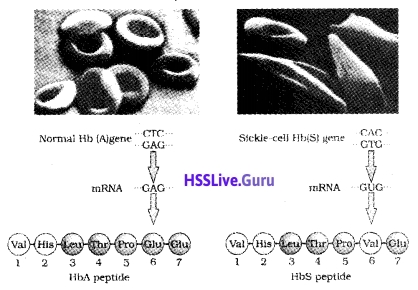
Example of point mutation is a change of single base pair in the gape for beta globin chain that results in the change of amino acid residue glutamate ‘to valine. It results sickle cell anemia.

Insertion or deletion of one or two bases, changes the reading frame from the point of insertion or deletion. Such mutations are referred to as frame-shift insertion or deletion mutations.

Plus Two Zoology Notes Chapter 4 Molecular Basis of Inheritance

2. tRNA- the Adapter Molecule:
Francis Crick proposed that an adapter molecule would bind to specific amino acids. tRNA has an anticodon loop and an amino acid accepter end to which it binds to amino acids. tRNAs are specific for each amino acid.

For initiation, there is another specific tRNA that is referred to as initiator tRNA. There are no tRNAs for stop codons.

Two-dimensional structure of tRNA looks like a clover-leaf. But in three-dimensional structure of tRNA looks like inverted L.
Plus Two Zoology Notes Chapter 4 Molecular Basis of Inheritance 15

Translation
Translation is the process of polymerisation of amino acids to form a polypeptide. The order and sequence of amino acids are defined by the sequence of bases in the mRNA. The amino acids are joined by a bond which is known as a peptide bond. Formation of a peptide bond requires energy.

The activation of amino acids with ATP and linked to tRNA- a process commonly called as charging of tRNA or aminoacylation of tRNA. If two such charged tRNAs are brought close together the peptide bond is formed.

The ribosome also acts as a catalyst (23S rRNA in bacteria is the enzyme- ribozyme) for the formation of peptide bond.

Plus Two Zoology Notes Chapter 4 Molecular Basis of Inheritance

A translational unit in mRNA is start codon (AUG) and the stop codon. mRNA also has some additional sequences that are not translated they are called as untranslated regions (UTR). The UTRs are present at both 5′-end (before start codon) and at 3′-end (after stop codon). They are required for efficient translation process.

The ribosome consists two subunits; a large subunit and a small subunit. For initiation, the ribosome binds to the mRNA at the start codon (AUG) that is recognised only by the initiator tRNA.
Plus Two Zoology Notes Chapter 4 Molecular Basis of Inheritance 16

In elongation , amino acid linked to tRNA, and bind to the codon in mRNA by forming complementary base pairs with the tRNA anticodon. The ribosome moves from codon to codon along the mRNA.

Amino acids are added one by one and translated into Polypeptide. At the end, a release factor binds to the stop codon, terminating translation and releasing the complete polypeptide from the ribosome.

Plus Two Zoology Notes Chapter 4 Molecular Basis of Inheritance

Regulation Of Gene Expression
The Lac operon:
In eukaryotes, the regulation is possible in

  1. transcriptional level (formation of primary transcript),
  2. processing level (regulation of splicing),
  3. transport of mRNA from nucleus to the cytoplasm,
  4. translational level.

For example E. coli synthesised the enzyme beta-galactosidase in the medium if the disaccharide, lactose is present.

Enzyme breakdown the lactose into galactose and glucose; the bacteria use them as a source of energy. The development and differentiation of embryo into adult organisms are also a result of the coordinated regulation of expression of several sets of genes.

In a transcription unit, the activity of RNA polymerase at a promoter is regulated by proteins. These regulatory proteins act both positively (activators) and negatively (repressors). The promoter regions of prokaryotic DNA is regulated by the interaction of adjacent operators. Each operon has its specific operator and specific repressor.

For example, lac operator is present only in the lac operon and it interacts specifically with lac repressor only.

1. The Lac operon:
The function of lac operon was first shown by Jacob and Monod.

In lac operon the structural gene is regulated by a promoter and regulatory genes. Such arrangement in bacteria is called as operon.

Other examples are trp operon, ara operon, his operon, val operon, etc.
Plus Two Zoology Notes Chapter 4 Molecular Basis of Inheritance 17

Plus Two Zoology Notes Chapter 4 Molecular Basis of Inheritance
The lac operon consists of one regulatory gene (i gene) and three structural genes (z, y, and a).

The i gene codes for the repressor of the lac operon.
The z gene codes for beta-galactosidase.
The y gene codes for permease, which increases permeability of the celt to beta galactosides.
The a gene codes for transacetylase.

Hence, all the three gene products in lac operon are required for metabolism of lactose. Lactose (inducer) is the substrate for the enzyme beta-galactosidase and it regulates switching on and off of the operon.

In the presence of an inducer, such as lactose, the repressor is inactivated by the inducer. Then RNA polymerase bind to the promoter and transcription proceeds. Regulation of lac operon by repressor is referred to as negative regulation.

Human Genome Project
This is mainly aims to find out the complete DNA sequence of human genome If two individuals differ, then their DNA sequences should also be different, at least at some places.

Human Genome Project was launched in the year 1990 (HGP). Human genome consists of approximately 3 × 10⁹ bp.

Goals of HGP
(i) Identify 20,000-25,000 genes in human DNA;
(ii) Determine the sequences of the 3 billion chemical base pairs.
(iii) Store this information in databases;
(iv) Improve tools for data analysis;
(v) Transfer related technologies to other sectors, such as industries;
(vi) Address the ethical, legal, and social issues (ELSI) that may arise from the project.

HGP was coordinated by the U.S. Department of Energy and the National Institute of Health. The project was completed in 2003.

This project also aims to solve challenges in health care, agriculture, energy production, environmental remediation.

Methodologies:
For sequencing, the total DNA from a cell is isolated and converted into random fragments of relatively smaller sizes and cloned in suitable host using vectors. The cloning resulted into amplification of each piece of DNA fragment so that it could be sequenced with ease.
Plus Two Zoology Notes Chapter 4 Molecular Basis of Inheritance 18

Plus Two Zoology Notes Chapter 4 Molecular Basis of Inheritance

The commonly used hosts are bacteria and yeast, and the vectors are called as BAC (bacterial artificial chromosomes), and YAC (yeast artificial chromosomes). The fragments are sequenced using automated DNA sequencers that was developed by Frederick Sanger.

These sequences are then arranged based on some overlapping regions present in them. Alignment of these sequences are done with computer based programs. These sequences are annotated and assigned to each chromosome. The sequence of chromosome 1 was completed only in May 2006.

Another task was the construction of genetic and physical maps on the genpme. This was made possible by knowing the polymorphism of restriction endonuclease recognition sites, and some repetitive DNA sequences.

1. Salient Features of Human Genome:

(i) The human genome contains 3164.7 million nucleotide bases.
(ii) The average gene consists of 3000 bases. The largest known human gene is dystrophin consist of 2.4 million bases.
(iii) The total number of genes is estimated at 30,000. The 99.9 per cent nucleotide bases are exactly the same in all people.
(iv) The functions are unknown for over 50 per cent of discovered genes.
(v) Less than 2 percent of the genome codes for proteins.
(vi) Repeated sequences make up very large portion of the human genome.
(vii) Repetitive sequences are stretches of DNA sequences that are repeated many times, sometimes hundred to thousand times
(viii) Chromosome 1 has most genes (2968), and the Y has the fewest (231)
(ix) Scientists have identified about 1.4 million locations where single base DNA differences (SNPs – single nucleotide polymorphism, pronounced as ‘snips’) occur in humans.

Plus Two Zoology Notes Chapter 4 Molecular Basis of Inheritance

Dna Fingerprinting
The 99.9 per cent of base sequence among humans is the same. The genetic differences between two individuals is calculated by comparing the two sets of 3 × 10⁶ base pairs.
Plus Two Zoology Notes Chapter 4 Molecular Basis of Inheritance 19
It is the identification of differences in some specific regions in DNA sequence called as repetitive DNA,
These repetitive DNA are separated from bulk genomic DNA as different pegks during density gradient centrifugation.

The bulk DNA forms a major peak and the other small peaks are referred to as satellite DNA. Depending on base composition, length of segment, and number of repetitive units, the satellite DNA is classified into many categories,

  1. Micro-satellites,
  2. Mini-satellites etc.

These sequences do not code for any proteins and show high degree of polymorphism. DNA from every tissue (such as blood, hair-follicle, skin, bone, saliva, sperm etc.), of an individual show the same degree of polymorphism, they become very useful identification tool in forensic applications.

The polymorphisms are inheritable from parents to children DNA fingerprinting is the basis of paternity testing, in case of disputes.

The polymorphism in DNA sequence is the basis of genetic mapping and DNA fingerprinting, Polymorphism arises due to mutations. Allelic sequence variation results inheritable mutation.

Such variation are observed in non coding DNA sequence. These mutations accumulating generation after generation, and form one of the basis of variability/polymorphism.

Plus Two Zoology Notes Chapter 4 Molecular Basis of Inheritance

The different types of polymorphisms ranging from single nucleotide change to very large scale changes. For evolution and speciation, such polymorphisms play very important role.

The technique of DNA Fingerprinting was initially developed by Alec Jeffreys. He used a satellite DNA as probe. It is called as Variable Number of Tandem Repeats (VNTR).

The technique, is based on Southern blot hybridisation using radiolabeled VNTR as probe.
Plus Two Zoology Notes Chapter 4 Molecular Basis of Inheritance 20
It involves

  1. isolation of DNA,
  2. digestion of DNA by restriction endonucleases,
  3. separation of DNA fragments by electrophoresis,
  4. transferring (blotting) of separated DNA fragments to synthetic membranes, such as nitrocellulose or nylon,
  5. hybridisation using labelled VNTR probe, and
  6. detection of hybridised DNA fragments by autoradiography.

The VNTR belongs mini-satellite.lt is the small DNA sequence. Its copy number varies from chromosome to chromosome in an individual. The numbers of repeat show very high degree of polymorphism.

The size of VNTR varies in size from 0.1 to 20 kb. So after hybridisation with VNTR probe, the autoradiogram gives many bands of differing sizes.

Plus Two Zoology Notes Chapter 4 Molecular Basis of Inheritance

These bands give a characteristic pattern for an individual DNA. It differs from individual to individual in a population except in the case of monozygotic (identical) twins.

Plus Two Zoology Notes Chapter 3 Principles of Inheritance and Variation

Students can Download Chapter 3 Principles of Inheritance and Variation Notes, Plus Two Zoology Notes helps you to revise the complete Kerala State Syllabus and score more marks in your examinations.

Kerala Plus Two Zoology Notes Chapter 3 Principles of Inheritance and Variation

Mendel’s Laws Of Inheritance
Gregor Mendel, conducted hybridisation experiments on garden peas and proposed the laws of inheritance in living organisms.

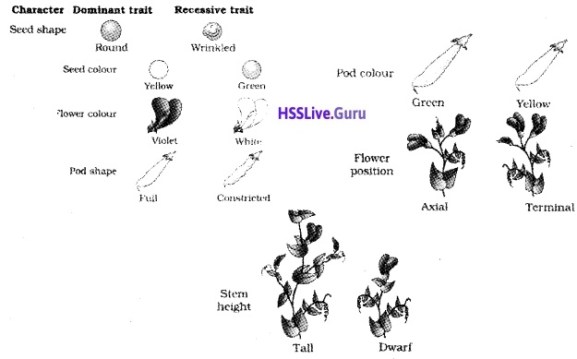
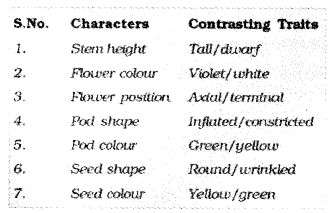
Mendel selected 14 true-breeding pea plant varieties, as pairs with contrasting traits.

Plus Two Zoology Notes Chapter 3 Principles of Inheritance and Variation 1
Plus Two Zoology Notes Chapter 3 Principles of Inheritance and Variation 2

Plus Two Zoology Notes Chapter 3 Principles of Inheritance and Variation

Inheritance Of One Gene
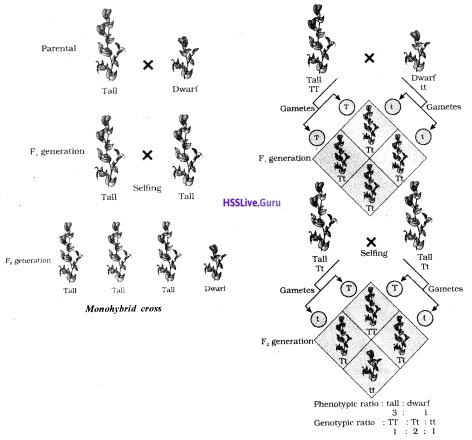
Mendel crossed tall and dwarf pea plants to study the inheritance of one gene. He collected the seeds produced as a result of this cross and grew them to generate plants of the first hybrid generation. This is called the Filial progeny or the F1.

The F1 progeny plants were tall. Mendel then self-pollinated the tall F1 plants and to raise the second Filial generation The result was that 3 tall and 1 dwarf.

Based on these observations,
Mendel proposed that ‘factors’ (genes) transmitted from parent to offspring through the gametes, over successive generations.

Genes which code for a pair of contrasting traits are known as alleles, i.e., they are alternative forms of the same gene.
Plus Two Zoology Notes Chapter 3 Principles of Inheritance and Variation 3

Plus Two Zoology Notes Chapter 3 Principles of Inheritance and Variation
Figure: A Punnett square used to understand a typical monohybrid cross conducted by Mendel between true-breeding tall plants and true-breeding dwarf plants.

According to Mendels experiment, true breeding tall are identical or homozygous TT and true breeding dwarf pea variety are also homozygous tt.

TT and tt are called the genotype of the plant while the terms tall and dwarf are the phenotype.

The production of gametes and the formation of the zygotes in the F1 and F2 plants can be understood from a diagram called Punnett Square.

The possible gametes are written on two sides, usually the top row and left columns. All possible combinations are represented in boxes below in the squares.

In the cross of tall TT(male) and dwarf tt (female) plants, the gametes produced by them are represented by T and t respectively. The all F1 is Tt progeny.

Plus Two Zoology Notes Chapter 3 Principles of Inheritance and Variation

The F1 plants of genotype Tf are self-pollinated. They produces gametes of the genotype T and fin equal proportion. When fertilisation takes place, the pollen grains of genotype T have a 50 percent chance to pollinate eggs of the genotype T, as well as of genotype t.

At F2, 3/4th of the plants are tall ,(of which 1/2 are Tt and only 1/4th are TT) and 1/4th are dwarf tt, i.e., phenotypic ratio is 3:1. and the genotypic ratio is 1 : 2 : 1.

From the Punnet square it is clearthat 1/4th of the random fertilisations lead to TT, 1/2 lead to Tt and 1/4th to tt.

For determining the genotype of a tall plant at F2, Mendel crossed the tall plant from F2 with a dwarf plant. This is called a test cross.

Diagrammatic representation of a test cross:
Plus Two Zoology Notes Chapter 3 Principles of Inheritance and Variation 4
Based on his observations on monohybrid crosses Mendel proposed two general rules first law is Law of Dominance and the Second Law or Law of Segregation.

1. Law of Dominance:

(i) Characters are controlled by discrete units called factors.
(ii) Factors occur in pairs.
(iii) In a dissimilar pair of factors one member of the pair dominates (dominant) the other (recessive).

The law of dominance explains the ratio of 3:1 in F2.

2. Law of Segregation:

According to these law the parents contain two alleles, during gamete formation, alleles of a pair segregate from each other and the gamete receives only one of the two alleles.

A homozygous parent produces all gametes that are similar while a heterozygous one produces two kinds of gametes.

Plus Two Zoology Notes Chapter 3 Principles of Inheritance and Variation

Non mendelian inheritance:
a. Incomplete Dominance:
F1 phenotype not resemble either of the two parents The inheritance of flower colour in the dog flower (snapdragon or Antirrhinum sp.) is a good example.

In a cross between true-breeding red-flowered (RR) and true breeding white-flowered plants (rr), the F1 (Rr) was pink.
Plus Two Zoology Notes Chapter 3 Principles of Inheritance and Variation 5
Plus Two Zoology Notes Chapter 3 Principles of Inheritance and Variation 6
Explanation of the concept of dominance:
Here the normal allele produces the normal enzyme that is needed for the transformation of a substrate S the modified allele is responsible for production of –

  1. the normal/less efficient enzyme, or
  2. a non-functional enzyme, or
  3. no enzyme at all

In the case(i), the modified allele is equal to the unmodified allele,
Plus Two Zoology Notes Chapter 3 Principles of Inheritance and Variation 7

Plus Two Zoology Notes Chapter 3 Principles of Inheritance and Variation
Figure: Results of monohybrid cross in the plant Snapdragon, where one allele is incompletely dominant over the other allele.

But in the case (ii) and (iii) if the allele produces a non-functional enzyme or no enzyme, the phenotype may be effected.

The unmodified (functioning) allele, which represents the original phenotype is the dominant allele and the modified allele is the recessive allele. So the recessive trait arise due to non-functional enzyme or because no enzyme is produced.

b. Co-dominance
Here F1 generation resembles both parents. A good example is different types of red blood cells that determine ABO blood grouping in human beings.

ABO blood groups are controlled by the gene I. The gene (I) has three alleles IA, IA and i. The alleles IA and IB produce a slightly different form of the sugar while allele i doesn’t produce any sugar.

So IA and IB are completely dominant over i, and when IA and i are present only IA expresses and when IB and i are present IB expresses.

when IA and IB are present together they both express their own types of sugars: this is because of codominance.Plus Two Zoology Notes Chapter 3 Principles of Inheritance and Variation 8

ABO blood grouping is a good example of multiple alleles. Here a single gene produce more than one effect.

For example, starch synthesis in pea seeds is controlled by one gene. It has two alleles (B and b). Starch is synthesised by BB homozygotes and bb homozygotes have lesser efficiency in starch synthesis.

After maturation of the seeds, BB seeds are round and the bb seeds are wrinkled. Heterozygotes produce
round seeds, and so B seems to be the dominant allele. But, the starch grains produced are of intermediate size in Bb seeds.

Plus Two Zoology Notes Chapter 3 Principles of Inheritance and Variation

Inheritance Of Two Genes
Mendel crossed pea plant seeds with yellow colour and round shape and seeds of green colour and wrinkled shape. Yellow colour was dominant over green and round shape dominant over wrinkled.

Y for dominant yellow seed colour and y for recessive green seed colour, R for round shaped seeds and r for wrinkled seed shape. The genotypes of the parents are RRYY and rryy.

The gametes RY and ry unite on fertilisation to produce the F1 hybrid RrYy. When Mendel self hybridised the F1 plants and found that the ratio in F2 is 9:3:3:1.

Plus Two Zoology Notes Chapter 3 Principles of Inheritance and Variation 9
Plus Two Zoology Notes Chapter 3 Principles of Inheritance and Variation 10
Phenotypic ratio: round yellow(9) : round green(3) : wrinkled yellow (3) : wrinkled green(1).
Figure: Result s of a dihybrid cross where the two parents differed in two pairs of contrasting traits: seed colour and seed shape.

1. Law of Independent Assortment:
Based on dihybrid crosses (crosses between plants differing in two traits) Mendel proposed Law of Independent Assortment.

The law states that when two pairs of traits are combined in a hybrid, segregation of one pair of characters is independent of the other pair of characters’.

Plus Two Zoology Notes Chapter 3 Principles of Inheritance and Variation

In the dihybrid cross the phenotypes round-yellow; Wrinkled- yellow; round- green and wrinkled- green appeared in the ratio 9:3:3:1.

The segregation of 50 percent R and 50 per cent ris independent from the segregation of 50 percent Y and 50 percent y. Therefore, 50 percent of the r bearing gamete has Y and the other 50 percent has y.

Similarly, 50 percent of the R bearing gamete has Yand the other 50 percent hasy. Thus there are four genotypes of gametes (four types of pollen and four types of eggs). The four types are RY, Ry, rY and ry.

2. Chromosomal Theory of Inheritance:
According to Mendel law, factors (genes) are discrete units, but its existence was not proved In 1900, three Scientists (de Vries, Correns and von Tschermak) independently rediscovered Mendel’s results on the inheritance of characters.

Walter Sutton and Theodore Boveri noted that the behaviour of chromosomes was parallel to the behaviour of genes and used chromosome movement to explain Mendel’s laws.

The chromosomes as well as genes occur in pairs. The two alleles of a gene pair are located on homologous sites on homologous chromosomes.
During Anaphase of meiosis I, the two chromosome pairs can align at the metaphase plate independently of each other.
So the pairing and separation of a pair of chromosomes would lead to the segregation of a pair of factors they carried.

Sutton united the chromosomal segregation with Mendelian principles and called as chromosomal theory of inheritance.

Experimental proof for the chromosomal theory of inheritance was given by Thomas Hunt Morgan and his colleagues. This led to discovery that variation occurs during sexual reproduction His studies were conducted on tiny fruit files, Drosophila melanogaster.

Plus Two Zoology Notes Chapter 3 Principles of Inheritance and Variation

They have short life cycle (two weeks), and a single mating could produce a large number j of progeny flies. The male and female flies are distinguishable and hereditary variations can be seen.

3. Linkage and Recombination:
Morgans dihybrid crosses in Drosophila reveals genes that are sex-linked.

For example yellow-bodied, white-eyed females crossed with brown-bodied, red-eyed males and intercrossed their F1 progeny. The F2 ratio was different from the expected 9:3:3:1. Because the two genes are not segregated independently located on the X same chromosome.

They found that some genes were very tightly linked (showed very low recombination), while others were loosely linked (showed higher recombination).

For example the genes for the white and yellow were very tightly linked and showed only 1.3 per cent recombination while white and miniature wing showed 37.2 per cent recombination.

Plus Two Zoology Notes Chapter 3 Principles of Inheritance and Variation 11
His student Alfred Sturtevant found that frequency of recombination between gene pairs on the same chromosome is equivalent to the distance between genes and ‘mapped’ their position on the chromosome.

Plus Two Zoology Notes Chapter 3 Principles of Inheritance and Variation

Sex Determination
Henking (1891) studied the spermatogenesis in an insects and X body. The ‘X body’ of Henking was given the name X-chromosome (sex chromosome).

Grasshopper is an example of XO type of sex determination in which the males have only one X-choromosome besides the autosomes, whereas females have a pair of X-chromosomes.

Insects and mammals including man:
XY type of sex determination is seen where both male (XY- heterogametic) and female (XX- homogametic) have same number of chromosomes. Both males and females bear same number of autosomes. i.e males have autosomes plus XY, while female have autosomes plus XX.
Plus Two Zoology Notes Chapter 3 Principles of Inheritance and Variation 12

Male heterogamety:
In XO type and XY type, males produce two different types of gametes, Such types of sex determination mechanism is seen in drosophila and human male respectively.

Female heterogamety:
In birds the total number of chromosome is same in both males and females. But females produce two types of gametes.

Female birds have one Z and one W chromosome, where as males have a pair of Z-chromosomes besides the autosomes.

Plus Two Zoology Notes Chapter 3 Principles of Inheritance and Variation

1. Sex Determination in Humans:
Out of 23 pairs of chromosomes, 22 pairs are same in both males and females; these are the autosomes. A pair of X-chromosomes are present in the female, whereas X and Y chromosome are present in males.

During spermatogenesis two types of gametes are produced of which 50 per cent carry the X- chromosome and the rest 50 per cent has Y-chromosome besides the autosomes.

Females produce only one type of ovum with an X-chromosome. In case the ovum fertilises with a sperm carrying X-chromosome the zygote develops into a female (XX) and with Y-chromosome results into a male offspring.

Thus the genetic makeup of the sperm that determines the sex of the child.

Mutation
It is the sudden change in the genetic make up of an organism. The loss (deletions) or gain (insertion/ duplication) of a segment of DNA, result in alteration in chromosomes. Alteration in chromosomes results in abnormalities or aberrations.

If the mutation also arise due to change in a single base pair of DNA. This is known as point mutation. Eg- sickle cell anemia.
Deletions and insertions of base pairs of DNA, causes frame-shift mutations.

There are many chemical and physical factors that induce mutations. They are called as mutagens. Eg- physical mutagen – UV radiations.

Plus Two Zoology Notes Chapter 3 Principles of Inheritance and Variation

Genetic Disorders
1. Pedigree Analysis:
It is the study of the family history of inheritance of a particular trait. Such an analysis of traits in a several of generations of a family is called the pedigree analysis. For this the standard symbols are used.

In human beings it helps to trace the inheritance of a specific trait, abnormality or disease. A number of disorders in human beings have been found to be associated with the inheritance of altered genes or chromosomes.
Plus Two Zoology Notes Chapter 3 Principles of Inheritance and Variation 13
Plus Two Zoology Notes Chapter 3 Principles of Inheritance and Variation 14

2. Mendelian Disorders:
Genetic disorders are classified into two categories. Mendelian disorders and Chromosomal disorders.

Mendelian disorders (dominant or recessive) arise by alteration or mutation in the single gene.
Eg-Haemophilia, Cystic, fibrosis, Sickle-cell anaemia, Ctflour blindness, Phenylketonuria, Thalesemia, etc.
The pattern of inheritance can be traced in a family by the pedigree analysis.

Haemophilia:
Haemophilia is the X-linked recessive trait that is transmitted from carrier female to male progeny in the zig-zag manner (Sex linked recessive disease) This is the bleeders disease mainly observed in family of Queen Victoria.

Plus Two Zoology Notes Chapter 3 Principles of Inheritance and Variation

In an affected individual a simple cut will result in non-stop bleeding. The heterozygous female (carrier) for haemophilia transmit the disease to sons.

Sickle-cell anaemia:
This is an autosome linked recessive trait transmitted from parents to the offspring when both the partners are carrier for the gene. The disease is controlled by a single pair of allele, HbA and HbS.

The homozygous individuals for HbS (HbSHbS) show the diseased phenotype. Heterozygous (HbAHbS) individuals are carrier of the disease.

The defect is caused by the substitution of Glutamic acid by Valine at the sixth position of the beta globin chain of the haemoglobin molecule.

It is due to the single base substitution at the sixth codon of the beta globin gene from GAG to GUG.

The mutant haemoglobin molecule under low oxygen tension causing the change in the shape of the RBC from biconcave disc to elongated sickle like structure.
Plus Two Zoology Notes Chapter 3 Principles of Inheritance and Variation 15

Phenylketonuria:
This is an autosomal recessive trait. This is due to the deficiency of enzyme that converts the amino acid
phenylalanine into tyrosine. As a result of this phenylalanine is accumulated and converted into phenylpyruvic acid.

Accumulation of these in brain results in mental retardation. These are also excreted through urine.

Plus Two Zoology Notes Chapter 3 Principles of Inheritance and Variation

3. Chromosomal disorders:
Failure of segregation or non-disjunction of chromosomes during cell division results in the gain or loss of a chromosome(s), called aneuploidy. For example

Down’s syndrome is the gain of extra copy of chromosome 21 and Turner’s syndrome is due the loss of an X chromosome in human females.

Failure of cytokinesis results in an increase in a whole set of chromosomes in an organism. This phenomenon is known as polyploidy. This is mainly seen in plants.

If an additional copy of a chromosome is added. This is called trisomy Eg- Down’s Syndrome and Klinefelter’s syndrome or lack of copy of a chromo^ome( monosomy) Eg- Turner’s syndrome.

Down’s Syndrome: (Trisomy of 21):
The affected individual is short statured with small round head, furrowed tongue and partially open mouth. Palm is broad with characteristic palm crease. Physical, psychomotor and mental development is retarded.

Plus Two Zoology Notes Chapter 3 Principles of Inheritance and Variation

Klinefelter’s Syndrome:
This is due to the trisomy of sex chromosome 44 autosomes+XXY. Individuals show feminine development i.e development of breast, i.e., Gynaecomastia Such individuals are sterile.

Turner’s Syndrome:
This is due to absence of one of the X chromosomes, i.e. 44 autosomes+ XO, Such females are sterile. The ovaries are rudimentary and lack other secondary sexual characters.

Plus Two Zoology Notes Chapter 2 Reproductive Health

Students can Download Chapter 2 Reproductive Health Notes, Plus Two Zoology Notes helps you to revise the complete Kerala State Syllabus and score more marks in your examinations.

Kerala Plus Two Zoology Notes Chapter 2 Reproductive Health

Reproductive health – problems and strategies
The Govt of India has started family planning (1951)and ‘Reproductive and Child Health Care (RCH)
programmes’ that helps
1. To create awareness among people about various reproduction related aspects.

2. Introduction of sex education in schools to avoid myths and misconceptions about sex-related aspects.

3. The information about reproductive organs, adolescence and related changes, safe and hygienic sexual practices, sexually transmitted diseases (STD), AIDS, etc., would help adolescent age group to lead a reproductively healthy life.

4. The information of available birth control options, care of pregnant mothers, post-natal care of the mother and child, importance of breastfeeding, equal opportunities for the male and the female child, etc., are the important components build up a socially responsible and healthy society.

5. The ban on amniocentesis for sex-determination helps to legally check increasing female foeticides, massive child immunisation, etc., are some programmes.

Plus Two Zoology Notes Chapter 2 Reproductive Health

Population Explosion And Birth Control
According to the census report of 2001
Plus Two Zoology Notes Chapter 2 Reproductive Health 1
Population increased due to decreased

  1. Maternal mortality rate (MMR)
  2. Infant mortality rate (IMR)

According to the 2001 census report, the population growth rate was 1.7 per cent.
Marriageable age raised to 18 years for females and 21 years for males. Government was taken measures to check this population growth rate by the contraceptive methods.

An ideal contraceptive should be user-friendly, easily available, effective and reversible with no or least side-effects.. Natural/Traditional, Barrier, lUDs, Oral contraceptives, Injectables, Implants and Surgical methods.

Natural Methods:
Periodic abstinence – Here the couples avoid or abstain from coitus from day 10 to 17 of the menstrual cycle.

Withdrawal or coitus interruptus is another method in which the male partner withdraws his penis from the vagina just before ejaculation so as to avoid insemination.

Plus Two Zoology Notes Chapter 2 Reproductive Health

Lactational amenorrhea This method is based on the fact that ovulation and therefore the cycle do not occur during the period of intense lactation following parturition. So chances of conception are almost nil.

Barrier Method:
Condoms (Nirodh’) are barriers made of thin rubber/ latex sheath that are used to cover the penis in the male or Wagina and cervix in the female, just before coitus. This can prevent conception.
Plus Two Zoology Notes Chapter 2 Reproductive Health 2
Use of condoms have additional benefit of protecting the user from STDs and AIDS. Both the male and the female condoms are disposable.

Diaphragms, cervical caps and vaults are also barriers made of rubber that are inserted into the female reproductive tract to cover the cervix during coitus. So it helps to prevent conception by blocking the entry of sperms through the cervix.
Plus Two Zoology Notes Chapter 2 Reproductive Health 3

Plus Two Zoology Notes Chapter 2 Reproductive Health

Intra Uterine Devices (lUDs):
IUDs are ideal contraceptives for the females. These devices are inserted by doctors or expert nurses in the uterus through vagina.

Two types are copper releasing lUDs (CuT, Cu7, Multiload 375) and the hormone releasing lUDs (Progestasert, LNG-20)

IUDs increase phagocytosis of sperms within the uterus and the Cu ions released suppress sperm motility and the fertilising capacity of sperms.

The hormone releasing lUDs make the uterus unsuitable for implantation It is one of most widely accepted methods of contraception in India.

Oral contraceptives(pills) contain either progestogens or progestogen-estrogen combinations.

Pills have to be taken daily for a period of 21 days starting within the first five days of menstrual cycle. After a gap of 7 days (during which menstruation occurs) it has to be repeated in the same pattern to prevent conception.

It helps to inhibit ovulation and implantation as well as to prevent entry of sperms, eg-Saheli.

Saheli-a new oral contraceptive for the females-was developed by scientists at Central Drug Research Institute (CDRI) in Lucknow.

Plus Two Zoology Notes Chapter 2 Reproductive Health

Administration of progestogens or progestogen-estrogen combinations or lUDs within 72 hours of coitus have been found to be very effective as emergency contraceptives to avoid possible pregnancy due to rape or casual unprotected intercourse.

Surgical Methods (Sterilisation):
Plus Two Zoology Notes Chapter 2 Reproductive Health 4
In male it is called ‘vasectomy’ a small part of the vas deferens is removed or tied up through a small incision on the scrotum.

In female, ‘tubectomy’ a small part of the fallopian tube is removed or tied up through a small incision in the abdomen or through vagina.

Plus Two Zoology Notes Chapter 2 Reproductive Health

Medical Termination Of Pregnancy (MTP)
Government of India legalised MTP in 1971 to avoid its misuse. So it helps to check indiscriminate and illegal female foeticides which are reported to be high in India.

It is important to avoid unwanted pregnancies either due to casual unprotected intercourse or failure of the contraceptive used during coitus or rapes.

MTPs are also essential in the cases where continuation of the pregnancy could be harmful or even fatal either to the mother or to the foetus or both.

MTPs are considered relatively safe during the first trimester, i.e., upto 12 weeks of pregnancy.

Sexually Transmitted Diseases (STDs)
Diseases or infections which are transmitted through sexual inter course are called sexually transmitted diseases (STD) or venereal diseases (VD) or reproductive tract infections (RTI).
Common STDs.

Gonorrhoea
Syphilis
Genital herpes
Chlamydiasis
Genital warts
Trichomoniasis
Hepatitis-B
AIDS

Early symptoms of most of these are minor and include itching, fluid discharge, slight pain, swellings, etc., in the genital region.

Plus Two Zoology Notes Chapter 2 Reproductive Health

Hepatitis-B and HIV are transmitted by sharing of injection needles, surgicaljnstruments, etc. with infected persons and transfusion of blood, from an infected mother to the foetus.

All diseases are completely curable except hepatitis-B, genital herpes, and HIV infections.
The important steps to control STDs are given below.

(i) Avoid sex with unknown partners / multiple partners.
(ii) Always use condoms during coitus.
(iii) In case of doubt, go to a qualified doctor for early detection and get complete treatment if diagnosed with disease.

Infertility
In the case of infertility, corrections are not possible, the couples could be assisted to have children through certain special techniques commonly known as assisted reproductive technologies (ART).

In vitro fertilisation (IVF—fertilisation outside the body in almost similar conditions as that in the body) followed by embryo transfer (ET).
In test tube baby programmeOva from the wife/donor (female) and sperms from the husband/donor (male) are collected and are induced to form zygote under simulated conditions in the laboratory.
The zygote or early embryo (with upto 8 blastomeres) is transferred into the fallopian tube (ZIFT – Zygote intra fallopian transfer) and embryos with more than 8 blastomeres, into the uterus (IUT – intra uterine transfer).
Transfer of an ovum collected from a donor into the fallopian tube (GIFT – gamete intra fallopian transfer) of another female who cannot produce one.

Plus Two Zoology Notes Chapter 2 Reproductive Health

Intra cytoplasmic sperm injection (ICS) sperm is directly injected into the ovum. It is the procedure to form an embryo in the laboratory.
Infertility cases either due to inability of the male partner to inseminate the female or due to very low sperm counts in the ejaculates, could be corrected by artificial insemination (Al) technique.
In this technique, the semen collected either from the husband or a healthy donor is artificially introduced either into the vagina or into the uterus (lUI-Intra uterine insemination) of the female.

Plus Two Zoology Notes Chapter 1 Human Reproduction

Students can Download Chapter 1 Human Reproduction Notes, Plus Two Zoology Notes helps you to revise the complete Kerala State Syllabus and score more marks in your examinations.

Kerala Plus Two Zoology Notes Chapter 1 Human Reproduction

The Male Reproductive System
It consists of
Plus Two Zoology Notes Chapter 1 Human Reproduction 1
Diagrammatic view of male reproductive system:
Plus Two Zoology Notes Chapter 1 Human Reproduction 2

Plus Two Zoology Notes Chapter 1 Human Reproduction
The testes are seen in a pouch called scrotum. It helps in maintaining the low temperature of the testes (2 – 2.5° C).

Each testis has about 250 compartments called testicular lobules. Each lobule contains one to three highly coiled seminiferous tubules in which sperms are produced.

Seminiferous tubule:
It consists of
Plus Two Zoology Notes Chapter 1 Human Reproduction 3
The male germ cells produce sperm Sertoli cells provide nutrition to the germ cells. Leydig cells secrete testicular hormones called androgens:
Plus Two Zoology Notes Chapter 1 Human Reproduction 4

Male sex accessory ducts:
It consists of
The seminiferous tubules of the testis open into rete testis
Plus Two Zoology Notes Chapter 1 Human Reproduction 5
The vasa efferentia open into epididymis. The epididymis leads to vas deferens. It receives a duct from seminal vesicle and opens into urethra as the ejaculatory duct.

Plus Two Zoology Notes Chapter 1 Human Reproduction

The urethra extends through the penis to its external opening called urethral meatus. The penis is the male external genitalia made up of special tissue that helps in erection of the penis to facilitate insemination.

The enlarged end of penis called the glans penis is covered by a loose fold of skin called foreskin.

Male accessory glands:
It consists of
Plus Two Zoology Notes Chapter 1 Human Reproduction 6
Secretions of these glands constitute the seminal plasma (fructose, calcium and certain enzymes). The secretions of bulbourethral glands helps in the lubrication of the penis.

The Female Reproductive System
It consists of

1.  A pair of ovaries
2.  A pair of oviducts
3.  Uterus
4.  Cervix
5.  Vagina
6.  External genitalia
7.  Mammary glands

Digrammatic sectional view of female reproductive system:
Plus Two Zoology Notes Chapter 1 Human Reproduction 7

Plus Two Zoology Notes Chapter 1 Human Reproduction
Ovaries (primary female sex organ) produce the female gamete (ovum) and several steroid hormones (ovarian hormones).

Each ovary is about 2 to 4 cm in length and is connected to the pelvic wall and uterus by ligaments.

Female accessory ducts:
It consists of
The oviducts (fallopian tubes – 10 – 12 cm long)
uterus
vagina
Its parts

The funnel-shaped infundibulum.
finger-like projections called fimbriae
The wider part of the oviduct called ampulla.
The last part of the oviduct isthmus joins the uterus.

The uterus opens into vagina through a narrow cervix. The cavity of the cervix is called cervical canal. The wall of the uterus has three layers of tissue.

  1. External perimetrium
  2. Middle myometrium and
  3. Inner endometrium

The endometrium undergoes cyclical changes during menstrual cycle while the myometrium exhibits strong contraction during delivery of the baby.

Plus Two Zoology Notes Chapter 1 Human Reproduction

Female external genitalia:
It consists of

  1. Mons pubis (cushion of fatty tissue covered by skin and pubic hair)
  2. Labia majora (fleshy folds of tissue extend down from the mons pubis and surround the vaginal opening)
  3. Labia minora (paired folds of tissue under the labia majora)
  4. Hymen (opening of the vagina is often covered partially by a membrane)
  5. Clitoris (tiny finger-like structure which lies above the urethral opening)

The hymen is torn during the first coitus (intercourse). Mammary glands (paired structures (breasts)). 15-20 mammary lobes containing clusters of cells called alveoli. The cells of alveoli secrete milk, which is stored in the cavities of alveoli.

Alveoli -mammary duct- mammary ampulla- lactiferous duct through which milk is sucked out.

Gametogenesis
Spermatogenesis:
Plus Two Zoology Notes Chapter 1 Human Reproduction 8
Some of the spermatogonia( diploid) called primary spermatocytes undergo meiosis. First meiotic division (reduction division) leading to formation of two equal haploid cells called secondary spermatocytes, second meiotic division produce four equal haploid spermatids.

Plus Two Zoology Notes Chapter 1 Human Reproduction

The spermatids are transformed into spermatozoa (sperms) by the process called spermiogenesis.
Plus Two Zoology Notes Chapter 1 Human Reproduction 9
After spermiogenesis, sperm heads become embedded in the Sertoli cells, and are finally released from the seminiferous tubules by the process called spermiation.
The GnRH stimulates secretion of two gonadotropins

  1. Luteinising hormone (LH)
  2. Follicle stimulating hormone (FSH).

LH acts at the Leydig cells and secrete androgens that stimulate the process of spermatogenesis. FSH acts on the Sertoli cells and stimulates secretion of some factors which help in the process of spermiogenesis.

Sperm:
Structure of sperm
It consists of

1.  Head
2.  Neck
3.  A middle piece and
4.  A tail

The sperm head is covered by a cap-like structure, acrosome (contains the enzymes that help fertilisation of the ovum).

Plus Two Zoology Notes Chapter 1 Human Reproduction

The middle piece possesses numerous mitochondria, which produce energy for the sperm motility.
Plus Two Zoology Notes Chapter 1 Human Reproduction 10
The human male ejaculates about 200 to 300 million sperms during a coitus of which 60 per cent sperms have normal shape and 40 per cent of show vigorous motility.

The Secretions of epididymis, vas deferens, seminal vesicle and prostate are essential for maturation and motility of sperms.

The seminal plasma with the sperms constitute the semen.

Oogenesis:
Oogonia are formed in embryonic stage udergores meiotic division to form primary oocytes. Primary oocyte then surrounded by a layer of granulosa cells and forms primary follicle.

Plus Two Zoology Notes Chapter 1 Human Reproduction

During puberty 60,000-80,000 primary follicles are found in each ovary. The primary follicle is surrounded by more layers of granulosa and become secondary follicles.

Spermatogenesis
Plus Two Zoology Notes Chapter 1 Human Reproduction 11
The secondary follicle become a tertiary follicle with fluid filled cavity called antrum. The primary oocyte within the tertiary follicle completes its first meiotic division( unequal division) and forms large haploid secondary oocyte and a tiny first polar body.

The tertiary follicle changes into the mature follicle or Graafian follicle.
Diagrammatic section view of ovary:
Plus Two Zoology Notes Chapter 1 Human Reproduction 12
The secondary oocyte then forms a new membrane called zona pellucida surrounding it.

The Graafian follicle ruptures to release the secondary oocyte (ovum) from the ovary by the process called ovulation.

Plus Two Zoology Notes Chapter 1 Human Reproduction

Menstrual Cycle
Diagrammatic representation of various events during a menstrual cycle:
Plus Two Zoology Notes Chapter 1 Human Reproduction 13
1. The menstrual phase:
First menstruation begins at puberty and is called menarche. In human females it is repeated at interval of about 28/29 days.

The menstrual flow is due to the breakdown of endometrial lining of the uterus and its blood vessels which forms liquid that comes out through vagina.

Menstruation only occurs if the released ovum is not fertilised. Lack of menstruation may be indicative of pregnancy.

2. The follicular phase:
During this phase, the primary follicles grows into mature Graafian follicle and endometrium of uterus regenerates through proliferation.

Plus Two Zoology Notes Chapter 1 Human Reproduction

3. The ovulatory phase:
Both LH and FSH attain a peak level in the middle of cycle (about 14th day).

4. The luteal phase:
Remaining parts of the Graafian follicle transform into corpus luteum. The corpus luteum secretes large amounts of progesterone which helps in the maintenance of the endometrium (implantation of the fertilized ovum).

In the absence of fertilisation, the corpus luteum degenerates. This causes disintegration of the endometrium leading to menstruation.In human beings, menstrual cycles ceases around 50 years of age termed as menopause.

Fertilisation And Implantation
During copulation (coitus) semen is released by the penis into the vagina (insemination).

The motile sperms reach the junction of the isthmus and ampulla (ampullary-isthmic junction) of the fallopian tube and fuses with the released ovum (fertilization) it results a diploid zygote.

Ovum surrounded by few sperms:
Plus Two Zoology Notes Chapter 1 Human Reproduction 14

During fertilisation, a sperm comes in contact with the zona pellucida layer of the ovum and induces changes in the membrane that block the entry of additional sperms.

The secretions of the acrosome help the sperm enter into the cytoplasm of the ovum through the zona pellucida and the plasma membrane. This induces the completion of the meiotic division of the secondary oocyte and forms a second polar body and a haploid ovum (ootid).

All the haploid gametes produced by the female (ova) have the sex chromosome X whereas in the male gametes (sperms) the sex chromosome could be either X or Y, hence, 50 per cent of sperms carry the X chromosome while the other 50 per cent carry the Y.

The zygote carrying XX would develop into a female baby and XY would form a male. During fertilisation, a sperm comes in contact with the zona pellucida layer of the ovum and induces changes in the membrane that block the entry of additional sperms.

Plus Two Zoology Notes Chapter 1 Human Reproduction

Transport of ovum, fertilisation and passage of growing embryo through fallopian tube:
Plus Two Zoology Notes Chapter 1 Human Reproduction 15
The secretions of the acrosome help the sperm enter into the cytoplasm of the ovum through the zona pellucida and the plasma membrane. This induces the completion of the meiotic division of the secondary oocyte and forms a second polar body and a haploid ovum (ootid).

All the haploid gametes produced by the female (ova) have the sex chromosome X whereas in the male gametes (sperms) the sex chromosome could be either X orY, hence, 50 percent of sperms carry the X chromosome while the other 50 percent carry the Y.

The zygote carrying XX would develop into a female baby and XY would form a male. The mitotic division of zygote is called cleavage and forms 2, 4, 8, 16 daughter cells called blastomeres. The embryo with 8 to 16 blastomeres is called a morula. The morula continues to divide and transforms into blastocyst then it moves into the uterus.

Plus Two Zoology Notes Chapter 1 Human Reproduction

The outer layer of blastocyst is called trophoblast and an inner group of cells called inner cell mass. The trophoblast layer gets attached to the endometrium and the inner cell mass gets differentiated as the embryo.

Later the blastocyst becomes embedded in the endometrium of the uterus. This is called implantation and it leads to pregnancy.

The milk produced during the initial few days of lactation is called colostrum which contains several antibodies provide resistance for the new-born babies.

Plus Two Botany Notes Chapter 8 Environmental Issues

Students can Download Chapter 8 Environmental Issues Notes, Plus Two Botany Notes helps you to revise the complete Kerala State Syllabus and score more marks in your examinations.

Kerala Plus Two Botany Notes Chapter 8 Environmental Issues

Air pollution
Pollutants are harmful substances that affect growth and yield of crops and cause premature death of plants. In animals they affect the respiratory system and causes diseases.

Smoke stacks of thermal power plants, smelters and other industries release particulate and gaseous air pollutants together with harmless gases, such as nitrogen, oxygen, etc.

Electrostatic precipitator:
Plus Two Botany Notes Chapter 8 Environmental Issues 1

Plus Two Botany Notes Chapter 8 Environmental Issues
These are separated using electrostatic precipitator which can remove over 99 per cent particulate matter present in the exhaust from a thermal power plant.

At high voltage the electrons produced in an instrument are attached to dust particles giving them a net negative charge. These charged dust particles are attracted by collecting plates. Then reducing the velocity of air between the plates which help the dust to fall.

Scrubber is an instrument that remove gases like sulphur dioxide present in the exhaust.
According to Central Pollution Control Board (CPCB), particulate size 2.5 micrometers or less in diameter (PM 2.5) are adversely affect the lungs followed by breathing and respiratory symptoms, irritation, inflammations and results premature death.

Automobiles are the largest source of air pollution in big cities .It is avoided by using lead-free petrol or diesel and catalytic converters, (platinum-palladium and rhodium as the catalysts) for reducing emission of poisonous gases.

The exhaust when passes through the catalytic converter, the unburnt hydrocarbons are converted into carbon dioxide and water, and carbon monoxide and nitric oxide are changed to carbon dioxide and nitrogen gas, respectively.

If once fitted the catalytic converter, there must be used unleaded petrol because lead in the petrol inactivates the catalyst.

1. Controlling Vehicular Air Pollution:
A Case Study of Delhi:
Analysis showed that in 1990s, Delhi ranked fourth among the 41 most polluted cities of the world. The serious air pollution problems in Delhi was reduced after filing public interest litigation (PIL) in the Supreme Court of India. After that Delhi govt, orderd of using compressed natural gas (CNG) in public transport, i.e., buses.

CNG is better than diesel. It bums most efficiently. CNG is cheaper than petrol or diesel and cannot be adulterated like petrol or diesel.

The supply of CNG for major distribution centres through pipelines is difficult. In the meantime Delhi govt, is also taken parallel steps for reducing vehicular pollution that is to

Plus Two Botany Notes Chapter 8 Environmental Issues
Control pollution in big cities:

  1. Avoid the use of old vehicles
  2. Use of unleaded petrol
  3. Use of low-sulphur petrol and diesel
  4. Use of catalytic converters in vehicles,
  5. Application of strict pollution level norms for vehicles, etc.

The new auto fuel policy introduced by the Government of India is to reduce the sulphur and aromatic content in petrol and diesel fuels.

Euro II norms aims that amount of sulphur to be controlled at 350 parts-per-rhillion (ppm) in diesel and 150 ppm in petrol.

The goal, according to the roadmap, is to reduce sulphur to 50 ppm in petrol and diesel and bring down the level to 35 percent. For these purpose, vehicle engines should be upgraded.

The Bharat Stage II (equivalent to Euro-ll norms) is applicable to all automobiles throughout the country from April 1, 2005.

Euro III emission specifications brought out in 11 cities from April 1, 2005and later the Euro-IV norms by April 1, 2010.

Analysis shows that, great reduction in CO2 and SO2 level in Delhi between 1997 and 2005. In India, the Air (Prevention and Control of Pollution) Act came into force in 1981, but was amended in 1987 to include noise as an air pollutant. It causes psychological and physiological disorders in humans.

The sound level above 150 dB arises due to the jet plane or rocket take off, damage ear drums and permanently impairing hearing ability. Noise also causes sleeplessness, increased heart beating and altered breathing pattern in humans.

It is necessary to reduce noise by using sound absorbing materials in industries. Govt, laws are there to reduce noise pollution around hospitals and schools by avoiding the use of air – horns, restriction in the use of loudspeakers etc.

Plus Two Botany Notes Chapter 8 Environmental Issues

Water Pollution And Its Control
To safeguard water resources, Government of India has passed the Water (Prevention and Control of Pollution) Act, 1974. It helps to maintain the water bodies clean.

1. Domestic Sewage and Industrial Effluents:
About 0.1 per cent impurities present in domestic sewage unfit for human use. Domestic sewage mainly contains biodegradable organic matter, which is decomposed by bacteria and other micro-organisms. The amount of organic matter present in sewage can be measured by Biochemical Oxygen Demand (BOD).

For the biodegradation of organic matter by micro-organisms require plenty of oxygen, it results in sharp decline in dissolved oxygen. This causes mortality of fish and other aquatic creatures.

Presence of large amounts of nutrients in waters also causes excessive growth of planktonic(free-floating) algae, called an algal bloom which gives colour to the water bodies. Algal blooms cause lose of the water quality and fish mortality. Some are toxic to human beings and animals.
Effect of sewage discharge on some important characteristics of water:
Plus Two Botany Notes Chapter 8 Environmental Issues 2
Presence of excessive nutrients cause water hyacinth (Eichhornia crassipes), to grow in plenty, it causes blocks in our waterways. These are plants of the world’s most problematic aquatic weed called Terror of Bengal’. They grow abundantly in eutrophic water bodies, and lead to an imbalance in the ecosystem of the water body.
View of algal bloom:
Plus Two Botany Notes Chapter 8 Environmental Issues 3

Plus Two Botany Notes Chapter 8 Environmental Issues

Sewage from homes and hospitals contain undesirable pathogenic microorganisms it causes outbreak of serious diseases, such as dysentery, typhoid, jaundice, cholera, etc.

Domestic sewage from industries like petroleum, paper manufacturing, metal extraction and processing, chemical manufacturing, etc. contains as mercury, cadmium, copper, lead, etc.

Clorinated toxic hydrocarbons such as DDT, BHC etc present in industrial waste waters passes through successive trophic levels of food chain and causes accumulation. This is called Biomagnification.

The concentration of DDT is increased at successive trophic levels, it starts at 0.003 ppm in water, it can ultimately can reach 25 ppm in fish-eating birds, through biomagnification.

High concentrations of DDT disturb calcium metabolism in birds, which causes the thinning of eggshell and their premature breaking, causing decrease in bird populations.

Eutrophication is the natural aging of a lake by nutrient enrichment of soil. It occurs when nitrates and phosphates reaches water bodies by run off water.
Biomagnification of DDT in aquatic food chain:
Plus Two Botany Notes Chapter 8 Environmental Issues 4
Pollutants from man’s activities like effluents from the industries and homes can accelerate the aging process. This phenomenon is called Cultural or Accelerated Eutrophication. It causes depleting oxygen content of water and results the death of fish and other aquatic organisms.

Heated (thermal) wastewaters from thermal power plants destroy the growth of aquatic organisms. But it promote the growth of aquatic organisms in cold waters.

Plus Two Botany Notes Chapter 8 Environmental Issues

2. A Case Study of Integrated Waste Water Treatment:
An example of such an initiative was put into practice at the town of Areata, situated along the northern coast of California. Biologists from the Humboldt State University, and the townspeople created an integrated water treatment process within a natural system.
The cleaning occurs in two stages-

(a) The conventional sedimentation, filtering and chlorine treatments. After this stage, lots of dangerous pollutants like dissolved heavy metals are there.
(b) The biologists developed a series of six connected marshes over 60 hectares of
marshland. Appropriate plants, algae, fungi and bacteria were seeded into this area, which neutralise, absorb and assimilate the pollutants. Hence, as the water flows through the marshes, it gets purified naturally. The marshes of Arcta rich in biodiversity especially fishes, animals and birds. So the Friends of the Areata Marsh (FOAM) were responsible for safeguarding of this wonderful project.

Ecological sanitation:
It is a sustainable system for handling human excreta, using dry composting toilets. This is a practical, hygienic, efficient and cost-effective solution to human waste disposal.

Here human excreta is recycled and reduces the need for chemical fertilisers. This is the basis of ‘EcoSan’ toilets in many areas of Kerala and Sri Lanka.

Plus Two Botany Notes Chapter 8 Environmental Issues

Solid Wastes
Solid wastes especially municipal solid wastes are wastes from homes, offices, stores, schools, hospitals, etc. contain, comprise paper, food wastes, plastics, glass, metals,rubber, leather, textile, etc. These are subjected to Sanitary landfills in which wastes are dumped in a depression after packed and covered with dirt everyday because burning is not practicable.

In metros Landfills are not really a good solution since the amount of garbage generation increased largely that these sites are getting filled too. Also there is danger of seepage of chemicals, etc., from these landfills polluting the underground water resources.

All wastes are categorised into three types –
(a) bio-degradable, (b) recyclable and (c) the non-biodegradable

Kabadiwallahs and rag-pickers doing the of separation of materials for recycling. The biodegradable materials are put into deep pits in the ground for natural breakdown.

State Governments had decided to reduce the use of plastics and use of eco-friendly packaging. It is done by use of natural fibre carry-bags and avoid polythene bags.

1. Case Study of Remedy for Plastic Waste:
A plastic sack manufacturer Ahmed Khan in Bangalore has found a solution for problem of accumulating plastic waste. About 8 years ago, in collaboration with R. V. College of Engineering and the Bangalore City Corporation, he realised that the

Plus Two Botany Notes Chapter 8 Environmental Issues

Polyblend, a fine powder of recycled modified plastic, is mixed with the bitumen that is used to lay roads.

Bitumen is a water repellant substance helps to increase road life. The raw material for creating Polyblend is any plastic film waste that brought about by rag pickers.

Incinerators are used to remove the wastes from hospitals, it contain disinfectants and other harmful chemicals, and also pathogenic micro-organisms.

Electronic wastes (e-wastes) mainly contains irreparable computers and other electronic goods. It is generated in the developed world and are exported to developing countries, mainly to China, India and Pakistan where metals like copper, iron, silicon, nickel and gold are recovered during recycling process. In developing countries, during the recycling process workers are exposed to toxic substances.

So recycling is the only solution for the treatment of e-wastes. it is carried out in an environment-friendly manner.

Agro-chemicals And Their Effects
In the period of green revolution use of inorganic fertilizers, pesticides, herbicides, fungicides, etc. has increased crop production manifold. These chemical substances are toxic to other micro organisms in the soil and affect the terrestrial ecosystems. It also adversely affects the aquatic ecosystem and result the eutrophication of water bodies.

1. Case Study of Organic Farming:
Ramesh Chandra Dagar, a farmer in Sonipat, Haryana, in his agriculture land, he included

  • Bee-keeping
  • Dairy management
  • Water harvesting, and
  • Composting as a chain of processes, which support each other.

It is an example of sustainable agricultural method. There is no need to use chemical fertilisers for crops, as cattle excreta (dung) are used as manure. Crop waste is used to create compost, which can be used as a natural fertiliser or can be used to generate natural gas for satisfying the energy needs of the farm.

Plus Two Botany Notes Chapter 8 Environmental Issues

Radio Active Wastes
Nuclear energy is useful in many ways especially to generate electricity. But the disasters that occurred as accidental leakage in the Three Mile Island and Chernobyl incident and safe disposal of radioactive wastes are the main problems.

It was also realised that nuclear energy radiation is damaging to biological organisms, because it causes mutations. At high doses, nuclear radiation is lethal but at lower doses, it creates various disorders and cancer. Storage of nuclear waste must done in shielded containers buried within the rocks, about 500 m deep below the earth’s surface.

Greenhouse Effect And Global Warming
The term ‘Greenhouse effect’ has been derived from a phenomenon that occurs in a greenhouse. It looks like a small glass house and is used for growing plants especially during winter. It does not allow heat to escape.

The greenhouse effect is a naturally occurring phenomenon that is responsible for heating of Earth’s surface and atmosphere. If greenhouse effect is not there, the average temperature at surface of Earth would have been -18°C rather than the present average of 15°C.
Plus Two Botany Notes Chapter 8 Environmental Issues 5

Plus Two Botany Notes Chapter 8 Environmental Issues
The incoming raditions of sunlight reaches the earth’s surface re-emits heat in the form of infrared radiation but part of this does not escape into space as atmospheric gases (e.g., carbon dioxide, methane, CFC and nitrogen oxides) absorb a major fraction of it.

The molecules of these gases radiate heat energy, and a major part of which again comes to Earth’s surface, thus heating it up once again This cycle is repeated many a times. This leading to global warming.

During the past century, the temperature of Earth has increased by 0.6° C. This rise in temperature leads to the occurance of El Nino effect that is the melting of polar ice caps and Himalayan snow caps. It causes rise in sea level and submerge many coastal areas.

To reduce the emission of green house gases it is necessary to

  1. Cutting down use of fossil fuel
  2. Improving efficiency of energy usage
  3. Reducing deforestation
  4. Planting trees and slowing down the growth of human population.

Ozone Depletion In The Stratosphere
There are two type of ozone that is ‘bad’ ozone, formed in the lower atmosphere (troposphere) that harms plants and animals. ‘Good’ ozone- this ozone is found in the upper part of the atmosphere (stratosphere), and it acts as a shield and absorbing ultraviolet radiation from the sun.

UV rays are harmful to living organisms since DNA and proteins of living organisms absorb it, and breaks the high energy chemical bonds within these molecules.

The thickness of the ozone in a column of air from the ground to the top of the atmosphere is measured in terms of Dobson units (DU).
Ozone hole in antartica area It is measured by Dobson unit:
Plus Two Botany Notes Chapter 8 Environmental Issues 6

Plus Two Botany Notes Chapter 8 Environmental Issues
Ozone gas is continuously formed by the action of UV rays on molecular oxygen, and also degraded into molecular oxygen in the stratosphere.

The balance between production and degradation of ozone in the stratosphere is disrupted due to
chlorofluorocarbons (CFCs).

The CFC produced in the upper part of the atmosphere is degraded by the action of UV. It splits and release active clorine. This active clorine destroys ozone and makes holes.

It was first noticed in Antarctic region.

UV-B and UV-C causes DNA damage and mutation. It causes aging of skin, damage to skin cells and various types of skin cancers. In human eye, cornea absorbs UV-B radiation and causes inflammation of cornea, called snow-blindness, cataract, etc.

To reduce the emission of CFCs and other ozone depleting chemicals, an international treaty was formed known as the Montreal Protocol, signed at Montreal (Canada) in 1987.

Plus Two Botany Notes Chapter 8 Environmental Issues

Degradation By Improper Resource Utilisation And Maintenance
The important improper resource utilisation practices are
(1) Soil erosion and desertification:
The fertility of top-soil is lost due to over-cultivation, unrestricted grazing, deforestation and poor irrigation practices, resulting in arid patches of land. It result in the creation of desert.

(2) Waterlogging and soil salinity:
Irrigation without proper drainage of water leads to waterlogging in the soil. It also causes the deposition of salts on the land surface or starts collecting at the roots of the plants. This increased salt content and reduce the growth of crops and damaging to agriculture.

Deforestation

At the beginning of the twentieth century, forests covered about 30 per cent of the land of India. By the end of the century, it shrunk to 19.4 per cent, whereas the National Forest Policy (1988) of India has recommended 33 per cent forest cover for the plains and 67 per cent for the hills.

Deforestation occurs due to growing human population for timber, firewood, and several other purposes. Slash and burn agriculture, commonly called as Jhum cultivation in the north-eastern states of India, has also contributed to deforestation.

The ash is used as a fertiliser and the land is then used for farming or cattle grazing. The farmers then move on to other areas and repeat this process.
The consequences of deforestation are

  1. Increased carbon dioxide concentration in the atmosphere
  2. Loss of biodiversity due to habitat destruction
  3. Disturbs hydrologic cycle
  4. Causes soil erosion, and lead to desertification

Reforestation is the process of restoring a forest that once existed but was removed.

Plus Two Botany Notes Chapter 8 Environmental Issues

1. Case Study of People’s Participation in Conservation of Forests:
In 1731, the king of Jodhpur in Rajasthan asked one of his ministers to arrange wood for constructing a new palace. The minister and workers went to a forest near a village, inhabited by Bishnois, to cut down trees. Bishnois are opposed the act of ministers. Of which Amrita Devi-.her three daughters and hundreds of other Bishnois followed her, and thus lost their lives saving trees.

The Government of India has recently established the Amrita Devi Bishnoi Wildlife Protection Award for individuals or communities from rural areas that have shown extraordinary courage and dedication in protecting wildlife.

Another movement started at Garhwal Himalaya in 1974 was – Chipko Movement, here local women showed enormous bravery in protecting trees from the axe of contractors.

In 1980s Government of India has introduced the concept of Joint Forest Management (JFM) this is helpful to local communities for getting benefit of various forest products (e.g., fruits, gum, rubber, medicine, etc.) and thus the forest can be conserved in a sustainable manner.

Plus Two Botany Notes Chapter 7 Ecosystem

Students can Download Chapter 7 Ecosystem Notes, Plus Two Botany Notes helps you to revise the complete Kerala State Syllabus and score more marks in your examinations.

Kerala Plus Two Botany Notes Chapter 7 Ecosystem

Ecosystem – structure And Function
Interaction of biotic and abiotic components form the physical structure that is characteristic for each type of ecosystem. Different types of plant and animal species of an ecosystem gives its species composition. Life of species occupying different strata is called stratification For example, trees occupy top vertical strata of a forest, shrubs and herbs and grasses occupy the bottom layers.

The components of the ecosystem are seen to function as a unit, they are
(i) Productivity; (ii) Decomposition; (iii) Energy flow; and (iv) Nutrient cycling.

Plus Two Botany Notes Chapter 7 Ecosystem

Productivity
The primary energy source for functioning of an ecosystem is solar energy.

The amount of food energy produced by a particular trophic level per unit area in a time or rate of biomass production is called productivity.

It is highest in a coral reef of aquatic ecosystems and in tropical rain forest of terrestrial ecosystems
Productivity is of two types

(a) Primary productivity:
It refers to the productivity at producer level. It is divided into two

  1. Gross primary productivity – It refers to total photosynthesis i.e total amount of food formed by the producers
  2. Net primary productivity – It refers to gross production minus losses by respiration and decomposition.

Plus Two Botany Notes Chapter 7 Ecosystem 1

(b) Secondary productivity:
It is defined as the rate of formation of new organic matter by consumers. The annual net primary productivity of the whole biosphere is approximately 170 billion tons (dry weight) of organic matter.

Plus Two Botany Notes Chapter 7 Ecosystem

Decomposition

Decomposition is the process by which complex organic compounds are broken into simpler and inorganic substances.

Decomposition is a complex process of enzymatic reaction and involves the step-wise degradation of detritus (dead organic matter and excreta of animals and plants). It involves following processes.

Fragmentation of detritus:
Leaching:
It is process by which simple and water soluble compounds like simple sugars and inorganic nutrients move downward along with percolating gravitational water.

Catabolism:
It is the enzymatic break down of organic compound.

Humification:
It is process by which simplified detritus is changed into dark coloured amorphous substance called humus.

Mineralisation:
It involves the release of inorganic subtances (Water, C02, etc) and other nutrients (NH4+, Ca++, Mg++, K+, etc.) in the soil.
Decomposition cycle in terrestrial ecosystem:
Plus Two Botany Notes Chapter 7 Ecosystem 2
Decomposition is largely an oxygen-requiring process. The rate of decomposition is controlled by chemical composition of detritus and climatic factors.

Decomposition rate is slower if detritus is rich in lignin and chitin, and quicker, if detritus is rich in nitrogen and water-soluble substances like sugars.
Warm and moist environment favour decomposition whereas low temperature and anaerobic condition inhibit decomposition and accumulation of organic materials.

Plus Two Botany Notes Chapter 7 Ecosystem

Energy flow
Of the incident solar radiation less than 50 percent of it is photosynthetically active radiation (PAR). Plants capture only 2-10 percent of the PAR. solar energy captured by plants flows through different organisms of an ecosystem.

Energy flow is the key function of an ecosystem. It is determined by two basic laws of thermodynamics.

First law of thermodynamics states that energy is neither created nor destroyed, but can betransffered from one component to another, or transformed from one state to another.

Second law of thermodynamics states that every energy transformation involves degradation or dissipation of energy from a concentrated to a dispersed form due to metabolic functions. Dissipation of energy occures as heat. The remaining energy used in the synthesis of plant biomass.

Producers in a terrestrial ecosystem, include herbaceous and woody plants and an aquatic ecosystem are species like phytoplankton, algae, and higher plants. The energy trapped by the producer is passed on to a consumer.

They are hence called consumers. If animals feed on the producers, they are called primary consumers (herbivores.), and if the animals eat other animals which in turn eat the plants they are called secondary consumers.

The consumers that feed on these herbivores are carnivores, i.e primary carnivores Those animals that depend on the primary carnivores for food are called as secondary carnivores.
A simple grazing food chain (GFC) is depicted below:
Plus Two Botany Notes Chapter 7 Ecosystem 3
The detritus food chain (DFC) begins with dead organic matter. It is made up of decomposers which are heterotrophic organisms, mainly fungi, and bacteria. They get energy from dead organic matter or detritus. These are also known as saprotrophs.

Plus Two Botany Notes Chapter 7 Ecosystem

In an aquatic ecosystem, energy flow occurs through GFC. In a terrestrial ecosystem, a much larger fraction of energy flows through the detritus food chain than through the GFC.

Detritus food chain is connected with the grazing food chain at some levels: some animals in an ecosystem are Omnivores, eg-cockroaches, crows, etc. These natural interconnections of food chains make it a food web.
Trophic levels in an ecosystem:
Plus Two Botany Notes Chapter 7 Ecosystem 4
The different steps of food chain is known as trophic level. Producers belong to the first trophic level, herbivores (primary consumer) to the second and carnivores (secondary consumer) to the third. The amount of energy decreases at successive trophic levels. Detritus or dead biomass that serves as an energy source for decomposers.

Each trophic level has a certain mass of living material at a particular time called as the standing crop. The standing crop is measured as the mass of living organisms (biomass).
In food chain the energy transfer from one trophic level to the next is 10%.

Plus Two Botany Notes Chapter 7 Ecosystem

Energy flow through different trophic levels:
Plus Two Botany Notes Chapter 7 Ecosystem 5

Ecological pyramids
An ecological pyramid is a graphical representation of an ecological parameter, like number or biomass or accumulated energy at different trophic levels in a food chain in as ecosystem.
The three ecological pyramids are

(a) pyramid of number; (b) pyramid of biomass and (c) pyramid of energy.

The idea of ecological pyramids was developed by Charles Elton. An ecological pyramid may be upright (taping towards the tip) or inverted (widens towards the tip).
Plus Two Botany Notes Chapter 7 Ecosystem 6

Plus Two Botany Notes Chapter 7 Ecosystem
The base of each pyramid represents the producers or the first trophic level while the apex represents tertiary or top level consumer.

In most ecosystems, all the pyramids, of number, of energy, and biomass are upright, i.e., producers are more in number and biomass than the herbivores, and herbivores are more in number and biomass than the carnivores. Also energy at a lower trophic level is always more than at a higher level.

The pyramid of biomass in sea is inverted because the biomass of fishes is more than Phytoplankton.
Pyramid of energy is always upright, because energy level decreases in successive trophic level some energy is always lost as heat at each step.

Ecological Succession
The successive replacement of biotic communities in an area over a period of time is known as ecological or biotic succession.

The first community to inhabit area is called pioneer community while the last and stable community in an area is called climax community. The intermediate communities between the pioneer and climax communities are called transitional or serai communities.

Basic types of succession:
Primary succession:
Primary succession which starts from the primitive substratum, where there was no previously any sort of living matter e.g. land formed by volcanic lava, development of forest climax on a barren land may take about 1,000 years.

Secondary Succession:
Secondary succession which starts from previously built up substrata with already existing living matter. Such areas include burned or cut forests, flooded lands, etc. such successions are comparatively more rapid. Time taken is about 50 – 100 years in case of a grassland and about 100 – 200 years for a forest.

1. Succession of Plants:
Depending mainly upon the nature of the environment succession is of two types hydrarch-starting in regions where water is in plenty, xerarch- where moisture is present in minimal amounts such as dry deserts, rocks, etc.

If succession occurs in medium water conditions, they are called mesarch.

Plus Two Botany Notes Chapter 7 Ecosystem

Xerarch
It involves the ecological succession on bare rock surfaces.
The various stages in the ecological succession in a xerarch are
(1) Crustose lichens stage – It forms the poineer community in a lithosere and is represented by lichen species.
These produce organic acids which cause weathering of rocks.
(2) Foliose lichens stage – It includes the lichens with leafy thalli.
(3) Moss stage – It is characterised by growth of mosses
(4) Herbs stage – short plant with soft stem
(5) Shrub stage – medium sized plant with soft stem
(6) Forest stage – It is the climax community depends upon the nature of climate eg a rain forest in a moist tropical area; a coniferrous forest or deciduous forest in temperature
area; a grassland in area with less rainfall etc.

Hydrarch:
It involves the ecological succession in the newly formed pond or lake.
Plus Two Botany Notes Chapter 7 Ecosystem 7

Plus Two Botany Notes Chapter 7 Ecosystem

(a) phytoplankton stage.
(b) Submerged plant stage. Hydrilla, Vallisneria, Utricularia
(c) Submerged free floating plant Stage -It includes nymphaea.nelumbium, etc.
(d) Reed swamp stage. It is also called amphibious stage It includes the plant species like sagittaria, Typha etc.
(f) Marsh – meadow stage. It is mainly formed of plant species like Carex (sedge). They form a mat-like vegetation towards the centre of the pond
(g) Scrub stage. In this stage the area is invaded by some shrubby plants which can tolerate bright sunlight as well as waterlogged conditions
(h) Forest stage. It is the climax community

Nutrient Cycling

The amount of nutrients, such as carbon, nitrogen, phosphorus, calcium, etc. present in the soil at any given time, is referred to as the standing state.

It varies in different kinds of ecosystems. Nutrients are continuously exchanged between organisms and their physical environment. These exchanges are called nutrient cycling / biogeochemical cycles.
Nutrient cycles are of two types:

  1. gaseous and
  2. sedimentary

Cycles of gaseous matter are called gaseous cycles. The reservoir of gaseous matter is atmosphere, (e.g.,
nitrogen, carbon cycle).

Cycles of mineral matter are called Sedimentary cycles. The reservoir of mineral matter is lithosphere, (e.g., sulphur and phosphorus cycle.)

1. Ecosystem – Carbon Cycle:
Carbon cycling occurs through atmosphere, ocean and through living and dead organisms. The amount of carbon fixed in the biosphere through photosynthesis annually is 4 × 10¹³ kg. Decomposition of dead organic matter and fossil fuel, through respiratory activities, burning of wood, forest fire, deforestation and volcanic activity releasing CO2 in the atmosphere.
Carbon cycle in biosphere:
Plus Two Botany Notes Chapter 7 Ecosystem 8

2. Ecosystem – Phosphorus Cycle:
Phosphorus is a major component of biological membranes, nucleic acids, and cellular energy transfer systems. The natural reservoir of phosphorus is rock, which contains phosphorus in the form of phosphates.

When rocks are weathered, minute amounts of these phosphates dissolve in soil solution and are absorbed by the roots of the plants. The waste products and the dead organisms are decomposed by phosphate-solubilising bacteria releasing phosphorus.

Plus Two Botany Notes Chapter 7 Ecosystem

Ecosystem Services
The products of ecosystem processes are named as ecosystem services, for example,

healthy forest ecosystems purify air and water, mitigate droughts and floods, cycle nutrients, generate fertile soils, provide wildlife habitat, maintain biodiversity, pollinate crops, provide storage site for carbon and also provide aesthetic, cultural and spiritual values.

Robert Constanza and his colleagues have very recently tried to put price tags on nature’s life-support services. Researchers have put an average price tag of US $ 33 trillion a year on these fundamental ecosystems services. It is nearly twice the value of the global gross national product GNP which is US $ 18 trillion. Out of the total cost of various ecosystem services.

The soil formation accounts for about 60 per cent, and contributions of other services like recreation and nutrient cycling, are less than 10 per cent each. The cost of climate regulation and habitat for wildlife are about 6 per cent each.