Plus Two Botany Notes Chapter 6 Organisms and Populations

Students can Download Chapter 6 Organisms and Populations Notes, Plus Two Botany Notes helps you to revise the complete Kerala State Syllabus and score more marks in your examinations.

Kerala Plus Two Botany Notes Chapter 6 Organisms and Populations

Organism And Its Environment

The annual variations in the intensity and duration of temperature, resulting in distinct seasons. These variations together with annual variation in precipitation (precipitation includes both rain and snow) responsible for the formation of major biomes such as desert, rain forest and tundra.

Regional and local variations within each biome lead to the formation of a wide variety of habitats.
Plus Two Botany Notes Chapter 6 Organisms and Populations 1
Plus Two Botany Notes Chapter 6 Organisms and Populations 2

Plus Two Botany Notes Chapter 6 Organisms and Populations
The existence of life not only in favourable habitat but it occurs in scorching Rajasthan desert, rain-soaked Meghalaya forests, deep ocean trenches, torrential streams, permafrost polar regions, high mountain tops, boiling thermal springs, and stinking compost pits.

1. Major Abiotic Factors:
Temperature:
The average temperature on land varies seasonally, it decreases from the equator towards the poles and from plains to the mountain tops. It ranges from minus degree Celsius in polar areas and high altitudes to more than 50°C in tropical deserts in summer.

It is clear that mango trees cannot grow in temperate countries like Canada and Germany, and the snow leopards are not found in Kerala forests.

Actually temperature affects the kinetics of enzymes which influence the basal metabolism, activity and other physiological functions of the organism.

A few organisms can tolerate and thrive in a wide range of temperatures they are called eurythermal, but majority of them are restricted to a narrow range of temperatures they are called stenothermal.

Water:
The productivity and distribution of plants is dependent on water. For aquatic organisms the quality (chemical composition, pH) of water is important.

The salt concentration (salinity in parts per thousand), is less than 5 per cent in inland waters, 30 – 35 per cent the sea and > 100 per cent in some hypersaline lagoons.

Some organisms can tolerate wide range of salinities, they are called euryhaline but others are restricted to a narrow range they are called stenohaline.

Freshwater animals cannot live for long in sea water and vice versa because of the osmotic problems.

Plus Two Botany Notes Chapter 6 Organisms and Populations

Light:
It is an important factor for photosynthesis.

Small plants (herbs and shrubs) growing in forests are adapted to photosynthesise under very low light conditions because of tall canopied trees. Many plants require sunlight for the initiation of photoperiodic flowering.

Animals require the diurnal and seasonal variations in light intensity and duration (photoperiod) fortiming their foraging, reproductive, and migratory activities. The spectral quality of solar radiation is important for life.

The UV component of the spectrum is harmful to many organisms while other colour components of the visible spectrum are important for marine plants living at different depths of the ocean.

Soil:
The nature and properties of soil dependent on the climate and the weathering process. The characteristics of the soil determine the water holding capacity.

These characteristics, pH, mineral composition, and topography determine the vegetation in any area. In the aquatic environment, the sediment-characteristics determine the type of benthic animals in ocean.

2. Responses to Abiotic Factors:
During the course of millions of years many species would have evolved constant internal (within the body) environment that permits maximum efficiency of biochemical reactions and physiological functions that results overall ‘fitness’ of the species.

Some organism maintain the constant internal environment when the external environmental conditions changes it is called homeostasis.

A person is able to do his/her work in temperature is 25°C when it is extremely hot or cold outside. It could be achieved at home, in the car while travelling, and at workplace by using an air conditioner in summer and heater in winter. Here the person’s homeostasis is maintained by artificial means.
Plus Two Botany Notes Chapter 6 Organisms and Populations 3

Plus Two Botany Notes Chapter 6 Organisms and Populations

How do other living organisms cope with the situation?
(i) Regulate:
Some organisms maintain their homeostasis by keeping up constant body temperature, constant osmotic concentration, etc.

Birds, mammals, and some lower vertebrate and invertebrate species are capable of such regulation i.e thermoregulation and osmoregulation. This is the characteristics of mammals to live in Antarctica or in the Sahara desert.

In summer season body of man sweat, it provide cooling effect. In Winter season, vyhen the temperature is much lower than 37°C, man start to shiver, a kind of exercise which produces heat and raises the body temperature. Plants do not have such mechanisms to maintain internal temperatures.

(ii) Conform:
Majority of animals and all plants cannot maintain a constant internal environment.

Thermoregulation is energetically expensive for many organisms. This is true for small animals like shrews and humming birds. Small animals have a larger surface area relative to their volume, they tend to lose body heat very fast when it is cold outside; so they have to spend much energy to generate body heat through metabolism. That is why very small animals are rarely found in polar regions.

If the stressful external conditions are remain only for a short duration, the organism has two other alternatives.

(iii) Migrate:
The organism move temporarily from the stressful habitat to a more favourable area and return when stressful period is over. Some persons moving from Delhi to Shimla in summer season. During winter some birds from Siberia and other extremely cold northern regions migrate to Keolado National Park (Bhartpur) in Rajasthan.

(iv) Suspend:
In bacteria, fungi and lower plants produce thick walled spores during unfavourable Conditions. They germinate in suitable environment.

In higher plants the seeds and vegetative reproductive structures are dormant during adverse condition and germinate after getting favourable moisture and temperature.

In animals, especially bears go into hibernation during winter. Some snails and fish go into aestivation to avoid summer. Under unfavourable conditions many zooplankton species in lakes and ponds are subject to diapause, a stage of suspended development.

Plus Two Botany Notes Chapter 6 Organisms and Populations

3. Adaptations:
Some organisms are subjected to physiological and behavioural adjustments. These responses are called adaptations Kangaroo rat in North American deserts is capable of meeting all its water requirements through its internal fat oxidation. It has the ability to concentrate its urine.

Desert plants have a thick cuticle on their leaf surfaces and stomata arranged in deep pits to minimise water loss through transpiration. They also have CAM pathway in which they open stomata during night and closed during day time.

Opuntia, their leaves are reduced to spines and the flattened stems do photosynthesis. Mammals of colder climates have shorter ears and limbs to minimise heat loss. This is an Allen’s Rule In the polar seas aquatic mammals like seals have a thick layer of fat (blubber) below their skin that acts as an insulator and reduces loss of body heat.

In high altitude, some organism feels altitude sicknes due to low atmospheric pressure and low 02. Its symptoms include nausea, fatigue, and heart diseases. But, gradually get adapted and stop experiencing altitude sickness by increasing red blood cell production, decreasing the binding capacity of hemoglobin and by increasing breathing rate.eg- Many tribes live in the high altitude of Himalayas.

Archaebacteria seen in hot springs and deep sea hydrothermal vents where temperature is more than 1000°C.

Many fish thrive in Antarctic waters where the temperature is below 0°c. A large variety of marine invertebrates and fish live at great depths in the ocean where the pressure could be > 100 times the normal atmospheric pressure.

Desert lizards keep their body temperature constant by behavioural means. They bask in the sun and absorb heat when their body temperature drops, but move into shade when the surrounding temperature starts increasing.

Some species are capable of burrowing into the soil to escape from the above-ground heat.

Plus Two Botany Notes Chapter 6 Organisms and Populations

Populations
1. Population Attributes:
Population has birth rates and death rates. The rates are expressed as the change in numbers with respect to the members of the population. If in a pond there are 20 lotus plants last year and through reproduction 8 new plants are added, so the current population is 28, birth rate is 8/20 = 0.4 offspring per lotus per year.

If 4 individuals in a laboratory population of 40 fruit flies died in a week, the death rate in the population during that period is 4/40 = 0.1 individuals per fruit fly per week.

Another attribute of a population is sex ratio. A population at any given time is composed of individuals of different ages. If the age distribution is plotted for the population, the resulting structure is called an age pyramid.
Plus Two Botany Notes Chapter 6 Organisms and Populations 4
The shape of the pyramid indicates the growth status of the population i.e

  1. growing,
  2. stable and
  3. declining.

Another important attribute of population is population Representation of age pyramids for human population density (designated as N) Total number is the measure of population density, it is difficult to determine if the counting is impossible.

In an area, if there are 200 Parthenium plants but only a single huge banyan tree with a large canopy, the population density of banyan is low when compared to that of Parthenium. In such cases, the per cent cover or biomass is the measure of the population size.

Number of fish caught pertrap is good measure of its total population density in the lake. The tiger census in our national parks and tiger reserves is based on pug marks and fecai pellets.

2. Population Growth:
Changes in population density that determined by four basic processes, natality, immigration mortality, and emigration.
Plus Two Botany Notes Chapter 6 Organisms and Populations 5

Plus Two Botany Notes Chapter 6 Organisms and Populations

  1. Natality refers to the number of births during a given period
  2. Mortality is the number of deaths in the population during a given period.
  3. Immigration is the movement of individuals into the population
  4. Emigration is the movement of individuals out of the population.

N is the population density at time t, then its density at time t + 1 is
Nt + 1 =Nt + [(B + I) – (D + E)]
Population density increase if the number of births plus the number of immigrants (B + I) is more than the number of deaths plus the number of emigrants (D + E).

If a new habitat is just being colonised, immigration contribute to population growth than birth rates.

Growth Models:
(i) Exponential growth:
When the resources in the habitat are unlimited, each species has the ability to grow in number. Here the population grows in an exponential or geometric fashion.
Plus Two Botany Notes Chapter 6 Organisms and Populations 6
Population growth curve a when responses are not limiting the growth, plot Is exponential, b when responses are limiting the growth, plot is logistic, K ts carrying capacity

If in a population of size N, the birth rates are represented as b and death rates as d, then the increase or decrease in N during a unit time period t (dN/dt) will be

dN/dt = (b – d) × N (b – d) = r, then dN/dt = rN

r is called the ‘intrinsic rate of natural increase’it is important for assessing impacts of any biotic or abiotic factor on population growth.

Plus Two Botany Notes Chapter 6 Organisms and Populations

The above equation shows the exponential or geometric growth and results J-shaped curve The integral form of the exponential growth equation as
Plus Two Botany Notes Chapter 6 Organisms and Populations 9

Nt = Population density after time t, N0 = Population density at time zero, r = intrinsic rate of natural increase, e = the base of natural logarithms (2.71828).

(ii) Logistic growth:
Limited resources leads to competition between individuals and the ‘fittest’ individual will survive and reproduce. Governments of many countries introduced restraints to limit human population growth.

In nature, a given habitat has resources to support a maximum possible number, beyond which no further growth is possible. This is called as nature’s carrying capacity (K) for that species in that habitat.

So the population growth in limited resources show initially a lag phase, followed by phases of acceleration and deceleration and finally an stationary phase, and the population density reaches the carrying capacity.

A plot of N in relation to time (t) results in a sigmoid curve. This type of population growth is called Verhulst-Pearl Logistic Growth equation. It is represented by
dN/dt = rN\(\frac{(K-N)}{K}\)
Where N = Population density at time t
r = Intrinsic rate of natural increase
K= Carrying capacity

3. Life History Variation:
Populations evolve to maximise their reproductive fitness, called as Darwinian fitness. Some organisms breed only once in their lifetime (Pacific salmon fish, bamboo) while others breed many times during their lifetime (most birds and mammals). Some produce a large number of small-sized offspring (Oysters, pelagic fishes) while others produce a small number of large-sized offspring (birds, mammals).

Plus Two Botany Notes Chapter 6 Organisms and Populations

4. Population Interactions:
It occurs between species. Interspecific interactions arise from the interaction of populations of two different species. It is beneficial, detrimental or neutral (neither harm nor benefit) to one of the species or both. Assigning a ‘+’sign for beneficial interaction, sign for detrimental and 0 for neutral interaction,
Population Interactions
Plus Two Botany Notes Chapter 6 Organisms and Populations 7
Both the species benefit in mutualism and both lose in competition. In both parasitism and Predation one species is benifitted and the other is harmed (host and prey).

In commensalism one species is benefitted and the other is neither benefitted nor harmed. In amensalism one species is harmed whereas the other is unaffected.

(i) Predation:
In predation, the energy stored at consumer level from plants are transferred to the next. So the consumer level energy transfer mainly takes place from prey to predator. For example prey is deer and predator is tiger.

The introduction of prickly pear cactus into Australia causes the spreading of these plants into millions of hectares. Later the cactus was controlled by cactus-feeding predator (a moth) from its natural habitat. This is an example of Biological control methods.

Predators also help in maintaining species diversity in a community, by reducing the intensity of competition among competing prey species. In an American Pacific Coast, the starfish Pisaster is an important predator.

In a field experiment, when all the starfish were removed from intertidal area, more than 10 species of invertebrates became extinct within a year, because of interspecific competition.

If a predator overexploits its prey, it become extinct. Later predator become extinct for the lack of food. This is the reason why predators in nature are ‘prudent’.

Plus Two Botany Notes Chapter 6 Organisms and Populations

Prey species also have defense mechanism to reduce the impact of predation. Some species of insects and frogs are cryptically-coloured (camouflaged) so the prey cannot be detected easily by the predator. If the prey is poisonous, it cannot be attacked by the predators. Eg- Monarch butterfly is distasteful to its predator (bird).

Plants have evolved some morphological and chemical defences against herbivores. Thorns (Acacia, Cactus) are morphological defence. Many plants produce and store chemicals that affect the herbivores digestion, reproduction and finally kill it.

The weed Calotropis produces poisonous cardiac glycosides and that affect cattle or goats browsing on this plant. Chemical substances that extract from plants (nicotine, caffeine, quinine, strychnine, opium, etc.,) are defences against grazers and browsers.

(ii) Competition:
The competition mainly for resources that takesplace among same species and different species. For example flamingoes coming into shallow South American lakes compete with resident fishes for their common food, the zooplankton in the lake.

In interference competition, the feeding efficiency of one species is reduced due to other species, even if resources (food and space) are abundant. So, in competition the fitness of one species is lower in the presence of another species.

According to Gause, when resources are limiting the competitively superior species eliminate the other species, This is an example of competitive exclusion.

When the goats introduced in the Galapagos island, Abingdon tortoise become extinct due to the greater browsing efficiency of the goats.

Plus Two Botany Notes Chapter 6 Organisms and Populations

Another evidence of competition in nature is called ‘competitive release’. Some species restricted to small geographical area because of the presence of a competitively superior species.

Connell’s elegant field experiments showed that on the rocky sea coasts of Scotland, the larger and competitively superior barnacle Balanus dominates the intertidal area, and eliminates the smaller barnacle Chathamalus.

Actually the herbivores and plants are more adversely affected by competition than carnivores.
Gause’s Competitive Exclusion Principle’ states that two closely related species competing for the same resources cannot co-exist, as a result competitively inferior one is eliminated.

Some species shows ‘resource partitioning’.that is, if two species compete for the same resource, they avoid competition by choosing different times for feeding or different foraging patterns.

MacArthur showed that five closely related species of warblers living on the same tree were able to avoid competition and co-exist due to behavioural differences in their foraging activities.

(iii) Parasitism:
Many parasites are host-specific. Some parasites evolved special adaptations such as the

loss of unnecessary sense organs, presence of suckers to cling on to the host, loss of digestive system and high reproductive capacity.

The life cycles of parasites consist of one ortwo intermediate hosts or vectors to facilitate parasitisation. The human liver fluke depends on two intermediate hosts to complete its life cycle. The malarial parasite needs a vector (mosquito) to cause disease in other hosts.

Majority of the parasites reduce the survival, growth and reproduction of the host and reduce its population density.

Parasites that feed on the external surface of the host organism are called ectoparasites. Examples are the lice on humans and ticks on dogs.

Ectoparasite copepods affect many marine fishes Chlorophyll-less Cuscuta a parasitic plant that absorbs nutritive materials from the host plant.

Endoparasites that live inside the host body at different sites (liver, kidney, lungs, red blood cells, etc.). The life cycles of endoparasites are more complex. Their reproductive potential is more but their morphological and anatomical features are simple.

In Brood parasitism parasitic bird lays its eggs in the nest of its host and the host incubate them. The eggs of the parasitic bird resemble the host’s egg in size Examples of brood parasitism are cuckoo (koel) and the crow.
Plus Two Botany Notes Chapter 6 Organisms and Populations 8

Plus Two Botany Notes Chapter 6 Organisms and Populations

(iv) Commensalism:
This is the interaction in which one species benefits and the other is neither harmed nor benefited. An epiphytic orchid on a mango branch, and barnacles growing on the back of a whale get benefit. But the mango tree and the whale is neither harmed nor benefited.

The cattle egret and grazing cattle is an example of commensalism. Another example of commensalism is the interaction between sea anemone with stinging tentacles and the clown fish.

(v) Mutualism:
In this interaction both partner species are benefitted. Examples are Lichens (between a fungus and algae), mycorrhizae (between fungi and the roots of higher plants). The fungi help the plant in the absorption of essential nutrients from the soil while the plant in turn provides the energy-yielding carbohydrates.
Plus Two Botany Notes Chapter 6 Organisms and Populations 9
Some examples of mutualism are found in plant-animal relationships. Plants need animals for pollinating their flowers and dispersing their seeds. Plants offer rewards in the form of pollen and nectar for pollinators and juicy and nutritious fruits for seed dispersers.

Plus Two Botany Notes Chapter 6 Organisms and Populations

Co-evolution occurs between the flower and its pollinator species. In many species of fig trees, pollination is done by wasp. The female wasp uses the fruit not only for egg laying but uses the developing seeds within the fruit for nourishing its larvae.

The Mediterranean orchid- Ophrys. petal of its flower shows the similarity with female bee in size, colour and markings. The male bee is attracted and ‘pseudocopulates’ with the flower, When this same bee pseudocopulates’ with another flower, it transfers pollen to it and thus, pollinates the flower.
Plus Two Botany Notes Chapter 5 Biotechnology and its Applications

Students can Download Chapter 5 Biotechnology and its Applications Notes, Plus Two Botany Notes helps you to revise the complete Kerala State Syllabus and score more marks in your examinations.

Kerala Plus Two Botany Notes Chapter 5 Biotechnology and its Applications

Biotechnological Applications In Agriculture
The important methods that useful for increasing food production are

(i)  Agro-chemical based agriculture
(ii) Organic agriculture; and
(iii) Genetically engineered crop-based agriculture

The Green Revolution helped to increase food production in many fold but it is not enough to meet the demand of growing human population. Here Genetically modified crops are the possible solution for this crisis.

Plus Two Botany Notes Chapter 5 Biotechnology and its Applications

GM (Genetically Modified) plants are useful in many ways

  1. Made crops more tolerant to abiotic stresses (cold, drought, salt, heat).
  2. Reduced reliance on chemical pesticides (pest-resistant crops).
  3. Helped to reduce post harvest losses.
  4. Increased efficiency of mineral usage by plants
  5. Enhanced nutritional value of food, e.g., Vitamin ‘A’ enriched Golden rice.

Eg-Bt cotton, Bt corn, rice, tomato, potato, and soyabean, etc have a gene for resistance to insects.

Bt Cotton
Bt toxin producing cry genes are isolated from Bacillus thuringiensis and inserted into the several crop plants such as cotton. The isolation of genes depends upon the crop and the targeted pest because most Bt toxins are insect-group specific,
For example

1. crylAc and cryllAb control the cotton bollworms
2. crylAb controls corn borer

Insecticidal protein of some species of Bacillus thuringiensis that kill certain insects such as lepidopterans (tobacco budworm, armyworm), coleopterans (beetles) and dipterans (flies, mosquitoes).

Plus Two Botany Notes Chapter 5 Biotechnology and its Applications

Bt toxin protein exist as inactive protoxins but it is converted into an active form in the presence of the alkaline pH of insect gut. The activated toxin binds to the surface of midgut epithelial cells and create pores that cause cell swelling and lysis and results in the death of insect.

Pest Resistant Plants:
Nematode Meloidegyne incognitia infects the roots of tobacco plants and causes a great reduction in yield. It is nessary to control the attack of insect pest.

The best method used to prevent the attack of nematode is RNA interference (RNAi). It involves silencing of a specific mRNA of nematode.
Plus Two Botany Notes Chapter 5 Biotechnology and its Applications 1
Plus Two Botany Notes Chapter 5 Biotechnology and its Applications 2

Plus Two Botany Notes Chapter 5 Biotechnology and its Applications
Here the complementary dsRNA molecule that binds to and prevents translation of the mRNA (silencing).

After the insertion of nematode-specific genes by Agrobacterium vectors into the host plant, it produce both sense and antisense RNA in the host cells. These two RNA’s being complementary to each other formed a double-stranded (dsRNA) that initiated RNAi and silenced the specific mRNA of the nematode.

Biotechnological Applications In Medicine
The recombinant DNA technological processes that helpful in the mass production of safe and more effective therapeutic drugs.

In world, about 30 recombinant therapeutics are marketed for human-use. In India, 12 of these are presently being marketed.

1. Genetically Engineered Insulin:
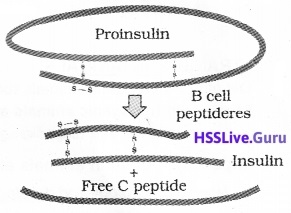
Insulin for diabetes was extracted from pancreas of slaughtered cattle and pigs, it caused allergic disease in some patients. In humans, insulin is synthesised as a prohormone which contains an extra stretch called the C peptide. It is removed and converted into a fully mature and functional insulin.
Plus Two Botany Notes Chapter 5 Biotechnology and its Applications 3
It consists of two short polypeptide chains: chain A and chain B, that are linked together by disulphide bridges.

An American company Eli Lilly in 1983 prepared two DNA sequences corresponding to A and B, chains of human insulin, and inserted in plasmids of E. coli to produce insulin chains. Chains A and B were produced separately, extracted, and combined by creating disulfide bonds to form human insulin.

2. Gene Therapy:
It is the replacement of defective gene by functional gene. This is done by transferring the functional gene into the individual cells, tissues or embryo to treat a disease.

Plus Two Botany Notes Chapter 5 Biotechnology and its Applications

The first reported case of gene therapy was adenosine deaminase (ADA) deficiency that seriously affected the functioning of the immune system. It is due to the deficiency of gene for adenosine deaminase.

Before genetic engineering, ADA deficiency cured by bone marrow transplantation or enzyme replacement therapy.

In the first step of gene therapy, lymphocytes from the blood of the patient are cultured and functional ADA cDNA is introduced in it. Then, these cells are return back to the patient. So that the patient requires frequently such genetically engineered lymphocytes.

The permanent cure for such disease is to introduce functional ADA cDNA into cells at early embryonic stages.

3. Molecular Diagnosis:
Early diagnosis of disease is possible by

1. Recombinant DNA technology
2. Polymerase Chain Reaction (PCR) and
3. Enzyme Linked Immuno-sorbent Assay (ELISA)

Low concentration of a bacteria or virus can be detected by amplification of their nucleic acid by PCR. It is used to detect HIV in suspected AIDS patients and detect mutations in suspected cancer patients It is also used to identify genetic disorders.

The presence of mutated gene can be detected by a probe. A single stranded DNA or RNA, tagged with a radioactive molecule. It is then hybridise to its complementary DNA in a clone of cells. By using autoradiography it is observed that the probe not have any complimentarity with the mutated gene.

Plus Two Botany Notes Chapter 5 Biotechnology and its Applications

Transgenic Animals
Out of many transgenic animals such as rats, rabbits, pigs, sheep, cows fish, etc. 95 percent of transgenic animals are mice.
Importance of such animals are
(i) Normal physiology and development:
Transgenic animals can be used to study of how genes are regulated, and how they affect the normal functions of the body and its development, e.g., study of insulin-like growth factor.

(ii) Study of disease:
Transgenic animals can be used to know, how genes contribute to the development of disease. Today transgenic models exist for many human diseases such as cancer, cystic fibrosis, rheumatoid arthritis and Alzheimer’s disease.

(iii) Biological products:
Transgenic animals that produce useful biological products. For example the introduction of genes which codes for a particular product such as human protein (-antitrypsin) used to treat emphysema. Another examples of disease treated are phenylketonuria (PKU) and cystic fibrosis.

In 1997, the first transgenic cow, Rosie, produced human protein-enriched milk (2.4 grams per litre). The milk contained the human alpha-lactalbumin. It is nutritionally a more balanced product for human babies than natural cow-milk.

(iv) Chemical and vaccine safety testing:
Transgenic animals carry genes that sensitive to toxic substances than non-transgenic animals. So they are exposed to the toxic substances and the effects studied.

Plus Two Botany Notes Chapter 5 Biotechnology and its Applications

Ethical Issues
Some ethical standards are maintained to evaluate the morality of all human activities that are either useful or harmful because the genetically modified organisms have unpredictable results.

Government of India has set up organisations such as GEAC (Genetic Engineering Approval Committee),
they take decisions regarding the validity of GM research and the safety of introducing GM-organisms for public services.

Today the patents are given for products and technologies that make use of the genetic materials, plants, and other biological resources, that have long been identified, developed, and used by farmers and indigenous people of a specific region/country. This is an important problem.

For example, it is estimated that 200,000 varieties of rice grown in India. Of which Basmati rice is distinct for its aroma and flavour. It is significant because this variety was referred in ancient texts, folklore, and poetry.

In 1997, an American company got patent rights on Basmati rice. It was helped the company to sell a ‘new’ variety of Basmati in the US and abroad. It is derived from Indian farmer’s varieties. But the patenting procedure restricts the selling and exporting of Basmati rice by other countries.

Similar attempts have also been made to patent uses, products, and processes based on Indian traditional herbal medicines, e.g., turmeric neem.

Plus Two Botany Notes Chapter 5 Biotechnology and its Applications

Therefore it is necessary to resist these patent applications of other countries/individuals because they permanently take overfull control of our resources.

Biopiracy

It is the unauthorised use of bio-resources by multinational companies and other organisations without compensatory payment.

Industrialised nations are financially rich but poor in biodiversity and traditional knowledge But the developing nations is rich in biodiversity and traditional knowledge related to bio-resources.

Here the sharing between developed and developing countries for traditional knowledge related to bio-resources has not been take place on the basis of compensatory payment. Therefore, some nations are developing laws to prevent such unauthorised exploitation of their bio-resources and traditional knowledge.

Recently Indian Parliament cleared the second amendment of the Indian Patents Bill, that takes such issues related to patents.

Plus Two Botany Notes Chapter 4 Biotechnology: Principles and Processes

Students can Download Chapter 4 Biotechnology: Principles and Processes Notes, Plus Two Botany Notes helps you to revise the complete Kerala State Syllabus and score more marks in your examinations.

Kerala Plus Two Botany Notes Chapter 4 Biotechnology: Principles and Processes

Principles Of Biotechnology
The important techniques leads to the origin of modern biotechnology are:

(i) Genetic engineering: Techniques to alter the chemistry of genetic material (DNA and RNA), and introduce these into host organisms and changing the phenotype of the host organism.
(ii) Maintaning the microbial contamination-free condition to promote the growth of desired
microbe/eukaryotic cell in large quantities for the manufacture of biotechnological products like antibiotics, vaccines, enzymes, etc.

In traditional hybridisation the new hybrid formed possess undesirable genes along with the desired genes. But the technique of genetic engineering /recombinant DNA creates transgenic organism contains only the desirable genes.

Plus Two Botany Notes Chapter 4 Biotechnology: Principles and Processes

In a chromosome there is a specific DNA sequence called the origin of replication, which is responsible for the initiation of replication. If the foreign (alien) DNA transferred and integrated into the genome of the recipient, it multiply along with the host DNA. This called as cloning (making multiple identical copies of any template DNA).

The concept of linking a gene coding for antibiotic resistance with a plasmid of Salmonella typhimurium was the first step in the construction recombinant DNA. It was the work of Stanley Cohen and Herbert Boyer (1972).
Antibiotic resistant gene was isolated from a plasmid by cutting DNA at specific locations by restriction enzymes. Then the cut piece of DNA is linked with the plasmid DNA (vectors) with the help of enzyme DNA ligase.

In the transfer of the malarial parasite into human body, mosquito acts vector. In the same way, a plasmid can be used as vector to deliver an alien piece of DNA into the host organism. It results in the creation of new combination of circular autonomously replicating DNA, it is known as recombinant DNA.

When this DNA is introduced into Escherichia coli, it could replicate using the new host’s DNA and polymerase enzyme to make multiple copies. The ability of forming multiple copies of antibiotic resistance gene in E.coliis called cloning.
The three basic steps in the creation of GMO are

  1. Identification of DNA with desirable genes;
  2. Introduction of the identified DNA into the host;
  3. Maintenance of introduced DNA in the host and transfer of the DNA to its progeny.

Plus Two Botany Notes Chapter 4 Biotechnology: Principles and Processes

Tools Of Recombinant Dna Technology
Important tools are

  1. restriction enzymes
  2. polymerase enzymes
  3. ligases
  4. vectors and the
  5. host organism.

1. Restriction Enzymes:
The enzymes restricting the growth of bacteriophage in Escherichia coli is used to cut DNA. This is called restriction endonuclease.

Restriction endonuclease- Hind II cut DNA molecules at a particular point by recognising a specific sequence of six base pairs. This is called recognition sequence.

Another restriction endonuclease EcoRI comes from Escherichia coli RY13. In EcoRI, ‘R’ indicates the order in which the enzymes were isolated from that strain of bacteria.

Restriction enzymes belong to nucleases. These are of two kinds; exonucleases and endonucleases. Exonucleases remove nucleotides from the ends of the DNA whereas, endonucleases bind to the DNA and cut each of the two strands of the double helix at specific points in their sugar-phosphate backbones.
Plus Two Botany Notes Chapter 4 Biotechnology Principles and Processes 1
Plus Two Botany Notes Chapter 4 Biotechnology Principles and Processes 2

Plus Two Botany Notes Chapter 4 Biotechnology: Principles and Processes
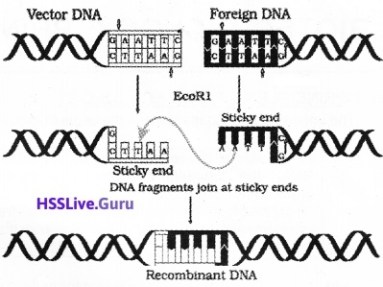
Each restriction endonuclease recognises a specific palindromic nucleotide sequence in the DNA. Actually palindromic nucleotide sequences is the same as the word, “MALAYALAM,” read in both forward and backward.
Eg- 5′ ——GAATTC ——3′
3′ —— CTTAAG —— 5
After cutting DNA duplex by an enzyme, it leaves single stranded portions at the ends. These are sticky ends on each strand. This stickiness of the ends facilitates the action of the enzyme DNA ligase.

Separation and isolation of DNA fragments:
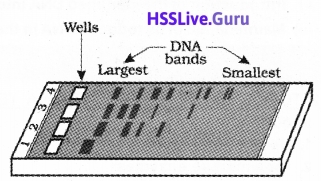
The cut fragments of DNA separated by a technique known as gel electrophoresis. Negatively charged DNA fragments are separated by forcing them to move towards the anode under an electric field through a agarose matrix.

The DNA fragments separate according to their size in agarose gel. So the smaller the fragment size moves farther.

The separated DNA fragments can be visualised only after staining the DNA with ethidium bromide followed by exposure to UV light. It appears as bright orange coloured bands. The separated bands of DNA are cut out from the agarose gel and extracted from the gel piece.

This step is known as elution. The DNA fragments thus obtained are used in constructing recombinant DNA by joining them with cloning vectors.
Agarose gel electrophoresis showing migration of digested and un digested DNA
Plus Two Botany Notes Chapter 4 Biotechnology Principles and Processes 3

Plus Two Botany Notes Chapter 4 Biotechnology: Principles and Processes

2. Cloning Vectors:
Plasmids and bacteriophages can replicate within bacterial cells independently without chromosomal DNA. Bacteriophages form a high copy numbers of their genome within the bacterial cells. Plasmids form 15-100 copies per cell.

If linking an alien piece of DNA with bacteriophage or plasmid DNA, it can multiply its numbers equal to the copy number of the plasmid or bacteriophage. So, this is helpful in the selection of recombinants from non-recombinants.

The features of artificial cloning vector are
(i) Origin of replication (oril):
It is a sequence of cloning vector in which replication starts when any piece of DNA linked to it. This sequence is responsible for controlling the copy number of the linked DNA.

(ii) Selectable marker:
In addition to ‘ori’, the vector contains selectable marker, which helps in identifying and eliminating non transformants and selectively permitting the growth of the transformants.

The genes coding for antibiotic resistance such as ampicillin, chloramphenicol, tetracycline or kanamycin, etc., are considered as selectable markers for E. coli. The normal E. coli cells do not show the resistance against any of these antibiotics.

(iii) Cloning sites:
For linking the alien DNA into the vector, there must be preferably single recognition sites for the commonly used restriction enzymes because more than one recognition sites within the vector results several fragments.

The ligation of alien DNA is carried out at a restriction site present in one of the two antibiotic resistance genes.
Plus Two Botany Notes Chapter 4 Biotechnology Principles and Processes 4
For example, ligation of a foreign DNA at the Bam H I site of tetracycline resistance gene in the vector pBR322, the recombinant plasmids lose tetracycline resistance due to insertion of foreign DNA.

Recombinants selected from non-recombinant by plating the transformants on ampicillin containing medium. The transformants growing on ampicillin containing medium are then transferred on a medium containing tetracycline.

It could not grow in the medium containing tetracycline. But, non recombinants can grow on both medium Therefore antibiotic resistance gene helps in selecting the transformants.

Another method of selecting recombinants from non-recombinants is their ability to produce colour in the presence of a chromogenic substrate. For this recombinant DNA is inserted within the coding sequence of an enzyme, beta-galactosidase. This results into inactivation of the enzyme, called as insertional inactivation.

If the bacteria does not have an insert, chromogenic substrate present in the medium react with betagalactosidase enzyme gives blue coloured colonies.

Plus Two Botany Notes Chapter 4 Biotechnology: Principles and Processes

If the plasmid have an insert, they do not produce any colour due to insertional inactivation of the gene coding for beta galactosidase, these are identified as recombinant colonies.

(iv) Vectors for cloning genes in plants and animals:
Normally Agrobacterioum tumifaciens (a pathogen of several dicot plants) transfer its ‘T-DNA’to normal plant cells and causes tumor. Similarly retroviruses in animals have the ability to transform normal cells into cancerous cells and they are used as vectors for delivering genes of interest to humans.

For delivering genes of interest to plants tumor inducing (Ti) plasmid of Agrobacterium tumifaciens is modified (disarming) as non pathogenic Similarly the retroviruses are disarmed and used to deliver desirable genes into animal cells.

3. Competent Host
(For Transformation with Recombinant DNA)
DNA is a hydrophilic molecule, it cannot pass through cell membranes. For this, bacterial cells must have to be competent to take up DNA.

This is done by treating them with calcium ions and incubating the cells and recombinant DNA on ice, followed by placing them at 42°C Then putting them back on ice. This helps the bacteria to take up the recombinant DNA.

Another methods:

  1. Micro-injection – recombinant DNA is directly injected into the nucleus of an animal cell.
  2. Biolistics or gene gun -cells are bombarded with high velocity micro-particles of gold or tungsten coated with DNA. It is suitable for plants.

And the last method uses ‘disarmed pathogen’ vectors, which when allowed to infect the cell, transfer the recombinant DNA into the host.

Plus Two Botany Notes Chapter 4 Biotechnology: Principles and Processes

Processes Of Recombinant Dna Technology
Recombinant DNA technology involves several steps. They are

1. Isolation of the Genetic Material (DNA):
Initially the bacterial cells/plant or animal tissue are treated with enzymes such as lysozyme (bacteria), cellulase (plant cells), chitinase (fungus) to open the cell to release DNA along with other macromolecules such as RNA, proteins, polysaccharides, and Other molecules can be removed by appropriate treatments and purified DNA precipitates out afterthe addition of chilled ethanol. It can be observed as collection also lipids.

To get DNA in a pure form and free from other macro-molecules it is treated with enzymes. RNA can be removed by treating with ribonuclease whereas proteins can be removed by treating with protease, of fine threads in the Suspension.

2. Cutting of DNA at Specific Locations:
It is done by incubating purified DNA molecules with the restriction enzyme. Here Agarose gel electrophoresis is used to check the progression of a restriction enzyme digestion. DNA is a negatively charged molecule, hence it moves towards the positive electrode (anode).

After having cut at the source DNA as well as the vector DNA with a specific restriction enzyme, the cut out ‘gene of interest’ from the source DNA and the cut vector with space are mixed and ligase is added. This results in the preparation of recombinant DNA.

3. Amplification of Gene of Interest using PCR:

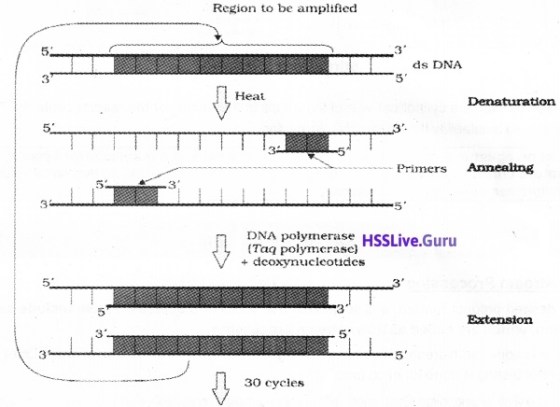
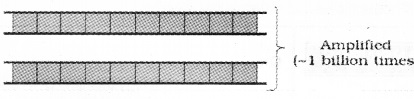
Polymerase Chain Reaction is helpful to produce multiple copies ( eg-1 billion copies-) of the gene of interest.

It is synthesised in vitro using two sets of primers (chemically synthesised oligonucleotides that are complementary to the regions of DNA) and the enzyme thermostable DNA polymerase (isolated from a bacterium, Thermus aquaticus).

This enzyme extends the primers using the nucleotides provided in the reaction mixture and the genomic DNA as template. If the process of replication of DNA is repeated many times, the segment of DNA (gene of interest) can be amplified. The amplified fragment is used to ligate with vector for further cloning.

Plus Two Botany Notes Chapter 4 Biotechnology: Principles and Processes

(PCR showing denaturation. annealing and extention)
Plus Two Botany Notes Chapter 4 Biotechnology Principles and Processes 5
Plus Two Botany Notes Chapter 4 Biotechnology Principles and Processes 6

4. Insertion of Recombinant DNA into the Host Cell/Orqanism:
Recombinant DNA carry gene resistant to antibiotic (e.g., ampicillin) is transferred into E. coli cells, the host cells become transformed into ampicillin-resistant cells. If spreading the transformed cells on agar plates containing ampicillin, only the transformants grow and untransformed cells die.

So it is helpful to select a transformed cell in the presence of ampicillin. The ampicillin resistance gene in this case is called a selectable marker.

5. Obtaining the Foreign Gene Product:
The main aim of all recombinant technologies is to produce a desirable protein. Here the foreign gene is expressed under appropriate conditions. If it is necessary to produce target protein i.e recombinant protein on a small scale, rDNA transferred into the host and cloned genes of interest must be grown in the laboratory. Then the protein is extracted and purified.

Plus Two Botany Notes Chapter 4 Biotechnology: Principles and Processes

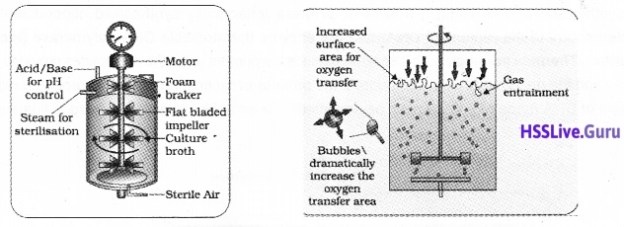
Stirred tank Bioreactor
Plus Two Botany Notes Chapter 4 Biotechnology Principles and Processes 7
A stirred-tank reactor is a cylindrical vessel that helps in the mixing of the reactor contents. The stirrer also facilitates oxygen availability throughout the bioreactor.

It consist of agitator system, an oxygen delivery system and a foam control system, a temperature control system, pH control system and sampling ports, so that small volumes of the culture can be withdrawn periodically.

6. Downstream Processing:
After the desired product formed, it is subjected to a series of processes. These include separation and purification, which are called as downstream processing.

Plus Two Botany Notes Chapter 4 Biotechnology: Principles and Processes

The product is added with preservatives and undergoes clinical trials as in case of drugs. Later the strict quality control testing is done for each product.

Plus Two Botany Notes Chapter 3 Strategies for Enhancement in Food Production

Students can Download Chapter 3 Strategies for Enhancement in Food Production Notes, Plus Two Botany Notes helps you to revise the complete Kerala State Syllabus and score more marks in your examinations.

Kerala Plus Two Botany Notes Chapter 3 Strategies for Enhancement in Food Production

Animal Husbandry
It is the agricultural practice of breeding and raising livestock which deals with the care and breeding of livestock like buffaloes, cows, pigs, horses, cattle, sheep, camels, goats, etc., that are useful to humans.

It includes poultry farming and fisheries also. Fisheries include rearing, catching and selling offish, mollusks and crustaceans (prawns, crabs, etc.).

Plus Two Botany Notes Chapter 3 Strategies for Enhancement in Food Production

More than 70 per cent of the world livestock population is in India and China.

1. Management of Farms and Farm Animals:
The modem practices of farm management improves and enhances food production.

a. Dairy Farm Management:
It is the management of animals for milk and its products for human consumption. Diairyfarm management includes processes and systems that increase yield and improve quality of milk.
It includes

Selection of good breeds having high yielding potential, resistance to diseases, they have to be housed well, should have adequate water, maintained disease free, feeding should be in a scientific manner (in the quality and quantity of fodder), maintaining cleanliness and hygiene during milking, storage and transport of the milk and its products, and require regular visit of a veterinary doctor.

b. Poultry Farm Management:
It is the management of chicken, ducks, turkey and geese for food or their eggs.

As in dairy farming, selection of disease free breeds, proper and safe farm conditions, proper feed and water and hygiene and health care are important components of poultry farm management.

Recently, the spread of ‘bird flu virus’ affected the egg industy and chicken consumption. The causative virus is H5N1.

Plus Two Botany Notes Chapter 3 Strategies for Enhancement in Food Production

2. Animal Breeding:
It aims for increasing the yield of animals and improving the desirable qualities of the produce.
The term ‘breed’ refers to a group of animals related by descent and similar in general appearance, features, size, configuration, etc.

When breeding is between animals of the same breed it is called inbreeding, while crosses between different breeds are called outbreeding.

Inbreeding

It is the mating of more closely related individuals within the same breed for 4 – 6 generations.
In this, superior males (the bull which gives rise to superior progeny) and superior females (cow or buffalo that produces more milk per lactation) of the same breed are mated.

The progenies are evaluated and superior among them are identified for further mating.

The strategy used for developing purelines in cattle is the same as Mendel was practiced. Thus inbreeding is necessary for evolving a pureline in any animal. Inbreeding increases homozygosity.

It exposes harmful recessive genes that are eliminated by selection. It also helps in the accumulation of superior genes and elimination of less desirable genes. But the continued inbreeding reduces fertility and productivity. This is called inbreeding depression.

It is overcome by mating with unrelated superior animals of the same breed. This is usually helps to
restore fertility and yield.

Out-breeding
It is the breeding of the unrelated animals of the same breed (but having no common ancestors), or between different breeds (cross-breeding) or different species (inter-specific hybridisation).

Plus Two Botany Notes Chapter 3 Strategies for Enhancement in Food Production

(A) Out-crossing:
It is mating of animals within the same breed, but having no common ancestors on either side of their pedigree up to 4-6 generations. The offspring produced called as out-cross. It is the method used for increasing milk production, growth rate in beef cattle, etc.

(B) Cross-breeding:
It is the method of mating superior males of one breed with superior females of another breed. The progeny hybrid animals are used for commercial production.
Eg-Hisardale is a new breed of sheep developed in Punjab by crossing Bikaneri ewes and Marino rams.

Eg-Hisardale is a new breed of sheep developed in Punjab by crossing Bikaneri ewes and Marino rams.

Interspecific hybridisation
It is the method of mating of male and female animals of different species, the progeny shows combined desirable features of both the parents with economic value, e.g., mule.
Mule:
Plus Two Botany Notes Chapter 3 Strategies for Enhancement in Food Production 1
Controlled breeding experiments are carried out using artificial insemination. The semen is collected from the male parent and injected into the reproductive tract of the selected female.

Semen can be stored in freezing state and used later. Artificial insemination helps to overcome several problems of normal matings.
To improve chances of successful production of hybrids, other technique is used.

Plus Two Botany Notes Chapter 3 Strategies for Enhancement in Food Production

Multiple Ovulation Embryo Transfer Technology (MOET)
In this method, a cow is given hormones, with FSH-like activity, to induce follicular maturation and super ovulation, it produce 6 – 8 eggs/cycle. This animal isthen mated with an elite bull or artificially inseminated. The fertilised eggs at 8 – 32 cells stages, are removed and transferred to surrogate mother.

The genetic mother is available for another round of super ovulation. This technology is useful for cattle, sheep, rabbits, buffaloes, mares, etc.

3. Bee-keeping
Bee-keeping or apiculture is an age-old cottage industry for the maintenance of hives of honeybees for the production of honey. Honey is a food of high nutritive value and used in medicine. Beeswax, obtained from them are used in the preparation of cosmetics and polishes. It is an income-generating industry.

Bee-keeping can be practiced in the area having wild shrubs, fruit orchards and cultivated crops grows.
The most common species used is Apis indica.
For successful bee-keeping it requires

(i) Knowledge of the nature and habits of bees,
(ii) Selection of suitable location for keeping the beehives,
(iii) Catching and hiving of swarms (group of bees),
(iv) Management of beehives during different seasons, and
(v) Handling and collection of honey and of bees wax.

Bees are the pollinators of many crop species such as sunflower, Brassica, apple and pear. Keeping beehives in crop fields during flowering period increases pollination efficiency and improves the crop yield and honey yield.

4. Fisheries
It is an industry for the catching, processing or selling offish, shellfish or other aquatic animals. Some of the freshwater fishes Catla, Rohu and common carp and the marine fishes Hilsa, Sardines, Mackerel and Pomfrets are commercially important.

Fisheries provides income and employment to millions of fishermen and farmers Aquaculture and pisciculture is used to increase the production of aquatic plants and animals Increasd production offish and their products are coming under blue Revolution’.

Plus Two Botany Notes Chapter 3 Strategies for Enhancement in Food Production

Plant Breeding
This technology aims to increase yields .Here Green Revolution plays an important role to meet the national requirements in food production .This is achieved through development of high-yielding and disease resistant varieties in wheat, rice, maize, etc.

1. What is Plant Breeding?
It is the purposeful manipulation of plant species to create desired plant types that are good for cultivation, better yields and disease resistant. Major food crops of today are developed from domesticated varieties that obtained from conventional plant breeding practices.

Today the crop improvement programme mainly based on genetics, molecular biology and tissue culture, Plant breeders give importance to crop yield and quality, increased tolerance to environmental stresses (salinity, extreme temperatures, drought), resistance to pathogens (viruses, fungi, and bacteria) and increased tolerance to insect pests.

Main steps of plant breeding for developing a new genetic variety of a crop are

(i) Collection of variability:
Genetic variability is mainly created from wild relatives of the crop. For this all wild varieties, species and relatives of the cultivated species are collected and preserved. The entire collection (of plants/seeds) having all the diverse alleles for all genes in a given crop is called germplasm collection.

(ii) Evaluation and selection of parents:
The selected plants with desirable combination of characters are multiplied and used in the process of hybridisation.

(iii) Cross hybridisation among the selected parents:
The desired characters from two different plants (parents) are combined and produce hybrids. One parent with high protein quality is combined with disease resistance of other parent. This is a very time-consuming and tedious process because the pollen grains from the male parent are collected and placed on the stigma of female parent.

(iv) Selection and testing of superior recombinants:
It is the testing of progeny that have the desired character combination. This step yields plants that are superiorto both of the parents.

Plus Two Botany Notes Chapter 3 Strategies for Enhancement in Food Production

(v) Testing, release and commercialisation of new cuttivars:
The newly selected progenies are evaluated for their yield, quality, disease resistance, etc. It is done by growing these plants in the research fields and recording their performance under ideal fertiliser application, irrigation, and other crop management practices.

The evaluation is followed by testing the materials in farmers fields, for at least three growing seasons at several locations in the country. These progenies are then evaluated in comparison to the best available local crop cultivar.

The agriculture contribution to India’s GDP is 33 percent and employs nearly 62 percent of the population. After India’s independence, the main challenge was to produce food for the increasing population. The development of several high yielding varieties of wheat and rice led to the dramatic increase in food production in our country. This is called as the Green Revolution.

Wheat and Rice

During the period 1960 to 2000, wheat production increased from 11 million tones to 75 million tonnes while rice production from 35 million tonnes to 89.5 million tonnes.

This was due to the development of semi-dwarf varieties of wheat and rice. Nobel laureate Norman E. Borlaug, at International Centre for Wheat and Maize had developed semi-dwarf wheat.

In 1963, high yielding and disease resistant wheat Sonalika and Kalyan Sona, were developed in India. Semi-dwarf rice varieties were developed from IR – 8 and Taichung Native-1. Later better-yielding semi dwarf varieties Jaya and Ratna were developed in India.

Sugarcane:
Saccharum barberi of north India had poor sugar content and yield. But Saccharum officinarumm of south India had thicker stems and higher sugar content but did not grow well in north India.

These two species are crossed to get sugar cane varieties combining the desirable qualities of high yield, thick stems, high sugar and ability to grow in the sugar cane areas of north India.

Plus Two Botany Notes Chapter 3 Strategies for Enhancement in Food Production

Millets:
The successfully developed millets in India are Hybrid maize, jowar and bajra. They are high yielding and resistant to water stress.

2. Plant Breeding for Disease Resistance:
Breeding of cultivars resistant to disease increases food production. It helps to reduce the dependence on the use of fungicides and bacteriocides. Before breeding, it is important to know about the causative organism and the mode of transmission.

Some of the diseases caused by fungi are rusts, e.g., brown rust of wheat, red rot of sugarcane and late blight of potato; by bacteria – black rot of crucifers; and by viruses – tobacco mosaic, turnip mosaic, etc.

Methods of breeding for disease resistance
It is done by the conventional breeding techniques (hybridisation and selection) or by mutation breeding. Conventional breeding is facing some difficulties because the limited number of disease resistant genes present in crop varieties orwild relatives.

These are either multiplied ordirectly used in breeding. Other breeding methods used are selection amongst somaclonal variants and genetic engineering.

Crop varieties resistant to bacteria, fungi and viruses
Plus Two Botany Notes Chapter 3 Strategies for Enhancement in Food Production 2

Plus Two Botany Notes Chapter 3 Strategies for Enhancement in Food Production

Mutation
It is the method of changing the base sequence within genes resulting in the creation of a new character not found in the parental type. It is done by inducing mutations artificially or by using chemicals or radiations (like gamma radiations), and selecting and using the plants that have the desirable character. This process is called mutation breeding.

Eg-In mung bean, resistance to yellow mosaic virus and powdery mildew were induced by mutations. Wild relatives of cultivated species have resistant characters but very low yield. So it is a need to introduce the resistant genes into the high-yielding cultivated varieties.

Eg- Gene resistant to yellow mosaic virus of wild species- bhindi (Abelmoschus esculentus) -transferred to the variety of A. esculentus and a new variety formed is called as Parbhani kranti.

3. Plant Breeding for Developing Resistance to Insect Pests:
Insect resistance in host crop plants can be developed in many ways particularly morphological, biochemical or physiological manner.

(1) Hairy leaves shows resistance to insect pests e.g, resistance to jassids in cotton and cereal leaf beetle in wheat
(2) In wheat, solid stems resistant to stem sawfly and smooth leaved and nectar-less cotton varieties resistant bollworms.
(3) High aspartic acid, low nitrogen and sugar content in maize shows resistance to maize stem borers.

Plus Two Botany Notes Chapter 3 Strategies for Enhancement in Food Production

The above insect resistance is made by hybridization techniques.
Crop varieties resistant to pest
Plus Two Botany Notes Chapter 3 Strategies for Enhancement in Food Production 3

4. Plant Breeding for Improved Food Quality:
In the world about three billion people suffer from micronutrient ( particularly iron, vitamin A, iodine and zinc), protein and vitamin deficiencies or ‘hidden hunger’. Diets lacking essential micronutrients increase the risk for disease, reduce lifespan and reduce mental abilities.

Biofortification
It is the breeding of crops with higher levels of vitamins minerals, proteins and healthier fats.

Objectives of improving nutritional quality
(i) Protein content and quality;
(ii) Oil content and quality;
(iii) Vitamin content; and
(iv) Micronutrient and mineral content.
  1. Maize hybrids possess twice the amount of the amino acids (lysine and tryptophan).
  2. Wheat variety, Atlas 66, with a high protein content,
  3. Iron-fortified rice variety have five times iron content.

The Indian Agricultural Research Institute, New Delhi has also released several vegetable crops that are rich in vitamins and minerals.

  1. Vitamin A-enriched carrots, spinach, pumpkin etc.
  2. Vitamin C enriched bitter gourd,bathua, mustard, and tomato;
  3. Iron and calcium enriched spinach and bathua;
  4. Protein enriched beans – broad, lablab, French and garden peas.

Single Cell Protein (SCP):
More than 25 per cent of human population is suffering from hunger and malnutrition So the new alternate sources of proteins for animal and human nutrition is Single Cell Protein (SCP). Eg- Spirulina (source of good Protein).

Spirulina can grown on waste water from potato processing plants straw, molasses, animal mannure and even sewage to produce large quantities and food rich in protein, minerals, fats, carbohydrate and vitamins. This method of growing spirulina in waste waters reduces environmental pollution.

About 250 Kg cow produces 200 g of protein per day. But 250g of micro-organism like Methylophilus methylotrophus, expected to produce 25 tonnes of protein. Microbes like mushrooms are cultivated in large scale and it is an acceptable as food.

Plus Two Botany Notes Chapter 3 Strategies for Enhancement in Food Production

Tissue Culture
It is method in which plants are regenerated from explants. The capacity to generate a whole plant from any cell/explant is called totipotency.
Tissue culture medium

  1. carbon source -sucrose
  2. inorganic salts
  3. vitamins
  4. amino acids
  5. growth regulators like auxins, cytokinins etc.

Micropropagation
It is the tissue culture method useful for the propagation of a large number of plants in very short durations.

All plants developed are genetically identical to the original plant, i.e., they are somaclones.
Many important food plants like tomato, banana, apple, etc. produced on commercial scale using this method.

Meristem culture
It is tissue culture method in which Healthy plants are developed from diseased plants or infected with a virus.

Here the meristem is taken from apical and axillary part and grow it in vitro to obtain virus-free plants Eg- banana, sugarcane, potato, etc.

Plus Two Botany Notes Chapter 3 Strategies for Enhancement in Food Production

Somatic hybridization
Here protoplast is isolated from plants by using enzymes. Isolated protoplasts from two different varieties of plants having desirable character are fused to get hybrid protoplasts, which can be further grown to form a new plant.

These hybrids are called somatic hybrids.
Eg- Protoplast of tomato is fused with that of potato and grown to form new hybrid plants containing the characters of tomato and potato. But here the desired combination of characters are not fully expressed for its commercial utilisation.

Plus Two Botany Notes Chapter 2 Sexual Reproduction in Flowering Plants

Students can Download Chapter 2 Sexual Reproduction in Flowering Plants Notes, Plus Two Botany Notes helps you to revise the complete Kerala State Syllabus and score more marks in your examinations.

Kerala Plus Two Botany Notes Chapter 2 Sexual Reproduction in Flowering Plants

Flower – A Fascinating Organ Of Angiosperms
Flower shows aesthetic, ornamental, social, religious and cultural importance. They are used as symbols for conveying human feelings such as love, affection, happiness, grief etc.

Plus Two Botany Notes Chapter 2 Sexual Reproduction in Flowering Plants

Pre-Fertilisation: Structures And Events
The Hormonal and Structural changes leads to the differentiation and development of the floral primordium.

In the flower the male reproductive structure is the androecium, it consists of a whorl of stamens. The female reproductive structure is gynoecium, it consists of pistils.

1. Stamen, Microsporangium and Pollen Grain:
A typical stamen consist of the long and slender stalk called the filament, and the bilobed structure called the anther. The number and length of stamens are variable in flowers of different species.
Plus Two Botany Notes Chapter 2 Sexual Reproduction in Flowering Plants 1
A typical angiosperm anther is bilobed i.e. dithecous.
It is a four-sided (tetragonal) structure consisting of four microsporangia located at the corners, two in each lobe. The microsporangia develop further and become pollen sacs.

Structure of microsporangium:
In young condition anther consist of cells called the sporogenous tissue. It is surrounded by four wall layers.

  1. Epidermis
  2. Endothecium
  3. Middle layers
  4. Tapetum.

The outer three wall layers shows protective function and help in breaking of anther to release the pollen. The innermost wall layer is the tapetum possessing more than one nucleus. It nourishes the developing pollen grains.

Microsporoqenesis:
During the development of anther, cells of the sporogenous tissue undergo meiotic divisions to form microspore tetrads. This is called microsporogenesis.

Plus Two Botany Notes Chapter 2 Sexual Reproduction in Flowering Plants

At maturity the microspores dissociate from each other and develop into pollen grains.

Pollen grain:
Pollen grain has hard outer layer called the exine, it is made up of sporopollenin (resistant organic material- not degraded by enzyme).

Exine surface shows Germ pores through which pollen tube come out. Exine shows different patterns and designs.

Pollen grains are well preserved as fossils because of the presence of sporopollenin.

The inner wall of the pollen grain is called the intine. It is thin and continuous layer made up of cellulose and pectin. The cytoplasm of pollen grain is surrounded by a plasma membrane.

When the pollen grain mature, it contains two cells, the bigger vegetative cell and the smaller generative cell.
Plus Two Botany Notes Chapter 2 Sexual Reproduction in Flowering Plants 2

About 60 per cent of angiosperms, pollen grains are shed at 2-celled stage. In the remaining species, the generative cell divides mitotically and give rise to the two male gametes before pollen grains are shed (3-celled stage).

Pollen grains of many species cause severe allergies and bronchial infections leading to chronic respiratory disorders- asthma, bronchitis, etc. For example Parthenium or carrot grass causes pollen allergy.

Pollen grains are nutritious
The pollen tablets are used as food supplements. In western countries pollen products are used as tablets and syrups. Pollen consumption is important to increase the performance of athletes and race horses.

Pollen products
Plus Two Botany Notes Chapter 2 Sexual Reproduction in Flowering Plants 3

Plus Two Botany Notes Chapter 2 Sexual Reproduction in Flowering Plants
The viability of pollen grains is important in the success of fertilisation. The period of viability of pollen grains is variable and depends on the temperature and humidity.

In some cereals such as rice and wheat, pollen grains lose its viability within 30 minutes of their release, and in some members of Rosaceae, Leguminosae and Solanaceae, they maintain viability for months.

Pollen grains can be stored for years in liquid nitrogen (-1960C). Such stored pollen can be used as pollen banks for future use.

2. The Pistil, Meqasporangium (ovule) and Embryo sac:
The gynoecium is the female reproductive part. It consist of a single pistil (monocarpellary) or more than one pistil (multicarpellary). If more than one pistils are fused togetherthey are called syncarpous or free they are called apocarpous.
Plus Two Botany Notes Chapter 2 Sexual Reproduction in Flowering Plants 4
Each pistil has three parts the stigma, style and ovary. The stigma is the place where pollen grains falls. The style is the elongated slender part beneath the stigma.

The broad basal part of the pistil is the ovary. Inside the ovary is the ovarian cavity (locule). The placenta is located inside the ovarian cavity. The number of ovules in an ovary are different. It is one (wheat,paddy, mango) to many (papaya, water melon, orchids).

The Megasporangium (Ovule):
The ovule is a small structure attached to the p|acenta by means of a stalk called funicle. The body of the ovule fuses with funicle in the region called hilum (junction between ovule and funicle).

Each ovule has one or two protective envelopes called integuments. It covers entire ovule except at the tip where a small opening called the micropyle.

Opposite the micropylar end, is the chalaza, representing the basal part of the ovule. Enclosed within the integuments is a mass of cells called the nucellus.

Cells of the nucellus have abundant reserve food materials. Embryo sac or female gametophyte is located at there.

Plus Two Botany Notes Chapter 2 Sexual Reproduction in Flowering Plants

Ovule structure
Plus Two Botany Notes Chapter 2 Sexual Reproduction in Flowering Plants 5

Megasporoqenesis:
It is the process of formation of megaspores from the megaspore mother cell. A single megaspore mother cell (MMC) is differentiates in the micropylar region of the nucellus.

It is a large cell containing dense cytoplasm and a prominent nucleus. The MMC undergoes meiotic division to form female gametophyte.

In most flowering plants, only one megaspore is functional while other three degenerates. Functional megaspore develops into the female gametophyte (embryosac). This is termed as monosporic development.

The nucleus of the functional megaspore undergoes three repeated mitotic division to form 8 nucleate embryosac. After the 8-nucleate stage, cell walls are formed leading to the organisation of the typical female gametophyte or embryo sac.
Plus Two Botany Notes Chapter 2 Sexual Reproduction in Flowering Plants 6
Six of the eight nuclei are surrounded by cell walls and organised into cells; the remaining two nuclei, called polar nuclei are situated below the egg apparatus in the large central cell.

Three cells are arranged at the micropylar end and constitute the egg apparatus. It consists of two synergids and one egg cell. The synergids have special cellular thickenings at the micropylartip called filiform apparatus, it helps to guide the pollen tubes into the synergid.

Three cells at the chalazal end are called the antipodals. The large central cell has two polar nuclei.

Angiosperm embryo sac at maturity is 8-nucleate and 7-celled.

Plus Two Botany Notes Chapter 2 Sexual Reproduction in Flowering Plants

3. Pollination:
It is the transfer of pollen grains to the stigma of a pistil.

Kinds of Pollination:
Depending on the source of pollen, pollination is divided into three types,
(i) Autogamy:
It is the transfer of pollen grains from the anther to the stigma of the same flower. In such flowers pollen release and stigma receptivity are at the same time and the anthers and the stigma should lie close to each other.

Some plants such as Viola, Oxalis, and Commelina produce two types of flowers – chasmogamous flowers (exposed anthers and stigma) and cleistogamous flowers (do not open flower). Cleistogamous flowers possible to the seed-set even in the absence of Pollinators.

Cleistogamous flowers
Plus Two Botany Notes Chapter 2 Sexual Reproduction in Flowering Plants 7

(ii) Geitonogamy:
Transfer of pollen grains from the anther to the stigma of another flower of the same plant. Functionally geitonogamy is a type of crosspollination but it is genetically similar to autogamy since the pollen grains come from the same plant.

(iii) Xenogamy:
Transfer of pollen grains from anther to the stigma of a different plant. This type of pollination occurs between genetically different species.

Agents of Pollination:
Pollination takesplace with abiotic (wind and water) and biotic (animals) agents. Majority of plants use biotic agents for pollination.

Wind pollination:
Pollen grains are light and non-sticky. They possess well-exposed stamens and feathery stigma. Such flowers have a single ovule in each ovary and numerous flowers packed into an inflorescence.
Example -corn cob – Here stigma and style which wave in the wind to trap pollen grains. Wind-pollination is more common in grasses.

Plus Two Botany Notes Chapter 2 Sexual Reproduction in Flowering Plants

Wind pollinated plant with well expesed stamens
Plus Two Botany Notes Chapter 2 Sexual Reproduction in Flowering Plants 8

Water Pollination:
Water Pollinated plants are mostly monocotyledons. In the lower plants such as algae, bryophytes and pteridophytes required water for the transport of male gametes and fertilisation.

Some examples of water pollinated plants are Vallisneria and Hydrilla (fresh water) and Zostera (marine sea- grasses).
Plus Two Botany Notes Chapter 2 Sexual Reproduction in Flowering Plants 9
In Vallisneria, the female flower reach the surface of water by the long stalk and the male flowers or pollen grains are released on to the surface of water. The anthers eventually reach the female flowers and the stigma.

In seagrasses, female flowers are submerged in water and the pollen grains are released inside the water. Pollen grains are long and ribbon like, some of them reach the stigma and results pollination.

In a majority of aquatic plants such as water hyacinth and water lily, the flowers emerge above the level of water and are pollinated by insects or wind.

In most of the water-pollinated species, pollen grains are protected from wetting by a mucilaginous covering.
Both wind and water pollinated flowers are not very colourful and do not produce nectar.

Animal pollination:
Animals pollinating agents are Bees, butterflies, flies, beetles, wasps, ants, moths, birds (sunbirds and humming birds) and bats.

Bees are the dominant biotic pollinating agent.
Larger animals such as some primates (lemurs), arboreal (tree-dwelling) rodents, or even reptiles (gecko lizard and garden lizard) have also been reported as pollinators in some species.

Features of animal pollinated flowers are
Flowers are large, colourful, fragrant and rich in nectar, the small flowers are clustered Into an inflorescence to make them conspicuous.

Plus Two Botany Notes Chapter 2 Sexual Reproduction in Flowering Plants

The flowers pollinated by flies and beetles secrete foul odours to attract these animals. Flowers in turn provide rewards to the animals in the form of Nectar and pollen grains.

In some species flower provide safe places to lay eggs. Eg-tallest flower of Amorphophallus (Flower- 6 feet in height).

The plant Yucca and moth cannot complete their life cycles without each other. The moth deposits its eggs in the locule of the ovary and the flower in turn gets pollinated by the moth. The larvae of the moth come out of the eggs as the seeds start developing.

Outbreeding Devices
In plants the continued self-pollination result in inbreeding depression. Flowering plants have some devices to prevent self pollination and to promote cross pollination.

  1. In some species, pollen release and stigma receptivity are not at the same time.
  2. In some other species, the anther and stigma are placed at different positions so that the pollen cannot come in contact with the stigma of the same flower. Both these devices prevent autogamy.
  3. In some other species self-incompatibility is the genetic mechanism Here pollen cannot germinate on the stigma of the same flower or other flowers of the same plant by inhibiting pollen germination or pollen tube growth in the pistil.
  4. Another device to prevent self-pollination is the production of unisexual flowers. If both male and female flowers are present on the same plant such as castor and maize (monoecious), it prevents autogamy but not geitonogamy.

In papaya, male and female flowers are present on different plants. This condition prevents both autogamy and geitonogamy.

Pollen-pistil Interaction:
After pollination, the pistil recognize pollen of the wrong type( incompatible )or the right type(compatible). If it is of the right type, the pistil accepts the pollen and promotes post-pollination events that leads to fertilisation. If the pollen is of the wrong type, the pistil rejects the pollen by preventing pollen germination on the stigma or the pollen tube growth in the style.
Plus Two Botany Notes Chapter 2 Sexual Reproduction in Flowering Plants 12

Plus Two Botany Notes Chapter 2 Sexual Reproduction in Flowering Plants
Pollen-pistil interaction is a kind of dialogue mediated by chemical components of the pollen interacting with those of the pistil.

Pollen tube grows through the tissues of the stigma and style and reaches the ovary. The generative cell divides and forms the two male gametes during the growth of pollen tube in the stylar region.

Then it enters into the ovule through the micropyle and reaches the synergids. It is reported that filiform apparatus present at the micropylar part of the synergids guides the entry of pollen tube.

Artificial hybridization:
It is the method for the crop improvement programme. It aims for the creation of’superior’ varieties.lt is done by emasculation and bagging techniques.

Anthers are removed by using forceps before the dehiscence of anther of female parent that bears bisexual flowers. This step is called as emasculation. It is covered with a bag of suitable size, to prevent contamination of its stigma with unwanted pollen. This process is called bagging.

When the stigma of bagged flower attains receptivity, mature pollen grains collected from anthers of the male parent are dusted on the stigma, and the flowers are rebagged, and the fruits allowed to develop.

Emasculation is not necessary for unisexual flowers. Here female flower buds are bagged before the flowers open. When the stigma becomes receptive, pollination is carried out using the desired pollen and the flower rebagged.

Plus Two Botany Notes Chapter 2 Sexual Reproduction in Flowering Plants

Double Fertilisation
By the help of filifiorm apparatus the pollen tube releases the two male gametes into the cytoplasm of the synergid. Then it fuses with the egg cell to form diploid zygote. This process is called syngamy.

The other male gamete moves towards the two polar nuclei located in the central cell and fuses with them to produce a triploid primary endosperm nucleus (PEN). This type of fusion contains three haploid nuclei, it is called triple fusion.

Therefore syngamy and triple fusion take place in an embryo sac, the phenomenon is called as Double fertilization.

The central cell after triple fusion becomes the primary endosperm cell (PEC) and develops into the endosperm while the zygote develops into an embryo.

Plus Two Botany Notes Chapter 2 Sexual Reproduction in Flowering Plants 13

Plus Two Botany Notes Chapter 2 Sexual Reproduction in Flowering Plants

Post-Fertilisation: Structures And Events
Double fertilization leads to the development of endosperm and embryo, maturation of ovule into seed and ovary into fruit. These are called as post-fertilisation events.

1. Endosperm:
It serve as nutrition for the developing embryo. In most plants, the PEN undergoes successive nuclear divisions to give rise to free nuclei. This stage of endosperm development is called free-nuclear endosperm. Later cell wall formation occurs and the endosperm becomes cellular.

The tender coconut contains free-nuclear endosperm and the surrounding white kernel is the cellular endosperm. Some times the endosperm completely consumed by the developing embryo (e.g., pea, groundnut, beans) before seed maturation or it is persist in the mature seed (e.g. castor and coconut) and be used up during seed germination.

2. Embryo:
The micropylarend of the embrysac sac contains zygotes which divide only after the endosperm is formed. The early stages of embryo development (embryogeny) are similar in both monocotyledons and dicotyledons.

The zygote gives rise to the proembryo and subsequently to the globular, heart-shaped and mature embryo.

Dicotyledonous embryo consists of an embryonal axis and two cotyledons. The portion of embryonal axis above cotyledons is the epicotyl, which terminates with the plumule. The cylindrical portion below the cotyledons is hypocotyl that terminates at its lower end in the radical or root tip. The root tip is covered with a root cap.
Plus Two Botany Notes Chapter 2 Sexual Reproduction in Flowering Plants 14

Plus Two Botany Notes Chapter 2 Sexual Reproduction in Flowering Plants
Embryos of monocotyledons possess only one cotyledon. In the grass family the cotyledon is called scutellum that rs situated towards one side of the embryonal axis. At its lower end, the embryonal axis consists of radical and root cap enclosed by sheath called coleorhiza.

The portion of the embryonal axis above the level of attachment of scutellum is the epicotyl. Epicotyl has a shoot apex and a few leaf primordia enclosed by a sheath called the coleoptile.

3. Seed:
In angiosperms, the seed is the fertilised ovule. Seeds are formed inside fruits. It consists of seed coat, cotyledon and an embryo axis. The cotyledons stores food reserves.

Non-albuminous seeds have no endosperm because it consumed during embryo development (e.g., pea, groundnut).
Albuminous seeds retain endosperm because it is not completely used up in embryo development (e.g., wheat, maize, barley, castor, sunflower).
In some seeds such as black pepper and beet, the remnants of nucellus are persistent. This persistent nucellus is called the perisperm

The micropylar region facilitates entry of oxygen and water into the seed during germination. As the seed matures, its water content is reduced and metabolic activity of the embryo slows down. This inactive state of embryo is called dormancy.

If seed get suitable conditions, they germinates. During the embryo development ovules mature into seeds, the ovary develops into a fruit, integuments of ovules develops into seed coats and ovary wall becomes wall of fruit called pericarp.

Many fruits have evolved mechanisms for dispersal of seeds.
Plus Two Botany Notes Chapter 2 Sexual Reproduction in Flowering Plants 15

Plus Two Botany Notes Chapter 2 Sexual Reproduction in Flowering Plants

1. In some species such as apple, strawberry, cashew, etc., the thalamus develops to form fruit. Such fruits are called false fruits
2. Fruits develops only from the ovary, they are called true fruits.
3. In some species fruits develop without fertilization, they are called. Parthenocarpic fruits, eg- Banana. Parthenocarpy cgn be induced by the use of growth hormones. Such fruits are seedless.

Dehydration and dormancy of mature seeds are important for storage So this is advantageous and to be used as food through out the year and also to raise crop in the next season.

In some species, the seeds lose viability within a few months but some seeds can remain alive for hundreds of years.

  • The oldest seed is lupine, Lupinus arcticus excavated from Arctic Tundra.
  • The seed germinated and flowered after of 10,000 years of dormancy.
  • The 2000 years old viable seed – Date palm, Phoenixdactylifera discovered during the archeological excavation at King Herod’s palace near the Dead Sea.

Plus Two Botany Notes Chapter 2 Sexual Reproduction in Flowering Plants

Apomixis And Polyembryony
In some flowering plant species of Asteraceae and grasses produce seeds without fertilisation, it is called apomixis.

Apomixis is a form of asexual reproduction that mimics sexual reproduction.

In some species, the diploid egg cell is formed without reduction division and develops into the embryo without fertilisation.

But in a few species of Citrus and Mango, the nucellar cells surrounding the embryo sac develop into the embryos. In such species each ovule contains many embryos. The occurrence of more than one embryo in a seed is called polyembryony.

Hybrids are widely used in cultivation as food and vegetable crops because of increased productivity, but their production is expensive for the farmers.

If these hybrids are made into apomicts, there is no segregation of characters in the hybrid progeny. So the farmers can use these apomictic seeds to raise new crop year after year without losing the desirable characters.

Plus Two Botany Notes Chapter 1 Reproduction in Organisms

Students can Download Chapter 1 Reproduction in Organisms Notes, Plus Two Botany Notes helps you to revise the complete Kerala State Syllabus and score more marks in your examinations.

Kerala Plus Two Botany Notes Chapter 1 Reproduction in Organisms

Asexual Reproduction

The offspring shows similarity in morphological and genetical characters. They also shows resemblance to their parents i.e they are exact copies. So they are called as clone.

Binary fission in Amoeba
Plus Two Botany Notes Chapter 1 Reproduction in Organisms 1

Plus Two Botany Notes Chapter 1 Reproduction in Organisms

In Protists and Monerans, the parent cell divides into two and give rise to new individuals. In such a case cell division is the mode of reproduction. It is called binary fission (e.g., Amoeba, Paramecium).

Budinq in yeast
Plus Two Botany Notes Chapter 1 Reproduction in Organisms 2

In yeast, the division is unequal and small buds are produced that remain attached initially to the parent cell which, later separated and mature into new yeast organisms (cells).

Formation of zoospore
Plus Two Botany Notes Chapter 1 Reproduction in Organisms 3

Members of the Kingdom Fungi and simple plants such as algae reproduce through special asexual reproductive structures are called zoospores (motile structures).

Plus Two Botany Notes Chapter 1 Reproduction in Organisms 4

Plus Two Botany Notes Chapter 1 Reproduction in Organisms

Other common asexual reproductive structures are conidia (eg-Penicillium), buds (eg-Hydra) and gemmules (eg-sponge).

In plants the asexual reproduction mainly by the units of vegetative propagative structures. They are

  1. Runner
  2. Rhizome
  3. Sucker
  4. Tuber
  5. offset
  6. bulb.

They are capable of giving rise to new offspring. These structures are called vegetative
Plus Two Botany Notes Chapter 1 Reproduction in Organisms 5
In water bodies, aquatic plant ‘water hyacinth’ is an invasive weed, called as the ‘Terror of Bengal’. Because it can propagate and spread all over the water body in a short period of time. It depletes the amount of oxygen, which leads to death of fishes.

Another examples of vegetative propagation are the origin of new plants from the buds (called eyes) of the potato tuber, from the rhizomes of banana and ginger.

In some plants adventitious buds arise from the notches present at margins of leaves eg- Bryophyllum. So it is used for the commercial propagation of plants.

Plus Two Botany Notes Chapter 1 Reproduction in Organisms

Sexual Reproduction
It involves formation of the male and female gametes of the same individual or different individuals of the opposite sex. These gametes fuse to form the zygote which develops to form the new organism.

So the offsprings are not identical to the parents or amongst themselves. They are different in external morphology, internal structure, and physiology.

The growth period of organisms before reproduction is called the juvenile phase (vegetative phase).This phase shows variable durations in different organisms.

It is found that some plants flower throughout the year and some others that show seasonal flowering. But few plants exhibit unusual flowering phenomenon;

Bamboo
It flowers only once in their life time, after 50 – 100 years, produce large number of fruits and die. Strobilanthus kunthiana (neelakuranji).
It flowers once in 12 years. Recently this plant flowered hilly areas in Kerala, Karnataka, and Tamil Nadu into blue stretches during September-0ctober2006 and attracted a large number of tourists.

In animals, the juvenile phase is followed by morphological and physiological changes. But the duration of reproductive phase is varying in different organisms.

Some animals lay their eggs throughout the year but others seasonally. The females of placental mammals exhibit cyclical changes in the ovaries as well as hormones during the reproductive phase.

Plus Two Botany Notes Chapter 1 Reproduction in Organisms

In non-primate mammals like cows, sheep, rats, deers, dogs, tiger, etc., such cyclical changes during reproduction are called oestrus cycle where as in primates (monkeys, apes, and humans) it  is called menstrual cycle.

Many mammals exhibit such cycles only during favourable seasons in their reproductive phase, they are called as seasonal breeders. The other mammals are reproductively active throughout their reproductive phase they are called continuous breeders.

The end of reproductive phase is called as senescence or old age. Later it leads to death. In both plants and animals, hormones and environmental factors regulate the reproductive processes and behavioural expressions of organisms.
Events in sexual reproduction: It involves

  1. pre-fertilisation
  2. fertilisation
  3. post-fertilisation

1. Pre-fertilisation Events:
These include gametogenesis and gamete transfer.

a. Gametogenesis:
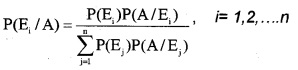
It is the process of formation of two types of haploid gametes – male and female.

In some algae the two gametes have similar morphology, they are called as homogametes or isogametes.

Plus Two Botany Notes Chapter 1 Reproduction in Organisms 6

Plus Two Botany Notes Chapter 1 Reproduction in Organisms

Some sexually reproducing organisms produce the gametes of two morphologically distinct types (antherozoid or sperms egg or ovum). They are called as heterogametes.

Sexuality in organisms:
Both the male and female reproductive structures are present in the same plant, they are bisexual or on different plants, they are unisexual.

Homothallic and monoecious are used to denote the bisexual condition Eg-some fungi and plants. Heterothallic and dioecious are used to denote unisexual condition.
Plus Two Botany Notes Chapter 1 Reproduction in Organisms 7
In flowering plants, the unisexual male flower is staminate, i.e., bearing stamens, while the unisexual female flower is pistillate i.e bearing pistils.

In some flowering plants, both male and female flowers are present on the same individual (monoecious) eg- cucurbits and coconuts or on separate individuals (dioecious) eg- papaya and date palm.

Earthworms, sponge, tapeworm, and leech, etc. are bisexual animals that possess both male and female reproductive organs, they are called hermaphrodites.

Plus Two Botany Notes Chapter 1 Reproduction in Organisms 8

Plus Two Botany Notes Chapter 1 Reproduction in Organisms
Cell division during gamete formation:
Diploid parent that produces haploid gametes by reduction division meiotic division. But the haploid parent produces gametes by mitoticdivision.

Members of monera, fungi, algae, and bryophytes have haploid plant body, but pteridophytes, gymnosperms, angiosperms, and human beings have diploid parent body.

In diploid organisms, meiocytes undergo meiosis to form haploid gametes contain only one set of chromosomes.

b. Gamete Transfer:
In most organisms, male gamete is motile and the female gamete is stationary. But few fungi and algae both types of gametes are motile.

They need water as a medium through which the male gametes moves. In algae, bryophytes and pteridophytes. water is the medium through which the gamete transfer takes place.

In seed plants, pollen grains are the carriers of male gametes, and ovule have the egg. In dioecious animals the gametes are formed in different individuals and the organism have special mechanism for gamete transfer.

In bisexual, self-fertilising plants, e.g. peas, transfer of pollen grains to the stigma takes place when it come in contact with the stigma. But in cross pollinating plants pollination agency helps the transfer. Pollen grains germinate on the stigma and the pollen tubes carrying the male gametes reach the ovule and discharge male gametes near the egg.
Plus Two Botany Notes Chapter 1 Reproduction in Organisms 9

Plus Two Botany Notes Chapter 1 Reproduction in Organisms
Plus Two Botany Notes Chapter 1 Reproduction in Organisms 10

2. Fertilisation:
It is the fusion of gametes. This process is called syngamy leads to the formation of a diploid zygote.

In rotifers, honeybees, some lizards and birds (turkey), the female gamete undergoes development to form new organisms without fertilisation. This phenomenon is called parthenogenesis.

In most aquatic organisms, such as algae, fishes and amphibians syngamy occurs outside the body of an organism (water) This type of gametic fusion is called external fertilisation.

For this, male partner release a large number of gametes into the surrounding medium (water). This is the case of bony fishes and frogs where a large number of offspring are produced.

One disadvantage is that the offspring are here prey, subjected to the attack of the predators. In terrestrial fungi, reptiles birds, mammals, and plants (bryophytes, pteridophytes, gymnosperms, and angiosperms), syngamy occurs inside the body of the organism, it is called internal fertilisation.

Here the male gamete is motile and has to reach the egg for fertilisation. In seed plants, the non-motile male gametes are carried to female gamete by pollen tubes.

3. Post-fertilisation Events:
It involves events afterthe formation of zygote.

a. The Zygote:
In fungi and algae, zygote develops a thick wall that is resistant to descication and damage. It undergoes a period of rest before germination.

Plus Two Botany Notes Chapter 1 Reproduction in Organisms

In organisms with haplontic life cycle, zygote divides by meiosis to form haploid spores that grow into haploid individuals.

Zygote is the vital link that maintains the continuity of species between organisms of one generation and the next.

b. Embrvoaenesis:
It is the process of development of embryo from the zygote. During embryogenesis, zygote undergoes cell division and cell differentiation (modifications to form specialised tissues and organs).

In oviparous animals like reptiles and birds, the fertilised eggs are covered by hard calcareous shell, it undergoes period of incubation and young ones hatch out.

On the other hand, in viviparous animals, the zygote develops into a young one inside the body of the female organism. Afterthe period of growth, they are delivered out.

In flowering plants, the zygote is formed inside the ovule. The sepals, petals and stamens of the flower wither and fall off.

Zygote develops into the embryo. The ovules develop into the seed. The ovary develops into the fruit which develops a thick wall called pericarp (protective).

Plus Two Botany Notes Chapter 1 Reproduction in Organisms

Kinds of fruits showing seeds and pericarp
Plus Two Botany Notes Chapter 1 Reproduction in Organisms 11

Plus Two Maths Notes Chapter 13 Probability

Students can Download Chapter 13 Probability Notes, Plus Two Maths Notes helps you to revise the complete Kerala State Syllabus and score more marks in your examinations.

Kerala Plus Two Maths Notes Chapter 13 Probability

Introduction
In this chapter we study the concept of conditional probability, multiplication rule of probability and independence of events, Baye’s theorem, Probability distribution and its mean and variance, Bernoulli Trials, Binomial Distribution, and its mean and variance.

Plus Two Maths Notes Chapter 13 Probability

A. Basic Concepts
I. Conditional Probability
Let A and B are two events associated with the sample space of a random experiment. The probability of occurrence of the event A that the event B has already happened is called Conditional Probability of A given B, denoted by P(A/B).
Plus Two Maths Notes Chapter 13 Probability 1
Properties:

  1. Let A and B be events of a sample space S of an experiment, then P(S/A) = 1, P(A/A) = 1
  2. If A and B are two events of a sample space S and E is an event of S such that P(E) ≠ 0, then P((A U B)/E) = P(A/E) + P(B/E) – P((A ∩ B)/E)
  3. P(A’/B) = 1 – P(A/B).

II. Multiplication Theorem
If A and B be two events associated with a random experiment, then

  1. P(A ∩ B) = P(B) × P(A/B), if P(B) ≠ 0
  2. P(A ∩ B) = P(A) × P(B/A), if P(A) ≠ 0

P(A ∩ B ∩ C) = P(A) × P(B / A) × P(C /(A ∩ B)).

Plus Two Maths Notes Chapter 13 Probability

III. Independent Events
Two events are said to be independent if the probability of occurrence of any one of the event does not affect the occurrence of the other.

  1. P(A/B) = P(A)
  2. P(A ∩ B) = P(A) × P(B)
  3. P(A ∩ B ∩ C) = P(A) × P(B) × P(C)
  4. Two events associated with a random experiment cannot be both mutually exclusive and independent.
  5. If P(A ∩ B) ≠ P(A) × P(B), the A and B are dependent events.
  6. If A and B are independent events, then
    • A and \(\bar{B}\) are independent events,
    • \(\bar{A}\) and \(\bar{B}\) are independent events.

IV. Theorem of total probability
Let {E1, E2,…., En}be a partition of the sample space S, and suppose that each of the events E1, E2, …., En has nonzero probability of occurrence. Let A be any event associated with S, then
P(A) = P(E1)P(A/E1) + P(E2)P(A/E2) +…….+ P(En)P(A/En)
= \(\sum_{i=1}^{n}\)P(Ei)P(A/Ei).

Plus Two Maths Notes Chapter 13 Probability

V. Baye’s Theorem
If E1, E2,…., En are n non-empty events which constitute a partition of sample space S, then
Plus Two Maths Notes Chapter 13 Probability 2

VI. Probability Distribution
The Probability Distribution of a random variable X is the system of numbers
Plus Two Maths Notes Chapter 13 Probability 3
Where the real numbers x1, x2,…….., xn are the possible values of the random variable X and p1, p2,……, Pn is the probability of the each possible values of the random variable X.
P1 + P2+…….+Pn = 1 and 0 ≤ pt ≤ 1.

  1. The mean of the above Probability Distribution is denoted by µ, is also called Expectation of X.
    ie; Mean = µ = E(X) = \(\sum_{i=1}^{n}\)xipi
  2. The Variance of the above Probability Distribution is denoted by σ2,
    ie; Variance = σ2 = E(X2) – [E(X)]2

Plus Two Maths Notes Chapter 13 Probability 4

Plus Two Maths Notes Chapter 13 Probability

VII. Bernoulli Trial
Trials of a random experiment are called Bernoulli trial, if it satisfies the following conditions:

  1. There should be a finite number of trials.
  2. The trials should be independent.
  3. Each trial has exactly two outcomes: success or failure.
  4. The probability of success remains the same in each trial.

VIII. Binomial Distribution
Binomial Distribution, denote by B(n, p) is given (p + q)n where p represents probability of success, q represent probability of failure and n represents the number of trials. The probability of x success is
P(X = x) = nCxqn – xpx.

  1. Mean = np
  2. Variance = npq
  3. Standard Deviation = \(\sqrt{n p q}\).

Plus Two Maths Notes Chapter 12 Linear Programming

Students can Download Chapter 12 Linear Programming Notes, Plus Two Maths Notes helps you to revise the complete Kerala State Syllabus and score more marks in your examinations.

Kerala Plus Two Maths Notes Chapter 12 Linear Programming

Introduction
A special class of optmisation problems such as finding maximum profit, minimum cost, or minimum use of resources, etc, is Linear Programming Problems. In this chapter we study some linear programming problems and their solutions graphically.

Plus Two Maths Notes Chapter 12 Linear Programming

A. Basic Concepts
A linear Programming Problem is one that is concerned with finding the optimal value (maximum or minimum) of a linear function of several variables (called the objective function) subject to the conditions that the variables are non-negative and satisfy a set of linear inequalities (called linear constraints). Variables are sometimes called decision variables and are non-negative.
A few important LPP are;

  • Diet Problem.
  • Manufacturing Problem.
  • Transportation Problem.

1. The common region determined by the constraints including the non-negative constraints x ≥ 0, y ≥ 0 of a LPP is called the feasible region.

2. Points within and on the boundary of the feasible region represents feasible solution of the constraints. Any point outside the feasible region is an infeasible solution.

3. Any point in the feasible region that gives the optimal value (maximum or minimum) of the objective function is called an optimal solution.

Plus Two Maths Notes Chapter 12 Linear Programming

I. Corner point Method

  1. Find the feasible region of the LPP and determine its corner points (vertices).
  2. Evaluate the objective function Z = ax + by at each corner points. Let M and m be the maxjmum and minimum values at these points.
  3. If the feasible region is bounded, M, and m respectively are the maximum and minimum values of the objective function.
  4. If the feasible region is unbounded, then
    • M is the maximum value of the objective function, if the open half-plane determined by ax + by > M has no points in common with the feasible region. Otherwise the objective function no maximum value.
    • m is the minimum value of the objective function, if the open half-plane determined by ax + by < m has no point in common with the feasible region. Otherwise, the objective function has no minimum value.

Plus Two Maths Notes Chapter 11 Three Dimensional Geometry

Students can Download Chapter 11 Three Dimensional Geometry Notes, Plus Two Maths Notes helps you to revise the complete Kerala State Syllabus and score more marks in your examinations.

Kerala Plus Two Maths Notes Chapter 11 Three Dimensional Geometry

Introduction
To refer a point in space we require a third axis (say z-axis) which leads to the concept of three dimensional geometry. In this chapter we study the concept of direction cosines, direction ratios, equation of a line and a plane, angle between two lines and two planes, angle between a line and a plane, shortest distance between two skew lines, distance of a point from a plane.

Plus Two Maths Notes Chapter 11 Three Dimensional Geometry

Basic concepts
I. Direction cosines and direction ratios
Consider a directed line passing through the origin makes angles α, β, and γ with the positive
direction x-axis, y-axis, and z-axis. Then α, β, and γ are called direction angles. The cosine of α, β, and γ are called direction cosines. Generally cos α = l, cos β = m and cos γ = n . Any scalar multiple of direction cosines are called direction ratios.

1. If (a, b, c) is the coordinate of a point P then a,b,c is a direction ratio of the directed line passing along P and origin. Direction cosines will be
Plus Two Maths Notes Chapter 11 Three Dimensional Geometry 1

2. l2 + m2 + n2 = 1

3. Direction ratios of a line segment passing through two points(x1, y1, z1) and(x2, y2, z2) is
x2 – x1, y2 – y1, z1 – z2

4. The angle between two lines having direction ratios a1, b1, c1 and a2, b2, c2 is
Plus Two Maths Notes Chapter 11 Three Dimensional Geometry 2

5. If direction ratios are proportional then the lines a, b, c, are parallel.ie; \(\frac{a_{1}}{a_{2}}=\frac{b_{1}}{b_{2}}=\frac{c_{1}}{c_{2}}\).

6. If a1a2 + b1b2 + c1c2 = 0 then the two lines are perpendicular.

Plus Two Maths Notes Chapter 11 Three Dimensional Geometry

II. Line in Space
Equation of line when a point and parallel direction ratios are given:
1. Vector equation:
\(\bar{r}=\bar{a}+\lambda \bar{b}\), where \(\bar{a}\) is a point, \(\bar{b}\) is a parallel vector and λ is a parameter, for different values of λ we get parallel lines.

2. Cartesian equation:
Plus Two Maths Notes Chapter 11 Three Dimensional Geometry 3
where (x1, y1, z1) is a point and a, b, c is a parallel direction ratios.

Equation of line when two points are given:
1. Vector equation:
\(\bar{r}=\bar{a}+\lambda(\bar{b}-\bar{a})\), where \(\bar{a}\) and \(\bar{b}\) are points and λ is a parameter, for different values of λ we get parallel lines.

2. Cartesianequation:
Plus Two Maths Notes Chapter 11 Three Dimensional Geometry 4
where(x1, y1, z1) and (x2, y2, z2) are two points.

Angle between two lines:
1. Vector form:
Plus Two Maths Notes Chapter 11 Three Dimensional Geometry 5
be two lines and θ be the angle between them, then cosθ =
Plus Two Maths Notes Chapter 11 Three Dimensional Geometry 6

Plus Two Maths Notes Chapter 11 Three Dimensional Geometry

  • If parallel \(\overline{b_{1}}=k \overline{b_{2}}\), k scalar.
  • If perpendicular \(\overline{b_{1}} \overline{b_{2}}\) = 0.

2. Cartesian form:
Plus Two Maths Notes Chapter 11 Three Dimensional Geometry 7
Plus Two Maths Notes Chapter 11 Three Dimensional Geometry 7a
be two lines and θ be the angle between them, then
Plus Two Maths Notes Chapter 11 Three Dimensional Geometry 8

  • If parallel \(\frac{a_{1}}{a_{2}}=\frac{b_{1}}{b_{2}}=\frac{c_{1}}{c_{2}}\)
  • If perpendicular a1a2 + b1b2 + c1c2 = 0.

Shortest distance between skew lines:
Lines which are neither interesting nor parallel are known as skew lines. Shortest distance between two skew lines is
1. Vector form:
Plus Two Maths Notes Chapter 11 Three Dimensional Geometry 9
be two skew lines, then d =
Plus Two Maths Notes Chapter 11 Three Dimensional Geometry 10

Plus Two Maths Notes Chapter 11 Three Dimensional Geometry

2. Cartesian form:
Plus Two Maths Notes Chapter 11 Three Dimensional Geometry 11
Plus Two Maths Notes Chapter 11 Three Dimensional Geometry 12

3. Distance between parallel lines,
Plus Two Maths Notes Chapter 11 Three Dimensional Geometry 13

Plus Two Maths Notes Chapter 11 Three Dimensional Geometry

III. Plane in space
Normal Form:
1. Vector Equation:
\(\bar{r}\).\(\hat{n}\) = d, where \(\hat{n}\) is a unit vector perpendicular to the Plane, and d is the perpendicular distance of the Plane from the origin. The general vector equation of a Plane is \(\bar{r} \bar{m}=d\), where \(\bar{m}\) is any vector perpendicular to the plane and cfis a constant.

2. Cartesian equation:
lx + my + nz = d, where l, m, n are direction cosines perpendicular to the Plane and dis the perpendicular distance of the Plane from the origin. The general cartesian equation of a Plane is ax + by + cz = d, where a, b, c are direction ratios perpendicular to the plane, and d is a constant.

Equation of plane when a point and a perpendicular vector is given:
1. Vector Equation:
\((\bar{r}-\bar{a}) \bar{m}=d\), where \(\bar{m}\) is a vector perpendicular to the Plane and \(\bar{a}\) is a point on the plane.

2. Cartesianequation:
a(x – x1) + b(y – y1) + c(z – z1) = d, where a, b, c are direction ratios perpendicular to the plane and (x1, y1, z1) is a point on the plane.

Plus Two Maths Notes Chapter 11 Three Dimensional Geometry

Equation of a plane passing through three non-collinear points:
1. Vector Equation:
\((\bar{r}-\bar{a}) \cdot[(\bar{b}-\bar{a}) \times(\bar{c}-\bar{a})]=0\), where \(\bar{a}, \bar{b}, \bar{c}\) are points on the plane.

2. Cartesian equation:
Plus Two Maths Notes Chapter 11 Three Dimensional Geometry 14
Where, (x1, y1, z1), (x2, y2, z2) and (x3, y3, z3) are points on the plane.

Plus Two Maths Notes Chapter 11 Three Dimensional Geometry

3. Intercept form of the equation of a Plane:
Let a, b, c are the x-intercept, y-intercept and z- intercept made by a plane, then the equation of x y z such a Plane is \(\frac{x}{a}+\frac{y}{b}+\frac{z}{c}=1\).

4. Angle between two Planes:
Angle between two planes is same as the angle between there perpendicular vectors.

5. Vector Form:
Plus Two Maths Notes Chapter 11 Three Dimensional Geometry 15
be two Planes and θ be the angle between them, then cos θ
Plus Two Maths Notes Chapter 11 Three Dimensional Geometry 16

6.
(i) if parallel \(\overline{m_{1}}=k \overline{m_{2}}\), k scalar.
(ii) if perpendicular \(\bar{m}_{1} \overline{m_{2}}\) = 0

7. Cartesian form:
a1x + b1y + c1z = d1, a2x + b2y + c2z = d2 be two lines and θ be the angle between them, then
Plus Two Maths Notes Chapter 11 Three Dimensional Geometry 17

  • If parallel \(\frac{a_{1}}{a_{2}}=\frac{b_{1}}{b_{2}}=\frac{c_{1}}{c_{2}}\)
  • If perpendicular a1a2 + b1b2 + c1c2 = 0

Angle between a line and a Plane:
Plus Two Maths Notes Chapter 11 Three Dimensional Geometry 18

Plus Two Maths Notes Chapter 11 Three Dimensional Geometry

Plane passing through the intersection of two given planes:
The equation of family of Planes passing through the intersection of the Planes a1x + b1y + c1z = d1 and a2x + b2y + c2z = d2 is a1x + b1y + c1z – d1 + λ(a2x + b2y + c2z – d) = 0.

Distance of a point from a Plane:
The perpendicular distance of the point (x1, y1, z1) from a Plane ax + by + cz = d is
Plus Two Maths Notes Chapter 11 Three Dimensional Geometry 19

The distance between parallel Planes ax + by + cz = d1 and ax + by + cz = d2 is
Plus Two Maths Notes Chapter 11 Three Dimensional Geometry 20

Plus Two Maths Notes Chapter 10 Vector Algebra

Students can Download Chapter 10 Vector Algebra Notes, Plus Two Maths Notes helps you to revise the complete Kerala State Syllabus and score more marks in your examinations.

Kerala Plus Two Maths Notes Chapter 10 Vector Algebra

Introduction
Physical quantities we deal are of two types, one that can be specified using a single real number which gives its magnitude and the other which involves the idea of direction as well as magnitude. The first type is called scalar quantity and the second is vector quantity. In this chapter we analyses the basic concepts about vectors, various operations, and their algebraic and geometrical properties.

Plus Two Maths Notes Chapter 10 Vector Algebra

I. Types of vectors

  1. Equal Vectors: Vectors having same magnitude and direction regardless of the positions of their initial points.
  2. Collinear Vectors: Vectors which are parallel to the same line, irrespective of their magnitude and direction.
  3. Like and Unlike Vectors: Collinear vectors having same direction are like vectors and opposite direction are unlike vectors.
  4. Unit Vectors: Vectors with magnitude unity.

II. Component form of a vector
Let i, j, k be the unit vectors along the x-axis, y-axis, z-axis respectively. The point P(x, y, z) be a point in space. Then the position vector of the point P can be expressed in component form as
Plus Two Maths Notes Chapter 10 Vector Algebra 11. If li + mj + nk is unit vector, then l,m,n are direction cosines along the vector.
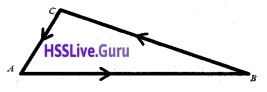
2. If P (a, b, c) is a point on space, then a, b, c are direction ratios and
Plus Two Maths Notes Chapter 10 Vector Algebra 2
are direction cosines along the vector \(\overline{O P}\).

III. Addition of Vectors
Plus Two Maths Notes Chapter 10 Vector Algebra 3
\(\overline{A B}+\overline{B C}+\overline{C A}=\overline{0}\) is known as triangle law of vector addition.
Plus Two Maths Notes Chapter 10 Vector Algebra 4

Plus Two Maths Notes Chapter 10 Vector Algebra

IV. Multiplication of a vector by a scalar
Let \(\bar{a}\) = a1i + a2j + a3k be a vector and λ be a scalar. Then the product of the vector \(\bar{a}\) by a scalar is denoted by λ\(\bar{a}\) and the new vector formed has a magnitude λ|\(\bar{a}\)|.
λ\(\bar{a}\) = λa1i + λa2j + λa3k

V. Vector joining two points
If P(a1, a2, a3) and Q(b1, b2, b3) are two points, then the vector joining P and Q is the vector \(\overline{P Q}\).
ie: \(\overline{P Q}\) = (b1 – a1)i + (b2 – a2)j + (b3 – a3)k

VI. Section Formula
If \(\bar{a}\) and \(\bar{b}\) be the position vectors of the points A and B respectively, then the position vector of the point P which divides AB in the ratio l:m
Plus Two Maths Notes Chapter 10 Vector Algebra 5

Plus Two Maths Notes Chapter 10 Vector Algebra

VII. Dot (Scalar) Product of vectors
Plus Two Maths Notes Chapter 10 Vector Algebra 6
Plus Two Maths Notes Chapter 10 Vector Algebra 7
Plus Two Maths Notes Chapter 10 Vector Algebra 8

Plus Two Maths Notes Chapter 10 Vector Algebra 10
Plus Two Maths Notes Chapter 10 Vector Algebra 9

VIII. Cross (vector) Product of Vectors
Plus Two Maths Notes Chapter 10 Vector Algebra 10
Plus Two Maths Notes Chapter 10 Vector Algebra 11

Plus Two Maths Notes Chapter 10 Vector Algebra
Geometrical meaning of vector product.

  • \(\bar{a} \times \bar{b}\) is a vector perpendicular to \(\bar{a}\) and \(\bar{b}\).
  • \(|\bar{a} \times \bar{b}|\) gives the area of a parallelogram with adjacent sides \(\bar{a}\) and \(\bar{b}\).

Plus Two Maths Notes Chapter 10 Vector Algebra 12
Plus Two Maths Notes Chapter 10 Vector Algebra 13

  • i × i = j × j = k × k = 0,
  • i × j = k, j × k = i, k × i = j
  • j × i = -k, k × j = -i, i × k = -j

Plus Two Maths Notes Chapter 10 Vector Algebra

IX. Box (Scalar Triple) Product of Vectors
Plus Two Maths Notes Chapter 10 Vector Algebra 14
Properties:
1. Since \(\bar{b} \times \bar{c}\) is a vector, \([\bar{a} \bar{b} \bar{c}]\) is a scalar quantity.

2. |\([\bar{a} \bar{b} \bar{c}]\)| is the volume of the parallelopiped with a adjacent sides vector \(\bar{a}, \bar{b}, \bar{c}\).

3. If \(\bar{a}\) = a1i + a2j + a3k; \(\bar{b}\) = b1i + b2j + b3k and \(\bar{c}\) = c1i + c2j + c3k, then
Plus Two Maths Notes Chapter 10 Vector Algebra 15

4. if \(\bar{a}, \bar{b}, \bar{c}\) be any three vectors, then \([\bar{a} \bar{b} \bar{c}]\) = \([\bar{b} \bar{c} \bar{a}]=[\bar{c} \bar{a} \bar{b}]\) (cyclic permutation of three vectors does not change the value of the scalar triple product).

5. In scalar triple product, the dot and cross can be interchanged.ie,
Plus Two Maths Notes Chapter 10 Vector Algebra 16

Plus Two Maths Notes Chapter 10 Vector Algebra

6. If any two vectors are interchanged the sign of box product is changed but magnitude remains the same.
Plus Two Maths Notes Chapter 10 Vector Algebra 17

7. If any two vectors are equal or proportional then the value of box product is zero.

8. Three vectors \(\bar{a}, \bar{b}, \bar{c}\) are coplanar if and only if \([\bar{a} \bar{b} \bar{c}]\) = 0.

Plus Two Maths Notes Chapter 9 Differential Equations

Students can Download Chapter 9 Differential Equations Notes, Plus Two Maths Notes helps you to revise the complete Kerala State Syllabus and score more marks in your examinations.

Kerala Plus Two Maths Notes Chapter 9 Differential Equations

Introduction
An equation involving derivatives of a dependent variable with respect to one or more independent variables is called a Differential Equation. In this chapter we study the method formation of a Differential Equation and solving of a Differential Equation.

I. Degree and Order of a DE
Order of a DE is defined as the order of the highest order derivative of the dependent variable with respect to the independent variable involved in the given DE.

Degree of a DE is defined as the exponent of highest differential coefficient appearing in the equation provided the equation is made into polynomial form in all differential coefficient.

Plus Two Maths Notes Chapter 9 Differential Equations

II. Formation of a DE
To form a DE from a given function we differentiate the function successively as many times as the number of arbitrary constants in the equation and eliminate the arbitrary constant.

III. Solution of a DE
1. Variable Separable Type:
A DE of the form mdx = ndy Where m is a function in x alone or a constant and n is a function y alone or a constant.
Solution is ∫mdx = ∫ndy + c.

2. Homogeneous DE:
A DE of the form \(\frac{d y}{d x}=\frac{f(x, y)}{g(x, y)}\), where f(x, y) and g(x, y) are homogeneous equations in x and y. Solution is put y = vx ⇒ \(\frac{d y}{d x}=v+x \frac{d v}{d x}\) after simplification DE will be converted into variable separable type.

Plus Two Maths Notes Chapter 9 Differential Equations

3. Linear DE:
A DE of the form \(\frac{d y}{d x}\) + Py = Q, where P and Q dx are function in x alone or a constant.
Solution is IF = e∫Pdx
⇒ y(IF) = ∫Q(IF)dx + c.

A DE of the form \(\frac{d x}{d y}\) + px = Q, where P and Q are function in y alone or a constant.
Solution is IF = e∫Pdy
⇒ x(IF) = ∫Q(IF)dy + c.

Plus Two Maths Notes Chapter 8 Application of Integrals

Students can Download Chapter 8 Application of Integrals Notes, Plus Two Maths Notes helps you to revise the complete Kerala State Syllabus and score more marks in your examinations.

Kerala Plus Two Maths Notes Chapter 8 Application of Integrals

Introduction
In this chapter we study the specific application of definite integrals to find the area under simple curves, area between lines and arcs of circles, parabolas, and ellipses.

Plus Two Maths Notes Chapter 8 Application of Integrals

Area under Simple Curves
Area = \(\int_{a}^{b}\)f(x)dx = \(\int_{a}^{b}\)ydx
Plus Two Maths Notes Chapter 8 Application of Integrals 1
Area = \(\int_{a}^{b}\)f(y)dy = \(\int_{a}^{b}\)xdy
Plus Two Maths Notes Chapter 8 Application of Integrals 2

Plus Two Maths Notes Chapter 8 Application of Integrals
Area = \(\int_{a}^{c}\)f(x)dx – \(\int_{c}^{b}\)f(x)dx
Plus Two Maths Notes Chapter 8 Application of Integrals 3
Area = \(\int_{a}^{b}\)f2(x)dx – \(\int_{a}^{b}\)f1(x)dx
Plus Two Maths Notes Chapter 8 Application of Integrals 4

Plus Two Maths Notes Chapter 7 Integrals

Students can Download Chapter 7 Integrals Notes, Plus Two Maths Notes helps you to revise the complete Kerala State Syllabus and score more marks in your examinations.

Kerala Plus Two Maths Notes Chapter 7 Integrals

Introduction
Integration is the reverse process of differentiation. The development of integral calculus is outcome of the efforts to solve the problems to find the function when its derivative is given and to find the area bounded by the graph of a function under certain conditions. In this chapter we study different method of find indefinite integral and definite integrals of certain functions and its properties.

Plus Two Maths Notes Chapter 7 Integrals

A. Basic Concepts
I. Integration
Let \(\frac{d}{d x}\)F(x) = f(x). then we write ∫f(x)dx = F(x) + C.
These integrals are called indefinite integrals and C is the constant of integration.

  1. Indefinite integral is a collection of family of curves, each of which is obtained by translating one of the curves parallel to itself upward or downwards along the y-axis.
  2. ∫[f(x) ± g(x)]dx = ∫f(x)dx ± ∫g(x)dx
  3. For any real number k, ∫[kf(x)]dx = k∫f(x)dx

II. Some Standard Results

  • ∫xn dx = \(\frac{x^{n+1}}{n+1}\) + C
  • ∫\(\frac{1}{x}\)dx = log|x| + C
  • ∫exdx = ex + C
  • ∫axdx = \(\frac{a^{x}}{\log a}\) + C
  • ∫sin x dx = -cosx + C
  • ∫cos xdx = sin x + C
  • ∫sec2xdx = tanx + C
  • ∫cosecx cotx dx = -cosecx + C
  • ∫secx tanx dx = secx + C
  • ∫cosec2x dx = -cotx + C
  • ∫tan x dx = log|sec x| + C
  • ∫cot xdx = log|sin x| + C
  • ∫sec xdx = log|sec x + tan x| + C
  • ∫cosec x dx = log|cosec x – cot x| + C

Plus Two Maths Notes Chapter 7 Integrals

Plus Two Maths Notes Chapter 7 Integrals 1
Plus Two Maths Notes Chapter 7 Integrals 2

Plus Two Maths Notes Chapter 7 Integrals

III. Some methods of Integration
1. If \(\frac{d}{d x}\) F(x) = f (x) and ∫f(x)dx = F(x) + C then ∫f(ax + b)dx = \(\frac{1}{a}\) F(ax + b) + C.

2. ∫[f(x)]n f'(x)dx = \(\frac{[f(x)]^{n+1}}{n+1}\) + C
\(\int \frac{f^{\prime}(x)}{f(x)} d x\) = log[f(x)| + C

3. ∫ex[f(x) + f'(x)]dx = exf(x) + C

4. Substitution Method:
The given integral I = ∫f(x)dx is transformed into another form by changing the independent variable x to t by substituting x = g(t). So that \(\frac{d x}{d t}\) = g'(t) ⇒ dx = g'(t)dt
∴ I = ∫f(x)dx = ∫f(g(t))g'(t)dt.

5.
Plus Two Maths Notes Chapter 7 Integrals 3

6.
Plus Two Maths Notes Chapter 7 Integrals 4

Plus Two Maths Notes Chapter 7 Integrals

7. Integration using partial fractions:
Consider Integrals of the form ∫\(\frac{P(x)}{Q(x)}\)dx, where P(x) and Q(x) are polynomials in x and Q(x) ≠ 0. If the degree of P(x) is less than Q(x), then the rational function is proper function otherwise improper function.

If \(\frac{P(x)}{Q(x)}\) is improper function, first it should be converted to proper by long division and now it takes the form \(\frac{P(x)}{Q(x)}\) = T(x) + \(\frac{P_{1}(x)}{Q(x)}\) Where T(x) is polynomial in x and \(\frac{P_{1}(x)}{Q(x)}\) is a proper function.

Now if \(\frac{P(x)}{Q(x)}\) is proper function we factorise the denominator Q(x) into simpler polynomials and decompose into simpler rational function. For this we use the following table.

8.
Plus Two Maths Notes Chapter 7 Integrals 5

9. Integration by Parts:
∫f(x)g(x)dx = f(x)∫g(x)dx – ∫(f'(x) ∫g(x)dx)dx
Here the priority of taking first function and second function is more important, for this use order of the letters in words ILATE, where

    • I- Inverse Trigonometric Function.
    • L – Logarithmic Function.
  • A – Algebraic Function.
  • T -Trigonometric Function.
  • E – Exponential Function.

Plus Two Maths Notes Chapter 7 Integrals

IV. Definite Integral
A definite integral has a unique value. A definite integral is denoted by \(\int_{a}^{b}\)f(x)dx, where a is the upper limit and b is the lower limit of the integral. If \(\frac{d}{d x}\) F(x) = f(x) and ∫f(x)dx = F(x) + C , then
\(\int_{a}^{b}\)f(x)dx = F(b) – F(a).

1. Definite integral as the sum of a limit:
Let f(x) be continuous function defined on a closed interval [a, b]. Then \(\int_{a}^{b}\)f(x)dx is area bounded by the curve y = f(x), the ordinates x = a, x = b and the x-axis.
Plus Two Maths Notes Chapter 7 Integrals 6
Plus Two Maths Notes Chapter 7 Integrals 7

Plus Two Maths Notes Chapter 7 Integrals
Plus Two Maths Notes Chapter 7 Integrals 8

Plus Two Maths Notes Chapter 6 Application of Derivatives

Students can Download Chapter 6 Application of Derivatives Notes, Plus Two Maths Notes helps you to revise the complete Kerala State Syllabus and score more marks in your examinations.

Kerala Plus Two Maths Notes Chapter 6 Application of Derivatives

Introduction
In this chapter we analyses the physical and geometrical applications of derivatives in real life such as to determine rate of change, to find tangents and normal to a curve, to find turning points, intervals in which the curve is increasing and decreasing, to find approximate value of certain quantities.

I. Rate of Change
\(\frac{d y}{d x}\), we mean the rate of change of y with respect to x. If s is the displacement function in terms of time t and v the velocity at that time. Then, \(\frac{d s}{d t}\) = velocity, Acceleration = \(\frac{d v}{d t}=\frac{d^{2} s}{d t^{2}}\)

Plus Two Maths Notes Chapter 6 Application of Derivatives

II. Tangents and Normals
If a tangent line to the curve y = f(x) makes an angle θ with the positive direction of the x-axis, then f'(x) = slope of the tangent = tanθ.
Equation of tangent to the curve y = f (x) at the point (x1, y1): y – y1 = f'(x1)(x – x1)
Equation of normal to the curve y = f (x) at the point (x1, y1): y – y1 = –\(\frac{1}{f^{\prime}\left(x_{1}\right)}\)(x – x1)

III. Increasing and decreasing functions
Nature of a function on a given interval;
Strictly increasing on [a, b]: f'(x) > 0, x ∈ (a, b) Increasing on [a, b]: f'(x) ≥ 0, x ∈ (a, b)
Strictly decreasing on [a, b]: f'(x) < 0, x ∈ (a, b) Decreasing on[a, b]: f'(x) ≤ 0, x ∈ (a, b).
1. Between two consecutive points at which f'(x) = 0 the function has only one nature either it is increasing or decreasing, not both.

IV. Approximation
Consider a function y = f(x). Let ∆x denote a small increment in x and ∆y be the corresponding increment in y. Then, ∆y can be approximated by dy, where dy = \(\frac{d y}{d x}\) × ∆x.

Plus Two Maths Notes Chapter 6 Application of Derivatives

V. Maxima and Minima
A function y = f(x) is said to have a local maximum at x = a, if f(a) is the maximum value obtained by the function in the neighbourhood of x = a.

A function y = f(x) is said to have a local minimum at x = a, if f(a) is the minimum value obtained by the function in the neighbourhood of x = a.

Point on the curve at which f'(x) = 0 is called stationary point or turning point. The following are methods to find the local maximum and local minimum at points where f'(x) = 0.

First Derivative Test:

  1. If f'(c) = 0 and f'(x)changes its sign from positive to negative from left to right of x = c, then the point is a local maximum point.
  2. If f'(c) = 0 and f'(x) changes its sign from negative to positive from left to right of x = c, then the point is a local minimum point.
  3. If f'(c) = 0 and if there is no change of sign for f'(x) from left to right of x = c, then the point is a inflexion point.

Second Derivative Test:

  1. If f'(c) = 0 and f”(c) < 0 , then x = c is a local maximum point.
  2. If f'(c) = 0 and f”(c) > 0, then x = c is a local minimum point.
  3. If f'(c) = 0 and f”(c) = 0, then the test fails and go to first derivate test for checking maxima and minima.

Plus Two Maths Notes Chapter 6 Application of Derivatives

Absolute Maxima and Minima:
Let f(x) be a function defined on [a, b] and if , f'(x) = 0 ⇒ x = x1, x2, x3,……etc, then

  1. Absolute maximum value of
    = max{f(a), f(x1), f(x2),…….f(b)}
  2. Absolute minimum value of
    = min{f(a), f.(x1), f(x2),…..f(b)}

Plus Two Maths Notes Chapter 5 Continuity and Differentiability

Students can Download Chapter 5 Continuity and Differentiability Notes, Plus Two Maths Notes helps you to revise the complete Kerala State Syllabus and score more marks in your examinations.

Kerala Plus Two Maths Notes Chapter 5 Continuity and Differentiability

Introduction
As a continuation of limits and derivatives studied in the previous years, now we are entering into a very important concept continuity and its graphical peculiarities. We also learn different methods of differentiation and introduce new class of functions such as exponential and logarithmic functions.

I. Continuity
Continuity of a function at a point
A function f(x) is said to be continuous at a point ‘a’ if the following conditions are satisfied.

  1. f(a) should be defined.
  2. Left limit should be equal to right limit, ie; \(\lim _{x \rightarrow a^{-}}\)f(x) = \(\lim _{x \rightarrow a^{+}}\) f(x)
  3. f(a) should be equal to the limit of the function at ‘a’. \(\lim _{x \rightarrow a^{-}}\)f(x) = \(\lim _{x \rightarrow a^{+}}\) f(x) = f(a).

Plus Two Maths Notes Chapter 5 Continuity and Differentiability

Continuity of a function
A function f(x) is said to be continuousif the function is continuous at every point on its domain. Some standard continuous functions are mentioned below;

  1. Constant function f(x) = c, c-constant.
  2. Identity function f(x) = x.
  3. Modulus function f(x) = |x|.
  4. Exponential function f(x) = ex.
  5. Logarithmic function f(x) = log x.
  6. Polynomial function
    f(x) = a0 + a1x + a2x2 +…….+ anxn
  7. Rational function
    f(x) = \(\frac{p(x)}{q(x)}\), P(x) & q(x) are polynomial function and q(x) ≠ 0.
  8. Trigonometric and inverse trigonometric function.

Graphical approach:
If there is a break in the graph of a function then it is not continuous.

Algebra of Continuous functions
Suppose f and g be two real functions in their respective domains then the following are true.
1. f + g, f – g, f.g, \(\frac{f}{g}\) [g(x) ≠ 0], fog, gof are all continuous functions.

Plus Two Maths Notes Chapter 5 Continuity and Differentiability

II. Differentiability
Differentiability at a point:
A function f(x) is said to be differentiable at a point ‘c’ if the following limit exists and the value of the limit is known as the first derivative of f(x) at
x = c denoted by f'(c) or \(\left(\frac{d y}{d x}\right)_{x=c}\)
Plus Two Maths Notes Chapter 5 Continuity and Differentiability 1

Derivative of a function:
The function defined by f'(x) = \(\lim _{h \rightarrow 0} \frac{f(x+h)-f(x)}{h}\)
wherever the limit exists is defined to be the derivative of f. The derivative of f is denoted by
f ‘(x) or \(\frac{d y}{d x}\) or y’ or y1
1. Every differentiable function is continuous. But the converse need not be.true, eg; f(x) = |x|.

Some Standard Results:
Plus Two Maths Notes Chapter 5 Continuity and Differentiability 2

Plus Two Maths Notes Chapter 5 Continuity and Differentiability
Plus Two Maths Notes Chapter 5 Continuity and Differentiability 3
Plus Two Maths Notes Chapter 5 Continuity and Differentiability 4
Algebra of derivatives:
Let f(x) and g(x) be two differentiable functions, then
1. \(\frac{d}{d x}\) (f(x) ± g(x)) = \(\frac{d}{d x}\)f(x) ± \(\frac{d}{d x}\) g(x).

2. Product Rule:
\(\frac{d}{d x}\)(f(x).g(x)) = \(\frac{d}{d x}\) f(x) × g(x) + f(x) × \(\frac{d}{d x}\) g(x)

3. Quotient Rule:
Plus Two Maths Notes Chapter 5 Continuity and Differentiability 5

Plus Two Maths Notes Chapter 5 Continuity and Differentiability

4. Chain Rule:
Let y be a real function which is a composite of two functions h(x) and g(x), ie; f(x) = h(g(x)) .then
\(\frac{d}{d x}\) f(x) = h'(g(x)) × g'(x).

5. Implicit Differentiation:
Here differentiate both sides of the function with respect to × and solve for \(\frac{d y}{d x}\).

6. Logarithmic Differentiation:
Function with are complicated Rational functions and of the form f(x) = u(x)v(x) is differentiated using Logarithmic Differentiation method. Here first take logarithm on both sides of the function and proceed as in implicit differentiation.

7. Parametric Differentiation:
Relation between two variable x and y which are expressed in the formx = f(t), y = g(t) is said to be parametric form with parameter t.
Here
Plus Two Maths Notes Chapter 5 Continuity and Differentiability 6

8. Second Order Derivative:
If f'(x) is differentiable we may differentiate once again with respect to x.
Then, \(\frac{d}{d x}\left(\frac{d y}{d x}\right)\) is called the Second Derivate of f with respective to x, denoted by \(\frac{d^{2} y}{d x^{2}}\) or f”(x) or y2 or y”.

Plus Two Maths Notes Chapter 5 Continuity and Differentiability

III. Rolle’s theorem
Let f: [a, b] → R be a continuous function on [a, b] and differentiable on (a, b), such that f(a) = f(b) , where a and b are some real numbers. Then there exists some c ∈ (a, b) such that f'(c) = 0.

IV. Mean Value theorem
Let f: [a, b] → R be a continuous function on [a, b]and differentiable on (a, b). Then there
exists some c ∈ (a, b) such that f’(c) = \(\frac{f(b)-f(a)}{b-a}\).