Plus Two Maths Notes Chapter 4 Determinants

Students can Download Chapter 4 Determinants Notes, Plus Two Maths Notes helps you to revise the complete Kerala State Syllabus and score more marks in your examinations.

Kerala Plus Two Maths Notes Chapter 4 Determinants

Introduction
Determinants have wide applications in engineering, Science, Economics, Social Science, etc. In this chapter we study about the various properties of determinants, minors, cofactors, applications in finding the area of triangle, adjoint, and inverse of a square matrix, and consistency and in consistency of linear equations.

Plus Two Maths Notes Chapter 4 Determinants

A. Basic Concepts
I. Determinant
Determinant is a real number associated with a square matrix. The determinant of matrix A is denoted by |A|. The value of a determinant is obtained by the sum of products of elements of a row (column) with corresponding cofactors.

  • |AB| = |A||B|
  • |An| = |A|n

Properties:
(i) The value of a determinant remains the same if its rows and columns are interchanged.
ie; |AT| = |A|.

(ii) If any two rows (or columns) of a determinant are interchanged, then sign of determinant changes.
Plus Two Maths Notes Chapter 4 Determinants 1

(iii) If any two rows (or columns) of a determinant is identical, then value of determinant is zero.
Plus Two Maths Notes Chapter 4 Determinants 2

(iv) If each element of a row (or columns) of a determinant is multiplied by a constant k, then its value gets multiplied by k.
Plus Two Maths Notes Chapter 4 Determinants 3
(a) If A is a square matrix of order n, then
|KA| = kn|A|

Plus Two Maths Notes Chapter 4 Determinants

(v) If any two rows (or columns) of a determinant is proportional, then value of determinant is
zero.
Plus Two Maths Notes Chapter 4 Determinants 4

(vi) If some or all elements of a row or column of a determinant are expressed as sum of two (or more) terms, then the determinant can be expressed as sum of two (or more) determinants.
Plus Two Maths Notes Chapter 4 Determinants 5

(vii) If, to each element of any row or column of a determinant, the equimultiples of corresponding elements of other row (or column) are added, then value of determinant remains the same, ie; the value of determinant remains same if we apply the operation Ri → Ri + kRj or Ci → Ci + kCj.

(viii) If the elements of a row or column are multiplied with cofactors of any other row or column, then their sum is zero.
ie; for example; a11C21 + a12C22 + a13C23 = 0.

If the elements of a row or column are multiplied with cofactors of the corresponding row or column, then their sum is |A|.
ie; for example; a11C11 + a12C12 + a13C13 = |A|.

Plus Two Maths Notes Chapter 4 Determinants

1. Minor of an element:
The minor of an element aij is the determinant obtained by deleting the ith row and jth column, usually denoted by Mij.

2. Cofactor of an element:
A signed Minor is called cofactor, ie; Cij = (-1 )i + j Mij. The matrix obtained by replacing all elements by its cofactor is called cofactor matrix.

3. Adjoint Matrix:
The transpose of a cofactor matrix is. called Adjoint Matrix, usually denoted by adj(A)
Plus Two Maths Notes Chapter 4 Determinants 6
Properties:

  • A × adj(A) = adj(A) × A = I|A|
  • If A is a square matrix of order n, then |adj(A)| = |A|n – 1
  • adj(AB) = adj(A)adj(B)

II. Inverse of a Matrix
A square matrix A is invertible if |A| ≠ 0 and A inverse is denoted by A-1 ie; A-1 = \(\frac{a d j(A)}{|A|}\)
Properties:

  • (A-1)-1 = A
  • (AB)-1 = B-1A-1
  • (AT)-1 = (A-1)T
  • If A is a square matrix of order n, then adj(adj(A)) = |A|n-2 × A.

Plus Two Maths Notes Chapter 4 Determinants

III. Application of Determinants
1. Area of a triangle whose vertices are (x1, y1), (x2, y2), (x3, y3) is
Plus Two Maths Notes Chapter 4 Determinants 7
(i) If Area = 0 then the points are collinear.

2. Solving of system of linear equations using
matrix method:
Consider the system of linear equations
a1x + b1y + C1z = d1
a2x + b2y + c2z = d2
a3x + b3y + c3z = d3
Convert the linear equation into matrix form AX = B, where
Plus Two Maths Notes Chapter 4 Determinants 8
Then the solution is given by X = A-1B

  • If |A| ≠ 0 the system is consistent and has unique solution.
  • If |A| = 0 and adj(A) × B ≠ 0,the system is inconsistent and has no solution.
  • If |A| = Oandadj(A) × B = 0 ,the system may be consistent and has infinitely many solutions.

In order to find these infinitely many solutions, replace one of the variable by k (say z = k) and solve any two of the given equations for x and y in terms of k

Plus Two Maths Notes Chapter 3 Matrices

Students can Download Chapter 3 Matrices Notes, Plus Two Maths Notes helps you to revise the complete Kerala State Syllabus and score more marks in your examinations.

Kerala Plus Two Maths Notes Chapter 3 Matrices

Introduction
The term ‘matrix’ was first used in 1850 by the famous English Mathematician James Joseph Sylvester. In 1858 Arther Cayley began the Systematic development of the theory of matrices. Matrix was first used for the study of linear equations and linear transformations. Now it is largely used in disciplines like statistics, physics, chemistry, psychology, etc.

Plus Two Maths Notes Chapter 3 Matrices

A. Basic Concepts
I. Matrix
A matrix is an ordered rectangular array of numbers or functions. The numbers or functions are called the elements or the entries of the matrix.
1. Order of a Matrix:
A matrix having m rows and n column is called a matrix of order m × n, generally denoted by
Plus Two Maths Notes Chapter 3 Matrices 1
Where 1 ≤ i ≤ m, 1 ≤ j ≤ n  i, j ∈ N.

II. Types of Matrix

  • Column Matrix: A matrix having only one column is called Column Matrix.
  • Row Matrix: A matrix having only one row is called Row Matrix.
  • Square Matrix: A matrix having equal number of row and column is called Square Matrix.
  • Diagonal Matrix: A Square matrix having all its non-diagonal entries zero is called Diagonal Matrix.
  • Scalar Matrix: A Square matrix having all its non-diagonal entries zero and equal diagonal elements is called Scalar Matrix.
  • Identity Matrix: A Square matrix having all its non-diagonal entries zero and diagonal elements unity is called an Identity Matrix.
  • Zero Matrix: A matrix having all elements zero is called Zero Matrix.

Plus Two Maths Notes Chapter 3 Matrices

III. Operations on matrices
1. Equality of Matrices:
Two matrices are equal if they are of same order and corresponding elements are equal.

2. Addition:
Addition is possible only if the two matrices are of same order and the operation is done by adding the corresponding elements in each Matrix. The addition of Matrix A and B is denoted by A + B.
Properties:

  • Matrix addition is Commutative.
  • Matrix addition is Associative.
  • Zero Matrix is the additive identity.
  • – A is the additive inverse of matrix A.

3. Scalar Multiplication:
The multiplication of a matrix by a scalar number k is done by multiplying each entries of A by k and matrix thus obtained is kA.

4. Difference:
Difference is possible only if the two matrices are of same order and the operation is done by subtracting the corresponding elements in each Matrix. The difference of Matrix A and B is denoted by A – B.

5. Multiplication:
Multiplication is possible only if the number of column of first matrix is equal to the number of rows of the second. The operation is done by multiplying the element in the first row of the first matrix with the corresponding elements in the first column in the second matrix.

Plus Two Maths Notes Chapter 3 Matrices

This is continued till the rows in the first matrix finish. The multiplication of Matrix A and B is denoted by A × B or AB.
Properties:

  • Matrix multiplication is Non-Commutative.
  • Matrix multiplication is Associative, le; A(BC) = (AB)C
  • Matrix multiplication is Distributive over addition, ie; A(B + C) = AB + AC
  • Identity Matrix is the multiplicative identity, le; AI = IA.

IV. Transpose of a Matrix
The transpose of a matrix A is obtained by interchanging the row and column of A and is denoted by AT.
Properties:

  • [AT]T = A
  • [kA]T = kAT
  • [A + B]T = AT + BT
  • [AB]T = BT AT

1. Symmetric Matrix:
A square matrix is said to be symmetric if [A]T = A.
Properties:
In a symmetric matrix the corresponding elements on both sides of the main diagonal will be same.

2. Skew Symmetric Matrix:
A square matrix is said to be symmetric if [A]T = -A.
Properties:

  • In a Skew Symmetric matrix the corresponding elements on both sides of the main diagonal differ only in sign.
  • For any square matrix A with real entries, A + AT is Symmetric matrix, and A – AT is Skew Symmetric matrix.
  • Any square matrix can be expressed as the sum of a Symmetric and Skew symmetric matrix.
    ie; A = \(\frac{1}{2}\)(A + AT) + \(\frac{1}{2}\)(A – AT)
  • If A and B are Symmetric matrices of the same order, AB is Symmetric if and only if AB = BA.
  • If A and B are Symmetric matrices of the same order, (AB + BA) is Symmetric and (AB – BA) is Skew Symmetric.

Plus Two Maths Notes Chapter 3 Matrices

V. Elementary Operation on Matrix
There are 6 operations on matrix, 3 for row and 3 for column.

  1. The interchange of any two rows or two columns, symbolically denoted as Ri ↔ Rj or ci ↔ cj.
  2. The multiplication of the elements of any row or column by a non-zero number, symbolically
    denoted as Ri ↔ kRj or Ci ↔ kCj.
  3. The addition to the elements of any row or column, the corresponding elements of any other row or column multiplied by any non-zero number, symbolically denoted as Ri ↔ Ri + kRj or Ci ↔ Ci + kCj.

VI. Invertible Matrices
A square matrix B is said to be the inverse of a matrix A if AB = I = BA, then B is generally denoted
as A-1.

  1. Inverse of a square matrix, if it exists, is unique.
  2. If A and B are invertible matrices of the same order, then (AB)-1 = B-1A-1

Plus Two Maths Notes Chapter 2 Inverse Trigonometric Functions

Students can Download Chapter 2 Inverse Trigonometric Functions Notes, Plus Two Maths Notes helps you to revise the complete Kerala State Syllabus and score more marks in your examinations.

Kerala Plus Two Maths Notes Chapter 2 Inverse Trigonometric Functions

Introduction
Trigonometric functions are real functions which are not objective and thus its inverse does not exist. In this chapter we study about the restrictions on domains and ranges of trigonometric functions which ensure the existence of their inverse and observe its graphical peculiarities.

A. Concepts
I. Functions
sin-1 x : [-1, 1 ] → [-\(\frac{\pi}{2}\), \(\frac{\pi}{2}\)]
cos-1 x: [-1, 1] → [0, π]
tan-1 x : R → \(\left(-\frac{\pi}{2}, \frac{\pi}{2}\right)\)
cosec-1 x : R – (-1, 1) → [-\(\frac{\pi}{2}\), \(\frac{\pi}{2}\)] – {0}
sec-1 x : R -(-1, 1) → [0, π] – {\(\frac{\pi}{2}\)}
cot-1 x : R → (0, π)

Plus Two Maths Notes Chapter 2 Inverse Trigonometric Functions

II. Properties
1. sin (sin-1 x) = x, x ∈ [-1, 1]
sin-1(sinx) = x, x ∈ [-\(\frac{\pi}{2}\), \(\frac{\pi}{2}\)]
cos(cos-1 x) = x, x ∈ [-1, 1]
cos-1(cosx) = x, x ∈ [o, π]
tan(tan-1 x) = x, x ∈ R
tan-1(tan x) = x, x ∈ \(\left(-\frac{\pi}{2}, \frac{\pi}{2}\right)\)

2. sin-1(-x) = -sin-1(x), x ∈ [-1, 1]
tan-1(-x) = -tan-1(x), x ∈ R
cosec-1(-x) = -cosec-1(x), x ∈ R -(-1, 1)
cos-1(-x) = π – cos-1(x), x ∈ [-1, 1]
cot-1(-x) = π – cot-1(x), x ∈ R
sec-1(-x) = π – sec-1(x), x ∈ R -(-1, 1)
sin-1(x) + cos-1(x) = \(\frac{\pi}{2}\), x ∈ [-1, 1].

3. cosec-1(x) + sec-1(x) = \(\frac{\pi}{2}\), |x| ≥ 1
tan-1(x) + cot-1(x) = \(\frac{\pi}{2}\), x ∈ R

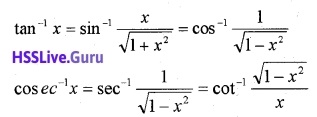
4. sin-1 x
Plus Two Maths Notes Chapter 2 Inverse Trigonometric Functions 1

Plus Two Maths Notes Chapter 2 Inverse Trigonometric Functions

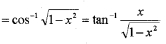
5. cos-1 x
Plus Two Maths Notes Chapter 2 Inverse Trigonometric Functions 2
Plus Two Maths Notes Chapter 2 Inverse Trigonometric Functions 3

6. tan-1(x) + tan-1(y) =
Plus Two Maths Notes Chapter 2 Inverse Trigonometric Functions 4

7. tan-1(x) – tan-1(y) =
Plus Two Maths Notes Chapter 2 Inverse Trigonometric Functions 5

Plus Two Maths Notes Chapter 2 Inverse Trigonometric Functions

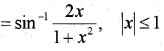
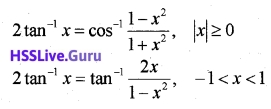
8. 2 tan-1 x
Plus Two Maths Notes Chapter 2 Inverse Trigonometric Functions 6
Plus Two Maths Notes Chapter 2 Inverse Trigonometric Functions 7

9. sin-1 x ± sin-1 y
Plus Two Maths Notes Chapter 2 Inverse Trigonometric Functions 8
Plus Two Maths Notes Chapter 2 Inverse Trigonometric Functions 9

Plus Two Maths Notes Chapter 1 Relations and Functions

Students can Download Chapter 1 Relations and Functions Notes, Plus Two Maths Notes helps you to revise the complete Kerala State Syllabus and score more marks in your examinations.

Kerala Plus Two Maths Notes Chapter 1 Relations and Functions

Introduction
A relation from a non-empty set A to a non-empty set B is a subset of A × B. In this chapter we study different types of relations and functions, composition of functions, and binary operations.

Basic Concepts
I. Types of Relations:
Here we study different relations in a set A

Empty Relation:
R : A → A given by R = Φ ⊂ A × A.

Universal Relation:
R : A → A given by R = A × A.

Plus Two Maths Notes Chapter 1 Relations and Functions

Reflexive Relation:
R : A → A with (a, a) ∈ R, ∀a ∈ A.

Symmetric Relation:
R : A → A with
(a, b) ∈ R ⇒ (b, a) ∈ R, ∀a, b ∈ A.

Transitive Relation:
R : A → A with (a, b) ∈ R and (b, c) ∈ R ⇒ (a, c) ∈ R,
∀a, b, c ∈ A.

Equivalence Relation:
R : A → A which is Reflexive, Symmetric, and T ransitive.

Equivalence Class:
Let R be an Equivalence Relation in a set A. If a ∈ A, then the subset {x ∈ A, (x, a) ∈ R} of A is called the Equivalence Class corresponding to ‘a’ and it is denoted [a].

Plus Two Maths Notes Chapter 1 Relations and Functions

II. Types of Functions
One-One or Injective function.
A function f : A → B is said to be One-One or Injective, if the image of distinct elements of A under fare distinct.
i.e; f(x1) = f(x2) ⇒ x1 = x2
Otherwise f is a Many-One function.

1. Graphical approach:
If lines parallel to x-axis meet the curve at two or more points, then the function is not one-one.

Onto or Surjective function:
A function f : A → B is said to be Onto or Surjective, if every element of B is some image of some elements of A under f.
ie; If for every element y ∈ Y then there exists an element x in A such that f(x) = y.

Bijective function:
A function f : A → B is said to be Bijectiveit it is both One-One and Onto.

Composition of Functions.
Let f : A → B and g : B → C be two functions. Then the composition of f and g denoted by is gof defined
gof : A → C and gof (x) = g(f(x)).

  1. If f : A → B and g : B → C are One-One, then gof : A → C is One-One.
  2. If f : A → B and g : B → C are Onto, then gof : A → C is Onto.
  3. If f : A → B and g : B → C are Bijective, ⇔ gof : A → C is Bijective.

Inverse Function:
If f : A → B is defined to be invertible, if there exists a function g : B → A such that gof = IA and
fog = IB. The function g is called the inverse of ‘f’ and is denoted by f-1.

  1. If function f : A → B is invertible only if f is bijective.
  2. (gof)-1 = f-1og-1.

Plus Two Maths Notes Chapter 1 Relations and Functions

III. Binary Operations
A binary operation ‘*’ on a set A is a function * : A × A → A, defined by a * b, a, b ∈ A.

  1. * : A × A → A is commutative if a * b = b * a, ∀a, b ∈ A.
  2. * : A × A → A is associative if a * (b * c) = (a * b) * c, ∀a, b, c ∈ A.
  3. e ∈ A is the identity element for the binary operation * : A × A → A if a * e = a = e * a, ∀a ∈ A.
  4. An elements a ∈ A is invertible for the binary operation * : A × A → A, if there exists an element b ∈ A such that a * b = e = b * a, where ‘e’ is the identity element for the operation ‘*’. Then ‘b’ is denoted by a-1.

Plus Two Chemistry Notes Chapter 16 Chemistry in Everyday Life

Students can Download Chapter 16 Chemistry in Everyday Life Notes, Plus Two Chemistry Notes helps you to revise the complete Kerala State Syllabus and score more marks in your examinations.

Kerala Plus Two Chemistry Notes Chapter 16 Chemistry in Everyday Life

Drugs and their Classifcation
Drugs- chemicals of low molecular masses which interact with macromolecular targets and produce a biological response. When this response is therapeutic and useful, these chemicals are called medicines. Medicines are used in diagnosis, prevention, and treatment of diseases. Chemotherapy – Use of chemicals for therapeutic effect.

1. Classification of Drugs:
(a) On the Basis ofPharmacobgical Effect:
Provides them the whole reange of drugs available forthe treatment of a particular type of problem, useful to doctors, e.g. Analgesics – pain killing effect, Antiseptics – kill or arrest the growth of microorganisms.

Plus Two Chemistry Notes Chapter 16 Chemistry in Everyday Life

(b) On the Basis of Drug Action:
Based on the action of a drug on a particular biochemical process, e.g. Antihistamines – inhibit the action of histamine.

(c) On the Basis of Chemical Structure:
Based on the chemical structure of the drug. These drugs share common structural features and often have similar pharmacological activity, e.g. Sulphonamides
Plus Two Chemistry Notes Chapter 16 Chemistry in Everyday Life 1

(d) On the Basis of Molecular Targets:
Based on molecular targets, most useful for medicinal chemists. Drugs usually interact with biomolecules called target molecules or drug targets.

Drug-Target Interaction
Enzymes and receptros are important drug targets. Enzymes are proteins which perform the role of biological catalysts in the body. Receptors are proteins which are crucial to communication system in the body.

1. Enzymes as Drug Targets:
(a) Catalytic Action of Enzymes:
In their catalytic activity enzymes perform two major functions:

  • To hold the substrate molecule in a suitable position, so that it can be attacked by the reagent effectively.
  • To provide functional groups that will attack the substrate and carry out chemical reaction.

Plus Two Chemistry Notes Chapter 16 Chemistry in Everyday Life

(b) Drug-Enzyme Interaction:
Drugs can block the binding site of the enzymes and prevent the binding of substrate, or can inhibit the catalytic activity of the enzyme. Such drugs are called enzyme inhibitors. This can be done in two different ways:

  • Competitive Inhibitors: drugs which compete with the natural substrate for their attachment on the active sites of enzymes.
  •  Allosteric Site: sites other than the active site of the enzyme. Some drugs bind to the allosteric site of the enzyme which changes the shape of the active site in such a way that substrate cannot recognise it.

Receptors as Drug Targets:
Majority of the receptor proteins are embedded in the cell membrane in such a way that their small part possessing active site projects out of the surface of the membrane and opens on the outside region of the cell membrane.

Chemical messengers – Chemicals involved in the transmission of message between two neurons and that between neurons to muscles. These are received at the binding site of the receptor proteins. To accommodate a messenger, shape of the receptor site changes. This brings about the transfer of message into the cell.

Antagonists – drugs that bind to the receptor site and inhibit its natural function. These are useful when blocking of a message is required.

Agonists – drugs that mimic the natural messenger by switching on the receptor. These are useful when there is lack of natural chemical messenger.

Plus Two Chemistry Notes Chapter 16 Chemistry in Everyday Life

Therapeutic Action of Different Classes of Drugs
1. Antacids:
Drugs which control acidity in stomach. In early times, antacids such as NaHCO3 or mixture of Al(OH)3 and Mg(OH)2 were used.

Histamine, stimulates the secretion of pepsin and hydrochloric acid in the stomach. Its discovery helped in the treatment of hyperacidity. The drug cimetidine (Tegamet) prevents the interaction of histamine with the receptors present in the stomach wall.

This resulted in release of lesser amount of acid. This drug was in use until another drug ranitidine (Zantac) was discovered.

2. Antihistamines:
Drugs which act against histamines, a potent vasodilator. It contracts the smooth muscles in the bronchi and gut and relaxes other muscles in the walls of fine blood vessels. It is also responsible for the nasal congestion associated with common cold and allergic response to pollen, e.g. Brompheniramine (Dimetapp), Terfenadine (Seldane) act as antihistamines.

3. Neurologically Active Drugs:
(a) Tranaquilizers:
Chemical compounds used for the treatment of stress and mild or even severe mental diseases. These relieve anxiety, stress, excitement by inducing a sense of well-being, e.g. Chlorodiazepoxide and meprobamate (mild tranquilizers suitable for relieving tension).

Plus Two Chemistry Notes Chapter 16 Chemistry in Everyday Life

Antidepressant drugs – Drugs that inhibit the enzymes which catalyse the degradation of the important neurotransmitter, noradrenaline. Thus, noradrenaline is slowly metabolised and can activate its receptor for longer periods of time, thus counteracting the effect of depression.
e.g. Iproniazid, Phenelzine. Equanikised in controlling depression and hypertension.

Barbiturates – important class of tranquilizers which are derivatives of barbituric acid. These are hypnotic (sleep producing agents), e.g. veronal, amytal, nembutal, luminal and seconal.

(b) Analgesics:
Reduce or abolish pain without causing impairment of consciousness, mental confusion, incoordination or paralysis or some other disturbances of nervous system. They are two types,

(i) Non-narcotic Analgesics:
Drugs effective in relieving skeletal pain such as due to arthritis, also reduce fever (antipyretic), e.g. Aspirin, paracetamol. Aspirin is also used in the prevention of heart attacks because of its anti blood clotting action.

(ii) Narcotic Analgesic:
Drugs which releive pain and produce sleep in medicinal doses. In poisonous doses they produce stupor, coma, convulsions and ultimately death.They cause addiction, e.g. Morphine, Heroin, Codeine.

4. Antimicrobials:
Destroy/prevent development or inhibit the pathogenic action of microbes such as bacteria, fungi, virus or other parasites selectively. Antibiotics, antieptics and disinfectants are antimicrobial drugs.

Plus Two Chemistry Notes Chapter 16 Chemistry in Everyday Life

(a) Antibiotics:
Chemical substances which are produced by microorganism/partly by chemical synthesis and are capable of destroying or inhibiting other micro organisms.
e.g. Salvarsan – Used in the treatment of syphilis. Antibiotics have either cidal(killing) effect ora static (inhibitory) effect on microbes.

BactericidalBacteriostatic
PecillineErythromycin
AminoglycosidesTetracycline
OfloxacinChloramphanicol

Antibiotics are also classified into broad spectrum and narrow spectrum antibiotics based on their spectrum of action (range of bacteria or other microorganism that are affected by a certain antibiotic).

(1) Broad Spectrum Antibiotics:
Antibiotics which attack a wide range of Gram-positive and Gram-negative bacteria, e.g. Tetracyclin, steptomycin, chloramphenicol, vancomycin, ofloxacin etc. Ampicillin and Amoxycillin are synthetic modifications of pencillins. These have broad spectrum.

(2) Narrow Spectrum Antibiotics:
Effective mainly against Gram-positive or Gram-negative bacteria, e.g. Pencilline.

(3) Limited Spectrum Antibiotics: Antibiotics effective against a single organism or disease.
Dysidazirine – Antibiotic which is toxic towards certain strains of cancer cells.

(b) Antiseptic and Disinfectants:
Chemicals which either kill or prevent the growth of microorganisms. Antiseptics are applied to the living tissues such as wounds, cuts, ulcers and skin deseases. These are not injected like antibiotics, e.g. Furacine, soframidne.

  • Dettol- Commonly used antiseptic, it is a mixture of chloroxylenol and terpineol.
  • Bithional – added to soaps to impart antiseptic properties.
  • Tincture iodine – 2 – 3% solution of iodine in alcohol-water mixture.
  • Dilute aq. solution of boric add- weak antiseptic for eyes.
  • Iodoform – antiseptic for wounds.

Plus Two Chemistry Notes Chapter 16 Chemistry in Everyday Life

Disinfectants are applied to inanimate objects such as floors, drainage system, instruments, etc.
e.g. 1% of phenol, SO2 (in very low concentration) and Cl2 (0.2 to 0.4 ppm) are common disinfectants. Some substance can act as an antiseptic as well as disinfectant by varying concentration.
e.g. 0.2% phenol – antiseptic
1 % phenol – disinfectant.

5. Antifertility Drugs:
Drugs used to control population. Birth control pills essentially contain a mixture of synthetic estrogen and progesterone derivatives. Progesterone suppresses ovulation. Synthetic progesterone derivatives are more potent than progesterone. e.g. Norethindrone.
Ethynylestradbl(novestrol) – eastrogen derivative used in combination with progesterone derivative.

Plus Two Chemistry Notes Chapter 16 Chemistry in Everyday Life

Chemicals in Food
Chemical are added to food for preservation, enhancing their appeal and adding nutritive value.

1. Artificial Sweetening Agents:
Chemical substances which give sweetening effect to food. Commonly used artificial sweetening agents: Aspartame – 100 times sweeter than cane sugar, methyl ester of dipeptide formed from aspartic acid and phenylalanine. Use of aspartame is limited to cold foods and soft drinks because it is unsatble at cooking temperature.

Saccharine – 550 times sweeter than cane sugar. It is the first popular artificial sweetening agent. It is excreted from the body in urine unchanged. It appears to be entirely inert and harmless when taken. Its use is of great value to diabetic persons and people who need to control in take of calories.

Sucrlose – 600 times sweeter than cane sugar. It is the trichloro derivative of sucrose. Its appearance and taste are like sugar. It is stable at cooking temperature. It does not provide calories.

Alitame – 2000 times sweeter than cane sugar. It is high potency sweetner. The control of sweetness of food is difficult while using it.

2. Food Preservatives:
They prevent spoilage of food due to microbial growth, e.g. Sugar, table salt, vegetable oils, sodium benzoate (C6H5 COONa), salts of sorbic acid, and propanoic acid.

Plus Two Chemistry Notes Chapter 16 Chemistry in Everyday Life

Cleansing agents
Detergents and soaps are commonly used as cleansing agents.

1. Soaps:
Sodium/pottassium salts of higher fatty acids or long chain fatty acids like palmitic acid, stearic acid, oleic acid etc. Glyceryl ester of fatty acids is treated with aqueous NaOH solution. This reaction is known as saponification.

In this reaction, esters of fatty acids are hydrolysed and the soap obtained remains in colloidal form. Soap is precipitated from the solution by adding NaCI. Pottassium soaps are soft to the skin than sodium soaps. These can be prepared by using KOH solution in place of NaOH.

Types of Soaps
Toilet soap:
Prepared by using better grade of fats and oils with suitable soluble hydroxide. Colour and perfumes are added to make them more attractive.

Medicated soaps:
These contain substances of medicinal value. In some soaps deodorants are added, e.g. Shaving soaps contain glycerol to prevent rapid drying. A gum called rosin is added which forms sodium rosinate and lathers well.

Laundry soaps:
These contain fillers like sodium rosinate, sodium silicate, borax and soium carbonate. Hard water contains calcium and magnesium ions which form insoluble calcium and magnesium soaps respectively when sodium or potassium soaps are dissolved in hand water.

These insoluble soaps separate as scum in water and are useless as cleansing agent. This precipitate adheres onto the fibre of the cloth as gummy mass and hinders good washing.

Plus Two Chemistry Notes Chapter 16 Chemistry in Everyday Life

2. Synthetic Detergents:
Cleaning agents which have all properties of soaps but actually do not contain any soap. These can be used both in soft and hard water. They are mainly classified into 3 categories.

  • Anionic detergents: They are sodium salts of sulphonated long chain alcohols or hydrocarbons, e.g. Sodium dodecylbenzene sulphonate.
  • Cationic detergents: They are quarternary ammonium salts of amines with acetate, chlorides or bromides as anions. Cationic part possess a long hydrocarbon chain and a positive charge on nitrogen atom. e.g. Cetyltrimethylammonium bromide.
  • Non-ionic detergents: They do not contain any ion in their constitution, e.g. detergent formed by the reaction between stearic acid and polyethylene glycol. Liquid dishwashing detergents are non-ionic type.

The hydrocarbon chain of synthetic detergents is highly branched. Bacteria cannot degrade this easily. Slow degradation of detergents leads to their accumulation. The branching of the hydrocarbon chain is now a days controlled and kept to the minimum. Unbranched chains can be biodegraded more easily and hence pollution is prevented.

Plus Two Chemistry Notes Chapter 16 Chemistry in Everyday Life

Supplementary Material
Antioxidants in Food:
These are important and necessary food additives which help in food preservation by retarding the action of oxygen on food. These are more reactive towards oxygen than the food material which they are protecting, e.g. Butylated Hydroxy Toluene (BHT), Butylated Hydroxy Anisole (BHA).

The addition of BHA to butter increases its shelf life from months to years. Sometimes BHT and BHA along with citric acid are added to produce more effect. Sulphur dioxide and sulphite are useful antioxidants for wine and beer, sugarsyrups and cut, peeled or dried fruits and vegetables.

Plus Two Chemistry Notes Chapter 15 Polymers

Students can Download Chapter 15 Polymers Notes, Plus Two Chemistry Notes helps you to revise the complete Kerala State Syllabus and score more marks in your examinations.

Kerala Plus Two Chemistry Notes Chapter 15 Polymers

The word polymer is coined from two Greek words poly means many and mer means unit. They are also called macromolecules.

Monomers – the repeating units of a polymer derived from some simple and reactive molecules. Polymerisation – process of formation of polymers from respective monomers.

e.g. nCH2 = CH2 (ethene) → -(CH2 – CH2)-n (polyethene).

Plus Two Chemistry Notes Chapter 15 Polymers

Classification of Polymers
1. Based on Source:

  • Natural Polymers: naturally occuring polymers, found in plants and animals, e.g. cellulose, rubber,
    wool, starch.
  • Semi-synthetic Polymers: ploymers obtained by modifying the naturally occuring polymers.
    e.g. cellulose nitrate, cellulose acetate (rayon)
  • Synthetic Polymer: polymers synthesised by chemical processes, e.g. nylon 6,6, Buna – S, etc.

2. Based on the Structure of Polymers:

  • Linear Polymers: polymers consisting of long and straight chains, e.g. polythene, polyvinyl chloride (PVC), etc.
  • Branched Chain Polymers: polymers containing linear chains having some branches, e.g. low density polythene (LDPE).
  • Cross Linked Polymers: polymers formed from bi-functional and tri-functional monomers. They contain strong covalent bonds between various linear chains, e.g. bakelite, melamine, etc.

3. Based on mode of polymerisation:
(1) Addition Polymers:
Polymers formed by the repeated addition of monomers possessing double or tripple bonds, e.g. polyethene, PVC, polystyrene, etc.
Plus Two Chemistry Notes Chapter 15 Polymers 1
Homopolymers:
Addition polymers formed by the polymerisation of a single monomeric species.
e.g. polythene, polystyrene, etc.

Copolymers:
Polymers made by addition polymerisation of two different monomers.
e.g. Buna-S, Buna-N, etc.
Plus Two Chemistry Notes Chapter 15 Polymers 2

Plus Two Chemistry Notes Chapter 15 Polymers

(2) Condensation polymers:
Polymers formed by repeated condensation reaction between two different bi-functional ortri-functional monomeric units, e.g. nylon – 6,6.
Plus Two Chemistry Notes Chapter 15 Polymers 3

4. Based on Molecular Forces:
(1) Elastomers:
Rubber-like solids with elastic properties, polymer chains are held together by the weakest intermolecular forces which stretching. The ‘cross links’ introduced help to retract the polymer to its original position after the force is released.
e.g. buna – S, buna – N, neoprene, etc.

(2) Fibres:
Thread forming solids which possess high tensile strength and high modulus due to strong intermolecular forces like H-bonding.
e.g. nylon -6,6, polyesters(terylene), etc.

(3) Thermoplastic Polymers:
Linear or slightly branched long chain molecules capable of repeatedly softening on heating and hardnening on cooling. The inter molecular forces of attraction are intermediate between elastomers and fibres.
e.g. polyethene, polystryne, polyvinyls, etc.

(4) Thermosetting polymers:
Cross linked or heavily branched molecules, which on heating undergo extensive cross linking in moulds and again become infusible. These cannot be reused.
e.g. bakelite, urea-formaldehyde resins, etc.

Plus Two Chemistry Notes Chapter 15 Polymers

Types of Polymerisation Reactions
a. Addition Polymerisation or Chain Growth Polymerisation:
Same or different monomers (unsaturated compounds) add together on a large scale through the formation of either free radicals or ionic species.
1. Free radical mechanism-It is characterised by 3 steps.

  • Initiation – a free radical is generated in presence of organic peroxide catalyst.
  • Propagation – The bigger radicals formed carries the reaction forward.
  • Termination – The product radical reacts with another radical to form the polymerised product. e.g. polymerisation of ethene to form polyethene in presence of benzoyl peroxide.

2. Preparation of Some Important Addition Polymers
(a) Polythene:
There are two types of polythene.
(i) Low Density Polythene (LDP):
Obtained by the polymerisation of ethene under high pressure of 1000 to 2000 atm and temperature 350 to 570 K, has a highly branched structure.
Uses: In the insulation of electrical wires; manufacture of squeeze bottles, toys and flexible pipes.

(ii) High Density Polythene (HDP):
Formed when ethene is polymerised in a hydrocarbon solvent in presence of Ziegler-Natta catalyst (Triethylaluminium and TiCl4 at 333 K – 343 K and 6 – 7 atm. It has high density due to close packing, chemicaly inert, more tougher and harder. Uses: for making buckets, dust bins, bottles, pipes, etc.

(b) Polytetrafuoroethene (Teflon):
Formed by the polymerisation of tetrafluoroethene in presence of free radical or persulphate catalyst at high pressure.
Uses: for the preparation of oil seals, gaskets, nonstick surface coated utensils.
Plus Two Chemistry Notes Chapter 15 Polymers 4

(c) Polyacrylonitrile (PAN):
Formed by the addition polymerisation of acrylonitrile in presence of peroxide catalyst.
Plus Two Chemistry Notes Chapter 15 Polymers 5

Plus Two Chemistry Notes Chapter 15 Polymers
Uses: as a substitue for wool in making commercial fibres as orlon or acrilan.

b. Condensation Polymerisation or Step Growth Polymerisation:
It involves repetitive condensation reaction between two bi-functional monomers.
(1) Polyamides:
Polymers possessing amide (-CO-NH-) linkages.
(i) Nylon 6, 6:
Prepared by the condensation of hexamethylenediamine and adipic acid. Uses:in making sheets, bristles for brushes and in textile industry.

(ii) Nylon 6:
Obtained by heating caprolactam with water at a high temperature.
Plus Two Chemistry Notes Chapter 15 Polymers 6
Uses: manufacture of tyre cords, fabrics and ropes.

(2) Polysters:
Polycondensation products of dicarboxylic acids and diols.
(i) Dacron or Teriyne:
Manufactured by heating a mixture of ethylene glycol and terephthalic acid at 420 to 460 K in the presence of zinc acetate-antimony trioxide catalyst.
Plus Two Chemistry Notes Chapter 15 Polymers 7
Uses: in blending with cotton and wool fibres, as glass reinforcing materials in safety helmets.

Plus Two Chemistry Notes Chapter 15 Polymers

(3) Phenol-Formaldehyde Polymer:
Phenol and formaldehyde undergo condensation reaction in the presence of either an acid or a base catalyst. The initial linear product formed is called Novolac. It is used in paints.
Plus Two Chemistry Notes Chapter 15 Polymers 8
Novalac on heating with formaldehyde undergoes cross linking to form bakelite. Uses: for making combs, phonograph records, electrical switches and handles of various utensils.
Plus Two Chemistry Notes Chapter 15 Polymers 9

(4) Melamine – Formaldehyde Polymer:
Formed by the condensation polymerisation of melamine and formaldehyde. Use: for making unbreakable crockery.
Plus Two Chemistry Notes Chapter 15 Polymers 10

c. Copolymerisation:
Polymerisation reaction in which a mixture of more than one monomeric species is allowed to polymerise and form copolymer, e.g. Buna – S. It is quite tough and is a good substitute for natural rubber. Uses: for the manufacture of automobile tyres, floortiles, foorwear components, cable insulation, etc.

d. Natural Rubber:
Natural polymer, possess elastic properties, obtained from rubber latex, polymer of isoprene (2 – methyl-1, 3-butadiene), also called cis-1, 4-polyisoprene.
Plus Two Chemistry Notes Chapter 15 Polymers 11

Plus Two Chemistry Notes Chapter 15 Polymers
(1) Vulcanisation of Rubber:
Process of heating natural rubber with sulphur at about 373 K to 415 K To improve its physical properties. On vulcanisation, sulphur forms cross links at the reactive sites of double bonds and thus the rubber gets stiffened.
Plus Two Chemistry Notes Chapter 15 Polymers 12

(2) Synthetic Rubber:
Any vulcanisable rubber-like polymer.
(i) Neoprene (polychloropren): Formed by the free radical polymerisation of chloroprene.
Plus Two Chemistry Notes Chapter 15 Polymers 13
It has supreior resistance to vegetable oils and mineral oils. Uses: for manufacturing conveyor belts, gaskets and hoses.

(ii) Buna – N:
Prepared by the copolymerisation of 1,3 – butadiene and acrylonitrile in the presence of a peroxide catalyst.
Plus Two Chemistry Notes Chapter 15 Polymers 14
It is resistanttothe action of petrol, lubricating oil and oiganic solvents. Uses: in making oil seals, tank lining, etc.

Plus Two Chemistry Notes Chapter 15 Polymers

Biodegradable Polymers
Polymers which can overcome environmental problems caused by polymeric solid waste materials, can be broken into small fragments by enzyme catalysed reaction, e.g.
(1) Poly β -hydroxybutyrate – co – β- hydroxy valerate (PHBV):
Obtained by the copolymerisation of 3 – hydroxybutanoic acid and 3-hydroxypentanoic acid. Uses: in speciality packaging, orthopaedic devices, in controlled release of drugs.

(2) Nylon -2, Nylon -6:
Alternating polyamide copolymer of glycine and amino caproic acid, biodegradable.
H2N – CH2 – COOH + H2N – (CH2)5 – COOH → -(NH – CH2 – CO – NH – (CH2)5 – CO )-n

Plus Two Chemistry Notes Chapter 15 Polymers

Polymers of Commercial Importance
Plus Two Chemistry Notes Chapter 15 Polymers 15

Plus Two Chemistry Notes Chapter 14 Biomolecules

Students can Download Chapter 14 Biomolecules Notes, Plus Two Chemistry Notes helps you to revise the complete Kerala State Syllabus and score more marks in your examinations.

Kerala Plus Two Chemistry Notes Chapter 14 Biomolecules

Biomolecules – orgainic compounds which build up living organisms and are required for their growth and maintenance.

Carbohydrates
Optically active polyhydroxy aldehydes or ketones or the compounds which produce such units on hydrolysis. These are primarily produced by plants, common examples – cane sugar, starch, glucose, cellulose etc. Sugars (saccharides) – carbohydrates are sweet in taste.

1. Classification of carbohydrates:
(i) Mono sacharides:
Carbohydrates that cannot be hydrolysed further to give simple units of polyhydroxy aldehydes or ketones.e.g. glucose, fructose, ribose.

Plus Two Chemistry Notes Chapter 14 Biomolecules

(ii) Oligosacharides:
Carbohydrates that yield 2 to 10 monosacharide units on hydrolysis. Depending upon the number of monsacharides they are further classified into disaccharides, trisaccharides, etc. e.g. Sucrose, maltose.

(iii) Polysaccharides:
Carbohydrates which yield a large number of monsaccharide units on hydrolysis, e.g. Starch, cellulose, glycogen.

Reducing sugars-Sugars which reduce, Tollens’ reagent, Fehling’s solution. In these the aldehydic or ketonic groups are free. e.g. Glucose, Maltose, Lactose.

Non-reducing sugars-disacchrides in which the reducing group of monosaccharides are bonded, e.g. Sucrose.

Monosaccharides:
These are further classified on the basis of number of C atoms and the functional group present in them. If aldehyde group is present, it is known as aldose, and if keto group present, it is known as a ketose.
e.g.

  • Aldohexose – aldose containing six carbon atoms.
  • Ketohexose – ketose containing six carbon atoms.

Glucose:
Preparation:
(1) From sucrose (Cane sugar):
If sucrose is boiled with dilute HCl or H2SO4 in alcoholic solution, glucose and fructose are obtained in equal amounts.
Plus Two Chemistry Notes Chapter 14 Biomolecules 1

Plus Two Chemistry Notes Chapter 14 Biomolecules

(2) From starch (commercial preparation) – by hydrolysis of starch by boiling it with dilute H2SO4 at 393 K underpressure.
Plus Two Chemistry Notes Chapter 14 Biomolecules 2

Structure:
Glucose is an aldohexose and is also known as dextrose.
(1) On prolonged heating with Hl, it forms n-hexane this indicates that all the 6 C atoms are in a straight chain.
Plus Two Chemistry Notes Chapter 14 Biomolecules 3

(2) Glucose reacts with hydroxylamineto form an oxime and adds a molecule of HCN to give cyanohydrin. These reactions confirm the presence of a CO group.
Plus Two Chemistry Notes Chapter 14 Biomolecules 4

(3) Glucose get oxidised to gluconic acid, on reaction with Br2 water. This indicates presence of -CHO group.
Plus Two Chemistry Notes Chapter 14 Biomolecules 5

(4) Acetylation of glucose with acetic anhydride gives glucose pentaacetate which confirms the presence of 5 -OH groups, in different C atoms since glucose is stable.
Plus Two Chemistry Notes Chapter 14 Biomolecules 6

Plus Two Chemistry Notes Chapter 14 Biomolecules

(5) On oxidation with HNO3, glucose as well as gluconic acid both yield a dicarboxylic acid saccharic acid. This indicates the presence of a primary -OH in glucose.
Plus Two Chemistry Notes Chapter 14 Biomolecules 7
Based on these reactions and comparing with the configuration of (+) isomer of glyceraldehyde the configuration of glucose can be represented as,
Plus Two Chemistry Notes Chapter 14 Biomolecules 8

2. Cyclic Structure of Glucose:
Reactions and facts that could not be explained by the open chain structure of glucose:

  • Glucose does not give 2, 4-DNP test, Schiffs test and does not form addition product with NaHSO3.
  • The pentaacetate of glucose does not react with NH2OH indicating the absence of free -CHO group.
  • Glucose exists in two different crystalline forms named as α- and β- forms.

To explain this behaviourthe following six membered cyclic structure (Hemiacetal structure) has been proposed. In this the -OH group at C-5 is involved in ring formation.
Plus Two Chemistry Notes Chapter 14 Biomolecules 9

Plus Two Chemistry Notes Chapter 14 Biomolecules
The two cyclic hemiacetal forms of glucose differ only in the configuration of the -OH group at C1, called anomeric carbon. Such isomers, α-form and β-forms are called anomers. The six membered cyclic structure of glucose is called pyranose structure (Haworth structure).
Plus Two Chemistry Notes Chapter 14 Biomolecules 10

3. Structure of Fructose:
The open chain structure of fructose can be represented as
Plus Two Chemistry Notes Chapter 14 Biomolecules 11
Fructose also exists in two cyclic forms which are obtained by the addition of -OH at C5 to the keto group.
Plus Two Chemistry Notes Chapter 14 Biomolecules 12
The cyclic structures of two anomers of fructose are represented by Haworth structure.
Plus Two Chemistry Notes Chapter 14 Biomolecules 13

Disaccharides:
In disaccharides, the monsaccharides are joined together by glycosidic linkage.

Plus Two Chemistry Notes Chapter 14 Biomolecules

(i) Sucrose:
This on hydrolysis gives equimolar mixture of D-(+)-glucose and D-(-)-fructose. The two monosaccharides are held together by a glycosidic linkage between C1 of α-glucose and C2 of β-fructose.

Since the reducing groups of glucose and fructose are involved in glycosidic bond formation sucrose is a non-reducing sugar.

Invert sugar. Sucrose is dextrorotatory but after hydrolysis gives dextrorotatory glucose (rotation +52.5°) and laevorotatory fructose (rotation -92.4°), the resultant mixture is laevorotatory.

Thus, hydrolysis of sucrose brings about a change in the sign of rotation from dextro to laevo and the product is named as invert sugar and the process is termed as inversion of sugar.

(ii) Maltose:
Disaccharide, composed of α -D-glucose. The glycosidic linkage is between C1 of one glucose and C4 of another glucose. The free aldehydic group can be produced at C1 of second glucose in solution. Hence, maltose is a reducing sugar.

Plus Two Chemistry Notes Chapter 14 Biomolecules

(iii) Lactose:
It is commonly known as milk sugar. It is composed of β-D-galatose and β-D-glucose, The glycosidic linkage is between C1 of galatose and C4 of glucose. It is also a reducing sugar.

4. Polysacharides:
They contain a large number of monosaccharide units joined together by glycosidic linkage.

(1) Starch:
Main storage polysaccharide of plants. It is a polymer of α -Glucose and consist of two components.

  • Amylose
  • Amylopectin

(i) Amylose:
Water soluble component, constitues about 15-20% of starch. Chemically it is a long unbranched chain with 200 – 1000 α -D-(+)-glucose units held by C1 – C4 glycosidic linkage.

(ii) Amylopectin:
Insoluble in water, constitutes about 80-85% of starch, branched chain polymer of α -D- glucose units in which chain is formed by C1-C4 glycosidic linkage whereas branching occurs by C1 – C6 glycosidic linkage.

(iii) Cellulose:
Occurs in plants, the most abundant organic substance in plant kingdom, a straight chain polysaccharide composed only of β-D-glucose units joined by glycosidic linkage between C1 of one glucose unit and C4 of the next glucose unit.

(iv) Glycogen:
The carbohydrates are stored in animal body as glycogen. It is also known as animal starch because its structure is similar to amylopectin. It is present in liver, muscles and brain.

5. Importance of Carbohydrates:
Essential for life in both plants and animals, honey is instant source of energy, cell wall of bacteria and plants is made up of cellulose, from cellulose we make furniture and cotton fibre, they provide raw material for many important industries like textiles, paper, lacquers, and breweries.

Proteins
(In Greek ‘proteios’ means primary or of prime importance). Chief sources of proteins-milk, pulses, fish, meat etc. They are also required for growth and maintenance of body. All proteins are polymers of a-amino acids.

1. Amino acids:
They contain amino (-NH2) and carboxyl (-COOH) functional groups.
Plus Two Chemistry Notes Chapter 14 Biomolecules 14

Plus Two Chemistry Notes Chapter 14 Biomolecules
The hydrolysis of protein gives only a-amino acids. All amino acids have trivial names. Amino acids are generally represented by a three letter symbol, e.g. Glycene – Gly, Alanine – Ala.

2. Classification of Amino Acids:
Amino acids are classified as acidic, basic or neutral depending upon the relative number of amino and carboxyl groups in their molecules.

Neutral – equal number – NH2 and – COOH groups. Acidic-no. of – COOH group isgreaterthan -NH2 group. Basic-no. of – NH2 group is greaterthan – COOH group. Amino acids are again classified into

  • Essential amino acids, which cannot be synthesised in the body and must be obtained through diet
  • Non-essential amino acids, which can be synthesised in the body.

Properties:
Colourless, crystalline, water soluble, high melting solids and behave like salts. In aqueous solution, the -COOH group can lose a proton and – NH2 group can accept a proton, giving rise to a dipolar ion known as zwitterion.
Plus Two Chemistry Notes Chapter 14 Biomolecules 15
Except glycine, all other naturally occuring α -amino acids are optically active. Most of the naturally occuring amino acids have L-configuration.

3. Structure of Proteins:
Proteins are polymers of α-amino acids and they are connected to each other by peptide bond or peptide linkage, whcih is an amide formed between -COOH group and -NH2 group. The combination of-NH2 group of one amino acid molecule with the -COOH group of another molecule results in the elimination of a water molecule and formation of a peptide bond -CO-NH-.
e.g. when -COOH group of glycine combines with the -NH2 of alanine, we get a dipeptide glycylalanine.
Plus Two Chemistry Notes Chapter 14 Biomolecules 16

Plus Two Chemistry Notes Chapter 14 Biomolecules
If three amino acids join, it is tripeptide and if 4 amino acids join, it is tetrapeptide. When the number of such amino acids is more than 10, it is called polypeptide. A polypeptide with more than hundred amino acids is called a protein, e.g. insuline contains 51 amino acids.

Classification of Proteins:
(a) Fibrous Proteins:
When the polypeptide chains run parallel and are held together by hydrogen and disulphide bonds, then fibre-like structure is formed. They are insoluble in water, e.g. Keratin (present in nail, wood, silk), Myosin (present in muscles).

(b) Globular Proteins:
The chains of polypeptide coil around to give a spherical shape. They are soluble in water, e.g. Insulin, egg albumins.

(i) Primary Structure of Proteins:
It refers to the sequence of amino acids in a polypeptide chain.

(ii) Secondary Structure of proteins:
It refers to the shape in which a long polypeptide chain can exist. They are found to exist in two different types of structures.
α -helix and β-pleated sheet structure.

In β-Helix a polypeptide chain forms all possible hydrogen bonds by twisting into a right handed screw (helix) with the -NH2 group of each amino acid residue hydrogen bonded to the C = O of an adjacent turn of the helix.

In β -structure all peptide chains are stretched out to nearly maxium extension and then laid side by side which are held together by intermolecular H-bonds. The structure resembles the pleated folds of drapery.

(iii) Tertiary structure of proteins:
It represents overall folding of the polypeptide chains. It gives rise to two major molecular shapes such as fibrous and globular.

(iv) Quaternary structure of proteins:
It refers to the spatial arrangement of the subunits (polypeptide chains) with respect to each other.

4. Denaturation of Proteins:
When a protein in its native form, is subjected to physical change like change in temperature or chemical change like change in pH, the H-bonds are disturbed, and the protein loses its biological activity. This is called denaturation of protein.e.g. Curdling of milk, Coagulation of egg white.

Plus Two Chemistry Notes Chapter 14 Biomolecules

Enzymes
They are biological catalysts. Almost all enzymes are globular proteins. They are very specific for a particular reaction and for a particular substrate. The ending of the name of an enzyme is -ase. They are generally named after the compound or class of compounds upon which they work.

e.g. Maltase (catalyses hydrolysis of maltose into glucose). They are also named after the reaction, where they are used. e.g. Oxidoreductase-enzymes which catalyse the oxidation of one substrate with simultaneous reduction of another substrate.

Vitamins
Organic compounds required in the diet in small amounts to perform specific biological functions for normal maintenance of optimum growth and health of the organism. Vitamins are designated by alphabets A, B, C, D, etc.

1. Classification of Vitamins:
(i) Fat Soluble Vitamins:
Vitamins soluble in fat and oils but insoluble in water, e.g. Vitamins A, D, E, and K. They are stored in liver and adipose tissues.

(ii) Water Soluble Vitamins:
vitamins soluble in water, e.g. B group vitamins and vitamin C. These must be supplied regularly in diet because they are readily excreted in urine and cannot be stored in body (except vitamin B12).
Some Important vitamins and Deficiency Diseases
Plus Two Chemistry Notes Chapter 14 Biomolecules 17

Plus Two Chemistry Notes Chapter 14 Biomolecules

Nucleic Acids
The particles in nucleus of the cell, responsible for heredity, are chromosomes, which are made up of proteins and another type of biomolecules called nucleic acids. These are mainly of two types: DNA (Deoxyribo Nucleic Acid) and RNA (Ribo Nucleic Acid).

1. Chemical Composition of Nucleic Acids:
Complete hydrolysis of DNA (or RNA) yields a pentose sugar, phosphoric acid and nitrogen containing heterocyclic compounds (called bases). In DNA molecules, the sugar is β -D-2-deoxyribose where as in RNA molecule it is β-D-ribose.
Plus Two Chemistry Notes Chapter 14 Biomolecules 18

DNA contains 4 bases – adenine (A), guanine (G), cytosine(C) and thymine (T). RNA contains the first three bases and Uracil (U) instead of thymine(T).

2. Structure of Nucleic Acid:
A unit formed by the attachment of a base to Y position of sugar is known as nucleoside. When nucleoside is linked to phosphoric acid at 5′ position of sugar unit, we get nucleotide.
Plus Two Chemistry Notes Chapter 14 Biomolecules 19
Nucleotides are joined together by phosphodiester linkage between 5′ and 3′ carbon atoms of the pentose sugar.

James Watson and Francis Crick gave a double strand helix structure for DNA. Two nucleic acid chains are wound about each other and held together by hydrogen bonds between pairs of bases.

The two strands are compementary to each other because the H-bonds are formed between specific pairs of bases. Adenine forms H- bond with thymine (-A=T-) whereas cytosine forms H-bonds with guanine (- c = G-).

In RNA molecules helices are single stranded. They are of 3 types – messenger RNA (m-RNA), ribosormal RNA (r-RNA) and transfer RNA (t-RNA).

3. Biological Functions of Nucleic Acids:
DNA- chemical basis of heredity, regarded as the reserve of genetic information, exclusively responsible for maintaining the identity of different species of organisms, capable of self duplication during cell division and identical DNA strands are transferred to daughter cells. Another important function of nucleic acids is the protein synthesis in the cell.

Plus Two Chemistry Notes Chapter 14 Biomolecules

Supplementary Material
Hormones:
Molecules that act as intercellular messengers .produced by endocrine glands in the body and are poured directly in the blood stream which transports them to the site of action. Chemically, they belong to different classes of compounds such as steriods (e.g., estrogens and antrogens), polypeptides (e.g., insulin, endorphins) and amino acid derivatives (e.g., epinephrine, norepinephrine).

Functions of Hormones: Helps to maintain the balance of biological activities in the body. e.g.

  1. Insulin plays an important role in keeping the blood glucose level within the narrow limit. It is released in response to the rapid rise in blood glucose level.
  2. Gglucagon tends to increase the glucose level in the blood. The two hormones, insulin and glucagon together regulate the glucose level in the blood.
  3. Epinephrine and norepinephrine mediate responses to external stimuli.

Growth hormones and sex hormones play role in growth and development, e.g.

Thyroxine:
Produced in thyroid gland. It is an iodinated derivative of amino acid tyrosine. Abnormally low level of thyroxine leads to hypothyroidism, characterised by lethargyness and obesity.

Increased level of thyroxine causes hyperthyroidism and enlargement of the thyroid gland. This condition can be controlled by adding Nal to commercial table salt (“Iodised” salt).

Hormones released by adrenal cortex play very important role in the functions of the body. e.g.

  1. Glucocorticoids: control the carbohydrate metabolism, modulate inflammatory reactions, and are involved in reactions to stress.
  2. Mineralocorticoids: control the level of excretion of water and salt by the kidney.

Addison’s disease:
Caused by the malfunctioning of adrenal cortex. It is characterised by . hypoglycemia, weakness and increased susceptibility to stress. It is a fatal disease unless treated by glucocorticoids and mineralocorticoids.

Plus Two Chemistry Notes Chapter 14 Biomolecules

Sex hormones: Released by gonads (testes in males and ovaries in females). These are responsible for the development of secondary sex characters, eg.

  1. Testosterone: Major male sex hormone, responsible for development of secondary male characteristics.
  2. Estradiol: Main famale sex hormone, responsible for secondary female characteristics in females, participates in the control of menstrual cycle.
  3. Progesterone: Female sex hormone responsible for preparing the utreus for implantation of fertilised egg.

Plus Two Chemistry Notes Chapter 13 Amines

Students can Download Chapter 13 Amines Notes, Plus Two Chemistry Notes helps you to revise the complete Kerala State Syllabus and score more marks in your examinations.

Kerala Plus Two Chemistry Notes Chapter 13 Amines

Amines
Derivatives of NH3, obtained by replacement of one, two or all the three hydrogen atoms by alkyl and/or aryl groups, e.g.
CH3 – NH2, C6H5NH2, CH3 – NH -CH3, CH3N(CH3)2

Structure:
Amines have pyramidal shape and the N atom is sp3 hybridised. The three sp3 hybrid orbitals are bonded with carbon atom and the fourth orbital contains an unshared pair of electrones.

Plus Two Chemistry Notes Chapter 13 Amines

Classification
Amines are classified as 1°, 2°, and 3° depending upon the number of alkyl/aryl groups in NH3.
Plus Two Chemistry Notes Chapter 13 Amines 1

Nomenclature
Common system-Alkyl amines, IUPAC system-Alkanamines i.e., ‘e’ of the alkane replaced by amine.
Plus Two Chemistry Notes Chapter 13 Amines 2

Preparation of Amines
(1) Reduction of nitro compounds:
They are reduced to amines by using H2/Pd, Sn + HCI, Fe + HCI.
Plus Two Chemistry Notes Chapter 13 Amines 3

Plus Two Chemistry Notes Chapter 13 Amines

(2) Ammonolysis of Alkylhalides:
Alkyl or benzyl halides on reaction with an ethanolic solution of NH3 give a mixture of 1°, 2°, 3° amines, and quaternary ammonium salt.
R – X + NH3 → R – NH2 + HX
R – NH2 + R – X → R2NH + HX
R2 – NH + R – X → R3N + HX
R3N + R – X → R4N+X
(Quarternary ammonium salt)
1° amine is obtained as major product by taking large excess of NH3.

(3) Reduction of Nitriles:
On reduction with LiAlH4 or catalytic hydrogenation they produce 1° amines.
Plus Two Chemistry Notes Chapter 13 Amines 4

(4) Reduction of amides:
On reduction with LiAlH4 they yield amines.
Plus Two Chemistry Notes Chapter 13 Amines 5

(5) Hoffmann Bromamide Degradation Reaction:
When an amide is treated with Br2 in presence of aqueous or ethanolic solution of NaOH a 1° amine with one carbon less than that present in the amide is formed. This reaction is used to step down the series.
Plus Two Chemistry Notes Chapter 13 Amines 6

Plus Two Chemistry Notes Chapter 13 Amines

(6) Gabriel Phthalimide Synthesis:
Phthalimide on treatment with ethanolic KOH forms its potassium salt which on heating with alkyl halide followed by alkaline hydrolysis produces the corresponding 1° amine.
Plus Two Chemistry Notes Chapter 13 Amines 7

Aromatic 1° amines cannot be prepared by this method because aryl halides do not undergo nucleophilic substitution with the anion formed by phthalimide.

Physical Properties
Lower aliphatic amines are soluble in water because they can form hydrogen bonds with water molecules. The solubility decreases with increase the molar mass of amines due to increase in size of the hydrophobic alkyl part.

Amines are soluble in organic solvents like alcohol, ether and benzene. The boiling points of isomeric amines increases in the order 1° > 2° > 3° because association through intermolecular hydrogen bonding is more in 1°amines.

Plus Two Chemistry Notes Chapter 13 Amines

Chemical Reactions
(1) Basic character of amines:
Amines react with acids to form salts.
Plus Two Chemistry Notes Chapter 13 Amines 8
Due to the unshared electrons on N atom, amines behave as Lewis bases. Basicity is expressed in Kb values or pKb values. Largerthe value of Kb, or smaller the value of pKb, stronger is the base.

Structure – Basicity Relationship of Amines:
The more stable the cation formed by protonation of the amine, more stable is the amine.

(a) Alkyl Amines versus Ammonia:
In gas phase:
Due to the electron releasing nature of alkyl group (+l effect) it pushes electron towards N and thus makes the unshared electron pair more available for sharing. Also the substituted ammonium ion formed gets stabilised due to dispersal of the positive charge.

Hence, alkyl amines are stronger bases than NH3. The order of basicity of amines in the gaseous phase is 3° > 2°> 1°> NH3.

In aqueous phase:
The greater the size of the substituted ammonium cation, lesser will be the solvation and the less stabilised is the ion. The extent of H-bonding and stability of the protonated ions follows the order: 1° > 2° > 3°. When the alkyl group is small there is no steric hindrance to H- bonding.

Thus, an interplay of +l effect, solvation effect and steric hindrance of the alkyl group decides the basic strength of alkyl amines in the aqueous state, e.g.
(CH3)2 NH > CH3NH2 > (CH3)3N > NH3
(C2H5)2 NH > (C2H5)3N > C2H5NH2 > NH3

Plus Two Chemistry Notes Chapter 13 Amines

(b) Aryl amines versus Ammonia: Aniline and other aryl amines are weaker bases than NH3 because, the – NH2 group is attached directly to the benzene ring. It results in the unshared electron pair on N atom to be in conjugation with the benzene ring and thus making it less available for protonation.
Plus Two Chemistry Notes Chapter 13 Amines 9
But anilinium ion obtained by accepting a proton has only two reasonating structures.
Plus Two Chemistry Notes Chapter 13 Amines 10
Thus aniline is more stable than anilinium ion. In the case of substituted aniline, the electron releasing groups like – OCH3, -CH3 increase basic strength where as electron-withdrawing groups – NO2, -SO3H, -COOH, -X decrease the basicity.

(2) Acylation:
Aliphatic and aromatic 10 and 2° amines react with acid chlorides, anhydrides and esters to form corresponding amides. 3° amines do not undergo acylation.
Plus Two Chemistry Notes Chapter 13 Amines 11
Plus Two Chemistry Notes Chapter 13 Amines 12

Plus Two Chemistry Notes Chapter 13 Amines

(3) Carbylamine Reaction:
Aliphatic and aromatic 1° amines on heating with chloroform and alcoholic KOH form foul smelling substances known as isocyanide or carbylamine.
Plus Two Chemistry Notes Chapter 13 Amines 13
This reaction is used as a test for 1° amines.

(4) Reaction with Nitrous Acid:
Three classes of amines react differently with nitrous acid.

(a) Primary Alphatic Amines:
They react with nitrous acid (HNO2) to form aliphatic diazonium salts, which being unstable, liberate N2 gas quantitatively and form alcohols.
Plus Two Chemistry Notes Chapter 13 Amines 14

Plus Two Chemistry Notes Chapter 13 Amines

(b) Aromatic Amines:
They react with HNO2 at low temperature (273 – 278 K) to form diazonium salts
Plus Two Chemistry Notes Chapter 13 Amines 15

(5) Reaction with Arylsulphonyl Chloride (Hinsberg’s Test):
Hinsberg’s reagent – Benzene sulphonyl chloride (C6H5SO2Cl).

(a) Reaction with 1° amine -N-alkylbenzene-sulphonyl chloride is formed which is soluble in alkali due to the presence of acidic hydrogen.
Plus Two Chemistry Notes Chapter 13 Amines 16

(b) Reaction with 2°amine – N,N-dialkyl benzene sulphonyl chloride is formed which is insoluble in alkali due to the absence of acidic hydrogen.
Plus Two Chemistry Notes Chapter 13 Amines 17

(c) Tertiary amine do not react with Hinsberg’s reagent. This test is used for the distinction of 1°, 2° & 3° amines and also for the separation of a mixture of amines.

(6) Electrophilic Substitution:
The -NH2 group an activating group which directs the incoming electrophile to ortho and para postions.

(a) Bromination:
Aniline reacts with Br2 water at room temperature to give a white ppt. of 2, 4, 6- tribromoaniline.
Plus Two Chemistry Notes Chapter 13 Amines 18

Plus Two Chemistry Notes Chapter 13 Amines
To get para and ortho product, the activating effect of -NH2 group should be controlled by acetylation.
Plus Two Chemistry Notes Chapter 13 Amines 19

(b) Nitration:
Direct nitration of aniline yields tarry oxidation products in addition to the nitro derivatives. Significant amount of m- derivative is also formed. This is due to protonation of aniline to anilinium ion which is m-directing.
Plus Two Chemistry Notes Chapter 13 Amines 20
However, by protecting -NH2 group by acetylation, nitration gives para and ortho derivatives. Para derivative is obtained as the major product.
Plus Two Chemistry Notes Chapter 13 Amines 21

(c) Sulphonation:
Aniline reacts with cone. H2SO4 to form anilinium hydrogen sulphate which on heating with H2SO4 at 453 – 473 K produces p-aminobenzene sulphonic acid (sulphanilic acid), as the major product.
Plus Two Chemistry Notes Chapter 13 Amines 22

Plus Two Chemistry Notes Chapter 13 Amines
Aniline does not undergo Friedel – Crafts alkylation and acylation due to salt formation with the catalyst, AlCl3 Due to this, N of aniline acquires positive charge and hence acts as a strong deactivating group for further reaction.

(II) Diazonium salts:
Diazonium salts have the general formula RN2+X where R stands for an aryl group and X ion may be Cl, Br, HSO4, BF4 etc. e.g. C6H5N2+Cl – Bezene diazonium chloride. Its stability is explained on the basis of resonance.
Plus Two Chemistry Notes Chapter 13 Amines 23
Alkyldiazonium salts are highly unstable.

Methods of Preparation
Benzenediazonium chloride is prepared by the reaction of aniline with nitrous acid (HNO2) at 273 – 278 K. Nitrous acid is produced in the reaction mixture by the reaction of NaNO2 with HCI. The conversion of 1° aromatic amines into diazonium salts is known as diazotisation.
Plus Two Chemistry Notes Chapter 13 Amines 24

Physical Properties
Colourless crystalline solid, readily soluble in water, stable in cold but decomposes in the dry state.

Plus Two Chemistry Notes Chapter 13 Amines

Chemical Reactions
A. Reactions Involving Displacement of Nitrogen:
(1) Replacement by halide or cyanide ion:
Sandmayerreaction – The Cl, Br and CN ions can easily be introduced in the benzene ring by treating benzene diazonium salt with HCI, HBrorHCN in the presence of CuCl, CuBr and CuCN respectively.
Plus Two Chemistry Notes Chapter 13 Amines 25
Gatterman reaction – Cl or Br can be introduced in the benzene ring by treating the diazonium salt solution with corresponding halogen acid in the presence of Cu powder.
Plus Two Chemistry Notes Chapter 13 Amines 26

(2) Replacement by Iodide Ion:
When diazonium salt solution is treated with Kl, iodobenzene is formed.
ArN2+Cl + Kl → Arl + KCl + N2

(3) Replacement by Fluoride Ion:
When arene diazonium chloride is treated with fluoroboric acid, arene diazonium fluoroborate is precipitated which on heating decomposes to yield aryl fuloride.
Plus Two Chemistry Notes Chapter 13 Amines 27

Plus Two Chemistry Notes Chapter 13 Amines

(4) Replacement by H:
When benzene diazonium salt is treated with mild reducing agents like hypophosphorous acid (phosphenic acid) or ethanol, the diazonium salts are reduced to arenes. ArN2+CI’ + H3P02 + H20
Plus Two Chemistry Notes Chapter 13 Amines 28

(5) Replacement by -OH:
When the diazonium salt solution is warmed upto 283 K, the salt gets hydrolysed to phenol.
Plus Two Chemistry Notes Chapter 13 Amines 29

(6) Replacement by – NO2 group:
When diazonium chloride is treated with fluoroboric acid benzene diazonium fluoroborate is formed which on heating with aqueous sodium nitrite solution in the presence of copper, the diazonium group is replaced by – NO2 group.
Plus Two Chemistry Notes Chapter 13 Amines 30

B. Reactions Involving Retention of Diazo Group-Coupling Reactions:
Benzene diazonium chloride reacts with phenol to form p-hydroxyazobenzene.
Plus Two Chemistry Notes Chapter 13 Amines 31
Reaction of diazonium salt with aniline yields p-aminoazobenzene.
Plus Two Chemistry Notes Chapter 13 Amines 32

Plus Two Chemistry Notes Chapter 13 Amines
Importance of Diazonium Salts
In the manufacture of azo dyes, in the preparation of a number of useful organic compounds, cyanobenzene can easily be obtained from diazonium salt.

Plus Two Chemistry Notes Chapter 12 Aldehydes, Ketones and Carboxylic Acids

Students can Download Chapter 12 Aldehydes, Ketones and Carboxylic Acids Notes, Plus Two Chemistry Notes helps you to revise the complete Kerala State Syllabus and score more marks in your examinations.

Kerala Plus Two Chemistry Notes Chapter 12 Aldehydes, Ketones and Carboxylic Acids

Carbonyl compounds – compounds containing the carbonyl group.
Plus Two Chemistry Notes Chapter 12 Aldehydes, Ketones and Carboxylic Acids 1

  • Aldehydes – compounds in which the carbonyl group is bonded to a carbon and hydrogen.
  • Ketones – compounds in which the carbonyl group is bonded to two carbon atoms.

Carboxylic acids and their derivatives (esters, anhydrides) – compounds in which the carbonyl group is bonded to oxygen.

  • Amides – compounds in which the carbonyl group is bonded to nitrogen atom.
  • Acyl halides – compounds in which the carbonyl group is bonded to halogen atom.

Plus Two Chemistry Notes Chapter 12 Aldehydes, Ketones and Carboxylic Acids 2

Plus Two Chemistry Notes Chapter 12 Aldehydes, Ketones and Carboxylic Acids
Nomenclature and Structure of Carboxyl Group
(1) Aldehydes and ketones:
(a) Common names:
Derived from the common names of the corresponding carboxylic acids by replacing ‘ic’ of the acids with ‘aldehyde’.
Plus Two Chemistry Notes Chapter 12 Aldehydes, Ketones and Carboxylic Acids 3

IUPAC names:
IUPAC names of aliphatic aldehydes or ketones are derived from the names of the corresponding alkanes. The ending ‘e’ of the alkane is replaced by ‘al’ for aldehyde and ‘one’ for ketone.
CH3 – CHO (Ethanal)
CH3 – CO – CH3 (Propanone)

Structure of the Carbonyl Group:
The carbonyl carbon atom is sp2 – hybridised. It forms 3 sigma bonds and one π bond. The carbonyl group has a trigonal coplanar structure.
Plus Two Chemistry Notes Chapter 12 Aldehydes, Ketones and Carboxylic Acids 4

The Plus Two Chemistry Notes Chapter 12 Aldehydes, Ketones and Carboxylic Acids 5 bond is polarised due higher electronegativity of oxygen relative to carbon.
Plus Two Chemistry Notes Chapter 12 Aldehydes, Ketones and Carboxylic Acids 6

Plus Two Chemistry Notes Chapter 12 Aldehydes, Ketones and Carboxylic Acids

Preparation of Aldehydes and Ketones
1. By Oxidation of Alcohols:
1° alcohols on oxidation give aldehydes and 2° alcohols on oxidation gives ketones.

2. By Dehydrogenation of Alcohols:
When the vapours of 1° alcohols are passed over heated Cu catalyst at 573 K corresponding aldehydes are formed while 2° alcohols on similar treatement give corresponding ketones.

3. From Hydrocarbons:
(i) Ozonolysis of alkenes:
It involves the addition of ozone molecule to alkene to form ozonide, and then cleavage of the ozonide by Zn – H20 to aldehydes, ketones or both.
Plus Two Chemistry Notes Chapter 12 Aldehydes, Ketones and Carboxylic Acids 7

a. Preparation of Aldehydes:
(1) Rosenmund reduction – From acid chloride:
Acid chloride is hydrogenated over catalyst, Pd on BaSO4 to form aldehyde.
Plus Two Chemistry Notes Chapter 12 Aldehydes, Ketones and Carboxylic Acids 8

(2) From Nitriles and Esters (Stephen reaction):
Nitriles are reduced to immine with SnCl2/HCl which on hydrolysis gives aldehydes.
Plus Two Chemistry Notes Chapter 12 Aldehydes, Ketones and Carboxylic Acids 9
Nitriles are selectively reduced by DIBAL – H (Diisobutylaluminium hydride) to imines followed by hydrolysis to aldehydes.
Plus Two Chemistry Notes Chapter 12 Aldehydes, Ketones and Carboxylic Acids 10
Esters are reduced to aldehydes with DIBAL -H.
Plus Two Chemistry Notes Chapter 12 Aldehydes, Ketones and Carboxylic Acids 11

Plus Two Chemistry Notes Chapter 12 Aldehydes, Ketones and Carboxylic Acids

(3) From Hydrocarbons:
Aromatic aldehydes are prepared from aromatic hydrocarbons.
(i) By Oxidation of Methyl Benzene:
(a) Etard Reaction – Toluene or substituted toluene when treated with chromyl chloride (CrO2Cl2) the methyl group is oxidised to a chromium complex, which on hydrolysis gives corresponding benzaldehyde.
Plus Two Chemistry Notes Chapter 12 Aldehydes, Ketones and Carboxylic Acids 12

(b) Using Chromic Oxide (CrO3):
Plus Two Chemistry Notes Chapter 12 Aldehydes, Ketones and Carboxylic Acids 13

(ii) By side chain chbrination followed by hydrolysis:
Plus Two Chemistry Notes Chapter 12 Aldehydes, Ketones and Carboxylic Acids 14

(iii) Gatterman – Koch Reaction:
When benzene or its derivative is treated with CO and HCl in the presence of anhydrous AlCl3 or CUCl, it gives benzaldehyde or substituted benzaldehyde.
Plus Two Chemistry Notes Chapter 12 Aldehydes, Ketones and Carboxylic Acids 15

b. Preparation of Ketones
(1) From Acyl Chlorides:
Treatment of acyl chlorides with dialkylcadmium gives ketones.
2 R – Mg – X + CdCl2 → R2Cd + 2Mg(X)Cl
2 R’ – CO – Cl + R2Cd → 2 R’ – CO – R + CdCl2

Plus Two Chemistry Notes Chapter 12 Aldehydes, Ketones and Carboxylic Acids

(2) From Nitriles:
Nitriles on treating with Grignard reagent followed by hydrolysis yield ketones.
Plus Two Chemistry Notes Chapter 12 Aldehydes, Ketones and Carboxylic Acids 16

(3) From Benzene or Substituted Benzenes (Friedel – Crafts acylation):
Plus Two Chemistry Notes Chapter 12 Aldehydes, Ketones and Carboxylic Acids 17

Physical Properties
The boiling points of aldehydes and ketones are higher than those of hydrocarbons and ethers (due to dipole-dipole interaction) but lower than those of alcohols (due to absence of intermolecular hydrogen bonding).

Lower members are miscible with water (due to formation of hydrogen bond). Their solubility decreases rapidly on increasing the length of alkyl chain.

Chemical Reactions
(1) Nucleophilic Addition Reactions:
(i) Mechanism:
A nucleophile attacks the carbonyl C. Its hybridisation changes from sp2 to sp3 and a tetrahedral alkoxide intermediate is formed which captures a proton to form the product.
Plus Two Chemistry Notes Chapter 12 Aldehydes, Ketones and Carboxylic Acids 18

Plus Two Chemistry Notes Chapter 12 Aldehydes, Ketones and Carboxylic Acids

(ii) Reactivity: Aldyhydes are generally more reactive than ketones in nucleophilic addition reaction due to:
Steric reason – presence of relatively large substituents in ketones hinders the approach of nucleophile to carbonyl carbon than in aldehydes having only one such substituent.

Electronic reason – two alkyl groups reduce the electrophilicity of the carbonyl carbon more effectively in ketones than in aldehydes.

(iii) Some important examples of nucleophilic addition and nucleophilic addition-elimination reactions:
(a) Addition of HCN:
Cyanohydrins are formed.
Plus Two Chemistry Notes Chapter 12 Aldehydes, Ketones and Carboxylic Acids 19

(b) Addition of Sodium Hydrogensulphite:
Corresponding crystalline addition products are formed which are water soluble and can be converted back to the original carbonyl compound by treating with dilute mineral acid or alkali. Therefore, these are useful for separation and purification of aldehydes.
Plus Two Chemistry Notes Chapter 12 Aldehydes, Ketones and Carboxylic Acids 20

(c) Addition of Grignard Reagent:
Addition products are formed which on hydrolysis give alcohols by the reaction of Grignard reagents with aldehydes and ketones. The adduct formed by the nucleophilic addition of RMgX to carbonyl group on hydrolysis yeilds alcohol.
Plus Two Chemistry Notes Chapter 12 Aldehydes, Ketones and Carboxylic Acids 21

  • Formaldehyde (HCHO) gives 1° alcohols
  • Other aldehydes (R – CHO) give 2° alcohols
  • Ketones (R-CO-R) give 3° alcohols

Example:
Plus Two Chemistry Notes Chapter 12 Aldehydes, Ketones and Carboxylic Acids 22

(d) Addition of Alcohols:
Aldehydes react with one equivalent of alcohol in presence of dry HCI to form hemiacetal, which further react with alcohol to form acetals.
Plus Two Chemistry Notes Chapter 12 Aldehydes, Ketones and Carboxylic Acids 23

Plus Two Chemistry Notes Chapter 12 Aldehydes, Ketones and Carboxylic Acids
Ketones react with ethylene glycol in presence of dry HCI to form cyclic products known as ethylene glycol ketals.
Plus Two Chemistry Notes Chapter 12 Aldehydes, Ketones and Carboxylic Acids 24

(e) Addition of Ammonia and Its Derivatives:
Plus Two Chemistry Notes Chapter 12 Aldehydes, Ketones and Carboxylic Acids 25
Z = alkyl, aryl, -OH, -NH2, C6H5NH, -NHCONH2 etc.
Plus Two Chemistry Notes Chapter 12 Aldehydes, Ketones and Carboxylic Acids 26

(2) Reduction:
(i) Reduction to Alcohols:
Aldehydes are reduced to 1° alcohols while ketones are reduced to 2° alcohols by NaBH4, LiAlH4 or by catalytic hydrogenation these are reduced using LiAlH4, NaBH4, H2/Pd, etc. Aldehyde gives 1° alcohols, while ketones gives 2° alcohols.
Plus Two Chemistry Notes Chapter 12 Aldehydes, Ketones and Carboxylic Acids 27

Plus Two Chemistry Notes Chapter 12 Aldehydes, Ketones and Carboxylic Acids
By the Reduction of Carboxylic Acids or Esters:
Plus Two Chemistry Notes Chapter 12 Aldehydes, Ketones and Carboxylic Acids 28

(ii) Reduction to Hydrocarbons:
(a) Clemmensen reduction:
The carbonyl group of aldehydes and ketones are reduced to – CH2 – group on treatment with zinc amalgam and concentrated HCl.
Plus Two Chemistry Notes Chapter 12 Aldehydes, Ketones and Carboxylic Acids 29

(b) Wolff – Kishner reduction:
The carbonyl group of aldehydes and ketones are reduced to – CH2 – group on treatment with hydrazine followed by heating with KOH in high boiling solvent such as ethylene glycol.
Plus Two Chemistry Notes Chapter 12 Aldehydes, Ketones and Carboxylic Acids 30

(3) Oxidation:
Oxidation of aldehyde gives carboxylic acids with same number of carbon atoms. The common oxidising agents used are HNO3, KMnO4, K2Cr2O7. Even mild oxidising agents like Tollens’ reagent and Fehling’s reagent also oxidise aldehydes.
Plus Two Chemistry Notes Chapter 12 Aldehydes, Ketones and Carboxylic Acids 31
Ketones are oxidised under vigorous conditions to give mixture of carboxylic acids having lesser number of C atoms than the parent ketone.
Plus Two Chemistry Notes Chapter 12 Aldehydes, Ketones and Carboxylic Acids 32

(i) Tollens’ Test (Tollen’s Reagent – Ammonical AgNO3):
On warming an aldehyde with Tollens’ reagent a bright silver mirror is produced due to the formation of silver metal. Aldehydes are oxidised to corresponding carboxylate ion. Ketones do not respond to this test.
R – CHO + 2 [Ag(NH3)2]+ + 3 OH → R – COO + 2 Ag + 2H2O + 4NH3

Plus Two Chemistry Notes Chapter 12 Aldehydes, Ketones and Carboxylic Acids

(ii) Fehling’s Test:
Fehling reagent is mixture of two solutions:|
Fehling solution A-aq. CuSO4 & Fehling solution B-Alkaline sodium potassium tartarate (Rochelle salt). On heating an aldehyde with Fehling’s reagent, a reddish-brown ppt. of Cu2O is obtained. Aromatic aldehydes & ketones do not respond to this test.
R – CHO + 2 Cu2+ + 5 OH → R – COO + Cu2O + 3H2O.

(iii) Oxidation of Methyl Ketones by Haloform Reaction:
Aldehydes and ketones having at least one CH3 group linked to carbonyl C are oxidised by sodium hypohalite to corresponding carboxylic acids having one C less than that of carbonyl compound.
Plus Two Chemistry Notes Chapter 12 Aldehydes, Ketones and Carboxylic Acids 33
Iodoform reaction with NaOl is also used for detection of CH3CO- group or CH3-CH(OH)- group which produce CH3-CO- group on oxidation.

(4) Reactions Due to α-Halogen:
(i) Aldol Condensation:
Aldehydes and ketones having at least one α-hydrogen react in presence of dilute alkali to form β-hydroxy adehydes (aldol) or β-hydroxy ketones (ketol) respectively.
Plus Two Chemistry Notes Chapter 12 Aldehydes, Ketones and Carboxylic Acids 34

Plus Two Chemistry Notes Chapter 12 Aldehydes, Ketones and Carboxylic Acids

(5) Other Reactions:
(i) Cannizzaro Reaction:
Aldehydes which do not have an α-H atom, undergo self oxidation reduction (disproportionation) reaction on treatment with cone, alkali. In this reaction one molecule of the aldehyde
is reduced to alcohol while another is oxidised to carboxylic acid salt.
Plus Two Chemistry Notes Chapter 12 Aldehydes, Ketones and Carboxylic Acids 35

(ii) Electrophilic Substitution:
Here the carbonyl group acts as a deactivating and meta directing group.
Plus Two Chemistry Notes Chapter 12 Aldehydes, Ketones and Carboxylic Acids 36
Uses of Aldehydes and Ketones:
As solvent in industry; 40% HCHO solution is formalin; HCHO is used to prepare bakeite, urea-formalde glues and other polymeric products; C6H5CHO is used in perfumery and in dye industries; Butyraldehyde, vanaline, acetophenone, camphor are well known for their odours and flavours; Acetone and ethyl methyl ketones are common industrial solvents.

Plus Two Chemistry Notes Chapter 12 Aldehydes, Ketones and Carboxylic Acids

Carboxylic Acids
Compounds containing – COOH group. R – COOH – Aliphatic acid. Ar- COOH -Aromatic acid.
Nomenclature:
Common names – derived from Latin and Greek names.
IUPAC names – ‘e’ of alkane is replanced by ‘-oic’ acid.
Plus Two Chemistry Notes Chapter 12 Aldehydes, Ketones and Carboxylic Acids 37

Structure of Carboxylic Group:
The bonds to the carboxyl C lie in one plane and are separated by about 120°. The carboxylic carbon is less electrophilic than carbonyl carbon because of resonance.
Plus Two Chemistry Notes Chapter 12 Aldehydes, Ketones and Carboxylic Acids 38

Methods of Preparation of Carboxylic Acids
(1) From primary alcohols and aldehydes:
10 alcohols are readily oxidised to carboxylic acids using KMnO4 in neutral, acidic or alkaline media or by K2Cr2O7 and CrO3 in acidic media.
Plus Two Chemistry Notes Chapter 12 Aldehydes, Ketones and Carboxylic Acids 39
Carboxylic acids can be prepared from aldehydes even using mild oxidising agents.
Plus Two Chemistry Notes Chapter 12 Aldehydes, Ketones and Carboxylic Acids 40

(2) From alkylbenzenes:
On vigorous oxidiation using chromic acid or acidic or alkaline KMnO4 the entire side chain of the alkyl benzene is oxidised to carboxyl group irrespective of length of the side chain.
Plus Two Chemistry Notes Chapter 12 Aldehydes, Ketones and Carboxylic Acids 41

(3) From Nitriles and Amides:
Nitriles are hydrolysed to amides and and then to carboxylic acid in the presence of H+ or OH as catalyst.
Plus Two Chemistry Notes Chapter 12 Aldehydes, Ketones and Carboxylic Acids 42

Plus Two Chemistry Notes Chapter 12 Aldehydes, Ketones and Carboxylic Acids

(4) From Grignard Reagent:
Grignard reagents react with CO2 (dry ice) to form salts of carboxylic acids which on acidification with mineral acids give corresponding carboxylic acids.
Plus Two Chemistry Notes Chapter 12 Aldehydes, Ketones and Carboxylic Acids 43

(5) From Acid Chlorides and Acid Anhydrides:
Acid chlorides when hydrolysed with water give carboxylic acids. Acid chlorides are hydrolysed with aqueous base to give carboxylate ions which on acidification gives corresponding carboxylic acids.
Plus Two Chemistry Notes Chapter 12 Aldehydes, Ketones and Carboxylic Acids 44
Anhydrides are hydrolysed to corresponding acids with water.
Plus Two Chemistry Notes Chapter 12 Aldehydes, Ketones and Carboxylic Acids 45

(6) From Esters:
Acidic hydrolysis of esters gives carboxylic acids while basic hydrolysis gives carboxylates, which on acidification give corresponding carboxylic adds.
Plus Two Chemistry Notes Chapter 12 Aldehydes, Ketones and Carboxylic Acids 46

Physical Properties
They have high boiling points than aldehydes, ketones, and even alcohols of comparable molecular mass due to more extensive association through intermolecular hydrogen bonding.
Plus Two Chemistry Notes Chapter 12 Aldehydes, Ketones and Carboxylic Acids 47

Plus Two Chemistry Notes Chapter 12 Aldehydes, Ketones and Carboxylic Acids

Chemical Reactions
a. Reactions Involving Cleavage of O-H Bond:
Acidity – Reaction with metals and alkalies:
Carboxylic acids evolve hydrogen with electropositive metals and form salts with alkalies.
2 R – COOH + 2 Na → 2R – COONa+ + H2
R – COOH + NaOH → R – COO Na+ + H2O
R – COOH + NaOH → R – COONa+ + H2O + CO2
Carboxylic acids are Bronsted acids. The acidity is explained by the resonance stabilisation of carboxylate ion.
Plus Two Chemistry Notes Chapter 12 Aldehydes, Ketones and Carboxylic Acids 48
Carboxylate ion is more resonance stabilised than phenoxide ion. Hence, carboxylic acids are more acidic than pehnols.

Effect of Substituents on the Acidity of Carboxylic Adds:
Electron withdrawing groups increase the acidity of carboxylic acids by stablilizing the conjugative base through delocalisation of the negative charge by inductive and/or resonance effects. But electron donating groups decreases the acidity by destabilizing the conjugate base.

The effect of groups in increasing acidity is in the order: Ph < I < Br < Cl < F < CN < NO2 < CF3

The presence of electron withdrawing group on the phenyl group of aromatic carboxylic acids increases their acidity while electron donating groups decrease their acidity.

b. Reactions Involving Cleavage of C-OH Bond:
(1) Formation of Anhydride:
Carboxylic acids on heating with mineral acids such as H2SO4 or with P2O5 give anhydride.
Plus Two Chemistry Notes Chapter 12 Aldehydes, Ketones and Carboxylic Acids 49

(2) Esterification:
Carboxylic acid are esterified with alcohols or phenols in presence of mineral acids.
Plus Two Chemistry Notes Chapter 12 Aldehydes, Ketones and Carboxylic Acids 50

(3) Reaction with PCl5, PCl3, and SOCl2:
R – COOH + PCl5 → R – COCl + POCl3 + HCl
3 R – COOH + PCl3 → 3 R – COCl + H3PO3
R – COOH + SOCl2 → R – COCl + SO2 + HCl
Thionyl chloride (SOCl2) is preferred because the other two products (SO2 and HCl) are gaseous and escape the reaction mixture making the pruification of the products easier.

(4) Reaction with Ammonia:
Ammonium salts are formed which on further heating give amides.
Plus Two Chemistry Notes Chapter 12 Aldehydes, Ketones and Carboxylic Acids 51

c. Reactions Involving -COOH Group:
(1) Reduction:
Carboxylic acids are reduced to primary alcohols by LiALH4 or better with B2H6.
Plus Two Chemistry Notes Chapter 12 Aldehydes, Ketones and Carboxylic Acids 52

Plus Two Chemistry Notes Chapter 12 Aldehydes, Ketones and Carboxylic Acids

(2) Decarboxylation:
Carboxylic acids lose CO2 and form hydrocarbon when theirsodium salts are heated with sodalime (NaOH + CaO).
Plus Two Chemistry Notes Chapter 12 Aldehydes, Ketones and Carboxylic Acids 53

Kolbe’s electrolysis:
Plus Two Chemistry Notes Chapter 12 Aldehydes, Ketones and Carboxylic Acids 54

4. Substitution Reactions in the Hydrocarbon Part:
(1) Halogenation – Hell-Volhard-Zelinsky (HVZ) Reaction:
Carboxylic acids having an α – hydrogen are halogenated, at the α – position on treatment with Cl2 or Br2 in presence of small amount of red P to give α – halo carboxylic acids.
Plus Two Chemistry Notes Chapter 12 Aldehydes, Ketones and Carboxylic Acids 55

(2) Ring substitution:
Aromatic carboxylic acids undergo electrophilic substitution reactions in which the -COOH group acts as deactivating and meta-directing group. They donot undergo Friedel – Crafts reaction because the carboxyl group is deactivating and the catalyst AlCl3 gets bonded to the carboxyl group.
Plus Two Chemistry Notes Chapter 12 Aldehydes, Ketones and Carboxylic Acids 56

Plus Two Chemistry Notes Chapter 12 Aldehydes, Ketones and Carboxylic Acids

Uses of Carboxylic Acids

  1. Methanoic acid- in rubber, textile, dyeing, leather and electroplating.
  2. Ethanoic acid-as a solvent and as vinegar in food industry.
  3. Hexanedioic acid – in the manufacture of Nylon 6, 6.
  4. Esters of benzoic acid – in perfumary.
  5. Sodium benzoate – as food preservative.
  6. Higher fatty acids – for the manufacture of soaps and detergents.

Plus Two Chemistry Notes Chapter 11 Alcohols, Phenols and Ethers

Students can Download Chapter 11 Alcohols, Phenols and Ethers Notes, Plus Two Chemistry Notes helps you to revise the complete Kerala State Syllabus and score more marks in your examinations.

Kerala Plus Two Chemistry Notes Chapter 11 Alcohols, Phenols and Ethers

Alcohols and phenols are formed when a hydrogen atom in hydrocarbon is replaced by -OH group. In alcohols one or more -OH groups are directly attached to carbon atom(s) of an aliphatic system. While phenols contain -OH group(s) directly attached to carbon atom(s) of an aromatic system. Ethers are alkoxy oraryloxy hydrocarbons.

Classification
1. Mono, Di, Tri or Polyhydric Compounds:
Alcohols and phenols are classified as mono-di-tri-polyhydric depending upon number of -OH group.
Plus Two Chemistry Notes Chapter 11 Alcohols, Phenols and Ethers 1
(i) Compounds Containing sp3 – C – OH Bond:
The – OH group is attached to sp3 C. They are further classified as 1°, 2°, and 3°.
Plus Two Chemistry Notes Chapter 11 Alcohols, Phenols and Ethers 2

Plus Two Chemistry Notes Chapter 11 Alcohols, Phenols and Ethers
Allylic Alcohols:
The -OH group is attached to a sp3 C next to the C = C.
Plus Two Chemistry Notes Chapter 11 Alcohols, Phenols and Ethers 3
Benzylic Alcohols:
The -OH group is attached to a sp3 C next to an aromatic ring.
Plus Two Chemistry Notes Chapter 11 Alcohols, Phenols and Ethers 4
Allylic and benzylic alcohols may be 1°,2° or 3°.

(ii) Compounds Containing sp2 C- OH Bond:
The – OH group bonded to a C = C i.e., to a vinylic or to an aryl C. Vinylic alcohol: CH2 = CH – OH
Plus Two Chemistry Notes Chapter 11 Alcohols, Phenols and Ethers 5
Ethers:
They are classified as simple ethers or symmetrical ethers – if the alkyl or aryl group attached to O are same and mixed ether or unsymmetrical ether- if the two groups attached to O are different.
Simple ethers
CH3 – O – CH3
C2H5 – O – C2H5
Mixed ethers
CH3 – O – C2H53
C2H5 – O – C3H7

Plus Two Chemistry Notes Chapter 11 Alcohols, Phenols and Ethers

Nomenclature
(a) Alcohols: Common name – alkyl alcohols
IUPAC – alkanols (‘e’of the alkane is replaced by ‘ol’)
Plus Two Chemistry Notes Chapter 11 Alcohols, Phenols and Ethers 6

(b) Phenols:
These are hydroxy derivative of benzene. The name phenol is also accepted by IUPAC.
Plus Two Chemistry Notes Chapter 11 Alcohols, Phenols and Ethers 7

(c) Ethers:
Common name – Alkyl Ether
IUPAC name – Aikoxyalkane
The smaller R – group is chosen as alkoxy and larger R – group is choosen as parent hydrocarbon.
Plus Two Chemistry Notes Chapter 11 Alcohols, Phenols and Ethers 8

Plus Two Chemistry Notes Chapter 11 Alcohols, Phenols and Ethers

Structure of Functional Group
Alcohols:
C of C – OH bond is sp3 hybridised. Bond is formed by sp3 – sp3 overlap. C – OH bond angle slightly less than the tetrahedral bond angle(109°28’) due to the repulsion between the unshared electron pairs of oxygen.

Phenols:
The -OH group is attached to sp2 C of an aromatic ring. The C – O bond length is slightly less than that in methanol. This is due to

  1. Partial double bond character on account of the conjugation of unshared electron pair of O with the aromatic ring and
  2. sp2 hybridised state of C to which O is attached.

Ethers:
The 4 electron pairs (2 bond pairs and 2 lone pairs) on O are arranged approximately in a tetrahedral arrangement. The bond angle is slightly greaterthan the tetrahedral angle due to the repulsive interaction between the two bulky -R groups.
Plus Two Chemistry Notes Chapter 11 Alcohols, Phenols and Ethers 9

Alcohols and Phenols
1. Preparation of Alcohols
(1) From alkenes:
(i) By acid catalysed hydration:
Alkenes react with water in presence of acid as catalyst. The addition is according to Markovnikov’s rule.
Plus Two Chemistry Notes Chapter 11 Alcohols, Phenols and Ethers 10

(ii) By hydroboration – oxidation:
Diborane – B2H6 or (BH3)2 reacts with alkene to given trialkyl borane which is oxidised to alcohol by H2O2 in presence of aq. NaOH.
Plus Two Chemistry Notes Chapter 11 Alcohols, Phenols and Ethers 11

(2) From Carbonyl Compounds:
(i) By Reduction of Aldehydes and Ketones:
These are reduced using LiAlH4, NaBH4, H2Pd etc.
Aldehyde gives 1° alcohols, while ketones gives 2° alcohols.
Plus Two Chemistry Notes Chapter 11 Alcohols, Phenols and Ethers 12

(ii) By the Reduction of Carboxylic Acids or Esters:
Plus Two Chemistry Notes Chapter 11 Alcohols, Phenols and Ethers 13

Plus Two Chemistry Notes Chapter 11 Alcohols, Phenols and Ethers

(3) From Griguard Reagents:
By the reaction of Grignard reagents with aldehydes and ketones. The adduct formed by the nucleophilic addition of RMgX to carbonyl group on hydrolysis yeilds alcohol.
Plus Two Chemistry Notes Chapter 11 Alcohols, Phenols and Ethers 14

  • Formaldehyde (HCHO) gives 1° alcohols
  • Other aldehydes (R – CHO) give 2° alcohols
  • Ketones (R – CO – R) give 3° alcohols

Example:
Plus Two Chemistry Notes Chapter 11 Alcohols, Phenols and Ethers 15

2. Preparation of Phenols:
(a) From Hatoarenes:
Plus Two Chemistry Notes Chapter 11 Alcohols, Phenols and Ethers 16

(b) From Benzene Sulphonic Acid:
Plus Two Chemistry Notes Chapter 11 Alcohols, Phenols and Ethers 17

(c) From Diazonium Salts:
Plus Two Chemistry Notes Chapter 11 Alcohols, Phenols and Ethers 18

(d) From Cumene (Isopropylbenzene):
Plus Two Chemistry Notes Chapter 11 Alcohols, Phenols and Ethers 19

Plus Two Chemistry Notes Chapter 11 Alcohols, Phenols and Ethers

3. Physical Properties:
The boiling points of alcohols and phenols increase with increase in the number of carbon atoms. In alcohols the boiling points decrease with increase of branching in carbon chain. The high boiling point of alcohols is due to intermolecular hydrogen bonding.

Solubility:
Solubility of alcohols and phenols in water is due to their ability to form hydrogen bonding. The solubility decreases with increase in size alkyl/aryl group.

4. Chemical Reactions of Alcohols:
(a) Reactions Involving Cleavage of O-H Bond
(1) Acidity of Alcohol and Phenols:
(i) Reaction with Metals:
Alcohols and phenols react with active metals such as Na, K and Al to yield corresponding alkoxides/phenoxides and H2.
Plus Two Chemistry Notes Chapter 11 Alcohols, Phenols and Ethers 20
Phenols react with aq. NaOH to form sodium phenoxides.
Plus Two Chemistry Notes Chapter 11 Alcohols, Phenols and Ethers 21

(ii) Acidity of Alcohols:
It is due to the polar nature of O-H bond. Electron releasing groups increase electron density on O tending to decrease the polarity of O-H bond. The acid strength of alcohols decreases in the order: 1°> 2° > 3° alcohols.

(iii) Acidity of Phenols:
The reaction of phenol with aqueous NaOH indicates that phenols are stronger acids than alcohols and water. Acidity of phenols can be explained by resonance.
Plus Two Chemistry Notes Chapter 11 Alcohols, Phenols and Ethers 22
The delocalisation of negative charge makes phenoxide ion more stable and favours the ionisation of phenol.
Plus Two Chemistry Notes Chapter 11 Alcohols, Phenols and Ethers 23

Plus Two Chemistry Notes Chapter 11 Alcohols, Phenols and Ethers
The acidity of phenols increases if an electron-withdrawing group is present at 0- and p- position. Electron releasing groups decrease the acidity.

(2) Esterification:
Alcohols and phenols react with carboxylic acids, acid chlorides and acid anhydrides to form esters.
Plus Two Chemistry Notes Chapter 11 Alcohols, Phenols and Ethers 24

Acefy/afron:
Introduction of acetyl (CH3CO-) group in alcohols or phenols. Acetylation of salicylic acid produces aspirin.
Plus Two Chemistry Notes Chapter 11 Alcohols, Phenols and Ethers 25

(b) Reaction Involving Cleavage of C-0 Bond in Alcohols 1) Reaction with Hydrogen Halides:
R – OH + HX → R – X + H2O
(1) Lucas Test:
Alcohols are distinguished by Lucas reagent (cone. HCI and ZnCl2). On treating with Lucas reagent, 3° alcohol gives immediate turbidity, 2° alcohol gives turbidity after few minutes, 10 alcohol do not produce turbidity at room temperature.

(2) Reaction with Phosphorus Trihalide (PCl3):
3 R – OH + PCl3 → 3 R – Cl + H3PO3.

(3) Dehydration:
Alcohols undergo dehydration to form alkenes on treating cone. H2SO4 or H3PO4.
Plus Two Chemistry Notes Chapter 11 Alcohols, Phenols and Ethers 26
e.g. ethanol undergoes dehydration by heating it with cone. H2SO4 at 443 K.
Plus Two Chemistry Notes Chapter 11 Alcohols, Phenols and Ethers 27
The relative ease of dehydration of alcohols in the follows the order 3° > 2° > 1°

(4) Oxidation:
It i nvolves the formation of a
Plus Two Chemistry Notes Chapter 11 Alcohols, Phenols and Ethers 28
Plus Two Chemistry Notes Chapter 11 Alcohols, Phenols and Ethers 29

Plus Two Chemistry Notes Chapter 11 Alcohols, Phenols and Ethers
1° alcohols are oxidised to aldehydes.
Plus Two Chemistry Notes Chapter 11 Alcohols, Phenols and Ethers 30
Strong oxidising agents such as acidified KMnO4 or K2Cr2O7 are used forgetting carboxylic acids from alcohols directly. A better reagent for oxidation of 1° alcohol to aldehydes is pyridinium chlorochromate (PCC).
Plus Two Chemistry Notes Chapter 11 Alcohols, Phenols and Ethers 31
2° alcohols are oxidised to ketones by CrO3.
Plus Two Chemistry Notes Chapter 11 Alcohols, Phenols and Ethers 32
3° alcohols do not undergo oxidation.

Dehydrogenation:
When the vapours of a alcohols are passed over heated Cu at 573 K,
1° alcohols give addehyde.
Plus Two Chemistry Notes Chapter 11 Alcohols, Phenols and Ethers 33
2° alcohols give ketones.
Plus Two Chemistry Notes Chapter 11 Alcohols, Phenols and Ethers 34
3° alcohols undergo dehydration to give alkene.
Plus Two Chemistry Notes Chapter 11 Alcohols, Phenols and Ethers 35

(c) Reactions of Phenols:
(1) Electrophilic Aromatic Substitution:
The -OH group attached to the benzene ring activates it towards electrophilic substitution. It is 0- and p- directing.
(i) Nitration:
Plus Two Chemistry Notes Chapter 11 Alcohols, Phenols and Ethers 36
o-Nitrophenol is steam volatile due to intramolecular H – bonding and p-Nitrophenol is less volatile due to intermolecular H -bonding. Hence the mixture can be seperated by steam distillation.
Plus Two Chemistry Notes Chapter 11 Alcohols, Phenols and Ethers 37

(ii) Halogenation:
Plus Two Chemistry Notes Chapter 11 Alcohols, Phenols and Ethers 38

Plus Two Chemistry Notes Chapter 11 Alcohols, Phenols and Ethers

(2) Kolbe’s Reaction:
Phenol, when treated with NaOH, forms sodium phenoxide which undergoes electrophilic substitution with CO2 to give 2- Hydroxybenzoic acid (Salicylic acid).
Plus Two Chemistry Notes Chapter 11 Alcohols, Phenols and Ethers 39

(3) Reimer – Tiemann Reaction:
On treating phenol with CHCI3 in presence of aq. NaOH, 2 – Hydroxy benzaldehyde (Salicylaldehyde) is formed.
Plus Two Chemistry Notes Chapter 11 Alcohols, Phenols and Ethers 40

(4) Reaction with Zn Dust:
Plus Two Chemistry Notes Chapter 11 Alcohols, Phenols and Ethers 41

(5) Oxidation:
Plus Two Chemistry Notes Chapter 11 Alcohols, Phenols and Ethers 42

Some Commercially Important Alcohols
(1) Methanol (CH3 – OH):
It is also known as wood spirit. Industrial preparation – Catalytic hydrogenation of carbon monoxide at high pressure and temperature and in the presence of ZnO-Cr2O3 catalyst.
Plus Two Chemistry Notes Chapter 11 Alcohols, Phenols and Ethers 43
Methanol is a colourless liquid, poisonous in nature, cause blindness and in large quantities causes even death. It is used as solvent in paints and varnishes.

(2) Ethanol (C3 – CH2 – OH):
Obtained commercially by fermentation of sugars. The enzyme invertase present in the yeast converts sugar into glucose and fructose, which undergo fermentation in presence of zymase, another enzyme found in yeast.
Plus Two Chemistry Notes Chapter 11 Alcohols, Phenols and Ethers 44

Plus Two Chemistry Notes Chapter 11 Alcohols, Phenols and Ethers
It is a colourless liquid, used in paint industry as a solvent.
Rectified spirit – 95.6% ethanol.
Absolute alcohol – Pure anhydrous alcohol (100% alcohol)
Power alcohol – Alcohol mixed with gasoline (1:4 ratio).
Denatured spirit- The commercial alcohol is made unfit for drinking by mixing in it some CuSO4, pyridine or methanol. It is known as denaturation of alcohol.

Ethers
1. Preparation of Ethers:
(1) By Dehydration of Alcohols:
Alcohols undergo dehydration in presence of protic acids. (H2SO4, H3PO4)
Plus Two Chemistry Notes Chapter 11 Alcohols, Phenols and Ethers 45

(2) Williamson Synthesis:
Alkyl halides react with sodium alkoxide to form ether.
R – X + R’ONa → R – O – R’ + NaX
Better results are obtained if alkyl halide is primary.
Plus Two Chemistry Notes Chapter 11 Alcohols, Phenols and Ethers 46
In case of secondary and tertiary akyl halides, elimination competes substitution.
Plus Two Chemistry Notes Chapter 11 Alcohols, Phenols and Ethers 47
Phenols are also converted to ethers by this method.
Plus Two Chemistry Notes Chapter 11 Alcohols, Phenols and Ethers 48

2. Physical Properties:
Ethers have much lower boiling points than the alcohols. It is due to the presence of H-bonding in alcohols. Lower members of ethers are soluble/miscible in water as they form hydrogen bonds with water molecule.
Plus Two Chemistry Notes Chapter 11 Alcohols, Phenols and Ethers 49

3. Chemical Reactions:
(1) Cleavage ofC-0 Bond in Ethers:
It takes place under drastic conditions with excess of HX.
R – O – R + HX → R – X + R – OH
R – OH + HX → R – X + H2O
Alkyl aryl ethers react with HX to give phenol and alkyl halide.
Plus Two Chemistry Notes Chapter 11 Alcohols, Phenols and Ethers 50

Plus Two Chemistry Notes Chapter 11 Alcohols, Phenols and Ethers
Order of reactivityof hydrogen halides is Hl > HBr > HCI. In the reaction of ether with HI, if the ether contains primary or secondary alkyl groups, it is the lower alkyl group that forms alkyl iodide.

e.g. CH3 – O – CH2CH3l + H – l → CH3l + CH3CH2OH. When one of the alkyl group is a tertiary group, the halide formed is a tertiary halide.
Plus Two Chemistry Notes Chapter 11 Alcohols, Phenols and Ethers 51

(2) Electrophilic Substitution:
It occurs at o- and p- position as the -OR group is o- and p- directing.
(i) Hologenation:
Plus Two Chemistry Notes Chapter 11 Alcohols, Phenols and Ethers 52

(ii) Nitration:
Anisole reacts with cone. HN03 as follows:
Plus Two Chemistry Notes Chapter 11 Alcohols, Phenols and Ethers 53

(iii) Friedel-Crafts reaction:
(a) Alkylation:
Plus Two Chemistry Notes Chapter 11 Alcohols, Phenols and Ethers 54
(b) Acetylation:
Plus Two Chemistry Notes Chapter 11 Alcohols, Phenols and Ethers 55

Plus Two Chemistry Notes Chapter 10 Haloalkanes and Haloarenes

Students can Download Chapter 10 Haloalkanes and Haloarenes Notes, Plus Two Chemistry Notes helps you to revise the complete Kerala State Syllabus and score more marks in your examinations.

Kerala Plus Two Chemistry Notes Chapter 10 Haloalkanes and Haloarenes

Haloalkanes and haloarenes are fomed by the replacement of H atom(s) in a hydrocarbon by halogen atom(s).
Haloalkanes – halogen attached to sp3 C.
Haloarenes – halogen linked to sp2 C.

Classification
1. Based on the number of halogen atoms:
Mono, di or polyhalogens according to number of halogen atoms.
Plus Two Chemistry Notes Chapter 10 Haloalkanes and Haloarenes 1

2. Compounds Containing sp3 C-Xbond:
(a) Alkyl halide or Haloalkanes (R – X):
General formula CnH2n+1X.
They are again classified into primary (1°) secondary. (2°) or tertary (3°).
Plus Two Chemistry Notes Chapter 10 Haloalkanes and Haloarenes 2

Plus Two Chemistry Notes Chapter 10 Haloalkanes and Haloarenes

(b) Allylic Halides:
The halogen bonded carbon atom (sp3) is bonded to (C=C)
Plus Two Chemistry Notes Chapter 10 Haloalkanes and Haloarenes 3

(c) Benzylic Halides:
halogen atom is bonded to an sp3 hybridised carbon atom next to an a aromatic ring.
Plus Two Chemistry Notes Chapter 10 Haloalkanes and Haloarenes 4

3. Compounds Containing sp2 C-X Bond:
(a) Vinylic Halides:
halogen atom is bonded to an sp2– hybridised carbon atom of C=C.
Plus Two Chemistry Notes Chapter 10 Haloalkanes and Haloarenes 5

(b) Aryl Halides:
Halogen atom is bonded to sp2– C atom of an aromatic ring. e.g. chlorobenzene.

Plus Two Chemistry Notes Chapter 10 Haloalkanes and Haloarenes

Nomenclature
Common name – Alkyl halides and arylhalides. IUPAC – Haloalkane and haloarene
e.g. CH3 – CH2 – CH2 – Br n-Propyl bromide
1 – Bromopropane (IUPAC) Isobutyl chloride
1 – Chloro – 2 – methylpropane
Plus Two Chemistry Notes Chapter 10 Haloalkanes and Haloarenes 6

Nature of C -X Bond
Since the halogen atom is more electronegative than C, the C – X bond of alkylhalide is polarised.
Plus Two Chemistry Notes Chapter 10 Haloalkanes and Haloarenes 7
The C – X bond length increases from C – F to C – I.

Plus Two Chemistry Notes Chapter 10 Haloalkanes and Haloarenes

Methods of Preparation
1. From Alcohols:
The -OH group of an alcohol is replaced by halogen on reaction with halogen acids (HX), PX3, PCl5, SOCl2, etc.
Plus Two Chemistry Notes Chapter 10 Haloalkanes and Haloarenes 8
3R – OH + PX3 H → 3R – X + H3PO3 (X = Cl, Br)
R – OH + PCl5 → R – Cl + POCl3 + HCl
Plus Two Chemistry Notes Chapter 10 Haloalkanes and Haloarenes 9
R – OH + SOCl2 → R – Cl + SO2 + HCl
Thionyl chloride (SOCl2) is preferred because the other two products are escapable gases. Hence the reaction gives pure alkyl halides.

2. From Hydrocarbons:
(a) Free RadicalHalogenation:
Free radical chlorination or bromination of alkanes gives mixture of isomers.
Plus Two Chemistry Notes Chapter 10 Haloalkanes and Haloarenes 10

(b) Electrophilic Substitution:
Aryl Chlroides and bromides easily prepared by electrophilic substitution of arenes.
Plus Two Chemistry Notes Chapter 10 Haloalkanes and Haloarenes 11

(c) Sandmayer’s Reaction:
When a primary aromatic amine, dissolved or suspended in cold aqueous mineral acid, is treated with sodium nitrite, a diazonium salt is formed.

Plus Two Chemistry Notes Chapter 10 Haloalkanes and Haloarenes

Mixing the solution of freshly prepared diazonium salt with cuprous chloride (Cu2Cl2) or cuprous bromide (Cu2 Br2) results in the replacement of the diazo group by -Cl or -Br.
Plus Two Chemistry Notes Chapter 10 Haloalkanes and Haloarenes 12

Aryl iodide is prepared by shaking the diazonium salt with potassium iodide.
Plus Two Chemistry Notes Chapter 10 Haloalkanes and Haloarenes 13

(d) From Alkanes:
Addition of hydrogen halides to an alkene gives alkyl halide. The addition is according to Markovnikov’s rule.
Plus Two Chemistry Notes Chapter 10 Haloalkanes and Haloarenes 14

3. Halogen Exchange:
Finkelstein Reaction: Alkyl iodides are prepared by the reaction of alkyl chlorides/bromides with Nal in dry acetone.
R – X + Nal → R – I + NaX (X = Cl, Br)
Swarts Reaction:
Alkyl fluorides are prepared by heating an alkyl chloride/bromide in the presence of a metallic fluoride such as AgF, Hg2F2, CoF2 or SbF3.
R – Br + AgF → R – F + AgBr.

Plus Two Chemistry Notes Chapter 10 Haloalkanes and Haloarenes

Physical Properties
Melting and Boiling Points : Lower members are gases and higher members are liquid or solids. Intermolecular forces of attraction are stronger in the halogen derivatives. Hence bp of chlorides, bromides and iodides are higherthan that of parent hydrocarbon.

The boiling points of alkyl halides decrease in the order Rl > RBr > RCI > RF. The bp of isomeric haloalkanes decrease with increase in branching. The bp of p-isomeric dihalobenzenes are higher than that of o- and m- isomers.

Solubility:
Haloalkanes are only very slightly soluble in water. But they, are soluble in organic solvents.

Chemical Reactions
a. Reactions of Haloalkanes: divided into three:

  1. Nucleophilic substitution
  2. Elimination reaction
  3. Reaction with metals

1. Nucleophilic Substitution Reaction:
The halogen atom is substituted by other nucleophiles.
Plus Two Chemistry Notes Chapter 10 Haloalkanes and Haloarenes 15
Nucleophilic substitution of alkyl halides:
R – X + \(\overline{\mathrm{Nu}}\) → R – NU + \(\bar{x}\)
Ambiden nucleophiles:
Groups possessing two nucleophilic centres, e.g. – CN, – ONO

Mechanism:
(a) Substitution Nucleophilic Bimolecular (SN2):
Reaction between R – X and Nu follows second order kinetics, i.e., rate depends upon the concentration of both the reactants. Consider the reaction of CH3 – Cl & OH
Plus Two Chemistry Notes Chapter 10 Haloalkanes and Haloarenes 16

Plus Two Chemistry Notes Chapter 10 Haloalkanes and Haloarenes
The incoming nucleophilic interacts with alkyl halide causing the C-X bond to break while forming a new C-OH bond. After the completion of reaction, the configuration of the carbon atom inverts. This process is called inversion of configuration.

The breaking and forming of bond take place simultaneously in a single step and no intermediate is formed. But a transition state is formed.

3° alkyl halides are the least reactive because bulky groups hinder the approaching of nucleophile. Order of reactivity: 1° > 2° > 3° halides.

(b) Substitution nucleophilic unimolecular (SN1):
Reaction between RX and Nu follows first order kinetics, i.e., rate depends the concentration of only one reactant. It occurs in two steps. In step I, the C – X band undergos slow.cleavage to produce a carbocation and in step II the carbocation is attacked by nucleophile, e.g.
Plus Two Chemistry Notes Chapter 10 Haloalkanes and Haloarenes 17
There is no inversion of configuration. 3° carbocation are more stable than 2° and 1 °. Hence the order of reactivity is 3° > 2°> 10 halides.

Allylic and benzylic halides show high reactivity towards SN1 reaction because the carbocation formed gets stabilised through resonance.

(c) Stereo Chemical Aspects of Nucleophilic Substitution:
SN2 reaction proceeds with complete stereo-chemical inversion while a SN1 reaction proceeds with racemisation.

Some Basic Concepts About Stereochemistry:
(i) Optical Activity:
Ability of certain compounds to rotate plane polarised light either to right or left. Such compounds are called optically active compounds. Dextorotary, d-form or (+)-compound which rotate plane polarised light to the right (clockwise direction).

Laevo rotatory, l-form or (-)- compound which rotate plane polarised light to the right (anticlockwise direction).

The (+) and (-) isomers of a compound are called optical isomers and the phenomenon is termed as optical isomerism.

Plus Two Chemistry Notes Chapter 10 Haloalkanes and Haloarenes

(ii) Molecular assymmetry:
If all the atoms/substituents attached to the carbon atom are different, the carbon atom is called assymnietric carbon or stereocentre. The assymmetry of the molecule is responsible for optical activity.

Chirality:
Objects which are non-super impossable on their mirror image are said to be chiral and this property is known as chirality. The objects which are super impossible mirror images are called achiral.

Enantiomers:
Stereo isomers related to each other as non-super impossible mirror images of each other and which rotate the plane polarised light equally but in opposite directions.

They have identical physical properties. They only differ with respect to the rotation of plane polarised light. If one of the enantiomers is dextrorotary, the other will be laevo rotatory.

Racemic misture-mixture containing two enantiomers in equal proportions. It has zero optical rotation, i.e., optically inactive.

Racemisation-process of conversion of enantiomer into racemic mixture. A racemic mixture is represented by prefixing dl or (±) before the name.

(iii) Retention of configuration:
preservation of integrity of the spatial arrangement of bonds to an asymmetric centre during a chemical reaction or transformation. e.g. XCabc is converted into YCabc
Plus Two Chemistry Notes Chapter 10 Haloalkanes and Haloarenes 18

(iv) Inversion, Retension and Racermisation
Plus Two Chemistry Notes Chapter 10 Haloalkanes and Haloarenes 19

Plus Two Chemistry Notes Chapter 10 Haloalkanes and Haloarenes
Retention of configuration – Compound A’only. Inversion of configuration – Compound ‘B’only. Racemisation – 50:50 mixture (A+B).

SN2 & SN1 Reactions of Optically Active Alkyl Halides: The product formed as a result of SN2 mechanism has the inverted configuration as compared to the reactant because the Nu attaches itself on the side opposite to the one where the halogen atom is present. SN1 reactions are accompanied by racemisation due to planar structure of carbocation.

2. Elimination Reactions:
When a haloalkanes with β – H atom is heated with alcoholic solution of KOH, there is elimination of H from β – C and a halogen atom from the α – C. Since β – H atom is involved in elimination, it is called β – elimination.
Plus Two Chemistry Notes Chapter 10 Haloalkanes and Haloarenes 20

Saytzeff Rule or (Zaitsev Rule):
In dehydrohalogenation reactions, the preferred product is that alkene which has the greater number of alkyl groups attached to the doubfy bonded carbon atoms. i.e., the more substituted alkene is the major product.
Plus Two Chemistry Notes Chapter 10 Haloalkanes and Haloarenes 21

3. Reaction with Metals:
Alkyl halides react with certain metals, organo-metallic compounds are formed. Alkyl halides react with Mg in presence of dry ether to form alkyl magnesium halide (Grignard reagent).
Plus Two Chemistry Notes Chapter 10 Haloalkanes and Haloarenes 22
Grignard reagents react with water to form hydrocarbons.
R – MgX + H2O → R – H + Mg(OH)X.

Wurtz Reaction:
Alkyl halide react with sodium in dry ether give hydrocarbons with even number of carbon atoms, i.e., double the number of carbon atoms present in the halide.
2R – X + 2Na R → R + 2 NaX

Plus Two Chemistry Notes Chapter 10 Haloalkanes and Haloarenes

b. Reactions of Haloarenes:
Aryl halides are extremely less reactive towards SN reactions due to the following reasons:
(i) Resonance effect:
Plus Two Chemistry Notes Chapter 10 Haloalkanes and Haloarenes 23
C-Cl bond acquires a partial double bond character. Hence, cleavage of C – X bond is difficult.

(ii) Difference in Hybridisation of C in C – X bond:

HaloalkaneHaloarenes
C sp3 hybridisedC sp2 hybridised
less s-charactermore s-character
C-X bond weakerC-X bond stronger

(iii) Instability of phenyl cation: the phenyl cation formed as a result of self-ionisation will not be stabilised by resonance.

(iv) Steric repulsion: it is less likely for the electron rich nucleophile to approach electron rich arenes.
Replacement by Hydroxyl Group:
Plus Two Chemistry Notes Chapter 10 Haloalkanes and Haloarenes 24
The presence of an electron-withdrawing group (-NO2) at
Plus Two Chemistry Notes Chapter 10 Haloalkanes and Haloarenes 25

Plus Two Chemistry Notes Chapter 10 Haloalkanes and Haloarenes

1. Electrophilic Substitution Reactions: Halogen atoms are slightly deactivating (-I effect) and are o, p- directing (+R effect).
(i) Halogenation:
Plus Two Chemistry Notes Chapter 10 Haloalkanes and Haloarenes 26

(ii) Nitration:
Plus Two Chemistry Notes Chapter 10 Haloalkanes and Haloarenes 27

(iii) Sulphonation:
Plus Two Chemistry Notes Chapter 10 Haloalkanes and Haloarenes 28

(iv) Friedel-Crafts Alkylation:
Plus Two Chemistry Notes Chapter 10 Haloalkanes and Haloarenes 29

(v) Friedel-Crafts Acylation:
Plus Two Chemistry Notes Chapter 10 Haloalkanes and Haloarenes 30

3. Reaction with Metals:
Wurtz – Fittig Reation:
A mixture of an alkyl halide and aryl halide gives an alkylarene when treated with sodium in dry ether.
Plus Two Chemistry Notes Chapter 10 Haloalkanes and Haloarenes 31
Fittig Reaction:
Aryl halides when treated with sodium in dry ether, diaryls are formed in which the aryl groups are joined together.

Plus Two Chemistry Notes Chapter 10 Haloalkanes and Haloarenes

Polyhalogen Compounds
(1) Dichloromethane (Methylene Chloride), CH2Cl2:
Used as a solvent, as a paint remover, as propellent in aerosols and in manufacture of drugs. It is harmful to human central nervous system. It causes dizziness, nausea, direct contact with the eyes can burn the cornea.

(2) Trichloromethane (Chloroform), CHCl3:
Employed as a solvent for fats, alkaloids. It was once used as general anaesthetic. Inhaling it depresses central nervous system. It is slowly oxidised by air in presence of light to form an extremely poisonous gas, carbonyl chloride known as phosgene. Hence it is stored in dark coloured bottles completely filled so that air is kept out.
Plus Two Chemistry Notes Chapter 10 Haloalkanes and Haloarenes 32

(3) Tniodomethane (Iodoform), CHl3:
Used as antiseptic in earlier times. The antiseptic properties is due to liberation of free iodine.

(4) Tetrachloromethane (Carbond Tetrachloride), CCl4:
Used as a solvent, as cleaning fluid, as spot remover, as fire extinguisher. Adverse effects:vomitting, dizziness, permanent damage to nerve cells, stupor, coma, liver cancer, skin cancer, eye diseases, damage to immune system.

(5) Freons:
The chloroflurocarbon compounds of methane and ethane are collectively known as freons. Freon 12 (CCl2Fl2) is one of the most common freons in industrial use. It causes ozone depletion.

Plus Two Chemistry Notes Chapter 10 Haloalkanes and Haloarenes

(6) DDT – Dichlorodiphenyltrichloroethane:
First chlorinated organic insecticides. It is effective against mosquito, lice. The chemical stability of DDT and its fat solubility are the main problems. DDT is not metabolised very rapidly by animals; instead, it is deposited and stored in the fatty tissues.
Plus Two Chemistry Notes Chapter 10 Haloalkanes and Haloarenes 33

Plus Two Chemistry Notes Chapter 9 Coordination Compounds

Students can Download Chapter 9 Coordination Compounds Notes, Plus Two Chemistry Notes helps you to revise the complete Kerala State Syllabus and score more marks in your examinations.

Kerala Plus Two Chemistry Notes Chapter 9 Coordination Compounds

Coordination chemistry – branch of chemistry which deal with the complex compounds formed by tmasition and other metals. Chlorophyll, haemoglobin and vitamin B12 are coordination compounds of Mg, Fe and Co respectively.

Werner’s Theory of Coordination Compounds
The main postulates are,

  1. Metal posses two types of valencies-primary and secondary. The primary valency is ionisable while the secondary valency is non-ionisable.
  2. Every metal atom or ion has a fixed number of secondary valancies equal to its coordination number.
  3. The primary valencies are satisfied by negative ions and the secondary valencies by negative or neutral groups (ligand).
  4. The ligand satisfying the secondary valencies are always directed towards fixed positions in space giving a definite geometry to the complex. The primary valencies are non directional.

Plus Two Chemistry Notes Chapter 9 Coordination Compounds

Some Important Terms in Coordination Compounds
(a) Coordination Entity, a central metal atom or ion bonded to fixed number of ions or molecules.
e.g. [Ni(CO)4], [Fe(CN)6]-4.

(b) Central Atom/Ion: the cation to which one or more neutral molecules or anions are attached, e.g. In [Fe(CN)6]-4, Fe2+ is central ion.

(c) Ligand: ions or molecules bound to the central atom/ ion in the coordination entity.

1. Unidentate/monodentate ligand: provides one electron pair per molecule, e.g. NH3, H2O, CO, F, Cl etc.

2. Bidentate/didentate ligand: furnishes two lone pair of electron per molecule, e.g. ethane -1,2- diamine or ethylenediamine (en) NH2 – CH2 – CH2 – NH2 Oxalate ion (ox) C2O42-.

3. Polydentate ligand: provides several pairs of electrons i.e. they e.g. EDTA (ethylene diamine tetraacetate) is hexadentate ligand.
Plus Two Chemistry Notes Chapter 9 Coordination Compounds 1

4. Chelate: bidentate or polydentate ligand which binds to a single central metal atom/ion and forms a ring like structure.

5. Ambidentate Ligand: Ligand which can ligate through two different atoms.
e.g. -NO2 & -ONO, -SCN & -NCS.

(d) Coordination number (C.N): number of ligand donor atoms to which the metal is directly bonded. e.g. [Ni(CO)4] C.N = 4 [CO(en)3] C.N = 6
[PtCl6]2- C.N = 6.

Plus Two Chemistry Notes Chapter 9 Coordination Compounds

(e) Coordination Sphere: The central atom along with ligands surrounding it, written in a square bracket. The atoms, ions or molecules in this sphere are non-ionisable. The ionisible groups are written outside the bracket and are called counter ions.
e.g. K4[Fe(CN)6]: [Fe(CN)6]4- – Coordination sphere, K+ -Counterion.

(f) Coordination Polyhedron: The spatial arrangement of the ligand atoms which are directly attached to the central atom/ion. e,g. octahedral, square planar and tetrahedral.

(g) Oxidation Number of Central Atom: The charge that the central atom in a complex would carry if all the ligands are removed along with electron pairs. It is represented by Roman numeral in parenthesis, e.g. [Co(NH3)6]3+, O.N of Co is +3 i.e., Co(III).

(h) Homoleptic Complexes: Complexes in which a metal is bound to only one kind of donor groups (ligands). e.g. [Co(NH3)6]3+.

Heteroleptic Complexes: Complexes in which a metal is bound to more than one kind of donor groups (ligands), e.g. [Co(NH3)4]Cl2]+.

Nomenclature of Coordination Compounds

1. The positive part of the coordination compound is named first and is followed by the name of negative part.

2. The ligands are named first followed by the central metal. The ligands are named in alphabetical order.

3. The prefixes di, tri, tetra etc. are used to indicate the number of same kind of ligands present. The prefixes bis(two ligands), tris (three ligands) etc. are used when the ligand include numerical prefixes, e.g. Ethylenediamine, dipyridyl.

4. Names of the anionic ligands ends in -’o’, those of cationic in ‘ium’. Neutral ligands have their regular names H2O- aqua, NH3– ammine, NO – nitrosyl, CO – carbonyl.

5. The O.N. of the central metal is indicated in Roman numeral in parenthesis.

6. When a complex species has negative charge, the name of the metal ends in ‘ate’, e.g. [Co(SCN)4]2-Tetrathiocyanatocobaltate(II).

For some metals, the Latin names are used in the complex anions, e.g. Ferrate for Fe, Argentate for Ag. If the complex ion is a cation, the metal is named same as the element.
Some examples:
Plus Two Chemistry Notes Chapter 9 Coordination Compounds 2

Plus Two Chemistry Notes Chapter 9 Coordination Compounds

Isomerism in Coordination Compounds
Isomers – two or more compounds that have same chemical formula but a different arrangement of atoms. Coordination compounds exhibit structural and stereo isomerism.
Plus Two Chemistry Notes Chapter 9 Coordination Compounds 3

1. Structural Isomerism:
(i) Ionisation Isomerism: arises when the counter ion in a complex salt is itself a potential ligand and can displace a ligand which can then become the counter ion.
e.g. [Co(NH3)5Br] SO4 – (Violet) gives [Co(NH3)5Br]2+ + SO42-
[CO(NH3)5SO4] Br – (Red) gives [Co(NH3)5SO4]+ + Br

(ii) Linkage Isomerism: arises in a coordination compound containing ambidentate ligand, e.g.
[CO(NH3)5NO2]Cl2 – Pentamminenitrito-N-cobalt(III) chloride.
[CO(NH3)5ONO]Cl2 – Pentamminenitrito-N-cobalt(III) chloride.

(iii) Coordination Isomerism: arises from the interchange of ligands between cationic and anionic entities of different metal ions present in a complex, e.g. [Cr(NH3)6] [Co(CN)6] & Co(NH3)6] [Cr(CN)6].

(iv) Hydrate Isomerism or Solvate Isomerism-, these isomers differ by whether or not a solvent molecule (water) is directly bonded to the metal ion or merely present as free solvent molecules in the crystal lattice.
e.g. [Co(H2O)6]Cl3(Violet)
[CO(H2O)5Cl] Cl2.H2O (Blue Green)
[Co(H2O)4Cl2]Cl.2H2O (Green)

Plus Two Chemistry Notes Chapter 9 Coordination Compounds

2. Stereo Isomerism:
Exhibited by compounds containing same ligand and central metal ion, but different spacial arrangement of ligands.

1. Geometrical Isomerism: arises in heteroleptic complexes due to different possible geometric arrangements of the ligands. Geometrical isomerism in square planar complexes: e.g. [Pt(NH3)2Cl2]
Plus Two Chemistry Notes Chapter 9 Coordination Compounds 4
It can occur with any square planar complexes of the type [ M X2L2] or [ML2XY]. It cannot occur in tetrahedral complexes because all positions in a tetrahedral complex are equivalent.

Geometrical isomerism in octahedral complexes: Octahedral complexes of the type [ M X2L4] or [ M XYL4] exist as cis and trans isomers.
e.g. [Co(NH3)4Cl2]+
Plus Two Chemistry Notes Chapter 9 Coordination Compounds 5
fac- mer isomerism – occurs in octahedral complex of the type [MX3Y3]. If the three donor atoms of the same ligands occupy adjacent positions at the corners of an octahedral face, it is facial (fac) isomer. When the positions are around the meridian of the octahedron, it is merdional (mer) isomer, e.g. [CO(NH3)3(NO2)3]
Plus Two Chemistry Notes Chapter 9 Coordination Compounds 6

Optical Isomerism:
Ability of a compound to rotate the plane polarised light. Dextro (right) rotatory – compound which can rotate plane polarised light towards right.

Laevo rotatory – compound which can rotate plane polarised light towards left. Optical isomerism common in octahedral complexes involving didentate ligands.
Plus Two Chemistry Notes Chapter 9 Coordination Compounds 7

Plus Two Chemistry Notes Chapter 9 Coordination Compounds

Bonding in coordination compounds
1. Valence Bond Theory (VBT) (By Pauling): the central metal atom/ion can use (n-1)d, ns, np or ns, np, nd orbitals for hybridisation to yield a set of equivalent orbitals of definite geometry which are allowed to overlap with ligand orbitals that can donate electron pair for bonding.

  • C.N 4 – sp3 hybridisation – tetrahedral
  • C.N 4 – dsp2 hybridisation – square planar
  • C.N 5 – sp3d hybridisation – trigonal bipyramidal
  • C.N 6 – sp3d2 hybridisation – octahedral
  • C.N 6 – d2sp3 hybridisation – octahedral

e.g. (i) [Co[NH3)6]3+ – cobalt ion is in +3 oxidation state and has electronic configuration 3d6. In presence of NH3 ligand the 3d electrons are paired and two d – orbitals, one s orbital and three p orbital undergo d2sp3 hybridisation.

Since the innerd-orbital (3d) is used in hybridisation it is called an inner orbital or low spin or spin paired complex. All electrons are paired, hence the molecule is diamagnetic.

(ii) [CoF6]3- is octahedral, paramagnetic (4 unpaired electrons), the outer d-orbital(4d) is used in the hybridisation (sp3d2). Thus it is called outer orbital or high spin or spin free complex.

(iii) [NiCl4]2- – Ni is in the +2 oxidation state (3d8), sp3 hybridisation, tetrahedral, paramagnetic (2 unpaired electrons).

(iv) [Ni(CO)4] – Ni is in 0 oxidation state, sp3 hybridisation, tetrahdral. diamagnetic (no unpaired electron).

(v) [Ni(CN)4]2- – Ni is in +2 oxidation state (3d8), dsp2 hybridisation, square planar, diamagnetic (no unpaired en.).

2. Magnetic Properties of Coordination Compounds:
The structures adopted by metal complexes can be explained by measuring their magnetic moments. For 3d1, 3d2 and 3d3 configurations there are two vacant d orbitals for hybridisation with 4s and 4p orbitals. The magnetic behaviour of these free ions and their coordination entities is similar.

For 3d4, 3d5, 3d6 etc. Configurations the required pair of 3d orbitals for octahedral hybridisation results only by pairing of 3d electrons which leaves unpaired electrons. The magneticdata agree with maximum spin pairing in many cases (Complications in d4 and d5 ions).
e.g.

  • [Mn(CN)6]3- – (Mn3+ – 3d4) – paramagnetic- 2 unpaired electrons.
  • [MnCl6]3- – (Mn3+ – 3d4) – paramagnetic – 4 unpaired electrons.
  • [Fe(CN)6]3- – (Fe3+ – 3d5) – paramagnetic-1 unpaired electron.
  • [FeF6]3- – (Fe3+ – 3d5) – paramagnetic – 5 unpaired electrons.
  • [CoF6]3- – (Co3+ – 3d6) – paramagnetic – 4 unpaired electrons.
  • [Co(C2O4)3]3- – (Co3+ – 3d6) – diamagnetic.

Plus Two Chemistry Notes Chapter 9 Coordination Compounds

This can be explained in terms of formation of inner orbital and outer orbital coordination entities.

[Mn(CN)6]3-, [Fe(CN)6]3- and [Co(C2O4)3]3- – inner orbital complexes – d2sp3 hybridisation.

[MnCl6]3-, [FeF6]3- and [CoF6]3- – outer orbital complexes – sp3d2 hybridisation.

3. Limitations of VB theory:

  • Involves a number of assumptions.
  • Does not give quantitative interpretation of magnetic data.
  • Does not explain the colour of coordination compounds.
  • Does not give a quantitative interpretation of the thermodynamic or kinetic stabilities of coordination compounds.
  • Does not make exact predictions regarding the tetrahedral and square planar structures of 4- coordinate complexes.
  • Does not distingish between weak and strong ligands.

4. Crystal Field Theory (CFT): It considers the metal-ligand bond to be ionic arising purely from electrostatic interactions between the metal ion and the ligand. Ligands are treated as a point charges in the case of anions or dipoles in case of neutral molecules.

The degeneracy of d-orbitals is removed when negative field is due to ligands. This results in splitting of the d-orbitals, the pattern of which depends upon the nature of the crystal field.

a. Crystal Field Splitting in Octahedral Complexes:
Here the metal atom is surrounded by six ligands. The orbital lying along the axes i.e., dz2 & \(d_{x}^{2}-y^{2}\) experience more repulsion and will be raised in energy; and the dxy, dyz and dxz orbitals will be lowered in energy from the average energy in the spherical crystal field.

Thus the degeneracy of the d-orbitals is removed to yield three orbitals of lower energy (t2g set) and two orbitals of higher energy (eg set). This splitting of the degenerate orbital due to the presence of ligands in a definite geometry is termed as crystal field splitting.
Plus Two Chemistry Notes Chapter 9 Coordination Compounds 8

Plus Two Chemistry Notes Chapter 9 Coordination Compounds
The crystal field splitting (∆0) depends upon the filed produced by the ligand and charge on the metal ion.

Spectrochemical Series: The series in which ligands are arranged according to their increasing field strength. The order is as given below:
l < Br < SCN < Cl < S2- < F < OHC2O42- < H2O < NCS < edta4- < NH3 < en < CN < CO
Electronic configuration in t2g and eg orbitals.
Plus Two Chemistry Notes Chapter 9 Coordination Compounds 9
Ligands for which ∆0 < P are known as weak field ligands and form high spin complexes. Ligands for which ∆0 > P are known as strong field ligands and form low spin complexes.

b. Crystal Field Splitting in Tetrahedral Compounds:
Here the d-orbital splitting is inverted and is smaller as compared to octahedral splitting. ∆t = (4/9) ∆0
Plus Two Chemistry Notes Chapter 9 Coordination Compounds 10

5. Colour in Coordination Compounds:
The colour of a transition metal complex is complementary to that which absorbed. It can be explained in terms of CFT. e.g. [Ti(H2O)6]3+. In Ti3+ (3d1) the single electron is present in the t2g level (t2g1).

When white light passes through the solution it absorb yellow-green light which would excite the electron to eg level (t2g1 eg0 → t2g0 eg1) and the complex appears violet in colour (d-d transition).

Plus Two Chemistry Notes Chapter 9 Coordination Compounds

Bonding in Metal Carbonyls
The homoleptic carbonyls are formed by most of the transition metals.
e.g. [Ni(CO)4], [Fe(CO)5], [Cr(CO)6], [Mn(CO)5]. The metal-carbon bond in metal carbonyls posses both ‘s’ and ‘p’ character. The M-C σ bond is formed by the donation of lone pair of electrons on the carbonyl carbon into a vacant orbital of the metal.

The M-C π bond is formed by the donation of a pair of electrones from a filled d-orbital of metal into the vacant antibonding π* orbital of CO. The metal to ligand bonding creates a synergic effect which strengthens the bond between CO and the metal.
Plus Two Chemistry Notes Chapter 9 Coordination Compounds 11

Stability of Coordination Compound
The stability of a complex in solution refers to degree of association between the two species involved in the state of equilibrium. Higherthe stability constant (or formation constant) higher the stability of the compound.

Plus Two Chemistry Notes Chapter 9 Coordination Compounds

Importance and Applications of Coordination Compounds

  1. In qualitative and quantitative chemical analysis.
  2. Eestimattion of hardness of H2O (titration with EDTA).
  3. Extraction of some metals, like Ag and Au.
  4. Purification of nickel (Mond process).
  5. In biological systems, e.g. Chlorophyll, vitamin B12 etc.
  6. As catalysts for many industrial process, e.g. Wilkinson catalyst – [(Ph3P)3 RhCI] – for the hydrogenation of alkenes.
  7. In black and white photography.
  8. In medicine – Some coordination compounds of Pt effectively inhibit the growth of tumours, e.g. cis-platin. EDTA is used in the treatment of lead poisoning.

Plus Two Physics Notes Chapter 15 Communication Systems

Students can Download Chapter 15 Communication Systems Notes, Plus Two Physics Notes helps you to revise the complete Kerala State Syllabus and score more marks in your examinations.

Kerala Plus Two Physics Notes Chapter 15 Communication Systems

Introduction
The aim of this chapter is to introduce the concepts of communication, namely the mode of communication, the need for modulation, production, and detection of amplitude modulation.

Plus Two Physics Notes Chapter 15 Communication Systems

Elements Of A Communication System
Every communication system has three essential elements.

  1. Transmitter
  2. Medium/channel
  3. Receiver

The general form of a communication system is given below.
Plus Two Physics Notes Chapter 15 Communication Systems - 1
1. Transmitter:
A transmitter transmits the information after modifying it to a form, suitable for transmission.
Transducers:
Transducers is a device, which convert a physical quantity (called information) into electrical signal are known as transducers.
Examples:
microphone (convert sound into electrie signals), photodetector (convert light into electric signals) are the examples of transducers.

2. Medium/Channel:
Channel is the physical me-dium, which connects transmitter and receiver.
In the case of telephony, communication channel is the transmission lines. In radio communication (orwireless communication) the free space serves as the communication channel.

Plus Two Physics Notes Chapter 15 Communication Systems

3. The receiver:
The receiver receives the transmitted signal. The received signal is converted to suitable form and deliver it to the user.

Modes of communication:
There are two basic modes of communication:

  1. point-to-point
  2. Broadcast

1. Point-to-Point:
In point-to-point communication mode, communication takes place over a link between a single transmitter and a receiver.
Example: Telephone communication

2. Broadcast:
In broadcast mode, there are a large number of receivers corresponding to a single transmitter.
Example: Radio and Television.

Basic Terminology Used In Electronic Communication Systems
It would be easy to understand the principles underlying any communication, if we get knowledge about the following basic terminology.
(i) Transducer:
Any device that converts one form of energy into another can be termed as a transducer.

(ii) Signal:
Information converted in electrical form and suitable for transmission is called a signal. Signals can be either analog or digital. Analog signals are continuous variations of voltage or current.

They are essentially single-valued functions of time. Sine wave is a fundamental analog signal. Sound and picture signals in TV are analog in nature.

Digital signals are those which can take only discrete step wise values. Binary system that is extensively used in digital electronics employs just two levels of a signal. ‘0’ corresponds to a low level and ‘1’ corresponds to a high level of voltage/current.

Plus Two Physics Notes Chapter 15 Communication Systems

(iii) Noise:
Noise refers to the unwanted signals that disturb communication system.

(iv) Transmitter:
A transmitter processes message signal to make it suitable for transmission.

(v) Receiver:
A receiver extracts the desired message signals from the received signals.

(vi) Attenuation:
The loss of strength of a signal while propagating through a medium is known as attenuation.

(vii) Amplification:
It is the process of increasing the amplitude of a signal using an electronic circuit called the amplifier.

(viii) Range:
It is the largest distance between a source and a destination up to which the signal is received with sufficient strength.

(ix) Bandwidth:
Bandwidth refers to the frequency range over which an equipment operates.

(x) Modulation:
The original low frequency message signal cannot be transmitted to long distances because of reasons given in Section 15.7. Therefore, the low frequency message signal is superimposed on a high frequency wave, (which acts as a carrier of the information). This process is known as modulation.

(xi) Demodulation:
The process of retrieval of information from the carrier wave is termed demodulation. This is the reverse process of modulation.

(xii) Repeater:
Plus Two Physics Notes Chapter 15 Communication Systems - 2
A repeater is a combination of a receiver and a transmitter. A repeater, picks up the signal from the transmitter, amplifies and retransmits it to the receiver.

Repeaters are used to extend the range of a communication system as shown in figure. A communication satellite is essentially a repeater station in space.

Plus Two Physics Notes Chapter 15 Communication Systems

Bandwidth Of Signals
The bandwidth of a message signal refers to a band of frequencies, which are necessary for transmission of the information contained in the signal.

The band Of 2800 Hz (300 Hz – 3100 Hz) is enough to transmit speech signals. To transmit music, 20 KHz. band width is required (because of the high frequencies produced by the musical instruments).

Bandwidth of square wave:
A rectangular wave can be decomposed into a superposition of sinusoidal waves of frequencies ν0, 2ν0, 3ν0, 4ν0………nν0, where n is an integer extending to infinity.
Plus Two Physics Notes Chapter 15 Communication Systems - 3
To produce a rectangular wave, we need to super impose all the harmonics ν0, 2ν0, 3ν0, ………nν0, which implies that bandwidth required for the transmission of rectangular wave is infinite.

For practical purpose, the higher harmonicas are removed. Thus bandwidth is limited. The removal of higher harmonics dos not effect the shape of rectangular wave. Because the contribution of higher harmonics to rectangular wave form is less.

Plus Two Physics Notes Chapter 15 Communication Systems

Bandwidth Of Transmission Medium
Different types of transmission media offer different bandwidths. The commonly used transmission media are wire, free space and fiber optic cable.

Cable offers a bandwidth of 750MHz Optical fibre offers a bandwidth of 1 THz to 1000 THz (Microwaves to ultraviolet).

Propagation Of Electro Magnetic Waves
When the em wave travels through space, the strength of wave decreases.

1. Ground wave:
It is a mode of propagation in which the ground waves progress along the surface of the earth. As the groundwave passes over the surface of the earth, it is weakened as a result of the energy absorption by the surface.

Due to this loss the ground waves are not suited for very large range communication. The ground wave propagation is effective only in very low frequencies (VLF) 500 KHz to 1500 KHz.

2. Sky waves:
It is that mode of wave propagation in which the radiowaves emitted from the transmitting antenna reach the receiving antenna after reflection in the ionosphere.
Plus Two Physics Notes Chapter 15 Communication Systems - 4

Plus Two Physics Notes Chapter 15 Communication Systems
The UV and other high energy radiations coming from sun are absorbed by air molecules. Due to this absorption, the air molecules get ionized and form an ionized layer of electrons and ions around the earth. The ionosphere extends from a height of nearly 80 Km to 300 km above the earth’s surface.

Explanation for reflection of em wave:
The refractive index of ionosphere decreases as we go into the ionosphere. Therefore an em wave coming from ground undergoes fortotal internal reflection.

Since this phenomenon is a frequency dependent one, there is a critical frequency (ranges from 5 to 10 MHz) above which the wave incident on the ionosphere will not reflect back. Therefore, sky wave propagation is not possible above 10 MHz. This limitation is overcome with satellite communication.

3. Space wave:
A space wave travels in a straight line from transmitting antenna to the receiving antenna. Space wave communication is also called Line of sight (LOS) communication.
Plus Two Physics Notes Chapter 15 Communication Systems - 5
Because of line-of-sight nature of propagation, direct waves get blocked at some point by the curvature of the earth as illustrated in the above figure.

If the signal is to be received beyond the horizon then the receiving antenna must be high enough to receive the line-of-sight waves.

The maximum line-of-sight distance dM between the two antennas having heights hT and hR above the earth is given by
dm = \(\sqrt{2 R h_{T}}+\sqrt{2 R h_{R}}\)
Note:
At frequencies above 40 MHz, communication is essentially limited to line-of-sight paths. At these frequencies, the antennas are relatively smaller.

Plus Two Physics Notes Chapter 15 Communication Systems

Modulation And Its Necessity
1. Size of the antenna or aerial:
For transmitting and receiving signal we need antenna having a size comparable to the wavelength of the signal (should have length at least one quarter of the wavelength).

Therefore, to transmit a 1 KHz signal it requires about 500m long antenna, which is practically impossible. This demand that the audio signal is to be converted into a high frequency signal fortransmission.

2. Effective power radiated by an antenna:
To send signals to large distances the power of the transmitter should be as high as possible. Transmission power of an antenna is inversely proportional to the square of the wavelength (P α (l/λ)2). Therefore, to attain high radiation power the wavelength should be as small as possible.

3. Mixing up of signals from different transmitters:
Suppose many people are talking at the same time and those audio signals are transmitting simultaneously. All those signals will get mixed up and there is no way to distinguish between them. This problem can be solved by transmitting the audio signals in the form of high frequency signals.

Modulation:
To overcome all those difficulties (mentioned above) we make use of the technique called modulation. Modulation is the process of super posing a low frequency (audio signal) information on to a high frequency carrier wave.

Carrierwave:
The carrierwave may be sinusoidal wave ora pulse train.
Plus Two Physics Notes Chapter 15 Communication Systems - 6

Plus Two Physics Notes Chapter 15 Communication Systems
Sinusoidal carrier wave can be mathematically expressed
c(t) = Ac sin (ωct + Φ)
where c(t)is the signal strength (voltage or current). Ac is the amplitude, ωc (2πvc) is the angular frequency and Φ is the initial phase of the carrier wave.

While modulating, any one of the parameters is varied according to the base band signal (audiosignal). These result in three types of modulation using sinusoidal carrier waves namely

  • Amplitude modulation
  • Frequency modulation
  • Phase modulation

Plus Two Physics Notes Chapter 15 Communication Systems - 7
In a similar way, a pulse train is characterized by pulse amplitude, pulse duration or pulse width and pulse position denoted by the rise and falls of the pulse. Hence different types of pulse modulation are

  • Pulse Amplitude Modulation (PAM)
  • Pulse Width Modulation (PWM)
  • Pulse Position Modulation (PPM)

Plus Two Physics Notes Chapter 15 Communication Systems

Amplitude Modulation
In amplitude modulation the amplitude of the carrier is varied in accordance with the information signal.

Mathematical analysis:
Consider a sinusoidal carrier wave c(t)=Ac sinωct and a modulating signal (message signal) m(t) = Am sinωmt.

The message signal is added in such a way to change the amplitude of carrier wave. Hence the modulated signal can be written as,
cm(t) = (Ac + Am sinωm t) sinωct
= Ac sinωc t + Am sinωm t sinωc t
= Ac sinωc t + µ Ac sinωc t sinωm t
where
Plus Two Physics Notes Chapter 15 Communication Systems - 8
called modulation index.
Using trigonometric relation sinAsinB = 1/2cos(A – B) – cos(A + B) we can write
Plus Two Physics Notes Chapter 15 Communication Systems - 9
The above equation shows that, the modulated signal consists of three frequencies, ωc, (ωc – ωm), (ωc + ωm) where (ωc – ωm ) is called lower side band frequency and (ωc + ωm) is called upper side band frequency.
A plot of Ac with ω for AM signal:
Plus Two Physics Notes Chapter 15 Communication Systems - 10
Note:
Modulation index (µ) is always kept ≤1 to avoid distortion.

Plus Two Physics Notes Chapter 15 Communication Systems

Production Of Amplitude Modulated Wave
Production of an amplitude-modulated wave is given in a block diagram.
Plus Two Physics Notes Chapter 15 Communication Systems - 11
Step – I:
The modulating signal Amsinωmt is added to the carrier signal Acsinωct to produce x(t).
x(t)=Am sinωm t + Ac sinωc t……..(1)

Step – II:
This signal x(t) = Amsinωmt + Acsinωct is passed through a square law device which is a non-linear device which produces an output.
y(t) = B x(t) + C x(t)2………..(2)
where B and C are constants.
Substitute the eq(1) in eq.(2).
y(t) = B [Am sinωmt + Acsinωct] + C [Am sinωmt + Ac sinωct]2
y(t) = B Am sinωmt + B Acsinωc + C [A2m sin2ωm t + A2c sin2ωct + 2AmAc sinωct sinωmt]
Plus Two Physics Notes Chapter 15 Communication Systems - 12

Step – III:
The output from the square law device y(t) is passed to Band pass filter. The Band pass filter remove dc component \(\frac{c}{2}\)(A2m + A2c) and ωm, 2ωm, and 2ωc from the signal y(t).

Hence the output of band bass filter will be amplitude modulated wave containing three frequencies ωc, (ωc – ωm) and (ωc + ωm). ie. Output of band pass filter
= BAωc sinωc t + C AmAc (cos(ωc – ωm )t) + AmAc(cos(ωc + ωm)t)
The output contain three frequencies ωc, (ωc – ωm) and (ωc + ωm).

Transmission of AM wave:
Plus Two Physics Notes Chapter 15 Communication Systems - 13
The AM is given to a power amplifier. The power amplifier provides the necessary power and then the modulated signal is fed to an antenna for radiation.

Plus Two Physics Notes Chapter 15 Communication Systems

Detection Of Amplitude Modulated Wave
The block diagram of AM receiver is shown in figure.
Plus Two Physics Notes Chapter 15 Communication Systems - 14

Step I:
The AM wave is received by the Receiving antenna.

Step II:
The signal from the antenna is given to the amplifier. The amplifier will give sufficient strength to the receiving signal.

Step III:
The output from the amplifier is given to the IF (intermediate frequency) stage. In IF stage, the carrier frequency is changed into a lower frequency.

Step IV:
Detection:
The output from the IF stage is given to the detector. Detection is the process of recovering the modulating signal from the modulated carrier wave. The process of detection is shown in block diagram.

The modulated signal fig (a) is given to the rectifier. The rectifier removes the negative part of the A.M and gives the output as shown in figure (b). This output is given to the envelop detector. The envelop detector gives an output of message signal as shown in figure (c).

Plus Two Physics Notes Chapter 15 Communication Systems

Step V:
The message signal from the detector is given to the amplifier. The amplifier, amplifies the signal and given to the loud speaker.
Plus Two Physics Notes Chapter 15 Communication Systems - 15

Plus Two Physics Notes Chapter 14 Semiconductor Electronics: Materials, Devices and Simple Circuits

Students can Download Chapter 14 Semiconductor Electronics: Materials, Devices and Simple Circuits Notes, Plus Two Physics Notes helps you to revise the complete Kerala State Syllabus and score more marks in your examinations.

Kerala Plus Two Physics Notes Chapter 14 Semiconductor Electronics: Materials, Devices and Simple Circuits

Introduction
Before the discovery of transistor, vacuum tube or valves were considered as the building blocks of electronic circuit.

1. A Comparison of Vacuum Tubes and Transistors:

Vacuum Tubes/valvesTransistors
1. External heating is required. (Electrons are supplied by heated cathode)No external heating is required.
2. Large evacuated space (vacuum) is required be­ tween cathode and anodeEvacuated space is not required
3. The electrons from heated cathode flows through vacuum.The charge carriers flows within solid itself.
4. Bulky (large in size)Small in size
5. Consume high powerLow power consumption
6. Operate at high voltageOperate at low voltage
7. Limited life arid low reliability.Long life and high reliability.

Plus Two Physics Notes Chapter 14 Semiconductor Electronics: Materials, Devices and Simple Circuits

Classification Of Metals, Conductors, And Semiconductors
1. On the basis of conductivity:
On the basis of relative values of electrical conductivity (σ) and resistivity ρ = \(\frac{1}{\sigma}\) solids are classified as

(i) Metals:
They possess very low resistivity (or high conductivity).
ρ → 10-2 – 10-8 Ω m
σ → 102 – 108 S m-1

(ii) Semiconductor:
They have resistivity or conductivity intermediate to metals and insulators.
ρ → 10-5 – 106 Ω m
σ → 105 – 10-6 S m-1

(iii) Insulators: They have high resistivity (or low conductivity).
ρ → 1011 – 1019 Ω m
σ → 10-11 – 10-19 S m-1

2. Band Theory: Conduction Band, Valence Band, and Energy Gap:
In an isolated atom, electrons will have definite energy level. When atoms combine to form solid, the energy levels of outer electrons overlap. Hence outer energy levels split in to many energy levels.

These energy levels are very closely spaced Hence it appears as continuous variation of energy. This collection of energy levels are called energy band.

The energy band which includes energy levels of valence electrons is called valence band. The energy band above valence band which includes energy levels of conduction electrons is called conduction band.

The gap between the top of valence band and bottom of conduction band is called energy band gap (Energy gap, Eg).
Energy level diagram of different bands:
Plus Two Physics Notes Chapter 14 Semiconductor Electronics Materials, Devices and Simple Circuits - 1

Plus Two Physics Notes Chapter 14 Semiconductor Electronics: Materials, Devices and Simple Circuits
The band gap energy of Ge and Si are 0.3ev and 0.7ev respectively.

3. Classification on the basis of Energy bands Conductors:
Conduction band is partially filled and valence band is partially empty.

OR

Conduction band and valence band are overlapped so that Eg = 0ev
Plus Two Physics Notes Chapter 14 Semiconductor Electronics Materials, Devices and Simple Circuits - 2
Due to overlapping, electrons are partially filled in conduction band. These partially filled electrons are responsible for current conduction.

Insulators:
Plus Two Physics Notes Chapter 14 Semiconductor Electronics Materials, Devices and Simple Circuits - 3
Conduction band is empty. Valence band may fully or partially filled. There is a wide energy gap between valence band and conduction band (Eg > 3ev).

Semiconductors:
Conduction band may be empty or lightly filled. Valence band is fully filled. The energy gap is very small (< 3ev)
Plus Two Physics Notes Chapter 14 Semiconductor Electronics Materials, Devices and Simple Circuits - 4
At room temperature some electrons in valence band get enough energy to cross the energy gap and move into conduction. Hence semiconductors show intermediate conductivity.

Plus Two Physics Notes Chapter 14 Semiconductor Electronics: Materials, Devices and Simple Circuits

Intrinsic Semiconductor
A semiconductor in its pure form is called intrinsic semiconductor.

For intrinsic semiconductor:
* The number of free electrons is equal to number of holes.
ie. ne = nh = ni
ne, nh and ni are the free electron concentration, hole concentration and intrinsic carrier concentration.

Explanation:
Each Si atom is covalently bonded to nearest four neighboring atoms. When temperature increase, some of covalent bond brakes and electrons become free leaving a vacancy (hole). Thus each free electron creates hole in the lattice. Hence number of free electrons equals number of holes.

* The total current in intrinsic semi conductor is the sum of free electron current Ie and hole current Ih.
I = Ie + Ih

Explanation:
When an electric field is applied, free electrons move towards positive potential and give rise to electron current, le. The holes move towards negative potential and give rise to hole current. Thus total current is contributed by both free electrons and holes.

Plus Two Physics Notes Chapter 14 Semiconductor Electronics: Materials, Devices and Simple Circuits

Extrinsic Semiconductor
1. Extrinsic semiconductor or impurity semiconductor:
The addition of suitable impurity improves the conductivity of intrinsic semiconductors. Such semiconductors are called extrinsic semiconductor. They are of two types n-type and p-type semiconductors.

2. Doping and Dopants:
The deliberate addition of suitable impurity to semiconductors to improve its conductivity is called doping.
The impurity atoms are called dopants. There are two types of dopants;

  • Pentavalent (valency 5): Arsenic (As), Antimony (Sb), Bismuth (Bi), Phosphorous (P), etc.
  • Trivalent (Valency 3): Indium (In), Boron (B), Aluminium (Al), etc.

3. n-type semiconductor:
When a pentavalent impurity is added to Si crystal, four electrons of impurity atom make bond with neighboring four Si atoms. The fifth electron remains weakly bound to its parent atom.

At room temperature this electron become free to move. Thus each pentavalent atom donate one extra electron for conduction and hence it is called donor impurity.
Plus Two Physics Notes Chapter 14 Semiconductor Electronics Materials, Devices and Simple Circuits - 5
Thus in doped semiconductor the number of conduction electrons will be large compared to number of holes. Hence electrons are the majority carriers and holes the minority carriers. Hence semiconductors doped with pentavalent impurity is called n-type semiconductor.
Note:
In n-type semiconductors
ne >> nh
But as a whole n-type semiconductor is neutral (ie. electrons is equal and opposite to ionized (donor) core in lattice).

4. p-type semiconductor:
When a trivalent impurity is added to Si crystal, three electrons of impurity atom make covalent bond with neighboring three Si atom. The fourth bond with neighboring Si atom lacks one electron. Thus a vacancy or a hole is created in fourth bond.

Plus Two Physics Notes Chapter 14 Semiconductor Electronics: Materials, Devices and Simple Circuits

The neighboring Si atom needs an electron to fill the vacancy and hence one electron in outer orbit of nearby Si atom move to this vacancy leaving a hole in its own site. Thus hole can move through the lattice.

Each trivalent atom creates a hole and it act as acceptor. Hence it is called acceptor impurity. The semiconductor doped with trivalent impurity has more number of holes than free electrons. Here holes are the majority carriers and electrons are the minority carriers. Hence it is called p-type semiconductor.
Note: I
(I) In p-type semi conductor
nh >> ne
But as a whole p-type semiconductor is electrically neutral. (The charge of additional holes is equal and opposite to acceptor ions).

(II) In thermal equilibrium electron and hole concentration in a semiconductor is given by nenh = n2r.

5. Energy band structure of Extrinsic semiconductors
n-type semiconductor:
Plus Two Physics Notes Chapter 14 Semiconductor Electronics Materials, Devices and Simple Circuits - 6
In n-type semiconductors, the donor energy level (ED) is slightly below conduction band.

P-type semiconductor:
Plus Two Physics Notes Chapter 14 Semiconductor Electronics Materials, Devices and Simple Circuits - 7
In p-type semiconductors, the acceptor energy level (EA) lies slightly above valence bond.

Plus Two Physics Notes Chapter 14 Semiconductor Electronics: Materials, Devices and Simple Circuits

p-n Junction
A p-n junction is basic building block of semiconductor devices like diode, transistor, etc.

1. p-n junction formation:
When pentavalent impurity is added to a part of p-type Si semiconductor wafer, we get both p region and n region in a single wafer.
The formation of p-n junction includes two processes.

(i) Diffusion:
In n type semiconductor, concentration of electrons is more than that of holes. In p-region, the hole concentration is more than electron concentration. Because of this concentration gradient, electrons diffuse from n side to p-side and holes diffuse from p-side to n-side during the formation of p-n junction. This produces diffusion current.

(ii) Drifting – Formation of Depletion region:
Plus Two Physics Notes Chapter 14 Semiconductor Electronics Materials, Devices and Simple Circuits - 8
When electrons diffuses from n to p, it leaves behind positively charged immobile donor ions on n-side. As electrons continue to diffuse from n to p, a layer of positive charge is developed on n- side.

Similarly when holes diffuse from p to n, it leaves behind negatively charged immobile ions on p side. As holes continue to diffuse from p to n, negative space charge region is developed on p side.

The positive space-charge region on n-side and negative space-charge region on p-side, is known as depletion region. This region contain only immobile ions.

2. Barrier Potential:
The n-region losses electrons and p-region gains electrons. Because of this a potential is developed across the junction. This potential is called barrier potential.

Plus Two Physics Notes Chapter 14 Semiconductor Electronics: Materials, Devices and Simple Circuits

Semiconductor Diodes
A semiconductor diode is a p-n junction provided with metallic contact at both ends to apply external voltage.
The symbol of p-n junction diode is given below.
Plus Two Physics Notes Chapter 14 Semiconductor Electronics Materials, Devices and Simple Circuits - 9
The arrow shows conventional direction of current.

1. p-n junction diode under forward bias:
When p-side of p-n junction diode is connected to positive terminal of the battery and n-side to the negative terminal it is said to be in forward biased.
Plus Two Physics Notes Chapter 14 Semiconductor Electronics Materials, Devices and Simple Circuits - 10
Due to the applied voltage, electrons of n-side get repelled by negative terminal of battery. Hence they cross depletion region and reach at p-side.

similarly the holes of p-side get repelled by positive terminal of battery and cross depletion region, reach n-side. The total forward current is sum of hole current and current due to electron.

2. p-n junction diode under reverse bias:
When p-side of p-n junction diode is connected to negative terminal of battery and n-side to the positive terminal, it is said to be in reversed biased.
Plus Two Physics Notes Chapter 14 Semiconductor Electronics Materials, Devices and Simple Circuits - 11

Plus Two Physics Notes Chapter 14 Semiconductor Electronics: Materials, Devices and Simple Circuits
In reverse bias the electrons of n-side and holes on p-side cannot cross the junction. But the minority carriers – holes on n-side and electrons on p-side drift across the junction and produce current. The reverse current is of the order micro ampere.
Note: Junction width increases in reverse bias.

Breakdown Voltage (VBr):
The reverse current remains independent of bias voltage up to a critical reverse bias voltage called reverse break down voltage. At breakdown voltage, reverse current increases sharply.

V-I characteristics:
To study variation of current with voltage for p-n junction diode, it is connected to a battery through a rheostat. Rheostat is used to vary the biasing voltage. A milliammeter is connected in series with diode to study forward current.

To measure reverse current micro ammeter is used. A voltmeter is connected across diode to measure voltage. The current is measured for different values of volt and a graph (V-I) is plotted.
Plus Two Physics Notes Chapter 14 Semiconductor Electronics Materials, Devices and Simple Circuits - 12
In forward bias, current first increases very slowly up to a certain value of bias voltage. After this voltage, diode current increases rapidly. This voltage is called Knee voltage or cut-in voltage or threshold voltage. (0.2v for Ge and 0.7v for Si). The diode offers low resistance in forward bias.

In reverse bias, current is very small. It remains almost constant up to break down voltage (called reverse saturation current). Afterthis voltage reverse current increases sharply.
Note:
(i) In forward bias, resistance is low compared to reverse bias.
(ii) The dynamic resistance of diode is defined as ratio of change in voltage to change in current.
rd = \(\frac{\Delta v}{\Delta l}\)

Plus Two Physics Notes Chapter 14 Semiconductor Electronics: Materials, Devices and Simple Circuits

Application Of Junction Diode
Diode as a rectifier:
The process of converting AC into DC is known as Rectification. A p-n junction diode conducts current when it is forward biased, and does not conduct when it is reverse biased. This feature of the junction diode enables it to be used as rectifier.

1. Diode as half wave rectifier:
Plus Two Physics Notes Chapter 14 Semiconductor Electronics Materials, Devices and Simple Circuits - 13
Circuit details:
A half wave rectifier consists of transformer, a diode and a load resistor RL. The primary coil of transformer is connected to a.c input and secondary is connected to RL through diode.

Working:
During the positive half cycle of the input a.c at secondary, the diode is forward biased and hence it conducts through RL. During negative half cycle of a.c at secondary, diode is reverse biased and does not conduct. Thus, we get +ve half cycle at the output. Hence the a.c input is converted into d.c output.

2. Full wave rectifier:
Circuit details:
Plus Two Physics Notes Chapter 14 Semiconductor Electronics Materials, Devices and Simple Circuits - 14
Full wave rectifier consists of transformer, two diodes, and a load resistance RL. Input a.c signal is applied across the primary of the transformer. Secondary of the transformer is connected to D1 and D2. The output is taken across RL.

Working:
During the +ve half cycle of the a.c signal at secondary, the diode D1 is forward biased and D2 is reverse biased. So that current flows through D1 and RL.

During the negative half cycle of the a.c signal at secondary, the diode D1 is reverse biased and D2 is forward biased. So that current flows through D2 and RL.

Thus during both the half cycles, the current flows through RL in the same direction. Thus we get a +ve voltage across RL for +ve and -ve input. This process is called full wave rectification.

Plus Two Physics Notes Chapter 14 Semiconductor Electronics: Materials, Devices and Simple Circuits

Special Purpose p-n Junction Diodes
1. Zener diode:
Zener diode is designed to operate under reverse bias in the breakdown region. It is used as a voltage regulator. The symbol for Zener diode is shown in figure.
Plus Two Physics Notes Chapter 14 Semiconductor Electronics Materials, Devices and Simple Circuits - 15
Zener diode is heavily dopped. Hence depletion region is very thin.
I-V characteristics of zener diode:
Plus Two Physics Notes Chapter 14 Semiconductor Electronics Materials, Devices and Simple Circuits - 16
The l-V characteristics of a Zener diode is shown in above figure. At break down voltage, current increases rapidly. After breakdown, zener voltage remains constant. This property of the Zenerdiode is used for regulating supply voltages.

Explanation for large reverse current:
Reverse current is due to the flow of electrons (minority carriers) from p to n and holes from n to p. When the reverse bias voltage increases and becomes V = V2 high electric field is developed. This high electric field can pull valence electrons from the atoms. These electrons account for high current.

1. (a) Zener diode as avoltage regulator Principle:
In reverse breakdown region, the voltage across the diode remains constant.
Circuit details:
Plus Two Physics Notes Chapter 14 Semiconductor Electronics Materials, Devices and Simple Circuits - 17

Plus Two Physics Notes Chapter 14 Semiconductor Electronics: Materials, Devices and Simple Circuits
The zenerdiode is connected to a fluctuating voltage supply through a resistor Rz. The out put is taken across RL.

Working:
When ever the supply voltage increases beyond the breakdown voltage ,the current through zener increases (and also through Rz).

Thus the voltage across Rz increases, by keeping the voltage drop across zenerdiode as a constant value. (This voltage drop across Rz is proportional to the input voltage).

2. Optoelectronic junction devices:
(i) Photodiode:
The photodiode can be used as a photodetector to detect optical signals.
Plus Two Physics Notes Chapter 14 Semiconductor Electronics Materials, Devices and Simple Circuits - 18
It is operated under reverse bias. When the photodiode is illuminated with light (photons) electron-hole pairs are generated. Due to electric field of the junction, electrons and holes are separated before they recombine.

The direction of the electric field is such that electrons reach n-side and holes reach p-side. Electrons collected on n-side and holes collected on p- side produce an emf. When an external load is connected, the current flows through the load.
The I-V characteristics of a photodiode:
Plus Two Physics Notes Chapter 14 Semiconductor Electronics Materials, Devices and Simple Circuits - 19

Plus Two Physics Notes Chapter 14 Semiconductor Electronics: Materials, Devices and Simple Circuits

(ii) Light emitting diode [LED]:
LED is heavily doped pn junction diode working under forward bias .Gallium Arsenide is used for making infrared LEDs.

Working:
When the junction diode is forward biased, electrons and holes flow in opposite directions across junction. Some of the electrons and holes combine at junction and energy is produced in the form of light.

Uses:
LEDs are used in remote controls, burglar alarm systems, optical communication, etc.

Advantages of LED over conventional incandescent lamps:

  1. Low operational voltage and less power.
  2. Fast action and no warm-up time required.
  3. The bandwidth of emitted light is 100 A° to 500 A° or in other words it is nearly (but not exactly) monochromatic.
  4. Long life and ruggedness.
  5. Fast on-off switching capability.

3. Solar cell:
Solar cell is junction diode used to convert solar energy into electrical energy.
Circuit details:
Plus Two Physics Notes Chapter 14 Semiconductor Electronics Materials, Devices and Simple Circuits - 20
Its p-region is thin and transparent and is called emitter. The n-region is thick and is called base. Output is taken across RL.

Working:
When light falls on this layer, electrons from the n-region cross to the p-region and holes in the p-region cross in to the n-region. Thus a voltage is developed across RL. Solar cells are used to charge storage batteries during daytime.
The I-V characteristics of a solar cell:
Plus Two Physics Notes Chapter 14 Semiconductor Electronics Materials, Devices and Simple Circuits - 21
The I-V characteristics of solar cell is drawn in the fourth quadrant of the coordinate axes. This is because a solar cell does not draw current but supplies the same to the load.

Plus Two Physics Notes Chapter 14 Semiconductor Electronics: Materials, Devices and Simple Circuits

Junction Transistor
1. Transistor: structure and action
Transistor is a three layered doped semiconductor device. There are two types of transistors:

  • n-p-n transistor
  • p-n-p transistor.

Plus Two Physics Notes Chapter 14 Semiconductor Electronics Materials, Devices and Simple Circuits - 22
Symbols:
Plus Two Physics Notes Chapter 14 Semiconductor Electronics Materials, Devices and Simple Circuits - 23
Naming the transistor terminals:
A transistor has 3 terminals:

  1. Emitter
  2. Collector
  3. Base.

1. Emitter:
The section, which supplies charge carriers, is called emitter. Emitter is heavily doped. The emitter should be forward biased.

2. Collector:
The section which collects the charge carriers, is called collector. Collector is moderately doped. The collector should be reverse biased.

3. Base:
Middle section between emitter and ‘ collector is called base. Base is lightly doped.

Transistor action:
Circuit details:
Emitter is maintained at forward bias and collector is maintained at reverse bias. VEB is the emitter base voltage and VCB is the collector base voltage.
Plus Two Physics Notes Chapter 14 Semiconductor Electronics Materials, Devices and Simple Circuits - 24

Plus Two Physics Notes Chapter 14 Semiconductor Electronics: Materials, Devices and Simple Circuits

Working:
Emitter is kept at forward bias so that the electrons are ejected into base. Thus an emitter current IE is produced.

At the base, electron hole combination takes place. As the base is lightly doped and very thin, only a few electrons combine with holes to constitute the base current, IB.

The remaining electrons are attracted towards collector because the collector is kept at reverse bias. Due to this electron flow, a collector current IC is produced.

In this way, the emitter current is divided into base current and collector current.
Mathematically this can be written as
IE = IB + IC
IB > is small, so IE = IC

2. Basic transistor circuit configurations and transistor characteristics:
Transistor can be used in three modes:

  • Common base configuration
  • Common emitter configuration
  • Common collector configuration

a. Common base configuration:
Plus Two Physics Notes Chapter 14 Semiconductor Electronics Materials, Devices and Simple Circuits - 25
In Common base configuration .base is common to both input and output
Current amplification = \(\frac{\text { output current }}{\text { input current }}\)
Current amplification, α = \(\frac{l_{C}}{l_{E}}\)

b. Common emitter configuration:
Plus Two Physics Notes Chapter 14 Semiconductor Electronics Materials, Devices and Simple Circuits - 26
Current amplification = \(\frac{\text { output current }}{\text { input current }}\)
Current amplification, β = \(\frac{l_{C}}{l_{B}}\)

c. Common collector configuration:
Current amplification γ = \(\frac{l_{E}}{l_{B}}\)

Relation between α and β:
i.e. β = \(\frac{\alpha}{I-\alpha}\)
Common Emitter Configuration:
Plus Two Physics Notes Chapter 14 Semiconductor Electronics Materials, Devices and Simple Circuits - 27

Plus Two Physics Notes Chapter 14 Semiconductor Electronics: Materials, Devices and Simple Circuits
Input Characteristics (CE configuration):
The graph connecting base current with base emitter voltage (at constant VCE) is the input characteristics of the transistor.
Plus Two Physics Notes Chapter 14 Semiconductor Electronics Materials, Devices and Simple Circuits - 28
To study the input characteristics, the collector to emitter voltage (VCE) is kept at constant. The base current IB against VBE is plotted in a graph.
The ratio ∆ VBE/∆ IB at constant VCE is called the input resistance.
i.e,,Input resistance \(r_{1}=\frac{\Delta V_{B E}}{\Delta I_{B}}\)

Output Characteristics (CE. Configuration):
The output characteristics is a graph connecting the collector current lc with collector-emitter voltage (VCE) at a constant base current (IB).
Plus Two Physics Notes Chapter 14 Semiconductor Electronics Materials, Devices and Simple Circuits - 29
This is obtained by measuring the collector current IB at different collector voltage by keeping the base current fixed.

Line OA is called saturation line .The region right of the saturation line is the active region. Transistor is operated as amplifier in this region. The region below IB = 0 is the cut off region.

The output resistance is the ratio of a small change in collector voltage to the change in collector current at constant base current.
Output resistance \(\mathrm{r}_{0}=\frac{\Delta \mathrm{V}_{\mathrm{CE}}}{\Delta \mathrm{I}_{\mathrm{C}}}\)

3. Transistor as a device
Transistor as a switch:
A circuit diagram for transistor switch is given below.
Plus Two Physics Notes Chapter 14 Semiconductor Electronics Materials, Devices and Simple Circuits - 30
Applying Kirchoff’s voltage rule to the input side of this circuit, we get
VBB = IBRB + VBE
and applying Kirchoff’s voltage rule to the output side of this circuit, we get
VCE = VCC – ICRC.
We shall treat VBB as the dc input voltage Vi and VCE as the dc output voltage Vo.
So, we have
Vi = IBRB + VBE ____(1) and
Vo = VCC – ICRi______(2)

The variation of output voltage with input voltage:
Plus Two Physics Notes Chapter 14 Semiconductor Electronics Materials, Devices and Simple Circuits - 31
The variation of output voltage with input voltage is shown in the above graph. This graph contain three regions

  • cut off region
  • Active region
  • saturation region.

Plus Two Physics Notes Chapter 14 Semiconductor Electronics: Materials, Devices and Simple Circuits

a. Cut off region:
In the case of Si transistor, if input voltage Vi is less than 0.6V, the transistor will be in cut off state and out put current (Ic) will be zero.
Substituting Ic = 0 in the eq (2) we get out put voltage Vo = VCC

b. Active region:
When Vi becomes greater than 0.6 V the transistor is in active state with some current Ic. The eq(2) shows that, the output Vo decrease as the term IcRc increases. With increase of Vi, Ic increases almost linearly and so Vo decreases linearly till its value becomes less than about 1.0 V.
Note:
Amplifier is working in the active region.

c. saturation region:
When the output voltage becomes 1.0V, the change becomes non linear and transistor goes into saturation state. With further increase in Vi the output voltage is found to decrease towards zero (though it may never become zero).

Working of transistor as switch:
When Vi is low (unable to give forward-bias to the transistor) we get high output (ie. Vo = Vcc). In this stage the transistor doesn’t conduct. Hence transistor is said to be switched off.

If Vi is high enough to drive the transistor into saturation, then Vo is low (very near to zero). In this stage the transistor driven into saturation it is said to be switched on.
Note:
The switching circuits are designed in such a way that the transistor does not remain in active state.

4. Transistoras an Amplifier (CE-Configuration):
Plus Two Physics Notes Chapter 14 Semiconductor Electronics Materials, Devices and Simple Circuits - 32
The working of an amplifier can be explained using the circuit given above. It is an n-p-n transistor connected in common emitter configuration. VBB is the biasing voltage used in the input side and Vcc is the reverse bias voltage used in the output side.

RB is the resistor connected to base in order to reduce the base current. Rc is the resistor which is connected in between Vcc and collector terminal. We take the voltage across Rc and Vcc with the help of a capacitor C. We maintain voltages VBB and Vcc such that the transistor is always on the active region.

Plus Two Physics Notes Chapter 14 Semiconductor Electronics: Materials, Devices and Simple Circuits

Working:
Case 1:
When there is no input signal (ie. Vi = 0,)
The input voltage can be written as
VBB = VBE + IBRB
This base voltage produces a base current IB which in turn produces a dc collector current IC. The output voltage can be written as
VCE = VCC – ICRC
This dc output voltage is unable to produce an output signal due to the presence of a capacitor. Because, the capacitor prevents the flow of dc current through it.

Case 2:
When there is an input ac signal, (ie. Vi ≠ 0):
when we apply an AC signal as input, we get an AC base current denoted by iB. Hence input AC voltage can be written as
Vi = iBr ______(1)
where ‘r’ is the effective input resistance.
This AC input current produces an AC output current (ic) which can flow through a capacitor. Hence the output voltage can be written as
V0 = ic × output resistance
If we take output resistance as RL then vo becomes
V0 = ic RL
V0 = βAC ic × RL _____(2) [since βAC = \(\frac{\mathrm{i}_{\mathrm{C}}}{\mathrm{i}_{\mathrm{B}}}\)]
Plus Two Physics Notes Chapter 14 Semiconductor Electronics Materials, Devices and Simple Circuits - 33

Power gain:
The power gain Apcan be expressed as the product of the current gain and voltage gain.
ie. power gain Aρ = βac × Av
Note:
The transistor is not a power generating device. The energy for the higher ac power at the output is supplied by the battery.

5. Feedback amplifier and transistor oscillator 9.13 Oscillator:
Atransistor amplifier can be converted in to oscillator by positive feed back, (positive feed back means that, a small portion of the out put signal is applied to the input in phase).

Circuit Details:
The battery Vcc is connected in between C (collector) and E (emitter) through a coil L1. Another coil Lis connected in between B (base) and E. A capacitor is connected in parallel to coil L.

Working:
Plus Two Physics Notes Chapter 14 Semiconductor Electronics Materials, Devices and Simple Circuits - 34
Plus Two Physics Notes Chapter 14 Semiconductor Electronics Materials, Devices and Simple Circuits - 35
When the key is pressed ,a small current flows through the coil L11. The variation of current in the coil L1 produces a change in flux. This change in flux induces a voltage across L.

As a result, the forward voltage increases which further increases the emitter and collector current. This again increases the forward voltage. This process continues till the collector gets saturated.

When the collector current is saturated (constant), the flux also become steady and the induced emf becomes zero. This reduces collector current. The decrease in collector current induces a voltage in L in the opposite direction (reverse voltage). As a result the collector current decreases further.

This continues until the collector current falls below its normal value. After this, the collector current build up and the process is repeated. Thus oscillation of frequency.
f = \(\frac{1}{2 \pi \sqrt{L C}}\) is produced.

Plus Two Physics Notes Chapter 14 Semiconductor Electronics: Materials, Devices and Simple Circuits

Digital Electronics And Logic Gates
In digital electronics we use two levels of voltage (represented by 0 and 1). Such signals are called digital signals. Logic gates are the building blocks of digital circuits. Logic gates are used in calculators, digital watches, computers, robots, industrial control systems, and in telecommunication.

1. Logic gates:
A logic gate is a digital circuit that follows certain logical relationship between input and output voltage. Hence it is so called. The funda¬mental logic gates are AND, OR, NOT, NAND, and NOR. The truth table gives all possible input logic level combinations with their respective output logic levels.

(i) NOT gate:
The most basic gate which has only a single input and single output. It is also called inverter. It produces an inverted version of input. The Boolean expression is y = \(\overline{\mathrm{A}}\)
The symbol is
Plus Two Physics Notes Chapter 14 Semiconductor Electronics Materials, Devices and Simple Circuits - 36
A The truth table is

InputOutput
AY
10
01

(ii) OR gate:
It has two or more inputs but a single output. The output is high when either inputs or both inputs are high.
The Boolean expression is Y = A + B (read as A or B)
The symbol is
Plus Two Physics Notes Chapter 14 Semiconductor Electronics Materials, Devices and Simple Circuits - 37
The truth table:
Plus Two Physics Notes Chapter 14 Semiconductor Electronics Materials, Devices and Simple Circuits - 38

Plus Two Physics Notes Chapter 14 Semiconductor Electronics: Materials, Devices and Simple Circuits

(iii) AND gate:
It has two or more inputs but a single output. The output is high only if both inputs are high. The Boolean express of output is Y = A.B (read as A and B)
The symbol is
Plus Two Physics Notes Chapter 14 Semiconductor Electronics Materials, Devices and Simple Circuits - 39
The truth table
Plus Two Physics Notes Chapter 14 Semiconductor Electronics Materials, Devices and Simple Circuits - 40

(iv) NAND gate (or bubbled AND gate):
This is an AND gate followed by NOT gate. The Boolean expression is y = \(\overline{\mathrm{A.B}}\)
The symbol is
Plus Two Physics Notes Chapter 14 Semiconductor Electronics Materials, Devices and Simple Circuits - 41
The truth table
Plus Two Physics Notes Chapter 14 Semiconductor Electronics Materials, Devices and Simple Circuits - 42

(v) NOR gate (or bubbled OR gate):
It has two or more inputs and one output. This is OR gate followed by NOT gate.
The Boolean expression is Y = \(\overline{A+B}\)
The symbol is
Plus Two Physics Notes Chapter 14 Semiconductor Electronics Materials, Devices and Simple Circuits - 43
The truth table is
Plus Two Physics Notes Chapter 14 Semiconductor Electronics Materials, Devices and Simple Circuits - 44
NAND gate and NOR gate are called universal gates because other basic gates like OR, AND and NOT gate can be realized using them.

Plus Two Physics Notes Chapter 14 Semiconductor Electronics: Materials, Devices and Simple Circuits

Integrated Circuits
The entire circuit fabricated on a small piece of semiconductor or chip is called Integrated Circuit (IC). It contain many transistors, diodes, resistors, capacitors, connecting wires – all in one package.

It was invented by Jack Kilky in 1958 and won Nobel prize for this invention. IC’s are produced by a process called photolithography. IC’s are categorized depending on nature of input signals.

(a) Linear or analogue IC:
These IC’s handle analogue signals and output varies linearly with input.
Eg: Operational Amplifier

(b) The digital IC:
These type handles digital signals and mainly contain logic gates Depending on the level of integration (number of circuit components or logic gates), IC are classified as

  • SSI – Small scale Integration (logic gates ≤ 10)
  • MSI – Medium Scale Integration (logic gates ≤ 100))
  • LSI – Large scale Integration (logic gates ≤ 1000)
  • VLSI – Very Large scale integration (logic gates > 1000)

The miniaturization in electronics technology is brought about by the Integrated circuit. It has made the things faster and smaller. IC is the heart of computer system. In fact IC’s are found in almost all electrical devices like cars, televisions, CD players, cell phones, etc.

Plus Two Physics Notes Chapter 13 Nuclei

Students can Download Chapter 13 Nuclei Notes, Plus Two Physics Notes helps you to revise the complete Kerala State Syllabus and score more marks in your examinations.

Kerala Plus Two Physics Notes Chapter 13 Nuclei

Introduction
In this chapter, We shall discuss various properties of nuclei such as their size, mass and stability, and also associated nuclear phenomena such as radioactivity, fission and fusion.

Atomic Masses And Composition Of Nucleus
1. Atomic Mass Unit (amu or u):
The most commonly used unit to express atomic mass of nucleus is atomic mass unit (u). It is defined as 1/12th of mass of carbon atom (C12).
Plus Two Physics Notes Chapter 13 Nuclei - 1

Plus Two Physics Notes Chapter 13 Nuclei

2. Proton:
The nucleus of lightest atom (isotope) of hydrogen is called proton. The mass of proton is
mp = 1.00727u = 1.67262 × 10⁻²⁷ kg
The charge of proton is +1.6 × 10⁻¹⁹ and it is stable.

3. Discovery of Neutron:
Neutron was discovered by James Chadwick. He bombarded Beryllium nuclei with α particles and observed the emission of neutral radiation. He assumed the neutral radiation consists of neutral particles called neutron.

4. Neutron:
Neutron is changeless particle of mass 1.6749 × 10⁻²⁷kg. Neutron is stable inside nucleus but it is unstable in its free state.

5. Representation of Nuclide:
Nuclear species or nuclides are represented by notation AZX, where X is the chemical symbol of species.
Z → Atomic Number = Number of protons (electrons)
N → Neutron Number = Number of neutrons
A → Mass Number = Z + N (Total number of protons and neutrons)

6. Isotopes, Isobars and Isotones:
Plus Two Physics Notes Chapter 13 Nuclei - 2

Size Of The Nucleus
The radius of nucleus is related to mass number (A) by the equation
R = R0A1/3
where 0 = 1.2 × 10⁻¹⁵ m
The volume of nucleus (the shape of nucleus is assumed to be spherical) is proportional to A.
ie. Volume = \(\frac{4}{3}\)πR3 = \(\frac{4}{3}\)R03.A
∴ Volume α A
The density of nucleus is constant. It is independent of A and its value is 2.3 × 10¹⁷kgm-3

Plus Two Physics Notes Chapter 13 Nuclei

Mass Energy And Nuclear Binding Energy
1. Mass Energy:
According to Einstein mass is considered as a source of energy. The mass ‘m’ can be converted into energy according to relation
E = mc2
This is mass energy equivalence relation. C is the velocity of light (3 × 10⁸m/s).

2. Nuclear binding energy:
(A) Mass Defect:
The mass defect (Am) is the difference in the mass of nucleus and total mass of constituent nucleons.
∆m = (ZMP + (A – Z)mn] – M
mP and mn are mass of proton and neutron respectively. M is the mass of nucleus.
Eg: In 168O, there are 8 protons and 8 neutrons. The atomic mass of 118O is 15.99493u. The expected mass of 168O is sum of masses of its nucleons.
Total mass of nucleons
= 8 × mP + 8 × mn
= 8 × 1.00727u + 8 × 1.00866u
= 16.12744u
The difference in mass,
∆m = 16.12744u – 15.99493u = 0.13691u

(B) Binding Energy and Binding Energy per nucleon (Eb and Ebn):
Binding Energy: Mass defect (∆m) gets converted into energy as
Eb = ∆mc2
This energy is called binding energy. Which binds nucleons inside the nucleus.

Binding Energy per nucleon:
Binding energy per nucleon Ebn is the ratio of binding energy of nucleus to number of nucleons
Ebn = \(\frac{E_{b}}{A}\)
Ebn is the measure of stability of nucleus.

Plus Two Physics Notes Chapter 13 Nuclei

(C) Plot of Ebn versus mass number, A Main features of the graph:

  • Ebn is almost constant for nuclei whose mass number ranges as 30 < A < 170. The maximum value of Ebn is 8.75Mev for 56Fe and it is 7.6MeV for 238U.
  • Ebn is low for lighter nuclei and also for heavier nuclei.
  • There appear narrow spikes in the curve.

The conclusions from the features of graph:

  • The force is attractive and sufficiently strong.
  • The nuclear force is short range. Each nucleon has its influence on its immediate neighbors only so nuclear force is saturated.
  • Heavier nuclei like U238 have low Ebn. So it split up into nuclei of high Ebn releasing energy ie. it undergoes fission.
  • Lighter nuclei like 2H, 3H, etc. have low Ebn. So it combine to form a heavier nuclei of high Ebn releasing energy ie. it undergoes nuclear fusion.
  • The nuclei at the peaks of narrow spikes have high Ebn which shows extra stability.

Nuclear Force
The features of nuclear force are:

  1. The nuclear force is the strongest force in nature.
  2.  The nuclear force is saturated. It is short range force.
  3. The nuclear force is charge independent ie. nuclear force between proton-proton, neutron-neutron, and proton-neutron are the same.

Variation of potential energy with distance:
The potential energy of a pair of nucleons as a function of their separation is shown in the figure
Plus Two Physics Notes Chapter 13 Nuclei - 3
Plus Two Physics Notes Chapter 13 Nuclei - 4
At a particular distance r0, potential energy is minimum. The force is attractive when r > r0 and it is repulsive when r < r0. The value of r0 is about 0.8fm.

Plus Two Physics Notes Chapter 13 Nuclei

Radioactivity
A.H. Becquerel discovered radioactivity.
In radioactive decay, unstable nucleus undergoes decay into stable one. There are three types of decay

  1. α decay
  2. β decay
  3. γ decay

1. Law of Radioactive Decay:
According to Law of Radioactive decay, the number of nuclei undergoing decay per unit time (or rate of decay) is proportional to number of nuclei in the sample at that time.
Plus Two Physics Notes Chapter 13 Nuclei - 5
λ is decay constant or disintegration constant. The negative sign indicates that number of nuclei is decreasing with time. The solution to the above differential equation is
N = N0e-λt
N0 is the initial number of atoms. This equation shows that number of nuclei is decreasing exponentially with time as shown below.
Plus Two Physics Notes Chapter 13 Nuclei - 6
Derivation of equation N(t) = N(0)e-λt
According to Law of Radioactive decay,
\(\frac{d N}{d t}\) = -λn
\(\frac{d N}{d t}\) = -λdt
Integrating
InN = -λt + C_____(1)
C is the constant of integration. To get value of C, let us assume that initially (t = 0) the number of nuclei be N0
∴ C = In N0
Substituting for C in equation (1) we get,
InN – In N0 = -λt
In\(\frac{N}{N_{0}}\) = -λt
\(\frac{N}{N_{0}}\) = e-λt
N = N0e-λt

Plus Two Physics Notes Chapter 13 Nuclei

(A) The decay rate (R):
The decay rate is number of nuclei disintegrating per unit time and is denoted by R.
R = \(\frac{-d N}{d t}\)
Differentiating the equation N = N0e-λt, we get
Plus Two Physics Notes Chapter 13 Nuclei - 7
In terms of decay rate we get R = R0e-λt
where R0 = λN0, decay rate at t = 0

(B) Half life (T1/2):
It is the time taken by radio nuclide to reduce half of its initial value.
half life period T1/2 = \(\frac{0.693}{\lambda}\)
Relation between (T1/2) and λ
If T1/2 is the half-life period, then N = \(\frac{\mathrm{N}_{0}}{2}\)
Substituting these values in N = N0e-λt, we get,
\(\frac{\mathrm{N}_{0}}{2}\) = N0e-λT1/2
2 = e-λT1/2
Taking log on both sides we get,
loge2 = λT1/2 (since log ex = x)
Plus Two Physics Notes Chapter 13 Nuclei - 8

(C) Mean life(t) or average life:
It is defined as time taken by radio nuclei to reduce 1/eth of its initial value.
Mean life τ = \(\frac{1}{\lambda}\)
proof
We know In (\(\frac{N}{N_{0}}\)) = -λt
Plus Two Physics Notes Chapter 13 Nuclei - 9
∴ t = τ, N = \(=\frac{N_{0}}{e}\)
In(1/e) = -λτ
In(e) = λτ
In e = 1
1 = λτ
∴ τ = 1/λ

(D) Relation between τ and T1/2
T1/2 = 693τ

Plus Two Physics Notes Chapter 13 Nuclei

(E) Units of Radioactivity:
The SI unit for radio activity is Becquerel. One becquerel is one disinte¬gration per second. The traditional unit of activity is curie.
1 curie = 3.7 × 10¹⁰ Bq

2. Alpha Decay (α decay):
In α decay, mass number is reduced by 4 units and atomic number is reduced by 2 units.
Plus Two Physics Notes Chapter 13 Nuclei - 10
Q-value
Q value is the energy released in nuclear reaction. The Q value or disintegration energy of a decay can be defined as the difference between the initial mass energy and final mass energy of decay products The Q value of a decay is expressed as
Q = (mx – my – mHe)c2

3. Beta decay (β – decay): There are two types of β decay

  • β+ decay
  • β decay

a. β+ decay:
In β+ decay atomic number is reduced by 1 unit. But mass number remains unchanged.
Plus Two Physics Notes Chapter 13 Nuclei - 11
In β+ decay, positron and neutrino are emitted. In β+ decay, conversion of proton into neutron, positron and neutrino takes place.
Plus Two Physics Notes Chapter 13 Nuclei - 12

b. β decay:
In β decay, atomic number is increased by 1 unit. But mass number does not change.
Plus Two Physics Notes Chapter 13 Nuclei - 13
In β decay a neutron converts into proton emitting electron and antineutrino.
Plus Two Physics Notes Chapter 13 Nuclei - 14

Plus Two Physics Notes Chapter 13 Nuclei

4. Gamma Decay:
The excited nucleus comes back to ground state by emitting gamma rays.
Eg:
Plus Two Physics Notes Chapter 13 Nuclei - 15

5. Properties of α, β and γ:
Properties of α – particle:

  • α -particles have a charge of +2e and a mass four times that of hydrogen atom.
  • They are deflected by electric and magnetic fields.
  • They affect photographic plates.
  • They produce fluorescence and phosphorescence.
  • They have a high ionizing power.
  • They can penetrate very thin metal foils.
  • The velocity is of the order of 107 m/s.

Properties of β – particles:

  • β – particle is an electron.
  • They are deflected by electric and magnetic fields.
  • They can affect photographic plates.
  • They can produce fluorescence and phosphorescence
  • They have low ionization power.

Properties of γ – ray:

  • γ – rays are electromagnetic waves.
  • They have the speed of light.
  • They have high penetrating power.
  • They can affect photographic plates.
  • They can produce fluorescence and phosphorescence.
  • They have ionizing power.
  • They are not deflected by electric and magnetic fields.

Plus Two Physics Notes Chapter 13 Nuclei

Nuclear Energy:
In the nuclear reactions, huge quantity of energy is released

1. Fission:
In nuclear fission, a heavier nuclei split into lighter ones releasing huge energy. When Uranium atom is bombarded with neutron, it breaks into intermediate mass fragments as shown.
Plus Two Physics Notes Chapter 13 Nuclei - 16
Note:

  • The energy released perfission of Uranium nucleus is 200MeV.
  • The neutrons released per fission of Uranium nucleus is 2.5
  • Controlled chain reaction (nuclear fission) is basic principle of nuclear reactor.
  • Uncontrolled chain reaction results in explosion. This is the principle behind atom bomb.

A. Chain reaction:
The nuclear fission (of U238) produces extra neutrons. These extra neutrons may bombard with the neighboring Uranium atoms and make it to undergo nuclear fission.

This fission again produces more neutrons. This process continues like a chain. This was first suggested by Enrico Fermi.

2. Nuclear Reactor:
The controlled chain reaction produce a steady energy output. This is the basic of nuclear reactor.
The main components of nuclear reactor:
Plus Two Physics Notes Chapter 13 Nuclei - 17
(i) Fissionable material or fuel:
The fissionable material is (23592U). Which is placed inside the core where the fission takes place.

(ii) Moderator:
It is used to slow down fast moving neutron. Commonly used moderators are water, heavy water (D2O), and graphite.

(iii) Reflector:
The core is surrounded by reflector to prevent the leakage.

(iv) Control rods:
Its purpose is to absorb neutron and hence to control reaction rate. It is made up of neutron-absorbing material like Cadmium.

Plus Two Physics Notes Chapter 13 Nuclei

(v) Coolant:
The energy released in the form of heat is continuously removed by coolant. It transfers heat to the working fluid.

The whole assembly is properly shielded to prevent radiation from coming out. The working fluid gets converted into steam by heat and it drive turbines and generate electricity.

A. Multiplication Factor (K)
Multiplication factor is a measure of growth rate of neutrons. For steady power operation, value of K should be 1. (called critical stage). If K > 1, reaction rate increases exponentially.

3. Nuclear Fusion – Energy Generation in stars:
In nuclear fusion lighter nuclei combine to form heavier nuclei releasing energy. Nuclear fusion is thermo nuclear reaction. It occurs at high temperature. At high temperature, particles get enough kinetic energy to overcome Coulomb repulsion.

Thermonuclear fusion is the source of energy in sun. The fusion inside sun involves burning of hydrogen into Helium.
Plus Two Physics Notes Chapter 13 Nuclei - 18

Plus Two Physics Notes Chapter 13 Nuclei

4. Controlled Thermonuclearfusion:
In future, we expect to build up fusion reactors to generate power. For this to happen, the nuclear fuel must be kept at a temperature 108K.

At this temperature fuel exists in plasma state. The problem is that no container can stand such a high temperature. Several countries around world including India are developing techniques to solve this problem.