Plus Two Accountancy Notes Chapter 4 Graphs and Charts for Business Data

Students can Download Chapter 4 Graphs and Charts for Business Data Notes, Plus Two Accountancy Notes helps you to revise the complete Kerala State Syllabus and score more marks in your examinations.

Kerala Plus Two Accountancy Notes Chapter 4 Graphs and Charts for Business Data

Introduction
One of the very useful features of Libre Office Calc Spreadsheet is the capability to create charts and graphs of the data. They are visual representations of numerical data, which has atleast two-dimensional relationship. The graph has at least two axes-x and y. X axis is usually horizontal while Yaxis is vertical.

Plus Two Accountancy Notes Chapter 4 Graphs and Charts for Business Data

Types of Graphs and Charts
Libre Office Calc provides various types of chart to help us to display data in different ways as per the need of the viewers. The major types available are given below:

1. Column chart:
It is the most commonly used chart type. It shows a bar chart or bar graph with vertical bars. The X axis shows the categories and Y axis shows the value for each category. Column chart are used to compare values across categories.

2. Bar chart:
This type of chart shows a bar graph or column chart with horizontal bar. The Y axis shows categories and the X axis shows the value for each category. It is suitable for comparing multiple values.

3. Line chart:
A line chart shows values in the Y axis and categories in X axis. The Y values of each data series is connected by a line. Line chart shows data changes for a certain period of time.

4. Pie chart:
A pie chart displays the contribution of each value to a total. It represents multiple subgroup of a single variable. It contains only one data series. A pie chart shows values as circular sectors of the total circle. Pie chart may be

  • Normal Pie chart
  • Exploded Pie chart
  • Doughnut chart or Donut chart
  • Exploded Doughnut chart

Plus Two Accountancy Notes Chapter 4 Graphs and Charts for Business Data

5. Area chart:
The chart shows values as points on the Y axis. The X axis shows categories. The Y values of each data series are connected by a line. The area between each two lines is filled with a colour.

6. Scatter chart:
Scatter chart is also known as XY chart. In this type of chart, both axes display values. This chart is used to show the relationship among two variables.

7. Radar chart:
It is also known as Net chart or Star chart. A radar chart has a separate axis for each category and the axes extend outward from the center of the chart. The value of each data point is plotted on the corresponding axis.

Basic steps for Graphs /Charts/Diagrams using Libre Office Calc
The steps involved in the chart preparation is given below:

  • Step 1: Data entry (in spread sheet, in the form of a table)
  • Step 2: Data selection (select data for plotting chart)
  • Step 3: Plotting the chart (Standard tool bar → Insert → chart wizard)
  • Step 4: Chart type (choose a chart type from the list)

Plus Two Accountancy Notes Chapter 4 Graphs and Charts for Business Data

Elements of a Chart

Chart elementsDescription
1. Axes TitlesMention the names or title for X, Y and Z axes
2. X, Y, & Z axesIn 2D chart, the horizontal X axis contains categories and vertical Y axis contains dependent values. In 3D chart, Z axis will also be there represents the depth which
3. Chart AreaThis is the total space that is enclosed by a chart. It is the background of the chart.
4. Chart wallIn 2D chart, the wall or area is bounded by X and Y axis. In 3D chart the wall is bounded by three axes X, Y and Z
5. Chart floorThe chart floor is the lower area in 3D chart.
6. Main Title/sub TitleIt is the explanatory heading of the chart. It identifies the purpose of a chart.
7. Data MarkerIndividual values plotted in a chart are called data marker or data point
8. Data SeriesData markers of the same colour or pattern is called data series.
9. LegendIt is an identifier of a piece of information shown in the chart/ graph. The legends are assigned to the data series in a chart.
10. Data LabelThe value of the data series plotted in a chart is known as data label.
11. Grid LinesThese are the vertical and Horizontal lines that appear in a chart. It increase the readability of a chart.

Plus Two Accountancy Notes Chapter 4 Graphs and Charts for Business Data

Advantages in using Graph/Chart

  1. It summarises a large data set in visual form.
  2. Charts or graphs can clarify trends better than do tables.
  3. It helps to estimate key values at a glance.
  4. It shows each data category in a frequency distribution.
  5. It permits a visual check of the accuracy and reasonableness of calculations.
  6. The charts and graphs allow the investigator to draw a valid conclusion.

Plus Two Accountancy Notes Chapter 3 Use of Spread Sheet in Business Application

Students can Download Chapter 3 Use of Spread Sheet in Business Application Notes, Plus Two Accountancy Notes helps you to revise the complete Kerala State Syllabus and score more marks in your examinations.

Kerala Plus Two Accountancy Notes Chapter 3 Use of Spread Sheet in Business Application

Business Applications
The following accounting applications are done with the help of spreadsheet

  • Payroll Accounting
  • Asset Management
  • Loan Repayment

Pay Roll Accounting
Payroll is a statement prepared to show the detailed salary calculation of employees. It contains Basic
Pay, Dearness Allowance, Travelling Allowance, Provident Fund Contribution, ESI Premium, etc. The computation of salary payment is based on the number of days an employee has worked, rate per grade, rate of allowances and deductions to be made therefrom.

Plus Two Accountancy Notes Chapter 3 Use of Spread Sheet in Business Application

1. Preparation of Salary Bill:
The preparation of salary bill should provide for the following:

  • Maintaining payroll related data such as Employee No., Name, attendance, Basic Pay, DA, and other allowances, deductions to be made, etc.
  • Periodic Payroll Computations: It includes the calculation of various earnings and deductions.
  • Preparation of salary statement and employee’s salary slip.
  • Generation of advice to bank: It contains the net salary to be transferred to individual bank account of employees and other salary related statutory payments such as provident fund, tax, etc.

2. Pav Roll Components:
The following elements are important for salary computation and its payment.

Earnings:

  • Basic Pay (BP): It is the pay in the pay scale
  • Grade Pay (GP): It is the pay to be added to the basic pay according to the designation.
  • Dearness Pay (DP): Portion of dearness allowance merged with Basic Pay
  • Dearness allowance (DA): Compensation for erosion in the purchasing power of wage earner due to Price rise.
  • House Rent Allowance (HRA): An amount paid as rent of residential accommodation.
  • Transport Allowance (TA): It is an amount to faclitate commuting to the palace of work.

Deductions:

  • Professional TAX: Statutory deduction levied by State Government.
  • Provident Fund (PF): It is a statutory deduction under provident Fund Act. It is deducted from salary as a part of social security.
  • Tax Deducted at Source (TDs)- Monthly deduction towards income Tax liability of an employee.
  • Recovery of Loan instalment: An amount deducted on account of any loan taken up by employee.

3. Net Salary Calculation:
Step 1: Calculate Gross salary by using the given formula.

Step 2: Calculate Total Deduction by using the following formula.
Total Deduction = Professional Tax + Provident Fund + Tax deducted at source + Loan Recovery + Any other deductions.

Plus Two Accountancy Notes Chapter 3 Use of Spread Sheet in Business Application

Step 3: Calculate net salary by the given formula
Net Salary = Gross salary – Total Deduction.

Asset Accounting
Assets are resources of the organisation. Assets which are used in the business for more than one year, called Fixed assets. The value of Fixed assets may be reduced due to depreciation. The gradual and permanent diminution in the value of assets due to wear and tear is called depreciation.

The depreciation on fixed assets is provided to recognise the cost of the asset consumed during an accounting period since the life of such assets extends beyond single accounting year.
Total amount of Depreciation – Acquisition cost – Salvage value.

1. Methods of calculation of depreciation:

  • Straight Line Method (SLM)
  • Written Down Value Method (WDV)

Straight Line Method
Under this method a fixed amount is deducted from the value of an asset year after year on account of depreciation and debited to profit and loss account. This method is also called Fixed Instalment method, or Original Cost method. Under this method value of asset will be reduced to zero.
Depreciation = \(\frac{\text { cost of the asset }-\text { Scrap Value }}{\text { Life of the asset }}\)

1. Cost of the asset/Acquisition cost = Purchase Price + Other expenses directly related with the asset (ie., carriage inward, freight, installation, renewal or reparis, Pre operating expenses).

2. Scap value / salvage value: It is the value of an asset which is realisable at the end of its useful life. Salvage value is the estimated residual value of depreciable asset or property at the end of its economical or useful life.

3. The depreciation under straight line method is computed by using the built in LibreOffice calc function SLN.

Plus Two Accountancy Notes Chapter 3 Use of Spread Sheet in Business Application

Written Down Value Method (WDV)
This method is also known as Diminishing balance method or Reducing balance method. Under this method, a fixed percentage is written off every year on the book value of the asset at the beginning of the year. Here the amount of depreciation goes on decreasing and there fore, the book value of asset will not become zero after its working life.
Amount of depreciation = Written Down Value of asset × Rate of depreciation

1. This method is also called Declining Balance (DB) method and uses the LibreOffice Calc function DB to compute the depreciation.

Loan Repayment Schedule
Loan is a sum of borrowed money for a specified period at a pre-specified rate of interest. The loan is repaid through a number of periodic repayment instalments over the loan repayment period.

LibreOffice Calc function PMT is used to calculate loan repayment schedule. The parameters of the function PMT are as follows.

Plus Two Accountancy Notes Chapter 3 Use of Spread Sheet in Business Application
Plus Two Accountancy Notes Chapter 3 Use of Spread Sheet in Business Application 1

Plus One Zoology Notes Chapter 9 Locomotion and Movement

Students can Download Chapter 9 Locomotion and Movement Notes, Plus One Zoology Notes helps you to revise the complete Kerala State Syllabus and score more marks in your examinations.

Kerala Plus One Zoology Notes Chapter 9 Locomotion and Movement

What is locomotion?
The movements result in a change of place or location. Such voluntary movements are called locomotion. Walking, running, climbing, flying, swimming are all some forms of locomotory movements.

Plus One Zoology Notes Chapter 9 Locomotion and Movement

Locomotory Movements In Lower Organisms

  1. Paramoecium, cilia helps in the movement of food through cytopharynx and locomotion.
  2. Hydra use its tentacles for capturing its prey and also use them for locomotion.

All locomotions are movements but all movements are not locomotions.

Types Of Movement
The three main types of movements of cells of the human body are

  • Amoeboid
  • Ciliary
  • Muscular.
Amoeboid movement:
1. Macrophages and leucocytes in blood exhibit amoeboid movement
2. pseudopodia formed by the streaming of protoplasm (as in Amoeba).
3. Cytoskeletal elements like microfiiaments exhibit amoeboid movement
Ciliary movement:
1. Internal tubular organs which are lined by ciliated epithelium.
2. The coordinated movements of cilia in the trachea help us in removing dust particles and foreign Substances
3. Passage of ova through the female reproductive tract.is also facilitated by the ciliary movement.
Muscular movement:
1. Movement of our limbs, jaws, tongue, etc, require muscular movement.
2. The muscles are used for locomotion.
Locomotion requires a coordinated activity of muscular, skeletal and neural systems.

Muscle
About 40-50 perent of the body weight of a human adult is contributed by muscles. Muscles are classified based on their location, three types of muscles are identified.

  1. Skeletal
  2. Visceral
  3. Cardiac.

Plus One Zoology Notes Chapter 9 Locomotion and Movement 0
1. Skeletal muscles:
They have a striped appearance and called as striated muscles. They are voluntary muscles because their activities are under the voluntary control of the nervous system. They are involved in locomotory actions and changes of body postures.

2. Visceral muscles:

  • They are located in the innerwalls alimentary canal, reproductive tract, etc. They are called smooth muscles (non striated muscle).
  • Their activities are not underthe voluntary controlcalled as involuntary muscles.
  • They helps in transportation of food through the digestive tract and gametes through the genital tract.

Plus One Zoology Notes Chapter 9 Locomotion and Movement

3. Cardiac muscles:

  • They are found in the muscles of heart. Based on appearance, cardiac muscles are striated and involuntary.
  • Skeletal muscle is made of a number of muscle bundles or fascicles held together by a common collagenous connective tissue layer called fascia
  • Each muscle bundle contains a number of muscle fibres. Each muscle fibre is lined by the plasma membrane called sarcolemma enclosing the sarcoplasm.
  • Muscle fibre is a syncitium because it contains many nuclei.
  • The endoplasmic reticulum, i.e., sarcoplasmic reticulum of the muscle fibres is the store house of calcium ions.
The muscle fibre consists of parallelly arranged filaments in the sarcoplasm called myofilaments or myofibrils. Each myofibril has alternate dark and light bands on it. The striated appearance is due to two important proteins – Actin and Myosin. The light bands contain actin and is called l-band or Isotropic band, whereas the dark band called A’ or Anisotropic band contains myosin.

The A and T bands are arranged alternately. Actin filaments are thinner as compared to the myosin filaments.In the centre of each T band is an elastic fibre called ‘Z’ line which bisects it. The thin filaments are firmly attached to the Z line. The thick filaments in the ‘A’ band are attached in the middle of this band by a thin fibrous membrane called ‘M’ line.

The myofibril between two successive ‘Z’ lines is the functional unit of contraction and is called a sarcomere In a resting state, the edges of thin filaments on either side of the thick filaments partially overlap the free ends of the thick filaments. The central part of thick filament, not overlapped by thin filaments is called the ‘H’ zone.

Plus One Zoology Notes Chapter 9 Locomotion and Movement 1

Plus One Zoology Notes Chapter 9 Locomotion and Movement

Structure of Contractile Proteins
Each actin filament is made of two ‘F’ (filamentous) actins helically wound to each other. Each ‘F’ actin is a polymer of monomeric ‘G’ (Globular) actins. Two filaments of another protein, tropomyosin also run close to the ‘F’ actins throughout its length.

Acomplex protein Troponin is distributed at regular intervals on the tropomyosin. In the resting state a subunit of troponin masks the active binding sites for myosin on the actin filaments.

Monomeric proteins called Meromyosins forms one thick filament. Each meromyosin has two important parts, a globular head with a short arm and a tail, the former being called the heavy meromyosin (HMM) and the latter, the light meromyosin (LMM). The globular head is an active ATPase enzyme and has binding sites for ATP and active sites for actin.
Plus One Zoology Notes Chapter 9 Locomotion and Movement 2

Mechanism of Muscle Contraction
The sliding filament theory which states that contraction of a muscle fibre takes place by the sliding of the thin filaments over the thick filaments.
Muscle contraction is initiated by a signal sent by the central nervous system (CNS) via a motor neuron. The junction between a motor neuron and the sarcolemma of the muscle fibre is called the neuromuscular junction or motor-end plate.
Plus One Zoology Notes Chapter 9 Locomotion and Movement 3

  1. In the junction, the neurotransmitter (Acetyl choline) is released which generates an action potential in the sarcolemma. This spreads and release of calcium ions into the sarcoplasm.
  2. Increase in Ca++ level leads to the binding of calcium with a subunit of troponin on actin filaments and thereby remove the masking of active sites for myosin.
  3. The energy from ATP hydrolysis is used to bind the myosin head with exposed active sites on actin to form a cross bridge.
  4. This pulls the attached actin filaments towards the centre of ‘A’ band. The Z’ line attached to these actins are also pulled inwards thereby causing a shortening of the sarcomere, i.e. contraction.
  5. During shortening of the muscle the T bands get reduced, whereas the ‘A’ bands retain the length The myosin, releasing the ADP and P1 goes back to its relaxed state.
  6. The ATP is again hydrolysed by the myosin head and the cycle of cross bridge formation and breakage is repeated causing further sliding.
  7. The process continues till the Ca++ ions are pumped back to the sarcoplasmic cisternae resulting in the masking of actin filaments.

Plus One Zoology Notes Chapter 9 Locomotion and Movement

This causes the return of ‘Z’ lines back to their original position, i.e., relaxation.
Plus One Zoology Notes Chapter 9 Locomotion and Movement 4

What is muscle fatigue?
Repeated activation of the muscles can lead to the accumulation of lactic acid due to anaerobic breakdown of glycogen causing fatigue. Muscle contains a red coloured oxygen storing pigment called myoglobin. These muscles contain plenty of mitochondria which helps in ATP production.

Hence they are called aerobic muscles. Some of the muscles possess very less quantity of myoglobin and gives whitish appearance . These are the White fibres. Number of mitochondria are also few in them. They depend on anaerobic process for energy.

Seletal System
1. Skeletal system consists of a framework of bones and a few cartilages.

2. Bone and cartilage are specialised connective tissues.

3. The former has a very hard matrix due to calcium salts in it and the latter has slightly pliable matrix due to chondroitin salts. In human beings, this system is made up of 206 bones and a few cartilages. It is grouped into two divisions.
Plus One Zoology Notes Chapter 9 Locomotion and Movement 5

Axial skeleton:

  1. It comprises 80 bones distributed along the main axis of the body.
  2. The skull, vertebral column, sternum and ribs constitute axial skeleton.

The skull is composed of two sets of bones – Cranial bones are 8 in number. The facial region is made up of 14 skeletal elements which form the front part of the skull.

Diagrammatic view of human skull:
A single U-shaped bone called hyoid is present at the base of the buccal cavity and it is also included in the skull.

Plus One Zoology Notes Chapter 9 Locomotion and Movement

What is ear ossicles ?
Each middle ear contains three tiny bones – Malleus, Incus and Stapes, collectively called Ear Ossicles.

Vertebral column:
It is formed by 26 serially arranged units called vertebrae and is dorsally placed. Each vertebra has a central hollow portion (neural canal) through which the spinal cord passes. First vertebra is the atlas and it articulates with the occipital condyles. The vertebral column is differentiated into cervical (7), thoracic (12), lumbar (5), sacral (1-fused)and coccygeal (1-fused) regions starting from the skull.

Vertebral column (right lateral view) Ribs and rib cage. The vertebral column protects the spinal cord, supports the head and serves as the point of attachment for the ribs and musculature of the back.
Plus One Zoology Notes Chapter 9 Locomotion and Movement 6

Sternum:
It is a flat bone on the ventral midline of thorax.
There are 12 pairs of ribs.
1. First seven pairs of ribs are called true ribs. Dorsaily, they are attached to the thoracic vertebrae and ventrally connected to the sternum with the help of hyaline cartilage.

2. The 8th, 9th and 10th pairs of ribs do not articulate directly with the sternum but join the seventh rib with the help of hyaline cartilage. These are called vertebrochondral (false) ribs.

3. Last 2 pairs (11th and 12th) of ribs are not connected ventrally and are called floating ribs. Thoracic vertebrae, ribs and sternum together form the rib cage.

Appendicular skeleton:
It includes bones of the limbs alongwith their girdles Each limb is made of 30 bones. The bones of the hand (fore limb) are humerus, radius and ulna, carpals (wrist bones-8 in number), metacarpals (palm bones – 5 in number) and phalanges (digits – 14 in number) Femur (thigh bone – the longest bone), tibia and fibula, tarsals (ankle bones – 7 in number), metatarsals (5 in number) and phalanges (digits -14 in number) are the bones of the legs (hind limb).

Plus One Zoology Notes Chapter 9 Locomotion and Movement

A cup shaped bone called patella cover the knee ventrally (knee cap). Pectoral and Pelvic girdle bones help in the articulation of the upper and the lower limbs respectively with the axial skeleton.
Plus One Zoology Notes Chapter 9 Locomotion and Movement 7
Each half of pectoral girdle consists of a clavicle and a scapula. Scapula is a large triangular flat bone situated in the dorsal part of the thorax between the second and the seventh ribs. The dorsal, flat, triangular body of scapula has a slightly elevated ridge called the spine which projects as a flat, expanded process called the acromion.

Below the acromion is a depression called the glenoid cavity which articulates with the head of the humerus to form the shoulder joint. Each clavicle is a long slender bone with two curvatures. This bone is commonly called the collar bone. Pelvic girdle consists of two coxal bones Each coxal bone is formed by the fusion of three bones

  1. ilium
  2. ischium
  3. pubis.

Plus One Zoology Notes Chapter 9 Locomotion and Movement

Joints
Joints are points of contact between bones, or between bones and cartilages. The movability of joints vary depending on different factors.
Joints are classified into three,

1. Fibrous joints
This type of joint is found in the flat skull bones which fuse end-to-end with the help of dense fibrous connective tissues in the form of sutures, to form the cranium. They do not allow any movement.
2. Cartilaginous joints
The bones are joined together with the help of cartilages. It allows limited movements.
3. Synovial joints
It has fluid filled synovial cavity between the articulating surfaces of the two bones. These joints help in locomotion and many other movements.(box)
Ball and socket joint (between humerus and pectoral girdle), Hinge joint (knee joint), Pivot joint (between atlas and axis), Gliding joint (between the carpals) and Saddle joint (between carpal and metacarpal of thumb) are some examples.

Disorders Of Muscular And Skeletal System
Myasthenia gravis:
Auto immune disorder affecting neuromuscular junction leading to fatigue, weakening and paralysis of skeletal muscle.

Muscular dystrophy:
Progressive degeneration of skeletal muscle mostly due to genetic disorder.

Tetany:
Rapid spasms (wild contractions) in muscle due to low Ca++ in body fluid.

Arthritis:
Inflammation of joints.

Osteoporosis:
Age-related disorder characterised by decreased bone mass and increased chances of fractures. Decreased levels of estrogen is a common cause.

Gout:
Inflammation of joints due to accumulation of uric acid crystals.

Plus One Zoology Notes Chapter 9 Locomotion and Movement

NCERT SUPPLEMENTARY SYLLABUS
Types of movements: Flagellar movement
The three main types of movements shown by the cells of the human body are amoeboid, ciliary and muscular. Human sperms shows type of movement called the flagellar movement. The flagellum is the propulsion equipment (due to whip like movement of the tail and the middle piece of the sperm) forthe movement of sperm towards the ovum.

Plus Two Accountancy Notes Chapter 2 Spread Sheet

Students can Download Chapter 2 Spread Sheet Notes, Plus Two Accountancy Notes helps you to revise the complete Kerala State Syllabus and score more marks in your examinations.

Kerala Plus Two Accountancy Notes Chapter 2 Spread Sheet

Spreadsheet – Meaning
Spreadsheet application is a computer program that allows to record, calculate and compare numerical or financial data. Using a spreadsheet program. We can store a lot of data in the worksheet and also arrange and analyse the data by using different functions and formulae for meaningful object.

It is used to establish relationship between two or more sets of data. Libre Office Calc, MS Office Excel, Open Office Spreadsheet etc. are examples of spreadsheet software.

Plus Two Accountancy Notes Chapter 2 Spread Sheet

Features of Spreadsheet

  1. A spreadsheet is a configuration of rows and columns.
  2. A spreadsheet is also known as worksheet.
  3. Spreadsheet application allows to enter (ie., add) and process data.
  4. It makes quick and easy financial and numerical analysis of data.
  5. The data stored in the spreadsheet can be converted into graphs, charts etc.
  6. It can be used to store, arrange and filter data.

Introduction to Libre Office Calc
Libre Office Calc is one of the best spreadsheet applications, which can be used to calculate, analyse and manage data. It is a Free and Open Source Software (FOSS). Libre Office Calc is available for a variety of platforms including Linux, OSX, Microsoft windows and Free BSD.
1. Features of Libre Office Calc:

  • It is a spreadsheet application.
  • It is both free software and open source software.
  • It can be used to calculate, analyse and manage data.
  • The worksheet in Libre Office Calc contains Rows and Columns in a Table format.

Basic concept of Libre Office Calc Spread Sheet
(a) Workbook:
A file in spreadsheet is known as a workbook. A work book is a collection of a number of work sheets.

(b) Work sheets:
The work area which consists of rows and columns in a spreadsheet is called worksheet. By default three worksheets – sheet-1, sheet-2, sheet-3 are available in work book.

(c) Active work sheet:
The worksheet which is available to the user for carrying out operations is called active work sheet. The name of the active worksheet will be shown in bold letters in the Sheet Tab at bottom of work sheet.

(d) Sheet Tab:
It shows the name of the work sheet at bottom left of the screen. Additional sheets can be added by clicking on the right hand side of the sheet Tab.

Plus Two Accountancy Notes Chapter 2 Spread Sheet

(e) Rename:
The Sheet-1, Sheet-2, and Sheet-3 etc. can be renamed by right clicking the mouse over the worksheet and selecting “Rename” option.

(f) Rows:
Rows are the horizontal vectors in the worksheet. These are numbered numerically
from Top to Bottom.

(g) Columns:
Columns are vertical vectors in the worksheet. These are referred by alpha characters from left to right such as A, B, C, …, AA, AB, AC …etc.

(h) Cell:
The intersection of a row and a column is called a cell. A cell is identified by a combination of an alpha – numeric character eg: A1, B6, C10, etc. This alpha numeric character is called cell address. Hence each cell has a unique address.

(i) Active cell:
When we start Libre Office Calc, the pointer (cursor) points the first cell ie., A1, and this cell is called the active cell. The active cell is distinguished by a dark box called cell pointer. We can move the cell pointer by using the arrow keys UP, DOWN, LEFT and RIGHT.

(j) Cell Reference:
A cell reference identifies location of a cell or group of selected cells in spreadsheet.

(i) Types of Cell References:
1. Relative Cell references:
By default cell reference is relative; which means that as a formula or function is copied and pasted to other cells, the cell references in the formula or function change to reflect the new location.

2. Absolute Cell reference:
The absolute cell reference consist of the column letter and row number surrounded by dollar ($) signs. Eg $A$5. An absolute cell reference is used when we want a cell reference to stay fixed on a specific cell.

Plus Two Accountancy Notes Chapter 2 Spread Sheet

3. Mixed cell reference:
It is a combination of relative and absolute cell references that holds either row or column constant when the formula or function is copied to another location.

(k) Inserting Rows and Columns:
We can add or delete Rows and Columns in a spreadsheet. To add column, click at the column header (right click on the mouse) there we get an option to add column.

Likewise, we can add rows. To delete the column, click the column header (right click on the mouse) there we get an option to delete column. Likewise we can remove rows.

(l) Ranges:
Range is a group of adjacent cells that forms a rectangular area. A range is specified by giving the address for first cell in range and the last cell in the rage, eg: range starting from A10 to A20 is written asA10:A20 where colon (:) is the range operator.

(m) Spreadsheet navigation:
We can move around a worksheet through four arrow keys. ie;

  • Left arrow key
  • Right arrow key
  • Up arrow key
  • Down arrow key

The mouse can also be used for navigation in spreadsheet except data entry. Some common operations/navigations are listed below:

MovementKey stroke (Press Key)
One cell upUp arrow key/Shift+Enter key
One cell downDown arrow key/ Enter key
One cell rightRight arrow key/Tab key
One cell leftLeft arrow key/Shift + Tab key
Top of sheet (Cell A1)Ctrl + Home Key
Move to last cell containing dataCtrl + End Key
Move to beginning of the RowHome Key or Ctrl+Left arrow key
Move to last filled cell in columnEnd key

Plus Two Accountancy Notes Chapter 2 Spread Sheet

(n) Labels:
A descriptive information for rows or columns in the form of a text, or a special character is called Label.
Eg: Name, Roll No, Address

(o) Formula:
The formula means a mathematical calculation on a set of cells. The formula must start with an = (equal to) sign. When a cell contains a formula, it often contains reference to other cells.
Eg: = Basic pay + DA + HRA.

Spreadsheet Functions
Functions:
A function is a special key word which can be entered into a cell in order to perform and process the data which is appended within brackets. There is a function button f(x) on the formula bar.

When we click on it, function offers assistance through Function Wizard. Alternatively we can enter the function directly into the formula bar. A function is a build in set of formulae which starts with an ‘equal to sign’ (=).
Eg =SUM (), =AVERAGE (), =COUNT() etc.
There are twelve different categories of functions available in LibreOffice Calc. Important functions are

  • Date and Time Function
  • Financial Function
  • Logical Function
  • Mathematical Function
  • Look Up and Reference Function
  • Statistical Function

Date and Time Functions
These functions are used for inserting, editing and manipulating date and time. “Date” must be entered with quotation marks. Libre Office Calc internally handleds a date/time value as a numerical value. The most commonly used Date and Time Functions are:

1. TODAY ():
It is the function for today’s date in the worksheet. This helps to update the date value when we reopen the spreadsheet or modify the values of the document.
Syntax: =TODAY()

2. NOW ():
It is the function for today’s date and present time. This helps to update the date and the time value when the cell value is modified.
Syntax: =NOW()

3. YEAR ():
It helps to update the year for the given date value
Syntax: = YEAR (Date value) or = YEAR (“Date”)

Plus Two Accountancy Notes Chapter 2 Spread Sheet

4. MONTH ():
It helps to update the month for the given date value. The month is recorded as an integer between 1 and 12.
Syntax: =MONTH(“date”) or =MONTH (date value)

5. DAY ():
It helps to update the day of the given date value. The day is recorded as an integer between 1 and 31
Syntax: = DAY(“Date”) or = DAY (date value)

6. DATEVALUE ():
This function converts the given date into the corresponding date number. By default 31/12/1899 has the value as 1.
Syntax: =DATEVALUE (“Date”)

7. DATE ():
This function calculates a date specified by year, month, day and displays it in the cell’s formatting.
Syntax: = DATE (Year; Month; Day)

Mathematical Functions
The following mathematical functions are very useful in business applications.

1. SUM ():
This function adds all the numbers in a range of cells. The AutoSum (S) button can also be used directly for summation of values from cells.
Syntax:=SUM (number 1, number 2,…….)

2. SUM IF ():
It returns the sum of the cells as per a given criteria.
Syntax: = SUMIF (range, “criteria”, sum_range) where

  • Range is the range of cells to evaluate.
  • Criteria defines which cells will be added.
  • Sum_range, is the range from which values are summed.

3. ROUND ():
This function rounds a number to specified number of digits or decimal places.
Syntax: = ROUND (Number, Count)
Plus Two Accountancy Notes Chapter 2 Spread Sheet 1

Plus Two Accountancy Notes Chapter 2 Spread Sheet

4. ROUNDUP():
Rounds a number up, away from zero without considering the value next to the rounding digit.
Syntax: = ROUNDUP (Number, Count)
Plus Two Accountancy Notes Chapter 2 Spread Sheet 2

5. ROUNDDOWN ( ):
Rounds a number down towards zero without considering the value next to the rounding digit.
Syntax: = ROUNDDOWN (Number, Count)
Plus Two Accountancy Notes Chapter 2 Spread Sheet 3

Statistical Functions
Statistical function operates on a set of data and give summarised results. Libreoffice Calc provides a number of statistical functions. They are

1. COUNT ():
This function used to count the number of cells in a range contains numbers only.
Syntax :=COUNT(Value 1, Value2,…)
or := COUNT (Range)

2. COUNTA():
This function used to count the number of ceils In a range contains any value. It will count number, text, time, date, logical values, error code, etc. In other words, this function counts the number of cells that are not empty in a range.
Syntax: = COUNTA (Value 1, Value 2….) or = COUNTA (Range)

3. COUNTBLANK():
This function in LibreOffice Calc count the number of empty cells in the given range. It is the opposite function of COUNTA.
Syntax: =COUNTBLANK (Range)

4. COUNTIF():
This function counts the number of cells within a given range that meet the criteria or condition.
Syntax: COUNTIF (Range, Criteria)

5. ROWS():
This function returns the number of rows in a reference or array.
Syntax = ROWS (Array)
Where Array is the reference or named area whose total number of rows is to be determihed.

Plus Two Accountancy Notes Chapter 2 Spread Sheet

6. Columns ():
This function returns the number of columns in an array or reference
Syntax: = COLUMNS (Array)
Where Array is the reference to a cell range whose total number of columns is to be found.

Text Manipulation Function
There are two types of Text Manipulation Functions in LibreOffice Calc. They are

1. TEXT ( ):
This function converts a number or I numerical value into text according to a defined format.
Syntax: TEXT (Number, Format)
This function is useful in situations to display numbers in a more readable format.

2. CONCATENATE ( ):
This function is used to combines several text strings in different cells into one string.
Syntax:=CONCATENATE (“Text 1 ”, “…..”,“ Text n”)

Logical Functions
Logical functions are used for comparison and checking a test condition. The major logical functions are IF, AND and OR.

1. IF ():
This function is used to test a condition. When the condition is TRUE, then first action is taken. When it is FALSE, then the second action is taken.
Syntax: IF (Test, Then value, Otherwise value)

2. NESTED IF ()
Libre Office Calc allows to include one function inside another function. It is called nesting of functions. The IF function can be nested, when you have multiple condition to meet.
Syntax: =IF (Test_1, Then value_1, If (Test_2, Then value _2, If (_____)))

3. AND ():
This function gives only a TRUE or FALSE answer.
Syntax: =AND (Logical value 1, Logical value 2,…)

4. OR ():
Returns TRUE if atleast one argument is TRUE. This function returns the value FALSE, If all the arguments have the logical value FALSE
Syntax: = OR (Logical value 1, Logical value 2,…)

Plus Two Accountancy Notes Chapter 2 Spread Sheet

Spreadsheet Reference Functions
The important spreadsheet reference functions are

1. LOOKUP () functions:
The LOOKUP function returns a value either from a one-row or one-column range or from an array. The lookup function has two syntax forms: Vector form and Array form.

The vector form of LOOUP looks in a one-row or one-column range (known as a vector) for a value, and then returns a value from the same position in a second one-row or one-column range.

The array form of LOOKUP looks in the first row or column of an array for the specified value, and then returns a value from the same position in the last row or column of the array.

  • LOOKUP (Vector from)
    Syntax: =LOOKUP (search criterion, Search vector, Result vector)
  • LOOKUP (Array form)
    =(LOOKUP (lookup_value, array)

2. VLOOK UP ():
VLOOK UP is the vertical LOOKUP function. Use VLOOK UP to search the first column (columns are vertical) of a block of data and return the value from another column in the same row.
Syntax: = VLOOKUP (Search criterion; Array; Index; Sort Order)

3. HLOOKUP ( ):
It is the Horizontal LOOKUP function, searches for a value in the first row of a table array and returns the corresponding value in ‘ the same column from another row of the same table array.
Syntax: -HLOOKUP (search criteria; index; sorted)

Financial Functions
The major financial functions of LibreOffice Calc are discussed below:

1. ACCRINT ():
This function returns the accrued interest for a security that pays periodic interest.
Syntax:= ACCRINT(Issue, First_nterest, settlement, rate, Par, frequency, basis, calc_method)

2. CUMIPMT():
This function returns the cumulative interest paid between two periods.
Syntax: = CUMIPMT (Rate, NPER, PV, S, E, Type)

3. PV():
This function is used to calculate the amount of money needed to be invested at a fixed rate today, to receive a specific amount, over a specified number of periods.
Syntax: = PV (Rate, NPER, Pmt, FV, Type)

4. PMT ():
PMT function calculates the equal periodic payment for an annuity with constant interest rates.
Syntax: = PMT (Rate, NPER, PV, FV, Type)

5. FV():
This function calculates the future value of an investment based on periodic, constant payment and a constant interest rate.
Syntax: = FV (RATE, NPER, PMT, PV, TYPE)

6. RATE ():
This function returns the interest rate per period of an annuity.
Syntax: = RATE (NPER, PMT, PV, FV, Type, Guess)

7. NPV ():
This function calculates the net present value of an investment by using a discount rate and a series of future payments (negative values) and income (positive values)
Syntax:- NPV(Rate, Value 1, Value 2,….)

Plus Two Accountancy Notes Chapter 2 Spread Sheet

Data Entry, Text Management, and Cell Formatting
In any computerised business application, the basic requirement is to input data, which may be either for processing or to update various data elements. In both the cases, data should be correct, accurate and should be in proper format.

Data Entry
Libreoffice Calc facilitates fast data entry. Some of the methods for data entry are mentioned below:

1. The data fill options:
The ‘fill’ command can be used to fill data into worksheet cells. To fill quickly in several types of data series, we select cells and drag the fill handle (A fill handle is the small black square in the lower-right corner of the selection). When we point to the fill handle, the pointer changes to + symbol.

2. Import/Copy Data from other sources:
This method will transfer data into required cells by copying or importing an external file to calc sheet.

3. Data validation:
This is a feature to define restrictions on type of data entered into a cell. We can configure data validation rules for cells data that will not allow users to enter invalid data. There may be warning messages when users tries to type wrong data in the cell.

Data Formatting
Formatting of spread sheets makes easier to read and understand the important information. On the Ribbon there are several tools and shortcuts to format spreadsheets effectively. Some of them are explained below.

1. Number formatting:
Number formatting includes adding percent symbols (%), commas(,), decimal places (.), and currency signs (?) date (dd/mm/yyyy), time (HH: mm), scientific values and as well as some special formats to a spreadsheet.

2. Currency:
If we enter a financial value with the currency sign, calc assigns a currency format to the cell along with the entry.

3. Dates:
If we enter the date, that follows one of the built-In Calc number formats, such as 01/06/2018 or 01 June 2018, the program assigns a Date format that follows the pattern of the date.

Plus Two Accountancy Notes Chapter 2 Spread Sheet

4. Changing cell colours:
Select the range to format. From the Toolbar, select format and click on cells to display format cells dialog box and choose background tab. The back ground tab provide Background colourforthe cell. Select the desired colour from the colour pallets. Then click OK to make necessary changes.

5. Create a custom cell border:
We can create a cell style that includes a custom border, and can apply to that cell style when we want to display the custom border around selected cells.

  • Select the properties option on the side bar (Right)
  • Click cell appearance
  • We can modify cell border properties

6. Conditional formatting:
We can apply conditional formatting to a cell range, a table, or a Pivot Table report. A conditional format changes the appearance of a cell range based on a condition or criteria. If the condition is true, the cell range is formatted based on that condition; if the condition is false, the cell range is not formatted based on that condition.

Changing The Alignment Of Data In Cells
There are several options to change the alignment of text (Data) in cells.

1. Text Formatting:
We can format the text in the cell in the following way.

  • The font style can be changed
  • The font size can be changed
  • If we need bold letters, Italics, or underlined, choose from appropriate field.
  • The back ground colour can be changed
  • The text alignment in the cell either is left, right, center or justify
  • The position in the cell ie., Top, Center or Bottom of the cell can be selected.
  • The borders to the cell can choose from the appropriate field.
  • Different types of borders can be given in the field.

All these actions are also given in property windows appears on the right of the work sheet.

Plus Two Accountancy Notes Chapter 2 Spread Sheet

2. Merging a range of cells:
Merged cells are’ a single cell that is created by combining two or more selected cells. When two or more adjacent horizontal or vertical cells are merged, the cells become one large cell and displayed across multiple columns or rows. The contents of cell appear in the centre of the merged cell.

3. Split a merged cell:
Select the merged cell which we want to split into two. When we select a merged cell, the merge and centre button also appears selected in the Alignment group on the Home Tab. Click merge and centre.

4. Formatting a table:
There are predefined table styles or quick styles that we can use to quickly, format a table. Select cells where the Table hasto be inserted. Then select the format option in the menu bar, in the dropdown menu select the auto format. We can select the predefined table format.

5. Headers and Footers:
In calc spreadsheet, headers and footers are lines of text that are printed at the top (Header) and bottom (footer) of each page in the menu bar. They contain descriptive text such as titles, dates, and / or page numbers and are used to add information to a printed spreadsheet. These options are available under insert option in the menu bar.

Output Reports
We can print entire or partial worksheets and work books, one at a time, or several at once.

1. Page set Up:
We can customize our output Report by editing the page set up option.

2. Print Out:
Before Printing, we have to verify print preview which gives an idea about how the print out may come. The modification can be done by this verification.

3. Defining the Print:
By default, Libre Office Calc prints all data on the current worksheet. The print area can be customized/defined by using Dialog Box option.

4. Preparation of reports using Pivot Tables:
A Pivot Table is a way to present information in a report format. A PivotTable report provides enhanced layout, attractive and formatted report with improved readability. There are two types of data table.

  • One-Variable Data Table
  • Two-Variable Data Table

The one variable Data Table allows us to identify a single decision variable in our model and see how changing the values for that variable affect the values calculated by one or more formulas in our model.

The two variable Data table allows us to Specify two decision variables and a variety of inputs and only a single formula.

Plus Two Accountancy Notes Chapter 2 Spread Sheet

Common Error Codes (Messages) in Libre Office Calc
Libre Office Calc provides some messages for errors of miscalculation, incorrect use of functions, invalid cell references, and values, and other user initiated mistakes. Some of the error codes/messages are given below.
Plus Two Accountancy Notes Chapter 2 Spread Sheet 4

Plus One Accountancy Notes Chapter 6 Depreciation, Provisions and Reserves

Students can Download Chapter 6 Depreciation, Provisions and Reserves Notes, Plus One Accountancy Notes helps you to revise the complete Kerala State Syllabus and score more marks in your examinations.

Kerala Plus One Accountancy Notes Chapter 6 Depreciation, Provisions and Reserves

Summary:
Meaning of depreciation:
Depreciation is decline in the value of a tangible fixed asset. In accounting depreciation is the process of allocating depreciable cost over useful life of a fixed asset.

Depreciation and similar terms:
Depreciation term is used in the context of tangible fixed assets. Depletion (in the context of extractive industries), and amortisation (in the context of intangible assets) are other related terms.

Factors Affecting Depreciation:

  • Wear and Tear due to use and/or passage of time
  • Expiration of Legal Rights
  • Obsolescence

Plus One Accountancy Notes Chapter 6 Depreciation, Provisions and Reserves

Importance of depreciation:

  • Depreciation must be charged to ascertain true and fair profit or loss.
  • Depreciation is a non-cash operating expense.

Methods of charging depreciation:
Depreciation amount can be calculated using:

  • Straight line method, or
  • Written down value method

Methods of recording depreciation:
In the books of account there are two types of arrangements for recording depreciation on fixed assets.

  • Charging depreciation to asset account or
  • Creating provision for depreciation/ accumulated depreciation account.

Charging depreciation to asset account:
According to this arrangement depreciation is deducted from the depreciable cost of the asset (credited to the asset account) and charged (or debited) to profit and loss account. Journal entries under this recording method are as follows:
Plus One Accountancy Notes Chapter 6 Depreciation, Provisions and Reserves img 1

2. Following two entries are recorded at the end of every year.
(a) For deducting depreciation amount from the cost of the asset.
Plus One Accountancy Notes Chapter 6 Depreciation, Provisions and Reserves img 2

(b) For charging depreciation to profit and loss account
Plus One Accountancy Notes Chapter 6 Depreciation, Provisions and Reserves img 3

3. Balance Sheet Treatment
When this method is used, the fixed asset appears at its net book value (ie. cost less depreciation charged till date) on the asset side of the balance sheet and not at its original cost (also known as historical cost).

Plus One Accountancy Notes Chapter 6 Depreciation, Provisions and Reserves

Creating Provision for depreciation account/ Accumulated depreciation Account:
This method is designed to accumulate the depreciation provided on an asset in a separate account generally called “Provision for Depreciation” or “Accumulated Depreciation” account.

The following journal entries are recorded under this method:
Plus One Accountancy Notes Chapter 6 Depreciation, Provisions and Reserves img 4

2. The following two journal entries are recorded at the end of each year
(a) For crediting depreciation amount to provision for depreciation account.
Plus One Accountancy Notes Chapter 6 Depreciation, Provisions and Reserves img 5

(b) For charging depreciation to profit and loss account
Plus One Accountancy Notes Chapter 6 Depreciation, Provisions and Reserves img 6

3. Balance Sheet treatment
In the balance sheet the fixed asset continues to appear at its original cost on the asset side. The depreciation charged till that date appears in the provision for depreciation account, which is shown either on the “liabilities side” of the balance sheet or by way of deduction from the original cost of the asset concerned on the asset side of the balance sheet.

Plus One Accountancy Notes Chapter 6 Depreciation, Provisions and Reserves

Disposal of Asset:
Disposal of asset can take place either

  • At the end of its useful life or
  • During the useful life (due to absolescence or any other abnormal factors). In this case the following journal entries are recorded.

1. For the sale of asset as scrap
Plus One Accountancy Notes Chapter 6 Depreciation, Provisions and Reserves img 7

2. For transfer of balance in asset account
Plus One Accountancy Notes Chapter 6 Depreciation, Provisions and Reserves img 8

In case, however “the provision for depreciation account” has been in use for recording the depreciation, then before passing the above entries transfer the balance of the provision for depreciation account to the asset account by recording the following journal entry.
Plus One Accountancy Notes Chapter 6 Depreciation, Provisions and Reserves img 9

Factors affecting the amount of depreciation:

  • Depreciation amount is determined by Original cost
  • Salvage value, and
  • Useful life of the asset

Provisions and Reserves:
A provision is a charge against profit. It is created for a known current liability the amount of which is uncertain. Reserve on the other hand, is an appropriation of profit. It is created to strengthen the financial position of the business.

Plus One Accountancy Notes Chapter 6 Depreciation, Provisions and Reserves

Types of Reserves:
Reserves may be:

  • General reserve and specific reserve;
  • Revenue reserve and capital reserve.

Secret Reserve:
When the total depreciation charged is higher than the total depreciable cost, the Secret reserve is created. The secret reserve is not explicitly shown in the balance sheet.

Kerala SSLC Physics Model Question Paper 5 Malayalam Medium

Students can Download Kerala SSLC Physics Model Question Paper 5 Malayalam Medium Pdf, Kerala SSLC Physics Model Question Papers helps you to revise the complete Kerala State Board New Syllabus and score more marks in your examinations.

Kerala SSLC Physics Model Question Paper 5 Malayalam Medium

General Instructions:

  1. The first 15 minutes is the cool off time. You may – use the time to read and plan your answers.
  2. Answer the questions only after reading the instructions and questions thoroughly.
  3. Questions with marks series 1, 2, 3 and 4 are categorized as sections A, B, C and D respectively.
  4. Five questions are given in each section. Answer any four from each section.
  5. Answer each question by keeping the time.

Time: 1½ Hours
Total Score: 40 Marks

Kerala SSLC Physics Model Question Paper 5 Malayalam Medium 1

Kerala SSLC Physics Model Question Paper 5 Malayalam Medium 2
Kerala SSLC Physics Model Question Paper 5 Malayalam Medium 3

Kerala SSLC Physics Model Question Paper 5 Malayalam Medium 4
Kerala SSLC Physics Model Question Paper 5 Malayalam Medium 5

Kerala SSLC Physics Model Question Paper 5 Malayalam Medium 6
Kerala SSLC Physics Model Question Paper 5 Malayalam Medium 7
Kerala SSLC Physics Model Question Paper 5 Malayalam Medium 8
Kerala SSLC Physics Model Question Paper 5 Malayalam Medium 9
Kerala SSLC Physics Model Question Paper 5 Malayalam Medium 10

Kerala SSLC Physics Model Question Paper 5 Malayalam Medium 11
Kerala SSLC Physics Model Question Paper 5 Malayalam Medium 12
Kerala SSLC Physics Model Question Paper 5 Malayalam Medium 13
Kerala SSLC Physics Model Question Paper 5 Malayalam Medium 14
Kerala SSLC Physics Model Question Paper 5 Malayalam Medium 15

Kerala SSLC Physics Model Question Paper 5 Malayalam Medium 16
Kerala SSLC Physics Model Question Paper 5 Malayalam Medium 17

Plus One Accountancy Notes Chapter 5 Trial Balance and Rectification of Errors

Students can Download Chapter 5 Trial Balance and Rectification of Errors Notes, Plus One Accountancy Notes helps you to revise the complete Kerala State Syllabus and score more marks in your examinations.

Kerala Plus One Accountancy Notes Chapter 5 Trial Balance and Rectification of Errors

Summary:
Meaning of trial balance:
A statement showing the abstract of the balance (debit/credit) of various accounts in the ledger.

Objectives of trial balance:
The main objectives of preparing the trial balance are:

  • To ascertain the arithmetical accuracy of the ledger accounts;
  • To help in locating errors; and
  • To help in the preparation of the final accounts.

Preparation of trial balance by the balance method:
In this method, the trial balance has three columns. The first column is for the head of the account, the second column for writing the debit balance and the third for the credit balance of each account in the ledger.

Plus One Accountancy Notes Chapter 5 Trial Balance and Rectification of Errors

Format of a Trial balance
Trial Balance of ………………… as on March 31.2005
Plus One Accountancy Notes Chapter 5 Trial Balance and Rectification of Errors img 1
It is normally prepared at the end of an accounting year. However, an organisation may prepare a trial balance at the end of any chosen period, which may be monthly, quarterly, half yearly or annually depending upon its requirements.
In order to prepare a trial balance following steps are taken:

  • Ascertain the balances of each account in the ledger.
  • List each account and place its balance in the debit or credit column as the case may be. (If an account has a zero balance, it may be included in the trial balance with zero in the column for its normal balance).
  • Compute the total of debit balances column.
  • Compute the total of the credit balances column.
  • Verify that the sum of the debit balances equal the sum of credit balances. If they do not tally, it indicates that there are some errors. So one must check the correctness of the balances of all accounts.

It may be noted that all assets expenses and receivables account shall have debit balances whereas all liabilities, revenues and payables accounts shall have credit balances.

Illustrative Trial Balance
Plus One Accountancy Notes Chapter 5 Trial Balance and Rectification of Errors img 2

Various types of errors:
1. Errors of commission:
Errors caused due to wrong recording of a transaction, wrong totalling, wrong casting, wrong balancing, etc.

2. Errors of omission:
Errors caused due to omission of recording a transaction entirely or partly in the books of account.

3. Errors of principle:
Errors arising due to wrong classification of receipts and payments between revenue and capital receipts and revenue and capital expenditure.

4. Compensating errors:
Two or more errors committed in such a way that they nullify the effect of each other on the debits and credits.

Plus One Accountancy Notes Chapter 5 Trial Balance and Rectification of Errors

Rectification of errors:
Errors affecting only one account can be rectified by giving an explanatory note or by passing a journal entry. Errors which affect two or more accounts are rectified by passing a journal entry.

Meaning and utility of suspense account:
An account in which the difference in the trial balance is put till such time that errors are located and rectified. It facilitates the preparation of financial statements even when the trial balance does not tally.

Disposal of suspense account:
When all the errors are located and rectified the suspense account stands disposed off.

Plus One Accountancy Notes Chapter 4 Bank Reconciliation Statement

Students can Download Chapter 4 Bank Reconciliation Statement Notes, Plus One Accountancy Notes helps you to revise the complete Kerala State Syllabus and score more marks in your examinations.

Kerala Plus One Accountancy Notes Chapter 4 Bank Reconciliation Statement

Summary
Bank Reconciliation Satement
A statement prepared to reconcile the bank balance as per cash book with the balance as per passbook or bank statement, by showing the items of difference between the two accounts.

Causes of difference
Timing of recording the transaction Errors made by business or by the bank.

Plus One Accountancy Notes Chapter 4 Bank Reconciliation Statement

Need for Reconciliation
It is generally experienced that when a comparison is made between the bank balance as shown in the firm’s cash book, the two balances do not tally. Hence, we have to first ascertain the causes of difference thereof and then reflect them in a statement called Bank Reconciliation Statement to reconcile (tally) the two balances.

In order to prepare a bank reconciliation statement we need to have a bank balance as per the cash book and a bank statement as on a particular day along with details of both the books.

If the two balances differ, the entries in both the books are compared and the items on account of which the difference has arisen are ascertained with the respective amounts involved so that the bank reconciliation statement may be prepared.

Proforma of bank reconciliation statement
Plus One Accountancy Notes Chapter 4 Bank Reconciliation Statement img 1
It can also be prepared with two amount columns one showing additions (+ column) and another showing deduction (- column).

Plus One Accountancy Notes Chapter 4 Bank Reconciliation Statement

Proforma of bank reconciliation statement (table form)
Plus One Accountancy Notes Chapter 4 Bank Reconciliation Statement img 2

Correct cash balance
It may happens that some of the receipts or payments are missing from either of the books and errors, if any, need to be rectified. This arises the need to look at the entries/errors recorded in both statements and other information available and compute the correct cash balance before reconciling the statements.

Kerala SSLC Chemistry Previous Year Question Paper March 2019 Malayalam Medium

Students can Download Kerala SSLC Chemistry Previous Year Question Paper March 2019 Malayalam Medium Pdf, Kerala SSLC Chemistry Model Question Papers helps you to revise the complete Kerala State Board New Syllabus and score more marks in your examinations.

Kerala SSLC Chemistry Previous Year Question Paper March 2019 Malayalam Medium

General Instructions:

  1. The first 15 minutes is the cool off time. You may use the time to read and plan your answers.
  2. Answer the questions only after reading the instructions and questions thoroughly.
  3. Questions with marks series 1, 2, 3 and 4 are categorized as sections A, B, C and D respectively.
  4. Five questions are given in each section. Answer any four from each section.
  5. Answer each question by keeping the time.

Time: 1½ Hours
Total Score: 40 Marks

Kerala SSLC Chemistry Previous Year Question Paper March 2019 Malayalam Medium - 1
Kerala SSLC Chemistry Previous Year Question Paper March 2019 Malayalam Medium - 2
Kerala SSLC Chemistry Previous Year Question Paper March 2019 Malayalam Medium - 3
Kerala SSLC Chemistry Previous Year Question Paper March 2019 Malayalam Medium - 4

Kerala SSLC Chemistry Previous Year Question Paper March 2019 Malayalam Medium - 5
Kerala SSLC Chemistry Previous Year Question Paper March 2019 Malayalam Medium - 6
Kerala SSLC Chemistry Previous Year Question Paper March 2019 Malayalam Medium - 7

Kerala SSLC Chemistry Previous Year Question Paper March 2019 Malayalam Medium - 8
Kerala SSLC Chemistry Previous Year Question Paper March 2019 Malayalam Medium - 9
Kerala SSLC Chemistry Previous Year Question Paper March 2019 Malayalam Medium - 10

Kerala SSLC Chemistry Previous Year Question Paper March 2019 Malayalam Medium - 11
Kerala SSLC Chemistry Previous Year Question Paper March 2019 Malayalam Medium - 12
Kerala SSLC Chemistry Previous Year Question Paper March 2019 Malayalam Medium - 13

Kerala SSLC Chemistry Previous Year Question Paper March 2019 Malayalam Medium - 14
Kerala SSLC Chemistry Previous Year Question Paper March 2019 Malayalam Medium - 15

Plus Two Accountancy Notes Chapter 1 Overview of Computerised Accounting System

Students can Download Chapter 1 Overview of Computerised Accounting System Notes, Plus Two Accountancy Notes helps you to revise the complete Kerala State Syllabus and score more marks in your examinations.

Kerala Plus Two Accountancy Notes Chapter 1 Overview of Computerised Accounting System

Introduction
Computerised Accounting System refers to the process of accounting transaction through the use of hardware and software in order to produce accounting records and reports, i.e. Journals, Ledgers, Trial Balance, Profit and Loss Account and Balance Sheet.

Plus Two Accountancy Notes Chapter 1 Overview of Computerised Accounting System

Data and Information
Data is raw, unorganised facts that need to be processed. Data can be something simple and useless until it is organised. When data is processed, organised, structured or presented in a given context so as to make it useful, it is called information. A computer is an information processing machine. Computers process data to produce information.
Example:
Plus Two Accountancy Notes Chapter 1 Overview of Computerised Accounting System 1

Components of Computerised Accounting System (CAS)

  1. Procedure: A logical sequence of actions to perform a task.
  2. Data: The raw fact for any business operation.
  3. People: Users of computerised accounting system
  4. Hardware: The physical components of a computer.
  5. Software: A set of programmes to do a work.

Salient Features of Computerised Accounting System (CAS)
1. Simple and Integrated:
Computerised accounting system is designed to integrate all the business operations such as sales, finance, purchase, etc.

2. Accuracy and speed:
Computrised Accounting system provides data entry forms for fast and accurate data entry of the transactions.

3. Scalability:
The system can cope easily with the increase in the volume of business transactions. The software can be used for any size and type of the organisation.

4. Security:
This system is highly secured and the data and information can be kept confidential.

5. Reliability:
Computerised accounting system makes sure that the critical financial information is accurate, controlled and safe from data corruption.

Plus Two Accountancy Notes Chapter 1 Overview of Computerised Accounting System

Grouping of Accounts
Grouping of accounts means classifying the ledger accounts and organising them under major heads of accounts. These main groups ascertain whether a ledger affects profits and Loss Account as a revenue item or it affects the Balance Sheet. It helps in presenting summarised reports and information. Basically, there are Five account groups viz. Capital, Assets, Liabilities, Income, and Expenditure.

1. Reserved or Default Groups:
All accounting packages have predefined account groups. They are called reserved groups. They are:

  • Account groups of Trading Account
  • Account groups of Profit and Loss Account
  • Account groups of Balance Sheet

2. Account groups of Trading Account:

  • Sales Account
  • Purchases Account
  • Direct Expenses Account
  • Direct Incomes Account

3. Account groups of Profit and Loss Account:

  • Indirect Incomes
  • Indirect Expenses

4. Account groups of Balance Sheet:
A. Liability Side

  1. Capital account
  2. Reserves and Surplus
  3. Loans
  4. Long Term Liabilities
  5. Current Liabilities
    • Sundry creditors
    • Bank overdraft
    • Outstanding expenses
    • Provisions

Plus Two Accountancy Notes Chapter 1 Overview of Computerised Accounting System

B. Assets side

  1. Fixed Assets
  2. Investments
  3. Current Assets
    • Cash in hand
    • Cash at bank
    • Sundry Detors
    • Stock in hand
  4. Miscellaneous Expenses

Codification of Accounts
Giving a numerical number or alphabet or both to a particular account for identification is known as codification of accounts.
1. Types of Codes:
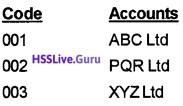
a. Sequential codes:
Here numbers or alphabets are.assigned in consecutive order. These codes are applied primarily to source documents such as cheques, invoices, etc.
(i) Name of customers:
Plus Two Accountancy Notes Chapter 1 Overview of Computerised Accounting System 2
(ii) Name of suppliers:
Plus Two Accountancy Notes Chapter 1 Overview of Computerised Accounting System 3

b. Block Codes:
In Block codes, a range of numbers is alloted to a particular account group. Here, numbers within a range follow sequential coding scheme.
Room Numbering System of a Lodge:
Plus Two Accountancy Notes Chapter 1 Overview of Computerised Accounting System 4
Coding of Dresses:
Plus Two Accountancy Notes Chapter 1 Overview of Computerised Accounting System 5

Plus Two Accountancy Notes Chapter 1 Overview of Computerised Accounting System

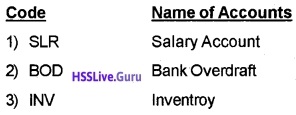
c. Mnemonic codes:
A mnemonic code consists of alphabets or abbreviations as symbols to codify an account.
Plus Two Accountancy Notes Chapter 1 Overview of Computerised Accounting System 6
Plus Two Accountancy Notes Chapter 1 Overview of Computerised Accounting System 7

Methodology to Develop Coding Structure
Let us examine the 15 digit Goods and Services Tax Identification Number (GSTIN). GSTIN is a 15 digit unique code which is assigned to each tax payer, which will be statewise and PAN-based.
GSTIN Format or Structure:
Plus Two Accountancy Notes Chapter 1 Overview of Computerised Accounting System 8
From the above details, we can identify that GSTIN is a combination of state code, PAN, number of registration within the state, default digit and check code to detect errors.
Another Example:
Let us examine how to develp a coding strucutre for students in Thrissur district under DHSE. The first step is to develop hierarchy of the school system and attributes of the students.

Entry year4 digit
School code5 digit
Course code2 digit
Roll Number2 digit

Plus Two Accountancy Notes Chapter 1 Overview of Computerised Accounting System

Thus we allocate 13 digit code to a student.
Plus Two Accountancy Notes Chapter 1 Overview of Computerised Accounting System 9

Security Features of Computerised Accounting Software
Every accounting software ensures data security, safety and confidentiality by providing the features like Password Security, Data Audit and Data Vault.
1. Password Security:
Password is the key to allow the access to the system. Computerised accounting system protects the unauthorised persons from accessing to the business data. Only authorised person, who is supplied with the password, can enter to the system.

2. Data Audit:
It enables one to know as to who and what changes have been made in the original data there by helping and fixing the responsibility of the person who has manipulated the data and ensures data integrity.

3. Data Vault:
Software provides additional security through data encryption. Encryption means scrambling the data so as to make its interpretation impossible.

Advantages of Computerised Accounting System (CAS)

  1. Financial reports can be prepared in time.
  2. Alterations and additions in transactions are easy and gives the changed result in all books of accounts instantly.
  3. It ensures effective control over the system.
  4. Economy in the processing of accounting data.
  5. Confidentiality of data is maintained.
  6. The closing balance of one financial year is automatically carried forward to next financial year.

Plus Two Accountancy Notes Chapter 1 Overview of Computerised Accounting System

Limitations of Computerised Accounting System

  1. Faster Obsolescence of technology necessitates frequently upgradation in accounting software.
  2. Data may be lost or corrupted due to power interruption.
  3. Un programmed reports can not be generated.
  4. Alterations in transactions are easy. This reduces the reliability of accounting work.
  5. Work with CAS is expensive.

Accounting Information System (AIS)
Accounting Information System (AIS) and its various subsystems may be implemented through Compterised Accounting System (CAS). Such system of AIS are described below.
Plus Two Accountancy Notes Chapter 1 Overview of Computerised Accounting System 10

Plus Two Accountancy Notes Chapter 1 Overview of Computerised Accounting System

  1. Cash and Bank subsystem: Receipts and payments of cash.
  2. Sales and Accounts Receivable sub system: Maintaining of sales and Receivables ledgers.
  3. Inventory subsystem: Purchase and sale of goods. Specifying the price, quantity, and date.
  4. Purchase and Accounts Payable sub system: Maintaing of purchase and payable leadgers.
  5. Pav Roll Accounting sub system: Payment of salaries and wages.
  6. Fixed Assets Accounting sub system: Purcahses, additions, sale and usage of fixed assets.
  7. Expense Accounting sub system: Various types of expenses.
  8. Tax Accounting sub system: Deals with GSTIN, Income Tax etc.
  9. Final Accounts sub system: Preparation of final accounts.
  10. Costing sub system: Ascertainment of cost of goods produced.
  11. Budget sub system: Preparation of budgets.
  12. Management information sub system (MIS): Preparation of reports that are vital for management decision making.

Plus One Accountancy Notes Chapter 2 Theory Base of Accounting

Students can Download Chapter 2 Theory Base of Accounting Notes, Plus One Accountancy Notes helps you to revise the complete Kerala State Syllabus and score more marks in your examinations.

Kerala Plus One Accountancy Notes Chapter 2 Theory Base of Accounting

Summary:
Generally accepted Accounting Principles (GAAP):
GAAP refers to the rules or guidelines adopted for recording and reporting to business transactions in order to bring uniformity in the preparation and presentation of financial statements. These principles are also referred to as concepts and conventions.

From the practicality viewpoint, the various terms such as principles, conventions, modifying principles, assumptions, etc., have been used interchangeably and are referred to as basic accounting concepts.

Plus One Accountancy Notes Chapter 2 Theory Base of Accounting

Plus One Accountancy Notes Chapter 2 Theory Base of Accounting img 1

Systems of Accounting:
There are two systems of recording business transactions, i.e., double entry system and single entry system.

Basis of Accounting:
There are two broad approach of accounting are cash basis and accural basis. Under cash basis transactions are recorded only when cash are received or paid, where as under accural basis, revenue or costs are recognises when they Occur rather than when they are paid.

Plus One Accountancy Notes Chapter 2 Theory Base of Accounting

Accounting Standards:
Accounting standards are written statement of uniform accounting rules and guidelines in practice for preparing the uniform and consistent financial statements.

Plus One Accountancy Notes Chapter 1 Introduction to Accounting

Students can Download Chapter 1 Introduction to Accounting Notes, Plus One Accountancy Notes helps you to revise the complete Kerala State Syllabus and score more marks in your examinations.

Kerala Plus One Accountancy Notes Chapter 1 Introduction to Accounting

Summary
Meaning of Accounting:
Accounting is a process of identifying, measuring, recording the business transactions and communicating thereof the required information to the interested users.

Accounting as a source of information:
Accounting as a source of information system is the process of identifying, measuring, recording and communicating the economic events of an organization to interested users of the information.

Plus One Accountancy Notes Chapter 1 Introduction to Accounting

Users of accounting information:
Accounting plays a significant role in society by providing information to management at all levels and to those having a direct financial interest in the enterprise, such as present and potential investors and creditors.

Accounting information is also important to those having an indirect financial interests, such as regulatory agencies, tax authorities, customers, labour unions, trade associations, stock exchanges, and others.

Qualitative characteristics of Accounting:
To make accounting information decision-useful, it should possess the following qualitative characteristics.

  • Reliability
  • Understandability
  • Relevance
  • Comparability

The objective of accounting:
The primary objectives of accounting are to:

  • Maintain records of business;
  • Calculate profit or loss;
  • Depict the financial position: and
  • Make information available to various groups and users.

Plus One Accountancy Notes Chapter 1 Introduction to Accounting

Role of accounting:
Accounting is not an end in itself. It is a means to an end. It plays the role of a:

  • Language of a business
  • Historical record
  • Current economic reality
  • Information system
  • Service to users

Plus One Zoology Notes Chapter 8 Excretory Products and their Elimination

Students can Download Chapter 8 Excretory Products and their Elimination Notes, Plus One Zoology Notes helps you to revise the complete Kerala State Syllabus and score more marks in your examinations.

Kerala Plus One Zoology Notes Chapter 8 Excretory Products and their Elimination

What is excretion?
Excretion is the elimination common nitrogenous wastes. Ammonia, urea and uric acid are the major forms of nitrogenous wastes excreted by the animals.

Plus One Zoology Notes Chapter 8 Excretory Products and their Elimination

Ammonotelic.ureotelic and urecotelic animals and their excretion:
1. The process of excreting ammonia is Ammonotelism. eg: Many bony fishes, aquatic amphibians and aquatic insects are ammonotelic.

2. Mammals, many terrestrial amphibians and marine fishes mainly excrete urea and are called ureotelic animals.

3. Reptiles, birds, land snails and insects excrete nitrogenous wastes as uric acid in the form of pellet or paste with a minimum loss of water and are called uricotelic animals.

Where is urea produced?
Ammonia produced by metabolism is converted into urea in the liver and released into the blood which is filtered and excreted out by the kidneys.

Excretion in lower organisms:

Protonephridia or flame cells are the excretory structures in Platyhelminthes (Flatworms, eg: Planaria), rotifers, some annelids and the cephalochordate – Amphioxus.
Nephridia are the tubular excretory structures of earthworms and other annelids
Malpighian tubules are the excretory structures of most of the insects including cockroaches.
Antennal glands or green glands perform the excretory function in crustaceans like prawns.

Human Excretory System
In humans, the excretory system consists of

  1. A pair of kidneys
  2. One pair of ureters
  3. A urinary bladder
  4. A urethra.

Each kidney of an adult human measures 10 – 12 cm in length, 5 – 7 cm in width, 2 – 3 cm in thickness with an average weight of 120 – 170 g.
Plus One Zoology Notes Chapter 8 Excretory Products and their Elimination 1
1. Centre of the inner concave surface of the kidney is a notch called hilum through which ureter, blood vessels and nerves enter.

2. Innerto the hilum is a broad funnel shaped space called the renal pelvis with projections called calyces.

3. Inside the kidney, there are two zones, an outer cortex and an inner medulla.

4. The medulla is divided medullary pyramids projecting into the calyces.

5. The cortex extends in between the medullary pyramids as renal columns called Columns of Bertini.

6. Each kidney has nearly one million complex tubular structures called nephrons, which are the functional units. A diagrammatic representation of a nephron showing blood vessels, duct and tubule Each nephron has two parts -1 The glomerulus & 2 Renal tubule.
Plus One Zoology Notes Chapter 8 Excretory Products and their Elimination 2
7. Glomerulus is a tuft of capillaries formed by the afferent arteriole – a fine branch of renal artery.

8. Blood from the glomerulus is carried away by an efferent arteriole.

9. The renal tubule begins with a double walled cup-like structure calle Bowman’s capsule, which encloses the glomerulus.

Plus One Zoology Notes Chapter 8 Excretory Products and their Elimination

10. Glomerulus alongwith Bowman’s capsule, is called the malpighian body or renal corpuscle

11. The tubule continues further to form a highly coiled network proximal convoluted tubule (PCT).

12. A hairpin shaped Henle’s loop is the next part of the tubule which has a descending and an ascending limb.

13. The ascending limb continues as another highly coiled tubular region called distal convoluted tubule (DCT).

14. The DCTs open into a straight tube called collecting duct, many of which open into the renal pelvis through medullary pyramids in the calyces.

15. The Malpighian corpuscle, PCT and DCT of the nephron are situated in the cortical region of the kidney whereas the loop of Henle dips into the medulla.
Plus One Zoology Notes Chapter 8 Excretory Products and their Elimination 3

Types of Nephrons:
1. In majority of nephrons, the loop of Henle is too short and extends only very little into the medulla. Such nephrons are called cortical nephrons.

2. In some of the nephrons, the loop of Henle is very long and runs deep into the medulla.These nephrons are called juxta medullary nephrons. A minute vessel of capillary network runs parallel to the Henle’s loop forming a ‘LT shaped vasa recta. Vasa recta is absent or highly reduced in cortical nephrons.

Urine Formation
1. It involves three main processes namely, glomerular filtration, reabsorption and secretion

2. The first step in urine formation is the filtration of blood, which is carried out by the glomerulus and is called glomerular filtration.

3. 1100 – 1200 ml of blood is filtered by the kidneys per minute. The glomerular capillary blood pressure causes filtration of blood through 3 layers,

(a) Endothelium of glomerular blood vessels
(b) Epithelium of Bowman’s capsule and
(c) Basement membrane between these two layers.

4. The epithelial cells of Bowman’s capsule called podocytes which possess minute spaces called filtration slits.

5. Blood is filtered through these membranes, that almost all the constituents of the plasma except the proteins pass onto the lumen of the Bowman’s capsule. It is the process of ultra filtration.

Glomerular filtration in a healthy individual is approximately 125 ml/minute, i.e., 180 litres per day

6. The kidneys have efficient mechanism for the regulation of glomerular filtration rate. It is carried out by juxta glomerular apparatus (JGA).JGA is found in the distal convoluted tubule .

7. A fall in GFR can activate the JG cells to release renin which can stimulate the glomerular blood flow and thereby the GFR back to normal.

8. Nearly 99 percent of the filtrate is reabsorbed by the renal tubules. This process is called reabsorption.

9. For example, substances like glucose, amino acids, Na+, etc., in the filtrate are reabsorbed actively whereas the nitrogenous wastes and water are absorbed by passive transport.

10. During urine formation, the tubular cells secrete substances like H+, K+ and ammonia into the filtrate.

11. Tubular secretion is helpful in the maintenance of ionic and acid-base balance of body fluids.

Plus One Zoology Notes Chapter 8 Excretory Products and their Elimination

Function Of The Tubules
Proximal Convoluted Ttubule (PCT):
1. PCT consists of simple cuboidal brush border epithelium which increases the surface area for reabsorption.

2. All essential nutrients, and 70 – 80 per cent of electrolytes and water are reabsorbed by this segment.

3. PCT also helps to maintain the pH and ionic balance of the body fluids. It occurs through selective secretion of hydrogen ions, ammonia and potassium ions into the filtrate and by absorption of HCO3 from it.

Henle’s Loop
Function:
It helps to maintain high osmolarity of medullary interstitial fluid. The descending limb of loop of Henle is permeable to water but impermeable to electrolytes. This concentrates the filtrate as it moves down.

The ascending limb is impermeable to water but allows transport of electrolytes actively or passively. Therefore, as the concentrated filtrate pass upward, it gets diluted due to the passage of electrolytes to the medullary fluid.

Distal Convoluted Tubule (DCT):
The reabsorption of Na+, HCO3 and water takes place in this segment. In this segment selective secretion of hydrogen and potassium ions and NH3 to maintain the pH and sodium-potassium balance in blood.
Plus One Zoology Notes Chapter 8 Excretory Products and their Elimination 4

Collecting Duct:
It extends from the cortex of the kidney to the inner parts of the medulla. Large amounts of water is reabsorbed from this region to produce a concentrated urine. This part maintains pH and ionic balance of blood by the selective secretion of H+ and K+ ions.

Plus One Zoology Notes Chapter 8 Excretory Products and their Elimination

Mechanism Of Concentration Of The Filtrate
The flow of filtrate in the two limbs of Henle’s loop is in opposite directions and thus forms a counter current. The flow of blood through the two limbs of vasa recta is also in a counter current pattern.

The proximity between the Henle’s loop and vasa recta, as well as the counter current in them help in maintaining an increasing osmolarity towards the inner medullary interstitium, i.e. from 300 mOsmolL-1 in the cortex to about 1200 mOsmolL-1 in the inner medulla. This gradient is mainly caused by NaCl and urea.

NaCl is transported by the ascending limb of Henle’s loop which is exchanged with the descending limb of vasa recta. NaCl is returned to the interstitium by the ascending portion of vasa recta. Similarly, small amounts of urea enterthe thin segment of the ascending limb of Henle’s loop which is transported back to the interstitium by the collecting tubule.

This transport is facilitated by the counter current mechanism This mechanism helps to maintain a concentration gradient in the medullary interstitium. Presence of such interstitial gradient helps in an easy passage of water from the collecting tubule thereby concentrating the filtrate (urine).
Plus One Zoology Notes Chapter 8 Excretory Products and their Elimination 5

Plus One Zoology Notes Chapter 8 Excretory Products and their Elimination

Regulation Of Kidney Function
The functioning of the kidneys is influenced by hypothalamus, JGA and to a certain extent, the heart in the body are activated by changes in blood volume.

How can diuresis is prevented in body?
The decrease of fluid from the body can activate these Osmoreceptors which stimulate the hypothalamus to release antidiuretic hormone (ADH) or vasopressin from the neurohypophysis. ADH facilitates water reabsorption Hence it prevents diuresis.

An increase in body fluid volume switch off the osmoreceptors and suppress the ADH release. ADH can also affect the kidney function by its constrictory effects on blood vessels. This causes an increase in blood pressure. An increase in blood pressure increase the glomerular blood flow and the GFR.

A fall in glomerular blood flow/glomerular blood pressure/GFR can activate the JG cells to release renin which converts angiotensinogen in blood to angiotensin I and further to angiotensin II. Angiotensin II, increases the glomerular blood pressure and thereby GFR.

Angiotensin II also activates the adrenal cortex to release Aldosterone. Aldosterone causes reabsorption of Na+ and water from the distal parts of the tubule. This also leads to an increase in blood pressure and GFR. This is known as the Renin-Angiotensin mechanism.

An increase in blood flow to the atria of the heart can cause the release of Atrial Natriuretic Factor (ANF). ANF can cause vasodilation (dilation of blood vessels) and thereby decrease the blood pressure. ANF mechanism acts as a check on the renin-angiotensin mechanism.

Micturition
It is the voluntary signal from the central nervous system (CNS). This signal is initiated by the stretching of the urinary bladder in response to the stretch receptors on the walls of the bladder.

The process of release of urine is called micturition and the neural mechanisms causing it is called the micturition reflex. An adult human excretes 1 to 1.5 litres of urine per day.

The urine is slightly acidic (pH – 6.0) and has a characterestic odour. 25 – 30 gm of urea is excreted out per day. Analysis of urine helps to know malfunctioning of the kidney.

For example, presence of glucose (Glycosuria) and ketone bodies (Ketonuria) in urine are indicative of diabetes mellitus.

Role Of Other Organs In Excretion
Lungs remove large amounts of CO2 (18 litres/day) and water every day. Liver secretes bile-containing substances like bilirubin, biliverdin, cholesterol, degraded steroid hormones, vitamins and drugs.

The sweat and sebaceous glands in the skin eliminates watery fluid containing NaCl, small amounts of urea, lactic acid, etc. Sebaceous glands eliminates sterols, hydrocarbons and waxes through sebum. This secretion provides a protective oily covering for the skin.

Plus One Zoology Notes Chapter 8 Excretory Products and their Elimination

Disorders Of The Excretory System
Uemia:
It leads to the accumulation of urea in blood. It lead to kidney failure. In such patients, urea can be removed by a process called hemodialysis.

Procedure of Dialysis:
Blood drained from a artery is pumped into a dialysing unit after adding an anticoagulant like heparin.The unit contains a coiled cellophane tube surrounded by a fluid (dialysing fluid).

The porous cellophane membrance allows the passage of molecules based on concentration gradient.
As nitrogenous wastes are absent in the dialysing fluid, the cleared blood is pumped back to the body through a vein after adding anti-heparin to it.

Remedy for kidney damage:
Kidney transplantation is the ultimate method in the correction of acute renal failures (kidney failure). A functioning kidney is used in transplantation from a donor to minimise its chances of rejection by the immune system of the host.

Renal calculi:
Stone or insoluble mass of crystallised salts (oxalates, etc.) formed within the kidney.

Glomerulonephritis:
Inflammation of glomeruli of kidney

NCERT SUPPLEMENTARY SYLLABUS
Diabetes Insipidus:
Antidiuretic hormone (ADH) is released from the posterior pituitary, prevents dehydration. It helps in the reabsorption of water by the distal parts of the kidney tubules and prevents diuresis. Deficiency of ADH leads to diabetes insipedus, that means huge amounts of dilute urine is formed followed by intense thirst.

The name itself (diabetes = overflow; insipidus = tasteless) distinguishes it from diabetes .mellitus (mel = honey), in which insulin deficiency causes large amounts of blood sugar to be lost in the urine

Artificial kidney:
Hemodialysis machine is known as the artificial kidney. Hemodialysis is an artificial process of removing toxic substances from the blood in patients of kidney failure.

Plus Two Accountancy Notes Chapter 5 Dissolution of Partnership

Students can Download Chapter 5 Dissolution of Partnership Notes, Plus Two Accountancy Notes helps you to revise the complete Kerala State Syllabus and score more marks in your examinations.

Kerala Plus Two Accountancy Notes Chapter 5 Dissolution of Partnership

Summary
Dissolution of Partnership Firm
When the partnership between all the partners of a firm comes to an end it is called dissolution of partnership firm. When the firm is dissolved, it leads to the closure of the business – firm’s book of accounts are closed, assets of the firm realised, liabilities are paid off and whatever remains is paid to the partners in settlement oftheir accounts.

Dissolution of Partnership
When the relation of partnership among different partners changes without affecting the entity of the firm, it is called dissolution of partnership. Dissolution of partnership takes place in the case of admission, retirement, death etc. This does not necessarily involve dissolution of partnership firm.

Plus Two Accountancy Notes Chapter 5 Dissolution of Partnership

Modes of dissolution of firm

  1. Dissolution by agreement
  2. Compulsary dissolution
  3. Dissolution on the happening of certain contingencies.
  4. Dissolution by notice
  5. Dissolution by court

Accounting treatment
The following accounts are prepared on dissolution.

Realisation account
Realisation account is a nominal account prepared for the purpose of closing the accounts of assets and liabilities and for finding out the profit or loss on realisation of assets and payment of liabilities. The profit or loss on realisation is transferred to partners’ capital accounts in their profit sharing ratio.

Capital accounts of partners
Each, partner’s capital account is credited with accumulated profit and realisation profit, if any, and debited with accumulated loss and realisation loss. After making any other adjustments, as per agreement, the balance in the capital account represents the amount due to or due from each partner. Partners’ capital accounts are closed by paying off orbringing in cash, as the case may be.

Plus Two Accountancy Notes Chapter 5 Dissolution of Partnership

Cash/Bank account
After entering the cash realised from assets and paying towards liabilities and realisation expenses the balance in this account equals the balance in the capital accounts of all partners. When settlement is made cash/bank account and partners’ capital accounts wil automatically be closed.

Journal entries usually passed at the time of dissolution of a partnership firm are the following
1. For closing the accounts of assets and transferring the same to realisation account.
Plus Two Accountancy Notes Chapter 5 Dissolution of Partnership 1

2. For closing the accounts of liabilities and transferring to realisation account.
Plus Two Accountancy Notes Chapter 5 Dissolution of Partnership 2

3. For transferring provisions relating to assets if any
Plus Two Accountancy Notes Chapter 5 Dissolution of Partnership 3

4. For transferring provisions relating to liabilities
Plus Two Accountancy Notes Chapter 5 Dissolution of Partnership 4

5. (i) On realising or selling the assets
Plus Two Accountancy Notes Chapter 5 Dissolution of Partnership 5

(ii) If an asset is taken over by a partner
Plus Two Accountancy Notes Chapter 5 Dissolution of Partnership 6

Plus Two Accountancy Notes Chapter 5 Dissolution of Partnership

6. (i) On paying the liabilities (external)
Plus Two Accountancy Notes Chapter 5 Dissolution of Partnership 7

(ii) If a partner agrees to discharge a liability
Plus Two Accountancy Notes Chapter 5 Dissolution of Partnership 8

7. (i) When realisation expense is met by the firm
Plus Two Accountancy Notes Chapter 5 Dissolution of Partnership 9

(ii) If realisation expense is paid by a partner Realisation a/c
Plus Two Accountancy Notes Chapter 5 Dissolution of Partnership 10

8. (i) For the amount realized from new or unrecorded asset
Plus Two Accountancy Notes Chapter 5 Dissolution of Partnership 11

(ii) If an unrecorded or new asset is taken over by a partner
Plus Two Accountancy Notes Chapter 5 Dissolution of Partnership 12

Plus Two Accountancy Notes Chapter 5 Dissolution of Partnership

9. (i) If any new or unrecorded liability is paid
Plus Two Accountancy Notes Chapter 5 Dissolution of Partnership 13

(ii) If any new or unrecorded liability is taken over by a partner
Plus Two Accountancy Notes Chapter 5 Dissolution of Partnership 14

10. For transferring realisation profit to partners’ capital
Plus Two Accountancy Notes Chapter 5 Dissolution of Partnership 15

11. For transferring accumulated profits and reserves.
Plus Two Accountancy Notes Chapter 5 Dissolution of Partnership 16

12. On discharge of loans to partners
Plus Two Accountancy Notes Chapter 5 Dissolution of Partnership 17

13. For cash brought in by a partner, if required so
Plus Two Accountancy Notes Chapter 5 Dissolution of Partnership 18

14. For cash paid off to a partner, as the case
Plus Two Accountancy Notes Chapter 5 Dissolution of Partnership 19

Plus One Physics Notes Chapter 14 Oscillations

Students can Download Chapter 14 Oscillations Notes, Plus One Physics Notes helps you to revise the complete Kerala State Syllabus and score more marks in your examinations.

Kerala Plus One Physics Notes Chapter 14 Oscillations

Introduction
In this chapter, we study oscillatory motion. The description of an oscillatory motion requires some fundamental concept like period, frequency, displacement, amplitude and phase.

Periodic And Oscillatory Motions
Periodic Motion:
A motion that repeats itself at regular intervals of time is called periodic motion.
Example:

  • The orbital motion of planets in the solar system.
  • The piston in a steam engine going back and forth

Oscillations or Vibrations:
A body executes to and fro motion at regular intervals of time is called oscillatory (or) vibratory motion.

Note:
(1) When the frequency is small, we call it oscillation. When the frequency is high, we call it vibration.
Period and frequency:
Period (T):
Time taken to complete one oscillation is called period

Frequency (n):
The number of oscillations per second is called frequency.
frequency v = \(\frac{1}{T}\)Hz

Plus One Physics Notes Chapter 14 Oscillations

Displacement:
Displacement of oscillation means the change of any physical property with time under consideration.

Explanation:
For example, consider the oscillation of block attached to a spring. In this case the displacement of block with time is referred to as displacement.

In the case if oscillation of simple pendulum, the angle from the vertical as a function of time may be regarded as a displacement variable. The voltage across a capacitor, changing with time in an a.c. circuit is also a displacement variable

Note:
The displacement variable may take both positive and negative values.

Mathematical expression for displacement:
The displacement of a periodic function can be written as
Plus One Physics Notes Chapter 14 Oscillations 1

Simple Harmonic Motion (S.H.M.)
Simple harmonic motion is the simplest form of oscillatory motion.

The oscillatory motion is said to be simple harmonic motion if the displacement ‘x’ of the particle from the origin varies with time as
Plus One Physics Notes Chapter 14 Oscillations 2
Where
x(t) = displacement x as a function of time t
A = amplitude
ω = angular frequency
(ω t+ Φ) = phase (time-dependent)
Φ = phase constant or initial phase

Graphical Variation of S.H.M.
Plus One Physics Notes Chapter 14 Oscillations 3

The above graph shows the graphical representation of x(t) = A coswt with time.
(Initial phase Φ = 0)

Plus One Physics Notes Chapter 14 Oscillations

Amplitude of S.H.M.
The maximum displacement of S.H.M. from mean position is called the amplitude of S.H.M.
Note:
1.
Plus One Physics Notes Chapter 14 Oscillations 4
Two simple harmonic motions having, same w and Φ but different amplitudes A and B as shown in the above figure.

2.
Plus One Physics Notes Chapter 14 Oscillations 5
Two simple harmonic motions having the same A and w but different phase angle Φ as shown in the above figure.

Simple Harmonic Motion And Uniform Circular Motion

Question 1.
Show that the projection of uniform circular motion on any diameter of the circle is S.H.M.
Plus One Physics Notes Chapter 14 Oscillations 6
Answer:
Consider a particle moving along the circumference of a circle of radius ‘a’ and centre O, with uniform angular velocity w. AB and CD are two mutually perpendicular diameters along X and Y axis. At time t = 0. let the particle be at P0 so that ∠P0OB = Φ.

After time Y second, let the particle reach P so that ∠POP0 = ωt. N is the foot of the perpendicular drawn from P on the diameter CD.

Plus One Physics Notes Chapter 14 Oscillations

Similarly M is the foot of the perpendicular drawn from P to the diameter AB. When the particle moves along the circumference of the circle, the foot of the perpendicular executes to and fro motion along the diameter CD or AB with O as the mean position. From the right angle triangle O MP, we get
cos (ωt + Φ) = \(\frac{\mathrm{OM}}{\mathrm{OP}}\)
∴ OM = OP cos (ωt + Φ)
X = a cos (ωt + Φ) ………………. (1)
Similarly, we get
sin (ωt + Φ) = \(\frac{y}{a}\) (or)
Y = a sin (ωt + Φ) ……………… (2)
Equation (1) and (2) are similar to equations of S.H.M. The equation(1) and (2) shows that the projection of uniform circular motion on any diameter is S.H.M.
At t = 0, if the particle is at B, then Φ = 0. Then equations (1) and (2) reduce to
x = a cos ωt ………………….. (3)
y = a sin ωt …………………….(4)

Velocity And Acceleration In Simple Harmonic Motion B
Velocity Of S.H.M.
The y displacement of S.H.M. is given by
y = a sin ω t
∴ velocity in y direction
Plus One Physics Notes Chapter 14 Oscillations 7

Case – 1
At the mean position y=0, therefore velocity is maximum. The maximum velocity is given by
Plus One Physics Notes Chapter 14 Oscillations 8
Case – 2
At the extreme position, y = a
∴ Vminimum = \(\sqrt{a^{2}-a^{2}}\) = 0
So the velocity of a S.H.M. varies between o and wa

Acceleration of S.H.M
We know y = a sin ω t
Velocity v = \(\frac{d y}{d t}\) = a ω cos ω t
Acceleration a = \(\frac{d^{2} y}{d t^{2}}\) = -aω² sin ωt
a = -aω² sin ωt
Plus One Physics Notes Chapter 14 Oscillations 9
This equation shows that acceleration of a SHM is directly proportional to the displacement and opposite to the displacement.

Variation of displacement Y with time t:
Plus One Physics Notes Chapter 14 Oscillations 10
Variation of velocity (v) with time:
Plus One Physics Notes Chapter 14 Oscillations 11

Variation of acceleration with time:
Plus One Physics Notes Chapter 14 Oscillations 12

Plus One Physics Notes Chapter 14 Oscillations

Force Law For Simple Harmonic Motion
According to Newton’s second law of motion F = ma
But a = -ω²y(t)
ie. force acting on the S.H.M. in Y direction
F = -mω²y(t)
(or) F = -ky(t)
Where k= mω²
From the above equation (1), we can take an alternative definition of simple harmonic motion.

Statement:
Simple harmonic motion is the motion executed by a particle subject to a force, which is proportional to the displacement of the particle and is directed towards the mean position.

Energy In Simple Harmonic Motion
A simple harmonically moving particle possesses both potential energy and kinetic energy. Potential energy is due to its displacement against restoring force. Kinetic energy is due to its motion.

Total energy of the S.H.M. is the sum of the kinetic energy and potential energy. Total energy remains a constant throughout its motion.

Expression for Kinetic energy:
Let m be the mass of the particle executing SHM. Let V be the velocity at any instant,
Plus One Physics Notes Chapter 14 Oscillations 13

Expression for potential energy:
Potential energy is work required to take the particle against the restoring force.

Work done to displace the particle through a small distance dy, dw = force × displacement
= mω²y × dy [force = ω²y ]. Therefore total work done to take the particle from o to y.
Plus One Physics Notes Chapter 14 Oscillations 14
Plus One Physics Notes Chapter 14 Oscillations 15
This work done is stored in the particle as its potential energy.
Plus One Physics Notes Chapter 14 Oscillations 16
At extreme position y = a
Plus One Physics Notes Chapter 14 Oscillations 17
At equilibrium position y = 0
∴ PE = 0
Total energy of a S.H.M.
Total energy = PE + kE
Plus One Physics Notes Chapter 14 Oscillations 18
∴ Total energy = maximum KE = maximum PE

Graphical variation of PE, KE and TE of S.H.M.
Plus One Physics Notes Chapter 14 Oscillations 19

Plus One Physics Notes Chapter 14 Oscillations

Some Systems Executing Simple Harmonic Motion
Oscillations due to a spring Hooks Law:
The force acting simple harmonic motion is proportional to the displacement and is always directed towards the centre of motion.
F α – x (or) F= kx
where k is called spring constant

Period of oscillation of a spring:
Plus One Physics Notes Chapter 14 Oscillations 20
Consider a body of mass m attached to a massless spring of spring constant K. The other end of spring is connected to a rigid support as shown in figure. The body is placed on a frictionless horizontal surface.

If the body be displaced towards right through a small distance ‘x’, a restoring force will be developed.
Plus One Physics Notes Chapter 14 Oscillations 21

The Simple Pendulum:
Plus One Physics Notes Chapter 14 Oscillations 22
Consider a mass m suspended from one end of a string of length L fixed at the other end as shown in figure. Suppose P is the instantaneous position of the pendulum. At this instant its string makes an angle θ with the vertical.

The forces acting on the bob are (1) weight of bob Fg (mg) acting vertically downward. (2) Tension T in the string.

Plus One Physics Notes Chapter 14 Oscillations

The gravitational force Fg can be divided into a radial component FgCos θ and tangential component FgSin θ. The radial component is cancelled by the – tension T. But the tangential component FgSin θ produces a restoring torque.

Restoring torque τ = – Fg sin θ . L.
τ = -mg sin θ.L …………….. (1)
-ve sign shown that the torque and angular displacement θ are oppositely directed. For rotational motion of bob,.
τ = Iα …………. (2).
Where I is a moment of inertia about the point of suspension and α is angular acceleration. From eq (1) and eq (2).
Iα = -mg sin θ.L
If we assume that the displacement θ is small, sin θ ≈ θ.
∴ Iα = -mg θ.L
Iα + mg θ.L = 0
Plus One Physics Notes Chapter 14 Oscillations 23
Damped Simple Harmonic Motion
Periodic oscillations of decreasing amplitude due to the presence of resistive forces of the medium are called damped oscillations.

Question 2.
Derive a differential equation for a damped simple harmonic oscillation.
Plus One Physics Notes Chapter 14 Oscillations 24
Answer:
Consider a block of mass ‘m’ connected to one end of a massless spring of spring constant K. The other end of spring is connected to rigid support. The block is connected to a vane through a rod (The vane and rod are massless). The vane is submerged in a liquid.

Let the equilibrium position of block be ‘O’. If this block is moved along downward direction through a distance x, a damping force will be developed on vane due to liquid. This damping force is proportional to velocity of vane ie; damping force Fd α – v (or) Fd = -bv

where b is called damping constant. The value of b depends on the characteristics of the liquid and the vane.

Plus One Physics Notes Chapter 14 Oscillations

The restoring force on the block due to spring. Fs = -kx. where x is the displacement of the mass from its equilibrium position.
∴ Total force on the block, F = -bv + -kx
ma = -bv + -kx
ma + bv + kx = 0
\(m \frac{d^{2} x}{d t^{2}}+b \frac{d x}{d t}+k x=0\)
This is the differential equation of S.H.M.

The motion of damped harmonic oscillator:
The solution of the above differential equation of damped harmonic oscillator is
Plus One Physics Notes Chapter 14 Oscillations 25

Case – 1
b = 0 (There is no damping force). In this case, we get
Plus One Physics Notes Chapter 14 Oscillations 26
The above result shows that, if there is no damping force (b = 0). The oscillator behaves like a undamped oscillator.
Plus One Physics Notes Chapter 14 Oscillations 27

Case – 2
If b is small, the amplitude of the oscillator decreases continuously with time. The motion is approximately a periodic. The Variation of displacement x (t) with time T is shown below.
Plus One Physics Notes Chapter 14 Oscillations 28

Case – 3
If damping constant b is large, the amplitude of the oscillator decreases to zero very quickly. The motion is not a periodic motion. The variation of displacement x (t) with time T is shown below.
Plus One Physics Notes Chapter 14 Oscillations 29

The Energy variation of damped oscillator:
The energy of an undamped oscillator, E = \(\frac{1}{2}\)kA².
where A is the amplitude of an undamped oscillator. But for the damped oscillator, amplitude = Ae-bt/2m.
Plus One Physics Notes Chapter 14 Oscillations 30

The above equation shows that the energy of a damped oscillator decreases exponentially with time, which is shown below
Plus One Physics Notes Chapter 14 Oscillations 31

Note:
Small damping means that the dimensionless ratio
\((b / \sqrt{k m})\) is much less than 1.

Plus One Physics Notes Chapter 14 Oscillations

Forced oscillations and resonance
Free oscillation:
When a body oscillates in the absence of external forces (eg. friction etc.) the oscillations are said to be free oscillations.

Forced oscillation:
When an external periodic force is applied to a damped harmonic oscillator, the oscillator will vibrate with a constant amplitude and frequency of vibration will be that of the applied periodic force. This type of oscillation is called forced oscillation.

The differential equation of forced oscillator:
Let F(t) = F0 cosωdt is an external force applied to a damped oscillator.

The total force acting on the damped oscillator,
F = – bv – kx + F0 cosωdt
where -bv is the damping force and -kx is the linear restoring force.
F + bv + kx = F0 cosωdt
\(m \frac{d^{2} x}{d t^{2}}+b \frac{d x}{d t}+k x=F_{0} \cos \omega_{d} t\)
This is the differential equation of an oscillator of mass m on which a periodic force of (angular) frequency ωd is applied. The oscillator initially oscillates with its natural frequency w. When we apply the external periodic force, the oscillation with the natural frequency die out, and the body oscillates with the (angular) frequency of the external periodic force.

The motion of forced oscillator:
The solution (displacement) of the above differential equation of forced oscillator can be written as
x(t) = Acos(ωdt + Φ)
Plus One Physics Notes Chapter 14 Oscillations 32
where m is the mass of the particle v0 and x0 are the velocity and the displacement of the particle at time t = 0, (which is the moment when we apply the periodic force)

Case -1
When b = 0 (damping force = 0) and ω = ωd,
we get A = \(\frac{F_{0}}{0}\)
A = ∞
This is an ideal case. This case never arises in a real situation as the damping is never perfectly zero.

Case – 2
(Small damping, driving frequency far from natural frequency).
In this ωdb << m(ω² – ωd²). Hence we can neglect ωdb. Hence amplitude of oscillation can be written as.
Plus One Physics Notes Chapter 14 Oscillations 33

Case – 3
(Small damping, driving frequency close to natural frequency).
In this case m(ω² – ωa²) << ωdb. Hence we can neglect m (ω² – ωa²). Hence amplitude of oscillation can be written as
Plus One Physics Notes Chapter 14 Oscillations 34

This equation shows that the maximum amplitude fora given driving frequency is governed by the driving frequency and damping constant.

Plus One Physics Notes Chapter 14 Oscillations

Resonant Oscillation
When the frequency of the external periodic force is varied, it is found that the amplitude of the forced vibration increases and reaches a maximum value and then decreases.

The amplitude will be maximum when the frequency of the applied periodic force is equal to the natural frequency of the vibration. Such oscillations are called resonant oscillations and the phenomenon is called resonance.

Graphical variation amplitude with driving frequency:
Plus One Physics Notes Chapter 14 Oscillations 35

Examples of resonance:
All mechanical structures have one or more natural frequencies, and if a structure is subjected to a strong external periodic driving force that matches one of these frequencies, the resulting oscillations of the structure may rupture it.

The Tacoma Narrows Bridge at Puget Sound, Washington, USA was opened on July 1, 1940. Four months later winds produced a pulsating resultant force in resonance with the natural frequency of the structure.

This caused a steady increase in the amplitude of oscillations until the bridge collapsed. It is for the same reason the marching soldiers break steps while crossing a bridge. Aircraft designers make sure that none of the natural frequencies at which a wing can oscillate match the frequency of the engines in flight! Earthquakes cause vast devastation.

In an earthquake, short and tall structures remain unaffected while the medium height structures fall down. This happens because the natural frequencies of the short structures happen to be higher and those of taller structures lower than the frequency of the seismic waves.