Plus Two Physics Notes Chapter 3 Current Electricity

Students can Download Chapter 3 Current Electricity Notes, Plus Two Physics Notes helps you to revise the complete Kerala State Syllabus and score more marks in your examinations.

Kerala Plus Two Physics Notes Chapter 3 Current Electricity

Introduction
In the present chapter, we shall study some of the basic laws concerning steady electric currents.

Electric Current
Rate of flow of electric charge is called electric current. or
Plus Two Physics Notes Chapter 3 Current Electricity - 1

Electric Currents In Conductors

  • Conductors: Free electrons are found in conductors. The electric current in conductors is due to the flow of electrons.
  • Electrolytes: The current in electrolyte is due to flow of ions.
  • Semiconductor: The current in semiconductor is due to flow of both holes and electrons.

Plus Two Physics Notes Chapter 3 Current Electricity

Ohm’s Law
At constant temperature, the current through a conductor is directly proportional to the potential difference between its ends.
V α I (or)
Plus Two Physics Notes Chapter 3 Current Electricity - 2
where R is constant, called resistance of materials.

1. Resistance of a material:
Factors Affecting Resistance of Resistor:
For a given material resistance is directly proportional to the length and inversely proportional to the area of cross-section.
R ∝ \(\frac{\mathrm{L}}{\mathrm{A}}\)
Plus Two Physics Notes Chapter 3 Current Electricity - 3
where ρ is the constant of proportionality and is called resistivity of material.

Resistivity (coefficient of specific resistance) of a Material:
The resistance per unit length for unit area of cross-section will be a constant and this constant is known as the resistivity of the material. The resistivity or coefficient of specific resistance is defined as the resistance offered by a resistor of unit length and unit area of cross-section.
Plus Two Physics Notes Chapter 3 Current Electricity - 4
Resistivity is a scalar quantity and its unit is Ω-m.

Conductance and conductivity:
The reciprocal of resistance is called conductance and the reciprocal of resistivity is called conductivity. The SI unit of conductance is seimen and that for conductivity is seimen per meter. The unit of conductance can also be expressed as Ω-1.

Plus Two Physics Notes Chapter 3 Current Electricity

Current density: Current per unit area is called current density
current density j = \(\frac{I}{A}\)
Vector form
Plus Two Physics Notes Chapter 3 Current Electricity - 5

Mathematical expression of Ohm’s law in terms of j and E:
Considers conductor of length i. Let V’ be the potential difference between the two ends of a conductor.
According to ohms law
We know V= IR
Plus Two Physics Notes Chapter 3 Current Electricity - 6
This potential difference produces an electric field E in the conductor. The p.d. across the conductor also can be written as
V = El _____(2)
Comparing (1) and (2), we get
El = jρl
E = jρ
The above relation can be written in vector form as
Plus Two Physics Notes Chapter 3 Current Electricity - 7
where σ is called conductivity of the material.

Plus Two Physics Notes Chapter 3 Current Electricity

Drift Of Electrons And The Origin Of Resistivity
Random thermal motion of electrons in a metal:
Every metal has a large number of free electrons. Which are in a state of random motion within the conductor. The average thermal speed of the free electrons in random motion is of the order of 105m/s.

Does random thermal motion produce any current? The directions of thermal motion are so randomly distributed. Hence the average thermal velocity of the electrons is zero. Hence current due to thermal motion is zero.

(a) Drift Velocity (vd):
The average velocity acquired by an electron under the applied electric field is called drift velocity.

Explanation: When a voltage is applied across a conductor, an electric filed is developed. Due to this electric field electrons are accelerated. But while moving they collide with atoms, lose their energy and are slowed down. This acceleration and collision are repeated through the motion. Hence electrons move with a constant average velocity. This constant average velocity is called drift velocity.

(b) Relaxation time (τ):
Relaxation time is the average of the time between two successive collisions of the free electrons with atoms.

(c) Expression for drift velocity:
Let V be the potential difference across the ends of a conductor. This potential difference makes an electric field E. Under the influence of electric field E, each free electron experiences a Coulomb force.
F = -eE
or ma = -eE
a = \(\frac{-e E}{m}\) _____(1)
Due to this acceleration, the free electron acquires an additional velocity. A metal contains a large number of electrons.
For first electron, additional velocity acquired in a time τ,
v1 = u1 + aτ1
where u1 is the thermal velocity and τ is the relaxation time.
Similarly the net velocity of second, third,……electron

Plus Two Physics Notes Chapter 3 Current Electricity
v2 = u2 + aτ2
v3 = u3 + aτ3
vn = un + aτn
∴ Average velocity of all the ‘n’ electrons will be
Plus Two Physics Notes Chapter 3 Current Electricity - 8
Vav = 0 + aτ (∴ average thermal velocity of electron is zero)
where τ = \(\frac{\tau_{1}+\tau_{2}+\ldots \ldots \ldots+\tau_{n}}{n}\)
where Vav is the average velocity of electron under an external field. This average velocity is called drift velocity.
ie. drift velocity Vd = aτ _____(2)
Plus Two Physics Notes Chapter 3 Current Electricity - 9

(d) Relation between electric current and drift speed:
Consider a conductor of cross-sectional area A. Let n be the number of electrons per unit volume. When a voltage is applied across a conductor, an electric filed is developed. Let vd be the drift velocity of electron due to this field.
Total volume passed in unit time = Avd
Total number of electrons in this volume = Avdn
Total charge flowing in unit time=Avdne
But charge flowing per unit time is called current I ie. current, I = Avdne
I = neAvd
Now current density J can be written as
J = nevd (J= I/A)
Deduction of Ohm’s law: (Vector form)
We know current density
J = nvde
Plus Two Physics Notes Chapter 3 Current Electricity - 10

Plus Two Physics Notes Chapter 3 Current Electricity

1. Mobility: Mobility is defined as the magnitude of the drift velocity per unit electric field.
Plus Two Physics Notes Chapter 3 Current Electricity - 11

Limitations Of Ohm’s Law
Certajn materials do not obey Ohm’s law. The deviations of Ohm’s law are of the following types.
1. V stops to be proportional to I.
Plus Two Physics Notes Chapter 3 Current Electricity - 12
Metal shows this type behavior. When current through metal becomes large, more heat is produced. Hence resistance of metal increases. Due to increase in resistance the V-I graph becomes nonlinear. This nonlinear variation is shown by solid line in the above graph.

2. Diode shows this type behavior. We get different values of current for same negative and positive voltages.
Plus Two Physics Notes Chapter 3 Current Electricity - 13

Plus Two Physics Notes Chapter 3 Current Electricity

3. This type behavior is shown by materials like GaAs. there is more than one value of V for the same current I.
Plus Two Physics Notes Chapter 3 Current Electricity - 14
Note: The materials which donot obey ohms law are mainly used in electronics.

Resistivity Of Various Materials
The materials are classified as conductors, semi conductors, and insulators according to their resistivities. Commercially produced resistors are of two types.

  1. Wire bound resistors
  2. Carbon resistors

1. Wire bound resistor:
Wire wound resistors are made by winding the wires of an alloy.
Eg: Manganin, Constantan, Nichrome.

2. Carbon resistors:
Resistors in the higher range are made mostly from carbon. Carbon resistors are compact. Carbon resistors are small in size. Hence their values are given using a colourcode.

(i) Colourcode of resistors:
The resistance value of commercially available resistors are usually indicated by certain standard colour coding.

The resistors have a set of coloured rings on it. Their significance is indicated in the table The first two bands from the end indicated the first two significant digits and the third band indicates the decimal multiplier. The last metallic band indicates the tolerance.
Value of colours:
Plus Two Physics Notes Chapter 3 Current Electricity - 15

Plus Two Physics Notes Chapter 3 Current Electricity
Illustration:
Plus Two Physics Notes Chapter 3 Current Electricity - 16
The colour code indicated in the given sample is Red, Red, Red with a silver ring at the right end. Then the value of given resistance is 22 × 102 ±10%.

Temperature Dependence Of Resistivity:
The resistivity of a material is found to be dependent on the temperature. The resistivity of a metallic conductor is approximately given by,
ρT = ρo[1 + α(T – To)]
where ρT is the resistivity at a temperature T and ρo is the resistivity at temperature To. α is called the temperature coefficient of resistivity.
Variation of resistivity in metals:
Plus Two Physics Notes Chapter 3 Current Electricity - 17
The temperature coefficient (α) of metal is positive. Which means resistivity of metal increases with temperature. The variation of resistivity of copper is as shown in above figure.
Eg: Silver, copper, nichrome, etc.
Variation of resistivity in semi conductor:
Plus Two Physics Notes Chapter 3 Current Electricity - 18
The temperature coefficient (α)of semiconductor is negative. Which means that resistivity decreases with increase in temperature. The variation of resistivity with temperature for a semiconductor is shown in above figure.
Eg: Carbon,Germanium,silicon
Variation of resistivity in standard resistors:
Plus Two Physics Notes Chapter 3 Current Electricity - 19

Plus Two Physics Notes Chapter 3 Current Electricity
standard resistors, the variation of resistivity will be very little with temperatures. The variation of resistivity with temperature for standard resistors is show above.
Eg: Manganin and constantan.
Explanation for the variation of resistivity:
The resistivity of a material is given by
Plus Two Physics Notes Chapter 3 Current Electricity - 20
The above equation shows that, resistivity depends inversely on number density and relaxation time τ.
Metals:
Number density in metal does not change with temperature. But average speed of electrons increases. Hence frequency of collision increases. The increase in frequency of collision decreases the relaxation time τ. Hence the resistivity of metal increases with temperature.

Insulators and semiconductors:
For insulators and semiconductors, the number density n increases with temperature. Hence resistivity decreases with temperature.

Electrical Energy, Power
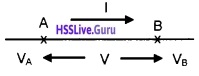
Plus Two Physics Notes Chapter 3 Current Electricity - 21
Consider two points A and B in a conductor. Let VA and VB be the potentials at A and B respectively. The potential At A is greater than that B and difference in potential is V.

If ∆Q charge flows from A to B in time ∆t. The potential energy of charge will be decreased. The decrease in potential energy due to charge flow from A to B,
= VA∆Q – VB∆Q
= (VA – VB)∆Q
= V∆Q (VA – VB = V)
This decrease in PE appeared as KE of flowing charges. But we know, the kinetic energy of charge carriers do not increase due to the collisions with atoms. During collisions, the kinetic energy gained by the charge carriers is shared with the atoms.

Hence the atoms vibrate more vigorously ie. The conductor heats up. According to conservation of energy, heat developed in between A and B in time ∆t
∆H = decrease in potential energy
∆H = V∆Q
∆H = VI∆t (∵ ∆Q=I∆t)
\(\frac{\Delta \mathrm{H}}{\Delta \mathrm{t}}\) = VI
Rate of workdone is power, ie

Plus Two Physics Notes Chapter 3 Current Electricity
Plus Two Physics Notes Chapter 3 Current Electricity - 22
using Ohm’s law V = IR
Plus Two Physics Notes Chapter 3 Current Electricity - 23
It is this power which heats up the conductor.
Power transmission:
The electric power from the electric power station is transmitted with high voltage. When voltage increases, the current decreases. Hence heat loss decreases very much.

Combination Of Resistors – Series And Parallel Combination
Resistors in series:
Consider three resistors R1, R2 and R3 connected in series and a pd of V is applied across it.
Plus Two Physics Notes Chapter 3 Current Electricity - 24
In the circuit shown above the rate of flow of charge through each resistor will be same i.e. in series combination current through each resistor will be the same. However, the pd across each resistor are different and can be obtained using ohms law.
pd across the first resistor V1 = I R1
pd across the second resistor V2, = I R2
pd across the third resistor V3 = I R3
If V is the effective potential drop and R is the effective resistance then effective pd across the combination is V = IR
Total pd across the combination = the sum pd across each resistor, V = V1 + V2 + V3
Substituting the values of pds we get IR = IR1 + IR2 + IR3
Eliminating I from all the terms on both sides we get
Plus Two Physics Notes Chapter 3 Current Electricity - 25
Thus the effective resistance of series combination of a number of resistors is equal to the sum of resistances of individual resistors.

Plus Two Physics Notes Chapter 3 Current Electricity

1. Resistors in parallel:
Consider three resistors R1, R2 and R3 connected in parallel across a pd of V volt. Since all the resistors are connected across same terminals, pd across all the resistors are equal.
Plus Two Physics Notes Chapter 3 Current Electricity - 26
As the value of resistors are different current will be different in each resistor and is given by Ohm’s law
Current through the first resistor
I1 = \(\frac{V}{R_{1}}\)
Current through the second resistor
I2 = \(\frac{V}{R_{2}}\)
Current through the third resistor
I3 = \(\frac{V}{R_{3}}\)
Total current through the combination is
I = \(\frac{V}{R}\), where R is the effective resistance of parallel combination.
Total current through the combination = the sum of current through each resistor
I = I1 + I2 + I3
Substituting the values of current we get
Plus Two Physics Notes Chapter 3 Current Electricity - 27
Eliminating V from all terms on both sides of the equations, we get
Plus Two Physics Notes Chapter 3 Current Electricity - 28
Thus in parallel combination reciprocal of the effective resistance is equal to the sum of reciprocal of individual resistances. The effective resistance in a parallel combination will be smaller than the value of smallest resistance.

Plus Two Physics Notes Chapter 3 Current Electricity

Cells, Emf, Internal Resistance
Electrolytic cell:
Electrolytic cell is a simple device to maintain a steady current in an electric circuit. A cell has two electrodes. They are immersed in an electrolytic solution.

E.M.F:
E.M.F. is the potential difference between the positive and negative electrodes in an open circuit. ie. when no current is flowing through the cell.

Voltage:
Voltage is the potential difference between the positive and negative electrodes, when current is flowing through it.

Internal resistance of cell:
Electrolyte offers a finite resistance to the current flow. This resistance is called internal resistance (r).

Relation between ε, V and internal drop:
Consider a circuit in which cell of emfs is connected to resistance R. Let r be the internal resistance and I be the current following the circuit.

According to ohms law,
current flowing through the circuit
Plus Two Physics Notes Chapter 3 Current Electricity - 29
V is the voltage across the resistor called terminal voltage. Ir is potential difference across internal resistance called internal drop.

Plus Two Physics Notes Chapter 3 Current Electricity

Cells In Series And Parallel
Plus Two Physics Notes Chapter 3 Current Electricity - 30
Consider two cells in series. Let ε1, r1 be the emf and internal resistance of first cell. Similarly ε2, r2 be the emf and internal resistance of second cell. Let I be the current in this circuit.
From the figure, the P.d between A and B
VA – VB = ε1 – Ir1 _____(1)
Similarly P.d between B and C
VB – VC = ε2 – Ir2 ______(2)
Hence, P.d between the terminals A and C
VAC = VA – VC = VA – VB + VB – VC
VAC = [VA – VB] + [VB – VC]
when we substitute eqn. (1) and (2) in the above equation.
VAC = ε1 – Ir1 + ε2 – Ir2 VAC = (ε1 – ε2) – I(r1 + r2)
VAC = εeq – Ireq
where εeq = ε1 + ε2, and req = r<sub1 + r2
The rule of series combination:

  1. The equivalent emf of a series combination of n cells is the sum of their individual emf.
  2. The equivalent internal resistance of a series com-bination of n cells is just the sum of their internal resistances.

Cells in parallel:
Plus Two Physics Notes Chapter 3 Current Electricity - 31
Consider two cells connected in parallel as shown in figure. ε1, r1 be the emf and internal resistance of first cell and ε2, r2 be the emf and internal resistance of second cell. Let I1 and I2 be the current leaving the positive electrodes of the cells.
Total current flowing from the cells is the sum of I1 and I2.
ie. I = I1 + I2 ______(1)
Let VB1 and VB2 be the potential at B1 and B2 respectively. Considering the first cell, P.d between B1 and B2.
Plus Two Physics Notes Chapter 3 Current Electricity - 32
Considering the second cell, P.d between B1 and B2
Plus Two Physics Notes Chapter 3 Current Electricity - 33

Plus Two Physics Notes Chapter 3 Current Electricity
Substituting the values I1 and I2 in eq.(1), we get
Plus Two Physics Notes Chapter 3 Current Electricity - 34
Plus Two Physics Notes Chapter 3 Current Electricity - 35
If we replace the combination by a single cell between B1 and B2, of emf and εeq and internal resistance req, we have
V = εeq – Ireq ______(3)
The eq(2) and eq(3) should be same.
Plus Two Physics Notes Chapter 3 Current Electricity - 36
The above equation can be put in a simpler way.
Plus Two Physics Notes Chapter 3 Current Electricity - 37
If there are n cells of emf ε1, ε2,………..εn and internal
resistance r1, r2………..rn respectively, connected in parallel.
Plus Two Physics Notes Chapter 3 Current Electricity - 38

Kirchoff’s Rules
1. First law (Junction rule): The total current entering the junction is equal to the total current leaving the junction.
Explanation:
Plus Two Physics Notes Chapter 3 Current Electricity - 39

Plus Two Physics Notes Chapter 3 Current Electricity
Consider a junction ‘O’. Let I1 and I2 be the incoming currents and I1, I4 and I5 be the outgoing currents.
According to Kirchoff’s first law,
Plus Two Physics Notes Chapter 3 Current Electricity - 40

2. Second law (loop rule): In any closed circuit the algebraic sum of the product of the current and resistance in each branch of the circuit is equal to the netjemf in that branch.

OR

Total emf in a closed circuit is equal to sum of voltage drops
Plus Two Physics Notes Chapter 3 Current Electricity - 41
Explanation: Consider a circuit consisting of two cells of emf E1 and E2 with resistances R1, R2 and R3 as shown in figure. Current is flowing as shown in figure
Applying the second law to the closed circuit ABCDE1A.
-I3R3 + E1 + -I1R1 = 0
Similarly for the closed loop ABCDE2A.
-I2R2 + -I3R3 + E2 = 0
For the closed loop AE2DE1A
-I1R1 + I2R2 + -E2 + E1 = 0
Note:

  • Voltage drop in the direction of current is taken as negative (and vice versa).
  • emf is taken as positive, if we go -ve to +ve terminal (and vice versa)

Plus Two Physics Notes Chapter 3 Current Electricity

Wheatstone’s Bridge
Four resistances P, Q, R, and S are connected as shown in figure. Voltage ‘V’ is applied in between A and C. Let I1, I2, I3 and I4 be the four currents passing through P, R, Q, and S respectively.
Plus Two Physics Notes Chapter 3 Current Electricity - 42
Working:
The voltage across R
When key is closed, current flows in different branches as shown in figure. Under this situation
The voltage across P, VAB = I1P
The voltage across Q, VBC = I3Q __(1)
The voltage across R, VAD = I2R
The voltage across S, VDC = I4S
The value of R is adjusted to get zero deflection in galvanometer. Underthis condition,
I1 = I3 and I2 = I4 _____(2)
Using Kirchoffs second law in loopABDA and BCDB, weget
VAB = VAD ______(3)
and VBC = VDC _______(4)
Substituting the values from eq(1) into (3) and (4), we get
I1P = I2R ______(5)
and I3Q = I4S _____(6)
Dividing Eq(5) by Eq(6)
Plus Two Physics Notes Chapter 3 Current Electricity - 43
[since I1 = I3 and I2 = I4]
This is called Wheatstone condition.

Plus Two Physics Notes Chapter 3 Current Electricity

Meter Bridge
Uses: Meter Bridge is used to measure unknown resistance.
Principle: It works on the principle of Wheatstone bridge condition (P/Q=R/S).
Plus Two Physics Notes Chapter 3 Current Electricity - 44
Circuit details:
Unknown resistance X’ is connected in between A and B. Known resistance (box) is connected in between B and C. Voltage is applied between A and C. A100cm wire is connected between A and C. Let r be the resistance per unit length. Jockey is connected to ‘B’ through galvanometer.
Working: A suitable resistance R is taken in the box. The position of jockey is adjusted to get zero deflection.
If ‘l’ is the balancing length from A, using Wheatstone’s condition,
Plus Two Physics Notes Chapter 3 Current Electricity - 45
knowing R and l, we can find X (resistance of wire)
Resistivity: Resistivity of unknown resistance (wire) can be found from the formula
\(\rho=\frac{\pi r^{2} X}{l}\)
Where r (the radius of wire) is measured using screw gauge. l (the length of wire) is measured using meter scale
Note: Meter bridge is most sensitive when all the four resistors are of the same order

Potentiometer
(a) Comparison of e.m.f of two cells using potentiometer:
Plus Two Physics Notes Chapter 3 Current Electricity - 46

Plus Two Physics Notes Chapter 3 Current Electricity
Principle: Potential difference between two points of a current carrying conductor (having uniform thickness) is directly proportional to the length of the wire between two points.

Circuit details: A battery (B1), Rheostat and key are connected in between A and B. This circuit is called primary circuit. Positive end of E1 and E2 are connected to A and other ends are connected to a two way key. Jockey is connected to a two key through galvanometer. This circuit is called secondary circuit.

Working and theory: Key in primary circuit is closed and then E1 is put into the circuit and balancing length l1 is found out.
Then, E1 α l1 ______(1)
Similarly, E2 is put into the circuit and balancing length (l2 ) is found out.
Then, E2 α l2 _______(2)
Dividing Eq(1) by Eq(2),
\(\frac{E_{1}}{E_{2}}=\frac{l_{1}}{l_{2}}\) _____(3)

(b) Measurement of internal resistance using potentiometer:
Principle: Potential difference between two points of a current carrying conductor (having uniform thickness) is directly proportional to the length of the wire between two points.

Circuit details: Battery B1, Rheostat and key K1 are connected in between A and B. This circuit is called primary.
Plus Two Physics Notes Chapter 3 Current Electricity - 47
In the secondary circuit a battery E having internal resistance ‘r’ is connected . A resistance box (R) is connected across the battery through a key (K2). Jockey is connected to battery through galvanometer.

Working and theory : The key (K1) in the primary circuit is closed and the key is the secondary (K2) is open. Jockey is moved to get zero deflection in galvanometer. The balancing length l1 (from A) is found out.
Then we can write.
E1 α l1 _____(1)
Key K2 is put in the circuit, corresponding balancing length (l2) is found out. Let V be the applied voltage, then
V1 α l1 _____(2)
‘V’ is the voltage across resistance box.
Current through resistance box
ie, voltage across resistance,
V = \(\frac{E R}{(R+r)}\) ____(3)
Substituting eq (3) in eq (2),
\(\frac{E R}{(R+r)} \alpha l_{2}\) ____(4)
Dividing eq (1) by eq (4),
Plus Two Physics Notes Chapter 3 Current Electricity - 48

Plus Two Physics Notes Chapter 3 Current Electricity

Question 1.
Why is potentiometer superior to voltmeter in measuring the e.m.f of a cell?
Answer:
Voltmeter takes some current while measuring emf. So actual emf is reduced. But potentiometer does not take current at null point and hence measures actual e.m.f. Hence potentiometer is more accurate than voltmeter.

Plus Two Chemistry Notes Chapter 7 The p Block Elements

Students can Download Chapter 7 The p Block Elements Notes, Plus Two Chemistry Notes helps you to revise the complete Kerala State Syllabus and score more marks in your examinations.

Kerala Plus Two Chemistry Notes Chapter 7 The p Block Elements

The p-block – Elements of group 13 to 18 of the periodic table. The outer electronic configuration of a p-block element is ns2np1-6.

Anomalous behaviour of the first element of a group: This is due to

  1. Small in size
  2. High electronegativity,
  3. High ionisation enthalpy and
  4. Non-availability of d – orbitals.

Diagonal Relationship:
In some cases, the first element of a group resembles diagonally with the element of the next group and of the next period.

Group 15 – Elements – Nitrogen Family:
Elements are – N, P, As, Sb, Bi
N2 comprises 78% by volume of the atmosphere. N and P are essential constituents of animals and plants. N – Present in proteins, P – Present in bones.

Characteristics:
1. Atomic radii increases with increase in Atomic Number.

2. Ionisation Enthalpy decreases down the group due to gradual increase in atomic size. Because of the extra stable half-filled p orbitals electronic configuration and smaller size, the ionisation enthalpy is less than that of group 14 elements in the corresponding periods.

3. Electronegativity decreases down the group.

Plus Two Chemistry Notes Chapter 7 The p Block Elements

Physical Properties:
All are polyatomic, metallic character increases from N to Bi, density increases from N to Bi, M.P. and B.P. increases down the group, except N all other elements show allotropy.

Chemical Properties:
Oxidisation states and trends in chemical reactivity:
The common oxidation states of 15 group elements are (-3), (+3) and (+5). The stability of +5 oxidisation state decreases and that of +3 state increases down the group due to inert pair effect. Nitrogen exhibits +1, +2, +4 oxidation states also when it react with O2.

The maximum covalence of N restricted to 4 since only 4 orbitals (one S and three P) are available for bonding.

Anomalous Properties of Nitrogen:
It is due to its small size, high electronegativity, high ionisation enthalpy and non-availability of ‘d’ orbitals. Nitrogen has unique ability to form pπ – pπ multiple bond. It cannot form dπ – pπ bond. P and A scan form dπ – dπ bond.

(i) Reactivity towards hydrogen:
EH3 hydrides, the central atom is sp3 hybridised, molecules assume trigonal pyramidal geometry with a lone pair on the central atom. Stability-decreases from NH3 to BiH3.

This is because, down the group the E-H bond dissociation enthalpy decreases due to increase in size of the central atom. Consequently, reducing character increases from NH3 to BiH3. The basicity decreases in the order NH3 > PH3 > AsH3 > SbH3> BiH3.

As the electro negativity of the central atom decreases on moving down the group, the bond pair-bond pair repulsion decreases. Hence the bond angle decreases in the order NH3 > PH3 > AsH3.

(ii) Reactivity towards oxygen:
They form E2O3 & E2O5 type oxides. The oxide in the higher oxidisation state of the element is more acidic than that in lower oxidation state.

(iii) Reactivity towards halogens:
They form EX3 and EX5 type halides. Nitrogen does not form pentahalide due to non-availability of d-orbital.

(iv) Reactivity towards Metals:
They react with some metals exhibiting – 3 oxidation state, e.g. Calcium nitrate (Ca3N2), Calcium phosphide (Ca3P2), Sodium arsenide (Na3As2).

Plus Two Chemistry Notes Chapter 7 The p Block Elements

Dinitrogen (N2):
It is produced commercially by the liquefaction and fractional distillation of air.
In laboratory, N2 is prepared by

NH4Cl(aq) + NaNO2(aq) → N2(g) + 2 H2O(l)+ NaCl(aq)
Plus Two Chemistry Notes Chapter 7 The p Block Elements 1
Properties:
Colourless, odourless, non-toxic gas; inert at room temperature because of high bond enthalpy of N ≡ N.

Uses:
Manufacture of NH3, liquid N2 is used as refrigerant to preserve biological materials, food items and in cryosurgery.

Ammonia:
Laboratory preparation:
2NH4Cl + Ca(OH)2 → 2NH3 + 2H2O + CaCl2
(NH4)2SO4 + 2NaOH → 2NH3 + 2H2O + Na2SO4

Industrial (large scale) preparation by Haber’s process:
N2(g) + 3H(g) ⇌ NH3(g); ΔfH = -46.1 kJ/mol-1 Catalyst used earlier- spongy iron with molybdenum promoter. Catalyst used now – iron oxide with small amounts of K2O and Al2O3.

High pressure and low temperature will favour the formation of NH3 as the forward reaction is exothermic and is accompanied by decrease in number of moles (Le Chatelier’s principle). Hence, a pressure of 200 × 105 Pa (about 200 atm) and a temperature of ~ 700 K are employed to increase the yield of NH3.

Plus Two Chemistry Notes Chapter 7 The p Block Elements

Properties:
Colourless, pungent smelling gas, trigonal pyramidal geometry, highly soluble in water.
NH3(g) + H2O(l) \(\rightleftharpoons\) NH+4(aq) + OH(aq)
Lewis base – due to the presence of a lone pair of electrons on N. It can form complex compounds with metal ions. This finds application in the detection of
Cu2+ and Ag+.

Uses:
To produce various nitrogeneous fertilizers, manufacture of inorganic nitrogen compounds (e.g. HNO3), liquid NH3 is used as a refrigerant.

Oxides of Nitrogen:

  1. Dinitrogen oxide (N2O) or laughing gas – Oxdation state (+1) – Colourless gas, neutral.
  2. Nitrogen monoxide(NO) – Oxdation state (+2) colourless gas, neutral.
  3. Dinitrogen Trioxide(N2O3) – Oxdation state (+3), blue solid, acidic in nature.
  4. Nitrogen dioxide(NO2) – Oxdation state (+4) brown gas, acidic. It contains odd number of valence electrons. On dimerisation, it is converted to stable N2O4 molecule with even number of electrons.
  5. Dinitrogen tetroxide(N2O4) – Dimer of NO2 – Oxdation state (+4), colourless solid/liquid, acidic.
  6. Dinitrogen pentoxide (N2O5) – Oxdation state (+5), colourless solid, acidic.

Plus Two Chemistry Notes Chapter 7 The p Block Elements 2

Nitric Acid:
It is the most important oxoacid of N.
Laboratory preparation:
KNO3/NaNO3 + H2SO4(conc.) → KHSO4/NaHSO4 + HNO3
Industrial preparation – Ostwald’s process:
(1) NH3 oxidised to NO by air.
Plus Two Chemistry Notes Chapter 7 The p Block Elements 3

(2) NO is converted to NO2
2NO(g) + O2(g) ⇄ 2NO2(g)

(3) NO2 dissolved in water to give HNO3
3NO2(g) + H2O(l) → 2HNO3 (aq) + NO(g)

Plus Two Chemistry Notes Chapter 7 The p Block Elements

Properties:
Colourless liquid, strong acid in aqueous solution. Concentrated HNO3 is a strong oxidising agent and attacks most metals except noble metals like Au and Pt. The products of oxidation depend upon the concentration of the acid, temperature and the nature of the material undergoing oxidation, e.g.

  • 3Cu + 8HNO3(dilute) → 3Cu(NO3)2 + 2NO + 4H2O
  • Cu + 4HNO3(conc.) → CuCu(NO3)2 + 2NO2 + 2H2O
  • 4Zn + 10HNO3(dilute) → 4Zn(NO3)2 + 5H2O + N2O
  • Zn + 4HNO3(conc.) → Zn(NO3)2 + 2H2O + 2N2O

Some metals (e.g., Cr, Al) do not dissolve in concentrated nitric acid because of the formation of a passive film of oxide on the surface.

Structure:
In the gaseous state, HNO3 exists as a planar molecule.
Plus Two Chemistry Notes Chapter 7 The p Block Elements 4

Uses:
Manufacture ammonium nitrate (fertilizer), preparation of explosives, preparation of nitroglycerine, pickling of stainless steel, etching of metals, oxidiser in rocket fuels.

Phosphorus:
Allotropic forms – White P, red P and black P
Plus Two Chemistry Notes Chapter 7 The p Block Elements 5

White Phosphorus:
Transient white waxy solid, poisonous, insoluble in water, soluble in CS2, glows in dark (chemiluminescence), kept underwater, less stable and therefore more reactive than other solid phases under normal conditions because of angular strain in discrete tetrahedral P4 molecules (angle 60°), readily catches fire in air and gives dense while fumes of P4O10.
P4 + 5O2 → P4O10

Red Phosphorus:
Obtained by heating white P at 573 K in an inert atm for several days, possesses iron grey lustre, odourless, non-poisonous, less reactive than white P, does not glow in dark, polymeric consisting of chains of P4 tetrahedra.
Plus Two Chemistry Notes Chapter 7 The p Block Elements 6

Black Phosphorus:
Obtained when red P is heated under high pressure, two forms α – black phosphorus (formed when red P is heated in a sealed tube at 803 K) and β – black phosphorus (prepared by heating white P at 473 K under high pressure).

Plus Two Chemistry Notes Chapter 7 The p Block Elements

Phosphine (PH3):
Prepared by the reaction of calcium phosphide with water or dilute HCl.
Ca3P2 + 6H2O → 3Ca(OH)2 + 2PH3
Ca3P2 + 6HCl → 3CaCl2 + 2PH3

Laboratory preparation:
By heating white P with con centrated NaOH solution in an inert atmosphere of CO2.
P4 + 3NaOH + 3H2O → PH3 + 3NaH2PO2

Properties:
Colourless gas with a rotten fishy smell, highly poisonous, weakly basic, the structure is similar to NH3 and gives phosphonium compounds with
acids. PH3 + HBr → PH4Br
Uses: in Holme’s signals, in smoke screens.

Phosphorus Halides:
It forms two types of halids PX3 and PX5 (X = F, Cl, Br)

Phosphorus Trichloride (PCl3):
Obtained by passing dry Cl2 over heated white P.
P4 + 6Cl2 → 4PCl3

Or, by the action of thionyl chloride on white P,
P4 + 8SOCl2 → 4PCl3 + 4SO2 + 2S2Cl2

Properties
Colourless oily liquid, hydrolyses in the presence of moisture giving fumes of HCl.
P4 + 3H2O → H3PO3 + 3HCl
It has pyrimidal shape and P is sp3 hybridised.
Plus Two Chemistry Notes Chapter 7 The p Block Elements 7

Phosphorus Pentachloride (PCl5):
Preparation:
White P4 + 10Cl2(dry) → 4PCl5

Properties:
yellowish white powder. In moist air it hydrolysed giving POCl3 and finally gets converted to phosphoric acid (H3PO4)
PCl5 + H2O → POCl3 + 2HCl
POCl3 + 3 H2O → H3PO4 + 3 HCl
In gaseous and liquid phases, the shape of the molecule is trigonal bipyramidal. There are two types of P-Cl bonds, equatorial bond and axial bond. Axial bonds are longer than equitorial bonds due to more repulsion. In solid state it exits as ionic solid, [PCl4]+[PCl6].

Oxoacids of Phosphorus:

  • Hypophosphorous/Phosphinic acid(H3PO2) – Monobasic
  • Orthophosphorous/Phosphonic acid(H3PO3) – Dibasic
  • Pyrophosphorous acid(H4P2O5) – Dibasic
  • Hypophosphoric acid(H4P2O6) – Tetrabasic
  • Orthophosphoric acid(H3PO4) – Tribasic
  • Pyrophosphoric acid(H4P2O7) – Tetrabasic
  • Metaphosphoric acid(HPO3)n – Tribasic

Plus Two Chemistry Notes Chapter 7 The p Block Elements

The p-H bonds are not ionisable and have no role in basicity. Only those H atoms in P-OH form are ionisable and cause basicity.

These acids in +3 oxidation state of P tend to disproportionate to higher and lower oxidation states, e.g. Orthophosphorous acid on heating disproportionates to give orthophosphoric acid (P in +5 state) and phosphine
Plus Two Chemistry Notes Chapter 7 The p Block Elements 8

The acids with P-H bond .have strong reducing property, e.g. H3PO2. It reduces AgNO3 to Ag.

Structure of Oxoacids:
Plus Two Chemistry Notes Chapter 7 The p Block Elements 9

Group 16 Elements (Chalcogens):
O, S, Se, Te and Po.

1. Occurrence:
O2 – Most abundant element on earth crust (46.6%), dry air contains 21% by volume. S – Present as sulphates, sulphides (e.g. CaSO4, PbS, ZnS). Se &Te-in metal selenides and tellurides, Po-radio active, formed by the decay of thorium and uranium minerals.

2. 6 General electronic configuration-ns2np4. In group:
Atomic and ionic radii increases, ionisation enthalpy, electron gain enthalpy and electronegativity decreases – O has the highest electronegativity next to F.

3. Physical Properties:
O is a diatomic gas, non metal. S-solid, non-metal. Se and Te are metalloids. Po-radioactive metal.

4. Chemical Properties:
Oxidation states and trends in chemical activity – exhibits variable oxidation states, stability of -2 oxidation state decreases down the group. O-shows +2 in OF2, -1 in peroxides and – 2 in other compounds. Other elements show +2, +4, +6 states.

5. Anomolous Behaviour of Oxygen:
It is due to small size high electronegativity, non availability of d-orbital and high polarising power.

(i) Reactivity with Hydrogen:
group 16 elements form H2E type hydrids (E = O, S, Se, Te, Po). Their acidic character increases from H2O to H2Te due to decrease in H-E bond dissociation enthalpy. All hydride except H2O posses reducing property. Reducing nature increases from H2S to H2Te.

Due to small size and high electro naegativity of oxygen, H2O molecules are highly associated through hydrogen bonding resulting in its liquid state and high boiling point.

While, due to large size and low electronegativity of S association through hydrogen bonding is hot possible in H2S. Hence it exists as a gas and has low boiling point than H2O.

(ii) Reactivity with Oxygen:
They form EO2 & EO3 type oxides. Ozone, O3 and SO2 are gases. Both type of oxides are acidic in nature.

(iii) Reactivity Towards the Halogens:
They form EX2, EX4 and EX6 type halides. The stability of halides decrease in the order F > Cl > Br > l

Plus Two Chemistry Notes Chapter 7 The p Block Elements

Dioxygen (O2):
Preparation:
(i) Heating KClO3, KMnO4, KNO3 etc.
Plus Two Chemistry Notes Chapter 7 The p Block Elements 10

(ii) Thermal decomposition of metal oxides.
2Ag2O → 4Ag + O2
2PbO2 H → 2PbO + O2

(iii) Decomposition of H202
2H2O2 → 2H2O + O2.

Large scale preparation:
Electrolysis of water, O2 liberated at anode.

Properties:
Colourless, odourless gas; paramagnetic, directly reacts with nearly all metals except Au and Pt.

Simple Oxides:
Binary compound of O with another element, e.g. MgO, Al2O3. Basic oxide – oxide that combine with water give a base. e.g. MgO. Acidic oxide – oxide that combine with water to give acid, e.g. SO2, CO2.
SO2 + H2O → H2SO3
In general, metallic oxides are basic and non-metallic oxides are acidic.

Plus Two Chemistry Notes Chapter 7 The p Block Elements

Ozone (O3):
Allotropic form of O, too reactive, prepared by passing a slow dry stream of O2 through a silent electrical discharge.
3O2 → 2O3
ΔH = +142 kJ mol-1

Properties:
Pure O3 is a pale blue gas, dark blue liquid and violet-black solid, thermodynamically unstable compared to O2.

Oxidising property:
Due to the ease with which it liberates atoms of nascent oxygen 03 acts as a powerful oxidising agent.
O3 → O2 + [O]
e.g. It oxidises lead sulphide to lead sulphate.
PbS(s) + 4O3(g) → PbSO4(s) + 4O2(g)

Estimation of O3:
When O3 reacts with excess of Kl solution buffered with a borate buffer (pH 9.2), l2 is liberated which can be titrated against a standard solution of sodium thiosulphate.
2l(aq) + H2O(l) + O3(g) → 2OH(aq) + l2(s) + O2(g)

Uses:
As a germicide, disinfectant and for sterilising water; for bleaching oils, ivory, starch etc. as oxidising agent in the manufacture of KMnO4.

Sulphur-Allotropic Forms:
Rhombic Sulphur (α – Sulphur):
yellow, insoluble in water, dissolve to some extent in benzene and alcohol, readily soluble in CS2.

Monoclinic Sulphur (β – Sulphur):
Soluble in CS2, needle shaped crystals.

Structure:
They exists as S8 molecules, the S8 ring is puckered and has a crown shape. The cylco-S6 ring adopts a chair form.
Plus Two Chemistry Notes Chapter 7 The p Block Elements 11

Sulphur Dioxide (SO2):
Preparation:
1. Burning of S in air
S(s) + O2(g) → SO2(g)

2. Treating sulphite with diluted H2SO4.
SO32- + 2H+ → H2O + SO2

Properties:
Colourless gas with pungent smell, highly soluble water, when passed through water forms sulphurous acid.
SO2(g) + H2O(l) → H2SO3(aq)

React with NaOH:
2NaOH + SO2 → Na2SO3 + H2O

Other reactions:
3SO2 + Cl2 → SO2Cl2
Plus Two Chemistry Notes Chapter 7 The p Block Elements 12

Plus Two Chemistry Notes Chapter 7 The p Block Elements

Users:
In pertroleum refining and sugar industry, in bleaching wool and silk, in manufacturing H2SO4.

Oxoacids of Sulphur:
Sulphur forms a number of oxoacids such as H2SO3, H2SO4, H2S2O3, H2S2O7

Manufacture of Sulphuric Acid:
Sulphuricacid is known as king of chemicals. It is manufactured by Contact Process.

Steps Involved:
(i) Burning of S or Sulphide ores in air to form SO2

(ii) Conversion of SO2 to SO3 by the reaction with O2 in presence of V2O5 catalyst.
Plus Two Chemistry Notes Chapter 7 The p Block Elements 13
ΔH = -196.6 KJ mol-1
Low temperature (720 K) and high pressure (2 bar) are the favourable conditions for maximum yield.

(iii) Absorption of SO3 in H2SO4 to give oleum (H2S2O7)
SO3 + H2SO4 → H2S2O8
Dilution of oleum with water gives H2SO4 of desired concentration. H2S2O7 + H2O → 2 H2SO4

Properties:
Colourless, oily liquid, dissolves in water with the evolution of large quantity of heat, dibasic acid, in aqueous solution, it ionises in two steps:
H2SO4(aq) + H2O(l) → H3O+(aq) + HSO4 (aq)
HSO4(aq) + H2O(l) → H3O+(aq) + SO42-(aq)
Concentrated H2SO4 is a strong dehydrating agent.

Uses:
Manufacture of fertilisers; petroleum refining; manufacture of pigments, paints, dyestuff; detergent industry; storage batteries; laboratory reagent

Plus Two Chemistry Notes Chapter 7 The p Block Elements

Group 17 Elements (Halogens): F, Cl, Br, I and At (radio active), highly reactive non-metallic elements.

1-6 Occurrence:
F-in fluorides (CaF2, Na3AIF6). Sea water contains chlorides, bromides and iodides of Na & K, electronic configuration – ns²np5, in a group from top to bottom atomic and ionic radii increases, ionisation enthalpy decreases.

Electron gain enthalpy – halogen have maximum negative electron gain enethalpy. Cl has highest electron gain enthalpy. Electro negativity decreases down the group. F is the most electronegative element in the periodic table.

Physical Properties:
F2, Cl2 – gases, Br2 – liquid and l2 – solid. F2 and Cl2 react with water Br2 and l2 sparingly soluble in water.

Oxidation States and Trends in Chemical Reactivity:
All the halogens exhibit-1 oxdn. state. But, Cl, Br and I exhibit +1, +3, +5 and +7 also. They react with metals and non-metals to form halides. The reactivity of the halogens decreases down the group.

Anomalous Behaviour of Fluorine:
It is due to smaller in size, high electronegativity, low F-F bond dissociation enthalpy and non-availability of d-orbitals, due to which it cannot expand its octet. It exhibits only-1 oxidation state.

(i) Reactivity Towards Hydrogen:
All form hydrogen halides (HX) which dissolve in water to form hydrohalic acids. The acidic strength of acids:
HF < HCl < HBr < Hl .The stability of halides decreases down the group due to decrease in (H-X) dissociation enthalpy in the order: H-F > H-Cl > H-Br > H-l.

(ii) Reactivity Towards Oxygen:
They form many oxides but most of them are unstable. Fluorine form OF2 and O2F2. Chlorine form oxides Cl2O, ClO2, Cl2O6 and Cl2O7, which are highly reactive oxidising agents, ClO2 is used as a bleaching agent for paper pulp, textiles.

(iii) Reactivity Towards Metals:
Metal halides are formed,
e.g. Mg(s) + Br2(l) → MgBr2(s)

(iv) Reactivity of Halogens Towards Other Halogens:
Halogens combine amongst themselves to form a number of compounds known as interhalogens. Five types: XX’, XX3, XX’5, XX’7 where X is a halogen of larger size and X’ of smaller size.

Plus Two Chemistry Notes Chapter 7 The p Block Elements

Chlorine:
Preparation:
(i) By heating manganese dioxide with concentrated HCl.
MnO2 + 4HCl → MnCl2 + 2H2O + Cl2

(ii) By the action of HCl on KMnO4.
2KMnO4 + 16HCl → 2KCl + 2MnCl2 + 8H2O + 5Cl2

Manufacture:
(i) Deacon’s Process – By oxidation of HCl gas by atm oxygen in the presence of CuCl2 at 723K.
Plus Two Chemistry Notes Chapter 7 The p Block Elements img 22

(ii) Electrolytic process
Plus Two Chemistry Notes Chapter 7 The p Block Elements img 23 (liberated at anode)

Properties:
Greenish yellow gas with pungent and suffocating odour, reacts with metal, and non metals
Plus Two Chemistry Notes Chapter 7 The p Block Elements 14
With excess NH3, Cl2 gives N2 and NH4Cl whereas with excess Cl2, NH3 gives NCl3 (explosive) and HCl.
Plus Two Chemistry Notes Chapter 7 The p Block Elements 15
With cold and dilute alkalies chlorine produces a mixture of chloride and hypochlorite but with hot and concentrated alkalies it gives chloride and chlorate.
Plus Two Chemistry Notes Chapter 7 The p Block Elements 16
With dry slaked lime, it gives bleaching powder.
2Ca(OH)2 + 2Cl2 → Ca(OCl)2 + CaCl2 + 2H2OCl2 is a powerful bleaching agent.
Cl2 + H2O → 2HCl + [O]
Coloured substance + [0] → colourless substance

Uses:
For bleaching wood pulp, cotton and textiles; for the preparation of insectiside, pesticides and other organic solvents, e.g. CHCl3, DDT, BHC etc.

Plus Two Chemistry Notes Chapter 7 The p Block Elements

Hydrogen Chloride (HCl):
Preparation:
Plus Two Chemistry Notes Chapter 7 The p Block Elements 17
HCl gas is dried by passing through a cone. H2SO4.
Properties :
Colourless and pungent smelling gas, soluble in water and ionises as follows:
HCl + H2O → H3O+ + Cl
It reacts with NH3 to give white fumes of NH4Cl.
NH3 + HCl → NH4Cl
It decomposes salt of weaker acids.
Na2CO3 + 2HCl → 2NaCl + H2O + CO2
NaHCO3 + HCl → NaCl + H2O + CO2

Uses: manufacture of Cl2, NH4Cl and glucose; for extracting glue.

Oxoacids of Halogen:
Due to high electronegativity and smaller in size fluorine forms only one oxoacid, HOF known as fluoric acid or hypofluorous acid.

Some oxoacids of Chlorine:

  • Hypochlorous acid: HOCl (Cl in +1 state)
  • Chlorous acid: HClO2 (Cl in +3 state)
  • Chloricacid: HClO3 (Cl in +5 state)
  • Perchloricacid: HClO4(Cl in +7 state).

Plus Two Chemistry Notes Chapter 7 The p Block Elements

Interhalogen Compounds:
Two different halogens react to form inter halogen compounds, e.g. ClF, ClF3, BrF5, IF7

Preparation:
By the direct combination of halogens.
Plus Two Chemistry Notes Chapter 7 The p Block Elements 18

Properties:
Covalent molecules, diamagnetic, volatile solids or liquids at 25°C except ClF which is a gas. They are more reactive than halogens because X-X bond is weaker than X-X bond. Due to electronegativity difference the X – X bond is polarised, hence it is reactive.

Their stability increases as the size difference of the halogens increases due to increase in the polarity of the bond. e.g. IF3 is more stable than ClF3.

Group 18 Elements (Noble Gases):
He, Ne, Ar, Kr, Xe and Rn (radio active). Except He all other noble gas have 8 electrons in the valence shell. Due stable electronic configuration all these are gases and chemically unreactive, (exeption – Kr, Xe, Rn)

Occurrence:
All except Rn occur in the atmosphere. The main source of He-natural gas. Rn- obtained as a decay of product of Radium.

Electronic Configuration-ns²np6 (except He-1s² ), ionisation enthalpy-high due to stable electronic configuration-it decreases down the group, atomic radii-increases down the group, electron gain enthalpy-almost zero since no tendency to accept an electron.

Physical Properties:
Monoatomic, colourless, odourless and tasteless gases, sparingly soluble in water, very low melting and boiling points because the only type of interatomic interaction in these elements is weak dispersion forces.

Chemical Properties:
Least reactive due to stable electronic configuration, high ionisation enthalpy and more positive electron gain enthalpy.

N. Bartlett prepared Xe+PtF6 by mixing PtF6 and Xe.

(a) Xenon – Fluorine Compounds:
Xe forms three binary fluorides XeF2, XeF4 and XeF6 by the direct reaction of Xe with F2.
Plus Two Chemistry Notes Chapter 7 The p Block Elements 19

XeF4 also prepared by reaction with O2F2 and XeF4. XeF4 + O2F2 → XeF6 + O2

Structure:
(a) XeF2 – sp3d hybridisation -linear
XeF4 – sp3d2 hybridisation – square planar
XeF6 – sp3d3 hybridisation – distorted octahedral
Plus Two Chemistry Notes Chapter 7 The p Block Elements 20

(b) Xenon-Oxygen Compounds:
XeO3: Prepared by hydrolysis of XeF4 and XeF6.
6XeF4 + 12H2O → 4Xe + 2XeO3 + 24HF + 3O2
XeF6 + 3H2O → XeO3 + 6HF.
XeOF4prepared by partial hydrolysis of XeF6.
XeF6 + H2O → XeOF4 + 2HCl

Plus Two Chemistry Notes Chapter 7 The p Block Elements

Structure:
XeO3 – sp3 hybridisation – Pyramidal
XeOF3 – sp3d2 hybridisation – Square pyramidal
Plus Two Chemistry Notes Chapter 7 The p Block Elements 21

Uses of Noble Gases:
1. He – for filling airships, aeroplane tyres, in gas-cooled nuclear reactors, for providing an inert atmosphere in the welding of metals and alloys.

2. Ne – for filling discharge tubes and fluorescent bulb for advertisement purpose, in botanical gardens and greenhouses.

3. Ar – to provide inert atmosphere in high-temperature metallurgical processes, for filling electric bulbs, for handling air-sensitive substances in laboratory.

4. Xe and Kr – in light bulbs designed for special purposes.

Plus Two Physics Notes Chapter 2 Electric Potential and Capacitance

Students can Download Chapter 2 Electric Potential and Capacitance Notes, Plus Two Physics Notes helps you to revise the complete Kerala State Syllabus and score more marks in your examinations.

Kerala Plus Two Physics Notes Chapter 2 Electric Potential and Capacitance

Introduction
The electric field strength is a vector quantity, while electric potential is a scalar quantity. Both these quantities are inter related.

Electrostatic Potential

1. Electric potential: The electric potential at a point is the work done by an external agent in moving a unit positive charge from infinity to that point against the electric field (without acceleration)
Explanation: If W is the work done in moving a charge ‘q’ from infinity to a point, then potential at
that point is, V = \(\frac{w}{q}\)

Potential difference: Electric potential difference between two points is the work done in moving a unit positive change from one point to other.
Potential difference between the points A and B is
VAB = VA – VB
VA and VB are the potentials at the points A and B respectively.

Potential energy difference: Potential energy difference is the work done to bring a q charge from one point to another point with out acceleration.
Relation between potential difference and potential energy difference:
Plus Two Physics Notes Chapter 2 Electric Potential and Capacitance - 1

Plus Two Physics Notes Chapter 2 Electric Potential and Capacitance
where UA and UB are the potential energies at the points A and B respectively.

Electric field is conservative: Electric field is conservative. A conservative field is defined as the field in which work done is zero in a complete round trip.

(or)

A conservative field is one in which work done is independent of path.

Potential Due To A Point Charge
Plus Two Physics Notes Chapter 2 Electric Potential and Capacitance - 2
Let P be a point at a distance Y from a charge +q. Let A be a point at a distance ‘x’ from q ,and E is directed along PA. Consider a positive charge at A. Then the electric field intensity at A’ is given by
Plus Two Physics Notes Chapter 2 Electric Potential and Capacitance - 3
If this unit charge is moved (opposite to E) through a distance dx, the work done dw = – Edx
[-ve sign indicates that dx is opposite to E ]
So the potential at ‘P’ is given by
Plus Two Physics Notes Chapter 2 Electric Potential and Capacitance - 4

Plus Two Physics Notes Chapter 2 Electric Potential and Capacitance

Potential due to an electric dipole
Plus Two Physics Notes Chapter 2 Electric Potential and Capacitance - 5
Consider dipole of length ‘2a’. Let P be a point at distance r1 from +q and r2 from -q. Let ‘r’ be the distance of P from the centre ‘O’ of the dipole. Let θ be angle between dipole and line OP.
Plus Two Physics Notes Chapter 2 Electric Potential and Capacitance - 6
Therefore total potential,
Plus Two Physics Notes Chapter 2 Electric Potential and Capacitance - 7
From ∆ABC , we get (r2 – r1) = 2a cosθ
we can also take r2 = r1 = r (since ‘2a’ is very small) Substituting these values in equation (1), we get
Plus Two Physics Notes Chapter 2 Electric Potential and Capacitance - 8
Case 1: If the point lies along the axial line of the dipole, then θ = 0°
Plus Two Physics Notes Chapter 2 Electric Potential and Capacitance - 9
Case 2: If the point lies along the equatorial line of the dipole, then θ = 90°
Plus Two Physics Notes Chapter 2 Electric Potential and Capacitance - 10
V = 0

Plus Two Physics Notes Chapter 2 Electric Potential and Capacitance

Potential Due To A System Of Charges
Plus Two Physics Notes Chapter 2 Electric Potential and Capacitance - 11
Consider a system of charges q1, q2,……,qn with position vectors r1P, r2P……..,rnP relative to some origin. The potential V1 at P due to the charge q1 is
Plus Two Physics Notes Chapter 2 Electric Potential and Capacitance - 12
where r1P is the distance between q1 and P. Similarly, the potential V2 at P due to q2,
Plus Two Physics Notes Chapter 2 Electric Potential and Capacitance - 13
where r2P is the distances of P from charges q2. By the superposition principle, the potential V at P due to the total charge configuration is the algebraic sum of the potentials due to the individual charges
ie. V = V1 + V2 +……+ Vn
Plus Two Physics Notes Chapter 2 Electric Potential and Capacitance - 14

Equipotential Surface
The surface over which the electric potential is same is called an equipotential surface.
Properties:

  1. Direction of electric field is perpendicular to the equipotential surface.
  2. No work is done to move a charge from one point to another along the equipotential surface.

Example:

  1. Surface of a charged conductor.
  2. All points equidistant from a point charge.

Equipotential surfaces for a uniform electric filed:
Plus Two Physics Notes Chapter 2 Electric Potential and Capacitance - 15

1. Relation Between Electric Field And Potential:
Plus Two Physics Notes Chapter 2 Electric Potential and Capacitance - 16
Consider two points A and B, separated by very small distance dx. Let the potential at A and B be V+ dV and V respectively. The electric field is directed from A to B.
If a unit +ve charge is moved through a distance ‘dx’ against this field, work done,
dw = -Edx _____ (1)
For unit charge dw = dv
∴ dv = – Edx
or
Plus Two Physics Notes Chapter 2 Electric Potential and Capacitance - 17
Electric field intensity at a point is the negative rate of change of potential with distance.

Plus Two Physics Notes Chapter 2 Electric Potential and Capacitance

Potential Energy Of System Of Charges

1. Potential Energy of System of Two Charges:
The potential energy of a system of two charges is defined as the work done in assembling this system of charges at the given position from infinite separation.
Plus Two Physics Notes Chapter 2 Electric Potential and Capacitance - 18
Consider two charges q1 and q2 separated by distance r. Imagine q1 to be at A and q2 at infinity. Electric potential at B due to charge q1 is given by
Plus Two Physics Notes Chapter 2 Electric Potential and Capacitance - 19
which is the work done in bringing unit positive charge from infinity to B. Therefore the work done in bringing charge q2 from infinity to B is
W = potential difference × charge
W = (V1 – V)q2
potential at inf infinity. V = 0
W = V1 × q2
\(W=\frac{1}{4 \pi \varepsilon_{0}} \frac{q_{1} q_{2}}{r_{12}}\)
This work done is stored as potential energy. Hence potential energy between the charges q1 and q2
Plus Two Physics Notes Chapter 2 Electric Potential and Capacitance - 20

2. Potential Energy of System of Three Charges:
Consider three charges q1, q2, and q3 separated by distances r12, r23 and r13.
Plus Two Physics Notes Chapter 2 Electric Potential and Capacitance - 22
The electric potential energy of this system is the sum of potential of each pair. Hence we can write
U = U12 + U23 + U13
Plus Two Physics Notes Chapter 2 Electric Potential and Capacitance - 23

Plus Two Physics Notes Chapter 2 Electric Potential and Capacitance

Potential Energy In An External Field

1. Potential energy of a single charge:
Consider a point O in an electric field. Let V be the electric potential at O. Hence work done in bringing a charge q from infinity to the point O is,
W = Vq.
This work done is stored in the form of electrostatic potential energy (U) of the charge q.
∴ The potential energy of the charge q in an electric field is U = Vq
Where V is the potential at that point.

2. Potential energy of a system of two charges in an electric field:
Consider an electric field. Let 1 and 2 be two points in the field and V1 and V2 be the potential at these points. Two charges q1 and q2 are located at 1 and 2.
Potential energy of the charge q1 in the external filed is, U1 = V1 q1
Potential energy of the charge q2 in the external field is, U2 = V2q2
Potential energy between the system of two charges q1 and q2
Plus Two Physics Notes Chapter 2 Electric Potential and Capacitance - 24
where r12 is the distance between the charges According to the principle of super position, the potential energy of the system of two charges in an electric field is
U = U1 + U2 + U12
Plus Two Physics Notes Chapter 2 Electric Potential and Capacitance - 25

3. Potential energy of a dipole in an external field:
Consider a dipole of dipole moment ‘P’ suspended in a uniform electric field of intensity ‘E’. Let θ be the angle between P and E.
Then we know torque τ = PE sinθ
Let the dipole be turned through an angle dθ
then work done dw = τdθ
= PE sinθ dθ
Total work done in rotating the dipole from θ1 to θ2
Plus Two Physics Notes Chapter 2 Electric Potential and Capacitance - 26
W = PE (cosθ1 – cosθ2)
This work done is stored as potential energy.

Plus Two Physics Notes Chapter 2 Electric Potential and Capacitance

Electrostatics Of Conductors
The electrostatic properties of conductors are given below:
1. Inside a conductor, electrostatic field is zero:
In the static situation, there is no current found inside the conductor. Hence we conclude that the electric field is zero inside the conductor The vanishing of electric field inside the metal cavity is called electrostatic shielding.

2. At the surface of a charged conductor, electrostatic field must be normal to the surface at every point.

3. The interior of a conductor can have no excess charge in the static situation.

4. Electrostatic potential is constant throughout the volume of the conductor and has the same value (as inside) on its surface.

5. Electric field at the surface of a charged conductor
\(\bar{E}=\frac{\sigma}{\varepsilon_{0}} \hat{n}\)
where σ is the surface charge density and is a unit vector normal to the surface in the outward direction.

6. Electric field inside a metal cavity is zero. Vanishing of electric inside a metal cavity is called electrostatic shielding. Sensitive electrical instruments can be protected from external electricfield by placing it in a metal cavity.

Dielectrics And Polarization
Dielectrics (insulator): Dielectrics are non-conducting substances. They have no charge carriers. The molecules of dielectrics may be classified into two classes.

  1. Polar molecule
  2. Nonpolar molecule

Electric field due to a dipole at a point on the perpendicular bisector of the dipole (at a point on the equatorial line).
Plus Two Physics Notes Chapter 2 Electric Potential and Capacitance - 27
Consider a dipole of dipole moment P = 2aq. Let ‘S’ be a point on its equatorial line at a distance ‘r’ from its centre. The magnitudes of electric field at ‘S’ due to +q and -q are equal and acts as shown in figure. To find the resultant electric field resolve.
Plus Two Physics Notes Chapter 2 Electric Potential and Capacitance - 28

Plus Two Physics Notes Chapter 2 Electric Potential and Capacitance
Their normal components cancel each otherwhere as their horizontal components add up to give the resultant field at ‘S’.
E = EAcos θ + EBcos θ = 2 EB cos θ
Plus Two Physics Notes Chapter 2 Electric Potential and Capacitance - 29

The direction of the field due to the dipole at a point on the equatorial line is opposite to the direction of dipole moment.

1. Dielectrics in external electric field
(a) Nonpolar dielectrics in external field:
Plus Two Physics Notes Chapter 2 Electric Potential and Capacitance - 30
Considers nonpolar dielectrics in an external electricfield. In electricfield, the positive and negative changes of a nonpolar molecule are displaced in opposite directions. Thus dipole moment is induced in a nonpolar molecule. The induced dipole moments of different molecules add up giving a net dipole moment.

(b) Polar dielectrics in external electric field:
Plus Two Physics Notes Chapter 2 Electric Potential and Capacitance - 31

Plus Two Physics Notes Chapter 2 Electric Potential and Capacitance
The permanent dipoles in a polar dielectrics are arranged randomly. So total dipole moment is zero. But when we apply external electric field, the individual dipole tends to align in the direction of electricfield. The induced dipole moments of different molecules add up giving a net dipole moment.

Electric susceptibility: Non-polar dielectrics and polar dielectrics can produce net dipole moment in the external electric field. The dipole moment per unit volume is called polarization and is denoted as P. For linear isotropic dielectrics.
\(\bar{P}=\chi_{0} \bar{E}\)
where χe is a constant and is known as the electric susceptibility of the dielectric medium.
How does the polarized dielectric modify the external field inside it?
Plus Two Physics Notes Chapter 2 Electric Potential and Capacitance - 32
Consider a dielectric slab placed inside a uniform external electric field E0. This field produces a uniform polarization as shown in the figure. Any region inside the dielectric, the net charge is zero.

This is due to the cancellation of positive charge of one dipole with negative charge of adjacent dipole. But the positive ends of the dipole do not cancel at right surface and the negative ends at the left surface.

This surface charges (-σp and +σp) produce a field \(\left(\vec{E}_{i n}\right)\) opposite to the external field. Hence total electric field is reduced inside the dielectric field which is shown in the figure below.
ie; E0 + Ein ≠ 0
Plus Two Physics Notes Chapter 2 Electric Potential and Capacitance - 34
How does a metal modify the external electric field applied on it?
Plus Two Physics Notes Chapter 2 Electric Potential and Capacitance - 35
When a conductor placed in a electric field, the free charges are moved in opposite direction as shown in figure. This rearrangement of charges in a metal produce an internal field (Ein) inside the metal. This internal field cancels the external field. Thus the net electric field inside the metal becomes zero.
ie; E0 + Ein = 0

Plus Two Physics Notes Chapter 2 Electric Potential and Capacitance

Capacitors And Capacitance
Capacitor: Capacitor is a system of two conductors separated by an insulator for storing electric charges.
Capacitance of a capacitor:
Plus Two Physics Notes Chapter 2 Electric Potential and Capacitance - 36
Consider two conductor having charges +Q and -Q and potentials V1 and V2. The amount of charge Q on a plate is directly proportional to the potential difference (v1 – v2) between the plates,
ie. Q α V1 – V2
(or) Q α V (where V = V1 – V2)
Plus Two Physics Notes Chapter 2 Electric Potential and Capacitance - 37
The constant C is called the capacitance of the capacitor. If V = 1, we get Q = C. Hence capacitance of a capacitor may be defined as the amount of charge required to raise the potential difference between two plates by one volt.
Dielectric strength:
What happens to the charge stored in capacitor when the p.d. between two plates increases?
When the p.d. between two plates increases, electric field in between two plates increases. This high electric field can ionize the surrounding air (or medium) and accelerate the charges to the oppositely charged plates and neutralize the charge on the plate. This is called electric break down.

The maximum electric field that a dielectric medium can withstand without break down (of its insulating property) is called its dielectric strength. The dielectric strength of air is 3 × 10⁶ v/m.

The Parallel Plate Capacitor
Electric field due to a capacitor:
Plus Two Physics Notes Chapter 2 Electric Potential and Capacitance - 38
Consider a parallel plate capacitor consists of two large conducting plates 1 and 2 separated by a small distance d. Let +σ and -σ be the surface charge densities of first and second plates respectively. (Here, we take, electric field towards right is taken as positive and left as negative.)
Region I: This region lies above plate 1.
E = E+ + Eie.
Plus Two Physics Notes Chapter 2 Electric Potential and Capacitance - 39
Region II: This region lies below the plate 2.
E = E + E+ ie.
Plus Two Physics Notes Chapter 2 Electric Potential and Capacitance - 40

Plus Two Physics Notes Chapter 2 Electric Potential and Capacitance
E = 0
Electric field in between two plates: In the inner region between the plates 1 and 2, the electric field due to two charged plates add up.
Plus Two Physics Notes Chapter 2 Electric Potential and Capacitance - 41

(a) Expression for capacitance of a capacitor: Potential difference between two plates
V= Ed
Plus Two Physics Notes Chapter 2 Electric Potential and Capacitance - 42

Effect Of Dielectric On Capacitance
Plus Two Physics Notes Chapter 2 Electric Potential and Capacitance - 43
Consider a capacitor of area A and charge densities +σ and -σ. Let d be the distance between the plates. If a dielectric slab is placed inside this capacitor, it undergoes polarization. Let +σp and -σp be polarized charge densities due to polarization.
Due to polarization electric field in between the plate becomes
\(E=\frac{\sigma}{K \varepsilon_{0}}\) _____(1)
The potential difference between the plates,
V = Ed _____(2)
Sub (1) in (2)
\(\mathrm{V}=\frac{\sigma}{\mathrm{K} \mathrm{s}_{0}} \mathrm{d}\)
Then the capacitance of capacitor
Plus Two Physics Notes Chapter 2 Electric Potential and Capacitance - 44
The product ε0 K is the permittivity of the medium.

Plus Two Physics Notes Chapter 2 Electric Potential and Capacitance

Combination Of Capacitors
1. Capacitors in series: Let three capacitors C1, C2 and C3 be connected in series to p.d of V. Let V1, V2 and V3 be the voltage across C1, C2, and C3.
Plus Two Physics Notes Chapter 2 Electric Potential and Capacitance - 45
The applied voltage can be written as
V = V1 + V2 + V3 ______(1)
Charge ‘q’ is same as in all the capacitor. So,
Plus Two Physics Notes Chapter 2 Electric Potential and Capacitance - 46
Substituting these values in (1),
Plus Two Physics Notes Chapter 2 Electric Potential and Capacitance - 47
If these capacitors are replaced by a equivalent capacitance ‘C’, then
V = \(\frac{q}{C}\)
Hence eq(2) can be written as
Plus Two Physics Notes Chapter 2 Electric Potential and Capacitance - 48
Effective capacitance is decreased by series combination.

2. Capacitors in parallel:
Plus Two Physics Notes Chapter 2 Electric Potential and Capacitance - 49
Let three capacitors C1, C2 and C3 be connected in parallel to p.d of V. Let q1, q2, and q3 be the charges on C1, C2 and C3.
If ‘q’ is the total charge, then’q’can be written as
q = q1 + q2 + q3
But q1 = C1V, q2 = C2V and q3 = C3V
Hence eq (2) can be written as
CV = C1V + C2V + C3V
Plus Two Physics Notes Chapter 2 Electric Potential and Capacitance - 50
Effective capacitance increases in parallel connection.

Plus Two Physics Notes Chapter 2 Electric Potential and Capacitance

Energy Stored In A Capacitor
Energy of a capacitor is the work done in charging it. Consider a capacitor of capacitance ‘C’. Let ‘q’ be the charge at any instant and ‘V’ be the potential. If we supply a charge ‘dq’ to the capacitor, then work done can be written as,
dw = Vdq
dw = \(\frac{q}{C}\)dq (since V = \(\frac{q}{C}\))
∴ Total work done to charge the capacitor (from ‘0’ to ‘Q’) is
Plus Two Physics Notes Chapter 2 Electric Potential and Capacitance - 51
But Q = CV
W = \(\frac{1}{2}\) CV2
This work done is stored in the capacitor as electric potential energy.
∴ Energy stored in the capacitor is,
Plus Two Physics Notes Chapter 2 Electric Potential and Capacitance - 52

Van De Graff Generator
Van de Graff generator is used to produce very high voltage.
Principle: If two charged concentric hollow spheres are brought in to contact, charge will always flow from inner sphere to the outer sphere.
Construction and working:
Plus Two Physics Notes Chapter 2 Electric Potential and Capacitance - 53
The vande Graff generator consists of a large spherical metal shell, placed on an insulating stand. Let p1 and p2 be two pulleys. Pulley p1 is at the center of the spherical shell S. A belt is wound around two pulleys p1 and p2. This belt is rotated by a motor. Positive charges are sprayed by belt. Brush B2 transfer these charges to the spherical shell. This process is continued. Hence a very high voltage is produced on the sphere.
Why does the charge flow from inner sphere to outer sphere?
Plus Two Physics Notes Chapter 2 Electric Potential and Capacitance - 54
Let ‘r’ and ‘R’ be the radius of inner sphere and outer sphere carrying charges q and Q respectively.
The potential on the outer sphere,
V(R) = Potential due to outer charge + potential due to inner charge
Plus Two Physics Notes Chapter 2 Electric Potential and Capacitance - 55
Potential on the inner sphere. V(r) = Potential due to outer charge + Potential due to inner charge
Plus Two Physics Notes Chapter 2 Electric Potential and Capacitance - 56
∴ Potential difference between the two spheres
Plus Two Physics Notes Chapter 2 Electric Potential and Capacitance - 57

Plus Two Physics Notes Chapter 2 Electric Potential and Capacitance
The above equation shows that, the inner sphere will be always at higher potential. Hence, charge always flow from inner sphere to outer sphere.

Plus One Zoology Notes Chapter 4 Biomolecules

Students can Download Chapter 4 Biomolecules Notes, Plus One Zoology Notes helps you to revise the complete Kerala State Syllabus and score more marks in your examinations.

Kerala Plus One Zoology Notes Chapter 4 Biomolecules

Plus One Zoology Notes Chapter 4 Biomolecules

How To Analyse Chemical Composition?
Take any living tissue (a vegetable or a piece of liver, etc.) and grind it in trichloroacetic acid (Cl3CCOOH) using a mortar and a pestle. The thick slurry is formed. Then it is passed through a cheese cloth or cotton getting two fractions.

  1. Acid soluble fraction (Filtrate)
  2. Acid-insoluble fraction.
    • All the carbon compounds from living tissues are called ‘biomolecules’.
    • The tissue is fully burnt, all the carbon compounds are oxidised to gaseous form (C02, water vapour) and are removed.
    • The remaining is called ‘ash’. It contains inorganic elements (like calcium, magnesium etc).
    • Inorganic compounds like sulphate, phosphate, etc., are also seen in the acid-soluble fraction.

Plus One Zoology Notes Chapter 4 Biomolecules 1
Organic compounds under biological view are classified into

  • Amino acids:
  • Nucleotide bases
  • Fatty acids etc.

Amino acids:

  1. They are organic compounds containing four substituent groups occupying the four valency positions.
  2. These are hydrogen, carboxyl group, amino group and a variable group designated as R group.

Plus One Zoology Notes Chapter 4 Biomolecules 2
Plus One Zoology Notes Chapter 4 Biomolecules

Based on the nature of R group there are many amino acids. However, those which occur in proteins are only of twenty one types.
The R group may be

  • Hydrogen (the amino acid is called glycine)
  • A methyl group (alanine)
  • Hydroxyl methyl (serine), etc.

Based on number of amino and carboxyl groups, there are

1. Acidic (eg: glutamic acid)
2. Basic (lysine) and neutral (valine) amino acids
3. Aromatic amino acids (tyrosine, phenylalanine, tryptophan)

A particular property of amino acids is due to ionizable nature of —NH2 and —COOH groups

Fatty acid:
It has a carboxyl group attached to an R group.
The R group could be

  1. A methyl (—CH2)
  2. Ethyl (—C2H5)

Carbon number varies in different fatty acids:

  • Palmitic acid – 16 carbon atoms
  • Arachidonic acid – 20 carbon atoms

Fatty acids are

1. saturated (without double bond)
2. unsaturated (with one or more C = C double bonds)
  • Lipids possess both glycerol and fatty acids.
  • They are monoglycerides, or diglycerides or triglycerides.
  • These are also called fats and oils based on melting point. Oils have lower melting point eg: gingely oil.
  • Some lipids have phosphorous, they are called phospholipids. They are found in cell membrane. eg: lecithin

Nitrogen bases:

  • They are (heterocyclic rings) adenine, guanine, cytosine, uracil, and thymine
  • If they are found attached to a sugar, they are called nucleosides.
  • If a phosphate group is found esterified to the sugar, they are called nucleotides.
  • Nucleic acids like DNA and RNA consist of nucleotides only.
Adenosine, guanosine, thymidine, uridine and cytidine are nucleosides.
Adenylic acid, thymidylic acid, guanylic acid, uridylic acid and cytidylic acid are nucleotides.

Diagrammatic representation of small molecular weight organic compounds in living tissues.
Plus One Zoology Notes Chapter 4 Biomolecules 3

Plus One Zoology Notes Chapter 4 Biomolecules

Primary And Secondary Metabolites:
Primary metabolites:
Organic compounds such as amino acids, sugars, etc.are belongs to primary metabolites. Primary metabolites play important role in normal physiologial processes.

Secondary metabolites:
When analyse plant, fungal and microbial cells the alkaloides, flavonoides, rubber, essential oils, antibiotics, coloured pigments, scents, gums, spices etc are found. These are called secondary metabolites. Many of them are useful to ‘human welfare’ (eg: rubber, drugs, spices, scents and pigments).

PigmentsCarotenoids, Ant.hocyanins, etc.
AlkaloidsMorphine, Codeine, etc.
TerpenoidesMonoterpenes, Diterpenes etc.
Essential oilsLemon grass oil, etc.
ToxinsAbrin, Ricin
LectinsConcanavalin A
DrugsVinblastin, curcumin, etc.
Polymeric substancesRubber, gums, cellulose

Biomacromolecules:
The acid insoluble fraction, has only four types of organic compounds i.e., proteins, nucleic acids, polysaccharides and lipids. These compounds, except lipids, have molecularweights in the range often thousand daltons and above.

Lipids, whose molecularweights do not exceed 800 Da, come under acid insoluble fraction. Hence Lipids are not macromolecules.

Biomicromolecules and biomacromolecules:
Molecular weights less than one thousand dalton are referred to as micromolecules or simply biomolecules while those which are found in the acid insoluble fraction are called macromolecules or biomacromolecules.

Component% of the total cellular mass
Water70 – 90
Proteins10 – 15
Carbohydrates3
Lipids2
Nucleie acid5 – 7
Ions1

Plus One Zoology Notes Chapter 4 Biomolecules

Proteins:
Proteins (heteropolymer)are linear chains of amino acids linked by peptide bonds i.e polymer of amino acids There are 21 types of amino acids (eg: alanine, cysteine, proline, tryptophan, lysine, etc.)
Some Proteins and their Function:

  • Dietary proteins are the source of essential amino acids.
  • Therefore, amino acids are essential or non-essential.
  • Essential amino acids obtained through food.

Proteins carry out many functions in living organisms:

  1. some transport nutrients across cell membrane
  2. some fight infectious organisms
  3. Collagen is the most abundant protein in animal world and
  4. Ribulose bisphosphate Carboxylase – Oxygenase (RUBISCO) is the most abundant protein in the biosphere.
ProteinFunctions
CollagenIntercellular ground substance
TrypsinEnzyme
InsulinHormone
AntibodyFights infectious agents
ReceptorSensory reception (smell, taste, hormone, etc.)
GLUT-4Enables glucose transport into cells

POLYSACCHARIDES
1. Polysaccharides are long chains of sugars.

2. Forexamplecellulose(homopolymer)is a polysaccharide consist of only one type of monosaccharide i.e. glucose.

3. Starch is store house of energy in plant tissues but animals have glycogen as energy source.

4. Inulin is a polymer of fructose.

Plus One Zoology Notes Chapter 4 Biomolecules 4

5. In a polysaccharide eg glycogen, the right end is called the reducing end and the left end is called the non reducing end.

Starch forms helical secondary structures:

  1. Starch can hold l2 molecules in the helical portion. This reaction product blue in colour.
  2. Cellulose does not contain complex helices and hence cannot hold l2.
  3. Cotton fibre is cellulose
  4. The complex polysaccharides have as building blocks such as amino-sugars (eg: glucosamine, N— acetyl galactosamine, etc.).
  5. Exoskeletons of arthropods have a complex polysaccharide called chitin (heteropolymers)

Plus One Zoology Notes Chapter 4 Biomolecules

Nucleic Acids:
Nucleic acids are the another macromolecule that found in the acid insoluble fraction of living tissues. For nucleic acids, the building block is a nucleotide.

Components of nucleic acid:

  1. Heterocyclic compound(adenine, guanine, uracil, cytosine and thymine).
  2. Monosaccharide and
  3. A phosphoric acid or phosphate.

The sugar found in polynucleotides is either ribose (a monosaccharide pentose) or 2’ deoxyribose.

Nature of pentose sugar in DNA and RNA:
A nucleic acid containing deoxyribose is called deoxyribonucleic acid (DNA) while that which contains ribose is called ribonucleic acid (RNA).

Structure Of Proteins (Proteins are heteropolymers containing many amino acids):
Primary structure:
The sequence of amino acid in which the left end represented by the first amino acid (N— terminal amino acid )the right end represented by the last amino acid (C— terminal amino acid). This sequence forms linear structure. It is called the primary structure.
Plus One Zoology Notes Chapter 4 Biomolecules 5
Primary structure of a portion of a hypothetical protein. N and C refer to the two termini of every protein. Single letter codes and three letter abbreviations for amino acids are also indicated.

Secondary structure:
The primary structure have rigid rod like appearance which is folded in the form of a helix (similar to a revolving staircase). It appears as right handed helices. It is called the secondary structure. Secondary structures exhibited by DNA is the Watson-Crick model. In this DNA exists as a double helix.

Tertiary structure:
The long protein chain is also folded upon itself like a hollow wollen ball, it called the tertiary structure. This gives us a 3-dimensional view of a protein. Tertiary structure is necessary for the many biological activities of proteins.
Plus One Zoology Notes Chapter 4 Biomolecules 6

Plus One Zoology Notes Chapter 4 Biomolecules

Quaternary structure:
Some proteins are assembled by more than one polypeptide chains .This is called the quaternary structure Adult human haemoglobin consists of 4 subunits. Two of these are identical to each other. Hence, two subunits are of a type and two subunits are of p type together constitute the human haemoglobin (Hb).

Nature Of bond linking Monomers In A Polymer:
1. Peptide bond:
In a protein, amino acids are linked by a peptide bond which is formed when the carboxyl (—COOH) group of one amino acid reacts with the amino (-NH2) group of the next amino acid with the elimination of a water.

2. Glvcosidic bond:
In a polysaccharide the individual monosaccharides are linked by a glycosidic bond. This bond is also formed by dehydration.
Plus One Zoology Notes Chapter 4 Biomolecules 7

3. Phosphodiester Bond:
In a nucleic acid a phosphate moiety links the 3′-carbon of one sugar of one nucleotide to the 5′-carbon of the sugar of the succeeding nucleotide. The bond between the phosphate and hydroxyl group of sugar is called phosphodiester bond

DNA Structure:

  1. The two strands of polynucleotides are antiparallel i.e., run in the opposite direction.
  2. The backbone is formed by the sugar-phosphate-sugar chain.
  3. The nitrogen bases are A and G of one strand base pairs with T and C, respectively
  4. There are two hydrogen bonds between A and T but three hydrogen bonds are present between G and C.
  5. Each strand appears like a helical staircase.
  6. At each step of ascent, the strand turns 36°.
  7. One full turn of the helical strand have ten steps or ten base pairs.
  8. The pitch is 34A°. The distance between each base pairs is 3.4A°.
  9. This form of DNA is called B-DNA.

Dynamic State Of Body Constituents – Concept Of Metabolism:
Biomolecules are constantly being changed into some other biomolecules and also made from some other biomolecules. This is called turn over. This breaking and making is through chemical reactions constantly occurring in living organisms called as metabolism.

Metabolic reactions and transformation of biomolecules:

  1. removal of CO2 from amino acids making an amino acid into an amine,
  2. removal of amino group in a nucleotide base and
  3. hydrolysis of a glycosidic bond in a disaccharide
    • Majority of these metabolic reactions are always linked to some other reactions. This series of linked reactions called metabolic pathways.
    • These metabolic pathways are similar to the automobile traffic in a city.
    • Another feature of these metabolic reactions is that every chemical reaction is a catalysed reaction.
    • The catalysts which hasten the rate of a given metabolic conversation are also proteins. These proteins with catalytic power are named enzymes.

Plus One Zoology Notes Chapter 4 Biomolecules

Metabolic Basis For Living:

  1. Metabolic pathways involves two processes The synthesis step is called anabolic pathways. The degradation step is called catabolic pathways.
  2. Catabolic pathways lead to the release of energy.
  3. For example, when glucose is degraded to lactic acid in our skeletal muscle, energy is liberated which stored in the form of chemical bonds, when needed, this bond energy is utilized.

Which is the energy currency of a cell?

  • The energy currency in living systems is the bond energy in a chemical called adenosine triphosphate (ATP).

The Living State:

  • All living organisms exist in a steady-state characterised by concentrations of each of these biomolecules.
  • These biomolecules are in a metabolic flux. Any chemical or physical process moves spontaneously to equilibrium.
  • The steady state is a non-equilibirium state. The systems at equilibrium cannot perform work. As living organisms work continuously, they cannot afford to reach equilibrium.
Hence the living state is a non-equilibrium steady-state to be able to perform work.

Metabolism provides a mechanism for the production of energy. Hence the living state and metabolism are synonymous. Without metabolism there cannot be a living state.

Enzymes:

Almost all enzymes are proteins. Some nucleic acids that behave like enzymes are called ribozymes

Enzvme activity:

  • The tertiary structure is biologically active, an active site of an enzyme is a crevice or pocket into which the substrate fits.
  • Thus enzymes, through their active site, catalyse reactions at a high rate.
  • Enzymes are damaged at high temperatures (say above 40°C).
  • Some enzymes isolated from organisms who normally live under extremely high temperatures (eg: hot vents and sulphur springs), are stable and retain their catalytic power even at high temperatures (upto 80° – 90°C).
  • Thermal stability is thus an important quality of such enzymes isolated from thermophilic organisms.

Plus One Zoology Notes Chapter 4 Biomolecules

Chemical Reactions:
Chemical compounds undergo two types of changes.
1. Physical change:
It involves the change in shape without breaking of bonds. eg: when ice melts into water, or when water becomes a vapour.

2. Chemical reaction/change:
When bonds are broken and new bonds are formed during transformation, this will be called a chemical reaction.Eg. Hydrolysis of starch into glucose is an organic chemical reaction. Rate of a physical or chemical process refers to the amount of product formed per unit time.

Role of enzvme in the rate of chemical reaction:
In the absence of any enzyme this reaction is very slow, with about 200 molecules of H2CO3 being formed in an hour. But using an carbonic anhydrase, the reaction speeds dramatically with about 600,000 molecules being formed every second.

The enzyme has accelerated the reaction rate by about 10 million times. A multistep chemical reaction, when each of the steps is catalysed by the same enzyme complex or different enzymes, is called a metabolic pathway.

  1. In glycolysis glucose becomes pyruvic acid through ten different enzyme catalysed metabolic reactions.
  2. Under normal aerobic conditions, pyruvic acid is formed.
  3. In yeast, during fermentation, the same pathway leads to the production of ethanol (alcohol).
  4. In our skeletal muscle, under anaerobic conditions, lactic acid is formed.

How do Enzymes bring about High Rates of Chemical Conversions?
The chemical which is converted into a product is called a ‘substrate’. Hence enzymes, i.e. proteins with three dimensional structures including an ‘active site’ convert a substrate (S) into a product (P).

What is the transition state?
During the state where substrate is bound to the enzyme active site, a new structure of the substrate called unstable transition state is formed. Then the bond breaking/making is completed, the product is released from the active site. The y-axis represents the potential energy content.

The x-axis represents the progression of the structural transformation or states through the ‘transition state’. If ‘P’ is at a lower level than ‘S’, the reaction is an exothermic reaction one need not to supply energy (by heating) in order to form the product.

However, whether it is an exothermic or spontaneous reaction or an endothermic or energy requiring reaction, the ‘S’ has to go through a much higher energy state or transition state. The difference in average energy content of ‘S’ from that of this transition state is called ‘activation energy’.

Enzymes bring down energy barrier making the transition of ‘S’ to ‘P’ more easy. Catalysed reactions proceed at rates faster than that of uncatalysed ones.
Plus One Zoology Notes Chapter 4 Biomolecules 8

Plus One Zoology Notes Chapter 4 Biomolecules

Nature of Enzyme Action:
Plus One Zoology Notes Chapter 4 Biomolecules 9
Each enzyme (E) has a substrate (S) binding site in its molecule so that a highly reactive enzyme-substrate complex (ES) is produced. This complex is short-lived and dissociates into its products.

The catalytic cycle of an enzyme action can be described in the following steps:

1. First, the substrate binds to the active site of the enzyme.
2. The binding of the substrate induces the enzyme to alter its shape.
3. The active site of the enzyme, now in close proximity of the substrate breaks the chemical bonds of the substrate and the new enzyme- product complex is formed.
4. The enzyme releases the products of the reaction and the free enzyme is ready to bind to another molecule of the substrate.

Factors Affecting Enzyme Activity:
Plus One Zoology Notes Chapter 4 Biomolecules 10
The activity of an enzyme can be affected by temperature, pH, change in substrate concentration.
1. Temperature and pH:
Each enzyme shows its highest activity at a particular temperature and pH called the optimum temperature and optimum pH. Low temperature preserves the enzyme in a temporarily inactive state whereas high temperature destroys enzymatic activity because proteins are denatured by heat.

2. Concentration of Substrate:
With the increase in substrate concentration, the velocity of the enzymatic reaction rises at first. The reaction ultimately reaches a maximum velocity (Vmax) which is not increased by further rise in concentration of the substrate because the enzyme molecules are saturated there are no free enzyme molecules to bind with the additional substrate molecules

Enzyme inhibition:
When the binding of the chemical shuts off enzyme activity, the process is called inhibition and the chemical is called an inhibitor. When the inhibitor closely resembles the substrate in its molecular structure and inhibits the activity of the enzyme, it is known as competitive inhibitor. eg: Inhibition of succinic dehydrogenase by malonate which closely resembles the substrate succinate in structure. Such competitive inhibitors are often used in the control of bacterial pathogens.

Plus One Zoology Notes Chapter 4 Biomolecules

Classification and Nomenclature of Enzymes:
Enzymes are divided into 6 classes.
1. Oxidoreductases/dehvdroaenases:
Enzymes which catalyse oxidoreduction between two substrates S and S’ eg:
Plus One Zoology Notes Chapter 4 Biomolecules 11

2. Transferases:
Enzymes catalysing a transfer of a group, G (other than hydrogen) between a pair of substrate S and S’ eg:
\(\mathbf{S}-\mathbf{G}+\mathbf{S}^{‘} \longrightarrow \mathbf{S}+\mathbf{S}^{‘}-\mathbf{G}\)

3. Hydrolases:
Enzymes catalysing hydrolysis of ester, ether, peptide, glycosidic, C – C, C – halide or P – N bonds.

4. Lyases:
Enzymes that catalyse removal of groups from substrates by mechanisms other than hydrolysis leaving double bonds.
Plus One Zoology Notes Chapter 4 Biomolecules 12

5. Isomerases:
Includes all enzymes catalysing inter-conversion of optical, geometric or positional isomers.

6. Lyases:
Enzymes catalysing the linking together of 2 compounds, eg: enzymes which catalyse joining of C – O, C – S, C – N, P – O etc. bonds.

Co-factors:
Enzymes are composed of one or several polypeptide chains and non-protein constituents called cofactors. They are bound to the enzyme to make the enzyme catalytically active. The protein part of the enzymes is called the apoenzyme.
Three kinds of cofactors are

  1. prosthetic groups
  2. co-enzymes
  3. Metal ions.

1. Prosthetic groups:
They are organic compounds that are tightly bound to the apoenzyme. For example, in peroxidase and catalase, which catalyze the breakdown of hydrogen peroxide to water and oxygen. Haem is the prosthetic group and it is a part of the active site of the enzyme.

Plus One Zoology Notes Chapter 4 Biomolecules

2. Co-enzymes:
They are also organic compounds loosely bound to apoenzyme for catalysis. Co-enzymes serve as co-factors in a number of different enzyme-catalyzed reactions. Many coenzymes are vitamins eg: coenzyme nicotinamide adenine dinucleotide (NAD) and NADP contain the vitamin niacin.

2. Metations:
Zinc is a cofactor for the proteolytic enzyme carboxypeptidase. Catalytic activity is lost when the co-factor is removed from the enzyme.

Plus Two Physics Notes Chapter 1 Electric Charges and Fields

Students can Download Chapter 1 Electric Charges and Fields Notes, Plus Two Physics Notes helps you to revise the complete Kerala State Syllabus and score more marks in your examinations.

Kerala Plus Two Physics Notes Chapter 1 Electric Charges and Fields

Introduction
You may have seen a spark (or a crackle sound), when we take off our synthetic clothes. Have you ever tried to find any explanation for this phenomenon? Do you know the reason for lightning?

The above phenomenon can be explained on the basis of static electricity. Static means anything that does not change with time. Electrostatics deals with the properties of charges at rest.

Plus Two Physics Notes Chapter 1 Electric Charges and Fields

Electric Charge
It is found experimentally that the charges are of two types:

  1. Positive charge
  2. Negative change

The unit of charge is Coulomb (c).
Note: Positively charged body means deficiency of electrons in the body and a negatively charged body means excess of electrons.

Gold-Leaf electroscope: A simple apparatus to detect charge on a body is called a gold-leaf electroscope.

Apparatus: It consists of a vertical metal rod placed in a box. Two thin gold leaves are attached to its bottom end as shown in figure.
Plus Two Physics Notes Chapter 1 Electric Charges and Fields - 1
Working: A charged object touches the metal knob at the top of the rod. Charge flows on to the leaves and they diverge. The degree of divergence is an indicator of the amount of charge.

Conductors And Insulators
Conductors: Conductors are those substances which allow passage of electricity through them.
Insulators: Insulators are those substances which do not allow passage of electricity through them.

1. Earthing (Or) Grounding:
When a charged body bring in contact with earth, all the excess charge pass to the earth through the connecting conductor. This process of sharing the charges with the earth is called grounding or earthing. Earthing provides protection to electrical circuits and appliances.

Plus Two Physics Notes Chapter 1 Electric Charges and Fields

Charging By Induction
A body can be charged in different ways.

  1. Charging by friction
  2. Charging by conduction
  3. Charging by induction

1. Charging by friction:
When two bodies are rubbed each other, electronsin one body (in which electrons are held less tightly) transferred to second body (in which electrons are held more tightly).

Explanation: When a glass rod is rubbed with silk, some of the electrons from the glass are transferred to silk. Hence glass rod gets +ve charge and silk gets -ve charge.

2. Charging by conduction:
Charging a body with actual contact of another body is called charging by conduction.
Explanation:
Plus Two Physics Notes Chapter 1 Electric Charges and Fields - 2
If a neutral conducting body (A) is brought in contact with positively charged conducting body (B), the neutral body gets positively charged.

3. Charging by induction:
The phenomenon by which a neutral body gets charged by the presence of neighboring charged body is called electrostatic induction.
Explanation:
Step I: Place two metal spheres on an insulating stand and bring in contact as shown in figure (a).
Plus Two Physics Notes Chapter 1 Electric Charges and Fields - 3
Step II: Bring a positively charged rod near to these spheres. The free electrons in the spheres are attracted towards the rod. Hence, one side of the sphere becomes negative and the other side becomes positive as shown in the figure (b).
Plus Two Physics Notes Chapter 1 Electric Charges and Fields - 4

Plus Two Physics Notes Chapter 1 Electric Charges and Fields
Step III: Separate the spheres by a small distance by keeping the rod nearto sphere A. The two spheres are found to be oppositely charged as shown in figure (c).
Plus Two Physics Notes Chapter 1 Electric Charges and Fields - 5
Step IV: Remove the rod, the charge on spheres rearrange themselves as shown in figure (d).
Plus Two Physics Notes Chapter 1 Electric Charges and Fields - 6
In this process, equal and opposite charges are developed on each sphere.

Basic Properties Of Electric Charge
1. Unlike charges attract and like charges repel.

2. Charge is conserved : Changes can neither be created nor be destroyed.
Explanation: When a glass rod is rubbed with silk, some of the electrons from the glass are transferred to silk. Hence glass rod gets +ve change and silk gets -ve changes.

3. Electric Charge is Quantized: Change on any body is the integral multiple of electronic charge. This is called quantization of charge.
i.e. q = ± ne, n = 1, 2, 3, ……….

4. Additivity of Charges: If a system contains n charges q1, q2, q3,……..qn, then the total change of the system is q1 + q2 + q3 +……+qn.

Coulomb’S Law
Statement: The force between two stationary electric charges is directly proportional to the product of the charges and inversely proportional to the square of the distance between them.
Explanation:
Plus Two Physics Notes Chapter 1 Electric Charges and Fields - 7
Consider two point charges q1 and q1. which are separated by a distance ’r’. The force between the changes.
\(\mathrm{F}=\frac{1}{4 \pi \varepsilon_{0}} \frac{\mathrm{q}_{1} \mathrm{q}_{2}}{\mathrm{r}^{2}}\)
vector form: The force F12 (on the first charge by second} is given by (vector form)
Plus Two Physics Notes Chapter 1 Electric Charges and Fields - 8

Plus Two Physics Notes Chapter 1 Electric Charges and Fields

Forces Between Multiple Charges
Super position principle: If the system contains a number of interacting changes, then the force on a given charge is equal to the vector sum of the forces exerted on it by all remaining charges.
Explanation:
Plus Two Physics Notes Chapter 1 Electric Charges and Fields - 9
Consider a system of three charges q1 q2 and q3 as shown in figure.
The force on q1 due to q2
\(\overrightarrow{F_{12}}=\frac{1}{4 \pi \varepsilon_{0} r_{12}^{2}} r_{12}^{\wedge}\)
Similarly the force q1 due to q3
\(\overrightarrow{F_{13}}=\frac{1}{4 \pi \varepsilon_{0}} \frac{q_{1} q_{2}}{r_{13}^{2}} r_{13}^{\wedge}\)
The total force F1 on q1 (due to q2 and q3) can be written as
Plus Two Physics Notes Chapter 1 Electric Charges and Fields - 10
System of ‘n’ charges: If system contains ‘n’ charges, total force acting on q1 due to all other charges.
Plus Two Physics Notes Chapter 1 Electric Charges and Fields - 11

Plus Two Physics Notes Chapter 1 Electric Charges and Fields

Electric Field
The concept electric field is introduced to explain the interaction between two charges.
Electric field intensity: Strength or intensity of the electric field at any point is defined as the force acting on a unit positive charge placed at that point.
Mathematical expression of electric field intensity:
Plus Two Physics Notes Chapter 1 Electric Charges and Fields - 12
Consider a charge q (test charge) at a distance ‘r’ from a source charge Q.
The force acting on q due to Q.
\(\mathrm{F}=\frac{1}{4 \pi \varepsilon_{0}} \frac{\mathrm{Qq}}{\mathrm{r}^{2}}\)
If q = 1, the force acting on this unit charge due to Q
\(\mathrm{F}=\frac{1}{4 \pi \varepsilon_{0}} \frac{\mathrm{Q}}{\mathrm{r}^{2}}\)
This force is called electric field intensity at a distance ‘r’ due to the charge Q.
ie; \(E=\frac{1}{4 \pi \varepsilon_{0}} \frac{Q}{r^{2}}\)

1. Electric field due to a system of charges:
Consider a system of charges q1, q2………..qn. Let P be point at distances r1p, r2p,………..rnp from charges. q1, q2,……..qn respectively. According to super position principle, total electric field at ‘p’ due to all other charges,
Plus Two Physics Notes Chapter 1 Electric Charges and Fields - 13
Plus Two Physics Notes Chapter 1 Electric Charges and Fields - 14

2. Physical Significance Of Electric Field:
Question 1.
What are the importance of the concept of electric field?
Answer:

  • Electric field explains the electrical environment of a system of charges.
  • Electric field help us to explain the interaction between two charges at rest or in motion.

Plus Two Physics Notes Chapter 1 Electric Charges and Fields

Electric Field Lines
Properties of Electric Lines of Force
Plus Two Physics Notes Chapter 1 Electric Charges and Fields - 15
(Field lines due to some simple charge configurations)

  1. An electric line of force originates from positive charge and ends on negative charge.
  2. The tangent drawn at a point on an electric line of force will give the direction of electric field at that point.
  3. Two lines of force never intersect each other. (If they cut each other, at the point of intersection there will be two tangents. This indicates that there will be two directions of electric field at the same point which is impossible).
  4. The number of electric lines of force passing normally through an area is directly proportional to the strength of the electric field.
  5. The relative density of the field lines indicates the relative strength of electric field.
  6. Electric field lines due to static charge never form closed loops.
  7. In a uniform electric field, lines of force are parallel.

Electric Flux
Plus Two Physics Notes Chapter 1 Electric Charges and Fields - 16
Consider a closed surface. Let ∆\(\vec{S}\) be a small area element on the surface. The electric field lines (E) passes through this area element at an angle θ. Electric flux ∆Φ through an area element ∆\(\vec{S}\) is defined by
Plus Two Physics Notes Chapter 1 Electric Charges and Fields - 17
The direction of area vector d\(\vec{S}\) is perpendicular to the surface.

Plus Two Physics Notes Chapter 1 Electric Charges and Fields

Electric Dipole
Electric dipole: A pair of equal and opposite charges separated by small distance is called electric dipole. Dipole moment (p): Electric dipole moment (p) is defined as product of magnitude of charge and dipole length.
Dipole moment p = q × 2a
q – charge, 2a – dipole length
Dipole moment is a vector, directed from negative to positive charge.

1. Electric field at a point on the axial line of an electric dipole: Consider an electric dipole of moment P = 2aq. Let ‘S’ be a point at a distance ‘r’ from the centre of the dipole.
Plus Two Physics Notes Chapter 1 Electric Charges and Fields - 18
Electric field at ‘S’ due to point charge at ‘A’
Plus Two Physics Notes Chapter 1 Electric Charges and Fields - 19
Directed as shown in figure. Electric field at ‘S’ due to point charge at ‘B’
Plus Two Physics Notes Chapter 1 Electric Charges and Fields - 20
Directed as shown in figure. Therefore resultant electric field at ‘S’
And its magnitude E = EB + -EA
Plus Two Physics Notes Chapter 1 Electric Charges and Fields - 21
P = q × 2a
We can neglect a2 because a<<r.
∴ Electric field at S,
Plus Two Physics Notes Chapter 1 Electric Charges and Fields - 22
This can be written in vector form as
Plus Two Physics Notes Chapter 1 Electric Charges and Fields - 23
The direction is along EB.
The field due to an electric dipole is directed from negative charge to positive charge along the axial line.

2. Electric field due to a dipole at a point on the perpendicular bisector of the dipole (at a point on the equatorial line).
Plus Two Physics Notes Chapter 1 Electric Charges and Fields - 24

Plus Two Physics Notes Chapter 1 Electric Charges and Fields
Consider a dipole of dipole moment P = 2aq. Let ‘S’ be a point on its equatorial line at a distance ‘r’ from its centre. The magnitudes of electric field at ‘S’ due to +q and -q are equal and acts as shown in figure. To find the resultant electric field resolve
Plus Two Physics Notes Chapter 1 Electric Charges and Fields - 25
Their normal components cancel each otherwhere as their horizontal components add up to give the resultant field at ‘S’.
E = EAcos θ + EBcos θ = 2 EB cos θ
Plus Two Physics Notes Chapter 1 Electric Charges and Fields - 26
The direction of the field due to the dipole at a point on the equatorial line is opposite to the direction of dipole moment.

3. Physical significance of dipole: The molecules of dielectrics may be classified into two classes:
(i) Polar molecules: In polar molecule, the centres of negative charges and positive charges do not coincide. Therefore they have a permanent
Example: H20, HCl, etc.

(ii) Nonpolar molecule: In nonpolar molecule, the centres of negative charges and positive charges coincide. Therefore they have no permanent electric dipole moment.
Example: C02, CH4, etc.
Note: In the presence of external electric field, a nonpolar molecule becomes a polar molecule.

Plus Two Physics Notes Chapter 1 Electric Charges and Fields

Dipole In A Uniform External Field
Plus Two Physics Notes Chapter 1 Electric Charges and Fields - 27
Consider an electric dipole of dipole moment P = 2aq kept in a uniform external electric field, inclined at an angle θ to the field direction.

Equal and opposite forces +qE and -qE act on the two charges. Hence the net force on the dipole is zero. But these two equal and opposite forces whose lines of action are different. Hence there will be a torque.
torque = any one force × perpendicular distance (between the line of action of two forces)
τ = qE × 2 a sin θ
Since P = 2aq
τ = P E sin θ
Vectorialy \(\vec{\tau}=\vec{P} \times \vec{E}\)
This torque tries to align the dipole along the direction of the external field.
Special Case:

  • When θ = 0 ; τ =0
  • When θ = 90; τ = PE, the maximum.

Note: In uniform electric field dipole has only rotational motion

Dipole in nonuniform electric field:
Question 2.
What happens to dipole if the applied electric field is nonuniform?
Answer:
In nonuniform electric field, the net force and torque acting on the dipole will not be zero. Hence the dipole undergoes for both translational and rotational motion.

Continuous Charge Distribution
Charges on a body may be distributed in different ways according to the nature of body. Depending upon this distribution of charge, we deal with different types of charge densities,

  1. Line charge density, λ
  2. Surface charge density, σ or
  3. Volume charge density, ρ

1. Linear charge density (λ): Charge per unit length is called linear charge density. If ∆Q is the charge contained in a line element ∆l,
Linear charge density λ = \(\frac{\Delta Q}{\Delta l}\)

2. Surface charge density (σ): Charge per unit area is called surface charge density. If ∆Q is the charge contained in a area element ∆s, surface charge density can be written as
σ = \(\frac{\Delta Q}{\Delta S}\)

3. Volume charge density (ρ): Charge per unit volume is called volume change density. If ∆Q is the charge contained in a volume ∆v, volume charge density.
ρ = \(\frac{\Delta Q}{\Delta v}\)

Plus Two Physics Notes Chapter 1 Electric Charges and Fields

Gauss’s Law
Gauss’s theorem states that the total electric flux over a closed surface is 1/ε0 times the total charge enclosed by the surface.
Gauss’s theorem may be expressed
Plus Two Physics Notes Chapter 1 Electric Charges and Fields - 28
Proof:
Plus Two Physics Notes Chapter 1 Electric Charges and Fields - 29
Consider a charge +q .which is kept inside a sphere of radius ‘r’.
Plus Two Physics Notes Chapter 1 Electric Charges and Fields - 30
Important points regarding Gauss’s law:

  • Gauss’s law is true for any closed surface.
  • Total charge enclosed by the surface must be added (algebraically). The charge may be located anywhere inside the surface.
  • The surface that we choose for the application of Gauss’s law is called the Gaussian surface.
  • Gauss’s law is used to find electric field due to system of charges having some symmetry.
    Gauss’s law is based on the inverse square of distance. Any violation of Gauss’s law will indicate departure from the inverse square law.

Applications Of Gauss’s Law
Gauss’s law can be used to find electric field due to system of some symmetric charge configurations. Some examples are given below.

1. Field Due To An Infinitely Long Straight Uniformly Charged Wire:
Plus Two Physics Notes Chapter 1 Electric Charges and Fields - 31
Consider a thin infinitely long straight rod conductor having change density λ. (λ = \(\frac{q}{l}\))
To find the electric field at P, we imagine a Gaussian surface passing through P.
Then according to Gauss’s law we can write,
Plus Two Physics Notes Chapter 1 Electric Charges and Fields - 32

Plus Two Physics Notes Chapter 1 Electric Charges and Fields
Integrating over the Gaussian surface, we get (we need not integrate the upper and lower surface because, electric lines do not pass through these surfaces.)
Plus Two Physics Notes Chapter 1 Electric Charges and Fields - 33

2. Field Due To A Uniformly Charged Infinite Plane Sheet
Plus Two Physics Notes Chapter 1 Electric Charges and Fields - 34
Consider an infinite thin plane sheet of change of density σ. To find electric field at a point P (at a distance ‘r’ from sheet), imagine a Gaussian surface in the form of cylinder having area of cross section ‘ds’.
According to Gauss’s law we can write,
Plus Two Physics Notes Chapter 1 Electric Charges and Fields - 35
(Since q = σds)
But electric field passes only through end surfaces ,so we get ∫ds = 2ds
Plus Two Physics Notes Chapter 1 Electric Charges and Fields - 36
E is directed away from the charged sheet, if a is positive and directed towards the sheet if a is negative.

3. Field Due To A Uniformly Charged Thin Spherical Shell: Consider a uniformly changed hollow spherical conductor of radius R. Let ‘q’ be the total charge on the surface.
Plus Two Physics Notes Chapter 1 Electric Charges and Fields - 37
To find the electric field at P (at a distance r from the centre), we imagine a Gaussian spherical surface having radius ‘r’.
Then, according to Gauss’s theorem we can write,
Plus Two Physics Notes Chapter 1 Electric Charges and Fields - 38
The electric field is constant, at a distance ‘r’. So we can write,
Plus Two Physics Notes Chapter 1 Electric Charges and Fields - 39

Plus Two Physics Notes Chapter 1 Electric Charges and Fields
Case I: Electric field inside the shell is zero.
Case II: At the surface of shell r = R
Plus Two Physics Notes Chapter 1 Electric Charges and Fields - 40

Plus One Zoology Notes Chapter 11 Chemical Coordination and Integration

Students can Download Chapter 11 Chemical Coordination and Integration Notes, Plus One Zoology Notes helps you to revise the complete Kerala State Syllabus and score more marks in your examinations.

Kerala Plus One Zoology Notes Chapter 11 Chemical Coordination and Integration

What is neural system?
The neural system and the endocrine system coordinate and regulate the physiological functions in the body.

Plus One Zoology Notes Chapter 11 Chemical Coordination and Integration

Endocrine Glands And Hormones:
Endocrine glands lack ducts and are called ductless glands. Their secretions are called hormones.

Hormones are non-nutrient chemicals which act as intercellular messengers and are produced in trace amounts

Human Endocrine System
The endocrine glands are located in different parts of our body constitute the endocrine system. Pituitary, pineal, thyroid, adrenal, pancreas, parathyroid, thymus and gonads (testis in males and ovary in females) are the organised endocrine bodies in our body.

In addition to these, some other organs, eg: gastrointestinal tract, liver, kidney, heart also produce hormones.
Plus One Zoology Notes Chapter 11 Chemical Coordination and Integration 1

The Hypothalamus:
The hypothalamus is the basal part of diencephalon, forebrain and it regulates body functions. The hormones produced by hypothalamus are of two types

  1. The releasing hormones (which stimulate secretion of pituitary hormones)
  2. The inhibiting hormones (which inhibit secretions of pituitary hormones).

For example,

Hypothalamic hormone called Gonadotrophin releasing hormone (GnRH) stimulates the pituitary synthesis and release of gonadotrophins.
Somatostatin from the hypothalamus inhibits the release of growth hormone from the pituitary.

These hormones originating in the hypothlamic neurons, pass through axons and are released from their nerve endings reach the pituitary gland through a portal circulatory system and regulate the functions of the anterior pituitary. The posterior pituitary is under the direct neural regulation of the hypothalamus.
Plus One Zoology Notes Chapter 11 Chemical Coordination and Integration 2

Plus One Zoology Notes Chapter 11 Chemical Coordination and Integration

The Pituitary Gland:
The pituitary gland is located in a bony cavity called sella tursica. It is divided into an adenohypophysis and a neurohypophysis.

Adenohypophysis:
It consists of two portions, pars distalis and pars intermedia. The pars distalis region of pituitary, commonly called anterior pituitary, produces growth hormone (GH), prolactin (PRL), thyroid stimulating hormone (TSH), adrenocorticotrophic hormone (ACTH), luteinizing hormone (LH) and follicle stimulating hormone (FSH).

Pars intermedia secretes only one hormone called melanocyte stimulating hormone (MSH). Pars intermedia is almost merged with pars distalis.

Neurohvpophysis:
It is also known as posterior pituitary, stores and releases two hormones called

  1. Oxytocin
  2. vasopressin

Function:
These are synthesised by the hypothalamus and are transported to neurohypophysis.

Growth hormone:
Over-secretion of GH stimulates abnormal growth of the body leading to gigantism and low secretion of GH results in stunted growth resulting in pituitary dwarfism. Prolactin regulates the growth of the mammary glands and formation of milk in them.

TSH stimulates the synthesis arid secretion of thyroid hormones from the thyroid gland. ACTH stimulates the synthesis and secretion of steroid hormones called glucocorticoids from the adrenal cortex. LH and FSH stimulate gonadal activity and called as gonadotrophins.

Activity of LH and FSH in males and females:
In males, LH stimulates the synthesis and secretion of hormones called androgens from testis. In males, FSH and androgens regulate spermatogenesis. In females, LH induces ovulation of fully mature follicles (graafian follicles) and maintains the corpus luteum, formed from the graafian follicles after ovulation.

In females FSH stimulates growth and development of the ovarian follicles. MSH acts on the melanocytes (melanin containing cells) and regulates pigmentation of the skin. Oxytocin stimulates a vigorous contraction of uterus at the time of child birth, and milk ejection from the mammary gland.

Hormone in water reabsorption:
Vasopressin acts on kidney and stimulates resorption of water and electrolytes by the distal tubules and thereby reduces loss of water through urine (diuresis). Hence, it is also called as anti-diuretic hormone (ADH).

The Pineal Gland:
The pineal gland is located on the dorsal side of forebrain. It secretes a hormone called melatonin. It regulates 24-hour (diurnal) rhythm of our body. For example, it helps in maintaining sleep-wake cycle, body temperature, metabolism, pigmentation, the menstrual cycle as well as our defense capability.

Thyroid Gland:
It is composed of two lobes which are located on either side of the trachea. The thyroid gland is composed of follicles and stromal tissues. The follicular cells synthesise two hormones, tetraiodothyronine or thyroxine (T4) and triiodothyronine (T3). Deficiency of iodine in our diet results in hypothyroidism and enlargement of the thyroid gland called goitre.

Hypothyroidism during pregnancy causes defective development and maturation of the growing baby leading to stunted growth (cretinism), mental retardation, low intelligence quotient, abnormal skin, deaf-mutism, etc.

In adult women, hypothyroidism cause the occurrence of irregular menstrual cycle. Due to cancer of the thyroid gland the synthesis and secretion of the thyroid hormones is increased to abnormal high levels leading to a condition called hyperthyroidism.
Plus One Zoology Notes Chapter 11 Chemical Coordination and Integration 3

Plus One Zoology Notes Chapter 11 Chemical Coordination and Integration

Parathyroid Gland:
It is present on the back side of the thyroid gland and secrete a peptide hormone called parathyroid hormone (PTH).

Parathyroid hormone (PTH) increases the Ca2+ levels in the blood. It acts on bones and stimulates the process of bone resorption (dissolution/demineralisation).

PTH also stimulates reabsorption of Ca2+ by the renal tubules and increases Ca2+ absorption from the digested food. Hence PTH is a hypercalcemic hormone i.e., it increases the blood Ca2+ levels. Along with TCT, it plays a significant role in calcium balance in the body.

Thymus:
The thymus gland is located on the dorsal side of the heart and the aorta and plays a major role in the development of the immune system.

This gland secretes the peptide hormones called thymosins which is involved in the differentiation of T-lymphocytes and provides cell-mediated immunity.
Thymosins also promote production of antibodies to provide humoral immunity. Thymus is degenerated in old individuals and the immune responses of old persons become weak.

Adrenal Gland:
It is located at the anterior part of each kidney. The gland is composed of inner adrenal medulla, and outside the adrenal cortex.

Adrenal medulla:

It secretes two hormones called adrenaline or epinephrine and noradrenaline or norepinephrine. These are commonly called as catecholamines

Adrenaline and noradrenaline are secreted during emergency situations and are called emergency hormones or hormones of Fight or Flight. These hormones increase alertness, pupilary dilation, piloerection (raising of hairs), sweating, etc.

These hormones increase the heart beat, the strength of heart contraction and the rate of respiration. Catecholamines stimulate the breakdown of glycogen resulting in an increased concentration of glucose in blood. They also stimulate the breakdown of lipids and proteins.

Adrenal cortex:
It is divided into three layers, called

  1. zona reticularis (inner layer)
  2. zonafasciculata (middle layer)
  3. zona glomerulosa (outer layer).

The secretory hormones are commonly called as corticoids. They are involved in carbohydrate metabolism called as glucocorticoids. eg: Cortisol.
Plus One Zoology Notes Chapter 11 Chemical Coordination and Integration 4

Plus One Zoology Notes Chapter 11 Chemical Coordination and Integration

Function:
It maintains the cardio-vascular system as well as the kidney functions, suppresses the immune response and stimulates the RBC production. Corticoids, which regulate the balance of water and electrolytes in our body are called mineralocorticoids. eg: Aldosterone.

Glucocorticoids stimulate, gluconeogenesis, lipolysis and proteolysis and inhibit cellular uptake and utilisation of amino acids. Aldosterone stimulates the reabsorption of Na+ and water and excretion of K+ and phosphate ions.

Hence it helps in the maintenance of electrolytes, body fluid volume, osmotic pressure and blood pressure. Androgenic steroids secreted by the adrenal cortex which play a role in the growth of axial hair, pubic hair and facial hair during puberty.

Pancreas:
It acts as both exocrine and endocrine gland. The endocrine consists of ‘Islets of Langerhans’.

The two main types of cells in the Islet of Langerhans are called alpha cells and beta -cells. The alpha cells secrete a hormone called glucagon, while the beta cells secrete insulin

Glucagon is a peptide hormone maintains the normal blood glucose levels, stimulates glycogenolysis – increased blood sugar (hyperglycemia),stimulates the process of gluconeogenesis – contributes to hyperglycemia. Insulin is a peptide hormone, which enhances cellular glucose uptake and utilisation.

As a result, there is a rapid movement of glucose from blood to hepatocytes and adipocytes resulting in decreased blood glucose levels (hypoglycemia). Insulin also stimulates conversion of glucose to glycogen (glycogenesis) in the target cells.

Prolonged hyperglycemia leads to a complex disorder called diabetes mellitus which is associated with loss of glucose through urine and formation of harmful compounds known as ketone bodies.

Testis:
A pair of testis is present in the scrotal sac of male individuals Testis performs dual functions as a primary sex organ as well as an endocrine gland. Testis is composed of seminiferous tubules and stromal or interstitial tissue. The Leydig cells or interstitial cells, which produce a group of hormones called androgens mainly testosterone.

Androgens regulate the development, maturation and functions of the male accessory sex organs like epididymis, vas deferens, seminal vesicles, prostate gland, urethra etc.

Androgens also stimulate muscular growth, growth of facial and axillary hair, aggressiveness, low pitch of voice, spermatogenesis (formation of spermatozoa), influence the male sexual behaviour (libido).

These hormones produce anabolic (synthetic) effects on protein and carbohydrate metabolism.

Ovary:
It is the primary female sex organ which produces one ovum during each menstrual cycle. Ovary produces two groups of steroid hormones called estrogen and progesterone. The estrogen is are secreted by the growing ovarian follicles. After ovulation, the ruptured follicle is converted to a structure called corpus luteum, which secretes progesterone.

Estrogens involved in stimulation of growth and activities of female secondary sex organs, development of growing ovarian follicles, appearance of female secondary sex characters (e.g., high pitch of voice, etc.), mammary gland development, regulate female sexual behaviour.

Progesterone supports pregnancy, stimulates the formation of alveoli (sac-like structures which store milk) and milk secretion.

Plus One Zoology Notes Chapter 11 Chemical Coordination and Integration

Hormones Of Heart Kidney And Gastrointestinal Tract:
The atrial wall of our heart secretes a very important peptide hormone called atrial natriuretic factor (ANF), which decreases blood pressure. When blood pressure is increased, ANF is secreted which causes dilation of the blood vessels. This reduces the blood pressure.

The juxtaglomerular cells of kidney produce a peptide hormone called erythropoietin which stimulates erythropoiesis (formation of RBC). The gastro-intestinal tract secrete four major peptide hormones, namely gastrin, secretin, cholecystokinin (CCK) and gastric inhibitory peptide (GIP).

Gastrin stimulates the secretion of hydrochloric acid and pepsinogen. Secretin stimulates secretion of water and bicarbonate ions. CCK acts on both pancreas and gall bladder and stimulates the secretion of pancreatic enzymes and bile juice, respectively. GIP inhibits gastric secretion and motility.

Mechanism Of Hormone Action:
Hormones bind to specific proteins called hormone receptors Hormone receptors present on the cell membrane of the target cells are called membrane-bound receptors and the receptors present inside the target cell are called intracellular receptors.

Binding of a hormone to its receptor leads to the formation of a hormone-receptor complex. Hormone- Receptor complex formation leads to certain biochemical changes in the target tissue. On the basis of their chemical nature, hormones can be divided into groups.

  1. peptide,
  2. polypeptide,
  3. protein hormones (eg: insulin, glucagon, pituitary hormones, hypothalamic hormones, etc.)
    • steroids (eg: cortisol, testosterone, estradiol and progesterone)
    • iodothyronines (thyroid hormones)
    • amino-acid derivatives (eg: epinephrine).

Hormones which interact with membrane-bound receptors do not enter the target cell, but generate second messengers (eg: cyclic AMP, IP3, Ca++, etc) which in turn regulate cellular metabolism. Hormones which interact with intracellular receptors (eg: steroid hormones, iodothyronines, etc.) regulate gene expression or chromosome function.
Plus One Zoology Notes Chapter 11 Chemical Coordination and Integration 5
Plus One Zoology Notes Chapter 11 Chemical Coordination and Integration 6

Plus One Zoology Notes Chapter 11 Chemical Coordination and Integration

Exophthalmic goitre, also called Grave’s disease:
This occurs due to hyperthyroidism i.e the excessive secretion of thyroxine hormone is accompanied by the enlargement of the thyroid glands. It is an autoimmune disease where patients produce antibodies that act on the thyroid glands to increase thyroxine hormone production and thyroid size. eg: Patients suffering from cancerof thyroid glands.

The symptoms are elevated metabolic rate, sweating, rapid and irregular heartbeat, weight loss despite increased appetite, frequent bowel movement and nervousness. Some patients may also experience exophthalmos (or protrusion of the eyeballs). Thus this condition is also known as exophthalmic goitre.

Addison’s’ disease:
The hyposecretory disorder of the adrenal cortex or destruction of adrenal cortex in diseases such as tuberculosis leads to deficit of both glucocorticoids and mineralocorticoids. This condition is known as Addison’s disease. The symptoms are loose weight, their blood glucose and sodium levels drop and potassium levels rise.

NCERT SUPPLEMENTARY SYLLABUS
Exophthalmic goitre, also called Grave’s disease:
This occurs due to hyperthyroidism i.e the excessive secretion of thyroxine hormone is accompanied by the enlargement of the thyroid glands.

It is an autoimmune disease where patients produce antibodies that act on the thyroid glands to increase thyroxine hormone production and thyroid size. eg: Patients suffering from cancer of thyroid glands.

The symptoms are elevated metabolic rate, sweating, rapid and irregular heartbeat, weight loss despite increased appetite, frequent bowel movement and nervousness. Some patients may also experience exophthalmos (or protrusion of the eye balls). This condition is also known as exophthalmic goitre.

Addison’s’ disease:
The hyposecretory disorder of the adrenal cortex or destruction of adrenal cortex in diseases such as tuberculosis leads to deficit of both glucocorticoids and mineralocorticoids.

This condition is known as Addison’s disease. The symptoms are weight loss, blood glucose and sodium levels drop and potassium levels rise.

Plus Two Accountancy Notes Chapter 6 Data Base Management System for Accounting

Students can Download Chapter 6 Data Base Management System for Accounting Notes, Plus Two Accountancy Notes helps you to revise the complete Kerala State Syllabus and score more marks in your examinations.

Kerala Plus Two Accountancy Notes Chapter 6 Data Base Management System for Accounting

Database/ Data source – Introduction
A database is a collection of related data. It is organised in such a way that its contents can easily be accessed, managed and updated. In LibreOffice, database is also called data source. Database consists of interrelated data tables that are structured in a manner that ensures-data consistency and integrity. LibreOffice base, MS Access, Oracle, SQL server, etc. are the commonly used softwares for data base management.

Database Management System (DBMS)
DBMS is a collection of programs. It enables the users to create and maintain a data base. It is a general purpose software system that facilitates the process of defining, constructing and manipulating database for various applications.

Plus Two Accountancy Notes Chapter 6 Data Base Management System for Accounting

Advantage of database/data source

  1. All of the information is together
  2. The information is portable
  3. Information can be accessed at any time
  4. Many users can access the same database at the same time.
  5. Reduced data entry, storage and retrieval cost.

Disadvantages of database/Data source

  1. Designing of database is a complex and time consuming process
  2. Initial training is required for all the users
  3. Installation cost is high

Basic concepts of LibreOffice Base

  1. Entities: Anything in the real world is called entities. It may be person, place or things.
    Eg: Employee is an entity, Orange is an entry
  2. Attributes: These.define the characteristics of an entity.
    Eg: Name, Age, Caste, Salary etc.
  3. Identifiers: The unique attribute of an entity is called identifier. This is also called primary key.
    Eg: Admission number of a student, Aadhar Number of a person etc.
  4. Relationships: These are the logical links between two entities or tables.

Components /Elements of LibreOffice Base

  1. Fields: Individual pieces of data in a database are called fields.
  2. Table: rows and columns to present fields in a database is called table. When creating a table, the characteristics of each field to be defined.
  3. Forms: Forms are used to enter or modify data (fields) in to tables. Forms allow the user to display the data in a Table or Query.
  4. Query: Query is a question. Queries are used to view, change and analyse data in different ways. It creates a new table from the existing tables based upon the question/ request asked to the data base.
  5. Reports: It is used to create and present information based on queries in a easily readable format.

Plus Two Accountancy Notes Chapter 6 Data Base Management System for Accounting

Planning (or designing) a database/ Data source
The first step in creating a database is to list down the various fields which are necessary for creating a database. The listed fields are used to create tables of the database. While entering fields into Tables, a primary key or an identifier is to be set for each table.

The primary key field cannot be left blank. The relationships of entities or tables can be created with the support of primary key. The relationships may be

  • One -to-One
  • One -to-Many
  • Many-to-Many

The database created on the basis of relationships between different data tables is called relational database. The database design can be used to describe the structure of different parts of the overall data base. Avoiding the duplication of attributes/ fields is key criteria of database design.

Creating a new database
To Create a new database, select File → New → Database from the menubar, or click the arrow next to the New icon on the standard tool bar and select Database from the drop-down menu. Both methods open the Database wizard. On the first page of the Database wizard, Select create → a new databases → click Next.
The second page has two questions

  1. Yes, register the data base for me
  2. Open the database for editing.

Choose any one from the above and click Finish. In LibreOffice Base, the entire database is encompassed in a file with extension .odb. This file format is actually a container of all elements of the database, including Fields, Tables, Forms, Queries and Reports.

Plus Two Accountancy Notes Chapter 6 Data Base Management System for Accounting

Creating database Tables
In DBMS, data is organised in Tables. A Table is a collection of data about a specific topic. Tables organise data into columns and rows. Each table is given a name. This is used to refer the table. The name depicts the content of the table. A database must have at least one table and may have several.

To work with Table, clicks the Tables icon in the Database list or Press Alt+A. The three tasks that we can perform on a table are in the Task list given below.

  • Using the wizard to create a Table
  • Creating a table by copying an existing table
  • Creating tables in Design view.

1. Using the wizard to create a new Table:
Step 1: Open LiberOffice Base
Application → Office → LibreOfficeBase

Step 2: From the Data base wizard Screen, Create a database file or open an existing database file.
Select Database → Select Create a new database option and click on Finish button → then we get save dialogue box.

Step 3: Type appropriate file name. The default extension ‘.odb’ will be automatically added.

Step 4: Select location and click on Save

2. Using the wizard to open an Existing database:
Step 1: Open LibreOffice Base. From Database
wizard → Select open an existing database file option and click on Open button.

Step 2: Choose the file from the destination and click open.

3. Creating a table by Copying an existing table:
Step 1: Open LibreOffice Base
Application → Office → LibreOffice Base

Step 2: Click on the Tables icon in the database pane to see the existing tables
Select Database → Click on the Table icon → Right click on the Table from the Existing Tables.

Step 3: Choose Copy form the pop-up menu

Step4: Move the mouse pointer below the table, → right click → Select Paste. The copy Table dialogue opens.

Step 5: Change table name and click Next

Step 6:
Plus Two Accountancy Notes Chapter 6 Data Base Management System for Accounting 1

Step 7: Click Create the new table is created

Step 8: Click the Save button at the top of the main database window.

Plus Two Accountancy Notes Chapter 6 Data Base Management System for Accounting

4. Creating Tables in Design View:
Step 1: Click Tables from Data base Pane Database Pane → click Tables.

Step 2: Click Create Tables in design view in Tasks area. The design view of the new table will appear in the work area of the window.

Step 3: In design view, we can see three columns like Field Name, Field Type and Description. Create required field for the Table. Click Field Name cell → center Field names from top to bottom.

Step 4: Right click on the Field Name required to set as unique identifier for the tables, Select Primary Key option from the pop-up menu.

Step 5: In the Field Type, select appropriate field type from the combo box.

Step 6: In Description Field, we canenter appropriate description for each attributes.

Step 7: Save the table by providing table name.

5. Defining Relationships between Tables:
Relationships are used for connecting tables in database to get the advantage of data redundancy. Having completed the designs of all data tables, the next step is to establish relationships between different tables.
Step1: Click on the Tools menu and then Relationships

Step 2: Relation Design window opens and in the work area, a Add Tables dialogue box will appear.

Step 3: Select a Table and clik Add bottom to add it in the relationships.

Step 4: Add two tables in this manner after that click the close button.

Step 5: Create a relationship between two tables, Position the mouse pointer over desired field in table object, hold down the left mouse button, drag the pointer right to targeted field of the next table object and then release the mouse button.
This can also be done Insert → New Relation menu.

Plus Two Accountancy Notes Chapter 6 Data Base Management System for Accounting

Creation of Forms in LibreOffice Base
Forms are used to input data into the database. In the language of database, a Form is a front end for data entry and editing. A Form is a window or screen that contain numerous fields or spaces to enter data. Each field holds a field label so that any user gets an idea of its contents.
The following two methods are used to create forms in LibreOffice Base

  • Create Form in Design View
  • Use wizard to create Form. The easy way to create Forms is use wizard to create Form.

1. Use Wizard to Create Form:
Step 1: Select Forms options from Database Pane

Step 2: Click on Use Wizard to Create Form Then. Form wizard window will appear.

Step3: Under the Table or queries, select Tables. The fields in the selected tables are listed in Available Fields list. Select the required field on by one and click on
Plus Two Accountancy Notes Chapter 6 Data Base Management System for Accounting 2

Step 4 – After selecting the required field proceed by clicking Next.

Step 5 – Add sub Form fields. This step is similar to step 3

Step 6 – Get joined Fields.
This step is for tables and queries for which no relationships has been defined. The wizard skip this step. Because we have already defined the relationship.

Step 7: Arrange controls: A control in a Form consist of two parts: label and field. This step in creating the Form determines where a controls label and field are placed relative each other. Four choices are available.

Step 8: Set data entry: It is better to accept the default settings. Click Next.

Step 9: Apply styles: The background colour, field boarder etc. can be selected from this options.

Step 10: Set the name of the form: we can give the name of the Form we are creating. The name must be unique and must have a relation with the data to be stored → click Finish. The Form opens in Edit mode.

Entering data in a form
The text box can be used to add data in the Form. Click on the text Box Icon, and click on the work area. The cursor will be positioned on the Top left of the work area. Then the matter is to be added. The text entered can be formatted. Images can also be inserted in the Form by selecting Image Insert Icon.

Plus Two Accountancy Notes Chapter 6 Data Base Management System for Accounting

Creation of Query in LibreOffice Base
Queries are used to get specific information from the database. Queries are also used to manipulate the database content. Structured Query Language (SQL) is the most widely-used query language. LibreOffice Base also uses SQL command for querying its database. The query operations can be done in two different ways.

  • Using the wizard to create a query
  • Using the design view

1. Using the wizard to create a query:
Step 1: Selection of Fields
The first step in Query wizard is field selection. All the tables included in the data base can be seen in the Table list select the appropriate Table. All the fields of the selected table can be seen in the Available Fields list.

The user can select the fields needed from the list using the tools arranged right to Available fields list. The selected fields can be seen in Fields in the Query list. The order of the selected fields can change using the tools (∧ and ∨) right to Fields in the query list. Then, press Next button or Finish button.

Step 2: Select the sorting order: In this step, the field name to sort the query result can be selected. (Skip this step, if no sorting is needed).

Step 3: Select the search conditions: This step specifies the search conditions to filter the query. (Skip the step, if no filtering is needed).

Step 4: Details of summary: This page specifies whetherto display all records of the query, or only the results of aggregate functions. This page is only displayed when there are numerical fields in the query that allow the use of aggregate functions.

Step 5: Grouping conditions: Specfies wheter to group the query. The data source must support the SQL statement “order by clause” to enable this page of the wizard.

Step 6: Assign aliases if desired: – Thisjsage helps to assign aliases to field name. Aliases are optional, and can provide more user- friendly names, which are displayed in place of field names.

Step 7: Overview: This wizard page gives an overview of the query made. It helps to enter a name of the query, and specifies whether to display or to modify the query afterthe wizard is finished.

Step 8: Press Finish button after the completion of Query wizard entry. The Query will be saved. The user can run this query at any time.

Step 9: Run the saved Query: Select Queries option from the left panel of the LibreOffice Base window. The saved query can be seen in the right side. Double click on the query name to run the query.

Plus Two Accountancy Notes Chapter 6 Data Base Management System for Accounting

2. To create query in design view:

  • Step 1: Use the option Create Query in Design view from Base window to create query in design view.
  • Step 2: Use Add Table or Query dialogue to include table(s) to query design.
  • Step 3: Include the fields and formula in the top row and give aliases in the second now, if needed.
  • Step 4: Press Run Query button to execute the query.

Creation or Reports in LibreOffice Base
Information from a database can be generated through the Reports in LibreOffice Base. The reports can be printed and formatted as perthe requirements of user. The reports can be edited, printed and exported to PDF format.
The reports can be created by the following two ways.

  • Create Report in Design view
  • Use wizard to ere ate Report

1. Use wizard to create Report in LibreOffice Base:

  • Step 1: Click the icon Reports in Database pane
  • Step 2: Click on Use wizard to create Report option in Task area.
  • Step 3: Select table or query from the drop down option for which reports need to be created.
  • Step 4: Select the required fields
  • Step 5: Enter title for the report in the field Title of the report and click on Finish button.
  • Step 6: The report generated is in the read only mode. It can be edited by clicking on Edit Document option.

In short, When the Report wizard is opened, the Report Builder is also opened. As we make our selections in the wizard these appear in layout in the Report Builder. After finishing the selections, save the report, name it and then close it.

Plus Two Accountancy Notes Chapter 6 Data Base Management System for Accounting

Accessing other Data Sources
LibreOffice Base allows other data sources to be accessed and linked into LibreOffice documents. To acess a data source which is not a .odb file.

  • Step 1: File → New → Database opens the Data base wizard window.
  • Step 2: Select Connect to exisiting data base. Click the arrow next to Data base type field and select the Database type from drop down list. Click Next.
  • Step 3: Click Browse and select the database click Next.
  • Step 4: Accept the default settings: Register the data base for me, and open the database for editing. Click Finish. Name and save the database in the location of our choice.

1. Accessing a spreadsheet as a data source:

  • Step 1: Choose File → New → Data base.
  • Step 2: Select Connect to an existing database. Select Spread sheet as a database type.
  • Step 3: Click Browse to locate the spreadsheet we want to access. If spreadsheet is password protected, Check the password required box, click Next.
  • Step 4: If the spreadsheet requires a users name, enter it. If a password is also required, check its box. Click Next → save the file.

2. Registering *.odb databases:
Databases created by LibreOffice base are in the *.odb format. Other programs can also produce database in this format. Registering a*.odb data base is simple.

  • Step 1: Select Tools → Options → Libre Office Base → Database
  • Step 2: Under Registered data Bases, Click New.
  • Step 3: Browse to where the database is located.
  • Step 4: Make sure the registered name is correct .Odb
  • Step 5: Click OK.

Plus Two Accountancy Notes Chapter 6 Data Base Management System for Accounting

Using data sources in LibreOffice
Any data source registered in spreadsheet or text document can use in other LiberOffice components including writer and calc.

1. Viewing data sources:
Open a document in writer or calc. To view the data sources available, Press F4 or select View → Data sources from the pull down menu. This brings up a list of registered databases. To view each data base, click on the arrow to the left of the database’s name.

2. Editing Data sources:
Some data sources can be edited in the Data view window. A record can be edited, added or deleted. Editing the data requires only a click in the cell whose data should be changed. To delete the record, right click on the gray box to the left of row to highlight the entire row, and select Delete row to . remove the selected row.

3. Launching Base to work on data sources:
We can launch LibreOffice Base at any time from the Data source window. Just right click on a database, or its tables or Queries icons and select Edit Database File. In Base, we can edit, add, and delete tables, queries, forms and reports.

4. Using Datasources in writer and Calc.:
Data can be placed into writer and Calc documents from the tables in the data source window. In writer, values from individual fields can be inserted. Or a complete table can be created in the writer document. One common way to use a data source is to perform a mail merge.

Plus One Accountancy Notes Chapter 12 Accounting System Using Database Management System

Students can Download Chapter 12 Accounting System Using Database Management System Notes, Plus One Accountancy Notes helps you to revise the complete Kerala State Syllabus and score more marks in your examinations.

Kerala Plus One Accountancy Notes Chapter 12 Accounting System Using Database Management System

Summary:
Accounting Reports:
A report displays information that is acquired from data processing and transformation in an organised manner. Reports tend to reduce the level of uncertainty associated with decision-makers and also influence their positive actions.

The output of the computerised accounting system are accounting reports. Financial accounting reports such as Cash book, Bank book, Ledger and Trial Balance may be generated in Access by adhering to report generation process.

Using Access for Producing Reports:
In Access, the reports are created by designing a report, identifying its information requirement, creating the queries in SQL to generate such information so that the final SQL statement provides the record set of information to the report design. Different Models of database design require different sets of SQL statements to produce different types of reports.

Plus One Accountancy Notes Chapter 12 Accounting System Using Database Management System

Queries Access:
There are several types of queries in Access that may be used to generate information. Such queries are called select queries because they are used to select records from the given set of records. There are three ways in which these queries may be created in Access: Wizard. Design View and SQL view method.

Designing Reports in Access:
A report in Access may be designed in three ways: Auto Report. Wizard and Design View method. An SQL statement (or query) is capable of displaying records containing fields from across a number of data tables.

A typical report in Access has the structure that consists of Report header, Page header, Group header, Details, Group footer, Page footer and Report footer.

Plus One Accountancy Notes Chapter 11 Structuring Database for Accounting

Students can Download Chapter 11 Structuring Database for Accounting Notes, Plus One Accountancy Notes helps you to revise the complete Kerala State Syllabus and score more marks in your examinations.

Kerala Plus One Accountancy Notes Chapter 11 Structuring Database for Accounting

Summary:
Database Concepts:

1. Reality: It consists of different components of an organisation such as people, facilities and other resources.

2. Data: It represents data concerning people, places, objects entities, events, etc., and non-financial 14 nature.

3. Database: It was a shared collection of inter-related data tables, tiles or structures which are designed to most varied information needs of all organisations.

4. International: Processed data organisation in a form that is suitable for decision-making.

5. DBMS: A collection of programmes that enable users to create and maintain a database.

Plus One Accountancy Notes Chapter 11 Structuring Database for Accounting

Database System Concepts and Architecture Data model:
Collection of concepts used to describe the structure of a database.

  1. Database Schemes: The description of a database is called its scheme.
  2. Database State and Instances: Data in a database at a particular movement is called database state.

Entity-Relationship (ER) Model:
An important concept of data model mostly used in a database-oriented application. The major elements of ER model are entities attributes, identities and relationship that are used to express reality for which a database is to be designed.

Relation Data Model (RDM):
It represents the database at collection of tables comprising different volumes. It consists of rows and columns. The table name and column name are used to help in interpreting the meaning of volumes of each row. Each row of table is called a data record.

Plus One Accountancy Notes Chapter 10 Applications of Computers in Accounting

Students can Download Chapter 10 Applications of Computers in Accounting Notes, Plus One Accountancy Notes helps you to revise the complete Kerala State Syllabus and score more marks in your examinations.

Kerala Plus One Accountancy Notes Chapter 10 Applications of Computers in Accounting

Summary:
Meaning of a Computer:
The computer is an electronic device capable of performing a variety of operations as desired by a set of instructions.

Elements of a Computer System:

  1. Hardware
  2. People
  3. Data Connectivity
  4. Software
  5. Procedure

Plus One Accountancy Notes Chapter 10 Applications of Computers in Accounting

Capabilities of a Computer:

  1. Speed
  2. Reliability
  3. Storage
  4. Accuracy
  5. Versatility

Need for Computers in Accounting:
The advent of globalisation has resulted in a rise in business operations. Consequently, every medium and large-sized organisations require well-established information system in order to generate information required for decision making and achieving the organisational objectives. This made Information technology to play a vital role in supporting business operations.

MIS and Accounting Information System:
A management information system provides information necessary to take decisions and manage an organisation effectively. Accounting information system on the other hand identifies, collects, processes and communicates economic information about an entity to a wide variety of users.

Accounting Reports:
Information supplied to meet a particular need is called a report. An accounting report must fulfil the following conditions:

  • Relevance
  • Timeliness
  • Accuracy
  • Completeness
  • Summarisation

Plus One Accountancy Notes Chapter 10 Applications of Computers in Accounting

Computerised Accounting System:
A computerised accounting system is an accounting information system that processes the financial transactions and events to produce reports as per user requirements. It is based on the concept of database and has two basic requirements:

  1. Accounting framework and
  2. Operating Procedure.

Advantages of Computerised Accounting System:

  1. Speed
  2. Reliability
  3. Scalability
  4. Efficiency
  5. MIS Reports
  6. Storage and Retrieval
  7. Accuracy
  8. Up-to-date
  9. Legibility
  10. Quality Report
  11. Real-time user interface
  12. Motivation and Employees interest
  13. Automated document production

Plus One Accountancy Notes Chapter 10 Applications of Computers in Accounting

Limitations of Computerised Accounting System:

  • Cost of training
  • Disruption
  • Breach of security
  • Inability to check unanticipated errors
  • Staff Opposition
  • System failure
  • III-effects on health

Categories of Accounting Packages:

  • Ready-to-Use
  • Tailored
  • Customised

Plus One Accountancy Notes Chapter 9 Accounts from Incomplete Records

Students can Download Chapter 9 Accounts from Incomplete Records Notes, Plus One Accountancy Notes helps you to revise the complete Kerala State Syllabus and score more marks in your examinations.

Kerala Plus One Accountancy Notes Chapter 9 Accounts from Incomplete Records

Summary:
Incomplete Records:
Incomplete records refer to a lack of accounting records according to the double-entry system. It is an incomplete, unscientific and unsystematic method of keeping the books of accounts of a trader.

Computation of profit and loss from incomplete records:
The statement of affairs is used to compute capital when a firm has a set of incomplete records. It shows assets on one side and the liabilities on the other as in the case of a balance sheet. The difference between the totals of the two sides is the capital.

Format of Statement of Affairs:
Statement of Affairs as on …………………
Plus One Accountancy Notes Chapter 9 Accounts from Incomplete Records img 1
The statement of profit or loss is prepared to ascertain the exact amount of profit or loss made during the year.

Plus One Accountancy Notes Chapter 9 Accounts from Incomplete Records

Format of Statement of Affairs:
Statement of Profit or Loss for the year ended ………….
Plus One Accountancy Notes Chapter 9 Accounts from Incomplete Records img 2

Preparation of Profit and Loss Account and Balance Sheet. (Conversion method):
In order to prepare final accounts from incomplete records, we have to find out the missing figures by making further computations and adjustments to the available information. The following are the steps to prepare the final accounts from incomplete records.

(i) Preparation of statement of Affairs.
(ii) Preparation of cash book
(iii) Ascertaining credit purchases and credit sales:-
Credit purchase can be ascertained by preparing a statement or by preparing Total creditors Account.

Format of Total Creditors Account:
Plus One Accountancy Notes Chapter 9 Accounts from Incomplete Records img 3

Plus One Accountancy Notes Chapter 9 Accounts from Incomplete Records

Format of Total Creditors Account:
Plus One Accountancy Notes Chapter 9 Accounts from Incomplete Records img 4

(a) Bills Receivable and Bills payable Accounts are prepared for finding out their opening or closing balances or for finding out the amount of bills accepted or bills received during the year.

(b) The proforma of total bills receivable account and total bills payable account. The proforma of total bills receivable account and total bills payable account is shown.

Total Bills Receivable Account:
Plus One Accountancy Notes Chapter 9 Accounts from Incomplete Records img 5

Total Bills Payable Account:
Plus One Accountancy Notes Chapter 9 Accounts from Incomplete Records img 6
(iv) Calculate:

  • Total purchase by adding cash purchases and credit purchases.
  • Total sales by adding cash sales and credit sales.

Plus One Accountancy Notes Chapter 9 Accounts from Incomplete Records

(v) Prepare Trial balance with the given information and missing information ascertained:
The components of the trial balance and their sources of information are summarised below
Plus One Accountancy Notes Chapter 9 Accounts from Incomplete Records img 7

(vi) Prepare final accounts in the usual manner.

Plus Two Accountancy Notes Chapter 5 Accounting Software Package – GNUKhata

Students can Download Chapter 5 Accounting Software Package – GNUKhata Notes, Plus Two Accountancy Notes helps you to revise the complete Kerala State Syllabus and score more marks in your examinations.

Kerala Plus Two Accountancy Notes Chapter 5 Accounting Software Package – GNUKhata

GNUKhata – Introduction
GNUKhata is an accounting software based on Double Entry Book Keeping system. It is a Free and Open Source Software (FOSS).

GNUKhata is developed by Digital Freedom Foundation in association with International Centre for Free and Open Source Software (ICFOSS). It is a free and flexible software for accounting and inventory management.

Features of GNUKhata

  1. It is free and open source accounting software.
  2. It is based on double entry book keeping
  3. All financial reports can be prepared
  4. Display of dual ledger facility
  5. Attachment of source document to vouchers is possible
  6. Linking of sales and purchase transactions to invoice.
  7. Export or import of data from spread sheet is possible.
  8. It ensures password security and data audit facility.

Plus Two Accountancy Notes Chapter 5 Accounting Software Package - GNUKhata

Installing GNUKhata
GNUKhata is Free and Open Source Software (FOSS). It can be legally downloaded and copied without having to pay anything to anyone. It is very simple to install GNUKhata in Linux. The installer file can be downloaded from the website www.anukhata.in. When we open GNUKhata for the first time, we can see a welcome screen.

Create Organisation
The first step in GNUKhata is to create an the organisation. To create a new organisation, click on “Create organisation” or press shift + control + R. While creating an organisation, the following details are to be given.

  • Organisation Name: enter the name of the organisation and press Enter Key.
  • Case: Choose the appearance of the organisation name, the options are As -is, Upper case, Lower Case or Title Case.
  • Organisation Type: Select the organisation type either Profit Making or Not for Profit.
  • Financial year: Enter the opening date of financial year then press enter key, closing date will show automatically which can be edited.
  • Inventory: Tick the box of Inventory for maintaining inventory accounts.

1. Create Admin and log in:
There are Four levels of users in GNUKhata. They are Admin, Manager, Operatorand internal Auditor. Each has different authorities. Only one user can log in as “Admin”. There may be any number of users in the role of manager, operator and internal auditor.

“Create Admin” is mandatory. After creating an organisation, the next step is “Create Admin”. Fill all the fields in the Create Admin window and Enter/click on create and login. Now we can see a Menu bar at the top. Click Menu items to activate the Keyboard shortcuts.

2. Organisation Particulars:
We can enter the organisation details like Address, Country, State, city, etc through Edit Organisation Particulars in Master menu. Enter or click on Save to save the details and click on Reset to clear the fields, if necessary.

3. Change Organisation:
Select Change Organisation from Sign Out menu to exit the active organisation. To change the user, select Logout from Sign Out menu.

Plus Two Accountancy Notes Chapter 5 Accounting Software Package - GNUKhata

4. Selecting Organisation:
To select the existing organisation, click on Select Existing Organisation tab and select Organisation name from the drop down menu.

5. Deleting Organisation:
After login as “Admin” user, select Delete Organisation from Administration menu. Confirm the decision to delete the organisation, the organisation will be deleted.

Groups and Sub-Groups
Grouping of account is a method of organising the large number of ledger accounts into sequential arrangement for recording and summarisation of accounting data. GNUKhata has predefined Groups and Sub-Groups.
They are:

  • Balance Sheet Groups
  • Profit & Loss / Income & Expenditure Account Group

1. Balance sheet Groups in GNUKhata:
Plus Two Accountancy Notes Chapter 5 Accounting Software Package - GNUKhata 1

Plus Two Accountancy Notes Chapter 5 Accounting Software Package - GNUKhata

2. Profit and loss / Income & Expenditure Account Groups in GNUKhata:
Plus Two Accountancy Notes Chapter 5 Accounting Software Package - GNUKhata 2

3. Description of the Groups and Sub Groups:

(i) (a) Capital: Amount contributed by proprietor, partners and share holders are recorded in this group.
(b) Corpus: Amount Contributed by the members of a non profit organisation (capital fund) are recorded in this group.

(ii) Current Assets: The assets which are consumed in operations are known as current assets. Accounts of such assets generated in the course of doing business are recorded in this group. The sub groups are

  • Bank-(Deposits)
  • Cash – (in hand, at factory, petty cash)
  • Inventory-(closing stock)
  • Loans and Advances-(temporary advance to Staff)
  • Sundry Debtors – (Credit sales)

(iii) Current Liability: The liabilities which are to be paid with in a short period (less than one year) are called current liabilities. The sub groups of current liabilities are.

  • Provisions: (PF, ESI, TDS dues, etc.)
  • Sundry CreditorsforExpenses: (Outstanding expenses)
  • Sundry Creditors for Purchase: (Amount payable to suppliers)

(iv) Fixed Assets: Accounts of all fixed assets (life span more than one year) are recorded in this Group. The sub groups are

  • Building
  • Furniture
  • Land
  • Plant and Machinery

Plus Two Accountancy Notes Chapter 5 Accounting Software Package - GNUKhata

(v) Investments: Contains accounts of investment made by the organit#ation. The sub groups are

  • Investment in Bank Deposits
  • Investment in shares and Debentures

(vi) Loan (Assets): Includes accounts of long term loans given

(vii) Loans (Liability): Amount borrowed from financial institutions. The sub Groups are

  • Secured: (Loan against Security)
  • Unsecured: (No Security)

(viii) Miscellaneous Expenses (Assets): This includes preliminary and preformation Expenses to the extent those are not written off.

(ix) Direct Income: Income from sale of goods, included in this group. If it is a service organisation, income from fees will come under this group.

(x) Indirect Income: All incomes which is not a direct income come under this group.
Eg: rent received, discount received, dividend received etc.

(xi) Direct Expenses: Expenses of purchase or manufacturing of goods are included in this group.
Eg. Wages, carriage inward, consumables etc. GNUKhata opens Opening Stock Account under this group.

(xii) Indirect Expenses: All office, administration sellng and distribution expenses are coming under this group.
Eg: Salary, Interest, depreciation, etc.

(xiii) Reserves: Contains retained earnings reserves and surplus.

Plus Two Accountancy Notes Chapter 5 Accounting Software Package - GNUKhata

System Generated Ledger Accounts in GNUkhata
GNUkhata has 29 predetermined Groups and subGroups. Out of these 13 are Groups and 16 are sub Groups. 25 Predefined Groups and sub groups are related with Balance sheet. Out of these 9 are Groups and 16 are Sub Groups. 4 Groups are related with Profit and Loss Account/ Income and Expenditure Account.

In GNUkhata, there are 4 system generated ledger accounts. We can neither change the name nor delete these accounts. Do not create accounts with the similar names. These are.
Plus Two Accountancy Notes Chapter 5 Accounting Software Package - GNUKhata 3

Creating Ledger Accounts in GNUKhata
A ledger account contains record of all transactions relating to Assets, Capital, Liabilities, Expenditure and Revenues. A ledger account is to be created under any of the above five groups. Based on the group under which a ledger account is created, the “ balance of the ledger account will be appeared either in Trading, Profit and loss account or in Balance sheet.

1. Steps for Creation of Ledger Accounts:

  1. Step 1: Click on Master Menu or Press Shift + Control + M or Press F2
  2. Step 2: Select Create Account option. Then a dialogue box appears. Enter all the details.
    • Group Name: Select the name of the group from the drop down list.
    • Sub group name: Select the name of sub gorup from the drop down list depending on the group we selected. A new subgroup can also be created.
    • Account name: Enter the name of account which we want to create
  3. Step 3: Click on Save button

2. Display Ledger Accounts:
To display Ledger accounts, select List of Accounts from Report menu. Now we can see a table containing a list of all ledger accounts along with its group name and sub group name.

3. Editing a ledger account:
To edit a ledger account, select Edit Account from Master menu. Here we can change Account name and opening balance. But we can not change the name of Group and sub Group.

4. Deleting a ledger account:
To delete a ledger account, select Edit Account from Master menu. Select the ledger account – we want to delete, click on Delete Button and confirm the deletion. System generated account and the ledger account already used in voucher cannot be deleted.

Plus Two Accountancy Notes Chapter 5 Accounting Software Package - GNUKhata

Types of Vouchers
GNUKhata has the following pre defined voucher types. We can not create a new voucher type.
Plus Two Accountancy Notes Chapter 5 Accounting Software Package - GNUKhata 4
Plus Two Accountancy Notes Chapter 5 Accounting Software Package - GNUKhata 5

Plus Two Accountancy Notes Chapter 5 Accounting Software Package - GNUKhata

Voucher Entry
Recording a transaction through voucher is called voucher entry. While recording a voucher the debit part of the transaction recorded first and there after credit part. We can add any number of debits and credits in a voucher.

1. Finding and Editing a Voucher Entry:
To edit a voucher entry, it must be found out first. For this, the given steps are to be followed.

  • Step 1: Select Find/ Edit voucher from voucher menu.
  • Step 2: Select any one Criteria and press Enter key. All transactions fulfilling the criteria will be displayed.
  • Step 3: Select the transaction that we want to edit and press Enter key
  • Step 4: Click Edit button to open the transaction in edit mode make necessary changes.
  • Step 5: Click on Save button to save changes.

2. Deleting a voucher entry:
To delete a voucher, First find it and click on Delete, after confirmation, the record will be deleted. Deleted vouchers cannot be restored.

3. Add account while in voucher entry:
While recording transactions in voucher entry mode, we can add a ledger account by clicking on Add Account, select the Group, sub Group, enter the account name and opening balance, if any. Click on Save Button and return to Voucher entry mode.

Plus Two Accountancy Notes Chapter 5 Accounting Software Package - GNUKhata

Reports
One of the tabs in the menu bar is Reports. From the Report menu, we will enable to view reports such as Ledger, Trial Balance, Balance sheet, Profit and Loss Account, List of accounts and List of deleted vouchers. For all these reports, we have to specify the periods.

1. Display Ledger Account:

  • Step 1: Click on Report tab from the menu bar
  • Step2: Select Ledger option from the list, Now view Ledger screen appears
  • Step 3: Select the name of ledger account we want to display
  • Step 4: Enter from date and to date
  • Step 5: Click on view button to view the ledger

2. Display Trial Balance:

  • Step1: Click on Report tab from the menu bar
  • Step 2: Select Trial balance from the menu
  • Step 3: Enter From date and To date
  • Step 4: Select the Trial Balance Type
  • Step 5: Click on view button to view the Trial Balance

3. Display Profit and Loss Account/Income and Expenditure Account:

  • Step 1: Click on Report tab from the menu bar
  • Step 2: Select Profit and loss or Income and Expenditure from the list
  • Step 3: Enter From date and To date.
  • Step 4: Click on view button

4. Display Balance sheet:

  • Step 1: Click on Report Tab from the menu bar
  • Step 2: Select Balance sheet from the list
  • Step 3: Select Balance sheet type
  • Step 4: Click on View button

Plus Two Accountancy Notes Chapter 5 Accounting Software Package - GNUKhata

Bank Reconciliation statement (BRS)
Bank Reconciliation statement is prepared by an account holder to reconcile cash book balance and pass book balance on a specific date. It is prepared for bank accounts opened under the Sub Group Bank of the Group Current Assets. To open Bank Reconciliation Statement, select Bank Reconciliation statement from the Master menu.

1. Causes of Difference between Cash Book Balance and Pass Book Balance:

  • Cheque issued; but not presented for payment
  • Cheque deposited; but not collected
  • Direct payment by a customer to the bank
  • Interest on deposit credited by the bank
  • Dividend, rent, etc collected by the bank
  • Payment made on behalf of the customer
  • Bank charges as per pass book
  • Bills receivables discounted, but dishonored
  • Interest on overdraft debited in the pass book

2. Terms associated with BRS:

  • Transaction Date: The date of the transaction
  • Clearance date: The date on which a particular transaction appears in a pass book
  • Reconciliation period: The period for which Bank Reconciliation is done is called Reconciliation period.
  • Statement of uncleared items: When the clearance date and Transaction date of a transaction falls with in the Reconciliation period, that transaction is said to be cleared. Otherwise it is uncleared item.

Plus Two Accountancy Notes Chapter 5 Accounting Software Package - GNUKhata

Short cut keys in GNUKhata

UseKeys
1. Activate Toolbar TabF1
2. Create Ledger AccountF2
3. Find/Edit Ledger AccountF3
4. Receipt VoucherF4
5. Receipt VoucherF5
6. Sales voucherF6
7. Purchase VoucherF7
8. Contra VoucherF8
9. Journal VoucherF9
10. Find/ Edit voucherF10
11. View Ledger AccountF11
12. Display Trial BalanceF12
13. Sales Returns voucherCtrl + 1
14. Purchases Returns voucherCtrl + 2
15. Credit Note voucherCtrl + 3
16. Debit Note voucherCtrl + 4
17. Cost centre statementCtrl + 5
18. Cash Flow statementCtrl + 6
19. List of AccountsCtrl + 7
20. Create/ Edit cost centreAlt + P
21. Bank Reconciliation statementAlt + R
22. ManualAlt + M
23. Master TabCtrl + M
24. Inventory TabCtrl + I
25. Transaction TabCtrl + T
26. Report TabCtrl + R
27. Administration TabCtrl + D
28. Help TabCtrl + H
29. Sign out TabCtrl + S
30. Sign out TabCtrl + L

Plus One Accountancy Notes Chapter 8 Financial Statements – I & II

Students can Download Chapter 8 Financial Statements – I & II Notes, Plus One Accountancy Notes helps you to revise the complete Kerala State Syllabus and score more marks in your examinations.

Kerala Plus One Accountancy Notes Chapter 8 Financial Statements – I & II

Summary:
Financial Statements:
Meaning and types Financial statements are the statements which present periodic reports on the process of business enterprises and the results achieved during a given period. Financial statement includes trading, profit & loss account, balance sheet and other statements.

Trading and Profit & Loss Account:
Trading and Profit & Loss account is prepared to ascertain the net result of business operations during a given period.

Format of Trading and Profit & Loss Account (In horizontal form):
Trading and Profit & Loss Account for the year ended ………………
Plus One Accountancy Notes Chapter 8 Financial Statements - I & II img 1

Plus One Accountancy Notes Chapter 8 Financial Statements - I & II

Need for Adjustment:
For the preparation of financial statements, it is necessary that all adjustments arising out of the accural basis of accounting are made at the end of the accounting period. Entries which are given outside the trial balance are called adjustment entries.

Treatment of various types of adjustments:
Plus One Accountancy Notes Chapter 8 Financial Statements - I & II img 2

Balance Sheet:
The balance sheet is a statement of assets and liabilities of a business enterprises and shows the financial position at a given date. It is not an account. It is only a statement.
Assets and liabilities shown in the balance sheet are marshalled in order to liquidity or in order to permanence.

Plus One Accountancy Notes Chapter 8 Financial Statements - I & II

Format of Balance Sheet (In horizontal form)
Balance sheet as on …………….
Plus One Accountancy Notes Chapter 8 Financial Statements - I & II img 3
Plus One Accountancy Notes Chapter 8 Financial Statements - I & II img 4

The Performa of income statement and balance sheet in vertical form.

Income Statement for the period ended ……..
Plus One Accountancy Notes Chapter 8 Financial Statements - I & II img 5
Plus One Accountancy Notes Chapter 8 Financial Statements - I & II img 6

Plus One Accountancy Notes Chapter 8 Financial Statements - I & II

Balance sheet as on………..
Plus One Accountancy Notes Chapter 8 Financial Statements - I & II img 7
Plus One Accountancy Notes Chapter 8 Financial Statements - I & II img 8

Plus One Zoology Notes Chapter 10 Neural Control and Coordination

Students can Download Chapter 10 Neural Control and Coordination Notes, Plus One Zoology Notes helps you to revise the complete Kerala State Syllabus and score more marks in your examinations.

Kerala Plus One Zoology Notes Chapter 10 Neural Control and Coordination

What is coordination?
Coordination is the process through which two or more organs interact and complement the functions of one another.

Plus One Zoology Notes Chapter 10 Neural Control and Coordination

Neural System
The neural system of all animals is composed neurons that receive and transmit different kinds of stimuli.

Neural system in lower forms

  • The neural organisation is very simple in lower invertebrates.
  • For example, in Hydra it is composed of a network of neurons.
  • The neural system is better organised in insects, where a brain is present.

The vertebrates have a more developed neural system.

Human Neural System
The human neural system is divided into two parts:

(i) Central neural system (CNS)
(ii) Peripheral neural system (PNS)
  • The CNS includes the brain and the spinal cord and is the site of information processing and control.
  • The PNS comprises of all the nerves of the body associated with the CNS.

The nerve fibres of the PNS are of two types:

(a) afferent fibres
(b) efferent fibres

Function of afferent efferent of nerve fibres:
The afferent nerve fibres transmit impulses from tissues/organs to the CNS. The efferent fibres transmit regulatory impulses from the CNS to the peripheral tissues/organs.
The PNS is divided into two divisions

  1. Somatic neural system
  2. Autonomic neural system.

Function:
The somatic neural system relays impulses from the CNS to skeletal muscles. The autonomic neural system transmits impulses from the CNS to the involuntary organs and smooth muscles of the body.
The autonomic neural system is classified into

  1. sympathetic neural system
  2. parasympathetic neural system.

Neuron As Structural And Functional Unit Of Neural System
A neuron is composed of three major parts,

1. cell body
2. dendrites and
3. axon

1. The cell body contains cytoplasm with cell organelles and certain granular bodies called Nissl’s granules.

2. Repeated branches project out of the cell body are called dendrites.

3. The axon is a long fibre, the distal end of which is branched. Each branch terminates as a bulb-like structure called synaptic knob which possess synaptic vesicles containing chemicals called neurotransmitters. Based on the number of axon and dendrites, the neurons are divided into three types,

  • multipolar (with one axon and two or more dendrites; found in the cerebral cortex)
  • bipolar (with one axon and one dendrite, found in the retina of eye)
  • unipolar (cell body with one axon only found usually in the embryonic stage).

Plus One Zoology Notes Chapter 10 Neural Control and Coordination 1
4. The myelinated nerve fibres are enveloped with Schwann cells, which form a myelin sheath around the axon.

5. The gaps between two adjacent myelin sheaths are called nodes of Ranvier.

6. Myelinated nerve fibres are found in spinal and cranial nerves.

8. Non-myelinated nerve fibre is enclosed by a Schwann cell that does not form a myelin sheath around the axon, and is commonly found in autonomous and the somatic neural systems.

Plus One Zoology Notes Chapter 10 Neural Control and Coordination

Generation and Conduction of Nerve Impulse
Neurons are excitable cells because their membranes are in a polarized state.
In resting state of neuron:
The axonal membrane is more permeable to potassium ions (K+) and impermeable to sodium ions (Na+) and negatively charged proteins present in the axoplasm. The fluid outside the axon contains a low concentration of K+, a high concentration of Na+ and thus form a concentration gradient.

These ionic gradients are maintained by the active transport of ions by the sodium-potassium pump which transports 3 Na+ outwards for 2 K+ into the cell.

As a result, the outer surface of the axonal membrane possesses a positive charge while its inner surface becomes negatively charged and therefore is polarised. The electrical potential difference across the resting plasma membrane is called as the resting potential.

When a stimulus is applied at a site on the polarised membrane:
The membrane freely permeable to Na and influx of Na+ followed by the reversal of the polarity at that site, i.e., the outer surface of the membrane becomes negatively charged and the inner side becomes positively charged.

This is called depolarized state. The electrical potential difference across the plasma membrane is called the action potential At sites immediately ahead, the axon membrane has a positive charge on the outer surface and a negative charge on its inner surface. As a result, a current flows on the inner surface from site A to site B.

On the outer surface current flows from site B to site A to complete the circuit of current flow. Hence, the polarity at the site is reversed, and an action potential is generated at site B. Thus, the impulse (action potential) generated at site A arrives at site B. The sequence is repeated along the length of the axon and consequently the impulse is conducted.
Plus One Zoology Notes Chapter 10 Neural Control and Coordination 2

Transmission of Impulses
A nerve impulse is transmitted from one neuron to another through junctions called synapses. The junction between pre-synaptic neuron and a post-synaptic neuron is called synaptic cleft. There are two types of synapses, namely

1. Electrical synapses and
2. Chemical synapses

At electrical synapses, erlectrical current flowdirectly from one neuron into the other across these synapses. It is very similar to impulse conduction along a single axon, impulse transmission across an electrical synapse is always faster than that across a chemical synapse.

At a chemical synapse, the membranes ofthepre-and post-synaptic neurons are separated by a fluid-filled space called synaptic cleft Chemicals called neurotransmitters are involved in the transmission of impulses at these synapses.

The released neurotransmitters bind to the specific receptors, present on the post-synaptic membrane. This binding opens ion channels allowing the entry of ions which can generate a new potential in the post- synaptic neuron.
Plus One Zoology Notes Chapter 10 Neural Control and Coordination 3

Plus One Zoology Notes Chapter 10 Neural Control and Coordination

Central Neural System
It controls the voluntary movements such as balance of the body, functioning of vital involuntary organs (e.g., lungs, heart, kidneys, etc.), thermoregulation, hunger and thirst, circadian (24-hour) rhythms of our body, activities of several endocrine glands and human behaviour.

It is also the site for processing of vision, hearing, speech, memory, intelligence, emotions and thoughts. The human brain is well protected by the skull. Inside the skull, the brain is covered by cranial meninges consisting of an outer layer called dura mater, a very thin middle layer called arachnoid and an inner layer called pia mater.

The brain is divided into three major parts:

  • forebrain
  • midbrain
  • hindbrain

Plus One Zoology Notes Chapter 10 Neural Control and Coordination 4

Forebrain
The forebrain consists of cerebrum, thalamus and hypothalamus. Cerebrum forms the major part of the human brain. Cerebrum divided longitudinally into two halves the left and right cerebral hemispheres. The hemispheres are connected by nerve fibres called corpus callosum.

The layer of cells which covers the cerebral hemisphere is called cerebral cortex. The cerebral cortex is referred to as the grey matter .The cerebral cortex contains motor areas, sensory areas and large regions These regions called as the association areas.They are responsible functions like memory and communication.

The inner part of cerebral hemisphere gives white appearance to the layer and called as the white matter. Hypothalamus lies at the base of the thalamus contains a number of centres which control body temperature, urge for eating and drinking. Hypothalamus secrete hormones called hypothalamic hormones.

he inner parts of cerebral hemispheres and a group of associated deep structures like amygdala, hippocampus, etc., form a complex structure called the limbic lobe or limbic system. Along with the hypothalamus,

it is involved in the regulation of sexual behaviour, expression of emotional reactions (eg: excitement, pleasure, rage and fear), and motivation

Plus One Zoology Notes Chapter 10 Neural Control and Coordination

Midbrain
The midbrain is located between the thalamus/hypothalamus of the forebrain and pons of the hindbrain. A canal called the cerebral aqueduct passess through the midbrain.

The dorsal portion of the midbrain consists mainly of four round swellings (lobes) called corpora quadrigemina. Midbrain and hindbrain form the brain stem..

Hindbrain
The hindbrain comprises pons, cerebellum and medulla (also called the medulla oblongata). Pons consists of fibre tracts that interconnect different regions of the brain. Cerebellum provide the additional space for many more neurons.

The medulla of the brain is connected to the spinal cord. The medulla contains centres which control respiration, cardiovascular reflexes and gastric secretions.

Reflex Action And Reflex Arc
It involves the sudden withdrawal of a body part which comes in contact with objects that are extremely hot, cold pointed or animals that are poisonous. The reflex pathway consists of one afferent neuron (receptor) and one efferent (effector or excitor) neuron arranged in a series.

The afferent neuron receives signal from a sensory organ and transmits the impulse via a dorsal nerve root into the CNS (at the level of spinal cord). The efferent nueuron carries signals from CNS to the effector. The stimulus and response thus forms a reflex arc in the knee jerk reflex.
Plus One Zoology Notes Chapter 10 Neural Control and Coordination 5

Sensory Reception And Processing
The sensory organs detect all types of changes in the environment and sent to different parts/centres of the brain. The sense organs are the eye (sensory organ for vision) and the ear (sensory organ for hearing).

Eye
Our paired eyes are located in sockets of the skull called orbits.

Parts of an eye
The wall of the eye ball is composed of three layers. External layer is composed of a dense connective tissue and is called the sclera. Anterior portion of this layer is called the cornea. Middle layer, choroid, contains many blood vessels and looks bluish in colour.

The choroid layer is thin over the posterior part of eye ball, but it becomes thick in the anterior part to form the ciliary body. The ciliary continues forward to form a pigmented and opaque structure called the iris which is the visible coloured portion ofthe eye.
Plus One Zoology Notes Chapter 10 Neural Control and Coordination 6

  1. The eye ball contains lens which is held in place by ligaments attached to the ciliary body. In front of the lens, the aperture surrounded by the iris is called the pupil.
  2. The inner layer is the retina contains three layers of cells – from inside to outside.
  3. Ganglion cells, bipolar cells and photoreceptor cells.
  4. There are two typ es of photoreceptor cells, namely, rods and cones
  5. The daylight (photopic) vision and colour vision are functions of cones
  6. The twilight (scotopic) vision is the function of the rods.
  7. The rods contain a purplish-red protein called the rhodopsin which contains a derivative of Vitamin A. In the human eye, there are three types of cones that respond to red, green and blue lights.

Plus One Zoology Notes Chapter 10 Neural Control and Coordination

What is blind spot?
The optic nerves and the retinal blood vessels enter above the posterior pole of the eye ball. Photoreceptor cells are not present in that region and hence it is called the blind spot.

What is macula lutea?
At the posterior pole of the eye lateral to the blind spot, there is a yellowish pigmented spot called macula lutea with a central pit called the fovea where only the cones are densely packed. It is the point where the visual acuity (resolution) is the greatest.

The space between the cornea and the lens is called the aqueous chamber and contains fluid called aqueous humor. The space between the lens and the retina is called the vitreous chamber and contains fluid called vitreous humor.

Mechanism of Vision
The light rays falls on the retina through cornea and lens generate impulses in rods and cones. The photosensitive compounds (photopigments) in the human eyes is composed of opsin (a protein) and retinal (an aldehyde of vitamin A). Light induces the changes in the structure of the opsin.

This causes membrane permeability changes. As a result, potential differences are generated in the photoreceptor cells. This produces a signal that generates action potentials in the ganglion cells through the bipolar cells.

These action potentials are transmitted by the optic nerves to the visual cortex area of the brain, where the neural impulses are analysed and the image formed on the retina is recognised based on earlier memory and experience.

The Ear
The ear is divided into three major sections called the outer ear, the middle ear and the inner ear. The outer ear consists of the pinna and external auditory meatus (canal).The pinna collects the vibrations of sound. The external auditory meatus leads inwards and extends up to the tympanic membrane (the ear drum).

There are wax-secreting sebaceous glands in the skin of the pinna and the meatus. The middle ear contains three ossicles called malleus, incus and stapes which are attached to one another in a chain-like fashion.

The malleus is attached to the tympanic membrane and the stapes is attached to the oval window. of the cochlea. The ear ossicles increase the efficiency of transmission of sound waves to the inner ear.
Plus One Zoology Notes Chapter 10 Neural Control and Coordination 7
An Eustachian tube connects the middle ear cavity with the pharynx. The Eustachian tube helps in equalising the pressures on either sides of the eardrum. The fluid-filled inner ear called labyrinth consists of two parts, the bony and the membranous labyrinths.

The bony labyrinth is connected with membranous labyrinth, which is surrounded by a fluid called perilymph. The membranous labyrinth is filled with a fluid called endolymph. The coiled portion of the labyrinth is called cochlea.

The membranes constituting cochlea, the reissner’s and basilar, divide the surounding perilymph filled bony labyrinth into an upper scala vestibuli and a lower scala tympani. The space within cochlea called scala media is filled with endolymph.

At the base of the cochlea, the scala vestibuli ends at the oval window The organ of corti is a structure located on the basilar membrane which contains hair cells that act as auditory receptors. The hair cells are present in rows on the internal side of the organ of corti.

The basal end of the hair cell is in close contact with the afferent nerve fibres. A large number of processes called stereo cilia are projected from the apical part of each hair cell. Above the rows of the hair cells is a thin elastic membrane called tectorial membrane. The inner ear also contains vestibular apparatus, located above the cochlea.

The vestibular apparatus is composed of three semi-circular canals and the otolith organ consisting of the saccule and utricle. The membranous canals are suspended in the perilymph of the bony canals. The base of canals is swollen and is called ampulla, which contains a projecting ridge called crista ampullaris which has hair cells.

The saccule and utricle contain a projecting ridge called macula. The crista and macula are the specific receptors of the vestibular apparatus responsible for maintenance of balance of the body and posture.
Plus One Zoology Notes Chapter 10 Neural Control and Coordination 8

Plus One Zoology Notes Chapter 10 Neural Control and Coordination

Mechanism of Hearing
How does ear convert sound waves into neural impulses, which are sensed and processed by the brain enabling us to recognise a sound?
The external ear receives sound waves and directs them to the ear drum.The ear drum vibrates in response to the sound waves and these vibrations are transmitted through the ear ossicles (malleus, incus and stapes) to the oval window.

The vibrations are passed through the oval window on to the fluid of the cochlea, where they generate waves in the lymphs. The waves in the lymphs induce a ripple in the basilar membrane. These movements of the basilar membrane bend the hair ceils, pressing them against the tectorial membrane.

As a result, nerve impulses are generated in the associated afferent neurons. These impulses are transmitted by the afferent fibres via auditory nerves to the auditory cortex of the brain, where the impulses are analysed and the sound is recognized.

The vibrations are passed through the oval window on to the fluid of the cochlea, where they generate waves in the lymphs. The waves in the lymphs induce a ripple in the basilar membrane. These movements of the basilar membrane bend the hair cells, pressing them against the tectorial membrane.

As a result, nerve impulses are generated in the associated afferent neurons. These impulses are transmitted by the afferent fibres via auditory nerves to the auditory cortex of the brain, where the impulses are analysed and the sound is recognized.

NCERT SUPPLEMENTARY SYLLABUS
Sense organs:
The environmental changes (both internal and external) called stimuli detected by the special sensory cells, are conveyed to the brain in the form of nerve impulses. The response for each stimulus from brain is sent to the various body parts for its well being. There are five senses: touch, vision, hearing, smell and taste.

While touch is a complex general sense, the other four are special senses. The general sensory receptors are simple receptors that are present in the skin, mucous membranes, connective tissues and muscles.

These sense the information such as tactile sensation (a mix of touch, pressure, stretch and vibration), heat, cold, pain and muscle sense.

Special sensory receptors are present in the head especially sensory organs like eyes and ears and tissues of the taste buds and olfactory epithelium. These sensory organs and tissues of eye and ear are photoreceptors and the auditory receptors respectively.

The chemical senses: the taste and smell:
The receptors fortaste and smell are called as chemoreceptors found as film of liquid coating in the membranes of the receptor cells. The taste receptors are specialized cells that detect chemicals present in the mouth while smell receptors are modified sensory neurons in the nasal passage which detect the volatile chemicals.

These two types of receptors complement each other and often respond to the same stimulus. The smell receptors are 3,400 times more sensitive than the taste receptors.

Sense of smell (olfaction):
Nose contains the receptors of smell, in the mucous coated thin, yellowish patch (about 5 cm2) of modified pseudo stratified epithelium called olfactory epithelium. It is located at the roof of the nasal cavity on either sides of the nasal septum.
Plus One Zoology Notes Chapter 10 Neural Control and Coordination 9
The olfactory epithelium contains three types of cells:

  • millions of olfactory receptor cells
  • columnar supportive cells
  • short basal cells.

Plus One Zoology Notes Chapter 10 Neural Control and Coordination

Olfactory receptors bear a cluster of about 20 modified cilia which function as receptor sites. These cilia extend from the olfactory epithelium into the thin coat of nasal mucous secreted by the supportive cells and olfactory glands. This mucous dissolves the airborne odour molecules.

Once dissolved, the chemicals bind to the specific receptors on the cilia stimulating the receptor cells. This causes depolarization then action potential in the receptor cell.

The axons of the olfactory receptors unite to form the olfactory nerve which transmits the information directly to olfactory bulb, a relay station in the brain. The nasal cavity contains pain receptors that respond to irritants such as ammonia, vinegar or hot chilly pepper.

Impulses from these pain receptors reach the brain. The brain combines these sensations with those of smell to identify the odours Humans can detect about 10,000 different odours but the olfactory capability of fish and mammals such as a dog is high.

Sense of taste (gustation):
The receptor cells fortaste are located in taste buds. Humans have about 10,000 taste buds are located in pockets around the papillae on the surface and sides of the tongue, but some on the surface of the pharynx and the larynx.

Each taste bud contains about 40 specialized receptor cells or gustatory cells, that helps to replace the worn out cells of the taste buds. The receptor cells for taste are not neurons, but they are microvilli .The microvilli protrude into the surrounding fluids through a narrow opening called the taste pore.

Dissolved chemicals contacting the microvilli bind to specific receptor proteins on the microvilli, thereby depolarizing the cell,it releases neurotransmitter which leads to the generation of an action potential in the associated sensory neuron.

Each dendrite receives signals from several receptor cells within the taste bud pass to the brain stem. From here the nerve impulse is relayed to the taste centre in the cerebral cortex of the brain that perceives the taste sensation.
In humans there are four basic taste senses:

sweet, sour, salt, and bitter. It is located in different parts of the tongue sweet and salty on the front, bitter on the back, and sour on the sides.

Plus One Zoology Notes Chapter 10 Neural Control and Coordination

Sense of touch:
Skin is the largest sense organ. These sensations of touch come from millions of microscopic simple sensory receptors located all over the skin and associated with the general sensations of contact or pressure, heat, cold, and pain. Some parts of the body have a large number of these such as the fingertips.

Structurally, these touch receptors are either free dendritic endings or encapsulated dendritic endings present in the skin (and other parts of the body). Free or bare dendritic nerve endings are present throughout the epidermis in “zigzag” form .These respond chiefly to pain and temperature but some respond to pressure as well.

Meissner’s corpuscles are small receptors are surrounded by specialized capsule (Schawann) cells. These are found just beneath the skin epidermis in dermal papillae and abundant in finger tips and soles of the feet. These are light pressure receptors.

Pacinian corpuscles are the large egg shaped bodies surrounded by multilayers of capsule cells. These are scattered deep in the dermis and in the subcutaneous tissue of the skin .These are stimulated by deep pressure.(box)

Whenever one or more of these sensory receptors are stimulated (by heat, cold, vibrations, pressure or pain) an impulse or action potential is generated. This impulse is then taken to the spinal cord and from there to the brain which analyses the stimulus and then generates appropriate response.

Plus One Accountancy Notes Chapter 7 Bill of Exchange

Students can Download Chapter 7 Bill of Exchange Notes, Plus One Accountancy Notes helps you to revise the complete Kerala State Syllabus and score more marks in your examinations.

Kerala Plus One Accountancy Notes Chapter 7 Bill of Exchange

Summary:
Bill of Exchange:
A bill of exchange is an acknowledgement of debt given by one person to another, incorporating all the terms and conditions of payment.

Features and advantages of a bill:
A bill is a written unconditional order, it is signed by the creditor and accepted by the debtor, the amount of the bill is payable either on demand or at a fixed period.

Parties to a bill of Exchange:
There are three parties, ie., drawer, drawee and payee.

Plus One Accountancy Notes Chapter 7 Bill of Exchange

Promissory Note:
A promissory note is an undertaking in writting given by the debtor to the creditor to pay the latter a certain sum of money in accordance with the conditions stated therein. There are two parties to a promissory note, the promissor and the promisee.

Maturity of Bill:
The term maturity refers to the date on which a bill or promissory note becomes due for payment. In arriving at the maturity date three days known as “days of grace” must be added to the date on which the period of credit expires instrument is payable.

Endorsement:
An endorsement is a written order on the back of the instrument by the payee or the holder for transferring his right to another person.

Accounting treatment:
A bill can be treated in the following four ways by its receiver.
Plus One Accountancy Notes Chapter 7 Bill of Exchange img 1
Plus One Accountancy Notes Chapter 7 Bill of Exchange img 2

Plus One Accountancy Notes Chapter 7 Bill of Exchange

Dishonour of a bill:
A bill is said to have been dishonoured when the drawee fails to make the payment on the date of maturity. In this situation, liability of the acceptor is restored. Therefore, the entries made on the receipt of the bill should be reserved. The entries of dishonour of bill as follows
(i) When the bill was kept by drawer till maturity.
Plus One Accountancy Notes Chapter 7 Bill of Exchange img 3
Plus One Accountancy Notes Chapter 7 Bill of Exchange img 4

Noting Charges:
When a bill is dishonoured due to non-payment, it is usual to get it ‘noted’, to establish the matter of dishonour. The noting is done by “Notary Public.” Noting authenticates the fact of dishonour. For providing this service, a fees is charged by the Notary Public which is called Noting Charges. The following facts are generally noted by the Notary;

  • Date, fact and reasons of dishonour;
  • If the bill is not expressly dishonoured, the reasons why he treats it as dishonoured and;
  • The amount of noting charges.

The entries recorded for noting charges in the drawers book are as follows:
When Drawer himself pays:
Plus One Accountancy Notes Chapter 7 Bill of Exchange img 5
Where endorsee pays:
Plus One Accountancy Notes Chapter 7 Bill of Exchange img 6
When the bank pays on discounted bill:
Plus One Accountancy Notes Chapter 7 Bill of Exchange img 7
When the bank pays in the event of sending the bill for collection to the bank:
Plus One Accountancy Notes Chapter 7 Bill of Exchange img 8

The entry recorded for noting charges in the book of drawee as follows:
For recording noting charges the drawee opens “Noting ChargesAccount”.
Plus One Accountancy Notes Chapter 7 Bill of Exchange img 9

Renewal of the bill:
Sometimes the acceptor of the bill foresees that it may be difficult to meet the obligation of the bill on maturity and may, therefore approach the drawer with the request for extension of time for payment.

Plus One Accountancy Notes Chapter 7 Bill of Exchange

If it is so, the old bill is cancelled and . the fresh bill with new terms of payment is drawn and duly accepted and delivered. This is called renewal of the bill. The drawee may have to pay interest to the drawer for the extended period of credit.
Following journal entries are recorded in the case of renewal of the bill.
Plus One Accountancy Notes Chapter 7 Bill of Exchange img 10

Retiring of the Bill:
Making payment of the bill of exchange before the due date is called retiring of the bill. To encourage the retirement of the bill, the holder allows some discount called “Rebate on bill” for the period between date of retirement and maturity. The rebate is calculated at a certain rate of interest.

The following journal entries are recorded:
(i) In the book of drawer:
On retiring the acceptance, rebate allowed.
Plus One Accountancy Notes Chapter 7 Bill of Exchange img 11
(ii) In the book of drawee:
Plus One Accountancy Notes Chapter 7 Bill of Exchange img 12