Plus One Chemistry Notes Chapter 4 Chemical Bonding and Molecular Structure

Students can Download Chapter 4 Chemical Bonding and Molecular Structure Notes, Plus One Chemistry Notes helps you to revise the complete Kerala State Syllabus and score more marks in your examinations.

Kerala Plus One Chemistry Notes Chapter 4 Chemical Bonding and Molecular Structure

Introduction
Matter is made up of different type of elements. The attractive force which holds the constituents together is called a chemical bond.

Kossel-Lewis Approach To Chemical Bonding
The bond between constituents are formed by the sharing of a pair of electrons or their transfer. G.N. Lewis introduced simple notations to represent these outer shell electrons in an atom. These notations are called Lewis symbols.

Plus One Chemistry Notes Chapter 4 Chemical Bonding and Molecular Structure 1

Significance of Lewis Symbols :
The number of dots around the symbol represents the number of valence electrons. This number of valence electrons helps to calculate the common or group valence of the element. The group valence of the elements is generally either equal to the number of dots in Lewis symbols or8 minus the number of dots or valence electrons.

How to Calculate Bond Order? Introduction to Bond Order.

Kossel, in relation to chemical bonding, drew attention to the following facts:
The bond formed, as a result of the electrostatic attraction between the positiveand negative ions was termed as the electrovalent bond. The electrovalence is thus equal to the number of unit charge (s) on the ion.
In terms of Lewis structures
Plus One Chemistry Notes Chapter 4 Chemical Bonding and Molecular Structure 2

1. According to electronic theory of chemical bond¬ing, atoms can combine either by transfer of valence electrons from one atom to another (gaining or losing) or by sharing of valence electrons in order to have an octet in their valence shells. This is known as octet rule.

2. Covalent Bond, Langmuir in 1919 refined the Lewis postulations by abandoning the idea of the stationary cubical arrangement of the octet, and by introducing the term covalent bond.

Plus One Chemistry Notes Chapter 4 Chemical Bonding and Molecular Structure

By Lewis – Langmuir theory the formation of chlorine molecule is as follows :
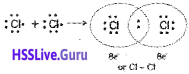
Plus One Chemistry Notes Chapter 4 Chemical Bonding and Molecular Structure 3
In water molecule covalent bond is as follows:
Plus One Chemistry Notes Chapter 4 Chemical Bonding and Molecular Structure 4

when two atoms share one electron pair they are said to be joined by a single covalent bond. If two atoms share two pairs of electrons, the covalent bond between them is called a double bond. And when combining atoms share three electron pairs as in the case of N2 molecule a triple bond a triple bond is formed.

  • The total number of electrons required for writing the structures are obtained by adding the valence electrons of the combining atoms.
  • For anions, each negative charge would mean addition of one electron. For cations, each positive charge would result in subtraction of one electron from the total number of valence electrons.
  • The least electronegative atom occupies the central position in the molecule/ion.

Formal charge
Formal charge (F.C.) on an atom in a Lewis structure = total number of valence electrons in the free atom— total number of non bonding (lone pairjelectrons—(1/2) total number of bonding(shared)electrons.

Let us consider the ozone molecule (O3).
The Lewis structure of O3 may be drawn as:
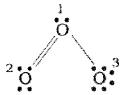
Plus One Chemistry Notes Chapter 4 Chemical Bonding and Molecular Structure 5

The atoms have been marked as 1,2 and 3. The formal charge on:

  • The central O atom marked 1 = 6 – 2- \(\frac{1}{2}\)(6) = +1
  • The end O atom marked 2 = 6 – 4 – \(\frac{1}{2}\)(4) = o
  • The end O atom marked 3 = 6 – 6 – \(\frac{1}{2}\)(2) = -1

Hence, we represent O3 along with the formal changes as follows:
Plus One Chemistry Notes Chapter 4 Chemical Bonding and Molecular Structure 6

Limitations of the Octet Rule
There are three types of exceptions to the octet rule. The incomplete octet of the central atom In some compounds, the number of electrons surrounding the central atom is less than eight. This is especially the case with elements having less than four valence electrons.
Some compounds are BCl3, AlCl3 and BF3.
Plus One Chemistry Notes Chapter 4 Chemical Bonding and Molecular Structure 7

Odd-electron molecules
In molecules with an odd number of electrons like nitric oxide, NO and nitrogen dioxide, NO2, the octet rule is not satisfied for all the atoms.
Plus One Chemistry Notes Chapter 4 Chemical Bonding and Molecular Structure 8

The expanded octet
In a number of compounds of these elements there are more than eight valence electrons around the central atom.Some examples are given below.
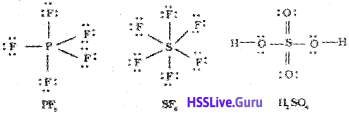
Plus One Chemistry Notes Chapter 4 Chemical Bonding and Molecular Structure 9

Ionic Or Electrovalent Bond
The formation of a positive ion involves ionization, i.e., removal of electrons from the neutral atom and that of the negative ion involves the addition of electron(s) to the neutral atom.

Plus One Chemistry Notes Chapter 4 Chemical Bonding and Molecular Structure

A qualitative measure of the stability of an ionic compound is provided by its enthalpy of lattice formation and not simply by achieving octet of electrons around the ionic species in gaseous state.

Lattice Enthalpy
The Lattice Enthalpy of an ionic solid is defined as the energy required to completely separate one mole of a solid ionic compound into gaseous constituentions.

Bond Parameters

Bond Length
It may be defined as the equilibrium distance between the centres of the nuclei of the two bonded i atoms in a molecule. Bond length are measured by spectroscopic, X-ray diffraction and electron diffraction techniques. It is usually expressed in Angstrom units (A°) or picometres (pm)
1 A° = 10-10m and 1 pm = 10-12m

Bond Angle
It is defined as the angle between the orbitals containing bonding electron pairs around the central atom in a molecule.

Bond Enthalpy
It is defined as the amount of energy required to break one mole of bonds of a particular type between two atoms in a gaseous state.

Bond Order:
In the Lewis description of covalent bond, the bond order is given by the number of bonds between the two atoms in a molecule. For example, the bond order in H2 is one, in O2 is two and in N2 is three. Isoelectronic molecules and ions have identical bond orders. For example N2, CO and NO+ have bond order 3. It is found that as the bond order increases, bond enthalpy increases and bond length decreases.

Resonance Structures
It is often observed that a single Lewis structure is inadequate for the representation of a molecule in conformity with its experimentally determined parameters. As in the case of O3.
Plus One Chemistry Notes Chapter 4 Chemical Bonding and Molecular Structure 10

O3 is represented by the above 3 structures. These are called canonical structures.

Experimentally determined oxygen-oxygen bond lengths in the O3 molecule are same (128 pm). Thus the oxygen-oxygen bonds in the O3 molecule are intermediate between a double and a single bond. According to the concept of resonance, the canonical structures of the hybrid describes the molecule accurately.

Some of the other examples of resonance structures are provided by the carbonate ion and the carbon dioxide molecule.

Polarity of Bonds
In reality no bond or a compound is either completely covalent or ionic. Even in case of covalent bond between two hydrogen atoms, there is some ionic character. As a result of polarisation, the molecule possesses the dipole moment. Which can be defined as the product of the magnitude of the charge and the distance between the centres of positive and negative charge. It is usually designated by a Greek letter Mathematically, it is expressed as follows: Dipole moment (µ) = change (Q) X distance of separation (r)

Plus One Chemistry Notes Chapter 4 Chemical Bonding and Molecular Structure

In case of polyatomic molecules, the dipole moment not only depend upon the individual dipole moments of bonds known as bond dipoles but also on the spatial arrangement of various bonds in the molecule.lt is due to the shifting of electrons to the side of more eletro negative element. For example,
Plus One Chemistry Notes Chapter 4 Chemical Bonding and Molecular Structure 11
The shifting of electrons is represented by an arrow. In case of H2O the resultant dipole moment is given by the following figure:
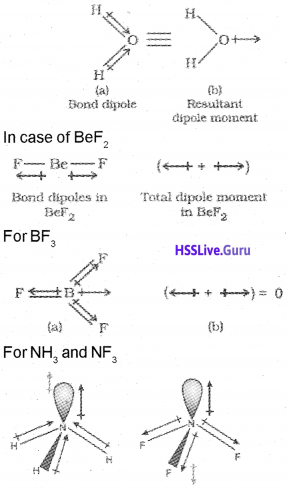
Plus One Chemistry Notes Chapter 4 Chemical Bonding and Molecular Structure 12

Fajans Rules:
Just as all the covalent bonds have some partial ionic character, the ionic bonds also have partial covalent character. The partial covalent character of ionic bonds was discussed by Fajans in terms of the following rules:

  • The smaller the size of the cation and the larger the size of the anion, the greater the covalent character of an ionic bond.
  • The greater the charge on the cation, the greater the covalent character of the ionic bond.
  • For cations of the same size and charge, the one, with electronic configuration (n-1)d”ns°, typical of transition metals, is more polarising than the one with a noble gas configuration, ns2 np6, typical of alkali and alkaline earth metal cations.

The cation polarises the anion, pulling the electronic charge toward itself and thereby increasing the electronic charge between the two. This is precisely what happens in a covalent bond, i.e., buildup of electron charge density between the nuclei. The polarising power of the cation, the polarisability of the anion and the extent of distortion (polarisation) of anion are the factors, which determine the per cent covalent character of the ionic bond.

The Valence Shell Electron Pair Repul-Sion (Vspert) Theory
The main postulates of VSEPR theory are as follows:

  • The shape of a molecule depends upon the number of valence shell electron pairs (bonded or nonbonded) around the central atom.
  • Pairs of electrons in the valence shell repel one another since their electron clouds are negatively charged.
  • These pairs of electrons tend to occupy such positions in space that minimise repulsion and thus maximise distance between them.
  • The valence shell is taken as a sphere with the electron pairs localising on the spherical surface at maximum distance from one another.
  • A multiple bond is treated as if it is a single electron pair and the two or three electron pairs of a multiple bond are treated as a single super pair.
  • Where two or more resonance structures can represent a molecule, the VSEPR model is applicable to any such structure.

The repulsive interaction of electron pairs de-crease in the order:
Lone pair (lp) – Lone pair (lp) > Lone pair (lp) – Bond pair (bp) > Bond pair (bp) – Bond pair (bp)

Valence Bond Theory
Valence bond theory was introduced by Heitlerand London (1927) and developed further by Pauling and others. A discussion of the valence bond theory is based on the knowledge of atomic orbitals, electronic configurations of elements, the overlap criteria of atomic orbitals, the hybridization of atomic orbitals and the principles of variation and superposition. First, we consider the formation of H2. When the attractive forces become greater than the repulsive forces, the molecule is formed and the system gets minimum energy. Because energy is released when a bond is formed. The energy so released is called bond enthalpy.

Orbital Overlap Concept
When two atoms approach each other, their atomic orbitals undergo partial interpenetration. This partial interpenetration of atomic orbitals is called overlapping of atomic orbitals. The electrons belonging to these orbitals are said to be shared and this results in the formation of a covalent bond. The main ideas of orbital of overlap concept of formation of covalent bonds are

  • Covalent bonds are formed by the overlapping of half filled atomic orbitals present in the valence shell of the atoms taking part in bonding.
  • The orbitals undergoing overlapping must have electrons with opposite spins.
    Overlapping of atomic orbitals results in decrease of energy and formation of covalent bond.
  • The strength of a covalent bond depends upon the extent of overlapping. The greater the overlapping, the stronger is the bond formed.

The above treatment of formation of covalent bond involving the overlap of half-filled atomic orbitals is called valence bond theory.

Types of Overlapping and Nature of Covalent Bonds
The covalent bond may be classified into two types depending upon the types of overlapping:
(i) Sigma(σ) bond, and
(ii) pi(π) bond

(i) Sigma( σ) bond :
This type of covalent bond is formed by the end to end (hand-on) overlap of bonding orbitals along the internuclear axis. This is called as head on overlap or axial overlap. This can be formed by any one of the following types of combinations of atomic orbitals.
s-s overlapping:
In this case, there is overlap of two half filled s-orbitals along the internuclear axis as shown below:

Plus One Chemistry Notes Chapter 4 Chemical Bonding and Molecular Structure 13

s-p overlapping:
This type of overlap occurs between half filled s-orbitals of one atom and half filled p-orbitals of another atom.
Plus One Chemistry Notes Chapter 4 Chemical Bonding and Molecular Structure 14

p-p overlapping :
This type of overlap takes place between half filled p-orbitals of the two approaching atoms.

Plus One Chemistry Notes Chapter 4 Chemical Bonding and Molecular Structure 15

(ii) pi(π) bond :
In the formation of n bond the atomic orbitals overlap in such a way that their axes remain parallel to each other and perpendicular to the internuclear axis. The orbitals formed due to side wise overlapping consists of two saucer type charged clouds above and below the plane of the participating atoms.
Plus One Chemistry Notes Chapter 4 Chemical Bonding and Molecular Structure 16

Strength of Sigma and pi Bonds
Basically the strength of a bond depends upon the extent of overlapping. In case of sigma bond, the overlapping of orbitals takes place to a larger extent. Hence, it is stronger as compared to the pi bond where the extent of overlapping occurs to a smaller extent. Further, it is important to note that pi bond between two atoms is formed in addition to a sigma bond. It is always present in the molecules containing multiple bond (double ortriple bonds).

Hybridisation
Hybridisationis defined as the process of intermixing of the orbitals of slightly different energies so as to redistribute their energies, resulting in the formation of new set of orbitals of equivalent energies and shape.

The number of hybrid orbitals is equal to the number of the atomic orbitals that get hybridised.

These hybrid orbitals are stable due to their arrangement which provides minimum repulsion between electron pairs. Therefore, the type of hybridisation indicates the geometry of the molecules.

Plus One Chemistry Notes Chapter 4 Chemical Bonding and Molecular Structure

It is not necessary that only half filled orbitals participate in hybridisation. In some cases, even filled orbitals of valence shell take part in hybridisation.

Types of Hybridisation
There are various types of hybridisation involving s, p and d orbitals. The different types of hybridisation are as under:

(I) sp hybridisation:
This type of hybridisation involves the mixing of one s and one p orbital resulting in the formation of two equivalent sp hybrid orbitals. Each sp hybrid orbitals has 50% s-character and 50% p-character. Such a molecule in which the central atom is sp- hybridised and linked directly to two other central atoms possesses linear geometry.The two sp hybrids point in the opposite direction which provides more effective overlapping resulting in the formation of stronger bonds.

Example of molecule having sp hybridisation BeCl2:
The ground state electronic.configuration of Be is 1s²2s². In the exited state one of the 2s-electrons is promoted to vacant 2p orbital to account for its divalency. One 2s and one 2p-orbitalsget hybridised to form two sp hybridised orbitals. These two sp hybrid orbitals are oriented in opposite direction forming an angle of 180°. Each of the sp hybridised orbital overlaps with the 2p-orbital of chlorine axially and form two Be-Cl sigma bonds.

II) sp² hybridisation :
In this hybridisation there is involvement of one s and two p-orbitals in orderto form three equivalent sp² hybridised orbitals. For example, in BCl2 molecule, the ground state electronic configuration of central boron atom is 1s²2s²2p¹. In the excited state, one of the 2s
electrons is promoted to vacant 2p orbital as a result boron has three unpaired electrons.

These three orbitals (one 2s and two 2p) hybridise to form three sp2 hybrid orbitals. The three hybrid orbitals so formed are oriented in a trigonal planar arrangement and overlap with 2p orbitals of chlorine to form three B-Cl bonds. Therefore, in BCl3 the geometry is trigonal planar with ClBCl bond angle of 120°
Plus One Chemistry Notes Chapter 4 Chemical Bonding and Molecular Structure 17

III) sp³ hybridisation:
This type of hybridisation can be explained by taking the example of CH4 molecule in which there is mixing of one s-orbital and three p-orbitals of the valence shell to form four sp³ hybrid orbital of equivalent energies and shape.

There is 25% s-character and 75% p-character in each sp³ hybrid orbital. The four sp3 hybrid orbitals so formed are directed towards the four corners of the tetrahedron.

The angle between sp³ hybrid orbital is 109.5°
Plus One Chemistry Notes Chapter 4 Chemical Bonding and Molecular Structure 18

The structure of NH3 and H2O molecules can also be explained with the help of sp3hybridisation. In NH3, the valence shell (outer) electronic configuration of nitrogen in the ground state is 2s²\(p_{x}^{1} 2 p_{y}^{1} 2 p_{z}^{1}\) having three unpaired electrons in the sp³ hybrid orbitals and a lone pair of electrons is present in the fourth one. These three hybrid orbitals overlap with 1s orbitals of hydrogen atoms to form three N-H sigma bonds. Due to the force of repulsion, the molecule gets distorted and the bond angle is reduced to 107° from 109.5°. The geometry of such a molecule will be pyramidal.
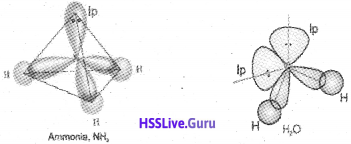
Plus One Chemistry Notes Chapter 4 Chemical Bonding and Molecular Structure 19

Other Examples of sp³, sp² and sp Hybridisation:
sp³ Hybridisation in C2H6 molecule:
In ethane molecule both the carbon atoms assume sp3 hybrid state. One of the four sp³ hybrid orbitals of carbon atom overlaps axially with similar orbitals of other atom to form sp³-sp³ sigma bond while the other three hybrid orbitals of each carbon atom are used in forming sp³-s sigma bonds with hydrogen atoms Therefore in ethane C-C bond length is 154 pm and each C-H bond length is 109 pm.

sp² Hybridisation in C2H4:
In the formation of ethene molecule, one of the sp² hybrid orbitals of carbon atom overlaps axially with sp² hybridised orbital of another carbon atom to form C-C sigma bond. While the other two sp² hybrid orbitals of each carbon atom are used for making sp²-s sigma bond with two hydrogen atoms. The unhybridised orbital (2px or 2py) of one carbon atom overlaps sidewise with the similar orbital of the other carbon atom to form weak π bond, which consists of two equal electron clouds distributed above and below the plane of carbon and hydrogen atoms.

Plus One Chemistry Notes Chapter 4 Chemical Bonding and Molecular Structure

Thus, in ethene molecule, the carbon-carbon bond consists of one sp²-sp² sigma bond and one pi (π) bond between p orbitals which are not used in the hybridisation and are perpendicular to the plane of molecule; the bond length is 134 pm. The C-H bond is sp^s sigma with bond length 108 pm. The H-C-H bond angle is 117.6° while the H-C-C angle is 121°.

sp Hybridisation in C2H2:
In the formation of ethyne molecule, both the carbon atoms undergo sp- hybridisation having two unhybridised orbital i.e., 2py and 2px. One sp hybrid orbital of one carbon atom overlaps axially with sp hybrid orbital of the other carbon atom to form C-C sigma bond, while the other hybridised orbital of each carbon atom overlaps axially with the half filled s orbital of hydrogen atoms forming σ bonds. Each of the two unhybridised p orbitals of both the carbon atoms overlaps sidewise to form two π bonds between the carbon atoms. So the triple bond between the two carbon atoms is made up of one sigma and two pi bonds

Hybridisation of Elements involving d-Orbitals
The elements present in the third period contain d orbitals in addition to s and p orbitals. The energy of the 3d orbitals are comparable to the energy of the 3s and 3p orbitals. The energy of 3d orbitals are also comparable to those of 4s and 4p orbitals. As a consequence the hybridisation involving either 3s, 3p, and 3d or 3d, 4s and 4p is possible. However, since the difference in energies of 3p and 4s orbitals is significant, no hybridisation involving 3p, 3d and 4s orbitals is possible.

1. Formation of PCl5 (sp³d hybridisation):
The ground state and the excited state outer electronic configurations of phosphorus (Z=15) are represented below.
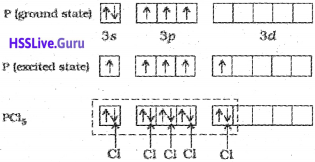
Plus One Chemistry Notes Chapter 4 Chemical Bonding and Molecular Structure 20

Now the five orbitals (i.eone s, three p, and one d orbitals) are available for hybridisation to yield a set of five sp3d hybrid orbitals which are directed towards the five comers of a trigonal bipyramidal.
Plus One Chemistry Notes Chapter 4 Chemical Bonding and Molecular Structure 21

Three sigma bond known as equatorial bonds lie in one plane and make an angle of 120° with each other.
The remaining two P-Cl bonds(called axial bonds)-one lying above and the other lying below the equatorial plane, make an angle of 90° with the plane.

As the axial bond pairs suffer more repulsive interaction from the equatorial bond pairs, therefore axial bonds have been found to be slightly longer and hence slightly weaker than the equatorial bonds; which makes PCl5 molecule more reactive.

Plus One Chemistry Notes Chapter 4 Chemical Bonding and Molecular Structure

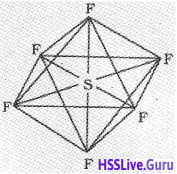
2. Formation of SF6 (sp³d² hybridisation):
In SF6 the central sulphur atom has the ground state outer electronic configuration 3s²3p4. In the exited state the available six orbitals i.e., one s, three p and two d are singly occupied by electrons. These orbitals hybridise to form six new sp³d² hybrid orbitals, which are projected towards the six corners of a regular octahedron in SF6. These six sp³d² hybrid orbitals overlap with singly occupied orbitals of fluorine atoms to form six S-F sigma bonds. Thus SF6 molecule has a regular octahedral geometry.
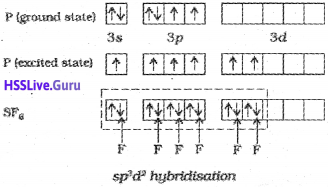
Plus One Chemistry Notes Chapter 4 Chemical Bonding and Molecular Structure 22

The structure of SF6 is given below.
Plus One Chemistry Notes Chapter 4 Chemical Bonding and Molecular Structure 23

Molecular Orbital Theory
Molecular orbital (MO) theory was developed by F. Hund and R.S. Mulliken in 1932. The salient features of this theory are :

  • The electrons in a molecule are present in the various molecular orbitals as the electrons of atoms are present in the various atomic orbitals.
  • The atomic orbitals of comparable energies and proper symmetry combine to form molecular orbitals.
  • While an electron in an atomic orbital is influenced by one nucleus, in a molecular orbital it is influenced by two or more nuclei depending upon the number of atoms in the molecule. Thus, an atomic orbital is monocentric while a molecular orbital is polycentric.
  • The number of molecular orbital formed is equal to the number of combining atomic orbitals. When two atomic orbitals combine, two molecular orbitals are formed. One is known as bonding molecular orbital while the other is called antibonding molecular orbital.
  • The bonding molecular orbital has lower energy and hence greater stability than the corresponding antibonding molecular orbital.
  • Just as the electron probability distribution around a nucleus in an atom is given by an atomic orbital, the electron probability distribution around a group of nuclei in a molecule is given by a molecular orbital.
  • The molecular orbitals like atomic orbitals are filled in accordance with the aufbau principle obeying the Pauli’s exclusion principle and the Hund’srule.

Formation of Molecular Orbitals
Linear Combination of Atomic Orbitals (LCAO)
The atomic orbitals of these atoms may be represented by the wave functions ψA and ψB. The formation of molecular orbitals is the linear combination of atomic orbitals that can take place by addition and by subtraction of wave functions of individual atomic orbitals as shown below.
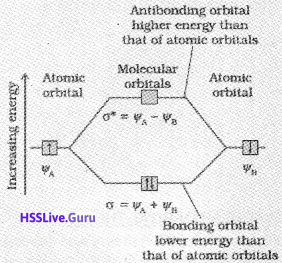
Plus One Chemistry Notes Chapter 4 Chemical Bonding and Molecular Structure 24
Energy Level Diagram for Molecular orbitals
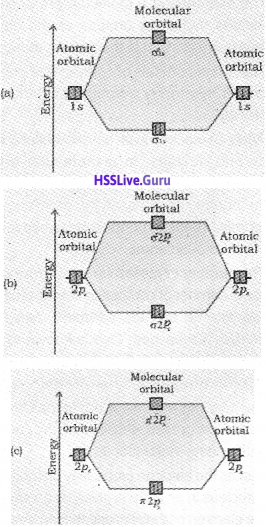
Plus One Chemistry Notes Chapter 4 Chemical Bonding and Molecular Structure 25
The increasing order of energies of various molecular orbitals for O2 and F2 is given below:
σ1s < σ*1s < σ2s < σ*2s < σ2px <(π2px = π2py) <(π*2px = π*2pz) < σ*2px

This sequence of energy levels of molecular orbitals is not correct for the remaining molecules Li2, Be2, B2, C2, N2. For molecules such as B2, C2, N2 etc. the increasing order of energies of various molecular orbitals is
σ1s < σ*1s < σ2s < σ*2s <(π2px = π2py) < σ2px <(π*2px = π*2pz) < σ*2pz

Plus One Chemistry Notes Chapter 4 Chemical Bonding and Molecular Structure

The important characteristic feature of this order is that the energy of σ 2pz molecular orbital is higher than that of π2px and π2py molecular orbitals. If the bonding influence is stronger a stable molecule results and if the antibonding influence is stronger,the molecule is unstable.

Bonding In Some Homonuclear Diatomic Molecules
Bond Order:
Bond order is defined as half of the difference between the number of electrons in the bonding molecular orbitals and that in the antibonding molecular orbitals.
Nh – N
i.e. Bond Order= \(\frac{N_{b}-N_{a}}{2}\). Where Nb is the number of electrons in the bonding molecular orbitals and Na is the number of electrons in the antibonding mo-lecular orbitals.

Significance of bond order:
Bond order conveys the following important informations about a molecule.
i) If the value of bond order is positive, it indicates a stable molecule and if the value of bond order is negative or zero, the molecule is unstable and is not formed.
ii) Bond dissociation energy of a diatomic molecule is directly proportional to the bond order of the molecule. The greater the bond order, the higher is the bond dissociation energy.
iii) Bond order is inversely proportional to the bond length. The higherthe bond ondervalue, smaller is the bond length. For example, the bond length in N2 molecule (having bond order 3) is less than that in O2 molecule (having bond order 2).

Magnetic character:
If all the electrons in the mol-ecules of a substance are paired, the substance will be diamagnetic. On the other hand, if there are un-paired electrons in the molecule, the substance will be paramagnetic.

Hydrogen Bonding
Hydrogen bond can be defined as the attractive force which binds hydrogen atom of one molecule with the electronegative atom (F, O orN) of another molecule. When hydrogen is bonded to strongly electronegative element ‘X’, the electron pair shared between the two atoms moves far away from hydrogen atom. As a result the hydrogen atom becomes, highly electropositive with respect to the other atom ‘X’. Since there is displacement of electrons towards X, the hydrogen acquires fractional positive charge (δ+) while ‘X’ attain fractional negative charge (δ). This results in the formation of a polar molecule having electrostatic force of attraction which can be represented as: Hδ+ – Xδ-

The magnitude of H-bonding depends on the physical state of the compound. It is maximum in the solid state and minimum in the gaseous state. Thus, the hydrogen bonds have strong influence on the structure and properties of the compounds.

Types of Hydrogen Bonds
There are two types of hydrogen bonds

  1. Intermolecular hydrogen bond
  2. Intramolecular hydrogen bond

1. Intermolecular hydrogen bond:
It is formed between two different molecules of the same or different compounds. For example, H-bond in case of HF molecule, alcohol or water molecules, etc.

2. Intramolecular hydrogen bond:
It is formed when hydrogen atom is in between the two highly electronegative (F, O, N) atoms present within the same molecule. For example, in o-Nitrophenol the hydrogen is in between the two oxygen atoms as shown below:

Plus One Physics Chapter Wise Questions and Answers Chapter 5 Law of Motion

Students can Download Chapter 5 Law of Motion Questions and Answers, Plus One Physics Chapter Wise Questions and Answers helps you to revise the complete Kerala State Syllabus and score more marks in your examinations.

Kerala Plus One Physics Chapter Wise Questions and Answers Chapter 5 Law of Motion

Plus One Physics Law of Motion One Mark Questions and Answers

Plus One Physics Laws Of Motion Questions Chapter 5 Question 1.
Which one of the following is not a force?
(a) Impulse
(b) Tension
(c) Thrust
(d) Weight
Answer:
(a) Impulse
Tension, thrust, weight are all common forces in mechanics whereas impulse is not a force.
Impulse = Force × Time duration.

Plus One Physics Laws Of Motion Questions And Answers Chapter 5 Question 2.
A passenger getting down from a moving bus, falls in the direction of the motion of the bus. This is an example for
(a) Inertia of motion
(b) Second law of motion
(c) Third law of motion
(d) Inertia of rest
Answer:
(a) Inertia of motion
A passenger getting down from a moving bus, falls in the direction of the motion of the bus. This is because his feet come to rest on touching the ground and the remaining body continues to move due to inertia of motion.

Plus One Physics Important Questions And Answers Pdf Chapter 5  Question 3.
Which one of the following is not a contact force?
(a) Viscous force
(b) Magnetic force
(c) Friction
(d) Buoyant force
Answer:
(b) Magnetic force

Plus One Physics Chapter Wise Questions And Answers Chapter 5 Question 4.
A jet engine works on the principle of
(a) Conservation of linear momentum
(b) Conservation of mass
(c) Conservation of energy
(d) Conservation of angular momentum
Answer:
(a) Conservation of linear momentum
A jet engine works on the principle of linear momentum.

State And Prove Impulse Momentum Theorem Chapter 5 Question 5.
Newton’s second and third laws of motion lead to the conservation of
(a) linear momentum
(b) angular momentum
(c) potential energy
(d) kinetic energy
Answer:
(a) linear momentum
Newton’s second and third laws lead to the conservation of linear momentum.

Hsslive Plus One Physics Chapter Wise Questions And Answers Chapter 5 Question 6.
A large force is acting on a body for a short time. The impulse imparted is equal to the change in
(a) acceleration
(b) momentum
(c) energy
(d) velocity
Answer:
(b) momentum
If a large force F acts for a short time dt, the impulse imparted is
I = F.dt, = \(\frac{d p}{d t}\).dt
I = dp = change in momentum.

Laws Of Motion Class 11 Questions With Solutions Pdf Chapter 5 Question 7.
When a shell explodes, the fragments fly apart though no external force is acting on it. Does this violate Newton’s first law of motion?
Answer:
No. The explosion takes place due to the internal force. The internal force does not change the position of centre of mass.

Prove Impulse Momentum Theorem Chapter 5 Question 8.
In taking a catch, a cricket player moves his hands backward on holding the ball. Why?
Answer:
We know F = \(\frac{\Delta P}{\Delta t}\)
When ∆t increases, the force acting on hand decreases.

350 degrees f to c … T C T F 32 x 59 is the method for converting degrees Fahrenheit to degrees Celsius.

Plus One Physics Important Questions And Answers Chapter 5 Question 9.
Name the factor on which inertia depends.
Answer:
Mass

Laws Of Motion Class 11 Test Paper Chapter 5 Question 10.
Why does a swimmer push the water backwards?
Answer:
A swimmer pushes the water backward in order to be pushed forward (Newton’s third law).

Laws Of Motion Previous Year Questions Chapter 5 Question 11.
Rocket works on the principle of conservation of_______.
Answer:
Momentum

Motion Questions And Answers Pdf Chapter 5 Question 12.
A man experience a backward jerk, while firing bullet from gun. Which law is applicable here? Answer:
Conservation of momentum.

Plus One Physics Laws Of Motion Notes Chapter 5 Question 13.
If you jerk a piece of paper under a book quick enough, the book will not move. Why?
Answer:
This is due to inertia of rest.

Class 11 Physics Chapter 5 Important Questions Chapter 5 Question 14.
Why it is difficult to walk on a slipper road?
Answer:
We will not get required reaction from slippery road.

Laws Of Motion Class 11 Important Questions Chapter 5 Question 15.
A stone, when thrown on a glass window, smashes the window pan to pieces. But a bullet fired from the gun passes through it making a hole why?
Answer:
This is due to inertia of rest of glass window.

Question 16.
Why an athlete runs some distance before taking a jump?
Answer:
An athletic runs some distance before taking a jump to gain some initial momentum. It helps the athlete to jump more.

Question 17.
Why a horse can not pull a cart and run in empty space?
Answer:
The horse-cart system moves forward due to reaction of ground on the feet of horse. In free space, there is no reaction. So it can not pull cart.

Question 18.
Why parachute descends slowly?
Answer:
Parachute has large surface area. This increases fluid friction and slows down the motion of parachute.

Question 19.
Sand is thrown on tracks with snow. Why?
Answer:
The presence of snow on tracks reduces friction and driving is not safe. If sand is thrown, friction will be increased and driving becomes safe.

Question 20.
It is difficult to move a cycle along a road with its brakes on. Explain.
Answer:
When the cycle is moved with its brakes on, wheels can only skid. There will be sliding friction. The sliding friction is more compared to rolling friction. Hence it is difficult to move a cycle with its brakes on.

Plus One Physics Law of Motion Two Mark Questions and Answers

Question 1.
Two masses are in the ratio 1:5

  1. What is inertia.
  2. What is the ratio of inertia of above case?

Answer:

  1. The inability of a body to change it’s state of rest or uniform motion is called inertia.
  2. Mass is a measure of inertia. Hence ratio of inertia is 1:5.

Question 2.
More force is required to push a body than pull to get same speed on a ground with some friction. Why?
Answer:
When we push, the action on the surface and normal reaction on the body increases. (Friction is directly proportional to normal reaction).

As a result more force is required to push the body. When we pull, normal reaction decreases. Hence friction decreases. Hence less force is required to pull the body.

Question 3.
A lift in a multistoried building is moving from ground floor to third floor. What will happen to weight of a person sitting in side of the lift.

  1. A When starts to move up from ground floor.
  2. When the lift moves with constant speed.

Answer:

  1. A weight increases weight w = mg + ma
  2. weight is constant ie. w = mg

Question 4.
Why it is advisable to hold a gun tight to one’s shoulder when it is being fired?
Answer:
The recoiling gun can hurt the shoulder. If gun is held tightly against the shoulder, the body and gun act a system. This will reduce recoil velocity as it is inversly proportional to mass of system.

Question 5.
Why shockers are used in vehicles?
Answer:
When there is a jerk or jump, the time for which force acts (∆t) increases. As the product of force and time for which force acts (F∆t) remains constant, increase in At will reduce the force. This provide smooth motion.

Plus One Physics Law of Motion Three Mark Questions and Answers

Question 1.
Give the magnitude and direction of net force on

  1. a drop of rain falling down with a constant velocity.
  2. a stone of mass 0.1 kg just after it dropped from the window of a tram accelerating at 1 ms-2.

Answer:
1. Net force is zero

2. When stone is dropped, gravitational force will act on the stone.
Gravitational force F = mg
= 0.1 × 10
= 1 N downward.

Question 2.
An external force is always required to break the inertia of a body which is either in the state of rest or state of uniform motion.

  1. Which law governs this statement?
  2. Can all forces produce acceleration? Why?
  3. A boy holding a spring balance in his hand suspend a mass 2kg from it. If the balance slips from his hand and falls down, find the reading of the balance while it is in the air.

Answer:

  1. Newtons first law of motion.
  2. No. If resultant force acting on the body is zero, the body will move with constant velocity or remain at rest.
  3. Zero

Question 3.
A man weighs 70 kg. He stands on a weighing scale in a lift which is moving.

  1. upward with a uniform speed of 10 m/s.
  2. downward with an uniform acceleration of 5 m/s2.
  3. upward with an uniform accelerate of 5 m/s2. (Take g = 10m/s2). Find weight in each case.

Answer:
1. Weight W = mg
= 70 × 10 = 700 N.

2. W = mg – ma
= 70 × 10 – 70 × 5
= 700 – 350
= 350 N

3. W = mg + ma
= 70 × 10 + 70 × 5
= 700 + 350
= 1050N.

Question 4.
A body of mass ‘m’ is placed on a rough inclined plane having coefficient of friction µs. The inclination of plane is given as ‘θ’.
Plus One Physics Chapter Wise Questions and Answers Chapter 5 Law of Motion - 1

  1. Which component of weight brings the body towards the bottom along the plane.
  2. Find how much force is required to pull the body along the plane.

Answer:
Plus One Physics Chapter Wise Questions and Answers Chapter 5 Law of Motion - 2

  1. mg Sinθ brings the body downwards
  2. When the body moves upwards the frictional force (Fs) acts downwards
    Total pulling Force = mg Sinθ + Frictional force (Fs) (u, mgCosθ).

Question 5.
Four person sitting in the back seat of a car at rest, is pushing on the front seat.

  1. Does the car move. Why?
  2. State the law which help you to answer above question.
  3. Long jumpers take a long run before the jump. Why?

Answer:

  1. No. Action and reaction cancel each other.
  2. Newtons third law of motion.
  3. To get large inertia of motion.

Question 6.
A Cricket player lowers his hands while catching a Cricket ball to avoid injury.

  1. What do you mean by impulsive force?
  2. Prove impulse – momentum theorem.

Answer:
1. The forces which acton bodies for short time are called impulsive forces.
Example:

  • In hitting a ball with a bat
  • In firing a gun

2. F = \(\frac{d p}{d t}\)
F∆t = dp
impulse = change in momentum.

Plus One Physics Law of Motion Four Mark Questions and Answers

Question 1.
A bead sliding on a wire A moves to C through B as shown in the figure. The bead at A has a speed of200cms
Plus One Physics Chapter Wise Questions and Answers Chapter 5 Law of Motion - 3

  1. what is speed at B?
  2. To what height will it rise before it returns?
  3. Why the ball moves up even after reaching the bottom most point B?

Answer:
1. mgh = 1/2 mv2
m × 10 × 0.8 = 1/2 mv2
V2 = 2 × 10 × 0.8
V = \(\sqrt{2 \times 10 \times 0.8}\)
V = 4 m/s.

2. 80 cm (if friction is neglected).

3. when the ball reaches at B, the potential energy is converted into kinetic energy. Due to this kinetic energy the ball raises to the point c.

Question 2.
Figure shows a block (mass m1) on a smooth horizontal surface, connected by a thin cord that passes over a pulley to a second block (m2), which hangs vertically.
Plus One Physics Chapter Wise Questions and Answers Chapter 5 Law of Motion - 4

  1. Obtain formula for the acceleration of the system and tension in the cord.
  2. If m1 and m2 interchanges its position, will it affect the tension of the string?
  3. What is the acceleration of the system if m1 = 5 kg and m2 = 2kg?

Answer:
1. When the body m2 moves in down ward direction.
m2g – T = m1 a
T = m2g – m1a.

2. New tension can be found from the relation
m1g – T = m2a
T = m1g – m2 a.

3. Acceleration of system, a
Plus One Physics Chapter Wise Questions and Answers Chapter 5 Law of Motion - 5

Question 3.
The collision of two ice hockey players are shown in figure.
Plus One Physics Chapter Wise Questions and Answers Chapter 5 Law of Motion - 6
Analyse the data given in the figure and answer the following questions.

  1. Which conservation law is applicable in this case.
  2. In which direction and at what speed do they travel after they stick together.
    [Hint – towards right can be taken us +ve direc¬tion and vice versa]
  3. If we assume the friction of playing ground is zero, predict the nature of motion and the point at which they come to rest.

Answer:
1. Conservation of linear momentum.

2. Total momentum before collision = Total momentum after collision.
110 × 4 + 90 × -6 = (110 + 90)v
v = 0.5 m/s
-ve direction, (in the direction of man mass 90 kg).

3. Uniform motion They will not stop.

Question 4.
A circular track of radius 300m is kept with outside of track raised to make 5 degree with the horizontal.

  1. Name the process in which outside of the road is raised little above the inner.
  2. Obtain an expression for the optimum speed to avoid skidding (considering to friction)

Answer:
1. Banking of roqd

2.
Plus One Physics Chapter Wise Questions and Answers Chapter 5 Law of Motion - 7
Plus One Physics Chapter Wise Questions and Answers Chapter 5 Law of Motion - 8
Consider a vehicle along a curved road with angle of banking θ. Then the normal reaction on the ground will be inclined at an angle θ with the vertical.
The vertical component can be divided into N Cosθ (vertical component) and N sinθ (horizontal component). The frictional force can be divided into two components. Fcosθ (horizontal component) and F sinθ (vertical component).
From the figure
N cos θ = F sinθ + mg
N cosθ – F sinθ = mg ______(1)
The component Nsin0 and Fsinθ provide centripetal force. Hence
N sinθ + F cos θ = \(\frac{\mathrm{mv}^{2}}{\mathrm{R}}\) ______(2)
eq (1) by eq (2)
Plus One Physics Chapter Wise Questions and Answers Chapter 5 Law of Motion - 9
Dividing both numerator and denominator of L.H.S by N cosθ. We get
Plus One Physics Chapter Wise Questions and Answers Chapter 5 Law of Motion - 10
This is the maximum speed at which vehicle can move over a banked curved road.
Optimum speed:
Optimum speed is the speed at which a vehicle can move over a curved banked road without using unnecessary friction. Putting µ = 0 in the above equation we get
v0 = \(\sqrt{\mathrm{Rg} \tan \theta}\).

Question 5.
A circular track of radius 400m is kept with outer side of track raised to make 5° with the horizontal (coefficient of friction 0.2)
(a) Name such track?
(b) What is optimum speed to avoid wear and tear of type?
(c) What is the maximum permissible speed to avoid skidding?
Answer:
(a) Banking.

Plus One Physics Law of Motion Five Mark Questions and Answers

Question 1.
A horse pulls a cart with constant force so that the cart moves with a constant speed.

  1. Does it violate Newtons second law of motion?
  2. If not, how will you account for the non acceleration of the cart?
  3. Will the speed of the cart increase, decrease or remain the same if the horse applied more force?
  4. A body of mass 5kg is acted upon by two perpendicular forces 8N and 6N. Give the magnitude and direction of the acceleration of the body.

Answer:
1. No.

2. The force applied by the car is balanced by the frictional force. Hence the cart moves with constant velocity.

3. If the horse is applied more force, the speed of the cart increases.

4. The resultant force,
Plus One Physics Chapter Wise Questions and Answers Chapter 5 Law of Motion - 11
F = 10N
We know, F = ma
10 = 5 × a
acceleration, a = \(\frac{5}{10}\) = 2 m / sec2
Plus One Physics Chapter Wise Questions and Answers Chapter 5 Law of Motion - 12
The angle of resultant force,
Plus One Physics Chapter Wise Questions and Answers Chapter 5 Law of Motion - 13
θ = tan-1 6/8
θ = 36°521
The angle of acceleration θ = 36°521.

Question 2.

  1. Friction is the force which opposes the relative motion between two surfaces in contact with each other. What is a limiting static friction? State the laws related to this.
  2. Show that the coefficient of friction is equal to the tan of the angle between the resultant and normal reactions.
  3. For a body of mass 5kg on a plane at a limiting static friction of 30 degrees. What is the force of friction?

Answer:
1. The maximum value of static friction is called limiting static friction.

  • The magnitude of the limiting friction is independent of the area of contact between the surfaces.
  • The limiting static friction is directly proportional to the normal reaction R.

ie f α R
fs = µsR.

2. Angle of friction is the angle whose tangent gives the coefficient of friction.
Plus One Physics Chapter Wise Questions and Answers Chapter 5 Law of Motion - 14
Consider a body placed on a surface. Let N be the normal reaction and limit is the limiting friction. Let ‘θ’ be the angle between Resultant vector and normal reaction. From the triangle OBC,
Plus One Physics Chapter Wise Questions and Answers Chapter 5 Law of Motion - 15
∴ tanθ = µ.

3. Tangent of the angle cient of friction.
µs = tanθ
µs = tan 30
µs = \(1 / \sqrt{3}\)
Friction F = µsmg
= \(1 / \sqrt{3}\) × 5 × 10
F = \(\frac{50}{\sqrt{3}}\)N.

Question 3.
The rate of change of linear momentum of a body is directly proportional to the external force applied on it, and takes place always in the direction of force applied.

  1. Name this law.
  2. Using this law obtain the expression for force.
  3. The motion of a particle of mass m is described by y = ut + \(\frac{1}{2}\) gt2. Find the force acting on it.

Answer:
1. Newton’s Second Law.

2. Consider a body of mass ‘m’ moving with a momentum \(\vec{p}\). Let \(\vec{F}\) be the force acting on it for time internal ∆t. Due to this force the momentum is changed from \(\vec{p}\) to p + ∆p. Then according to Newtons second law, we can write
Plus One Physics Chapter Wise Questions and Answers Chapter 5 Law of Motion - 16
Where K is a constant pf proportionality. When we take the limit ∆t → 0, we can write
Plus One Physics Chapter Wise Questions and Answers Chapter 5 Law of Motion - 17

3.
Plus One Physics Chapter Wise Questions and Answers Chapter 5 Law of Motion - 18
Hence force F = mg.

Question 4.
Recoil of gun is based on the principle of conservation of momentum.

  1. State the principle of conservation of momentum.
  2. Explain the reoil velocity of gun.
  3. A bullet of mas 100g is fired from a rife of mass 200 kg with a spped of 50 m/s. Calculate the recoil velocity of the rife.

Answer:
1. According to law of conservation of linear momentum, if the external force acting on a body is zero, total linear momentum remains constant. According to Newton’s second law.
F = \(\frac{d p}{d t}\)
If F = 0, \(\frac{d p}{d t}\) = 0 i.e; P is constant.

2. Let M, m be the mass of gun and bullet respectively. Let V and ν be the velocities of gun and bullet after firing.
According to consevation of momentum
Total momentum before firing = Total momentum after firing
∴ O = MV + m ν
-MV = mν
The above equation shows that when bullet moves in forward direction, the gun moves in back direction. This motion of gun is called recoil of gun.

3. M = 200kg, m = 100g = 0.1kg
ν = 50 m/s, V = ?
MV = mν
200 × V = 0.1 × 50
V = \(\frac{0.1 \times 50}{200}\)m/s.

Question 5.
While firing a bullet, the gun must be held tight to the shoulder.

  1. Which conservation law helps you to explain this
  2. “In the firing process, the speed of the gun is very low compared to the speed of the bullet.” Substantiate the above statement using mathematical expressions.
  3. A shell of 20kg moving at 50m/s bursts in to two parts of masses 15kg and 5kg. If the larger part continues to move in the same direction at 70 m/s. What is the velocity and direction of motion of the other piece.

Answer:
1. Conservation of momentum.

2. Total momentum is conserved
∴ mu + MV = 0
V = \(\frac{-m u}{M}\) M is very large. Hence v is small

3. MV = m1 u1 + m2 u2
20 × 50 = 5u1 + 15 × 70
5u1 = 50
u1 = 10m/s.

Question 6.
While firing a bullet, the gun must be held tight to the shoulder.

  1. This is a consequence of______
  2. Show that recoil velocity is opposite to the muzzle velocity of the bullet.
  3. A gun of mass 5 kg fire a bullet of mass 5g, vertically upwards to a height of 100m. Calculate the recoil velocity of gun.

Answer:
1. Conservation of linear momentum.

2. Let M be the mass of gun and m be the mass of bullet. When gun fires, the gun and bullet acquire velocities V and v respectively.
According to conservation of momentum.
Total momentum before firing = Total momentum afterfiring
m × o + M × o = mu + MV
O = mv + MV
ie. – MV = mv
V = \(\frac{-m v}{M}\)

3. M = 5kg, m = 5 × 10⁻³ kg, h = 100m
v2 = u2 + 2as
0 = u2 + 2 × 10 × 100
Velocity of bullet,
Plus One Physics Chapter Wise Questions and Answers Chapter 5 Law of Motion - 19

Question 7.
A standing passenger falls backwards when the bus starts suddenly.

  1. Explain why this happens?
  2. Which Newtons law gives the above concept. State the law.
  3. Obtain an expression for force using Newtons law.

Answer:
1. Due to inertia of rest, the body continues in the state of rest.

2. Newtons first law:
Everybody continues in its state of rest or of uniform motion along a straight line unless it is compelled by an external unbalanced force to change that state:

3. Consider a body of mass ‘m’ moving with a momentum \(\vec{p}\). Let \(\vec{F}\) be the force acting on it for time internal ∆t. Due to this force the momentum is changed from \(\vec{p}\) to p + ∆p. Then according to Newtons second law, we can write
Plus One Physics Chapter Wise Questions and Answers Chapter 5 Law of Motion - 20
Where K is a constant pf proportionality. When we take the limit ∆t → 0, we can write
Plus One Physics Chapter Wise Questions and Answers Chapter 5 Law of Motion - 21

Question 8.
According to Newton’s law of motion rate of change of momentum is directly proportional to applied force.
a. Impulse has the unit similarto that of

  1. Momentum
  2. force
  3. time
  4. Energy

b. A man falling from certain height receives more injuries when he falls on a marble floor than when he falls on a heap of sand. Explain. Why?
c.
Plus One Physics Chapter Wise Questions and Answers Chapter 5 Law of Motion - 22
Force – time graph for a body starting from rest is shown in the figure. What is the velocity of the body at the end of 12 second? (Mass of the body is 5 kg)
Answer:
a. 1. Momentum.

b. When a man falls on a marble floor, the momentum is reduced to zero in lesser time. Due to this, the rate of change of momentum is large. So greater force acts on a man falls on marble floor.

c. The area of force – time graph gives change in momentum.
ie. change in momentum,
mv = 1/2 × (12 – 4) × (20 -10)
mv = 40

Plus One Physics Law of Motion NCERT Questions and Answers

Question 1.
Give the magnitude and direction of the net force acting on
(a) a drop of rain falling down with a constant speed.
(b) a cork of mass 10g floating on water
(c) a kite skillfully held stationary in the sky
(d) a car moving with a constant velocity of 30km h-1 on a rough road
(e) a high – speed electron in space far from all material objects, and free of electric and magnetic fields.
Answer:
Applying Newton’s first law of motion, we find that no net force acts in any of the situations, (a) to (d). Again, no force in situation (e). This is because electron is far away from all material agencies producing electromagnetic and gravitational forces.

Question 2.
A constant retarding force of 50 N is applied to a body of mass 20kg moving initially with a speed of 15ms-1. How long does the body take to stop?
Answer:
Acceleration, a = –\(\frac{50 \mathrm{N}}{20 \mathrm{kg}}\) = -2.5ms-2
[Negative sign indicates retardation]
u = 15ms-1, v = 0, t = ?
v = u + at
0 = 15 – 2.5t or 2.5t = 15 or
t = \(\frac{15}{2.5}\)s = 6.0s.

Question 3.
A constant force acting on a body of mass 3.0kg changes its speed from 2.0ms-1 to 3.5 ms-1 in 25s. The direction of motion of the body remains unchanged. What is the magnitude and direction of the force?
Answer:
m = 3kg; u = 2ms-1; v = 3.5 ms-1;
t = 25s ; F = ?
v = u + at
3.5 = 2 + 25a or a = 0.06 ms-2
F = ma = 3kg × 0.06 ms-2 = 0.18N.
The direction of force is along the direction of motion.

Question 4.
A bob of mass 0.1 kg hung from the ceiling of a room by a string 2 m long is set into oscillation. The speed of the bob at its mean position is 1 ms-1. What is the trajectory of the bob if the string is cut when the bob is

  1. at one of its extreme positions.
  2. at its mean position.

Answer:

  1. At the extreme position, the speed of the bob is zero. If the string is cut, it will fall vertically down wards.
  2. At the mean position, the bob has a horizontal velocity. If the string is cut, it will fall along a parabolic path.

Question 5.
A man of mass 70kg stands on a weighing scale in a lift which is moving

  1. upwards with a uniform speed of 10ms-1
  2. downwards with a uniform acceleration of 5ms-2
  3. upwards with a uniform acceleration of 5ms-2 What would be the readings on the scale in each case?
  4. What would be the reading if the lift mechanism failed and it hurtled down freely under gravity?

Answer:

  1. a = 0, R = mg = 70 × 10 N = 700N
  2. mg – R = , ma ; R – mg – ma = (g – a)
    = 70(10 – 5) N = 350N
  3. R – mg = ma or R = m(g + a)
    = 70(10 + 5)N = 1056 N
  4. In the event of free fall, it is a condition of weight lessness.

Question 6.
A nucleus is at rest in the laboratory frame of reference. Show that if it dist integrates into two smaller nuclei, the products must move in opposite directions.
Answer:
Applying principle of conservation of momentum,
Plus One Physics Chapter Wise Questions and Answers Chapter 5 Law of Motion - 23
The negative sign indicates that the products move in opposite directions.

Question 7.
A shell of mass 0.020 kg is fired by a gun of mass 100kg. If the muzzle speed of the shell is 80ms-1, what is the recoil speed of the gun?
Answer:
m = 0.02kg, M = 100kg, v = 80ms-1, V = ?
Plus One Physics Chapter Wise Questions and Answers Chapter 5 Law of Motion - 24
= -0.016ms-1 = -1.6cm s-1
Negative sign indicates that gun moves in a direction opposite to the direction of motion of the bullet.

Plus One Physics Model Question Paper 4

Kerala Plus One Physics Model Question Paper 4

Time: 2 Hours
Cool off time: 15 Minutes
Maximum: 60 Scores

General Instructions to candidates

  • There is a ‘cool off time’ of 15 minutes in addition to the writing time.
  • Use the ‘cool off time’ to get familiar with the questions and to plan your answers.
  • Read the instructions carefully.
  • Read questions carefully before you answering.
  • Calculations, figures, and graphs should be shown in the answer sheet itself.
  • Malayalam version of the questions is also provided.
  • Give equations wherever necessary.
  • Electronic devices except non-programmable calculators are not allowed in the Examination Hall.

Plus One Physics Previous Year Question Papers and Answers 2018 1

Answer any four questions from question numbers 1 to 5. Each carries one score.
Plus One Physics Model Question Papers Paper 4 1

Engineering Physics MCQ with answers in PDF format.

Question 1.
Name the weakest force among the fundamental forces.
Plus One Physics Model Question Papers Paper 4 2

Question 2.
The work done during an isochoric process is …………….
Plus One Physics Model Question Papers Paper 4 3

The harmonic sequence formula is a sort of average calculator that is estimated by dividing the number of utilities.

Question 3.
Highway police detect over speeding vehicles by using ……………….
a. Magnus effect
b. Pascals law
c. Doppler effect
d. Bernoulli’s theorem
Plus One Physics Model Question Papers Paper 4 4

Question 4.
Two forces 3N and 4N are acting perpendicular to each other. The magnitude of the resultant force is
Plus One Physics Model Question Papers Paper 4 5

Question 5.
Say true/false: “Trade winds are produced due to conduction.”
Plus One Physics Model Question Papers Paper 4 6

Answer any five questions from question numbers 6 to 11. Each carries two scores.
Plus One Physics Model Question Papers Paper 4 7Plus One Physics Model Question Papers Paper 4 8

Question 6.
The displacement (S) of a body in time ‘t’ is given by S = at2 + bt. Find the dimensions of a and b.
Plus One Physics Model Question Papers Paper 4 9

Question 7.
Give the magnitude and direction of the net force on a stone of mass 0.1 kg.
a. Just after it is dropped from the window of a train accelerating 1 ms2.
b. Lying on the floor of a train which is accelerating with 1 ms-2, the stone being at rest relative to the train.
Plus One Physics Model Question Papers Paper 4 10

Question 8.
A body is rolling on a horizontal surface. Derive an equation for its kinetic energy,
Plus One Physics Model Question Papers Paper 4 11

Question 9.
The stress-strain graphs for two materials A and B are shown below (the graphs are drawn using the same scale) Which one is more elastic? Why?
Plus One Physics Model Question Papers Paper 4 12
Plus One Physics Model Question Papers Paper 4 13

Question 10.
“A heavy and a light body have the same kinetic energy.” Which one has greater momentum? Why?
Plus One Physics Model Question Papers Paper 4 14

Question 11.
The following figures refer to the steady flow of a nonviscous liquid. Which of the two figures is correct? Why?
Plus One Physics Model Question Papers Paper 4 15

Answer any five questions from question num 1.5 m numbers 12 to 17. Each carries three scores.
Plus One Physics Model Question Papers Paper 4 16

Question 12.
The side of a cube is measured as 3.405 cm.
a. How many significant figures are there in the measurement?
b. If the percentage error in the measurement of the side of the cube is 3%, find; the percentage error in its volume.
Plus One Physics Model Question Papers Paper 4 17

Question 13.
According to the conservation of energy “energy can neither be created nor be destroyed”
a. Prove law of conservation of mechanical energy in the case of a freely falling body.
b. The bob of a pendulum of length 1.5 m is released from the position A shown in the figure. What is the speed with which the bob arrives at the lowermost point B, given that 5% of its initial energy is dissipated against air resistance?
Plus One Physics Model Question Papers Paper 4 18

Question 14.
Acceleration due to gravity on earth changes with depth and height.
a. What is the weight of a body placed at the center of the earth? Why?
b. Find the height at which the acceleration due to gravity is 1/4th that at the surface of the earth.
Plus One Physics Model Question Papers Paper 4 19
Plus One Physics Model Question Papers Paper 4 20

Question 15.
A metal sphere of density ‘p’ and radius ‘a is falling through an infinite column of liquid of density ‘o’ and coefficient of viscosity Ty
a. Name any two forces acting on the; sphere.
b. With the help of Stokes theorem, derive an equation for the terminal velocity of I the sphere.
Plus One Physics Model Question Papers Paper 4 21

Question 16.
Conduction is the mode of transfer of heat in solids. of Write the unit of thermal conductivity.
b. “Burns produced by steam is severe than that produced by boiling water”Why?
Plus One Physics Model Question Papers Paper 4 22

Question 17.
A gas has ‘f’ degrees of freedom.
a. Calculate its Cp, Cv, and γ.
b. Define the mean free path.
Plus One Physics Model Question Papers Paper 4 23

Answer any five questions from question numbers 18 to 22. Each carries two scores.
Plus One Physics Model Question Papers Paper 4 24

Question 18.
A satellite moves in a circular orbit of radius ‘r’ with an orbital velocity.
a. Derive an equation for the orbital velocity of a satellite.
b. The time taken by Saturn to complete one orbit around the Sun is 29.5 times the earth year. If the distance of the earth from the Sun is 1.5 × 10⁸km, then what will be the distance of the Saturn from the Sun?
Plus One Physics Model Question Papers Paper 4 25

Question 19.
In the simple harmonic motion, force is directly proportional to the displacement from the mean position.
a. Give an example of a harmonic oscillator.
b. Derive equations for the kinetic and potential energies of a harmonic oscillator.
c. Show graphically the variation of kinetic energy’ and potential energy of a harmonic oscillator.
Plus One Physics Model Question Papers Paper 4 26

Question 20.
A stretched string can be used as a musical instrument.
a. What is the fundamental frequency of a stretched string?
b. With neat diagrams, derive equations for the second and third harmonics of a stretched string.
Plus One Physics Model Question Papers Paper 4 27
Plus One Physics Model Question Papers Paper 4 28

Question 21.
A body having an initial velocity ‘v0’ has an acceleration ‘a’.
a. Using the velocity-time graph, derive an equation for displacement of the above body.
b. Draw the velocity Time graph and speed Time graph of a body thrown vertically in the air.
Plus One Physics Model Question Papers Paper 4 29

Question 22.
A javelin is thrown with an initial velocity ‘ V0‘ at an angle ” with the horizontal.
a. What are the horizontal and vertical velocities of the body
i. At the point of projection
ii. At maximum height
b. Find the angle of projection at which the maximum height attained by the javelin is equal to the horizontal range.
Plus One Physics Model Question Papers Paper 4 30

Answer any three questions from question numbers 23 to 26. Each carries five scores.
Plus One Physics Model Question Papers Paper 4 31

Question 23.
a. What is meant by ‘banking of roads’?
b. With a neat diagram, derive an equation for the maximum velocity of a car on a banked road.
c. What is the optimum speed of the car along the banked road?
Plus One Physics Model Question Papers Paper 4 32

Question 24.
The moment of inertia of a thin rod of mass M and length 1 about an axis perpendicular to the rod at its midpoint is \(\frac { { Ml }^{ 2 } }{ 12 }\).
a. What is the radius of gyration in the above case?
b. A student has to find the moment of inertia of the above rod about an axis (AB) perpendicular to the rod and passing through one end of the rod. Name and state the law used for this case.
c. Using the theorem, find the moment of inertia of the rod about AB.
Plus One Physics Model Question Papers Paper 4 33

Question 25.
Small drops of water assume spherical shape due to surface tension.
a. Define surface tension.
b. Derive an equation for the excess pressure inside a liquid drop of radius ‘R’ having surface tension σ.
c. Why do farmers plow the fields before summer?
Plus One Physics Model Question Papers Paper 4 34

Question 26,
Carnot engine is considered as an ideal heat engine.
a. Draw the PV graph of Carnot’s cycle.
b. Derive an equation to find the work done during an adiabatic process.
c. Calculate the efficiency of a heat engine working between ice point and steam point.
Plus One Physics Model Question Papers Paper 4 35

Answers

Answer 1.
Doppler effect

Answer 2.
Zero

Answer 3.
Doppler effect

Answer 4.
7N

Answer 5.
False

Answer 6.
[S] = [L]
[at2] = [L]
a = [LT-2]
[bt] = [L]
[b] = [LT-1]

Answer 7
a. Only force is gravitational. F = mg = 0.1 × 9.8 = 9.8 N downward j
b. Gravitational force is cancelled by normal I reaction.
∴ F2 = ma = 0.1 × 1 = 0.1 N, direction of motion of train.

Answer 8.
Plus One Physics Model Question Papers Paper 4 36

Answer 9.
In the two graphs, the slope of a graph of material A is greater than the slope of a graph of material B. So material A is more elastic than B. For material A the break-even point (D) is higher.

Answer 10.
Plus One Physics Model Question Papers Paper 4 37
Momentum is greater for a heavy body.

Answer 11.
Figure b is correct. According to an equation of continuity, the speed of liquid is larger at a smaller area. From Bernoulli’s theorem due to larger speed, the pressure will be lower at a smaller area and therefore the height of liquid column will also be at lesser height, while in Fig(a) height of liquid column at the narrow area is higher.

Answer 12.
Plus One Physics Model Question Papers Paper 4 38

Answer 13.
a. Law of conservation of energy. Energy can neither be created nor be destroyed, but it can be transformed from one form into another. Consider a body of mass’s’ placed at
Plus One Physics Model Question Papers Paper 4 39
b. Changing in PE after dissipation.
Plus One Physics Model Question Papers Paper 4 40

Answer 14.
Plus One Physics Model Question Papers Paper 4 41
Plus One Physics Model Question Papers Paper 4 42

Answer 15.
a. i. Weight, F, = mg acting downward
ii. Viscous force, F2 acting upward,
b. By strokes, formula F = 6πrηV Viscous force = Apparent weight of sphere in the solid
Plus One Physics Model Question Papers Paper 4 43

Answer 16.
a. W m-1K-1
b. Boiling water contains only a specific amount of heat energy required for it to boil. However, as steam is formed from boiling water, it contains the heat energy of boiling water, along with the latent heat of vaporization.i.e., 1kg of steam at 100°C contains 22.6 × 10⁵ J more heat than 1 kg of water at 100°C. Hence, as steam has more heat energy, it can cause more severe burns than boiling water.

Answer 17.
Plus One Physics Model Question Papers Paper 4 44
b. Mean free path is an average distance between two successive collisions.

Answer 18.
a. It is the velocity required to put the satellite into its orbit around the earth.
Plus One Physics Model Question Papers Paper 4 45
The gravitational force on the satellite
Plus One Physics Model Question Papers Paper 4 46
The centripetal force required by the satellite to stay in this orbit is
Plus One Physics Model Question Papers Paper 4 47
in this orbit is In equilibrium the centripetal force is given by the gravitational force
Plus One Physics Model Question Papers Paper 4 48

Answer 19.
a. Oscillation of simple pendulum Oscillation of loaded spring
b. Let m be the mass of the particle executing SHM. Let v be the velocity at any instant,
Plus One Physics Model Question Papers Paper 4 49
Potential energy is the work required to take a particle against the restoring., force. Let a particle be displaced through a distance x from the mean position. Then restoring force, F = – kx, where k is the force constant. Now if we displace the particle further through a distance dx, Small work done, dw = – Fdx = kx dx Total work done from 0 to x
Plus One Physics Model Question Papers Paper 4 50

Answer 20.
a. Fundamental mode (or) First harmonic: If the string is plucked in the middle and released, then it vibrates in one segment with nodes at its ends and an antinode in the middle.
Plus One Physics Model Question Papers Paper 4 51
This is the lowest frequency with which string vibrates.
b. Second harmonic If the string is pressed in the middle and plucked at one-fourth of its length, then the string vibrates in two segments.
Plus One Physics Model Question Papers Paper 4 52
Plus One Physics Model Question Papers Paper 4 53
Third harmonic If the striping is pressed at one-third of its length from one end and plucked at one-sixth its length, it will vibrate in three segments.
Plus One Physics Model Question Papers Paper 4 54
Thus a collection of all possible mode is called harmonic series and n is called harmonic number.

Answer 21.
Plus One Physics Model Question Papers Paper 4 55
The area under the velocity-time graph gives the displacement of the body. Displacement, x = area OABD x = area of triangle ABC+ area of rectangle OACD.
Plus One Physics Model Question Papers Paper 4 56

Answer 22.
a.
i. Horizontal Vx = V0 cosθ Vertical Vy = V0sinθ
ii. Horizontal V’x = VO cosθ
Plus One Physics Model Question Papers Paper 4 57

Answer 23.
a. To avoid skidding and damage to tires of vehicles, the outer part of a road is slightly raised than the inner part. This is known as banking of roads.
Plus One Physics Model Question Papers Paper 4 58
The forces on the car are:
1. The weight of the car vertically downwards.
2. Normal reaction Racing normal to the road.
3. Frictional force acting parallel to the road.
Since there is no vertical acceleration,
R cosθ = mg + F sinθ
or R cosθ – F sinθ = mg …(1)
Now for maximum speed, F = μ, R
The centripetal force is provided by horizontal components of Rand Fas shown in the figure.
Plus One Physics Model Question Papers Paper 4 59
Plus One Physics Model Question Papers Paper 4 60

Answer 24.
a. The radius of gyration (k). It is the defined as the distance from an axis of rotation at which, if the whole mass of the body was concentrated, then its moment of inertia about that point would be the same as the moment of inertia of actual distribution of mass. l = Mk2
The radius of gyration (k) of a body is the square root of a ratio of the moment of inertia and a total mass of the body.
ie., a radius of gyration, k= \(k=\sqrt { \frac { l }{ M } }\)

b. Theorem of parallel axes: This theorem is good for any shape. The moment of inertia of the body about any axis is equal to the sum of a moment of inertia of a.parallel axis passing through the center of mass and product of its mass of the body and square of the distance between the two parallel axes.
Plus One Physics Model Question Papers Paper 4 61
where I am the moment
c. Using parallel axes theorem, the moment of inertia about AB,
Plus One Physics Model Question Papers Paper 4 62

Answer 25.
a. Surface tension (a) is the property due to which the free surface of a liquid at rest behaves like an elastic stretched membrane tending to contract so as to occupy a minimum surface area.
Plus One Physics Model Question Papers Paper 4 63
Thus it is measured as the force acting per unit length of an imaginary line drawn on the liquid surface, the direction of force being perpendicular to this line and tangential to the liquid surface.

b. Consider a liquid drop of radius R and surface tension o. Let P be the excess pressure inside the drop. The work done by the force due to excess pressure is
Plus One Physics Model Question Papers Paper 4 64
c. On plowing, the gap between sand particles act as a capillary tube, so that groundwater reaches the surface easily due to capillary rise.

Answer 26.
Plus One Physics Model Question Papers Paper 4 65
b. Work was done in the adiabatic process: We have a small amount of work done when volume changes through at pressure P.
Plus One Physics Model Question Papers Paper 4 66
(volume changes from v1 to v2 diabolically)
Plus One Physics Model Question Papers Paper 4 67
Plus One Physics Model Question Papers Paper 4 68
Plus One Physics Model Question Papers Paper 4 69

Plus One Physics Previous Year Question Papers and Answers

Plus One Maths Chapter Wise Previous Questions Chapter 15 Statistics

Kerala State Board New Syllabus Plus One Maths Chapter Wise Previous Questions and Answers Chapter 15 Statistics.

Kerala Plus One Maths Chapter Wise Previous Questions Chapter 15 Statistics

Plus One Maths Statistics 3 Marks Important Questions

Question 1.
Consider the numbers 4,7,8,9,10,12,13,17 (MARCH-2010)
i) Find the mean of the numbers.
ii) Find the mean deviation about the mean.
iii) Find the standard deviation.
Answer:
Plus One Maths Chapter Wise Previous Questions Chapter 15 Statistics 1
Plus One Maths Chapter Wise Previous Questions Chapter 15 Statistics 2

Question 2.
Consider the following data; 35,49,30,32,50,41,34,45,36 (MARCH-2013)
i) Find its median.
ii) Find its mean deviation about median
Answer:
i) 30, 32, 34, 35, 36, 41, 45, 49, 50
Median is the 5th observation when the data is arranged in ascending order. Hence median = 36
ii)
Plus One Maths Chapter Wise Previous Questions Chapter 15 Statistics 3

Question 3.
The mean and standard deviation of marks obtained by 50 students of 50 students in a class in two subjects mathematics are given below:  (IMP-2014)
Plus One Maths Chapter Wise Previous Questions Chapter 15 Statistics 4
Which one of the subject shows highest variability in marks? Why?
Answer:
Plus One Maths Chapter Wise Previous Questions Chapter 15 Statistics 5
Thus Accountancy with highest CV shows highest variability and Mathematics with lowest CV shows lowest variability.

Plus One Maths Statistics 4 Marks Important Questions

Free Online Polynomial in Ascending Order Calculator helps people to rearrange the given polynomial expression in ascending order in a fraction of seconds.

Question 1.
A public Opinion polling agency surveyed 200 government employees. The following table shows the ages of the employees interviewed: (MARCH-2011)
Plus One Maths Chapter Wise Previous Questions Chapter 15 Statistics 6
i) Calculate the mean age of the employees interview.
ii) Compute the mean deviation of the ages about the mean age.
Answer:
Plus One Maths Chapter Wise Previous Questions Chapter 15 Statistics 7
Plus One Maths Chapter Wise Previous Questions Chapter 15 Statistics 8

The frequency distribution calculator helps you find the distribution frequency of the numbers in the data set.

Question 2.
Consider the following frequency table. (IMP-2011)
Plus One Maths Chapter Wise Previous Questions Chapter 15 Statistics 46
i) Find the mean.
ii) Find the mean deviation about mean.
Answer:
Plus One Maths Chapter Wise Previous Questions Chapter 15 Statistics 9

Question 3.
Consider the following data in respect of marks of 50 students in Mathematics and Physics. (IMP-2011)
Plus One Maths Chapter Wise Previous Questions Chapter 15 Statistics 10
i) Find coefficient of variation of Mathematics and Physics.
ii) Which subject shows more variability?
iii) Which subject shows more consistent?
Answer:
Plus One Maths Chapter Wise Previous Questions Chapter 15 Statistics 11
ii) Greater CV more variability; therefore Mathematics is more variable than Physics.
iii) Less CV more consistent, therefore Physics is more consistent.

Question 4.
Find the Standard deviation for the following data: (IMP-2012)
Plus One Maths Chapter Wise Previous Questions Chapter 15 Statistics 12
Answer:
Plus One Maths Chapter Wise Previous Questions Chapter 15 Statistics 13

Question 5.
Consider the frequency distribution. (MARCH-2013)
Plus One Maths Chapter Wise Previous Questions Chapter 15 Statistics 14
i) Find the mean.
ii) Calculate the variance and the standard deviation.
Answer:
i)
Plus One Maths Chapter Wise Previous Questions Chapter 15 Statistics 15
Plus One Maths Chapter Wise Previous Questions Chapter 15 Statistics 16
ii)
Plus One Maths Chapter Wise Previous Questions Chapter 15 Statistics 17

Question 6.
Consider the frequency distribution. (MARCH-2013)
Plus One Maths Chapter Wise Previous Questions Chapter 15 Statistics 18
i) Find the mean.
ii) Calculate the variance and standard deviation.
Answer:
i)
Plus One Maths Chapter Wise Previous Questions Chapter 15 Statistics 19
ii)
Plus One Maths Chapter Wise Previous Questions Chapter 15 Statistics 20

Question 7.
Consider the following frequency table (MARCH-2014)
Plus One Maths Chapter Wise Previous Questions Chapter 15 Statistics 21
i) Find the mean.
ii) Find the mean deviation about the mean.
Answer:
Plus One Maths Chapter Wise Previous Questions Chapter 15 Statistics 22

Question 8.
Find the standard deviation of the data: (IMP-2014)
Plus One Maths Chapter Wise Previous Questions Chapter 15 Statistics 23
Answer:
Plus One Maths Chapter Wise Previous Questions Chapter 15 Statistics 24

Plus One Maths Statistics 6 Marks Important Questions

Question 1.
The scores of two batsmen A and B in 5 innings during a certain match are as follows: (IMP-2010)
Plus One Maths Chapter Wise Previous Questions Chapter 15 Statistics 25
Find:
i) Mean score of each batsman.
ii) Standard deviation of the scores of each batsman.
iii) Which of the batsman is more consistent?
Answer:
Plus One Maths Chapter Wise Previous Questions Chapter 15 Statistics 26
Plus One Maths Chapter Wise Previous Questions Chapter 15 Statistics 27

Question 2.
Calculate mean, variance and standard deviation for the following distribution. (IMP-2012)
Plus One Maths Chapter Wise Previous Questions Chapter 15 Statistics 28
Answer:
Plus One Maths Chapter Wise Previous Questions Chapter 15 Statistics 29
Standard Deviation = √20100 = 141.8

Question 3.
Calculate the median and Mean deviation about median for the following data. (IMP-2012)
Plus One Maths Chapter Wise Previous Questions Chapter 15 Statistics 30
Answer:
Plus One Maths Chapter Wise Previous Questions Chapter 15 Statistics 31
Median class is the class in which the \(\left(\frac{50}{2}=25\right)^{t h}\) observation lies. Therefore median class is 20 – 30.
Plus One Maths Chapter Wise Previous Questions Chapter 15 Statistics 32

Question 4.
Consider the following distribution; (MARCH-2012)
Plus One Maths Chapter Wise Previous Questions Chapter 15 Statistics 33
i) Calculate the mean of the distribution.
ii) Calculate the standard deviation of the distribution.
Answer:
i)
Plus One Maths Chapter Wise Previous Questions Chapter 15 Statistics 34
ii)
Plus One Maths Chapter Wise Previous Questions Chapter 15 Statistics 35

Question 5.
Consider the following distribution. (IMP-2012)
Plus One Maths Chapter Wise Previous Questions Chapter 15 Statistics 36
i) Find the mean.
ii) Find the standard deviation.
iii) Find the coefficient of variation of marks.
Answer:
i)
Plus One Maths Chapter Wise Previous Questions Chapter 15 Statistics 16
ii)
Plus One Maths Chapter Wise Previous Questions Chapter 15 Statistics 15
Plus One Maths Chapter Wise Previous Questions Chapter 15 Statistics 17
iii)
Plus One Maths Chapter Wise Previous Questions Chapter 15 Statistics 37

Question 6.
Consider the frequency distribution (MARCH-2014)
Plus One Maths Chapter Wise Previous Questions Chapter 15 Statistics 38
i) Find the mean.
ii) Calculate the variance and the standard deviation.
Answer:
i)
Plus One Maths Chapter Wise Previous Questions Chapter 15 Statistics 39
ii)
Plus One Maths Chapter Wise Previous Questions Chapter 15 Statistics 40

Question 7.
i) If \(overline { x }\) is the mean and a is the standard deviation of a distribution, then the coefficient of variation is ……… (MARCH-2015)
a) \(\frac{\bar{x}}{\sigma} \times 100\)
b) \(\frac{\sigma}{\bar{x}}\)
c) \(\frac{\sigma}{\bar{x}} \times 100\)
d) \(\frac{\bar{x}}{\sigma} \times 50\)
ii) Find the standard deviation for the following data:
Plus One Maths Chapter Wise Previous Questions Chapter 15 Statistics 41
Answer:
i)
\(\frac{\bar{x}}{\sigma} \times 100\)
ii)
Plus One Maths Chapter Wise Previous Questions Chapter 15 Statistics 13

Question 8.
i) The sum of all the deviations of the observations of a data from its A.M. is …………. (IMP-2013)
a) Zero
b) Maximum
c) Minimum
d) Negative number
ii) Calculate the Mean. Variance and Standard deviations of the following frequency distribution.
Plus One Maths Chapter Wise Previous Questions Chapter 15 Statistics 42
Answer:
i) a) zero
ii)
Plus One Maths Chapter Wise Previous Questions Chapter 15 Statistics 15
Plus One Maths Chapter Wise Previous Questions Chapter 15 Statistics 17
Plus One Maths Chapter Wise Previous Questions Chapter 15 Statistics 37

Question 9.
i) Suppose the mean of certain number of observation is 50 and the sum of all the observations is 450. Write down the number of observations (MARCH-2016)
ii) Find the mean deviation about mean for the following data:
Plus One Maths Chapter Wise Previous Questions Chapter 15 Statistics 43
Answer:
Plus One Maths Chapter Wise Previous Questions Chapter 15 Statistics 47

Question 10.
i) If the variance of a certain distribution is 8, write its standard deviation. (MAY-2017)
ii) Find the mean, standard deviation and coefficient of variation for the following frequency distribution.
Plus One Maths Chapter Wise Previous Questions Chapter 15 Statistics 48
Answer:
i) √8
ii)
Plus One Maths Chapter Wise Previous Questions Chapter 15 Statistics 15
Plus One Maths Chapter Wise Previous Questions Chapter 15 Statistics 17
Plus One Maths Chapter Wise Previous Questions Chapter 15 Statistics 37

Question 11.
i) Find the variance for the observations 2,4,6,8 and 10. (MARCH-2017)
ii) Consider the frequency distribution
Plus One Maths Chapter Wise Previous Questions Chapter 15 Statistics 44
Answer:
i)
Plus One Maths Chapter Wise Previous Questions Chapter 15 Statistics 45
ii)
Plus One Maths Chapter Wise Previous Questions Chapter 15 Statistics 49

Plus One Maths Notes Chapter 6 Linear Inequalities

Kerala State Board New Syllabus Plus One Maths Notes Chapter 6 Linear Inequalities.

Kerala Plus One Maths Notes Chapter 6 Linear Inequalities

Two real numbers or two algebraic expressions related by the symbols <, >, ≤ or ≥ form an inequality. In this unit we study linear inequalities in one and two variables, their formation and solution graphically.

Solve inequality calculator or quadratic inequalities with our free step-by-step algebra calculator.

I. Linear Inequalities in One Variable
The solution of an inequality in one variable is a value of the variable ‘x’ which makes it a true statement.

Equal numbers can be added or subtracted from both sides of the inequation.

If we multiply or divide both sides of an inequation by a positive number, the inequality sign will not be changed.

If we multiply or divide both sides of an inequation by a negative number, the inequality sign will be reversed.

To represent x < a (or x > a) on a number line, put a circle on the number ‘a’ and a dark line to the left (or right) of the number ‘a’.

To represent x ≤ a (or x ≥ a) on a number line, put a dark circle on the number ‘a’ and a dark line to the left (or right) of the number ‘a’.

II. Linear Inequalities in two Variables
The region containing all the solutions of an inequality is called the solution region.

In order to identify the half-plane represented by inequality, it is just sufficient to take any point (a, b) [say point (0, 0)] not on the line and check whether it satisfies the inequality or not. If it satisfies, then the inequality represents the half-plane and shade the region which contains the point, otherwise, the inequality represents that half-plane which does not contain the point within it.

If the inequality is of the type ax + by ≥ c or ax + by ≤ c, then the point on the line ax + by = c is also included in the solution. So draw a dark line in the solution region.

If the inequality is of the type ax + by > c or ax + by < c, then the point on the line ax + by = c are not to be included in the solution. So draw a broken or dotted line in the solution region.

Plus One Maths Notes Chapter 9 Sequences and Series

Kerala State Board New Syllabus Plus One Maths Notes Chapter 9 Sequences and Series.

Kerala Plus One Maths Notes Chapter 9 Sequences and Series

I. Sequence and Series
A sequence can be regarded as a function whose domain is the set of natural numbers or some subset of it of the type {1, 2, 3, ….., k}.
Generally denoted by a1, a2, …….., an, ………
Let a1, a2, …….., an, …….. be a sequence. Then the expression a1 + a2 + ……. + an + …….. is called the series associated with the given sequence.

II. Arithmetic Progression (AP)
A sequence a1, a2, ……, an, …….. is called an arithmetic sequence or arithmetic progression if an+1 = a2 + d, n ∈ N, where a1 is called the first term and the constant term d is called the common difference of the AP.

Standard form of an AP:
a, a + d, a + 2d, …….. where a is the first term and d is a common difference.

If a constant is added to each term of an AP, the resulting sequence is also an AP.

If a constant is subtracted to each term of an AP, the resulting sequence is also an AP.

If each term of an AP is multiplied by a constant k, the resulting sequence is also an AP. But the resulting AP will have a common difference kd.

If each term of an AP is divided by a constant k, the resulting sequence is also an AP. But the resulting AP will have a common difference \(\frac{d}{k}\).

nth term, an = a + (n – 1)d

Sum of n terms, Sn = \(\frac{n}{2}\) [2a + (n – 1)d]

Sn = \(\frac{n}{2}\) [t1 + tn]

Arithmetic mean between a and b is \(\frac{a+b}{2}\)

III. Geometric Progression (GP):
A sequence a1 + a2 + ……… + an + …….. is called Geometric sequence or Geometric progression if \(\frac{a_{k+1}}{a_{k}}=r\), k ≥ 1, where a1 is called the first term and the constant term r is called the common ratio of the AP.

Standard form of a GP:
a, ar, ar2,…… where a is the first term and r is a common difference.

nth term, tn = arn-1

Sum of n terms,
Plus One Maths Notes Chapter 9 Sequences and Series 1

Geometric mean between a and b is √ab

Arithmetic mean ≥ Geometric mean.

Infinite G.P, and its Sum G. P. of the form a + ar + ar2 + ar3 + …… ∞ is called infinite G.P.
S = \(\frac{a}{1-r}\); |r| < 1

Infinite Series Calculator‘ is an online tool that helps to calculate the summation of infinite series for a given function.

IV. Special Series
Plus One Maths Notes Chapter 9 Sequences and Series 2

Plus One Maths Notes Chapter 8 Binomial Theorem

Kerala State Board New Syllabus Plus One Maths Notes Chapter 8 Binomial Theorem.

Kerala Plus One Maths Notes Chapter 8 Binomial Theorem

Binomial theorem gives the expansion of (a + b)n for a rational number ‘n’. In this Unit, we study the binomial theorem for positive integral indices only.

Expanding Binomial Calculator is a free online tool.

I. Binomial Theorem
The expansion of a binomial for any positive integral ‘n’ is given by the binomial theorem.
Plus One Maths Notes Chapter 8 Binomial Theorem 1
There are (n + 1) terms in the expansion of (a + b)n.

The sum of the indices of ‘a’ and ‘b’ in every term of the expansion is ‘n’.

The general term in the expansion is tr+1 = nCr an-r br

Middle term in the expansion:
1. If ‘n’ is even, \(\left(\frac{n}{2}+1\right)^{t h}\) term.

2. If ‘n’ is odd, \(\left(\frac{n+1}{2}\right)^{t h}\) and \(\left(\frac{n+1}{2}+1\right)^{b_{t}}\) term.

Plus One Economics Chapter Wise Questions and Answers Chapter 4 Presentation of Data

Students can Download Chapter 4 Presentation of Data Questions and Answers, Plus One Economics Chapter Wise Questions and Answers helps you to revise the complete Kerala State Syllabus and score more marks in your examinations

Kerala Plus One Economics Chapter Wise Questions and Answers Chapter 4 Presentation of Data

Plus One Economics Presentation of Data One Mark Questions and Answers

Plus One Economics Chapter Wise Questions And Answers Pdf Question 1.
Which of the following comes under geometric diagram?
(a) Histogram
(b) Bar diagram
(c) Ogives
(d) Frequency polygon
Answer:
(b) Bar diagram

Plus One Economics Chapter Wise Questions And Answers Question 2.
Which of the following comes under frequency diagrams?
(a) Bar diagram
(b) Histogram
(c) Pie diagram
(d) All the above
Answer:
(b) Histogram

Plus One Economics Chapter Wise Questions And Answers Malayalam Question 3.
To draw time-series graph, time is presented on:
(a) X-axis
(b) Y-axis
(c) any of two
Answer:
(a) X-axis

Plus One Statistics Chapter Wise Questions And Answers Question 4.
Name the types of graphs.
Answer:

  1. One dimensional graph
  2. Two-dimensional graph
  3. Three-dimensional graph
  4. Pictograms

Plus One Economics Chapter Wise Questions And Answers Pdf Download Question 5.
State whether true or false.

  1. The width of bars in a bar diagram need not be equal.
  2. The width of rectangles in a histogram should essentially be equal.
  3. Histograms can only be formed with continuous classification of data.
  4. Histogram and column diagram are the same method of presentation of data.
  5. Mode of a frequency distribution can be drawn graphically with the help of histogram,
  6. The median of a frequency distribution cannot be drawn from the Ogive.

Answer:

  1. true
  2. false
  3. true
  4. true
  5. true
  6. true

Plus One Economics Presentation of Data Two Mark Questions and Answers

Hsslive Economics Plus One Chapter Wise Questions And Answers Question 1.
Which of the following is a cumulative frequency curve?
Answer:
(a) Bar diagram
(b) Histogram
(c) Ogive
(d) Pie diagram
Answer:
(c) Ogive

Plus One Economics Questions And Answers Question 2.
Distinguish between captions and stubs.
Answer:
Captions refers to the column headings and stubs refers to the row heading.

Histogram And Frequency Polygon Questions With Answers Question 3.
Match the following.

AB
Source noteRow headings
CaptionsGives origin of data
StubsExplains the specific feature
FootnoteColumn Headings

Answer:

AB
Source noteGives origin of data
CaptionsColumn Headings
StubsRow Headings
FootnoteExplains the specific feature

Plus One Economics Presentation of Data Three Mark Questions and Answers

Presentation Of Data Class 11 Question 1.
What kind of diagrams are more effective in representing the following?

  1. Monthly rainfall in a year
  2. Composition of the population of Delhi by religion
  3. Components of cost in a factory

Answer:

  1. Simple bar diagram
  2. Sub-divided or component bar diagram
  3. Pie diagram

Pie Chart Class 11 Economics Question 2.
Name different types of diagrams.
Answer:
The different types of diagrams are:
1. Geometric diagram

  • Bar diagrams
  • Pie diagram

2. Frequency diagram

  • Histogram
  • Frequency polygon
  • Frequency curve -Ogive

3. Arithmetic line graph

Question 3.
“Diagrams and graphs help us visualize the whole meaning of numerical complex data at a single glance”. Comment.
Answer:
One of the most convincing and appealing ways in which statistical results may be presented is through diagrams and graphs. The special feature of graphs and diagrams is that they do away with figures altogether. Diagrams and graph is a statistical method which can be used for simplifying the complexity of quantitative data and t make them easily intelligible.

It presents dry and uninteresting statistical facts in the shape of attractive and appealing pictures and charts. They are important methods of visual aids and are appealing t the eye and mind of the observer.

Question 4.
“There are generally three forms of diagrammatic presentation of data” explain.
Answer:
There are various methods to present data. But generally, three forms of presentation of data are there
which are noted below:

  1. Geometric diagram
  2. Frequency diagram
  3. Arithmetic line graph

1. Geometric Diagram:
Bar diagram and pie diagram come in the category of geometric diagram for presentation of data. The bar diagrams are of three types-simple, multiple and component bar diagrams.

2. Frequency Diagram:
Data in the form of grouped frequency distributions are generally represented by frequency diagrams like histogram, frequency polygon, frequency curve, and ogive

3. Arithmetic Line Graph:
An arithmetic line graph is also called time-series graph and is a method of diagrammatic presentation of data. A line graph by joining these plotted points, thus, obtained is called arithmetic line graph or time-series graph.

Question 5.
Explain Ogive?
Answer:
Cumulative frequency of any class is equal to the sum of the frequencies of all the classes preceding that class and its own frequency e.g., frequencies are 10, 7, 12, 17 and 22. Cumulative frequencies are 10, 10 + 7 = 17, 17 + 12 = 29, 29 + 17 = 46 and 46 + 22 = 68.
Cumulative frequency of the last class = Total frequency.

For drawing an Ogive, cumulative frequency (i.e. number of values) is taken on the Y-axis and limits of class intervals on the X-axis.
Ogive is of two types:

  1. less than
  2. more than

In a “less than” type Ogive, we plot the upper limit of each class along the X-axis and in a “more than” type Ogive, we plot the lower limit of each class along the X-axis. Along the Y-axis, we plot the cumulative frequencies at the end of each class. Ogive can be drawn even if the class interval are unequal or open end. Ogives are performed over frequency curves for comparative study.

Question 6.
Illustrate how classes can be formed while presenting the data?
Answer:
Classes can be formed in two ways:

  1. Exclusive type
  2. Inclusive type

1. Exclusive Type:
When the class intervals are so fixed that the upper limit of one class is the lower limit of the new class, it is known as exclusive method of classification.

Marks (Percentage)No. of students
0-1015
10-2017
20-3022
30-4030
40-5039
50-6045

In this method, higher value of the variable in the class is not included in that class i.e.,

Marks (Percentage)No. of students
0 and more but less than 1015
10 and more but less than 2017
20 and more but less than 3022
30 and more but less than 4030
40 and more but less than 5039
50 and more but less than 6045

2. Inclusive Type:
In this method, the students getting say 39% marks will be included in class 30 – 39 itself i.e.,

Marks (Percentage)No. of students
0-95
10-198
20-297
30-3913
40-4925

Plus One Economics Presentation of Data Four Mark Questions and Answers

Question 1.
Choose the correct answer
a. Bar diagram is a

  1. one-dimensional diagram
  2. two-dimensional diagram
  3. diagram with no dimension
  4. none of the above

b. Data represented through a histogram can help in finding graphically the

  1. mean
  2. mode
  3. median
  4. all the above

c. Ogives can be helpful in locating graphically the

  1. mode
  2. mean
  3. median
  4. none of the above

d. Data represented through arithmetic line graph help in understanding

  1. long term trend
  2. cyclicity in data
  3. seasonality in data
  4. all the above

Answer:
a. 1. one-dimensional diagram
b. 3. mode
c. 3. median
d. 1. long term trend

Question 2.
Point out major parts of a statistical table.
Answer:

  1. Table number
  2. Title
  3. Headnote
  4. Stub
  5. Box head or caption
  6. Body or field
  7. Footnote
  8. Source note

Question 3.
Give the rules for constructing tables.
Answer:
The rules of constructing diagrams are:

  • Every diagram should be titled.
  • It should suit the size of the paper
  • It should be neat and attractive
  • It should be neatly indexed
  • It should contain footnotes
  • The details in diagram should be self-explanatory

Plus One Economics Presentation of Data Five Mark Questions and Answers

Question 1.
Explain the advantages of diagrammatic presentation.
Answer:
The advantages of diagrammatic presentation are given below.

  1. Diagram give a clear picture of data
  2. Comparison can be made easy
  3. Diagrams can be used university at any place
  4. It saves time and energy
  5. The data can be remembered easily

Question 2.
Show how pie diagram is drawn for the following data?

ItemsProduction in K.G.
Tea3260
Coffee1850
Cocoa900
Total6010

Answer:
Plus One Economics Chapter Wise Questions and Answers Chapter 4 Presentation of Data img1

Question 3.
Give steps in the preparation of pie diagram.
Answer:
A pie diagram is also a component diagram, but unlike a component bar diagram, a circle whose area is proportionally divided among the components it represents. It is also called a pie chart. The circle is divided into as many parts as there are components by drawing straight lines from the centre to the circumference.

The following steps in the preparation of pie diagram are given below:

  • Convert each component as percentage of the total.
  • Multiply the percentage by 360/100 = 3.6 to convert into degree.
  • Starting with the twelve o’clock position on the circle draw the largest component circle
  • Draw other components in clockwise succession in descending order of magnitude except for each all components

Like all others and miscellaneous which are shown last:

  • Use different columns or shades to distinguish between different components
  • Explain briefly the different components either within the components in the figure or outside by arrow.

Plus One Economics Presentation of Data Eight Mark Questions and Answers

Question 1.
Write short notes on the following

  1. pie diagrams
  2. frequency curves
  3. frequency polygon
  4. ogive
  5. arithmetic line graph

Answer:
1. Pie Diagram:
A pie diagram is also a component diagram, but unlike a component bar diagram, a circle whose area is proportionally divided among the components it represents. It is also called a pie chart. The circle is divided into as many parts as there are components by drawing straight lines from the centre to the circumference. Pie charts usually are not drawn with absolute values of a category.

The values of each category are first expressed as percentage of the total value of all the categories. A circle in a pie chart, irrespective of its value of radius, is thought of having 100 equal parts of 3.6° (3607100) each. To find out the angle, the component shall subtend at the centre of the circle, each percentage figure of every component is multiplied by 3.6°.

2. Frequency Polygon:
A frequency polygon is a plane bounded by straight lines, usually four or more lines. Frequency polygon is an alternative to histogram and is also derived from histogram itself. A frequency polygon can be fitted to a histogram for studying the shape of the curve. The simplest method of drawing a frequency polygon is to join the midpoints of the topside of the consecutive rectangles of the histogram.

3. Frequency Curve:
The frequency curve is obtained by drawing a smooth freehand curve passing through the points of the frequency polygon as closely as possible. It may not necessarily pass through all the points of the frequency polygon but it passes through them as closely as possible

4. Ogive:
Ogive is also called cumulative frequency curve. As there are two types of cumulative frequencies, for example, less than type and more than type, accordingly there are two ogives for any grouped frequency distribution data. Here in place of simple frequencies as in the case of frequency polygon, cumulative frequencies are plotted along y-axis against class limits of the frequency distribution.

For less than give the cumulative frequencies are plotted against the respective upper limits of the class intervals whereas for more than ogives the cumulative frequencies are plotted against the respective lower limits of the class interval. An interesting feature of the two ogives together is that their intersection point gives the median

5. Arithmetic Line Graph:
An arithmetic line graph is also called time-series graph and is a method of diagrammatic presentation of data. Init, time (hour, day/date, week, month, year, etc.) is plotted along x-axis and the value of the variable (time series data) along y-axis. A line graph by joining these plotted points, thus, obtained is called arithmetic line graph (time series graph). It helps in understanding the trend, periodicity, etc. in a long term time series data.

Question 2.
3 Forms of presentation of data

  1. Textual
  2. Tabular
  3. Diagrams & graphs Prepare a flow chart.

Answer:
Plus One Economics Chapter Wise Questions and Answers Chapter 4 Presentation of Data img2

Plus One Physics Notes Chapter 5 Law of Motion

Students can Download Chapter 5 Law of Motion Notes, Plus One Physics Notes helps you to revise the complete Kerala State Syllabus and score more marks in your examinations.

Kerala Plus One Physics Notes Chapter 5 Law of Motion

Summary
Laws Of Motion Class 11 Notes Chapter 5 Introduction
In this chapter we are going to learn about the laws that governs the motion of bodies.
Inertia:
The inability of a body to change by itself it’s state of rest or uniform motion along a straight line is called inertia.
Examples of inertia:
1. When a fast moving bus is suddenly stopped, a standing passenger tends to fall in the forward direction.
Explanation
The passenger has the same velocity as that of the bus. When the bus stops suddenly the lower part of his body is brought to rest suddenly because of the friction between his feet and floor of the bus. But the upper part continues to move because of its inertia.

2. When a bus suddenly takes off, a standing passenger tends to fall in the backward direction. This is because the lower part of the body gets a speed when the bus picks up speed and upper part continues to be at rest because of its inertia.

3. Consider a person sitting inside a stationary train and tossing a coin. The coin falls into his own hand. If he repeats the experiment when the train is moving with uniform speed, then also the coin falls into his own hand.

4. Cleaning a carpet by beating is in accordance with law of inertia.

5. Rabbit chased by a dog runs in zigzag manner. This is to take advantage of the large inertia of the massive dog.

6. A person chased by an elephant runs in a zigzag manner or in a circle. This is to take the advantage of the large inertia of the massive elephant.

Newton’s Laws:
Newton built on Galileo’s ideas and laid the foundation of mechanics in terms of three laws.

  • Newtons first law
  • Newtons second law
  • Newtons third law

Laws Of Motion Class 11 Notes Pdf Chapter 5 Newton’s First Law Of Motion
Everybody continues in its state of rest or of uniform motion along a straight line unless it is compelled by an external unbalanced force to change that state:
Note: Newton’s first law of motion brings the idea of inertia. Inertia of a body is measured by the mass of the body. Heavier the body, greater is the force required to change its state and hence greater is its inertia.

Class 11th Physics Chapter 5 Notes  Newton’s Second Law Of Motion
Linear Momentum (\(\vec{p}\)):
Momentum of a body is defined as the product of its mass m and velocity \(\vec{v}\)
Plus One Physics Notes Chapter 5 Law of Motion 1
Explanation
Momentum of a body can be produced or destroyed by the application of force on it. Therefore, momentum of a body is measured by the force required to stop the body in unit time.
Force required to stop a moving body depends upon

  1. mass of the body
  2. velocity of the body.

1. Mass of the body:
When a ball and a big stone are allowed to fall from the same height, we find that a greater force is required to stop the big piece of stone than the ball. Thus larger the mass of a body, greater is its linear momentum.

2. Velocity of the body:
A bullet thrown with the hand can be stopped easily than the same bullet fired from the gun. Therefore, langerthe velocity of a body, greater is its linear momentum.
Note: Momentum is a vector quantity. Its unit is Kgms-1
Newton’s Second Law of motion:
The rate of change of momentum of a body is directly proportional to the applied force and takes place in the direction in which the force acts. Mathematically this can be written as
Plus One Physics Notes Chapter 5 Law of Motion 2

Laws Of Motion Class 11 Notes Pdf Download Chapter 5 Question 1.
Derive F = ma from Newton’s Second law.
Answer:
Consider a body of mass ‘m’ moving with a momentum \(\vec{p}\). Let \(\vec{F}\) be the force acting on it for time internal Dt. Due to this force the momentum is changed from \(\vec{p}\) to p + Dp. Then according to Newtons second law, we can write
Plus One Physics Notes Chapter 5 Law of Motion 3
Where K is a constant proportionality. When we take the limit ∆t → 0, we can write
Plus One Physics Notes Chapter 5 Law of Motion 4

Unit of force:
Unit of force is newton. 1N = 1Kgms-2
Force in terms of the components:
We know force is a vector, Hence we can write as
Plus One Physics Notes Chapter 5 Law of Motion 5
Plus One Physics Notes Chapter 5 Law of Motion 6
Impulsive force:
The forces which act on bodies for short time are called impulsive forces.
Example:

  • In hitting a ball with a bat
  • In firing a gun

Impulse:
An impulse force does not remain constant, but changes from zero to maximum. This impulsive force is not easy to measure, because it changes with time. In such a case, we measure the total effect of the force called impulse.

The impulse of a force is the product of the average force and the time for which it acts.
Plus One Physics Notes Chapter 5 Law of Motion 7
Relation between impulse and momentum:
We know from Newtons second law
F = \(\frac{\Delta p}{\Delta t}\)
Plus One Physics Notes Chapter 5 Law of Motion 8
R.H.S. is the impulse and L.H.S. is change of momentum ie; change of momentum = impulse.

Laws Of Motion Notes Class 11 Chapter 5 Question 2.
When we jump to hard soil there is greater discomfort than when we jump to loose soil. Why?
Answer:
F = \(\frac{\Delta p}{\Delta t}\). When we jump to hard soil, Dt is small and F is large. When we jump to loose soil it takes more time for the body to come to rest. Therefore, Dt is large and F will be small.

Plus One Physics Laws Of Motion Chapter 5 Question 3.
A cricketer draws his hand while catching a cricket ball. Why?
Answer:
When cricketer draws his hand, the Dt will increase. Hence F acting on the hand will decrease.

Newtons Third Law Of Motion
Statement:
To every action, there is always an equal and opposite reaction.
Explanation: When a book is placed on the table, the weight of the book acts on the table downwards. The table exerts an equal force on the book in the upward direction. If the force applied by the book on the table is action, the force applied by the table on the book is reaction.

Newton’s Laws Of Motion Class 11 Notes Chapter 5 Question 4.
If action and reaction are equal and opposite, why they do not cancel?
Answer:
Though action and reaction are equal and opposite, they do not cancel each other because action is on one body and reaction is on another body.
Consider a pair of bodies A and B. According to the
third law FAB = – FBA
(force on A by B) = – (force on B by A).

Plus One Physics Laws Of Motion Notes Chapter 5 Conservation Of Momentum
Second law and third law lead to conservation of linear momentum.
Statement:
When there is no external force on a body (or system), the total momentum remains constant.

Proof in the case of a single body:
According to Newtons second law, F = \(\frac{d p}{d t}\). if F = 0, we get p = constant. Which means that momentum of a body remains constant, if there is no external force acting on it.

Conservation of momentum in the case of firing a gun:
Consider a gun of mass M and bullet of mass ‘m’ at rest. On firing the gun exerts a force F on the bullet and bullet exerts an equal force -F in the opposite direction. Because of this action and reaction (due to firing), the gun acquires a momentum Pg and bullet acquires a momentum Pb.
Momentum before firing
The bullet and gun are at rest. Hence momentum before firing = M × 0 + m × 0
Momentum before firing = 0 ________(1)
Momentum after firing
According to Newtons second law, the change in
momentum of bullet. ∆Pb = Pb – 0 = F∆t ______(2)
Since initially both are rest,
Dp = final momentum – initial
momentum Similarly the change in momentum of gun
∆pg = pg – 0 = -F∆t _______(3)
∴ Total momentum after firing = pb + pg
= F∆t + – F∆t.
Total momentum after firing = 0 _______(4)
from eq (1) and eq (4), we get,
Total momentum before firing = Total momentum after firing.

Conservation of momentum in the case of two colliding bodies:
Plus One Physics Notes Chapter 5 Law of Motion 9
Consider two bodies A and B with initial momenta PA and PB. After collision, they acquire momenta P1A and P1g respectively.
According to Newton’s second law, the change in momentum of A due to the collision with B,
Plus One Physics Notes Chapter 5 Law of Motion 10
Similarly the change in momentum of B due to the collision with A, FBA∆t = P1B – PB
Plus One Physics Notes Chapter 5 Law of Motion 11
[Where Dt is time for which the two bodies are in contact].
According Newton’s third law, we can write
FAB = -FBA
Plus One Physics Notes Chapter 5 Law of Motion 12
Total momentum before collision = Total momentum after collision.
Note: Conservation linear momentum is always satisfied for elastic collision and inelastic collision.

Class 11 Physics Chapter 5 Notes Equilibrium Of A Particle
Equilibrium of a particle in mechanics refers to the situation, when the net external force on the particle is zero.

Common Forces In Mechanics
There are two types of forces commonly used in mechanics,

  1. Contact forces
  2. Non contact forces

1. Contact forces:
A contact force on an object arises due to contact with some other object. Example : Friction, viscosity, air resistance etc.

2. Non contact forces:
A non contact force on an object arises due to non contact with some other object
Example: Gravitational force

Friction:
Friction is the force that develops at the surfaces of contact of two bodies and impedes (opposes) their relative motion.
There are different types of friction.
Laws Of Motion Class 11 Notes Chapter 5

  • Static friction: The opposing force that comes into play when one body tends to move over the surface of another (but the actual motion has yet not started)
  • Limiting friction (fs): The maximum value of static friction is called limiting friction.
  • Kinetic friction (fk)(or) dynamic friction: Kinetic friction or dynamic friction is the opposing force that comes into play when one body is actually moving’overthe surface of another body.
  • Sliding friction: The opposing force that comes into play when one body is actually sliding over the surface of the other body is called sliding friction.
  • Rolling friction: The opposing force that comes into play when one body is actually rolling over the surface of the other body is called rolling friction.

Laws of static Friction:

  • The force of maximum static friction is directly proportional to the normal reaction
  • The force of static friction is opposite to the direction in which the body tends to move.
  • The force of static friction is parallel to the surfaces in contact.
  • The force of maximum static friction is independent of the area of contact (as long as the normal reaction remains constant).
  • The force of static friction depends only on the nature of surfaces in contact.

a. Laws of Kinetic friction:

  1. The force of Kinetic friction is proportional to normal reaction.
  2. The force of Kinetic friction is opposite to the dh rection in which the body moves.
  3. The force of Kinetic friction is parallel to the surfaces in contact.
  4. The force of Kinetic friction is independent of the area contact (as long as the normal reaction remains constant)
  5. The force of Kinetic friction depends on the nature of surface.
  6. Force of Kinetic friction is almost independent of the speed.
  7. Force of Kinetic friction is less than force of static friction.

b. Coefficient of static friction:
The force of static friction (fs)max is directly proportional to the normal reaction N
(fs)max α N
Plus One Physics Notes Chapter 5 Law of Motion 14
Where ms is called coefficient of static friction.
Definition of ms
Coefficient of static friction is the ratio of the force of the maximum static friction to the nprmal reaction.

c. Coefficient of Kinetic friction:
The force of kinetic friction is directly proportional to the normal reaction N.
i e (fk)max α N
Plus One Physics Notes Chapter 5 Law of Motion 15
Where µk is called coefficient of Kinetic friction.
Definition of µk
Coefficient of Kinetic friction is the ratio of the force of Kinetic friction to the normal reaction.

d. Angle of friction:
Angle of friction is the angle whose tangent gives the coefficient of friction.
Plus One Physics Notes Chapter 5 Law of Motion 16

Proof:
Consider a body placed on a surface. Let N be the normal reaction and flimit is the limiting friction. Let ‘θ’ be the angle between Resultant vector and normal reaction. From the triangle OBC,
Plus One Physics Notes Chapter 5 Law of Motion 17
∴ tanθ = µ
Angle of repose:
The angle of repose is the angle of the inclined plane at which a body placed of it just begins to slide.
Explanation
considers body placed on a inclined plane. Gradually increase the angle of inclination till the body placed on its surface just begins to slide down. If α is the inclination at which the body just begins to slide down, then α is called angle of repose.
Plus One Physics Notes Chapter 5 Law of Motion 18
The limiting friction F acts in upward direction along the inclined plane. When the body just begins to move, we can write
F = mg sin α ______(1)
from the figure normal reaction,
N = mg cos α ______(2)
dividing eq (1) by eq (2)
Plus One Physics Notes Chapter 5 Law of Motion 19
Note: Angle of repose is equal to angle of friction.
Rolling friction:
Why rolling friction is less than kinetic friction?
When a body rolls over a plane, there is just one point of contact between the body and plane. The relative motion between point and plane is zero. Hence in this ideal situation, kinetic friction becomes zero.
Advantages of friction

  • Friction helps us to walk on the ground.
  • Friction helps us to hold objects.
  • Friction helps in striking matches.
  • Friction helps in driving automobiles.
  • Friction is helpful in stopping a vehicle etc.

Disadvantages of friction

  • Friction produces wear and tear.
  • Friction leads to wastage of energy in the form of heat.
  • Friction reduces the efficiency of the engine etc.

Steps to reduce friction

  • Polishing the surfaces in contact
  • Use of lubricants
  • Ball bearing placed between moving parts of machine.

Circular Motion
When a body moves along circumstances of a circle, there is an acceleration towards it’s centre. This acceleration is called centripetal acceleration. The force providing this acceleration is called centripetal force.
Centripetal force f = \(\frac{\mathrm{mv}^{2}}{\mathrm{R}}\)

  1. For a stone rotated in a circle by a string, the centripetal force is provided by the tension in the string.
  2. The centripetal force for motion of a planet around the sun is the gravitational force on the planet due to sun.
  3. For a car on circular road, the centripetal force is provided by the friction between tire and road.

1. Motion of a car on a level road:
Plus One Physics Notes Chapter 5 Law of Motion 20
Consider a vehicle moving overa level curved road. The two forces acting on it are

  • Weight (mg) vertically down
  • The reaction (N)

The normal reaction can’t produce sufficient centripetal force required for circular motion. The centripetal force for circular motion is provided by friction. This friction opposes the motion of the car moving away from the circular road. Hence condition for circular motion can be written as Centripetal force ≤ force of friction
Plus One Physics Notes Chapter 5 Law of Motion 21
The maximum speed of circular motion of the car
vmax = \(\sqrt{\mu_{s} \mathrm{rg}}\)

Question 5.
Why surface of the road is kept inclined to the horizontal?
Answer:
Consider a vehicle moving along a level curved road. The vehicle will have a tendency to slip outward. This outward slip is prevented by frictional force. But friction causes unnecessary wear and tear. More over, for typical value of µ and R the maximum speed v = \(\sqrt{\mu_{s} \mathrm{rg}}\) rg will be very small.

These defects can be avoided if we raise the outer edge of the road slightly above the inner edge. This process is called banking of curve. The angle made by the surface of the road with the horizontal is called the angle of banking.

2. Motion of a car on a banked road:
Plus One Physics Notes Chapter 5 Law of Motion 22
Plus One Physics Notes Chapter 5 Law of Motion 23
Consider a vehicle along a curved road with angle of banking q. Then the normal reaction on the ground will be inclined at an angle q with the vertical.

The vertical component can be divided into N Cosq (vertical component) and N sinq (horizontal component). Suppose the vehicle has a tendency to slip outward. Then the frictional force will be developed along the plane of road as shown in the figure. The frictional force can be divided into two components. Fcosq (horizontal component) and F sinq (vertical component).
From the figure are get
N cos q = F sinq + mg
N cosq – F sinq = mg ______(1)
The component Nsinq and Fsinq provide centripetal force. Hence
Plus One Physics Notes Chapter 5 Law of Motion 24
Dividing both numerator and denominator of L.H.S by N cosq. We get
Plus One Physics Notes Chapter 5 Law of Motion 25
This is the maximum speed at which vehicle can move over a banked curved road.

Optimum speed:
Optimum speed is the speed at which a vehicle can move over a curved banked road without using unnecessary friction.
When a car is moved with optimum speed Vo, m can be taken as zero.
putting m = 0 in the above equation we get
Plus One Physics Notes Chapter 5 Law of Motion 26

Plus One Maths Chapter Wise Questions and Answers Chapter 5 Complex Numbers and Quadratic Equations

Students can Download Chapter 5 Complex Numbers and Quadratic Equations Questions and Answers, Plus One Maths Chapter Wise Questions and Answers helps you to revise the complete Kerala State Syllabus and score more marks in your examinations.

Kerala Plus One Maths Chapter Wise Questions and Answers Chapter 5 Complex Numbers and Quadratic Equations

Plus One Maths Complex Numbers and Quadratic Equations Three Mark Questions and Answers

Plus One Maths Chapter Wise Questions And Answers Pdf Chapter 5 Question 1.
If z1 = 2 – i, z2 = 1 + i

  1. Find | z1 + z2 + 1| and |z1 – z2 + i| (2)
  2. Hence find \(\left|\frac{z_{1}+z_{2}+1}{z_{1}-z_{2}+i}\right|\) (1)

Answer:
1. |z1 + z2 + 1| = |2 – i + 1 + i + 1| = 4
|z1 – z2 + i| = |2 – i – 1 – i + i| = |1 – i|
\(=\sqrt{1+1}=\sqrt{2}\)

2.
Plus One Maths Chapter Wise Questions And Answers Pdf Chapter 5

Hsslive Maths Textbook Answers Plus One Chapter 5 Question 2.
Find the square root of -15 – 8i.
Answer:
Let x + iy = \(\sqrt{-15-8 i}\)
Then (x + iy)2 = -15 – 8i
⇒ x2 – y2 + 2xyi = – 15 – 8i
Equating real and imaginary parts, we have
x2 – y2 = -15 ______(1)
2xy = – 8
We know the identity
(x2 + y2)2 = (x2 – y2)2 + (2xy)2
= 225 + 64
= 289
Thus, x2 + y2 = 17 _______(2)
From (1) and (2), x2 = 1 and y2 = 16 or x = ±1 and y = ±4
Since the product xy is negative, we have
x = 1, y = -4 or, x = -1, y = 4
Thus, the square roots of -15 – 8i are 1 – 4i and -1 + 4i.

Plus One Maths Complex Numbers and Quadratic Equations Four Mark Questions and Answers

Plus One Maths Questions And Answers Chapter 5 Question 1.
Consider the complex number \(\frac{i-1}{\cos \frac{\pi}{3}+i \sin \frac{\pi}{3}}\)

  1. Express in a + ib form. (2)
  2. Convert into polar form. (2)

Answer:
1.
Hsslive Maths Textbook Answers Plus One Chapter 5

2.
Plus One Maths Questions And Answers Chapter 5
The complex number lies in the first quadrant;
⇒ θ = α = \(\frac{5 \pi}{12}\)
Plus One Maths Chapter Wise Questions And Answers Chapter 5

Plus One Maths Chapter Wise Questions And Answers Chapter 5 Question 2.

  1. Express the complex number \(\frac{2-i}{(1-i)(1+2 i)}\) in the form a + ib (2)
  2. Solve the equation 27x2 – 10x + 1 = 0 (2)

Answer:
1.
Complex Numbers Class 11 Extra Questions Chapter 5

2. 27x2 – 10x + 1 = 0
Complex Numbers And Quadratic Equations Chapter 5

Complex Numbers Class 11 Extra Questions Chapter 5  Question 3.

  1. For what value of x and y 4x + i(3x – y) = 3 – 6i (2)
  2. Solve the equation 21x2 – 28x + 10 = 0 (2)

Answer:
1. Given; 4x + i(3x – y) = 3 – 6i
⇒ 4x = 3; 3x – y = -6
Complex Numbers And Quadratic Equations Class 11 Pdf

2. 21x2 – 28x + 10 = 0
Complex Numbers And Quadratic Equations Class 11 Solutions

Complex Numbers And Quadratic Equations Chapter 5 Question 4.
Consider the complex number z = \(\frac{1+i}{1-i}\)
1. Write z in a + ib form.
2.
Complex Numbers And Quadratic Equations Class 11 Notes
In the figure radius of the circle is 1. Write the polar form of the complex number represent by the points P and Q. (2)
3. Find the square root of i. (2)
Answer:
1.
Plus One Maths Complex Numbers And Quadratic Equations

2. Polar form of the point P is \(1\left(\cos \frac{\pi}{2}+i \sin \frac{\pi}{2}\right)\)
Polar form of the point Q is \(1\left(\cos \frac{\pi}{4}+i \sin \frac{\pi}{4}\right)\)

3. i = 0 + i ⇒ \(\sqrt{i}\) = x + iy ⇒ i = x2 + y2 + 2xyi x2 + y2 = 0; 2xy = 1
(x2 + y2)2 = (x2 – y2)2 + 4x2y2
(x2 + y2)2 = 0 + (1)2 = 1
x2 + y2 = 1; x2 + y2 = 0
Complex Numbers Class 11 Questions Chapter 5

Plus One Maths Complex Numbers and Quadratic Equations Six Mark Questions and Answers

Complex Numbers And Quadratic Equations Class 11 Pdf Question 1.

  1. Express the complex number \(\frac{3-\sqrt{-16}}{1-\sqrt{-9}}\) in the form a + ib (2)
  2. Represent the complex number \(\frac{5+i \sqrt{3}}{-4+2 \sqrt{3 i}}\) in the polar form. (2)
  3. Solve the equation ix2 – x + 12i = 0 (2)

Answer:
1.
Plus One Maths Complex Numbers and Quadratic Equations Four Mark Questions and Answers 12

2.
Plus One Maths Complex Numbers and Quadratic Equations Four Mark Questions and Answers 13

The complex number lies in the third quadrant;
Plus One Maths Complex Numbers and Quadratic Equations Four Mark Questions and Answers 14

3. ix2 – x + 12i = 0
Plus One Maths Complex Numbers and Quadratic Equations Four Mark Questions and Answers 15

Plus One Maths Complex Numbers and Quadratic Equations Practice Problems Questions and Answers

Complex Numbers And Quadratic Equations Class 11 Solutions Question 1.
Express each of the following in a + ib form. (1 score each)

  1. (2 – 4i) + (5 + 3i)
  2. (1 – i) – (-1 + 6i)
  3. 3(7 + 7i) + i(7 + 7i)
  4. \(\left(\frac{1}{5}+i \frac{2}{5}\right)-\left(4+\frac{5}{2} i\right)\)

Answer:
1. (2 – 4i) + (5 + 3i) = (2 + 5) + (-4 + 3)i = 7 – i

2. (1 – i) – (-1 + 6i) = 1 – i + 1 – 6i = 2 – 7i

3. 3(7 + 7i) + i(7 + 7i) = 21 + 21i + 7i – 7 = 14 + 28i

4.
Plus One Maths Complex Numbers and Quadratic Equations Four Mark Questions and Answers 16

Question 2.
Express each of the following in a + ib form. (1 score each)

  1. (-5i)(\(\frac{1}{8}\)i)
  2. (-i)(2i)(-\(\frac{1}{8}\)i)3
  3. i99
  4. i111 + i222 + i333
  5. (7 – i)(2 + 7i)
  6. (-1 – i)(4 + 2i)
  7. (5 – 3i)2
  8. (\(\frac{1}{3}\) + 3i)3

Answer:
1.
Plus One Maths Complex Numbers and Quadratic Equations Four Mark Questions and Answers 17

2.
Plus One Maths Complex Numbers and Quadratic Equations Four Mark Questions and Answers 18

3. i99 = i96 + 3 = i96i3 = -i

4. i111 + i222 + i333 + i108 + i220 + 2 + i332 + 1
= i3 + i2 + i1 = -i – 1 + i = -1

5. (7 – i)(2 + 7i) = 7 × 2 – 2i + 7 × 7i – i × 7i
= 14 – 2i + 49i + 7 = 21 + 47i

6. (-1 – i)(4 + 2i) = -4 – 4i – 2i + 2 = – 2 – 6i

7. (5 – 3i)2 = 52 – 2 × 5 × 3i + (3i)2
= 25 – 30i – 9 = 16 – 30i

8.
Plus One Maths Complex Numbers and Quadratic Equations Four Mark Questions and Answers 19

Question 3.
Find the multiplicative inverse of the following; (1 score each)

  1. 3 – 4i
  2. 2 – 3i
  3. \(\sqrt{5}\) + 3i

Answer:
1. Multiplicative inverse = \(\frac{1}{3-4 i}\)
Plus One Maths Complex Numbers and Quadratic Equations Four Mark Questions and Answers 20

2. Multiplicative inverse = \(\frac{1}{2-3 i}\)
Plus One Maths Complex Numbers and Quadratic Equations Four Mark Questions and Answers 21

3. Multiplicative inverse = \(\frac{1}{\sqrt{5}+3 i}\)
Plus One Maths Complex Numbers and Quadratic Equations Four Mark Questions and Answers 22

Question 4.
Express each of the following in a + ib form. (2 score each)
Plus One Maths Complex Numbers and Quadratic Equations Four Mark Questions and Answers 23
Answer:
Plus One Maths Complex Numbers and Quadratic Equations Four Mark Questions and Answers 24
Plus One Maths Complex Numbers and Quadratic Equations Four Mark Questions and Answers 25
Plus One Maths Complex Numbers and Quadratic Equations Four Mark Questions and Answers 26
Plus One Maths Complex Numbers and Quadratic Equations Four Mark Questions and Answers 27

Plus One Maths Complex Numbers and Quadratic Equations Four Mark Questions and Answers 28

Question 5.
Convert the following into polar form. (2 score each)

  1. 1 + i
  2. -1 + i
  3. \(\sqrt{3}\) – i
  4. \(\frac{5-\sqrt{3} i}{4+2 \sqrt{3} i}\)

Answer:
1. Given; 1 + i = r(cosθ + isinθ)
r = \(\sqrt{1+1}=\sqrt{2}\)
tanα = \(\left|\frac{1}{1}\right|\) = 1 ⇒ α = \(\frac{\pi}{4}\)
The complex number lies in the first quadrant;
Plus One Maths Complex Numbers and Quadratic Equations Four Mark Questions and Answers 29

2. -1 + i = r(cosθ + isinθ)
r = \(\sqrt{1+1}=\sqrt{2}\)
tanα = \(\left|\frac{1}{-1}\right|\) = 1 ⇒ α = \(\frac{\pi}{4}\)
The complex number lies in the second quadrant;
Plus One Maths Complex Numbers and Quadratic Equations Four Mark Questions and Answers 30

3.
Plus One Maths Complex Numbers and Quadratic Equations Four Mark Questions and Answers 31
The complex number lies in the fourth quadrant;
Plus One Maths Complex Numbers and Quadratic Equations Four Mark Questions and Answers 32

4.
Plus One Maths Complex Numbers and Quadratic Equations Four Mark Questions and Answers 33
The complex number lies in the fourth quadrant;
Plus One Maths Complex Numbers and Quadratic Equations Four Mark Questions and Answers 34

Plus One Accountancy Notes Chapter 3 Recording of Transactions – I & II

Students can Download Chapter 3 Recording of Transactions – I & II Notes, Plus One Accountancy Notes helps you to revise the complete Kerala State Syllabus and score more marks in your examinations.

Kerala Plus One Accountancy Notes Chapter 3 Recording of Transactions – I & II

Summary:
Plus One Accountancy Chapter 3 Meaning of source documents:
Various business documents such as invoice, bills, cash memos, vouchers, which form the basis and evidence of a business transaction recorded in the books of account are called source documents.

Hsslive Plus One Accountancy Notes Meaning of accounting equation:
A statement of equality between debits and credits signifying that the assets of a business are always equal to the total liabilities and capital.

Plus One Accountancy Notes Rules of debit and credit:
An account is divided into two sides. The left side of an account is known as debit and the credit. The rules of debit and credit depend on the nature of an account. Debit and Credit both represent either increase or decrease, depending on the nature of an account.

These rules are summarised as follows:
Plus One Accountancy Chapter 3

Accountancy Class 11 Chapter 3 Notes Books of original entry:
The transactions are first recorded in these books in a chronological order. Journal is one of the books of original entry. The process of recording entries in the journal is called journalising.

Format of Journal
Hsslive Plus One Accountancy Notes

Chapter 3 Accounts Class 11 Notes Ledger:
A book containing all accounts to which entries are transferred from the books of original entry. Posting is process of transferring entries from books of original entry to the ledger.

Accountancy Class 11 Chapter 3 Solutions Journalising Format of a Ledger
Plus One Accountancy Notes

Plus One Accountancy Chapter 3 Notes Special Journals:
Special journals are also called day books or subsidiary books. Transactions that cannot be recorded in any special journal are recorded in journal is called the “Journal Proper.”

The special-purpose journals are:

  • Cash Book
  • Petty Cash Book
  • Purchase Book
  • Purchase Return Book
  • Sales Book
  • Sales Return Book
  • Journal Proper

(a) Cash Book
A book used to record all cash receipts and payments. Cash book may be single column cash book, doulbe column cash book and three column cash book.

Single Column Cash book
This is cash book containing only one column for cash and prepared as cash account in ledger.

Format of Single Column Cash Book
Accountancy Class 11 Chapter 3 Notes

Double Column Cash book:
This is cash book containing one more column for bank along with the cash column, it serves the purpose of cash and bank account.

Format of Double Column Cash Book
Chapter 3 Accounts Class 11 Notes

(b) Petty Cash Book:
A book used to record small cash payments

(c) Purchase Book / Purchase Journal:
A special journal in which only credit purchases are recorded.

Accounts Class 11 Chapter 3 Notes Format of Purchase Day Book
Accountancy Class 11 Chapter 3 Solutions Journalising

(d) Purchase Return Book:
A book in which return of purchased goods on credit is recorded.

Accounts Chapter 3 Class 11 Notes Format of Purchase Return Book
Plus One Accountancy Chapter 3 Notes

(e) Sales Book / Sales Journal:
A special journal in which only credit sales are recorded.

Format of Sales Day Book
Plus One Accountancy Notes Chapter 3 Recording of Transactions - I & II img 8

(f) Sales Return Book:
A special book in which return of goods sold on credit is recorded.

Format of Sale Return Book
Plus One Accountancy Notes Chapter 3 Recording of Transactions - I & II img 9

Balancing the Accounts:
Accounts in the ledger are periodically balanced, generally at the end of the accounting period with the object of ascertaining the net position of each amount.

Balancing of an account means that the two sides are totaled and the difference between them is shown on the side which is shorter in order to make their totals equal. The words ‘balance carried down (c/d)’ are written against the amount of the difference between the two sides.

The amount of balance is brought down (b/d) in the next accounting period indicating that it is a continuing account until finally settled or closed. In case the debit side exceeds the credit side.

The difference is written on the side, if the credit side exceeds the debit side, the difference between the two appears on the debit side and is called debit and credit balance respectively. The accounts of expenses losses, gains and revenues are not balanced but are closed by transferring to trading and profit and loss account.

Plus One Economics Notes Chapter 1 Indian Economy on the Eve of Independence

Students can Download Chapter 1 Indian Economy on the Eve of Independence Notes, Plus One Economics Notes helps you to revise the complete Kerala State Syllabus and score more marks in your examinations.

Kerala Plus One Economics Notes Chapter 1 Indian Economy on the Eve of Independence

Low level of economic development under the colonial rule:
The British rule started in India in 1757 and came to an end in 1947. The Indian economy underwent rapid changes under British rule. The economic policies pursued by the colonial government in India were concerned more with the protection and promotion of the economic interests of their home country than the development of the Indian economy. The twin objectives of British rule in India were

  1. To use India as a supplier of raw materials for British Industries.
  2. To convert India into a market for the finished products produced in Britain.

Plus One Economics Notes Chapter 1 Agricultural Sector:
Agricultural Sector was the backbone of the Indian economy.
During the British colonial rule India remained fundamentally an agrarian economy. Around eighty percent of India’s population lived in villages. Agriculture was stagnant and it was the main source of livelihood of the population. People depended directly or indirectly on agriculture and its productivity was very slow. The agricultural sector stagnated during British rule.
Major reasons for agricultural stagnation were:

  1. The exploitative land settlement system followed by British rulers
  2. Use of low level of technology
  3. Rural indebtedness
  4. Low agricultural productivity
  5. Use of limited chemical fertilizer
  6. Inadequate irrigation facilities

Economics Plus One Notes Chapter 1 Industrial Sector:
India’s industrial sector could not make progress during British rule. Their aim was to collect raw materials from India and sell their final products in India.

By the second half of the nineteenth century, modem industry began to take root in India. Initially, cotton industries in Maharashtra and Gujarat (Bombay presidency) and the jute industry in Bengal were established. Then industries of fertilizers, rayon, rubber, cement, sugar, pepper, etc., were established in some regions of the country. The setting up of Tata Iron and Steel Company (TISCO) in 1907 was a landmark in the industrialization of India. Jemshedji Tata established TISCO in Jamshedpur in Bihar. During the British rule hardly any capital goods industries were established in the country.

Plus One Economics Chapter 1 Foreign Trade:
Though India exported value-added products before the British period, we started exporting primary products during their rule. Consequently, India became an exporter of primary products such as raw silk, cotton, wool, sugar, indigo, jute, etc. and an importer of finished consumer goods like cotton, silk and woollen clothes and capital goods like light machinery produced in the factories of Britain.
The most important characteristic of India’s foreign trade, throughout the colonial period was the generation of a large export surplus.

Plus One Economics Chapter 1 Notes Demographic Condition:
Various details about the population of British India were first collected through a census in 1881. Through Suffering from certain limitations, it revealed the unevenness in India’s population growth. Subsequently, every ten years such census operations were carried out. Before 1921, India was in the first stage of demographic transition. The second stage of transition began after 1921.

Economics Notes Plus One Chapter 1 Occupational Structure:
Occupational structure refers to the distribution of working persons across different industries and sectors. Broadly we divide occupations into three types. Agriculture, animal husbandry, forestry, fisheries, etc., are collectively known as ‘primary’ activities. Manufacturing industries, both small and large scale, are known as ‘secondary’ activities. Transport, communication, banking, financial services, etc., are ‘tertiary’ activities.

Hsslive Economics Plus One Chapter 1 Infrastructure:
Infrastructural facilities developed in India during the British period. Infrastructure means some kind of permanent installation, which are used over a long period of time for the supply of basic inputs like railway lines, roads, dams, canal systems, power stations, pipelines, hospitals, educational institutions like schools, colleges, etc. Basic infrastructure facilities such as railways, ports, water transport, and telegraph did develop during the British rule. The real intention behind such a development was to serve the various colonial interests of Britain.

Plus One Chemistry Notes Chapter 2 Structure of Atom

Students can Download Chapter 2 Structure of Atom Notes, Plus One Chemistry Notes helps you to revise the complete Kerala State Syllabus and score more marks in your examinations.

Kerala Plus One Chemistry Notes Chapter 2 Structure of Atom

Plus One Chemistry Chapter 2 Notes Pdf Introduction
The atomic theory of matter was first proposed by John Dalton. His theory, called Dalton’s atomic theory, regarded the atom as the ultimate particle of matter.

Sub-Atomic Particles
Discovery Of Electron
The experiments of Michael Faraday in discharge tubes showed that when a high potential is applied to a gas taken in the discharge tube at very low pres-sures, certain rays are emitted from the cathode. These rays were called cathode rays.
Plus One Chemistry Notes Chapter 2 Structure of Atom 1

The results of these experiments are summarised below:
1. The cathode rays start from cathode and move towards the anode.

2. In the absence of electrical or magnetic field, these rays travel in straight lines.ln the presence of electrical or magnetic field, they behave as negatively charged particles, i.e.,they consist of negatively charged particles, called electrons.

3. The characteristics of cathode rays (electrons) do not depend upon the material of electrodes and the nature of the gas present in the cathode ray tube.Thus, we can conclude that electrons are the basic constituent of all the atoms.

Charge To Mass Ratio Of Electron
In 1897, the British physicist J.J. Thomson measured the ratio of electrical charge (e) to the mass of electron (m<sub>e</sub>) by using cathode ray tube and applying electrical and magnetic field perpendicular to each other as well as to the path of electrons.

From the amount of deviation of the particles from their path in the presence of electrical or magnetic field, the value of e/m was found to be 1.75882 × 10¹¹ coulomb per kg or approximately 1.75288 × 10<sup>8</sup> cou-lomb per gram. The ratio e/m was found to be same irrespective of the nature of the gas taken in the dis-charge tube and the material used as the cathode.

Structure Of Atom Class 11 Notes Charge Of The Electron
Millikan (1868-1953) devised a method known as Oil drop experiment (1906-14), to determine the charge on the electrons. He found the charge on the electron to be – 1.6 × 10⁻¹⁹C.

Mass of the electron (m)
Plus One Chemistry Notes Chapter 2 Structure of Atom 2

Discovery Of Protons And Neutrons
Electrical discharge earned out in the modified cathode ray tube led to the discovery of canal rays. The characteristics of these positively charged particles are listed below:

  • unlike cathode rays, the e/m ratio of the particles depend upon the nature of gas present in the cathode ray tube.
  • Some of the positively charged particles carry a multiple of the fundamental unit of electrical charge.
  • The behaviour of these particles in the magnetic or electrical field is opposite to that observed for cathode rays.

The smallest and lightest positive ion was obtained from hydrogen and was called proton. Later, electrically neutral particles were discovered by Chadwick (1932) by bombarding a thin sheet of beryllium by α – particles when electrically neutral particles having a mass slightly greater than that of the protons was emitted. He named these particles as neutrons.

Atomic Models

Structure Of Atom Class 11 Notes Hsslive Thomson Model Of Atom
J.J. Thomson was the first to propose a model of the atom. According to him, the atom is a sphere in which positive charge is spread uniformly and the electrons are embedded in it so as to make the atom electrically neutral. This model is also known as “plumpudding model’. But this model was soon discarded as it could not explain many of the experimental observations.

Hsslive Structure Of Atom Notes Rutherford’s Nuclear Model of Atom
Rutherford and his students (Hans Geiger and Ernest Marsden) bombarded very thin gold foil with α – particles. The experiment is known as α -particle scattering experiment. On the basis of the observations, Rutherford drew the following conclusions regarding the structure of atom :

1. Most of the space in the atom is empty as most of the α -particles passed through the foil undeflected.

2. A few α – particles were deflected. Since the α – particles are positively charged, the deflection must be due to enormous repulsive force showing that the positive charge of the atom is not spread throughout the atom as Thomson had presumed. The positive charge has to be concentrated in a very small volume that repelled and deflected the positively charged α – particles.

3. Calculations by Rutherford showed that the volume occupied by the nucleus is negligibly small as compared to the total volume of the atom.

On the basis of above observations and conclusions, Rutherford proposed the nuclear model of atom (after the discovery of protons). According to this model:
1.The positive charge and most of the mass of the atom was densely concentrated in extremely small region. This very small portion of the atom was called nucleus by Rutherford.

2. The electrons move around the nucleus with a very high speed in circular paths called orbits. Thus, Rutherford’s model of atom resembles the solar system in which the nucleus plays the role of sun and the electrons that of revolving planets.

3. Electrons and the nucleus are held together by electrostatic forces of attraction.

Chemistry Notes For Class 11 Chapter 2 Atomic Numberand Mass Number
’ Knowing the atomic number Z and mass number A of an element, we can calculate the number of protons, electrons and neutrons present in the atom of the element.
Atomic Number (Z) = Number of protons = Number of electrons
Mass Number (A) – Atomic number (Z) = Number of neutrons

Isotopes, Isobars And Isotones
Isotopes are atoms of the same element having the same atomic number but different mass numbers. They contain different number of neutrons. For ex-ample, there are three isotopes of hydrogen having mass numbers 1,2 and 3 respectively. All the three isotopes have atomic number 1. They are represented as \(_{ 1 }^{ 1 }{ H }\), \(_{ 1 }^{ 2 }{ H }\) and \(_{ 1 }^{ 3 }{ H }\) and named as hydrogen or protium, deuterium (D) and tritium (T) respectively. Isobars are atoms of different elements which have the same mass number. For example, \(_{ 6 }^{ 14 }{ C }\) and \(_{ 7 }^{ 14 }{ N }\) are isobars.
Isotones may be defined as atoms of different elements containing same number of neutrons. For example \(_{ 6 }^{ 13 }{ C }\) and \(_{ 7 }^{ 14 }{ N }\) are isotones.

Developments Leading To The Bohr’S Model Of Atom
Neils Bohr improved the model proposed by Rutherford. Two developments played a major role in the formulation of Bohr’s model of atom. These were:

  1. electromagnetic radiation possess both wave like and particle like properties(Dual character)
  2. Experimental results regarding atomic spectra which can be explained only by assuming quantized electronic energy levels in atoms.

Wave Nature Of Electromagnetic Ra-Diation
Light is the form of radiation and it was supposed to be made of particles known as corpuscules.
As we know, waves are characterised by wavelength (λ), frequency (υ) and velocity of propagation (c) and these are related by the equation
c = vλ or v = \(\frac { c }{ \lambda } \)

The wavelengths of various electro magnetic radia-tions increase in the order.
γ rays < X-rays< uv rays < visible < IR < Microwaves < Radio waves

Particle Nature Of Electro Magnetic Radiation: Planck’S Quantum Theory
Planck suggested that atoms and molecules could emit (or absorb) energy only in discrete quantities and not in a continuous manner, a belief popular at that time. Planck gave the name quantum to the smallest quantity of energy that can be emitted or absorbed in the form of electromagnetic radiation. The energy (E) of a quantum of radiation is proportional to its frequency (υ) and is expressed by the equation E = hυ

Class 11 Chemistry Chapter 2 Notes Photoelectric Effect
When a metal was exposed to a beam of light, electrons were emitted. This phenomenon is called photoelectric effect. Obseravations of the photoelectric effect experiment are the following:

  • There is no time lag belween the striking of light beam and the ejection of electrons from the metal surface.
  • The number of electrons ejected is proportional to the intensity or brightness of light.
  • For each metal, there is a characteristic minimum frequency, u0 (also known as threshold frequency) below which photoelectric effect is not observed. At a frequency u>u0, the ejected electrons come out with certain kinetic energy.

The kinetic energies of these electrons increase with the increase of frequency of the light used.

Using Plank’s quantum theory Einstein explained photoelectric effect. When a light particle, photon with sufficient energy strikes an electron instantaneously to the electron during the collision and the electron is ejected without any time lag. Greater the energy of photon greater will be the kinetic energy of ejected electron and greater will be the frequency of radiation.

If minimum energy to eject an electron is hv0 and the photon has an energy equal to hv. Then kinetic en-ergy of photoelectron is given by, hv=hv0 + 1/2 mev2 where me is the mass of electron and hv0 is called the work function.

Duel Behaviour Of Electromagnetic Ra-Diation
Light has dual behaviour that is it behaves either as a wave or as a particle. Due to this wave nature, it shows the phenomena of interference and diffraction.

Evidence For The Quantized Electronic Energy Levels : Atomic Spectra
It is observed that when a ray of white light is passed through a prism, the wave with shorter wavelength bends more than the one with a longer wavelength. Since ordinary white light consists of waves with ail the wave-lengths in the visible range, a ray of white light is spread out into a series of coloured bands called spectrum. In a continuous spectrum light of different colours merges together. For example violet merges into blue, blue into green and soon.

Chapter 2 Class 11 Chemistry Notes Emission and absorption spectra
The spectrum of radiation emitted by a substance that has absorbed energy is called an emission spectrum. Atoms, molecules or ions that have absorbed radiation are said to be “excited”.

A continuum of radiation is passed through a sample which absorbs radiation of certain wavelengths. The missing wavelength which corresponds to the radiation absorbed by the matter, leave dark spaces in the bright continuous spectrum. The study of emission or absorption spectra is referred to as spectroscopy Line spectra or atomic spectra is the spectra where emitted radiation is identified by the appearance of bright lines in the spectra.

Line spectrum of Hydrogen
The hydrogen spectrum consists of several series of lines named after their discoverers. Balmershowed in 1885 on the basis of experimental observations that if spectral lines are expressed in terms of wavenumber (\(\overline { v } \)), then the visible lines of the hydrogen spectrum obey the following formula :
\(\overline { v } \) = 109,677 \(\left[\frac{1}{2^{2}}-\frac{1}{n^{2}}\right] \mathrm{cm}^{-1}\)
where n = 3, 4, 5, ………….
The series of lines described by this formula are called the Balmer series.

The value 109,677cm-1 is called the Rydberg constant for hydrogen. The first 5 series of lines correspond to n1 = 1, 2, 3, 4, 5 are known as Lyman, Balmer, Paschen, Bracket and Pfund series respectively. Line specrum becomes more complex for heavier atoms.

Chapter 2 Chemistry Class 11 Notes Bhor’S Model For Hydrogen Atom
Bhors model for hydrogen atom says that
1. the energy of an electron does not change with time.
The diagram shows the Lyman, Balmer and Paschen series of transitions for hydrogen atom.
Plus One Chemistry Notes Chapter 2 Structure of Atom 3
2. The frequency of radiation absorbed or emitted when transition occurs between two stationary states that differ in energy by ∆E, is given by :
\(v=\frac{\Delta E}{h}=\frac{E_{2}-E_{1}}{h}\)
E1 and E2 are the energies of the lower and higher allowed energy states respectively.
The angular momentum of an electron in a given stationary state can be expressed as in equation,
Plus One Chemistry Notes Chapter 2 Structure of Atom 4

Chemistry Chapter 2 Class 11 Notes Bohr’s theory for hydrogen atom:
1. The stationary states for electron are numbered n = 1,2,3. These integral numbers are known as Principal quantum numbers.
2. The radii of the stationary states are expressed as:
rn = n² a0
where a0 = 52.9 pm

3. The most important property associated with the electron, is the energy of its stationary state. It is
given by the expression, \(E_{n}=-R_{H}\left(\frac{1}{n^{2}}\right)\)
where RH is called Rydberg constant and its value is 2.18 × 10⁻¹⁸ J. The energy of the lowest state, also called as the ground state, is
E1 = -2.18 × 10⁻¹⁸ \(\left(\frac{1}{1^{2}}\right)\) = -2.18 × 10⁻¹⁸ J. The energy of the stationary state for n = ∝, will be :
E2 = -2.18 × 10⁻¹⁸ J\(\left(\frac{1}{2^{2}}\right)\) = -0.545 × 10⁻¹⁸ J.

When the electron is free from the influence of nucleus(n = ∞), the energy is taken as zero. When the electron is attracted by the nucleus and is present in orbit n, the energy is emitted and its energy is lowered. That is the reason for the presence of negative sign and depicts its stability relative to the reference state of zero energy and n = ∞

4. Bohr’s theory can also be applied to the ions containing only one electron, similar to that present in hydrogen atom. For example, He<sup>+</sup> Li<sup>2+</sup>, Be<sup>3+</sup> and so on. The energies of the stationary states associated with these hydrogen-like species are given by the expression,
Plus One Chemistry Notes Chapter 2 Structure of Atom 5

Structure Of Atom Class 11 Notes Pdf Explanation of Line Spectrum of Hydrogen
The frequency (v) associated with the absorption and emission of the photon can be evaluated by using equation,
Plus One Chemistry Notes Chapter 2 Structure of Atom 6

Class 11 Chapter 2 Chemistry Notes Limitations of Bohr’s Model
Bohr’s model was too simple to account for the following points:
1. It fails to account for the finer details (doublet, that is two closely spaced lines) of the hydrogen atom spectrum. This model is also unable to explain the spectrum of atoms other than hydrogen Further, Bohr’s theory was also unable to explain the splitting of spectral lines in the presence of magnetic field (Zeeman effect) or an electric field (Stark effect).
2. It could not explain the ability of atoms to form molecules by chemical bonds.

Towards Quantum Mechanical Model Of The Atom
Two important developments which contributed significantly in the formulation of a more suitable and general model for atoms were:

  1. Dual behaviour of matter
  2. Heisenberg uncertainty principle

Structure Of Atom Class 10 Notes Pdf Dual Behaviour of Matter
The French physicist, de Broglie proposed that matter, like radiation, should also exhibit dual behaviour i. e., both particle and wavelike properties. This means that just as the photon, electrons should. also have momentum as well as wavelength. de Broglie, from this analogy, gave the following relation between wavelength (λ) and momentum (p) of a material particle.
\(\lambda=\frac{h}{m v}=\frac{h}{p}\)

Heisenberg’s Uncertainty Principle
Werner Heisenberg a German physicist in 1927, stated uncertainty principle which is the consequence of dual behaviour of matter and radiation. It states that it is impossible to determine simultaneously, the exact position and exact momentum (or velocity) of an electron. Mathematically, it can be given as in equation,
Plus One Chemistry Notes Chapter 2 Structure of Atom 7

∆x is the uncertainty in position and ∆p<sub>x</sub> (or ∆v<sub>x</sub>) is the uncertainty in momentum (or velocity) of the particle. If the position of the electron is known with high degree of accuracy (∆x is small), then the velocity of the electron will be uncertain ∆v<sub>x</sub> is large]. On the other hand, if the velocity of the electron is known precisely ( ∆v<sub>x</sub> is small), then the position of the electron will be uncertain (∆x will be large). Thus, if we carry out some physical measurements on the electron’s position or velocity, the outcome will always depict a fuzzy or blur picture.

Significance of Uncertainty Principle
Heisenberg Uncertainty Principle rules out existence of definite paths or trajectories of electrons and other similar particles. The trajectory of an object is determined by its location and velocity at various moments. If we know where a body is at a particular instant and if we also know its velocity and the forces acting on it at that instant, we can tell where the body would be sometime later. We, therefore, conclude that the position of an object and its velocity fix its trajectory. The effect of Heisenberg Uncertainty Principle is significant only for motion of microscopic objects and is negligible for that of macroscopic objects.

Reasons for the Failure of the Bohr Model
In Bohr model, an electron is regarded as a charged particle moving in well defined circular orbits about the nucleus. The wave character of the electron is not considered in Bohr model. Further, an orbit is a clearly defined path and this path can completely be defined only if both the position and the velocity of the electron are known exactly at the same time. This is not possible according to the Heisenberg uncertainty principle. Bohr.model of the hydrogen atom, therefore, not only ignores dual behaviour of matter but also contradicts Heisenberg uncertainty principle. There was no point in extending Bohr model to other atoms. In fact, an insight into the structure of the atom was needed which could account for wave-particle duality of matter and be consistent with Heisenberg uncertainty principle. This came with the advent of quantum mechanics.

Quantum Mechanical Model Of Atom
Quantum mechanics is a theoretical science that deals with the study of motions of microscopic objects such as electrons.

In quantum mechanical model of atom, the behaviour of an electron in an atom is described by an equation known as Schrodinger wave equation. Fora system, such as an atom or molecule whose energy does not change with time, the Schrodinger equation written as Hψ = Eψ where H is a mathematical operator, called Hamiltonian operator, E is the total energy and ψ is the amplitude of the electron wave called wave function.

Hydrogen Atom And The Schrodinger Equation
The wave function ψ as such has no physical significance. It only represents the amplitude of the electron wave. However ψ² may be considered as the probability density of the electron cloud. Thus, by determining ψ² at different distances from the nucleus, it is possible to trace out or identify a region of space around the nucleus where there is high probability of locating an electron with a specific energy.

According to the uncertainty principle, it is not possible to determine simultaneously the position and momentum of an electron in an atom precisely. So Bohr’s concept of well defined orbits for electron in an atom cannot hold good. Thus, in quantum mechanical mode, we speak of probability of finding an electron with a particular energy around the nucleus. There are certain regions around the nucleus where probability of finding the electron is high. Such regions are called orbitals. Thus an orbital may be defined as the region in space around the nucleus where there is maximum probability of finding an electron having a specific energy.

Orbitals and Quantum Numbers
Orbitals in an atom can be distinguished by their size, shape and orientation. An orbital of smaller size means there is more chance of finding the electron near the nucleus. Similarly, shape and orientation mean that there is more probability of finding the electron along certain directions than along others. Atomic orbitals are precisely distinguished by what are known as quantum numbers. Each orbital is designated by three quantum numbers labelled as n, l and m<sub>l</sub>

The principal quantum number n’ is a positive integer with value of n= 1, 2, 3 ……………

The principal quantum number determines the size and to large extent the energy of the orbital.

The principal quantum number also identifies the shell. With the increase in the value of ‘n’, the number of allowed orbital increases and are given by ‘n²’ Ait the orbitals of a given value of ‘n’ constitute a single shell of atom and are represented by the following letters
n= 1 2 3 4 ………………
Shell = K LM N ………………

Size of an orbital increases with increase of principal quantum number ‘n’. Since energy of the orbital will increase with increase of n.

Azimuthal quantum number, ‘F is also known as orbital angular momentum or subsidiary quantum number. It defines the three-dimensional shape of the orbital. For a given value of n, l can have n values ranging from 0 to (n – 1), that is, for a given value of n, the possible value of l are: l = 0, 1, 2, ……….. (n – 1)

Each shell consists of one or more subshells or sub-levels. The number of subshells in a principal shell is equal to the value of n. For example h the first shell (n = 1), there is only one sub-shell which corresponds to l = 0. There are two sub-shells (l= 0, 1) in the second shell (n = 2), three l= 0, 1, 2) and so on. Each sub-shell is assigned an azimuths! quantum number (l). Sub-shells corresponding to different values of l are represented by the following symbols.
l : 0 1 2 3 4 5 …………….
Notation for sub-shell : s p d f g h …………….

Magnetic orbital quantum number. ‘m<sub>l</sub>’ gives information about the spatial orientation of the or bital with respect to standard set of co-ordinate axis. For any sub-shell (defined by T value) 21+ 1 values of m,are possible and these values are given by:
m, = -l, -(l-1), (l-2)… 0, 1… (l-2), (l-1), l Thus for l = 0, the only permitted value of m,= 0, [2(0) + 1 = 1, one s orbital].

Electron spin ‘s’:
George Uhlenbeck and Samuel Goudsmit proposed the presence of the fourth quantum number known as the electron spin quantum number (m<sub>s</sub>). Spin angular momentum of the electron — a vector quantity, can have two orientations relative to the chosen axis. These two orientations are distinguished by the spin quantum numbers ms which can take the values of +½ or -½. These are called the two spin states of the electron and are. normally represented by two arrows, ↑ (spin up) and ↓ (spin down). Two electrons that have different m<sub>s</sub> values (one +½ and the other -½) are said to have opposite spins. An orbital cannot hold more than two electrons and these two electrons should have opposite spins.

Shapes of Atomic Orbitals
The orbital wave function or V for an electron in an atom has no physical meaning. It is simply a mathematical function of the coordinates of the electron.

According to the German physicist, Max Bom, the square of the wave function (i.e., ψ²) at a point gives the probability density of the electron at that point.

For 1 s orbital the probability density is maximum at the nucleus and it decreases sharply as we move away from it. The region where this probability I density function reduces to zero is called nodal surfaces or simply nodes. In general, it has been found that ns-orbital has (n – 1) nodes, that is, number of nodes increases with increase of principal quantum number n.

These probability density variation can be visualised . in terms of charge cloud diagrams.

Boundary surface diagrams of constant probability density for different orbitals give a fairly good representation of the shapes of the orbitals. In this representation, a boundary surface or contour surface is drawn in space for an orbital on which the value of probability density |ψ|² is constant. Boundary ‘ surface diagram for a s orbital is actually a sphere centred on the nucleus. In two dimensions, this sphere looks like a circle. It encloses a region in which probability of finding the electron is about 90%. The s-orbitals are spherically symmetric, that is, the probability of finding the electron at a given distance is equal in all the directions.

unlike s-orbitals, the boundary surface diagrams of p orbitals are not spherical. Instead, each p orbital consists of two sections called lobes that are on either side of the plane that passes through the nucleus. The probability density function is zero on the plane where the two lobes touch each other. The size, shape and energy of the three orbitals are identical. They differ, however, in the way the lobes are oriented. Since the lobes may be considered to lie along the x, y or z-axis, they are given the designations 2px, 2py, and 2pz. It should be understood, however, that there is no simple relation between the values of m, (-1, 0 and+1) and the x, y and z directions. For our purpose, it is sufficient to remember that, because there are three possible values of m, there are, therefore, three p orbitals whose axes are mutually perpendicular. Like s orbitals, p orbitals increase in size and energy with increase in the principal quantum number

The number of nodes are given by (n -2), that is number of radial node is 1 for 3p orbital, two for 4p orbital and so on.

For l = 2, the orbital is known as d-orbital and the minimum value of principal quantum number (n) has to be 3 as the value of l cannot be greater than n-1. There are five m; values (-2, -1, 0, +1 and +2) for l = 2 and thus there are five d orbitals. The five d-orbitals are designated as dxy, dyz, dxz, dx²-y² and d. The shapes of the first fourd-orbitals are similarto each other, where as that of the fifth one, d, is different from others, but all five 3d orbitals are equivalent in energy. The d orbitals for which n is greater than 3 (4d, 5d…) also have shapes similar to 3d orbital, but differ in energy and size.

Besides the radial nodes (i.e., probability density function is zero), the probability density functions for the np and nd orbitals are zero at the plane (s), passing through the nucleus (origin). For example, in case of pz orbital, xy-plane is a nodal plane, in case of dxy orbital, there are two nodal planes passing through the origin and bisecting the xy plane containing z-axis. These are called angular nodes and number of angular nodes are given by T, i.e., one angular node for p orbitals, two angular nodes for cf orbitals and so on. The total number of nodes are given by (n-1), i.e., sum of I angular nodes and (n-l-1) radial nodes.

Energies Of Orbitals
The order of energy of orbitals in single electron sys-tem are given below:
1s < 2s = 2p < 3s = 3p = 3d < 4s = 4p = 4d = 4f The orbitals having same energy are called degenerate.

Filling Of Orbitals In Atom
Aufbau principle: According to this principle in the ground state of an atom, an electron will occupy the orbital of lowest energy and orbitals are occupied by electrons in the order of increasing energy.
Plus One Chemistry Notes Chapter 2 Structure of Atom 8
Plus One Chemistry Notes Chapter 2 Structure of Atom 9

Pauli’s exclusiohn principle : Pauli’s exclusion principle states that ‘no two electrons in an atom can have the same values for all the four quantum numbers’

Since the electrons in an orbital must have the same n, I and m quantum numbers, if follows that an orbital can contain a maximum of two electrons provided their spin quantum numbers are different. This is an important consequence of Pauli’s exclusion principle which says that an orbital can have maximum two electrons and these must have opposite spins.

Hund’s rule of maximum multiplicity :
This rule states that electron pairing in orbitals of same energy will not take place until each available orbital of a given subshell is singly occupied (with parallel spin).
The rule can be illustrated by taking the example of carbon atom. The atomic number of carbon is 6 and its electronic configuration is 1s²2s²2p². The two electrons of the 2p subshell can be distributed in the following three ways.

According to Hund’s rule, the configuration in which the two unpaired electron occupying 2px, and 2py orbitals with parallel spin is the correct configuration of carbon.

Exceptional configurations of chromium and copper
The electronic configuration of Cr (atomic number 24) is expected to be [Ar] 4s² 3d4, but the actual configuration is [Ar] 4s¹ 3d5. Similarly, the actual configuration of Cu (At. No. 29) is [Ar] 4s¹ 3d10 instead of the expected configuration [Ar] 4s² 3d9.

This is because of the fact that exactly half filled or completely filled orbitals (i.e., d5, d10, f7, f14) have lower energy and hence have extra stability.

Plus One Botany Chapter Wise Questions and Answers Chapter 1 Biological Classification

Students can Download Chapter 1 Biological Classification Questions and Answers, Plus One Botany Chapter Wise Questions and Answers helps you to revise the complete Kerala State Syllabus and score more marks in your examinations

Kerala Plus One Botany Chapter Wise Questions and Answers Chapter 1 Biological Classification

Plus One Botany Biological Classification One Mark Questions and Answers

Plus One Botany Chapter Wise Questions And Answers Pdf Question 1.
In Whit takers, five-kingdom classification eukaryotes are distributed among
(a) two kingdoms
(b) three kingdoms
(c) four kingdoms
(d) all the five kingdoms
Answer:
(c) four kingdoms

Plus One Botany Chapter Wise Questions And Answers Question 2.
Cyanobacteria are classified under which of the following kingdoms?
(a) Monera
(b) Protista
(c) Plantae
(d) Algae
Answer:
(a) Monera

Plus One Botany Questions And Answers Question 3.
Main component of cell wall of fungi is
(a) cellulose
(b) chitin
(c) pectin
(d) silica
Answer:
(b) chitin

Plus One Botany Chapter Wise Previous Questions And Answers Question 4.
Dinoflagellates are mostly
(a) marine and saprophytic
(b) freshwater and saprophytic
(c) marine and photosynthetic
(d) terrestrial and
Answer:
(c) marine and photosynthetic

Plus One Biology Chapter Wise Questions And Answers Pdf Question 5.
Which of the following kingdoms do viruses belong to
(a) monera
(b) Protista
(c) fungi
(d) none of these
Answer:
(d) none of these

Hsslive Plus One Botany Chapter Wise Questions And Answers Question 6.
Observe the relationship between the first pair and fill up the blanks.

  1. Thermoacidophiles: Archaebacteria in hot spring
  2. Ripening of fruits: …………….

Answer:
Ethylene.

Plus One Botany Chapter Wise Previous Year Questions And Answers Question 7.
Fill in the blanks.

  1. Rhizopus: Phycomycetes
    Yeast: ………..
  2. Holdfast: Anchorage
    Heterocyst: ……….

Answer:

  1. Ascomycetes
  2. N2 fixation

Plus One Botany Chapter Wise Questions And Answers Hsslive Question 8.
Who proposed Five kingdom classification?
Answer:
R .H. Whittaker

Plus One Botany Previous Questions Chapter Wise Pdf Question 9.
Find out the correct sequence of taxonomical category.

  1. Order → Kingdom → species → phylum
  2. species → genus → order → phylum

Answer:
2. species → genus → order → phylum

Biological Classification Important Questions Question 10.
In the five-kingdom system of Whittaker, how many kingdoms are eukaryotes?
Answer:
Four kingdoms

Plus One Botany Previous Question Papers Chapter Wise Question 11.
Observe the relationship between the first pair and fill up the blanks.

  1. Nostoc : Eubacteria:: methanogens: ………….
  2. Yeast: ………………..:: Rhizopus: Phycomycetes :

Answer:

  1. Archaebacteria
  2. Ascomycetes

Biology Classification Questions And Answers Question 12.
Find out the odd one.
a. Diatom, Gonyaulax, Yeast, Euglena, Plasmodium
Answer:
Yeast

Hsslive Botany Previous Questions And Answers Question 13.
Vinod observed blooms in a polluted water body, his friend Kumar said that it might be nitrogen-fixing Nostoc or Anabaena. Can you suggest which type of cell can fix atmospheric nitrogen in these organisms?
Answer:
Heterocyst

Botany Chapter Wise Questions And Answers Question 14.
Observe the relationship of the terms in the first pair and fill in the blanks:

  1. Vibrio: Comma shaped
    ……….: Rod-shaped
  2. Agaricus: Basidiomycetes
    Penicillium: ………….

Answer:

  1. Bacillus
  2. Ascomycetes

Biological Classification Previous Year Questions Question 15.
Difference between Virus and Viroid.
(a) Absence of protein coat in viroid but present in virus
(b) Presence of low molecular weight RNA in virus but absent in viroid
(c) Both a and b
(d) None of the above
Answer:
(a) Absence of protein coat in viroid but present in virus

Question 16.
Viruses are non-cellular organisms but replicate themselves once they infect the host cell. To which of the following kingdom do viruses belong to?
(a) Monera
(b) Protista
(c) Fungi
(d) None of the above
Answer:
(d) None of the above

Question 17.
A virus is considered as a living organism and an obligate parasite when inside a host cell. But virus is not classified along with bacteria or fungi. What are the characters of virus that are similar to nonliving objects?
Answer:
Viruses are acellular and can be crystallized.

Plus One Botany Biological Classification Two Mark Questions and Answers

Question 1.
The seven taxonomic categories are given below. Arrange them in the correct sequence starting from the smallest taxon.
Class → species → kingdom → order → family → division → genus.
Answer:
Species → genus → family → order → class → division → kingdom.

Question 2.
“Two kingdom classification is inadequate one”. Comment on it.
Answer:

  1. It does not include organisms showing both plant and animal character.
  2. It does not take into the consideration of nature of nucleus.

Question 3.
Five-kingdom classification of organism was given by R.H.Whittaker. State the criteria followed by Whittaker for his classification.
Answer:

  1. Nature of cell
  2. Nature of nucleus
  3. Mode of nutrition

Question 4.
Name the following;

  1. A protist which can live both as an autotroph and as a heterotroph.
  2. Name a protist group which consists of saprophytes.

Answer:

  1. Euglena
  2. Slime mould

Question 5.
State two economic importance of

  1. Heterotrophic bacteria
  2. Archaebacteria

Answer:

  1. Major decomposers that help in the curdling of milk, production of antibiotic, fixing nitrogen and cause diseases like tetanus, typhoid, cholera etc.
  2. Archaebacteria: production of biogas.

Question 6.
What is the nature of cell walls of diatoms?
Answer:
Cell walls are made up of silica with two overlapping shells fit together like a soapbox.

Question 7.
Find out what do the terms algal blooms and red tides signify?
Answer:

  • Algal bloom: Excessive growth of blue-green algae causes pollution of water bodies with characteristic odour.
  • Red tide: Dinoflagellates like gonyaulax are red in colour which imparts red colour to seawater.

Question 8.
Find out what do the terms ‘algal bloom’ and ‘red tides’ signify.
Answer:
1. Algal bloom’: When colour of water changes due to profuse growth of coloured phytoplanktons, it is called algal bloom.

2. ‘Red tides: Redness of the red sea is due to the luxuriant growth of Trichodesmium erythrium, a member of cyanobacteria (blue-green algae)’

Question 9.
How are viroids different from virus?
Answer:
Viroids are free RNA without protein coat. Viruses have protein coat which encloses either RNA or DNA.

Question 10.
Justify the physiological relationship between the algal and fungal component of lichen.
Answer:
The fungus holds water, provides protection and ideal housing to the alga. The alga supplies carbohydrate food for the fungus. If the alga is capable of fixing nitrogen, it supplies fixed nitrogen to fungus. This association is called symbiosis.

Question 11.
Bacteria reproduce by various methods. Mention the type of reproduction given in the diagram. What are the other methods of reproduction occur in bacteria?
Plus One Botany Chapter Wise Questions And Answers Pdf
Answer:
Binary fission
The other methods are sporulation and sexual reproduction.

Question 12.
Biological classification is essential. Comment.
Answer:
The animals and plants vary greatly in their form, structure and mode of life. To find out an organism of known characters from the vast number of organism is simply impossible. So classification is important to divide into groups and subgroups.

Question 13.
Match the following:

a. Produces a plant diseasep. Saccharomyces cere visae
b. is edible- light blight of potato.q. Phytophthora infestans
c. is a source of antibioticr. Agaricus campestris
d. is used in the manufacture of ethanols. Penicillium notatum

Answer:

  • a – Phytophthora infestans – light blight of potato.
  • b- Agaricus campestris
  • c – Penicillium notatum
  • d – Saccharomyces cere visae

Question 14.
Plants are autotrophs. Can you think of some plants that are heterotrophs?
Answer:
Generally all plants are autotrophs but plants like loranthus and cuscuta absorbs water & nutrients from other plants so they are called as heterotrophs.

Question 15.
What are the characteristic features of Euglenoides?
Answer:
They have protein sheath is called pellicle instead of cell wall. They have two flagella – One long and other short. They are photosynthetic in the presence of light and behave as heterotrophs in the absence of sunlight.

Question 16.
Give 4 difference between Ascomycetes and Basidiomycetes:
Answer:

AscomycetesBasidiomycetes
1. Mycelium consists of branched multicellular septate hyphae.1. Mycelium may be primary, secondary (or) tertiary
2. The fruiting bodies are ascocarps2. Fruiting bodies are basidiocarps.
3. Sexual reproduction leads to the formation of ascus3. Formation of basidia formation of ascus.

Question 17.
Observe the cyanobacteria given below and answer the following.

  1. Name the cyanobacteria, and the kingdom it belongs.
  2. Label’s ‘P’ and mention its functions.

Plus One Botany Chapter Wise Questions And Answers
Answer:

  1. Nostoc-kingdom-Monera
  2. Heterocyst – To fix nitrogen from the atmosphere.

Question 18.
What do the terms phycobiont and mycobiont signify?
Answer:
Algal component of lichen is called phycobiont. It prepares food for fungus. Fungal partner is called mycobiont. It provides shelter and absorbs mineral nutrients for algae.

Question 19.
Prepare a comparative account of different classes of kingdom fungi by considering following statements.
Answer:

  1. Mode of nutrition
  2. Mode of reproduction

Question 20.
The two-kingdom classification is introduced by Linnaeus. Why is the two kingdom classification inadequate?
Answer:
There was no place of viruses and bacteriophages which can neither be considered as prokaryotes not eukaryotes.

In this classification, eukaryotes were put together with prokaryotes and non-photosynthetic fungi along with photosynthetic plants.

Question 21.
How is the five-kingdom classification advantageous over the two kingdom classification?
Answer:
In this classification main criteria used by R H Whittaker include cell structure, thallus organisation, mode of nutrition, reproduction and phylogenetic relationships. These characters were not considered in two kingdom classification.

Question 22.
Are chemosynthetic bacteria-autotrophic or heterotrophic?
Answer:
Autotrophic, because they get energy from the oxidation of inorganic compounds. So the released energy is stored in the ATP molecules.

Question 23.
Cyanobacteria and some other photosynthetic bacteria don’t have chloroplasts. How do they conduct photosynthesis?
Answer:
Cyanobacteria and other photosynthetic bacteria have thylakoids suspended freely in the cytoplasm (i.e., they are not enclosed in membrane), and they have bacteriochlorophyll

Question 24.
With respect to fungal sexual cycle, choose the correct sequence of events.
Answer:

  1. Karyogamy, Plasmogamy and Meiosis
  2. Meiosis, Plasmogamy and Karyogamy
  3. Plasmogamy, Karyogamy and Meiosis
  4. Meiosis, Karyogamy and Plasmogamy

Question 25.
What is the principle underlying the use of cyanobacteria in agricultural fields for crop improvement?
Answer:
It is due to the presence of special nitrogen-fixing cell called heterocyst present between the filaments. So it helps to increase N2 content in the soil.

Question 26.
Methane is the main component of biogas and it is produced by bacteria.

  1. Name the bacteria.
  2. Identify the group in which it belongs.

Answer:

  1. Methanogens
  2. Archaebacteria

Question 27.
Based on the relationship, fill in the blanks.

  1. Sac fungi: Ascomycetes
    Imperfect fungi: …………
  2. Thermoacidophiles: Archaebacteria in hot springs
    …………………: Archaebacteria in Salty areas

Answer:

  1. Deuteromycetes
  2. Halophiles

Question 28.
Name the kingdom in which euglena belongs. Give the special type nutrition.
Answer:
Kingdom Protista, Mixotrophic nutrition (ie, both autotrophic and heterotrophic).

Question. 29
Some bacteria are different from others and they have the ability to survive in extreme conditions. Name it.
Answer:
Archaebacteria (halophiles, thermoacidophiles and methanogens).

Question 30.
Mycoplasma are included in five kingdom classification but not viruses. Why?
Answer:
Because mycoplasmas are living cellular organisms but viruses are acellular particles.

Question 31.
In which division of protista chief producers in ocean belongs. Give the cell wall composition of such organisms.
Answer:
Chrysophytes, silicified cell wall.

Question 32.
Nitrobactor and nitrosomonas are free living nitrogen fixers and chemoautotrophs but their functions are different. Do you agree. Give reasons.
Answer:
Yes. Nitrobactor converts nitrite into nitrate while nitrosomonas converts ammonia into nitrites.

Question 33.
Name the classes fungi shows exogenous and endogenous spore production. In which fruiting bodies they are found.
Answer:

  • Exogenous-Basidiomycetes. Its fruiting body is basidiocarp.
  • Endogenous-Ascomycetes. Its fruiting body is ascocarp.

Question 34.
Rust and smut diseases are caused by the members of basidiomycetes. Name it.
Answer:
Smut disease- Ustilago, Rust disease-Puccinia.

Question 35.
What are the events takes place in slime mould during favourable and unfavourable season?
Answer:
During favourable condition the cells aggregate and form plasmodium while in unfavourable season plasmodium differentiates and produce fruiting bodies that bear spores at tip.

Question. 36
Suppose you accidentally find an old preserved permanent slide without a label. In your effort to identify it, you place the slide under microscope and observe the following features

  1. Unicellular
  2. Well defined nucleus
  3. Biflagellate-one flagellum lying longitudinally and the other transversely.

What would you identify it as? Can you name the kingdom it belongs to?
Answer:
Dinoflagellates, Kingdom protista

Question. 37
What would you identify it as? Can you name the kingdom it belongs to?
Answer:
Dinoflagellates, Kingdom protista

Question. 38
Why lichens are called as dual organisms?
Answer:
Lichens are said to be dual organisms because they show a symbiotic association between a fungus and alga.

Question 39.
Name the asexual, reproductive structure of penicillium and yeast.
Can penicilium reproduce through sexual method? If the yes or no Give reason.
Answer:
Conidia – penicilium, buds – yeast
Yes, It is done by the production of ascospores in asci of Ascocarp.

Question 40.
Organise a discussion in your class on the topic virus. Are viruses living or non-living?
Answer:
They are filterable and may becrystalised. They are inert outside their specific host and able to reproduce inside the living host cell, so they are considered as living. They use the protein synthesising machinery of the host.
Eg. AIDS virus, mumps virus etc.

Question 41.
How are viroids different from viruses?
Answer:

VirusViroid
1. Their size is smaller than bacteria1. Their size is smaller than viruses
2. Protein coat is Present2. Protein coat is absent
3. Genetic material may be DNA or RNA3. Genetic material is only RNA
4. They cause AIDS, smallpox etc.4. They cause potato spindle tuber diseases

Question 42.
Some bacteria are specialised and live in extreme habitat.

  1. Name the types of bacteria are specified in the above statement.
  2. Which is the part of bacteria modified to live in that condition?

Answer:
1. Types of bacteria

  • Methanogens
  • Halophiles
  • Thermo acidophiles

2. Ceil wall structure

Question 43.
The two nuclei per cell can be seen in fungal cell but it later fuse in some members.

  1. Name such type of fungal hyphae or mycelium.
  2. Identify the classes of fungi.

Answer:

  1. Dikaryotic mycelium
  2. Ascomycetes, Basidiomycetes

Question 44.
Classify the pathogenic microorganisms and disease in different groups based on the following symptoms mosaic disease, citrus canker .potato spindle tuber disease, sleeping sickness, malaria.
Answer:
mosaic disease-virus, citrus canker-Bacteria, potato spindle tuber disease -viroids, sleeping sickness- Trypanosoma, malaria-Plasmodium vivax.

Plus One Botany Biological Classification Three Mark Questions and Answers

Question 1.
Describe briefly the four major groups of protozoa.
Answer:
Protozoans are heterotrophs act either as predators
or parasites. They are of four groups

  1. Amoeboid protozoans: They capture their prey by using pseudopodia. They live in freshwater. Some are parasites eg: entamoeba.
  2. Flagellated protozoans: They are free-living or parasites. They cause diseases, eg: Trypanosoma-sleeping sickness.
  3. ciliated protozoans: They possess cilia in their body surface for locomotion. They have gullet for food intake. Eg: Paramecium
  4. Sporozoans: They are spore-producing organism that causes diseases eg: plasmodium causing malaria.

Question 2.
Different types of fungi are given
1. Classify them into their specific classes.

GroupsFungi
PhycomycetesTrichoderma
AscomycetesNeurospora
BasidiomycetesAlbugo
DeuteromycetesMucor
Agaricus
Ustilago
Alternaria
Claviceps

2. Write the distinguishing characters of ascomycetes and basidiomycetes
3. The characteristic features of members of monera are given below.

Organisms lack cell wall, live without oxygen, smallest living cell and causes diseases. Identify the organism by analysing the above characters.
Answer:
1. specific classes.

  • Phycomycetes – Mucor, Albugo
  • Ascomycetes – Neurospora, Claviceps
  • Basidiomycetes-Agaricus, Ustilago
  • Deuteromycetes – Altemaria, Trichoderma.

2. In ascomycetes, Asexual mode of reproduction is prominent by conidiospores. In Basidiomycetes asexual spores are not found. Sexual spores are arranged in ascus with Ascospores in ascomycetes, whereas sexual spores are arranged in basidium in basidiomycetes.

3. Mycoplasma

Question 3.
Give a brief account of virus with respect to their structure and nature of genetic material. Also, name four common viral diseases?
Answer:
Viruses are organism having inert crystalline structure outside the living cell. They have genetic material RNA or DNA.which is either single-stranded/double-stranded. It is enclosed by protein capsid with subunits called capsomeres.

The viral genetic material takes control over the host cell mechanism during infection. Some common viral diseases are mumps, herpes, smallpox and influenza in animals and mosaic disease in plants.

Question. 4
In which groups are the following found- Sporangiophore, Conidia, zygospore and ascospore.
Answer:

  • Conidia are spores found in ascomycetes.
  • These are haploid asexual spores produced in chains exogenously.
  • Zygospores are the diploid resting spores found in mucor.
  • Ascospores are haploid sexual spores found in sac-like structure (ascus).
  • Sporangiophore is an aerial branch produced by hyphae in mucor that bear sporangia.

Plus One Botany Biological Classification NCERT Questions and Answers

Question 1.
What is the nature of cell walls in diatoms?
Answer:
The cell walls in diatoms are embedded with silica, which makes them indestructible. They form two thin overlapping shells which fit together as in a soapbox. Thus diatoms have left behind large amounts of cell wall deposits in their habitat.

Question 2.
How are viroids different from viruses?
Answer:
Viroids are free RNAs without the protein coat, while virus have a protein coat encapsulating the RNA.

Question 3.
Describe briefly the four major groups of Protozoa.
Answer:
Four major groups of Protozoa are as given below:
1. Amoeboid Protozoa:
They are found in freshwater, seawater or moist soil. They have pseudopodia, like amoeba, hence the name ameoboid protozoa.

2. Flagellated Protozoans:
They have flagella helps in locomotion. Some are parasite. Eg. Trypanosoma causes sleeping sickness.

3. Ciliated Protozoa:
They have thousands of cilia present all over the body. The cilia helps in locomotion and steering of food into the gullet.

4. Sporozoans:
Many protozoans have an infectious spore-like stage in the life cycle. The spore-like stage helps them get transferred from one host to another host.

Question. 4
Plants are autotrophic. Can you think of some plants that are partially heterotrophic?
Answer:
Certain insectivorous plants, like bladderwort and venus fly trap, are partially heterotrophic.

Question. 5
What do the terms phycobiont and mycobiont signify?
Answer:
Lichens are good examples of symbiotic life of algae and fungi. Phycobiont is the name of the part composed of algae and Mycobiont is the name of the part composed of fungi. Fungi provide minerals and support to the alage, while algae provide nutrition to the fungi.

Question 6.
What are the characteristic features of Euglenoids?
Answer:
Features of Euglenoids.

  • No cell wall.
  • Protein-rich layer, called pellicle, which makes flexible body.
  • Two flagella of different lengths.
  • Autotrophs in sunlight, heterotrophs in the absence of sunlight. Example: Euglena.

Question 7.
Give a brief account of viruses with respect to their structure and nature of genetic material. Also name four common viral diseases.
Answer:
Virus Structure:
Outside a host cell, virus is a crystalline structure, composed of protein. Inside the crystal, there is genetic material, which can be either RNA or DNA. No virus has both RNA and DNA. Viruses, infecting plants, have single-stranded RNA. Viruses, infecting animals, have either single or double-stranded RNA or double-stranded DNA.

The protein coat is called capsid. Capsid is made of smaller subunits, called capsomeres, it protects nucleic acid. Diseases caused by Virus; AIDS, Mumps, Influenza, Herpes.

Question 8.
Find out what do the terms ‘algal bloom’ and ‘red tides’ signify.
Answer:
Dinoflagellates can be of different colours depending on the type of pigment present. The red dinoflagellate sometimes multiplies at a very rapid rate. This is called as algal bloom. This gives a red appearance to the part of affected sea. This is also known as ‘red tide’. Toxins released by them can kill other marine species.

Plus One Botany Biological Classification Multiple Choice Questions and Answers

Question 1.
The life form used as indicators of pollution
(A) Lichens
(B) Protozoa
(C) Algae
(D) Agaricus
Answer:
(A) Lichens

Question 2.
Kingdom monera comprises
(A) Amoeba, Bacteria,Trypanosoma
(B) Bacteria, Viruses,Virolds
(C) Archaebacteria, Eubacteria, Mycoplasma
(D) Mycoplasma, Viruses, Bacteria
Answer:
(C) Archaebacteria, Eubacteria, Mycoplasma

Question 3.
Who discovered two-kingdom classification
(A) Ivanowsky
(B) Stanley
(C) leuwernhoek
(D) Linnaeus
Answer:

Question 4.
Asexual reproduction takes place by Zoospores in
(A) Pythium
(B) Agaricus
(C) Rhizopus
(D) Ustilago
Answer:
(D) Ustilago

Question 5.
Identify the organism used as bioweapon
(A) Bacillus thuringiensis
(B) Bacillus anthracis
(C) Pseudomonas citri
(D) Rhizobium tumefacient
Answer:
(B) Bacillus anthracis

Question 6.
Reserve food in the form of glycogen and cell wall made up of chitin are characteristic of
(A) Protists
(B) bacteria
(C) Fungi
(D) protozoa
Answer:
(C) Fungi

Question 7.
The fruiting body of club fungi is
(A) Basidium
(B) Ascus
(C) Ascocarp
(D) Basidiocarp
Answer:
(D) Basidiocarp

Question 8.
RNA without protein coat are found in
(A) bacteria
(B) protozoa
(C) viruses
(D) viroides
Answer:
(D) viroides

Question 9.
The phycobiont and mycobiont are found in
(A) bacteria
(B) lichen
(C) viroides
(D) fungi
Answer:
(B) lichen

Question 10.
The organism which causing sleeping sickness belongs to
(A) Protists
(B) bacteria
(C) Fungi
(D) viruses
Answer:
(A) Protists

Question 11.
In which of the following groups are neurospora and Penicillium included?
(A) Phycomycetes
(B) Basidiomycetes
(C) Zygomycetes
(D) Ascomycetes
Answer:
(D) Ascomycetes

Question 12.
Occurrence of Dikaryon phase is characteristic feature of
(A) Bacteria
(B) Fungus
(C) Slime moulds
(D) Cyanobacteria
Answer:
(B) Fungus

Question13.
Methane producers are belongs to
(A) Archaebacteria
(B) Cyanobacteria
(C) Eubactenia
(D) Actinomycetes
Answer:
(A) Archaebacteria

Question 14.
Heterocyst are found in
(A) Nitrosomonas
(B) cyanobacteria
(C) fungi
(D) protozoa
Answer:
(B) cyanobacteria

Question 15.
Colletotrichum falcatum is a fungus causing the following disease
(A) Smut of wheat
(B) Wilt disease of cotton
(C) Red rot of sugar cane
(D) Late blight of potato
Answer:
(C) Red rot of sugar cane

Plus One Maths Chapter Wise Questions and Answers Chapter 2 Relations and Functions

Students can Download Chapter 2 Relations and Functions Questions and Answers, Plus One Maths Chapter Wise Questions and Answers helps you to revise the complete Kerala State Syllabus and score more marks in your examinations.

Kerala Plus One Maths Chapter Wise Questions and Answers Chapter 2 Relations and Functions

Plus One Maths Relations and Functions Three Mark Questions and Answers

Plus One Maths Relations And Functions Previous Questions And Answers Question 1.
Let A = {1, 2, 3, 4, 6}. Let R be the relation on A defined by R = {(a, b): a, b ∈ A, b is exactly divisible by a}

  1. Write R in roster form. (1)
  2. Find the domain of R. (1)
  3. Find the range of R. (1)

Answer:

  1. R = {(1, 1), (1, 2), (1, 3), (1, 4), (1, 6), (2, 4), (2, 2), (4,4), (6,6), (3,3), (3,6)}
  2. Domain of R = {1, 2, 3, 4, 6}
  3. Range of R = {1, 2, 3, 4, 6}

Plus One Maths Chapter Wise Questions And Answers Pdf Question 2.
Determine the domain and range of the relation R defined by R = {(x, x + 5) : x ∈ {0, 1, 2, 3, 4, 5}}
Answer:
R = {(0, 5), (1, 6), (2, 7), (3, 8), (4, 9),(5, 10)}
Domain of R = {0, 1, 2, 3, 4, 5}
Range of R = {5, 6, 7, 8, 9, 10}

Relations And Functions Class 11 Important Questions Pdf Question 3.
A function f is defined as f(x) = 2x – 5, Write down the values of f(0), f(7), f(-3).
Answer:
Given; f(x) = 2x – 5
f(0) = -5;
f(7) = 2(7) – 5 = 14 – 5 = 9
f(-3) = 2(-3) – 5 = -6 – 5 = -11

Hsslive Maths Textbook Answers Plus One Question 4.
Find the range of the following functions.

  1. f(x) = 2 – 3x, x ∈ R, x>0 (1)
  2. f(x) = x2 + 2, x is a real number. (1)
  3. f(x) = x, x is a real number. (1)

Answer:

  1. Given; f(x) = 2 – 3x is a first degree polynomial function, therefore the range is R.
  2. Given; f(x) = x2 + 2, The range of x2 is [0, ∞) , then the range of f(x) = x2 + 2 is [2, ∞)
  3. Given; f(x) = x is the identity function, therefore the range is R.

Plus One Maths Relations and Functions Four Mark Questions and Answers

Plus One Maths Chapter Wise Questions And Answers Question 1.
Let A = {1, 2}, B = {1, 2, 3, 4}, C = {5, 6} and D = {5, 6, 7, 8}. Verify that

  1. A × (B ∩ C) = (A × B) ∩ (A × C) (2)
  2. A × C is a subset of B × D (2)

Answer:
1. A × (B ∩ C) ={1, 2} × Φ = Φ
A × B = {(1, 1), (1, 2), (1, 3), (1, 4), (2, 1), (2, 2), (2, 3), (2, 4)}
A × C = {(1, 5), (1, 6), (2, 5), (2, 6)}
(A × B) ∩ (A × C) = Φ
Hence; A × (B ∩ C) = (A × B) ∩ (A × C)

2. A × C = {(1, 5), (1, 6), (2, 5), (2, 6)}
B × D = {1, 2, 3, 4} × {5, 6, 7, 8}
= {(1, 5), (1, 6), (1, 7), (1, 8), (2, 5), (2, 6), (2, 7), (2, 8), (3, 5), (3,6), (3, 7), (3, 8), (4, 5), (4, 6), (4, 7), (4, 8)}
Hence A × C is a subset of B × D.

Relations And Functions Class 11 Important Questions Question 2.
The arrow diagram given below shows a relation R from P to Q. Write the relation in roster form, set-builder form. Find its domain and range.
Plus One Maths Relations And Functions Previous Questions And Answers
Answer:
R – {(9, -3), (9, 3), (4, -2), (4, 2), (25, -5), (25, 5)}
R = {{x, y) : y2 = x}
Domain of R = {9, 4, 25}
Range of R = {5, 3, 2, -2, -3, -5}

Question 3.
Find the domain of the following.

  1. f(x) = \(\frac{x^{2}+2 x+1}{x^{2}-8 x+12}\) (2)
  2. f(x) = \(\frac{x^{2}+3 x+5}{x^{2}-5 x+4}\) (2)

Answer:
1. Given; f(x) = \(\frac{x^{2}+2 x+1}{x^{2}-8 x+12}\)
The function is not defined at points where the denominator becomes zero.
x2 – 8x +12 = 0 ⇒ (x – 6)(x – 2) = 0 ⇒ x = 2, 6
Therefore domain of fis R – {2, 6}.

2. Given; f(x) = \(\frac{x^{2}+3 x+5}{x^{2}-5 x+4}\)
The function is not defined at points where the denominator becomes zero.
x2 – 5x + 4 = 0 ⇒ (x – 4)(x -1) = 0 ⇒ x = 1, 4
Therefore domain of f is R – {1, 4}.

Plus One Maths Questions And Answers Question 4.
Let f(x) = \(=\sqrt{x}\) and g(x) = x be two functions defined over the set of nonnegative real numbers. Find (f + g)(x), (f – g)(x), (fg)(x) and \(\left(\frac{f}{g}\right)(x)\).
Answer:
(f + g)(x) = f(x) + g(x) = \(=\sqrt{x}\) + x
(f – g)(x) = f(x) – g(x) = \(=\sqrt{x}\) – x
(fg)(x) = f(x) × g(x) = \(=\sqrt{x}\) × x = \(x^{\frac{3}{2}}\)
Plus One Maths Relations and Functions Four Mark Questions and Answers 2

Plus One Maths Relations And Functions Question 5.
Let f(x) = x2 and g(x) = 2x + 1 be two functions defined over the set of nonnegative real numbers. Find (f + g)(x), (f – g)(x), (fg)(x) and \(\left(\frac{f}{g}\right)(x)\).
Answer:
(f + g)(x) = f(x) + g(x) = x2 + 2x + 1
(f – g)(x) = f(x) – g(x) = x2 – 2x – 1
f(fg)(x) = f(x) × g(x)
= x2(2x +1) = 2x3 + x2
Plus One Maths Relations and Functions Four Mark Questions and Answers 3

Relations And Functions Questions And Answers Pdf Question 6.
A = {1, 2}, B = {3, 4}

  1. Write A × B
  2. Write relation from A to B in roster form. (1)
  3. Represent all possible functions from A to B (Arrow diagram may be used) (2)

Answer:
1. A × B = {(1, 3), (1, 4), (2, 3), (2, 4)}

2. Any Subset of A × B (say R={(1, 3),(2, 4)})

3.
Plus One Maths Chapter Wise Questions And Answers Pdf

Plus One Maths Relations and Functions Six Mark Questions and Answers

Relations And Functions Class 11 Important Questions With Solutions Question 1.
Let A = {1, 2, 3}, B = {3, 4} and C = {4, 5, 6}. Find

  1. A × (B ∩ C) (1)
  2. (A × B) ∩ (A × C) (2)
  3. A × (B ∪ C) (1)
  4. (A × B) ∪ (A × C) (2)

Answer:
1. A × (B ∩ C) = {1, 2, 3} × {4}
= {(1, 4), (2, 4), (3, 4)}

2. (A × B) ∩ (A × C)
= {(1, 3), (1, 4), (2, 3), (2, 4), (3, 3), (3, 4)} ∩ {(1, 4), (1, 5), (1, 6), (2, 4), (2, 5) , (2, 6), (3, 4), (3, 5), (3, 6)}
= {(1, 4), (2, 4), (3, 4)}

3. A × (B ∪ C) = {1, 2, 3} × {3, 4, 5, 6}
= {(1, 3), (1, 4), (1, 5), (1, 6), (2, 3), (2, 4), (2, 5), (2, 6), (3, 3), (3, 4), (3, 5), (3, 6)}

4. (A × B) ∪ (A × C)
= {(1, 3), (1, 4), (2, 3), (2, 4), (3, 3), (3, 4)} ∪ {(1, 4), (1, 5), (1, 6), (2, 4), (2, 5), (2, 6), (3, 4), (3, 5), (3, 6)}
= {(1, 3), (1, 4), (1, 5), (1, 6), (2, 3), (2, 4), (2, 5), (2, 6), (3, 3), (3, 4), (3, 5), (3, 6)}

Question 2.
Find the domain and range of the following
Relations And Functions Class 11 Important Questions Pdf
Answer:
i) Given; f(x) = -|x|
D(f) = R, R(f) = (-∞, 0]

ii) Given; f(x) = \(\sqrt{9-x^{2}}\)
x can take values where 9 – x2 > 0
⇒ x2 ≤ 9 ⇒ -3 ≤ x ≤ 3 ⇒ x ∈ [-3, 3]
Therefore domain of f is [-3, 3]
Put \(\sqrt{9-x^{2}}\) = y, where y ≥ 0
⇒ 9 – x2 = y2⇒ x2 = 9 – y2
⇒ x = \(\sqrt{9-x^{2}}\)
⇒ 9 – y2 ≥ 0 ⇒ y2 ≤ 9 ⇒ -3 ≤ y ≤ 3
Therefore range of fis [0, 3].

iii) Given; f(x) = |x – 1|
Domain of f is R
The range of |x| is [0, ∞) , then the range of
f(x) = |x -1| is [0, ∞)

iv) Given; f(x) = \(\sqrt{x-1}\)
x can take values where x – 1 ≥ 0
⇒ x ≥ 1 ⇒ x ∈ [1, ∞]
Therefore domain of fis [1, ∞]
The range of \(\sqrt{x}\) is [0, ∞), then the range of
f(x) = \(\sqrt{x-1}\) is [0, ∞).

Plus One Maths Relations and Functions Practice Problems Questions and Answers

Question 1.
If (x + 1, y – 2) = (3, 1), find the values of x and y.
Answer:
(x + 1, y – 2) = (3, 1) ⇒ x + 1 = 3, y – 2 = 1 ⇒ x = 2, y = 3.

Question 2.
If \(\left(\frac{x}{3}+1, y-\frac{2}{3}\right)=\left(\frac{5}{3}, \frac{1}{3}\right)\), find the values of x and y.
Answer:
Hsslive Maths Textbook Answers Plus One

Question 3.
If G = {7, 8}; H = {2, 4, 5}, find G × H and H × G.
Answer:

  • G × H ={(7, 2), (7, 4), (7, 5), (8, 2), (8, 4), (8, 5)}
  • H × G ={(2, 7), (2, 8), (4, 7), (4, 8), (5, 7), (5, 8)}

Question 4.
if A = {-1, 1} find A × A × A
Answer:
A × A ={-1, 1} × {-1, 1}
= {(-1, -1), (-1, 1), (1, -1), (1, -1)}
A × A × A
= {(-1, -1), (-1, -1), (1,-1), (1, -1)} × {-1, 1}
= {(-1, -1, -1), (-1, 1, -1), (1, -1, -1), (-1, 1, -1), (-1, -1, 1), (-1, 1, 1), (1, -1, 1), (-1, 1, 1)}.

Question 5.
Write the relation R = {(x, x3): x is a prime number less than 10} in roster form.
Answer:
2, 3, 5, 7 are the prime number less than 10.
R = {(2, 8),(3, 27),(5, 125),(7, 343)}

Question 6.
If f(x) = x2, find \(\frac{f(1.1)-f(1)}{(1.1-1)}\)?
Answer:
Plus One Maths Relations and Functions Four Mark Questions and Answers 7

Question 7.
Let \(\left\{\left(x, \frac{x^{2}}{1+x^{2}}\right), x \in R\right\}\) be a real function from R to R. Determine the domain and range of f.
Answer:
Domain of f is R.
Let \(\frac{x^{2}}{1+x^{2}}\) = y ⇒ x2 = y(1 + x2)
⇒ x2 = y + yx2 ⇒ x2 – yx2 = y
⇒ x2(1 – y) = y
Plus One Maths Relations and Functions Four Mark Questions and Answers 8
⇒ y ≥ 0, 1 – y > 0
⇒ y ≥ 0, y < 1 ⇒ 0 ≤ y ≤ 1
Therefore range of f is [0, 1).

Question 8.
Graph the following real functions. (each carries 2 scores)

  1. f(x) = |x – 2|
  2. f(x) = x2
  3. f(x) = x3
  4. f(x) = \(\frac{1}{x}\)
  5. f(x) = (x – 1)2
  6. f(x) = 3x2 – 1
  7. f(x) = |x| – 2

Answer:
1. f(x) = |x – 2| = \(\left\{\begin{aligned}x-2, & x \geq 2 \\-x+2, & x<2 \end{aligned}\right.\)
Plus One Maths Relations and Functions Four Mark Questions and Answers 9
Plus One Maths Relations and Functions Four Mark Questions and Answers 10

2. f(x) = x2
Plus One Maths Relations and Functions Four Mark Questions and Answers 11
Plus One Maths Relations and Functions Four Mark Questions and Answers 12

3. f(x) = x3
Plus One Maths Relations and Functions Four Mark Questions and Answers 13
Plus One Maths Relations and Functions Four Mark Questions and Answers 14

4. f(x) = \(\frac{1}{x}\)
Plus One Maths Relations and Functions Four Mark Questions and Answers 15
Plus One Maths Relations and Functions Four Mark Questions and Answers 16

5. f(x) = (x – 1)2
Plus One Maths Relations and Functions Four Mark Questions and Answers 17
Plus One Maths Relations and Functions Four Mark Questions and Answers 18

6. f(x) = 3x2 – 1
Plus One Maths Relations and Functions Four Mark Questions and Answers 19
Plus One Maths Relations and Functions Four Mark Questions and Answers 20

7. f(x) = |x| – 2
Plus One Maths Relations and Functions Four Mark Questions and Answers 21
Plus One Maths Relations and Functions Four Mark Questions and Answers 22

Question 9.
Consider the relation, R = {(x, 2x – 1)/x ∈ A) where A = (2, -1, 3}

  1. Write R in roster form. (1)
  2. Write the range of R. (1)

Answer:
1. x = 2 ⇒ 2x – 1 = 2(2) – 1 = 3
x = -1 ⇒ 2x – 1 = 2(-1) – 1 = -3
x = 3 ⇒ 2x – 1 = 2(3) – 1 = 5
R = {(2, 3), (-1, -3), (3, 5)}

2. Range of R = {3, -3, 5}

Question 10.
Let A = {1, 2, 3, 4, 6} and R be a relation on A defined by R = {(a, b): a, b ∈ A, b is exactly divisible by a}

  1. Write R in the roster form. (1)
  2. Find the domain and range of R. (1)

Answer:

  1. R = {(1, 1), (1, 2), (1, 3), (1, 4), (1, 6), (2, 2), (2, 4), (2, 6), (3, 3), (4, 4), (5, 5), (6, 6)}
  2. Domain = {1, 2, 3, 4, 6}; Range = {1, 2, 3, 4, 6}

Question 11.
Consider the real function

  1. \(f(x)=\frac{x^{2}+2 x+3}{x^{2}-8 x+12}\)
  2. Find the value of x if /(x) = 1
  3. Find the domain of f.

Answer:
1. Given; f(x) = 1 ⇒ 1 = \(\frac{x^{2}+2 x+3}{x^{2}-8 x+12}\)
⇒ x2 – 8x + 12 = x2 + 2x + 3
⇒ 10x = 9 ⇒ x = \(\frac{9}{10}\)

2. Find the value for which denominator is zero.
⇒ x2 – 8x + 12 = 0
⇒ (x – 6)(x – 2) = 0 ⇒ x = 6, 2
Therefore domain of f is R – {2, 6).

Question 12.
If f(x) = x3 + 5x and g(x) = 2x +1, find (f + g)(2) and {fg)(1).
Answer:
(f + g)(2) = f(2) + g(2) = (2)3 + 5(2) + 2(2) + 1
= 8 + 10 + 4 + 1 = 23
(fg)(1) = f(1)g(1) = (1 + 5)(2 + 1) = 6 × 3 = 18.

Question 13.
Let A = {1, 2, 3, 4, 5} and R be a relation on A defined by R = {(a, b):b = a2}

  1. Write R in the roster form.
  2. Find the range of R.

Answer:

  1. R ={(1, 1), (2, 4)}
  2. Range = {1, 4}

Question 14.
Draw the graph of the function
f(x) – |x| + 1, x ∈ R
Answer:
Plus One Maths Relations and Functions Four Mark Questions and Answers 23

Question 15.
Draw the graph of the function.
f(x) = x3, x ∈ R
Answer:
Plus One Maths Relations and Functions Four Mark Questions and Answers 24