Kerala State Board New Syllabus Plus One Malayalam Textbook Answers Unit 1 Kinav Text Book Questions and Answers, Summary, Notes.
Kerala Plus One Malayalam Textbook Answers Unit 1 Kinav
Kinav Questions and Answers


Kinav Summary


Kerala State Board New Syllabus Plus One Malayalam Textbook Answers Unit 1 Kinav Text Book Questions and Answers, Summary, Notes.
Kerala State Board New Syllabus Plus One Malayalam Textbook Answers Unit 1 Chapter 4 Matsyam Text Book Questions and Answers, Summary, Notes.


Kerala State Board New Syllabus Plus One Hindi Textbook Answers Unit 1 Chapter 1 अनुताप Text Book Questions and Answers, Summary, Notes.
Anuthap Hindi Chapter प्रश्न 1.
‘उसे शाक-सा लगा’ क्यों?
अनुताप
“बाबूजी आइए…… मैं पहुँचाए देता हूँ।”
एक रिक्शेवाले ने उसके नज़दीक आकर कहा,
“असलम अब नहीं आएगा।” “क्या हुआ उसको?”
रिक्शे में बैठते हुए उसने लापरवाही से पूछा। पिछले
चार-पाँच दिनों से असलम ही उसे दफ्तर पहुंचाता रहा था।
“बाबूजी, असलम नहीं रहा…”
“क्या?”
उसे शाक-सा लगा,
“कल तो भला चंगा था।
“उसके दोनों गुर्दो में खराबी थी, डाक्टर ने रिक्शा
चलाने से मना कर रखा था,”
उसकी आवाज़ में गहरी उदासी थी,
“कल आपको दफ्तर पहुंचाकर लौटा तो पेशाब बंद हो
गया था, अस्पताल ले जाते समय उसने रास्ते में ही दम तोड़ दिया था ……”
उत्तर:


प्रश्न 2.
इनके साथ हमदर्दी जताना बेवकूफ़ी होगीयहाँ यात्री का कौनसा मनोभाव प्रकट हो रहा है?
उत्तर:
श्रमिक वर्ग के प्रति उपेक्षा का मनोभाव और सहजीव के प्रति संवेदना हीनता का मनोभाव।
प्रश्न 3.
वह किसी अपराधी की भाँति सिर झुकाए रिक्शे के साथ-साथ चल रहा था, क्यों?
उत्तर:

अनुताप अनुवर्ती कार्य
ये प्रसंग किन-किन पात्रों से संबंधित हैं?
प्रश्न 4.
i) उसे शाक-सा लगा। उसकी
ii) आवाज़ में गहरी उदासी थी।
iii) उसने रास्ते में ही दम तोड़ दिया।
iv) कल की घटना उसकी आँखों के आगे सजीव हो उठी।
v) एकबारगी उसकी इच्छा हुई कि रिक्शे से उतर जाए।
vi) किसी कार के हार्न से चौंककर वह वर्तमान में आ गया।
vii) उसके लिए यह चढ़ाई खास मायने नहीं रखती थी।
viii) वह अपराधी की भाँति सिर झुकाए चल रहा था।
उत्तर:
i) यात्री को शाक-सा लगा।
ii) रिक्शेवाले की आवाज़ में गहरी उदासी थी।
iii) असलम ने रास्ते में ही दम तोड़ दिया।
iv) कल की घटना यात्री की आँखों के आगे सजीव हो उठी।
v) एकबारगी यात्री की इच्छा हुई कि रिक्शे से उत्तर जाए।
vi) किसी कार के हार्न से चौककर यात्री वर्तमान में आ गया।
vii) रिक्शेवाले के लिए यह चढ़ाई खास मायने नहीं रखती थी।
viii) यात्री अपराधी की भाँति सिर झुकाए चल रहा था।
प्रश्न 5.
यात्री का मन संघर्ष से भरा था। वह अपना संघर्ष डायरी में लिख रहा है। वह डायरी लिखें।
उत्तर:
2014 माच 5. बुधवार
नटराज नगरः
आज मेरे लिए बड़ा मानसिक संघर्ष का दिन है। रिस्शेवाला असलम की मृत्यु की खबर सुनकर मैं व्याकुल हो गया। असलम के प्रति मुझसे हमदर्दी का अभाव हुआ। मेरा दिल पश्चाताप से उत्पन्न अनुताप से भरा है। नटराज टाकीज़ के पास की चढ़ाई पार करते समय मुझे असलम की रिक्शे से उतरना था। मैं नहीं जानता था कि असलम के गुर्यों में खराबी थी। मज़बूत कदकाठी रिक्शेवाले से हमदर्दी से मैंने ज़रूर व्यवहार किया। फिर भी मेरा आत्मसंघर्ष मैं कैसे निकालूँ?
असलम के प्रति मेरी श्रद्धांजलि…. हे भगवान! मुझे माफी दें….. भगवान मुझे अच्छी नींद दें।
Hsslive Guru Plus One Hindi Notes प्रश्न 6.
असलम की मृत्यु की खबर
उत्तर:
पत्नी : लगता है आप बड़ी परेशानी में हैं?
यात्री : हैं… हाँ… आप ने ठीक समझी।
पत्नी : क्या हुआ?
यात्री : एक रिक्शावाला…
पत्नी : रिक्शावाला?
यात्री : मैं बताता हूँ।
पत्नी : हाँ…हाँ… क्या नाम है उसका?
यात्री : असलम।
पत्नी : आप और असलम के बीच….
यात्री : असलम की मृत्यु हो गयी।
पत्नी : अरे बापरे! कैसे?
यात्री : उसके दोनों गुदों में खराबी थी।
पत्नी : हे भगवान! तो?
यात्री : मैंने यह न जानकर उससे….
पत्नी : उससे?
यात्री : रिक्शा चला कर बिना हमदर्दी से व्यवहार किया।
पत्नी : आह!
यात्री : मैं पश्चाताप विवश हूँ।
पत्नी : मैं समझ सकती हूँ।
यात्री : पश्चाताप से उत्पन्न अनुताप से…..
पत्नी : अनुताप से…
यात्री : मेरे मन ने….,
पत्नी : साफ बताईए….
यात्री : मुझे उदास बना लिया है।
पत्नी : हाँ….हाँ… मैं ने अब समझ ली आप की परेशानी का कारण।
यात्री : मैं क्या करूँ?
पत्नी : चिंता छोडिए। असलम के परिवार के लिए कुछ हम कर देंगे।
यात्री : जरूर! आप एक चाय बनाईए।
पत्नी : जी हाँ….. अब तैयार होगा।
प्रश्न 7.
असलम के प्रति अपना व्यवहार
उत्तर:
यात्री अपराधी ही है। यह इसलिए है कि असलम के प्रति यात्री द्वारा दिखाई गयी उपेक्षा के कारण असलम की मृत्यु हो गयी थी।
प्रश्न 8.
हमदर्दी का अभाव
उत्तर:
अनुताप
सालों के बाद मैं उस दिन की याद में आत्मकथा लिखता हूँ। असलम नामक एक रिक्शावाला मुझे दफ्तर ले जाता था। एक दिन दफ्तर जाते समय असलम का साथी रिक्शावाले से मैंने समझा कि असलम मर गया है। असलम के दोनों गुर्दो में खराबी थी। डॉक्टर ने रिक्शा चलाने से उसे मना कर रखा था। मुझे यह नहीं मालूम था। यह न जानकर मैंने असलम से रिक्शा चलाया। रिक्शे में बैठ कर चढ़ाई पर मैंने उसे बड़ी परेशानी दी।
रिक्शा चलाते हुए असलम धीरे-धीरे कराह रहा था। बीच-बीच में एक हाथ से पेट पकड़ लेता था। दाहिना हाथ गद्दी पर जमाकर असलम बड़ी कठिनाई और परेशानी से चकाई पर रिक्शा खींच रहा था। वह बुरी तरह हाँफ रहा था। उसके गंजे सिर पर पसीने की नन्हीं नन्हीं बूंदें दिखाई देने लगी थीं। लेकिन असलम के प्रति मेरे व्यवहार में हमदर्दी का बड़ा अभाव हुआ था। आज सालों के बाद भी मेरे मन से असलम की दयनीय अवस्था का चित्र न मिट जाता। मेरा मन पश्चाताप से उत्पन्न अनुताप से आज भी भर रहा है। असलम! आप को मेडी श्रद्धांजली क्षमायाचना के रूप में मैं समर्पित करता हूँ।
प्रश्न 9.
पश्चाताप से उत्पन्न अनुताप
उत्तर:
मित्र : अरे! आप क्यों इतना उदास हैं?
यात्री : मैं…. उदास….
मित्र : हैं… हाँ… बड़ी उदासी मैं हैं आप
यात्री : आप ने ठीक समझा।
मित्र : अरे! बापरे! क्या हुआ?
यात्री : एक रिक्शावाला…
मित्र : हाँ…हाँ… क्या नाम है उसका?
यात्री : असलम।
मित्र : आप और असलम के बीच….
यात्री : असलम की मृत्यु हो गयी।
मित्र : अरे बापरे! कैसे?
यात्री : उसके दोनों गुदों में खराबी थी।
मित्र : हे भगवान! तो?
यात्री : मैंने यह न जानकर उससे….
मित्र : उससे?
यात्री : रिक्शा चला कर बिना हमदर्दी से व्यवहार किया।
मित्र : आह!
यात्री : मैं पश्चाताप विवश’हूँ।
मित्र : मैं समझ सकता हूँ।
यात्री : पश्चाताप से उत्पन्न अनुताप से…..
मित्र : अनुताप से…
यात्री : मेरे मन ने….
मित्र : साफ बताईए….
यात्री : मुझे उदास बना लिया है।
मित्र : हॉ….हाँ… मैं ने अब समझ लिया आप की उदासी का कारण।
यात्री : मैं क्या करूं?
मित्र : चिंता छोडिए। असलम के परिवार के लिए कुछ कर दीजिए।
यात्री : जरूर।
डायरी की परख, मेरी ओर से
प्रश्न 10.
घटना की सूचना है।
उत्तर:

प्रश्न 11.
संवेदना की अनुभूति है।
प्रश्न 12.
आत्मसंघर्ष की अभिव्यक्ति है।
प्रश्न 13.
आत्मपरक शैली है।
उत्तर:
कहानी
ii) अलारक्खी क्यों हताश थी?
iii) उपर्युक्त अंश का संक्षेपण करें।
iv) अलारक्खी के उस दिन की डायरी कल्पना करके लिखिए।
v) उपर्युक्त अंश केलिए उचित शीर्षक दें।
नीचे दिए मुद्दों के आधार पर अनुताप शीर्षक की सार्थकता पर अपना विचार प्रकट करें-
प्रश्न 14.
पाठ के केंद्र भाव को सूचित करता है।
उत्तर:
अनुताप’ शीर्षक बिलकुल सार्थक है। पाठ का केन्द्रभाव यात्री का अनुताप ही है। इसको यह शीर्षक ठीक सूचित करता है। पाठ पढ़कर चरमसीमा तक पहुँचने के लिए शीर्षक हमें प्रेरित करता है। पाठ का संक्षिप्त हम शीर्षक से समझ सकते हैं। इन कारणों से अनुताप शीर्षक सार्थक और संगत है।
प्रश्न 15.
चरमसीमा तक पढ़ने को प्रेरित करता है।
प्रश्न 16.
संक्षिप्त, पर स्पष्ट है।
प्रश्न 17.
सार्थक एवं संगत है।
प्रश्न 18.
निम्नलिखित पाठभाग का अनुवाद मातृभाषा में कीजिए:
आगे वह कुछ नहीं सुन सका। एक सन्नाटे ने उसे अपने आगोश में ले लिया….। कल की घटना उसकी आँखों के आगे सजीव हो उठी। रिक्शा नटराज टाकीज़ पार कर बड़े डाकखाने की ओर जा रहा था। रिक्शा चलाते हुए असलम धीरे-धीरे कराह रहा था। बीच बीच में एक हाथ से पेट पकड़ लेता था। सामने डाक बंगले तक चढ़ाई ही चढ़ाई थी। एकबारगी उसकी इच्छा हुई थी कि रिक्शे से उतर जाए। अगले ही क्षण उसने खुद को समझाया था – रोज़ का मामला है….. कब तक उतरता रहेगा….. ये लोग नाटक भी खूब कर लेते हैं, इनके साथ हमदर्दी जताना बेवकूफी होगी….. अनाप-शनाप पैसे माँगते हैं, कुछ कहो तो सरे आम रिक्शे से उतर पड़ा था, दाहिना हाथ गद्दी पर जमाकर चढ़ाई पर रिक्शा खींच रहा था। वह बुरी तरह हाँफ रहा था, गंजे सिर पर पसीने की नन्हीं-नन्हीं बूंदे दिखाई देने लगी थीं…..।
उत्तर:


प्रश्न 19.
‘उसे शाक-सा लगा’ – क्यों?
उत्तर:
असलम की आकस्मिक मृत्यु की खबर सुनकर और जीवन की क्षणिकता के बारे में सोचकर यात्री को शाक-सा लगा।
प्रश्न 20.
‘उसकी आवाज़ में गहरी उदासी थी। क्यों?
उत्तर:
अपने साथी असलम की मृत्यु के कारण और उसको नष्ट हो जाने के कारण रिकशेवाले की आवाज़ में गहरी उदासी थी।
प्रश्न 21.
‘वह किसी अपराधी की भाँति सिर झुकाए रिक्शे के साथ-साथ चल रहा था’, क्यों?
उत्तर:
अपने सहजीव के प्रति दिखाई गई उपेक्षा से उत्पन्न पश्चाताप के कारण।
प्रश्न 22.
ये प्रसंग किन-किन पात्रों से संबंधित हैं?
a. उसे शाक-सा लगा।
उत्तर:
यात्री से।
b. उसकी आवाज़ में गरही उदासी थी।
उत्तर:
मज़बूत कदकाठी रिक्शेवाले से।
c. उसने रास्ते में ही दम तोड़ दिया।
उत्तर:
असलम से।
d. कल की घटना उसकी आँखों के आगे सजीव हो उठी।
उत्तर:
यात्री से।
e. एकबारगी उसकी इच्छा हुई कि रिक्शे से उतर जाए।
उत्तर:
यात्री से।
f. किसी कार के हार्न से चौंककर वह वर्तमान में आ गया।
उत्तर:
यात्री से।
g. उसके लिए यह चढ़ाई खास मायने नहीं रखती थी।
उत्तर:
मज़बूत कदकाठी रिक्शेवाले से।
प्रश्न 23.
वह अपराधी की भाँति सिर झुकाए चल रहा था।
उत्तरः
यात्री से।
प्रश्न 24.
‘वह किसी अपराधी की भाँति सिर झुकाए रिकशे के साथ चल रहा था।’ अपराधी की भाँति कौन चल रहा था?
उत्तर:
यात्री।
प्रश्न 25.
यात्री सिर झुकाए रिकशे के साथ अपराधी जैसे क्यों चल रहा था?
उत्तर:
असलम के प्रति दिखाई गयी उपेक्षा से उत्पन्न पश्चाताप के कारण।
प्रश्न 26.
यात्री के मनोभाव के साथ ‘अनुताप’ लघुकथा के शीर्षक का कोई संबंध है?
उत्तर:
‘अनुताप’ शीर्षक से बिल्कुल संबंध है। यात्री द्वारा असलम के प्रति दिखाई गयी उपेक्षा के कारण असलम की मृत्यु हो गयी थी। यात्री के मन में इससे उत्पन्न पश्चाताप ‘अनुताप’ शीर्षक से संबंधित है।
प्रश्न 27.
‘वह किसी अपराधी की भाँति सिर झुकाए रिकशे के साथ चल रहा था। यात्री पश्चाताप से विवश होकर अपनी बहन को पत्र लिखता है। प्रस्तुत पत्र तैयार करें।
उत्तर:
स्थान,
तारीख,
प्रिय बहन रमा,
तुम कैसी हो? ठीक हो न? मैं यहाँ पर ठीक हूँ। फिर भी, दो दिनों से मेरा मन बहुत दुःखित है। मेरे परिचय का एक रिक्शवाला था। वह मुझे रोज दफ्तर ले चलता था। उसका नाम असलम है। कल असलम की आकस्मिक मृत्यु हो गयी। उसकी मृत्यु में मेरा भी दायित्व है। उसके दोनों गुों में खराबी थी। लेकिन उसके प्रति मेरी ओर से बड़ी उपेक्षा हो गयी। उसकी मृत्यु केलिए यह भी एक कारण बना। उसके प्रति मुझसे दिखाई गयी उपेक्षा से उत्पन्न पश्चाताप और अनुताप से मेरा मन विवश हो रहा है। असलम के प्रति मेरी श्रद्धांजलि जरूर है। फिर भी, रमा मैं विवश हूँ।
मुझे जवाब देकर सान्तवना देना।
(हस्ताक्षर)
तुम्हारा भाई
सेवा में,
रमा,
गाँधी नगर,
कोच्ची
प्रश्न 28.
सूचनाः यह गद्यांश पढ़कर नीचे दिए प्रश्नों का उत्तर लिखें।
राम और श्याम अनाथ बालक थे। दिन भर काम करके वे जहाँ आश्रय मिलते वहाँ सो जाते थे। वे पढ़े-लिखे नहीं थे। बच्चे स्कूल जाते वक्त वे दोनों बडी इच्छा से देखते थे। एक दिन स्कूल जानेवाले एक बच्चे से उन्होंने अपने पढ़ने का आग्रह बताया। बच्चे ने स्कूल जाकर अपने अध्यापक से सारी बातें बताई। दूसरे दिन अध्यापक, प्रधानाध्यापक से चर्चा करके इन बालकों के पास आया। उनकी दीनता देखकर अध्यापक को बहुत दुख हुआ। उन्होने बालकों के पढ़ने का आग्रह भी समझा। वे उन दोनों को अपने घर ले गए, भोजन और कपडे दिए। स्कूल में भर्ती करवा दिया और रहने का आयोजन भी किया।
i) राम और श्याम के मन में क्या आग्रह था?
उत्तर:
पढ़ने का आग्रह था।
ii) अध्यापक को बहुत दुःख क्यों हुआ?
उत्तर:
राम और श्याम की दीनता देखकर
पढ़ने का आग्रह
अनाथ बालक राम और श्याम अनपढ़ थे। उनके मन में पढ़ने के लिए बड़ी इच्छा थी। उनकी इच्छा समझकरएक स्कूल के अध्यापक उन्हें मुफ्त में पढ़ने का प्रबंध कर दे दिया।
iv) संक्षेपण केलिए उचित शीर्षक दें।
उत्तर:
पढ़ने की इच्छा।
v) बच्चे ने स्कूल जाकर अपने अध्यापक से सारी बातें बताई। बच्चा और अध्यापक के बीच का वार्तालाप तैयार कीजिए।
उत्तर:
बच्चा : अध्यापक जी….
अध्यापक : हाँ…. हाँ… क्या बात है?
बच्चा : आज मैं स्कूल आते समय…..
अध्यापक : हाँ….. आगे बोलो…
बच्चा : दो अनाथ बालकों को देखा …..
अध्यापक : ओहो ……. फिर?
बच्चा : वे हमारे स्कूल में……
अध्यापक : स्कूल में?
बच्चा : पढ़ना चाहते हैं।
अध्यापक : अरे बापरे!
बच्चा : आप कृपया इनकी सहायता कीजिए।
अध्यापक : मैं प्रधान अध्यापक से बात करूँगा।
बच्चा : धन्यवाद गुरुजी।
अध्यापक : तुम क्लास जाओ।
बच्चा : जी गुरुजी।


अनुताप शब्दार्थ


Kerala State Board New Syllabus Plus One Malayalam Textbook Answers Unit 2 Chapter 4 Kaippad Kelkkunnundo? Text Book Questions and Answers, Summary, Notes.


Kerala State Board New Syllabus Plus One Malayalam Textbook Answers Unit 2 Chapter 1 Kayalarikathu Text Book Questions and Answers, Summary, Notes.


Kerala State Board New Syllabus Plus One Malayalam Textbook Answers Unit 3 Chapter 2 Oonjalil Text Book Questions and Answers, Summary, Notes.


Kerala State Board New Syllabus Plus One Malayalam Textbook Answers Unit 2 Chapter 2 Cinemayum Samoohavum Kalavupoya Cyclum Text Book Questions and Answers, Summary, Notes.


Kerala State Board New Syllabus Plus One Malayalam Textbook Answers Unit 1 Chapter 3 Verukal Nashtapedunnavar Text Book Questions and Answers, Summary, Notes.


Kerala State Board New Syllabus Plus One Malayalam Textbook Answers Unit 1 Chapter 2 Ormayude Njaramb Text Book Questions and Answers, Summary, Notes.


Kerala State Board New Syllabus Plus One Malayalam Textbook Answers Unit 1 Chapter 1 Sandarsanam Text Book Questions and Answers, Summary, Notes.




Kerala State Board New Syllabus Plus One Malayalam Textbook Answers Unit 2 Chapter 3 Kazhinjupoya Kalaghattavum Text Book Questions and Answers, Summary, Notes.


Students can Download Chapter 3 Classification of Elements and Periodicity in Properties Questions and Answers, Plus One Chemistry Chapter Wise Questions and Answers helps you to revise the complete Kerala State Syllabus and score more marks in your examinations.
Plus One Chemistry Chapter 3 Questions And Answers Question 1.
Which of the following is not a Dobereiner triad?
a) Cl, Br, I
b) Ca, Sr, Ba
c) Li, Na, K
d) Fe, Co, Ni
Answer:
d) Fe, Co, Ni
Plus One Chemistry Chapter 3 Question 2.
The elements of s-block and p-block are collectively called ___________
Answer:
Representative elements
Classification Of Elements And Periodicity In Properties Questions And Answers Question 3.
The cause of periodicity of properties is
a) Increasing atomic radius
b) Increasing atomic weights
c) Number of electrons in the valence shell
d) The recurrence of similar outer electronic configuration
Answer:
d) The recurrence of similar outer electronic configuration
An online valence electrons calculator finds the abbreviated or condensed electron configuration of an element with these instructions.
Classification Of Elements And Periodicity In Properties Important Questions Question 4.
Halogen with highest ionization enthalpy is ___________ .
Answer:
Fluorine
Classification Of Elements And Periodicity In Properties Question 5.
Which of the following represents the most electropositive element?
a) [He]2s1
b) [He]2s2
c) [Xe]6s1
d) [Xe]6s2
Answer:
c) [Xe]6s1
Periodic Classification Of Elements Class 10 Extra Questions With Answers Question 6.
Second electron gain enthalpy is
Answer:
always positive
Classification Of Elements And Periodicity In Properties Class 11 Pdf Question 7.
Correct order of polarising power is
a) Cs+ < K+ < Mg2+ < Al3+
b) Al3+ < Mg2 + K+ < Cs+
c) Mg2+ < Al3+ < K+ < Cs+
d) K+ < Cs+ < Mg2+ < Al3+
Answer:
a) Cs+ < K+ < Mg2+ < Al3+
Chemistry Chapter 3 Class 11 Important Questions Question 8.
The IUPAC name of the element with atomic number is 109 is ___________
Answer:
Une
Important Questions Of Periodic Classification Of Elements Class 11 Question 9.
The size of iso electronic species F~, Ne and Na+ is affected by
a) Nuclear charge
b) Principal quantum number.
c) Electron – electron interaction in outer orbitals.
d) None of the factors because their size is the same.
Answer:
Nuclear charge as nuclear charge is high the size is small.
Chapter 3 Chemistry Class 11 Question 10.
In transition elements the differentiating electron occupies (n-1)d sublevel in preference to ______________
Answer:
np level
Important Questions For Class 11 Chemistry Chapter 3 Question 1.
The arguments made by two students are as given:
Student 1: ‘Hydrogen belongs to Group 1.’
Student 2: ‘Hydrogen belongs to Group 17.’
1. Who is right?
2. What is your opinion?
Answer:
1. Nobody is right.
2. Hydrogen has a one s-electron and hence can be placed in group 1 (alkali metals). It can also • gain an electron to achieve a noble gas arrangement and hence it can behave similar to a group 17 (halogen family) element. Because it a special case, hydrogen is placed separately at the top of the Periodic Table.
Class 11 Chemistry Chapter 3 Important Questions With Answers Question 2.
Match the following:
| Sodium | f-block |
| Oxygen | s-block |
| Uranium | d-block |
| Silver | p-block |
Answer:
Sodium – s-block
Oxygen – p-block
Uranium – f-block
Silver – d-block
Periodic Classification Of Elements Important Questions Question 3.
Answer:
1. K
2. K comes below Na in the Periodic Table. The atomic size increases down the group due to the fact that the inner energy levels are filled with electrons, which serve to shield the outer electrons from the pull of the nucleus.
Questions On Periodic Classification Of Elements Class 11 Question 4.
The general characteristics of a particular block of elements is as given:
They are highly electropositive, soft metals. They are good reducing agents. They lose the outermost electron(s) readily to form 1+ ion of 2+ ion.
Answer:
1. s-block
2. The p-block contains metals, non-metals and metalloids. They form ionic as well as covalent compounds.
Class 11 Chemistry Chapter 3 Important Questions Question 5.
The variation in electron gain enthalpies of elements is less systematic than for ionization enthalpies. Out of oxygen and sulphur which has greater negative value for electron gain enthalpy? Justify.
Answer:
Sulphur has greater negative value (-200 kJ mol1) for electron gain enthalpy compared to that of oxygen (-141 kJ mol1). This is because, due to smaller size of oxygen the added electron experiences much repulsion from the electrons present in the shell. Due to large size, the electron-electron repulsion is much less in sulphur.
Question 6.
Some elements are given. Li, Cs, Be, C, N, O F, I, Ne, Xe.
Answer:
Question 1.
Analyse the given figure and answer the questions that follow.

Answer:
Question 2.
Consider the statement: The element with 1s2
configuration belongs to the p-block.’
Answer:
Question 3.
The properties of elements are a periodic function of
their atomic weights.
Answer:
Question 4.
1. Define ionisation enthalpy.
2. IE1 <IE2 <IE3
What is meant by this? Justify.
Answer:
1. Ionisation enthalpy is the amount of energy required to remove the most loosely bound electron from an isolated gaseous atom in its ground state.
2. It shows the increasing order the magnitude of successive ionization enthalpies. As the positive charge of the ion increases, it becomes more difficult to remove the valence electron due to increase in effective nuclear charge.
Question 5.
Say whether the following are true or false:
Answer:
Question 6.
Analyze the graph given below:

1. Identify the graph.
2. Account forthe following observations:
i) ‘Ne’ has the maximum value of ∆iH.
ii) In the graph from Be to B, ∆iH decrease.
Answer:
1. Graph showing the variation of ionisation enthalpy (∆iH) with atomic number (Z) of the elements of second period.
2. i) ‘Ne’ is an inert gas and it has closed electron shell with stable octet electronic configuration. Hence it has the maximum ionisation enthalpy in the second period.
ii) Be has completely filled electronic configuration and a more stable. So ionization enthalpy is high
Question 7.
Study the graph and answer the questions that follow:

1. On moving down a group what happens to electron gain enthalpy?
2. Why chlorine shows more negative electron gain enthalpy than fluorine? ,
Answer:
1. On moving down a group,electron gain enthalpy becomes less negative because the size of the atom increases and the added electron would be farther from the nucleus.
2. Due to small size of F, the added electron goes to the smaller 2p quantum level and suffers significant replusion from the other electrons present in this level. But due to big size of Cl, the added electron goes to the n = 3p quantum level and occupies a larger region of space and the electron-electron repulsion is much less.
Question 8.
Electron gain enthalpy is an important periodic property.
1. What is meant by electron gain enthalpy?
2. What are the factors affecting electron gain enthalpy?
3. How electron gain enthalpy varies on moving across a period? Justify.
Answer:
1. Electron gain enthalpy(∆egH) is the enthalpy change accompanying the process of addition of an electron to a neutral gaseous atom to convert it into a negative ion.
2. Effective nuclear charge, atomic size, electronic configuration
3. Electron gain enthalpy becomes more negative with increase in the atomic number across a period. The effective nuclear charge increases from left to right across a period and consequently, it will be easier to add an electron to a smaller atom since the added electron on an average would be closer to the nucleus. Thus more energy is released.
Question 9.
1. The electron gain enthalpies of Be and Mg are positive. What is your opinion? Justify.
2. Electron gain enthalpies of nobles gases have large positive values. Why?
Answer:
1. The statement is correct. Electron gain enthalpies of Be (+240 kJ/mol) and Mg (+230 kJ/mol) are positive because they have stable electronic configurations with fully filled s-orbitals (Be – 2s², Mg – 3s²). Hence, the gain of electron is highly endothermic.
2. Noble gases have stable octet electronic configuration of ns2 np6 (except He -1 s²) and they have practically no tendency to accept additional electron. They have large positive electron gain enthalpies because the electron has to enter the next higher principal quantum level leading to a very unstable electronic configuration. Hence, energy has to be supplied to add an extra electron.
Question 10.
During a group discussion, a student argued that ionization enthalpy depends only upon electronic configuration.
1. Do you agree? Comment.
2. Define shielding effect/screening effect.
3. Is there any relation between ionization enthalpy and shielding effect/screening effect? Explain.
Answer:
1. No. In addition to electornic configuration, ionization enthalpy depends upon other factors like atomic size, nuclear charge and shielding effect/screening effect.
2. In multi-electron atoms, the nuclear charge experienced by the valence electron will be less than the actual charge on the nucleus because it is shielded by inner core of electrons. This is called shielding effect or screening effect.
3. Yes. Ionization enthalpy decreases with increase in shielding effect/screening effect of inner electrons. This is because as a result of shielding of the valence electron by the intervening core of electrons it experiences a net positive charge which is less than the actual charge of the nucleus. In general, shielding is effective when the orbitals in the inner shells are completely filled.
Question 11.
a) Which of the following has higher first ionization enthalpy, N or O? Justify.
b) Which one is bigger, For F ? Why?
Answer:
1. N. This is because in N, three 2p-electrons reside in different atomic orbitals in accordance with Hund’s rule (\(2p_{ x }^{ 1 }2{ p }_{ y }^{ 1 }2{ p }_{ z }^{ 1 }\)) whereas in O, two the four 2p-electrons must occupy the same 2p-orbital resulting in an increased electron-electron repulsion (\(2p_{ x }^{ 2 }2{ p }_{ y }^{ 1 }2{ p }_{ z }^{ 1 }\)). Consequently, it is easier to remove the fourth 2p-electron from O than it is, to remove one of the three 2p-electrons from N.
2. F (136 pm) is bigger than F (72 pm). An anion is bigger than its parent atom. Addition of one electron in F results in increased repulsion among the electrons and a decrease in effective nuclear charge. Thus, attraction between nucleus and the electrons decreases and hence size increases.
Question 12.
Electronegativity differs from electron gain enthalpy.
Answer:
Question 13.
Ionization enthalpy is an important periodic property.
1. What is the unit in which it is expressed?
2. What are the factors influencing ionization enthalpy?
3. How ionisation enthalpy varies in the periodic table?
Answer:
1. kJ mol-1.
2. Atomic/ionic radius, nuclear charge, shielding effect/screening effect, penetration effect and electronic configuration.
3. Ionization enthalpy generally increases with increase in atomic number across a period due to regular increase in nuclear charge and decrease in atomic size. Thus, the attractive force between the nucleus and the electron cloud increases. Consequently, the electrons are more and more tightly bound to the nucleus.
Ionisation enthalpy generally decreases from top to bottom a group: This is because the effect of increased nuclear charge is cancelled by the increase in atomic size and the shielding effect. Consequently, the nucelar hold on the valence electron decreases gradually and ionization enthalpy decreases.
Question 14.
The second period elements show anomalous ‘ behaviour.
1. Give reason.
2. What are the anomalous properties of second period elements?
Answer:
1. The first element is each group belong to the second period. The difference in behaviour of these elements from the other elements of the same group can be attributed to the following factors:
2. The important anomalous properties of second period elements are: diagonal relationship, maximum covalence of four and ability to form pπ —pπ multiple bonds.
Question 15.
Atomic size, valency, ionization enthalpy, electron gain enthalpy and electronegativity are the important periodic properties of elements.
1. What do you mean by periodicity?
2. Periodic properties are directly related to ___________
Answer:
1. The periodical repetition of elements with similar properties after certain regular intervals when the elements are arranged in the order of increasing atomic numbers is called periodicity,
2. Electronic configuration.
Question 16.
1. Which is the element among alkali metals having lowest ionization enthalpy?
2. What is meant by valence of an element? How it varies in the periodic table?
3.

Identify the elements A, B, C and D, if the graph represents halogens.
Answer:
1. Fr
2. Valence of an element is the combining capacity of that element. In the case of representative elements the number of valence electrons increases from 1 to 8 on moving across a period, the valence to the element with respect to H and Cl increases from 1 to 4 and then decreases from 4 to zero. On moving down a group, the number of valence electrons remains same and, therefore, all the elements in a group exhibit same valence.
3. A = F, B = Cl, C = Br, D = I
Question 17.
Li and Mg belonging to first and second group in periodic table respectively resemble each other in many respects.
1. Name the relationship.
2. B can only form [BF4]– ion while Al can form [AIF6]3-, though both B and Al belong to group 13. Justify.
Answer:
1. Diagonal relationship.
2. This is because B, being a second period element has a maximum covalence of 4. It cannot expand its covalence beyond 4 due to absence of d-orbitals. But Al, being a third period element has vacant d-orbitals in its valence shell and hence can expand its covalence beyond 4.
Question 18.
During a group discussion a student argues that both oxidation state and valence are the same.
1. Do you agree?
2. Justify taking the case of [AICI(H2O)5]2+.
Answer:
1. No. Valence refers to the combining capacity of an element whereas oxidation state is the charge assigned to an element in a compound based on the assumption that the shared electron in a covalent bond belongs entirly to the more electronegative element.
2. In [AICI(H2O)5]2+the valence of Al is 6 while its oxidation state is +3.
Question 19.
Among the elements of the third period, identify the element
Answer:
Question 20.
A cation is smaller than the corresponding neutral atom while an anion is larger. Justify.
Answer:
A cation is smaller than its parent atom because it has fewer number of electrons while its nuclear charge remains the same. The size of an anion will be larger than that of the parent atom because the addition of one or more electrons would result in increased . repulsion among the electrons and a decrease in effective nuclear charge.
Question 21.
1. How the metallic character varies in the periodic table?
2. Categorize the following oxides into acidic, basic, neutral and amphoteric:
Al2O3, Na2O, CO2, Cl2O7, MgO, CO, As2O3, N2O
Answer:
1. The metallic character decreases from left to right across the period due to increase in ionization enthalpy along a period which makes loss of electrons difficult. From top to bottom a group metallic character increases due to decrease in ionization enthalpy. Thus, metallic character decreases diagonally from left bottom to right top of the periodic table.
2. Acidic oxides: CO2, Cl2O7
Basic oxides: Na2O, MgO
Neutral oxides: CO, N2O
Amphoteric oxides: Al2O3, As2O3
Question 22.
A group of ions are given below:
Na+, Al3+, O2-, Ca2+, Mg2+, F–, N3-, Br–
1. Find the pair which is not isoelectronic.
2. Arrange the above ions in the increasing order of size.
Answer:
1. Ca2+ and Br
2. Al3+ < Mg2+ < Na+ < F– < O2- < N3- < Ca2+ < Br–
Question 1.
Statement 1: ‘Atomic mass is the fundamental property of an element.’
Statement 2: ‘Atomic number is a more fundamental property of an element than its atomic mass.’
1. Which statement is correct? Justify your answer.
2. Name the scientist who proposed this statement? What observation led him to this conclusion?
Answer:
1. Statement 2. Atomic number indicates the number of electrons present in an element. Most of the chemical properties of an element depend on its electronic configuration,
2. Henry Moseley. He observed regularities in the characteristic X-ray spectra of the elements. A plot of √υ (where u is the frequency of the X-rays emitted) against atomic number (Z) gave a straight line and not the plot of √υ vs atomic mass.
Question 2.
Atoms possessing stable configuration have less tendency to loss electrons and consequently will have high value of ionization enthalpy.
1. Justify this statement by taking the case of half-filled and completely filled electronic configurations.
2. The noble gases have highest ionization enthalpies in each respective periods. Why?
Answer:
1. Atoms with half-filled and completely filled electronic configurations have extra stability due to symmetric distribution of electrons and maximum exchange energy. Hence, more energy is required for the removal of their electrons. Elements like N (1s² 2s² \(2p_{ x }^{ 1 }2{ p }_{ y }^{ 1 }2{ p }_{ z }^{ 1 }\)), P (1s² 2s² 2p6 3s² \(3p_{ x }^{ 1 }3{ p }_{ y }^{ 1 }3{ p }_{ z }^{ 1 }\)) etc. possessing half-filled shells have high ionization enthalpies.
Elements like Be ((1s² 2s²), Mg(1s² 2s² 2p6 3s²) etc. having completely filled shells show high values of ionization enthalpy.
2. Noble gases have closed electron shells and very stable octet electronic configurations (except He). Hence, maximum amount of energy is required to remove their valence electron.
Question 3.
Mendeleev arranged the elements in the order of increasing atomic weights.
a) Write down the merits of Mendeleev’s periodic table.
b) What are the demerits of Mendeleev’s periodic table?
Answer:
a) Merits of Mendeleev’s periodic table:
b) Demerits of Mendeleev’s periodic table:
Question 4.
1. Name any three numerical scales of electronegativity.
2. How electronegativity varies in the periodic table? Justify.
Answer:
1. Pauling scale, Mullimen-Jaffe scale, Allred- Rochow scale.
2. Electronegativity generally increases from left to right a period and decreases from top to bottom in a group. This is because, from left to right across a period atomic size decreases and attraction between the valence electrons and the nucleus increases. From top to bottom in a group atomic size increases and attraction between the valence electrons and the nucleus decreases.
Question 5.
1. First ionization enthalpy of Na is lower than that of Mg. But its second ionization enthalpy is higher than that of Mg. Explain.
2. Which one is smaller, Na or Na+? Give reason.
Answer:
1. By the removal of one electron from Na it gets
the stable octet configuration of Ne. But when the first electron is removed from Mg it gets the unstable configuration of Na. It requires more energy due to small size and greater nuclear charge of Mg. In the case of Na the second electron is to be removed from a stable octet configuration which requires more energy than the removal of second electron from Mg.
2. Na+ (95 pm) is smaller than Na (186 pm). Acation is smaller than its parent atom. Na+ has fewer number of electrons (10 electrons) compared to Na (11 electrons). But the nuclear charge remains the same in both. Thus, effective nuclear charge per electron is greater in Na+. Thus, the attraction between nucleus and the remaining electrons increases and size decreases.
Question 6.
Removal of electron becomes easier on moving down the group.
1. Comment the above statement based on ionization enthalpy.
2. How electronic configuration influences the ionization enthalpy value?
Answer:
1. On moving from top to bottom in a given group, size of the atom increases and ionisation enthalpy decreases. Hence, it becomes easier to remove the valence electron.
2. Atoms with octet configuration, half-filled and completely filled configurations have extra stability and hence have higher values of ionization enthalpy.
Question 7.
The energy released during the addition of an electron to an isolated neutral atom is called electron gain enthalpy.
1. Explain how electron gain enthalpy differ from electronegativity.
2. The second ionisation enthalpy of an element is always greater than the first ionisation enthalpy. Give reason.
Answer:
1. Electron gain enthalpy(AegH) is the enthalpy change accompanying the process of addition of an electron to a neutral gaseous atom to convert it into a negative ion. It is a quantitative property of an isolated gaseous atom, which can be measured. Whereas, electronegativity is a qualitative measure of the ability of an atom in a chemical compound to attract shared electrons to itself. It is not a measureable quantity.
2. This is because to remove second electron from a positively charged ion more amount of energy is required due to increase in effective nuclear charge.
Question 8.
The physical and chemical properties of elements are periodic functions of their atomic numbers.
1. The atomic number of an element ‘X’ is 19. Write the group number, period and block to which X’ belong in the periodic table.
2. Name the element with
i) highest electronegativity and
ii) highest electron gain enthalpy
Answer:
1. The element is K.
19K= 1s² 2s² 2p6 3s² 3p6 4s1
Group number = 1
Period number = 4
Block = s-block
2. i) Fluorine
ii) Chlorine
Question 1.
What is the basic theme of organisation in the periodic table? (2)
Answer:
The basic theme of organisation of elements in the periodic table is to facilitate the study of the properties of all the elements and their compounds. On the basis of similarities in chemical properties, the various elements have been divided into different groups. This has made the study of elements simple because their properties are now studied in the form of groups rather than individually.
Question 2.
What is the basic difference in approach between Mendeleev’s Periodic Law and the Modern Periodic Law? (2)
Answer:
Mendeleev Periodic Law states that the properties of the elements are a periodic function of their atomic weights whereas Modern Periodic Law states that the properties of elements are a periodic function of their atomic numbers. Thus, the basic difference in approach between Mendeleev’s Periodic Law and Modern Periodic Law is the change in basis of arrangements of elements from atomic weight to atomic number.
Question 3.
Consider the following species. N3-, O2-, F–, N2+, Mg2+ and Al3+ (2)
1. What is common in them?
2. Arrange them in order of increasing ionic radii.
Answer:
1. Each one of these ions contains 10 electrons and
hence these are isoelectronic ions,
2. The ionic radii of isoelectronic ions decrease with the increase in the magnitude of the nuclear charge. Among the isoelectronic ions: N3-, O2-, F–, Na+, Mg2+ and Al3+, nuclear charge increase in the order:
N3-< O2- < F– < Na+ < Mg2+ < Al3+
Therefore, the ionic radii decrease in the order:
N3- > O2- > F– > Na+ > Mg2+ > Al3+
Question 4.
Anything that influences the valence electrons will affect the chemistry of the element. Which one of the following factors does not affect the valence shell?
(a) Valence principal quantum number (n)
(b) Nuclear charge (Z)
(c) Nuclear mass
(d) Number of core electrons (1)
Answer:
Nuclear mass does not affect the valence shell. Thus, option (c) is the correct answer.
Question 5.
Considering the elements F, Cl, O and N, the correct order of their chemical reactivity in terms of oxidising property is: (1)
a) F > Cl > O > N
b) F > O > Cl > N
c) Cl > F > O > N
d)0>F>N>CI
Answer:
a) F > Cl > O > N
Across a period, the oxidising character increases from left to right. Therefore, among F, O and N, oxidising power decreases in the order: F > O > N. However, within a group, oxidising power decreases from top to bottom. Thus, F is a stronger oxidising agent than Cl. Thus, overall decreasing order of oxidising power is F > Cl > O > N and the choice (a) is correct.
Students can Download Chapter 7 Equilibrium Questions and Answers, Plus One Chemistry Chapter Wise Questions and Answers helps you to revise the complete Kerala State Syllabus and score more marks in your examinations.
Question 1.
Equilibrium in a system having more than one phase is called _________
Answer:
heterogeneous
Question 2.
Addition of a catalyst to a chemical system at equilibrium would result in
a) Increase in the rate of forward reaction
b) Increase in the rate of reverse reaction
c) A new reaction path
d) Increase in the amount of heat evolved in the reaction
Answer:
c) A new reaction path
Question 3.
With increase in temperature, equilibrium constant of a reaction
a) Always increases
b) Always decreases
c) May increase or decrease depending upon the number of moles of reactants and products
d) May increase or decrease depending upon whether reaction is exothermic or endothermic
Answer:
d) May increase or decrease depending upon whether reaction is exothermic or endothermic
Question 4.
Water is a conjugate base of ____________ .
Answer:
H3O+

Question 5.
Which of the following substances on dissolving in water will give a basic solution?
a) Na2CO3
b) Al2(SO4)3
c) NH4Cl
d) KNO3
Answer:
a) Na2CO3
Ged exam books to download, equilibrium concentration calculator, Finding the Least Common Denominator, combining like expressions.
Question 6.
Choose the correct answer for the reaction,
N2(g) + 3H2(g) \(\rightleftharpoons \) 2NH3(g); ∆rH = -91.8 kJ mol-1 The concentration of H2(g) at equilibrium can be increased by
1) Lowering the temperature
2) Increase the volume of the system.
3) Adding N2 at constant volume.
4) Adding H2 at constant volume.
Answer:
2) and 4) are correct.
Question 7.
Conjugate base of a strong acid is a
Answer:
Weak base
Question 8.
The expression forostwald dilution law is
Answer:
Ka = Cα²
Question 9.
The hydroxyl ion concentration in a solution having pH = 4 will be
Answer:
10-14
Question 10.
A mono protic acid in 1M solution is 0.01 % ionized the dissociation constant of this acid is
Answer:
10-8
Question 11.
A certain buffer solution contains equal concentration of x– and Hx. The Kafor Hx is 10-6 pH of buffer is
Answer:
6
Question 12.
In the equilibrium reaction
CaCO3(s) → CaO(s) + CO2(g) the equilibrium constant is given by —–
Answer:
PCO2
Question 13.
Congugate base of a strong acid is a _________ .
a) Strong base
b) Strong acid
c) Weak acid
d) Weak base
e) Salt
Answer:
d) Weak base
Question 14.
The species acting both as bronsted acid and base is _________ .

Answer:
b) HSO4–
Question 15.
PH of .01 M KOH solution will be _________ .
Answer:
12
Question 1.
“High pressure and low temperature favours the formation of ammonia in Haber’s process.” Analyse the statement and illustrate the conditions using Le-Chatliers principle?
Answer:
The given statement is correct.
N2(g) + 3H2(g) \(\rightleftharpoons \) 2NH3(g); ∆rH =-91.8 kJ mol-1 Since the number of moles decreases in the forward reaction a high pressure of ~ 200 atm is applied. Since the forward reaction is exothermic the optimum temperature of ~ 700 K is employed for maximum yield of ammonia.
Question 2.
“Chemical equilibrium is dynamic in nature”. Analyse the statement and justify your answer.
Answer:
At equilibrium the reaction does not stop. Both forward and backward reactions are taking place at equal rates. Thus, at equilibrium two exactly opposite changes occur at the same rate. Hence, chemical equilibrium is dynamic in nature.
Question 3.
Pressure has no influence in the following equilibrium: N2(g) + O2(g) \(\rightleftharpoons \) 2NO(g)
Answer:
Question 4.
During a class room discussion a student is of the view that the value of equilibrium constant can be influenced by catalyst.
Answer:
Question 5.
What is the equilibrium constant (K) in the following cases?
Answer:
Question 6.
1. What is homogeneous equilibrium?
2. Suggest an example for this.
Answer:
1. The equilibrium in which the reactants and products are in the same phase,
2. N2(g) + 3H2(g) \(\rightleftharpoons \) 2NH3(g)
In this equilibrium, the reactants and products are in the gaseous phase.
Question 7.
The equilibrium constants for two reactions are given. In which case the yield of product will be the maximum?
For first reaction: K1 = 3.2 × 10⁻⁶
For second reaction: K2 = 7.4 × 10⁻⁶
Answer:
Higher the value of K, greater will be the yield of product. So maximum yield will be in the second case.
Question 8.
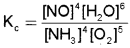
Write an expression for equilibrium constant, Kc forthe ‘ reaction, 4NH3(g) + 5O2(g) \(\rightleftharpoons \) 4NO(g) + 6H2O(g)
Answer:
Question 9.
1. State Henry’s law.
2. Suggest an example fora gas in liquid equilibrium.
Answer:
1. The mass of a gas dissolved in a given mass of a solvent at any temperature is directly proportional to the pressure of the gas above the solvent.
2. Equilibrium between the CO2 molecules in the. gaseous state and the CO2 molecules dissolved in water under pressure,
CO2(g) \(\rightleftharpoons \) CO2(in solution)
Question 10.
1. What is heterogeneous equilibrium?
2. Suggest an example forthis.
Answer:
1. Equilibrium in a system having more than one phase is called heterogeneous equilibrium
2. Equilibrium between solid Ca(OH)2 and its saturated solution:
Ca(OH)2(s) + (aq) \(\rightleftharpoons \) Ca2+(aq) + 2OH–(aq)
Question 11.
For the equilibrium 2SO3(g) → 2SO2(g) + O2(g), Kc at 47 °C 3.25 × 10⁻⁹ mol per litre. What will be the value of Kp at this temperature (R = 8.314 J K-1mol-1).
Answer:
R = 8.314 J K-1 mol-1 ∆n = 3 – 2 = 1
T = 47 °C = 273 + 47 = 320 K
Kc = 3.25 × 10⁻⁹
Kp = Kc (RT)∆n
= 3.25 × 10⁻⁹ (8.314 × 320)1
= 3.25 × 10-9 × 8.314 × 320 = 8.65 × 10⁻¹²
Question 12.
The pH of a sample of vinegar is 3.76. Calculate the concentration of hydrogen ions in it.
Answer:
pH= -log[H+] = 3.76
log[H+] = – 3.76
[H+] = antilog of (- 3.76) = 1.738 × 10⁻⁴ mol L-1
Question 13.
The equilibrium constant can be expressed in terms of partial pressure as well as concentration.
1. Give the relation between Kp and Kc.
2. What is the relation between Kp and Kc for the reaction, N2(g) + O2(g) \(\rightleftharpoons \) 2NO(g)?
Answer:
1. Kp = Kc(RT)∆n, where ∆n = (number of moles of gaseous products) – (number of moles of gaseous reactants).
2. Here, ∆n = 2 – 2 = 0
Kp = Kc(RT)∆n , Kp = Kc (RT)°
∴ Kp = Kc
Question 14.
1. Explain Arrhenius concept of acids and bases with suitable examples.
2. How proton exists in aqueous solution? Give reason.
Answer:
1. According to Arrhenius theory, acids are substances that dissociates in water to give hydrogen ions, H+(aq) and bases are substances that produce hydroxyl ions, OH–(aq). Forexample, HCl is an Arrhenius acid and NaOH is an Arrhenius base.
2. In aqueous solution the proton bonds to the oxygen atom of a solvent water molecule to give trigonal pyramidal hydronium ion, H3O+(aq). This is because a bare proton, H+ is very reactive and cannot exist freely in aqueous solutions.
Question 15.
1. What is an acidic buffer?
2. Suggest an example for an acidic buffer.
Answer:
1. An acidic buffer is a buffer solution having pH less than 7. It is prepared by mixing a weak acid and its salt formed with a strong base.
2. Mixture of acetic acid (CH3COOH) and sodium acetate (CH3COONa) is an example for an acidic buffer. Its pH is around 4.75.
Question 16.
1. What is a basic buffer?
2. Suggest an example for basic buffer.
Answer:
1. A basic buffer is a buffer solution having pH greater than 7. It is prepared by mixing a weak base and its salt formed with a strong acid.
2. Mixture of ammonium hydroxide (NH4OH) and ammonium chloride (NH4CI) is an example for a basic buffer. Its pH is around 9.25.
Question 1.
The concentration of reactant and products for the reaction, H2(g) + l2(g) \(\rightleftharpoons \) 2Hl(g) are recorded as follows:
| Reactant or Product | Molar Concentration |
| H2 | 0.080 |
| l2 | 0.060 |
| HI | 0.490 |
a) Write down the expressions for equilibrium constant of the above reaction.
b) Calculate the equilibrium constant at the temperature 298 K if [Hl] = 0.49 M, [H2]=0.08 M and [l2]=0.06 M.
Answer:

Question 2.
1. When equilibrium is reached in a chemical reaction?
2. What is the influence of molar concentration in a reaction at equilibrium?
3. Write the expression for equilibrium constant for the decomposition of NH4CI by the reaction,
NH4Cl \(\rightleftharpoons \) NH3+HCl
Answer:
1. When the rate of forward reaction is equal to rate of backward reaction, the chemical reaction is said to be in equilibrium.
2. Rate of chemical reaction is directly proportional to the product of molar concentration of the reactants.
3. \(\mathrm{K}=\frac{\left[\mathrm{NH}_{3}\right] \mathrm{HCl}}{\left[\mathrm{NH}_{4} \mathrm{Cl}\right]}\)
Question 3.
1. What is meant by Kp?
2. How Kp is related to Kc?
Answer:
1. Kp is the equilibrium constant in terms of the partial pressures of the reactants and products (Pressure should be expressed in bar as standard state is 1 bar). It is used for reactions involving gases.
2. Kp = Kc (RT)∆n
where R = universal gas constant, T = absolute temperature and ∆n = number of moles of gaseous product(s) – number of moles of gasesous reactant(s).
Question 4.
a) What do you mean by equilibrium constant?
b) Write any two characteristics of equilibrium constant.
c) Write an expression for equilibrium constant of the reaction, 2SO2(g) + O2(g) \(\rightleftharpoons \) SO3(g).
Answer:
a) Equilibrium constant at a given temperature is the ratio of product of molar concentrations of the products to that of the reactants, each concentration term being raised to the respective stoichiometric coefficients in the balanced chemical equation.
b) 1. The value of equilibrium constant is independent of the initial concentrations of the reactants and products.
2. Equilibrium constant is temperature dependent having one unique value for a particular reaction represented by a balanced equation at a given temperature.
Question 5.
2NO2(g) \(\rightleftharpoons \) N2O4(g); ∆H = -52.7 kJ mol-1
1. What change will happen if we increase the temperature?
2. What is the effect of increase in pressure in the above equilibrium?
3. What happens when N2O4 is removed from the reaction medium?
Answer:
1. Since the forward reaction is exothermic, on increasing temperature the rate of backward reaction (endothermic reaction) increases.
2. Since the number of moles decreases in the forward reaction, on increasing pressure, the rate of forward reaction increases.
3. Rate of forward reaction increases.
Question 6.
Consider this reaction:
CO(g) + 2H2(g) \(\rightleftharpoons \) CH3OH(g); ∆rH = -92 kJ mol-1
Explain the influence of the following on the basis of
Le Chatelier’s principle.
1. Decrease in pressure.
2. Increase in temperature.
3. Increase in the partial pressure of hydrogen.
Answer:
1. On decreasing pressure the reaction shifts in the direction in which there is increase in the number of moles. Thus, the rate of backward reaction increases on decreasing pressure.
2. On increasing temperature, the rate of endothermic reaction increases. Here, backward reaction is endothermic. Hence, on increasing temperature the rate of backward reaction increases.
3. Hydrogen, being a reactant increase in its partial pressure increases the rate of forward reaction.
Question 7.
The equilibrium showing dissociation of phosgene gas is given below:
COCl2(g) \(\rightleftharpoons \) CO(g) + Cl2(g)
When a mixture of these three gases at equilibrium is compressed at constant temperature, what happens to
1. The amount of CO in mixture?
2. The partial pressure of COCl2?
3. The equilibrium constant for the reaction?
Answer:
1. Amount of CO decreases, because the system favours the reaction in which number of moles decreases with increase of pressure i.e., backward reaction.
2. Increases.
3. Equilibrium constant remains the same since temperature is constant.
Question 8.
The equilibrium constant of the reaction H2(g) + l2(g) \(\rightleftharpoons \) 2Hl(g) is 57 at 700 K. Now, give the equilibrium constants for the following reactions at the same temperature:

Answer:

Question 9.
1. What are buffer solutions?
2. Which of the following are buffer solutions?
NaCl + HCl
NH4Cl + NH4OH
HCOOH + HCOOK
3. What is the effect of pressure on the following equilibria?
i) Ice \(\rightleftharpoons \) Water
ii) N2(g) + O2(g) \(\rightleftharpoons \) 2N0(g)
Answer:
1. These are solutions which resist change in pH on dilution or with the addition of small amounts of acid or alkali.
2. NH4Cl + NH4OH
3. i) When pressure is increased the melting point of ice decreases and hence the rate of forward reaction will increase.
ii) Pressure has no effect in this equilibrium because there is no change in the number of moles of the gaseous reactants and products.
Question 10.
The aqueous solution of the compounds NaCl, NH4Cl and CH3COONa show different pH.
Answer:
Question 11.
1. What is pH? What is its significance?
2. The concentration of hydrogen ion in a sample of soft drink is 3.8 × 10⁻³. What is its pH?
Answer:
1. pH is a logarithmic scale used to express the hydronium ion concenration in molarity more conveniently. The pH of a solution is defined as negative logarithm to the base 10 of the activity of hydrogen ion. pH = — log \({ { a }_{ { H }^{ + } } }\) = —log[H+]
2. [H+] = 3.8 × 10⁻³
pH = -log[H+]
= -log [3.8 × 10⁻³] = -(-2.42) = 2.42
Question 12.
1. State the Le-Chatelier’s principle.
2. Apply the above principle in the following equilibrium and predict the effect of pressure.
CO(g) + 3H2(g) \(\rightleftharpoons \) CH4(g) + H2O(g)
Answer:
1. The Le Chateliers principle states that a change in any of the factors that determine the equilibrium conditions of a system will cause the system to change in such a manner so as to reduce or to counteract the effect of the change.
2. On increasing pressure the rate of forward reaction increases. This is because number of moles decreases in the forward reaction. In other words, the value of Qc decreases on increasing pressure. As Qc < Kc, the reaction proceeds in the forward direction.
Question 13.
1. Explain Lewis concept of acids and bases.
2. Why does BF3 act as a Lewis acid?
Answer:
1. A Lewis acid can be defined as a species which accepts electron pair and a Lewis base is a species which donates an electron pair.
2. In BF3, the boron atom is electron deficient and it accepts a lone pair of electron. So it acts as a Lewis acid.
Question 14.
1. How the value of AG influence the direction of an equilibrium process?
2. The equilibrium constant for a reaction is 8. What will be the value of ∆G at 27 °C?
Answer:
1. If ∆G is negative, then the reaction is spontaneous and proceeds in the forward direction.
If ∆G is positive, then reaction is considered non- spontaneous. instead, as reverse reaction would have a negative ∆G, the products of the forward reaction shall be converted to the reactants.
If ∆G is 0, reaction has achieved equilibrium. At this point, there is no longer any free energy to drive the reaction.
2.

Question 15.
1. What is common ion effect?
2. Suggest an example for this effect.
Answer:
1. Common ion effect may be defined as the suppression of the dissociation of a weak electrolyte by the addition of some strong electrolyte containing a common ion.
2. The dissociation equilibrium of NH4OH is shifted towards left in presence of NH4Cl having the common ion, NH4+.
Question 16.
1. Predict whether an aqueous solution of (NH4)2SO4 is acidic, basic or neutral?
2. Justify your answer.
Answer:
1. An aqueous solution of (NH4)2SC4 is acidic in nature.
2. (NH4)2SO4 is formed from weak base, NH4OH, and strong acid, H2SO4. In water, it dissociates completely
(NH4)2SO4(aq) → 2NH4+ (aq) + SO42- (aq)
NH4+ ions undergoes hydrolysis to form NH4OH and H+ ions.
NH4+(aq) + H2O(l) \(\rightleftharpoons \) NH4OH(aq) + H+(aq)
NH4OH is a weak base and therefore remains almost unionised in solution. This results in increased H+ ion concentration in solution making the solution acidic.
Question 17.
1. What are sparingly soluble salts? Suggest an example.
2. Define solubility product constant, Ksp.
3. Obtain the relation between solubility product constant (Ksp) and solubility (S), of a solid salt of general formula Mxp+ Xyq-.
Answer:
1. Sparingly soluble salts are those salts with solubility less than 0.01 M.
e.g. BaSO4
2. The solubility product of a sparingly soluble salt at a given temperature is defined as the product of the concentrations of its ions in the saturated solution, with each concentration term raised to the power equal to the number of times the ion occurs in the equation representing the dissociation of the electrolyte.
3. The equilibrium in the saturated solution of the salt can be represented as,

Question 18.
The Le Chatelier’s principle is applicable to physical and chemical equilibria.
1. What are the factors which can influence the equilibrium state of a system?
2. Explain the factors affecting the chemical equilibrium on the basis of Le Chatelier’s principle taking Haber’s process for the manufacture of ammonia as an example.
Answer:
1. The following factors can influence the equilibrium state of a system:
2. N2(g) + 3H2(g) \(\rightleftharpoons \) 2NH3(g); ∆rH = -91.8 kJ mol-1
When concentration of N2 or H2 is increased, a good yield of NH3 can be achieved. The rate of forward reaction can also be increased by removing NH3 from the reaction mixture.
When pressure is increased, the system will try to decrease pressure and for this system will proceed in that direction where there is minimum number of moles i.e., forward reaction. Thus, a good yield of NH3 can be achieved by increasing pressure.
Since the formation of NH3 is an exothermic reaction, a good yield of NH3 can be achieved by decreasing the temperature. But if the temperature is decreased to very low value the reactant molecules do not have sufficient energy to interact. Hence, an optimum temperature of 500°C is used.
Question 19.
1. Soda water is prepared by dissolving CO2 in water under high pressure. What is the principle involved in this process?
2. At 1000 K, equilibrium constant Kc for the reaction 2SO3(g) \(\rightleftharpoons \) 2SO2(g) + O2(g) is 0.027. What is the value of Kp at this temperature?
Answer:
1. Henry’s law
2. Kp =Kc(RT)∆n
∆n = 3.2 = 1
Kp = 0.027 × (0.0831 × 1000)1 = 2.2437
Question 20.
1. For the reaction PCL \(\rightleftharpoons \) PCl3 +Clc
i) Write the expression of Kc.
ii) What happens if pressure is increased?
2. Write the conjugate acid and base of the following species:
i) H20 ii) HCO;
3. Name the phenomenon involved in the preparation of soap by adding NaCI.
Answer:
1. i) \(\kappa_{c}=\frac{\left[\mathrm{PC}_{3}\right]\left[\mathrm{Cl}_{2}\right]}{\left[\mathrm{PCl}_{5}\right]}\)
ii) If we increase the pressure the system will try to decrease the pressure. For this system will proceed in the direction where there is minimum number of moles, i.e., rate of backward reaction increases by decreasing the pressure.
2. i) Conjugate acid of H2O is H3O+
Conjugate base of H2O is OH”
ii) Conjugate acid of HCO,” is H2CO3 Conjugate base of HCO3– is CO32-
3. Common ion effect.
Question 21.
a) The pH of black coffee is 5.0. Calculate the hydrogen ion concentration.
b) The Ksp of barium sulphate is 1.5 × 10⁻⁹. Calculate the solubility of barium sulphate in pure water.
Answer:

Question 22.
1. What is conjugate acid-base pair?
2. Illustrate with an example.
Answer:
1. The acid-base pairthat differs only by one proton is called conjugate acid-base pair. Such acid-base pairs are formed by loss or gain of a proton.
2. Consider the ionization of hydrochloric acid in water.

HCl(aq) acts as an acid by donating a proton to H2O molecule which acts as a base because it accepts the proton. The species H2O+ is produced when water accepts a proton from HCl. Therefore, Cl– is the conjugate base of HCl and HCl is the conjugate acid of Cl–. Similarly, H2O is the conjugate base of H2O+ and H3O++ is the conjugate acid of the base H2O.
Question 23.
1. What are the applications of equilibrium constant?
2. What is meant by reaction quotient, Qc?
3. Predict the direction of net reaction in the following cases:
i) Qc < Kc
ii) Qc > Kc
iii) Qc = Kc
Answer:
1. The applications of equilibrium constant are:
• To predict the extent of a reaction on the basis of its magnitude.
• To predict the direction of the reaction.
• To calculate equilibrium concentrations.
2. Reaction quotient, Qc at a given temperature is defined as the ratio of the product of concentrations of the reaction products to that of the reactants, each concentration term being raised to their individual stoichiometric coefficients in the balanced chemical equation, where the concentrations are not necessarily equilibrium values.
3. i) When Qc > Kc, the reaction will proceed in the
direction of reactants (reverse reaction), i.e., net reaction goes from right to left.
ii) When Qc < Kc, the reaction will proceed in the direction of products (forward reaction), i.e., net reaction goes from left to right.
iii) When Qc = Kc, the reaction mixture will be at equilibrium, i.e., no net reaction occurs.
Question 24.
Solubility product helps to predict the precipitation of salts from solution.
1. Find the relation between solubility (S) and solubility product (Ksp) of calcium fluoride and zirconium phosphate.
2. The solubility product of two sparingly soluble salts XY2 and AB are 4 × 10-15 and 1.2 × 10⁻¹⁶ respectively. Which salt is more soluble? Explain.
Answer:
1. The equilibrium in the saturated solution of calcium fluoride can be represented as,
CaF2(s) \(\rightleftharpoons \) Ca2+(aq) + 2F–(aq)
Ksp = [Ca2+][F–]2 = S.(2S)2 = 4S3
The equilibrium in the saturated solution of zirconium phosphate can be represented as,
Zr3(PO4)4(s) \(\rightleftharpoons \) 3Zr4+(aq) + 4PO43-(aq)
Ksp = [Zr4+]3[PO43-]4 = (3S)3.(4S)4 = 6912S7
2. XY2 is more soluble than AB.

Ionic Strength Calculator … Ionic strength of a solution indicates the concentration of ionic charge in the solution.
Question 25.
a) How common ion effect can influence the solubility of ionic salts?
b) What is the application of common ion effect in gravimetric estimation?
Answer:
1. In a salt solution, if we increase the concentration of any one of the ions, according to Le Chatelier’s principle, it should combine with the ion of its opposite charge and some of the salt will be precipitated till Ksp = Qsp. Similarly, if the concentration of one of the ions is decreased, more salt will dissolve to increase the concentration of both the ions till Ksp = Qsp.
2. The common ion effect is used for almost complete precipitation of a particular ion as its sparingly soluble salt, with very low value of solubility product for gravimetric estimation.
Plus One Chemistry Equilibrium Four Mark Questions and Answers
Question 1.
Match the following:

Answer:

Question 2.
In Contact process, SO3 is prepared by the oxidation of SO2 as per the following reaction:
2SO2(g) + O2(g) \(\rightleftharpoons \) 2SO3(g); ∆H = -189.4
a) What happens to the rate of forward reaction when i) temperature is increased?
ii) pressure is decreased?
iii) a catalyst V2O5 is added?
b) Calculate the pH of 0.01 M H2SO4 solution. Also, calculate the hydroxyl ion concentration in the above solution.
Answer:
1. D When temperature is increased, the rate of forward reaction decreases since it is exothermic.
ii) When pressure is decreased the rate of forward reaction decreases since it is associated with decrease in number of moles.
iii) When a catalyst V2O5 is added the rate of both forward and backward reactions are increased by the same extent and equilibrium is reached earlier.
2.

The method presented in our buffer pH calculator allows you to compute the pH of both arterial and venous blood.
Question 3.
Calculate the [H+] in the following biological fluids whose pH are given in brackets.
i) Human muscle fluid (6.83)
ii) Human stomach fluid (1.22)
iii) Human blood (7.38)
iv) Human saliva (6.4)
Answer:
i) pH =-log[H+] = 6.83
log[H+] = – 6.83
[H+] = antilog (- 6.83) = 1.48 × 10⁻⁷ mol L-1
ii) [H+] = antilog (- 1.22) = 6.03 × 10⁻² mol L-1
iii) [H+] = antilog (- 7.38) = 4.17 × 10⁻⁸ mol L-1
iv) [H+] = antilog (- 6.4) = 3.98 × 10⁻⁷ mol L-1
Question 4.
The pH value of a solution determines whether it is acidic, basic or neutral in nature.
1. The concentration of hydrogen ion in the sample of a soft drink is 3.8 × 10⁻³ mol/L. Calculate its pH. Also predict whether the above solution is acidic, basic or neutral.
2. The dissociation constants of formic acid (HCOOH) and acetic acid (CH3COOH) are 1.8 × 10⁻⁴and 1.8 × 10⁻⁴ respectively. Which is relatively more acidic? Justify your answer.
Answer:
1. pH = – log[H+] = – log[3.8 × 10⁻³] = 2.42
Since pH is less than 7, it is an acidic solution,
2. HCOOH is more acidic.
Ka value is directly proportional to the acid strength, i.e., greater the Ka value, stronger is the acid.
Question 5.
a) Write the expression for Henderson – Hasselbalch equation for i) An acidic buffer & ii) A basic buffer.
b) Calculate the pH of a solution which is 0.1 M in
CH3COOH and 0.5 M in CH3COONa. Ka for CH3COOH is 1.8 × 10⁻⁶.
Answer:

Question 1
A liquid is in equilibrium with its vapour in a sealed containerat a fixed temperature. The volume of the container is suddenly increased. (3)
a) What is the initial effect of the change on vapour pressure?
b) How do rates of evaporation and condensation change initially?
c) What happens when equilibrium is restored finally and what will be the final vapour pressure?
Answer:
a) Vapour pressure decreases due to increase in volume.
b) Rate of evaporation remains same and rate of condensation decreases.
c) Finally the same vapour pressure is restored and the rate of evaporation becomes equal to the rate
Question 2.
The concentration of hydrogen ion in a sample of soft drink is 3.8 × 10⁻³ M. What is its pH? (2)
Answer:
pH = -log[H+]
= -log (3.8 × 10⁻³) = 2.42
Question 3.
The pH of a sample of vinegar is 3.76. Calculate the concentration of hydrogen ion in it. (2)
Answer:
H= -log [H+]
or log [H+] = -3.76 = -4.24
[H+] = antilog (-3.76) = 1.74 × 10⁻⁴M
Question 4.
The ionization constants of HF, HCOOH and HCN at 298 K are 6.8 × 10⁻⁴, 1.8 × 10⁻⁴ and 4.8 × 10⁻⁹ respectively. Calculate the ionization constants of the corresponding conjugate base. (3)
Answer:
The relation between ionization constant of an acid and that of its conjungate base is Ka x Kb = Kw

Question 5
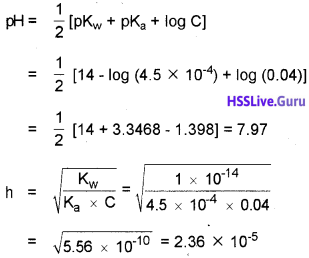
The ionization constant of nitrous acid is 4.5 x 10⁻⁴. Calculate the pH of 0.04 M sodium nitrite solution and also its degree of hydrolysis. (2)
Answer:
Sodium nitrite is a salt of strong base and weak acid. Its degree of hydrolysis, h is given by the relation.
Question 6
A 0.02 M solution of pyridinium hydrochloride has pH = 3.44. Calculate the ionization constant of pyridine. (2)
Answer:
Pyridinium hydrochloride is a salt of a weak base (pyridine) and a strong acid (HCl). The pH of an aqueous solution of this salt is given by the relation:

Students can Download Chapter 1 Some Basic Concepts of Chemistry Questions and Answers, Plus One Chemistry Chapter Wise Questions and Answers helps you to revise the complete Kerala State Syllabus and score more marks in your examinations.
Plus One Chemistry Chapter Wise Questions And Answers Question 1.
Which of the following is a mixture?
a) Graphite
b) Sodium chloride
c) Distilled water
d) Steel
Answer:
d) Steel
Plus One Chemistry Chapter 1 Questions And Answers Question 2.
1 µ g = __________ g
[10-3, 10-6, 10-9, 10-12] ‘
Answer:
10-6
Plus One Chemistry First Chapter Questions And Answers Question 3.
The number of significant figures in 0.00503060 is __________ .
Answer:
6
Plus One Chemistry Chapter Wise Questions And Answers Pdf Question 4.
The balancing of chemical equations is based on which of the following law?
a) Law of multiple proportions
b) Law of conservation of mass
c) Law of definite proportions
d) Gay-Lussac law
Answer:
b) Law of conservation of mass
By using the percent/actual yield calculator, you can get the accurate amount of percent, actual, and theoretical yield produced in a chemical reaction.
Plus One Chemistry Questions And Answers Question 5.
Which among the following is the heaviest?
a) 1 mole of oxygen
b) 1 molecule of sulfur trioxide
c) 100 u of uranium
d) 44 g carbon dioxide
Answer:
d) 44 g carbon dioxide
Plus One Chemistry Previous Year Question Papers And Answers Chapter Wise Question 6.
Calculate the number of atoms in 48 g of He?
Answer:
Gram atomic mass of He = 4 g.
Thus, numberofatomsin4g (1 mol) He = 6.02 × 10²³
So number of atoms in 48 g of He = \(\frac{48}{4}\) × 6.02 × 1023
=12 × 6.02 × 1023
= 7.224 × 1024
Hsslive Chemistry Previous Questions And Answers Chapter Wise Plus One Question 7.
One mole of CO2 contains how many gram atoms?
Answer:
3 gram atoms.
Plus One Chemistry Previous Year Questions And Answers Chapter Wise Question 8.
The ratio of gram atoms of Au and Cu in 22ct gold is __________
Answer:
7 : 2
Plus One Chemistry Chapter Wise Questions And Answers Pdf Download Question 9.
A compound contains 69.5% oxygen and 30.5% nitrogen and its molecular weight is 92. The compound will be
Answer:
N2O4
Plus One Chemistry Chapter 1 Question 10.
The total number of electrons present in 1 mole of water is
Answer:
6 × 1024.
Hsslive Plus One Chemistry Chapter Wise Questions And Answers Question 11.
40g NaOH is present in 100 ml of a solution. Its molarity is __________
Answer:
10 M
Plus One Chemistry Some Basic Concepts Of Chemistry Questions Question 1.
Classify the following substances into homogeneous and heterogeneous mixtures.
Answer:
| Homogeneous | Heterogeneous |
| Milk, Iron Gasoline Air Kerosene | Muddy Water |
Plus One Chemistry Previous Year Questions Chapter Wise Question 2.
Calculate the volume occupied by 4.4 g of CO2 at STP?
Answer:
1 mole CO2 = 44 g
4.4 CO2 = 0.1 mole CO2
Volume occupied by 1 mol CO2 at STP = 22.4 L
∴ Volume occupied 0.1 mol CO2 at STP = 0.1 × 22.4 L
= 2.24 L
Plus One Chemistry Chapter 1 Previous Questions And Answers Question 3.
During a group discussion a student argued that “the water of sea and river should have different chemical composition”.
Answer:
Plus One Chemistry Question And Answer Question 4.
“When science developed some theories are also modified”.
Write the modified atomic theory.
Answer:
Plus One Chemistry Chapter Wise Previous Questions And Answers Question 5.
Carbon combines with oxygen to form CO and CO2.
Answer:
Hss Live Plus One Chemistry Chapter Wise Questions And Answers Question 6.
Calculate the volume occupied by 6.02×1025 molecules of oxygen at STP.
Answer:
Volume occupied by 1 mole of oxygen gas at STP = 22.4 l
i.e., Volume occupied by 6.02×10²³ molecules of oxygen gas at STP = 22.4 l
Hence the volume occupied by 6.02 × 1025 molecules
of oxygen gas at STP = \(\frac{22.4 \times 6.02 \times 10^{25}}{6.02 \times 10^{23}}\) = 2240 l.
Plus One Chemistry Chapter Wise Questions And Answers Hsslive Question 7.
Calculate the molality of a solution of NaOH containing 20g of NaOH in 400 g solvent.
Answer:

Question 8.
Calculate the mole fraction of NaOH in a solution containing 20 g of NaOH per 360 g of water.
Answer:

Question 9.
12 g of carbon reacts with 32 g of oxygen to form 44g of carbon dioxide.
Answer:
Question 10.
When hydrogen and oxygen combine to form water, the ratio between volume of reactants and products is 2:1:2.
Answer:
Question 11.
Carbon form two oxides, the first contains 42.9% C and the second contains 27.3% carbon. Show that these are in agreement with the law of multiple proportions.
Answer:
In the first compound:
C = 42.9%
O = 100-42.9 = 57.1%
So, the ratio between the masses of C and O = 42.9:57.1 = 1:1.33
In the second compound:
C = 27.3%
O= 100-27.3= 72.7%
So, the ratio between the masses of C and O = 27.3 : 72.7= 1:2.66
Hence, the ratio of masses of oxygen which combines with a fixed mass of carbon is 1.33:2.66 or 1:2, a simple whole number ratio. This illustrates the law of multiple proportions.
Question 12.
Match the following:
| A | B |
| 1 amu | 1.008 x 1.66 x10–24 |
| Mass of 1 H atom | 6.02 x 10²³ |
| Molar volume of O2 at STP | 11.2L |
| Volume of 14g of N2 at STP | 1.66 x 10⁻²⁴ |
| Avogadro number | 22.4L |
Answer:
| A | B |
| 1 amu | 1.66 x 10⁻²⁴ |
| Mass of 1 H atom | 1.008 x 1.6 x10–24 |
| Molar volume of O2 at STP | 22.4L |
| Volume of 14g of N2 at STP | 11.2L |
| Avogadro number | 6.02 x 10²³ |
Question 13.
Calculate the molality of a solution containing 10 g ofNaOH in 200 cm3 of solution. Density of solution is 1.4 g/mL. (Molar mass of NaOH = 40)
Answer:
Mass of the solution = 200 × 1.04 = 208 g
Mass of NaOH (WB) = 10g Molar mass of NaOH (MB) = 40 g mol-1
Mass of water (WA) = (208 -10) g = 198 g = 0.198 kg

Question 14.
Calculate the mass percentage of oxygen in CaCO3.
Answer:
Molecular mass of CaCO3 = 100 g mol-1
Mass of oxygen in 100 g CaCO3=3 × 16 g = 48 g
Percentage of oxygen in CaCO3 =\(\frac{48}{100}\)×100 = 48%
Question 15.
KCIO3 on heating decomposes to KCI and O2. Calculate the mass and volume of O2 produced by heating 50 g of KCIO3.
Answer:
The reaction is represented as,

According to the equation, 96 g of oxygen is obtained from 245 g of KCIO3.
Hence mass of oxygen obtained from 50 g KCIO3 is \(\frac{96 \times 50}{245}=19.6 \mathrm{g}\)
According to the equation 245 g of KCIO3 gives 3 moles of O2 at STP which is 3 × 22.4 L = 67.2 L
Volume of oxygen liberated by 50g of KCIO3
= \(\frac{67.2 \times 50}{245}=13.71 \mathrm{L}\)
Question 16.
Calculate the number of molecules present in
Answer:
1. \(\frac{11}{44}\) = 0.25 mole
1 mole of CO2 contains 6.022 × 10²³ molecules.
∴ 0.25 mole CO2 contains 6.022 × 1023 × 0.25
= 1.51 × 10²³ molecules.
2. 56 mL = 0.056 L
\(\frac{0.056}{22.4}\) =0.0025 mole
= 6.022 × 1023 × 0.0025=1.5 × 10²¹ molecules
Question 17.
Calculate the number of moles of 02 required to produce 240 g of MgO by burning Mg metal. [Atomic mass: Mg=24, 0=16]
Answer:
2 Mg + O2 → 2MgO
No. of moles of MgO = \(\frac{240}{40}\)=6
No. of moles of 02 required = 6/2 = 3
Question 18.
Arrange the following in the increasing order of their mass.
(a) 1 g of Ca
(b) 12 amu of C
(c) 6.022 × 10²³ mol-ecules of CO2
(d) 11.2 L of N2 at STP
Answer:
a) Mass of 1 g Ca = 1 g
b) Mass of 12 amu C = \(\frac{12}{6.022 \times 10^{23}}\) = 2 × 10-23
c) Mass of 6.022 × 10²³ molecules of CO2 = 44 g
d) Mass of 11.2 L of N2 at NTP = \(\frac{28 \times 11.2}{22.4}\) = 14 g
(b) < (a) < (d) < (c)
Question 19.
Complete the table:
| 42g N2 | 1.5 mole N2 | 33600mLN2 (STP) |
| 16g 0: | – – – – mole O2 | 11.2 L of O2 (STP) |
| ….g CO2 | 1 mole CO2 | – – – – L of C O2 (STP) |
| 28g CO | 1 mole CO | – – – – mLCO (STP) |
Answer:
| 42g N2 | 1.5 Mole N2 | 33600mLN2 (STP) |
| 16g O2 | 0.5 Mole O2 | 11.2 L of O2 (STP) |
| 44 g CO2 | 1 mole CO2 | 22.4 L of CO2 (STP) |
| 28g CO | 1 mole CO | 22400mLCO (STP) |
Question 20.
1. Irrespective of the source, pure sample of H20 always contains 88.89% by mass of oxygen and 11.11% by mass of hydrogen.
a) Which law is illustrated here?
b) State the law.
2. Complete the table by filling in the blanks:
| 48 g O2 | 1.5 mol O2 | ……mL O2 (at STP) |
| …… g Na | 2 gram atom Na | 2NA Na atoms |
| …….g CO2 | 2.5 mol CO2 | 56 L (at STP) |
| 8.5 g NH3 | ……mol NH3 | 11.2 L (at STP) |
Answer:
1. a) Law of definite proportions.
b) The same chemical compound always contains the same elements combined in the same fixed proprotion by mass.
2.
| 48 g O2 | 1.5 mol O2 | 33600 mL O2 (at STP) |
| 46g Na | 2 gram atom Na | 2Na Na atoms |
| 110 g CO2 | 2.5 mol CO2 | 56 L (at STP) |
| 8.5 g NH3 | 0.5 mol NH3 | 11.2L(atSTP) |
Question 21.
Calcium carbonate reacts with aqueous HCl to give CaCl2 and CO2 according to the reaction:
CaCO3 + 2HCl → CaCl2 + CO2 + H2O
What mass of CaCO3 is required to react completely with 25 mL of 0.75 M HCl?.
Answer:
Mass of HCI in 0.25 mL 0.75 M HCl \(=\frac{36.5 \times 0.75 \times 0.25}{1000}=0.6844 \mathrm{g}\)
As per reaction 100 g CaCO3 reacts with 2 × 36.5 = 73 g of HCl
∴ Mass of CaCO3 reacting with 0.6844 g HCl \(=\frac{100 \times 0.6844}{73}=0.9375 \mathrm{g}\)
Question 1.
During a Seminar, a student remarked that “Dalton’s atomic theory has some faulty assumptions”.
a) Do you agree with him?
b) What is the present status of Dalton’s atomic theory?
c) Write any two wrong postulates of Dalton’s atomic theory.
Answer:
a) I agree with him. Out of 6 Dalton’s postulates, 5 postulates are faulty and only one is correct.
b) Dalton’s atomic theory has undergone many modifications.
c)
Question 2.
One gram atom of an element contains 6.023 × 10²³ atoms.
Answer:
1. 16 g oxygen contains 6.022 × 10²³ atoms
∴ 8 g oxygen contains \(\frac{6.022 \times 10^{23}}{2}\) = 3.011 × 10²³
2.

3. One mole is the amount of a substance that contains as many particles or entities as there are atoms in exactly 12 g (or 0.012 kg) of the 12C isotope.
Avogadro number – It is the number of discrete particles present in 1 mole of any substsnce. (Avogadro number, NA = 6.022 × 10²³)
Question 3.
Answer:
1. Homogeneous-Air, NaCI solution, Bronze, Gun powder, Petrol.
Heterogeneous – Mixture of sugar and sand, Smoke.
2. When two elements combine to form more than one compound the different masses of one of the elements combining with fixed mass of the other element bear a simple ratio. ,
eg. Carbon reacts with oxygen to form two compounds viz. CO and CO2. In CO mass ratio is 12:16. In CO2 mass ratio is 12:32. Then mass ratio between oxygen in the 2 compounds is 16:32 or 1:2 which is a simple whole number ratio. Hence, the law is verified.
Question 4.
1. One mole of an ideal gas occupies 22.4 L at STP
a) Calculate the mass of 11.2 L of oxygen gas at STP.
b) Calculate the number of atoms present in the above sample.
2. 21 g of nitrogen gas is mixed with 5 g of hydrogen gas to yield ammonia according to the equation.
N2 + 3H2 → 2NH3
Calculate the maximum amount of ammonia that can be formed.
Answer:
1. a) Mass of 22.4 L oxygen at STP = 32 g
∴ Mass of 11.2 L oxygen at STP = 16 g
b) No. of atoms present in 16 g of O2
\(\frac{6.02 \times 10^{23}}{2}\) ×2 = 6.02 × 10²³ atoms
2. N2 + 3H2 → 2NH3
1 mole N2 + 3 mole H2 → 2moles NH3
1 mole N2 requires 3 mol H2
i.e., 28g N2 requires 6 g H2
Hence, 21 g N2 requires \(\frac{6 \times 21}{28}\) = 4.5 g H2
21 g N2 reacts completely and 0.5g H2 remains unreacted.
Hence, N2 is the limiting reagent.
28g N2 gives 2 × 17 g NH3
∴ 21 g N2 gives \(\frac{2 \times 17 \times 21}{28}\) = 25.5 g NH3
Question 5.
When two elements combine to form more than one compound the different masses of one of the elements combining with fixed mass of the other bear a simple ratio.
i) Name the above law.
ii) Explain the above law by taking oxides of carbon.
Answer:
i) Law of multiple proportions.
ii) Carbon reacts with oxygen to form two compounds viz. CO and CO2.
In CO, mass ratio is 12:16
In CO2,mass ratio is 12:32
Ratio of the masses of oxygen combining with a fixed mass of carbon in the two compounds is 16:32 or 1:2, which is a simple whole number ratio.
Question 6.
A compound contains 80% carbon and 20% hydrogen. If the molecular mass is 30 calculate empirical formula and molecular formula.
Answer:
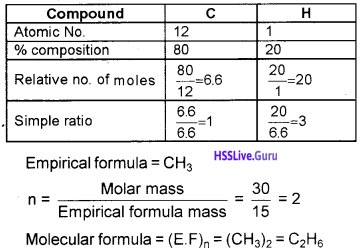
Question 7.
A compound contains 4.07% of hydrogen, 24.27% of carbon and 71.65% of chlorine. The molar mass is 98.96. What is the empirical and molecular formula?
Answer:

Question 8.
Nitrogen forms various oxides.
1. Identify the law of chemical combination illustrated here. Also state the law.
2. Determine the formula of each oxide from the given data and illustrate the law.

Answer:
1. Law of multiple proportions.
When two elements combine to form more than one compound the different mass of one of the elements which combine with the fixed mass of the other element bear a simple ratio.
2.

In NO and NO2, the masses of oxygen combining with a fixed mass (14 g) of nitrogen are in the ratio, 16:32 = 1:2. Similarly, in N2O and N2O3, the masses of oxygen combining with a fixed mass (28 g) of nitrogen are in the ratio, 16:48 = 1:3. These are simple whole number ratios. Hence, the law of multiple poportions is verified.
Question 1.
Which of the following weighs more?
a) 1 mole of glucose
b) 4 moles of oxygen
c) 6 moles of N
d) 5 moles of sodium
Answer:
a) 1 mole glucose = (72 + 12 + 96) g = 180 g
b) 4 moles of oxygen = 4 × 32g = 128g
c) 6 moles of nitrogen = 6 × 14 g = 84 g
d) 5 moles of Na = 5 × 23 g = 115 g.
Thus, 1 mole glucose weighs more.
Question 2.
3 g of H2 is mixed with 29 g of O2 to yield water.
1. Which is the limiting reagent?
2. Calculate the maximum amount of water that can be formed.
3. Calculate the amount of the reactants which remains unreacted.
Answer:
1.
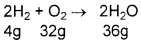
According to the equation, 4 g H2 requires 32 g
So 3 g H2 requires \(\frac{377 \times 33}{44}\) = 24 g O2.
Here 3 g H2 is mixed with 29 g of O2. All H2 will react. Hence H2 is the limiting reagent.
2. According to the equation, 4 g H2 gives 36 g H2O. Hence 3 g H2 will give 36 × 3/4 = 27 g H2O.
3. Amount of O2 unreacted = (29 – 24)g = 5 g
Question 3.
a) Calculate the mass of oxygen required for the complete burning of 2 g of carbon.
b) Calculate the molar mass of (i) CO2 (ii) CH4
Answer:
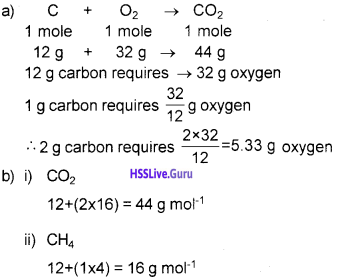
Question 4.
One gram mole of a substance contains 6.022 x 10²³ molecules.
1. 24 g of carbon is treated with 72 g of oxygen to form CO2. Identify the limiting reagent.
2. Find the number of molecules of CO2 formed in this situation.
Answer:
1.

2 mol of C requires 2 mol of O2.
2 mol C completely reacts with 2 mol of O2 and 0.25 mol O2 and 0.25 mol O2 remains unreacted. Hence, C is the limiting reagent.
2. No. of moles of CO2 formed = 2
∴ No. of molecules of CO2 formed
= 2 × 6.022 × 1023 = 1.2044 × 1024
Question 5.
One gram mole of a substance contains 6.022×10²³ molecules.
i) Find out the number of molecules in 2.8 g of nitrogen.
ii) Which is the heavier-one SO2 molecule or one CO2 molecule?
Answer:
i) No. of molecules in1 mole of N2 = 6.022 × 10²³
i.e., No. of molecules in 28 g of N2 = 6.022 × 10²³
∴ No. of molecules in 2.8 g N2
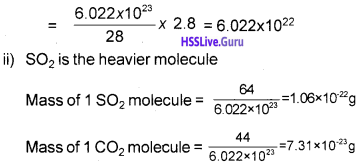
Question 6.
a) How can you illustrate the law of multiple proportions by using oxides of metals containing 78.7% and 64.5% of the metal?
b) Match the following:
1/12th the mass of C12 atom – 1 mole
1 g of hydrogen atom – amu
22.4 L O2 at NTP – gram mole
180 g of glucose – gram atom
6.022 × 10²³ particles – molar volume
Answer:
a) In 100 g samples of the two oxides, the masses of the metal are 78.7 g and 64.5 g respectively.
First Oxide :
Mass of oxygen = 100 – 78.7 = 21.3 g
No. of parts by mass of oxygen combining with one part by mass of metal =\(\frac{78.7}{21.3}=3.7 \mathrm{g}\)
Second oxide:
Mass of oxygen = 100 – 64.5 = 35.5 g
No. of parts by mass of oxygen combining with one part by mass of metal = \(\frac{64.5}{35.5}=1.9 \mathrm{g}\)
The ratio of masses of oxygen combining with a fixed mass of metal = 3.7 : 1.9 = 2: 1, a simple whole number ratio.
b) 1/12th the mass C12 atom – amu
1 g of hydrogen atom – gram atom
22.4 L O2 at NTP – molar volume
180 g of glucose – gram mole
6.022 × 10²³ particles – 1 mole
Question 7.
Calculate
1. The number of molecules present in 1 g of water.
2. The volume of 0.2 mole of sulphur dioxide at STP.
Answer:
1. Number of moles in 1 g water = \(\frac{1}{8}\)
∴ No. of molecules in 1 g water
\(=\frac{1 \times 6.022 \times 10^{23}}{18}=3.35 \times 10^{22}\)
2. Volume of 0.2 mol S02 at STP = 0.2 × 22.4 litre
= 4.48 litre
Question 8.
“One mole of all substances contain the same number of specified particles.”
a) Justify the statement.
b) Howto connect mole, gram mole, and gram atom?
c) What is the relation between number of moles and volume?
d) Calculate the number of moles of a gas in 11.2 L at • STP.
Answer:
a) This statement is true i.e., one mole of all sub-stances contain the same number of specified particles. According to Avogadro’s law.
1 mole of any substance contains 6.022 × 10²³ specified particles.
b)

1 gram mole is the molecular mass expressed in gram. It is the mass of 1 mole molecules in gram. Thus, 1 gram mole contains 1 mole molecules.
1 gram atom is the atomic mass expressed in gram. It is the mass of 1 mole atoms in gram. Thus, 1 gram atom contains 1 mole atoms.
c) Number of moles is directly proportional to volume (according to Avogadro law).

Question 1.
Calculate the molecular mass of the following : (3)
1. H2O
2. CO2
3. CH4
Answer:
1. Molecular mass of H2O = 2(1.008 u) +16.00 u
= 18.016u
2. Molecular mass of CO2 = 12.01 u + 2(16.00 u)
= 44.01 u
3. Molecular mass of CH4 = 12.01 u + 4(1.008 u)
= 16.042 u
Question 2.
Calculate the mass percent of different elements present in sodium sulphate (Na2SO4). (2)
Answer:
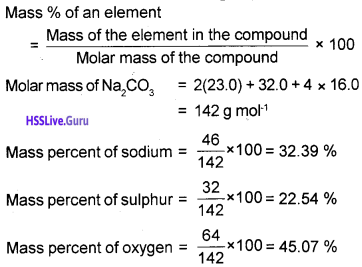
Question 3
Calculate the amount of carbon dioxide that could be produced when (3)
1. 1 mole of carbon is burnt in air.
2. 1 mole of carbon is burnt in 16 g of dioxygen.
3. 2 moles of carbon are burnt in 16 g of dioxygen.
Answer:
1. The balanced equation for the combustion of carbon dioxide in dioxygen in air is

In air combustion is complete.
Hence, Amount of CO2 produced when 1 mole of carbon is burnt in air = 44 g
2. As only 16 g dioxygen is available it is the limiting reagent.
Hence, amount of CO2 produced = \(\frac{44}{32}\)×16 = 22 g
3. Here again, dioxygen is the limiting reactant. Therefore, amount of CO2 produced from 16 g dioxygen = \(\frac{44}{32}\)×16 = 22g
Question 4.
Chlorine is prepared in the laboratory by treating manganase dioxide (MnO2) with aqueous hydrochloric acid according to the reaction,
4HCl(aq) + MnO2(s) → 2H2O(l) + MnCl2(aq) + Cl2(g)
How many grams of HCl react with 5.0 g of manganese dioxide?
(Atomic mass of Mn = 54.94 u) (2)
Answer:
1 mol of MnO2, i.e., 54.94 + 32 = 86.94 g MnO2 react with 4 moles of HCl, i.e., 4 × 36.5 g = 146 g of HCl.
∴ Mass of HCl reacting with 5.0 g of MnO2
\(=\frac{146}{86.94} \times 5 \mathrm{g}=8.4 \mathrm{g}\)
Question 5.
Calculate the molarity of a solution of ethanol in water in which the mole fraction of ethanol is 0.040. (2)
Answer:

Students can Download Chapter 6 Thermodynamics Notes, Plus One Chemistry Notes helps you to revise the complete Kerala State Syllabus and score more marks in your examinations.
Introduction
The study of energy transformations forms the subject matter or thermodynamics.
Thermodynamic Terms
The system and the surroundings
A system in thermodynamics refers to that part of universe in which observations are made and remain-ing universe constitutes the surroundings. The surroundings include everything other than the system. System and the surroundings together constitute the universe.
Types Of The System
1. Open System:
In an open system, there is exchange of energy and matter between system and surroundings
2. Closed System:
In a closed system, there is no exchange of matter, but exchange of energy is possible between system and the surroundings
3. Isolated System:
In an isolated system, there is no exchange of energy or matter between the system and the surroundings. The presence of reactants in a thermos flask or any other closed insulated vessel is an example of an isolated system.
The State Of The System
The state of a system means the condition of the system when is macroscopic properties have definite values. If any of the macroscopic properties of the system changes, the state of the system will change. A process is said to occur when the state of the system changes.
The measurable properties required to describe the state of a system are called state variables or state functions. Temperature, pressure, volume, composition etc. are state variables.
The Internal Energy as a State Function
1. Work:
The system which can’t exchange heat between the system and surroundings through its boundary is called adiabatic system. The manner in which the state of such a system may be changed will be called adiabatic process. Adiabatic process is a process in which there is no transfer of heat between the system and surroundings.
Internal energy, U, of the system is a state function. The positive sign expresses that wad is positive when work is done on the system. Similarly, if the work is done by the system, wad will be negative.
2. Heat:
A system change its internal energy by ex-change of heat. The q is positive, when heat is transferred from the surroundings to the system and q is negative when heat is transferred from system to the surroundings. first law of thermodynamics, which states that The energy of an isolated system is constant.
i. e., ∆U = q + w
It is commonly stated as the law of conservation of energy i.e., energy can neither be created nor be destroyed.
Applications
Work
The work done due to expansion or compression of a gas against an opposing external pressure is called the pressure – volume type of work. It is a kind of mechanical work.
If Y is the initial volume and Vf is the final volume of a certain amount of gas and Pex is the external pressure, then the work involved in the process is given by
w = – Pex (Vf – Vi) or w = -Pex ∆V
The negative sign of this expression is required to obtain conventional sign for w.
It must be noted that the above expression gives the work done by the gas in irreversible expansion or compression
Work done in isothermal reversible expansion (or compression) of a gas is given by the relation
wrev =-2.303 nRT log \(\frac{V_{f}}{V_{i}}\)
Where n = the number of moles of the gas
Free expansion
Expansion of a gas in vaccum is called free expansion. Since P = 0 in vacuum, work done in free expansion = 0
Isothermal and free expansion of an ideal gas.
1. For isothermal irreversible change q= -w = pex (Vf – Vi)
2. For isothermal reversible change
q = -w = nRT In \(\frac{V_{f}}{V_{i}}\)
= 2.303 nRT log \(\frac{V_{f}}{V_{i}}\)
3. For adiabatic change q = 0, ∆U = wad
Enthalpy, H
1. A useful new state function:
We know that the heat absorbed at constant volume is equal to change in the internal dnergy i.e., ∆U= qp
We may write equation as ∆U=qp – p∆V at constant pressure, where qp is heat absorbed by the system and -pAV represent expansion work done by the system.
We can rewrite the above equation as U2 -U1 = qp – p(V2 – V1)
On rearranging, we get qp = (U2 +pV2) = (U1 +pV1) Now we can define another thermodynamic function, the enthalpy H [Greek word enthalpien, to warm or heat content] as :
H=U+PV
so, equation becomes qp = H2 – H1 = ∆H
Although q is a path dependent function, H is a state function because it depends on U, p and V, all of which are state functions.
Therefore, ∆H is independent of path. Hence,qp is also independent of path.
For finite changes at constant pressure, we can write ∆H = ∆U + ∆pV
It is important to note that when heat is absorbed by the system at constant pressure, we are actually measuring changes in the enthalpy. Remember ∆H = qp heat absorbed by the system at constant pressure.
∆H is negative for exothermic reactions which evolve heat during the reaction and ∆H is positive for endothermic reactions which absorb heat from the surroundings.
2. Extensive and Intensive Properties:
An extensive property is a property whose value depends on the quantity or size of matter present, in the system. For example, mass, volume, internal energy, enthalpy, heat capacity, etc. Those properties which do not depend on the quantity or size of matter present are known as intensive properties. For example temperature, density, pressure, etc.
3. Heat Capacity:
The heat required to rise the temperature of the system in case of heat absorbed by the system.
The increase of temperature is proportional to the heat transferred q = coeff × ∆T
The magnitude of the coefficient depends on the size, composition, and nature of the system. We can also write it as q = C ∆T
The coefficient, C is called the heat capacity. Water has a large heat capacity i.e., a lot of energy is needed to raise its temperature. C is directly proportional to amount of substance. The molar heat capacity of a substance, Cm = \(\frac{C}{n}\), is the heat capacity for one mole of the substance and is the quantity of heat needed to raise the temperature of one mole by one degree Celsius (or one kelvin).
Specific heat, also called specific heat capacity is the quantity of heat required to raise the temperature of one unit mass of a substance by one degree Celsius (or one kelvin). q = c × m × ∆T
4. The relationship between Cp and Cv for an ideal gas:
At constant volume, the heat capacity, C is denoted by Cv and at constant pressure, this is denoted by Cp. Let us find the relationship between the two. We can write equation for heat, q at constant volume as qv=Cv ∆T = ∆U at constant pressure as qp = Cp∆T = ∆H
The difference between Cp and Cv can be derived for an ideal gas as:
For a mole of an ideal gas, ∆H = ∆U + ∆(pV)
= ∆U + ∆(RT)
= ∆U + R∆T
On putting the values ∆H of ∆H and we have
Cp∆T = Cv∆T
Cp = Cv +R
Cp – Cv = R
Measurement Of ∆U And ∆H: Calorimetry
We can measure energy changes associated with chemical or physical processes by an experimental technique called calorimetry.
1. ∆U measurements:
Here, a steel vessel (the bomb) is immersed in a water bath. The whole device is called calorimeter. The steel vessel is immersed in water bath to ensure that no heat is lost to the surroundings. A combustible substance is burnt in pure dioxygen supplied in the steel bomb. Heat evolved during the reaction is transferred to the water around the bomb and its temperature is monitored. Since the bomb calorimeter is sealed, its volume does not change i.e., the energy changes associated with reactions are measured at constant volume. Under these conditions, no work is done as the reaction is carried out at constant volume in the bomb calorimeter. Even for reactions involving gases, there is no work done as ∆V = 0.

2. ∆H measurements:
Measurement of heat change at constant pressure (generally under atmospheric pressure) can be done in a calorimeter at constant p
In an exothermic reaction, heat is evolved, and system loses heat to the surroundings.
Therefore, qp will be negative and ∆rH will also be negative. Similarly in an endothermic reaction, heat is absorbed, qp is positive and ∆rH will be positive.
Enthalpy Change, ∆rH Of A Reaction – Reaction Enthalpy
The enthalpy change accompanying a reaction is called the reaction enthalpy.
The reaction enthalpy change is denoted by ∆rH
∆rH = (sum of enthalpies of products) – (sum of enthalpies of reactants)
1. Standard enthalpy of reactions:
The standard enthalpy of reaction is the enthalpy change for a reaction when all the participating substances are in their standard states.
The standard state of a substance at a specified temperature is its pure form at 1 bar.
2. Enthalpy changes during phase transformations:
The enthalpy change that accompanies melting of one mole of a solid substance in standard state is called standard enthalpy of fusion or molar enthalpy of fusion ∆fusH°.
Amount of heat required to vaporize one mole of a liquid at constant temperature and under standard pressure (1bar) is called its standard enthalpy of vaporization or molar enthalpy of vaporization ∆vapH°. And that of sublimation is called Standard enthalpy of sublimation, ∆subH°.
3. Standard enthalpy of formation
The standard enthalpy change for the formation of one mole of a compound from its elements in their most stable states of aggregation (also known as reference states) is called Standard Molar Enthalpy of Formation( ∆fH°).
Hess’s Law of Constant Heat Summation Hess’s Law:
If a reaction takes place in several steps then its standard reaction enthalpy is the sum of the standard enthalpies of the intermediate reactions into which the overall reaction may be divided at the same temperature.
Enthalpy Calculator is a free online tool that displays the Enthalpy for the given equation.
Enthalpies For Different Types Of Reactions
1. Standard enthalpy of combustion
Enthalpy of combustion of a substance is defined as the enthalpy change accompanying the complete combustion of one mole of the substance in excess of air or oxygen.
Standard enthalpy of combustion is defined as the enthalpy change accompanying the complete combustion of one mole of the substance in excess of air or oxygen when all the reactants and products are tin their standard states at the specified temperature. It is denoted as ∆cH°.
For example, the complete combustion of one mole of methane evolves 890.3 kJ of heat. Thus, the enthalpy of combustion of methane is- 890.3 kJ mol-1.
Combustion reactions are always accompanied by the evolution of heat. Hence enthalpy of combustion is always negative.
2. Enthalpy of atomization (symbol: ∆aH°)
It is the enthalpy change on breaking one mole of bonds completely to obtain atoms in the gas phase.
3. Bond Enthalpy (symbol: ∆bondH°)
The bond dissociation enthalpy is the change in enthalpy when one mole of covalent bonds of a gaseous covalent compound is broken to form products in the gas phase.
Lattice Enthalpy
The lattice enthalpy of an ionic compound is the enthalpy change which occurs when one mole of an ionic compound dissociates into its ions in gaseous state.
Spontaneity
A process which has an urge or a natural tendency to occur under a given set of conditions is known as a spontaneous process.
Some of the spontaneous process need no initiation, i.e., they take place by themselves. Dissolution of common salt in water, evaporation of water in an open vessel, combination of NO and oxygen to form NO2, neutralisation reaction between NaOH and HCl, etc. are examples of such processes. But some other spontaneous processes need initiation. For example, hydrogen reacts with oxygen to form water only when initiated by passing an electric spark. Once initiated, it occurs by itself.
1. Is decrease in enthalpy a criterion for spontaneity?
By analogy, we may be tempted to state that a chemical reaction is spontaneous in a given direction, because decrease in energy has taken place, as in the case of exothermic reactions.lt becomes obvious that while decrease in enthalpy may be a contributory factor for spontaneity, but it is not true for all cases.
2. Entropy and spontaneity
Entropy(S) is the measure of the degree of randomness or disorder in the system. The greater the disorder in an isolated system, the higher is the entropy. The crystalline solid state is the state of lowest entropy (most ordered), The gaseous state is state of highest entropy. ∆S is independent of path.
Dilution factor formula. After the first tube, each tube is the dilution of the previous dilution tube.
∆S is related with q and T for a reversible reaction as: ∆S = \(\frac{q_{\text {rev }}}{T}\)
When a system is in equilibrium, the entropy is maximum, and the change in entropy, ∆S = 0.
3. Gibbs energy and spontaneity
we define a new thermodynamic function the Gibbs energy or Gibbs function, G, as G = H – TS
Gibbs energy change is a better parameter to determine the spontaneity or feasibility of a process. It can be summarised as follows.
i) If ∆G is negative (i.e., <0) the precess will be spontaneous. ii) If ∆G is zero, the precess is in equilibrium state. iii) If ∆G is positive (i.e., >0), the process is non- spontaneous in the forward direction. The reverse process may be spontaneous.
Ncert Supplementary Syllabus
Enthalpy of Dilution
It is known that enthalpy of solution is the enthalpy change associated with the addition of a specified amount of solute to the specified amount of solvent at a constant temperature and pressure. This argument can be applied to any solvent with slight modification. Enthalpy change for dissolving one mole of gaseous hydrogen chloride in 10 mol of water can be represented by the following equation.
HCl(g) + 10 aq. → HCl. 10 aq. ∆H = -69.01 kJ/mol
Let us consider the following set of enthalpy changes:
(S- 5) HCl(g) + 25 aq. → HCl.25 aq. ∆H = -72.03 kJ/mol
(S-2) HCtlgi + 40 aq. → HCl.40 aq. ∆H = -72.79 kJ/mol
(S-3) HCl(g) + ∞ aq. → HCl. ∞aq. ∆H = -74.85 kJ/mol
The values of ∆H show general dependence of the enthalpy of solution on amount of solvent. As more and more solvent is used, the enthalpy of solution approaches a limiting value, i.e, the value in infinitely dilute solution. For hydrochloric acid this value of AH is given above in equation (S-3).
If we subtract the first equation (equation S-1) from the second equation (equation S-2) in the above set of equations, we obtain
This value (-0.76kJ/mol) of ∆H is enthalpy of dilution. It is the heat withdrawn from the
HCl.25 aq. + 15 aq. → HCl.40 aq.
∆H = [ -72.79 – (-72.03)] kJ/mol
= -0.76 kJ/mol
This value (-0.76kJ/mol) of ∆H is enthalpy of dilution. It is the heat withdrawn from the surroundings when additional solvent is added to the solution. The enthalpy of dilution of a solution is dependent on the original concentration of the solution and the amount of solvent added.
Theoretical Yield Calculator is a free online tool that displays the amount of product predicted with the complete utilisation of the limiting reactant.
Entropy and Second Law of Thermodynamics
We know that for an isolated system the change in energy remains constant. Therefore, increase in entropy in such systems is the natural direction of a spontaneous change. This, in fact, is the second law of thermodynamics. Like first law of thermodynamics, second law can also be stated in several ways. The second law of thermodynamics explains why spontaneous exothermic reactions are so common. In exothermic reactions, heat released by the reaction increases the disorder of the surroundings and overall entropy change is positive which makes the reaction spontaneous.
Absolute Entropy and Third Law of Thermodynamics
Molecules of a substance may move in a straight line in any direction, they may spin like a top and the bonds in the molecules may stretch and compress. These motions of the molecule are called translational, rotational and vibrational motion respectively. When temperature of the system rises, these motions become more vigorous and entropy increases. On the other hand, when temperature is lowered, the entropy decreases. The entropy of any pure crystalline substance approaches zero as the temperature approaches absolute zero. This is called third law of thermodynamics. This is so because there is perfect order in a crystal at absolute zero.
The statement is confined to pure crystalline solids because theoretical arguments and practical evidences have shown that entropy of solutions and super cooled liquids is not zero at 0 K. The importance of the third law lies in the fact that it permits the calculation of absolute values of entropy of pure substance from thermal data alone. For a pure substance, this can be done by summing \(\frac{q_{\text {rev }}}{T}\) increments from 0 K to 298 K. Standard entropies can be used to calculate standard entropy changes by a Hess’s law type of calculation.