Kerala Syllabus 9th Standard Physics Solutions Chapter 6 Current Electricity

You can Download Current Electricity Questions and Answers, Summary, Activity, Notes, Kerala Syllabus 9th Standard Physics Solutions Part 2 Chapter 6 help you to revise complete Syllabus and score more marks in your examinations.

Kerala State State Syllabus 9th Standard Physics Solutions Chapter 6 Current Electricity

Current Electricity Textual Questions and Answers

Current Electricity Class 9 Kerala Syllabus Chapter 6 Activity -1

A positively charged electroscope is connected to the earth through a switch using a conductor.
Current Electricity Class 9 Kerala Syllabus Chapter 6

9th Class Physics Chapter 6 Notes Kerala Syllabus Question 1.
What kind of charge is present in this electroscope?
Answer:
Static

HSSLive.Guru

Current Electricity Class 9 Solutions Kerala Syllabus Chapter 6 Question 2.
What happens to this charge when the switch is turned on?
Answer:
Charge neutralizes

9th Std Physics Notes Kerala Syllabus Chapter 6 Question 3.
Will the flow of charge sustain in this arrangement?
Answer:
The charge will not sustain in this arrangement

9th Standard Physics Notes Kerala Syllabus Chapter 6 Activity – 2

A circuit with a cell, a bulb, and a switch is given in the figure.
9th Class Physics Chapter 6 Notes Kerala Syllabus

Kerala Syllabus 9th Standard Physics Notes Chapter 6 Question 4.
Will the flow of electric current sustain in the circuit if it is switched on?
Answer:
Yes, the flow of electric charge will sustain.

Current Electricity 9th Class Exercise Kerala Syllabus Chapter 6 Question 5.
What difference is there in the flow of current in both circuits?
Answer:
In the first circuit, there is a flow of charge for a short interval of time. There is a continuous flow of charge in the second.

Kerala Syllabus 9th Standard Physics Notes Pdf Chapter 6 Question 6.
Complete the table based on different situations as shown in figure.
Current Electricity Class 9 Solutions Kerala Syllabus Chapter 6
9th Std Physics Notes Kerala Syllabus Chapter 6
Answer:

SituationDirection of flow/motion
Ball falling downDownwards from a higher level to a lower level
Flow of airFrom a region of high pressure to a region of low pressure
Flow of waterFrom a higher level to lower level
Flow of heatFrom a point having higher temperature to that having lower temperature

There should be a difference in energy levels between two points if any type of flow is to occur.

Kerala Syllabus 9th Standard Physics Notes Malayalam Medium Activity-3

observe the figures
9th Std Physics Notes Kerala Syllabus Chapter 6
9th Standard Physics Notes Kerala Syllabus Chapter 6

Question 7.
If the value is opened, in which one will there be a flow of water and rotation of the wheel?
Answer:
Kerala Syllabus 9th Standard Physics Notes Chapter 6

Question 8.
Why?
Answer:
It is due to the gravitational potential difference that there is a flow of water and consequent rotation of the wheel.

Activity-4

Current Electricity 9th Class Exercise Kerala Syllabus Chapter 6
A bulb is connected to a switch, using a conductor.

Question 9.
Will the bulb glow if switched on? Why?
Answer:
The bulb will not glow
There is no potential difference between P and Q. Hence there is no flow of current and the bulb does not flow.

HSSLive.Guru

Potential Difference and Current:
There should be a potential difference between two points of a conductor if there is to be flow of current between them. Current flows from a point of high electric potential to a point of low electric potential.

The unit of potential difference is volt (V). Voltameter is the device to measure this. If 1 joule of work is done to move one-coulomb charge from one point to another, then the potential difference between the points is 1 volt.

Activity – 5

Kerala Syllabus 9th Standard Physics Notes Pdf Chapter 6
The pump has been used in such a way that the some quantity of water that flows from A to B per second is returned to Afrom B in the same period of time.

Question 10.
Why is there a continuous flow of water when the value is opened?
Answer:
Here, it is due to the working of the pump, which is an external source of power, that the potential difference was maintained and the flow of water was made possible continuously.

Source of emf

An external source is needed to maintain a potential difference between the ends of a conductor and to maintain the flow of electric current through the conductor. That external source is called source of emf.
Eg: Generator, cell, battery, solar cell ………

Question 11.
Write down the energy change in each.
Answer:
Generator: Mechanical energy → electrical energy
Cell (While discharging): Chemical energy → electrical energy
Battery (While discharging): Chemical energy → electrical energy
Solar cell: Solar energy → electrical energy

Question 12.
Complete the table
Kerala Syllabus 9th Standard Physics Solutions Chapter 6 Current Electricity 10
Answer:

Water circuitPump Water wheelflow of waterValue
Electric circuitCell bulbflow of electric chargeSwitch

A source of emf is essential to maintain a potential difference between the ends of a conductor and to maintain the flow of current through the conductor.

Activity – 6

Make a circuit given in figure using a voltmeter a 12V, 3W bulb, a cell, and a switch operate it
Kerala Syllabus 9th Standard Physics Solutions Chapter 6 Current Electricity 11

Question 13.
How should-you connect a voltmeter in a circuit?
Answer:
The voltmeter should be connected across the points (parallel) where the potential difference is to be mea¬sured.

Question 14.
In what mode are the cells connected within the remote control of a TV?
Answer:
In series mode

Question 15.
If 4 cells of 1.5 V each are connected in series what is the total voltage?
Answer:
4 × 1.5 = 6V

Question 16.
How can you connect four cells of 1.5V each to get 3V? What is the advantage of doing so?
Answer:
Kerala Syllabus 9th Standard Physics Solutions Chapter 6 Current Electricity 12
If connected in this mode, we get electric current for a long time without variation in voltage.
Combination of cells:
A battery is a combination of two or more cells connected in a suitable manner. Cells can be connected in two ways.
1. Series connection
Kerala Syllabus 9th Standard Physics Solutions Chapter 6 Current Electricity 13
This is the method of connecting cells one after the other in such a way that the positive of one cell is connected to the negative of another cell.
Salient features:

  • The total emf is the sum of the emf of all the cells.
  • The current passing through each cell is the same.
  • The internal resistance developed in the circuit by the battery increases.
  • The current in the external circuit increases under high voltage.

2. Parallel connection

Kerala Syllabus 9th Standard Physics Solutions Chapter 6 Current Electricity 14
This is the method of connecting similar potes together.
Salient features:

  • If all the cells have equal emf then the emf of the circuit is the same as that of a single cell.
  • The total current flowing in the circuit splits up and flows through each cell.
  • The internal resistance of the circuit is very low.
  • More current can be made available for a longer time under low voltage.

Electric Current:
Electric current is the flow of electric charges. Current is the quantity of charge that flows through a conductor in a circuit in one second.

Question 17.
If 10 coulomb charge flows in a circuit in 5s, how much is the charge flowing in the circuit in one second?
Answer:
Charge, Q = 10C
Time,t = 5s
Charge flowing in one second = \(\frac { 10 }{ 5 }\) = 2 C/s

Question 18.
If a charge of Q coulomb flows in a time t second, then how much is the quality of charge that flows in one second?
Answer:
Current (I) = \(\frac{\text { Quantity of charge }}{\text { Time taken }}\)
i.e I = Q/t

Question 19.
What is the unit of current?
Answer:
Unit of current = \(\frac{\text { Unit of charge }}{\text { Unit of time }}\)
= C/s OR A

Activity -1

Make a circuit containing an ammeter, switch, cell and a bulb connected in series.
Kerala Syllabus 9th Standard Physics Solutions Chapter 6 Current Electricity 15
Repeat the experiment by increasing the number of cells in series.

Question 20.
What change occurred in the ammeter reading when the number of cells was increased?
Answer:
Ammeter reading increases

Question 21.
What about the intensity of light from the bulb?
Answer:
Intensity of light increases

Question 22.
How are the current and the intensity of light related to each other?
Answer:
As current in circuit increases, intensity of light increases.

Question 23.
What is the current in a conductor if 2 C charge flows in 10s?
Answer:
\(\mathrm{I}=\frac{\mathrm{Q}}{\mathrm{t}}=\frac{2 \mathrm{c}}{10 \mathrm{s}}=0.2 \mathrm{C} / \mathrm{s}\)
= 0.2 A

Ammeter

Kerala Syllabus 9th Standard Physics Solutions Chapter 6 Current Electricity 16
Ammeter is a device used to measure the current in a circuit. The positive terminal of it must be con¬nected directly to the positive of the cell and the negative terminal, to the negative of the cell. Ammeter should be connected in series in the circuit The needle of the device moves in accordance with the current in the circuit We can measure the current by checking the position of the needle. Unit of current is ampere (A), it is also written as C/s. mA(milliampere) and µA(microampere) are smaller units of current The symbol of ammeter is
Kerala Syllabus 9th Standard Physics Solutions Chapter 6 Current Electricity 17

Ohm’S Law

Make a circuit by including a nichrome wire (30cm), cell, switch, ammeter, and voltmeter.
Measure current (I) and potential difference (V). Repeat the activity by increasing the number of cells in series.
Kerala Syllabus 9th Standard Physics Solutions Chapter 6 Current Electricity 18
Analyze the table and record the findings

Question 24.
What change occurred in the circuit when there was a change in voltage?
Answer:
As voltage increases, current increases.

Question 25.
Do you see any peculiarity in the value of V/l? v
Answer:
V/I will be a constant
V ∝ I
V = a constant × I
V/I = a constant
This constant is the resistance of the conductor. This is indicated by the letter R.
∴R = V/I
Ohm’s law:
When temperature remains constant, the current through a conductor is directly proportional to the potential difference between its ends. In other words, the ratio of potential difference to the current is a constant.
Resistors are conductors used to include a particular resistance in a circuit its symbol is
Kerala Syllabus 9th Standard Physics Solutions Chapter 6 Current Electricity 19

Question 26.
On the basis of the information gathered from Table 6.5, draw a V-l graph, Mark I in the X – axis and V in the Y – axis.
Answer:
Kerala Syllabus 9th Standard Physics Solutions Chapter 6 Current Electricity 20

Question 27.
Is the graph a straight line?
Answer:
Yes, the graph is a

Question 28.
What is the unit of resistance?
Answer:
Unit of resistance = \(=\frac{\text { Unit of voltage }}{\text { Unit of Current }}\)
\(\frac{\text { Volt }}{\text { Ampere }}\) or ohm (Ω )

HSSLive.Guru

Question 29.
1 Ω = 1V/1A From this what do you mean by 1 ohm?
Answer:
If the potential difference between the ends of a conductor is 1V when a current of 1A flows through it, then the resistance of the conductor is 1Ω.

When the potential difference between the ends of conductor is 1 Vand if a current of 1A flows through it, then the resistance of the conductor is 1Ω.
Using the given figure, from equation representing Ohm’s Law.
Kerala Syllabus 9th Standard Physics Solutions Chapter 6 Current Electricity 21

Question 30.
Complete the following table based on Ohm’s Law

Voltage (Volt V)Current (1)  ampere (A)Resistance (R)  ohm(Q)
12………………….4
…………………..23
63 …………………..

Answer:

Voltage (Volt V)Current (I) ampere (A)Resistance (R) ohm(Q)
12…… 3 ……4
…… 6 …..23
63……. 2 ……..

Resistors

Arrange a circuit as shown in the figure
Kerala Syllabus 9th Standard Physics Solutions Chapter 6 Current Electricity 22
Among the conductors fixed on the wooden plank, PA is iron, PB is aluminum, PC, PD and PE are nichrome. Their lengths are the same. PE has double the length. The thickness of PD is double that of the others. Touch the free end J at A, B, C, D and record in the table the ammeter reading at each distance.

Question 31.
Is the intensity of light from the bulb the same in each situation?
Answer:
No

Question 32.
Is the ammeter reading the same when different conductors of the same length and thickness were included?
Answer:
No. The ammeter reading was not the same

Question 33.
What change has occurred in the ammeter reading when the area of cross-section of the same conductor is altered?
Answer:
When the area of cross-section increases ammeter reading also increases.

Question 34.
Is there a change in the ammeter reading when the length of the same conductor is altered? Record,
Answer:
Ammeter reading decreases with increase in length.

Question 35.
Is the applied potential difference the same in all cases?
Answer:
Yes. The potential difference applied is the same.

Question 36.
According to Ohm’s Law, V/I must be a constant (resistance, R). If so, what is the reason for the changes in the ammeter readings?
Answer:
The reason for the change in the ammeter reading is the variation of resistance of the conductors included in the circuit.

Activity -1

Connect a 6V bulb to a 6V source. Using a multimeter, measure the resistance of the bulb when the circuit is switched off. Switch on the bulb for a short time, then switch it off and immediately measure its resistance.

Question 37.
Is the resistance the same in both the situations?
Answer:
No

Question 38.
When the circuit was switched on, was the temperature of the bulb low or high?
Answer:
High

Question 39.
Did the resistance increase or decrease when the temperature was increased?
Answer:
Resistance increased when the temperature was increased.

Question 40.
List the factors affecting the resistance of a conductor?
Answer:

  • Area of cross-section
  • Nature of the material
  • Length
  • Temperature

Activity-2

In the activity conducted above, touch the free end J at E and slowly slide it from E to P

Question 41.
What change occurred in the intensity of light from the bulb?
Answer:
Intensity of light increases gradually.

Question 42.
What may be the reason behind the change?
Answer:
As the length of the conductor decreases, resistance and current increases.

Question 43.
What is the working principle of a rheostat?
Answer:
If the potential difference is constant, then the current is inversely proportional to the resistance. For a conductor of uniform area of cross-section, the length of a conductor and the resistance are directly proportional.

Rheostat is a device used to regulate the current in a circuit by changing the resistance

Question 44.
What is the symbol of a rheostat?
Answer:
Kerala Syllabus 9th Standard Physics Solutions Chapter 6 Current Electricity 23

Question 45.
Given below is a table related to the resistance of a conductor. Complete the table suitably.
Answer:

Question 46.
Analysis the completed table and write down the inferences.
Answer:
The resistance of a conductor increases with the increases in the length of the conductor.
R α l
The resistance of a conductor decreases with increases in the area of cross-section.
R α I/A that is R α I/A
R = a constant × l/A
R = \(\rho \frac{1}{\mathrm{A}}\)
\(\rho\) = RA/l
P is the resistivity of the material the conductor is made of. The length of a conductor of resistance R Q is 1m and its area of cross-section is 1m2. Calculate the resistivity of the material the conductor is made of. length, l= 1m
Area of cross-section, A = 1m2
Resistivity \(\rho=\frac{R A}{1}=\frac{R \times 1}{1} \quad \rho=R\)
Resistivity of a substance is the resistance of the conductor of unit length and unit area of cross-section. The resistivity of a substance is a constant at fixed temperature. But it will be different for different materials.
Unit of resistivity =
Kerala Syllabus 9th Standard Physics Solutions Chapter 6 Current Electricity 24
The Unit of resistivity is Qm
Let’s get acquainted with some of the tools related to electric current:
We use many electric devices in our everyday life. Different tools are needed to connect these devices with the electric line and to perform maintenance. They are enlisted here.

Screwdriver
Kerala Syllabus 9th Standard Physics Solutions Chapter 6 Current Electricity 25
it helps in fixing and removing the screws Screwdrivers are available in different sizes It is used to combine a wide range of screws with +,* shaped edges.

Electric tester
Kerala Syllabus 9th Standard Physics Solutions Chapter 6 Current Electricity 26
It is used to check whether current is coming into the sockets or other devices in the houses Some of these can be used as screwdriver. The bulb in¬side the tester will glow if there is presence of current.

Wire stripper
Kerala Syllabus 9th Standard Physics Solutions Chapter 6 Current Electricity 27
It is used to remove insulation of wires while combining insulated electric wires or when they are to be connected to the devices

Pliers
Kerala Syllabus 9th Standard Physics Solutions Chapter 6 Current Electricity 28
It is used to join wires by twisting them together or for cutting or removing wires. Pliers are available in different shapes and sizes

Gloves
Kerala Syllabus 9th Standard Physics Solutions Chapter 6 Current Electricity 29
While doing the work related to electric power, gloves are worn in the hand as a protection from electric shock.

Multimeter
Kerala Syllabus 9th Standard Physics Solutions Chapter 6 Current Electricity 30
It is used to measure current, voltage, and resistance in a circuit and to understand whether the circuit is open, closed or any connection is left. Besides, it also helps to check whether the various elements in an electronic circuit are functioning properly.

Clamp ammeter
Kerala Syllabus 9th Standard Physics Solutions Chapter 6 Current Electricity 31
It helps to measure the current in a circuit without connecting wires or devices in the circuit.

Insulation tape
Kerala Syllabus 9th Standard Physics Solutions Chapter 6 Current Electricity 32
When connecting the wires or connecting it with a device, this is used to provide insulation in those parts where it has been damaged.

Spanner
Kerala Syllabus 9th Standard Physics Solutions Chapter 6 Current Electricity 33
It is used for fixing nut and bolt. They are available in different sizes.

Soldering iron
Kerala Syllabus 9th Standard Physics Solutions Chapter 6 Current Electricity 34
It is used to solder electronic components in a circuit

Hammer
Kerala Syllabus 9th Standard Physics Solutions Chapter 6 Current Electricity 35
It is used for fixing and removing nails.

Drill machine
Kerala Syllabus 9th Standard Physics Solutions Chapter 6 Current Electricity 36
It is used to drill holes on hard surfaces. It can be used to fix and remove screws as well.

Let Us Assess

Question 1.
complete the table properly
Kerala Syllabus 9th Standard Physics Solutions Chapter 6 Current Electricity 37
Answer:
Kerala Syllabus 9th Standard Physics Solutions Chapter 6 Current Electricity 38

Question 2.
Given below are the diagrams showing the connection of ammeter and voltmeter in a circuit. Of these, which are correct?
Kerala Syllabus 9th Standard Physics Solutions Chapter 6 Current Electricity 39
Answer:
Kerala Syllabus 9th Standard Physics Solutions Chapter 6 Current Electricity 40

Question 3.
Complete the table. The conductor is made of the same material.
Answer:

Length of conductorArea of cross-section of conductorResistance of the conductor
1 cm2 cm210 Q
2 cm2cm220 Q
1 cm4cm25Q

Question 4.
In an electrical circuit if 100 J work is done to move 10 C electric charge from point A to the point B, find out the potential difference between the points A& B.
Answer:
100/10 = 10V

Question 5.
6 electric cells are connected in series in an elec¬tronic device which works at 9 V potential difference. Find out emf of one cell.
Answer:
9/6 = 1.5V

HSSLive.Guru

Question 6.
An ammeter that connects to an electronic circuit shows a reading of 2A. Find how many charges flows through the ammeter in 10 s.
Answer:
Q = I x t = 2 x 10 = 20 coulomb

Question 7.
When a conductor is stretched, its length becomes double. Find out how many times the resistance changes.
Answer:
4 times.

Question 8.
Kerala Syllabus 9th Standard Physics Solutions Chapter 6 Current Electricity 41
In the given graphs which is the graph depicting Ohm’s Law? Justify your answer.
Answer:
(a) v ∝ I, As V increases, I also increase.

Question 9.
A conductor of 5 Q resistance has length 2m and area of cross-section 2 m2. If so, find out the resistivity of the material of the conductor.
Answer:
Kerala Syllabus 9th Standard Physics Solutions Chapter 6 Current Electricity 42

Question 10.
Draw a circuit diagram describing how 6 torch cells should be connected to a bulb and a switch to obtain effective voltage of 9 V.
Answer:
Kerala Syllabus 9th Standard Physics Solutions Chapter 6 Current Electricity 43

Current Electricity More Questions

Question 1.
The resistance of a 10cm long wire is 120. If this is folded into two parts of equal length and included in a circuit, how much will be the resistance produced?
Answer:
When folded into two parts, length is halved and area of cross-section is doubled. Due to the decrease in length, resistance is halved. Also due to the decrease in area of cross-section, resistance is again halved.

So effective resistance R = \(12 \times \frac{1}{2} \times \frac{1}{2}=3 \Omega\)

Question 2.
Of the following, which one correctly indicates Ohm’s Law?
Kerala Syllabus 9th Standard Physics Solutions Chapter 6 Current Electricity 44
Answer:
The second one

Question 3.
A potential difference of 6V is applied across a conductor having 12Ω resistance. How much current will pass through it?
How many times will the current increase if length of the resistor is halved and potential difference is doubled?
Answer:
I = \(\frac { V }{ R }\) = \(\frac { 6 }{ 12 }\) = 0.5A
If length is halved R = 12 × 1/2 = 6
potential difference V = 2 × 6 = 10V
I = \(\frac { V }{ R }\) = \(\frac { 12 }{ 6 }\) = 2A
That is I is increased by 4 times.

Kerala Syllabus 9th Standard Chemistry Solutions Chapter 7 The World of Carbon

You can Download The World of Carbon Questions and Answers, Summary, Activity, Notes, Kerala Syllabus 9th Standard Chemistry Solutions Part 2 Chapter 7 help you to revise complete Syllabus and score more marks in your examinations.

Kerala State Syllabus 9th Standard Chemistry Solutions Chapter 7 The World of Carbon

The World of Carbon Textual Questions and Answers

Activities In The Text

Kerala Syllabus 9th Standard Chemistry Notes Question 1.
Find the position of carbon in the periodic table and the complete the table.
Kerala Syllabus 9th Standard Chemistry Notes
Answer:

SymbolC
Atomic number6
Electron configuration No. of electrons in the2, 4
Outermost shell4
Valency4
Metal/non-metalNon-metal

Hss Live Guru 9th Chemistry Kerala Syllabus Question 2.
What are allotropes?
Answer:
Different forms of the same element having different physical properties but with same chemical properties are known as Allotropes and this phenomenon is called Allotropy.

9th Class Chemistry Chapter 7 Notes Kerala Syllabus Question 3.
What are the characteristics of diamond.
Answer:

  • Very hard
  • Transparent
  • Not a conductor of electricity
  • High thermal conductivity
  • High refractive index

9th Chemistry Notes Kerala Syllabus  Question 4.
Write the uses of diamond
Answer:

  • It is used to make ornaments.
  • It is used for cutting glass.

9th Standard Chemistry Kerala Syllabus Question 5.
Explain the structure of diamond with Figure?
Answer:
In diamond each carbon atom is linked by covalent bond with four other carbon atom surrounding it. This strong bonding is responsible for the hardness of diamond. Due to the absence of free electron in this crystal structure, it does not conduct electricity
Hss Live Guru 9th Chemistry Kerala Syllabus

Chemistry 9th Class Notes Kerala Syllabus Question 6.
Write the important properties of Graphite?
Answer:

  • It is Gray in color
  • It is good conductor of electricity
  • It is a smooth solid
  • It does not vapourize
  • It is Lustrous
  • It is nonvolatile

Hss Live Guru Chemistry 9th Kerala Syllabus Question 7.
Give reason Graphite is used as a lubricant to reduce friction in machine parts?
Answer:
It is a smooth solid. It does not vapourize. It also has high melting point

Hsslive Guru Chemistry Class 9 Kerala Syllabus  Question 8.
Explain the structure of Graphite?
Answer:
9th Class Chemistry Chapter 7 Notes Kerala Syllabus
In Graphite each carbon atoms is united with three surrounding carbon atom through covalent bond and forms a sheet-like structure. These sheets or layers are stacked one above the other to form three dimensional structure.

Each layer is made up of hexagons there is no covalent bonding between the layers. These layers are held together by weak Vander Waal’s physical forces. Hence these layers can slide over one another.

Hsslive Guru 9 Chemistry Kerala Syllabus Question 9.
What are amorphous carbon?
Answer:
Cock, coal, charcoal, bone charcoal, etc. are non-crystalline allotropes of carbon. These are commonly called amorphous carbon.

Kerala Syllabus 9th Chemistry Notes Question 10.
Which carbon compound is present in the atmosphere?
Answer:
Carbon dioxide

Hss Live 9th Chemistry Kerala Syllabus Question 11.
Which carbon compound is produced by the combustion of fuels?
Answer:
Carbon dioxide

9th Class Chemistry Notes Kerala Syllabus Question 12.
How carbon dioxide is prepared of in the laboratory?
Answer:
Carbon dioxide is prepared in the laboratory by the action of marble piece or calcium carbonate with dil.
HCl CaCO3 + 2HCl → CaCl2 + H2O + CO2

Hsslive Guru Std 9 Chemistry Kerala Syllabus Question 13.
Which are the reactants are used to prepare carbon dioxide (CO2) in the laboratory?
Answer:
CaCO3 and HCl

Hsslive Guru 9th Chemistry Kerala Syllabus Question 14.
Complete the equation of the reaction
Answer:
CaCO3 + 2HCl → CaCl2 + H2O + CO2

Chemistry Solutions Class 9 Kerala Syllabus Question 15.
How can we identify that the gas formed here is C02?
Answer:

  1. Show a burning splinter into the gas. It gets extinguished.
  2. lt turns lime water in milky

Hsslive Guru Chemistry 9 Kerala Syllabus Question 16.
Which properties of CO2 are familiar to you?
Answer:
Extinguishes fire

Hsslive 9th Chemistry Kerala Syllabus Question 17.
What are the properties of carbon dioxide known to you? Tick the correct ones given below.
Answer:

  • Coloured / Colourless✓
  • Supports combustion / Does not support combustion✓
  • Denser than air / Density higher than air✓
  • Has a characteristic odor/ Odourless ✓

Kerala Syllabus 9th Standard Chemistry Question 18.
Whether the aqueous solution of CO2 is acidic or alkaline?
Answer:
Acidic (carbonic acid, H2CO3)

Hsslive Class 9 Chemistry Kerala Syllabus Question 19.
Write the chemical formulae and uses of some carbonates.
Answer:
Na2CO3 – Soda ash
CaCO2 – limestone, marble.

9th Std Chemistry Notes Kerala Syllabus Question 20.
How carbonates can be identified.
Answer:
Add some dilute HC; to the given salt. If a colorless gas that turns lime-water milky is formed, that salt will be a carbonate. The gas formed is CO2.

Question 21.
The variety of carbon compounds is essential for the existence of life on the earth. Figure shows the ways in which carbon dioxide is exchanged over the earth. This is known as carbon cycle.
9th Chemistry Notes Kerala Syllabus
Name the process by which carbon dioxide is utilized by plants?
Answer:
Photosynthesis

Question 22.
What are the activities that increase the amount of carbon dioxide in air?
Answer:
Combustion, Respiration, Decomposition

Question 23.
Is the tremendous increase in the amount of CO2 in atmosphere advantages?
Answer:
No, It causes greenhouse effect. Greenhouse effect is the reason for global warming.

Question 24.
What is green house effect?
Answer:
The process of increasing atmospheric temperature due to the increase in the amount of carbon dioxide in the atmosphere is called green house effect.

Question 25.
What is global warming?
Answer:
As a result of the green house effect, the average temperature of the earth and atmosphere increases. This is known as global warming.

Question 26.
Discuss the consequences of global warming in the following.
1. In ice layers
2. In ocean islands
3. In the field of agriculture
4. In the climate
Answer:

  1. Ice layers melt and rivers will be flooded
  2. The ocean islands will be submerged.
  3. Fields of agriculture will be submerged
  4. Causes rise in atmospheric temperature.

Question 27.
Suggest some measures to resist global warming effectively.
Answer:

  1. Limit the use of fossil fuels
  2. Plant more trees

Question 28.
Give the uses of carbon dioxide?
Answer:

  • It is used in fire extinguisher
  • It is used for the preparation of soda water/soft drink
  • It is used for the preparation of washing soda, baking soda, etc.
  • It is used for the preparation of fertilizers like urea
  • Used for the preparation of carbogen which is used for artificial breathing. Carbogen is 95% 02 and 5% C02
  • Dry ice is solid carbon dioxide, which is used in stage shows for creating special effects resembling clouds.

Question 29.
How carbon monoxide is formed?
Answer:
Carbon dioxide is the gas formed when carbon reacts with oxygen.
However, if the relative amount of carbon increases or that of oxygen decreases the reaction takes place as given below.
2C + O2 → 2CO

  • The gas thus formed is carbon monoxide. It is a poisonous gas.
  • It is formed by the incomplete combustion of carbon in a limited supply of air.

Question 30.
How carbon monoxide becomes fatal?
Answer:
When carbon monoxide is inhaled, it reacts with the hemoglobin in the blood and forms carboxy hemoglobin. As a result, the oxygen-carrying capacity of blood decreases leading even to death.

Question 31.
What measures can be taken to avoid situations that produce carbon monoxide?
Answer:

  • Avoid incomplete combustion
  • Ensure the supply of oxygen.
  • Service motor vehicles regularly

Question 32.
Explain the use of carbon monoxide?
Answer:

  • Used as a gaseous fuel
  • Industrially important gases like water gas (A mixture of CO and H2) producer gas (A mixture of CO and N2)
  • Used as reducing agent in metallurgy

Question 33.
Write the chemical formulae of washing soda baking soda and marble.
Answer;
Washing Soda (Na2CO3.10H2O)
Baking soda (NaHCO3)
Marble (CaCO3)

Question 34.
What is organic compounds?
Answer:
Organic compounds are carbon compounds except the inorganic compounds like CO,CO2, carbonates, bicarbonates etc.

Question 35.
How many electrons are there in the outermost shell of carbon?
Answer:
Four

Question 36.
What is the valency of carbon?
Answer:
4

Question 37.
Complete the table given below.
9th Standard Chemistry Kerala Syllabus
Answer:
Chemistry 9th Class Notes Kerala Syllabus

Question 38.
What are hydrocarbon?
Answer:
Hydrocarbons are compounds containing only car¬bon and hydrogen.

Question 39.
What is catenation?
Answer:
Catenation is the ability of the atoms of an element to combine among themselves. In comparison to other elements, the ability for catenation is very high for carbon.

Question 40.
What are characteristics responsible for the increase in number of carbon compounds?
Answer:

  • Valency of carbon is 4
  • Ability of catenation is high
  • Single, double and triple bonds are possible be-tween carbon atoms.
  • Carbon atoms combine together to form many straight-chain, ring or branched-chain compounds.

Let’S Assess

Question 1.
The names of some allotropes of carbon, their properties and uses are given in the table, but not in the correct order Match them suitably.
Hss Live Guru Chemistry 9th Kerala Syllabus
Answer:
Diamond:

  • Manufacture of ornaments
  • Transparent
  • High refractive index

Graphite:

  • Electric conductor
  • Smooth
  • Lubricant

Question 2.
Some statements related to carbon monoxide and carbon dioxide are given. Classify them correctly.
a) formed as a result of the incomplete combustion of carbon compounds’
b) aqueous solution shows acidic nature.
c) poisonous gas
d) used in fire extinguishers
e) an be used as a fuel
f) formed as a result of the complete combustion of carbon compounds.
g) can be prepared from carbonates and bicarbonates.
h) is a component of producer gas and water gas.
Answer:
a) carbon monoxide
b) Carbon dioxide
c) Carbon monoxide
d) Carbon dioxide
e) Carbon monoxide
f) Carbon dioxide
g) Carbon dioxide
h) Carbon monoxide

Question 3.
a) Write the chemical formula of calcium carbonate.
b) Which gas is formed when calcium carbonate reacts with acids?
c) What is the name of an aqueous solution of this gas?
Answer:
a) CaCO3
b) Carbon dioxide
c) Soda water (carbonic acid)

Question 4.
Graphite, which is an allotrope of carbon, is a con-ductor of electricity. But diamond, another allotrope is not a conductor of electricity. Why?
Answer:
diamond each carbon atom is linked by covalent bond with four other carbon atom surrounding it. This strong bonding is responsible for the hardness of diamonds. Due to the absence of free electron in this crystal structure, it does not conduct electricity

Question 5.
Write the structure of a straight-chain and a a ring hydrocarbon having four carbon atoms.
Answer:
Hsslive Guru Chemistry Class 9 Kerala Syllabus

Extended Activities

Question 1.
Arrange the objects as shown in the figure and conduct the experiment. Based on your observations, what is the conclusion that you reach at?
Hsslive Guru 9 Chemistry Kerala Syllabus
Answer:
The bulb glows because pencil led or graphite is a good conductor of Electricity.

Question 2.
Lighted candles of different lengths are arranged in a trough as shown in the figure. Pour a saturated solution of sodium bicarbonate (baking soda) into the trough. Add a little vinegar to the solution. What do you observe? Give reasons for the observation.
Kerala Syllabus 9th Chemistry Notes
Answer:
Candle with smallest height is extinguished first and the candle with highest height is extinguished last. The reason is the density of carbon dioxide is greater than that of air. Carbon dioxide is produced when baking soda react with vinegar.

Question 3.
Let’s make a fire extinguisher Arrange the apparatus as shown in the figure (a). Add the vinegar contained in a test tube to the sodium bicarbonate (baking soda) solution (figure b) by tilting the wash bottle. Introduce the resultant gas to a candle flame. Record your observation. What is your inference?
Hss Live 9th Chemistry Kerala Syllabus
Answer:
The candle flame gets extinguished. The reason is when Baking soda reacts with vinegar to produce carbon dioxide.

Kerala Syllabus 9th Standard Biology Solutions Chapter 6 The Biology of Movement

You can Download The Biology of Movement Questions and Answers, Summary, Activity, Notes, Kerala Syllabus 9th Standard Biology Solutions Part 2 Chapter 6 help you to revise complete Syllabus and score more marks in your examinations.

Kerala State Syllabus 9th Standard Biology Solutions Chapter 6 The Biology of Movement

The Biology of Movement Textual Questions and Answers

The Biology Of Movement 9th Chapter 6 Question 1.
Are exercise and games necessary?
Answer:
On physical strength increases as we involve in interesting exercises such as games. Exercise reduces mental stress and helps us to work energetically.

9th Class Biology Notes Kerala Syllabus Chapter 6 Question 2.
Prepare a note on how exercise is beneficial to the body?
Biology Answer:
Exercise helps us in many ways.
It increases blood circulation all over the body. Cardiac muscles become strong. More capillaries are formed in muscles. Increases the efficiency of muscles. Stored fat is broken down thereby reduces obesity. Sweats more and so more waste is eliminated through sweat. Exchange of respiratory gases becomes more effective. Vital capacity increases.
Kerala Syllabus 9th Standard Biology Notes Chapter 6 Question 3.
‘Exercise helps our respiratory system more healthy.’ Do you agree with this statement? Substantiate your answer?
Answer:
Exercise increases our vital capacity and exchange of respiratory gases becomes more effective,

Involuntary Movements

Kerala Syllabus 9th Class Biology Notes Chapter 6 Question 4.
Prepare a table about voluntary movements and involuntary movements?
The Biology Of Movement 9th Chapter 6
Answer:

Voluntary movementsInvoluntary movements
Hand movements Movement of tongue Leg movementsHeart beat Lung’s movement Pulse rate

Hss Live Guru 9th Biology Chapter 6 Question 5.
What do you mean by voluntary movements?
Answer:
The movements which occur according to our will is called voluntary movements.

9th Biology Notes Kerala Syllabus Chapter 6 Question 6.
Define involuntary movements?
Answer:
The movements which are not controlled by our will is called involuntary movements.

Types Of Muscles

9th Class Biology Chapter 6 Notes  Question 7.
Which muscle make voluntary movements possible?
Answer:
Skeletal muscle

Hss Live Guru Biology 9 Chapter 6 Question 8.
Striated muscle have cells
Answer:
Cylindrical

9th Standard Biology Notes Chapter 6 Question 9.
Where do you find smooth muscles in human body?
Answer:
Smooth muscles are seen in internal organs like the stomach, small intestine and in blood vessels.

Class 9 Biology Notes Kerala Syllabus Chapter 6 Question 10.
Smooth muscles are also known as
Answer:
Nonstriated muscles

Kerala Syllabus 9th Standard Biology Notes Pdf Chapter 6 Question 11.
Shape of smooth muscle is
Answer:
Spindle

Biology Notes For Class 9 Kerala Syllabus Chapter 6 Question 12.
Cardiac muscles are seen on the
Answer:
Walls of the heart

Kerala Syllabus 9th Standard Biology Solutions Chapter 6 Question 13.
…….. & ……… makes involuntary movements possible.
Answer:
Smooth muscle and cardiac muscle

Kerala Syllabus 9th Standard Biology Notes Malayalam Medium Question 14.
Skeletal muscle: Cylindrical shape
…………………..: Spindle shape
Answer:
Smooth muscle

Kerala Syllabus 9th Std Biology Solutions Chapter 6 Question 15.
Skeletal muscle: striated muscle
………………….: nonstriated muscle
Answer:
Smooth muscle

9th Standard Biology Question 16.
Different types of muscles and their characteristics. Prepare a table.
Answer:
9th Class Biology Notes Kerala Syllabus Chapter 6

Muscles Fatigue

Question 17.
What do you mean by muscle fatigue?
Answer:
When we are engaged in continuous and strenuous exercises, lactic acid accumulates in the muscles due to anaerobic respiration. This increases acidity in muscles and slows down the action of many enzymes associated with muscle contraction. As a result, muscles get exhausted and temporarily lose their power of contraction. This condition is called muscle fatigue.

Bones and Movement

Question 18.
The human skeleton system consists of bones.
Answer:
206

Question 19.
Based on the position, the human skeleton can be divided into ………. & …………
Answer:
Axial skeleton and appendicular skeleton.

Question 20.
Number of bones in the human skull is
Answer:
29

Question 21.
How many bones are there in human ribs?
Answer:
12 × 2 = 24

Question 22.
Hind limbs: 60 bones
………………: 26 bones
Answer:
Vertebral column

Question 23.
There are bones in the pelvic girdle of human beings.
Answer:
1 × 2 = 2

Question 24.
Muscles which contracts on folding the forelimb?
Answer:
Flexor muscle

Question 25.
Complete the illustration given below
Kerala Syllabus 9th Standard Biology Notes Chapter 6
Answer:
Kerala Syllabus 9th Class Biology Notes Chapter 6

Question 26.
Muscle which contracts on extending the forelimb?
Answer:
Extensor muscle

Question 27.
Muscle which relaxes on folding the forelimb?
Answer:
Extensor muscle

Question 28.
Muscle which relaxes on extending the forelimb?
Answer:
Flexor muscle

Question 29.
What is antagonistic muscle?
Answer;
A movement is effective and complete when muscles work in unison with bones. In forelimb, when one muscle contracts the other muscle relaxes. These types of muscles which are opposite in action are called antagonistic muscles.

Question 30.
The basis of almost all the movements of the body is the proper functioning’ of ………….
Answer:
Antagonistic muscles

Joints And Movements

Question 31.
Complete the table of skeletal joints. Which shows its position and peculiarities.
Hss Live Guru 9th Biology Chapter 6
Answer:
9th Biology Notes Kerala Syllabus Chapter 6

Structure Of Joint

9th Class Biology Chapter 6 Notes

Question 32.
…………. are the meeting place of two bones
Answer:
Joints

Question 33.
Explain the function of joints
Answer:
joints help in the movement of bones. Joints give more flexibility to bones to move. The nature of movements varies with the nature of joints.

Question 34.
…………. secretes synovial fluid
Answer:
Synovial membrane

Question 35.
…………. covers and protects the joints
Answer:
Capsule

Question 36.
…………. reduces friction between the bones
Answer:
Cartilage

Question 37.
What is the function of synovial fluid?
Answer:
Synovial fluid functions as a lubricant between the bones.

Question 38.
What is the function of ligaments?
Answer:
Ligaments ensure that bones are not displaced and holds them in position.

Question 39.
What are the functions of the skeletal system?
Answer:
Skeletal system facilitating movements, maintains posture, helps in hearing, protects our internal organs from damage, produces blood cells and maintains the mineral homeostasis.

Skeletal And Muscular Disorders

Rheumatic Arthritis:

  • Caused by infection in joints, injuries, degenerative changes due to old age.
  • Damage to cartilage
  • Severe pain, incapable of moving joints

Dislocation:

  • Displacement of bones in joints
  • Damage to ligaments
  • Severe pain oedema and difficulty in movements

Sprain:

  • The stretching or breaking of ligaments
  • Severe pain and oedema

Osteoporosis:

  • A condition in which bones become brittle and cause fracture
  • This may be due to the deficiency of calcium, defects in metabolic activities and deficiency of Vitamin D

Muscular dystrophy:

  • A condition that leads to degeneration of muscles due to various reasons.
  • Muscles become weak
  • Generally, affect boys.

Skeleton Outside the Muscles

OrganismsParts of exoskeleton
HumansNail, Hair
ReptilesScales, Nail

Locomotion Without Skeleton

Question 40.
Different types of movement in organisms which move without skeleton.
Answer:

OrganismsDifferent types of movement
ParameciumCilia
EuglenaFlagellum
EarthwormCircular muscles and longitudinal muscles setae

Locomotion And Movement

Movement is the displacement occurring in any part of the body. Displacement of the entire body is called locomotion

The diversity of locomotion in animal world:
Hss Live Guru Biology 9 Chapter 6

Do plants move?

Question 41.
Plants exhibit movements in response to various
Answer:
Stimuli

Question 42.
What are the various stimuli which cause movements in plants?
Answer:
Light, gravity, water, touch, chemicals, etc. are the various stimuli which cause movements in plants.

Question 43.
Complete the table relating to the plant movement
9th Standard Biology Notes Chapter 6
Answer:
Class 9 Biology Notes Kerala Syllabus Chapter 6
Kerala Syllabus 9th Standard Biology Notes Pdf Chapter 6

Question 44.
Identify the type of movement, roots grow towards water
Answer:
Hydrotropism

Question 45.
What do you mean by tropic movement?
Answer:
If the direction of plant movements is in accordance with the direction of stimulus it is called tropic movements.

Question 46.
Is there any relation between stimulus and the direction of movement in mimosa?
Answer:
No. Hence it is nastic movement.

Question 47.
What do you mean by nastic movement?
Answer:
If the direction of plant movement is not in accordance with the stimulus, it is called nastic movement.

Question 48.
Write some examples for nasty plant movements from your surroundings.
Answer:
Movements of Mimosa pudica, prayer plant, venus flytrap, etc.

Let Us Assess

Question 1.
What is the reason for muscle fatigue?
a) Lack of glucose in muscle cells
b) Lack of oxygen in muscle cells
c) Increase in the level of carbon dioxide in muscle cells
d) cellular respiration ceases
Answer:
b) Lack of oxygen in muscle cells

Question 2.
Observe the figure and answer the following questions. What changes do you observe in the growth of root and stem in a plant, if it is kept stationary as shown in the figure for a few days? Why?
Biology Notes For Class 9 Kerala Syllabus Chapter 6
Answer:
Roots grow towards gravity and the stem grows against gravity.

Question 3.
Identify the odd one giving reason
a) Coconut trees near a river bend towards the river
b) Root of trees near a well grows towards the well
c) Leaves of touch-me-not fold when we touch it
d) Roots of plants grows towards gravity
Answer:
Leaves of touch-me-not fold when we touch it because it is a nastic movement.

Kerala Syllabus 9th Standard Maths Solutions Chapter 11 Prisms

You can Download Prisms Questions and Answers, Activity, Notes, Kerala Syllabus 9th Standard Maths Solutions Chapter 11 help you to revise complete Syllabus and score more marks in your examinations.

Kerala State Syllabus 9th Standard Maths Solutions Chapter 11 Prisms

Prisms Textual Questions and Answers

Textbook Page No. 171

Kerala 9th Maths Solutions Chapter 11 Question 1.
The base of a prism is an equilateral triangle of perimeter 15 centimetres and its height is 5 centimetres. Calculate its volume.
Answer:
Base perimeter of an equilateral triangle = 15 cm.
Base edge = 15/3 = 5 cm
Height = 5 cm
Volume = Base area x Height
Kerala 9th Maths Solutions Chapter 11

Kerala Syllabus 9th Standard Maths Notes Chapter 11 Question 2.
A hexagonal hole of each side 2 metres is dug in the school ground to collect rainwater. It is 3 metres deep. It now has water one metre deep. How much litres of water is in it?
Answer:
One side of the hexagon = 2 m
It is given that the depth of the pit is 3 metre but the water level is only in 1 metre. So we take the height as 1 metre.
Volume of water = Volume of the hexagonal prism = Area of the hexagon × height
Kerala Syllabus 9th Standard Maths Notes Chapter 11
Area of the regular hexagon is equal to six times the area of equilateral triangle.

Kerala Syllabus 9th Standard Maths Solutions Chapter 11 Question 3.
A hollow prism of base a square of side 16 centimetres contains water 10 centimetres high. If a solid cube of side 8 centimetres is immersed in it, by how much would the water level rise?
Answer:
When a solid cube is immersed into water, the volume of water is raised.
Sum of the volume of the water at first time and volume of the solid cube immersed equally to the product of base area and height of water level now.
Volume of the water at first = Base area × height
= 16 × 16 × 10 = 2560 cm3
Volume of the solid cube when edges are 8 cm
= 8 × 8 × 8 = 512 cm3
Height at first = 10 cm
Water level raised = 12 -10 = 2 cm

Textbook Page No. 174

Class 9 Maths Solution Kerala Syllabus Chapter 11 Question 1.
The base of a prism is an equilateral triangle of perimeter 12 centimetres and its height is 5 centimetres. What is its total surface area?
Answer:
Base perimeter of equilateral triangular prism = 12 cm
Base side = 12/3 = 4 cm
Lateral surface area of equilateral trian-gular prism = Base perimeter × Height
=12 × 5 = 60 cm2
Base area of equilateral triangular prism = \(\frac { √3 }{ 4 }\) × 42 = 4√3 = 6.92 cm2
Total surface area of equilateral triangular prism =60 + 2 × 6.92 = 73.84 cm2

Kerala Syllabus 9th Standard Notes Maths Chapter 11 Question 2.
Two identical prisms with right tri-angles as base are joined to form a rectangular prism as shown below:
Kerala Syllabus 9th Standard Maths Solutions Chapter 11
What is total surface area?
Answer:
The sides of the rectangular prism are
Length = 12 cm
Breadth = 5 cm and
Height = 15 cm.
Base area = 2 × perimeter of rectangle
2 × 12 × 5 = 120 cm2
Lateral surface area = base perimeter × height
= 2 (length + breadth) × height = 2(12 + 5) × 15
= 2 × 17 × 15 = 510 cm2
Total surface area = 120 + 510 = 630 cm2

Class 9 Maths Notes Kerala Syllabus Chapter 11 Question 3.
A water trough in the shape of a prism has trapezoidal faces. The dimensions of a base are shown in this picture:
Class 9 Maths Solution Kerala Syllabus Chapter 11
The length of the trough is 80 centimetres. It is to be painted inside and outside. How much would be the cost at 100 rupees per square metre?
Answer:
Now we add the area of two edge faces and three lateral faces ( 1 on bottom and 2 on sides).
In figure, AB = 50 cm, CD = 70 cm
Kerala Syllabus 9th Standard Notes Maths Chapter 11
EC = \(\frac { 70 – 50 }{ 2 }\) = 10 cm
BE = 24 cm
BC2 = BE2 + EC2 = 242 + 102
= 576 + 100 = 676
BC = √676 = 26 cm.
Area of the trapezoidal faces of the water
Class 9 Maths Notes Kerala Syllabus Chapter 11
= 12 × 120 = 1440 cm2 Area of two trapezoidal faces
= 2 × 1440 = 2880 cm2 Area of two rectangular faces on sides
= 2 × 80 × 26=4160 cm2
Area of rectangular face at bottom
=50 × 80 = 4000 cm2
Total Area= 2880 + 4160 + 4000 = 11040 cm2 = 1.1 m2
Total area to be painted
= 2 × 1.1 =2.2 m2
Total cost = 2.2 × 100 = 220
= Rs. 220

Textbook Page No. 176

9th Standard Maths Notes Kerala Syllabus Chapter 11 Question 1.
The base radius of an iron cylinder is 15 centimetres and its height is 32 centimetres. It is melted and re-cast into a cylinder of base radius 20 centimetres. What is the height of this cylinder?
Answer:
Volume of the first cylinder
= π R2 H = π (15)2 x 32 = 7200 π
Volume of the melted and recast cylinder = π r2h = π (20)2 x h = 400 π h
Volume remains constant when melted.
400 π h=7200π
h = \(\frac { 7200π }{ 400π }\) =18
Height of the second cylinder = 18 cm

9th Class Maths Notes Malayalam Medium Chapter 11 Question 2.
The base radii of two cylinders of the same height are in the ratio 3:4. What is the ratio of their volumes?
Answer:
Let r1 r2 be the radii of two cylinders,
then r1 : r2 = 3 : 4,
9th Standard Maths Notes Kerala Syllabus Chapter 11

Kerala Syllabus 9 Standard Maths Chapter 11 Question 3.
The base radii of two cylinders are in the ratio 2:3 and their heights are in the ratio 5:4.
i. What is the ratio of their volu-mes?
ii. The volume of the first cylinder is 720 cubic centimetres. What is the volume of the second?
Answer:
i. If the base radius of the first cylinder is 2r then base radius of the second one is 3r.
Height of the first cylinder is 5h and second cylinder is 4h.
Volume of the first cylinder
= Base area × height .
= π × 2r × 2r × 5h = 20 π r2 h.
Volume of the second cylinder
= π × 3r × 3r × 4h=36 πr2h.
The ratio between the volumes
= 20πr2h : 36πr2h = 20 : 36.= 5 : 9

ii. The volume of the first cylinder is 720 cm3 is given. Let consider the volume of the second cylinder be x, then the ratio between the volumes is 5: 9
5 : 9 = 720 : x
5 × x = 9 × 720
x = 1296
Volume of the second cylinder = 1296 cm3

Textbook Page No. 178

Question 1.
The inner diameter of a well is 2.5 metres and it is 8 metres deep. What would be the cost of cementing its inside at 350 rupees per square metre?
Answer:
Area of the part cemented = Base perimeter × height
9th Class Maths Notes Malayalam Medium Chapter 11
= 20π = 20 × 3.14 = 62.8cm
Total cost of cementing = 62.8 × 350 = Rs. 21980

Question 2.
The diameter of a road roller is 80 centimetres and it is 1.20 metres long:
Kerala Syllabus 9 Standard Maths Chapter 11
What is the area of levelled surface, when it rolls once?
Answer:
Radius of roller = 40 cm
Length of roller (height) = 1.20 m = 120 cm
Area of leveled surface, when it rolls once
= Curved surface area of the roller
= 2 × π × Radius × Height
= 2 × 3.14 × 40 × 120 = 30144 cm2 = 3.0144 m2

Question 3.
The base area and the curved surface area of a cylinder are equal. What is the ratio of the base radius and height?
Answer:
Curved surface area of the cylinder = Base perimeter x height = 2 πrh
Base perimeter = πr2
If it is equal, 2 π rh = πr2
2rh = r × r, 2h = r
i.e., The radius is twice the height.

Prisms Exam oriented Questions and Answers

Question 1.
A cylinder has base radius 4 cm and height 10 cm. Then find its lateral surface area.
Answer:
Perimeter of a circle with radius 4 cm = 2 × π × 4 = 8π cm.
Curved surface area of the cylinder = Base perimeter × height = 8 π × 10= 80 π cm2

Question 2.
The volume and base area of a square prism are 3600 cubic centimetre and 144 cm2 respectively. What is its total surface area ?
Answer:
Volume of the prism = 3600 cm3
Base area × height = 3600 cm3
144 × height = 3600
height = 3600/144 = 25 cm
Surface area = = Base area + Lateral surface area
Lateral surface area = Base perimeter × height
= 12 × 4 × 25 = 1200 cm2
(Base area = 144, One side = √144 =12 cm)
Total surface area = 144 + 1200 = 1344 cm2

Question 3.
A cylinder has height 20 cm and base radius 4 cm. Then find its vol-ume.
Answer:
When the square of the radius is multiplied by π we get the area of the circle.
Base area of the cylinder
= π × 42 = 16 π cm2
The height of the cylinder is 20cm Volume = 16 π × 20 = 320 π cm3

Question 4.
The base edge of a square prism is 15 cm. The total surface area is 1950 m2.
i. What is its height ?
ii. Calculate the volume.
Answer:
i .Base edge = 15 cm
Total surface area = Base area + Lateral surface area
= 2a2 + 4ah (base egde is ‘a’)
1950 = 2 × 152 + 4 × 15 × h
1950 = 450 + 60h
60h = 1950 – 450 = 1500
h = 1500/60 = 25 cm

ii. Volume = a2 × h = 15 × 15 × 25
= 5625 cm3

Question 5.
A square-shaped plot has length 24 m. A pond of 4 m length, 3 m breadth and 1.5 m height is dug here. If the sand dug out is levelled equally in the remaining area of the plot. Find the height of the levelled sand.
Answer:
Area of the land
= 32 × 24
= 768 m2
Kerala Syllabus 9th Standard Maths Solutions Chapter 11 Prisms 10
Area of the pond = 4 × 3 = 12m2
Area of the remaining places = 768 – 12 = 756 m2.
Volume of the sand dug out = 4 × 3 × 1.5
Height of soil = \(\frac { Volume }{ Base area }\)
= \(\frac { 4 × 3 × 1.5 }{ 756 }\) = 0.0238m = 2.38 cm

Question 6.
Two Aluminium sheets of length 10 cm and breadth 6 cm are folded to make two cylindrical vessels. One is made by folding lengthwise and the other breadthwise, which will have maximum volume?
Answer:
Kerala Syllabus 9th Standard Maths Solutions Chapter 11 Prisms 11

Question 7.
A cylinder made of metal has radius 18 cm and height 40 cm. When this melts how many cylinders can be made of radius 2 cm and height 5 cm?
Answer:
Volume of the first c ylinder = π r2H = π (18)2 × 40 = 12960 π cm3
Volume of the newly made cylinder = π (2)2 × 5 = 20π cm3
Number of the newfy made cylinders
= \(\frac { 12360π }{ 20π }\) = 648 cylindres

Question 8.
If a wooden piec e is in the shape of square prism has base 12 cm and height 70 cm. What is the maximum volume of the cylinder that can be carved out of it?
Answer:
Diameter of the largest cylinder =12cm Radius = 6 cm, Height = 70 cm
Volume of the cylinder
= base area × height
= πr2h = π × 6 × 6 × 70 = 7912.8 cm3

Question 9.
A tin with length 40 cm width 20 cm and height 20 cm, which is in the shape of a quadrangular prism has sugar-filled in it. If the sugar is measured using a cylindrical vessel with radius 4 cm and height 15 cm, then how many times can the sugar be measured using the vessel?
Answer:
Volume of the quadrangular prism = 50 × 40 × 20
Volume of the cylinder = πr2h.
= 3.14 × 4 × 4 × 15
Number of times the sugar can be measured = \(\frac { 50 × 40 × 20 }{ 3.14 × 4 × 4 × 15 }\) = 53 times

Question 10.
A prism is made by cutting cardboard as shown in the figure.
Kerala Syllabus 9th Standard Maths Solutions Chapter 11 Prisms 12
a. What is the name of the prism?
b. What will be the area of the required cardboard for making the rectangle form?
Answer:
a.Triangular prism
b. Lateral area = base perimeter × height = (15 + 13 + 14) × 20 = 42 × 20
= 840 cm2

Question 11.
Two tins in the shape of cylinder has radii 15 cm and 10 cm respectively. The heights are 25 cm and 18 cm respectively.In the both cylinders, the ghee are filled. When it transferred into another cylindrical-shaped tin. If there is ghee in the bigger tin with height 30 cm. Then find its radius.
Answer:
‘Volume of the ghee in the first tin
= πr2h = π × 15 × 15 × 25 = 5625π cm3
Volume of the ghee in the second tin
= πr2h = π × 10 × 10 × 18 = 1800 π cm3
Total volume = 5625 π + 1800 π
=7425 π cm3 Volume of the ghee in the bigger tin
= πr2h = 7425 π
h =30
πr2h = πr2 × 30 = 7425 π
r2 = \(\frac { 7425 π }{ 30π }\) = 247.5
\(r=\sqrt{247.5}=15.73 \mathrm{cm}\)

Question 12.
The diameter of a water tank in the shape of a cylinder is 3 m and height 4 m. How many litres of water will the tank hold?
Answer:
Radius = 1.5 m, Height = 4m
Volume of the cylinder
= Base area × height = πr2h = 3.14 × 1.5 × 1.5 × 4 = 28.26 m3
= 28.26 × 100 × 100 × 100 cm3
= 28260000 cm3 = 28260000/1000 = 28260 liter

Question 13.
If a box in the shape of a square prism has length 25 cm, 20 cm width and 7-litre volume. What will be its height?
Answer:
Volume = 7 litre = 7000 cm3
lbh = 7000
25 × 20 × h = 7000
h = \(\frac { 7000 }{ 25 × 20 }\) = 14 cm

Question 14.
If the base length, width, height of a quadrangular prism are 37.5 cm, 18 cm, 40 cm respectively. Find the area of cube which has same volume as that of this prism.
Answer:
Volume of quadrangular prism = base area × height = 37.5 × 18× 40 = 27000 cm3
Volume of quadrangular prism = Volume of cube
∴ Volume of cube = 27000 cm3
Let one side of a cube be x, then a3 = 27000 ; a = 30cm
30 × 30 × 30 = 27000, Hence
Surface area of the cube = 6a2 = 6 × 30 × 30 = 5400 cm2

Question 15.
The diameters of two-cylinder are in the ratio 2 : 3 and their heights in the ratio 5: 4. If the volume of the first cylinder is 400 cm3, then find the volume of the second cylinder.
Answer:
The diameters of two-cylinder are in the ratio 2 : 3 so the radius of the cylinders are also 2:3.
Assume that radius of first cylinder is 2r and second cylinder be 3r.
Assume that height of first cylinder is 5h and second cylider be 4h.
Volume of the first cylinder = πr2h
= π × 2r × 2r × 5h = 20 πr2
Volume of the second cylinder = πr2h
= π × 3r × 3r × 4h=36 πr2h
Ratio between volumes
= 20πr2h : 36πr2h = 20 : 36 = 5 : 9
Volume of the first cylinder is 400.
If the volume of second cylinder be x, then
5 : 9 = 400: x; 5x = 400 × 9
x = \(\frac { 400 × 9 }{ 5 }\) = 80 × 9 = 720 cm3

Kerala Syllabus 8th Standard Basic Science Solutions Chapter 13 Diversity for Sustenance

You can Download Diversity for Sustenance Questions and Answers, Summary, Activity, Notes, Kerala Syllabus 8th Standard Basic Science Solutions Chapter 13 help you to revise complete Syllabus and score more marks in your examinations.

Kerala State Syllabus 8th Standard Basic Science Solutions Chapter 13 Diversity for Sustenance

Diversity for Sustenance Textbook Questions and Answers

Diversity For Sustenance Kerala Syllabus 8th Chapter 13 Biosphere

Biosphere is the part of earth where life exists. Living world contains plants, animals, microorganisms, etc. Abiotic factors are also essential for the existence of living world. Sun is the ultimate source of energy in living world. Green plants convert light energy to chemical energy by photosynthesis.

Illustration (Text Book Page No:182)

Diversity For Sustenance Class 8 Kerala Syllabus Chapter 13 Question 1.
Discuss and complete the illustration given below suitably.
Diversity For Sustenance Kerala Syllabus 8th Chapter 13
Diversity For Sustenance Class 8 Kerala Syllabus Chapter 13

Diversity For Sustenance Pdf Kerala Syllabus 8th Chapter 13 Ecology

Ecology is the study of interrelationship of organisms among themselves and with their environment.

Basic Science Class 8 Chapter 13 Kerala Syllabus Chapter 13 Producers

Plants that perform photosynthesis are the producers.

Hss Live Guru Biology 8 Kerala Syllabus Chapter 13 Consumers

Organisms that directly or indirectly depend on green plants for energy are called consumers. Animals that directly depend plants are called primary consumers. Those dependent on primary consumers are the secondary consumers. The organisms depend on secondary consumers are called tertiary consumers.

Indicators (Text Book Page No: 183)

Hss Live Guru 8th Biology Kerala Syllabus Chapter 13 Question 1.
How do food chain and food web differ from each other?
Answer:
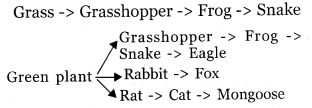
The chain of animals that eat and being eaten constitute food chain. But in nature different food chains are interrelated and this network is called food web.
Eg. Food Chain
Diversity For Sustenance Pdf Kerala Syllabus 8th Chapter 13

8th Class Biology Notes Pdf Kerala Syllabus Chapter 13 Question 2.
Is a single organism involved in more than one food chain?
Answer:

  • Same organism belongs to different food chains.
  • Beneficial. No species increase or decrease beyond a level.

8th Class Physics Notes Kerala Syllabus Chapter 13 Question 3.
Is the possibility of an organism becoming food to more Is the possibility of an organism becoming food to more than one organism helpful to the existence of the food chain?
Why?
Answer:
If a particular species increase its number, the animals that forms its food get destroyed. It cause food scarcity and thus they themselves destroyed.

Diversity For Sustenance Notes Kerala Syllabus 8th Chapter 13 Question 4.
How does the variation in the number of a particular organism in the food chain affect the existence of other organisms?
Answer:
The number of an organisms decrease it adversely effects the existences of another group that depend them for their food. The increase and decrease in the number of organisms adversely affect the equilibrium of environments.

Hss Live Guru 8 Biology Kerala Syllabus Chapter 13 Trophic Level

Trophic level indicates the position of an organism in a food chain. Green plants belong to first trophic level. All food chains start from green plants. Herbivores are in II trophic level and Carnivores are included in III trophic level.

The Illustration (Text Book Page No: 184)

Basic Science For Class 8 Chapter 13 Question 5.
Did you read the note on trophic level?
Complete the illustration by including the organisms of the food web at various trophic levels
Answer:
Tertiary Consumers – Eagle, Mongoose
Secondary Consumers – Frog, Snake
Primary Consumers – Grasshopper, Rat
Producers – Grass, Paddy

Hsslive Guru Biology 8th Kerala Syllabus Chapter 13 Question 6.
Does the same organism occupy more than one trophic level?
Answer:
The same organism is included in different trophic levels as the complexity of food web increases.

Kerala Syllabus 8th Standard Chemistry Notes Chapter 13 Question 7.
Is there any possibility of a fifth trophic level?
Answer:
The number of trophic levels is an ecosystem is not constant. Even though in nature the food chains are not too long. This is to reduce the loss of energy during transmission.

Kerala Syllabus 8th Standard Physics Notes Chapter 13 Question 8.
How does the elimination of organisms from the higher trophic levels affect the ecosystem?
Answer:
The loss of organisms in higher levels cause tremendous increase in the number of organisms in the lower levels. It disrupt the equilibrium of environment.

Interactions in the Ecosystem

Many relations exist in nature. It maintains the equilibrium and stability of the ecosystem.
Food relations between organisms are good examples for these interactions.
Predation: One is benefitted. Other is harmed,
eg. Tiger and Deer.
Parasitism: One is benefitted. Other is harmed,
eg: Mango tree and Loranthus.
Competition: Both are harmed first. Later the winner is benefitted.
eg: Paddy and Weeds.
Mutualism: Both are benefitted
eg: Sea anemone and Hermit crab.
Commensalism: One is benefitted and the other is neither benefitted nor harmed.
eg : Mango tree and Vanda

Biodiversity

Biodiversity is the sum total of all the diverse species of organisms and their ecosystems (habitats)
Biodiversity has 3 different levels such as ecosystem diversity species diversity and genetic diversity.
Walter G. Rosen is the scientist who used the term ‘biodiversity’ for the first time.

Indicators (Text Book Page No: 186)

Hsslive Guru 8th Class Kerala Syllabus Chapter 13 Question 9.
Are all ecosystems alike in biodiversity?
Answer:
No.

Question 10.
Are all organisms seen in an ecosystem also seen in another ecosystem?
Answer:
Organisms adapted to the conditions of particular ecosystems. The physical and chemical structure of each ecosystem is different. So organisms seen in one ecosystem may not be present in another ecosystem.

Question 11.
What is the need for protecting natural ecosystems?
Answer:
Natural ecosystem are to be conserved for the existence and conservation of organisms. Ecosystems are the treasure houses of biodiversity. They provide innumerable services. Essential services, Ecological services, supporting services, and cultural services.

Indicators (Text Book Page No: 188)

Question 12.
Large scale destruction of ecosystems
Answer:
Birds are primary the victims of changes occurring in the ecosystem

Question 13.
Overexploitation of the natural resources
Answer:
The unwise interference of human beings destroys our ecosystem with rich biodiversity. If adversely affects the bird diversity in our locality. Many species of birds disappeared due to habitat loss. The pesticides like DDT, endosulfan used in agricultural field kills or drives away the birds that come
in search of food.

Conservation of Biodiversity

Conservation of organisms within their natural habitat is termed as in-situ conversation.
eg: Wildlife sanctuaries, National Parks, Community Reserves, etc.
Conservation of organisms outside their natural habitats is termed ex-situ conservation.
eg : Zoological garden, botanical garden, gene bank

Indicators (Text Book Page No: 183)

Question 14.
What is the scope of ex-situ conservation?
Answer:
It is possible to conserve the endangered animals by keeping them in specialized environment and by providing suitable conditions for reproduction. Rare species of plants can be conserved. Seeds, gametes, etc. can be collected and make we when necessary.

Question 15.
What is the significance of gene banks?
Answer:
Gene banks are research centers. Here special arrangements are these to collect seeds, gametes, etc. and to preserve them for long periods. Animals can be recreated when necessary.

Let US assess (Text Book Page No: 195) 

Question 16.
Phytoplankton – zooplankton – fish – seal – shark
a) In which trophic level is the secondary consumer of this food chain included?
b) Rewrite the food chain in such a way that the organism in the third trophic level figures in the second trophic level.
Answer:
a. In 3rd trophic level.
b. algae → fish → duck

Question 17.
Find the odd one out from the following. Justify your answer.
a) Quagga, Malabar civet cat, Nilgiri Tahr, Lion-tailed macaque.
b) Eravikulam, Mathikettan shola, Periyar, Silent Valley
Answer:
a. Quaaga, Extinct
b. Periyar – Wildlife Sanctuary Others are national parks.

Question 18.
Examine the statements given below and rewrite if there are errors.
a) Extinct species are included in the Red Data Book.
b) WWF is an organisation working with the objective of protection of biodiversity.
c) Gene banks are included in in-situ conservation.
Answer:
In red data book endangered organisms are included
b. Right / True
c. Seed bank, sperm bank etc. are ex-situ conservation methods.

Diversity for Sustenance Additional Questions & Answers

Question 19.
Classify the following as producers and consumers.
Lizard, Planktons, Paddy, Calotes, Carrot, Grasshopper, Tortoise, Algae, Snake
Answer:

ProducersConsumers
PaddyLizard
CarrotCalotes
PlanktonsGrasshopper
AlgaeTortoise
Snake

Question 20.
Find out suitable example for the animal relations mentioned.
i. Parasitism
ii. Mutualism
iii. Commensalism
Crops × Weeds
Mango tree × Vanda
Mango tree × Loranthus
Fish × Heron
Hermit crab × sea anemone
Answer:
i. Mango tree and Loranthus
ii. Hermit Crab – Sea anemone
iii. Mango tree and Vanda.

Question 21.
Complete the illustration Suitably
Basic Science Class 8 Chapter 13 Kerala Syllabus Chapter 13
Answer:
a. Environmental / Ecological services
b. Cultural services
c. Food, Medicine
d. Nutrient Cycle, Pollination

Question 22.
Which are the different types of conservation of biodiversity?
Answer:
These are mainly two types.

  1. In-situ conservation in which organisms are conserved within their natural environment
  2. Ex-situ conservation in which animals are protected out their natural environment.

Question 23.
Classify the following into Ex-situ and In-situ.
(Zoological Gardens, Sacred Groves, Gene banks, Biosphere Reserves, Botanical Gardens, National parks)
Answer:

In-situEx-situ
National parksZoological Gardens
Sacred GrovesGene Banks Botanical
Biosphere ReservesGardens.

Question 24.
Expand the following terms.
Answer:
JNTBGRI – Jawaharlal Nehru Tropical Botanic Garden and Research Institute.
MBG – Malabar Botanical Garden RGCB – Rajiv Gandhi Centre for Biotechnology.

Question 25.
Why do all the food chains start from green plants?
Answer:
The basis of all food chains is the plants. They are the producers. These are eaten by the herbivores which in turn are eaten by the carnivores.

Question 26.
The members at the successively higher levels are lesser in number and larger in size in a food chain. What about their body weight? What would be the reason for that?
Answer:
In the successively higher levels in the food chain the number of consumers decreases and the size of their body increases. The number of producers will be very large. The number of animals which feed on them is less in number. But their body size increases.

Question 27.
Hay → Horse
Paddy → Fowl → Fox
Phytoplankton → Tadpole → Fish → Man
Grass → GrasshopperFrog → Snakes Vulture
Examine the food chain given above and classify them as primary consumers, secondary and tertiary consumers.
Answer:
Producers: Hay, Paddy, Phytoplankton, Grass
Primary consumer: Horse, Fowl, Tadpole, Grasshopper
Secondary consumers: Fox, Fish, Frog, Snake
Tertiary consumers: Vulture, Man

Question 28.
What will happen if the number of herbivores increases?
Answer:
If the number of herbivores increase they will eat away all the grass and shrubs and they will have to face shortage of food. The destruction of grass and shrubs will cause soil erosion and the top fertile soil will be washed away.

Question 29.
Animals which are facing extinction.
Answer:

  • Wild goat
  • Musk deer
  • Indian wild Ass
  • Lion-tailed Monkey
  • Lion
  • Rhinoceros
  • The large Indian Bustard
  • Tiger
  • Kashmir deer
  • Himalayan Tig
  • Silver owl
  • Panda

Kerala Syllabus 8th Standard Basic Science Solutions Chapter 12 Why Classification?

You can Download Why Classification? Questions and Answers, Summary, Activity, Notes, Kerala Syllabus 8th Standard Basic Science Solutions Chapter 12 help you to revise complete Syllabus and score more marks in your examinations.

Kerala State Syllabus 8th Standard Basic Science Solutions Chapter 12 Why Classification?

Why Classification? Textbook Questions and Answers

Classification

Classification is the grouping of organisms on the basis of similarities and differences. Classification using suitable criteria makes the study of organisms more easy. Many criteria are used in classification.
Eg: size, beauty, speed, type of teeth, claws, etc.

Taxonomic Keys

Scientific indicators used to recognize and classify plants and animals are called Taxonomic keys. Dichotomous keys is the most popular among these. Each indicator contains 2 options for selection. By selecting the characteristic feature of the organism to be identified it can be recognized and classified.

Indicators (Text Book Page No: 170)

Why Classification Class 8 Kerala Syllabus Chapter 12 Question 1.
Peculiarity of dichotomous keys
Answer:
Dichotomous key is the most popular among these. Each indicator contains 2 options for selection. By selecting the characteristic feature of the organism to be identified it can be recognized and classified.

Why Classification Kerala Syllabus Chapter 12 Taxonomy

Taxonomy is the branch of science that deals with the identification and classification of organisms according to similarities and differences. Organisms are given scientific names. Carl Linnaeus laid foundation stone for classification. In all organism that including human beings are placed in different levels of classification. It was scientist named carl Linnaeus who fixed taxonomic hierarchy and provided a scientific base for classification. Hence he is known as the father of taxonomy.

Scientists and their Contribution to Taxonomy

Aristotle:
Why Classification Class 8 Kerala Syllabus Chapter 12
Father of Biology Classified animals as red-blooded and non-red blooded

Theophrastus:
Why Classification Kerala Syllabus Chapter 12
Father of Botany Grouped Plants as animals, biennials, and perennials

Charaka:
Why Classification Notes Kerala Syllabus Chapter 12
Father of Ayurveda Author of ‘Charaka Samhita’

John Ray:
Why Classification Class 8 Notes Kerala Syllabus Chapter 12
– Used the term ‘Species’ for the first time
– Recorded more than 18000 plants in his book ‘Historia Generalis Plantarum’

Carls Linnaeus:
Hss Live Guru Biology 8 Kerala Syllabus Chapter 12
– Father of Modern Taxonomy.
– Suggested different levels of Classification
– Introduced Binomial Nomenclature

Why Classification Notes Kerala Syllabus Chapter 12 Indicators (Text Book Page No: 173)

Hss Live Guru Biology 8 Kerala Syllabus Chapter 12 Question 2.
Which are the organisms included in kingdom Animalia?
Answer:
Cockroach, Butterfly, Bird, Rabbit, Cat, Tiger, Lion, bear

Why Classification Class 8 Notes Kerala Syllabus Chapter 12 Question 3.
Which organisms are excluded at each consecutive level? Why?
Answer:

  • Eliminated from Phylum Chordates — Butterfly, Cockroach
    Reason — Animals with vertebral columns alone are included in the phylum chordates.
  • Eliminated from Class Mammalia
    — Bird (Pigeon) Reason — Animals that give birth to young ones alone included in this group.
  • Eliminated from the order Carnivora — Rabbit
    Reason — Carnivores alone included in this order.
  • Eliminated from the family Felidae — Bear
    Reason — It does not have retractile claws.
  • Eliminated from the Genus Felis — Lion, tiger
    Reason — Animals having small body and without roaring sound are included.
  • Eliminated from the Species domestic — Wild Cat
    Reason — It has the basic features of cat

Basic Science Class 8 Chapter 12 Solution Kerala Syllabus Chapter 12 Question 4.
At what levels of this illustration can humans be included?
Answer:
Man can be included in Class Mam-malia and Phylum Chordata.

Binomial Nomenclature

Binomial nomenclature is the scientific naming of organisms. Scientific name consists of two words. First word indicates genus and second word indicates species. Scientific name of man – Homo sapiens. Earlier two-kingdom classification was in practice. Accordingly, the organisms were broadly classified into planate and anemia. Later Rober. H. Whittaker classified organisms into 5 Kingdoms.
Eg : Monera, Protista, Fungi, Plantae, Animalia.
Another Scientist Carl Vaus added ‘domain’ above kingdom and expanded it into 6 kingdom classification.

Indicators (Text Book Page No: 176)

Class 8 Basic Science Chapter 12 Kerala Syllabus Chapter 12 Question 5.
Limitations of two-kingdom classification.
Answer:
Bacteria, Fungus, etc were not inclu­ded in two kingdom classification.

Hss Live Guru 8th Physics Kerala Syllabus Chapter 12 Question 6.
Possibilities of five kingdom classification.
Answer:
In five kingdom classification bacteri­a, amoeba, fungus, plants, and animals were included in separate kingdoms according to their characteristics.

8th Std Physics Notes Kerala Syllabus Chapter 12 Question 7.
Circumstances that led to the formulation of six kingdom classification.
Answer:
In ancient times knowledge regarding the characteristics of micro organ­isms was limited. It was found out that the cell structu­re and physiology of archaebacteria belongs to kingdom monera are quite different from other bacteria. Hence kingdom monera was divided into two kingdoms – Archae and Bacteria. Be­sides another level namely ‘domain’ was added above kingdom. Thus 6 king­dom classification came into existence

8th Standard Biology Kerala Syllabus Chapter 12 Question 4.
Completing the table (Text Book Page No: 177)
8th Class Biology Notes Pdf Kerala Syllabus Chapter 12
Answer:

DomainEukarya
KingdomAnimalia
PhylumChordata
ClassMammalia
OrderPrimates
FamilyHominidae
GenusHomo
SpeciesSapiens

Indicators (Text Book Page No: 178)

Basic Science Class 8 Chapter 12 Kerala Syllabus Question 8.
What are the peculiarities of virus?
Answer:
Viruses have no specific cell structure. Genetic material and a protein sheath alone are present. It is difficult to destroy them. They live only in living cells. They are dead or inactive outside the cell. It multiplies inside the host cell and destroys it.

Hss Live Guru 8 Biology Kerala Syllabus Chapter 12 Question 9.
Can virus be included in any of the classification methods we have discussed earlier? Why?
Answer:
As viruses have no cellular structure, it is not possible to include in any of the classifications mentioned.

Let US assess (Text Book Page No: 179) 

Basic Science For Class 8 Chapter 12 Kerala Syllabus Question 10.
Identify the word pair relation and fill in the blanks
a. Five kingdom classification: Robert H.Whittaker
Six kingdom classification :
b. Charaka: Charaka Samhita
John Ray
Answer:
a. Carl Vaus
b. Historia Generalis Plantarum

Kerala Syllabus 8th Standard Biology Notes Chapter 12 Question 11.
Hints about some organisms are given below. Name the
kingdom to which these organisms belong:
a. Multicellular heterotrophic organisms with a nucleus and capacity for locomotion.
b. Multicellular, heterotrophic, non-motile organisms with a nucleus.
c. Unicellular organisms with a nucleus.
d. Multicellular, autotrophic, non-motile organisms with a nucleus.
Answer:
a. Animals
b. Fungi
c. Amoeba
d.Plants

Kerala Syllabus 8th Standard Chemistry Notes Chapter 12 Question 12.
Write from the table the name of the organism which has more resemblances with tiger. Give explanations for your answer.
Basic Science Class 8 Chapter 12 Solution Kerala Syllabus Chapter 12
Answer:
Lion having the scientific name Pantheraleo.
Lion and Tiger belongs to same Genus ‘Panthera’

Why Classification? Additional Questions and Answers

Basic Science Class 8 Ch 12 Kerala Syllabus  Question 13.
Identify the word pair relation and fill the blanks.
a. 2 Kingdom Classification: Carls Linnaeus:: 5 kingdom Classification: …………….
b.Mushrooms: Fungi:: Bacteria: ……………..
c. Aristotle – Father of Biology Carls Linnaeus – …………….
d. Golden shower: Cassia fistula::…………..: Corvus splendens
e. Charaka: Father of Ayurveda::……………: Father of Botany
Answer:
a. R H Whittaker
b. Monera
c. Father of Taxonomy
d. Crow
e. Theophrastus

Hss Live Guru 8th Biology Kerala Syllabus Chapter 12 Question 14.
2. Identify the odd one and write the characteristic features of others.
a. Lion, Tiger, Rabbit, Cat.
b. Genus, Order, Carl Linnaeus, Phylum.
Answer:
a. Rabbit – Others including order Carnivora
b. Carl Linnaeus – He is the Father of Modern Taxonomy. Others are different levels of classification.

Question 15.
Which organism is most suit¬able for the following indicators (amoeba, bacteria, virus, Fungus)
1. Lives only in living cell
2. Pathogen
3. Only genetic material and a protein covering.
Answer:
Virus

Question 16.
Find out the scientists suitable to the statements given.
i. Author of Charaka Samhitha
ii. Author of Historia Generalis Plantarum
iii. Father of Modern Taxonomy
iv.Father of Biology
Answer:
i. Charaka
ii. John ray
iii. Carl Linnaeus
iv. Aristotle

Question 5.
Complete the table
Class 8 Basic Science Chapter 12 Kerala Syllabus Chapter 12
Answer:

  • Elephas Maximus / Elephas Indicus
  • Pavo Cristatus
  • Canis Familiaris
  • Hibiscus Rosasinensis
  • Azadiracuta Indica
  • Oryza sativa

Question 17.
What are limitations in the system of classification of Carl Linnaeus?
Answer:
Some lower organisms share the characters of both animals and plants. So it is difficult to recognize them as plants or animals. Linnaeus considered only plants and animals for his classification. Microscopic organisms like bacteria, fungus, protozoa, etc were not included either in plant kingdom or in animal kingdom. Certain animals which were included in the classification of Linnaeus show characters of both the animal and plant kingdoms. Eg: Euglena protozoan shows locomotory movements like animals, but it contains chlorophyll like plants.

Question 18.
7. Hints about some organisms are given below. Name the kingdom to which these organisms belong.
a. Multicellular heterotrophic organisms with a nucleus and capacity for locomotion.
b. Multicellular heterotropic, non-motile organisms with a nucleus.
c. Unicellular organisms with a nucleus.
d. Multicellular, autotroph, non-motile organisms with a nucleus
Answer:
a. Animalia
b. Fungi
c. Protista
d. Plantae

Question 19.
Write the scientific name of following animals and plants. Coconut, paddy, wheat, crow, mango, grapes
Answer:
Coconut – Cocos nucifera
Paddy – Oryza sativa
Wheat – Triticum aestivum
Crow – Corvus splendens
Mango – Mangifera indica
Grapes – Vitis vinifera

Question 20.
What are two important characters of species?
Answer:
1. Species is a group of organisms that can freely interbreed to produce fertile offsprings.
2. A group of organisms that closely resemble each other in structure biochemical makeup and external characteristics but which are genetically different. In one species there may be subspecies.

Question 21.
The method of classification adopted by Whittaker is much better than the method adopted by Carl Linnaeus the father of the science of classification. What is your response to this statement?
Answer:
The classification of Linnaeus had only two kingdoms, plants, and animals. He did not consider bacteria, protozoa, fungus, etc. Certain characters of animals considered by Linnaeus for classification are found in both the kingdoms, eg. photosynthesis found in plants is seen in some animals like Euglena. Certain characters of animals can be seen in plants also, eg certain types of algae. But Whittaker adopted the method of having five kingdoms including protozoa and bacteria.

  • Monera,
  • Protista
  • fungi
  • Plantae
  • animalia

Question 22.
Bacteria does not have a well defined Nucleus. Viruses are also like Bacteria. Why is it not possible to include viruses under Monera.
Answer:
Viruses exhibit living nature only when they enter the host cells. On other occasions, they do not exhibit living nature. But organisms in Monera are not like that.

Question 23.
How do the levels of classification of plants made by Carl Linnaeus differ from the levels of classification of Animals?
Answer:
Not much differences are there. In the place of ‘Order’ in animal classification, plant classification has series. And in the place of ‘Phylum’ in animal classification, plant classification has ‘Division’.

Question 24.
Find the level of classification and complete the given table.
Hss Live Guru 8th Physics Kerala Syllabus Chapter 12
Answer:
1. Kingdom
2.Phylum Chordata
3. Mammalia
4. Mammalia
5. Species

Question 25.
Cell is the smallest unit of life. But there are certain organisms that live without cell too. Analyze this statement.
Answer:
Life is not possible without a cell. Viruses do not have cells. As it is so, it does not have life when it outside a living cell. As it enters a living cell, it will show the features of life forms. It makes use of the components of the host cell and continues to live. Though it does not have a cell, it can continue its life only after entering a host cell and by making use of its components.

Question 26.
Observe the given statement, and write correct answer if you find false statements.
a. Aristotle is the Father of Biology.
b. John Ray is the Father of Botany.
c. Carl Linnaeus used the term ‘species’ for the first time.
d. Charaka proposed binomial nomenclature.
Answer:
a. True
b. False, Theophrastus
c. False, John Ray
d. False, Carl Linnaeus

Question 27.
What is the relationship between taxonomic keys and dichotomous key?
Answer:
Taxonomic keys are scientific indicators used to identify and classify plants and animals. Dichotomous keys is one of the popular taxonomic keys.

Kerala Syllabus 9th Standard Hindi Solutions Unit 3 Chapter 1 नंगे पैर

You can Download नंगे पैर(Nange pair) Questions and Answers, Summary, Activity, Notes, Kerala Syllabus 9th Standard Hindi Solutions Unit 3 Chapter 1 help you to revise complete Syllabus and score more marks in your examinations.

Kerala State Syllabus 9th Standard Hindi Solutions Unit 3 Chapter 1 नंगे पैर (कहानी)

नंगे पैर Textual Questions and Answers

नंगे पैर विश्लेषणात्मक प्रश्न

Nange Pair Notes Kerala Syllabus 9th प्रश्ना 1.
‘बंद दरवाज़ा खोलने में उसे थोड़ा समय लगा। दरवाज़े से बाहर और हॉल को पारकर आगे आने में देर लगी।’ देर लगने का कारण क्या होगा?
Nange Pair Notes Kerala Syllabus 9th
उत्तर:
बेबी एक अपाहिज लड़की है। उसके एक पैर नहीं है। वह बैसाखियों के सहारे चलती है। इस लिए देर लगी।

9th Hindi Notes Kerala Syllabus प्रश्ना 2.
‘दोपहर में बेबी को अकेलापन लगता’ -बेबी बाहर निकल नहीं पाती। जो अकेलापन सहते हैं, वे हमसे क्या-क्या चाहते होंगे?
9th Hindi Notes Kerala Syllabus
उत्तर:
जो अकेलापन सहते हैं वे दूसरों की हाज़िरी चाहते हैं। बोलने-बियाने के लिए दोस्तों को चाहते हैं। उनकी आँखें हमेशा दूसरों के आने की प्रतीक्षा करती रहती हैं।

Kerala Syllabus 9th Standard Hindi Solutions Unit 1 Chapter 3 प्रश्ना 3.
लगने दो बहिन! पोस्टमैन का काम जिस-तिस की डाक जिस-तिस के हाथ में सौंपने का है- अहाते में फेंकने का नहीं।” यहाँ पोस्टमैन का कौन-सा मनोभाव प्रकट होता है?
Kerala Syllabus 9th Standard Hindi Solutions Unit 1 Chapter 3
उत्तर:
इससे स्पष्ट होता है कि पोस्टमैन अपने काम के प्रति ईमानदार है। वह अपना दायित्व समझता है। उसे ईमानदारी के साथ निभाता है। अपने काम के प्रति पोस्टमैन का सकारात्मक मनोभाव यहाँ हम देख सकते हैं।

Kerala Syllabus 9th Standard Hindi Solutions Unit 3 Chapter 1 प्रश्ना 4.
बेबी ने मन ही मन निश्चय किया कि वह उस पोस्टमैन को नंगे पैर चलने नहीं देगी । यह तय करते ही उसे सुखद अनुभूति हुई’ कारण क्या होगा?’
Kerala Syllabus 9th Standard Hindi Solutions Unit 3 Chapter 1
उत्तर:
दूसरों की खुशी में खुशी ढूँढ़ना बड़ी बात है। यही सबसे बड़ी खुशी है। बेबी ने पोस्टमैन को जूते देकर खुश करने का निश्चय किया। इससे ही वह खुश हो जाती है। यहाँ बेबी के खुले दिल का परिचय मिलता है। इससे ही उसे सुखद अनुभूति होती है।

Hss Live Guru 9th Hindi Kerala Syllabus प्रश्ना 5.
‘तब होली का त्योहार मनाया जा चुका था।’ इस प्रस्ताव का तात्पर्य क्या है?
Hss Live Guru 9th Hindi Kerala Syllabus
उत्तर:
बेबी पोस्टमैन को चप्पल सीधे देना नहीं चाहती है। वह उपहार के रूप में देने का बहाना ढूँढ़ती है। लेकिन होली का त्योहार बीत गया था।

9th Standard Hindi Notes Pdf Kerala Syllabus प्रश्ना 6.
‘साहब मेरी लाइन बदल दीजिए, सिटी में कहीं भी बदली दीजिए’ ऐसा क्यों कहा होगा?
9th Standard Hindi Notes Pdf Kerala Syllabus
उत्तर:
पोस्टमैन बिना चप्पल चलता था। यह देखकर बेबी ने उसे जूते दिए। बेबी के एक पैर ही नहीं है। लेकिन पोस्टमैन उस अभाव की पूर्ति करने में असमर्थ है। उसे यह हाल सह नहीं पाता होगा। इससे बदली माँगी होगी।

नंगे पैर Text Book Activities

नंगे पैर अभ्यास के प्रश्न

Hsslive Hindi Class 9 Kerala Syllabus प्रश्ना 1.
‘पोस्टमैन की आवाज़ उसके कानों में आई, पर फर्श पर डाक गिरने की आवाज़ सुनाई नहीं दी। बेबी पीछे मुड़ी। सँभालकर पलंग से उतरी। फिर बैसाखियों के सहारे एक-एक कदम चलकर दरवाजे तक आई।’
Hsslive Hindi Class 9 Kerala Syllabus
i. बेबी हर बात का सूक्ष्म निरीक्षण करती है। उसके मुताबिक व्यवहार भी करती है।
Kerala Syllabus 9th Standard Hindi Solutions Unit 3 Chapter 1 नंगे पैर 8
जैसे,
9th Standard Hindi Notes Kerala Syllabus

9th Standard Hindi Notes Kerala Syllabus प्रश्ना 2.
लिखें, इसपर आपकी प्रतिक्रिया।
Kerala Syllabus 9th Standard Hindi Solutions Unit 3 Chapter 1 नंगे पैर 10
उत्तर:

रसोई से खाने की महक आ रही है।जल्दी रसोई पहुँता है / पहुँचती है।
स्तक देने की आवाज़ आ रही है।दरवाज़ा खोलने के लिए आता है । आती है।
स्कूल में घंटी लंबी बज रही है।घर जाने की तैयारी करता है/करती है।
बादलों के गरजने की आवाज़ आ रही है।बारिश की प्रतीक्षा में बैठता है। बैठती है।
कोई दोस्त पुकार रहा है।उसके साथ खेलने जाता है | जाती है।

नंगे पैर विधात्मक प्रश्न

Kerala Syllabus 9th Standard Notes Hindi प्रश्ना 1.
डायरी लिखें :
‘बेबी ने मन ही मन निश्चय किया कि वह उस पोस्टमैन को नंगे पैर चलने नहीं देगी। यह तय करते ही उसे सुख अनुभूति हुई।’ सोचें, उस दिन बेबी के मन में कौन-कौन से विचार आए होंगे? बेबी के विचारों को डायरी के रूप में लिखें।
Kerala Syllabus 9th Standard Hindi Solutions Unit 3 Chapter 1 नंगे पैर 11
उत्तर:
14 सितंबर 2016
सोमवार
आज कितना अच्छा दिन है। जीवन में एक अच्छा निर्णय लिया। कितने दिन से उस पोस्टमैन को नंगे पैर चलते देख रही हूँ। लेकिन उसे ऐसे चलने देना सही नहीं है। बेचारे के पैर गर्मी से तपते होंगे। जो भी हो अपना निर्णय सही है। उसे मैं जूते बनवाकर दूंगी। इससे बढ़िया और क्या मैं कर सकती हूँ।

Kerala Syllabus 9th Standard Hindi Guide Pdf प्रश्ना 2.
टिप्पणी लिखें :
‘नंगे पैर’ शीर्षक इस कहानी के लिए कहाँ तक सार्थक है? अपना मत स्पष्ट करते हुए एक टिप्पणी लिखें।
Kerala Syllabus 9th Standard Hindi Solutions Unit 3 Chapter 1 नंगे पैर 12
उत्तर:
इस कहानी में दो विशेष पात्र हैं- पोस्टमैन और बेबी। बेबी अपाहिज है, उसके एक पैर नहीं है। पोस्टमैन बिना चप्पल चलता है। बेबी पोस्टमैन की हालत सह नहीं पाती है। पोस्टमैन के लिए वह जूता बनवाकर देती है। बेबी के पैर नहीं है लेकिन वह नंगे पैर चलनेवाले पोस्टमैन की कठिनाई को महसूसती है। यह कहानी नंगे पैर के इर्द-गिर्द घूमती है। इससे हम यह कह सकते हैं कि यह शीर्षक बिल्कुल सार्थक है।

नंगे पैर Additional Questions and Answers

नंगे पैर आशयग्रहण के प्रश्न

9th Standard Hindi Textbook Pdf Kerala Syllabus प्रश्ना 1.
दुपहर के समय बेबी के कमरे का माहौल कैसा था?
Kerala Syllabus 9th Standard Hindi Solutions Unit 3 Chapter 1 नंगे पैर 13
उत्तर:
बीच हॉल में रखे रेडियो में साढ़े बारह बजे के रिकॉर्ड बज रहे थे। शांत माहौल में गीतों के सुर गूंज रहे थे।

Class 9 Hindi Notes Kerala Syllabus प्रश्ना 2.
नए पोस्टमैन को धक्का-सा लगने का कारण क्या था?
Kerala Syllabus 9th Standard Hindi Solutions Unit 3 Chapter 1 नंगे पैर 14
उत्तर:
नए पोस्टमैन ने एक नज़र बेबी के पैरों की ओर देखा। बेबी के एक पैर नहीं था। वह बैसाखियों के सहारे चलती थी। यह देखकर उसे धक्का-सा लगा।

Hsslive Guru 9th Hindi Kerala Syllabus प्रश्ना 3.
पोस्टमैन को बिना चप्पल चलने के संबंध में बेबी ने क्या सोचा? ।
Kerala Syllabus 9th Standard Hindi Solutions Unit 3 Chapter 1 नंगे पैर 15
उत्तर:
बेबी ने सोचा कि शायद उसके जूते फट गए होंगे, वे मरमत होकर आते होंगे। .

Hss Live Guru Hindi 9th Kerala Syllabus प्रश्ना 4.
पोस्टमैन के अभावों को कहानी में कैसे दर्शाया गया है?
Kerala Syllabus 9th Standard Hindi Solutions Unit 3 Chapter 1 नंगे पैर 16
उत्तर:
पोस्टमैन के पास छाता नहीं, साइकिल नहीं और जूता भी नहीं था। धूप से उसका चेहरालाल-पीला होता। पसीने से उसकी कमीज़ पीठ से चिपकी रहती।

9th Standard Hindi Textbook Answers Kerala Syllabus प्रश्ना 5.
बेबी ने पोस्टमैन के पैर का नाप लेने के लिए कौन-सा तरकीब अपनाया?
Kerala Syllabus 9th Standard Hindi Solutions Unit 3 Chapter 1 नंगे पैर 17
उत्तर:
पोस्टमैन के डाक देकर चले जाने पर बेबी अहाते के किनारे आई, सीढियों से नीचे उतर आई। फ्रॉक की जेब से परकार निकालकर जानेवाले पोस्टमैन के पैरों के निशान का नापजोख किया।

नंगे पैर Grammar

नंगे पैर व्याकरण के प्रश्न

प्रश्ना 1.
इस वाक्य पर ध्यान दें
Kerala Syllabus 9th Standard Hindi Solutions Unit 3 Chapter 1 नंगे पैर 18
‘पैरों की. गोलाई आदि का ठीक-ठीक माप।’
Kerala Syllabus 9th Standard Hindi Solutions Unit 3 Chapter 1 नंगे पैर 19

प्रश्ना 2.
इसमें ‘गोलाई’ शब्द ‘गोल’ और ‘आई’ के मेल से बना है। ध्यान दें, इससे अर्थ में कौन-सा परिवर्तन आता है। इस तालिका में इसी प्रकार के और कुछ शब्दों को जोड़ें।
Kerala Syllabus 9th Standard Hindi Solutions Unit 3 Chapter 1 नंगे पैर 20
उत्तर:

विशेषणप्रत्ययसंज्ञा
गोलआईगोलाई
चतुरआईचतुराई
सुंदरतासुंदरता
चिकनाआईचिकनाई
बुराआईबुराई
कालापनकालापन
पागलपनपागलपन

नंगे पैर Summary in Malayalam and Translation

Kerala Syllabus 9th Standard Hindi Solutions Unit 3 Chapter 1 नंगे पैर 21
Kerala Syllabus 9th Standard Hindi Solutions Unit 3 Chapter 1 नंगे पैर 22
Kerala Syllabus 9th Standard Hindi Solutions Unit 3 Chapter 1 नंगे पैर 23
Kerala Syllabus 9th Standard Hindi Solutions Unit 3 Chapter 1 नंगे पैर 24
Kerala Syllabus 9th Standard Hindi Solutions Unit 3 Chapter 1 नंगे पैर 25
Kerala Syllabus 9th Standard Hindi Solutions Unit 3 Chapter 1 नंगे पैर 26
Kerala Syllabus 9th Standard Hindi Solutions Unit 3 Chapter 1 नंगे पैर 27

नंगे पैर शब्दार्थ

Kerala Syllabus 9th Standard Hindi Solutions Unit 3 Chapter 1 नंगे पैर 28
Kerala Syllabus 9th Standard Hindi Solutions Unit 3 Chapter 1 नंगे पैर 29

Kerala Syllabus 8th Standard Maths Solutions Chapter 7 Ratio

You can Download Equal Triangles Questions and Answers, Activity, Notes, Kerala Syllabus 8th Standard Maths Solutions Chapter 7 help you to revise complete Syllabus and score more marks in your examinations.

Kerala Syllabus 8th Standard Maths Solutions Chapter 7 Ratio

Area of Quadrilaterals Text Book Questions and Answers

Ratio Chapter Class 8 Kerala Syllabus Question 1.
In a regular polygon, the ratio of the inner and outer angle is 7 : 2. What is each angle? How many sides does the polygon
Solution:
Let the inner angle be 7x and the outer angle 2x .
Inner angle + outer angle = 180°
7x + 2x = 180°
9x = 180°
x = 180 ÷ 9 = 20°
Inner angle = 7x = 7 × 20 = 140°
Outer angle = 2x = 2 × 20 = 40°
Sum of the outer angles of a polygon of n sides is 360°. Since it is a regular polygon, the outer angles are equal,
n × 40 = 360°
Kerala Syllabus 8th Standard Maths Solutions Chapter 7 Ratio 81
Number of sides of the polygon = 9

Hsslive Maths Class 8 Kerala Syllabus Question 2.
The number of girls and boys in a class are in the ratio 7 : 5 and there are 8 more girls than boys. How many girls and boys are there in this class?
Solution:
Let the number of girls be 7x and the number of boys be 5x ,
Difference = 7x – 5x = 2x
Kerala Syllabus 8th Standard Maths Solutions Chapter 7 Ratio 1
Number of girls = 7x = 7 × 4 = 28
Number of boys = 5x = 5 × 4 = 20

Hsslive Class 8 Maths Kerala Syllabus Question 3.
Blue and yellow paints are mixed in the ratio 2 : 5 to make a new colour. 6 litres more of yellow 1 than blue is taken. How many litres of each is mixed?
Solution:
Let the measure of blue paint be 2x and yellow paint be 5x .
Their difference = 5x – 2x = 3x
3x = 6
x = 2
Quantity of blue paint = 2x = 2 × 2 = 4 litre
Quantity of yellow paint = 5x = 5 × 2 = 10 litre

Hsslive Guru 8th Class Maths Kerala Syllabus Question 4.
There are four right triangles, the ratio of perpendicular sides being 3 : 4 m each. One more fact about each is given below. Find the lengths of the sides of each triangle.
i. The difference in the lengths of the perpendicular sides is 24 metres.
ii. The hypotenuse is 24 metres.
iii. The perimeter is 24 metres.
iv. The area is 24 square metres.
Solution:
i. Let the perpendicular sides be 3x and 4x
Kerala Syllabus 8th Standard Maths Solutions Chapter 7 Ratio 6
The difference between the perpendicular sides be,
4x – 3x =x
x = 24
Sides are, 3x = 3 × 24 = 72 m
4x = 4 × 24 = 96 m
5x = 5 × 24 = 120 m

ii. Hypotenuse = 5x = 24

Kerala Syllabus 8th Standard Maths Solutions Chapter 7 Ratio 7
Perpendicular sides 3x = 3 × 4.8 = 14.4 m
4x = 4 × 4.8 = 19.2 m

iii. Perimeter = 3x + 4x + 5x = 12x
12x = 24
x = 2
Sides are, 3x = 3 × 2 = 6m
4x = 4 × 2 = 8 m
5x = 5 × 2 = 10 m

iv. Area = 1/2 × 3x × 4x = 6x 2
6x 2 = 24
x 2 = 4; x = 2
Sides are, 3x = 3 × 2 = 6m
4x = 4 × 2 = 8m
5x = 5 × 2 = 10 m

Textbook Page No 137

8th Std Maths Guide Kerala Syllabus  Question 5.
Acid and water are mix ed in the ratio 4 : 3 to make a liquid. On adding 10 more litres of water, the ratio changed to 3 : 1. How many litres of acid and water does the liquid contain now?
Solution:
Let the volume of acid be 4x and volume of water be 3x volume of acid on adding 10 more litres of acid = 4x + 10 litres
present ratio = 3 : 1
4x + 10 : 3x = 3 : 1
3 × 3x = 1 × (4x + 10)
9x = 4x + 10
9x – 4x = 10 ; 5x = 10
x = 2
Volume of acid in the original mix ture = 4x = 4 × 2 = 8 litres
Volume of water in the original mix ture = 3x = 3 × 2 = 6 litres
Volume of acid in the present mix ture = 8 + 10 = 18 litres
Volume of water in the present mix ture = 6 litres

Hss Live Maths Class 8 Kerala Syllabus Question 6.
Two angles are in the ratio 1 : 2. On increasing the smaller angle by 6° and decreasing the larger angle by 6°, the ratio changed to 2 : 3. What were the original angle?
Solution:
Let x be the smaller angle and 2x be the larger angle,
x + 6 : 2x – 6 = 2 : 3
2(2x – 6) = 3 (x +6)
4x – 12 = 3x + 18
4x – 3x = 18 + 12 = 30; x = 30
Original smaller angle = x ° = 30°
Original larger angle =2x ° = 6o°

Hss Live Guru 8th Maths Kerala Syllabus Question 7.
The sides of a rectangle are in the ratio 4 : 5.
i. By what fraction should the shorter side be increased to make it a square?
ii. By what fraction should the longer side be decreased to make it a square?
Solution:
Let 4x be the smaller side and 5x be the larger side,
i. Let y part of a shorter side be added breadth after adding = 4x + 4xy = 4x (1 + y)
Ratio of breadth and length of a square = 1 : 1
so present ratio
4 × (1 + y) : 5x = 1 : 1
1 × 4x (1 + y) = 5x × 1
4(1 + y) = 5
Kerala Syllabus 8th Standard Maths Solutions Chapter 7 Ratio 8
On adding \(\frac{1}{4}\) part of the original breadth, it can be made into square,

ii. Let y part of the longer side be substracted length after subtracting = 5x – 5xy
= 5x (1 – y)
As the present ratio is 1 : 1
5x (1 – y) : 4x = 1 : 1
1 × 5x (1 – y) = 1 × 4x
5 (1 – y) = 4
Kerala Syllabus 8th Standard Maths Solutions Chapter 7 Ratio 9
On subtracting \(\frac{1}{5}\) part of the original length, it can be made into square.

Hss Live Guru 8 Maths Kerala Syllabus Question 8.
Two quantities are in the ratio 3 : 5
i. If the smaller alone is made four times the original, What would be the ratio?
ii. If the smaller is doubled and the larger is halved, What would be the ratio?
Solution:
i. Let 3x be the smaller side and 5x be the larger side,
4 times the smaller = 4 × 3x = 12x
present ratio = 12x : 5x = 12 : 5

ii. Double the smaller = 2 × 3x = 6x
Kerala Syllabus 8th Standard Maths Solutions Chapter 7 Ratio 10

Kerala Syllabus 8th Standard Maths Notes Question 9.
i. The capacities of two bottles are in the ratio 3 : 4. The smaller bottle was filled twice and the larger bottle was filled and emptied into a vessel. Twice the smaller and half the larger was emptied into another. What is the ratio of the quantities of water in the two vessels?

ii. In the problem, what is the capacities of the bottles are in the ratio 4 : 7?
Solution:
i. Let the capacity of the smaller bottle = 3x
the capacity of the larger bottle = 4x
Volume of water when the smaller bottle is filled twice = 2 × 3x = 6x
Volume of water when the larger bottle is filled once = 4x
Total volume now = 6x + 4x = 10x
Volume of the water when the smaller bottle is filled twice = 6x
Volume of water when larger bottle is filled half = \(\frac{4 x }{2}\) = 2x
Total volume now = 6x + 2x = 8x
Ratio of the quantities of water = 10x : 8x , = 10 : 8 = 5 : 4

ii. Ratio of capacities of the bottle = 4 : 7
Let the capacity of the smaller bottle = 4x
the capacity of the larger bottle = 7x
Volume of water when the smaller bottle is filled twice = 2 × 4x = 8x
Volume of water when the larger bottle is filled once = 7x
Total volume now = 8x + 7x = 15x
Volume of the water when the smaller bottle is filled twice = 8x
Volume of water when larger bottle is filled half = \(\frac{7 x }{2}\)
Ratio Chapter Class 8 Kerala Syllabus
= 30 : 23 (multiplied by 2)

8th Std Maths Notes Kerala Syllabus Question 10.
The breadth and length of two rectangles are in the ratio 2 : 3. In another rectangle, whose breadth is 1 cm less and length is 3 cm less than those of the first, this ratio is 3 : 4. Calculate the breadth and length of both rectangles.
Solution:
Ratio between the breadth and length of the first rectangle = 2 : 3
Breadth of the first rectangle = 2x
Length of the first rectangle = 3x
Breadth of the second rectangle = 2x – 1
Length of the second rectangle = 3x – 3
Ratio between the breadth and length = 3 : 4
so, (2x – 1) : (3x – 3) = 3 : 4
3 (3x – 3) = 4 (2x – 1)
9x – 9 = 8x – 4
9x – 8x = -4 + 9
x = 5
Breadth of the first rectangle = 2x = 2 × 5 = 10cm
Length of the first rectangle = 3x = 3 × 5 = 15 cm
Breadth of the second rectangle = 2x – 1 = 10 – 1 = 9 cm
Length of the second rectangle = 3x – 3 = 15 – 3 = 12 cm

Textbook Page No 141

Hsslive Guru Class 8 Maths Kerala Syllabus Question 11.
Johny invested 50000 rupees, Jaleel 40000 rupees and Jayan 20000 rupees to start a business together. They got 3300 rupees as profit in a month, which they divided in the ratio of their investments. How much did each get ?
Solution:
Ratio of the investment = 50000 : 40000: 20000 = 5 : 4 : 2
Profit of one month = 3300 rupees
8th Standard Maths Notes Pdf Kerala Syllabus

Kerala Syllabus 8th Standard Notes Maths Question 12.
The capacities of three water tanks are in the ratio 2 : 3 : 5. The smallest of them can hold 2500 litres. How many litres can the other two hold ?
Solution:
Ratio of the capacities = 2 : 3 : 5
Let the capacities be 2x , 3x , 5x
Quantity of water in smaller tank = 2x = 2500
x = 1250 litres
Capacity of second tank = 3x = 3 × 1250 = 3750 litres
Capacity of third tank = 5x = 5 × 1250 = 6250 litres

Maths Guide For Class 8 Kerala Syllabus Question 13.
The angles of a triangle are in the ratio 1 : 3 : 5. How much is each angle?
Solution:
Hsslive Maths Class 8 Kerala Syllabus

Class 8 Maths Notes Kerala Syllabus Question 14.
The outer angles of triangle are in the ratio 5 : 6: 7. What are the angles ?
Solution:
Sum of outer angle = 360°
Let the angles be 5x , 6x , 7x
5x + 6x + 7x = 360°
18x = 360°
x = 20°
Angles are = 5x =5 x 20 = 100°
6x = 6 × 20 = 1200
7x = 7 × 20 = 140°

8th Standard Maths Notes Kerala SyllabusQuestion 15.
The sides of a triangle are in the ratio 2 : 3 : 4. The longest side is 20 cm more than the shortest side. Calculate the length of all three sides.
Solution:
Let sides be 2x , 3x , 4x then,
Since the longest side is 20 cm more than the shortest side,
4x = 2x + 20, 4x – 2x = 20
2x = 20
x = 10
First side = 2 × 10 = 20 cm
Second side = 3 × 10 = 30 cm
Third side = 4 × 10 = 40 cm

Class 8 Chapter 7 Maths Kerala Syllabus Question 16.
A box contains beads of three colors. Black beads and white beads are in the ratio 3 : 5. White and red beads are in the ratio 2 : 3. What is the ratio of all three colors ?
Solution:
Black beads : White beads: Red beads
Hsslive Class 8 Maths Kerala Syllabus

Hsslive Guru 8 Maths Kerala Syllabus Question 17.
The length, breadth and height of a rectangle block are in the ratio 3 : 2 : 5 and its volume is 3750 cubic centimetres. Calculate the length, breadth and height.
Solution:
Let breadth be 3x , length be 2x and height be 5x , then
3x × 2x × 5x = 3750
30 × 3 = 37
x = 5
Breadth = 3x = 3 × 5 = 15 cm
Length = 2x = 2 × 5 = 10 cm
Height = 5x = 5 × 5 = 25 cm

Additional Questions And Answers

Hss Live Guru Maths 8th Kerala Syllabus Question 1.
Sides of a triangular plot are in the ratio 3 : 5 : 7. Perimeter of the plot is 150 meter. Find the length of the sides.
Solution:
Perimeter = 150 m
Hsslive Guru 8th Class Maths Kerala Syllabus
= 30 m, 50 m, 70 m

Question 2.
The denominator and numerator of fraction are in the ratio 3 : 1. If \(\frac{1}{2}\) part of the numerator is added to it, prove that the ratio becomes 2 : 1.
Solution:
Kerala Syllabus 8th Standard Maths Notes Pdf
Ratio between denominator and numerator, when \(\frac{1}{2}\) part of the numerator is added to it, then the ratio is 6 : 3 = 2 : 1

Question 3.
Arun, Varun and Hari bought two packet of sweets, 245 in all. The ratio of the number of sweets Arun took to the number of sweets Varun took is 3 : 4. The ratio of the number of sweets Varun and Hari took is 6 : 7
How many sweets did each take?
Solution:
8th Std Maths Guide Kerala Syllabus

Question 4.
In a goat farm, the ratio of the number of goats which give milk to the number of goats which don’t is 6 : 2. The number of goat which don’t give milk is 160. How many goats do give milk? And how many goats are there in all?
Solution:
Ratio of the number of goat which give milk to the number of goat which don’t = 6 : 2
We have to find how many times the number of goat which don’t give milk is the number of goats which give milk is \(\frac{6}{2}\) times
that the number of goats which don’t give milk.
Therefore the number of goats which give milk \(160 \times \frac{6}{2}=480\)
Total number of goats = 160 + 480 = 640

Question 5.
Length and breadth of a rectangle are in the ratio 5 : 3. How many parts of the length of this rectangle is to be deducted so as to get the ratio of the length and breadth of the new rectangle is 7 : 6?
Solution:
5 : 3 = 10 : 6
If \(\frac{3}{10}\) part of 10 is deducted from it, the ratio is 7 : 6
That is \(\frac{3}{10}\) part of the length is deducted from it, the ratio is 7 : 6

Question 6.
In a school, the ratio of the number of boys to the number of teachers 2 : 3; and the ratio of the number of teacher to the number of girls is 4 : 5. What is the ratio of the number boys to girls.
Solution:
boys : teacher : girls
Hss Live Maths Class 8 Kerala Syllabus

Question 7.
The ratio between the number of boys and girls in a college is 8 : 5. If the number of girls is 800, find the total number of students.
Solution:
Let the number of boys = 8x
Let the number of girls = 5x
5x = 800
x = 800 ÷ 5 = 160
Number of boys = 8 × 160 = 1280
Total number of students = 800 + 1280 = 2080

Question 8.
The sides of a triangle are in the ratio 3 : 5 : 7. Its smallest side is 28 cm less than the largest side. Find the sides of the triangle.
Solution:
Ratio of the sides of the triangle = 3 : 5 : 7
3x = 7x – 28
7x – 28 = 3x
4x = 28
x = 28 ÷ 4
Smallest side = 3 × 7 = 21 cm
Second side = 5 × 7 = 35 cm
Largest side = 7 × 7 = 49 cm

Question 9.
To make a colour, red, blue and green paints mixed in the ratio 1 : 2 : 4. How much quantity red and green are needed for 10 bottle of blue paint?
Solution:
Let red paint be 1x bottle, blue paint
2x bottle and green paint 4x
2x = 10 x = 10 ÷ 2 = 5
Red paint needed = 1 × 5 = 5 bottles
Green paint needed = 4 × 5 = 20 bottles.

Question 10.
In a 50 litre mixture of milk and water, milk and water are in the ratio 3 : 2. How much more milk should be added to it to make the ratio as 3 : 1.
Solution:
Let the measure of milk = 3x litre and
that of water = 2x litre.
3x + 2x = 50, 5x = 50
x = 50 ÷ 5 = 10
Milk = 3 × 10 = 30 litres
Water = 2 × 10 = 20 litres
Let k more litre of milk is added to make the ratio 3 : 1
Then 30 + k : 20 = 3 : 1
30 + k = 60, k = 60 – 30 = 30
Measure of milk to be added = 30 litres

Question 11.
The length and breadth of a rectangle are in the ratio 8 : 5. The length is 9 centimetres more than the breadth. What are the length and breadth of the rectangle?
Solution:
Let the length of the rectangle = 8x and breadth = 5x
Their difference = 8x – 5x = 3x
This is given as 9 m, 8x – 5x = 9
3x = 9, x = 9 ÷ 3 = 3
∴ Length of the rectangle = 8 × 3 = 24 cm
Breadth of the rectangle = 5 × 3 = 15 cm

Question 12.
In a concrete, cement and sand are mixed in the ratio 4 : 3. Prove that double the quantity of cement should be added to it to make the ratio 4 : 1.
Solution:
cement : sand = 4 : 3
Let cement = 4x and sand = 3x .
Double of cement = 2 x 4x = 8x ,
Quantity of cement now = 4x + 8x = 12x
Quantity of sand = 3x
Their ratio now = 12x : 3x
= 12 : 3 (divided by x)
= 4 : 1 (divided by 3)
That is if double the quantity of cement is added, the ratio will become 4 : 1.

Question 13.
Ratio of the number of red beads and blackheads in a box is 6 : 5. If the number of red beads is 4 more than the number of black beads find the number of red beads and black beads in the box.
Solution:
Let the number of red beads = 6x
Number of black beads = 5x
6x – 5x = 1x ; = 6x – 5x = 4
This is given as 4. ∴ x = 4
Number of red beads = 6 × 4 = 24
Number of black beads = 5 × 4 = 20

Question 14.
The ratio of the number of boys to the number of girls in a school is 14 : 15. There are 27 more girls than boys. How many girls are there in this school? How many boys?
Solution:
Ratio of the number of boys to the number of girls = 14 : 15
Let girls be 15x & boys be 14x
Their difference = 15x – 14x
= x = 27
Number of girls = 15x = 15 × 27 = 405
Number of boys = 14x = 14 × 27 = 378

Question 15.
State that if the sides of a triangle are in the ratio 3 : 4 : 5, then it is a right angled triangle. If perimetre is 36 cm, then find the length of the sides?
Solution:
Sides are 3x , 4x and 5x
Hss Live Guru 8th Maths Kerala Syllabus
Square of two sides are equal to the square of the third side. Therefore, it is a right angled triangle.
Hss Live Guru 8 Maths Kerala Syllabus

Question 16.
Ratio of cement, sand and gravel in a concrete mixture are in the ratio 1 : 3 : 4. If 80 kilogram of mixture is to be prepare, what quantity of cement, sand and gravel are to be taken?
Solution:
Let quantity of cement = x,
Quantity of sand = 2x,
Quantity of gravel = 4x
x + 3x + 4x = 80
8x = 8o ⇒ x = 10
quantity of cement = x = 10 kg
quantity of sand = 3x = 3 × 10 = 30 kg
quantity of gravel = 4x = 4 × 10 = 40 kg

Question 17.
Did the sides of a triangle be in the ratio 3 : 5 : 8 ? Why ?
Solution:
Sides are 3x, 5x and 8x .
3x + 5x = 8x
here sum of two sides is equal to the third side.
But sum of two sides should be greater than the third side. So the given sides
3x, 5x and 8x are not the sides of a triangle.
Therefore the ratio 3 : 5 : 8 cannot be the sides of a triangle.

Question 18.
In ∆ ABC, AB : BC = 2 : 3, BC : CA = 4 : 5, then find AB : BC : CA.
Solution:
Kerala Syllabus 8th Standard Maths Notes

Question 19.
One side of triangle given below is 12 cm. P is the midpoint of BC. Find the ratio of areas between ∆ ABC and ∆ APC
Kerala Syllabus 8th Standard Maths Solutions Chapter 7 Ratio 61
Solution:
Kerala Syllabus 8th Standard Maths Solutions Chapter 7 Ratio 62

Question 20.
Area of a rectangle is 2400 sq.cm. If length and breadth are in the ratio 8 : 3, find length and breadth? If length and breadth are increased by 20 cm, then find the ratio between length and breadth
Solution:
Length = 8x
Breadth = 3x
Kerala Syllabus 8th Standard Maths Solutions Chapter 7 Ratio 63
length = 8 × 10 = 80,
Breadth = 3 × 10 = 30
When length and breadth are increased by 20, then length = 100;
Breadth = 50
length : breadth = 2 : 1

Kerala Syllabus 10th Standard Biology Solutions Chapter 1 Sensations and Responses

You can Download Sensations and Responses Questions and Answers, Summary, Activity, Notes, Kerala Syllabus 10th Standard Biology Solutions Chapter 1 help you to revise complete Syllabus and score more marks in your examinations.

Kerala State Syllabus 10th Standard Biology Solutions Chapter 1 Sensations and Responses

Sensations and Responses Questions and Answers

Sslc Biology Chapter 1 Questions And Answers Kerala Syllabus Question 1.
Sslc Biology Chapter 1 Questions And Answers Kerala Syllabus
Children and other organisms have a variety of experiences? What are they?
Answer:

  • A child tasting a mango.
  • A snail withdrawing its body into the shell when it is touched.
  • Feel cold when washing face.
  • Birds are flying when making sound.

Sslc Biology Chapter 1 Questions Kerala Syllabus Question 2.
What are the factors to which children and organisms respond here?
Answer:

  • Touch
  • Sound
  • Light
  • Taste
  • Smell

Stimulus: The senses that evoke responses in organisms are called stimuli. These are two types, external and internal stimuli.

External stimuli: Sound, touch, heat, chemicals, pressure, cold, radiations.

Internal stimuli: Hunger, touch, infection, pressure variation, thirst, exhaust.
Sslc Biology Chapter 1 Questions Kerala Syllabus

  • Nerve cells or receptors that are capable of receiving stimuli from within the body and external environment are located in sense organs.
  • Nerve cells are capable of receiving stimuli from within the body and external environment. They also transmit messages to and from central nervous system and organs.
  • The function of the nervous system is to generate and coordinate responses according to internal and external changes.
  • The nervous system includes the brain, spinal cord, nerves, and receptors.

Neuron
A neuron has mainly the following parts a cyton (cell body), impulse receiving dendrons and branches of dendrons is dendrites, impulse transmitting axon and branches of axon is aconites, synaptic knobs for secreting neurotransmitter. In certain neurons, the nerve fibers are covered by myelin sheath, made up of white Schwann cells.
Sensations And Responses Kerala Syllabus

Sensations And Responses Kerala Syllabus  Question 3.
Make a table which shows the function and peculiarities of different parts of nerve cell.
10th Biology First Chapter Kerala Syllabus

10th Biology First Chapter Kerala Syllabus Question 4.
Analyse figure given below and write inferences on myelin sheath.
Kerala Syllabus 10th Standard Biology Chapter 1
Formation of myelin sheath:
Schwann cells, a part of nervous tissues repeatedly encircle the axon to form the myelin sheath. Myelin sheath in the brain and spinal cord is formed of specialized cells called Oligodendrocytes. The myelin sheath has a shiny white colour.

Functions of myelin sheath:

  • Provide nutrients and oxygen to the axon.
  • Accelerate impulses.
  • Act as an electric insulator.
  • Protects the axon from external shocks.
  • Gives white appearance (white matter) to the neural parts.

Kerala Syllabus 10th Standard Biology Chapter 1 Question 5.
Differentiate between white matter and grey matter.
Answer:
The part of nerve, where myelinated neurons are present in abundance, is called as the white matter. The part of nerve where the cell bodies and nonmyelinated neurons are present is called as the grey matter.

Generation Of Impulses

The difference in the distribution of ions maintains positive charge on the outer surface and negative charge inside the plasma membrane of the receptor part of neuron. When stimulated, this ionic equilibrium (polarity) changes there and the outer surface becomes negatively charged and inner become positively charged. As a result, impulse generated. This charge difference stimulates its adjacent parts and similar changes occur there too. Thus a continuous flow of the impulse becomes possible.
Sensations And Responses Class 10 Notes Kerala Syllabus

Charges on either side of the plasma membrane in a resting state:
Positive charge on the outer surface and negative charge inside the plasma membrane of the neuron.

Charges in the distribution of ions on both sides of the plasma membrane when it gets stimulated:
When stimulated, the ionic equilibrium in a particular part changes. As a result polarity changes and the outer surface becomes negatively charged while the inner surface becomes positively charged. The change does not persist for long.

Sensations And Responses Class 10 Notes Kerala Syllabus Question 6.
How is the impulses transmit through the neurons?
Answer:
When impulses reach at the synaptic knobs, a chemical substance, known as neurotransmitter, released in the synaptic cleft. This neurotransmitter stimulates the adjacent dendrites to form new electric impulses.
Synapse:
Sensations And Responses Class 10 Questions And Answers
The junction between neurons or between neurons and muscles or glands is known as the synapse. It helps to regulate the speed and direction of impulses. The impulses are transmitted across the synaptic cleft only through a chemical (neurotransmitter), secreted from the synaptic knobs.

This neurotransmitter stimulates the adjacent dendrites to form new electric impulses. Acetylcholine and dopamine are examples of neurotransmitters. Synapse helps to regulate the speed and direction of impulses.
Sensation And Responses Questions And Answers Kerala Syllabus
Sensations And Responses Class 10 Questions And Answers Question 7.
Complete the flow chart that shows the transmission of impulses through a neuron to other neurone.
Sslc Biology Chapter 1 Questions And Answers Pdf Kerala SyllabusAnswer:
Impulse due to stimulus → dendrites → dendrons → cyton → axon → aconites → synaptic knob → secretion of neurotransmitter to the synaptic cleft → Stimulation in the adjacent dendrites → Impulse forms.

Nerves

Nerves are groups of axons or nerve fibers. They are covered by connective tissues. On the basis of function are further classified.
Sslc Biology Chapter 1 Question Paper Kerala Syllabus

Sensation And Responses Questions And Answers Kerala Syllabus Question 8.
Analyse table 1.1 and prepare notes in your science diary.

Nerves and their peculiarities

Functions

Sensory nerve (formed) of sensory nerve fibrescarries impulses from various parts of the body to the brain and the spinal cord.
Motor nerve (formed of motor nerve fibres)carries impulses from brain and spinal cord to various parts of the body.
Mixed nerve (formed of sensory nerve fibres and motor nerve fibres)carries impulses to and from the brain and spinal cord

Answer:
Nerves:
Nerves are groups of axons or nerve fibers. They are covered by connective tissue.

Sensory nerve:
Carry impulses from various parts of the body to the brain and the spinal cord. Formed by the union of sensory nerve fibers.

Motor nerve:
Carry impulses from brain and spinal cord to various parts of the body. Formed by the union of motor nerve fibres.

Mixed nerve:
Formed by the union of sensory and motor fibres. Carry sensory impulses from the receptors to the brain or spinal cord. Carry motor impulses from brain or spinal cord to different parts of the body.

Nervous System

The nervous system consists of two parts, namely the central nervous system and the peripheral nervous system.
Biology Class 10 Chapter 1 Kerala Syllabus

Sslc Biology Chapter 1 Questions And Answers Pdf Kerala Syllabus Question 9.
Complete the Worksheet.
Answer:
10th Biology 1st Chapter Kerala Syllabus

Brain

The brain contains the greatest number of neurons in the nervous system.
Protection of the brain:
The brain is protected inside a hard skull and is covered by a three-layered membrane, called the meninges. Cerebrospinal fluid, a fluid formed inside the meninges. It regulates the pressure inside the brain and to protect the brain from injuries.

Nourishment of the brain:
The cerebrospinal fluid formed from blood is reabsorbed into the blood. It provides nutrients and oxygen to the tissues of the brain.

Different parts of brain:
Human brain has outer cerebrum, cerebellum and medulla oblongata and inner thalamus and hypothalamus.
Sslc Biology Chapter 1 Questions Pdf Kerala Syllabus

Sslc Biology Chapter 1 Question Paper Kerala Syllabus Question 10.
Prepare a table showing different parts of brain, peculiarity and functions of each.
Answer:
Kerala Syllabus 10th Biology Chapter 1

spinal cord

Biology Class 10 Chapter 1 Kerala Syllabus  Question 11.
Structure of spinal cord
Answer:
Spinal cord, which is the continuation of medulla oblongata, is situated within the vertebral column and is covered by a three-layered membrane, called meninges. The outer part of spinal cord is white matter and inner is grey matter. The central canal at its center is filled with CSF. There are 31 pairs of spinal nerves arising from the spinal cord. A dorsal root and a ventral roof join to form a spinal nerve.
Kerala Syllabus 10th Standard Biology Solutions Chapter 1 Sensations and Responses - 13

10th Biology 1st Chapter Kerala Syllabus Question 12.
How does the dorsal root differ from ventral root?
Answer:
Sensory impulses reach the spinal cord through the dorsal root. Motor impulses go out of the spinal cord through the ventral root.

Sslc Biology Chapter 1 Questions Pdf Kerala Syllabus Question 13.
Mention the functions of spinal cord.
Answer:

  • Transmitting impulses from different parts of our body to and fro the brain.
  • Coordinates the rapid and repeated movements during walking, running, etc.
  • Effects certain reflex actions.

Reflex Actions:
Reflex actions are the accidental and involuntary responses of the body in response to a stimuli. There are cerebral and spinal reflexes.

Reflex Arc:
Reflex arc is the pathway of impulses in the reflex action.

Kerala Syllabus 10th Biology Chapter 1  Question 14.
What are the parts that involve in a reflex arc?
Answer:
Kerala Syllabus 10th Standard Biology Solutions Chapter 1 Sensations and Responses - 14
A reflex arc involves.

  • stimulus receiving receptor.
  • sensory neuron.
  • inter neuron.
  • motor neuron.
  • effecting muscles.

10th Class Biology 1st Chapter Kerala Syllabus Question 15.
Complete the flowchart of the pathway of impulse during a reflex action.
Kerala Syllabus 10th Standard Biology Solutions Chapter 1 Sensations and Responses - 15

Hsslive Guru 10th Biology Kerala Syllabus Question 16.
What you mean by Cerebral reflex?
Answer:
A reflex under the control of the cerebrum is called cerebral reflex. Eg. We blink our eyes when light suddenly falls on our eyes.

Class 10 Biology Chapter 1 Questions And Answers Kerala Syllabus Question 17.
There may be instances in your life when you felt sudden fear or sadness. Write down some of those experiences.
Answer:

  • Suddenly seeing a snake while walking.
  • On touching hot objects, the hand is withdrawn.
  • Withdrawal of the leg when a spine pierce into the feet.
  • When a housefly flies towards the eye, the eye blink.

Question 18.
What are the changes that take place in the body during emergency situations? Write them down in Table.
Answer:
During an emergency situation:

  • Heartbeat increases.
  • Breathing rate increases decreases.
  • Dilates eye pupil.
  • Salivary secretion decreases.

Autonomous nervous system:
The autonomous nervous system is composed of the sympathetic system and the parasympathetic system.
There are many activities which occur beyond our conscious area. Such activities are controlled by the autonomous nervous system. The endocrine system is also associated with the nervous system for performing this function.

Question 19.
Analyze illustration 1.5 to understand the actions of sympathetic and parasympathetic systems during emergency situations and complete table.
Kerala Syllabus 10th Standard Biology Solutions Chapter 1 Sensations and Responses - 16
Answer:
Kerala Syllabus 10th Standard Biology Solutions Chapter 1 Sensations and Responses - 17
Kerala Syllabus 10th Standard Biology Solutions Chapter 1 Sensations and Responses - 18
Kerala Syllabus 10th Standard Biology Solutions Chapter 1 Sensations and Responses - 19

Sensations and Responses Let Us Assess

Question 1.
The part of the brain which helps to maintain body balance,
a) Cerebrum.
b) Cerebellum.
c) Medulla oblongata.
d) Thalamus.
Answer:
b) Cerebellum.

Question 2.
Identify the relationship and fill in the blanks.
Irregular flow of charge in the brain: Epilepsy.
Decreased production of dopamine:….?
Answer:
Parkinsons.

Question 3.
Analyse the following instances and answer the questions.
1) a thorn accidentally pierce the foot.
2) the leg is withdrawn.
3) the thorn is taken out slowly.
a) Write the stimuli and response.
b) Which is the conscious response?
c) Was the leg withdrawn after sensing the pain? Which action took place there? Prepare an illustration showing the parts through which the impulses transmitted.
Answer:
a) A thorn accidentally pierce the foot (stimulus) and the leg is withdrawn (response).
b) The thorn is taken out slowly.
Kerala Syllabus 10th Standard Biology Solutions Chapter 1 Sensations and Responses - 20
c) No, reflex action.
Stimulus → Receptor → Sensory nerve → Interneuron → motor nerve → related muscle → Withdrawl of leg.

Sensations and Responses Extended Activities

1. Prepare a model of the human brain using locally available materials and exhibit in the class.
(Hint:- Paper/Pulp)
2. Prepare the script of a short play which contains the methods of first aid to be given to people who have met with accidents and present it.

Sensations and Responses More Questions and Answers

Question 1.
Select the suitable code from the indicators and write them on the basis of correct features in the given boxes.
Cerebrum – CRB
Cerebellum – CRZ
Medulla oblongatas – MOG
Hypothalamus. – HYP
Thalamus – THL
Answer:
1. The part that provide awareness of vision, hearing, smell, tastes, touch, heat. (CRB)
2. Co-ordinates muscular activities and maintains equilibrium of the body. (CRL)
3. Plays a major role in the maintenance of homeostasis. (HYP)
4. Controls involuntary actions like heartbeat, breathing, etc. (MOG)
5. Relay station of impulses to and fro the cerebrum. (THL)
6. Centre of thought, intelligence, memory and imagination. (CRB)
7. The second-largest part of the brain. (CRL)
8. The rod-shaped medulla oblongata is seen below the cerebrum. (MOG)
9. Greymatter is seen in the external cortex and white matter is seen in the internal medulla. (CRB)
10. Part that controls pituitary gland. (HYP)

Question 2.
Classify the following items as external stimulus and internal stimulus.
Sound, hunger, touch, heat, chemicals, pressure, infection, pressure variation, thirst, cold, exhaust, radiations.
Answer:
External stimuli: Sound, touch, heat, chemicals, pressure, cold, radiations.
Internal stimuli: Hunger, touch, infection, pressure, variation, thirst, exhaust.

Question 3.
Suppose that the formation of CSF ceases in meninges, how would be the aftereffect of this?
Answer:
When the formation of CSF ceases, it will adversely affect our nervous system, because, CSF provides nutrients and oxygen to brain tissues, regulates the pressure inside the brain and also protects brain from injuries.

Question 4.
Any mild injury to the medulla oblongata may lead to sudden death. Why?
Answer:
Medulla oblongata controls involuntary actions like heartbeat and breathing. Any mild injury to medulla oblongata results disfunctioning of breathing and heartbeat and may lead to death.

Question 5.
A person could not walk easily after drinking alcoholic beverages. Can you say why?
Answer:
Alcohol is affected the normal functioning of his cerebellum, which maintains equilibrium of the body through muscular coordination. So he could not walk easily.

Question 6.
After a road accident, a person lost his memory for a few days. In which part of his brain got injured?
Answer:
Cerebrum.

Question 7.
List out the physiological changes that may occur when a boy facing the audience during a competition.
Answer:

  • Increases the rate of heartbeat.
  • Dilation of trachea / Increases breathing.
  • Conversion of glycogen to glucose.
  • Secretion of hormones increase.
  • Decrease in the secretion of saliva.

Question 8.
Rajesh is taking his food watching blood cold scenes of a film on TV. Will this affect his digestion? Make inferences in connection with his sympathetic and parasympathetic system.
Answer:
When excitement occurs, sympathetic nervous system enhances the physiological activities, except activities related to digestion. Since sympathetic system worked in Rajesh, it will affect his digestion and related activities.

Question 9.
Find out the odd one. Write down the common feature of others: Intelligence, Hearing, Breathing, Imagination. (Model 2016)
Answer:
Breathing. All others are controlled by the cerebrum.

Question 10.
Find out the relationship between the pair of words and fill up the blanks.
a) Relay of impulses: thalamus
…………… : hypothalamus
Answer:
Homeostasis


Question 11.
Find out the odd one and identify the common features of others: Dendrite, Acetyl Choline, Axon, Synaptic knob. (March 2016)
Answer:
Acetyl Choline. Others are parts of neurons.

Question 12.
Which is related to Alzheimer’s disease from those given below? What is the chief symptom of the disease?
a) Degeneration of specific ganglion.
b) Accumulation of an insoluble plaque in nervous tissue.
c) Irregularity in the electric Impulse in the brain. (March 2016)
Answer:
b) Accumulation of an insoluble protein in nervous tissue.

Question 13.
Tabulate the following activities based on the type of nervous system that controls, and give proper headings.
a) Recognize smell of flowers.
b) Taking decisions at the emergency situations.
c) Rate of heartbeat increases at times of crisis.
d) Production of hormone decreases after overcoming the crisis. (March 2016)
Answer:
a) Central nervous system
b) Autonomous nervous system
c) Sympathetic nervous system
d) Parasympathetic nervous system

Question 14.
Find out Sword pair relation’ and fill in the blanks,  (Model 2015)
a) Cerebellum: Equilibrium.
…….. : Functions as the relay station of impulses.
Answer:
a) Thalamus.

Question 15.
Some indications of a disease are given below.  (Model 2015)
1) Loss of complete memory, even the memory regarding the day, date, etc.
2) The patient becomes unaware of his actions.
3) It is common among aged people.
a) Identify the disease.
b) How is it caused?
Answer:
a) Alzheimer’s disease.
b) Continuous degeneration of neurons due to plaque by the accumulation of an insoluble protein.

Question 16.
Find out the relationship between the pair of words and fill up the blanks.  (Model 2015)
Cranial nerve : Communication from Brain to organ.
………. : Communication from Spinal cord to organ.
Answer:
Spinal Nerve.

Question 17.
Find out the odd one and comment on the common feature of others.  (Model 2014)
a) Dendron, Axon, Ampulla, Dendrite, Aconite.
b) Seeing beautiful cinema, Thinking, Hearing melodious song, Sudden withdrawal of legs while stepping on fire accidentally, Sensing the taste of sweets.
Answer:
a) ampulla, others are parts of neurons.
b) Sudden withdrawal of legs while stepping on fire accidentally, others are conscious activities.

Question 18.
List of various physiological activities in human body which are under the control of 2% autonomous nervous system are given below. Group them into actions of sympathetic system (Group A) and parasympathetic system (Group B).
a) Pupil dilates.  (Model 2014)
b) Urinary bladder contracts.
c) Trachea dilates.
d) Function of the stomach is stimulated.
e) Secretion of saliva increases.
f) Glycogen is converted into glucose.
g) Peristalsis slows down.
h) Rate of heartbeat decreases.
Answer:
Sympathetic System:
a) Pupil dilates.
c) Trachea dilates.
f) Glycogen is converted to glucose.
g) Peristalsis slow down.

Parasympathetic System:
b) Urinary bladder contracts.
d) function of stomach is stimulated.
e) Secretion of saliva increases.
h) Rate of heartbeat decreases.

Question 19.
Symptoms of a disease related to nervous system is given below.  (Model 2014)
a) Tremor due to the irregular involuntary movement of muscles.
b) Uncontrolled flow of saliva.
c) Loss of balance of the body.
i) Identify this disease and write down its name.
ii) What is the cause of this disease?
Answer:
i) Parkinson disease.
ii) Deficiency of a neurotransmitter dopamine.

Question 20. )
Redraw the picture and answer the following questions.  (Model 2014)
Kerala Syllabus 10th Standard Biology Solutions Chapter 1 Sensations and Responses - 21
a) Identify and label the parts according to the functions given below:
i) the part which maintains balance and equilibrium of the body?
ii) the part which controls heartbeat.
iii)the part which controls voluntary activities.
b) Write one more function for each of these three identified parts.
Answer:
a) Redrawing figure:
b) i) Cerebellum-co-ordinating muscular activities.
ii) Medulla oblongata – Controls breathing.
iii) Cerebrum – center of intelligence.

Question 21.
Select the odd one. Write the common feature of others.  (March 2013)
Axon, Nephron, Dendron, Dendrite.
Answer:
Nephron. Others are parts of neuron.

Question 22.
Radha is moving away with fear from a snake.  (March 2013)
a) State what happens to the functioning of following organs?
Heart, Pupil, Trachea and Liver
b) Which nervous system is activated during such emergency situation?
Answer:
a) Rate of heartbeat increases, Pupil dilates, Trachea dilates, Glycogen is converted into glucose within liver,
b) Sympathetic system.

Question 23.
Find out ‘Word pair relation’ and fill in the blanks.  (March 2013)
Eye – Vision
Cerebellum –
Answer:
To maintain body balance.

Question 24.
Find the odd one. Write down the common features of others.  (March 2013)
Epilepsy, Parkinson’s disease, Mumps, Alzheimer’s disease.
Answer:
Mumps – All others are the diseases caused by any kind of problems in brain.

Question 25.
a) Which is the part of nervous system excited during emergency situation?  (Model 2012)
b) How does this system acts on the following internal organs?
Heart, Liver, Urinary bladder and Eye.
Answer:
a) Sympathetic nervous system
b) Heart – Rate of heartbeat increases, Liver Glycogen is converted into glucose, Urinary bladder – Regains its original state, Eye – Pupil dilates.

Question 26.
Find out the odd one. Justify your answer.  (Model 2012)
a) Blinking of eyes in intense light.
b) Withdrawing hands-on touching hot object.
c) Withdrawing of legs when contact with thorns.
Answer:
a) Blinking of eyes in intense light. This is cerebral reflex. Others are spinal reflexes.

Question 27.
Find out ‘word pair relation’ and fill up.  (Model 2012)
Cerebrum: Thought
Cerebellum :
Answer:
Equilibrium

Question 28.
Hypothalamus has an important role in maintaining homeostasis. Analyze this statement and note down 4 ideas to justify your views.  (March 2012)
Answer:
Hypothalamus produces certain neurosecretory hormones which influence the production of various stimulating hormones secreted by the pituitary gland. These hormones, in turn, stimulate the production of hormones of certain other important endocrine glands. Pituitary glands stimulate the glands to produce the hormones only according to the need of the body.

So hypothalamus indirectly helps in maintaining homeostasis. For example, during summer when water has to be retained in the body vasopressin is produced which will enhance the reabsorption of water from urine and they maintain the water level in the body. Calcium level is also maintained by the decrease and increase production of calcitonin and parathormone. In short

  • Changes in the internal environment affects the rhythm of life activities.
  • Secretion of hormones is increased or decreased according to the changes
  • Life activities are regularised this way.
  • Thus hypothalamus prepares the body to overcome different situations and maintain a normal balance.

Question 29.
Segregate the appropriate statements from column.  (March 2012)
(A) as the functions of sympathetic.
(B) and Parasyampathic.
(C) nervous system.
Kerala Syllabus 10th Standard Biology Solutions Chapter 1 Sensations and Responses - 22
Answer:
B. Sympathetic nervous system:

  • Decreases abdominal activities.
  • Conversion of glycogen to glucose.
  • Peristalsis slows down.
  • Increases breathing.

C. Parasympathetic nervous system:

  • Pupil constricts
  • Secretion of saliva increases

Sensations And Responses SCERT Questions and Answers

Question 1.
The parts of a reflex arc are illustrated in the form of a flow chart. Fill in the blank portions and complete the flow chart.  (Question Pool – 2017)
Kerala Syllabus 10th Standard Biology Solutions Chapter 1 Sensations and Responses - 23
Answer:
A) Receptor.
B) Sensory neuron.
C) Intemeuron.
D) Motor neuron.

Question 2.
Appu was taken by fear, on seeing a snake on his way to school and ran back.  (Question Pool – 2017)
i) Which part of the autonomous nervous system controlled the body activities of Appu in the above situation?
ii) What are the changes that take place in the intestine and eye during the above situation?
Answer:
i) Sympathetic system.
ii) Peristalsis in the intestine slows down pupil dilates.

Question 3.
Which of the following activities take place under the control of the parasympathetic system?  (Question Pool – 2017)
Urinary bladder contracts, glycogen is converted to glucose, Gastric activities slow down, production of saliva increases.
Answer:
Urinary bladder contracts.
Production of saliva increases.

Question 4.
The brain contains a fluid which is formed from and reabsorbed into the blood,  (Question Pool – 2017)
a) Identify the fluid.
b) What are the functions of that fluid?
Answer:
a) Cerebrospinal fluid.
b) Provides nutrients and oxygen to brain tissues, protects the brain from injuries.

Question 5.
Some of the activities of the autonomous nervous system are given below. Analyze the activities and tabulate them under appropriate headings.  (Question Pool – 2017)
a) Pupil dilates.
b) Production of hormones decreases.
c) Converts glucose to glycogen.
d) Peristalsis slows down.
Answer:

Sympathetic systemParasympathetic system
a) Pupil dilatesc) Converts glucose to glycogen
d) Peristalsis slows downd) Production of hormone decreases

Question 6.
A synapse is only the junction between two neurons. Do you agree with this statement? Why?  (Question Pool – 2017)
Answer:

  • Don’t agree.
  • It is the junction – between two neurons.
  • between a neuron and a muscle cell.
  • between a neuron and a glandular cell.

Question 7.
Write down the action of the parasympathetic and the sympathetic system in the following organs.  (Question Pool – 2017)
Kerala Syllabus 10th Standard Biology Solutions Chapter 1 Sensations and Responses - 24
Answer:
a) Pupil constricts.
b) Pupil dilates.
c) Heartbeat becomes normal.
d) Heartbeat increases.

Question 8.
One of the components of the nervous system is illustrated below. Fill in the blanks appropriately.  (Question Pool – 2017)
Kerala Syllabus 10th Standard Biology Solutions Chapter 1 Sensations and Responses - 25
Answer:
A. Cranial nerves.
B. 31 pairs.
C. Autonomous nervous system.
D. Sympathetic system.

Question 9.
The dorsal root and the ventral root play a significant role in the transmission of impulses between spinal cord and different parts of the body. Do you agree with this statement? Justify.  (Question Pool – 2017)
Answer:

  • Yes. Sensory impulses reach the spinal cord through the dorsal root.
  • Motor impulses go out of the spinal cord to different parts of the body through ventral root.

Question 10.
All reflex actions take place under the control of the spinal cord. Evaluate the statement and justify with suitable examples.  (Question Pool – 2017)
Answer:

  • All reflex actions are not under the control of the spinal cord.
  • Cerebral reflex / some reflex actions are under the control of the cerebrum.
    Eg. Weblink our eyes when light suddenly falls on eyes/any cerebral reflex.

Question 11.
Kerala Syllabus 10th Standard Biology Solutions Chapter 1 Sensations and Responses - 26
The causes of diseases related to the nervous system in two individuals X and Y are given above.  (Question Pool – 2017)
i) Identify the diseases?
ii) The deficiency of which neurotransmitter causes disease in Y?
Answer:
i) X-Alzheimer’s.
ii) Dopamine.

Question 12.
The flow chart given below indicates the transmission of impulse from one neuron to another. Complete the flow chart using the data given in the box.  (Question Pool – 2017)
Kerala Syllabus 10th Standard Biology Solutions Chapter 1 Sensations and Responses - 27
Answer:
A. Dendron.
B. Cell body.
C. Axon.
D. Aconite.
E. Synaptic knob.
F. Neurotransmitter.

Question 13.
Examine the picture given below.  (Question Pool – 2017)
Kerala Syllabus 10th Standard Biology Solutions Chapter 1 Sensations and Responses - 28
a) Identify A and B.
b) What is the role of A in the transmission of electric impulses?
Answer:
a) A – Myelin sheath.
B – Schwann cell.
b)1. accelerates impulses.
2. act as an electric insulator.
3. provides nutrients and oxygen to axon.

Question 14.
The illustration of a nerve based on its function is given below.  (Question Pool – 2017)
a) Identify the nerve depicted in the illustration.
b) Identify the nerve that carries impulse to and from A and B?
Answer:
a) Sensory nerve.
b) Mixed nerve.

Question 15.
The sympathetic nervous system stimulates all body activities. Its activity helps the body to overcome emergency situations.  (Question Pool – 2017)
Do you agree with the statement? Justify your answer by citing suitable examples.
Answer:

  • Agree partially.
  • Sympathetic system enables body to overcome emergency situations.
  • Sympathetic system slows down certain body activities.
  • Eg. Production of saliva decreases/slows down peristalsis. Slows down gastric activities.

Question 16.
The illustration given below indicates the transmission of impulses from one neuron to another. Observe the illustration and answer the following question.  (Question Pool – 2017)
Kerala Syllabus 10th Standard Biology Solutions Chapter 1 Sensations and Responses - 29
Identify the part in the illustration.
Identify the chemical substance which is secreted from A. Give one example for this chemical substance.
Answer:
a) Synapse.
b) Neurotransmitters, Acetylcholine / Dopamine.

Question 17.
Analyze the illustration of impulse transmission through axon and answer the following questions.  (Question Pool – 2017)
Kerala Syllabus 10th Standard Biology Solutions Chapter 1 Sensations and Responses - 30
a) What are the changes that take place in illustration B when compared to A? Give reason for this change.
b) Explain how this change brings about the transmission of impulses through axon.
Answer:
a) When stimulated, ionic equilibrium in the particular part changes and the outer surface of the plasma membrane of axon becomes negatively charged while the inner surface becomes positively charged.
b)1. These changes generate impulses.
2. The momentary charge difference in the axon stimulates its adjacent parts.
3. Similar changes occur there also.
4. Impulses get transmitted through axon.

Question 18.
Complete the following illustration.  (Question Pool – 2017)
Kerala Syllabus 10th Standard Biology Solutions Chapter 1 Sensations and Responses - 31
Answer:
A. Central canal.
B. Sensory impulses.
C. Ventral root.

Question 19.
The disease symptoms of two individuals are given below.  (Question Pool – 2017)
Kerala Syllabus 10th Standard Biology Solutions Chapter 1 Sensations and Responses - 32
a) Identify the diseases of individuals A and B.
b) Explain the causes of diseases in individual A.
Answer:
a) A-Alzheimers.
B – Parkinsons.
b)1. Accumulation of an insoluble protein in the neural tissues of the brain.
2. Neurons get destroyed.

Question 20.
Mohan lost his memory and was partially paralyzed after he met with an accident.  (Question Pool – 2017)
a) Which part of Mohan’s brain was affected?
b) How is the brain protected?
Answer:
a)1. Cerebrum.
2. Skull.
3. Meninges.
4. Cerebrospinal fluid.
b) The brain is protected inside a hard skull and is covered by a three-layered membrane called the meninges. Cerebrospinal fluid a fluid formed inside the meninges also protects the brain.

Question 21.
Observe the picture and answer the following.  (Question Pool – 2017)
Kerala Syllabus 10th Standard Biology Solutions Chapter 1 Sensations and Responses - 33
a)Identify A.
b)What are the peculiarities of the impulses which are transmitted through the dorsal root and the ventral root?
Answer:
a) A – central canal.
b)1. Dorsal root – sensory impulses.
2. Ventral root – motor impulses.

Question 22.
The following figure shows the distribution of ions on either side of the plasma membrane of the axon. Analyze the figure and answer the following.  (Question Pool – 2017)
Kerala Syllabus 10th Standard Biology Solutions Chapter 1 Sensations and Responses - 34
a) Why is there a difference in charge distribution on either side of the plasma membrane?
b) What changes do the stimulus create in the charges on either side of the plasma membrane? How do these charges get transmitted through the axon as impulses?
Answer:
The difference in the distribution of ions.

  • When stimulated, in that particular part, the outer surface of the plasma membrane becomes negatively charged while the inner surface becomes positively charged.
  • The momentary charge difference stimulates its adjacent parts and similar.

Question 23.
Draw the diagram and label the following parts.  (Question Pool – 2017)
Kerala Syllabus 10th Standard Biology Solutions Chapter 1 Sensations and Responses - 35
a) The part which secretes acetylcholine.
b) The part which receives impulses from the adjacent neuron.
c) The part which carries impulses from the cell body to outside.
Answer:
Kerala Syllabus 10th Standard Biology Solutions Chapter 1 Sensations and Responses - 36
a) Synaptic knob.
b) Dendrite.
c) Axon.

Question 24.
Draw the diagram and label the following parts.  (Question Pool – 2017)
Kerala Syllabus 10th Standard Biology Solutions Chapter 1 Sensations and Responses - 37
a) The part that helps in the maintenance of homeostasis
b) That acts as relay station of impulses to and from the cerebrum.
c) The second-largest part of the brain.
Answer:
Kerala Syllabus 10th Standard Biology Solutions Chapter 1 Sensations and Responses - 38
a) Hypothalamus.
b) Thalamus.
c) Cerebellum.

Question 25.
Identify the correct statements from those given below:  (Question Pool – 2017)
i) The central nervous system consists of the brain and the spinal cord.
ii) The peripheral nervous system consists of 31 pairs of cranial nerves and 12 pairs of spinal nerves.
iii) The sympathetic system and the parasympathetic system are parts of the central nervous system.
iv) The autonomous nervous system which is a part of the peripheral nervous system helps to overcome the emergency situations.
Answer:
Correct statements
(i),
(iv).

Question 26.
Identify the odd one. What is common about others?  (Question Pool – 2017)
a) Touch, light, hunger, sound.
b) Brain, gland, nerves, spinal cord.
c) Breathing, sight, intelligence, hearing.
Answer:
a) hunger – others are external stimuli.
b) gland – others are parts of nervous system.
c) breathing – others are controlled by cerebrum.

Question 27.
Box A and Box B contains the parts of the brain and related information respectively. Analyze the information in the boxes and complete the table as per the model “cited”.  (Question Pool – 2017)
Kerala Syllabus 10th Standard Biology Solutions Chapter 1 Sensations and Responses - 39

Part

Hypothalamus

Location

Situated just below the thalamus

Function

Maintains homeostasis

Thalamus
Cerebellum
Medulla
oblongata

Answer:

PartLocationFunction
ThalamusSituated below the cerebrumrelay station of impulse
Cerebellumbehind the cerebrummaintains equili­brium of the body
Medulla oblongataseen as a rod-shaped structure near the cerebellumcontrols involuntary actions

Question 28.
Observe the illustration and answer the questions.  (Question Pool – 2017)
Kerala Syllabus 10th Standard Biology Solutions Chapter 1 Sensations and Responses - 40
a) Which action does the illustration depict?
b) Identify A, Band C.
Answer:
a) reflex action.
b) A – Sensory nerve.
B – Motor nerve.
C – Interneuron.

Question 29.
Identify the word pair relationship and fill in the blanks:  (Question Pool – 2017)
i) Sensory nerves: Carries impulses to the spinal cord.
………….. : Carries impulses from the brain to various parts of the body.
ii) Skull : Brain
…………… : Spinal cord
iii) Hypothalamus: Maintains homeostasis
…………… : Control center of involuntary actions.
iv) Dendrite: Receives impulses
…………… : Carries impulses outside
Answer:
i) Motor nerve.
ii) Vertebral column.
iii) Medulla oblongata.
iv) Axon.

Question 30.
Redraw the illustration and answer the questions given below.  (Orukkam – 2017)
Kerala Syllabus 10th Standard Biology Solutions Chapter 1 Sensations and Responses - 41
a) Identify the parts A, B, C?
b) Identify the part indicated by D?. How impulses are transmitted through this part?
c) Write the role of myelin sheath in the transmission of impulses?
d) The flowchart related to the transmission of impulses from one neuron to another is below. Complete the flowchart?
Kerala Syllabus 10th Standard Biology Solutions Chapter 1 Sensations and Responses - 42
A- Dendrite.
B- Dendron.
C- Axon.
b) Synapse:
Neurotransmitter released by the synaptic knobs stimulate the dendrites of adjacent neurons to produce further impulse.
c) Myelin sheath increases the speed of impulse transmission. It also acts as an electric insulator.
d) A – Dendron.
B – Axon.
C – Aconite.
D – Neurotransmitter.

Question 31.
Balu: In the spinal cord and the cerebrum, white matter is seen outside and Greymatter is seen inside.  (Orukkam – 2017)
Ramu: In the cerebrum, the grey matter is seen outside and the white matter is seen inside, but in the spinal cord, the white matter is seen outside and the grey matter is seen inside.
In the group discussion related to the nervous system, Balu and Ramu said so.
a) Whose opinion do you agree with?
b) Explain white matter and grey matter?
Answer:
a) Ramu’s opinion
b)1. The part where myelinated neurons are present in abundance – white matter.
2. The part where cell body and non-myelinated. neurons are present – grey matter.

Question 32.
The statements related to the generation and transmission of impulses are given below. Select the letters related to each statement and label in the figures given below.  (Orukkam – 2017)
A. The charge difference in the axon membrane stimulates its adjacent parts and the part which is stimulated regain in its original state.
B. There exists a positive charge on the outer surface and negative charge inside the plasma membrane of the neuron.
C. The momentary charge difference proceeds, impulses get transmitted through axon.
D. When stimulated, the outer surface of the plasma membrane becomes negatively changed while the inner surface becomes positively charged.
Kerala Syllabus 10th Standard Biology Solutions Chapter 1 Sensations and Responses - 43
Answer:
Kerala Syllabus 10th Standard Biology Solutions Chapter 1 Sensations and Responses - 44

Question 33.
Redraw the picture, identify and label the parts which have the following functions.  (Orukkam – 2017)
Kerala Syllabus 10th Standard Biology Solutions Chapter 1 Sensations and Responses - 45
a) The part which controls involuntary actions.
b) The part which coordinates muscular activities.
c) The part which helps to feel senses.
d) The part which acts as the relay station of impulses.
e) The part which plays a major role in the maintenance of homeostasis.
B. Identify the parts of brain related to the following actions.

a) Maintains the equilibrium of the body
b) Controls breathing
c) The three-layered membrane which helps in the protection of brain.
d) The production center of oxytocin and vasopressin
e) Centre of thought, intelligence, and memory

Answer:
Kerala Syllabus 10th Standard Biology Solutions Chapter 1 Sensations and Responses - 46
B. a – Cerebellum
b – Medulla oblongata.
c – Meninges.
d – Hypothalamus.
e – Cerebrum.

Question 34. (Orukkam – 2017)
Kerala Syllabus 10th Standard Biology Solutions Chapter 1 Sensations and Responses - 47
a) How these responses are known as?  (Orukkam – 2017)
b) Prepare a flowchart related to the pathway of impulses mentioned in A?
Answer:
a) Reflex Action
b) Receptor generates impulses → sensory neuron → Interneuron → Motor neuron → Related muscles.

Question 35.
Arrange the statements related to the actions of autonomous nervous system in the illustration given below. Give title to the illustration. (Orukkam – 2017)
A. The pupil in the eye dilates.
B. Urinary bladder contracts.
C. Glucose is converted to glycogen.
D. Gastric activities slow down.
E. The pupil constricts.
F. Gastric activities become normal.
G. Production of saliva decreases.
H. Glycogen is converted to glucose.
I. Production of saliva increases.
J. Urinary bladder retains to normal state.
Kerala Syllabus 10th Standard Biology Solutions Chapter 1 Sensations and Responses - 48
Answer:
Kerala Syllabus 10th Standard Biology Solutions Chapter 1 Sensations and Responses - 49

Question 36.
Write the different types of nerves and their functions like the example given below.  (Orukkam – 2017)
Kerala Syllabus 10th Standard Biology Solutions Chapter 1 Sensations and Responses - 50.
Answer:
B. Sensory Nerve → Carries impulse to the brain and spinal cord from various sensory parts of the body.
C. Motor Nerve → Carries impulses from the brain and spinal cord to various parts of the body.

Question 37.
The symptoms of a disease that affecting nervous system is given below.  (Orukkam – 2017)
Loss of body balance, irregular movement of muscles, shivering of the body, profuse salivation
a) Identify the disease.
b) Write the causes of the disease.
c) Explain the other diseases that affecting nervous system with their cause and symptoms.
Answer:
a) Parkinsons
b) Degeneration of specific ganglia in the brain due to decreased production of dopamine.
c)1. Alzheimer’s: Loss of memory, Inability to recognize friends and relatives, Inability to do routine works.
2. Epilepsy: Continuous muscular contraction, frothy discharge from the mouth, clenching of teeth and falls unconscious.

Question 38.
Observe the figure and answer the questions given below.  (Orukkam – 2017)
Kerala Syllabus 10th Standard Biology Solutions Chapter 1 Sensations and Responses - 51
a) Identify the parts indicated as A, B, C?
b) Write the name of the fluid-filled in B?
c) How spinal cord is protected?
Answer:
a) A – Dorsal root.
B – Central canal.
C – Ventral root.
b) Cerebrospinal fluid.
c) Spinal cord is protected by a three-layered membrane meanings, filled with CSF, inside the spinal column.

Kerala Syllabus 9th Standard Biology Solutions Chapter 5 Excretion to Maintain Homeostasis

You can Download Excretion to Maintain Homeostasis Questions and Answers, Summary, Activity, Notes, Kerala Syllabus 9th Standard Biology Solutions Part 2 Chapter 5 help you to revise complete Syllabus and score more marks in your examinations.

Kerala State Syllabus 9th Standard Biology Solutions Chapter 5 Excretion to Maintain Homeostasis

Excretion to Maintain Homeostasis Textual Questions and Answers

Excretion To Maintain Homeostasis Kerala Syllabus 9th Question 1.
How can make our external environment garbage-free?
Answer:
We can made our external environment garbage free by processing reusing or recycling waste material.

Kerala Syllabus 9th Standard Biology Notes Chapter 5 Question 2.
Different by-products are formed as a result of many …. in the cells.
Answer:
Metabolic activities

Excretion To Maintain Homeostasis Notes Kerala Syllabus Question 3.
What are the main excretory products in human beings?
Answer:
Carbon dioxide, water, and nitrogenous compounds.

Kerala Syllabus 9th Standard Biology Notes Question 4.
………. carries excretory products to excretory compounds.
Answer:
Blood

9th Class Biology Chapter 5 Notes Kerala Syllabus Question 5.
Complete the flow chart of the waste materials formed inside the cells reach excretory organs?
Excretion To Maintain Homeostasis Kerala Syllabus 9th
Answer:
a) Tissue fluid
b) Blood

Excretory Organs

9th Standard Biology Notes Kerala Syllabus Question 6.
Name the organs that help to remove waste materials from blood and maintain homeostasis?
Answer:
Liver, Lungs, skin, and kidney

9th Class Biology 5th Lesson Questions And Answers Question 7.
Complete the illustration.
Kerala Syllabus 9th Standard Biology Notes Chapter 5
Answer:
Excretion To Maintain Homeostasis Notes Kerala Syllabus

Liver – The Waste Processing Unit

Hsslive Guru Class 9 Biology Kerala Syllabus Question 8.
What is the function of liver?
Answer:
Liver converts harmful substances entering the body and those produced inside the body into harmless substances. Synthesis of urea from ammonia is an example for this.

Hss Live Guru 9 Biology Kerala Syllabus Question 9.
…………….. are formed by the breakdown of protein.
Answer:
Amino acids

Kerala Syllabus 9th Standard Biology Solutions Question 10.
What are the uses of amino acids?
Answer:
Amino acids are used for the synthesis of various substances like proteins, enzymes etc. which are used for bodybuilding.

Class 9 Biology Solutions Kerala Syllabus Question 11.
What is the most harmful by-product formed by the metabolism of amino acid?
Answer:
Ammonia

9th Class Biology Chapter 5 Kerala Syllabus Question 12.
Prepare a note on the synthesis of urea.
Answer:
Amino acids are formed by the breakdown of proteins. As a result of the metabolic activities of amino acids, several nitrogenous by-products are formed. The most harmful among these is ammonia. The ammonia formed in tissues diffuses into blood through tissue fluids and blood transports it to the liver. In liver with the help of certain enzymes, ammonia combines with carbon dioxide and water to form urea.

Kerala Syllabus 9th Class Biology Notes Question 13.
Write down the chemical equation of the synthesis of urea.
Ammonia + carbon dioxide + water → urea

Formation Of Sweat

Hsslive Guru 9th Biology Kerala Syllabus Question 14.
How is sweat formed from blood?
Answer:
Blood passes through the capillaries excess water and minerals enter the sweat glands. This is eliminated as sweat through the body surface.

9th Biology Notes Kerala Syllabus Question 15.
What are the components of sweat?
Answer:
Urea, salt, and water

Biology 9th Class Chapter 5 Notes Kerala Syllabus Question 16.
Which is the largest organ in our body?
Answer:
Skin

Kerala Syllabus 9th Biology Notes Question 17.
What do you mean by sweat gland?
Answer:
Sweat gland is a long coiled tube that opens to the surface of the skin.

Kerala Syllabus 9th Standard Biology Guide Question 18.
The lower portion of the sweat gland is rich in
Answer:
Capillaries

Hsslive Guru Biology 9th Kerala Syllabus Question 19.
……… helps in regulating our body temperature.
Answer:
Sweating

Kidneys

Hsslive Guru 9 Biology Kerala Syllabus Question 20.
What are the main functions of kidney?
Answer:
Kidneys are vital organs which help in maintaining homeostasis by filtering waste products like urea, salts, vitamins, other harmful substances, etc. from blood. When blood passes through the kidneys, the waste materials present in it are filtered.

Question 21.
Prepare a short note on the position and size of the kidney?
Answer:
Human beings possess a pair of kidneys, situated on both sides of the vertebral column adjoining the muscles in the abdominal cavity. They are bean-shaped and are about 11 cm long, 5 cm broad and 3 cm thick. Each kidney is covered by a strong but soft membrane.

Question 22.
Illustrate kidney and its parts.
Answer:
Kerala Syllabus 9th Standard Biology Notes

Question 23.
Complete the illustration of kidneys and associated parts.
9th Class Biology Chapter 5 Notes Kerala Syllabus
Answer:
a) bean-shaped and are located in the abdominal cavity on either side of the vertebral column.
b) Renal artery
c) Renal vein
d) Ureters

Internal Structure of Kidney

Question 24.
Internal structure of kidney
Answer:
9th Standard Biology Notes Kerala Syllabus

Question 25.
Analyze illustration given below and prepare table including the parts and peculiarities of nephron.
9th Class Biology 5th Lesson Questions And Answers
Answer:

PartsPeculiarities
Bowman’s capsuleThe double-walled cup­shaped structure at one end of the nephron. The space between the two walls is called capsular space.
Afferent vesselThe branch of renal artery which enters the Bow­mann’s capsule.
GlomerulusThe region where afferent vessel enters the Bow­mann’s capsule and splits into minute capillaries.
Efferent vesselThe blood vessel that comes out of Bowman’s capsule.
Peritubular capillariesBlood capillaries seen around the renal tubules as the continuation of the efferent vessel.
Renal tubuleThe long tubule which connects the Bowman’s capsule and the collecting duct.
Collecting ductThe part where renal tubules enter. Absorption of water takes place.
Urine is collected and is carried to the pelvis.

Question 26.
……… are the structural and functional units of kidneys.
Answer:
Nephrons

Question 27.
Where is Bowmann’s Capsule of nephrons distributed?
Answer:
Cortex

Question 28.
What is capsular space?
Answer:
It is the space between the double walls of the Bowman’s capsule.

Question 29.
Blood capillaries seen around the renal tubules as continuation of the efferent vessel are ………..
Answer:
Peritubular capillaries

Question 30.
………… helps the ultrafiltration.
Answer:
Glomerulus

Formation of urine

Question 31.
List out the process of formation of urine.
Answer:

  • Ultrafiltration
  • Reabsorption and secretion
  • Absorption of water

Question 32.
What are the characteristic that help in ultrafiltration?
Answer:
This process is supported by the high pressure developed in the glomerulus, due to the difference in the diameter of afferent vessel and efferent vessel

Question 33.
How is urine formed?
Answer:
When blood flows through the glomerulus, ultrafiltration takes place through its small pores. The glomerular filtrate formed as a result of this is collected in the capsular space. When glomerular filtrate flows through renal tubeless to the collecting duct, essential components are reabsorbed to the peritubular capillaries. The absorption of excess water from the glomerular filtrate takes place in the collecting duct. What is left behind is urine.

Question 34.
Prepare a table relating to the different components of the glomerular filtrate and urine.
Answer:

Components of glomerular filtrateComponents of urine
WaterWater-96%
GlucoseUrea-2%
Amino acidsSodium chloride
Sodium, potassiumPotassium chloride
calcium ions, vitaminsCalcium salts
Urea, uric acid creatinine, etcPhosphate, Uric acid
Creatinine etc. – 2%

Question 35.
Urine is temporarily stored in the
Answer:
Urinary bladder

Question 36.
State whether true or false
Washing out of germs inside the urinary tract also
takes place during the process of micturition.
Answer:
True

Question 37.
How does avoiding timely urination affect our body and list out the healthy habits to be followed?
Answer:
Avoiding urination for a long time prevents the expulsion of bacteria that may be present in the urinary tract and urinary bladder. This causes infection in the inner membrane of the urinary bladder.
Females are more susceptible to urinary tract infections when compared to males.
1) Frequent urination
2) Drink plenty of water
3) Keep the personal hygiene

Question 38.
Prepare a flow chart on the role of kidneys in maintaining homeostasis
Answer:
Hsslive Guru Class 9 Biology Kerala Syllabus

Kidney Diseases

DiseaseReasonSymptoms
Nephritisinflammation of kidneys due to infection or intoxication.Turbid and dark-colored mine, back pain, fever, oedema on face and ankle
Kidney stoneDeposition of crystals of calcium salts in kidney or urinary tract.Pain in the lower abdomen, blockage of mine, dizziness, vomiting
UremiaDifferent types of kidney diseases, nephritis. diabetes. Irigli’s blood pressure.Anemia, loss ol body weight, dizziness suffocation, dianitoea production of urine stops gradually.

Haemodialysis
Hss Live Guru 9 Biology Kerala Syllabus

Question 39.
What do you mean by hemodialysis?
Answer:
Haemodialysis is the process proposed by modern medicine for the removal of wastes from the blood when both the kidneys become non-functional. In this process, blood is pumped into an artificial kidney called haemodialyser and is purified.

Question 40.
Who designed the first artificial kidney?
Answer:
William Johann Kolff in 1944.

Kidney Transplantation

When both kidneys of an individual get damaged completely a fully functioning kidney should be received from a donor to save life. Kidney of a healthy person who died in an accident or of a completely healthy person can be transplanted after considering the matching of blood groups and tissues.

Excretion In Other Organisms

Diversity in Excretion:

Question 41.
Prepare a table about the excretory organs and excretory products of different organisms?
Kerala Syllabus 9th Standard Biology Solutions
Answer:

OrganismExcretory productExcretory organ
AmoebaAmmonia, excess water in the bodyNo special excretory organ, contractile vacuoles function as excretory organs.
EarthwormUrea, ammonia, waterSpecial structures called nephridia collect excretory products from body cavity and eliminate through pores in the body surface.
InsectsUric acidMalpighian tubules seen along with digestive tract. They separate excretory products and eliminates along with digestive wastes.
FishesAmmoniaKidneys filter the wastes and eliminate directly to water
FrogUreaNitrogenous wastes filtered by kidneys are excreted in the form of urine.
Reptiles and birdsUric acidKidneys filter waste products and eliminate along with digestive wastes.

Question 42.
What are the methods of the excretion in plants?
Answer:
Stomata, hydathodes, formation of heartwood, abscision of leaves.

Question 43.
Illustration related to the excretion in plants.
Answer:
Class 9 Biology Solutions Kerala Syllabus

Let Us Assess

Question 1.
Glucose, amino acids, etc. found in the glomerular filtrate are absent in urine. Why?
Answer:
When glomerular filtrate flows through renal tubules to the collecting duct, essential components are reabsorbed to the peritubular capillaries. So glucose and amino acids are absent in urine.

Question 2.
The steps involved in the formation of urine are given below. Arrange them in the correct sequence.
1. Collects urine
2. Ultrafiltration takes place
3. Reabsorption of ions takes place towards this part from renal tubules.
4. Collects glomerular filtrate
5. Excess urea is secreted here from peritubular capillaries.
9th Class Biology Chapter 5 Kerala Syllabus
Answer:
Kerala Syllabus 9th Class Biology Notes

Question 3.
Alcoholism is a bad habit which should be avoided. Analyze this statement relating it to the health of liver.
Answer:
The detoxification of alcohol in our body is done by liver cells. As a result liver cell become damaged.

Question 4.
Based on the similarities in major excretory materials, arrange the following organisms properly in the table given below
Frog, Amoeba, Human beings, Fish, Birds, Insects
Hsslive Guru 9th Biology Kerala Syllabus
Answer:

AmmoniaUreaUric acid
AmoebaFrogBirds
FishHumanInsects

Question 5.
Observe the figure and answer the questions.
9th Biology Notes Kerala Syllabus
Answer:
a) A) Afferent vessel
B) Efferent vessel
b) When blood flows through the glomerulus, ultrafiltration takes place through its small pores. This process is supported by the high pressure developed.in the glomerulus, due to the difference in the diameters of afferent versel and efferent vessel.

Kerala Syllabus 10th Standard Hindi Solutions Unit 1 Chapter 2 हताशा से एक व्यक्ति बैठ गया था

You can Download हताशा से एक व्यक्ति बैठ गया था Questions and Answers, Summary, Activity, Notes, Kerala Syllabus 10th Standard Hindi Solutions Unit 1 Chapter 2 help you to revise complete Syllabus and score more marks in your examinations.

Kerala State Syllabus 10th Standard Hindi Solutions Unit 1 Chapter 2 हताशा से एक व्यक्ति बैठ गया था (टिप्पणी)

हताशा से एक व्यक्ति बैठ गया था Text Book Questions and Answers

हताशा से एक व्यक्ति बैठ गया था विश्लेषणात्मक प्रश्न

Hatasha Se Ek Vyakti Kerala Syllabus 10th प्रश्ना 1.
‘जानना’ शब्द की लेखक की व्याख्या से आप कहाँ तक सहमत हैं?
Hatasha Se Ek Vyakti Kerala Syllabus 10th
उत्तर:
लेखक का कहना सही है। अकसर हम दूसरों को उनके नाम, पता, उम्र, ओहदे, जाति आदि के द्वारा जानते हैं। लेकिन असल में किसी को जानना है तो उसके जीवन के असलियत को जानना है। उसका दुख, निराशा, असहायता और कठिनाइयों को जाने बिना ‘जानना’ कभी पूरा नहीं होता।

Hatasha Se Ek Vyakti Baith Gaya Tippani 10th प्रश्ना 2.
कविता के शिल्प-पक्ष पर लेखक के क्या-क्या निरीक्षण है?
Hatasha Se Ek Vyakti Baith Gaya Tippani 10th
उत्तर:
लेखक कहते हैं कि इस कविता में शिल्प की बारीक कारीगरी हम देख सकते हैं। इसमें ‘जानना’ किसी लोकगीत की स्थाई की तरह बार-बार आता है। इस कविता में गीतात्मकता बोध बहुत मिलता है।

हताशा से एक व्यक्ति बैठ गया था Text Book Activities & Answers

हताशा से एक व्यक्ति बैठ गया था अभ्यास के प्रश्न

Hatasha Se Ek Vyakti Baith Gaya Kerala Syllabus 10th प्रश्ना 1.
टिप्पणी के आधार पर लिखें।
Hatasha Se Ek Vyakti Baith Gaya Kerala Syllabus 10th
उत्तर:
Hatasha Se Ek Vyakti Baith Gaya Summary 10th

Hatasha Se Ek Vyakti Baith Gaya Summary 10th प्रश्ना 2.
कविता पर टिप्पणी लिखते समय किन-किन बातों पर ध्यान देना है? नरेश सक्सेना की टिप्पणी के आधार पर आकलन सूची तैयार करें।
हताशा से एक व्यक्ति बैठ गया था Summary Kerala Syllabus 10th
उत्तर:

  • कवि का परिचय दिया है।
  • कविता का आशय संक्षिप्त रूप से प्रस्तुत किया है।
  • कविता का संदेश लिखा है।
  • कविता के शिल्प पक्ष का विश्लेषण किया है।

हताशा से एक व्यक्ति बैठ गया था Summary Kerala Syllabus 10th प्रश्ना 3.
सोचें, यह चित्र आपसे क्या कह रहा है?
Kerala Syllabus 10th Standard Hindi Solutions Unit 1 Chapter 2 हताशा से एक व्यक्ति बैठ गया था 6
हताशा से एक व्यक्ति बैठ गया था Notes Kerala Syllabus 10th
उत्तर:
चित्र में एक मुर्गी का बच्चा दिखाई पड़ता है। वह प्रलय से बचा हुआ जूते पर खड़ा हुआ नज़र आ रहा है। चारों ओर पानी ही पानी। कहाँ जाएँ? उसके मन में आकांक्षा होगी कि मैं बच पाएगा या नहीं। फिर भी एक जूते को आसरा बनाकर वह आगे बढ़ना चाहता है। आगे की सैर मुश्किल होगी या नहीं, कुछ सोचता भी नहीं, प्रस्तुत चित्र एक उत्तरजीविता की कहानी बताता है।

हताशा से एक व्यक्ति बैठ गया था Orakkum Questions and Answers

सूचनाः कविता का यह अंश पढ़े और निम्नलिखित प्रश्नों के उत्तर लिखें।
हताशा से एक व्यक्ति बैठ गया था ।
व्यक्ति को मैं नहीं जानता था ।
हताशा को जानता था।

हताशा से एक व्यक्ति बैठ गया था Notes Kerala Syllabus 10th प्रश्ना 1.
यहाँ कवि क्या कहना चाहता है?
उत्तर:
दर्द और एहसास सबके एक जैसे होते है।
उसे समझने केलिए किसी को वैयक्तिक रूप से जानने की ज़रूरत नहीं।

Hatasha Se Ek Vyakti Baith Gaya Tha Notes Kerala Syllabus 10th प्रश्ना 2.
‘व्यक्ति को न जानना’ और ‘हुताशा को जानना’ का मतलब क्या है?
उत्तर:
व्यक्ति न जानना का अर्थ है – उनका नाम, पता, स्थान, जाति आदि का न जानना। हताशा को जानना का मतलब है उनके एहसासों और दर्दो को जानना।

Hatasha Se Ek Vyakti Notes Kerala Syllabus 10th प्रश्ना 3.
यहाँ कवि का कौन-सा मनोभाव व्यक्त होता है?
उत्तर:
किसी व्यक्ति के एहसासों और दों का जानने का मनोभाव है। दर्द और एहसास सब के एक जैसे होते है। उसे समझने केलिए किसी को वैयक्तिक रूप से जानने की ज़रूरत नहीं हैं।

हताशा से एक व्यक्ति बैठ गया था SCERT Questions and Answers

Hatasha Se Ek Vyakti Baith Gaya Tha Question Answer Kerala Syllabus 10th प्रश्ना 1.
कवितांश का टिप्पणी लिखें।
उत्तर:
प्रस्तुत पंक्तियाँ श्री विनोद कुमार शुक्ल की कविता “हताशा से एक व्यक्ति बैठ गया था” कविता से ली गई हैं। इन पंक्तियों में कवि किसी व्यक्ति को जानने का हमारा जो रूढी होता है वह तोड़ देते हैं। किसी व्यक्ति को उनके नाम, जाति, पते, उम्र, से जानना नहीं उन के एहसासों या दर्दो से जानना है। दर्द और एहसास सबके एक जैसे होते है। उसे समझने वैयक्तिक रूप से जानने की ज़रूरत नहीं। उनकी मदद करने केलिए दर्द और एहसास समझना ही काफी हैं।

हताशा से एक व्यक्ति बैठ गया था Additional Questions and Answers

हताशा से एक व्यक्ति बैठ गया था आशयग्रहण के प्रश्न

Sslc Hindi Chapter 2 Tippani Kerala Syllabus 10th प्रश्ना 1.
नरेश सक्सेना के मत में जानने पहचानने की हमारी रूढ़ी क्या है?
Hatasha Se Ek Vyakti Baith Gaya Tha Notes Kerala Syllabus 10th
उत्तर:
व्यक्ति के नाम, पते, उम्र, ओहदे या जाति ही किसी को जानने पहचानने की हमारी रूढ़ी है।

हताशा से एक व्यक्ति बैठ गया था Worksheet Kerala Syllabus 10th प्रश्ना 2.
नरेश जी के मत में हमें किसी व्यक्ति की किन-किन बातों को जानना चाहिए?
Hatasha Se Ek Vyakti Notes Kerala Syllabus 10th
उत्तर:
हमें किसी भी व्यक्ति की हताशा, निराशा और असहायता को जानना पहचानना चाहिए।

हताशा से एक व्यक्ति बैठ गया था Summary in Malayalam and Translation

Hatasha Se Ek Vyakti Baith Gaya Tha Question Answer Kerala Syllabus 10th
Sslc Hindi Chapter 2 Tippani Kerala Syllabus 10th
हताशा से एक व्यक्ति बैठ गया था Worksheet Kerala Syllabus 10th
Hatasha Se Ek Vyakti Baith Gaya Summary In Hindi 10th

हताशा से एक व्यक्ति बैठ गया था शब्दार्थ

हताशा से एक व्यक्ति बैठ गया था Question And Answer Kerala Syllabus 10th

Kerala Syllabus 9th Standard Physics Solutions Chapter 3 Motion and Laws of Motion

You can Download Motion and Laws of Motion Questions and Answers, Summary, Activity, Notes, Kerala Syllabus 9th Standard Physics Solutions Part 1 Chapter 3 help you to revise complete Syllabus and score more marks in your examinations.

Kerala State Syllabus 9th Standard Physics Solutions Chapter 3 Motion and Laws of Motion

Motion and Laws of Motion Textual Questions and Answers

Kerala Syllabus 9th Standard Physics Notes Chapter 3 Question 1.
What will be the result when a man tries to move a vehicle by pushing it, standing inside the vehicle? The vehicle moves/the vehicle doesn’t move.
Answer:
The vehicle doesn’t move.

Motion And Laws Of Motion Class 9 Kerala Syllabus Question 2.
What if the same vehicle is pushed from outside.
Answer:
Yes, the vehicle moves
Internal forces can not move an object, but only an external unbalanced force can cause motion.

Newton’S First Law Of Motion

Every object continues in its state of rest or of uniform motion along a straight line unless an unbalanced external force acts on it. This is Newton’s First law of motion.

Class 9 Physics Chapter 3 Kerala Syllabus Question 3.
What is inertia of rest?
Answer:
Inertia of rest is the tendency of a body to remain in its state of rest or its inability to change its state of rest by itself.

Class 9 Physics Chapter 3 Notes Kerala Syllabus Question 4.
Write down an activity to show inertia of rest.
Kerala Syllabus 9th Standard Physics Notes Chapter 3
Answer:
Place a bottle filled with water on a thick rough pa¬per as shown. Pull the paper suddenly to one side. The bottle falls in the opposite direction fo the motion of paper. This is because of inertia of rest.

Kerala Syllabus 9th Standard Physics Chapter 3 Question 5.
What is inertia of motion?
Answer:
Inertia of motion is defined as the inability of a body to change it state of motion by itself.

9th Class Physics Notes Chapter 3 Kerala Syllabus Question 6.
Write down an activity to show inertia of motion.
Motion And Laws Of Motion Class 9 Kerala Syllabus
Answer:
Place a bottle on a thick paper with rough surface. Bring the bottle into motion by pulling the paper slowly. Gradually increase the speed of pulling stop pulling when the bottle gains a certain speed. The bottle falls in the direction of motion of the pa-per, due to inertia of motion of the bottle.

9th Physics Chapter 3 Notes Kerala Syllabus Question 7.
Find out reasons for the Situations
a) Place some carom board coins in a pile. Using the striker, strike out the coin at the bottom. What do you observe? What is the reason?
b) When a running bus is suddenly stopped, passengers, standing in the bus show a tendency to fall forward.
c) Place a small brick on a plank. When the plank
is pulled suddenly the brick remains in the same position as before.
d) When a bus moves forward suddenly from rest, the standing passengers tend to fall backward.
e) Accidents that happen to passengers who do not wear seat belts are more fatal.
Answer:
a) Only the coin at the bottom is thrown away. Others will remain in the previous stage.
b) The passengers start to move forward due to the tendency to continue in its state of motion.
c) It is due to the tendency to continue in the state of rest.
d) The passengers tend to fall backward due to the tendency to continue in their state of rest.
e) The passengers inside the vehicle have the tendency to move forward due to inertia of motion.
Inertia: The inability of a body to change its state of rest or of uniform motion along a straight line by its itself.
Inertia of rest: Inertia of rest is defined as the inability of a body to change its state of rest by itself.
Inertia of motion : Inertia of motion is defined as the inability of a body to change its state of motion by itself. Eg. When a running bus is suddenly stopped, the standing passengers fall forward due to inertia of motion. When a bus at rest starts suddenly, the standing passengers fall backward due to inertia of rest.

9th Class Physics Chapter 3 Kerala Syllabus Question 8.
Expand the table by finding more situations from daily life.
Class 9 Physics Chapter 3 Kerala Syllabus
Answer:

Inertia of restInertia of motion
1. When the branch of a mango tree is shaken mangoes fall.1. A running athlete cannot stop himself abruptly at the finishing point.
2. When the carpet is trapped, dust particle scatters.2. A man stepping down from a slowly moving bus stops after few steps of running.
3. When the coin on a Cardboard placed over a glass is struck, it falls into the glass3. In hammer throw, before the hammer is let go off, it is whirled along a circular path.

Physics Class 9 Chapter 3 Kerala Syllabus Question 9.
Find out the reasons
a) An athlete doing a long jump-start his run from a distance.
b) A running elephant cannot change its direction suddenly.
Answer:
a) This activity helps to cover long distances by utilizing inertia of motion.
b) Mass of elephant is greater. So inertia of motion also be greater. Also, it cannot be able to change its direction suddenly.

Mass And Inertia

9th Class Physics 3rd Chapter Kerala Syllabus Question 10.
It is dangerous for loaded vehicles to negotiate a curve in the road without reducing speed. What is the reason?
Answer:
Loaded vehicles possess more inertia of motion. As ” mass increases, inertia also increases.

9th Class Physics Chapter 3 Notes Kerala Syllabus Question 11.
It is more difficult to roll a filled tar drum than an empty drum.
a) Which of two has a greater mass?
b) Which has greater inertia?
Answer:
a) The mass of drum filled with tar will be greater,
b) Inertia will be greater to tar filled drum
Conclusion: Inertia depends on mass. When the mass increases inertia also increases. When the mass decreases inertia also decreases.

Physics Class 9 Chapter 3 Questions And Answers Question 12.
If a tennis ball (mass 58.5 g) and a cricket ball (mass 163 g) are the reach a certain distance when hit with a cricket bat, which is to be hit with greater force? The tennis ball / the cricket ball?
Answer:
The cricket ball

9th Class Physics Notes Kerala Syllabus  Question 13.
Will the change of velocity be the same in both the cases?
Answer:
Velocities are different in both cases due to the difference in masses.

The inertia of an object depends upon its mass. When the mass increases, inertia also increases.

Momentum

Momentum is a characteristic property of moving objects. It is measured as the product of the mass of the body and its velocity.

Momentum = mass × velocity
Unit of momentum is kg m/s

Chapter 3 Physics Class 9 Kerala Syllabus Question 14.
A car of 1000 kg moves with a velocity of 10 m/s. On applying brakes it comes to rest in 5s. Then what are its initial momentum and final momentum?
Answer:
m = 1000 kg
u = 10 m/s
v = 0
t = 5s
Initial momentum = mu
= 1000 × 10 =10000 kg m/s
Final momentum = mV
= 1000 × 0 = 0 Kg m/s

Physics Chapter 3 Class 9 Kerala Syllabus Question 15.
A hockey ball of mass 200 g hits on a hockey stick with a velocity 10 m/s. Calculate the change in momentum if the ball bounces back on the same path with the same speed.
Answer:
m = 200g = 200/1000 = 0.2 kg
Initial momentum = mu
= 0.2 × 10 = 2 kg m/s
Final momentum = mv
= 0.2 × 70 = 2 kgm/s
change in momentum = mv – mv = – 2 – 2
= -4 kg m/s

Class 9 Physics Chapter 3 Kerala Syllabus Question 16.
A loaded lorry of mass 12000 kg moves with a velocity of 12 m/s. Its velocity becomes 10 m/s after 5 s.
a) What is the initial momentum and what is the final momentum?
b) What is the change in momentum?
c) What is the rate of change of momentum?
Answer:
a) Initial momentum = mu
=12000 × 12 = 144000 kg m/s Final momentum = mv
=12000 × 10 = 120000 kg m/s
b) Change in momentum = mv – mu
= 120000 – 144000 = –24000 kg m/s
c) Rate of change in momentum = \(\frac { mv – mu }{ t }\)
= \(\frac { -24000 }{ 5 }\)
= – 4800 kgm/s2

Newton’S Second Law Of Motion

The rate of change of momentum of a body is directly proportional to the unbalanced external force acting on it.
Class 9 Physics Chapter 3 Notes Kerala Syllabus
Equation for Calculating Force:
According to second law of motion F ∝ ma
F = kma (k – a constant)
k = 1 ∴ F = 1 × ma
F = ma,
Kerala Syllabus 9th Standard Physics Chapter 3
ie. F- Force, m – mass, a – acceleration.
Unit of force is Newton (N)
Another unit is dyne.

Physics 9th Class Chapter 3 Kerala Syllabus Question 17.
A constant force is applied for 2 s on a body of mass 5 kg. As a result, if the velocity of the body is changed from 3 m/s to 7 m/s, find out the value of the applied force.
Answer:
9th Class Physics Notes Chapter 3 Kerala Syllabus

Physics Class 9 Chapter 3 Notes Kerala Syllabus Question 18.
A car moving with a speed of 108 km/h comes to rest after 4s on applying brake, if the mass of the car including the passengers is 1000 kg, what will be the force applied when brake is applied?
Answer:
Initial velocity of the car u = 108 km/h
9th Physics Chapter 3 Notes Kerala Syllabus
= 30 m/s
Final velocity v = 0
Mass m = 1000 kg
Time t = 4s
According to newton’s second law
F = ma
9th Class Physics Chapter 3 Kerala Syllabus
= – 7500 N
The negative sign indicates that the applied force is opposite to the direction of motion.

Question 19.
Velocity of an object of mass 5 kg increases from 3 m/s to 7 m/s on applying a force continuously for 2s. Find out the force applied. If the duration for which force acts is extended to 5s, what will be the velocity of the object then?
Answer:
u = 3 m/s
v = 7 m/s
t = 2s
m = 5 kg
According to Second Law of Motion F = ma
Physics Class 9 Chapter 3 Kerala Syllabus
If we substitute the values in the equation v = u + at, velocity can be calcualted when the time for force is extended to 5s.
v = 3 + (2 × 5) = 13 m/s

Question 20.
Velocity-time graph of an object of mass 20 g, moving along the surface of a long table is given below.
9th Class Physics 3rd Chapter Kerala Syllabus
What is the frictional force experienced by the object?
Answer:
From the graph
Initial velocity u = 20 m/s
Final velocity v = 0m/s
t = 10 s
m = 20
g = 20/100 kg
F = ma
Kerala Syllabus 9th Standard Physics Solutions Chapter 3 Motion and Laws of Motion 11
= -0.04 N
The negative sign shows that the frictional force is acting opposite to the direction of motion of the object.

Question 21.
m1 and m2 are the masses of two bodies. When a force of 5 N is applied on each body, m1 gets an acceleration of 10 m/s2 and m2, 20 m/s2. If the two bodies are tied together and the same force is applied, find the acceleration of the combined system.
Answer:
Kerala Syllabus 9th Standard Physics Solutions Chapter 3 Motion and Laws of Motion 12
Kerala Syllabus 9th Standard Physics Solutions Chapter 3 Motion and Laws of Motion 13

Impulse

Impulsive force is a very large force acting for a very short time.
Impulse of force is the product of the force and the time.
Impulse = Force × time
Impulse – Momentum Principle
According to Newton’s second law of motion,
\(F=\frac{m(v-u)}{t}\)
F x t = m(v – u)
F × t= mv – mu
ie. impulse = change Is momentum This is known as impulse-momentum principle. It states that a change in momentum of an object is equal to the impulse experienced by it.

Question 22.
Explain the following situation by relating force and time.
Answer:
When the change in momentum is a constant, the force acting on a body will be inversely proportional to the time taken. As time increase, the force acting decreases and as time decreases, the force acting increases.

Question 23.
During a pole vault jump, the impact is reduced by falling on a foam bed.
Answer:
When the change in momentum is a constant, the force acting on a body will be inversely proportional to the time taken. As time increase, the force acting decreases and as time decreases, the force acting increases.

Question 24.
Hay or sponges are used while packing glassware. This helps to avoid breaking of glasswares due to collision.
Answer:
When the change in momentum is a constant, the force acting on a body will be inversely proportional to the time taken. As time increase, the force acting decreases and as time decreases, the force acting increases.

Question 25.
Karate experts move their hands with great speed to chop strong bricks.
Answer:
When the change in momentum is a constant, the force acting on a body will be inversely proportional to the time taken. As time increase, the force acting decreases and as time decreases, the force acting increases.

Newton’S Third Law Of Motion

Kerala Syllabus 9th Standard Physics Solutions Chapter 3 Motion and Laws of Motion 14
Kerala Syllabus 9th Standard Physics Solutions Chapter 3 Motion and Laws of Motion 15
Pass a long string through a straw and tie the string between two windows of the classroom Paste an inflated balloon on the straw.

Question 26.
Inflate a balloon and release it suddenly. What happens?
Answer:
Release of air causes the balloon to move in the opposite direction. Releasing air from the balloon is action and the movement of the balloon is reaction.

Question 27.
What do you observe?
Answer:
The cork pushed out due to the pressure of steam. The tube moves backward.

Question 28.
If the action is the cork being pushed out due to the force exerted by the steam on it, what is the reaction?
Answer:
The reaction is the backward movement of boiling tube.

Question 29.
Write down the action and reaction while we are walking on a floor?
Answer:
When we are walking through a floor, we applies a force on the floor. This is action. The floor applies a force in the opposite direction. This is reaction.
Rocket Propulsion:

  • Escaping of hot gases from the jet of rocket is action.
  • The force exerted by these gases on the rocket is reaction.

Question 30.
Are the action and reaction equal and opposite?
Answer:
Action and reaction are equal and opposite.
Newton’s Third law of Motion For every action there is an equal and opposite reaction.

Question 31.
Examine the following situations and complete the table.
Kerala Syllabus 9th Standard Physics Solutions Chapter 3 Motion and Laws of Motion 16
Answer:

SituationAction (FJReaction (FJ
1. A man jumps from a boat to ’ the shore.The man exerts a force on the boat. The boat moves backward.The boat exerts an equal force on the man. The man lands on the shore.
2. A bullet is fired from a gunthe bullet exerts a force on the gun So it moves backwardThe gun exerts an equal force to the bullet, so it moves forward
3. A boat is rowed.The man applied force on the waterThe boat moves forward.

Conclusions:

  • As a result of the applied force by a second body to a body, reaction will occur at the second body.
  • Action and reaction are equal and opposite.
  • Since action and reaction takes place in two different bodies, they do not cancel each other.

Law Of Conservation Of Momentum

Observe the figure and answer the following questions.
Kerala Syllabus 9th Standard Physics Solutions Chapter 3 Motion and Laws of Motion 17

Question 32.
Move the first marble slightly back and roll forward. What happens?
Answer:
One marble will be thrown off from the other end and reaches the previous position.

Question 33.
Bring the two marbles into contact and let them roll. What happens?
Answer:
Two marbles will move from the other end.
Kerala Syllabus 9th Standard Physics Solutions Chapter 3 Motion and Laws of Motion 18
Observe the figure and answer the following questions.

Question 34.
Total momentum before collision = ………….
ANswer:
m1 u1 + m2 u2.

Question 35.
Total momentum after collision =…….
Answer:
m1 v1 + m2 v2

Question 36.
Initial momentum of A=
Answer:
m1 u1

Question 37.
Final momentum of A =
Answer:
m1 v1

Question 38.
Change in momentum of A=
Answer:
m1 v1 – m1 u1

Question 39.
Rate of change of momentum of A =
Answer:
\(\frac{m_{1} v_{1}-m_{1} u_{1}}{t}\)

Question 40.
Initial momentum of B =……
Answer:
m2 u2

Question 41.
Final momentum of = …………….
Answer:
m2 v2

Question 42.
Change in momentum of B = ………
Answer:
m2 v2 – m2 u2.

Question 43.
Rate of change of momentum of B = ……………
Answer:
\(\frac{\mathrm{m}_{2} \mathrm{v}_{2}-\mathrm{m}_{2} \mathrm{u}_{2}}{\mathrm{t}}\)

According to IInd Law of motion, rate of change of momentum is directly proportional to the external force.
Force exerted by B on A
Kerala Syllabus 9th Standard Physics Solutions Chapter 3 Motion and Laws of Motion 19

Law Of Conservation Of Momentum

In the absence of an external force, the total momentum of a system is a constant.

Question 44.
A bullet is fired with a velocity v from a gun of mass M. What will be the recoil velocity of the gun if the mass of the bullet is m?
Answer:
According to low of Conservation of Momentum, total momentum ofthe gun and the bullet before firing and their total momentum after firing will be equal,
ie. Total momentum before firing = 0 + 0 =0
Total momentum after firing = MV + mv
Accoriding to Law of Conservation of Momentum 0 =MV + mv
MV = -mv
V = \(\frac { -mv }{ M }\)
The recoil velocity ofthe gun V = \(\frac { -mv }{ M }\). The negative
sign indicates that the gun moves in the opposite direction of motion ofthe bullet.

Question 45.
Suppose a child of mass 40 kg running on a horizontal surface with a velocity of 5m/s jumps on a stationary skating board of mass3 kg while running as shown in the figure. If there is no other force acting horizontally (assuming the frictional force on the wheels to be zero), calculate the velocity of the combined system of child and the skating board.
Answer:
Suppose the velocity of the board while moving is u. Total momentum of the child and the skating board before jumping will be
= 40 kg × 5 m/s + 3 kg × 0 m/s
= 200 kg m/s Total momentum when the system starts moving (body and skating board)
= (40 + 3) kg × u m/s
= 43 × u kgm/s.
According to the Law of Conservation of Momentum, Total momentum remains constant.
43 u = 200
u = 200/43 = + 4.65 m/s

Circular Motion

Motion of a body through a circular path is known as circular motion.
Kerala Syllabus 9th Standard Physics Solutions Chapter 3 Motion and Laws of Motion 20

Question 46.
Does the velocity of an object moving with a uniform speed along a circular path change?
Yes

Question 47.
How does this change in velocity happen?
Due to change in speed/change in direction/due to change in both speed and direction.
Answer:
Due to change in direction.

  • Whirling of a stone tied to a string is a type of circular motion.
  • The force we apply form the center of the circle reaches the object through the string. The acceleration which a body in circular motion experiences towards the center of the circle through the radius is centripetal acceleration. The force that creates centripetal acceleration is a centripetal force.
    Centripetal force (Fc) = mv2/t
    m – mass, v-velocity, r- radius of the circular path
  • In the absence of centripetal force, circular moving body thrown off through the tangent.
  • If a body moving along a circular path covers equal distances in equal intervals of time, it is said to be in uniform circular motion.

Question 48.
In hammer throw, before the hammer is let go off, why is it whirled around along a circular path?
Answer:
It is to get initial momentum. Also helpful to cover long distances through the tangent.

Question 49.
How does the speed of a giant wheel in an amusement park?
Answer:
The motion of giant wheel is controlled by mechanically. So its speed is uniform except when starting and stopping.
Examples for uniform circular motion:

  • Motion of needles in a watch.
  • Whirling of a stone tied to a string.
  • Movement of the leaf of an electric fan except when starting and stopping.
  • Circular motion of earth’s artificial /satellites.

The acceleration experienced by an object in a circular motion, along the radius, towards the center of the circle, is known as centripetal acceleration. The force that creates a centripetal acceleration is called centripetal force. Centripetal acceleration and centripetal force are directed towards the center.
If an object moving along a circular path covers equal distances in equal intervals of time, it is said to be in uniform circular motion.

Let Us Assess

Question 1.
Observe the figures given below. Answer the following questions.
Kerala Syllabus 9th Standard Physics Solutions Chapter 3 Motion and Laws of Motion 21
a) When the card is suddenly struck off, what happens to the coin? Explain.
b) What is the law to which this property is related?
c) How is this property related to the mass of the object?
Answer:
a) The coin falls into the glass due to inertia of rest.
b) Newton’s 1st law of motion.
c) Mass increases inertia increases.


Question 2.
What are the balanced forces acting on a book at rest on a table?
Answer:
a) Downward force exerts by the book on the table (i.e., weight of the book).
b) Upward force applies by the table on the book (reaction).

Question 3.
To remove the dust from a carpet, it is suspended and hit with a stick. What is the scientific principle behind it?
Answer:
Inertia of rest. The dust in the carpet shows the tendency to continue in its state of rest.

Question 4.
Acar and a bus are traveling with the same velocity. Which has greater momentum? Why?
Answer:
Bus. Because when mass increases momentum increases.

Question 5.
On the basis of Newton’s third law of motion, explain the source of force that helps to propel a rocket upward.
Answer:

  • It is due to the reaction force by the escaping gas from rocket.
  • Escaping gases form the rocket is action.
  • The force exerted by escaping gases on the rocket is reaction.

Question 6.
A car-travels with a velocity of 15 m/s. The total mass of the car and the passengers in it is 1000 kg. Find the momentum of the car.
Answer:
Momentum p = mv
= 1000 × 15
= 15000 kg m/s

Question 7.
Give reasons:
a) When a bullet is fired from a gun, the gun recoils.
b) When a bus at rest suddenly moves forward, the passengers, standing in the bus, fall backward.
c) We slip on a mossy surface.
Answer:
a) The gun recoils due to the reaction force applied by the shot to the gun. Forward movement of the shot is action and the Backward movement of the gun is reaction.
b) Inertia of rest is the reason. The passengers tends continue in state of rest.
c) Absence of reaction force is the cause for this.

Extended Activities

Question 1.
Prepare and present an experiment to illustrate inertia of rest.
Answer:
Make a pile of coins on a table. Strikes off the lowest coin by a knife quickly. Only that particular coin thrown off and the others remains in the previous manner. This is due to the tendency of coins to remain in its state of rest.

Question 2.
Find out situations from our daily life to explain the law of conservation of momentum and note them down.
Answer:

  • Recoil of a gun during firing.
  • Rocket propulsion.
  • Bomb explosion.

Motion and Laws of Motion More Questions and Answers

Question 1.
Fill in the blanks.
a) As the time interval decreases, rate of change of momentum
b) The force required to produce an acceleration of 1 m/s2 on a body of mass 1 kg is
Answer:
a) Increases
b) 1 Newton (1N)

Question 2.
Correct the statement if any wrong.
An object moving with uniform speed along a circular path undergoes velocity change due to the change in speed.
Answer:
An object moving with a uniform speed along a circular path undergoes velocity change due to change in direction.

Question 4.
a) What is meant by momentum?
b) Write down the equation for calculating momentum.
c) A body of mass 50 kg starts from rest. If its velocity changes to 15 m/s after 10 seconds, calculate the change in momentum? What will be the rate of change of momentum?
Answer:
a) The measurement of the quantity of motion of a body is called momentum
b) Momentum p = mv
Kerala Syllabus 9th Standard Physics Solutions Chapter 3 Motion and Laws of Motion 22

Question 5.
a) Define circular motion and uniform circular motion.
b) What is the relation between centripetal force and centripetal acceleration?
Answer:
a) The motion of an object through a circular path is said to be circular motion.
If an object moving along a circular path covers equal distance in equal intervals of time if is said to be uniform circular motion.
b) The force requires to produce centripetal acceleration is centripetal force.

Question 6.
a) State Newton’s II law of motion?
b) Derive the equation for force on the basis of this law.
Answer:
a) The rate of change of momentum of a body is directly proportional to the unbalanced external force acting on it.
b) According to II law.
Kerala Syllabus 9th Standard Physics Solutions Chapter 3 Motion and Laws of Motion 23
F = kma (k – a constant)
The force required to produce an acceleration of 1 m/s2 on a body of mass 1 kg is 1N
1 = k × 1 × 1
k = 1
∴ F = 1 × ma
F = ma

Question 7.
A car of mass 1000 kg runs with a velocity of 10 m/s. What is the momentum of this car?
Answer:
Momentum p = mv
m = 1000 kg
v = 10 m/s
∴ P = 1000 × 10
= 10000 kg m/s

Question 8.
A loaded lorry of mass 1500 kg moves with a velocity of 12 m/s. Within a small interval of the time, the velocity becomes 10 m/s.
a) What is the initial momentum of the lorry?
b) What is its final momentum?
c) What is the change in momentum?
Answer:
a) Initial momentum P = mv, m = 1500 kg
= 1500 × 12, v1 = 12m/s
= 18000 kg m/s, v2 = 10 m/s
b) Final momentum p = mv2
= 1500 × 10 = 15000 kg m/s
c) Change in momentum = mv2 – mv1
=15000 – 18000
= – 3000 kg m/s
Rate of change of momentum
= \(\frac { change in momentum }{ Time }\)
= \(\frac { m(v – u) }{ t }\)

Kerala Syllabus 9th Standard Chemistry Solutions Chapter 5 Acids, Bases, Salts

You can Download Wave Motion Questions and Answers, Summary, Activity, Notes, Kerala Syllabus 9th Standard Chemistry Solutions Part 2 Chapter 5 help you to revise complete Syllabus and score more marks in your examinations.

Kerala State Syllabus 9th Standard Chemistry Solutions Chapter 5 Acids, Bases, Salts

Acids, Bases, Salts Textual Questions and Answers

Learning Activities

hss live guru 9th chemistry Acids, Bases, Salts Question 1.
What are the methods used to identify acids and alkalies
Answer:
Using indicators like litmus, phenolphthalein and methyl orange.

kerala syllabus 9th standard chemistry chapter 5 Acids, Bases, Salts Question 2.
Find the characteristics of the substances given in the table below using litmus papers.

SubstanceChange in the color of litmusCharacteristics
Vinegar
Lime water
Soap solution
Hydrochloric acid

Answer:

SubstanceChange in the color of litmusCharacteristics
VinegarBlue turns red.Acidic
Lime waterRed litmus turns blueAlkaline
Soap solutionRed litmus. turns blueAlkaline
Hydrochloric acidBlue litmus turns redAcidic

class 9 chemistry chapter 5 kerala syllabus Acids, Bases, Salts Question 3.
Take a small piece of zinc in a test tube as shown in the figure. Add 2ml of dilute hydrochloric acid using a dropper. Show a burning match stick at the mouth of the test tube. Record the observation.
hss live guru 9th chemistry Acids, Bases, Salts
Answer:
Burn with a ‘pop’ sound

kerala syllabus 9th standard chemistry notes Acids, Bases, Salts Question 4.
What would be the reason?
Answer:
Hydrogen gas liberated burns

kerala syllabus 9th standard chemistry notes chapter 5 Question 5.
Now complete the chemical equation of this reaction
Zn + 2HCl → ZnCl2 + …………..
Answer:
Zn + 2HCl → ZnCl2 + H2
Acids react with reactive metals to form hydrogen gas

class 9 chemistry chapter 5 notes kerala syllabus Question 6.
Take some calcium carbonate (marble pieces) in a boiling tube as shown in figure. Add dilute hydro¬chloric acid to it through a thistle funnel. Pass the evolving gas through clear lime water taken in a test tube.
kerala syllabus 9th standard chemistry chapter 5 Acids, Bases, Salts
Which is the gas that comes out through the delivery tube?
Answer:
Carbon dioxide

class 9 chemistry chapter 5 notes Acids, Bases, Salts Ques 7.
What is your observation when this gas is passed through clear lime water?
Answer:
LimeWater turns milky
When acids react with carbonates, carbondioxide(CO2) gas is liberated.

9th class chemistry chapter 5 Acids, Bases, Salts Question 8.
From the characteristics given below, find out those suitable for acids and put (✓) Mark.
1. Have alkaline taste.
2. Turn blue litmus red
3. React with carbonates to form carbon dioxide gas
4. Soapy to touch
5. Liberate hydrogen on reaction with highly reactive metals like Mg and Zn
6. Have sour taste
7. Turns red litmus blue
Answer:

  1. Have alkaline taste.
  2. Turn blue litmus red (✓)
  3. React with carbonates to form carbon dioxide gas (✓)
  4. Soapy to touch
  5. Liberate hydrogen on reaction with highly reactive metals like Mg and Zn (✓)
  6. Have sour taste (✓)
  7. Turns red litmus blue

Question 9.
The name of some familiar acids and their chemical formulae are given in the table below. Complete the table.
class 9 chemistry chapter 5 kerala syllabus Acids, Bases, Salts
Answer:

Name of acidChemical formula
Hydrochloric acidHCI
Nitric acidHNO3
Carbonic acidH2CO3
Sulphuric acidH2SO4

Question 10.
Which component is responsible for the common properties of acids
Answer:
H

Question 11.
Chemical equations showing the formation of oppositely charged ions when hydrochloric acid (HCI) and nitric acid (HN03) dissolve in water are given.
HCI → H++Cl
HNO3 → H++ NO
a) Which are the ions present in HCl solution?
b) Which are the ions present in HNO3 solution
c) Which is the ion common to both?
Answer:
a) H+ and Cl
b) H+ and NO3
c) H+

Question 12.
What is acids?
Answer:
Acids are substances which can increase the concentration of hydrogen (H+) ions in an aqueous solution.

Question 13.
List the acids that are present in lime juice, curd, tamarind, vinegar.
Answer:
Lime juice — Citric acid
Curd — Lactic acid
Tamarind — Tartaric acid
Vinegar — Acetic acid

Question 14.
Write the chemical equation for the ionization of HCl.
Answer:
HCl → H++Cl

Ques 15.
How many hydrogen ions are released when one molecule of HCI is ionized?
Answer:
one H+

Question 16.
What is the basicity of an acid?
Answer:
The number of hydrogen ions that can be donated by one molecule of an acid is its basicity.
If the basicity is 1, it is called monobasic acid.

Question 17.
Write the ionization equation of nitric acid (HNO3) and find its basicity.
Answer:
HNO3 → H+ +NO3
Basicity -1

Question 18.
Write the chemical equation for the ionization of the sulphuric acid (H2S04)
Answer:
H2SO4 → H+ + HSO4 (bisulphate ion)
HSO4 → H+ + SO24 (sulphate ion)

Question 19.
How many hydrogen ions are released when one molecule of H2SO4 gets ionized? What is its basicity? ’
Answer:
Two H+ ions basicity = 2
It the basicity of an acid is 2,
it is said to be a dibasic acid.

Question 20.
Complete the ionization equation of phosphoric acid (H3PO4).
H3PO4 → ………… + PO34(Phosphate ion)
Answer:
H3PO4 → 3H+ + PO34 (Phosphate ion)

Question 21.
What is the basicity of H3PO4?
Answer:
3
If the basicity is 3,
the acid is called a tribasic acid.

Ques 22.
The chemical formulae of some acids are given in the box. Pick out monobasic and dibasic acids.
H2CO3, HNO3, H3PO4, H2SO3, HCI, H2SO4
Answer:
Monobasic: HNO3, HCI
Dibasic: H2CO3, H2SO3, H2SO4

Question 23.
How do you make soda water? Write the equation of this reaction.
Answer:
CO2 is dissolved in water to make soda water.
H2O + CO2 → H2CO3 (Carbonic acid)

Question 24.
Complete the equation of dissolution of SO2 in water.
………… + ………….. → H2SO3 (sulfurous acid)
Answer:
SO2 + H2O → H2SO3 (sulfurous acid)
CO2, SO2 and NO2 are non-metallic oxides. Generally, compounds formed by the reaction of non-metallic oxides with water are acidic.

Question 25.
What is acid rain?
Answer:
In industrial areas and townships, the chances of air pollution are very high. In such regions, gases like SO2 and NO2 reach the atmosphere in larger amounts. These gases dissolve in rainwater and reach the soil as acids. This is known as ‘acid rain’.

Question 26.
What are the environmental problems caused by acid rain?
Answer:

  • Plants lose their ability to produce carbohydrates through photosynthesis as their leaves are de- strayed.
  • Severe acid rain destroys the greenery of a region.
  • The acidic nature of water causes the death and destruction of fish and corals.

Question 27.
What measures are to be taken against the environmental issues caused by acid rain?
Answer:

  • Reduce the excessive use of fossil fuels.
  • Before using fossil fuels, remove sulfur compounds from them as far as possible.

Question 28.
Burn a neatly rubbed and cleaned magnesium ribbon. Record the observation. What would be the white powder obtained?
Answer:
Magnesium burns brightly and a white powder is formed. The white powder formed is magnesium oxide (MgO)

Question 29.
Take the product in a watch glass and add two or three drops of water. Find its nature using litmus paper.
Answer:
Red litmus turns to blue. MgO is alkaline in nature.

Question 30.
Write the chemical equation of this reaction.
MgO + H2O → Mg(OH)2
magnesium hydroxide

Question 31.
Take some water in a beaker, add some quick lime (calcium oxide) and stir it. Take some clear solution in a test tube from the beaker and add a drop of red litmus solution.
a) What do you observe?
b) What is the substance formed when calcium oxide reacts with water? Complete the chemical equation of the reaction.
CaO + H2O → ……………
c) What do you infer about the nature of this substance from this litmus test?
Answer:
a) The solution turns to blue
b) CaO + H2O → Ca(OH)2
c) Ca(OH)2 is alkaline in nature

Question 32.
Are MgO and CaO metallic oxides or non-metallic oxides?
Answer:
Metallic oxides
Metallic oxides generally exhibit characteristics of bases. The bases that dissolve in water are called alkalies.

Question 33.
From the oxides given below, find out the basic oxides. K2O, SO2, P2O5, MgO, CaO, NO2
Answer:
Basic oxides- K2O, MgO, CaO

Question 34.
Chemical names and formulae of some familiar alkalies are given in the table. Complete the table.
kerala syllabus 9th standard chemistry notes Acids, Bases, Salts
Answer:

Chemical name of alkaliesChemical formula
Sodium hydroxideNaOH
Calcium hydroxideCa(OH)2
Ammonium hydroxideNH4OH
Potassium hydroxideKOH

Question 35.
Can you find out the common factor in alkalies?
Answer:
OH

Bases and alkalies:
All bases are not alkalies. Water-soluble bases are called alkalies.
NaOH and KOH are alkalies. But even though Al(OH)3 and Cu(OH). are based, they are not considered as alkalies as they are not soluble in water. Metallic oxides are generally basic in nature. But a few of them have both acidic as well as basic character. Such oxides are called amphoteric oxides. Example Al,O3, ZnO
They can react with acids as well as bases.

Question 36.
Write the equation of the dissolution of sodium hydroxide in water.
Answer:
NaOH → Na+ +OH (hydoxide ion)

Question 37.
Complete the given equation of the ionization of calcium hydroxide.
Ca(OH)2 → Ca+2 +……….
Answer:
Ca(OH)2→ Ca+2 + 2OH

Question 38.
Which is the common ion released when alkalies dissolve in water?
Answer:
OH-
Alkalies are substances which can increase the concentration of hydroxide (OH) ions in anaqueous solution.

Question 39.
Write common names of some alkalies, their chemical names and chemical formulae
Answer:

Question 40.
The equations representing the ionization of some acids and alkalies are given below. Fill in the blanks.
Answer:
HCl → H+ + Cl
KOH → K+ +OH
H2CO3 → 2H+ + CO32-
NH4OH → NH+4 + OH
HNO3 → H+ + NO3

Question 41.
What is Arrhenius theory?
Answer:
According to Arrhenius theory, acids are substances which liberate H+ ions in aqueous solution and bases are substances which liberate OH- ions in aqueous solutions.
Kerala Syllabus 9th Standard Chemistry Solutions Chapter 5 Acids, Bases, Salts 5

Question 42.
What was the color of NaOH solution when phenolphthalein was added?
Answer:
Pink

Question 43.
Which nature of the NaOH solution is indicated here?
Answer:
Alkaline

Question 44.
What do you infer from the decrease in the intensity of colour of the NaOH solution on adding HCl?
Answer:
Concentration of NaOH is decreasing

Question 45.
When the color disappears completely will there be any NaOH left behind in the conical flask?
Answer:
No

Question 46.
Add a few drops of NaOH solution to the completely decolorized. What change can you observe? What will be the reason?
Answer:
Pink color reappears concentration of NaOH in-creases.

Question 47.
To this again add dilute HCl drop by drop and stir it. What do you observe?
Answer:
Pink color disappears

Question 48.
What are neutralization reactions?
Answer:
Acid and alkali react with each other to nullify their individual properties. Such chemical reactions are called neutralization reactions.

Question 49.
Write the chemical equation for the neutralization reaction between sodium hydroxide and dilute hydrochloric acid.
Answer:
NaOH + HCI → NaCI + H2O

Question 50.
You have already recorded the volume of HCI used for neutralization of 20 mL NaOH in the earlier experiment. Change the concentration of the acid and repeat the experiment. Is there any change in the volume of HCI?
Answer:
Yes

Question 51.
Can you find out more examples for neutralization reaction?
Answer:

  • Slaked lime is sprinkled in farms to reduce acidity
  • Antacids are used to remove acidity in the stom¬ach.

Question 52.
What happens when the acid level in the stomach is high?
Answer:
It increases the acidity of the stomach

Question 53.
What do we do in such situations?
Answer:
We take antacids.

Question 54.
What are antacids?
Answer:
The medicines used for reducing acidity in the stomach are known as antacids.

Question 55.
What types of substances are present in antacids?
Answer:
Alkaline

Question 56.
How do they work?
Answer:
They neutralize acid in the stomach.

Question 57.
Take equal quantities of dilute hydrochloric acid, sodium hydroxide solution and distilled water in three test tubes. Use red litmus paper and blue litmus paper to find out the nature of the solutions. Also, add two or three drops of phenolphthalein solution to the three test tubes. Record the observation and find out the nature of the substances.
Do you notice any color change in distilled water? What property of water is revealed here?
Answer:
No’, water is neutral

Question 58.
What happens to the amount of H+ ions when a little acid is added to water?
Answer:
Increase

Question 59.
What happens if alkali is added?
Answer:
Amount OH increases

Question 60.
What is pH value?
Answer:
Determination of pH value is the scientific method for finding the acidic/alkaline nature of substances. The Danish scientist Sorensen devised the pH scale for this. The pH scale was devised based on the H+ ion concentration in the solution.

Question 61.
Observe the pH scale and answer the questions given below. What is the pH value of the neutral solution?
Kerala Syllabus 9th Standard Chemistry Solutions Chapter 5 Acids, Bases, Salts 6
Answer:
7

Question 62.
What is the nature of the solution having pH value more than 7?
Answer:
Basic

Question 63.
What is the nature of the solution having pH value less than 7?
Answer:
Acidic

Question 64.
What is pH scale?
Answer:
The pH scale is the method used to express the acidic /basic nature of a substance based on the amount of H ions present in their aqueous solutions.
On the basis of the pH scale, the pH value of a neutral solution is 7. The pH value of acids is less than

Question 65.
How the pH value can be find out using pH solution?
Answer:
Add a drop of pH solution to the solution whose pH is to be determined or dip the pH paper into it. The pH value of the solution can be determined by comparing with the pH color chart.

Question 66.
Find the pH value of the following substances using the pH paper and complete the table given below.
Kerala Syllabus 9th Standard Chemistry Solutions Chapter 5 Acids, Bases, Salts 7
Answer:

Name of Substancecolour of pH paperpH valueacid/ base
VinegarRedless than 7Acid
Lime waterBluemore than 7base
dil. Hydro­chloric acidRedless than 7Acid
Waterno colour change7neutral
Washing soda SolutionBluemore than 7base
Ammonia SolutionBluemore than 7base
Potassium nitrate solutionno colour change7neutral
Sodium chloride solutionno colour change7neutral

Question 67.
It is better to determine the pH of soil before farming? Why?
Answer:
The pH of soil is an important factor for crops. It is important to identify whether the soil of a region is suitable for a particular crop. Acidic soil is suitable for some crops while basic soil for a few others.

Question 68.
What are the products of the reaction between dilute hydrochloric acid and sodium hydroxide solution?
Answer:
Kerala Syllabus 9th Standard Chemistry Solutions Chapter 5 Acids, Bases, Salts 8

Question 69.
Name the products formed when the common component of an acid and the common component of an alkali combine together.
Answer:
H2O (water)

Question 70.
Which is the positive ion present in sodium hydroxide? Which is the negative ion present in hydrochloric acid?
Answer:
Na+ Cl

Question 71.
Write the chemical formula of the compound formed by the combination of these two ions. Identify this substance.
Answer:
Na+ + Cl → NaCI

Question 72.
What is naturalization?
Answer:
Neutralization is the process in which acid and alkali react with each other to form salt and water. Acid + Alkali → Salt + water

Question 73.
Complete the equation for the reaction between dilute sulphuric acid (H2S04) and magnesium hydrox¬ide Mg(OH)2.
Mg(OH)2 + H2SO4 → + 2H2O
Answer:
Mg(OH)2 + H2SO4 MgSO4 + 2H2O

Question 74.
What are the products formed?
Answer:
Magnesium sulfate (MgSO4) and water (H2O)

Question 75.
Identify the salts given in the table and find out the acids and alkalies required for the formation of salt
Kerala Syllabus 9th Standard Chemistry Solutions Chapter 5 Acids, Bases, Salts 9
Answer:

SaltChemical formulaAcidAlkali
Magnesium chlorideMgCl2HCIMg(OH)2
Calcium sulphateCaSO4H2SO4Ca(OH)2
Aluminium sulphateAl2(SO4)3H2SO4Al(OH)3
Sodium nitrateNaNO3HNO3NaOH
Potassuim ‘ phosphateK3PO4H3PO4KOH

Question 76.
Write the name and symbol of some positive ions and negative ions.
Answer:
Kerala Syllabus 9th Standard Chemistry Solutions Chapter 5 Acids, Bases, Salts 10

Question 77.
Write the name and symbol of some positive ions and negative ions.
Answer:
Formula — Name
KOH — Potassium hydroxide
K2CO3 — Potassium carbonate
KHCO3 — Potassium bicarbonate
KNO3 — Potassium nitrate
K2SO4 — Potassium sulphate
KHSO4 — Potassium bisulphate
K3PO4 — Potassium phosphate
KH2PO4 — Potassium dihydrogen phosphate
Zn(OH)2 — Zinc hydroxide
ZnCO3 — Zinc carbonate
Zn(HCO3)2 — Zinc bicarbonate
Zn(NO3)2 — Zinc nitrate
ZnSO4 — Zinc sulfate
Zn(HSO4)2 — Zinc bisulfate
Zn3(PO4)2 — Zinc phosphate
Zn(H2PO4)2 — Zincdihydrogen phosphate
Fe(OH)2 — Ferrous hydroxide
FeCO3 — Ferrous carbonate
Fe(HCO3)2 — Ferrous bicarbonate
Fe(NO3)2 — Ferrous nitrate
FeSO4 — Ferrous sulfate
Fe(HSO4)3 — Ferrous bisulfate
Fe3(PO4)2 — Ferrous phosphate
Fe(H2PO4)2 — Ferrous dihydrogen phosphate
Fe(OH)3 — Ferric hydroxide
Fe2(CO3)3 — Ferric carbonate
Fe(HCO3)3 — Ferric bicarbonate
Fe(NO3)3 — Ferric nitrate
Fe2(SO4)3 — Ferric sulphate
Fe(HSO4)3 — Ferric bisulphate
FePO4 — Ferric phosphate
Fe(H2PO4)3 — Ferric dihydrogen phosphate
CuOH — Cuprous hydroxide
Cu2CO3 — Cuprous carbonate
CuHCO3 — Cuprous bicarbonate
CuNO3 — Cuprous nitrate
Cu2SO4 — Cuprous sulphate
CuHSO4 — Cuprous bisulphate
Cu3PO4 — Cuprous phosphate
CuH2PO4 — Cuprous dihydrogen phosphate
Cu(OH)2 — Cupric hydroxide
CuCO3 — Cupric carbonate
Cu(HCO3)2 — Cupric bicarbonate
Cu(NO3)2 — Cupric nitrate
CuSO4 — Cupric sulphate
Cu(HSO4)2 — Cupric bisulphate
Cu3(PO4)2 — Cupric phosphate
Cu(H3PO4)2 — Cupric dihydrogen phosphate
NHOH — Ammonium hydroxide
(NH4)2CO3 — Ammonium carbonate
NH4HCO3 — Ammonium bicarbonate
NH4NO3 — Ammonium nitrate
(NH4)2SO4 — Ammonium sulphate
NH4HSO4 — Ammonium bisulfate
(NH4)3PO4 — Ammonium phosphate
NH4H2PO4 — Ammonium dihydrogen phosphate
Mn(OH)2 — Manganous hydroxide
MnCO3 — Manganous carbonate
Mn(HCO3)2 — Manganous bicarbonate
Mn(NO3)2 — Manganous nitrate
MnSO4 — Manganous sulfate
Mn(HSO4)2 — Manganous bisulfate
Mn3(PO4)2 — Manganous phosphate
Mn(H2PO3)3 — Manganous dihydrogen phosphate

Question 78.
The name of few salts and their chemical formulae are given in the table. Complete the table adding names of more salts and write the positive ions and negative ions.
Kerala Syllabus 9th Standard Chemistry Solutions Chapter 5 Acids, Bases, Salts 11
Answer:

Nameof saltChemical formulaPositive ionNegative ion
Sodium ChlorideNaClNa+Cl
Magnesium sulphateMgSO4Mg2+SO42
Calcium carbonateCaCO3Ca2+CO32
Sodium nitrateNaNO3Na+NO5
Aluminium sulphateAl2(SO4)3Al3+SO42

Question 79.
What is the number of positive ions and negative ions in a ‘molecule’ of NaCI?
Anaswer:
Positive ions 1, Negative ions 1

Question 80.
What would be the sum of the charges of the posi¬tive ions and negative ions in a ‘molecule’ of NaCI?
Answer:
1+ + 1 = 0 (zero)

Question 81.
Why slats are neutral in nature?
Answer:
Salts are electrically neutral. The sum of the charge of the positive ions and negative ions in a salt will be zero.

Question 82.
What are the method of writing chemical formulae of salts?
Answer:

  • While writing the chemical formula, first write the symbol of the positive ion and then the symbol of the negative ion.
  • Write the numbers indicating the charge of each ion as subscripts after interchanging them.
  • Simplify the subscripts and write them in the smallest whole-number ratio.

Question 83.
Write the different stages in writing the chemical formulae of compounds formed by the combination of magnesium ion (Mg3+) with phosphate ion (PO43-) and carbonate ion (CO32-)
Answer:
Mg2+ PO43
Mg2+CO32
Mg3 (PO4)2
Mg2/2 (CO3)2/2
MgCO3

Question 84.
Some positive ions and negative ions are given in the table. Write the name and chemical formulae of the maximum possible salts formed by them.
Positive ion — Negative ion
Ca2+ (calcium ion) — Cl (chloride ion)
NH4+ (Ammonium ion) — SO42– (sulphate ion)
PO43– (Phosphate ion)
Answer:
1) Calcium chloride CaCl2?
2) Calcium sulphate CaSO4
3) Calcium phosphate Ca3(PO4)2
4) Ammonium chloride NH4Cl
5) Ammonium sulphate (NH4)2SO4
6) Ammonium phosphate (NH4)3PO4

Question 85.
Give example for some salts that are used as fertilizers.
Answer:

  • Ammonium sulphate.(NH4)2SO4
  • Potassium chloride KCl
  • Sodium nitrate NaNO3

Question 86.
We use various salts in our daily life. A list of some of these salts and their chemical formulae are given in the table. Analyze the table and complete.
Kerala Syllabus 9th Standard Chemistry Solutions Chapter 5 Acids, Bases, Salts 12
Answer:
Kerala Syllabus 9th Standard Chemistry Solutions Chapter 5 Acids, Bases, Salts 13
Kerala Syllabus 9th Standard Chemistry Solutions Chapter 5 Acids, Bases, Salts 14

Let Us Assess

Question 1.
Complete the chemical equations for the following ionization equation.
Kerala Syllabus 9th Standard Chemistry Solutions Chapter 5 Acids, Bases, Salts 15
Answer:
Kerala Syllabus 9th Standard Chemistry Solutions Chapter 5 Acids, Bases, Salts 16

Question 2.
Identify the symbol from the box and write against their names.
SO32– , NO3 , HCO3, OH, CO32-, HSO4
Carbonate —
Bisulphate —
Sulfite —
Nitrate —
Hydroxide —
Bicarbonate —
Answer:
Carbonate → CO32
Bisulphate → HSO3
Sulfite → SO32
Nitrate → NO3
Hydroxide → OH
Bicarbonate → HCO3

Question 3.
a) Name the salt formed by the reaction between
magnesium hydroxide [Mg(OH)2] and dil. hydrochloric acid (HCl).
b) Write the equation for the reaction
c) Which is the acid required for the preparation of magnesium sulfate?
Answer:
a) Magnesium Chloride
b) Mg(OH)2 + 2HCl MgCl2 + 2H2O
c) H2SO4 (sulphuric acid)

Question 4.
List the cation and anions of the substance given in the table.
Kerala Syllabus 9th Standard Chemistry Solutions Chapter 5 Acids, Bases, Salts 17
Answer:

CompoundChemical formulaCationAnion
Potasium ChlorideKClK+Cl
Magnesium ChlorideMgCl2Mg2+Cl
Sodium NitrateNaNO3Na+NO3
Ammonium ChlorideNHCl4NH4Cl
Aluminium SulphateAl2(SO4)3Al3+C042
Calcium PhosphateCa(PO4)3Ca2+PO43

Question 5.
A little distilled water is taken in a beaker.
A. What is the pH value of the distilled water?
B. What happens to the pH value when the following substances are added to the water? Justify your answer.
i) Caustic soda
ii) Vinegar
Answer:
A. Seven
B. i) pH value increases, solution becomes basic
ii) pH value decreases, solution becomes acidic

Question 6.
Match the column A, B, and C by identifying the correct chemical formulae and the use of the salts
Kerala Syllabus 9th Standard Chemistry Solutions Chapter 5 Acids, Bases, Salts 18
Answer:

SaltChemicalUse
Washing sodaNa2CO3.10H2CManufacture of Glass
GypsumCaSO4.2H2OManufacture of cement
Blue vitriolCuSO4.5H2OFungicide
Baking sodaNaHCO3Fire extinguisher

Question 7.
The pH values of some substances are given in the table. Analyze the table and answer the questions

SubstancepH value
Vinegar4.2
Limewater10.5
Milk6.4
Water7
Toothpaste8,7
Blood7.36

a. Is blood acidic or basic in nature?
b. The pH value of pure milk is 6.4. Does the pH value increase or decrease when milk changes . to curd. Justify your answer
c. Among the substances given in the above table
(i) Which one is strongly basic?
(ii) Which one has weak acidic nature
Answer:
a) Basic
b) pH value decrease. Curd is lactic acid
c) i) Limewater
ii) Blood

Extended Activities

Question 1.
Organic acids are present in a number of substances we use in our daily life.
(eg. Tomato, orange, apple, grapes, curd, etc.) Identify the organic acids in each of them and tabulate.
Answer:
Tomato — oxalic acid
Orange — Citric acid
Apple — Malic acid
Grapes — Tartaric acid
Curd — Lactic acid, Butiric acid

Question 2.
Haven’t you conducted an activity to find the pH value of the soil related to different crops? Identify the pH values of soil samples collected from different places.
Prepare a list of the crops that are suitable for the soil of each area on the basis of its pH value
Answer:

Name of cropSuitable pH
Paddy5-8
Coconut5-8
Rubber5-6.5
Tea4.0-6.5
Coffee4.5-5.5
Potato5.2-7.5
Cocoa5.5-7.0
Tobacco5.5-6.00
Brinjal5.5-6.50
Cucumber6.0-7.5
Bitter gourd6.0-7.5
Watermelon6.5-70
Tapioca5.5-7.0

Question 3.
a) Complete the equations of the ionization of phosphoric acid.
H3PO4 → H+ + H2PO4 (Dihydrogenphosphate ion)
H3PO4 → H+ + …………. (Hydrogenphosphate ion)
…….. → H+ + PO43- (phosphate ion)
b) How many types of salts can be formed by phosphoric acid? Why?
c) Write the chemical name of the following salts.
Mg(H2PO4)2
MgHPO4
Mg3(PO4)2
Answer:
a) H2PO4 → H+ + HPO42- (Hydrogenphosphate ion)
HPO42- → H + PO43- (phosphate ion)
b) It is tribasic
c) Magnessium dihydrogen phosphate Magnessium hydrogenphosphate Magnessium phosphate

Question 4.
Solution of sodium carbonate, potassium chloride, and ammonium sulfate are taken in separate beakers. Dip a litmus paper (red, blue) in each beaker.
Kerala Syllabus 9th Standard Chemistry Solutions Chapter 5 Acids, Bases, Salts 19
Kerala Syllabus 9th Standard Chemistry Solutions Chapter 5 Acids, Bases, Salts 20
Answer:

SaltColour of the litmus paper

Nature of the substance

ARed litmus turnsBasic
to blue
BNo color changeNeutral
CBlue litmus turns to redAcidic

i) Observe the color change of litmus paper and tabulate.
ii) Name the acid and alkali that react to form each salt given above?
iii) Can you explain the color change of the litmus paper on the basis of the nature of the acid and alkali that react to form the salt?
(hint: Potassium chloride is a salt formed by the reaction between a strong acid and a strong alkali)

i) Salts formed by the reaction between a strong acid and a strong base will be neutral in nature, eg: KCI
ii) Salts formed by the reaction between a strong base and weak acid will be slightly basic eg: Na2CO3
iii) Salts formed by the reaction between a weak base and strong acid will be slightly acidic eg:(NH4)2SO4

Acids, Bases, Salts More Questions and Answers

Question 1.
Non-metalic oxides like CO2, SO2, and NO2 shows acidic nature, justify it.
Answer:
Compounds formed by the reaction of the above nonmetal oxide dissolves in water shows acidic character.

Question 2.
Take quick lime (Calcium oxide) in a beaker containing water. Take a little of this in a test tube and show a red litmus paper.
Answer:
Red litmus paper turns to blue because calcium oxide dissolves in water to form calcium hydroxide. It is basic in nature.

Question 3.
Complete the equation of the reaction between calcium oxide and water.
Answer:
CaO + H2O → Ca(OH)2

Question 4.
What can be inferred about the nature of this substance from the litmus test?
Answer:
Alkaline nature

Question 5.
Classify the following oxides into acidic oxide and basic oxide
SO3, NO2, CaO, K2O P2O5, Na2O, CO2, MgO
Answer:

Acidic OxideBasic Oxide
SO3Cao
NO2K2O
P2O5Na2O
CO2MgO

Question 6.
Try to write the chemical equation for the reaction of Fe with hydrochloric acid.
Answer:
Fe + 2 HCI → FeCl2 + H2

Question 7.
Analyze the chemical equation for the reactions taking place when hydrochloric acid dissolves in water.
Answer:
HCl → H+ + Cl
H+ + H2O → H3O+ (Hydronium ion)

Question 8.
Explain the basis of classification of acid into monobasic, Dibasic and tribasic acids.
Answer:
An acid molecule dissolves in water to liberate H+ ions. Based on this acids are classified into monobasic, Dibasic and tribasic acids. HCl is a monobasic acid.

Question 9.
Explain the dissociation of H2SO4
Answer:
H2SO4 → H+ + HSO4+ (Bisulphate ion)
HSO4– → H+ + SO42+ (Sulphate ion)

Question 10.
Classify the following acids into monobasic, dibasic and tribasic acids,
H2CO3, HNO3, H3PO4, H2SO4, HCl, H2S4
Answer:

Question 11.
During the rainy season, the farmers are using slaked lime in agricultural fields, give reason.
Answer:
To reduce the acidity of the soil.

Question 12.
Write the chemical formula of slaked lime.
Answer:
Calcium hydroxide – Ca(OH)4

Question 13.
Most of the alkalies are also known by the common names in addition to their chemical names. Caustic soda, milk of lime, milk of magnesia and caustic potash are the common names of some alkalies. Identify the chemical formula with the help of the given table.
Answer:

Question 14.
Observe the chemical equation of the dissolution of Sodium hydroxide in water.
NaOH → Na+ + OH (Hydroxide ion)
Now complete the given chemical equation for the ionization of Calcium hydroxide.
Ca(OH)2 → + ………. + …………..
Answer:
Ca(OH)2 → Ca+ + 2OH

Question 15.
Which is the common ion released when alkalies dissolved in water?
Answer:
OH

Question 16.
Difference between bases and alkalies?
Answer:
Bases are compounds that are opposite in acids in their characteristics.
Bases dissolving in water are alkalies. The metal hydroxide which dissolves in water functioning as strong alkalies.
Sodium hydroxide, Potassium hydroxide are alkalies, but Al(OH)3, Ca(OH)2 are bases.

Question 17.
What is meant by a neutralization reaction?
Answer:
An acid combines with alkali to nullify their individual properties. Such reactions are called neutralization reaction.

Question 18.
Give equation for the neutralization reaction of Sodium hydroxide with Hydrochloric acid.
Answer:
NaOH + HCl → NaCl + H2O

Question 19.
If we add small quantity of acid to water, what happens to the quantity of H+ ion?
Answer:
Quantity of H+ ion increases.

Question 20.
What change occurs when alkali is added?
Answer:
Quantity of OH+ ion increases.

Question 21.
Complete the table and find the pH value by using pH paper of the following substances.
Answer:

Question 22.
If the pH value increases whether acid or alkali character increases?
Answer:
Alkali character increases

Question 23.
If the pH value increases whether the H+ ion concentration decreases or increases?
Answer:
Decreases

Question 24.
The names of a few salts and their chemical formulas are given below. Find the cations & anions and complete the table.
Answer:

Question 25.
Can you find out the acid and alkali responsible for the formation of the salts given in the table from their chemical formula
Answer:

Question 26.
Prepare a table by writing the chemical formula of more salts that you are familiar with and also the names of the acid and alkalies from which they are formed.
Answer:

Question 27.
Find out how the chemical formula of the salts are written analyzing the table.
Answer:
Kerala Syllabus 9th Standard Chemistry Solutions Chapter 5 Acids, Bases, Salts 21

Question 28.
Give the salts used as chemical fertilizers?
Answer;
Ammonium Sulphate – (NH4)2SO4
Potassium Chloride – KCl
Sodium Nitrate – NaNO3

Question 29.
a) Complete the chemical equation for the ionization of Phosphoric acid.
H3PO4 → H+ + H2PO4+
H3PO4+ → H+ + ……….
………. → H+ + PO43-
b) Based on the ionization equation given above Phosphoric acid is a tribasic acid? Justify it.
Answer:
a) H3PO4 → H+ + H2PO42-(Dihydrogen Phosphate ion)
H2PO4 → H+ + HPO42- (Hydrogen Phosphate ion)
HPO42- → H+ + PO43- (Phosphate ion)
b) In Phosphoric acid in aqueous solution number of H+ ion release is 3. Hence it is a tribasic acid.

Question 30.
Two solutions A and B having pH value 5 and 9, respectively. Which one shows acidic character and which one shows alkaline character. Why?
Answer:
A shows acidic character because the pH value is below 7, B shows alkaline character because the pH value is above 7.

Question 31.
List the cations and anions of the substances given in the table.
Kerala Syllabus 9th Standard Chemistry Solutions Chapter 5 Acids, Bases, Salts 22
Answer:

SubstanceChemical formulaAnionCation
Potassium SulphateK2SO4SO42Mg2+
Ammonium NitrateNH4NO3NO31-NH4+
Calcium ChlorideCaCl2ClCa2+
Magnesium CarbonateMgCO3CO32Mg2+

Question 32.
Some cations and anions are given. Write the chemical formula of all the salts possible by combining them.
Kerala Syllabus 9th Standard Chemistry Solutions Chapter 5 Acids, Bases, Salts 23
Answer:
Kerala Syllabus 9th Standard Chemistry Solutions Chapter 5 Acids, Bases, Salts 24

Question 33.
Name the salt formed by the reaction between Potassium hydroxide (KOH) and Nitric acid (HNO3).
Answer:
a) Potassium Nitrate
b) KOH + HNO3 → KNO3 + H2O

Kerala Syllabus 9th Standard Chemistry Solutions Chapter 6 Non-Metals

You can Download Non-Metals Questions and Answers, Summary, Activity, Notes, Kerala Syllabus 9th Standard Chemistry Solutions Part 2 Chapter 6 help you to revise complete Syllabus and score more marks in your examinations.

Kerala State Syllabus 9th Standard Chemistry Solutions Chapter 6 Non-Metals

Non-Metals Textual Questions and Answers

Activities In The Text

9th Class Chemistry Chapter 6 Solutions Kerala Syllabus Question 1.
Which are the non-metals familiar to you?
Answer:
Nitrogen, Oxygen, Chlorine, Argon

Class 9 Chemistry Chapter 6 Notes Kerala Syllabus Question 2.
Is it interesting to see the balloons flying up in the air? Which is the gas-filled in these balloons?
Answer:
Hydrogen.

Kerala Syllabus 9th Standard Chemistry Chapter 6  Question 3.
Which gas is mainly filled in cylinders used in hospitals for artificial respiration?
Answer:
Oxygen

Kerala Syllabus 9th Standard Chemistry Notes Question 4.
Which is the gas-filled in tires to increase their efficiency?
Answer:
Nitrogen

Hsslive Guru 9th Chemistry Kerala Syllabus Question 5.
Which are the gases present in air

ComponentsPercentage
Nitrogen78.08
Oxygen20.95
Argon0.9
Carbon dioxide0.038
Other0.032

Which is the most abundant gas in air?
Answer:
Nitrogen

Chemistry 9th Class Notes Kerala Syllabus Question 6.
Write the constituent elements of food materials?
Answer:
Carbohydrates: carbon, hydrogen, oxygen
Protein: carbon, hydrogen, oxygen, nitrogen
Fat: carbon, hydrogen, oxygen

9th Chemistry Notes Kerala Syllabus Question 7.
List the constituent elements of some plastics?
Answer:
PVC: Carbon, hydrogen, chlorine Polythene: Carbon, hydrogen Carbon, hydrogen, oxygen, nitrogen, chlorine are nonmetals

Chemistry Class 9 Chapter 6 Kerala Syllabus Question 8.
What do you know about hydrogen gas?
Answer:
Hydrogen is the major component in the sun and stars. A very small quantity of hydrogen is seen in the atmosphere in free state. Water is a major com¬pound of hydrogen. Hydrogen is present in large amounts in bio substances.

Hss Live Guru 9 Chemistry Kerala Syllabus Question 9.
List out the hydrogen compounds known to you
Answer:
1. H2SO4 HCI HNO3 H2CO3
2. H2O H2O2 NaOH H2PO4

Hsslive Guru 9 Chemistry Kerala Syllabus Question 10.
Explain the preparation of hydrogen in the laboratory?
Materials required: Test tube, zinc granule, dilute hydrochloric acid, lighted match stick.
9th Class Chemistry Chapter 6 Solutions Kerala Syllabus
Procedure: Take 5 ml. dilute hydrochloric acid in a test tube and add some zinc granule to it. Bring a burning match stick at the mouth of the test tube. What do you observe?
Answer:
The gas burns with a pop sound

Class 9 Chemistry Notes Kerala Syllabus Question 11.
Which gas is produced?
Answer:
Hydrogen.

Chemistry Notes Class 9 Kerala Syllabus Question 12.
Write the balanced equation of this chemical reaction.
Answer:
Zn + 2HCl → ZnCl2 + H2

Hss Live Guru Chemistry 9th Kerala Syllabus Question 13.
What are the reactants and products in this reaction?
Answer:
Zn, HCl – Reactants ZnCl2 + H2 – Products

Kerala Syllabus 9th Standard Chemistry Solutions Question 14.
How is zinc chloride formed along with hydrogen gas in this chemical reaction?
Answer:
During this chemical reaction, Zn atom replaces hydrogen in hydrochloric acid.

Chemistry Class 9 Notes Kerala Syllabus Question 15.
What are displacement reactions?
Answer:
Reactions, where an element in a compound is displaced by another element, is called displacement reactions/ Substitution reactions.

9 Standard Chemistry Kerala Syllabus Question 16.
Give examples for displacement reactions.
Answer:
1) Mg + 2HCl → MgCl2 + H2
2) Zn + H2SO4 → ZnSO4 + H2
3) Mg + 2HNO3 → Mg(NO3 )3 + H2
4) Zn + CuSO4 → ZnSO4 + Cu
5) 2NaBr + Cl2 → 2NaCl + Br2
6) CH4 + Cl2 → CH3Cl + HCl

Question 17.
You have seen hydrogen balloons fly up in the air. What can you infer about the density of hydrogen from this?
Answer:
The density of hydrogen is less than that of air.

Question 18.
What is the reaction between hydrogen and oxygen?
Answer:
Hydrogen burns in oxygen to form water. This is an exothermic reaction. (Water is also formed when electric sparks are passed through a mixture of hydrogen and oxygen)
2H2 + O2 → 2H2O + heat

Question 19.
What is a combination reaction?
Answer:
The reaction in which two or more simple substances (elements/compounds) combine to form a compound is called combination reaction.
eg: 2H2 + O2 → 2H2O

Question 20.
What is the reaction between hydrogen and chlorine?
Answer:
Hydrogen combines with chlorine in the presence of sunlight to form hydrogen chloride
Class 9 Chemistry Chapter 6 Notes Kerala Syllabus

Question 21.
Give examples for combination reactions.
1) N2 +3H2 → 2NH3
2) 2Mg + O2 → 2MgO
3) H2 + S → H2S
4) 2Na + H2 → 2NaH
5) CaO + H2O→ Ca(OH)2

Qn. 22
List the uses of hydrogen
Answer:

  • For the industrial production of ammonia and methanol
  • To saturate unsaturated oils
  • As a fuel

Question 23.
Observe and analyse the graph showing the heat energy released during the combustion of various fuels.
Kerala Syllabus 9th Standard Chemistry Chapter 6
Which among the fuels given has the highest calorific value?
Answer:
Hydrogen

Question 24.
What is calorific value?
Answer:
The calorific value of a fuel is the heat energy released from one unit mass of that fuel on complete combustion.

Question 25.
Which fuel has the highest calorific value?
Answer:
Hydrogen

Question 26.
What will be the product formed when hydrogen burns in air?
Answer:
Water(H20)

Question 27.
What are the advantages of using hydrogen as a fuel?
Answer:

  • High calorific value
  • No environmental pollution
  • Availability is very high

Question 28.
What are the limitations of using hydrogen as a fuel?
Answer:

  1. Hydrogen is a gas that burns explosively in air
  2. Distribution and storing the gas is not easy.

Question 29.
List out some compounds containing oxygen.
Answer:

  • C6H12O6
  • CuO
  • CaCO3
  • H2SO4

Question 30.
Prepare and present a short note on the role of plants in maintaining the oxygen level.
Answer:
In the presence of sunlight, the chlorophyll present in plants forms glucose by combining CO2 and water. As a result of this reaction (photosynthesis), oxygen is liberated. This helps to maintain the oxygen level in the atmosphere.
6CO2 + 6H2O → C6H12O6 + 6O2

Question 31.
What do know about the presence of oxygen on earth
Answer:

Earth crust45-50%
Water88-90%
Air21%
Plants60-70%
Animals60-70%

From the table you might have understood that the level of oxygen is very high in nature

Question 32.
Explain the preparation of oxygen in the laboratory with a figure?
Kerala Syllabus 9th Standard Chemistry Notes

Question 33.
Write the apparatus materials used for the preparation of oxygen?
Answer:

  • Dry boiling tube
  • Crystal of potassium permanganate
  • Spirit lamp
  • Glowing splinter

Question 34.
Introduce a glowing matchstick into the boiling tube. What do you observe?
Answer:
The glowing matchstick flares up.

Question 35.
Presence of which gas is indicated by the flaring up of the glowing matchstick?
Answer:
oxygen

Question 36.
Complete the equation of this chemical reaction.
Hsslive Guru 9th Chemistry Kerala Syllabus
Answer:
Chemistry 9th Class Notes Kerala Syllabus

Question 37.
What is decomposition?
Answer:
Decomposition is the process of forming two or more products due to the decomposition of a compound.
9th Chemistry Notes Kerala Syllabus

Question 38.
What happens during the electrolysis of water? Com¬plete its chemical equation given below
Kerala Syllabus 9th Standard Chemistry Solutions Chapter 6 Non-Metals 8
Answer:
Kerala Syllabus 9th Standard Chemistry Solutions Chapter 6 Non-Metals 9

Question 39.
Put a (✓) mark against the correct option related to oxygen from those given below.
Chemistry Class 9 Chapter 6 Kerala Syllabus
Answer:
Colour — Yes/ No ✓
Odour — Yes/ No ✓
Solubility in Water — Soluble✓/insoluble
Density — More than air ✓/less than air
Flammability — supports combustion✓

Question 40.
What is combustion?
Answer:
The burning of a substance in oxygen is called combustion.

Question 41.
Take some sulphur in a spatula and burn it. What do you observe?
Answer:
Sulphur burns. The smell of gun powder.

Question 42.
How does oxygen react with non-metals?
Kerala Syllabus 9th Standard Chemistry Solutions Chapter 6 Non-Metals 11
Answer:
Oxygen reacts with the non-metals such as carbon and hydrogen to produce carbon dioxide and water respectively,
e.g: C + O2 → CO2.
2H2 + O2 → 2H2O

Question 43.
Have you notice that the lustre of metals like aluminium and ion fades gradually. Give reason?
Answer:
The reason for this is the formation of oxide of these metals when they combine with oxygen

Question 44.
Explain the uses of oxygen
Answer:

  • For combustion
  • As an oxidant in rocket fuels
  • For artificial respiration

Question 45.
What is ozone?
Answer:
Oxygen is seen as diatomic molecule that is formed by combining two oxygen atoms.
But ozone is a triatomic molecule containing three oxygen atoms. (03)
Ozone is found in the stratosphere, a layer of atmosphere.

Question 46.
How ozone is formed in the atmosphere?
Ozone is present mostly in the stratosphere of the atmosphere. Atmosphere oxygen dissociates on absorption of high energy ultraviolet radiation. The oxygen atoms thus formed combine together to form 03 molecule.

Question 47.
Depletion of ozone in the atmosphere reduces the absorption of ultraviolet rays. Justify the statements.
Answer:
Chloroflouro carbons are responsible for the depletion of the ozone layer. Chlorofluorocarbon released into the atmosphere reach the stratosphere and breakdown by the action of ultraviolet radiation releasing chlorine the chlorine decomposes ozone molecules into oxygen. This disturbs the equilibrium in the ozone – oxygen cyclic process. Hence the depletion of ozone in the atmosphere reduces the absorption of ultraviolet rays.

Question 48.
Howto reducing the rate of depletion of ozone layer?
Answer:
Today the use of CFC is being controlled in most of the countries. Harmful CFC are replaced nowadays with safer substances this has helped in reducing the rate of depletion of ozone layer.

Question 49.
Nitrogen is the chief constituent of atmospheric air have you ever thought of the advantage of having a greater quantity of nitrogen in the atmosphere?
Answer:
Nitrogen molecule has a triple bond (N = N). Because of this strong bond, nitrogen is most inert oxygen helps in combustion while nitrogen plays on important role in regulating the rate of combustion of oxygen.

Question 50.
What are the different ways in which nitrogen is obtained by plants?
Answer:

  • By bio decomposition
  • Through fertilizers
  • By nitrogen-fixing by bacteria

Question 51.
“It is said that lightning is a boom to plants”. Justify the statement?
Answer:
During lightening the triple bond in nitrogen breaks and combine with the atmospheric oxygen to form nitric oxide (NO)
N2+O2 → 2NO
Nitric oxide thus formed further combines with more amount of oxygen to form nitrogen dioxide (NO2)
2NO + O2 → 2NO2
Nitrogen dioxide dissolves in rainwater in the presence of oxygen and reaches the soil as nitric acid (HNO3)
4NO2 + 2H2O + O2 → 4HNO3
Nitric acid reacts with the minerals in the soil to form nitrate salts which is absorbed by the plants. So it is said that lightning is a boom to plants.

Question 52.
Can you list out which other means are there for getting greater amount of elements for plants?
Answer:

  • Use of organic fertilizers
  • Use chemical fertilizers
  • Bio decomposition
  • Through nitrogen fixation

Question 53.
List the merits and limitations of the application of organic fertilizers?
Answer:
Merits:

  • Eco-friendly
  • Preserve the inmate nature of the soil

Limitation:

  • Biodegradation needs time so it cannot easy to absorbed by plants in time.
  • Presence of microorganism is necessary.
  • Storage and transportation not easy.

Question 54.
What are the other uses of nitrogen?
Answer:

  • In production of nitrogenous fertilizers
  • To fill in the tyres of vehicles
  • Liquified nitrogen as a refrigerant
  • Tc avoid the presence of oxygen in packed foods
  • In the manufacture of ammonia

Question 55.
List out the chlorine compounds you are familiar with.
Answer:

  • Hydrogen chloride (HCl)
  • Sodium chloride (NaCl)
  • Potassium chloride (KCl)

Question 56.
Draw the arrangement for the preparation of chlorine in the laboratory.
Answer:
Kerala Syllabus 9th Standard Chemistry Solutions Chapter 6 Non-Metals 12

Question 57.
Write the balanced chemical equation?
Answer:
2KMnO4 +16HCl → 2KCl + 2MnCl2 + 8H2O + 5Cl2

Question 58.
What are the reactants required for the preparation of chlorine?
Answer:
Potassium permanganate, Con. HCI

Question 59.
What are the products obtained?
Answer:
Potassium chloride (KCl)
Manganous chloride (MnCl2)
Water (H2O)
Chlorine (Cl2)

Question 60.
In laboratory preparation of chlorine why chlorine gas is passed through water?
Answer:
Hydrogen chloride vapours conning along with chlorine is removed by passing it through water.

Question 61.
Which method is used to remove the water vapour formed along with chlorine?
Answer:
The chlorine gas formed can be passed through con. H2SO4 because it can absorb the water vapour formed along with chlorine.

Question 62.
Observe the figure and see the way in which chlorine is being collected in a gas jar? Why this method is used?
Answer:
The density of Cl2 is greater than that of air hence it can be collected by the upward displacement of air.

Question 63.
Explain the physical properties of chlorine?
Colour – colourless
Odour – pungent smell
Density -greater than that of air

Question 64.
Describe an experiment to show the bleaching action of chlorine?
Answer:
Prepare and store dry chlorine in a gas jar. Put some moist petals of colour flowers and pieces of coloured paper in the jar. The observation is chlorine gas can decolourise coloured substances by bleaching.

Question 65.
Write the chemistry behind the bleaching action of chlorine?
Answer:
Chlorine gas reacts with the water to give hydrochloric acid hypochlorous acid (HClO)
Cl2 + H2O → HCl + HOCl
Hypochlorous acid decomposes and liberate atomic oxygen.
HClO → HCl + [O]
This atomic oxygen oxidises coloured substances.

Question 66.
Write the uses of chlorine?
Answer:

  • For bleaching
  • For the preparation of insecticides
  • For removing stains in the fabric
  • For purification of water
  • For the preparation of bleaching powder

Question 67.
How bleaching powder is prepared?
Answer:
Bleaching powder is prepared by passing dry chlorine gas over dry slaked lime.

Question 68.
How bleaching powder act as a disinfectant?
Answer:
Chlorine, liberated when bleaching powder reacts with water, helps disinfection. Bleaching powder is a good source of chlorine.

Question 69.
How the presence of a chloride salt can be confirmed?
Answer:
When silver nitrate solution is added to the given salt solution, if a white curdy precipitate soluble in ammonium hydroxide solution, is formed the pres¬ence of a chloride salt can be confirmed.
NaCl + AgNO3 → AgCl + NaNO3

Question 70.
Analyse the chemical equation given below.
NaCl + AgNO3 → AgCl + NaNO3
Which is the ion combined with sodium ion in the
first reactant NaCl?
Answer:
Cl

Question 71.
To which metal ion, is this ion combined in the product?
Answer:
Ag+

Question 72.
To which metal ion is this nitrate ion combined now in the product.
Answer:
Na+

Question 73.
Are the ions interchanged here?
Answer:
Yes

Question 74.
What is double decomposition reaction?
Answer:
Double decomposition is a reaction in which two compounds when react with each other, interchange their ions to form two new compounds.
eg: 1) NaCl + AgNO3 → AgCl + NaNO3
2) H2SO4+BaCl2 → 2HCl + BaSO4

Question 75.
Arrange the chemical reactions given below in the table under the heads combination reaction, decom¬position, displacement reactions and double decomposition.
a) 2KCl → 2K + Cl2
b) CaCO3 → CaO + CO2
c) 2Hl → H2+l2
d) KCl + AgNO3 → AgCl + KNO3
e) Mg + 2HCl → MgCl2 + H2
f) 2H2 + O2 → 2H2O
g) Mg + H2SO4 → MgSO4 + H2
h) Na2SO4 + BaCl2 → BaSO4 + 2NaCl
Answer:
a) Decomposition
b) Decomposition
c) Combination
d) Double decomposition
e) Displacement
f) Combination
g) Displacement
h) Double decomposition

Let’S Assess

Question 1.
Some chemicals are given in the box. Find out and write down the chemicals needed to prepare oxygen and hydrogen in laboratory.
Sulphuric acid, hydrochloric acid, sodium nitrate, zinc, potassium permanganate, ammonium chloride, water.
Answer:
Oxygen — Potassium permanganate
Hydrogen — Zinc, Hydrochloric acid

Question 2.
Find out to which gases are the following statements related?
a) The gas which is combustible and is formed through the electrolysis of water
b) The gas that is used for water purification.
c) The element inevitable for the growth of plants.
d) The gas formed by the thermal decomposition of KMnO.
Answer:
a) Hydrogen
b) Chlorine
c) Nitrogen
d) Oxygen

Question 3.
Certain nonmetals and their uses are given in the wrong order in the table below. Match them correctly.
Element — Uses
Hydrogen — Disinfectant
Oxygen — Refrigerant
Chlorine — Fuel
Nitrogen — Biodegradati
Answer:
Element — Uses
Hydrogen — Fuel
Oxygen — Biodegradati
Chlorine — Disinfectant
Nitrogen — Refrigerant

Question 4.
a) What are the chemicals used for the preparation of chlorine in the laboratory?
b) why is chlorine passed through sulphuric acid during its preparation?
c) how will you prepare bleaching powder?
d) Name the gas that comes out of bleaching powder in the presence of water?
Answer:
a) Potassium permanganate concentrated HCl
b) It can absorb water vapour in the chlorine gas obtained
c) Bleaching p[owder is prepared by passing dry chlorine over dry slaked lime.

Question 5.
“We should give up chemical fertilizers completely and promote the use of organic fertilizers”. Do you agree with this statement? Substantiate your answer.
Answer:
Yes

  1. Organic fertilizers are echofriendly.
  2. Preserve the inmate nature of the soil.
  3. Does not create any health problem.

Question 6.
Classify the given chemical reactions in the table below.
a) Mg + O2 → 2MgO
b) H2 + l2 → 2HI
c) 2H2O → 2H2 + O2
d) NaCl + AgNO3 → AgCl + NaNO3
e) ZnSO4 + BaCl2 → BaSO4 + ZnCl2
f) Zn + H2SO4 → ZnSO4 + H2
g) FeSO4 + Zn → ZnSO4 + Fe
h) CaCO3 → CaO + CO2
Answer:
a) Combination
b) Combination
c) Decomposition
d) Double decomposition
e) Double decomposition
f) Displacement
g) Displacement

Extended Activities

Question 1.
Conduct a discussion on how nitrogen cycle benefits plants and animals.
Answer:
Nitrogen cycle helps to maintain the level of nitrogen in the atmosphere stable. During lightning nitro¬gen in the atmosphere combines with oxygen and forms nitric oxide. This nitric oxide combines with oxygen again to form nitrogen dioxide Nitrogen dioxide in the presence of oxygen dissolves in rainwater and reaches earth as nitric acid. This nitric acid combines with compounds present in earth and changes them to nitrates. Plants absorb this nitrates easily. Through plant products, nitrogen reacts animals also When plants and animals decay nitrogen again reaches the atmosphere this process goes on continuously. So the amount of nitrogen is kept constant.

Question 2.
Conduct a seminar on ‘Ozone Depletion and its Solutions’
Answer;
Ozone is present mostly in the stratosphere of the atmosphere. Atmosphere oxygen dissociates on absorption of high energy ultraviolet radiation. The oxy¬gen atoms thus formed combine together to form 03 molecule.
Kerala Syllabus 9th Standard Chemistry Solutions Chapter 6 Non-Metals 13
Ozone absorbs low energy ultraviolet radiations and decomposes back to oxygen as a result of this cyclic process the level of ozone remains constant. In the atmosphere.
The energy required for this process is obtained from the ultraviolet process is obtained form the ultraviolet radiations emitted by the sun. Due to this such harmful radiations doe not reach the earth excessively.

Chloroflouro carbons are responsible for the depletion of the ozone layer. Chlorofluorocarbon released into the atmosphere reach the stratosphere and breakdown by the action of ultraviolet radiation releasing chlorine the chlorine decomposes ozone molecules into oxygen. This disturbs the equilibrium in the ozone – oxygen cyclic process. Hence the depletion of ozone in the atmosphere reduces the absorption of ultraviolet rays.

Today the use of CFC is being controlled in most of the countries. Harmful CFC are replaced nowadays with safer substances this has helped in reducing the rate of depiction of ozone layer.

Question 3.
Take 5 ml hydrogen peroxide (H202) solution in a test tube. Add a little manganese dioxide to it. Bring a burning matchstick into the test tube. What do you observe? Find reason for your observation?
Answer:
Observation: The burning matchstick flares up. Reason: In the presence of manganese dioxide, hydrogen peroxide decomposes quickly and liberates oxygen gas. The presence of oxygen flaring up of the match stick.
2H2O2 → 2H2O + O2

Non-Metals More Questions and Answers

Question 1.
Certain gases are given below Hydrogen oxygen-nitrogen chlorine, carbon dioxide
a) Which is a combustible gas?
b) Which gas support combustion?
c) Which gas has the tendency to limit combustion?
d) Which gas resist combustion?
Answer:
a) Hydrogen
b) Oxygen
c) Nitrogen
d) Carbondioxide

Question 2.
Classify the following gases into molecules having single bond, double bond and triple bond
a) Nitrogen
b) Chlorine
c) oxygen
Answer:
Single bond – Chlorine
double bond – Oxygen
Triple Bond-Nitrogen

Question 3.
Which one of the following doesn’t belong to the group?
Carbohydrates, protein, polythene, Fats
Answer;
Polythene

Question 4.
The components in food materials are given below. Filling the missing ones
a) Carbohydrate – Carbon, Hydrogen, …………
b) Protein – Carbon, Hydrogen, Oxygen,
c) Fats – Carbon, Hydrogen,
Answer:
a) Oxygen
b) Nitrogen
c) Nitrogen

Question 5.
Identify the relation in the first pair and fill up the missing ones in the second pair
a) PVC: Carbon, Hydrogen, Chlorine
…………..: Carbon, Hydrogen
b) Aqueous solution of CO2: H2CO3
Aqueous solution of SO2:
c) Na2CO3.10.H2O : Washing soda
NaHCO3 :…….
Answer;
a) Polythene
b) H2SO3
c) Baking soda

Question 6.
Certain gases are given in column A. Chemicals required to produce the gases are given in column B. Match them suitably.

AB
HydrogenCalciumcarbonate + dil. HCl
OxygenPotassium permanganate
ChlorineMagnessium + dil HCl
CarbondioxidePotassium permanganate + Conc.HCl

Answer:

AB
Hydrogen– Magnesium + dil. HCl.
Oxygen– Potassium permanganate
Chlorine– Potassium permanganate + cone. HCl
Carbon dioxide– Calcium carbonate + dil. HCl


Kerala Syllabus 8th Standard Maths Solutions Chapter 4 Identities

You can Download Identities Questions and Answers, Activity, Notes, Kerala Syllabus 8th Standard Maths Solutions Chapter 4 help you to revise complete Syllabus and score more marks in your examinations.

Kerala State Syllabus 8th Standard Maths Solutions Chapter 4 Identities

Identities Text Book Questions and Answers

Textbook Page No. 68

Identities Class 8 State Syllabus Question 1.
Write numbers as shown below.
Identities Class 8 State Syllabus
(i) Mark a square of four numbers as shown in the calendar then find the difference by multiplying angle to angle. Is the difference same when 4 numbers from any of the square is taken?
(ii) Explain the reason by using algebra.
(iii) Instead of 4 numbers, take a square of nine numbers and mark the numbers from 4 corners.
Class 8 Maths Chapter 4 Identities
Solution:
(i)
Kerala Syllabus 8th Standard Maths Identities
6, 7
6 × 2 – 1 × 7
= 12 – 7 = 55 When 4 numbers of any square is taken we get the same difference.

(ii) If first number is x when we consider any of the square,
Kerala Syllabus 8th Standard Maths Notes
we get in this form (x + 5) (x + 1) – x (x + 6)
(x2 + 6x + 5) – (x2 + 6x)
= x2 + 6x + 5 – x2 – 6x = 5
so any square is taken the difference is 5

(iii)
8th Class Maths Identities
Difference = 18 × 10 – 8 × 20 = 180 – 160 = 20
We can represent the numbers at the 4 corners from the square of nine numbers in the method of algebra as follows.
Hsslive Guru 8th Class Maths
Difference is
(x + 10) (x + 2) – x (x + 12)
(x2 + 12x + 20) – (x2 + 12x)
(x2 + 12x + 20 – x2 – 12 x) = 20
so, when any difference is taken we can find that the answer is 20.

Class 8 Maths Chapter 4 Identities Question 2.
Instead of 4 numbers take the square of nine numbers as shown in the previous table and mark the numbers at the four corners.
Kerala Syllabus 8th Standard Notes Maths
(i) Find the difference of angle to angle sum?
(ii) Explain with the help of algebra, why we get the same difference in all such squares?
(iii) Explain the case of the square of 16 numbers?
Solution:
(i) (6 + 20) – (12 + 10)
= 26 – 22
= 4

(ii) If we write the square of 9 numbers in the algebraic method
Hss Live Guru Class 8 Maths
Difference of angle to angle sum
[yx + (y + 2)(x + 2)] – [y(x + 2) + (y + 2)x]
[(yx + yx + 2x + 2y + 4) – ( yx + 2y + xy + 2x)] = 4

(iii) If we take the square of 16 numbers.
We get the form as
8th Standard Maths Guide Kerala Syllabus
The difference of the angle to angle sum is ,
[yx + (y + 3)(x + 3)] – [y(x + 3) + (y + 3)x]
[yx + yx + 3x + 3y + 9] – [yx + 3y + yx + 3x] = 9

Kerala Syllabus 8th Standard Maths Identities Question 3.
Observe the following operations
1 × 4 = (2 × 3) – 2
2 × 5 = (3 × 4) – 2
3 × 6 = (4 × 5) – 2
4 × 7 = (5 × 6) – 2
(i) Write next operations of two rows in the same order.
(ii) Among the 4 nearest natural numbers. Find the relation- ship between the product of first and last and those in the middle.
(iii) Write the principle in algebraic expression and explain the reason
Solution:
(i) 5 × 8 = (6 × 7) – 2
6 × 9 = (7 × 8) – 2
(ii) The product of first and last numbers = 2 subtracted from the product of two middle numbers.
(iii) The numbers are n, n+1, n+2, (n+3)
n (n+3) = n2 + 3n
(n + 1) (n + 2) = n2 + 3n + 2
difference = 2

Kerala Syllabus 8th Standard Maths Notes Question 4.
The method to find the product of 46 × 28 is shown below.
8th Standard State Syllabus Maths Solutions
(i) Observe the method in 2 two digit numbers.
(ii) Two digit numbers are expressed in the algebraic form, 10 m + n
Solution:
(i) 57 × 24
8th Maths Solutions State Syllabus

(ii) If ab, cd are the numbers
ab × cd
(10a + b) (10c + d)
10a × 10c + 10a × d + 10c × b + b × d
100 × ac + 10 (ad + cb) + bd

Textbook Page No. 71

8th Class Maths Identities Question 1.
Find the squares of the given numbers by using simple calculations.
(i) 52
(ii) 105
(iii) 20\(\frac{1}{2}\)
(iv) 10.2
Solution:
(i) 522 = (50 + 2)2
= 502 + 2 × 50 × 2 + 22
= 2500 + 200 + 4
= 2704

(ii) 1052 = (100 + 5)2
= 1002 + 2 × 100 × 5 + 52
=10000 + 1000 + 25
= 11025

(iii) (20 \(\frac{1}{2}\))2 =(20 + \(\frac{1}{2}\))2
= 202 + 2 × 20 ×\(\frac{1}{2}\) + (\(\frac{1}{2}\))2
= 400 + 20 +\(\frac{1}{4}\)
= 420\(\frac{1}{4}\)

(iv) (10.2)2 = (10 + 0.2)2
= 102 + 2 × 10 × 0.2 + (0.2)2
= 100 + 4 + 0.04
= 104.04

Textbook Page No. 74

Hsslive Guru 8th Class Maths Question 1.
Is there any common method to find the squares of numbers like 1\(\frac{1}{2}\), 2\(\frac{1}{2}\), 3\(\frac{1}{2}\) etc. Explain with the help of algebra?
Solution:
8th Standard Maths 4th Chapter
We can adopt an easy method to find out the square of numbers like 1\(\frac{1}{2}\), 2 \(\frac{1}{2}\), 3\(\frac{1}{2}\) as
(n + \(\frac{1}{2}\))2 = n2 + n + \(\frac{1}{4}\)
Eg: (10 \(\frac{1}{2}\))2 = 102 + 10 + \(\frac{1}{4}\)
= 100 + 10 + \(\frac{1}{4}\)
= 110\(\frac{1}{4}\)

Kerala Syllabus 8th Standard Notes Maths Question 2.
The method to find 372 is shown below
Maths Notes For Class 8 State Syllabus
(i) Use this method to find the square of other 2 digit numbers.
(ii) Explain algebraic method to get correct answer in this method.
(iii) Find an easy method to find the square of numbers end in 5
Solution:
(i) Square of 23
8th Standard Maths Identities

(ii) Number = xy
10x + y
(10x + y)2
= (10x)2 + 2 × 10x × y + y2
= 100x2 + 10 (2 xy) + y2
= x2 x 100 + 2 x y × 10 + y2
= 100x2 + 20xy + y2

(iii) 10 (x + 5)2
= 102x2 + 2 × 10x × 5 + 52
= 100 x2 + 100 x + 25
= 100 (x2 + x) + 25
Eg:
152 = 100 (12 + 1) + 25
= 200 + 25= 225
252 = 100 (22 + 2) + 25
= 600 + 25 = 625
352 = 100 (32 + 3) + 25
= 1200 + 25 = 1225
Multiply the sum of first number and its square with 100 and add 25.

Hss Live Guru Class 8 Maths Question 3.
Observe the following expressions.
12 + (4 × 2) = 32
22 + (4 × 3) = 42
32 + (4 × 4) = 52
(i) Write two more expressions we get
(ii) What is the common principles from this? Explain on the basis of algebra
Solution:
(i) 42 + (4 × 5) = 62
52 + (4 × 6) = T
(ii) n2 + 4(n + 1) = (n + 2)2
n2 + 4n + 4 = (n + 2)2

8th Standard Maths Guide Kerala Syllabus Question 4.
Explain on the basis of algebra that any natural number which is not a multiple of 3 when divided by 3, we get the remainder as 1.
Solution:
We can write the natural numbers which are not the multiple of 3 as.
3n + 1, 3 n + 2
(3n + 1)2 = (3n)2 + 6n + 1
= 9n2 + 6n + 1
= 3 (3n2 + 2n) + 1
When divided by 3, remainder is 1
(3n + 2)2 = 9n2 + 6n + 4
= 9n2 + 6n + 3 + 1
= 3 (3n2 + 2n + 1) + 1
When divided by 3, remainder is 1

8th Standard State Syllabus Maths Solutions Question 5.
Prove that, the squares of numbers which end in 3 end in 9.
Solution:
We can write the numbers end in 3 as
10x + 3 is (10x + 3)2
=(10x)2 + 6ox + 9; So it ends in 9.

Textbook Page No. 79

8th Maths Solutions State Syllabus Question 1.
Find the squares of the numbers given below.
(i) 49
(ii) 98
(iii) 7 \(\frac{3}{4}\)
(iv) 9.25
Solution:
(i) 492 = (50 – 1)2
= 502 – 2 × 50 × 1 + 1
= 2500 – 100 + 1
= 2401

(ii) 982 = (100 – 2)2
= 1002 – 2 × 100 × 2 + 22
= 10000 – 400 + 4
= 9604

(iii) (7 \(\frac{3}{4}\))2 = (8 – \(\frac{1}{4}\))2
= 82 – 2 × 8 × \(\frac{1}{4}\) + (\(\frac{1}{4}\))2
= 64 – 4 + \(\frac{1}{16}\)
= 60\(\frac{1}{16}\)

(iv) 9.25 2
= (10 -.75)2
= 102 – 2 × 10 × .75 + (.75)2
= 100 – 15 + 0.5625
= 85. 5625

8th Standard Maths 4th Chapter Question 2.
Observe the following
Kerala Syllabus 8th Standard Maths Guide
Explain the common principle in these using algebra?
Solution:
(x – \(\frac{1}{2}\))2 + (x + \(\frac{1}{2}\))2
x2 – x + \(\frac{1}{4}\) + x2 + x + \(\frac{1}{4}\)
2x2 + \(\frac{1}{2}\)

Question 3.
Some of the natural numbers can be written as the difference of two squares as.
242 = 72 – 52 = 52 – 12
32 = 92 – 72 = 62 – 22
40 = 112 – 92 = 72 – 32
(i) Explain the method to write the multiples of 8 from 24 onwards in this method on the basis of algebra.
(ii) In how many methods the multiples of 16 from 48 onwards to write the difference of perfect squares?
Solution:
(i) 4xy = (x + y)2 – (x – y)2
24 = 4 × 6 × 1 = ( 6 + 1)2 – (6 – 1)2
= 72 – 52
24 = 4 × 3 × 2 = (3 + 2)2 – (3 – 2)2
= 52 – 12
The multiples of 8 from 24 onwards can be written in two forms as 4 × x × y
Number = 4 × y = (r + y)2 – (r – y)2
Number = 4 ab = (a + b)2 – (a – b)2
32 = 4 × 8 × 1
= (8 + 1)2 – (8 – 1)2
= 92 – 72
32 = 4 × 4 × 2
= (4 + 2)2 – (4 – 2)2
= 62 – 22
40 = 4 × 10 × 1
= (10 + 1)2 – (10 – 1)2 = 112 – 92
40 = 4 × 5 × 2
= (5 + 2)2 – (5 – 2 )2 = 72 – 32

(ii) 48 = 4 × 4 × 3, 4 × 12 × 1, 4 × 6 × 2
There are the different ways of writing 48. So it can be written in 3 different methods as the difference of perfect squares.
48 = 4 × 4 × 3
= (4 + 3)2 – (4 – 3)2 = 72 – 12
48 = 4 × 12 × 1
= (12 + 1)2 – (12 – 1 )2 = 132 – 112
48 = 4 × 6 × 2
= (6 + 2)2 – (6 – 2)2 = 82 – 42

Textbook Page No. 81

Maths Notes For Class 8 State Syllabus Question 1.
Calculate the answers of the following questions by using mental calculations.
(i) (a) 682 – 32
(b) (31\(\frac{1}{2}\))2 – (2\(\frac{1}{2}\))2
(c) 3.62 – 1.42
(ii) (a) 201 × 99
(b) 2 \(\frac{1}{3}\) × 1\(\frac{2}{3}\)
(c) 10.7 × 9.3
Solution:
Kerala Syllabus 8th Standard Maths Solutions Chapter 4 Identities 16
(c) 10.7 × 9.3
= (10 + 0.7) (10 – 0.7)
= 102 – 0.72
= 100 – 0.49
= 99.51

8th Standard Maths Identities Question 2.
Observe the following expressions.
Kerala Syllabus 8th Standard Maths Solutions Chapter 4 Identities 17
Explain the common method in these using algebra.
Solution:
n2 – (n – 1)2
= n2 – (n2 – 2n+ 1)
= n2 – n2 + 2n – 1
= 2n – 1
n2 – (n – 1)2 = 2n – 1
Kerala Syllabus 8th Standard Maths Solutions Chapter 4 Identities 18

Kerala Syllabus 8th Standard Maths Guide Question 3.
Find, where we get big number among the following pairs without multiplying them?
(i) 25 × 75, 26 × 74
(ii) 76 × 24 . 74 × 26
(iii) 10.6 × 9.6
(iv) 10.4 × 9.6
Solution:
(i) 26 × 74
(ii) 74 × 26
(iii) 10.6 × 9.6
Indications
25 × 75 = (50 – 25) (50 + 25)
= 502 – 252
26 × 74 = (50 – 24) (50 + 24)
= 502 – 242

Class 8 Maths State Syllabus Question 4.
Find the difference in the given questions.
(i) (125 × 75) – (126 × 74)
(ii) (124 × 76) – (126 × 74)
(iii) (224 × 176) – (226 × 174)
(iv) (10.3 × 9.7) – (10.7 × 9.3)
(v) (11.3 × 10.7) – (11.7 × 11.3)
Solution:
(i) (125 × 75) – (126 × 74)
(100 + 25) (100 – 25) – (100 + 26) (100 – 26)
(1002 – 252) – (1002 – 262)
= 262 – 252
= (26 + 25) (26 – 25)
= 51

(ii) (124 × 76) – (126 × 74)
(100 + 24) (100 – 24) – (100 + 26) (100 – 26)
(1002 – 242) – (1002 – 26)2
= 262 – 242
= (26 + 24) (26 – 24)
= 50 × 2
= 100

(iii) (224 × 176) – (226 × 174)
(200 + 24) (200 – 24) – (200 + 26) (200 – 26)
(2002 – 242) – (2002 – 262)
= 262 – 242
= (26 + 24) (26 – 24)
= 50 × 2
= 100

(iv) (10.3 × 9.7) – (10.7 × 9.3)
(10 + 0.3) (10 – 0.3) – (10 + 0.7) (10 – 0.7)
(102 – 0.32) – (102 – 0.72)
= 0.72 – 0.32
= (0.7 + 0.3) (0.7 – 0.3)
= 1 × .4 = .4

(v) (11.3 × 10.7) – (11.7 × 11.3)
(11 + 0.3) (11 – 0.3) – (11 + 0.7) (11 – 0.7)
(112 – 0.32) – (112 – 0.72)
= 0.72 – 0.32
= (0.7 + 0.3) (0.7 – 0.3)
= 1 × 0.4 = 0.4

Textbook Page No. 85

State Syllabus 8th Class Maths Question 1.
4 numbers in a square is marked on the calendar.
Kerala Syllabus 8th Standard Maths Solutions Chapter 4 Identities 19
Add the squares of number pairs in angle to angle. Find out the difference of these sums?
42 + 122 = 160
112 + 52 = 146
160 – 146 = 14
(i) In the same was mark other 4 numbers and work out the questions.
(ii) Explain the reason on the basis of algebra that in all the squares we get the difference 14.
Solution:
(i)
Kerala Syllabus 8th Standard Maths Solutions Chapter 4 Identities 20
52 + 132 = 25 + 169 = 194
122 + 62 = 144 + 36 = 180
194 – 180 = 14

(ii) Let the first number in the square is x
Kerala Syllabus 8th Standard Maths Solutions Chapter 4 Identities 21
[x2 + (x + 8)2] – [(x + 7)2 + (x + 1)2]
[x2 + x2 + 16x + 64] – [x2 + 14x + 49 + x2 + 2x + 1]
= 14

Question 2.
Take nine numbers forming a sq¬uare in a calendar and mark the four numbers at the corners.
Kerala Syllabus 8th Standard Maths Solutions Chapter 4 Identities 22
Add the squares of diagonal pai¬rs and find the difference of the sums.
32 + 192 = 370
172 + 52 = 314
370 – 314 = 56
(i) Do this for other such nine numbers.
(ii) Explain using algebra, why the difference is always 56. (it is convenient to take the number at the centre of the square as x – see the section
Solution:
Kerala Syllabus 8th Standard Maths Solutions Chapter 4 Identities 23

(ii) If we represent a square with 9 nu-mbers
[(x – 8)2 +(x + 8)2] – [(x + 6)2 + (x – 6)2]
[x2 + 82 + x2 + 82] – [x2 + 62 + x2 + 62]
(82 + 82) – (62 + 62) = 128 – 72 = 56

Question 3.
Take a square of nine numbers in the calendar and make the 4 numbers in the 4 corners.
Kerala Syllabus 8th Standard Maths Solutions Chapter 4 Identities 24
Multiply the angle to angle number pairs. Find the difference of the products.
3 × 19 = 57
17 × 5 = 85
85 – 57 = 28
(i) Take a square of nine numbers and follow the same method as above.
(ii) Explain the reason why we get the difference in the^squares as 28 on the basis of algebra.
Solution:
(i)
Kerala Syllabus 8th Standard Maths Solutions Chapter 4 Identities 25
18 × 6 – 4 × 20
108 – 80 = 28

(ii)
Kerala Syllabus 8th Standard Maths Solutions Chapter 4 Identities 26
(x + 6) (x – 6) – (x – 8) (x + 8)
(x2 – 62) – (x2 + 82)
= x2 – 62 – x2 – 82
= 82 – 62
= (8 + 6) (8 – 6)
= 14 × 2 = 28

Identities Additional Questions and Answers

Question 1.
Kerala Syllabus 8th Standard Maths Solutions Chapter 4 Identities 27
(a) Take a square of 4 numbers and multiply angle to angle and find the difference. Is the difference the same when 4 numbers are taken from the comers in any square?
(b) Explain the reason by using the principle of algebra.
(c) Take a square of 9 numbers multiply angle to angle and find the difference. Explain on the basis of algebra.
Solution:
(a)
Kerala Syllabus 8th Standard Maths Solutions Chapter 4 Identities 28
17 × 12 – 11 × 18 = 204 – 198 = 6 We get the same difference.

(b) Take the square with the numbers as follows.
Kerala Syllabus 8th Standard Maths Solutions Chapter 4 Identities 29
(n + 6) ( n + 1) – n (n + 7)
(n2 + 7) (n + 6) – (n2 + 7n)
= 6

(c)
Kerala Syllabus 8th Standard Maths Solutions Chapter 4 Identities 30
(n + 5) (n – 5) – (n – 7) (n + 7)
(n2 – 52) (n2 – 72)
= 72 – 52
= 49 – 25 = 24

Question 2.
Find the square of 10.01
Solution:
10.012 = (10 + 0.01)2
= 102 + 2 × 10 × 0.01 + 0.012
= 100 + 0.2 + 0.0001 = 100.2001

Question 3.
Find the square of 99. 99
Solution:
99.992 = (100 – 0.01)2
= 1002 – 2 × 100 × 0.01 + 0.012
= 10000 – 2 + 0.0001 = 9998.0001

Question 4.
Find out the difference in the following question.
1. (18 × 12) – (20 × 10)
2. (131 × 19) – (135 × 17)
3. (222 × 78) – (224 × 76)
4. (12.4 × 2.6) – (12. 6 × 2.4)
Solution:
Use the same method of the 4th question in page 83 of the text book.