Plus One Computer Science Chapter Wise Questions and Answers Chapter 10 Functions

Students can Download Chapter 10 Functions Questions and Answers, Plus One Computer Science Chapter Wise Questions and Answers helps you to revise the complete Kerala State Syllabus and score more marks in your examinations.

Kerala Plus One Computer Science Chapter Wise Questions and Answers Chapter 10 Functions

Plus One Functions One Mark Questions and Answers

Question 1.
The process of dividing big programs into small programs are called __________.
Answer:
Modularization

Plus One Computer Science Chapter Wise Questions and Answers Chapter 10 Functions

Question 2.
The big programs are divided into smaller programs. This smaller programs are called __________.
Answer:
Functions

Question 3.
The execution of the program begins at __________ function.
Answer:
main function

Question 4.
One of the following is not involved in the creation and usage of a user defined function.
(a) Define a function
(b) Declare a function
(c) invoke a function
(d) None of these
Answer:
(d) None of these

Question 5.
The default data type returned by a function is ________.
(a) float
(b) double
(c) int
(d) char
Answer:
(c) int

Question 6.
After the execution of a function, it is returned back to the main function by executing _________ keyword.
Answer:
return

Question 7.
Supplying data to a function from the called func-tion by using _________.
Answer:
parameters (arguments)

Question 8.
_________ keyword is used to give a value back to the called function.
Answer:
return.

Question 9.
_________ key word is used to specify a function returns nothing.
Answer:
void

Plus One Computer Science Chapter Wise Questions and Answers Chapter 10 Functions

Question 10.
One of the following is not necessary in the function declaration. What is it?
(a) name of the function
(b) return type
(c) number and type of arguments
(d) name of the parameters
Answer:
(d) name of the parameters

Question 11.
A function declaration is also called _________.
Answer:
prototype

Question 12.
Consider the following declaration
int sum(int a , int b)
{
return a+b;
}
From the following which is the valid function call.
(a) n = sum(10)
(b) n = sum(10,20)
(c) n = sum(10,20,30)
(d) n = sum()
Answer:
(b) n = sum(10,20)

Question 13.
The ability to access a variable or a function from some where in a program is called ________.
Answer:
scope

Question 14.
A variable or a function declared within a function is have ______ scope.
Answer:
local

Question 15.
A variable or a function declared out side of all the functions is have __________ scope.
Answer:
global

Question 16.
State True/False

  1. A local variable exist till the end of the program
  2. A global variable destroyed when the sub function terminates

Answer:

  1. False
  2. False

Question 17.
consider the following declaration
int x;
void main()
{
……..
}
Here x is a _____ variable.
Answer:
global

Plus One Computer Science Chapter Wise Questions and Answers Chapter 10 Functions

Question 18.
consider the following declaration
void main()
{
int x;
}
Here x is a _______ variable
Answer:
local

Question 19.
__________ parameter is used when the function call does not supply a value for parameters
Answer:
default

Question 20.
The parameter used to call a function is called ____________.
Answer:
Actual parameter

Question 21.
The parameters appear in a function definition are ___________.
Answer:
formal parameters

Question 22.
After the distribution of answer scripts, the teacher gives the Photostat copy of the mark list to the students to check the marks. If the students make any change that do not affect the original mark list. There is a similar situation to pass the arguments to a function. What is this method?
(a) call by value
(b) call by reference
(c) call by address
(d) none of these
Answer:
(a) call by value

Question 23.
Your class teacher gives you the original mark list to check the mark. If you make any change it will affect the original mark list. There is a similar situation to pass the arguments to a function. What is this method?
(a) call by value
(b) call by reference
(c) call by function
(d) none of these
Answer:
(b) call by reference

Question 24.
Consider the following function declaration
int sum(int,a, int b)
{
Body
}
Here the arguments are passed by __________.
Answer:
call by value method

Plus One Computer Science Chapter Wise Questions and Answers Chapter 10 Functions

Question 25.
Consider the following function declaration
int sum(int &a, int &b)
{
Body
}
Here the arguments are passed by __________.
Answer:
call by reference method

Question 26.
A function calls it self is known as ____________.
Answer:
recursive function

Question 27.
Varun wants to copy a string by using strcpy() function. From the following which header file is used for this?
(a) cstdio
(b) cmath
(c) cstring
(d) cctype
Answer:
(c) cstring

Question 28.
__________ is a named group of statements to perform a job/task and returns a value.
Answer:
Function

Question 29.
In his C++ program Ajith wants to accept a lengthy text of more than one line. Which function in C++ can be used in this situation.
Answer:
gets() function can be used to accept a lengthy text.

Question 30.
A function can call itself for many times and return a result. What is the name given to such a function? (MARCH-2016)
Answer:
Recursive function

Question 31.
How many values can a C++ function return? (SCERT SAMPLE-I) (1)
Answer:
One Value

Question 32.
A function may require data to perform the task assigned to it. Which is the component of function prototype that serves this purpose? (SCERT SAMPLE – II) (1)
Answer:
Arguments (Parameters)

Question 33.
“Arguments used in call statement are formal arguments”. State true or false. (SAY-2016) (1)
Answer:
False

Plus One Computer Science Chapter Wise Questions and Answers Chapter 10 Functions

Question 34.
Name the built-in function to check whether a character is alphanumeric or not. (MARCH-2017)
Answer:
pisalnum()

Plus One Functions Two Mark Questions and Answers

Question 1.
How does C++ support modularity in programming C++
Answer:
The process of converting big programs into smaller programs is known as modularisation. This small programs are called modules or sub programs or functions. C++ supports modularity in programming called functions.

Question 2.
Consider the following code snippet
charch;
cout << “Enter an alphabet”;
cin>>ch;
cout<<toupper (ch);
What is the output of the above code? Give a sample output.
If the above code is used in a computer that has no cctype file, how will you modify the code to get the same output?
Answer:
It reads a character and convert it into upper case.
eg:
Enter an alphabet: a
The output is A.
If a computer has no cctype header file the code is as follows,
char ch;
cout<< “Enter an alphabet”;
cin»ch;
if (ch >= 97 && ch<<122)
cout<<ch – 32;

Question 3.
The following assignment statement will generate a compilation error.
char str[20];
str = “Computer”
Write a correct C++ statement to perform the same task
Answer:
char str[20] = “Computer”;

OR

char str[20];
strcpy(str,”Computer”); (The header file <string.h> should be included)

Question 4.
float area(const float pi = 3.1415, const float r)
{
r = 10;
return pi*r;
}
Is there any problem? If yes what is it?
Answer:
There is an error. The error is ‘r’ is a constant V must be initialised and cannot be changed during execution.

Question 5.
Match the following

a. strcmp()1. cctype
b. tolower()2. iomanip
c. sqrt()3. iomanip
d. abort()4. cstdlib
e. setw()5. cmath

Answer:
a. 3
b. 1
c. 5
d. 4
e. 2

Plus One Computer Science Chapter Wise Questions and Answers Chapter 10 Functions

Question 6.
What are the jobs of a return statement in a program?
Answer:
In the case of a sub function a return statement helps to terminate the sub function and return back to the main function or called function. But in the case of a main function it terminates the program.

Question 7.
How to invoke a function in C++ program?
Answer:
function can be called or invoked by providing the name of the function followed by the arguments in parenthesis.
eg: sum(m,n);

Question 8.
Briefly explain constant arguments
Answer:
By using the keyword const we can make argument (parameter) of a function as a constant argument. The value of the const argument cannot be modified within the function.

Question 9.
Short notes on header files
Answer:
A header file is a prestored file that helps to use some operators and functions. To write C++ pro-grams the header files are must. Following are the header files
alloc
iostream
iomanip
cstdio
cctype
cmath
cstring
The syntax for including a header file is as follows
#include<name of the header file>
eg: #include<iostream>

Question 10.
Identify the appropriate header files for the following.

  1. setw()
  2. cout
  3. toupper()
  4. exit()
  5. strcpy()

Answer:

  1. setw() – iomanip.h
  2. cout – iostream
  3. toupper() – cstring
  4. exit() – process
  5. strcpy() – cstring

Question 11.
Construct the function prototypes for the following functions.

  1. The function Display() accepts one argument of type double and does not return any value.
  2. Total () accepts two arguments of type int, float respectively and returns a float type value. (MARCH-2015) (2)

Answer:

  1. void Display(double);
  2. float Total(int, float);

Plus One Computer Science Chapter Wise Questions and Answers Chapter 10 Functions

Question 12.
Explain two types of variable according to its scope and life. (SAY-2015) (2)
Answer:
Scope and life of variables and functions
1. Local scope:
A variable declared inside a block can be used only in the block. It cannot be used any other block.
eg:
#include<iostream>
using namespace std;
int sum(int n1 ,int n2)
{
int s;
s = n1 + n2;
return (s);
}
int main()
{
int n1 ,n2;
cout<<“Enter 2 numbers cin>>n1>>n2;
cout<<“The sum is “<<sum(n1 ,n2);
}
Here the variable s is declared inside the function sum and has local scope;

2. Global scope:
A variable declared outside of all blocks can be used any where in the program.
#include<iostream>
using namespace std;
int s;
int sum(int n1,int n2)
{
s = n1 + n2;
return(s);
}
int main()
{
int n1 ,n2;
cout<<“Enter 2 numbers cin>>n1>>n2;
cout<<“The sum is “<<sum(n1,n2);
}
Here the variable s is declared out side of all functions and we can use variable s any where in the program.

Plus One Computer Science Chapter Wise Questions and Answers Chapter 10 Functions

Question 13.
There is a way to pass more than one value to the calling function from the called function. Explain how? (SCERT SAMPLE – I) (2)
Answer:
Methods of calling functions
Two types call by value and call by reference.
1. Call by value:
In call by value method the copy of the original value is passed to the function, if the function makes any change will not affect the original value.
Example
#include<iostream.h>
#include<conio.h> void
swap(int a, int b)
{
int temp;
temp = a;
a = b;
b = temp;
}
main()
{
clrscr();
int a,b;
cout<<“Enter values for a and b:-“;
cin>>a>>b;
cout<<“The values before swap a =”<<a<<“ and
b =”<<b;
swap(a,b);
cout<<“\nThe values before swap a =”<<a«“ and
b =”<<b;
getch();
}

2. Call by reference:
In call by reference method the address of the original value is passed to the function, if the function makes any change will affect the original value.
Example
#include<iostream.h>
#include<conio.h>
void swap(int &a, int &b)
{
int temp;
temp = a;
a = b;
b = temp;
}
main()
{
clrscrO;
int a,b;
cout<<“Enter values for a and b:- “; cin>>a>>b;
cout<<“The values before swap a =”<<a<<“ and
b=”<<b;
swap(a,b);
cout<<“\nThe values before swap a =”<<a<<“ and
b =”<<b;
getch();
}

Question 14.
A
Answer:
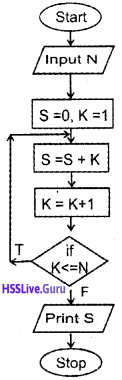
int sum (int N, int Start_No) .
{
int i, S = 0;
for (i = Start_No; i < = N + Start_No; i++)
S = S + i;
reurn S;
}

Question 15.
Differentiate between the string functions strcmp() and strcmpi(). (SAY-2016) (2)
Answer:
strcmp(): It is used to compare two strings and returns an integer.
Syntax:
strcmp(string1,string2)

  • if it is 0 both strings are equal.
  • if it is greater than 0(i.e. +ve) stringl is greater than string2
  • if it is less than 0(i.e. -ve) string2 is greater than string1

strcmpi():
It is same as strcmp() but it is not case sensitive. That means uppercase and lowercase are treated as same.
eg: “ANDREA” and “Andrea” and “andrea” these are same.

Question 16.
Read the function definition given below. Predict the output, if the function is called as convert (7). (MARCH-2017) (2)
void convert (int n)
{
if (n>1)
convert (n/2);
cout<<n%2;
}
Answer:
The out put is 111. convert() is a recursive function.

Plus One Functions Three Mark Questions and Answers

Question 1.
Consider the following function declaration with optional (default) arguments and state legal or illegal and give the reasons

  1. int sum(int x = 10, int y, int z)
  2. int sum(int x = 10, int y = 20, int z)
  3. int sum(int x = 10, int y = 20, int z = 30)
  4. int sum(int x, int y = 20, int z)
  5. int sum(int x, int y = 20, int z = 30)
  6. inf sum(int x, int y, int z = 30)
  7. int sum(int x = 10, int y, int z = 30)

Answer:
There is a rule to make an argument as default argument,i.e., to set an argument with a value that must be in the order from right to left. All the arguments in the right side of an argument must be set first to make an argument as a default argument.

  1. illegal, because y and z are not have values
  2. illegal, because z has no value
  3. legal
  4. illegal, because z has no value
  5. legal
  6. legal
  7. illegal, because x has a value but y has no value

Plus One Computer Science Chapter Wise Questions and Answers Chapter 10 Functions

Question 2.
A list of C++ built-in functions are given. Classify them based on the usage and prepare a table with proper group names.
Plus One Computer Science Chapter Wise Questions and Answers Chapter 10 Functions 1
Answer:
Plus One Computer Science Chapter Wise Questions and Answers Chapter 10 Functions 2

Question 3.
Read the following program
#include<iostream>
using namespace std;
int main()
{
cout<<sum(2,3);
}
int sum(int x, int y)
{return (x + y);}
On compilation on the program, an error will be displayed. Identify and explain the reason. How can you rectify the problem
Answer:
The compilation of the program starts from the first line arid next line and so on( i.e. line by line). While compiling the line cout<<sum(2,3); The compiler does not understand the word sum(2,3) because it is not declared yet hence the error prototype required. To rectify this problem there are two methods

First method:
Give the function definition just before the main function as follows.
#include<iostream>
using namespace std;
int sum(intx, int y)
{return (x + y);}
int main()
{
cout<<sum(2,3);
}

Second Method:
Give the function declaration(prototype only) in the main function as follows.
#include<iostream>
using namespace std;
int main()
{
int sum(int.int);
cout<<sum(2,3);
}
int sum(int x, int y)
{return (x + y);}

Question 4.
Considering the following function definition.
{
for (int f = 1; n>0; n-)
f = f*n;
return f;
}
void main()
{
int a = 5, ans;
ans = fact (a);
cout<< a << “! = ” << ans;
}
The expected, desired output is 5! = 120
What will be the actual output of the program? It is not the same as above, why? What modification are required in the program to get the desired output.
Answer:
The output is 0! = 120
Because the address of variable ’a’ is given to the variable ‘n’ of the function fact(call by reference method). So the function changes its value (i.e. n-) to 0. Hence the result.
To get the desired result call the function as call by value method in this method the copy of the value of the variable ‘a’ is given to the function. So the actual value of ‘a’ will not changed. So instead of int fact(int &n) just write int fact(int n), i.e., no need of & symbol.

Plus One Computer Science Chapter Wise Questions and Answers Chapter 10 Functions

Question 5.
A function is defined as follows
int sum (int a, int b = 2)
{return (a + b);}
Check whether each of the following function calls is correct or wrong, Justify your answer

  1. cout << sum (2,3);
  2. cout << sum( 2) ;
  3. cout << sum();

Answer:
Here the function is declared with one optional argument. So the function call with minimum one argument is compulsory.

  1. It is valid. Here a becomes 2 and b becomes 3.
  2. It is also valid . Here a becomes 2 and b takes the default value 2.
  3. It is not a valid call. One argument is compulsory.

Question 6.
The factorial of a number, say N is the product of first N natural numbers. Thus, factorial of 5 can be obtained by taking the product of 5 and factorial of 4. Similarly factorial of 4 be found out by taking the product of 4 and factorial of 3. At last the factorial of 1 is 1 itself.

Which technique is applicable to find the factorial of a number in this fashion? Write a C++ function to implement this technique. Also explain the working of the function by giving the number 5 as input.
Answer:
A function calls itself is known as recursion.
#include<iostream>
using namespace std;
int fac(int);
int main()
{
int n;
cout<<“enter a number”;
cin>>n;
cout<<fac(n);
}
int fac(int n)
{
if (n == 1) return (1);
else
return (n × fac(n – 1));
}
The working of this program is as follows If the value of n is 5 then it calls the function as fa. The function returns value 5 × fac(4), That means this function calls the function again and returns 5 ×4 × fac(3). This process continues until the value n = 1. So the result is 5 × 4 × 3 × 2 × 1 = 120.

Question 7.
How do two functions exchange data between them? Compare the two methods of data transfer from calling function to called function
Answer:
There are two methods they are call by value and call by reference
1. call by value:
In call by value method, a copy of the actual parameters are passed to the formal parameters. If the function makes any change it will not affect the original value.

2. call by reference:
In call by reference method, the reference of the actual parameters are passed to the formal parameters. If the function makes any change it will affect the original value.

Question 8.
Read the following program
#include<iostream>
using namespace std;
int a = 0;
int main()
{
int showval(int);
cout<< a; a++;
cout << showval (a);
cout<< a;
}
int showval(int x)
{
int a = 5;
return (a + x);
}
Write down the value displayed by the output of the above program with suitable explanation. What are the inferences drawn regarding the scope of variables?
Answer:
The output is 061.
Global variable: A variable declared out side of all functions it is known as global variable.
Local variable: A variable declared inside of a function it is known as local variable.
If a variable declared inside a function(main or other) with the same name of a global variable. The function uses the value of local variable and does not use the value of the global variable.

Here int a = 0 is a global variable. In the main function the global variable ‘a’ is used. There is no local variable so the value of ‘a’, 0 is displayed. The statement ‘a++’ makes the value of ‘a’ is 1. It calls the function showval with argument ‘a = T.

The argument ‘x’ will get this value i.e. ‘x = 1 But in the function showval there is a local variable ‘a’ its value is 5 is used. So this function returns 6 and it will be displayed. After this the value 1 of the global variable ‘a’ will be displayed. Hence the result 061.

Plus One Computer Science Chapter Wise Questions and Answers Chapter 10 Functions

Question 9.
The following are function calling statements. Some of them will be executed, while some other generate compilation error. Write down your opinion on each of them with proper justification Function

  1. har ch =
  2. sqrt(25);
  3. strcat (“Computer”, “Program”);
  4. double num = pow(2,3,5)
  5. putchar(getchar());

Answer:

  1. getch get a character from the console(keyboard) but does not echo to the screen. So we can’t read a character from the console.
  2. It returns the square root of 25.
  3. It concatenates Program to computer, i.e. we will get a string “computer program”
  4. The function pow should contains only two arguments. But here it contains 3 arguments so it is an error. We can write this function as follows Double num = pow(pow(2,3),5)
  5. It reads a character from the console and display it on the screen.

Question 10.
Write down the operation performed by the following statements.

  1. int l = strlen(“Computer Program”);
  2. char ch[ ] = tolower(“My School”);
  3. cout <<(strcmp(“High”, “Low”)>0 ? toupper(“High”):tolower(“Low”));

Answer:

  1. The built in function strlen find the length of the string i.e. 16 and assigns it to the variable I.
  2. This is an error because tolower is a character function.
  3. This is also an error because tolower and toupper are character functions.

Question 11.
A line of given length with a particular character is to be displayed. For example, ********** js a line with ten asterisks (*). Define a function to achieve this output.
Answer:
Plus One Computer Science Chapter Wise Questions and Answers Chapter 10 Functions 3

Question 12.
Read the following function
int fib(int n)
{
if (n<3)
return 1;
else
return (fib(n – 1) + fib(n – 2));
}

  1. What is the speciality of this function
  2. How does it work?
  3. What will be the output of the following code?

Answer:

  1. This function is a recursive function. That means the function calls itself.
  2. It works as follows
    • if i = 1, The function fib calls with value 1. i.e. fib(1) returns 1
    • if i = 2, The function fib calls with value 2. i.e. fib(2) returns 1
    • if i = 3, The function fib calls with value 3. i.e. fib(3) returns fib(2) + fib(1) i.e. it calls the function again.
      So the result is 1 + 1 = 2
    • if i = 4, The function fib calls with value 4. i.e. fib(4) returns fib(3) + fib(2) i.e. it calls the function again.
      So the result is 2 + 1 = 3
  3. The output will be as follows 1 1 2 3

Question 13.
Explain scope rules of functions and variables in a C++ program
Answer:
Local variable or function:
A variable or function declared inside a function is called local variable or function. This cannot be accessed by the out-side of the function.
eg:
main()
{
int k; // local variable
cout<<sum(a,b); // local function
}

Global variable or function:
A variable or function declared out side of a function is called global variable or function. This can be accessed by any statements.
eg:
int k; // global variable
int sum(int a, int b); // global function
main()
{
}

Plus One Computer Science Chapter Wise Questions and Answers Chapter 10 Functions

Question 14.
Briefly explain default arguments Default arguments.
Answer:
A default value can be set for a parameter (argument) of a function. When the user does not give a value the function will take the default value. An important thing remember,is an argument cannot have a default value unless all arguments on its right side must have default value.
Functions with valid default arguments are given below

  • float area(int x, int y, int z = 30);
  • float area(int x, int y = 20, int z = 30);
  • float area(int x = 10, int y = 20, int z = 30);

Functions with invalid default arguments are given below

  • float area(int x = 10, int y, int z);
  • float area(int x, int y = 20, int z);
  • float area(int x = 10, int y = 20, int z);

Question 15.
How to pass an array to function.
Answer:
By using call by reference method we can send an array as argument. We have to send only the array name and its data type. The array name holds the starting address and will access the subsequent elements of an array.
The following example shows this
Plus One Computer Science Chapter Wise Questions and Answers Chapter 10 Functions 4

Question 16.
How to pass a structure to a function.
Answer:
A structure can be passed as argument to a function either call by value or call by reference method. An example is given below to read name and age of a structure and pass it to a function.
Plus One Computer Science Chapter Wise Questions and Answers Chapter 10 Functions 5

Question 17.
Write a program to read a character and check whether it is alphabet or not. If it is an alphabet check whether it is upper case or lower case?
Answer:
Plus One Computer Science Chapter Wise Questions and Answers Chapter 10 Functions 6

Question 18.
Write a program to read 2 strings and join them 2 string.
Answer:
Plus One Computer Science Chapter Wise Questions and Answers Chapter 10 Functions 7

Question 19.
Write a program to read 2 strings and compare it 2 string.
Answer:
Plus One Computer Science Chapter Wise Questions and Answers Chapter 10 Functions 8
Plus One Computer Science Chapter Wise Questions and Answers Chapter 10 Functions 9

Question 20.
Write a program to read a string and display the number of alphabets and digits and special characters.
Answer:
Plus One Computer Science Chapter Wise Questions and Answers Chapter 10 Functions 10

Question 21.
Write a program to perform the following opera-tions on a string

  1. Length of a string
  2. Search a character
  3. Display the string

Answer:
Plus One Computer Science Chapter Wise Questions and Answers Chapter 10 Functions 11
Plus One Computer Science Chapter Wise Questions and Answers Chapter 10 Functions 13

Plus One Computer Science Chapter Wise Questions and Answers Chapter 10 Functions

Question 22.
Write short notes about conversion functions.
Answer:
The header file stdlib.h is used for conversion functions.Following are the important conversion functions
1. itoa():
It is used to convert an integer into a string.
eg:
int n = 100;
charstr[20];
itoa(n,str,10);

2. Itoa():
It is used to convert an long into a string.
eg:
long n = 1002345L
char str[20];
ltoa(n,str,10);

3. atoi():
It is used to convert a string into integer
eg:
int n;
str[] = “123”
n = atoi(str);

4. atoll():
It is used to convert a string into long
eg:
long n;
str[] = “123456”
n = atol(str);

Question 23.
Plus One Computer Science Chapter Wise Questions and Answers Chapter 10 Functions 14

  1. Predict the output of both programs.
  2. Justify your predictions.

Answer:
1. A. Output
value = 40

B. output
value = 0

2. In the first case (A) the argument x is passed by reference method. So the changes made in the function reflects in main()

In the second case (B) the argument x is passed by value method. So the changes made in the function will not reflect in main()

Question 24.
Consider the following C++ function.
int recfact(int x)
{
if(x == 0)
return 1;
else
return x * recfact(x – 1);
}

  1. What type of function is this? Explain. (2 Scores)
  2. What is the output of the above function when x = 5

Answer:

  1. recursive function. The abilty of a function to call itself is called recursion. A function is said to be recursive if a statement in the body of the function calls itself.
  2. Output 120

Plus One Computer Science Chapter Wise Questions and Answers Chapter 10 Functions

Question 25.
void initialise()
{
int k = 10;
}
int main()
{
int a, b;
float marks;
a = 20;
cout<<“First value =”<< a;
initialise();
b = k + a;
cout<<“New value =”<<b;
}

  1. Identify the error in the above code and explain its reasons.
  2. Correct the errors.

Answer:

  1. K is a local variable in the function initialize 0. It is not accessible in main()
  2. Making the variable K as global we can correct the error.

Question 26.
Write a program to read 2 strings and join them using string function.
Answer:
#include<iostream>
#include<cstring>
#include<cstdio>
using namespace std;
int main()
{
char str1 [50],str2[50],str[100];
cout<<“Enter a string:”; gets(strl);
cout<<“Enter another string:”; gets(str2);
strcat(str,str1);
strcat(str,str2);
cout<<“The concatenated string is”<<str;
}

Plus One Computer Science Chapter Wise Questions and Answers Chapter 10 Functions

Question 27.
Consider the following code.
#include<iostream>
#include<cstdlib>
using namespace std;
int main()
{
char str1 [] = “123”,str2[] = “45”;
int a,b;
a = atoi(str1);
b = atoi(str2);
cout<<a + b;
}
What will be the output and give the reason?
Answer:
The output is 123 + 45 = 168. Here the conversion function atoi is used to convert the string “123” into integer 123 and “45” into integer 45 so the result.

Question 28.
Name the different methods used for passing arguments to a function. Write the difference between them with examples. (MARCH-2015)
Answer:
Methods of calling functions:
Two types call by value and call by reference.
1. Call by value:
In call by value method the copy of the original value is passed to the function, if the function makes any change will not affect the original value.
Example
Plus One Computer Science Chapter Wise Questions and Answers Chapter 10 Functions 15
Plus One Computer Science Chapter Wise Questions and Answers Chapter 10 Functions 16

2. Call by reference:
In call by reference method the address of the original value is passed to the function, if the function makes any change will affect the original value.
Example
Plus One Computer Science Chapter Wise Questions and Answers Chapter 10 Functions 17

Question 29.
Write a C++ program to display the simple interest using function. (SAY-2015) (3)
Answer:
include < iostream>
using namespace std;
float Simplelnt (float p, int n, float r)
{
return (p*n*r/100);
}
int main()
{
float p, r, SI;
int n;
cout<<“Enter values for p,n,r:”; cin>>p>>n>>r;
SI = Simplelnt (p,n,r); cout<<“simple interest is”<<SI;
}

Plus One Computer Science Chapter Wise Questions and Answers Chapter 10 Functions

Question 30.
Write a function’s definition of the above type to find the sum of matural numbers from 1 to N. (Hint: If the value of N is 5, the answer will be 1 + 2 + 3 + 4 + 5 = 15). (MARCH – 2016) (3)
Answer:
int sum (int n)
{
if (n == 0)
return 0;
else
return (n + sum (n – 1));
}

Question 31.
A program requires functions for adding 2 numbers, 3 numbers and 4 numbers, How can you provide a solution by writing a single functio0n? (SCERT SAMPLE -1) (3)
Answer:
It can be solved by writing function with default values.
eg: int add (int n1, int n2, int n3 = 0, int n4 = 0)
{
return (n1 + n2 + n3 + n4);
}
This function can be invoked by the following function calling
1. add (5,2);
2. add (5,2,7);
3. add (5,2,7,10);

The 1. Call returns 5 + 2 = 7
2. Call returns 5 + 2 + 7 = 14
3. Call returns 5 + 2 + 7 + 10 = 24

Question 32.
Explain the difference between call-by-value method and call-by-reference method with the help of examples. (SCERT SAMPLE – II) (3)
Answer:
Methods of calling functions:
Two types call by value and call by reference.
1. Call by value:
In call by value method the copy of the original value is passed to the function, if the ’ function makes any change will not affect the original value.
Example
Plus One Computer Science Chapter Wise Questions and Answers Chapter 10 Functions 18
Plus One Computer Science Chapter Wise Questions and Answers Chapter 10 Functions 19

2. Call by reference:
In call by reference method the address of the original value is passed to the function, if the function makes any change will affect the original value.
Example
Plus One Computer Science Chapter Wise Questions and Answers Chapter 10 Functions 20

Plus One Computer Science Chapter Wise Questions and Answers Chapter 10 Functions

Question 33.
Explain recursive functions with the help of a suitable example. (SAY-2016) (3)
Answer:
A function calls itself is called recursive function.
#include<iostream>
using namespace std;
void convert(int n)
{
if(n>1)
convert(n/2);
cout<<n % 2;
}
int main()
{
convert(7);
}
Here the function convert is a recursive function, that means it calls itself and output of the above program is 111.

Question 34.
Name the built-in function to check whether a character is alphanumeric or not. (MARCH-2017) (3)
Answer:
isalnum()

Question 35
Briefly explain the three components in the structure of a C++ program. (MARCH-2017) (3)
Answer:
1. Preprocessor directives:
A C++ program starts with the preprocessor directive i.e., # .include, #define, #undef, etc, are such a preprocessor directives. By using #include we can link the header files that are needed to use the functions. By using #define we can define some constants.
eg: #define x 100. Here the value of x becomes 100 and cannot be changed in the program. No semicolon is needed.

2. Header files:
A header file is a pre stored file that helps to use some operators and functions. To write C++ programs the header files are must. Following are the header files iostream

  • iomanip
  • cstdio
  • cctype
  • cmath
  • cstring

The syntax for including a header file is as follows
#include<name of the header file>
eg: #include<iostream>

3. The main function:
The main function is the first function which is invoked at the time of execution and the program ends within main(). The other functions are invoke from main().

Question 36.
Explain the difference between call by value method and call by reference method with the help of examples. (MARCH-2017) (3)
Answer:
Two types are call by value and call by reference.
1. Call by value:
In call by value method the copy of the original value is passed to the function, if the function makes any change wilt not affect the original value.
Example
Plus One Computer Science Chapter Wise Questions and Answers Chapter 10 Functions 21

2. Call by reference:
In call by reference method the address of the original value is passed to the function, if the function makes any change will affect the original value.
Example
Plus One Computer Science Chapter Wise Questions and Answers Chapter 10 Functions 22
Plus One Computer Science Chapter Wise Questions and Answers Chapter 10 Functions 23

Plus One Functions Five Mark Questions and Answers

Question 1.
Short notes about character functions and string functions
Answer:
A. Character functions:
1. isalnum():
t is used to check whether a character is alphabet or digit. It returns a non zero value if it is an alphabet or digit otherwise it returns zero.

2. isalpha():
It is used to check whether a character is alphabet or not. It returns a non zero value if it is an alphabet otherwise it returns zero.

3. isdigit():
It is used to check whether a character is digit or not. It returns a non zero value if it is digit otherwise it returns zero.

4. islower():
It is used to check whether a character is lower case alphabet or not. It returns a non zero value if it is a lowercase alphabet otherwise it returns zero.

5. isupper():
It is used to check whether a character is upper case alphabet or not. It returns a non zero value if it is an upper case alphabet otherwise it returns zero.

6. tolower():
It is used to convert the alphabet into lower case

7. toupper():
It is used to convert the alphabet into upper case

B. String functions:

1. strcpy():
This function is used to copy one string into another

2. strcat():
This function is used to concatenate(join) second string into first string

3. strlen():
This function is used to find the length of a string.

4. strcmp():
This function is used to compare 2 strings. If the first string is less than second string then it returns a negative value. If the first string is equal to the second string then it returns a value zero and if the first string is greater than the second string then it returns a positive value.

Plus One Computer Science Chapter Wise Questions and Answers Chapter 10 Functions

Question 2.
Write functions to perform the following operations

  1. sqrt()
  2. power of 2 numbers
  3. sin
  4. cos

Answer:
Plus One Computer Science Chapter Wise Questions and Answers Chapter 10 Functions 24
Plus One Computer Science Chapter Wise Questions and Answers Chapter 10 Functions 25

Question 3.
Write a C++ program to display the roots of quadratic equation. (SAY-2015) (5)
Answer:
#include<iostream>
#include<cmath>
Plus One Computer Science Chapter Wise Questions and Answers Chapter 10 Functions 26

Question 4.
Explain ‘Call by Value’ and ‘Call by Reference’ methods of function calling with the help of a suitable example. (SAY-2016)
Answer:
Two types are call by value and call by reference.
1. Call by value:
In call by value method the copy of the original value is passed to the function, if the function makes any change will not affect the original value.
Example
Plus One Computer Science Chapter Wise Questions and Answers Chapter 10 Functions 27
Plus One Computer Science Chapter Wise Questions and Answers Chapter 10 Functions 29

2. Call by reference:
In call by reference method the address of the original value is passed to the function, if the function makes any change will affect the original value.
Example
Plus One Computer Science Chapter Wise Questions and Answers Chapter 10 Functions 30

Plus One Computer Science Chapter Wise Questions and Answers Chapter 10 Functions

Question 5.
Define network topology. Explain any four network topologies in detail. (SAY-2016)
Answer:
Network topologies:
Physical or logical arrangement of computers on a network is called structure or topology. It is the geometrical arrangement of computers in a network. The major topologies developed are star, bus, ring, tree and mesh

1. Star Topology:
A star topology has a server all other computers are connected to it. If computer A wants to transmit a message to computer B. Then computer A first transmit the message to the server then the server retransmits the message to the computer B.

That means all the messages are transmitted through the server. Advantages are add or remove workstations to a star network is easy and the failure of a workstation will not effect the other. The disadvantage is that if the server fails the entire network will fail.

2. Bus Topology:
Here all the computers are attached to a single cable called bus. Here one computer transmits all other computers listen. Therefore it is called broadcast bus. The transmission from any station will travel in both the direction. The connected computers can hear the message and check whether it is for them or not.

Advantages are add or remove computer is very easy. It requires less cable length and the installation cost is less. Disadvantage is fault detection is very difficult because of no central computer.

3. Ring Topology:
Here all the computers are connected in the shape of a ring and it is a closed loop. Here also there is no central computer. Here a computer transmits a message, which is tagged along with its destination computer’s address. The message travels in one direction and each node check

whether the message is for them. If not, it passes to the next node. FIt requires only short cable length. If a single node fails, at least a portion of the network will fail. To add a node is very difficult.

4. Hybrid Topology:
It is a combination of any two or more network topologies. Tree topology and mesh topology can be considered as hybrid topology.
(a) Tree Topology:
The structure of a tree topology is the shape of an inverted tree with a central node and branches as nodes. It is a variation of bus topology. The data transmission takes place in the way as in bus topology. The disadvantage is that if one node fails, the entire portion will fail.

(b) Mesh Topology:
In this topology each node is connected to more than one node. It is just like a mesh (net). There are multiple paths between computers. If one path fails, we can transmit data through another path.

Plus One Chemistry Chapter Wise Questions and Answers Chapter 8 Redox Reactions

Students can Download Chapter 8 Redox Reactions Questions and Answers, Plus One Chemistry Chapter Wise Questions and Answers helps you to revise the complete Kerala State Syllabus and score more marks in your examinations.

Kerala Plus One Chemistry Chapter Wise Questions and Answers Chapter 8 Redox Reactions

Plus One Chemistry Redox Reactions One Mark Questions and Answers

Question 1.
In which of the following, oxidation number of chlorine is +5?
a) Cl
b) ClO
c) ClO2
d) ClO3
Answer:
d) ClO3

Question 2.
An oxidising agent is a substance which can
a) Gain electrons
b) Lose an electronegative radical
c) Undergo decrease in the oxidation number of one of its atoms
d) Undergo any one of the above changes
Answer:
d) Undergo any one of the above changes

Question 3.
The arrangement of metals in the order of decreasing tendency to lose electrons is called _________ .
Answer:
Activity series

Plus One Chemistry Chapter Wise Questions and Answers Chapter 8 Redox Reactions

Question 4.
When KMnO4, reacts with acidified FeSO4
a) Only FeSO4 is oxidised
b) Only KMnO4 is oxidised
c) FeSO4 is oxidised and KMnO4 is reduced
d) KMnO4 is oxidised and FeSO4 is reduced
Answer:
c) FeSO4 is oxidised and KMnO4 is reduced

Question 5.
In the disproportionation reaction, which of the following statements is not true?
a) The same species is simultaneously oxidised as well as reduced
b) The reacting species must contain an element having at least three oxidation states
c) The element in the reacting species is present in the lowest oxidation state
d) The element in the reacting species is present in the intermediate oxidation state
Answer:
c) The element in the reacting species is present in the lowest oxidation state

Question 6.
Find the oxidation state of oxygen in OF2.
Answer:
The oxidation number of fluorine in its compounds is always taken as -1.
In OF2
X+ (-1 × 2) = 0
X = +2

Question 7.
The oxidation numbers of chlorine atoms in bleaching powder is _________ .
Answer:
-1

Question 8
SO2 can act as
a) Oxidising agent only
b) Reducing agent only
c) Both oxidising and reducing agents
d) Acid and a reducing agent only
Answer:
c) Both oxidising and reducing agents

Question 9.
In the reaction
2KMnO4 +16HCl → 5Cl2 + MnCl2 + 2KCl + 8H2O the reduction product is _________ .
Answer:
MnCl2

Plus One Chemistry Chapter Wise Questions and Answers Chapter 8 Redox Reactions

Question 10.
The strongest reducing agent is .
a) K
b) Ba
c) Li
d) Na
Answer:
c) Li

Question 11.
Oxidation state of oxygen in H2O2 is _________ .
Answer:
-1

Plus One Chemistry Redox Reactions Two Mark Questions and Answers

Question 1.
Balance the following equation using oxidation number method:
MnO2 + Cl → Mn2+ + Cl2
Answer:
Assigning oxidation numbers:
Plus One Chemistry Chapter Wise Questions and Answers Chapter 8 Redox Reactions 1
Equating the increase and decrease in oxidation number:
MnO2 + 2Cl → Mn2+ + Cl2
Balancing hydrogen and oxygen atoms:
MnO2 + 2Cl + 4H+ → Mn2+ + Cl2 + 2H2O

Question 2.
Balance the following equation using half reaction method:
Cu + NO3 → Cu2+ + NO2
Answer:
Separating into half reactions:
Oxidation half: Cu → Cu2+
Reduction half: NO3 → NO2
Balancing oxygen and hydrogen atoms:
NO3 + 2H+ → NO2 + H2O
Balancing charge by adding electrons and making the number of electrons equal in the two half reactions:
Cu → Cu2+ + 2e
2NO3 + 4H+ + 2e → 2NO2 + 2H2O
Adding the two half reactions to achieve the overall reaction:
Cu + 2NO3 + 4H+ → Cu2+ + 2NO2 + 2H2O

Question 3.
Complete the following ionic equations:

  1. Al3+ + 3e → …………….
  2. MnO42- → + e
  3. K → K+ + ……………
  4. Fe2+ → Fe3+ +

Answer:

  1. Al3+ + 3e → Al
  2. MnO42- → MnO4+ e
  3. K → K+ + e
  4. Fe2+ → Fe3+ + e

Plus One Chemistry Chapter Wise Questions and Answers Chapter 8 Redox Reactions

Question 4.
Find the oxidation number of P in the following compounds:

  1. Na2PO4
  2. H3P2O7
  3. PH3
  4. H3PO4

Answer:

  1. Na2PO4, Oxidation state of P = +6
  2. H4P2O7, Oxidation state of P = +5
  3. PH3, Oxidation state of P = -3
  4. H3PO4, Oxidation state of P = +5

Question 5.
Choose the correct oxidation number of sulphur in the compounds in column Afrom column B.

Column AColumn B
Na2SO4-2
H2sO3+7
H2S+6
H2S2O7+4

Answer:

Column AColumn B
Na2SO4+6
H2SO3+4
H2S-2
H2S2O8+7

Question 6.
Explain oxidation number and valency.
Answer:
Valency of an atom is its combining capacity and is denoted by a number without sign. The valency of an element is always a whole number.

Oxidation number is a net charge which an atom has or appears to have when the other atoms from the molecule are removed as ions assuming that the shared pair of electrons is with more electronegative atom.

Question 7.
Some rules related to oxidation number are given below. Correct the mistakes.

  • Oxidation number of alkali metals and alkaline earth metals is +2.
  • Oxidation number of hydrogen is always +1.
  • Algebraicsum of oxidation number of all the atoms in an ion is not equal to the charge on the ion.

Answer:

  • Oxidation number of alkali metals is +1.
  • Oxidation number of alkaline earth metals is +2.
  • Oxidation number of H is +1 except in metallic hydrides.

Question 8.
Match the following:

Oxidation number of Cl in Cl2O7Cu
OxidantZn
Stannous Chloride, SnCl2+7
Oxidation number of C in diamondGet reduced easily
The metal which can’t displace H from dil.HClZero
Reducing agent for mercuric chloride

Answer:

Oxidation number of Cl in Cl2O7+7
OxidantGet reduced I easily
Stannous Chloride, SnCl2Reducing agent for mercuric chloride
Oxidation number of C in diamondZero
The metal which can’t displace H from dil.HClCu

Question 9.
1. Calculate the oxidation number of oxygen in OF2 and KO2.
2. When Zn rod is dipped in blue CuSO4 solution ‘ the blue colour of CuSO4 fades due to displacement reaction. Write the reaction and identify the following:
i) The substance oxidised and the substance reduced.
ii) The oxidant and the reductant.
Answer:
1. OF2: x + (-1 × 2) = 0
x – 2 = 0
x = +2
KO2: (+1 × 1) + 2x = 0
1 + 2x = 0
2x = -1
x = –\(\frac{1}{2}\)

2. Zn(s) + CuSO4 (aq) → ZnSO4(aq) + Cu(s)
i) Substance oxidised – Zn
Substance reduced – Cu
ii) Oxidant-Cu
Reductant – Zn

Plus One Chemistry Chapter Wise Questions and Answers Chapter 8 Redox Reactions

Question 10.
a) Calculate the oxidation number of C in CH4 and in CH3Cl.
b) The sum of oxidation numbers of all atoms in a molecule is …………
Answer:
a) CH4:
x + (1 × 4) = 0
x + 4 = 0
x = -4
Oxidation number of C in CH4 is -4.

CH3Cl:
x + (3 × 1) + -1 = 0
x + 3 – 1= 0
x + 2 = 0
x = -2
Oxidation number of C in CH3Cl is -2.

b) Zero

Question 11.
1. Write the oxidation state of each element and identify the oxidising agent and reducing agent in the following reaction:
H2S(g) + Cl2(g) → 2HCl(g) + S(s)
2. Fill in the blanks and classify the following reactions into oxidation and reduction:
i) Mn7+ + 5e → ……………
ii) Sn4+ + …………… → Sn2+
iii) Na → Na+ + ……………
iv) Fe3+ +…………… → Fe2+
Answer:
1.Plus One Chemistry Chapter Wise Questions and Answers Chapter 8 Redox Reactions 2
Reducing agent – H2S
Oxidising agent -Cl2

2. i) Mn7+ + 5e → Mn2+
ii) Sn4+ + 2e → Sn2+
iii) Na → Na+ + e
iv) Fe3+ + e → Fe2+
Oxidation: Reaction (iii)
Reduction: Reactions (i), (ii) and (iv)

Question 12.
Dihydrogen undergoes redox reactions with many metals at high temperature.
a) Write the reaction between hydrogen with sodium.
b) Comment, whether the product formed, is covalent compound or ionic compound.
c) Which is the reducing agent in this reaction?
Answer:
1. 2Na + H2 → 2NaH
2. Ionic compound is formed. When alkali metals react with hydrogen ionic hydrides are formed.
3. Na is the reducing agent.

Plus One Chemistry Chapter Wise Questions and Answers Chapter 8 Redox Reactions

Question 13.
1. Is it possible to keep copper sulphate solution in zinc pot? Why?
2. Assign oxidation numbers of the underlined elements.
i) NaH2\(\underline { P } \)O4
ii) NaH\(\underline { S } \)O4
Answer:
1. No. Zn being more reactive will displace Cu from CuSO4. Thus Cu will be deposited on the vessel.

2. i) NaH2\(\underline { P } \)O4
+1 +(+1 × 2) + x +(-2 × 4) = 0
1 + 2 + x – 8 = 0
x – 5 = 0
x = +5
ii) NaH\(\underline { S } \)O4
+1 + 1 + x +(-2 × 4) = 0
+1 + 1 + x – 8 = 0
x – 6 = 0
x = +6

Question 14.
Identify the substance oxidised, reduced, oxidising agent and reducing agent in the reaction:
2Cu2O + Cu2S → 6Cu + SO2
Answer:
Plus One Chemistry Chapter Wise Questions and Answers Chapter 8 Redox Reactions 3
In this reaction, Cu is reduced from +1 state to zero. oxidation state and S is oxidised from -2 state to +4 state. Cu2O helps S in Cu2S to increase its oxidation number. Therefore, Cu(l) is the oxidising agent. S of Cu2S helps Cu both in Cu2S itself and Cu2O to decrease its oxidation number. Therefore, S of Cu2S is the reducing agent.

Question 15.
Explain the following in terms of electron transfer concept:

  1. Oxidation
  2. Reduction
  3. Oxidising agent
  4. Reducing agent

Answer:

  1. Oxidation: Loss of electron(s) by any species.
  2. Reduction: Gain of electron(s) by any species.
  3. Oxidising agent: Any species which accepts electrons).
  4. Reducing agent: Any species which donates electron^).

Question 16.
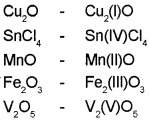
Represent the following compounds using Stock notation:
Cu2O, SnCl4, MnO, Fe2O3, V2O5
Answer:
Plus One Chemistry Chapter Wise Questions and Answers Chapter 8 Redox Reactions 4

Question 17.
In a redox reaction, oxidation and reduction occur simultaneously.
a) Write the classical concept of oxidation and reduction.
b) Identify the species undergoing oxidation and reduction in the following reaction:
H2S(S) + Cl2(g) → 2HCl(g) + S(s)
Answer:
1. Oxidation:
addition of oxygen/electronegative element to a substance or removal of hydrogen/ electropositive element from a substance.

Reduction:
removal of oxygen/electronegative element from a substance or addition of hydrogen/ electropositive element to a substance.

2.Oxidised species:
H2S. This is because a more electronegative element, Cl is added to H or a more electro positive element, H has been removed from S.

Reduced species:
Cl. This is due to addition of more electropositive element H to it.

Plus One Chemistry Redox Reactions Three Mark Questions and Answers

Question 1.
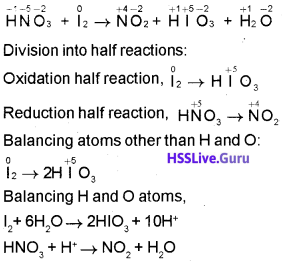
An equation is given below:
HNO3+ l2 → HlO3 + NO2 + H2O

  • Find the oxidising agent and reducing agent.
  • Balance the equation using half reaction method.

Answer:
Oxidising agent = HNO3
Reducing agent = l2
Skeletal equation:
Plus One Chemistry Chapter Wise Questions and Answers Chapter 8 Redox Reactions 5
Balancing the charge on the half reactions by adding electrons and equalising the number of electrons:
Plus One Chemistry Chapter Wise Questions and Answers Chapter 8 Redox Reactions 6

Question 2.
1. Define redox reactions.
2. Predict whether the following reaction is a redox reaction or not? Justify.
Cr2O72- + H2O → 2CrO42- + 2H+
Answer:
1. Redox reactions are those reactions are those reactions in which reduction and oxidation occur simultaneously. These reactions involve change in oxidation state of the interacting species.

2. No.
Because no element undergoes change in oxidation number.

Plus One Chemistry Chapter Wise Questions and Answers Chapter 8 Redox Reactions

Question 3.
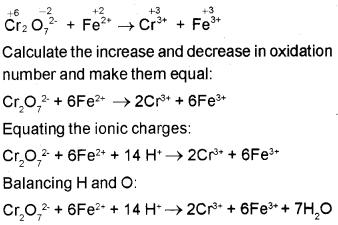
a) Find out the oxidising agent and reducing agent in the following reaction:
Cu(s) + 2Ag+(aq) → Cu2+(aq) + 2Ag(s)
b) Balance the following redox reaction in acid medium using oxidation number method.
Cr2O72- + Fe2+ → Cr3+ + Fe3+
Answer:
1. Oxidising agent – Ag
ReducingAgent – Cu

2. Assigning oxidation number:
Plus One Chemistry Chapter Wise Questions and Answers Chapter 8 Redox Reactions 7

Question 4.
Calculate the oxidation number of sulphur, chromium and nitrogen in H2SO4, Cr2O72- and NO3.
Answer:
H2SO4
(2 × +1) + x+ (4 × -2) = 0
+2 + x – 8 = 0
x – 6 = 0
x = +6

Cr2O72-
2x + 7 ×-2 = -2
2x = -2 + 14
2x = 12
∴ x = +6

NO3
x + 3 × -2 = -1
x = -1 + 5
x = +4

Question 5.
1. Assign oxidation numbers
(i) P in NaH2PO4
(ii) Mn in KMnO4
(iii) B in NaBH4
(iv) S in H2SO4
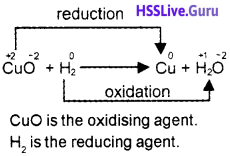
2. Identify the oxidising and reducing agents in the following reaction:
CuO + H2 → Cu + H2O
Answer:
1. i) NaH2PO4
Na+1H2+1PO4-2
1+2 + x- 8 = 0
3 + x – 8 = 0
x – 5 = 0
x =+ 5

ii) K+1MnO4-2
1+ x – 8 = 0
x – 7 = 0
x = +7

iii) Na+1BH4+1
1 + x + 1 × 4 = 0
x + 5 = 0
x = -5

iv) H2+1SO4-2
2 + x – 8 = 0
x – 6 = 0
x = +6

2.
Plus One Chemistry Chapter Wise Questions and Answers Chapter 8 Redox Reactions 8

Question 6.
A copper rod is dipped in silver nitrate solution.

  1. What are the observations?
  2. Write the displacement reaction.
  3. Identify the species getting oxidised and reduced.

Answer:

  1. The colour of the solution changes to blue. Silver is deposited on the copper rod.
  2. Cu(s) +2AgNO3(aq) → Cu(NO3)2(aq) + 2Ag(s)
  3. Oxidised species – Cu Reduced species – Ag+

Plus One Chemistry Chapter Wise Questions and Answers Chapter 8 Redox Reactions

Question 7.
1. Identify the oxidising and reducing agent in the reaction:
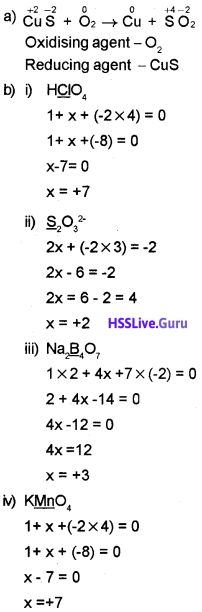
CuS + O2 → Cu + SO2
2. Determine the oxidation number of the underlined element in the following:
Plus One Chemistry Chapter Wise Questions and Answers Chapter 8 Redox Reactions 9
Answer:
Plus One Chemistry Chapter Wise Questions and Answers Chapter 8 Redox Reactions 10

Question 8.
1. Identify the substance oxidised, substance reduced, oxidising agent and reducing agent in the reaction:
Cl2 + 2l → 2Cl +l2

2. Calculate the oxidation number of underlined elements in the following compounds:
i) K2\(\underline { Cr } \)2O7
ii) H\(\underline { H } \)O3
Answer:
1. Cl2 is reduced, therefore Cl2 is the oxidising agent. I’ is oxidised, therefore I” is the reducing agent.

2. i) K2\(\underline { Cr } \)2O7
(+1 × 2) + 2x +(-2 × 7) = 0
+2 + 2x – 14 =0
2x – 12 =0
2x = 12
x = +6
ii) H\(\underline { H } \)O3
(+1 × 1) + x + (-2 × 3) = 0
1+ x – 6 = 0
x – 5 = 0
x = +5

Question 9.
Determine oxidation number of the elements underlined in each of the following.
Plus One Chemistry Chapter Wise Questions and Answers Chapter 8 Redox Reactions 12
Answer:
Plus One Chemistry Chapter Wise Questions and Answers Chapter 8 Redox Reactions 13

Plus One Chemistry Redox Reactions Four Mark Questions and Answers

Question 1.
Permanganate ion (MnO4) reacts with bromide ion (Br) in basic medium to give manganese dioxide
(MnO2) and bromate ion (BrO3).
a) Write the balanced ionic equation for this reaction.
b) Identify the oxidising agent and reducing agent in this reaction.
Answer:
Plus One Chemistry Chapter Wise Questions and Answers Chapter 8 Redox Reactions 14

Question 2.
A redox reaction involves oxidation and reduction.
a) What do you understand by electrode potential?
b) Define a redox couple.
c) Explain the set-up for Daniell cell with a diagram.
d) Write the electrode reactions and overall cell reaction which occur in the Daniel cell.
Answer:
a) The potential difference between metal and its own ion is called electrode potential.

b) A redox couple is defined as the combination of oxidised and reduced forms of a substance taking part in an oxidation or reduction half reaction.

c) Take copper sulphate solution in a beaker and put a copper strip. Take zinc sulphate solution in another beaker and put a zinc rod. The two redox couples are represented as Zn2+/Zn and Cu2+/Cu. Put the beaker containing copper sulphate solution and beaker containing zinc sulphate side by side. Connect two solution by a salt bridge. The Zn and Cu rods are connected by a metalic wire with a provision for ammeter and switch. Transfer of electrons now does not take place directly from Zn to Cu2+, but through metallic wire. The electricity from solution in one beaker to solution in the other beaker flows by the migration of ions through the salt bridge.
Plus One Chemistry Chapter Wise Questions and Answers Chapter 8 Redox Reactions 15

Question 3.
Redox reactions are those in which oxidation and reduction takes place. Explain the different types of redox reactions with suitable examples.
Answer:
Combination Reactions: The reactions in which two substances combine together to form a new compound are called combination reactions. These can be denoted as A+ B → C where either A or B or both A and B should be in the elemental form.
Plus One Chemistry Chapter Wise Questions and Answers Chapter 8 Redox Reactions 16
Decomposition reactions:
The reactions in which a compound breaks up into two or more substances at least one of which is in elemental form are called decompositions reactions.
Plus One Chemistry Chapter Wise Questions and Answers Chapter 8 Redox Reactions 17

Displacement reactions:
The reactions of the type X + YZ → XZ + Y in which an atom or ion in a compound is displaced by an ion (atom) of another element, such that X and Y are in elemental form are called displacement reactions. They are of two categories:
1. Metal displacement reactions: Reactions in which a more electropositive metal displaces a less electropositive metal from its compound.
Plus One Chemistry Chapter Wise Questions and Answers Chapter 8 Redox Reactions 18

2. Non-metal displacement reactions: These are reactions in which a non-metal is displaced by another metal or non-metal.
Plus One Chemistry Chapter Wise Questions and Answers Chapter 8 Redox Reactions 19
Disproportionation reactions: These are special type of redox reactions in which an element in one oxidation state is simultaneously oxidised and reduced. Here one of the reactants should contain an element that should exist in at least three oxidation states. The element in the form of reacting substance is in the intermediate oxidation state; and both higher and lower oxidation states of that element are formed in the reaction.
e.g. The decomposition of hydrogen peroxide.
Plus One Chemistry Chapter Wise Questions and Answers Chapter 8 Redox Reactions 20
Here the oxygen of peroxide, which is present in -1 state, is converted to zero oxidation state in O2 and to -2 state in H2O.

Plus One Chemistry Redox Reactions NCERT Questions and Answers

Question 1.
Fluorine reacts with ice and results in the change :
Plus One Chemistry Chapter Wise Questions and Answers Chapter 8 Redox Reactions 21
Justify that this reaction is a redox reaction.
Answer:
In the given reaction O.N. of F2 changes from zero to -1 in HF and HOF whereas O.N. of oxygen change from -2 in H2O to zero in HOF. Thus, F2 is reduced, whereas oxygen is oxidised and, therefore, it is a redox reaction.

Question 2.
Write formulas for the following compounds:

  1. Mercury (II) chloride
  2. Nickel (II) sulphate
  3. Tin (IV) oxide
  4.  Thallium (I) sulphate
  5. Iron (III) sulphate
  6. Chromium (III) oxide

Answer:

  1. Hg(II)Cl2
  2. Ni(II)SO4
  3. Sn(IV)O2
  4. Tl2(I)SO4
  5. Fe2(III)(SO4)3
  6. Cr2(III)O3

Plus One Chemistry Chapter Wise Questions and Answers Chapter 8 Redox Reactions

Question 3.
The compound AgF2 is unstable. However, if formed, the compound acts as a very strong oxiding agent. Why?
Answer:
In AgF2, oxidation state of Ag is + 2 which is very unstable. Since Ag can exist in a stable state of + 1 it quickly accepts an electron to form the more stable + 1 oxidation state.
Ag2+ + e → Ag+

Question 4.
Consider the reactions:
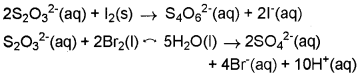
Plus One Chemistry Chapter Wise Questions and Answers Chapter 8 Redox Reactions 22
Why does the same reductant, thiosulphate react differently with iodine and bromine?
Answer:
The average O.N. of S in S2O32- is + 2 while in S4O62- it is + 2.5. The O.N. of S in SO42- is+6. Since Br2 is a stronger oxidising agent that l2, it oxidises S of S2O32- to a higher oxidation state of + 6 and hence forms SO42- ion. l2, however, being a weaker oxidising agent oxidises S of S2O32- ion to a lower oxidation of + 2.5 in S4O62- ion.

Question 5.
Why does the following reaction occur?
XeO64-(aq) + 2F(aq) + 6H+(aq) → XeO3(s) + F2(g) + 3H2O(I)
What conclusion about the compound Na4XeO6 (of which XeO64- is a part) can be drawn from the reaction?
Answer:
The balanced equation along with O.N. of the elements above their symbols will be as:
Plus One Chemistry Chapter Wise Questions and Answers Chapter 8 Redox Reactions 23
In the equation the, O.N. of Xe decreases from + 8 in XeO64- to + 6 in XeO3 while that of F increases from – 1 in F to 0 in F2. Therefore, XeO64- is reduced while F is oxidised. This reaction occurs because Na4XeO6 (0r XeO64-) is stronger oxidising agent than F2.

Plus One Computer Science Chapter Wise Questions and Answers Chapter 9 String Handling and I/O Functions

Students can Download Chapter 9 String Handling and I/O Functions Questions and Answers, Plus One Computer Science Chapter Wise Questions and Answers helps you to revise the complete Kerala State Syllabus and score more marks in your examinations.

Kerala Plus One Computer Science Chapter Wise Questions and Answers Chapter 9 String Handling and I/O Functions

Plus One String Handling and I/O Functions One Mark Questions and Answers

Question 1.
To read a single character for gender i.e. ‘m’ or ‘f’ ________ function is used.
Answer:
(a) getch()
(b) getchar()
(c) gets()
(d) getline()
Answer:
(b) getchar()

Plus One Computer Science Chapter Wise Questions and Answers Chapter 9 String Handling and I/O Functions

Question 2.
To use getchar(), putchar(), gets() and puts(), which header file is used?
(a) iostream
(b) cstdio
(c) input
(d) output
Answer:
(b) cstdio

Question 3.
To use cin and cout, which header file is needed?
(a) iostream
(b) cstdio
(c) input
(d) output
Answer:
(a) iostream

Question 4.
Predict the output of the following code snippet.
#include<cstdio>
int mainO
{
char name[ ] = “ADELINE”;
for(int i=0; name[i]!=’\0′;i++)
putchar(name[i]);
}
Answer:
The output is “ADELINE”.

Question 5.
From the following which is equivalent to the function getc(stdin).
(a) putchar()
(b) gets()
(c) getchar()
(d) puts()
Answer:
(c) getchar()

Question 6.
From the following which is equivalent to the function putc(ch, stdout).
(a) putchar(ch)
(b) ch = gets()
(c) ch = getchar()
(d) puts(ch )
Answer:
(a) putchar(ch)

Plus One Computer Science Chapter Wise Questions and Answers Chapter 9 String Handling and I/O Functions

Question 7.
To print a single character at a time which function is used?
(a) puts()
(b) putchar()
(c) gets()
(d) getchar()
Answer:
(b) putchar()

Question 8.
To read a string _______ function is used.
(a) puts()
(b) putchar()
(c) gets()
(d) getchar()
Answer:
(b) gets()

Question 9.
To print a string _______ function is used.
(a) puts()
(b) putchar()
(c) gets()
(d) getchar()
Answer:
(b) puts()

Question 10.
Consider the following code snippet.
main()
{
char str[80];
gets(str);
for(int i=0. len=0;str[il!=’\0′;i++.len++);
cout<<“The length of the string is ” <<len;
}
Select the equivalent forthe under lined statement from the following
(a) int len = strlen(str)
(b) int len = strcmp(str)
(c) int len = strcount(str)
(d) None of these
Answer:
(a) int len = strlen(str)

Plus One Computer Science Chapter Wise Questions and Answers Chapter 9 String Handling and I/O Functions

Question 11.
Arjun wants to read a string with spaces from the following which is suitable.
(а) cin>>
(b) cin.getline(str,80)
(c) str = getc(stdin)
(d) none of these
Answer:
(b) cin.getline(str,80)

Question 12.
State whether the following statement is true or false. The ‘<<‘ insertion operator stops reading a string when it encounters a space.
Answer:
True

Question 13.
_________ function is used to copy a string to another variable. (SAY-2016) (1)
Answer:
strcpy();

Question 14.

  1. Write the declaration statement for a variable ‘name’ in C++ to store a string of maximum length 30.
  2. Differentiate between the statement cin>>name and gets (name) for reading data to the variable ‘name’. (SAY-2016)

Answer:
1. char name[31];(One for null(\0) character).

OR

cin>> does not allows space. It will take characters up to the space and characters after space will be truncated . Here space is the delimiter. Consider the following code snippet that will take the input upto the space.
#include<iostream>
using namespace std;
int main()
{
char name[20];
cout<<“Enter your name:”;
cin>>name;
cout<<“Hello “<<name;
}
If you input a name “Alvis Emerin” then the output will be Hello Alvis. The string after space is truncated.

2. gets(): This function is used to get a string from the keyboard including spaces. Considerthe following code snippet that will take the input including the space.
#include<iostream>
#include<cstdio>
using namespace std;
int main()
{
char name[20];
cout<<“Enter your name:”;
gets(name);
cout<<“Hello “<<name;
}
If you input a name “Alvis Emerin” then the output will be Hello Alvis Emerin.

Question 15.
What is the advantage of using gets() function in the C++ program to input string data? Explain with an example.
Answer:
gets() function is used to get a string from the keyboard including spaces. Consider the following code snippet that will take the input including the space.
#include<iostream>
#include<cstdio>
using namespace std;
int main()
{
char name[20];
cout<<“Enter your name:”;
gets(name);
cout<<“Hello “<<name;
}
If you input a name “Alvis” then the output is Hello Alvis.

Plus One String Handling and I/O Functions Two Mark Questions and Answers

Question 1.
In a C++ program, you forgot to include the header file iostream. What are the possible errors occur in that Program? Explain?
Answer:
Prototype error. To use cin and cout the header file iostream is a must.

Plus One Computer Science Chapter Wise Questions and Answers Chapter 9 String Handling and I/O Functions

Question 2.
Categorise the following into three according to their relationship
iostream, cstdio, gets(), puts(), getchar(), putchar(), getline(), write(), cin, cout.
Answer:
Plus One Computer Science Chapter Wise Questions and Answers Chapter 9 String Handling and IO Functions 1

Question 3.
Pick the odd one out from the following and give reason.
gets(), getline(), getch() getchar().
Answer:
getline() – It is a stream function whereas the others are console functions.

Question 4.
My_name is a variable contains a string. Write two different C++ statements to display the string. (SAY-2016) (2)
Answer:

  1. cout<<my_name;
  2. puts(my_name);

Question 5.
Suggest most suitable built-in function in C++ to perform the following tasks: (MARCH-2016) (2)

  1. To find the answer for 53
  2. To find the number of characters in the string “KERALA” “HAPPY NEW YEAR”
  3. To get back the number 10 if the argument is 100.

Answer:

  1. pow(5,3);
  2. strlen(“KERALA”)
  3. tolower(‘M’)
  4. sqrt(100);

Question 6.
Read the following C++ statements:
charstr[50];
cin>>str;
cout<<str;
During execution, if the string given as input is “GREEN COMPUTING”, the output will be only the word “GREEN”. Give reason for this. What modification is required to get the original string as output? (SCERT SAMPLE -1) (2)
Answer:
cin>>word;
cout<<word;
It displays “HAPPY” because cin takes characters upto the space. That is space is the delimiter for cin. The string after space is truncated. To resolve this use gets() function.

Because gets() function reads character upto the enter key.
Hence gets(word);
puts(word);
Displays “HAPPY NEW YEAR”

Question 7.
Suppose M[5][5] is a 2D array that contains the elements of a square matrix. Write C++ statements to find the sum of the diagonal elements. (2)
Answer:
gets() function is used to get a string from the keyboard including spaces. To use gets () function the header file cstdio must be included. It reads the characters upto the enter key pressed by the user.
eg:
char name[20];
cout << “Enter your name”;
gets(name);
cout<< “Hello”<< name;
When the user gives Alvis Emerin. It displays as “Hello Alvis Emerin”.

Plus One String Handling and I/O Functions Three Mark Questions and Answers

Question 1.
Suresh wants to print his name and native place using a C++ program. The program should accept name and native place first.
Name is: Suresh Kumar
Address is: Alappuzha
Answer:
#include<iostream>
#include<cstdio>
using namespace std;
int main()
{
char name[20],place[20];
cout<<“Enter your name”;
cin.getline(name,80);
cout<<“Enter your place”;
cin.getline(place,80);
cout<<“Your name is puts(name);
cout<<“Your place is puts(place);
}

Plus One Computer Science Chapter Wise Questions and Answers Chapter 9 String Handling and I/O Functions

Question 2.
“Programming is Fun”. Write a C++ program to read a string like this in lower case and print it in UPPER CASE. With out using toupper() library function.
Answer:
using namespace std;
#include<cstdio>
int main()
{
char line[80];
int i;
puts(Enter the string to convert”);
gets(line);
for(i=0;line[i]!=’\0′;i++)
if (Iine[i]>=97 && line[i]<=122)
line[i]=line[i] – 32;
puts(line);
}

Question 3.
An assignment Kumar has written a C++ program which reads a line of text and print the number of vowels in it. What will be his program code?
Answer:
#include<cstdio>
#include<cctype>
#include<iostream>
using namespace std;
int main()
{
char line[80];
int i,vowel=0;
puts(Enter a string”);
gets(line);
for(i=0;line[i]!=’\0′;i++)
switch(tolower(line[i]))
{
case ‘a’:
case ‘e’:
case ‘i’:
case ‘o’:
case ‘u’:
vowel++;
}
cout<<“The number of vowels is “<<vowel;

Question 4.
What will be the output of the following code if the user enter the value “GOOD MORNING”.
1. char string [80];
gets(string);
cout<<string;

2. char string [80];
cin>>string;
cout<<string;

3. charch;
ch = getchar();
cout<<ch;

4. char string [80];
cin.getline(string,9);
cout<<string;
Answer:

  1. GOOD MORNING
  2. GOOD
  3. G
  4. GOOD MORN

Question 5.
Consider the following code snippet.
int main()
{
int n;
cout<<“Enter a number”;
cin>>n;
cout<<“The number is “<<n;
}
Write down the names of the header files that must be included in this program
Answer:
Here cin and cout are used so the header file iostream must be included.

Plus One Computer Science Chapter Wise Questions and Answers Chapter 9 String Handling and I/O Functions

Question 6.
Write a program to display the following output.
A
BB
CCC
#include<iostream>
using namespace std;
int main()
{
char str[]=”ABC”;
int i,j;
for(i=0;i<3;i++)
{
for(j=0;j<=i;j++)
cout<<str[i];
cout<<endl;
}
}

Question 7.
Distinguish getchar and gets.
Answer:
getchar is a character function but gets is a string function. The header file cstdio.h must be included. It reads a character from the keyboard.
Eg.
char ch;
ch = getchar();
cout<<ch;
gets is used to read a string from the keyboard. It reads the characters upto enter key. The header file cstdio must be included.
char str[80J;
cout<<“Enter a string”;
gets(str);

Question 8.
Distinguish putch and puts.
Answer:
putch is a character function but puts is a string function. The header file cstdio must be included. It prints a character to the monitor.
Eg:
char ch;
ch = getc(stdin);
putch(ch);
puts is used to print a string. The header file stdio.h must be included.
charstr[80];
puts(“Entera string”);
gets(str);
puts(str);

Question 9.
Write a program to check whether a string is palindrome or not. (A string is said to be palindrome if it is the same as the string constituted by reversing the characters of the original string. eg: “MALAYALAM”, “MADAM”, “ARORA”, “DAD”, etc.)
Answer:
#include<iostream>
using namespace std;
int main()
{
char str[40];
int len,i,j;
cout<<“Enter a string:”;
cin>>str;
for(len=0;str[len]!-\0′;len++);
for(i=0,j=len-1;i<len/2;i++,j–)
if(str[i]!=str[j])
break;
if(i==len/2) .
cout<<str<<” is palindrome”;
else
cout<<str<<” is not palindrome”;
}

Question 10.
Explain multi-character function.
Answer:
getline() and write() functions are multi character functions:
1. getline() It reads a line of text that ends with a newline character. It reads white spaces also.
eg:
char line[80];
cin.getline(line,80);

2. write() It is used to display a string.
Eg.
char line[80];
cin.getline(line,80);
cout.write(line,80);

Plus One Computer Science Chapter Wise Questions and Answers Chapter 9 String Handling and I/O Functions

Question 11.
Read a string and print the number of vowels.
Answer:
#include<cstdio>
#include<cctype>
#include<iostream>
using namespace std;
int main()
{
char line[80];
int i,vowel=0;
puts(“Enter a string”);
gets(line);
for(i=0;line[i]!=’\0′;i++)
switch(tolower(line[i]))
{
case ‘a’:
case ‘e’:
case ‘i’;
case ‘o’:
case ‘u’:
vowel++;
}
cout<<“The number of vowels is in the string is “<< vowel;
}

Question 12.
Distinguish between get() and put() functions.
Answer:
get() function:
get() is an input function. It is used to read a single character and it does not ignore the white spaces and newline character.
Syntax is cin.get(variable);
eg: char ch;
cin.get(ch);

put() function:
put() is an output function. It is used to print a character.
Syntax is cout.put(variable);
eg:
charch;
cin.get(ch);
cout.put(ch);

Question 13.
Write a program to read a string and print the number of consonants.
Answer:
#include<iostream>
#include<cstdio>
#include<cctype>
using namespace std;
int main()
{
char str[40],ch;
int consonent = 0,i;
cout<<“Enter a string:”;
gets(str);
for(i=0;str[i]!=’\0′;i++)
{
ch = toupper(str[i]);
if(ch>=’B’ && ch<=’Z’)
if(ch!=’E’&& ch!=’I’&& ch!=’0’&& ch!=’U’)
consonent++;
}
cout<<“The number of consonents is “<<consonent;
}

Plus One Computer Science Chapter Wise Questions and Answers Chapter 9 String Handling and I/O Functions

Question 14.
Write a program to read a string and print the number of spaces.
Answer:
#include<iostream>
#include<cstdio>
using namespace std;
int main()
{
char str[40];
int space=0,i;
cout<<“Enter a string:”;
gets(str);
for(i=0;str[i]!=’\0′;i++)
if(str[i]==32)
space++;
cout<<“The number of spaces is “<<space;
}

Question 15.
Describe in detail about the unformatted console I/O functions.
Answer:
1. Single character functions: This function is used to read or print a character at a time,
(i) getchar():
It reads a character from the keyboard and store it in a character variable.
eg:
char ch;
ch=getchar();

(ii) putchar():
This function is used to print a character on the screen.
eg:
char ch;
ch = getchar();
putchar(ch);

2. String functions This function is used to read or print a string.
(i) gets():
This function is used to read a string from the keyboard and store it in a character variable.
eg:
charstr[80];
gets(str);

(ii) puts():
This function is used to display a string on the screen.
eg:
char str[80];
gets(str);
puts(str);

Question 16.
Write a program to input a string and find the number of uppercase letters, lowercase letters, digits, special characters and white spaces.
Answer:
#include<iostream>
#include<cstdio>
using namespace std;
int main()
{
char str[100];
int i,digit=0, Ualpha=0, Lalpha=0, special=0, wspace=0;
cout<<“Enter a string:”;
gets(str);
for(i=0;str[i]!=’\0′;i++)
if(str[i]>=48 && str[i]<=57)
digit++;
else if(str[i]>=65 && str[i]<=90)
Ualpha++;
else if(str[i]>=97 && str[i]<=122)
Lalpha++;
else if(str[i]==’ ‘ || str[i]==’\t’)
wspace++;
else
special++;
cout<<“The number of alphabets is “<<Ualpha+Lalpha<<
” the number of Uppercase letters is “<<Ualpha<< ” the number of Lowercase letters is “<<Lalpha<<” the number of digits is “<<digit<<” the special characters is “<<special<<” and the number of white spaces is “<<wspace;
}

Plus One Computer Science Chapter Wise Questions and Answers Chapter 9 String Handling and I/O Functions

Question 17.
Write a program to count the number of words in a sentence.
Answer:
#include<iostream>
#include<cstdio>
using namespace std;
int main()
{
int i,words=1;
char str[80];
cout<<“Enter a string\n”;
gets(str);
for(i=0;str[i]!=’\0′;i++)
if(str[i]==32)
words++;
cout<<“The number of words is “<<words;
}

Question 18.
Write a program to input a string and replace all lowercase vowels by the corresponding uppercase letters.
Answer:
#include<iostream>
#include<cstdio>
using namespace std;
int main()
{
char str[100];
int i;
cout<<“Enter a string:”;
gets(str);
for(i=0;str[i]!=\0′;i++)
if(str[i]>=65 && str[i]<=90 || str[i]> = 97 && str[i]<=122)
switch(str[i])
{
case ‘a’:
str[i] = str[i]-32;
break;
case ‘e’:
str[i] = str[i]-32;
break;
case ‘i’:
str[i] = str[i]-32;
break;
case ‘o’: .
str[i] = str[i]-32;
break;
case ‘u’:
str[i] = str[i]-32;
}
cout<<str;
}

Question 19.
Write a program to input a string and display its reversed string using console I/O functions only. For example if the input is “AND” the output should “DNA”.
Answer:
#include<iostream>
using namespace std;
int main()
{
char str[40],rev[40];
int len.ij;
cout<<“Enter a string:”;
cin>>str;
for(len=0;str[len]!=’\0′;len++);
for(i=0,j=len-1 ;i<len;i++,j–)
rev[il=str[j];
rev[i]=’\0′;
cout<<“The reversed string is “<<rev;
}

Plus One Computer Science Chapter Wise Questions and Answers Chapter 9 String Handling and I/O Functions

Question 20.
Write a program to input a word(say COMPUTER) and create a triangle as follows.
C
C O
C O M
C O M P
C O M P U
C O M P U T
C O M P U T E
C O M P U T E R
Answer:
#include<iostream>
#include<cstring>//for strlen()
using namespace std;
int main()
{
charstr[20];
cout<<“enter a word(eg.COMPUTER):”;
cin>>str;
int ij;
for(i=0;i<strlen(str);i++)
{
for(j=0;j<=i;j++)
cout<<str[j]<<“\t”;
cout<<endl;
}
}

Question 21.
Write a program to input a line of text and display the first characters of each word. Use only console I/O functions. For example, if the input is “Save Water, save Nature”, the output should be “SWSN”.
Answer:
#include<iostream>
#include<cstdio>
using namespace std;
int main()
{
int i;
charstr[80];
cout<<“Enter a string\n”;
gets(str);
if(str[0]!=32)
cout<<str[0];
for(i=0;str[i]!=’\0′;i++)
if(str[i]==32 && str[i+1]!=32)
cout<<str[i+1];
}

Plus One Computer Science Chapter Wise Questions and Answers Chapter 6 Data Types and Operators

Students can Download Chapter 6 Data Types and Operators Questions and Answers, Plus One Computer Science Chapter Wise Questions and Answers helps you to revise the complete Kerala State Syllabus and score more marks in your examinations.

Kerala Plus One Computer Science Chapter Wise Questions and Answers Chapter 6 Data Types and Operators

Plus One Data Types and Operators One Mark Questions and Answers

Question 1.
___________ is the main activity carried out in computers.
Answer:
Data processing

Plus One Computer Science Chapter Wise Questions and Answers Chapter 6 Data Types and Operators

Question 2.
The data used in computers are different. To differentiate the nature and size of data ___________ is used.
Answer:
Data types

Question 3.
Classify the following data types,
int, array, function, char, pointer, void, float, double, structure
Answer:

Fundamental data typesDerived data types
intarray
floatfunction
doublepointer
voidstructure
char

Question 4.
Sheela wants to store her age. From the following which is the exact data type.
(a) void
(b) char
(c) int
(d) double
Answer:
(c) int

Question 5
Integer data type uses ________ bytes of memory.
(a) 5
(b) 2
(c) 3
(d) 4
Answer:
(d) 4

Question 6.
char data type ________uses bytes of memory.
(a) 1
(b) 3
(c) 7
(d) 8
Answer:
(a) 1

Plus One Computer Science Chapter Wise Questions and Answers Chapter 6 Data Types and Operators

Question 7.
From the following which data type uses 4 bytes of memory.
(a) float
(b) short
(c) char
(d) double
Answer:
(a) float

Question 8.
Full form of ASCII is ___________
Answer:
American Standard Code for Information Interchange

Question 9.
Ramu wants to store the value of From the following which is correct declaration.
(a) char pi = 3.14157
(b) int pi = 3.14157
(c) float pi = 3.14157
(d) long pi = 3.14157
Answer:
(c) float pi = 3.14157

Question 10.
From the following which is not true, to give a variable name.
(a) Starting letter must be an alphabet
(b) contains digits
(c) Cannot be a keyword
(d) special characters can be used
Answer:
(d) special characters can be used

Question 11.
Pick a valid variable name from the following.
(а) 9a
(b) float
(c) age
(d) date of birth
Answer:
(c) age.

Question 12.
To perform a unary operation how many number of operands needed?
(a) 2
(b) 3
(c) 1
(d) None of these.
Answer:
(c) 1 (Unary means one)

Plus One Computer Science Chapter Wise Questions and Answers Chapter 6 Data Types and Operators

Question 13.
To perform a binary operation how many number of operands needed?
(а) 2
(b) 3
(c) 1
(d) None of these.
Answer:
(a) 2 (binary means two)

Question 14.
To perform a ternary operation how many number of operands needed?
(a) 2
(b) 3
(c) 1
(d) None of these.
Answer:
(b) 3 (eg: ternary means three)

Question 15.
In C++ 13 % 26 =
(a) 26
(b) 13
(c) 0
(d) None of these
Answer:
(b) % is a mod operator i.e. it gives the remainder. Here the remainder is 13.

Question 16.
In C++ 41/2 =
(a) 20.5
(b) 20
(c) 1
(d) None of these
Answer:
(b) 20. (The actual result is 20.5 but both 41 and 2 are integers so .5 must be truncated)

Question 17.
++ is a __________ operator.
(a) Unary
(b) Binary
(c) Ternary
(d) None of these
Answer:
(a) Unary.

Question 18.
Conditional operator is _________ operator.
(a) Unary
(b) Binary
(c) Ternary
(d) None of these
Answer:
(c) Ternary

Question 19.
% is a _______ operator
(a) Unary
(b) Binary
(c) Ternary
(d) None of these
Answer:
(b) Binary

Question 20.
State True/False

  1. Multiplication, division, modulus have equal priority
  2. Logical and (&&) has less priority than logical or ()

Answer:

  1. True
  2. False

Plus One Computer Science Chapter Wise Questions and Answers Chapter 6 Data Types and Operators

Question 21.
_______is composed of operators and operands.
(a) expression
(b) Keywords
(c) Identifier
(d) Punctuators
Answer:
(a) expression

Question 22.
Supply value to a variable at the time of declaration is known as __________.
Answer:
Initialisation

Question 23.
From the following which is initialisation.
(a) int k;
(b) int k = 100;
(c) int k[10];
(d) None of these
Answer:
(b) int k = 100;

Question 24.
State True/False
In an expression all the operands having lower size are converted(promoted) to the data type of the highest sized operand.
Answer:
True

Question 25.
Classify the following as arithmetic/Logical expression.
(a) x + y * z
(b) x < y && y > z
(c) x / y
(d) x > 89 || y < 80
Answer:
(a) and (c) are Arithmetic, (b) and (d) are Logical

Question 26.
Suppose x = 5 and y = 2 then what will be cout<<(float)x/y
Answer:
2.5 The integer x is converted to float hence the result.

Question 27.
Consider the following.
a = 10;
a* =10;
Then a =
(a) a = 100
(b) a = 50
(c) a = 10
(d) a = 20
Answer:
(a) a = 100. This short hand means a = a*10

Question 28.
Consider the following.
a = 10;
a+ = 10;
Then a =
(a) a = 30
(b) a = 50
(c) a = 10
(d) a = 20
Answer:
(d) a = 20. This short hand means a = a + 10

Question 29.
Pick the odd one out
(a) structure
(b) Array
(c) Pointer
(d) int
Answer:
(d) int, it is fundamental data type the others are derived data types

Plus One Computer Science Chapter Wise Questions and Answers Chapter 6 Data Types and Operators

Question 30.
From the following select not a character of C++ language
(a) A
(b) 9
(c) \
(d) @
Answer:
(d) @

Question 31.
Consider the following
float x = 25.56;
cout<<(int)x;
Here the data type of the variable is converted. What type of conversion is this?
(a) type promotion
(b) type casting
(c) implicit conversion
(d) None of these
Answer:
(b) type casting (explicit conversion);

Question 32.
Identify the error in the following C++ statement and correct it.
short population = 68000;
Answer:
The maximum number that can store in short type is less than 32767. So to store 68000 we have to use long data type.

Question 33.
Consider the following statements in C++ if(mark>=18)
cout<<“Passed”;
else
cout<<“Failed”;
Suggest an operator in C++ using which the same output can be produced.
Answer:
Conditional operator (?:)

Plus One Data Types and Operators Two Mark Questions and Answers

Question 1.
Analyses the following statements and write True or False. Justify

  1. There is an Operator in C++ having no special character in it
  2. An operator cannot have more than 2 operands
  3. Comma operator has the lowest precedence
  4. All logical operators are binary in nature
  5. It is not possible to assign the constant 5 to 10 different variables using a single C++ expression
  6. In type promotion the operands with lower data type will be converted to the highest data type in expression.

Answer:

  1. True (sizeof operator)
  2. False(conditional operator can have 3 operands)
  3. True
  4. False
  5. False(Multiple assignment is possible)
    eg: a = b = c ==5
  6. True

Question 2.
Consider the following declaration.
const int bp;
bp = 100;
Is it valid? Explain it?
Answer:
This is not valid. This is an error. A constant variable cannot be modified. That is the error and a constant variable must be initialised. So the correct declaration is as follows, const int bp = 100;

Question 3.
Consider the following statements in C++

  1. cout<<41/2;
  2. cout<<41/2.0;

Are this two statements give same result? Explain?
Answer:
This two statements do not give same results. The first statement 41/2 gives 20 instead of 20.5. The reason is 41 and 2 are integers. If two operands are integers the result must be integer, the real part must be truncated.

To get floating result either one of the operand must be float. So the second statement gives 20.5. The reason 41 is integer but 2.0 is a float.

Plus One Computer Science Chapter Wise Questions and Answers Chapter 6 Data Types and Operators

Question 4.
If mark = 70 then what will be the value of variable result in the following
result = mark > 50? ’P’: ’F’;
Answer:
The syntax of the conditional operator is given below
Condition ? Value if true : Value if false;
Here the conditional operator first checks the condition i.e., 70 > 50 it is true. So ’P’ is assigned to the variable result.
So the result is ’P’;

Question 5.
Is it possible to initialise a variable at the time of execution. What kind of initialisation is this? Give an example
Answer:
Yes it is possible. This is known as Dynamic initialisation. The example is given below
eg: int a = 10, b = 5; int c = a*b; here the variable c is declared and initialised with the value 10*5.

Question 6.
Boolean data type is used to store True/False in C++. Is it true? Is there any data type called Boolean in C++?
Answer:
No there is no data type for storing boolean value true/false. But in C++ non -zero (either negative or positive) is treated as true and zero is treated as false

Question 7.
Consider the following
n=-15;
if (n)
cout<<“Hello”;
else
cout<<“hai”;
What will be the output of the above code?
Answer:
The output is Hello, because n = -15 a non zero number and it is treated as true hence the result.

Question 8.
Is it possible to declare a variable in between the program as and when the need arise? Then what is it?
Answer:
Yes it is possible to declare a variable in between the program as and when the need arise. It is known as dynamic initialisation.
eg. int x = 10, y = 20;
int z = x*y;

Question 9.
char ch;
cout<<“Enter a character”;
cin>>ch;
Consider the above code, a user gives 9 to the variable ‘ch’. Is there any problem? Is it valid?
Answer:
There is no problem and it is valid since 9 is a character. Any symbol from the key board is treated as a character.

Question 10.
“With the same size we can change the sign and range of data”. Comment on this statement.
Answer:
With the help of type modifiers we can change the sign and range of data with same size. The important modifiers are signed, unsigned, long and short.

Question 11.
Write short notes about C++ short hands?
Answer:
x = x + 10 can be represented as x + = 10, It is called shorthands in C++. It is faster. This is used with all the arithmetic operators as follows.

Arithmetic Assignment ExpressionEquivalent Arithmetic Expression
x+ = 10x = x + 10
x- = 10x = x -10
X* = 10x = x * 10
x/ = 10x = x /10
x% = 10x = x % 10

Question 12.
What is the role of ‘const’ modifier?
Answer:
This ‘const’ keyword is used to declare a constant.
eg: const int bp=100;
By this the variable bp is treated as constant and cannot be possible to change its value during execution.

Plus One Computer Science Chapter Wise Questions and Answers Chapter 6 Data Types and Operators

Question 13.
Specify the most appropriate data type for handling the following data.

  1. Roll no. of a student.
  2. Name of an employee.
  3. Price of an article.
  4. Marks of 12 subjects

Answer:

  1. short Roll no;
  2. char name[20];
  3. float price;
  4. short marks[12];

Question 14.
Write C++ statement for the following,

  1. The result obtained when 5 is divided by 2.
  2. The remainder obtained when 5 is divided by 2.

Answer:

  1. 5/2
  2. 5 % 2

Question 15.
Predict the output of the following code. Justify.
int k = 5;
b = 0;
b = k++ + ++k;
cout<<b;
Answer:
Output is 12. In this statement first it take the value of k in 5 then increment it K++. So first operand for + is 5. Then it becomes 6. Then ++k makes it 7. This is the second operand. Hence the result is 12.

Question 16.
Predict the output.
1. int sum = 10, ctr = 5;
sum = sum + ctr–;
cout<<sum;

2. int sum = 10, ctr = 5;
sum = sum + ++ctr;
cout<<sum;
Answer:

  1. 15
  2. 16

Question 17.
Predict the output.
int a;
float b;
a = 5;
cout<<sizeof(a + b/2);
Answer:
Output is 4. Result will be the memory size of floating point number

Plus One Computer Science Chapter Wise Questions and Answers Chapter 6 Data Types and Operators

Question 18.
Predict the output.
int a, b, c;
a = 5;
b = 2;
c = a/b;
cout<<c;
Answer:
Output is 2. Both operands are integers. So the result will be an integer

Question 19.
Explain cascading of i/o operations
Answer:
The multiple use of input or output operators in a single statement is called cascading of i/o operators.
eg: To take three numbers by using one statement is as follows
cin>>x>y>>z;
To print three numbers by using one statement is as follows
cout<<x<<y<<z;

Question 20.
Trace out and correct the errors in the following code fragments

  1. cout<<“Mark =”45;
  2. cin<<“Hellow World!”;
  3. cout>>”X + Y;
  4. Cout<<‘Good,<<‘Morning’

Answer:

  1. cout<<“Mark = 45”;
  2. cout<<“Hellow World!”;
  3. cout<<X + Y;
  4. Cout<<“Good Morning”;

Question 21.
Raju wants to add value 1 to the variable ‘p’ and store the new value in ‘p’ itself. Write four different statements in C++ to do the task.
Answer:

  1. P=P+1;
  2. p++;(post increment)
  3. ++p;(pre increment)
  4. p+=1;(short hand in C++)

Question 22.
Read the following code
char str [30];
cin>>str;
cout<<str;
If we give the input “Green Computing”, we get the output “Green”. Why is it so? How can you correct that? (2)
Answer:
The input statement cin>> cannot read the space. It reads the text up to the space, i.e. the delimiter is space. To read the text up to the enter key gets() or getline() is used.

Question 23.

NameSymbol
(a) Modulus operator(i) ++
(b) Logical Operator(ii) ==
(c) Relational Operator(iii) =
(d) Assignment operator(iv) ?:
(e) Increment operator(v) &&
(f) Conditional Operator(vi) %

Answer:

NameSymbol
(a) Modulus operator(vi) %
(b) Logical Operator(v) &&
(c) Relational Operator(ii) ==
(d) Assignment operator(iii) =
(e) Increment operator(i) ++
(f) Conditional Operator(iv) ?:

Plus One Computer Science Chapter Wise Questions and Answers Chapter 6 Data Types and Operators

Question 24.
Write a C++ expression to. calculate the value of the following equation.
Plus One Computer Science Chapter Wise Questions and Answers Chapter 6 Data Types and Operators 1
Answer:
x = (-b + sqrt(b*b – 4*a*c)/(2*a)

Question 25.
A student wants to insert his name and school address in the C++ program that he has written. But this should not affect the compilation or execution of the program. How is it possible? Give an example.
Answer:
He can use comments to write this information. In C++ comments are used to write information such as programmer’s name, address, objective of the codes etc. in between the actual codes. This is not the part of the programme. There are two types of comments

  1. Single line (//) and
  2. Multi-line (/* and *f)

1. Single line (if):
Comment is used to make a single line as a comment. It starts with //.
eg: /./programme starts here.

2. Multi-line (/* and */):
To make multiple lines as a comment. It starts with /* and ends with */.
Eg: /* this programme is used to find sum of two numbers */

Question 26.
Consider the following C++ statements:
char word [20];
cin>>word;
cout<<word;
gets(word);
puts(word);
If the string entered is “HAPPY NEW YEAR”, predict the output and jsutify your answer.
Answer:
cin>>word;
cout<<word;
It displays “HAPPY” because cin takes characters upto the space. That is space is the delimiter for cin. The string after space is truncated. To resolve this use gets () function. Because gets () function reads character upto the enter key.
Hence
gets(word);
puts(word);
Displays “HAPPY NEW YEAR”

Plus One Computer Science Chapter Wise Questions and Answers Chapter 6 Data Types and Operators

Question 27.
Write the difference between x = 5 and x == 5 in C++.
Answer:
x = 5 means the value 5 of the RHS is assigned to the LHS variable x . Here = is the assignment operator. But x == 5, == this is the relational (comparison) operator. Here it checks whether the value of RHS is equal to the value of LHS and this expression returns a boolean value as a result. It is the equality operation.

Question 28.
1. What is the output of the following program?
# include <iostream.h>
void main ()
{
int a;
a = 5 + 3*5;
cout << a;
}

2. How do 9, ‘9’ and “9” differ in C++ program?
Answer:
Here multiplication operation has more priority than addition.
hence
1. a = 5 + 15 = 20

2. Here 9 is an interger
‘9’ is a character
“9” is a string

Question 29.
Read the following C++ program and predict the output by explaining the operations performed.
#include<iostream.h>
void main ()
{
int a = 5, b = 3;
cout<<a++ /–b;
cout<<a/ (float) b;
}
Answer:
Here a = 5 and b = 3
a++ /– b = 5/2 = 2
That is a++ uses the value 5 and next it changes its value to 6
So a/(float) b = 6/(float)2
= 6/2.0
= 3
So the output is 2 and 3

Question 30.
What is the preprocessor directive statement? Explain with an example.
Answer:
A C++ program starts with the preprocessor directive i.e., # include, #define, #undef, etc, are such a preprocessor directives. By using #include we can link the header files that are needed to use the functions. By using #define we can define some constants.
eg. #define x 100. Here the value of x becomes 100 and cannot be changed in the program. No semicolon is needed.

Plus One Computer Science Chapter Wise Questions and Answers Chapter 6 Data Types and Operators

Question 31.
The following C++ code segment is a part of a program written by Smitha to find the average of 3 numbers.
int a, b, c;
float avg;
cin>>a>>b>>c;
avg = (a + b + c)/3;
cout<<avg; .
What will be the output if she inputs 1, 4 and 5? How can you correct it?
Answer:
= (1 + 4 + 5)/3
= 10/3
= 3.3333
Instead of this 3.3333 the output will be 3. This is because if both operands are integers an integer division will be occurred, that is the fractional part will be truncated. To get the correct output do as follows
case 1: int a,b,c; is replaced by float a,b,c;

OR

case 2: Replace (a + b + c)/3 by (a + b + c)/3.0;

OR

case 3: Type casting.
Replace avg = (a + b + c)/3;
by avg = (float)(a + b + c)/3;

Plus One Data Types and Operators Three Mark Questions and Answers

Question 1.
In a panchayath or municipality all the houses have a house number, house name and members. Similar situation is in the case of memory. Explain
Answer:
The named memory locations are called variable. A variable has three important things

  1. variable name: A variable should have a name
  2. Memory address: Each and every byte of memory has an address. It is also called location (L) value
  3. Content: The value stored in a variable is called content.lt is also called Read(R) value.

Question 2.
Briefly explain constants.
Answer:
A constant or a literal is a data item its value doe not change during execution. The keyword const is used to declare a constant. Its declaration is as follows
const data type variable name = value;
eg.const int bp = 100;
\const float pi = 3.14157;
const char ch = ‘a’;
const char[]=”Alvis”;

1. Integer literals:
Whole numbers without fractional parts are known as integer literals, its value does not change during execution. There are 3 types decimal, octal and hexadecimal.
eg: For decimal 100, 150, etc.
For octal 0100, 0240, etc.
For hexadecimal 0x100, 0x1A, etc.

2. Float literals:
A number with fractional parts and its value does not change during execution is called floating point literals.
eg: 3.14157, 79.78, etc

3. Character literal:
A valid C++ character enclosed in single quotes, its value does not change during execution.
eg: ‘m’, ‘f, etc.

4. String literal:
One or more characters enclosed in double quotes is called string constant. A string is automatically appended by a null character(‘\0’)
eg: “Mary’s”, “India”, etc.

Plus One Computer Science Chapter Wise Questions and Answers Chapter 6 Data Types and Operators

Question 3.
Consider the following statements
int a = 10, x = 20;
float b = 45000.34, y = 56.78;
1. a = b;
2. y = x;
Is there any problem for the above statements? What do you mean by type compatibility?
Answer:
Assignment operator is used to assign the value of RHS to LHS. Following are the two chances
(a) The size of RHS is less than LHS. So there is no problem and RHS data type is promoted to LHS. Here it is compatible.

(b) The size of RHS is higher than LHS. Here comes the problem sometimes LHS cannot possible to assign RHS. There may be a chance of wrong answer. Here it is not compatible.
Here
1. a = b; There is an error since the size of LHS is 2 but the size of RHS is 4.
2. y = x; There is no problem because the size of LHS is 4 and RHS is 2.

Question 4.
A company has decided to give incentives to their salesman as perthe sales. The criteria is given below.
If the total sales exceeds 10,000 the incentive is 10%

  1. If the total sales >= 5,000 and total sales <10,000, the incentive is 6 %
  2. If the total sales >= 1,000 and total sales <5,000, the incentive is 3 %

Write a C++ program to solve the above problem and print the incentive after accepting the total sales of a salesman. The program code should not make use of ‘if’ statement.
Answer:
#include<iostream>
using namespace std;
int mainO
{
float sales,incentive;
cout<<“enter the sales”;
cin>>sales;
incentive = (sales>10000 ? sales*.10: (sales > =5000 ? sales * .06 : (sales >= 1000 ? sales * -03: 0)));
cout<<“\nThe incentive is ” << incentive;
}

Question 5.
A C++ program code is given below to find the value of X using the expression
\(x=\frac{a^{2}+b^{2}}{2 a}\)
where a and b are variables

#include<iostream>
using namespace std;
int main()
{
int a;b;
float x
cout<<“Enter the values of a and b;
cin>a>b;
x = a*a + b*b/2*a;
cout>>x;
}
Predict the type of errors during compilation, execution and verification of the output. Also write the output of two sets of input values

  1. a = 4, b = 8
  2. a = 0, b = 2

Answer:
This program contains some errors and the correct program is as follows.
#include<iostream>
using namespace std;
int main()
{
int a,b;
float x; .
cout<<“Enterthe values of a and b”;
cin>>ab;
x=(a*a + b*b)/(2*a);
cout<<x;
}
The output is as follows

  1. a = 4 and b = 8 then the output is 10
  2. a = 0 and b = 2 then the output is an error divide by zero error(run time error)

Plus One Computer Science Chapter Wise Questions and Answers Chapter 6 Data Types and Operators

Question 6.
A list of data items are given below
45, 8.432, M, 0.124,8 , 0, 8.1 × 1031, 1010, a, 0.00025, 9.2 × 10120, 0471,-846, 342.123E03

  1. Categorise the given data under proper headings of fundamental data types in C++.
  2. Explain the specific features of each data type. Also mention any other fundamental data type for which sample

data is not given
Answer:
1.
Plus One Computer Science Chapter Wise Questions and Answers Chapter 6 Data Types and Operators 2

2. The specific features of each data type.
(i) int data type:
It is used to store whole numbers without fractional (decimal point) part. It can be either negative or positive. It con¬sumes 4 bytes (32 bits) of memory.i.e. 232 . numbers. That is 231 negative numbers and 231 positive numbers (0 is considered as +ve ) So a total of 232 numbers. We can store a number in between -231 to + 231-1.

(ii) char data type:
Any symbol from the keyboard, eg. ‘A’ , ‘?’, ‘9’,…. It consumes one byte( 8 bits) of memory. It is internally treated as integers, i.e. 28 = 256 characters. Each character is having a ASCII code, ‘a’ is having ASCII code 97 and zero is having ASCII code 48.

3. float data type:
It is used to store real numbers i.e. the numbers with decimal point. It uses 4 bytes(32 bits) of memory.
eg: 67.89, 89.9 E-15.

4. double data type:
It is used to store very large real numbers. It uses 8 bytes(64 bits) of memory.

5. void data type:
void means nothing. It is used to represent a function returns nothing.

Question 7.
Write valid reasons after reading the following statements in C++ and comment on their correctness by give reasons.

  1. char num = 66;
    char num = B’;
  2. 35 and 35L are different
  3. The number 14, 016 and OxE are one and the same
  4. Char data type is often said to be an integer type
  5. To store the value 4.15 float data type is preferred over double

Answer:

  1. The ASCII number of B is 66. So it is equivalent.
  2. 35 is of integer type but 35L is Long
  3. The decimal number 14 is represented in octal is 016 and in hexadecimal is OXE.
  4. Internally char data type stores ASCII numbers.
  5. To store the value 4.15 float data type is better because float requires only 4 bytes while double needs 8 bytes hence we can save the memory.

Plus One Computer Science Chapter Wise Questions and Answers Chapter 6 Data Types and Operators

Question 8.
Suggest most suitable derived data types in C++ for storing the following data items or statements

  1. Age of 50 students in a class
  2. Address of a memory variable
  3. A set of instructions to find out the factorial of a number
  4. An alternate name of a previously defined variable.
  5. Price of 100 products in a consumer store
  6. Name of a student

Answer:

  1. Integer array of size 50
  2. Pointer variable
  3. Function
  4. Reference
  5. Float array of size 100
  6. Character array

Question 9.
Considering the following C++ statements. Fill up the blanks

  1. If p = 5 and q = 3 then q%p is _______
  2. If E1 is true and E2 is False then E1 && E2 will be _______
  3. If k = 8, ++k < = 8 will be ________
  4. If x = 2 then (10* ++x) % 7 will be ________
  5. If t = 8 and m = (n=3,t-n), the value of m will be ______
  6. If i = 12 the value i after execution of the expres¬sion i+ = i- – + – -i will be ______

Answer:

  1. 3
  2. False
  3. False(++k makes k = 9. So 9<=8 is false)
  4. 2(++x becomes 3 ,so 10 * 3 = 30%7 = 2)
  5. 5( here m = (n = 3,8-3) = (n = 3,5), so m = 5, The maximum value will take)
  6. Here i = 12

i + = i- – + – -i
here post decrement has more priority than pre decrement. So “i- -” will be evaluated first. Here first uses the value then change so it uses the value 12 and i becomes 11
i + = 12 + – -i
now i = 11.
Here the value of i will be changed and used so “i- -” becomes 10
i + = 12 + 10 = 22
So, i = 22 +10
i = 32
So the result is 32.

Question 10.
The Maths teacher gives the following problem to Riya and Raju.
x = 5 + 3 * 6.
Riya got x = 48 and Raju got x = 23. Who is right and why it is happened? Write down the operator precedence in detail?
Answer:
Here the answer is x = 23. It is because of precedence of operators. The order of precedence of operators are given below.
Plus One Computer Science Chapter Wise Questions and Answers Chapter 6 Data Types and Operators 8
Here multiplication has more priority than addition

Plus One Computer Science Chapter Wise Questions and Answers Chapter 6 Data Types and Operators

Question 11.
Explain the data types’ in C++. (3)
Answer:
Fundamental data types:
It is also called built-in data type. They are int, char, float, double and void
1. int data type:
It is used to store whole numbers without fractional (decimal point) part. It can be either negative or positive. It consumes 4 bytes (32 bits) of memory. i.e. 232 numbers. That is 231 negative numbers and 231 positive numbers (0 is considered as +ve) So a total of 232 numbers. We can store a number in between -231 to + 2311.

2. char data type Any symbol from the keyboard, eg. ‘A’,‘9’, …. It consumes one byte( 8 bits) of memory. It is internally treated as integers, i.e. 28 = 256 characters. Each character is having an ASCII code, ‘a’ is having ASCII code 97 and zero is having ASCII code 48.

3. float data type:
It is used to store real numbers i.e. the numbers with decimal point. It uses 4 bytes(32 bits) of memory.
eg: 67.89, 89.9 E-15.

4. double data type:
It is used to store very large real numbers. It uses 8 bytes(64 bits) of memory.

5. void data type:
Void means nothing. It is used to represent a function returns nothing.

  • User defined Data types: C++ allows programmers to define their own data type. They are Structure(struct), enumeration (enum), union, class, etc.
  • Derived data types: The data types derived from fundamental data types are called Derived data types. They are Arrays, pointers, functions, etc

Question 12.
Predict the output of the following C++ statements.
int a = -5, b = 3, c = 4;
C+ = a++ + –b;
cout<<a<<b<<c;
Answer:
a = -4, b = 2 and c = 1.

Question 13.
Match the following
Plus One Computer Science Chapter Wise Questions and Answers Chapter 6 Data Types and Operators 9
Answer:
Plus One Computer Science Chapter Wise Questions and Answers Chapter 6 Data Types and Operators 10

Question 14.
Write any five unary operators of C++. Why are they called so?
Answer:
A unary operator is an operator that need only one operand to perform the operation. The five unary operators of C++ are given below.
Unary +, Unary -, ++, – – and ! (not)

Plus One Computer Science Chapter Wise Questions and Answers Chapter 6 Data Types and Operators

Question 15.
Write C++ examples for the following:

  1. Declaration statement
  2. Assignment statement
  3. Type casting

Answer:

  1. int age;
  2. age = 16;
  3. avg = (float)a + b + c/3;

Plus One Data Types and Operators Five Mark Questions and Answers

Question 1.

  • Name: Jose
  • Roil no: 20
  • Age: 17
  • Weight: 45.650

Consider the above data, we know that there are different types of data are used in the computer. Explain different data types used in C++.
Answer:
1. int data type:
It is used to store whole numbers without fractional (decimal point) part. It can be either negative or positive. It consumes 4 bytes (32 bits) of memory, i.e. 232 numbers. That is 231 negative numbers and 231 positive numbers (0 is considered as +ve) So a total of 232 numbers. We can store a number in between -231 to + 2311.

2. char data type:
Any symbol from the keyboard, eg. A’,’9′,…. It consumes one byte( 8 bits) of memory. It is internally treated as integers, i.e. 28 = 256 characters. Each character is having a ASCII code, ‘a’ is having ASCII code 97 and zero is having ASCII code 48.

3. float data type:
It is used to store real numbers i.e, the numbers with decimal point. It uses 4 bytes(32 bits) of memory.
eg: 67.89, 89.9 E-15.

4. double data type:
It is used to store very large real numbers. It uses 8 bytes(64 bits) of memory.

5. void data type:
void means nothing. It is used to represent a function returns nothing.

Plus One Computer Science Chapter Wise Questions and Answers Chapter 6 Data Types and Operators

Question 2.
Define an operator and explain operator in detail.
Answer:
An operator is a symbol that performs an operation. The data on which operations are carried out are called operands. Following are the operators
1. lnput(>>) and output(<<):
These operators are used to perform input and output operation.
eg: cin>>n;
cout<<n;

2. Arithmetic operators:
It is a binary operator. It is used to perform addition(+), subtraction(-), division (/), multiplication (*) and modulus (%- gives the remainder) operations.
eg: If x = 10 and y = 3 then
Plus One Computer Science Chapter Wise Questions and Answers Chapter 6 Data Types and Operators 3
x/y = 3, because both operands are integer. To get the floating point result one of the operand must be float.

3. Relational operator:
It is also a binary operator. It is used to perform comparison or relational operation between two values and it gives either true(1) or false(O). The operators are <,<=,>,>=,== (equality)and !=(not equal to)
eg: If x = 10 and y = 3 then
Plus One Computer Science Chapter Wise Questions and Answers Chapter 6 Data Types and Operators 4

4. Logical operators:
Here AND(&&), OR(||) are binary operators and NOT(!) is a unary operator. It is used to combine relational operations and it gives either true(1) or false(O). If x=True and y=False then
Plus One Computer Science Chapter Wise Questions and Answers Chapter 6 Data Types and Operators 5
Both operands must be true to get a true value in the case of AND(&&) operation If x = True and y = False then
Plus One Computer Science Chapter Wise Questions and Answers Chapter 6 Data Types and Operators 6
Either one of the operands must be true to get a true value in the case of OR(||) operation If x = True and y = False then
Plus One Computer Science Chapter Wise Questions and Answers Chapter 6 Data Types and Operators 7

5. Conditional operator:
It is a ternary operator hence it needs three operands. The operator is ?:
Syntax: expression ? value if true : value if false. First evaluates the expression if it is true the second part will be executed otherwise the third part will be executed.
eg: If x = 10 and y = 3 then x>y ? cout<<x : cout<<y;. Here the output is 10

6. sizeof():
This operator is used to find the size used by each data type.
eg. sizeof(int) gives 2.

7. Increment and decrement operator:
These are unary operators.
(a) Increment operator (++): It is used to incre¬ment the value of a variable by one i.e., x++ is equivalent to x = x + 1;
(b) Decrement operator (–): It is used to decre¬ment the value of a variable by one i.e., x-is equivalent to x = x – 1.

8. Assignment operator (=):
lt is used to assign the value of a right side to the left side variable.
eg: x = 5; Here the value 5 is assigned to the variable x.

Plus One Chemistry Chapter Wise Questions and Answers Chapter 6 Thermodynamics

Students can Download Chapter 6 Thermodynamics Questions and Answers, Plus One Chemistry Chapter Wise Questions and Answers helps you to revise the complete Kerala State Syllabus and score more marks in your examinations.

Kerala Plus One Chemistry Chapter Wise Questions and Answers Chapter 6 Thermodynamics

Plus One Chemistry Thermodynamics One Mark Questions and Answers

Question 1.
Hot coffee in a thermos flask is an example of system.
Answer:
Isolated

Question 2.
Which of the following statements is incorrect about internal energy?
a) The absolute value of internal energy cannot be determined
b) The internal energy of one mole of a substance is same at any temperature or pressure
c) The measurement of heat change during a reaction by bomb calorimeter is equal to the internal energy change
d) Internal energy is an extensive property
Answer:
b) The internal energy of one mole of a substance is same at any temperature or pressure

Question 3.
For which of the following the standard enthalpy is not zero?
a) C (Diamond)
b) C (Graphite)
c) Liquid mercury
d) Rhombicsulphur
Answer:
a) C (Diamond)

Question 4.
Say TRUE or FALSE?
Any spontaneous process must lead to a net increase in entropy of the universe.
Answer:
TRUE

Question 5.
The ∆H fora reaction is-30 kJ. On the basis of this fact, we can conclude that the reaction
a) Gives off thermal energy
b) Is fast
c) Is slow
d) Is spontaneous
Answer:
a) Gives off thermal energy

Plus One Chemistry Chapter Wise Questions and Answers Chapter 6 Thermodynamics

Question 6.
Write the type of system in each of the following:

  1. Hot water taken in an open vessel
  2. Hot water taken in a closed metallic vessel
  3. Hot water taken in a thermos flask

Answer:

  1. Open system
  2. Closed system
  3. Isolated system

Question 7.
In a reversible process the total change in entropy is ∆s(universe) is
Answer:
Zero

Question 8.
For the reaction Ag2O \(\rightleftharpoons \) 2Ag + \(\frac{1}{2}\)O2(g) ∆S and ∆H are 66J K-1mol-1 and 30.56 Kg mol respectively. The reaction will not be spontaneous at.
Answer:
463K

Question 9.
One mole of methane undergoes combustion to form CO2 and water at 25°C. The difference between ∆U & ∆H will be
Answer:
-2RT

Plus One Chemistry Chapter Wise Questions and Answers Chapter 6 Thermodynamics

Question 10.
A gas expands from 1 l to 6 l against a constant pressure of 1 atm and it absorbs 500J of heat ∆μ is
Answer:
-6.5J

Question 11.
Born Haber cycle is to find out __________
Answer:
lattice energy

Plus One Chemistry Thermodynamics Two Mark Questions and Answers

Question 1.
1. Explain enthalpy of fusion.
2. Give illustration of fusion of ice.
Answer:
1. It is the enthalpy change when one mole of a solid is converted into its liquid at its melting point.

2. Enthalpy of fusion of ice is 6 kJ/mol. From this it is clear that 6 kJ of energy is required to convert one mole of ice (18 g) into water at 0°C.

Question 2.
a) What do you meant by enthalpy of vapourisation?
b) Explain enthalpy of sublimation.
Answer:
a) It is the enthalpy change when one mole of a liquid is converted into its vapour at its boiling point.
b) It is the enthalpy change when one mole of a solid is converted into its vapour at its transition temperature.

Plus One Chemistry Chapter Wise Questions and Answers Chapter 6 Thermodynamics

Question 3.
One equivalent of an acid reacts completely with one equivalent of a base in dilute solution.
1. Which type reaction is this?
2. HCl + NaOH → NaCl + H2O
On the basis of above equation, explain enthalpy of neutralisation.
Answer:
1. Nneutralisation.

2. When one equivalent of HCl (36.5 g) reacts completely with one equivalent of NaOH (40 g), 57.1 kJ energy is liberated.

Question 4.
1. What is the difference between system and surroundings?
2. There are different types of systems. What are they? Explain.
3. Give example for different types of systems.
Answer:
1. A system in thermodynamics refers to that part of universe in which observations are made. The remaining part of the universe other than the system constitutes the surroundings.

2. System is classified into the following three types. Open system: This is a system in which there is exchange of energy and matter between system and surroundings.
Closed system:
This is a system in which there is no exchange of matter, but exchange of energy is possible between system and the surroundings.

Isolated system:
This is a system in which there is no exchange of energy or matter between the • system and the surroundings.

3. Open system
Presence of reactants in an open beaker
Closed system
Presence of reactants in a closed vessel made of conducting material
Isolated system
Presence of reactants in a • thermos flask or any other closed insulated vessel

Plus One Chemistry Chapter Wise Questions and Answers Chapter 6 Thermodynamics

Question 5.
Match the following:

AB
1. IsothermalTemperature varies
2. AdiabaticTemperature constant
3. IsobaricVolume constant
4. IsochoricPressure constant

Answer:

AB
1. IsothermalTemperature constant
 2.AdiabaticTemperature varies
3. IsobaricPressure constant
4. IsochoricVolume constant

Question 6.
1. What is meant by enthalpy?
2. Derive an equation for enthalpy change.
3. What is enthalpy change?
Answer:
1. Enthalpy is the sum of internal energy and pressure volume energy.
i.e.,H = U + pV

2. ∆H = ∆U + ∆pV)
∆H = ∆U + p∆V + V∆p
At constant pressure, ∆p=0
∆H = ∆U+p∆V
But ∆U=q+w
∆H=q+w+p∆V
w = -p∆V
i.e; ∆H= q – p∆V + p∆V
∆H = qp

3. Enthalpy change is heat absorbed or released at constant pressure.

Question 7.
1. Find the enthalpy of the reaction,
C(graphite) + O2(g) → CO2(g)
Given,
i) C(graphite)+ ½ O2(g) → CO(g); ∆H =-110.5 kJ mol-1
ii) CO(g) + ½ O2(g) → CO2(g); ∆H =-283.0 kJ mol-1
2. Melting of ice is a spontaneous process. What are the criteria for spontaneity of a process?
Answer:
1. Considerthe reaction,
C(grahite) + O2(g) → CO2 (g); ∆H = x
CO2 can also be prepared through the following two steps:
i) C(graphite)+ ½ O2(g) → CO(g); ∆H =110.5 kJ mol-1
ii) CO(g) + ½ O2(g) → CO2(g); ∆H =-283.0 kJ mol-1
Then by Hess’s law, x = (-110.5+-283.0) kJ=-393.5 kJ

2. Certain endothermic process are found to be spontaneous in nature. Hence, spontaneous behaviour of a process cannot be explained only on the basis of energy consideration.
For a spontaneous process ∆STotal is +ve.
For a nonspontaneous process ∆STotal is -ve.

Question 8.
Explain the following:

  1. Enthalpy of atomization
  2. Enthalpy of solution at infinite dilution

Answer:

  1. It is the enthalpy change on breaking one mole of bonds completely to obtain atoms in the gas phase.
  2. It is the enthalpy change observed on dissolving the substance in an infinite amount of solvent when the interactions between the ions or solute molecules are negligible.

Question 9.
The enthalpy change for the reaction,
N2(g) + 3H2(g) → 2NH3(g) is -92.38 kJ at 298 K.
What is ∆U at 298 K?
Answer:
∆U = ∆H — ∆ngRT
= -92.38 × 10³ J – [-2 × 8.314J K-1 mol-1 × 293 K)]
= -92.38 × 10³J +4.872 × 10³J
= -87.51 × 10³J
= – 87.51 kJ

Plus One Chemistry Chapter Wise Questions and Answers Chapter 6 Thermodynamics

Question 10.
What are the two types of heat capacities? How they are related?
Answer:
The two types of heat capacities are heat capacity at constant pressure (Cp) and heat capacity at constant volume (Cv). These two are related as Cp – Cv = R, where R is the universal gas constant.

Question 11.
Enthalpy and Entropy changes of two reactions are given below: Find out whether they are spontaneous or not at 27°C. Justify.
1. ∆H = 26 kJ/mole, ∆S = 8.3 J/K/mole
2. ∆H = -393.4 kJ/mole, ∆S = 6 J/K/mole
Answer:
1. ∆G = ∆H -T∆S
= 26000 – 300 × 8.3 = 23.510
Since ∆G is positive, the process is non-spontaneous.

2. ∆G = ∆H -T∆S
= -393400 – 300 × 6 = -391600
Since ∆G is negative, the process is spontaneous.

Question 12.
1. What is enthalpy of solution?
2. What is enthalpy of dilution?
Answer:
1. Enthalpy of solution is the enthalpy change associated with the addition of a specified amount of solute to the specified amount of solvent at a constant temperature and pressure.

2. Enthalpy of dilution is the heat withdrawn from the surroundings when additional solvent is added to the solution. It is dependent on the original concentration of the solution and the amount of solvent added.

Question 13.
What is the significance of the second law of thermodynamics in the spontaneity of exothermic and endothermic reactions?
Answer:
The second law of thermodynamics provides explanation for the spontaneity of chemical reactions. In exothermic reactions heat released by the reaction increases the disorder of the surroundings and overall 1 entropy change is positive which makes the reaction spontaneous.

In the case of endothermic reactions, since heat is ‘ absorbed by the system from the surroundings, the entropy change of the surroundings becomes negative (∆Ssurr < 0). In this case the process will be spontaneous only if the entropy change of the reacting system is postive (∆Ssys > 0) and is also greater than ASsurr in magnitude so that the overall entropy change (∆Stotal) is positive.

Question 14.
Explain the importance of third law of thermodynamics.
Answer:
The importance of third law of thermodynamics lies in the fact that it permits the calculation of absolute values of entropy of pure substances from thermal data alone. For a pure substance, this can be done by summing \(\frac { { q }_{ rev } }{ T } \) increments from 0 K to 298 K.
Plus One Chemistry Chapter Wise Questions and Answers Chapter 6 Thermodynamics 1

Question 15.
C12H22O11 + 12O2 → 12CO2 + 11H2O
Consider this equation and answer the following questions.
a) Thermodynamically, which type reaction is this?
b) What is enthalpy of combustion?
c) Give another example.
Answer:
a) Combustion.
b) It is the enthalpy change when one mole of a substance undergoes complete combustion in excess of air or oxygen.
c) C6H12O6 + 6O2 → 6CO2 + 6H2O

Plus One Chemistry Chapter Wise Questions and Answers Chapter 6 Thermodynamics

Question 16.
Bond dissociation energies of hydrogen and nitrogen are 430 kJ and 41.8 kJ respectively and the enthalpy of formation of NH3 is – 46 kJ. What is the bond energy of N-Hbond?
Answer:
3H2 + N2 → 2NH3; AH = -46 kJ
3 × ½H2 + ½N2 → 2 × ½NH3
[(3× ½ × 430) + (½ × 941 .8)] – (3N-H) = – 46
[(3 × 215) + (470.9) + (46)] → [3N-H]
[645 + 470.9 + 46] = 3N-H
N-H = 387.3 kJ

Plus One Chemistry Thermodynamics Three Mark Questions and Answers

Question 1.
In 1840, G.H.Hess (a Russian chemist) proposed an important generalisation of thermochemistry which is known after his name as Hess’s law.
1. State Hess’s law.
2. Give illustration of Hess’s law.
Answer:
1. Enthalpy change in a chemical reaction is same whether it takes place in one step or in more than one step.

2. Considerthe formation of CO2.
C + O2 → CO2; ∆H = x
CO2 can be prepared through the following two steps:
C + ½O2 → CO ; ∆H = y
CO + ½O2 → CO2; ∆H = Z
Then by Hess’s law,
x = y + z

Question 2.
∆U = q-p∆V. If the process is carried out at constant
volume, then ∆V=0. Answer the following questions.
1. Give the equation for ∆U.
2. 1000J was supplied to a system at constant volume. It resulted in the increase of temperature of the system from 45 °C to 50 °C. Calculate the change in internal energy.
Answer:
1. ∆U = qv

2. Since the volume kept constant, ∆V=0
∴ ∆U = qv = 1000J

Question 3.
Thermodynamics deals with macroscopic properties.
1. What is the difference between extensive and intensive properties?
2. Classify the following properties into extensive and intensive.
Pressure, Mass, Volume, Temperature, Density, Heat capacity, Viscosity, Surface tension, Internal • energy, Molar heat capacity, Refractive index, Enthalpy, Specific heat capacity
Answer:
1. Extensive properties are those properties whose value depend on the quantity or size of matter present in the system.
Intensive properties are those properties which do not dependent on the quantity or size of matter present in the system.

2. Extensive properties: Mass, Volume, Heat capacity, Internal energy, Enthalpy Intensive: Pressure, Temperature, Density, Viscosity, Surface tension, Molar heat capacity, Refractive index, Specific heat capacity.

Plus One Chemistry Chapter Wise Questions and Answers Chapter 6 Thermodynamics

Question 4.
1. What is meant by state of the system and state variables?
2. Give any four examples for state variables/state functions.
Answer:
1. The state of a system refers to the conditions of existence of a system when its macroscopic properties have definite values. If any of the macroscopic properties of the system changes, the state of the system will change. The measurable properties required to describe the state of a system are called state variables or state functions. A state function is a property of a system whose value depends only upon the initial and final states of the system and is independent of the path by which this state has been reached. Properties whose values depend on the path followed are called path functions.

2. State variables/State functions – Temperature, Pressure, Enthalpy, Entropy

Question 5.
1. Explain the Zeroth law of thermodynamics.
2. What are the important modes of transference of energy. Explain.
Answer:
1. The Zeroth law of thermodynamics states that if two bodies say, ‘A’ and ‘B’ are in thermal equilibrium with another body say, ‘C’, then the bodies A’ and ‘B’will also be in thermal equilibrium with each other. It provides the basis for the measurement of temperature.

2. The two important modes of transference of energy are heat and work.
Heat:
The exchange of energy, which is a result of temperature difference between system and surroundings is called heat (q).

Work:
The exchange of energy between system and surroundings can occur in the form of work which can be mechanical work, electrical work or pressure-volume work. The exchange of energy as pressure-volume work can occur if system consists of gaseous substance and there is a difference of pressure between system and surroundings.

Question 6.
1. Explain the symbols and sign conventions of heat and work.
2. Explain internal energy.
Answer:
1. Heat is represented by the symbol ‘q’. The ‘q’ is positive, when heat is transferred from the surroundings to the system and ‘q’ is negative when heat is transferred from system to the surroundings.
Work is represented by the symbol ‘w’. The ‘w’ is positive when work is done on the system and ‘w’ is negative when work is done by the system.

2. Every substance is associated with a definite amount of energy due to its physical and chemical constitution. This is called internal energy. It is the sum of the different types of energies such as chemical, electrical, mechanical etc.

Question 7.
Fill in the blanks.

  1. If heat is released, ‘q’ is ……………
  2. For exothermic process ‘∆H’is ………………
  3. If work is done on the system, ‘w’ is ………………
  4. For endothermic process ‘∆H’ is ………………
  5. If work is done by the system, ‘w’ is ………………

Answer:

  1. Negative
  2. Negative
  3. Positive
  4. Positive
  5. Negative

Question 8.
1. What is meant by enthalpy of formation?
2. What is the value of standard enthalpy of formation (∆fH) of an element?
Answer:
1. Enthalpy of formation is the enthalpy change when one mole of a compound is formed from its elements in their most stable states of aggregation (i.e., reference state).

2. Zeno

Question 9.
First Law of thermodynamics is the law of conservation of energy.

  1. Give the mathematical form of the first law.
  2. Write the Gibb’s equation.
  3. What is the sign for ∆G for a spontaneous process?

Answer:

  1. ∆U=q+w w = work done
    q = heat absorbed
  2. G = H- TS or ∆G= ∆H – T∆S
  3.  In the case of spontaneous process ∆G = -ve

Plus One Chemistry Chapter Wise Questions and Answers Chapter 6 Thermodynamics

Question 10.
1. Predict the sign of ∆S for the reaction,
NH3(g) + HCl(g) → NH4Cl(s)
2. The reaction between gaseous hydrogen and chlorine is
H2(g) + Cl2(g) → 2HCl(g); ∆rH = -1840 kJ
i) What is the enthalpy of formation of HCl?
ii) How much heat will be liberated at 298 K and 1 atm for the formation of 365 g of HCl?
Answer:
1. ∆S is negative

2. i) ∆fH = \(\frac{-1840}{2}\) = -920 kJ mol-1
ii) Heat liberated during the formation of 1 mole (36.5 g) of HCl = 920 kJ
∴ Heat liberated during the formation of 365 g of HCl = 9200 kJ

Question 11.
Derive the Meyer’s relationship.
Answer:
We have, q = C × ∆T
At constant volume, qv = Cv × ∆T = ∆U
At constant pressure, qp = Cp × ∆T = ∆H
For 1 mole of an ideal gas,
∆H = ∆U + ∆(pV) = ∆U + ∆(RT) = ∆U + R∆T
∴ ∆H = ∆U + R∆T
On putting the values of ∆H and ∆U,
Cp∆T = Cv∆T + R∆T
Cp = Cv + R
Cp – Cv = R, which is the Meyer’s relationship.

Question 12.
1. In a process 701J of heat is absorbed by a system and 394 J of work is done by the system. What is the change in internal energy for the process?
2. What is free expansion? What is the work done during free expansion of an ideal gas?
Answer:
1. ∆U=q+w = 9 + w = 701J – 394 J = 307J

2. Expansion of a gas in vacuum is called free expansion. No work is done during free expansion of an ideal gas whether the process is reversible or irreversible.

Question 13.
1. Name the instrument used for measuring the ∆U of a process.
2. What is the value of ∆G for a reaction at equilibrium?
3. ∆H and ∆S of a reaction are 30.56 and 0.666 kJ/ mol respectively at 1 atm pressure. Calculate the temperature at which the reaction is in equilibrium.
Answer:
1. Bomb calorimeter
2. Zeno
3. ∆H-T∆S = 0 or ∆H = T∆S
Plus One Chemistry Chapter Wise Questions and Answers Chapter 6 Thermodynamics 2

Question 14.
Thermodynamic process differ based on the manner
in which it is carried out.
1. Distinguish between reversible and irreversible processes.
2. Calculate the amount of work done when 2 moles of a gas expands from a volume of 2 L to 6 L isothermally and irreversibly against a constant external pressure of 1 atm.
Answer:
1.

Reversible processIrreversible process
1) Which can be reversed1) Which cannot be reversed spontaneous process
2) Takes place infinitesimally slowly2) Takes place spontaneous
3) Work done maximum3) Work done minimum

2. w = -p∆V = -1 × (6 – 2)
= – 4 L atm

Plus One Chemistry Chapter Wise Questions and Answers Chapter 6 Thermodynamics

Question 15.
1. What are thermochemical equations?
2. Give an example for a thermochemical equation.
Answer:
1. A balanced chem ical equation together with the value of its ∆rH is called a thermochemical equation.
2.

Question 16.
1. Define lattice enthalpy of an ionic compound.
2. What is Born-Haber cycle?
Answer:
1. The lattice enthalpy of an ionic compound is the enthalpy change which occurs when one mole of an ionic compound dissociates into its ions in gaseous state.

2. It is a simplified method developed by Max Born and Fritz Haberto correlate lattice enthanpies of ionic compounds to otherthermodynamic data.

Question 17.
Predict what happens to entropy in the following changes:

  1. Metal is converted into alloy.
  2. Solute crystallizes from solution.
  3. Hydrogen molecule dissociates.

Answer:

  1. The entropy will increase.
  2. The entropy will decrease.
  3. The entropy will increase.

Question 18.
1. Give the relation between change in enthalpy and change in free energy.
2. Name the above relation.
3. What is the significance of the above relation?
Answer:
1. ∆G = ∆H – T∆S

2. Gibbs equation orGibbs-Helmholtz equation.

3. This relation is used to predict the spontaneity of a process based on the value of ∆G . If ∆G is negatve, the process is spontaneous. If ∆G is positive, the process is non-spontaneous.

Plus One Chemistry Chapter Wise Questions and Answers Chapter 6 Thermodynamics

Question 19.
1. Predict in each of the following whether entropy increases or decreases.
i) Sublimation of camphor
ii) 4Fe(s) + 3O2(g) → 2Fe2O3(g)
2. The equilibrium constant for a reaction at 30 °C
2.5 x 10⁻²⁹. What will be the value of ∆G?
Answer:
1. i) entropy increases
ii) entropy increases
2.
Plus One Chemistry Chapter Wise Questions and Answers Chapter 6 Thermodynamics 4

Question 20.
1. Explain the effect of temperature on the spontaneity of a process based on Gibbs equation.
2. For a reaction 2A(g) + B(g) → 2D(g), enthalpy and entropy changes are – 20.5 kJ mol-1 and – 50.4 J K-1mol-1 respectively. Predict whether the reaction occurs at 25 °C.
Answer:
1. If ∆H is -ve and ∆S is +ve, ∆G would certainly be -ve and the process will be spontaneous at all temperatures.
If both ∆H and ∆S are – ve ∆G would be -ve if ∆H > T∆S
If both ∆H and ∆S are + ve ∆G would be -ve if T∆S > ∆H
If ∆H is +ve and AS is -ve, ∆G would certainly be +ve and the process will be non-spontaneous at all temperatures.

2. According to Gibbs equation, ∆G = ∆H – T∆S
∆G = (-20.5 × 10³)-(298 ×-50.4)
= – 20500 + 15019.2 = – 5480.8 J mol-1
Since ∆G is -ve, the process is spontaneous.

Plus One Chemistry Thermodynamics Four Mark Questions and Answers

Question 1.
1. Explain the first, second and third laws of thermodynamics.
2. What do you meant by entropy?
3. Explain the spontaneous process.
Answer:
1. First law:
Energy can neither be created nor be destroyed. Energy in one form can be converted into another form without any loss or gain.

Second law:
Entropy of the universe increases during a spontaneous process.

Third law:
Entropy of a perfect crystalline substance is zero at absolute zero of temperature.

2. Entropy:
Entropy is a measure of randomness or disorder of a system.

3. Spontaneous process:
A spontaneous process is defined as an irreversible process which has a natural tendency to occur either of its own or after proper initiation under the given set of conditions.

Plus One Chemistry Chapter Wise Questions and Answers Chapter 6 Thermodynamics

Question 2.
U1, q, w, U2 are given. U1 is internal energy, q is absorbed heat, w is work done and U2 is final energy.
a) Derive an equation for ∆U.
b) Give the equation for w.
c) Calculate the change in internal energy of a system which absorbs 200 J of heat and 315 J of work is done by the system.
Answer:
a) U2 = U1 + q +w
U2 – U1 = q + w
or ∆U = q + w
b) w= -p∆V
c) q = 200J
w = -315J
∆U = ?
∆U = q + w
= 200 + {315}
= 200-315 = -115J

Question 3.
a) Predict whether entropy increases or decreases in the following changes:
i) l2(s) → l2(g)
ii) Temperature of a crystalline solid is raised from 0 Kand 115 K.
iii) Freezing of water
b) Calculate the enthalpy of combustion of methane. Given that standard enthalpies of formation of CH4, CO2 and H2O are -75.2, -394 and -285.6 kJ/mol respectively.
Answer:
a) i) Entropy increases
ii) Entropy increases
iii) Entropy decreases
b) The required equation is,
Plus One Chemistry Chapter Wise Questions and Answers Chapter 6 Thermodynamics 5

Plus One Chemistry Thermodynamics NCERT Questions and Answers

Question 1.
In a process, 701 J of heat is absorbed by a system and 394 J of work is done by the system. What is the change in internal energy for the process? (2)
Answer:
Heat absorbed by the system, (q) = + 701 J
Work done by the system (w) = – 304 J
Change in internal energy (∆U) = q + w
= 701 – 394
= 307 J

Question 2.
The reaction of cyanamide, NH2CN (s) with oxygen was carried out in a bomb calorimeter and AU was found to be – 742.7 kJ mol1 at 298 K. Calculate the enthalpy change for the reaction at 298 K. (2)
Answer:
NH2CN(S) + 3/2O2(g) → N2(g) + CO2(g) + H2O(l)
∆U = 742.7 kJ mol-1;
∆n(g) =2 – 3/2= + 0.5
R = 8.314 × 10⁻³kJ K-1 mol-1;
T = 298K
According to the relation, ∆H = ∆U + ∆ngRT
∆H = -742.7 kJ + 0.5 mol × 8.314 × 10-3kJ K-1 mol-1 × 298 K
=-742.7 kJ + 1.239kJ
=-741.5 kJ

Plus One Chemistry Chapter Wise Questions and Answers Chapter 6 Thermodynamics

Question 3.
Calculate the number of kJ of heat necessary to raise the temperature of 60 g of aluminium from 35 °C to 55 °C. Molar heat capacity of Al is 24 J mol-1 K-1. (2)
Answer:
Moles of Al (n) = \(\frac { 60{ g } }{ 27{ g }{ mol }^{ -1 } } \) = 2.22 mol
Molar heat capacity (Cm) = 24 J mol-1 K-1
∆T = 55 °C – 35 C° = 20C° or 20 K
Now, q = Cm × n × ∆T
= 24.0 J mol-1 K-1 × 2.22 mol × 20 K
= 1065.6 J
= 1.067 kJ

Question 4.
The enthalpy of formation of CO(g), CO2 (g), N2O (g), N2O4 (g) are -110, – 393, 81 and 9.7 kJ mol-1 respectively. Find the value of ∆rH for the reaction:
N2O4 (g) + 3CO(g) → N2O(g) + 3CO2(g)
Answer:
Plus One Chemistry Chapter Wise Questions and Answers Chapter 6 Thermodynamics 6

Question 5.
The equilibrium constant for the reaction is 10. Calculate the value of ∆G ; Given R = 8 J K-1 mol-1; T = 300 K.
Answer:
Plus One Chemistry Chapter Wise Questions and Answers Chapter 6 Thermodynamics 7

Question 6
Calculate the entropy change in surroundings when 1.0 mol of HzO (I) is formed under standard conditions. Given ∆fH = – 286 kJ mol-1.
Answer:
Plus One Chemistry Chapter Wise Questions and Answers Chapter 6 Thermodynamics 8

Question 7.
Comment on the thermodynamic stability of NO(g) and NO2 (g) given :
Plus One Chemistry Chapter Wise Questions and Answers Chapter 6 Thermodynamics 9
Answer:
Plus One Chemistry Chapter Wise Questions and Answers Chapter 6 Thermodynamics 10

Plus One Chemistry Chapter Wise Questions and Answers Chapter 5 States of Matter

Students can Download Chapter 5 States of Matter Questions and Answers, Plus One Chemistry Chapter Wise Questions and Answers helps you to revise the complete Kerala State Syllabus and score more marks in your examinations.

Kerala Plus One Chemistry Chapter Wise Questions and Answers Chapter 5 States of Matter

Plus One Chemistry States of Matter One Mark Questions and Answers

Question 1.
When a gas is compressed at constant temperature
a) The speeds of the molecules increase
b) The collisions between the molecules increase
c) The speed of the molecules decrease
d) The collisions between the molecules decrease
Answer:
b) The collisions between the molecules increase

Question 2.
The temperature at which a real gas obeys ideal gas law over an appreciable range of pressure is called ___________
Answer:
Boyle temperature or Boyle point

Question 3.
The compressibility factor is given by the expression
Plus One Chemistry Chapter Wise Questions and Answers Chapter 5 States of Matter 1
Answer:
a) \(\frac{p V}{n R T}\)

Question 4.
Two flasks of equal volume contain CO2 and SO2 respectively at 298 K and 1.5 atm pressure. Which of the following is equal in them?
a) Masses of the two gases
b) Rates of effusion
c) Number of molecules
d) Molecular structures
Answer:
c) Number of molecules

Plus One Chemistry Chapter Wise Questions and Answers Chapter 5 States of Matter

Question 5.
With rise in temperature, viscosity of a liquid
a) Increases
b) Decreases
c) Remains constant
d) May increase or decrease
Answer:
b) Decreases

Question 6.
The unit of‘b’ in VanderWaals equation of state.
Answer:
l mol-1

Question 7.
Most probable velocity, average velocity, and root mean square velocity are related by
Answer:
1 : 1.128 : 1.224

Question 8.
The volume of 2.8g of CO at 27°C and 0.821 atm pressure is (R = 0.0821 l atm Km-1 ol-1)
Answer:
3L

Question 9.
The density of gas at 27°C and 1 atm is d. Pressure remaining constant at which of the following temp will its density become 0.75d?
Answer:
400K

Question 10.
The rms velocity of an ideal gas at 27°C is 0.3ms-1. ‘ Its rms velocity at 927°C in (ms-1) is
Answer:
0.6m/s

Plus One Chemistry States of Matter Two Mark Questions and Answers

Question 1.
Find out the relation between the first pair and complete the second pair.
a) Boyle’s law: Temperature
Charles’ law : ……………….
b) Avagadro’slaw: V α n
Ideal gas equation: ……………..
Answer:
a) Pressure
b) pV=nRT

Question 2.
The graphs of Boyle’s law as plotted by Student 1 (Graph 1) and Student 2 (Graph 2) are given below:
Plus One Chemistry Chapter Wise Questions and Answers Chapter 5 States of Matter 2

  1. Which is the correct graph?
  2. Justify your answer.

Answer:

  1. Both the graphs are correct.
  2. According to Boyle’s law, v α 1/p or p α 1/v. This is clear from graph 1. Also, according to Boyle’s law, pv is a constant at constant n and T. This is clear from graph 2.

Plus One Chemistry Chapter Wise Questions and Answers Chapter 5 States of Matter

Question 3.
The rate of diffusion of hydrogen is less than that of oxygen.

  1. Do you agree?
  2. Which law is applied here?
  3. State the law.

Answer:

  1. Yes.
  2. Graham’s law of diffusion.
  3. Rate of diffusion of a gas is inversely proportional to the square root of its molecular mass.

Question 4.
The ideal gas equation has been modified for real gases by applying pressure and volume corrections.

  1. What is the corrected equation known as?
  2. Write the equation and explain the terms.

Answer:

  1. The van derWaals’equation.
  2. \(\left(p+\frac{a n^{2}}{V^{2}}\right)\) (V — nb) = nRT
    where p – pressure, V – volume, n – no. of moles of the gas, a & b – van der Waals’ constants, R – universal gas constant and T – absolute temperature.

Question 5.
‘Moist soil grains are pulled together.’

  1. Name the related phenomenon.
  2. Justify.

Answer:

  1. Surface tension.
  2. This is because the surface area of thin film of water in moist soil is reduced due to surface tension.

Question 6.
1. What is aqueous tension?
2. What is its significance in the determination of pressure of a dry gas?
Answer:
1. The pressure exerted by saturated water vapour at a given temperature is called aqueous tension at that temperature.

2. Pressure of dry gas can be calculated by subtracting aqueous tension from the total presssure of the moist gas.
Pdry gas=PTotal-Aqueous tensi0n

Question 7.
A balloon filled with air, when kept in sunlight bursts after some time.

  1. Name the related law.
  2. Justify.

Answer:

  1. Charles’ law
  2. According to Charles’ law, volume a Temperature. Therefore, the volume increases when temperature increases, When the volume of the gas inside the baloon expanded more than that the balloon could afford, it bursted.

Question 8.
Define surface energy. What is its SI unit?
Answer:
Surface energy is defined as the energy required to rise the surface area of the liquid by one unit. The SI unit of surface energy is J m-2.

Question 9.
a) Based on Boyle’s law how will you show that at a constant temperature, pressure is directly proportional to the density of a fixed mass of the gas?
b) Give the relation between density and molar mass of a gaseous substance.
Answer:
a) According to Boyle’s law,
Plus One Chemistry Chapter Wise Questions and Answers Chapter 5 States of Matter 3

Question 10.
The isotherm of carbon dioxide at various temperatures is given below:
Plus One Chemistry Chapter Wise Questions and Answers Chapter 5 States of Matter 4
1. What is the significance of the shaded area?
2. Identify the pressure at which liquid CO2 appears for the first time when cooled form 30.98 °C. What is this pressure called?
Answer:

  1. At any point in the dome shaped shaded area liquid and gaseous CO2 exists in equilibrium.
  2. 73 atm. Critical pressure (pc).

Plus One Chemistry Chapter Wise Questions and Answers Chapter 5 States of Matter

Question 11.
Certain properties of liquids are given below: Classify them on the basis of effect of temperature on them,

  1. Evaporation
  2. Vapour pressure
  3. Surface tension
  4. Viscosity

Answer:
Properties which increase with increase in temperature: Evaporation & Vapour pressure Properties which decrease with increase in temperature: Surface tension & Viscosity

Question 12.
The size of the water bubbles increases on moving to the surface.
1. Name the law responsible for this.
2. What is your justification?
Answer:
1. Boyle’s law.

2. According to Boyle’s law volume is inversely proportional to pressure. At the bottom of the pond, pressure is greater. So the volume (size) of the bubble was the least. But on coming up, pressure decreases and hence size of the bubble increases.

Question 13.
What are the properties of liquid state?
Answer:
Vapour pressure, Boiling point, Viscosity and Surface tension.

Plus One Chemistry States of Matter Three Mark Questions and Answers

Question 1
Analyse the following graph :
Plus One Chemistry Chapter Wise Questions and Answers Chapter 5 States of Matter 5
1. Name the gas law associated with this graph.
2. State the law.
3. Give the mathematical expression of this law.
Answer:
1. Boyle’s law.

2. It states that at constant temperature, pressure of a fixed amount of gas varies inversly with its volume.

3. Mathematically, Boyle’s law can be written as p ∝ \(\frac{1}{V}\) (at constant T and n)
Or p = k × \(\frac{1}{V}\) where k is the proportionality
constant which depends upon the amount of the gas, temperature of the gas and the units in which p and V are expressed.

Plus One Chemistry Chapter Wise Questions and Answers Chapter 5 States of Matter

Question 2.
1. What are van der Waals’ forces?
2. Which are the different types of van der Waals’ forces?
3. Arrange the van der Waal’s forces in the increasing order of their strength.
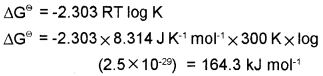
Answer:
1. The attractive intermolecular forces are known as van der Waals’ forces.

2. Dispersion forces/London forces, Dipole-Dipole forces, Dipole-Induced dipole forces and Hydrogen bonding.

3. Dispersion forces/London forces < Dipole-Induced dipole forces < Dipole-Dipole forces < Hydrogen bonding

Question 3.
A graphical representation of Charles’ law is given below:
Plus One Chemistry Chapter Wise Questions and Answers Chapter 5 States of Matter 6

  1. What is the temperature corresponding to the point‘A’called? .
  2. What will be the temperature at that point A’ in degree Celsius?
  3. What is the significance of this temperature?

Answer:

  1. Absolute zero temperature
  2. -273.15 °C
  3. Absolute zero is the lowest hypothetical or imaginary temperature at which gases are supposed to occupy zero volume.

Question 4.
Assume that two gases X and Y at the same temperature and pressure have the same volume.
1. Which of the following is correct?
No. of moles of X= No.of moles of Y
No. of moles of X ≠ No.of moles of Y
2. Which law helped you to find the answer?
3. State the law.
Answer:
1. No. of moles of X= No.of moles of Y

2. Avogadro’s law

3. Equal volumes of all gases under the same conditions of temperature and pressure contain equal number of molecules.

Question 5.
During a seminar session in the class, the presenter argued that equal amounts of both H2and N2 on heating at constant pressure will expand in the same rate. Another student objected this argument by saying that they will expand differently since their molecular masses are different.

  1. Who is correct in your opinion?
  2. Which law helped you to reach the answer?
  3. State the law and give its mathematical expression.

Answer:
1. The argument of the presenter is correct.

2. Charles’ law

3. Charles’ law states that pressure remaining constant, the volume of a fixed mass of a gas is directly proportional to its absolute temperature.

Mathematically, V ∝ T (at constant n and P) Or \(\frac{V}{T}\) = K, where K is the proportionality constant which depends on the pressure of the gas, its amount and the unit in which V is expressed.

Plus One Chemistry Chapter Wise Questions and Answers Chapter 5 States of Matter

Question 6.
1. What is an ideal gas?
2. Give the ideal gas equation and explain the terms.
3. Derive the ideal gas equation.
Answer:
1. A gas that follows Boyle’s law, Charles’ law and Avogadro law strictly at all conditions is called an ideal gas.

2. The ideal gas equation is pV = nRT where p = pressure, V = volume, n = number of moles, R = universal gas constant and T = absolute temperature.

3. According to Boyle’s law:
V ∝ \(\frac{1}{p}\) at constant T and n.
According to Charles’ law:
V ∝ T. at constant n and p.
According to Avogadro law,
V ∝ n , at constant p and T Combining the above three equations,
V ∝ \(\frac{nT}{p}\)
⇒ V = R\(\frac{nT}{p}\), where R is the proportionality constant known as universal gas constant.
Or pV = nRT, the ideal gas equation.

Question 7.
Partial pressure of a vessel containing Cl2, CO2 and CO is the sum of the partial pressures of Cl2, O2 and CO.
1. If so, is it correct to say partial pressure of a vessel containing NH3 and HCl gases is the sum of their partial
pressures? Justify.
2. Which law helped you to answer this?
3. State the law.
Answer:
1. No. NH3 reacts with HCl to form NH4CI. Since they are not non-interacting gases, their sum of partial pressures may not be equal to the total pressure.

2. Dalton’s law of partial pressures.

3. It states that the total pressure exerted by the mixture of non-reactive gases is equal to the sum of the partial pressures of individual gases.

Question 8.
The average kinetic kenergy of the gas molecules is directly proportional to the absolute temperature.

  1. Which theory is related to this assumption?
  2. Write the other postulates of this theory.

Answer:
1. Kinetic moleculartheory of gases.

2.

  • The volume of a gas molecule is negligible when compared to the whole volume of the gas.
  • There is no force of attraction between the particles of a gas at ordinary temperature and pressure.
  • The gas molecules are in random motion.
  • During motion, they collide with each other and also with the walls of the container.
  • Gravity has no influence in the movement of gas molecules.
  • Pressure of a gas is due to the collision of gas molecules with the walls of the container.
  • At any particular time, different particles in the gas have different speeds and hence different kinetic energies.

Question 9.
Three mateorological baloons filled with equal amount of helium, rising in the atmosphere are shown below: (Assume that temperature remains constant).
Plus One Chemistry Chapter Wise Questions and Answers Chapter 5 States of Matter 7

  1. Which of the baloons will be at the lowest altitude?
  2. Which law helped you to find the answer?
  3. State the law.

Answer:

  1. C –
  2. Boyle’s law.
  3. At low altitudes pressure is high. According to Boyle’s law for a given mass of a gas, greater the pressure lower is the volume at constant temperature.
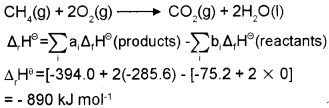
Question 10.
‘All the postulates of the kinetic molecular theory of gases are correct.’

  1. Do you agree with the statement?
  2. If no, write the wrong postulates of this theory.
  3. Give justification.

Answer:
1. No.

2.

  • Volume of the molecules of a gas is negligibly small in comparison to the space occupied by the gas.
  •  There is no force of attraction between the molecules of a gas.

3. If assumption i) is correct, the p vs V graph of experimental data (real gas) and that theoritically calculated from Boyle’s law (ideal gas) should coincide. But this never happens.
If assumption ii) is correct, the gas will never liquify. But gases do liquify when cooled and compressed.

Question 11.
Two gases with equal molecular mass will have the same rate of diffusion.’

  1. Do you agree?
  2. Explain.
  3. Substantiate your answer with an example.

Answer:
1. Yes.

2. According to Graham’s law of diffusion the rate of diffusion depends only on the molecular mass. So if the molecular masses are the same, their rate of diffusion is same.

3. Both CO and N2 have the same molecular mass (28 g mol-1)
Rate of diffusion of CO = Rate of diffusion of N2

Plus One Chemistry Chapter Wise Questions and Answers Chapter 5 States of Matter

Question 12.
Water can be boiled more quickly on the top of a mountain.

  1. Do you agree?
  2. What is the reason?
  3. What is called boiling point of a liquid?
  4. How normal boiling point and standard boiling point differ?

Answer:
1. Yes.

2. As we move to the top of a mountain atmospheric pressure decreases and hence boiling point decreases. So water boils quickly.

3. Boiling point of a liquid is the temperature at which the vapour pressure of a liquid is equal to the external pressure or atmospheric pressure.

4. The boiling point at 1 atm pressure is called normal boiling point. The boiling point at 1 bar pressure is called standard boiling point.

Question 13.
Ethanol flows faster than honey.

  1. Name the related phenomenon.
  2. Explain this phenomenon.
  3. What is the effect of temperature on this?

Answer:
1. Viscosity.

2. Viscosity is a measure of resistance to flow which arises due to the internal friction between layers of fluid as they slip past one another while liquid flows.

3. Viscosity of liquids decreases as the temperature rises because at high temperature molecules have high kinetic energy and can overcome the intermolecular forces to slip past one another between the layers.

Question 14.
Liquid drops attain spherical shape.

  1. Which property of liquids is responsible for this?
  2. Explain the phenomenon and justify.
  3. Suggest another consequence of this phenomenon.

Answer:
1. Surface tension.

2. Surface tension is defined as the force acting per unit length perpendicular to the line drawn on the surface of liquid. The lowest energy state of the liquid will be when surface area is minimum. Spherical shape satisfies this condition.

3. Fire polishing of glass – On heating, the glass melts and the surface of the liquid tends to take the rounded shape at the edges due to surface tension, which makes the edges smooth.
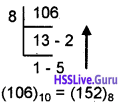
Question 15.
Vapour pressure is an important property of liquids.

  1. What is vapour pressure?
  2. How boiling point and vapour pressure are related?
  3. Pressure cooker is used for cooking food at higher altitudes. Give reason.

Answer:
1. Vapour pressure of a liquid is the pressure exerted by the vapour which is in equilibrium with liquid at a given temperature.

2. Boiling point of a liquid is the temperature at which the vapour pressure of liquid becomes equal to the atmospheric pressure. Thus, lower the vapour pressure of a liquid higher will be its boiling point and vice-versa.

3. At high altitudes atmospheric pressure is low. Therefore, liquids at high altitudes boil at lower temperatures in comparison to that at sea level. In a pressure cooker, the internal pressure is greater than atmospheric pressure. Hence, in a pressure cooker water boils at a temperature higher than its normal boiling point of 100 °C. Thus, cooking becomes more effective.

Question 16.
Assume that ‘A’, ‘B’ and ‘C’ are three non-reacting gases kept in a vessel at a constant temperature.
Then, PTotal= PA + PB + PC
1. Name the related law.
2. How can you explain the above law on the basis of kinetic molecular theory of gases?
Answer:
1. Dalton’s law of partial pressures.

2. In the absence of attractive forces, the particles of the gas behave independent of one another. The same is true even if there are more than one type of molecules. Thus, the number of molecules colloding the unit area of the wall per second at a given temperature, fora fixed amount of the gas issame.lt implies that the partial pressure of the gas will be unaffected by the presence of the molecules of other gases. But, the total pressure exerted is duet the impact of molecules of all the gases. Hence, the total pressure would be the sum of the partial pressures of the gases.

Question 17.
1. Write the general equation which relates the different variables of a gas used to describe the state of any ideal gas.
2. A flask at 295 K contains a gaseous mixture of N2 and O2 at a total pressure of 1.8 atm. If 0.2 moels of N2 and 0.6 moles of O2 are present, find the partial pressures of N2 and O2.
3. What is meant by Boyle temperature or Boyle point?
Answer:
1. PV = nRT
2.
Plus One Chemistry Chapter Wise Questions and Answers Chapter 5 States of Matter 8

3. It is the temperature at which a real gas obeys ideal gas law over an appreciable range of pressure.

Question 18.
1. Liquid tries to rise or fall in the capillary. Name the related phenomenon.
2. What is the effect of temperature on the above phenomenon?
3. WhatistheSI unit of the above phenomenon.
Answer:
1. Surface tension.

2. The magnitude of surface tension of a liquid depends on the attractive forces between the molecules. When the attractive forces are large, the surface tension is large. Increase in temperature increases the kinetic energy of the molecules and effectiveness of intermolecular attraction decreases, so surface tension decreases as the temperature is raised.

3. N m-1.

Question 19.
1. Define critical temperature (Tc ).
2. CO2 cannot be liquified above 31.1°C. Why?
3. The critical temperatures of ammonia and carbon dioxide are 405.5 Kand 304.10 K respectively. On cooling, which of these gases will liquify first? Justify.
Answer:
1. It is the highest temperature at which a gas can
be liquified by applying external pressure.

2. The critical temperature (Tc ) of CO2 is 30.98°C. This is the highest temperature at which liquid CO2 is observed. Above this temperature it is gas.

3. Ammonia. This is because, on cooling, critical temperature of ammonia will be reached first. Liquefaction of carbon dioxide will require more cooling.

Plus One Chemistry Chapter Wise Questions and Answers Chapter 5 States of Matter

Question 20.
a) Will water boils at higher temperature at sea level or at top of a mountain. Explain.
b) A vessel of 120 mL capacity contains a certain amount of gas at 35 °C and 1.2 bar pressure. The gas is transferred to another vessel of volume 180 mL at 35 °C. What would be its pressure?
Answer:
a) When atmospheric pressure decreases boiling point of the liquid also decreases. So the boiling point of water at sea level is not same as that at the top of a mountain. Atmospheric pressure decreases from sea level as we go high. Hence, the boiling point at the top of the mountain is less than that at sea level.
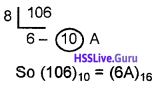
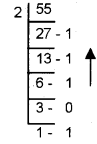
Plus One Chemistry Chapter Wise Questions and Answers Chapter 5 States of Matter 9

Question 21.
Real gases deviate from ideal behaviour.
1. What are the two wrong postulates of kinetic theory of gases, responsible for deviation of real gases from ideal behaviour?.
2. When do real gases deviate from ideal behaviour?
Answer:
1.

  • Volume of the molecules of a gas is negligibly small in comparison to the space occupied by the gas.
  • There is no force of attraction between the molecules of a gas.

2. Real gases deviate from ideal behaviour at high pressure and low temperature, when the gas molecules are very close to each other.

Question 22.
1. What is meant by compressibility factor, Z?
2. What is the significance of compressibility factor?
3. A plot of pV/nRT of oxygen gas against p is as follows:
Plus One Chemistry Chapter Wise Questions and Answers Chapter 5 States of Matter 10
a) Is the gas ideal or real?
b) Write the equation of state of the above gas.
Answer:
1. Compressibility factor (Z) is the ratio of product pV and nRT. Mathematically, Z = \(z=\frac{p V}{n R T}\).

2. The deviation of real gases from ideal behaviour can be measured in terms of compressibility factor.

3. a) Real gas.
\(\left[p+\frac{a n^{2}}{V^{2}}\right]\)[V-nb] = nRT (van der Waals’ equation)

Question 23.
a) What is the difference between gas and vapour?
b) Analyse the vapour pressure vs temperature curve shown below:
Plus One Chemistry Chapter Wise Questions and Answers Chapter 5 States of Matter 11
Arrange the compounds shown in the graph in the decreasing order of their normal boiling points,

c) The density of a gas was found to be 2.92 g L1 at 27 °C and 2.0 atm. Calculate the molar mass of the gas.
Answer:
a) A gas below its critical temperature can be liquified by applying pressure. Under these conditions, it is called vapour of the substance.

b) water > ethyl alcohol > carbon tetrachloride > diethyl ether
Plus One Chemistry Chapter Wise Questions and Answers Chapter 5 States of Matter 12

Question 24.
1. How will you account for the observation that automobile tyre is inflated with lesser air in summer than in winter?
2. A sample of gas occupies 250 mLat27 °C. What volume will it occupy at 35 °C if there is no change in pressure?
Answer:
1. This can be explained on the basis of Gay Lussac’s law, according to which at constant volume, pressure of a fixed amount of a gas varies directly with the temperature. In summer season the temperature will be higher. Hence, pressure will increase and the tyre may burst if filled with more air. But during winter temperature is low and hence pressure will below.

2. According to Charles’ law,
Plus One Chemistry Chapter Wise Questions and Answers Chapter 5 States of Matter 13

Question 25.
Real gases behave ideally at low temperature and high pressure.

  1. Is the above statement correct or not?
  2. Justify.
  3. Write the van der Waals’ equation for 1 mole of a real gas.

Answer:
1. The statement is wrong.

2. This is because real gases behave ideally at high temperature and low pressure, when the gas molecules are far apart.

3. \(\left(p+\frac{a}{V^{2}}\right)\)(V – b) = RT

Question 26.
1. Distinguish between real gas and ideal gas.
2. Explain the deviation of the following gases from ideal behaviouron the basis of the pV vs. p plot. CO, CH4, H2 and He.
Answer:
1. Real gas do not follow, Boyle’s law, Charles law, and Avagadro law perfectly under all conditions. Ideal gas follow, Boyle’s law, Charles’ Law and Avagadro law strictly under all conditions.

2.
Plus One Chemistry Chapter Wise Questions and Answers Chapter 5 States of Matter 14
It can be seen that at constant temperature pV vs p plots for these gases are not straight lines. Two types of curves are seen. In the curves for H2 and He, as the pressure increases the value of pV also increases. These gases show positive deviation from ideal behaviour at all pressures. The second type of plot is seen in the case of CO and CH4. For these gases the pV value decreases with increase in pressure and reaches to a minimum value characteristics of the gas. After that PV value starts increasing. The curve then crosses the line for ideal gas and after that shows positive deviation continuously.

Question 27.
1. What is meant by laminar flow?
2. Derive the expression for the force responsible for flow of layers of a liquid.
Answer:
1. When a liquid flows overa fixed surface, the layer of molecules in the immediate contact of surface is stationary. The velocity of upper layers increases as the distance of layers from the fixed layer increases. This type of flow in which there is a regular gradation of velocity in passing from one layer to the next is called laminar flow.

2. Consider three layers of a flowing liquid as shown below:
Plus One Chemistry Chapter Wise Questions and Answers Chapter 5 States of Matter 15
For any layer, the layer above it accelerates its flow and the layer below this retards its flow. If the velocity of the layer at a distance dz is changed by a value du then velocity gradient is given by \(\frac{du}{dz}\). A force is required to maintain the
flow of layers. This force is proportional to the area of contact (A) of layers and velocity gradient.
Plus One Chemistry Chapter Wise Questions and Answers Chapter 5 States of Matter 16
where η is a proportionality constant called coefficient of viscosity.

Question 28.
1. What are London forces?
2. What is the relation between London forces and the distance between the particles?
Answer:
1. The attractive force between two temporary dipoles is known as London forces or Dispersion forces.

2. London forces are always attractive and the interaction energy is inversely proportional to the sixth power of the distance between two interacting particles.

Question 29.
1. What is meant by thermal energy and thermal motion?
2. Can oxygen exist as a gas at -273.15°C? Write the significance of this temperature.
Answer:
1. Thermal energy is the energy of a body arising from motion of its atoms or molecules. The movement of particles due to thermal energy is called thermal motion.

2. At – 273.15 °C oxygen will not exist as a gas. In fact all the gases get liquified before this temperature is reached. It is the absolute zero of temperature, which is the lowest hypothetical or imaginary temperature at which gases are supposed to occupy zero volume.

Plus One Chemistry Chapter Wise Questions and Answers Chapter 5 States of Matter

Question 30.
Molecues of a gas are in a state of continuous motion
1. What is most probable speed?
2. Give the equation for average speed of molecules.
Answer:
1. Most probable speed is the speed possessed by the maximum fraction of molecules of the gas at a given temperature.

2. If there are ‘n’ molecules in a sample and their individual speeds are u1, u2 ……… un, then, average speed of molecules, uav is given by the equation:
\(u_{a v}=\frac{u_{1}+u_{2}+\ldots+u_{n}}{n}\)

Plus One Chemistry States of Matter Four Mark Questions and Answers

Question 1.
1. State the Avogadro law.
2. Give the mathematical expression of this law.
3. What is the value of molar volume of an ideal gas at 273.15 K and 1 bar?
4. Show that, at constant temperature and pressure, the density of an ideal gas is proportional to its molar volume.
Answer:
1. It states that equal volumes of all gases under the same conditions of temperature and pressure contain equal number of molecules.

2. v ∝ n (at constant P and T)
⇒ V = k × n where k is a proportionality constant.

3. 22.71098 L

4. According to Avogadro law, for n moles of an ideal gas,
V = k × n
But n = \(\frac{m}{M}\) where m is the mass of the gas and M is its molar mass.
Thus, V = k × \(\frac{m}{M}\)
On rearranging the above equation,
M = k × \(\frac{m}{V}\) = k × d
⇒ M ∝ d

Question 2.
The speed of molecules is a measure of their average kinetic energy.
a) What is root mean square speed?
b) Give the equation for root mean square speed.
c) Calculate the following:
i) Root mean square speed of methane molecule at 27°C.
ii) Most probable speed of nitrogen molecule at 25°C
Answer:
a) It is the square root of the mean of the squares of speeds of various molecules of the gas at a given temperature.
Plus One Chemistry Chapter Wise Questions and Answers Chapter 5 States of Matter 17

Question 3.
The graph A is drawn at high temperature and low pressure and graph B is drawn at low temperature and high pressure.
Plus One Chemistry Chapter Wise Questions and Answers Chapter 5 States of Matter 18
a) Which graph represents ideal behaviour?
b) Give the equation for combined gas law.
c) A baloon occupies volume of 700 mL at 25°C and 760 mm of pressure. What will be its volume at higher attitude when temperature is 15°C and pressure is 600 mm Hg.
Answer:
Plus One Chemistry Chapter Wise Questions and Answers Chapter 5 States of Matter 19

Question 4.
1. Give the relationship among the three types of molecular speeds.
2. Drawthe Maxwell-Boltzmann distribution showing all the molecularspeeds.
3. Which of the following molecules will have the higher value of most probable speed at the same temperature, N2 or Cl2? Justify.
Answer:
1. Root mean square speed, average speed and the most probable speed have the following relationship:
Urms > Uav > Ump
2.
Plus One Chemistry Chapter Wise Questions and Answers Chapter 5 States of Matter 20
3. N2. This is because at the same temperature, gas molecules with heavier mass have slower speed than lighter gas molecules. At the same temperature, lighter nitrogen molecules move faster than heavier chlorine molecules. Hence, at any given temperature, nitrogen molecules have higher value of most probable speed than the chlorine molecules.

Plus One Chemistry States of Matter NCERT Questions and Answers

Question 1.
What will be the minimum pressure required to compress 500 dm3 of air at 1 bar to 200 dm3 at 30 °C? (2)
Answer:
p1 = 1 bar p2 = ?
V1 = 500 dm³ V2 = 200 dm³
Temperature remains constant.
According to Boyle’s law,
Plus One Chemistry Chapter Wise Questions and Answers Chapter 5 States of Matter 21

Question 2.
Using the equation of state pV=nRT show that at a given temperature, the density of the gas is proportional to the gas pressure p. (2)
Answer:
According to ideal gas equation :
Plus One Chemistry Chapter Wise Questions and Answers Chapter 5 States of Matter 22

Question 3.
The density of a gas is found to be 5.46 g/dm³ at 27°C and under 2 bar pressure. What will be its density at STP. (3)
Answer:
Plus One Chemistry Chapter Wise Questions and Answers Chapter 5 States of Matter 23

Question 4.
Calculate the volume occupied by 8.8 g of CO2 at 31.1°C and 1 bar pressure (R = 0.083 bar L K-1 mol-1). (2)
Answer:
Plus One Chemistry Chapter Wise Questions and Answers Chapter 5 States of Matter 24

Question 5.
Explain the significance of van der Waal parameters. (2)
Answer:
The van der Waal parameter ‘a’ is a measure of the magnitude of intermolecular forces. The van der Waal parameter ‘b’ which is also called co-volume is a measure of effectve size of the gas molecules.

Plus One Computer Science Chapter Wise Questions and Answers Chapter 5 Introduction to C++ Programming

Students can Download Chapter 5 Introduction to C++ Programming Questions and Answers, Plus One Computer Science Chapter Wise Questions and Answers helps you to revise the complete Kerala State Syllabus and score more marks in your examinations.

Kerala Plus One Computer Science Chapter Wise Questions and Answers Chapter 5 Introduction to C++ Programming

Plus One Introduction to C++ Programming One Mark Questions and Answers

Question 1.
IDE means _____________
Answer:
Integrated Development Environment

Plus One Computer Science Chapter Wise Questions and Answers Chapter 5 Introduction to C++ Programming

Question 2.
We know that C++ is a high level language. From the following which statement is true.
(a) C++ contains English like statements.
(b) C++ contains mnemonics
(c) C++ contains only 0 and 1
(d) None of these
Answer:
(a) C++ contains English like statements.

Question 3.
C++ is a ______ language.
(a) High level
(b) Low level
(c) Middle level
(d) None of these
Answer:
(a) High level

Question 4.
C++ was developed at ___________
(a) AT & T Bell Laboratory
(b) Sanjose Laboratory
(c) Kansas University Lab
(d) None of these
Answer:
(a) AT & T Bell Laboratory

Question 5.
C++ is a successor of ___________ language
(a) C#
(b) C
(c) java
(d) None of these
Answer:
(b) C

Question 6.
The most adopted and popular approach to write programs is __________
Answer:
Structured programming

Question 7.
From the following which uses OOP concept
(a) C
(b) C++
(c) Pascal
(d) Fortran
Answer:
(b) C++

Question 8.
______________ is the smallest individual unit
Answer:
Token

Question 9
Pick the odd one out
(a) float
(b) void
(c) break
(d) Alvis
Answer:
(d) Alvis, the others are keywords.

Plus One Computer Science Chapter Wise Questions and Answers Chapter 5 Introduction to C++ Programming

Question 10.
Reserved words for the compiler is ____________
(a) Literals
(b) Identifier
(c) Keywords
(d) None of these
Answer:
(c) Keywords

Question 11.
Pick an identifier from the following
(а) auto
(b) age
(c) float
(d) double
Answer:
(b) age

Question 12.
Pick the invalid identifier
(a) name
(b) Date of birth
(c) age
(d) joining time
Answer:
(b) Date of birth, because it contains space.

Question 13.
Pick the octal integer from the following
(a) 217
(b) 0 X 217
(c) 0217
(d) None of these
Answer:
(c) 0217, an octal integer precedes 0

Question 14.
Pick the hexadecimal integer from the following
(a) 217
(b) 0 × 217
(c) 0217
(d) None of these
Answer:
(b) 0 × 217, a hexadecimal integer precedes 0×

Question 15.
From the following pick a character constant
(a) ‘A’
(b) ‘ALL’
(c) ‘AIM’
(d) None of these
Answer:
(a) ‘A’, a character enclosed between single quote

Question 16.
Non graphic symbol can be represented by using ___________
Answer:
Escape Sequence

Plus One Computer Science Chapter Wise Questions and Answers Chapter 5 Introduction to C++ Programming

Question 17.
Manish wants to write a program to produce a beep sound. Which escape sequence is used to get an alert (sound)
(a) \a
(b) \d
(c) Vs
(d) None of these
Answer:
(a) \a.

Question 18.
Ajo wants to print a matter in a new line. Which escape sequence is used for this?
(a) \a
(b) \n
(c) \s
(d) None of these
Answer:
(b) \n

Question 19.
To represent null character is used ______
(a) \n
(b) \0
(c) \f
(d) As
Answer:
(b) \0

Question 20.
State True/ False a string is automatically appended by a null character.
Answer:
True

Question 21.
From the following pick a string constant
(a) ‘a’
(b) “abc”
(c) ‘abc’
(d) None of these
Answer:
(b) “abc”, a character constant must be enclosed between double quotes.

Question 22.
C++ was developed by __________
(a) Bjarne Stroustrup
(b) James Gosling
(c) Pascal
(d) None of these
Answer:
(a) Bjarne stroustrup

Plus One Computer Science Chapter Wise Questions and Answers Chapter 5 Introduction to C++ Programming

Question 23.
From the following which is not a character constant.
(а) ‘c’
(b) ‘e’
(c) ‘d’
(d) “c”
Answer:
(d) “c”, It is a string constant the others are character constant.

Question 24.
From the following which is a valid declaration.
(a) int 91;
(b) int x;
(c) int 9x;
(d) int “x”;
Answer:
(b) int x;

Question 25.
Symbols used to perform an operation is called ____________
(a) Operand
(b) Operator
(c) Variable
(d) None of these
Answer:
(b) Operator

Question 26.
Consider the following
C = A + B. Here A and B are called
(a) Operand
(b) Operator
(c) Variable
(d) None of these,
Answer:
(b) Operand

Question 27.
The execution of a program starts at ________ function
Answer:
main()

Question 28.
The execution of a program ends with ________ function
Answer:
main()

Question 29.
______ is used to write single line comment
(a) //
(b) /*
(c) */
(d) None of these
Answer:
(a) //

Question 30.
const k = 100 means
(a) const float k = 100
(b) const double k = 100
(c) const int k = 100
(d) const char k = 100
Answer:
(c) const int k = 100

Plus One Computer Science Chapter Wise Questions and Answers Chapter 5 Introduction to C++ Programming

Question 31.
Each and every statement in C++ must be end with ________
(а) Semicolon
(b) Colon
(c) full stop
(d) None of these
Answer:
(a) Semicolon

Question 32.
From the following select the input operator
(а) >>
(b) <<
(c) >
(d) <
Answer:
(a) >>

Question 33.
From the following select the output operator
(a) >>
(b) <<
(c) >
(d) <
Answer:
(b) <<

Question 34.
From the following which is known as a string terminator.
(а) ‘\0’
(b) ‘\a’
(c) ‘As’
(d) ‘\t’
Answer:
(a) ‘\0’

Question 35.
Adeline wrote a C++ program namely sum.cpp and she compiled the program successfully with no error. Some files are generated. From the following which file is a must to run the program
(a) sum.exe
(b) sum.obj
(c) sum.vbp
(d) sum.htm
Answer:
(a) sum.exe

Question 36.
Adeline wrote a C++ program namely sum.cpp and she compiled the program successfully with no error. Some files are generated namely sum.obj and sum.exe. From this which file is not needed to run the program
Answer:
sum.obj is not needed and can be deleted.

Question 37.
From the following which is ignored by the compiler
(a) statement
(b) comments
(c) loops
(d) None of these
Answer:
(b) comments

Plus One Computer Science Chapter Wise Questions and Answers Chapter 5 Introduction to C++ Programming

Question 38.
To write a C++ program, from the following which statement is a must
(a) sum()
(b) main()
(c) #include<iostream>
(d) #include<iomanip>
Answer:
(b) main(). A C++ program must contains at least one main() function

Question 39.
State True / False
Comment statements are ignored by the compiler
Answer:
True

Question 40.
More than one input/output operator in a single statement is called _______
Answer:
Cascading of I/O operator

Question 41.
Is 0X85B a valid integer constant in C++? If yes why?
Answer:
Yes. It is a hexadecimal number.

Plus One Introduction to C++ Programming Two Mark Questions and Answers

Question 1.
Mr. Dixon declared a variable as follows
int 9age. Is it a valid identifier. If not briefly explain. the rules for naming an identifier.
Answer:
It is not a valid identifier because it violates the rule
The rules for naming an identifier is as follows:

  1. It must be start with a letter(alphabet)
  2. Under score can be considered as a letter
  3. White spaces and special characters cannot be used.
  4. Key words cannot be considered as an identifier

Question 2.
How many bytes used to store ‘\a’.
Answer:
To store ‘\a’ one byte is used because it is an escape sequence. An escape sequence is treated as one character. To store one character one byte is used.

Question 3.
How many bytes used to store “\abc”.
Answer:
A string is automatically appended by a null character.

  • Here one byte for \a (escape sequence).
  • One byte for character b.
  • One byte for character c.
  • And one byte for null character.
  • So a total of 4 bytes needed to store this string.

Question 4.
How many bytes used to store “abc”.
Answer:
A string is automatically appended by a null character.

  • Here one byte for a.
  • One byte for character b.
  • One byte for character c.
  • And one byte for null character.
  • So a total of 4 bytes needed to store this string.

Plus One Computer Science Chapter Wise Questions and Answers Chapter 5 Introduction to C++ Programming

Question 5.
Consider the following code
int main()
{
cout<<“welcome to C++”;
}
After you compile this program there is an error called prototype error. Why it is happened? Explain.
Answer:
Here we used the output operator cout<<. It is used to display a message “welcome to C++” to use this operator the corresponding header file <iostream> must be included. We didn’t included the header file hence the error.

Question 6.
In C++ the size of the string “book” is 5 and that of “book\n” is 6. Check the validity of the above statement. Justify your answer.
Answer:
A string is automatically added by a null character(\0). The null character is treated as one character. So the size of string “book” is 5. Similarly, a null character (\0) is also added to “book\n”. \n and \0 is treated as single characters. Hence the size of the string “book\n” is 6.

Question 7.
Pick the odd man out. Justify
TOTSAL, TOT_SAL, totsal5, Tot5_sal, SALTOT, tot.sal
Answer:
tot.sal. Because it contains a special character dot(.). An identifier cannot contain a special character. So it is not an identifier. The remaining satisfies the rules of naming identifier. So they are valid identifiers.

Question 8.
Write a C++ statement to print the following sentence. Justify.
“\ is a special character”
answer:
cout<<“\\ is a special character”
\\ is treated as an escape sequence.

Question 9.
A student type a C++ program and saves it in his personal folder as Sample.cpp. After getting the output of the program, he checks the folder and finds three files namely Sample.cpp, Sample.obj and Sample.exe. Write the reasons for the generation of the two files in the folder.
Answer:
After the compilation of the program sample.cpp, the operating system creates two files if there is no error. The files are one object file (sample.obj) and one executable file(sample.exe). Now the source file(sample.cpp) and object file(sample.obj) are not needed and can be deleted. To run the program sample.exe is only needed.

Question 10.
Mention the purpose of tokens in C++. Write names of any four tokens in C++. (2)
Answer:
Token: It is the smallest individual units similar to a word in English or Malayalam language. C++ has 5 tokens.

  1. Keywords
  2. Identifier
  3. Literals (Constants)
  4. Punctuators
  5. Operators

Question 11.
The following are some invalid identifiers. Specify its reason.

  1. Sum of digits
  2. 1 year
  3. First jan
  4. For

Answer:

  1. Sum of digits → space not allowed hence it is invalid
  2. 1 year → First character must be an alphabet hence it is invalid
  3. First.jan → special characters such as dot (.) not allowed hence it is invalid.
  4. For → It is valid. That is it is not the keyword for

Question 12.
Some of the literals in C++ are given below. How do they differ?(5, ‘5’, 5.0, “5”)
Answer:

  • 5 – integer literal
  • ‘5’ – Character literal
  • 5.0 – floating point literal
  • “5”- string literal

Question 13.
Identify the invalid literals from the following and write reason for each:

  1. 2E3.5
  2. “9”
  3. ‘hello’
  4. 55450 (2)

Answer:
1. 2E3.5 → The mantissa part (3.5) will not be a floating point number. Hence it is invalid

3. ‘hello’ → It is a string hence it must be enclosed in double quotes instead of single quotes. It is invalid.

Question 14.
Which one of the following is a user defined name?
(a) Keyword
(b) Identifier
(c) Escape sequences
(d) All of these
Answer:
(b) Identifier

Plus One Computer Science Chapter Wise Questions and Answers Chapter 5 Introduction to C++ Programming

Question 15.
Identify whether the following are valid identifiers or not? If not give the reason.

  1. Break
  2. Simple.interest (2)

Answer:

  1. Break – It is valid( break is the keyword, not Break);
  2. Simple.interest – It is not valid, because dot(.) is used.

Question 16.
Identify the invalid literals from the following and write a reason for each:

  1. 2E3.5
  2. “9”
  3. ‘hello’
  4. 55450 (2)

Answer:
1. Invalid, because exponent part should not be a floating point number

2. valid

Plus One Introduction to C++ Programming Three Mark Questions and Answers

Question 1.
Rose wants to print as follows
\n is used for New Line. Write down the C++ statement for the same.
Answer:
#include<iostream>
using namespace std;
int main()
{
cout<<“\\n is used for New Line”;
}

Question 2.
Alvis wants to give some space using escape sequence as follows
Welcome to C++. Write down the C++ statement for the same
Answer:
#include<iostream>
using namespace std;
int main()
{
cout<<“Welcome to \t C++”;
}

Question 3.
We know that the value of pi = 3.14157, a constant (literal). What is a. constant? Explain it.
Answer:
A constant or a literal is a data item its value doe not change during execution.
1. Integer literals:
Whole numbers without fractional parts are known as integer literals, its value does not change during execution. There are 3 types decimal, octal and hexadecimal.
Eg. For decimal “100, 150, etc

  • For octal 0100, 0240, etc
  • For hexadecimal 0 × 100, 0x1 A, etc

2. Float literals:
A number with fractional parts and its value does not change during execution is called floating point literals.
eg: 3.14157,79.78, etc

3. Character literal:
A valid C++ character enclosed in single

Plus One Computer Science Chapter Wise Questions and Answers Chapter 5 Introduction to C++ Programming

Question 4.
Write a program to print the message “TOBACCO CAUSES CANCER” on screen.
Answer:
#include<iostream>
using namespace std;
int main()
{
cout<<” TOBACCO CAUSES CANCER”;
}

Question 5.
You are supplied with a list of tokens in C++ program, Classify and Categorise them under proper headings.
Explain each category with its features. tot_mark, age, M5, break, (), int, _pay, ;, cin.
Answer:
Plus One Computer Science Chapter Wise Questions and Answers Chapter 5 Introduction to C++ Programming 1

Question 6.
Write a program to print the message “SMOKING IS INJURIOUS TO HEALTH” on screen.
Answer:
#include<iostream>
using namespace std;
int mainO
{
cout<<” SMOKING IS INJURIOUS TO HEALTH”;
}

Plus One Introduction to C++ Programming Five Mark Questions and Answers

Question 1.
Consider the following code
The new line character is \n. The output of the following code does not contain the \n. Why it is happened? Explain.
Answer:
\n is a character constant and it is also known as escape sequence. This is used to represent the non graphic symbols such as carriage return key(enter key), tab key, backspace, space bar, etc. It consists of a backslash symbol and one more characters.
Plus One Computer Science Chapter Wise Questions and Answers Chapter 5 Introduction to C++ Programming 2

Plus One Computer Science Chapter Wise Questions and Answers Chapter 5 Introduction to C++ Programming

Question 2.
You are about to study the fundamentals of C++ programming Language. Do a comparative study of the basics of the new language with that of a formal language like English or Malayalam to familiarize C++? Provide sufficient explanations for the compared items in C++ Language.
Answer:
1. Character set:
To study a language first we have to familiarize the character set. For example, to study English language first we have to study the alphabets. Similarly here the character set includes letters(A to Z & a to z), digits(0 to 9), special characters(+, -, ?, *, /, …..) white spaces(non printable), etc.

2. Token:
It is the smallest individual units similar to a word in English or Malayalam language. C++ has 5 tokens

  • Keywords: These are reserved words for the compiler. We can’t use for any other purposes.
    Eg: float is used to declare variable to store numbers with decimal point. We can’t use this for any other purpose
  • Identifier: These are user defined words. Eg: variable name, function name, class name, object name, etc…
  • Literals (Constants): Its value does not change during execution
    eg: In maths % = 3.14157 and boiling point of water is 100.
  • Punctuators: In English or Malayalam language punctuation mark are used to increase the readability but here it is used to separate the tokens.
    eg:{,}, (,), ……..
  • Operators: These are symbols used to perform an operation(Arithmetic, relational, logical, etc…).

Plus One Chemistry Chapter Wise Questions and Answers Chapter 4 Chemical Bonding and Molecular Structure

Students can Download Chapter 4 Chemical Bonding and Molecular Structure Questions and Answers, Plus One Chemistry Chapter Wise Questions and Answers helps you to revise the complete Kerala State Syllabus and score more marks in your examinations.

Kerala Plus One Chemistry Chapter Wise Questions and Answers Chapter 4 Chemical Bonding and Molecular Structure

Plus One Chemistry Chemical Bonding and Molecular Structure One Mark Questions and Answers

Question 1.
The octet rule is not valid for
a) CO2
b)H2O
c) O2
d) CO
Answer:
d) CO

Question 2.
The stability of an ionic crystal depends principally on
a) High electron gain enthalpy of the anion forming species
b) The lattice enthalpy of the crystal
c) Low ionization enthalpy of the cation forming species
d) Low heat of sublimation of cation forming solid
Answer:
b) The lattice enthalpy of the crystal

Question 3.
Which of the following molecules has highest dipole moment?
a) H2S
b)CO2
c) CCl4
d) BF3
Answer:
a) H2S

Question 4.
The d-orbital involved in sp3d hybridization is .
Answer:
dz2

Plus One Chemistry Chapter Wise Questions and Answers Chapter 4 Chemical Bonding and Molecular Structure

Question 5.
Which of the following is paramagnetic and has a bond order of ½?
Plus One Chemistry Chapter Wise Questions and Answers Chapter 4 Chemical Bonding and Molecular Structure 1
Answer:
H2+

Question 6.
Dipole moment µ electric charge ‘e’ and bond length ‘d’are related by the equation.
Answer:
M = e x d

Question 7.
In which of the following carbon atom is sp2 hybridised?
a) CO2
b) C2H6
c) C6H6
d) HCN
e) \(C{ H }_{ 3 }-C\equiv CH\)
Answer:
C6H6

Question 8.
AgF is ionic whereas Agcl is covalent. This can be explained by
Answer:
Faja’ens Rule

Question 9.
The shape of covalent molecule CIF3 is _________
Answer:
T – shaped

Question 10.
The C – O bond order in CO32- is
Answer:
1.33

Plus One Chemistry Chemical Bonding and Molecular Structure Two Mark Questions and Answers

Question 1.
The order of repulsion of electron pairs as written by student is given below:
lone pair-lone pair repulsion < lone pair-bond pair repulsion>bond pair-bond pair repulsion.
1. Can you see anything wrong in this?
If yes, correct it.
2. Name the theory behind this.
Answer:
1. Yes.
Repulsion decreases in the order: lone pair-lone pair repulsion>lone pair-bond pair repulsion> bond pair-bond pair repulsion,

2. VSEPR theory

Question 2.
During a small group discussion in the class room a student argued that in acetylene both the carbon atoms are in sp3 hybridised state.

  1. What is your opinion?
  2. What is the bond angle between carbon atoms in acetylene?

Answer:

  1. The student’s argument is wrong. In acetylene both the carbon atoms are triple bonded and are in sp hybridised state,
  2. 180°

Plus One Chemistry Chapter Wise Questions and Answers Chapter 4 Chemical Bonding and Molecular Structure

Question 3.
Classify the following compounds according to their hybridisation.
CH4, BF3, C2H4, BeF2, C2H2
Answer:
sp3 hybridisation – CH4
sp2 hybridisation – BF3, C2H4
sp hybridisation – BeF2, C2H2

Question 4.
A student arranged the halide ions in the increasing order of polarisability as: F < l < CI < Br
1. Is this the correct order? If not write it in correct order.
2. Justify.
Answer:
1. No.
Polarisability increases in the order: F < Cl <Br < l

2. Polarisability increases when the size of anion increases.

Question 5.
Give any two differences between sigma and pi bonds.
Answer:
Sigma bond (σ) is formed when two atomic orbitals under head-on overlapping. It is a strong bond. Pi(π) bond is formed when atomic orbitals undergo lateral (sidewise) overlapping. It is a weak bond.

Question 6.
Write the type of hybridisation of each carbon in the compound.
CH3-CH=CH-CN
Answer:
Carbon 1 → sp³
Carbon 2 → sp²
Carbon 3 → sp²
Carbon 4 → sp

Plus One Chemistry Chemical Bonding and Molecular Structure Three Mark Questions and Answers

Question 1.
Plus One Chemistry Chapter Wise Questions and Answers Chapter 4 Chemical Bonding and Molecular Structure 2
1. What is meant by the above picture?
2. Which type of bond is present here?
3. Which type of overlapping leads to the formation of π bond?

Answer:

  1. s-s overlapping
  2. A strong sigma bond
  3. This type of covalent bond is formed by the lateral or sidewise overlap of half-filled atomic orbitals.

Question 2.
‘In ethane there are 6 covalent bonds. Five are strong σ bonds and the remaining one is a weak π bond.’

  1. Do you agree with this?
  2. How is a bond different from π bond in the mode of formation?

Answer:

  1. Yes.
  2. Sigma bond is formed by the end to end overlapping of bonding orbitals along the internuclear axis, π bond is formed by the lateral or sidewise overlap of half filled atomic orbitals.

Plus One Chemistry Chapter Wise Questions and Answers Chapter 4 Chemical Bonding and Molecular Structure

Question 3.
Choose the correct molecules from the given clues: H2O, SF6, BF3
1. Clue -1 The central atom is in sp² hybridised state and the molecule has trigonal planar in shape. Clue-2 The bond angle is 120°
2. Clue-1 The number of electron pairs in this molecule is 6.
Clue -2 It has octahedral geometry.
3. Clue-1 The bond angle is reduced from 109° 28′ to 104.5°
Clue-2 It has a bent shape.
Answer:

  1. BF3
  2. SF6
  3. H2O

Question 4.
Give theoretical explanation for the following statements.
1. H2S is acidic while H2O is neutral.
2. Hydrogen chloride gas dissolves in water.
Answer:
1. S-H bond energy is less than that of O-H bond energy. So H+ can be easily generated from H2S.

2. When HCl is treated with H2O it undergoes hydrolysis as per the following reaction and dissolves.
HCl + H2O → H3O+ +Cl

Question 5.
The potential energy level diagram forthe formation of hydrogen molecule as drawn by a student is given below:
Plus One Chemistry Chapter Wise Questions and Answers Chapter 4 Chemical Bonding and Molecular Structure 3
1. Resketch the graph with correct labelling.
2. How can you determine the radius of one hydrogen atom?
Answer:
1.
Plus One Chemistry Chapter Wise Questions and Answers Chapter 4 Chemical Bonding and Molecular Structure 4
2. Bond length in hydrogen molecule is the intermolecular distance between two hydrogen atoms. So, half of the bond length is taken as the radius of hydrogen atom.

Question 6.
Ionisation enthalpy is one of the factors favoring the
formation of ionic bonds.
1. Will you agree with this statement?
2. Explain how?
3. Write anotherfactorfavouring the formation of ionic bonds.
Answer:
1. Yes.

2. In the formation of the ionic bond, a metal atom losses electrons to form cation. This process requires energy equal to the ionisation enthalpy. Lesser the ionisation enthalpy of the metal atom, easier will be the removal of electron from the atom to form cation and hence greater will be the tendency to form ionic bond.

3. Electron gain enthalpy of the element forming anion.

Plus One Chemistry Chapter Wise Questions and Answers Chapter 4 Chemical Bonding and Molecular Structure

Question 7.
Complete the following table:

Sigma bondπ -bond
Formation………….………….
Strong/Weak………….………….
About rotation………….………….

Answer:

Sigma bondπ -bond
FormationSigma bond is formed by end to end (or axial) overlap of atomic orbitalsπ -bond is formed by the sidewise overlap of atomic orbitals
Strong/WeakStrongWeak
About rotationFree rotationFree rotation is not possible

Question 8.
a) The dipole moment of BF3 is zero even though the B – F bonds are polar. Justify.
b) Give the hybridisation involved in the following compounds

  1. NH3
  2. C2H4
  3. SF6
  4. PCl5

c) o-nitro phenol has a lower boiling point than its para isomer. Why?
Answer:
a) In BF3, dut to the symmetric trigonal planar geometry of the molecule, the B – F bond are oriented at an angle of 120°to one another. The three bond moments give a net sum of zero as the resultant of any two is equal and opposite to the third.
Plus One Chemistry Chapter Wise Questions and Answers Chapter 4 Chemical Bonding and Molecular Structure 5
b)

  1. sp³
  2. sp²
  3. sp³d²
  4. sp³d

c) In o-nitrophenol, intramolecular hydrogen bonding is present and there is no association of molecules whereas in p-nitrophenol there is inter-molecular hydrogen bonding which causes association of molecules.
Plus One Chemistry Chapter Wise Questions and Answers Chapter 4 Chemical Bonding and Molecular Structure 6

Question 9.
1. How many a and n bonds are there in the following molecules i) ethane ii) acetylene?
2. BF3 and NH3 are tetra atomic molecules. But the shape of BF3 is different from that of NH3. Explain this using hybridisation.
Answer:
1. i) Ethane – 7σ bonds
ii) Acetylene-3σ bonds and 2 π bonds

2. In BF3 molecule, the ground state electronic configuration of central boron atom is 1s²2s²2p¹. In the excited state, one of the 2s electrons is promoted to vacant 2p orbital. As a result, boron has three unpaired electrons. These three orbitals (one 2s and two 2p) hybridise to form three sp2 hybrid orbitals oriented in a trigonal planar arrangement and overlap with 2 p orbitals of F to form three B – F bonds. Therefore, BF3 molecule has a planar geometry with FBF bond angle of 120°.
Plus One Chemistry Chapter Wise Questions and Answers Chapter 4 Chemical Bonding and Molecular Structure 7
In NH3, the valence shell electronic configuration of N in ground state is 2s² \(2p_{ x }^{ 1 }2{ p }_{ y }^{ 1 }2{ p }_{ z }^{ 1 }\). These four orbitals undergo sp³ hybridisation to form four sp³ hybrid orbitals, three of them containing unpaired electrons and the fourth one containing lone pair. The three hybrid orbitals overlap with 1 s orbitals of hydrogen atoms to form three N – H sigma bonds. Since, the bp-lp repulsion is greater than the bp-bp repulsion, the molecule gets distorted and the bond angle is reduced to 107° from 109.5°. Thus, the geometry of NH3 molecule is trigonal pyramidal.
Plus One Chemistry Chapter Wise Questions and Answers Chapter 4 Chemical Bonding and Molecular Structure 8

Question 10.
Covalent bond is formed by the overlaping of atomic orbitals.
1. What is meant by orbital overlapping?
2. What are the 3 types of overlapping?
Answer:
1. Orbital overlapping is the partial interpenetration or merging of atomic orbitals. It results in the pairing of electrons. Greater the overlap the stronger is the bond formed between two atoms.

2. s-s overlapping
s-p overlapping
p-p overlapping

Question 11.
1. Which among the following will exist He2 or He2+? Explain.
2. H2S is a gas at ordinary condition, while H2O is liquid. Account for the above statement.
3. State the hybridisation in the following molecules,
i) PF6
ii) C2H6
Answer:
1. He2+
Helium molecule contains 4 electrons. Out of this 4 electrons, 2 are present in the bonding molecular orbital and the remaining 2 are present in the anti-bonding molecular orbital.
Bond order = ½ (Nb-Na)
= ½ (2-2) = 0
Hence, He2 cannot exist. The molecular orbital diagram is given below:
Plus One Chemistry Chapter Wise Questions and Answers Chapter 4 Chemical Bonding and Molecular Structure 9
He2+ contains 3 electrons. Out of these 3 electrons, 2 are present in the σ1s level and the remaining one is present in the σ* 1s level.
Bond order = ½ (Nb-Na)
= ½ (2-1) = ½
Since the bond order is half the molecular ion exists but possesses low stability.

2. In H2S, there is no hydrogen bonding whereas in water, molecular association is possible due to intermolecular hydrogen bonding.

3. i) PF5 = sp³d hybridisation
ii) C2H6 = sp³ hybridisation

Plus One Chemistry Chapter Wise Questions and Answers Chapter 4 Chemical Bonding and Molecular Structure

Question 12.
Bond order is a term commonly used in MO theory.
1. How is it calculated?
2. How is it related to bond length and bond energy?
Answer:
1. Bond order = ½ (Nb-Na)
where Nb = No. of electrons occupying bonding orbitals and Na = No. of electrons occupying antibonding orbitals.

2. As the bond order increases, bond length decreases and bond energy increases, i.e., bond order is directly proportional to bond energy and inversely proportional to bond length.

Question 13.
1. Explain the hybridisation and geometry of ethyne.
2. What is the difference between bonding molecular orbital and antibonding molecular orbital?
3. How the magnetic nature of a molecule is related to its electronic structure?
Answer:
1. In the formation of ethyne (C2H2), both the carbon atoms undergo sp hybridisation having two unhybridised orbitals (2px and 2py). One sp hybrid orbital of one carbon atom overlaps axially with sp hybrid orbital of the other carbon atom to form C-C sigma bond, while the other hybridised orbital of each carbon atom overlaps axially with the half filled s orbital of hydrogen atoms forming o bonds. Each of the two unbybridised p orbitals of both the carbon atoms overlaps sidewise to form two K bonds between the carbon atoms. Thus, ethyne has a linear geometry with π bond angle of 180°.
Plus One Chemistry Chapter Wise Questions and Answers Chapter 4 Chemical Bonding and Molecular Structure 10

2. The molecular orbital which has lower energy than the atomic orbital is called bonding molecular orbital and the molecular orbital which has greater energy than the atomic orbital is called anti bonding molecular orbital.

3. If all the molecular orbitals in a molecule are doubly occupied (i.e., paired), the substance is diamagnetic (repelled by magnetic field). It one or more molecular orbitals are singly occupied (i.e., unpaired) it is paramagnetic (attracted by magnetic field).

Question 14.
Molecular Orbital Theory (MOT) is an advanced theory
of chemical bonding.
1. Write the salient features of MOT.
2. What is meant by LCAO? Illustrate using hydrogen molecule.
3. What are the conditions for the combination of atomic orbitals?
Answer:
1.

  • The electrons in a molecule are present in the
    various molecular orbitals.
  • The atomic orbitals of comparable energies and proper symmetry combine to form molecular orbitals.
  • iii) The electron in a molecular orbital is influenced by two or more nuclei depending upon the number of atoms in the molecule.
  • The number of molecular orbitals formed is equal to the number of combining atomic orbitals. When two atomic orbitals combine, two
    molecular orbitals are formed. One is known as bonding molecular orbital while the other is called antibonding molecular orbital.
  • The bonding molecular orbital has lower energy and hence greater stability than the corresponding antibonding molecular orbital.
  • The electron probability distribution around a group of nuclei in a molecule is given by a molecular orbital.
  • The molecular orbitals are filled in accordance with the Aufbau principle obeying the Pauli’s exclusion principle and the Hund’s rule.

2. LCAO refers to the linear combination of atomic orbitals. It is an approximate method used to explain the formation of molecular obritals. Consider hydrogen molecule consisting of two atoms A and B. Each hydrogen atom has one electron in the 1s orbital. The atomic orbitals of these atoms can be represented by the wave functions ψA and ψB. Mathematically, the formation of molecular orbitals can take place by addition and by subtraction of wave functions of individual atomic orbitals.
ψMO = ψA ± ψB
Therefore, the two molecular orbitals σ and σ* are formed as:
σ* = ψA – ψB
The molecular orbital σ formed by the addition of atomic orbitals is called the bonding molecular orbital while the molecular orbital σ* formed by the subtraction of atomic orbital is called antibonding molecular orbital. The energy level diagram is shown below:
Plus One Chemistry Chapter Wise Questions and Answers Chapter 4 Chemical Bonding and Molecular Structure 11

3.

  • The combining atomic orbitals must have the same or nearly same energy.
  • The combining atomic orbitals must have the same symmetry about the molecular axis.
  • The combining atomic orbitals must overlap to the maximum extent.

Question 15.
Consider a reaction PCl5(g) → PC3(g) + Cl2(g)
1. What is the change in hybridisation state of phosphorus?
2. Explain why does PCl5 decomposes easily?
Answer:
1. When PCl5 decomposes to PCl3, the hybridisation of P changes from sp³d to sp³.

2. In PCl5, the five sp³d orbitals of P overlap with the singly occupied p orbitals of Cl atoms to form five P-CI sigma bonds. Three P-Cl bonds which lie in one plane and make an angle of 120° with each other are called equatorial bonds. The remaining two P – Cl bonds, called axial bonds, one lie above and the other lie below the equatorial plane, make an angle of 90° with the plane. As the axial bond pairs suffer more repulsive interaction from the equatorial bond pairs, axial bonds are slightly longer and hence slightly weaker than the equatorial bonds. This makes PCl5 molecule more reactive and hence it decomposes easily.
Plus One Chemistry Chapter Wise Questions and Answers Chapter 4 Chemical Bonding and Molecular Structure 12

Question 16.
The electron dot structure (Lewis structure) of ammonia molecule is shown below:
Plus One Chemistry Chapter Wise Questions and Answers Chapter 4 Chemical Bonding and Molecular Structure 13
1. Write the number of bond pairs of electrons and lone pairs of electrons in ammonia molecule.
2. The structures of o-nitrophenol and p-nitrophenol are shown in the figure. The former is a steam volatile liquid whereas the latter is a solid. Justify your answer giving reason.
Plus One Chemistry Chapter Wise Questions and Answers Chapter 4 Chemical Bonding and Molecular Structure 14
Answer:
1. Ammonia molecule contains one lone pair of electrons and 3 bond pair of electrons,

2. In o-nitrophenol, there is intramolecular hydrogen bonding and there is no molecular association. But in p-nitro phenol intermolecular hydrogen bonding is present and hence molecular association is possible.

Plus One Chemistry Chemical Bonding and Molecular Structure Four Mark Questions and Answers

Question 1.
Hydrogen bonding is present in NH3 and H2O.
1. What is hydrogen bond?
2. What are different types of hydrogen bonds?
3. Explain the effect of hydrogen bonding.
Answer:
1. Hydrogen bond is defined as the attractive force which binds hydrogen atom of one molecule with the electronegative atom (F, O, N) of the same or another molecule.

2. Intermolecular hydrogen bond and Intramolecular hydrogen bond.

3. Compounds containing hydrogen bonds show higher melting and boiling points. Compounds whose molecules can form hydrogen bonds with water molecules are soluble in water.

Question 2.
Classify the following compounds according to their
shape.
BeF2, BeCl2, CH4, BF3, PCl5, SF6, SbCl5 NH4+, SiF4, AlCl3.
Answer:
Linear – BeF2, BeCl2
Trigonal planar-AlCl3, BF3
Tetrahedral – CH4, NH4+, SiF4
T rigonal bipyramidal – PCl5, SbCl5

Plus One Chemistry Chapter Wise Questions and Answers Chapter 4 Chemical Bonding and Molecular Structure

Question 3.
Benzene is an example of a compound exhibiting resonance.
1. What is meant by resonance?
2. Explain the resonance of ozone.
Answer:
1. When a molecule cannot be represented by a single structure but its characteristic properties can be described by two or more different structures, then the actual molecule is said to be a resonance hybrid of these canonical structures.

2. The resonance in ozone can be represented by the following structures:
Plus One Chemistry Chapter Wise Questions and Answers Chapter 4 Chemical Bonding and Molecular Structure 15
According to structures I and II, there is one single bond and one double bond in ozone molecule. But experiments show that both the oxygen- oxygen bonds are equal and the bond length 128 pm) is intermediate between single (148 pm) and double bond (121 pm) lengths. Hence it is assumed that ozone is a resonance hybrid (structure III) of structures I and II.

Question 4.
Match the following:

No. of electrons pairsShape of moleculeExamples
2Trigonal planarSF6
4LinearBeF2, BeCl2
3TetrahedralBF3, AlCl3
6OctahedralCH4, SiF4

Answer:

No. of electrons pairsShape of moleculeExamples
2LinearBeF2, BeCl2
4TetrahedralCH4, SiF4
3Trigonal planarBF3, AlCl3
6OctahedralSF6

Question 5.
In the formation of methane, carbon undergoes sp³ hybridisation.

  1. What do you mean by sp³ hybridisation?
  2. Give the % s-character and p-character of an sp³ hybrid orbital.
  3. What is the bond angle in methane?
  4. What is the geometry of methane molecule?

Answer:

  1. sp³ hybridisation involves mixing up of one – s and three-p orbitals of the valence shell of an atom to form four sp³ hybrid orbitals of equivalent energies and shape.
  2. Each sp³ hybrid orbital has 25% s-character and 75% p-character.
  3. The angle between the sp3 hybrid orbitals in methane is 109°28′.
  4. Tetrahedron.

Question 6.
Complete the following table:
Plus One Chemistry Chapter Wise Questions and Answers Chapter 4 Chemical Bonding and Molecular Structure 16
Answer:
Plus One Chemistry Chapter Wise Questions and Answers Chapter 4 Chemical Bonding and Molecular Structure 17

Question 7.
Fill in the blanks:
Plus One Chemistry Chapter Wise Questions and Answers Chapter 4 Chemical Bonding and Molecular Structure 18
Answer:
Plus One Chemistry Chapter Wise Questions and Answers Chapter 4 Chemical Bonding and Molecular Structure 19

Question 8.
Dipole moment is used to predict the shape of
molecules.
1. Justify the statement based on the shapes of CO2 and H2O.
2. Which is having high dipole moment? NH3 or NF3? Why?
Answer:
1. Carbon dioxide is a linear molecule in which the two C=0 bonds are oriented in the opposite directions at an angle of 180°. Hence the two C=0 bond dipoles cancel each other and the resultant dipole moment of CO2 is zero. Thus CO2 is non¬polar molecule
Plus One Chemistry Chapter Wise Questions and Answers Chapter 4 Chemical Bonding and Molecular Structure 20
On the other hand, water molecule has a bent structure in which two O-H bonds are oriented at an angle of 104.5°. Therefore, the bond dipoles of two O-H bonds do not cancel each other and the molecule will have a net dipole moment (1.85D).
Plus One Chemistry Chapter Wise Questions and Answers Chapter 4 Chemical Bonding and Molecular Structure 21

2. The dipole moment of NH3 is higher than that of NF3. In both cases, the central N atom has a lone pair whose orbital dipole points away from the N atom. In NH3 the orbital dipole due to the lone pair is in the same direction as the resultant bond dipole of the three N-H bonds. On the other hand, in the case of NF3, the resultant dipole of the three N-F bonds is in the opposite direction to the orbital dipole due to the lone pair. Thus, the orbital dipole due to the lone pair decreases the effect of the resultant N-F bond moments, which results in the low dipole moment of NF3.
Plus One Chemistry Chapter Wise Questions and Answers Chapter 4 Chemical Bonding and Molecular Structure 22

Question 9.
The geometry of a covalent molecule is related to the hybridisation involved in the central atom. Complete the following table:
Plus One Chemistry Chapter Wise Questions and Answers Chapter 4 Chemical Bonding and Molecular Structure 23
Answer:
Plus One Chemistry Chapter Wise Questions and Answers Chapter 4 Chemical Bonding and Molecular Structure 24

Question 10
Depending upon the type of overlapping, covalent bonds are of two types.
a) Name them and give any two difference between them.
b) Find the total number of these two types of bonds ’ in propane and 2-butene.
Answer:
a) Sigma (σ) bond and pi (π) bond.
Sigma (σ) bond:
This type of covalent bond is formed by the end to end overlapping of half-filled atomic orbitals along the internuclear axis. The overlap is also known as head on overlap or axial overlap. The electrons constituting sigma bond are called sigma electrons.

Pi (π) bond:
This type of covalent bond is formed by the lateral or sidewise overlap of half-filled atomic orbitals. The atomic orbitals overlap in such a way that their axes remain parallel to each other and perpendicularto the internuclear axis.
b) 10 σ bond in propane
11 σ bond and 1π bond in 2-butene

Plus One Chemistry Chemical Bonding and Molecular Structure NCERT Questions and Answers

Question 1.
Explain the formation of a chemical bond. (2)
Answer:
According to Kossel-Lewis approach, the formation of chemical bond between the two atoms takes place either by the transference of electrons or by mutual sharing of electrons. However, according to the modem view the formation of chemical bond between the two approaching atoms occurs only if there is a net decrease of energy because of attractive and repulsive forces.

Question 2.
Write the favourable conditions for the formation of ionic bond. (2)
Answer:
Ionic bond is formed by transference of electrons from one atom to another. The favourable conditions for its formation are:

  • Low ionisation enthalpy of element forming cation.
  • More negative value of electron gain enthalpy of element forming the anion and
  • High value of lattice enthalpy of the compound formed.

Plus One Chemistry Chapter Wise Questions and Answers Chapter 4 Chemical Bonding and Molecular Structure

Question 3.
Although geometries of NH3 and H2O molecules are distorted tetrahedral, bond angle in water is less than that in ammonia. Discuss. (2)
Answer:
The difference in bond angles is due to the different numbers of lone pairs and bond pairs in the two species. In NH3, the N atom has two lone pairs and three bond pairs while in H2O, the O atom has two lone pairs and two bond pairs. The repulsive interactions of lone pairs and bond pairs in water are relatively more than those in NH3. Hence, bond angle around central atom in water is relatively smaller (104.5°) than that in NH3 molecule (107°).

Question 4.
Is there any change in the hybridisation of B and N atoms as a result of the following reaction? (2)
BF3 + NH3 → F3B.NH3
Answer:
During combination of species BH3 and NH3, N atom of NH3 is donor and B atom of BF3 is acceptor. The hybrid state of B in BF3 is sp² and that of N in NH3 is sp³. In the compound F3B+-NH3 both N and B atoms are surrounded by four bond pairs. Thus, the hyrid state of both is sp³. Hence during the reaction the hybrid state of B changes from sp² to sp³ but that of N remains the same.

Question 5.
Define hydrogen bond. Is it weaker or stronger than the van der Waals’ forces? (2)
Answer:
Hydrogen bond can be defined as the attractive force which binds hydrogen atom of one molecule with the electronegative atom (F, O or N) of another molecule. Hydrogen bond is stronger than van der Waals’forces because it is a strong dipole-dipole interaction. The van der Waals’ forces, on the other hand, are weak dispersion forces.

Plus One Computer Science Chapter Wise Questions and Answers Chapter 2 Data Representation and Boolean Algebra

Students can Download Chapter 2 Data Representation and Boolean Algebra Questions and Answers, Plus One Computer Science Chapter Wise Questions and Answers helps you to revise the complete Kerala State Syllabus and score more marks in your examinations.

Kerala Plus One Computer Science Chapter Wise Questions and Answers Chapter 2 Data Representation and Boolean Algebra

Plus One Data Representation and Boolean Algebra One Mark Questions and Answers

Question 1.
___________ is a collection of unorganized fact.
Answer:
Data

Plus One Computer Science Chapter Wise Questions and Answers Chapter 2 Data Representation and Boolean Algebra

Question 2.
Data can be organized into useful ____________
Answer:
Information

Question 3.
___________ is used to help people to make decision.
Answer:
Information

Question 4.
Processing is a series of actions or operations that convert inputs into __________
Answer:
Output

Question 5.
The act of applying information in a particular context or situation is called ____________
Answer:
Knowledge

Question 6.
What do you mean by data processing?
Answer:
Data processing is defined as a series of actions or operations that converts data into useful information.

Question 7.
Odd man out and justify your answer.
(a) Adeline
(b) 12
(3) 17
(d) Adeline aged 17 years is in class 12.
Answer:
(d) Adeline aged 17 years is in class 12. This is information. The others are data.

Question 8.
Raw facts and figures are known as _______
Answer:
data

Question 9.
Processed data is known as _______
Answer:
Information

Question 10.
Which of the following helps us to take decisions?
(a) data
(b) information
(c) Knowledge
(d) intelligence
Answer:
(b) information

Plus One Computer Science Chapter Wise Questions and Answers Chapter 2 Data Representation and Boolean Algebra

Question 11.
Manipulation of data to get information is known as ___________
Answer:
Data processing

Question 12.
Arrange the following in proper order
Process, Output, Storage, Distribution, Data Capture, Input.
Answer:

  1. Data Capture
  2. Input
  3. Storage
  4. Process
  5. Output
  6. Distribution

Question 13.
Pick the odd one out and give reason:
(a) Calculation
(b) Storage
(c) Comparison
(d) Categorization
Answer:
(b) Storage. It is one of the data processing stage the others are various operations in the stage Process

Question 14.
Information may act as data. State true or False.
Answer:
False

Question 15.
Complete the Series.

  1. (101)2, (111)2, (1001)2, ……….
  2. (1011)2, (1110)2, (10001)2, ………

Answer:

  1. 1011, 1101
  2. 10101, 10111

Question 16.
What are the two basic types of data which are stored and processed by computers?
Answer:
Characters and number

Question 17.
The number of numerals or symbols used in a number system is its _______________
Answer:
Base

Question 18.
The base of decimal number system is ________
Answer:
10

Question 19.
MSD is ________
Answer:
Most Significant Digit

Question 20.
LSD is _________
Answer:
Least Significant Digit

Question 21.
Consider the number 627. Its MSD is _________
Answer:
6

Question 22.
Consider the number 23.87. Its LSD is __________
Answer:
7

Question 23.
The base of Binary number system is ___________
Answer:
2

Plus One Computer Science Chapter Wise Questions and Answers Chapter 2 Data Representation and Boolean Algebra

Question 24.
What are the symbols used in Binary number system?
Answer:
0 and 1

Question 25.
Complete the following series,
(101)2, (111)2, (1001)2
Answer:
1011, 1101

Question 26.
State True or False. In Binary, the unit bit changes either from 0 to 1 or 1 to 0 with each count.
Answer:
True

Question 27.
The base of octal number system is ________
Answer:
8

Question 28.
Consider the octal number given below and fill in the blanks.
0, 1, 2, 3, 4, 5, 6, 7, __
Answer:
10

Question 29.
The base of Hexadecimal number system is ________
Answer:
16

Question 30.
State True or False.
In Positional number system, each position has a weightage.
Answer:
True

Question 31.
In addition to digits what are the letters used in Hexadecimal number system.
Answer:
A(10), B(11), C(12), D(13), E(14), F(15)

Plus One Computer Science Chapter Wise Questions and Answers Chapter 2 Data Representation and Boolean Algebra

Question 32.
Convert (1110.01011)2 to decimal.
Answer:
1110.01011 = 1 × 23 + 1 × 22 + 1 × 21 + 0 × 20 + 0 × 2 – 1 + 1 × 2 – 2 + 0 × 2 – 3 + 1 × 2 – 4 + 1 × 2 – 5
= 8 + 4 + 2 + 0 + 0 + 0.25 + 0 + 0.0625 + 0.03125
= (14.34375)10

Question 33.
1 KB is bytes.
(a) 25
(b) 210
(c) 215
(d) 220
Answer:
(b) 210

Question 34.
The base of hexadecimal number system is ________.
Answer:
16

Question 35.
A computer has no _________
(a) Memory
(b) l/o device .
(c) CPU
(d) IQ
Answer:
(d) IQ

Question 36.
Pick the odd man out.
(AND, OR, NAND, NOT)
Answer:
NOT

Question 37.
Select the complement of X + YZ.
(a) \(\bar{x}+\bar{y}+\bar{z}\)
(b) \(\bar{x} .\bar{y}+\bar{z}\)
(c) \(\bar{x} \cdot(\bar{y}+\bar{z})\)
(d) \(\bar{x}+\bar{y} \cdot \bar{z}\)
Answer:
(c) \(\bar{x} \cdot(\bar{y}+\bar{z})\)

Question 38.
Select the expression for absorption law.
(a) a + a = a
(b) 1 + a = 1
(c) o . a = 0
(d) a + a . b = a
Answer:
(a) a + a . b = a

Question 39.
What is the characteristic of logical expression?
Answer:
Logical expressions yield either true or false values

Question 40.
Name the table used to define the results of Boolean operations.
Answer:
Truth Table

Question 41.
According to ________ law, \(\bar{x}+\bar{y}=\overline{x y}\) and \(\overline{x y}=\bar{x}+\bar{y}\)
Answer:
De Morgan’s law

Plus One Computer Science Chapter Wise Questions and Answers Chapter 2 Data Representation and Boolean Algebra

Question 42.
A NOR gate is ON only when all its inputs are
(a) ON
(b) Positive
(c) High
(d) OFF
Answer:
(d) OFF

Question 43.
The only function of a NOT gate is __________
Answer:
Invert an output signal

Question 44.
NOT gate is also known as _________
Answer:
Inverter

Question 45.
What is the relation between the following statements.
x + 0 = x and x . 1 = x
Answer:
One is the dual of the other expression.

Question 46.
The algebra used to solve problems in digital systems is called __________
Answer:
Boolean Algebra

Question 47.
Pick the one which is not a Basic Gate.
(AND, OR, XOR, NOT)
Answer:
XOR

Question 48.
Select the universal gates from the list. (NAND, NOR, NOT, XOR)
Answer:
NAND, NOR

Question 49.
Which is the final stage in data processing?
Answer:
Distribution of information is the final stage in data processing

Question 50.
Fill up the missing digit.
(41)8 = ( )16
Answer:

  • Step 1: Divide the number into one each and write down the 3 bits equivalent.
  • Step 2: Then divide the number into group of 4 bits starting from the right then write its equivalent hexa decimal.

Plus One Computer Science Chapter Wise Questions and Answers Chapter 2 Data Representation and Boolean Algebra - 1
Answer:
So the answer is 21.

Question 51.
Real numbers can be represented in memory by using __________
Answer:
Exponent and Mantissa

Question 52.
Consider the number 0.53421 x 10⁻⁸ Write down the mantissa and exponent.
Answer:
Mantissa: 0.53421
Exponent: -8

Question 53.
Characters can be represented in memory by using _________
Answer:
ASCII Code

Question 54.
ASCII Code of A’ is __________
Answer:
(100 0001)2 = 65

Question 55.
ASCII Code of’a’ is __________
Answer:
(110 0001)2 = 97

Question 56.
Define the term ‘bit’?
Answer:
A bit stands for Binary digit. That means either 0 or 1.

Plus One Computer Science Chapter Wise Questions and Answers Chapter 2 Data Representation and Boolean Algebra

Question 57.
Find MSD in the decimal number 7854.25
Answer:
Because it has the most weight

Question 58.
ASCII stands for __________.
Answer:
American Standard Code for Information Interchange

Question 59.
List any two image file formats.
Answer:
BMP, GIF

Question 60.
Name the operator which performs logical multiplication.
Answer:
AND

Question 61.
Name a gate which is ON when all its inputs are OFF .
Answer:
NAND or NOR

Question 62.
Specify the laws applied in the following cases.

  1. a (b + c) = ab + ac
  2. (a + b) + c = a + (b + c)

Answer:

  1. Distribution law
  2. Associative law

Question 63.
Pick the correct Boolean expression from the following.
(a) \(A +\bar{A}=163.\)
(b) \(\text { A. } \bar{A}=1\)
(c) \(A \cdot \overline{A B}=A + B\)
(d) A + AB = A
Answer:
(a) & (d)

Question 64.
1’s complement of the binary number 110111 is _________
Answer:
Insert 2 zeroes in the left hand side to make the binary number in the 8 bit form 00110111
To find the 1’s complement, change all zeroes to one and all ones to zero. Hence the answer is 11001000

Plus One Data Representation and Boolean Algebra Two Mark Questions and Answers

Question 1.
Why do we store information?
Answer:
Normally large volume of data has to be given to the computer for processing so the data entry may be taken more days, hence we have to store the data. After processing these stored data, we will get information as a result that must be stored in the computer for future references.

Question 2.
What is source document.
Answer:
Acquiring the required data from all the sources for the data processing and by using this data design a document, that contains all relevant data in proper order and format. This document is called source document.

Question 3.
Briefly explain data, information and processing with real life example.
Answer:
Consider the process of making coffee. Here data is the ingredients – water, sugar, milk and coffee powder
Information is the final product i.e. Coffee Processing is the series of steps to convert the ingredients into final product, Coffee. That is mix the water,sugar and milk and boil it. Finally pour the coffee powder.

Plus One Computer Science Chapter Wise Questions and Answers Chapter 2 Data Representation and Boolean Algebra

Question 4.
ASCII is used to represent characters in memory. Is it sufficient to represent all characters used in the written languages of the world? Propose a solution. Justify.
Answer:
No It is not sufficient to represent all characters used in the written languages of the world because it is a 7 bit code so it can represent 27 = 128 possible codes. To represent all the characters Unicode is used because it uses 4 bytes, so it can represent 232 possible codes.

Question 5.
The numbers in column A have an equivalent number in another number system of column B.
Find the exact matvh

AB
(12)8(1110)2
F1625
(19)1610
(11)8(13)16
(17)8
9

Answer:

AB
1210
F(17)8
(19)1625
(11)89

Question 6.

  1. Name various number systems commonly used in computers.
  2. Include each of the following numbers into all possible number systems
    123 569 1101

Answer:

  1. The number system are binary, octal, decimal and hexa decimal
  2. All possible number systems are
    • 123 Octal, decimal and hexa decimal
    • 569 Decimal, hexa decimal
    • 1101 Binary, Octal, Decimal, Hexa decimal

Plus One Computer Science Chapter Wise Questions and Answers Chapter 2 Data Representation and Boolean Algebra

Question 7.
Fill up the missing digit. (Score 2)
If (220)a = (90)b then (451)a = (  )10
Answer:
It contains 2 & 9, so a and b 2, b 8. The values of a can be 8 or 10. The values of b can be 10 or 16. L.H.S > R.H.S. a < b and a b also.
The possible values of a and b are given below.
Plus One Computer Science Chapter Wise Questions and Answers Chapter 2 Data Representation and Boolean Algebra - 2

Question 8.
Convert (106)10 = (  )2?
Answer:
Plus One Computer Science Chapter Wise Questions and Answers Chapter 2 Data Representation and Boolean Algebra - 3

Question 9.
Convert (106)10 = (  )8?
Answer:
Plus One Computer Science Chapter Wise Questions and Answers Chapter 2 Data Representation and Boolean Algebra - 4

Question 10.
(106)10 = (  )16?
Answer:
Plus One Computer Science Chapter Wise Questions and Answers Chapter 2 Data Representation and Boolean Algebra - 5

Question 11.
Convert (55.625)10 = (  )2?
Answer:
First convert 55, for this do the following
Plus One Computer Science Chapter Wise Questions and Answers Chapter 2 Data Representation and Boolean Algebra - 6
Write down the remainders from bottom to top.
(55)10 = (110111 )2
Next convert 0.625, for this do the following.
Plus One Computer Science Chapter Wise Questions and Answers Chapter 2 Data Representation and Boolean Algebra - 7
Write down the remainder from top to bottom. So the answer is
(55.625)10 = (110111.101)2

Question 12.
Convert (55.140625)10 = (  )8?
Answer:
First convert 55, for this do the following.
Plus One Computer Science Chapter Wise Questions and Answers Chapter 2 Data Representation and Boolean Algebra - 8
Write down the remainders from bottom to top.
(55)10 = (67)8
Next convert 0.140625, for this do the following.
Plus One Computer Science Chapter Wise Questions and Answers Chapter 2 Data Representation and Boolean Algebra - 9
Write down the remainders from top to bottom. So the answer is
(55.140625)10 = (67.11 )8

Plus One Computer Science Chapter Wise Questions and Answers Chapter 2 Data Representation and Boolean Algebra

Question 13.
Convert (55.515625)10 = (  )16
Answer:
First convert 55, for this do the following.
Plus One Computer Science Chapter Wise Questions and Answers Chapter 2 Data Representation and Boolean Algebra - 10
Write down the remainders from bottom to top.
ie. (55)10 = (37)16
Next convert .515625
Plus One Computer Science Chapter Wise Questions and Answers Chapter 2 Data Representation and Boolean Algebra - 11
So the answer is
(55.515625)10 = (37.84)16

Question 14.
Convert (101.101)2 = ( )10?
Answer:
101.101 = 1 × 22 + 0 × 21 + 1 × 20 + 1 × 2-1 + 0 × 2-2 + 1 × 2-3 = 4 + 0 + 1 + 1/2 + 0 + 1/8 = 5 + 0.5 + 0.125
(101.101)2 = (5.625)10

Question 15.
Convert (71.24)8 = (  )10?
Answer:
71.24 = 7 × 81 + 1 × 80 + 2 × 8-1 + 4 × 8=2
= 56 + 1 + 2/8 + 4/82
= 57 + 0.25 + 0.0625 (71.24)8
(71.24)8 = (57.3125)10

Question 16.
Convert (AB.88)16 = (  )10?
Answer:
Plus One Computer Science Chapter Wise Questions and Answers Chapter 2 Data Representation and Boolean Algebra - 12
= 160 + 11 + 0.5 + 0.03125
(AB.88)16 = (171.53125)10

Question 17.
Convert (1011)2 = (  )8?
Answer:
Step I: First divide the number into groups of 3 bits starting from the right side and insert necessary zeroes in the left side.
0 0 1 | 0 1 1

Step II: Next write down the octal equivalent.
Plus One Computer Science Chapter Wise Questions and Answers Chapter 2 Data Representation and Boolean Algebra - 13
So the answer is (1011)2 = (13)8.

Question 18.
Convert (110100)2 = (  )16
Answer:

  • Step I: First divide the number into groups of 4 bits starting from the right side and insert necessary zeroes in the left side.
  • Step II: Next write down the hexadecimal equivalent.

Plus One Computer Science Chapter Wise Questions and Answers Chapter 2 Data Representation and Boolean Algebra - 14
So the answer is (110100)2 = (34)16.

Question 19.
(72)8 = ( )2?
Answer:
Write down the 3 bits equivalent of each digit.
Plus One Computer Science Chapter Wise Questions and Answers Chapter 2 Data Representation and Boolean Algebra - 15
So the answer is (72)8 = (111010)2.

Plus One Computer Science Chapter Wise Questions and Answers Chapter 2 Data Representation and Boolean Algebra

Question 20.
Convert (AO)16 = (  )2 ?
Answer:
Write down the 4 bits equivalent of each digit
Plus One Computer Science Chapter Wise Questions and Answers Chapter 2 Data Representation and Boolean Algebra - 16
So the answer is (AO)16 = (1010 0000)2.

Question 21.
Convert (67)8 = (  )16?
Answer:
Step I: First convert this number into binary equivalent for this do the following
Plus One Computer Science Chapter Wise Questions and Answers Chapter 2 Data Representation and Boolean Algebra - 17

Step II: Next convert this number into hexadecimal equivalent for this do the following.
Plus One Computer Science Chapter Wise Questions and Answers Chapter 2 Data Representation and Boolean Algebra - 18
So the answer is (67)8 = (37)16

Question 22.
Convert (A1)16 = (  )8?
Answer:
Step I: First convert this number into binary equivalent. For this do the following
Plus One Computer Science Chapter Wise Questions and Answers Chapter 2 Data Representation and Boolean Algebra - 19

Step II: Next convert this number into octal equivalent. For this do the following.
Plus One Computer Science Chapter Wise Questions and Answers Chapter 2 Data Representation and Boolean Algebra - 20
So the answer is (A1)16 = ( 241)8.

Question 23.
What is the use of the ASCII Code?
Answer:
ASCII means American Standard Code for Information Interchange. It is a 7 bit code. Each and every character on the keyboard is represented in memory by using ASCII Code.
eg: A’s ASCII Code is 65 (1000001), a’s ASCII Code is 97 (1100001)

Question 24.
Pick invalid numbers from the following.

  1. (10101)8
  2. (123)4
  3. (768)8
  4. (ABC)16

Answer:

  1. (10101)8 – Valid
  2. (123)4 – Valid
  3. (768)8 – Invalid. Octal number system does not contain the symbol 8
  4. (ABC)16 – Valid

Question 25.
Convert the decimal number 31 to binary.
Answer:
Plus One Computer Science Chapter Wise Questions and Answers Chapter 2 Data Representation and Boolean Algebra - 21
(31)10 = (11111)2

Plus One Computer Science Chapter Wise Questions and Answers Chapter 2 Data Representation and Boolean Algebra

Question 26.
Find decimal equivalent of (10001 )2
Answer:
Plus One Computer Science Chapter Wise Questions and Answers Chapter 2 Data Representation and Boolean Algebra - 22
= 1 × 24 + 0 × 23 + 0 × 22 + 0 × 21 + 1 × 20
= 16 + 0 + 0 + 0 + 1
= (17)10

Question 27.
If (X)8 =(101011 )2 then find X.
Answer:
Divide the binary number into groups of 3 bits and write down the corresponding octal equivalent.
Plus One Computer Science Chapter Wise Questions and Answers Chapter 2 Data Representation and Boolean Algebra - 23
X = 53

Question 28.
Fill the blanks:
(a) (………..)2 = (AB)16
(b) (——D—–)16 = (1010 1000)2
(c) 0.2510 = (—–)2

Answer:
Write down the 4bit equivalent of each digit
(a) (………..)2 = (AB)16
Plus One Computer Science Chapter Wise Questions and Answers Chapter 2 Data Representation and Boolean Algebra - 24
= (10101011)2
(b) (——D—–)16 = (1010 1000)2
(A D 8)16 =(1010 1101 1000)2

(c) 0.2510 = (—–)2
Plus One Computer Science Chapter Wise Questions and Answers Chapter 2 Data Representation and Boolean Algebra - 25
0.2510 = (0.01)2

Question 29.
Which is the MSB of representation of -80 in SMR?
Answer:
It is 1 because In SMR if the number is negative then the MSB is 1.

Question 30.
Write 28.756 in Mantissa exponent form.
Answer:
28.756 = .28756 × 100
= .28756 × 102
= .28756 E + 2

Question 31.
Represent -60 in 1’s complement form.
Answer:
+60 = 00111100
Change all 1 to 0 and all 0 to 1 to get the 1’s complement.
-60 is in 1’s complement is 11000011

Question 32.
Define Unicode.
Answer:
The limitations to store more characters is solved by the introduction of Unicode. It uses 16 bits so 216 = 65536 characters(i.e, world’s all written language characters) can store by using this.

Question 33.
Substract 1111 from 10101 by using 2’s complement method.
Answer:
To subtract a number from another number find the 2’s complement of the subtrahend and add it with the minuend. Here the subtrahend is 1111 and minuend is 5 bits. So insert a zero. So subtrahend is 01111. First take the 1’s complement of subtrahend and add 1 to it
Plus One Computer Science Chapter Wise Questions and Answers Chapter 2 Data Representation and Boolean Algebra - 26
Here is a carry. So ignore the carry and the result is +ve.
So the answer is 110

Question 34.
You purchased a soap worth Rs. (10010)2 and you gave Rs. (10100)2 and how much rupees will you get back in binary.
Answer:
Substract (10010)2 from (10100)2
Plus One Computer Science Chapter Wise Questions and Answers Chapter 2 Data Representation and Boolean Algebra - 27
You will get rupees (10)2

Plus One Computer Science Chapter Wise Questions and Answers Chapter 2 Data Representation and Boolean Algebra

Question 35.
Draw the logic circuit diagram for the following Boolean expression.
Answer:
Plus One Computer Science Chapter Wise Questions and Answers Chapter 2 Data Representation and Boolean Algebra - 28

Question 36.
Simplify the expression using basic postulates and laws of Boolean algebra.

  1. \(\bar{x}+x \cdot \bar{y}\)
  2. \(x(y+y . z)+y(\bar{x}+x z)\)

Answer:

  1. \(\bar{x}+\bar{y}\)
  2. y

Question 37.
Show \(A(\bar{B}+C)\) using NOR gates only.
Answer:
Plus One Computer Science Chapter Wise Questions and Answers Chapter 2 Data Representation and Boolean Algebra - 29

Question 38.
The following statement Demorgan’s theorem of Boolean algebra. Identify and state ‘Break the line, change the sign’.
Answer:
Demorgan’s theorems,
Demorgan’s first theorem,
\(\overline{x + y}\) = \(\bar{x} . \bar{y}\)
Demorgan’s second theorem,
\(\overline{x – y}\) = \(\bar{x} + \bar{y}\)

Question 39.
Prove algebraically that
\(x \cdot y + x \cdot \bar{y} \cdot z\) = x . y + x . z
Answer:
\(x \cdot y + x \cdot \bar{y} \cdot z\) = \(x(y+\bar{y} . z)\)
= x . (y + z) = x . y + x . z
Hence proved.

Question 40.
State which of the following statements are logical statements.
(a) AND is a logical operator
(b) ADD 3 to y
(c) Go to class
(d) Sun rises in the west.
(e) Why are you so late?
Answer:
(a) and (d) are logical statements because these statements have a truth value which may be true or false.

Question 41.
Express the integer number -39 in sign and magnitude represnetation.
Answer:
First find the binary equivalent of 39 for this do the following
Plus One Computer Science Chapter Wise Questions and Answers Chapter 2 Data Representation and Boolean Algebra - 30
In sign and magnitude representation -39 in 8 bit form is (10100111)2.

Question 42.

  1. Which logic gate does the Boolean expression \(\overline{\mathrm{AB}}\) represent?
  2. Some NAND gates are given. How can we construct AND gate, OR gate and NOT gate using them?

Answer:
1. NAND

2. AND gate
Plus One Computer Science Chapter Wise Questions and Answers Chapter 2 Data Representation and Boolean Algebra - 31

Plus One Computer Science Chapter Wise Questions and Answers Chapter 2 Data Representation and Boolean Algebra

Question 43.
Perform the following number conversions.

  1. (110111011.11011)2 = (….)8
  2. (128.25)10= (…..)8

Answer:
1. 110111011.11011
Step 1: Insert a zero in the right side of the above number and divide the number into groups of 3 bits as follows
110 111 011 . 110 110

Step 2: Write down the corresponding 3 bit binary equivalent of each group
6 7 3 .6 6
Hence the result is (673.66)8

2. It consists of 2 steps.
Step 1: First convert 128 into octal number for this do the following
Plus One Computer Science Chapter Wise Questions and Answers Chapter 2 Data Representation and Boolean Algebra - 32
Write down the remainders from bottom to top.
(128)10 = (200)8

Step 2: Then convert .25 into octal number for this do the following
Plus One Computer Science Chapter Wise Questions and Answers Chapter 2 Data Representation and Boolean Algebra - 33
(0.25)10 = (0.2)8.
Combine the above two will be the result.
(128.25)10= (200.2)8

Question 44.
Represent -38 in 2’s complement form.
Answer:
+38 = 00100110
First take the 1 ’s complement for this change all 1 to 0 and all 0 to 1
Plus One Computer Science Chapter Wise Questions and Answers Chapter 2 Data Representation and Boolean Algebra - 34
2’s complement of -38 is (11011010)8.

Plus One Data Representation and Boolean Algebra Three Mark Questions and Answers

Question 1.
Differentiate manual data processing and electronic data processing?
Answer:
In manual data processing human beings are the processors. Our eyes and ears are input devices. We get data either from a printed paper, that can be read using our eyes or heard with ears. Our brain is the processor and it can process the data, and reach in a conclusion known as result. Our mouth and hands are output devices.

In electronic data processing the data is processing with the help of a computer. In a super market, key board and hand held scanners are used to input data, the CPU process the data, monitor and printers (Bill) are output devices.

Question 2.
Complete the series.

  1. 3248, 3278 ,3328, …., ….
  2. 5678, 5768, 605s, ……, …..

Answer:
1. (324)8 = 3 × 82 + 2 × 81 + 4 × 80
= 3 × 64 + 2 × 8 + 4 × 1
= 192 + 16 + 4 = (212)10

(327)8 = 3 × 82 + 2 × 81 + 7 × 80
= 192 + 16 + 7 = (215)10

(332)8= 3 × 82 + 3 × 81 +2 × 80
= 192 + 24 + 2 = (218)10
So the missing terms are (221)10, (224)10 we have to convert this into octal.
Plus One Computer Science Chapter Wise Questions and Answers Chapter 2 Data Representation and Boolean Algebra - 35
So the missing terms are (335)8, (340)8

2. (567)8 = 5 x 82 + 6 x 81 + 7 x 80
= 5 x 64 + 6 x 8 + 7 x 1
= 320 + 48 + 7 = (375)10

(576)8 = 5 x 82 + 7 x 81 + 6 x 80
= 320 + 56 + 6 = (382)10

(605)8 = 6 x 82 + 0 x 81 + 5 x 80
= 6 + 64 + 0 + 5
= 384 + 0 + 5 = (389)10
So the missing terms are (396)10, (403)10 we have to convert this into octal.
Plus One Computer Science Chapter Wise Questions and Answers Chapter 2 Data Representation and Boolean Algebra - 36
So the missing terms are (614)8, (623)8

Plus One Computer Science Chapter Wise Questions and Answers Chapter 2 Data Representation and Boolean Algebra

Question 3.
Fill up the missing digits.

  1. (4……)8 = (……110)2
  2. (…….7……)8 = (100…….110)2

Consider the following
Plus One Computer Science Chapter Wise Questions and Answers Chapter 2 Data Representation and Boolean Algebra - 37
Answer:
1. 4…….100 and 110……….6
So (46)8 = (100 110)2

2. 100…….4
7……111
110………6
So (476)8 = (100 111 110)2

Question 4.
Fill up the missing numbers.

  1. (A…….)16 = (……..1001)2
  2. (…….B…….)16 = (1000………1111)2

Consider the following:
Plus One Computer Science Chapter Wise Questions and Answers Chapter 2 Data Representation and Boolean Algebra - 38
Plus One Computer Science Chapter Wise Questions and Answers Chapter 2 Data Representation and Boolean Algebra - 39
Answer:
1. A……..1010
1001………9
So (A9)16 = (1010 1001)2

2. B…….1011
1000………8
1111………F
So (8BF)16 = (1000 1011 1111)2

Question 5.
Complete the Series.

  1. 6ADD, 6ADF, 6AE1, ……., …….
  2. 14A9, 14AF, 14B5, …….., ……

Answer:
1. Consider the sequence
6ADD, 6ADF, 6AE1, ………….
Here the ‘numbers’ are
0, 1, 2, 3, 4, 5, 6, 7, 8, 9, A, B, C, D, E, F, 10, 11,——–
The difference between 6ADD & 6ADF is 2
Plus One Computer Science Chapter Wise Questions and Answers Chapter 2 Data Representation and Boolean Algebra - 40
Similarly 6ADF & 6AE1 is 2
Plus One Computer Science Chapter Wise Questions and Answers Chapter 2 Data Representation and Boolean Algebra - 41
So Add 2 to 6AE1 we will ge 6AE3 Then add 2 to 6AE3 we will get 6AE5 Therefore the missing terms 6AE3, 6AE5

2. Consider the sequence.
14A9, 14AF, 14B5, ———
The difference between 14A9 and 14AF is 6.
The normal sequence is
Plus One Computer Science Chapter Wise Questions and Answers Chapter 2 Data Representation and Boolean Algebra - 42
The difference between 14AF and 14B5 is also 6.

The normal sequence is
Plus One Computer Science Chapter Wise Questions and Answers Chapter 2 Data Representation and Boolean Algebra - 43

Similarly the next 6 terms in the sequence are given below.
Plus One Computer Science Chapter Wise Questions and Answers Chapter 2 Data Representation and Boolean Algebra - 44

Similarly the next 6 terms are
Plus One Computer Science Chapter Wise Questions and Answers Chapter 2 Data Representation and Boolean Algebra - 45
So the missing terms are 14BB and 14C1

Plus One Computer Science Chapter Wise Questions and Answers Chapter 2 Data Representation and Boolean Algebra

Question 6.
Find the octal numbers corresponding to the following numbers using shorthand method.

  1. (ADD)16
  2. (DEAD)16

Answer:
1. (ADD)16
Step 1: Write down the 4 bit binary equivalent of each digit
Plus One Computer Science Chapter Wise Questions and Answers Chapter 2 Data Representation and Boolean Algebra - 46

Step 2: Divide this number into groups of 3 bits starting from the right and write down the octal equivalent.
Plus One Computer Science Chapter Wise Questions and Answers Chapter 2 Data Representation and Boolean Algebra - 47
(ADD)(ADD)16 = (5335)(ADD)8

2. (DEAD)16
Step 1: Write down the 4 bit binary equivalent of each digit.
Plus One Computer Science Chapter Wise Questions and Answers Chapter 2 Data Representation and Boolean Algebra - 48

Step 2: Divide this number into groups of 3 bits starting from the right and write down the octal equivalent.
Plus One Computer Science Chapter Wise Questions and Answers Chapter 2 Data Representation and Boolean Algebra - 49
(DEAD)16 = (157255)8

Question 7.
If (126)x = (56)y, then find x and y.
Answer:
L.H.S contains 2 & 6, so x ≠ 2
R.H.S contains 5 & 6, so y ≠ 2
L.H.S > R.H.S
So x < y and x ≠ y also The possible values of x and y are given below.
Plus One Computer Science Chapter Wise Questions and Answers Chapter 2 Data Representation and Boolean Algebra - 50
Case I:
Let x = 8 then y = 10
Plus One Computer Science Chapter Wise Questions and Answers Chapter 2 Data Representation and Boolean Algebra - 51
It is grater than (56)10
so when x = 8 then y ≠ 10

case II:
let x = 8 and y = 16
Plus One Computer Science Chapter Wise Questions and Answers Chapter 2 Data Representation and Boolean Algebra - 52

Question 8.
If (102)x = (42)y then (154)x = (  )y.
Answer:
L.H.S contains 2, so x ≠ 2
R.H.S contains 5 & 4, so y ≠ 2
L.H.S > R.H.S
So x < y and x ≠ y also
The possible values of x and y are given below.
Plus One Computer Science Chapter Wise Questions and Answers Chapter 2 Data Representation and Boolean Algebra - 53
case I:
let x = 8 and y = 10
Plus One Computer Science Chapter Wise Questions and Answers Chapter 2 Data Representation and Boolean Algebra - 54
So when x = 8 then y ≠ 10

case II:
let x = 8 and y = 16
Plus One Computer Science Chapter Wise Questions and Answers Chapter 2 Data Representation and Boolean Algebra - 55
So x = 8 and y = 16
then we have fo find the hexadecimal equivalent of (154)8 For this first convert this into binary thus again convert it into hexadecimal. First write down the 3 bit equivalent of 154.
Plus One Computer Science Chapter Wise Questions and Answers Chapter 2 Data Representation and Boolean Algebra - 56
Then divide this number into groups of 4 bits starting from the right and write down the hexa decimal equivalent.
Plus One Computer Science Chapter Wise Questions and Answers Chapter 2 Data Representation and Boolean Algebra - 57
so the result is (154)8 = (6C)16

Plus One Computer Science Chapter Wise Questions and Answers Chapter 2 Data Representation and Boolean Algebra

Question 9.
Fill up the missing digit.
If (121)a = (441)b then (121)b = (  )10
Answer:
L.H.S. contains 2, so a ≠ 2
R.H.S. contains 4, so b ≠ 2
L.H.S. < R.H.S. So a > b and a b also.
Hence the values of a can be 10 or 16.
The values of b can be 8 or 10.
The possible values of a and b are given below.
Plus One Computer Science Chapter Wise Questions and Answers Chapter 2 Data Representation and Boolean Algebra - 58
Case I:
Let a = 16 and b = 10
(121 )16 = (289)10, so b ≠ 10

Case II:
Let a = 16 and b = 8
(121)16 = (289)10
(441)8 = 4 × 82 + 4 × 81 + 1 × 80
= 256 +32 + 1
= (289)10.
So a = 16 and b = 8.
Then (121)8 = 1 × 82 + 2 × 81 + 1 × 80
= 64 + 16 + 1 = (81)10

Question 10.
Fill up the missing digit. (Score 3)
If (128)a = (450)b then (16)a = (  )10
Answer:
L.H.S. contains 2 & 8, so a 2 and a ≠ 8.
R.H.S. contains 4 and 5, so b ≠ 2.
L.H.S. < R.H.S. so a > b and a ≠ b also.
The possible values of a and b are given below.
Plus One Computer Science Chapter Wise Questions and Answers Chapter 2 Data Representation and Boolean Algebra - 59
Case I:
a = 16 and b = 8
(128)16 = (296)10
(450)8 = (296)10 So a = 16 and b = 8.
Then (16)16 = 1 × 16 + 6 × 160 = (22)10

Question 11.
Fill up the missing digit.
(3A.6D)16 = (  )8
Answer:
Step I: Write down the 4 bits equivalent of each digit.
Plus One Computer Science Chapter Wise Questions and Answers Chapter 2 Data Representation and Boolean Algebra - 60

Step II: Divide this number into groups of 3 bit starting from the right side of the left side of the decimal point and starting from the left side of the right side of the decimal point.
So 00/111/010.011/011/010

Step III: Write the octal equivalent of each group. SO we will get. (72.332)8.
(3A.6D)16 = (72.332)8

Question 12.
What are the various ways to represent integers in computer?
Answer:
There are three ways to represent integers in computer. They are as follows:

  1. Sign Magnitude Representation (SMR)
  2. 1’s Complement Representation
  3. 2’s Complement Representation

1. SMR:
Normally a number has two parts sign and magnitude, eg: Consider a number +5. Here + is the sign and 5 is the magnitude. In SMR the most significant Bit (MSB) is used to represent the sign. If MSB is 0 sign is +ve and MSB is 1 sign is – ve.
eg: If a computer has word size is 1 byte then
Plus One Computer Science Chapter Wise Questions and Answers Chapter 2 Data Representation and Boolean Algebra - 61
Here MSB is used for sign then the remaining 7 bits are used to represent magnitude. So we can represent 27 = 128 numbers. But there are negative and positive numbers. So 128 + 128 = 256 number. The numbers are 0 to +127 and 0 to -127. Here zero is repeated. So we can represent 256 – 1 = 255 numbers.

2. 1 ‘s Complement Representation: To get the 1’s complement of a binary number, just replace every 0 with 1 and every 1 with 0. Negative numbers are represented using 1’s complement but +ve number has no 1’s complement.
eg: To find the 1’s complement of 21 +21 = 00010101
To get the 1 ‘s complement change all 0 to 1 and all 1 to 0.
-21 = 11101010
1’s complement of 21 is 11101010

3. 2’s Complement Representation: To get the 2’s complement of a binary number, just add 1 to its 1’s complement +ve number has no 2’s complement.
eg: To find the 2’s complement of 21 +21 =00010101
First take the 1’s complement for this change all 1 to 0 and all 0 to 1
Plus One Computer Science Chapter Wise Questions and Answers Chapter 2 Data Representation and Boolean Algebra - 62
2’s complement of 21 is 1110 1011

Plus One Computer Science Chapter Wise Questions and Answers Chapter 2 Data Representation and Boolean Algebra

Question 13.
Write short notes about Unicode (3)
Answer:
It is like ASCII Code. By using ASCII, we can represent limited number of characters. But using Unicode we can represent all of the characters used in the written languages of the world.
eg: Malayalam, Hindi, Sanskrit .

Question 14.
Match the following.

1. (106)10a. (171.53125)10
2. (71.24)8b. (6a)16
3. (AB.88)16c. (20)8
4. (10)16d. (10000000)2
5. (128)10e. (10)16
6. (16)10f. (57.3125)10

Answer:
1 – b, 2 – f, 3 – a, 4 – c, 5 – d, 6 – e

Question 15.
Find the largest number in the list.

  1. (1001)2
  2. (A)16
  3. (10)8
  4. (11)10

Answer:
Convert all numbers into decimal
1. (1001)2 = 1 × 23 + 0 × 22 + 0 × 21 + 1 × 20
= 8 + 0 + 0 + 1
= (9)10

2.) (A)16 = (10)10

3. (10)8 = 1 × 81+0 × 80
= (8)10
So the largest number is 4 – (11)10

Question 16.
Subtract 10101 from 1111 by using 2’s complement method.
Answer:
To subtract a number from another number find the 2’s complement of the subtrahend and add it with the minuend. Here subtrahend is 10101 and minuend is 1111 First take the 1’s complement of subtrahend and add 1 to it.
1’s complement of 10101 is 01010 add 1 to it
Plus One Computer Science Chapter Wise Questions and Answers Chapter 2 Data Representation and Boolean Algebra - 63
Here is no carry. So the result, is -ve and take the 2’s complement of 11010 and put a -ve symbol. So 1’s complement of 11010 is 00101 add 1 to this
Plus One Computer Science Chapter Wise Questions and Answers Chapter 2 Data Representation and Boolean Algebra - 64
So the result is -00110

Question 17.
Mr. Geo purchased (10)2 kg sugar @Rs. (110 10)2 and (1010)2 kg Rice @Rs. (10100)2. So how much rupees he has to pay in decimal.
Answer:
Convert each into decimal number system multiply and sum it up.
(10)2 = (2)10

(11010)2 = 1 × 24 + 1 × 23 + 0 × 22 + 1 × 21 + 0 × 21
= 16 +8 + 0 +2 + 0
= (26)10

(1010)2 = 1 × 23 + 0 × 22 + 1 × 21 +0 × 20
= 8 + 0 + 2 + 0
= (10)2

(10100)2 = 1 × 24 + 0 × 23 + 1 × 22 +0 × 21 + 0 × 20
= 16 + 0 + 4 + 0 + 0
= (20)2
therfore 2 × 26 + 10 × 20
= 52 + 200
= 252
So Mr. Geo has to pay Rs. 252/-

Question 18.
Mr. Vimal purchased a pencil @ Rs. (101)2, a pen @ Rs. (1010)2 and a rubber @ Rs. (10)2. So how much rupees he has to pay in decimal.
Answer:
Add 101 + 1010 + 10
Plus One Computer Science Chapter Wise Questions and Answers Chapter 2 Data Representation and Boolean Algebra - 65
then convert (10001)2 into decimal
(10001)2 = 1 × 24 + 0 × 23 + 0 × 22 + 0 × 21 + 1 × 20
= 16 + 0 + 0 + 0 + 1
= (17)10
So Mr. Vimal has to pay Rs. 17/-

Plus One Computer Science Chapter Wise Questions and Answers Chapter 2 Data Representation and Boolean Algebra

Question 19.
Mr. Antony purchased 3 books worth Rs. a total of (1100100)2. Atlast he returned a book worth Rs. (11001)2. So how much amount he has to pay for the remaining two books in decimal number sys¬tem.
Answer:
Plus One Computer Science Chapter Wise Questions and Answers Chapter 2 Data Representation and Boolean Algebra - 66
then convert (1001011 )2 into decimal
(1001011)2 = 1 × 26 + 0 × 25 + 0 × 24 + 1 × 23 + 0 × 22 + 1 × 21 + 1 × 20
=64 + 0 + 0 + 8 + 0 + 2 + 1
= (75)10
So he has to pay Rs. 75/-

Question 20.
Mr. Leones brought two products from a super market a total of Rs. (11010010)2 and he got a dicount of Rs. (1111)2 So how much he has to pay for this products in decimal number system.
Answer:
Substract (1111)2 from (11010010)2
Plus One Computer Science Chapter Wise Questions and Answers Chapter 2 Data Representation and Boolean Algebra - 67
then convert (11000011)2 into decimal
(11000011)2 = 1 × 27 + 1 × 26 + 0 × 25 + 0 × 24 + 0 × 23 + 0 × 22 + 1 × 21 + 1 × 20
=128 + 64 + 0 + 0 + 0 + 0 + 2 + 1
= (195)10

Question 21.
A textile showroom sells shirts with a discount of Rs. (110010)2 on all barads. Mr. Raju wants to buy a shirt worth Rs. (11111000)2. So after discount how much amount he has to pay in decimal.
Answer:
Substract (110010)2 from (11 111 000)2
Plus One Computer Science Chapter Wise Questions and Answers Chapter 2 Data Representation and Boolean Algebra - 68
then convert (11000110)2 into decimal
(11000110)2 = 1 × 27 + 1 × 26 + 0 × 25 + 0 × 24 + 0 × 23 + 1 × 22 + 1 × 21 + 0 × 20
= 128 + 64 + 0 + 0 + 0 + 4 + 2 + 0
= (198)10

Question 22.
Mr. Lijo purchased a product worth Rs. (1110011)2 and he has to pay VAT @ Rs. (1100)2. Then calculate the total amount he has to pay in decimal.
Answer:
Add (1110011)2 and (1100)2
Plus One Computer Science Chapter Wise Questions and Answers Chapter 2 Data Representation and Boolean Algebra - 69
then convert (1111111)2 into decimal
(1111111)2 = 1 × 26 + 1 × 25 + 1 × 24 + 1 × 23 + 1 × 22 + 1 × 21 + 1 × 20
= 64 + 32 + 16 + 8 + 4 + 2 + 1
= (127)10

Question 23.
By using truth table, prove the following laws of Boolean Algebra.

  1. Idempotent law
  2. Involution law

Answer:
1. A + A = A
A = A = A
Plus One Computer Science Chapter Wise Questions and Answers Chapter 2 Data Representation and Boolean Algebra - 70
Plus One Computer Science Chapter Wise Questions and Answers Chapter 2 Data Representation and Boolean Algebra - 71

2. (A1)1 = A
Plus One Computer Science Chapter Wise Questions and Answers Chapter 2 Data Representation and Boolean Algebra - 72

Question 24.
Consider the logical gate diagram.
Plus One Computer Science Chapter Wise Questions and Answers Chapter 2 Data Representation and Boolean Algebra - 73

  1. Find the logical expression for the circuit given.
  2. Find the compliment of the logical expression.
  3. Draw the circuit diagram representing the compliment.

Answer:
1. \((x+\bar{y}) \cdot z\)

2. \((\bar{x} . y)+\bar{z}\)
3.
Plus One Computer Science Chapter Wise Questions and Answers Chapter 2 Data Representation and Boolean Algebra - 74

Plus One Computer Science Chapter Wise Questions and Answers Chapter 2 Data Representation and Boolean Algebra

Question 25.
Draw the logic circuit diagram for the following Boolean expression.
\(A \cdot(\bar{B} + \bar{C})+\bar{A} \bar{B} \bar{C}\)
Answer:
Plus One Computer Science Chapter Wise Questions and Answers Chapter 2 Data Representation and Boolean Algebra - 75

Question 26.
Consider a bulb with three switches x, y and z. Write the Boolean expression representing the following states.

  1. All the switches x, y and z are ON
  2. x is ON and y is OFF or Z is OFF
  3. Exactly one switch is ON.

Answer:

  1. xy . z
  2. \(x \bar{y}+\bar{z}\)
  3. \(x . \bar{y} . \bar{z}+\bar{x} . y . \bar{z}+\bar{x} . \bar{y} . \bar{z}\)

Question 27.
Match the following.

AB
i. Idem potent lawa. x + (y + z)=(x + y)+z
ii. Involution lawb. x + xy = x
iii. Complementarity lawc. x + y = y + x
iv. Commutative lawd. xx- 0
v. Absorption lawe. x = x
vi. Associative lawf. x + x = x

Answer:
i – f, ii – e, iii – d, iv – c, v – b, vi – a

Question 28.
Explain the principle of duality.
Answer:
It states that, starting with a Boolean relation, another Boolean relation can be derived by

  1. Changing each OR sign (+) to a AND sign (.)
  2. Changing each AND sign (.) to an OR sign (+)
  3. Replacing each 0 by 1 and each 1 by 0.

The relation derived using the duality principle is called the dual of the original expression,
eg: x + 0 = x is the dual of x . 1 = x

Question 29.
Draw the circuit diagram for \(F=A \bar{B} C+\bar{C} B\) using NAND gate only.
Answer:
\(F=A \bar{B} C+\bar{C} B\)
= (A NAND (NOT B) NAND C) NAND ((NOT C) NAND B)
Plus One Computer Science Chapter Wise Questions and Answers Chapter 2 Data Representation and Boolean Algebra - 76

Question 30.
Draw a logic diagram for the function f = YZ + XZ using NAND gates only.
Answer:
f = YZ + XZ
= (Y NAND Z) NAND (X NAND Z)
Plus One Computer Science Chapter Wise Questions and Answers Chapter 2 Data Representation and Boolean Algebra - 77

Question 31.
How do you make various basic logic gates using NAND gates.
Answer:
1. AND operation using NAND gate,
A.B = (A NAND B) NAND (A NAND B)
Plus One Computer Science Chapter Wise Questions and Answers Chapter 2 Data Representation and Boolean Algebra - 78

2. OR operation using NAND gate,
A + B = (A NAND A) NAND (B NAND B)
Plus One Computer Science Chapter Wise Questions and Answers Chapter 2 Data Representation and Boolean Algebra - 79

3. NOT operation using NAND gate,
NOT A = (A NAND A)
Plus One Computer Science Chapter Wise Questions and Answers Chapter 2 Data Representation and Boolean Algebra - 80

Plus One Computer Science Chapter Wise Questions and Answers Chapter 2 Data Representation and Boolean Algebra

Question 32.
Which of the following Boolean expressions are correct? Write the correct forms of the incorrect ones.

  1. A + A1 = 1
  2. A + 0 = A
  3. A . 1 = A
  4. A . A1 = 1
  5. A + A . B = A
  6. A . (A + B) = A
  7. A + 1=1
  8. \((\overline{\mathrm{A} . \mathrm{B}})=\overline{\mathrm{A}} . \overline{\mathrm{B}}\)
  9. A + A1B = A + B
  10. A + A = A
  11. A + B . C = (A+B) . (B+C)

Answer:

  1. Correct
  2. Correct
  3. Correct
  4. Wrong, A . A1 = 0
  5. Correct
  6. Correct
  7. Correct
  8. Wrong \(\overline{\mathrm{A} . \mathrm{B}}=\overline{\mathrm{A}}+\overline{\mathrm{B}}\)
  9. Correct
  10. Correct
  11. Wrong, A + B . C = (A + B) . (A + C)

Question 33.
Prove algebraically that (x + y)’ . (x’ + y’) = x’ . y’
Answer:
LHS = (x + y)’ . (x’ + y’)
= (x’ . y’) . (x’ . y’)
= x’ . y’ . x’ + x’ . y’ . y’
= x’ . y’ + x’ . y’
= x ‘. y’ = RHS
Hence proved.

Question 34.
Give the complement of the following Boolean Expression.

  1. (A + B) . (C + D)
  2. (P + Q) + (Q + R) . (R + P)
  3. (B + D’) . (A + C’)

Answer:
1. ((A+B) . (C+D))1 = (A+B)’ + (C+D)’
= A’ . B’ + C’ . D’

2. ((P+Q) + (Q+R) . (R.P))’ = (P+Q) ‘. ((Q+R) . (R+P))’
= P’ . Q’ . (Q+R)’ + (R+P)’
= P’ . Q’ . (Q’ . R’ + R’ . P’),

3. ((B+D’).(A+C’))’ = (B+D’)’0 + (A+C’)’
= B’ . D” + A’ . C”
= B’ . D + A’ . C

Question 35.
State and prove the idempotent law using truth table. Idempotent law
Answer;
Idempotent law states that

  1. A + A = Aand
  2. A . A = A Proof

1. A + A = A
Truth table is as follows:
Plus One Computer Science Chapter Wise Questions and Answers Chapter 2 Data Representation and Boolean Algebra - 81
ie. A + A = A as it is true for both values of A. Hence proved.

2. A . A = A
Truth table is as follows:
Plus One Computer Science Chapter Wise Questions and Answers Chapter 2 Data Representation and Boolean Algebra - 83
ie. A . A = A itself. It is true for both values of A. Hence proved.

Plus One Computer Science Chapter Wise Questions and Answers Chapter 2 Data Representation and Boolean Algebra

Question 36.
State the Absorption laws of Boolean algebra with the help of truth tables.
Answer:
Absorption law states that
A + A . B = A and A . (A + B) = A
Proof:
The Truth table of the expression A + A . B=A is as follows.
Plus One Computer Science Chapter Wise Questions and Answers Chapter 2 Data Representation and Boolean Algebra - 89
Here both columns A and A + A . B are identical. Hence proved.
For A . (A + B) = A, the truth table is as follows:
Plus One Computer Science Chapter Wise Questions and Answers Chapter 2 Data Representation and Boolean Algebra 90
Both columns A & A . (A + B) are identical. Hence proved

Question 37.
State Demorgen’s laws. Prove anyone with truth table method.
Answer:
Demorgan’s first theorem states that (A + B)’ = A’ . B’
ie. the complement of sum of two variables equals product of their complements,

The second theorem states that (A . B)’ = A’ + B’
ie. The complement of the product of two variables equals the sum of the complement of that variables.
Proof:
Truth table of first one is as follows:
Plus One Computer Science Chapter Wise Questions and Answers Chapter 2 Data Representation and Boolean Algebra - 86
From the truth table the columns of both (A + B)’ and A’ . B’ are identical. Hence proved.

Question 38.
Fill in the blanks:

  1. (0.625)10 = (……….)2
  2. (380)10 = (……..)16
  3. (437)8 = (………)2

Answer:

  1. (0.101)2
  2. (17C)16
  3. (100 011 111)2

Question 39.
What do you mean by universal gates? Which gates are called Universal gates? Draw their symbols.

OR

Construct a logical circuit for the Boolean expression \(\bar{a} \cdot b+a \cdot \bar{b}\). Also write the truth table.
Answer:
Universal gates:
By using NAND and NOR gates only we can create other gate hence these gates are called Universal gate.
NAND gate:
Plus One Computer Science Chapter Wise Questions and Answers Chapter 2 Data Representation and Boolean Algebra - 87

NOR gate:
Plus One Computer Science Chapter Wise Questions and Answers Chapter 2 Data Representation and Boolean Algebra - 88

Truth table:
Plus One Computer Science Chapter Wise Questions and Answers Chapter 2 Data Representation and Boolean Algebra 91

Logical circute:
Plus One Computer Science Chapter Wise Questions and Answers Chapter 2 Data Representation and Boolean Algebra 92

Question 40.
Computers uses a fixed number of bits to respresent data which could be a number, a character, image, sound, video etc. Explain the various methods used to represent characters in memory.
Answer:
Representation of characters.
1. ASCII(American Standard Code for Information Interchange):
It is 7 bits code used to represent alphanumeric and some special characters in computer memory. It is introduced by the U.S. government. Each character in the keyboard has a unique number.
eg: ASCII code of ‘a’ is 97.

When you press ‘a’ in the keyboard , a signal equivalent to 1100001 (Binary equivalent of 97 is 1100001) is passed to the computer memory. 27 = 128, hence we can represent only 128 characters by using ASCII. It is not enough to represent all the characters of a standard keyboard.

2. EBCDIC(Extended Binary Coded Decimal Interchange Code):
It is an 8 bit code introduced by IBM(International Business Machine). 28 = 256 characters can be represented by using this.

3. ISCII(Indian Standard Code for Information Interchange):
It uses 8 bits to represent data and introduced by standardization committee and adopted by Bureau of Indian Standards(BIS).

4. Unicode:
The limitations to store more characters is solved by the introduction of Unicode. It uses 16 bits so 216 = 65536 characters (i.e, world’s all written language characters) can store by using this.

Plus One Computer Science Chapter Wise Questions and Answers Chapter 2 Data Representation and Boolean Algebra

Question 41.
Draw the logic circuit for the function
\(f(a, b, c)=a . b . c+\bar{a} . b+a . \bar{b}+a . b . \bar{c}\)

OR

Prove algebrically.
\(x . y+x . \bar{y} . z=x . y .+x . z\)
Answer:
Plus One Computer Science Chapter Wise Questions and Answers Chapter 2 Data Representation and Boolean Algebra 93

OR

\(x \cdot y+x \cdot \bar{y} \cdot z=x \cdot(y+\bar{y} \cdot z)\)
= x . (y + z) = x . y + x . z
Hence proved.

Question 42.
Following are the numbers in various number systems. Two of the numbers are same. Identify them:

  1. (310)8
  2. (1010010)2
  3. (C8)16
  4. (201)10

OR

Consider the following Boolean expression:
(B’ + A)’ = B . A’
Identify the law behind the above expression and prove it using algebriac method.
Answer:
1. (310)8 = 3 * 82 + 1 * 81 + 0 * 80
= 192 + 8 + 0
= (200)10

2. (1010010)2 = 1 × 26+ 0 × 25 + 1 × 24 + 0 × 23 + 0 × 22 + 1 × 21 + 0 × 20
= 64 + 0 + 16 + 0 + 0 + 2 + 0
= (82)10

3. (C8)16 = C × 16 + 8 × 160
= 12 × 16 + 8 × 1
= 192 + 8
= (200)10
Here (a) (310)8 and (C8)16 are same

OR

This is De Morgan’s law (B’ + A’) = (B’)’ . A’
= B . A’
Hence it is proved

Question 43.
Find the decimal equivalent of hexadecimal number (2D)16. Represent this decimal number in 2’s complement form using 8 bit word length.
Answer:
Convert (2D)16 to binary number for this write down the 4 bit binary equivalent of each number
Plus One Computer Science Chapter Wise Questions and Answers Chapter 2 Data Representation and Boolean Algebra 94
(2D)16 = (00101101 )2
First find the 1’s complement of (00101101 )2 and add 1 to it
Plus One Computer Science Chapter Wise Questions and Answers Chapter 2 Data Representation and Boolean Algebra 95
Hence 2’s complement is (11010011)2

Question 44.
Answer any one question from 15(a) and 15(b).
1. Draw the logic circuit for the Boolean expression:
\((A+\overline{B C})+\overline{A B}\)

2. Using algebraic method prove that
\(\bar{Y} \cdot \bar{Z}+\bar{Y} \cdot Z+Y \cdot Z+Y=1\)
Answer:
1.
Plus One Computer Science Chapter Wise Questions and Answers Chapter 2 Data Representation and Boolean Algebra 96

OR

2. L.H.S. = \(\bar{Y} \cdot \bar{Z}+\bar{Y} \cdot Z+Y Z+Y\)
= \(\bar{y} \cdot(\bar{z}+z)+y \cdot(z+1)\)
= \(\bar{y}. 1+\bar{y} \cdot 1=y \cdot y=1\)

Plus One Computer Science Chapter Wise Questions and Answers Chapter 2 Data Representation and Boolean Algebra

Question 45.
With the help of a neat circuit diagram, prove that NAND gate is a universal gate.
Answer:
1. AND operation using NAND gate,
A . B = (A NAND B) NAND (A NAND B)
Plus One Computer Science Chapter Wise Questions and Answers Chapter 2 Data Representation and Boolean Algebra 97

2. OR operation using NAND gate,
A + B = (A NAND A) NAND (B NAND B)
Plus One Computer Science Chapter Wise Questions and Answers Chapter 2 Data Representation and Boolean Algebra 98

3. NOT operation using NAND gate,
NOT A = (A NAND A)
Plus One Computer Science Chapter Wise Questions and Answers Chapter 2 Data Representation and Boolean Algebra 99

Question 46.
Boolean expression:
\((A+\overline{B C})+\overline{A B}\)

OR

Using algebraic method, prove that
\(\bar{Y} \cdot \bar{Z}+\bar{Y} \cdot Z+Y \cdot Z+Y=1\)
Answer:
Plus One Computer Science Chapter Wise Questions and Answers Chapter 2 Data Representation and Boolean Algebra 100

OR

= Y . Z + Y . Z + Y . Z + Y
= Y . (Z + Z) + Y . (Z + 1)
= Y . 1 + Y. 1
= Y + Y
= 1
Hence the result.

Plus One Data Representation and Boolean Algebra Five Mark Questions and Answers

Question 1.
Explain the components of Data processing.
Answer:
Data processing consists of the techniques of sorting, relating, interpreting and computing items of data in orderto convert meaningful information. The components of data processing are given below.

  1. Capturing data: In this step acquire or collect data from the user to input into the computer.
  2. Input: It is the next step. In this step appropriate data is extracted and feed into the computer.
  3. Storage: The data entered into the computer must be stored before starting the processing.
  4. Processing/Manipulating data: It is a laborious work. It consists of various steps like computations, classification, comparison, summarization, etc. that converts input into output.
  5. Output of information: In this stage we will get the results as information after processing the data.
  6. Distribution of information: In this phase the information(result) will be given to the concerned persons/computers.

Plus One Computer Science Chapter Wise Questions and Answers Chapter 2 Data Representation and Boolean Algebra

Question 2.
Define computer. What are the characteristics?
Answer:
A computer is an electronic device used to perform operations at very high speed and accuracy.
Following are the characteristics of the computer.

  1. Speed: It can perform operations at a high speed.
  2. Accuracy: It produces result at a high degree of accuracy.
  3. Diligence: Unlike human beings, a computer is free from monotony, tiredness, lack of concentration etc. We know that it is an electronic ma chine. Hence it can work four hours without making any errors.
  4. Versatility: It is capable of performing many tasks. It is useful in many fields.
  5. Power of Remembering: A computer consists of huge amount of memory. So it can store and recall any amount of information. Unlike human beings, it can store huge amount of data and can be retrieved when needed.

Disadvantages of computer:

  1. No. IQ: It has no intelligent quotient. Hence they are slaves and human beings are the masters. It can’t take its own decisions.
  2. No feelings: Since they are machines they have no feelings and instincts. They can perform tasks based upon the instructions given by the humans (programmers)

Plus One Accountancy Chapter Wise Questions and Answers Chapter 10 Applications of Computers in Accounting

Students can Download Chapter 10 Applications of Computers in Accounting Questions and Answers, Plus One Accountancy Chapter Wise Questions and Answers helps you to revise the complete Kerala State Syllabus and score more marks in your examinations.

Kerala Plus One Accountancy Chapter Wise Questions and Answers Chapter 10 Applications of Computers in Accounting

Plus One Accountancy Applications of Computers in Accounting One Mark Questions and Answers

Question 1.
The physical components of computer is called as …………..
(a) Software
(b) Hardware
(c) Liveware
Answer:
(b) Hardware

Question 2.
Set of programs which governs the operation of a computer system is termed …………..
(a) System software
(b) Software
(c) Application of window
Answer:
(b) Software

Question 3.
A centrally controlled integrated collection of data is called ……………
(a) DBMS
(b) Information
(c) Database
Answer:
(c) Database

Plus One Accountancy Chapter Wise Questions and Answers Chapter 10 Applications of Computers in Accounting

Question 4.
Tally is a
(a) Utility software
(b) Application software
(c) Operating system
(d) Connecting software
Answer:
(b) Application software

Question 5.
…………… is a software system that manages the creation of use of database.
(a) Database
(b) DBMS
(c) Management system
Answer:
(b) DBMS

Question 6.
Which one of the following is an output device of a computer?
(a) Mouse
(b) Keyboard
(c) Monitor
(d) Barcode reader
Answer:
(c) Monitor

Question 7.

…………. is the storehouse of a computer.
Answer:
Memory

Question 8.
…………… are set of program designed to carry out operations for a specified application.
Answer:
Application software.

Question 9.
The output obtained from VDU (Visual Display Unit) is termed ………..
Answer:
Hard copy.

Question 10.
The part.of the computer which controls the various operations of a computer is called ………..
Answer:
Control unit.

Question 11.
………….. is temporary memory and anything stored in it will remain there a long as the system is on.
Answer:
RAM (Random Access Memory)

Question 12.
Modern computerised accounting systems are based on the concept of ………..
Answer:
Database.

Question 13.
A sequence of actions taken to transform the data into decision-useful information is called ………..
Answer:
Data processing

Question 14.
The joystick is a …….. device of a computer.
Answer:
Input.

Question 15.
VDU is also called ……….
Answer:
Monitor.

Plus One Accountancy Chapter Wise Questions and Answers Chapter 10 Applications of Computers in Accounting

Question 16.
Complete the series using the hint given.
Hint: System analyst → Human beings → liveware
a. Windows → Operating system → ?
Answer:
Software.

Plus One Accountancy Applications of Computers in Accounting Two Mark Questions and Answers

Question 1.
Match the following.
Plus One Accountancy Chapter Wise Questions and Answers Chapter 10 Applications of Computers in Accounting img1
Answer:
1-b
2-e
3-d
4-c
5-a

Question 2.
What is a computer?
Answer:
Sp A computer is an electronic device that accepts data and instruction as input, stores them, process the data according to the instructions and communicate the results as output.

Question 3.
Hardware includes different devices. Name any four devices.
Answer:
Keyboard, Mouse, Monitor, Processor.

Question 4.
Redraw the given block diagram of a computer correctly:
Plus One Accountancy Chapter Wise Questions and Answers Chapter 10 Applications of Computers in Accounting img2
Answer:
Plus One Accountancy Chapter Wise Questions and Answers Chapter 10 Applications of Computers in Accounting img3

Question 5.
List out any four features of a computer.
Answer:

  1. Highspeed
  2. Large volume of data can be stored.
  3. Accuracy is very high.
  4. Computers are multipurpose information machine ie. versatility.

Question 6.
List out any four limitations of a computer.
Answer:

  1. Computers lacks common sense.
  2. Lack of decision-making skills
  3. Computers have no intelligence.
  4. Computers cannot make judgments based on feelings.

Plus One Accountancy Chapter Wise Questions and Answers Chapter 10 Applications of Computers in Accounting

Question 7.
What is Accounting Information System?
Answer:
Accounting Information System (AIS) is a collection of resources (people and equipment), designed to transform financial and other data into information. Such information is organised in a manner that correct decisions can be based on it.

Question 8.
What are the basic requirements of a computerised accounting system?
Answer:
Every computerised accounting system has two basic requirements.

  1. Accounting Framework: It consists of a set of principles, coding and grouping structure of accounting.
  2. Operating procedure: It is a well defined operating procedure blended suitably with the operating environment of the organisation.

Question 9.
State the various essential features of an accounting report.
Answer:
The accounting report must have the following features it.

  1. Relevance
  2. Timelines
  3. Accuracy
  4. Completeness
  5. Summarisation

Question 10.
Give examples of the relationship between a Human Resource Information System and MIS.
Answer:
There is a relationship between the Human Resource Information System and Management Information System, the following are the example of it.

  1. Hiring employees as per the requirement.
  2. Evaluating the performance of the workers.
  3. Enrolling employees in benefit.

Question 11.
Give examples of two types of Operating System.
Answer:

  • DOS – Disk Operating System
  • Windows – Windows Operating System

Plus One Accountancy Applications of Computers in Accounting Three Mark Questions and Answers

Question 1.
Explain the term ‘Liveware’.
Answer:
People interacting with computers are called Live-ware of the computer system. It consists of the following three groups.
1. System analysts:
System analysts are the people who design data. processing systems.

2. Programmers:
Programmers are the people who write programs for processing data.

3. Operators:
Operators are the people who participate in operating the computer.

Plus One Accountancy Chapter Wise Questions and Answers Chapter 10 Applications of Computers in Accounting

Question 2.
What is the Transaction processing system? Name three components of a Transaction processing system.
Answer:
Transaction processing systems (TPS) are among the earliest computerised systems catering to the requirements of large business enterprises. The purpose of a TPS is to record, process, validate and store transactions that occur in the various functional areas of business for subsequent retrieval and usage.
TPS system has three components:

  • Input-Processing-Output
  • ATM facility.
  • Telephone Account and Airline Seat Reservation System are examples of TPS.

Question 3.
Discuss the different types of accounting packages. The accounting packages are classified into the following categories.
Answer:
1. Ready to use accounting software:
It is relatively easier to learn and people adaptability is very high. It is suited to small/ conventional organisations. The level of secrecy is relatively low. This software offers little scope of linking to other information systems.

2. Customised Accounting software:
Helps to meet the special requirement of the user. It is suited to large and medium organisations and can be linked to the other information system.

3. Tailored:
The accounting software is generally tailored in large business organisations with multi-users and geographically scattered locations. This software requires specialised training for users. The level of secrecy is relatively high and they offer high flexibility in terms of number of users.

Question 4.
“Computers are the servants or masters of human beings.” Elucidate.
Answer:
A computer system have certain special features or advantages which in comparison to human beings become its capabilities.
The advantages of computers are as follows:

  1. High speed
  2. Accuracy
  3. Storage of huge data
  4. Versatility
  5. Deligence

Even though computers possess the above-mentioned features, it suffers from the following limitations:

  1. Computers lack common sense.
  2. Lack of IQ
  3. Lack of decision making skill
  4. No feeling

Question 5.
Find out the odd one and state reasons.

  1. Mouse, Monitor, Programmers, Processor.
  2. DACEASY, FORTRAN, ALU, LINUX
  3. Monitor, Barcode reader, Printer, Plotter

Answer:

  1. Programmers, others are hardware components.
  2. ALU, others are software
  3. Barcode reader, others are output devices.

Plus One Accountancy Applications of Computers in Accounting Four Mark Questions and Answers

Question 1.
Find the odd one and state reason.

  1. Keyboard, Mouse, Light pen, Printer
  2. System Analysts, Language Processors, System software, Utility Programmes.
  3. RAM, Floppy disk, Compact disk, Hard disk
  4. COBOL, C++, DOS, BASIC

Answer:

  1. A printer is an output unit, all others are input units.
  2. System Analyst is a human ware.
  3. RAM is the Internal memory unit, all others are. external memory unit.
  4. DOS is an operating system, all others are computer languages.

Plus One Accountancy Chapter Wise Questions and Answers Chapter 10 Applications of Computers in Accounting

Question 2.
Classify the following into input unit and output unit devices.
Keyboard, Mouse, VDU (Visual Display Unit), Printer, Magnetic tape, Magnetic disk, Light pen, Optical scanner, Plotter, Speech synthesiser, MICR, OCR, Barcode reader, Smart card reader, Speaker, LCD projector.
Answer:

Input devicesOutput devices
KeyboardVDU
MousePrinter
Magnetic tape MagneticPlotter
disk Light Pen OpticalSpeech Synthesiser
scanner MICR OCRSpeaker
Barcode reader SmartLCD projector
card reader

Question 3.
What are the generic consideration before sourcing accounting software?
Answer:
The following factors are considered before sourcing accounting software:

  1. Flexibility
  2. Cost of installation and maintenance
  3. Size of organisation
  4. Ease of adaptation and training needs
  5. Utilities / MIS reports
  6. Expected level of secrecy (Software and data)
  7. Exporting/importing data facility
  8. Vendors reputation and capability

Question 4.
Classify the following components as Hardware, soft-ware and liveware.

  1. Programmers
  2. Keyboard
  3. Windows or Linux
  4. COBOL or C++
  5. Mouse
  6. Assembler or Compiler
  7. Operators
  8. Virus/Antivirus/ Scanners
  9. Monitor
  10. Processor
  11. System Analysts
  12. MS-Excel or MS Office

Answer:
a. Hardware:

  • Keyboard
  • Mouse
  • Monitor
  • Processor

b. Software:

  • Windows or Linux (Operating System)
  • COBOL or C++ (Computer Language)
  • Assembler or Compilers (Language processor)
  • Virus/Antivirus and Scanner (Utility programs)
  • MS Excel or MS Office

c. Liveware:

  • System analyst
  • Programmers
  • Operators

Plus One Accountancy Chapter Wise Questions and Answers Chapter 10 Applications of Computers in Accounting

Question 5.
Complete the following diagrams showing the functional relationship of the various components of computers.
Plus One Accountancy Chapter Wise Questions and Answers Chapter 10 Applications of Computers in Accounting img4
Answer:
a. Input devices:

  1. Keyboard
  2. Mouse
  3. Light pen

b. Output devices:

  1. Monitor
  2. Printers
  3. Plotters

c. CPU:

  1. Memory unit
  2. ALU
  3. Control unit

d. Secondary storage devices:

  1. Floppy disk
  2. Hard disk
  3. Optical disk

Plus One Accountancy Applications of Computers in Accounting Five Mark Questions and Answers

Question 1.
Computerised Accounting is different from Manual accounting. Explain.
Answer:
Computerised accounting is different from manual accounting, the following are the main difference between these two:

Computerised AccountingManual Accounting
1. In computerised accounting data can be easily processed and statements can be prepared with high speed and accuracy.1. In manual accounting financial statements cannot be prepared with such speed and accuracy.
2. Mass data can be stored in very small space and brought back very easily.2. Data are stored in large number of books and retrieval of data is a very tedious job.
3. Coding is essential in computerised accounting.3. Coding is not essential.
4. Closing entries are not necessary.4. Closing entries are necessary.
5. The possibility of errors are less in computerised accounting.5. The possibility of errors are more.

Plus One Accountancy Applications of Computers in Accounting Six Mark Questions and Answers

Question 1.
What are the elements of a computer system?
Answer:
A computer system is a combination of six elements. They are as follows:
1. Hardware:
The physical components of a computer system is termed as Hardware. Eg: Mouse, Keyboard, Monitor, Processor, etc.

2. Software:
Set of programs that govern the operations of a computer system is termed as soft-ware. There are six types of software as follows.

  1. Application software
  2. Operating system
  3. Utility programs
  4. Language processors
  5. System software
  6. Connectivity software

3. People:
People interacting with computers are also called the “live-wave” of the computer system. It consists of the following three groups.

  1. System analysis
  2. Programmers
  3. Operators

4. Procedures:
The procedure means a series of operations in a certain order or manner to achieve desired results. There are three types of procedures which constitute part of computer system

  1. Hardware oriented
  2. Software oriented
  3. Internal procedure

5. Data:
These are facts and may consist of numbers, text, etc. These are gathered and entered into a computer system.

6. Connectivity:
Tie manner in which a particular computer system is connected to others says through telephone lines, microwave transmission, satellite, etc. is the element of connectivity.

Plus One Accountancy Chapter Wise Questions and Answers Chapter 10 Applications of Computers in Accounting

Question 2.
Define computerised accounting. List out various advantages and limitations of computerised accounting system.
Answer:
A computerised accounting system is an accounting information system that processes financial transactions and events to produce reports as per user requirements.
a. Advantages:

  1. Speed
  2. Accuracy
  3. Reliability
  4. Efficiency
  5. Storage and Retrieval
  6. Automated document production
  7. Quality reports
  8. Real-time user interface

b. Limitations:

  1. Huge training costs
  2. Staff opposition
  3. System failure
  4. Breaches of security
  5. Inability to check unanticipated errors

Plus One Computer Science Chapter Wise Questions and Answers Chapter 4 Principles of Programming and Problem Solving

Students can Download Chapter 4 Principles of Programming and Problem Solving Questions and Answers, Plus One Computer Science Chapter Wise Questions and Answers helps you to revise the complete Kerala State Syllabus and score more marks in your examinations.

Kerala Plus One Computer Science Chapter Wise Questions and Answers Chapter 4 Principles of Programming and Problem Solving

Plus One Principles of Programming and Problem Solving One Mark Questions and Answers

Question 1.
The process of writing program is called _______.
Answer:
programming or coding

Plus One Computer Science Chapter Wise Questions and Answers Chapter 4 Principles of Programming and Problem Solving

Question 2.
One who writes program is called _________
Answer:
Programmer

Question 3.
The step by step procedure to solve a problem is known as ________
Answer:
Algorithm

Question 4.
Diagrammatic representation of an algorithm is known as __________
Answer:
Flow Chart

Question 5.
Program errors are known as _________
Answer:
bugs

Question 6.
Process of detecting and correcting errors is called ________
Answer:
debugging

Question 7.
Mr. Ramu represents an algorithm by using some symbols. This representation is called _______.
Answer:
Flow Chart

Question 8.
Your computer teacher asked you that which symbol is used to indicate beginning or ending flow chart? What is your answer?
(a) Parallelogram
(b) Rectangle
(c) Oval
(d) Rhombus
Answer:
(c) Oval

Plus One Computer Science Chapter Wise Questions and Answers Chapter 4 Principles of Programming and Problem Solving

Question 9.
You are suffering from stomach ache. The doctor prescribes you for a scanning. This process is related in a phase in programming. Which phase is this?
Answer:
Problem identification

Question 10.
Your friend asked you a doubt that to draw a flow chart parallelogram is used for what purpose?
Answer:
To input/output

Question 11.
Mr. Anil wants to perform a multiplication which symbol is used to represent in a flow chart.
Answer:
It is a processing so rectangle is used

Question 12.
Mr. George wants to check a number is greater than zero and to perform an operation while drawing a flow chart which symbol is used for this?
Answer:
Rhombus

Question 13.
ANSI means ________
Answer:
American National Standards Institute

Question 14.
To indicate the flow of an operation which symbol is used to draw a flow chart.
Answer:
Flow lines with arrow heads

Question 15.
Mr. Johnson is drawing a flow chart but it is not fit in a single page. Which symbol will help him to complete the flow chart?
Answer:
Connectors

Question 16.
Mr. Ravi developed a s/w student information system, He wants to protect the s/w from unauthorized copying. There is an act what is it?
Answer:
Copy right act

Plus One Computer Science Chapter Wise Questions and Answers Chapter 4 Principles of Programming and Problem Solving

Question 17.
Odd man out.
(а) Parallelogram
(b) Oval
(c) Rectangle
(d) Star
Answer:
(d) Star, others are flowchart symbols

Question 18.
Odd man out
(a) Oval
(b) Rhombus
(c) Connector
(d) Triangle
Answer:
(d) Triangle, Others are flowchart symbols

Question 19.
Raju wrote a program and he wants to check the errors and correct if any? What process he has to do for this?
Answer:
debugging

Question 20.
Odd one out.
(a) Problem identification
(b) Translation
(c) debugging
(d) copyright
Answer:
(d) Copy right, others are phases in programming

Question 21.
Odd man out.
(a) syntax error
(b) logical error
(c) Runtime error
(d) printer error
Answer:
(d) Printer error, Others are different types of errors

Question 22.
A computerized system is not complete after the execution and testing phase? What is the next phase to complete the system?
Answer:
Documentation.

Question 23.
Mr. Sathian takes a movie DVD from a CD library and he copies this into another DVD without permission. This process is called _______________
Answer:
Piracy

Question 24.
Mr. Santhosh purchased a movie DVD and he takes several copies without permission. He is a _________
(a) Programmer
(b) Administrator
(c) Pirate
(d) Organizer
Answer:
(c) Pirate

Question 25.
The symbol used for copy right is a _______
(a) @
(b) Copy
(c) &
(d) ©
Answer:
(d) ©

Question 26.
Following are the advantages of flowcharts one among them is wrong. Find it.
(a) Better communication
(b) Effective analysis
(c) proper program documentation
(d) Modification easy
Answer:
(d) Modification easy. It is a disadvantage.

Plus One Computer Science Chapter Wise Questions and Answers Chapter 4 Principles of Programming and Problem Solving

Question 27.
Which flow chart symbol has one entry flow and two exit flows?
Answer:
Diamond

Question 28.
Which flow chart symbol is always used in pair?
Answer:
connector

Question 29.
Program written in HLL is known as ____________
Answer:
Source code

Question 30.
Some of the components in the phases of programming are given below. Write them in order of their occurrence. (1)

  1. Translation
  2. Documentation
  3. Problem identification
  4. Coding of a program

Answer:
The chronological order is as follows

  1. Problem Identification
  2. Coding of a program
  3. Translation
  4. Documentation

Question 31.
_________ is the stage where programming errors are discovered and corrected.
Answer:
Debugging or compiling

Question 32.
Ramesh has written a C++ program. During compilation and execution there were no errors. But he got a wrong output. Name the type of error he faced.
Answer:
Logical Error

Question 33.
Pick out the software which rearranges the scattered files in the hard disk and improves the performance of the system.
(a) Backup software
(b) File compression software
(c) Disk defragmenter
(d) Antivirus software
Answer:
(c) Disk defragmenter

Question 34.
Some phases in programming are given below.

  1. Source coding
  2. Execution
  3. Translation
  4. Problem study

These phases should follow a proper order. Choose the correct order from the following:
(a) 4 → 2 → 3 → 1
(b) 1 → 3 → 2 → 4
(c) 1 → 3 → 4 → 2
(d) 4 → 1 → 3 → 2
Answer:
(d) 4 → 1 → 3 → 2

Question 35.
Which one of the following errors is identified at the time of compilation?
(a) Syntax error
(b) Logical error
(c) Run-time error
(d) All of these
Answer:
(a) Syntax error

Question 36.
Pick the odd one out and give a reason for your finding
Plus One Computer Science Chapter Wise Questions and Answers Chapter 4 Principles of Programming and Problem Solving - 1
Answer:
c. This has one entry flow and more than one exit flow.

OR

b. Used for both input and output.

Plus One Principles of Programming and Problem Solving Two Mark Questions and Answers

Question 1.
A debate on ‘Whether Free Software is to be promoted’ is planned in your class. You are asked to present points in support of Free Software. What would be your arguments, (at least three)?
Answer:
Freedom to use Comparatively cheap Freedom to modify and redistribute

Plus One Computer Science Chapter Wise Questions and Answers Chapter 4 Principles of Programming and Problem Solving

Question 2.
Mr. Roy purchased a DVD of a movie and he found that on the cover there is a sentence copyright reserved and a mark ©. What is it? Briefly explain?
Answer:
It is under the act of copyright and the trademark is © copyright is the property right that arises automatically when a person creates a new work by his own and by Law it prevents the others from the unauthorized or intentional copying of this without the permission of the creator.

Question 3.
Can a person who knows only Malayalam talk to a person who knows only Sanskrit normally consider the corresponding situation in a computer program and justify your answer?
Answer:
Normally it is very difficult to communicate. But it is possible with the help of a translator. Translation is the process of converting programs written in High Level Language into Low Level Language (machine Language). The compiler or interpreter is used for this purpose. It is a program.

Question 4.
Define the term, debugging. Write the names of two phases that are included in debugging. (2)

OR

Define the different types of errors that are encountered during the compilation and running of a program.
Answer:
Debugging:
The program errors are called ‘bugs’ and the process of detecting and correcting errors is called debugging. Compilation and running are the two phases.

OR

In general there are two types of errors syntax errors and logical errors. When the rules or syntax of the language are not followed then syntax errors occurred and it is displayed after compilation.

When the logic of a program is wrong then logical errors occurred and it is not displayed after compilation but it is displayed in the execution and testing phase.

Question 5.
Write an algorithm to input the scores obtained in three unit tests and find the average score.

OR

Plus One Computer Science Chapter Wise Questions and Answers Chapter 4 Principles of Programming and Problem Solving - 2
Explain the flowchart and predict the output.
Answer:

  • Step 1: Start
  • Step 2: Read S1, S2, S3
  • Step 3: avg = S1 + S2 + S3/3
  • Step 4: Print avg
  • Step 5: Stop

OR

This flowchart is used to print the numbers as 1,2, 3, ………, 10.

Plus One Computer Science Chapter Wise Questions and Answers Chapter 4 Principles of Programming and Problem Solving

Question 6.
Differentiate between top down design and bottom up design in problem sloving.
Answer:
Bottom up design:
Here also larger programs are divided into smaller ones and the smaller ones are again subdivided until the lowest level of detail has been reached. We start solving from the lowest module onwards. This approach is called Bottom up design.

Question 7.
Answer any one question from 5 (a) and 5 (b).
1. Draw a flowchart for the following algorithm.

  • Step 1: Start
  • Step 2: Input N
  • Step 3: S = 0, K = 1
  • Step 4: S = S + K
  • Step 5: K = K + 1
  • Step 6: If K < = N Then Go to Step 4
  • Step 7: Print S
  • Step 8: Stop

OR

2. Name the two stages in programming where debugging process is involved. What kinds of errors are removed in each of these stages?
Answer:
1.
Plus One Computer Science Chapter Wise Questions and Answers Chapter 4 Principles of Programming and Problem Solving 3

2. The two stages are compile time and run time. In the debugging process can remove syntax error, logical error and runtime error.

Question 8.
Answer any one question from 7(1) and 7(2)
1. Observe the following portion of a flowchart. Fill in the blank symbols with proper instructions to get 321 as the output.
Plus One Computer Science Chapter Wise Questions and Answers Chapter 4 Principles of Programming and Problem Solving 4

2. The following flowchart can be used to print the numbers from 1 to 100. Identify another problem that can be solved using this flowchart and write the required instructions in the symbols.
Plus One Computer Science Chapter Wise Questions and Answers Chapter 4 Principles of Programming and Problem Solving 5
Answer:
1.
Plus One Computer Science Chapter Wise Questions and Answers Chapter 4 Principles of Programming and Problem Solving 6

2. The following flowchart can be used to store another problem such as used to print odd numbers lessthan 200.
Plus One Computer Science Chapter Wise Questions and Answers Chapter 4 Principles of Programming and Problem Solving 7

Plus One Computer Science Chapter Wise Questions and Answers Chapter 4 Principles of Programming and Problem Solving

Question 9.
Write an algorithm to print the numbers upto 100 in reverse order, That is the output should be as 100, 99, 98, 97, …………., 1

OR

Draw a flow chart to check whether the given number is positive, negative or zero.
Answer:

  • Step 1: Start
  • Step 2: Set i ← 100
  • Step 3: if i <= 0 then go to step 6
  • Step 4: Print i
  • Step 5: Set i ← i — 1 go to step 3
  • Step 6: Stop

OR

Plus One Computer Science Chapter Wise Questions and Answers Chapter 4 Principles of Programming and Problem Solving 8

Plus One Principles of Programming and Problem Solving Three Mark Questions and Answers

Question 1.
When you try to execute a program, there are chances of errors at various stages, Mention the types of errors and explain.
Answer:
1. Syntax error,
eg: 5 = x

2. Logic error:
If the programmer maks any logical mistakes, it is known as logical error.
eg: To find the sum of values A and B and store it in a variable C you have to write C = A + B. Instead of this if you write C = A × B, it is called logic error.

3. Runtime error:
An error occured at run time due to inappropriate data.
eg: To calculate A/B a person gives zero to B. There is an error called division by zero error during run time.

Question 2.
Following is a flow chart to find and display the largest among three numbers. Some steps are missing in the flowchart. Redraw the flow chart by adding necessary steps and specify its purpose. How can this flow chart be modified without using a fourth variable?
Answer:

Plus One Computer Science Chapter Wise Questions and Answers Chapter 4 Principles of Programming and Problem Solving 9

Plus One Computer Science Chapter Wise Questions and Answers Chapter 4 Principles of Programming and Problem Solving

Question 3.
A flow chart is given below.
Plus One Computer Science Chapter Wise Questions and Answers Chapter 4 Principles of Programming and Problem Solving 10

  1. What will be the output of the above flow chart?
  2. How can you modify the above flow chart to display the even numbers upto 20, starting from 2.

Answer:
1. 1, 2, 3, 4, 5

2.
Plus One Computer Science Chapter Wise Questions and Answers Chapter 4 Principles of Programming and Problem Solving 11

Question 4.
Write an algorithm to check whether the given number is even or odd.
Answer:

  • Step 1: Start
  • Step 2: Read a number to N
  • Step 3: Divide the number by 2 and store the remainder in R.
  • Step 4: If R = O Then go to Step 6
  • Step 5: Print “N is odd” go to step 7
  • Step 6: Print “N is even”
  • Step 7: Stop

Question 5.
Write an algorithm to find the largest of 2 numbers?
Answer:

  • Step 1: Start
  • Step 2: Input the values of A, B Compare A and B.
  • Step 3: If A > B then go to step 5
  • Step 4: Print “B is largest” go to Step 6
  • Step 5: Print “A is largest”
  • Step 6: Stop

Question 6.
Write an algorithm to find the sum of n natural numbers and average?
Answer:

  • step 1: Start
  • Step 2: Set i ←1, S 0
  • Step 3: Read a number and set to n
  • Step 4: Computer i and n if i > n then go to step 7.
  • Step 5: Set S ← S + i
  • Step 6: i ← i + 1 go to step 4
  • Step 7: avg ← S/n
  • Step 8: Print “Sum = S and average = avg”
  • Step 9: Stop

Question 7.
Write an algorithm to find the largest of 3 numbers.
Answer:

  • Step 1: Start
  • Step 2: Read 3 numbers and store in A, B, C
  • Step 3: Compare A and B. lf A > Bthengotostep 6
  • Step 4: Compare B and C if C > B then go to step 8
  • Step 5: print “B is largest” go to step 9
  • Step 6: Compare A and C if C > A then go to step 8
  • Step 7: Print”A is largest” go to step 9
  • Step 8: Print “C is largest”
  • Step 9: Stop

Plus One Computer Science Chapter Wise Questions and Answers Chapter 4 Principles of Programming and Problem Solving

Question 8.
Write an algorithm to calculate the simple interest (I =P × N × R/100)
Answer:

  • Step 1: Start
  • Step 2: Read 3 values for P, N, R
  • Step 3: Calculate I ← P × N × R/100
  • Step 4: Print “The simple interest = l”
  • Step 5: Stop

Question 9.
Write an algorithm to calculate the compound interest (C.l = P × (1 + r/100)n – P)
Answer:

  • Step 1: Start
  • Step 2: Read 3 number for p, n, r
  • Step 3: Calculate C.I = p × (1 + r/100)n – p
  • Step 4: Print “The compound Interest = C.l”
  • Step 5: Stop

Question 10.
Write an algorithm to find the cube of first n natural numbers (eg: 1, 8, 27, …., n3)
Answer:

  • Step 1: Star
  • Step 2: Set i ← 1
  • Step 3: Read a number and store in n
  • Step 4: Compare i and n if i > n then go to step 7
  • Step 5: Print i × i × i
  • Step 6: i ← i + 1 go to step 4
  • Step 7: Stop

Question 11.
Write an algorithm to read a number and find its factorial (n ! = n × (n – 1) × (n – 2) ×………..3 × 2 × 1)
Answer:

  • Step 1: Start
  • Step 2: Fact ← 1
  • Step 3: Read a number and store in n
  • Step 4: If n = 0 then go to step 7
  • Step 5: Fact ← Fact × n
  • Step 6: n ← n – 1 go to step 4
  • Step 7: Print “Factorial is fact”
  • Step 8: Stop

Question 12.
Draw a flow chart to find the sum of n natural numbers and average.
Answer:
Plus One Computer Science Chapter Wise Questions and Answers Chapter 4 Principles of Programming and Problem Solving 12

Question 13.
Draw a flow chart to find the largest of 3 numbers.
Answer:
Plus One Computer Science Chapter Wise Questions and Answers Chapter 4 Principles of Programming and Problem Solving 13

Question 14.
Draw a flow chart to find the largest of 2 numbers.
Answer:
Plus One Computer Science Chapter Wise Questions and Answers Chapter 4 Principles of Programming and Problem Solving 14

Plus One Computer Science Chapter Wise Questions and Answers Chapter 4 Principles of Programming and Problem Solving

Question 15.
Draw a flow chart to check whether the given number is even or odd.
Answer:
Plus One Computer Science Chapter Wise Questions and Answers Chapter 4 Principles of Programming and Problem Solving 15

Question 16.
Draw a flow chart to calculate simple interest.
Answer:
Plus One Computer Science Chapter Wise Questions and Answers Chapter 4 Principles of Programming and Problem Solving 16

Question 17.
Draw a flow chart to calculate compound interest.
Answer:
Plus One Computer Science Chapter Wise Questions and Answers Chapter 4 Principles of Programming and Problem Solving 17

Question 18.
Draw a flow chart to find the cube of n natural numbers.
Answer:
Plus One Computer Science Chapter Wise Questions and Answers Chapter 4 Principles of Programming and Problem Solving 18

Question 19.
Draw a flow chart to read a number and find its factorial.
Answer:
Plus One Computer Science Chapter Wise Questions and Answers Chapter 4 Principles of Programming and Problem Solving 19

Plus One Computer Science Chapter Wise Questions and Answers Chapter 4 Principles of Programming and Problem Solving

Question 20.
Mr. Vimal wants to represent a problem by using a flowchart, which symbols are used for this. Explain.
Answer:
Flow chart symbols are explained below
1. Terminal (Oval)
Plus One Computer Science Chapter Wise Questions and Answers Chapter 4 Principles of Programming and Problem Solving 20
It is used to indicate the beginning and ending of a problem

2. Input/Output (parallelogram)
Plus One Computer Science Chapter Wise Questions and Answers Chapter 4 Principles of Programming and Problem Solving 21
It is used to take input or print output.

3. Processing (Rectangle)
Plus One Computer Science Chapter Wise Questions and Answers Chapter 4 Principles of Programming and Problem Solving 22
It is used to represent processing. That means to represent arithmetic operation such as addition, subtraction, multiplication.

4. Decision (Rhombus)
Plus One Computer Science Chapter Wise Questions and Answers Chapter 4 Principles of Programming and Problem Solving 23
It is used to represent decision making. One exit path will be executed at a time.

5. Flowlines (Arrows)
Plus One Computer Science Chapter Wise Questions and Answers Chapter 4 Principles of Programming and Problem Solving 24
It is used to represent the flow of operation

6. Connector
Plus One Computer Science Chapter Wise Questions and Answers Chapter 4 Principles of Programming and Problem Solving 25
These symbols will help us to complete the flow chart, which is not fit in a single page. A connector symbol is represented by a circle and a letter or digit is placed within the circle to indicate the link.

Question 21.
Jeena uses an algorithm to represent a problem while Neena uses flowchart which is better? Justify your answer?
Answer:
Flowchart is better. The advantages of flow chart is given below.
1. Better communication:
A flow chart is a pictorial representation while an algorithm is a step by step procedure to solve a program. A programmer can easily explain the program logic using a flow chart.

2. Effective analysis:
The program can be analyzed effectively through the flow chart.

3. Effective synthesis:
If a problem is big it can be divided into small modules and the solution for each module is represented in flowchart separately and can be joined together final system design.

4. Proper program documentation:
A flow chart will help to create a document that will help the company in the absence of a programmer.

5. Efficient coding:
With the help of a flowchart it is easy to write program by using a computer language.

Plus One Computer Science Chapter Wise Questions and Answers Chapter 4 Principles of Programming and Problem Solving

Question 22.
A flow chart is a better method to represent a program. But it has some limitation what are they?
Answer:
The limitations are given below

  • To draw a flowchart, it is time consuming and laborious work.
  • If any change or modification in the logic we may have to redraw a new flow chart.
  • No standards to determine how much detail can include in a flow chart.

Question 23.

1. Problem identificationa. Flowchart
2. Steps to obtain. the solutionb. Syntax Error
3. Codingc. Runtime Error
4. Translationd. COBOL
5. Debugginge. X-ray
6. Execution & Testingf. Compiler

Answer:
1 – e
2 – a
3 – d
4 – f
5 – b
6 – c

Question 24.
Alvis executes an error free program but he got an error. Explain different types of error in detail.
Answer:
There are two types of errors in a program before execution and testing phase.They are syntax error and logical error. When the programmer violates the rules or syntax of the programming language then the syntax error occurred.
eg: It involves incorrect punctuation.

Keywords are used for other purposes, violates the structure etc,… It detects the compiler and displays an error message that include the line number and give a clue of the nature of the error, When the programmer makes any mistakes in the logic, that types of errors are called logical error. It does not detect by the compiler but we will get a wrong output.

The program must be tested to check whether it is error free or not. The program must be tested by giving input test data and check whether it is right or wring with the known results. The third type of errors are Runtime errors.

This may be due to the in appropriate data while execution. For example consider B/C. If the end user gives a value zero for c, the execution will be interrupted because division by zero is not possible. These situation must be anticipated and must be handled.

Question 25.
The following are the phases in programming. The order is wrong rearrange them in correct order.

  1. Debugging
  2. Coding
  3. Derive the steps to obtain the solution
  4. Documentation
  5. Translation
  6. Problem identification
  7. Execution and testing

Answer:
The correct order is given below.

  1. Problem identification
  2. Derive the steps to obtain the solution
  3. Coding
  4. Translation
  5. Debugging
  6. Execution and testing
  7. Documentation

Plus One Computer Science Chapter Wise Questions and Answers Chapter 4 Principles of Programming and Problem Solving

Question 26.
Draw a flow chart to input ten different numbers and find their average.
Answer:
Plus One Computer Science Chapter Wise Questions and Answers Chapter 4 Principles of Programming and Problem Solving 26

Question 27.
Draw the flow chart to find the sum of first N natural numbers.
Answer:
Plus One Computer Science Chapter Wise Questions and Answers Chapter 4 Principles of Programming and Problem Solving 27

Question 28.
Make a flow chart using the given labelled symbols, for finding the sum of all even numbers upto ‘N’

OR

Write an algorithm to accept an integer number and print the factors of it.
Plus One Computer Science Chapter Wise Questions and Answers Chapter 4 Principles of Programming and Problem Solving 28
Answer:
Draw flowchart in any of the following order
e, c, d, f, i, h, a, b, g
e, d, c, f, i, h, a, b, g
e, c, d, a, f, i, h, b, g
e, d, c, a, f, i, h, b, g

  • Step 1: Start
  • Step 2: Input n
  • Step 3: i = I
  • Step 4: if i <= n/2 then repeat step 5 & 6
  • step 5: if n % i == 0 print i
  • Step 6: i = i + I
  • Step 7: Stop

Plus One Computer Science Chapter Wise Questions and Answers Chapter 4 Principles of Programming and Problem Solving

Question 29.
List the two approaches followed in problem solving or programming. How do they differ?
Answer:
Approaches in problem solving:
(a) Top down design:
Larger programs are divided into smaller ones and solve each tasks by performing simpler activities. This concept is known as top down design in problem solving

(b) Bottom up design:
Here also larger programs are divided into smaller ones and the smaller ones are again subdivided until the lowest level of detail has been reached. We start solving from the lowest module onwards. This approach is called Bottom up design.

Phases in Programming
1. Problem identification:
This is the first phase in programming. The problem must be identified then only it can be solved, for this we may have to answer some questions.

During this phase we have to identify the data, its type, quantity and formula to be used as well as what activities are involved to get the desired out put is also identified for example if you are suffering from stomach ache and consult a Doctor.

To diagnose the disease the Doctor may ask you some question regarding the diet, duration of pain, previous occurrences etc, and examine some parts of your body by using stethoscope X-ray, scanning etc.

2. Deriving the steps to obtain the solution. There are two methods, Algorithm and flowchart, are used for this.
(a) Algorithm:
The step-by-step procedure to solve a problem is known as algorithm. It comes from the name of a famous Arab mathematician Abu Jafer Mohammed Ibn Musaa Al-Khowarizmi. The last part of his name Al-Khowarizmi was corrected to algorithm.

(b) Flowchart:
The pictorial or graphical representation of an algorithm is called flowchart.

Question 30.
Write an algorithm to find the sum of the squres of the digits of a number. (For example, if 235 is the input, the output should be 22 + 32 + 52 = 38)
Answer:

  • Step 1: Start
  • Step 2: Set S = O
  • Step 3: Read N
  • Step 4: if N > O repeat step 5, 6 and 7
  • Step 5: Find the remainder. That is rem = N % 10
  • Step 6 : S = S + rem × rem
  • Step 7 : N = N/10
  • Step 8 : Print S
  • Step 9 : Stop

Question 31.
Consider the following algorithm and answer the following questions:

  • Step 1: Start
  • Step 2 : N = 2, S = 0
  • Step 3: Repeat Step 4, Step 5 while N <= 10
  • Step 4: S = S + N
  • Step 5: N = N + 2
  • Step 6: Print S
  • Step 7: Stop
  1. Predict the output of the above algorithm.
  2. Draw a flowchart for the above algorithm

Answer:
1. The output is 30

2.

Plus One Computer Science Chapter Wise Questions and Answers Chapter 4 Principles of Programming and Problem Solving 29

Plus One Computer Science Chapter Wise Questions and Answers Chapter 4 Principles of Programming and Problem Solving

Question 32.
“It is better to give proper documentation within the program”. Give a reason.
Answer:
It is the last phase in programming. A computerized system must be documented properly and it is an ongoing process that starts in the first phase and continues till its implementation. It is helpful for the modification of the program later.

Plus One Principles of Programming and Problem Solving Five Mark Questions and Answers

Question 1.
Mr. Arun wants to develop a program to computerize the functions of supermarket. Explain different phases he has to undergo is detail.

OR

Briefly explain different phases in programming.
Answer:
The different phases in programming is given below:
1. Problem identification:
This is the first phase in programming. The problem must be identified then only it can be solved, for this we may have to answer some questions.
During this phase we have to identify the data, its type, quantity and formula to be used as well as what activities are involved to get the desired output is also identified for example if you are suffering from stomach ache and consult a Doctor.

To diagnose the disease the doctor may ask you some question regarding the diet, duration of pain, previous occurrences, etc and examine some parts of your body by using stethoscope X-ray, scanning, etc.

2. Deriving the steps to obtain the solution.
There are two methods, Algorithm and flowchart, are used for this.
(a) Algorithm:
The step-by-step procedure to solve a problem is known as algorithm. It comes from the name of a famous Arab mathematician Abu Jafer Mohammed Ibu Musaa Al-Khowarizmi. The last part of his name Al-Khowafizmi was corrected to algorithm.

(b) Flowchart:
The pictorial or graphical representation of an algorithm is called flowchart.

3. Coding:
The dummy codes (algorithm)or flow chart is converted into program by using a computer language such s Cobol, Pascal, C++, VB, Java, etc.

4. Translation:
The computer only knows machine language. It does not know HLL, but the human beings HLL is very easy to write programs. Therefore a translation is needed to convert a program written in HLL into machine code (object code).

During this step, the syntax errors of the program will be displayed. These errors are to be corrected and this process will be continued till we get “No errors” message. Then it is ready for execution.

5. Debugging:
The program errors are called ‘bugs’ and the process of detecting and correcting errors is called debugging. In general there are two types of errors syntax errors and logical errors. When the rules or syntax of the language are not followed then syntax errors occurred and it is displayed after compilation.

When the logic of a program is wrong then logical errors occurred and it is not displayed after compilation but it is displayed in the execution and testing phase.

6. Execution and Testing:
In this phase the program will be executed and give test data for testing the purpose of this is to determine whether the result produced by the program is correct or not. There is a chance of another type of error, Run time error, this may be due to inappropriate data.

7. Documentation:
It is the last phase in programming. A computerized system must be documented properly and it is an ongoing process that starts in the first phase and continues till its implementation. It is helpful for the modification of the program later.

Plus One Computer Science Chapter Wise Questions and Answers Chapter 4 Principles of Programming and Problem Solving

Question 2.
Briefly explain the characteristic of an algorithm.
Answer:
The following are the characteristics of an algorithm

  1. It must starts with ‘start’ statement and ends with ‘stop’ statement.
  2. it should contains instructions to accept input and these are processed by the subsequent instructions.
  3. Each and every instruction should be precise and must be clear. The instructions must be possible to carry out, for example consider the examples the instruction “Go to market” is precise and possible to carried out but the instruction “Go to hell” is also precise and can not be carried out.
  4. Each instruction must be carried out in finite time by a person with paper and pencil.
  5. The number of repetition of instructions must be finite.
  6. The desired results must be obtained after the algorithm ends.

Plus One Accountancy Chapter Wise Questions and Answers Chapter 7 Bill of Exchange

Students can Download Chapter 7 Bill of Exchange Questions and Answers, Plus One Accountancy Chapter Wise Questions and Answers helps you to revise the complete Kerala State Syllabus and score more marks in your examinations.

Kerala Plus One Accountancy Chapter Wise Questions and Answers Chapter 7 Bill of Exchange

Plus One Accountancy Bill of Exchange One Mark Questions and Answers

Question 1.
The Maker of the bill of exchange is called the ……….
(a) Drawer
(b) Drawee
(c) Payee
Answer:
(a) Drawer.

Question 2.
Bill of exchange before its acceptance is called is ……………
(a) Bill
(b) Promissory Note
(c) Draft
Answer:
(c) Draft.

Question 3.
When a discounted bill is dishonoured, the ………… account is credited in the books of the drawer,
(a) Bank
(b) Drawee
(c) Payee
Answer:
(a) Bank

Plus One Accountancy Chapter Wise Questions and Answers Chapter 7 Bill of Exchange

Question 4.
A bill is noted when it is
(a) Dishonoured
(b) Honoured
(c) Discounted
(d) Accepted
Answer:
(a) Dishonoured

Question 5.
The process of transferring the ownership of the bill is called
(a) Acceptance
(b) Negotiation
(c) Endorsement
Answer:
(c) Endorsement

Question 6.
The credit instrument which contains a promise made by the debtor to pay a certain sum of money for value received is
(a) Bill of Exchange
(b) Debenture
(c) Promissory Note
(d) Equity Share
Answer:
(c) Promissory Note

Question 7.
A bill of exchange is an Instrument.
Answer:
Negotiable

Question 8.
………………. days of grace are allowed in case of time bills for calculating the date of maturity.
Answer:
Three

Question 9.
If the date of maturity of a bill is on a holiday then the bill will mature on ………….. day.
Answer:
The Previous day

Question 10.
When noting charges are paid finally the amount will
be recovered from
Answer:
Drawee.

Plus One Accountancy Chapter Wise Questions and Answers Chapter 7 Bill of Exchange

Question 11.
Complete the following on the basis of hints given

  1. Dishonour of discounted bill – An entry in the book of drawer.
  2. ………………………………………………. – No entry in the book of drawer.

Answer:
Honouring of discounted bill.

  1. Noting charges incurred – When bill is dishonoured.
  2. Rebate is allowed – …………………….

Answer:
When bill is honoured before due date.

Question 12.
Bill of exchange in Indian languages is called
Answer:
Hundi.

Question 13.
The person to whom the amount mentioned in the promissory note is payable is known as ………………..
Answer:
Promisee.

Question 14.
A person who endorse the promissory note in favour of another is known as ………………..
Answer:
Endorser

Question 15.
In a promissory note, the person who makes the promise to pay is called ……………………
Answer:
Promissor.

Question 16.
Bill of exchange is drawn on the ………….
Answer:
Debtor/Drawee.

Question 17.
The person to whom payment of the bill is to be made is known as ……………….
Answer:
Payee

Question 18.
A promissory note does not require ………..
Answer:
Acceptance.

Question 19.
Making payment of the bill of exchange before the due date is called …………..
Answer:
Retiring of the bill

Question 20.
A bill of exchange accepted without consideration, just to oblige a friend is known as
Answer:
Accommodation Bill

Question 21.
If the proceeds of the bill of exchange is to be paid after a particular period is called …………
Answer:
Time Bill.

Plus One Accountancy Chapter Wise Questions and Answers Chapter 7 Bill of Exchange

Question 22.
Find the odd one and state the reasons.

  1. Bill of exchange, cheque, promissory note, fixed deposit receipt.
  2. Drawer, Drawee, Payee, Endorser.

Answer:

  1. Fixed Deposit Receipt – Others are negotiable instruments
  2. Drawee – Others may be the same person

Question 23.
On the date of maturity, Arun (acceptor) requested to Santhosh (drawer) to cancel the old bill and draw a new bill upon him for a period of 2 months. Santhosh agrees to this. It is a case of ………………
Answer:
Renewal of bill

Plus One Accountancy Bill of Exchange Two Mark Questions and Answers

Question 1.
A bill of exchange must contain “an unconditional promise to pay.” Do you agree with a statement?
Answer:
No. The bill of exchange contains an unconditional order to pay a certain amount on an agreed date.

Question 2.
Define Bill of exchange.
Answer:
According to the Negotiable Instruments Act, 1881 a bill of exchange is “an instrument in writing containing an unconditional order, signed by the maker, directing a certain person to pay a certain sum of money only to, or to the order of a certain person, or to the bearer of the instrument.”

Question 3.
What are the features of bill of exchange?
Answer:
Following are the essential features of a bill of exchange.

  1. It must be in writing.
  2. It must be an order to pay, and not a request to pay.
  3. No condition should be attached to the order.
  4. The drawer must sign the bill
  5. The order must be for the payment of money only.
  6. It should be properly stamped.
  7. The amount mentioned in the bill may be made payable either on demand or after the expiry of a ‘stipulated period.

Question 4.
Who are.the parties to a bill of exchange ?
Answer:
There are three parties to a bill of exchange:

  1. Drawer – He is the creditor who draws a bill of exchange upon the debtor.
  2. Drawee – He is the person upon whom the bill of exchange is drawn. He is the purchaser of the goods on credit and the debtor.
  3. Payee – He is the person to whom payment of the bill is to be made on the maturity date. The drawer and the payee can be one party when payment is to be made to the drawer.

Question 5.
What are days of grace?
Answer:
Three extra days over the nominal due date legally given to the acceptor of a bill to make payment are called days of grace. Days of grace are allowed only in the case of time bills.

Question 6.
Calculate the maturity date of the following bill.

  1. Drawn on January 5th for three months.
  2. Drawn on May 1st for 4 months.

Answer:
1.

  • January 5th to February 5th
  • February 5th to March 5th
  • March 5th to April 5th
  • April 5th + 3 days of grace = April 8th

2.

  • May 1st – June 1st
  • June 1st – July 1st
  • July 1st – August 1st
  • August 1st – September 1st
  • September 1st + 3 days of grace = September 4th

Question 7.
What do you mean by Endorsement?
Answer:
An endorsement is a written order on the back of the instrument by the payee or the holder, for transferring his right to another person. The person who makes the endorsement is called endorser and in whose favour the endorsement is made is called the endorsee.

Plus One Accountancy Chapter Wise Questions and Answers Chapter 7 Bill of Exchange

Question 8.
What is an Accommodation Bill?
Answer:
A bill of exchange and Promissory note may be used for raising funds temporarily. Such a bill is called an ‘accommodation bill’ as it is accepted by the drawee to accommodate the drawer. These are drawn and accepted without consideration with a view to provide funds to one or more parties. There is no trade or debtor-creditor pfifationsip between parties. It is also known as ‘kite bill’ or ‘Wind bill’.

Question 9.
Ram received a bill from Anil on 1/7/2009 for 3 months for Rs. 4,000. Later the bill has been endorsed to Kumar. In this statement identify the parties involved in terms of drawer, drawee endorser and payee.
Answer:

  • Drawer – Ram
  • Drawee – Anil
  • Payee – Kumar
  • Endorsee – Kumar

Question 10.
Manu purchased goods on credit from Kumar for Rs. 40,0 on 1st April 2009. On the same date Kumar draws a bill for 2 months and got it accepted by Manu. What are the options available to Kumar in dealing with the bill?
Answer:
The following options are available to deal with the bill.

  1. He can retain the bill till the date of maturity.
  2. He can get the bill discounted through the bank.
  3. He can endorse the bill in favour of his creditor.
  4. He may sent the bill for collection to the bank.

Question 11.
Mr. Mohan holds a bill of exchange. He approaches a bank to receive the amount of bill before the maturity date. Does he get the money? Write your comments,
Answer:
If the drawer of the bill needs cash immediately or before the maturity date he can discount the bill with the bank. Discounting of the bill means encashing the bill with the banker on the security of the bill before the maturity date. The banker will deduct a certain sum from the bill amount as discount and pays the balance to the holder. The bank will present the bill to the drawee on the due date and get the payment of the bill.

Question 12.
Explain the term “Noting”
Answer:
When a bill of exchange is dishonoured due to nonpayment, it is usual to get it ‘noted’, to establish the matter of dishonour legally. The noting is done by the “Notary public”, who is an officer appointed by the Government for this purpose. Noting authenticates the facts of dishonour.

For providing this service, a number of fees is charged which is called “Noting charges” Noting charges either paid by the holder or any other parties should be borne by the acceptor in the absence of any agreement.

Question 13.
What do you mean by ‘Retiring of Bill’?
Answer:
The acceptor can pay the amount of the bill before its due date. The process of paying the amount of the bills payable before the due date is called retiring the bill. In such case, the holder usually allows some discount to the acceptor of bill. Such a discount is called “rebate on retired bill”. The amount of rebate depends on the period that the bill has yet to run.

Question 14.
What do you mean by Renewal of Bills?
Answer:
process of drawing and accepting a new bill by cancelling the old bill is called renewal of a bill. It is a granting of extension of credit to the acceptor. When this is done the acceptor may have to pay interest for the extended period of credit. It is paid in cash or may be included in the amount of the new bill.

Question 15.
On 1.1.2005 Raju sold goods to Anil for Rs. 20,000/ – and draw upon him a bill for 2 months. Anil accepted the bill and returned it to Raju. Later Raju endorsed the bill to Tom. On the date of maturity the bill was dishonoured.
Give advice to Tom, regarding the steps to be undertaken immediately after the dishonour.
Answer:
1. The holder of the bill, Tom should send a notice of dishonour to the drawer, Raju within a reasonable time. Otherwise, the other parties of the bill may deny their liability.

2. When the bill is dishonoured it is better to get the fact noted with a Notary public.

Plus One Accountancy Chapter Wise Questions and Answers Chapter 7 Bill of Exchange

Question 16.
Identify the endorser, endorsee and type of endorsement from the following
Plus One Accountancy Chapter Wise Questions and Answers Chapter 7 Bill of Exchange 1
Answer:

  • Endorser – Santhosh
  • Endorsee – Arunkumar
  • Type – Conditional Endorsement

Plus One Accountancy Bill of Exchange Three Mark Questions and Answers

Question 1.
Define promissory Note and Point out its Features.
Answer:
According to the Negotiable Instruments Act 1881, a promissory note is “an instrument in writing containing an unconditional undertaking, signed by the maker, to pay a certain sum of money only to or to the order of a certain person, or to the bearer of the instrument.”
The following are the features of promissory note

  1. It must be in writing
  2. It must contain an unconditional promise to pay.
  3. It must be signed by the maker
  4. The person to whom payment is to be made must also be certain.
  5. The amount payable must be certain.
  6. It should be properly stamped.

Question 2.
Who are the parties to a promissory note:
Answer:
There are two parties to a promissory note.
1. The maker or the promisor:
He is the person who makes or draws the promissory notable is the debtor.

2. The payee or the promisee:
He is a person in whose favour the promissiory note is drawn.

Question 3.
Syam sold goods to Anil on credit for Rs. 3,000, on 10th April 2003. He drew a bill on Anil for the amount at 3 months after date. Anil accepted the same and returned it to syam. At maturity, he met his obligation. Pass journal entries in the books of both parties.
Answer:
Book of Syam (Drawer) Journal
Plus One Accountancy Chapter Wise Questions and Answers Chapter 7 Bill of Exchange 2
Book of Anil [Drawee] Journal
Plus One Accountancy Chapter Wise Questions and Answers Chapter 7 Bill of Exchange 3

Question 4.
Haridas discounts a bill for Rs. 10,000 with his banker on 4th February, 2007. The bill was drawn on 1st January for Four months. The discount rate was 12%. p.a. write Journal entries in the book of Haridas.
Answer:
Book of Haridas [Drawer] Journal
Plus One Accountancy Chapter Wise Questions and Answers Chapter 7 Bill of Exchange 4
Plus One Accountancy Chapter Wise Questions and Answers Chapter 7 Bill of Exchange 5
Note: Calculation of discount
Discount = 10.000 × 12/100 × 3/12 = 300 It may be noted that discount has been charged for three months and not for 4 months because the bank will have to wait for 3 months to get the payment of bill on the due date.

Question 5.
From the given specimen of a promissory note identify:-
a) Promisor
b) Promisee
c) Consideration
Plus One Accountancy Chapter Wise Questions and Answers Chapter 7 Bill of Exchange 6
Answer:
Plus One Accountancy Chapter Wise Questions and Answers Chapter 7 Bill of Exchange 7

Plus One Accountancy Bill of Exchange Four Mark Questions and Answers

Question 1.
On January 1st, 2006, Ramesh sold goods worth ₹2,000 to Kannan and drew abill for the amount for 3 months. Kannan accepted the bill and returned it to Ramesh. Ramesh endorsed the bill in favour of Jayan, on 6th January. The bill was duly met on maturity. Pass journal entries in the book of Ramesh, Kannan and Jayan.
Answer:
Book of Ramesh [Drawer] Journal
Plus One Accountancy Chapter Wise Questions and Answers Chapter 7 Bill of Exchange 8
Book of Kannan [Drawee] Journal
Plus One Accountancy Chapter Wise Questions and Answers Chapter 7 Bill of Exchange 9
Book of Jayan [Endorser] Journal
Plus One Accountancy Chapter Wise Questions and Answers Chapter 7 Bill of Exchange 10

Plus One Accountancy Chapter Wise Questions and Answers Chapter 7 Bill of Exchange

Question 2.
On 10th March 2004, Chandran drew and Devan accepted a 2 months bill for Rs. 2000. On April 11 Chandran sends the bill to his bank for collection. On due date the amount is collected. Give journal entries in the book of both the parties.
Answer:
Journal (In the book of Chandran)
Plus One Accountancy Chapter Wise Questions and Answers Chapter 7 Bill of Exchange 11
Journal (In the book of Devan)
Plus One Accountancy Chapter Wise Questions and Answers Chapter 7 Bill of Exchange 12
Plus One Accountancy Chapter Wise Questions and Answers Chapter 7 Bill of Exchange 13

Question 3.
On 1st June 2005, ‘A’ Sold goods to ‘B’ worth Rs.
20,000 and drew on him a bill for 3 months. ‘B’ accepted the same and returned to ‘A’. On 5th June 2005, ‘A’ discounted the bill with his banker and received Rs. 19,000. On the due date, ‘B’ failed to pay the amount and the bill got dishonoured. Pass journal entries in the books of A and B.
Answer:
Book of A [Drawer] Journal
Plus One Accountancy Chapter Wise Questions and Answers Chapter 7 Bill of Exchange 14
Book of B [Drawee] Journal
Plus One Accountancy Chapter Wise Questions and Answers Chapter 7 Bill of Exchange 15

Question 4.
Identify the document shown below and state Any 6 features of the document.
Plus One Accountancy Chapter Wise Questions and Answers Chapter 7 16
Answer:
Document is a Bill of Exchange.
Features:

  1. It contains an order to pay money.
  2. The order shortly be unconditional
  3. The drawer must sign the bill
  4. The drawee must be a certain person.
  5. The order must be for the payment of money only.
  6. It should be properly stamped.

Question 5.
From the given specimen of Bill of exchange, identify:

  1. Drawer
  2. Drawee
  3. Payee
  4. Term of bill
  5. Date of maturity
  6. Consideration on the bill

Plus One Accountancy Chapter Wise Questions and Answers Chapter 7 Bill of Exchange 17
Answer:
Plus One Accountancy Chapter Wise Questions and Answers Chapter 7 Bill of Exchange 18

Plus One Accountancy Chapter Wise Questions and Answers Chapter 7 Bill of Exchange

Question 6.
Complete the following table.
Plus One Accountancy Chapter Wise Questions and Answers Chapter 7 Bill of Exchange 19
Answer:

  1. Debtor
  2. Order or promise, order to make payment
  3. Needs acceptance by drawee/does not need any acceptance.
  4. Three – Drawer, Drawee, Payee Two – Drawer and payee
  5. Drawer has secondary liability.

Question 7.
Complete the journal on the basis of the narration given for a bill of exchange of Rs. 20,000/-
Book of Santhosh Journal
Plus One Accountancy Chapter Wise Questions and Answers Chapter 7 Bill of Exchange 20
Answer:
Journal Book of Santhosh
Plus One Accountancy Chapter Wise Questions and Answers Chapter 7 Bill of Exchange 21

Plus One Accountancy Bill of Exchange Five Mark Questions and Answers

Question 1.
Ajay sold goods to Babu for Rs. 2,700 on 1.1.2007 and immediately drawn a bill for 4 months upon Babu for the same amount Babu accepted the bill and returned it to Ajay. On the 4th February 2007, Babu retires his acceptance under a rebate of 12% p.a. Give journal entries in the books of both the parties.
Answer:
Book of Ajay [Drawer] Journal
Plus One Accountancy Chapter Wise Questions and Answers Chapter 7 Bill of Exchange 22
Plus One Accountancy Chapter Wise Questions and Answers Chapter 7 Bill of Exchange 23
Book of Babu [Drawee] Journal
Plus One Accountancy Chapter Wise Questions and Answers Chapter 7 Bill of Exchange 24

Question 2.
In a classroom debate Mohan argued that a bill of exchange and promissory note are same but syam disagree with him and states that they are different, whose argument is correct? Give reason.
Answer:
The argument of Syam is correct. There are some defference between bill of exchange and promissory note.
Plus One Accountancy Chapter Wise Questions and Answers Chapter 7 Bill of Exchange 25

Question 3.
On January 15th, 2003 ‘N’ draw a bill of Rs. 8000 on his debtor ‘M’ for two months. By the due date of the bill, ‘M’ became insolvent and a dividend of 50 paise in the rupee was received from his estate. Pass Journal entries in the books of N and M.
Answer:
Journal (In the book of ‘N’)
Plus One Accountancy Chapter Wise Questions and Answers Chapter 7 Bill of Exchange 26
Plus One Accountancy Chapter Wise Questions and Answers Chapter 7 Bill of Exchange 27

Plus One Accountancy Chapter Wise Questions and Answers Chapter 7 Bill of Exchange

Question 4.
Identify the types of endorsement from the given format and write short notes on each type.
Plus One Accountancy Chapter Wise Questions and Answers Chapter 7 Bill of Exchange 28
Answer:

  1. Blank Endorsement: The endorser simply puts his signature, without mentioning the name of the endorsee.
  2. Special Endorsement: The endorser mentions the name of the endorsee along with his signature on the back of the Instrument.
  3. Restrictive Endorsement: Restrictlnq further endorsement.
  4. Sans – Recourse Endorsement: If the bill is dishonoured the holder cannot have recourse to the endorser.
  5. Facultative Endorsement: Endorsement made by waiving some right of the endorser.

Question 5.
The transaction between Rajesh and Murali are journalised below. Identify the drawer, drawee/acceptor, amount and term of bill. Also write appropriate narration to each transaction.
Book of Murali Journal
Plus One Accountancy Chapter Wise Questions and Answers Chapter 7 Bill of Exchange 29
Answer:

  1. Drawer – Rajesh
  2. Drawee – Murali
  3. Amount of bill – 10,000/-
  4. Term of bill – 3 Months
  5. Narration:
    • Purchased goods on credit
    • Acceptance given on bill
    • Bill amount paid on the due date

Plus One Accountancy Bill of Exchange Six Mark Questions and Answers

Question 1.
On 5th January 2003, Balu sold goods to Raju for Rs. 2500. Balu drew a 2 months bill on Raju. Raju accepted the bill and returned it to Balu. On 5th March Raju approached Balu with a request to renew the bill for a further period of 2 months. Balu agreed on the proposal for which an interest of Rs. 50 is charged. The second bill is duly accepted and was met on maturity. Give Journal entries in the book of Balu & Raju.
Answer:
Journal (In the book of Balu)
Plus One Accountancy Chapter Wise Questions and Answers Chapter 7 Bill of Exchange 30
Plus One Accountancy Chapter Wise Questions and Answers Chapter 7 Bill of Exchange 31

Question 2.
On January 15, 2012, ‘Syam’ sold goods to’ Naveen’ for Rs.30,000 and drew a bill for the same amount payable after 3 months. The bill was accepted by Naveen. The bill was discounted by Syam from his bank for Rs. 29,500 on January 31,2012. On maturity, the bill was dishonoured. He further agreed to pay Rs. 10,500 in cash including Rs.500 interest and accept a new bill for two months for the remaining Rs.20,000. The new bill was endorsed by Syam in favour of his creditor ‘Kiran’ for settling a debt of Rs.20500. The new bill was duly met by Naveen on maturity.
Record the Journal entries in the book of Syam and Naveen.
Answer:
Journal Entries (in the book of Syam)
Plus One Accountancy Chapter Wise Questions and Answers Chapter 7 Bill of Exchange 32

Plus One Accountancy Chapter Wise Questions and Answers Chapter 7 Bill of Exchange
Journal Entries (in the book of Naveen)
Plus One Accountancy Chapter Wise Questions and Answers Chapter 7 Bill of Exchange 33

Plus One Accountancy Bill of Exchange Eight Mark Questions and Answers

Question 1.
Mr. Anil sold goods to Sunil for Rs. 5,000 on credit and drew a bill for 3 months. Sunil accepted the bill and returned it to Anil. On the due date, the bill was dishonoured, noting charge being Rs. 100. Show journal entries in the books of Anil and Sunil, if

  1. The bill was retained by Mr. Anil.
  2. The bill was endorsed to Mr. Hari.
  3. The bill was discounted with the bank for Rs. 4,800.
  4. The bill was sent to the bank for collection.

Answer:
Book of Anil [Drawer] Journal
1. If the bill is retained
Plus One Accountancy Chapter Wise Questions and Answers Chapter 7 Bill of Exchange 34

2. If the bill was endorsed to Mr. Hari.
Plus One Accountancy Chapter Wise Questions and Answers Chapter 7 Bill of Exchange 35

3. If the bill is discounted with bank.
Plus One Accountancy Chapter Wise Questions and Answers Chapter 7 Bill of Exchange 36

4. If the bill sent for collection
Plus One Accountancy Chapter Wise Questions and Answers Chapter 7 Bill of Exchange 37

Book of Sunil [Drawee] Journal
Plus One Accountancy Chapter Wise Questions and Answers Chapter 7 Bill of Exchange 38

Plus One Computer Science Chapter Wise Questions and Answers Chapter 12 Internet and Mobile Computing

Students can Download Chapter 12 Internet and Mobile Computing Questions and Answers, Plus One Computer Science Chapter Wise Questions and Answers helps you to revise the complete Kerala State Syllabus and score more marks in your examinations.

Kerala Plus One Computer Science Chapter Wise Questions and Answers Chapter 12 Internet and Mobile Computing

Plus One Internet and Mobile Computing One Mark Questions and Answers

Question 1.
A network of smaller networks that exists all over the world is called ____________
Answer:
Internet

Plus One Computer Science Chapter Wise Questions and Answers Chapter 12 Internet and Mobile Computing

Question 2.
ARPANET means ______
Answer:
Advanced Research Projects Agency Network

Question 3.
Odd one out.
(a) Internet explorer
(b) Mozilla
(c) Netscape navigator
(d) Windows Explorer
Answer:
(d) Windows explorer, the others are browsers.

Question 4.
Odd man out.
(a) Word
(b) Excel
(c) PowerPoint
(d) Mosaic
Answer:
(d) Mosaic. It is a browser, others are MS Office packages.

Question 5.
The interface between user and computer hardware is called operating system then what about the interface between user and internet (www)?
Answer:
Browser

Question 6.
With the help of this the user can search informations provided on the internet. What is it?
Answer:
Browser.

Question 7.
Benhur wants to navigate through the web pages from the following which will help him?
(a) A browser
(b) MS Word
(c) Tally
(d) Paint
Answer:
(a) A browser

Plus One Computer Science Chapter Wise Questions and Answers Chapter 12 Internet and Mobile Computing

Question 8.
I am a piece of software. With the help of me a user can search information from the internet and navigate through the web pages. Who am I?
Answer:
Browser

Question 9.
Anil told you that he was browsing at that time. From the following choose the right one.
(a) He was visiting a website
(b) He was reading a book
(c) He was watching TV
(d) He was sleeping
Answer:
(a) He was visiting a website. The process of visiting a website is called browsing.

Question 10.
___________ is a popular browser commonly used in windows operating system.
(a) Mozilla
(b) Netscape navigator
(c) Mosaic
(d) Internet explorer
Answer:
(d) Internet Explorer

Question 11.
___________ browser is commonly used in Linux.
(a) Internet explorer
(b) Mozilla
(c) Netscape navigator
(d) Mosaic
Answer:
(b) Mozilla

Question 12.
Mr. Asokan wants to go the previous page. From the following which option will help him?
(a) Back button
(b) Refresh
(c) Favorites
(d) Stop
Answer:
(a) Back and forward button

Question 13.
While navigating through a website, sita wants to go back to the home page. From the following which will help her?
(a) Refresh
(b) Search
(c) Home
(d) Mail
Answer:
(c) Home

Question 14.
While surfing a website, Joyson wants to play music or video. Which button will help him?
(a) Home
(b) Search
(c) Media
(d) Mail
Answer:
(c) Media

Plus One Computer Science Chapter Wise Questions and Answers Chapter 12 Internet and Mobile Computing

Question 15.
Purnima wants to know the websites that her brother had visited last week? From the following which will help her?
(a) Media
(b) History
(c) Mail
(d) Search
Answer:
(b) History

Question 16.
While browsing, the internet connection is lost so you want to reload the web page. Which will help for this?
(a) Refresh
(b) Stop
(c) Media
(d) Edit
Answer:
(a) Refresh

Question 17.
The address bar is also known as _________
(a) URL
(b) UDL
(c) KRL
(d) None of these
Answer:
(a) URL

Question 18.
You want to add and organize a website to a list. Which will help for this?
(a) Favorites
(b) Search
(c) Back
(d) Mail
Answer:
(a) Favorites

Question 19.
How can it possible to understand that the browser is retrieving data?
(a) Access indicator icon animates
(b) From the refresh button
(c) From the back button
(d) None of these
Answer:
(a) Access indicator icon animates

Question 20.
The progress of the data being downloaded indicates by the ____________
(a) Address bar
(b) Progression bar
(c) Status bar
(d) None of these
Answer:
(c) Status Bar

Question 21.
Baby wants to download a file The time needed for that depends on the _________ of the file.
(a) Size
(b) Place
(c) Type
(d) None of these
Answer:
(a) Size

Question 22.
Kasim wants to print data on a A4 size paper. From the following which option will help him for that?
(a) Copy
(b) Page setup
(c) Search
(d) Media
Answer:
(b) Page setup

Question 23.
Mr. Franco’s e-mail id is [email protected]. He wants to connect this page fastly. From the following which will help him.
(a) Favorite
(b) Search
(c) Refresh
(d) Media
Answer:
(a) Favorite

Plus One Computer Science Chapter Wise Questions and Answers Chapter 12 Internet and Mobile Computing

Question 24.
Mrs. Janaki purchased a product through online and payment was given by credit card. She wants to protect the information about the credit card. How can it be possible from the following?
(а) Security
(b) Favorite
(c) Media
(d) Content
Answer:
(a) Security

Question 25.
Odd man out.
(a) www.google.com
(b) www.yahoo.com
(c) www.altavista.com
(d) www.stmaryshss.com
Answer:
(d) www.stmaryshss.com, the others are search engines.

Question 26.
Alvis got email about some products without his consent. Which type of email is this?
Answer:
Spam

Question 27.
What is the primary thing you have needed to sent an email to your friend?
Answer:
You have need an email id (address)

Question 28.
There is a PTA meeting in your school in the next month. The school authorities want to send the invitation to the parents. Which field of the message structure will help for this?
Answer:
CC or bcc

Question 29.
You want to send an invitation to your friends But the friends should not know that the same invitation is sent by you to others also. Which field of the message structure will help you?
Answer:
bcc

Question 30.
Mr. Lijo wants to send his photograph to his friend by email. Which feature will help him for this?
Answer:
Attachment feature

Question 31.
You got some pictures of Jesus Christ through email from one of your friends. You want to send this pictures to your brother. What button will help you for this?
Answer:
Forward button

Question 32.
You got an email from your father working abroad. You want to send an email without typing his email id. Which button will help you for this?
Answer:
Reply button

Question 33.
You got an email from an Insurance Company you want to store their email id which feature will help you for this?
Answer:
We can add address to Address Book.

Question 34.
Who proposed the idea of www.
Answer:
Tim Berners Lee

Question 35.
The protocol for internet communication is ___________
Answer:
TCP/IP protocol

Plus One Computer Science Chapter Wise Questions and Answers Chapter 12 Internet and Mobile Computing

Question 36.
A short distance wireless Internet access method is ___________.
Answer:
Wi-Fi

Question 37.
Give an example for an e-mail address.
Answer:
[email protected]

Question 38.
Which of the following is not a search engine?
(а) Google
(b) Bing
(c) Face book
(d) Ask
Answer:
(c) Facebook

Question 39.
Name the protocol used for e-mail transmission across Internet.
Answer:
Simple Mail Transfer Protocol(SMTP)

Question 40.
Name three services over Internet.
Answer:
WWW, Search engine, Engine

Question 41.
Each document on the web is referred using ___________
Answer:
Uniform Resource Locator(URL)

Question 42.
The small text files used by browsers to remember our email id’s, user names, etc are known as ____________.
Answer:
Cookies

Question 43.
The act of breaking into secure networks to destroy data is called ___________ hacking.
Answer:
Black hats

Question 44.
SIM is _______
(a) Subscriber Identity Module
(b) Subscriber Identity Mobile
(c) Subscription Identity Module
(d) Subscription Identity Mobile
Answer:
(a) Subscriber Identity Module

Question 45.
The protocol used to send SMS message is _________
Answer:
SS7(Signalling System No.7)

Question 46.

  1. Define Intranet
  2. Write the structure of an e-mail address. (1)

Answer:

  1. Intranet: A private network inside a company or organisation is called intranet,
  2. The structure of the email address is given below username@domainname
    eg: [email protected]

Plus One Computer Science Chapter Wise Questions and Answers Chapter 12 Internet and Mobile Computing

Question 47.

  1. Acquiring information such as username, password, credit card details etc. using misleading websites is known as _______
  2. Pick the odd one out:
    Google, Safari, Mozilla Firefox, Internet explorer.

Answer:

  1. Phishing
  2. Google it is a search engine All others are web browsers

Question 48.
Bluetooth can be used for _________ communication
(i) long distance
(ii) short distance
(iii) mobile phone
(iv) all of these
Answer:
(ii) short distance/(iii) mobile phone

Question 49.
Pick the odd one from the following list
(a) Spam
(b) Trojan horse
(c) Phishing
(d) Firewall
Answer:
(d) Firewall

Question 50.
_________ are small text files that are created in our computer when we use a browser to visit a website.
Answer:
cookies

Question 51.
Which one of the following technologies is used for locating geographic positions according to satellite based navigation system?
(a) MMS
(b) GPS
(c) GSM
(d) SMS
Answer:
(b) GPS

Plus One Internet and Mobile Computing Two Mark Questions and Answers

Question 1.
While walking on the road, Simran saw a notice board contains a text “Browsing” in front of a shop. What is Browsing?

OR

Roopa’s mother told you that Roopa is browsing in her room. What is browsing?
Answer:
The process of visiting the websites of various companies, organization, government, individuals etc is called internet browsing or surfing with the help of a browser software we can browse websites.

Question 2.
How can we know that the browser is working or not?
Answer:
The access indicator icon on the right corner of menu bar animates (rotates), when the browser is retrieving data or working. It is static when the browser is not working.

Plus One Computer Science Chapter Wise Questions and Answers Chapter 12 Internet and Mobile Computing

Question 3.
Discuss the steps to download a file from the website.
Answer:
To download a file from the website click on the link or button provided in the web page, then a dialog box will display. Enter the file name and specify the folder to which the file is to be saved. Then click save button then a window showing the progress of the downloading.

Question 4.
What is a Spamming?
Answer:
Sending an email without recipient’s consent to promote a product or service is called spamming. Such an email is called a spam.

Question 5.
You want to send a picture drawn using MS paint immediately to your friend. What method will you adopt for this, so that your friend receives it within seconds? Explain the steps to perform this operation.
Answer:
E-mail (Electronic mail) can be used. There is a facility called attachment will help you to send files with E-mail to your friend. First open your mail box, then take the option to write mail. Fill the email id and subject in the text boxes namely To and Sub respectively.

You can type text in the area given below. Then press the option attachments then select the picture file then press done and press send button.

Question 6.
What do you mean by an ‘always on’ connection?
Answer:
Wired broadband connection is called ‘always on’ connection because it does not need to dial and connect.

Question 7.
What are wikis?
Answer:
In this we can give our contributions regarding various topics and others can watch and edit the content. So incorrect information, advt, etc. are removed quickly.
eg: www.wikipedia.org.

Question 8.
How does a Trojan horse affect a computer?
Answer:
It appears as a useful software but it is a harmful software and it will delete useful software or files in a computer.

Question 9.
How can multimedia content be sent using mobile phones.
Answer:
MMS (Multi-Media Service) allows sending Multi-Media(text, picture, audio and video file) content using mobile phones. It is an extension of SMS.

Question 10.
What are the functions of a mobile OS?
Answer:
Mobile OS manages the hardware, multimedia functions, Internet connectivity, etc. Popular OSs are Android from Google, iOS from Apple, BlackBerry OS from BlackBerry and Windows Phone from Microsoft.

Question 11.
1. Observe the two figures given
Plus One Computer Science Chapter Wise Questions and Answers Chapter 12 Internet and Mobile Computing 1

  • Write their names
  • What are their uses?
  • Name the device associated with them.

2. RAM cannot be replaced by hard disk in a computer. Why?
Answer:
1. Their names are

  • Bar code, QR code
  • This is used to store all the information about a product such as name, price, batch, Exp. date etc.
  • Barcode Reader, Mobile camera (Mobile camera can be used to read QR code information).

2. RAM means Random Access Memory. It is also called read and write memory. It is used to store operating system, and other programs, The one and only memory that the processor can be accessed is the primary memory. Hence RAM cannot be replaced by hard disk in a computer.

Plus One Computer Science Chapter Wise Questions and Answers Chapter 12 Internet and Mobile Computing

Question 12.
Explain “DOS attack’’ on servers.
Answer:
Denial of Service(DoS) attack:
Its main target is a Web server. Due to this attack the Web server/computer forced to restart and this results refusal of service to the genuine users.

If we want to access a website first you have to type the web site address in the URL and press Enter key, the browser requests that page from the web server. Dos attacks send huge number of requests to the web server until it collapses due to the load and stops functioning.

Question 13.
Find the best matches from the given definitions for the terms in the given list.
(Worm, Hacking, Phishing, Spam)

  1. Unsolicited emails sent indiscriminately.
  2. A technical effort to manipulate the normal behavior of networked computer system.
  3. A stand alone malware program usually makes the data traffic slow.
  4. Attempt to acquire information like usernames and passwords by posing as the original website.
  5. Appear to be a useful software but will do damage like deleting necessary files.

Answer:
Worm – 3
Hacking – 2
Phishing – 4
Spam – 1

Plus One Internet and Mobile Computing Three Mark Questions and Answers

Question 1.
What is a browser?
Answer:
A browser is a piece of software that acts as an interface between the user and the internal working of the internet. With the help of a browser the user can search information on the internet and it allows user to navigate through the web pages. The different browsers are

  • Microsoft internet explorer
  • Mozilla
  • Netscape Navigator
  • Mosaic
  • Opera

Question 2.
Mr. Anirudhan wants to visit the website of Manorama. Their website address is www. manoramaonline.com. How can it be possible?
Answer:
To visit the website of manorama. Anirudhan has to type “www.manoramaonline.com” in the address bar and press the enter key or use the go button. Then the home page of manorama will display. Sometimes while typing the website address on the browser automatically searches and display the homepage.

Question 3.
The education Dept, of Govt, of Kerala declared SSLC results and it is available on the internet your friend wants to save the result in his computer. Help him to do so. .
Answer:
To save the result in his computer to a file by using the ‘save’ or ‘save as’ option of the file menu. When click this option a dialog box will appear then specify the folder whereas the file has to be saved using the dialog box and click OK. To save an image right click on the image, a pop-up menu will appear then choose the save option give a name and press OK.

Question 4.
The application form of Kerala entrance exam can be downloaded from the official website of Kerala govt. What do you mean by downloading?
Answer:
Downloading is the transfer of files or data from one computer to another usually from a server com¬puter to a client computer. The time required to download the file depends on the size of the file. The files may be text, graphics, program, movies, music, etc.

To download a file click on the link or button provided in the web page and specify the folder and filename and there is a window that shows the progress of the file being downloaded.

Question 5.
To apply minority scholarship, a student has to enter his details online, take a printout of this web page then send the application form with this printout to the authorities. Explain how to take a printout of a web page ?
Answer:
To print a web page either select the print command from file menu or use the print button on the standard tool bar. The page setup option is provided in the file menu. It helps to specify the paper size, margins header and footer and also the page orientation. The print preview option helps to view how the page will look after printing.

Plus One Computer Science Chapter Wise Questions and Answers Chapter 12 Internet and Mobile Computing

Question 6.
Mr. Franco’s e-mail id is [email protected]. He wants to connect this page fastly and he visited regularly. How can it possible?
Answer:
Mr. Franco regularly visited this site to visit this site he has to type the address repeatedly every time. It is laborious work and it can be avoided if he marks the particular address as favorite. A favorite is a link to a web page. So that he can access that page faster.

To do this click add to favorite option then a dialog box appears that asks for a name for the favorite. To make the web page available offline, then ‘Make available offline1 option has to be checked.

Question 7.
Match the following.

(1) Browsera. File
(2) Menu Barb. URL
(3) Tool Barc. Previous page
(4) Address Bard. Progress
(5) Status Bare. Mail icon
(6) Back Buttonf. Mosaic

Answer:
(1) f (2) a (3) e (4) b (5) d (6) c

Question 8.
Noby accessing internet by using a dial-up connection and manu using a direct connection. What is the difference between these two?
Answer:
There are two ways to connect to the internet. First one dialing to an ISP’s computer or with a direct connection to an ISP.
1. Dial-up Connection:
Here the internet connection is established by dialing into an ISP’s computer and they will connect our computer to the internet. It uses Serial Line Internet Protocol (SLIP) or Point to Point Protocol (PPP). It is slower and has a higher error rate.

2. Direct connection:
In direct connection there is a fixed cable or dedicated phone line to the ISP. Here it uses ISDN (Integrated Services Digital Network) a high speed version of a standard phone line. Another method is leased lines that uses fibre optic cables.

Digital Subscribers Line (DSL) is another direct connection, this uses copper wires instead of fibre optic for data transfer. Direct connection provides high speed internet connection and error rate is less.

Question 9.
Explain the different steps happened in between user’s click and the page being displayed.
Answer:

  1. The browser determines the URL selected.
  2. The browser asks the DNS for URLS corresponding IP address (Numeric address)
  3. The DNS returns the address to the browser.
  4. The browser makes a TCP connection using the IP address.
  5. Then it sends a GET request for the required file to the server.
  6. The server collects the file and send it back to the browser.
  7. The TCP connection is released.
  8. The text and the images in the web pages are displayed in the browser.

Plus One Computer Science Chapter Wise Questions and Answers Chapter 12 Internet and Mobile Computing

Question 10.
What is a Spamming?
Answer:
Sending an email without recipient’s consent to promote a product or service is called spamming. Such an email is called a spam.

Question 11.
You wish to visit the website of your school. Name the software required. Which software is available with Windows for this purpose? Give names of other such software.
Answer:
Browsing software or Browser. The browsers are:

  1. Netscape Navigator
  2. Internet Explorer
  3. Mozilla
  4. Opera
  5. Mosaic etc.

Question 12.
Suppose you want to collect information regarding Tsunami using Internet.

  1. Suggest a method for this purpose
  2. Explain one method adopted.

Answer:
A browser is a piece of software that acts as an interface between the user and the internal working of the internet. With the help of a browser the user can search information on the internet and it allows userto navigate through the web pages. The different browsers are

  • Microsoft internet explorer
  • Mozilla
  • Netscape Navigator
  • Mosaic
  • Opera

Question 13.
What is a blog?
Answer:
Conducting discussions about particular subjects by entries or posts. The posts appeared in the reverse chronological order means the most recent post appears first.
eg: Blogger.com, WordPress.com, hsslive.com etc.

Plus One Computer Science Chapter Wise Questions and Answers Chapter 12 Internet and Mobile Computing

Question 14.
What do you mean by phishing.
Answer:
it is an attempt to get others information such as usenames, passwords, bank ale details etc by acting as the authorized website. Phishing websites have URLs and home pages similar to their original ones and mislead others, it is called spoofing.

Question 15.
What is quarantine?
Answer:
When you start an anti-virus program and if any fault found it stops the file from running and stores the file in a special area called Quarantine (isolated area) and can be deleted later.

Question 16.
Compare the intranet and extranet.
Answer:
A private network inside a company or organisation is called intranet and can be accessed by the company’s personnel. But Extranet allows vendors and business partners to access the company resources.

Question 17.
Write short notes on

  1. mobile broadband
  2. Wi-MAX

Answer:

  1. Mobile broadband: Accessing Internet using wireless devices like mobile phones, tablet, USB dongles, etc.
  2. Wi MAX(Wireless Microwave Access): It uses microwaves to transmit information across a network in a range 2GHz to 11GHz over very long distance.

Question 18.
Compare blogs and microblogs.
Answer:
Blogs: Conducting discussions about particular subjects by entries or posts. The posts appeared in the reverse chronological order means the most recent post appears first.
eg: Blogger.com, WordPress.com, hsslive.com etc.

Microblogs: It allows users to exchange short messages, multimedia files, etc.
eg: www.twitter.com

Question 19.
What is firewall?
Answer:
It is a system that controls the incoming and outgoing network traffic by analyzing the data and then provides security to the computer network in an organization from other networks (internet).

Question 20.
XYZ engineering college has advertised that its campus is Wi-Fi enabled. What is Wi-Fi? How is the Wi-Fi facility implemented in the campus.
Answer:
Wi-Fi means Wireless Fidelity. It is a wireless technology. Some organisation offers Wi-Fi facility. Here we can connect internet wirelessly over short distance, using Wi-Fi enabled devices.

It uses radio waves to transmit information across a network in a range 2.4 GHz to 5 GHz in short distance. Nowadays this technology is used to access internet in campuses, hypermarkets, hotels by using Laptops, Desktops, tablet, mobile phones etc.

Plus One Computer Science Chapter Wise Questions and Answers Chapter 12 Internet and Mobile Computing

Question 21.
What is GPS?
Answer:
It is a space based satellite navigation system that provides location and time information in all weather conditions, anywhere on or near the Earth where there is an unobstructed line of sight to four or more GPS satellites. The system provides critical capabilities to military, civil and commercial users around the world.

It is maintained by the United States government and is freely accessible to anyone with a GPS receiver. GPS was created and realized by the U.S. Department of Defense (DoD) and was originally run with 24 satellites. It is used for vehicle navigation, aircraft navigation, ship navigation, oil exploration, Fishing, etc. GPS receivers are now integrated with mobile phones.

Question 22.
Write short notes on SMS.
Answer:
Short Message Service(SMS):
It allows transferring short text messages containing up to 160 characters between mobile phones. The sent message reaches a Short Message Service Center(SMSC), that allows ‘store and forward’ systems. It uses the protocol SS7(Signaling System No7). The first SMS message ‘Merry Christmas’ was sent on 03/12/1992 from a PC to a mobile phone on the Vodafone GSM network in UK.

Question 23.
What is smart card? How it is useful?
Answer:
A smart card is a plastic card with a computer chip or memory that stores and transacts data. A smart card (may be like your ATM card) reader used to store and transmit data. The advantages are it is secure, intelligent and convenient. The smart card technology is used in SIM for GSM phones. A SIM card is used as an identification proof.

Question 24
Social media plays an important role in today’s life. Write notes supporting and opposing its impacts.(3)
Answer:

Advantages of social media:

  • Bring people together: It allows people to maintain the friendship.
  • Plan and organize events: It allows users to plan and organize events.
  • Business promotion: It helps the firms to promote their sales.
  • Social skills: There is a key role of the formation of society.

Disadvantages.

  • Intrusion to privacy: Some people may misuse the personal information.
  • Addiction: sometimes it may waste time and money.
  • Spread rumours: The news will spread very quickly and negatively

Question 25.
One of your friends wants to send an email to his father abroad to convey him birthday wishes with a painting done by him. Explain the structure and working of email to him. (3)
Answer:
The email message contains the following fields.

  1. To: Recipient’s address will be enter here. Multiple recipients are also allowed by using coma.
  2. CC: Enter the address of other recipients to get a carbon copy of the message.
  3. bcc: The address to whom blind carbon copies are to be sent. This feature allows people to send copies to third recipient without the knowledge of primary and secondary recipients.
  4. From: Address of the sender
  5. Reply to: The email address to which replies are to be sent.
  6. Subject: Short summary of the message.
  7. Body: Here the actual message is to be typed.

Question 26.
Briefly explain any three mobile communication services.
Answer:
Mobile communication services.
1. Short Message Service(SMS):
It allows transferring short text messages containing up to 160 characters between mobile phones. The sent message reaches a Short Message Service Center(SMSC), that allows ‘store and forward’ systems. It uses the protocol SS7(Signaling System No7), The first SMS message ‘Merry Christmas’ was sent on 03/12/1992 from a PC to a mobile phone on the Vodafone GSM network in UK.

2. Multimedia Messaging Service (MMS):
It allows sending Multi-Media(text, picture, audio and video file) content using mobile phones. It is an extension of SMS.

3. Global Positioning System(GPS):
It is a space – based satellite navigation system that provides location and time information in all weather conditions, anywhere on or near the Earth where there is an unobstructed line of sight to four or more GPS satellites. The system provides critical capabilities to military, civil and commercial users around the world.

It is maintained by the United States government and is freely accessible to anyone with a GPS receiver. GPS was created and realized by the U.S. Department of Defense (DoD) and was originally run with 24 satellites. It is used for vehicle navigation, aircraft navigation, ship navigation, oil exploration, Fishing, etc. GPS receivers are now integrated with mobile phones.
Plus One Computer Science Chapter Wise Questions and Answers Chapter 12 Internet and Mobile Computing 2

4. Smart Cards:
A smart card is a plastic card with a computer chip or memory that stores and transacts data. A smart card (maybe like your ATM card) reader used to store and transmit data. The advantages are it is secure, intelligent and convenient. The smart card technology is used in SIM for GSM phones. A SIM card is used as an identification proof.

Plus One Computer Science Chapter Wise Questions and Answers Chapter 12 Internet and Mobile Computing

Question 27.
Define Internet. Compare two types of Internet connectivities namely Dial-up and Broadband.
Answer:
Types of connectivity
There are two ways to connect to the internet. First one dialing to an ISP’s computer or with a direct connection to an ISP.

Question 28.
1. your friend does not have an e-mail address. Suggest an e-mail address for him. Starting the advantages of e-mail, explain how it becomes useful for his further communications.

OR

2. List the possible risks while interacting with social media.
Answer:
1. An example of an email id isjobi_cg@rediffmail. com. here jobi_cg is the user name, rediffmail is the portal or website address and.com is the top level domain which identifies the type of organisation. Similarly, we can create an email id, for this type the URL “www.rediffmail.com” and for the new user you have to signup and create an email Id.
The advantages of email are given below:

  1. Speed is high
  2. It is cheap
  3. We can send email to multiple recipients.
  4. Incoming messages can be saved locally.
  5. It reduces the usage of paper.
  6. We can access mail box anytime and from any where.

2. The possible risks while interacting with social media is given below.

  • Intrusion to privacy: Some people may mis use the personal information.
  • Addiction: Sometimes due to addiction it may waste time and money.
  • Spread rumours: The news will spread very quickly and negatively.

Question 29.
Mobile phone technology has evolved through four generations.

  1. Which generation is called Long Terms Evolution?
  2. Explain some major advancements evolved through these generations. (3)

Answer:
1. 4G

2. Generations in mobile communication
The mobile phone was introduced in the year 1946. Early stage it was expensive and limited services hence its growth was very slow. To solve this problem, cellular communication concept was developed in 1960’s at Bell Lab. 1990’s onwards cellular technology became a common standard in our country.

The various generations in mobile communication are:
(a) First Generation networks(1G):
It was developed around 1980, based on analog system and only voice transmission was allowed.

(b) Second Generation networks(2G):
This is the next generation network that was allowed voice and data transmission. Picture message and l\4MS(Multimedia Messaging Service) were introduced. GSM and CDMA standards were introduced by 2G.

(i) Global System for Mobile(GSM):
It is the most successful standard. It uses narrow band TDMA(Time Division Multiple Access), allows simultaneous calls on the same frequency range of 900 MHz to 1800 MHz. The network is identified using the SIM(Subscriber Identity Module).

(a) GPRS(General Packet Radio Services):
It is a packet oriented mobile data service on the 2G on GSM. GPRS was originally standardized by European Telecommunications Standards Institute (ETSI) GPRS usage is typically charged based on volume of data transferred. Usage above the bundle cap is either charged per megabyte or disallowed.

(b) EDGE(Enhanced Data rates for GSM Evolution):
It is three times faster than GPRS. It is used for voice communication as well as an internet connection.

(ii) Code Division Multiple Access(CDMA):
It is a channel access method used by various radio communication technologies. CDMA is an example of multiple access, which is where several transmitters can send information simultaneously over a single communication channel. This allows several users to share a band of frequencies To permit this to be achieved without undue interference between the users, and provide better security.

(c) Third Generation networks(3G):
It allows high data transfer rate for mobile devices and offers high speed wireless broadband services combining voice and data. To enjoy this service 3G enabled mobile towers and hand sets required.

(d) Fourth Generation networks(4G):
lt is also called Long Term Evolution(LTE) and also offers ultra broadband Internet facility such as high quality streaming video. It also offers good quality image and videos than TV.

Plus One Computer Science Chapter Wise Questions and Answers Chapter 12 Internet and Mobile Computing

Question 30.
What is browsing? Briefly explain the steps needed for browsing.
Answer:
The process of visiting a website is called browsing.
Web Browsing steps are given below:

  1. The browser determines the URL entered.
  2. The browser asks the DNS for URLS corresponding IP address (Numeric address)
  3. The DNS returns the address to the browser.
  4. The browser makes a TCP connection using the IP address.
  5. Then it sends a GET request for the required file to the server.
  6. The server collects the file and send it back to the browser.
  7. The TCP connection is released.
  8. The text and the images in the web pages are displayed in the browser.

Question 31.
Susheel’s email id is [email protected]. He sends an email to Rani whose email id is [email protected]. How is the mail sent from susheel’s computer to Rani’s computer?
Answer:
To send an email first type the recipients address and type the message then click the send button. The website’s server first check the email address is valid, if it is valid it will be sent otherwise the message will not be sent and the sender will get an email that it could not deliver the message.

This message will be received by the recipient’s server and will be delivered to recipient’s mail box. He can read it and it will remain in his mail box as long as he will be deleted. Simple Mail Transfer Protocol(SMTP) is used.
The advantages of email are given below:

  1. Speed is high
  2. It is cheap
  3. We can send email to multiple recipients
  4. Incoming messages can be saved locally
  5. It reduces the usage of paper
  6. We can access mail box anytime and from anywhere.

The disadvantages are:

  1. it requires a computer, a modem, software and internet connection to check mail.
  2. Some mails may contain viruses.
  3. Mail boxes are filled with junk mail. So very difficult to find the relevant mail.

Plus One Internet and Mobile Computing Five Mark Questions and Answers

Question 1.
Your younger brother does not know the structure of an email message. Explain the structure of an email message.
Answer:
The email message contains the following fields:

  1. To: Recipient’s address will be enter here. Multiple recipients are also allowed by using coma.
  2. CC: Enter the address of other recipients to get a carbon copy of the message.
  3. bcc: The address to whom blind carbon copies are to be sent. This feature allows people to send copies to third recipient without the knowledge of primary and secondary recipients.
  4. From: Address of the sender
  5. Reply to: The email address to which replies are to be sent.
  6. Subject: Short summary of the message.
  7. Body: Here the actual message is to be typed

Plus One Computer Science Chapter Wise Questions and Answers Chapter 12 Internet and Mobile Computing

Question 2.
‘Email is the most popular, but most misused service of the internet’. Justify your answer.
Answer:
The advantages of email are given below:

  1. Speed is high
  2. It is cheap
  3. We can send email to multiple recipients
  4. Incoming messages can be saved locally
  5. It reduces the usage of paper
  6. We can access mail box anytime and from anywhere.

The disadvantages are:

  1. it requires a computer, a modem, software and internet connection to check mail.
  2. Some mails may contain viruses
  3. Mail boxes are filled with junk mail. So very difficult to find the relevant mail

Plus One Physics Chapter Wise Questions and Answers Chapter 1 Physical World

Students can Download Chapter 1 Physical World Questions and Answers, Plus One Physics Chapter Wise Questions and Answers helps you to revise the complete Kerala State Syllabus and score more marks in your examinations.

Kerala Plus One Physics Chapter Wise Questions and Answers Chapter 1 Physical World

Plus One Physics Physical World One Mark Questions and Answers

Question 1.
The word ‘Science’ originated from a Latin verb. Which is that verb?
Answer:
‘Scientia’ means ‘to know’.

Question 2.
The word physics comes from a Greek word______.
Answer:
‘Fusis’ means ‘nature’.

Plus One Physics Chapter Wise Questions and Answers Chapter 1 Physical World

Question 3.
Name the branch of science that deals with

  1. Study of stars
  2. Study of earth

Answer:

  1. Astronomy
  2. Geology

Plus One Physics Physical World Three Mark Questions and Answers

Question 1.
Fill in the blanks
Plus One Physics Physical World Three Mark Questions and Answers 1
Answer:
Plus One Physics Physical World Three Mark Questions and Answers 2

Plus One Maths Chapter Wise Questions and Answers Chapter 16 Probability

Students can Download Chapter 16 Probability Questions and Answers, Plus One Maths Chapter Wise Questions and Answers helps you to revise the complete Kerala State Syllabus and score more marks in your examinations.

Kerala Plus One Maths Chapter Wise Questions and Answers Chapter 16 Probability

Plus One Maths Probability Three Mark Questions and Answers

Question 1.
Two dice are thrown. The events A, B and C are as follows:

  1. A: getting an even number on the first die.
  2. B: getting an odd number on the first die.
  3. C: getting sum of the numbers on the dice ≤ 5.

Describe the events.
Answer:

  1. A = {(2, 1), (2, 2), (2, 3), (2, 4), (2, 5), (2, 6), (4, 1), (4, 2), (4, 3), (4, 4), (4, 5), (4, 6), (6, 1), (6, 2), (6, 3), (6, 4), (6, 5), (6, 6)}
  2. B = {(1, 1), (1, 2), (1, 3), (1, 4), (1, 5), (1, 6),(3, 1), (3, 2), (3, 3), (3, 4), (3, 5), (3, 6), (5, 1), (5, 2), (5, 3), (5, 4), (5, 5), (5, 6)}
  3. C = {(1, 1), (1, 2), (2, 1), (2, 2), (1, 3), (3, 1), (2, 3), (3, 2), (1, 4), (4, 1)}

Plus One Maths Chapter Wise Questions and Answers Chapter 16 Probability

Question 2.
A bag contains 6 red and 12 green balls. Two balls are drawn. What is the probability that one is red and other is green?
Answer:
Here total number of balls = 6 + 12 = 18 Two balls from 18 can be drawn in
18C2 = \(\frac{18 \times 17}{1 \times 2}\) = 153
One red ball out of 6 red can be drawn in 6C1 = 6 ways. One green balls from 12 green may be done in 12C1 = 12 ways.
Therefore, number of favorable cases
= 6 × 12 = 72
The probability that one is red and other is green \(=\frac{72}{153}=\frac{8}{17}\).

Plus One Maths Chapter Wise Questions and Answers Chapter 16 Probability

Question 3.
In class XI of a school 40% of the students study Mathematics and 30% study Biology, 10% of the class study both Mathematics and Biology. If a student is selected at random from the class, find the probability that he will be studying Mathematics or Biology.
Answer:
Let M- Mathematics and B – Biology be the events.
P(M) = \(\frac{40}{100}\) = \(\frac{2}{5}\); P(B) = \(\frac{3}{10}\);
P(M ∩ B) = \(\frac{1}{10}\)
P(M ∪ B) = P(M) + P(B) – P(M ∩ B)
Plus One Maths Probability Three Mark Questions and Answers 1

Plus One Maths Probability Four Mark Questions and Answers

Question 1.
Two die are rolled, A is the event that the sum of the numbers shown on the two die is 7 and B is the event that at least one of the die shows up 2. Are the two events A and B

  1. Mutually exclusive
  2. Exhaustive.

Answer:
S = {(1, 1), (1, 2), (1, 3), (1, 4), (1, 5), (1, 6), (2, 1), (2, 2), (2, 3), (2, 4), (2, 5),(2,6), (3, 1) , (3, 2), (3, 3), (3, 4), (3, 5), (3, 6), (4, 1), (4, 2), (4, 3), (4, 4), (4, 5), (4, 6), (5, 1), (5, 2), (5, 3), (5, 4), (5, 5), (5, 6), (6, 1), (6, 2), (6, 3), (6, 4), (6, 5), (6, 6)}
A = {(6, 1), (1, 6), (4, 3), (3, 4), (2, 5), (5, 2)}
B = {(2, 1), (2, 2), (2, 3), (2, 4), (2, 5), (2, 6), (1, 2), (3, 2), (4, 2), (5, 2), (6, 2)}
1. Now; A ∩ B = {(2, 5), (5, 2)} ≠ Φ
Therefore not mutually exclusive.

2. A ∪ B = {(6, 1), (1, 6), (4, 3), (3, 4), (2, 5), (5, 2), (2, 1), (2, 2), (2, 3), (2, 4), (2, 6), (1, 2), (3, 2), (4, 2), (6, 2)} ≠ S
Therefore not mutually exhaustive.

Plus One Maths Chapter Wise Questions and Answers Chapter 16 Probability

Question 2.
A letters of the word ASSASSINATION are randomly chosen. Find the probability that letter is

  1. a vowels. (2)
  2. a consonant (2)

Answer:
There 13 letter in the word, with 6 vowels and 7 consonants.
One letter is selected out of 13 in 13C1 = 13 ways.
1. One vowel is selected out of 6 in 6C1 = 6 ways.
Thus the probability of a vowel = \(\frac{6}{13}\).

2. One consonant is selected out of 7 in 7C1 = 7 ways.
Thus the probability of a consonant = \(\frac{7}{13}\).

Plus One Maths Chapter Wise Questions and Answers Chapter 16 Probability

Question 3.
If E and F are events such that P(E) = \(\frac{1}{4}\), P(F) = \(\frac{1}{2}\) and P(E and F) = \(\frac{1}{8}\). Find

  1. P(E or F)
  2. P(not E and not F)

Answer:
P(E) = \(\frac{1}{4}\), P(F) = \(\frac{1}{2}\); P(E ∩ F) = \(\frac{1}{8}\)
1. P(E ∪ F) = P(E) + P(F) – P(E ∩ F)
Plus One Maths Probability Four Mark Questions and Answers 2

2. P(not E and not F) = P(E’ ∩ F’) = P(E ∪ F)’
= 1 – P(E ∪ F) = 1 – \(\frac{5}{8}\) = \(\frac{3}{8}\)

Plus One Maths Probability Practice Problems Questions and Answers

Question 1.
A die is thrown. Describe the following events: (1 score each)

  1. A: a number less than 7.
  2. B: a number greater than 7.
  3. C: a multiple of 3:
  4. D: a number less than 4.
  5. E: An even number greater than 4.
  6. F: a number not less than 3.

Also find
A ∪ B, A ∩ B, B ∪ C, E ∩ F, D ∩ E, A – C, D – E F’, E ∩ F’.
Answer:

  1. A = {1, 2, 3, 4, 5, 6}
  2. B = Φ
  3. C = {3, 6}
  4. D = {1, 2, 3}
  5. E = {6}
  6. F = {3, 4, 5, 6}

Now; A ∪ B = {1, 2, 3, 4, 5, 6}
A ∩ B = Φ; B ∪ C = {3, 6}, E ∩ F = {6}
F’ = {1, 2}, E ∩ F’ = Φ.

Plus One Maths Chapter Wise Questions and Answers Chapter 16 Probability

Question 2.
Describe the sample space for the following events: (2 score each)

  1. A coin is tossed and a die is thrown.
  2. A coin is tossed and then a die is rolled.
  3. 2 boys and 2 girls are in a Room X and 1 boy and 3 girls in Room Y. Specify the sample space for the experiment in which a room is selected and then a person.
  4. One die of red colour, one of white colour and one of blue colour are placed in a bag. One die is selected at random and rolled, its colour and the number on its upper most face is noted.
  5. An experiment consists of tossing a coin and then throwing it second time if a head occur. If a tail occurs on the first toss, then a die is rolled once.
  6. A coin is tossed. If the outcome is a head, a die is thrown. If the die shows up shows up an head, a die is thrown. If the die shows up an even number, the die is thrown again.

Answer:
1. A coin is tossed then S1 = {H, T}
A die is rolled then S2 = {1, 2, 3, 4, 5, 6}
Hence sample space
S = {H1, H2, H3, H4, H5, H6, T1, T2, T3, T4, T5, T6}.

2. A coin is tossed then S1 = {H, T}
A die is rolled then S2 = {1, 2, 3, 4, 5, 6}
Hence sample space S = {H1, H2, H3,H4, H5,H6, T}

3. Let B1, B2 denote the boys and G1, G2 girls in room X, B1 denote the boys and G3, G4, G5 girls in room Y. Hence sample space
S = {XB1, XB2, XG1, XG2, YB1, YG3, XG4, XG5}

4. Three die are R,W, and B, then S1 = {R, W, B)
A die is rolled then S2 = {1, 2, 3, 4, 5, 6}
Hence sample space S = {R1, R2, R3, R4, R5, R6, W1, W2, W3, W4, W5, W6, B1, B2, B3, B4, B5, B6}

5. A coin is tossed then S1 = {H, T}
A coin tossed again then S2 = {H, T}
A die is rolled then S3 = {1, 2, 3, 4, 5, 6}
Hence sample space
S = {HH, HT, T1, T2, T3, T4, T5, T6}

6. A coin is tossed then S1 = {H, T}
When the coin shows T, then there is no action. When the coin shows H, a die is thrown
S2 = {1, 2, 3, 4, 5, 6}
When the die shows {1, 3, 5}, then there is no action.
When the die shows {2, 4, 6}, then a die is thrown again.
Hence;
S = {T, H1, H3, H5, H21, H22, H23, H24, H25, H26, H41, H42, H43, H44, H45, H46,H61, H62, H63, H64, H65, H66}.

Plus One Maths Chapter Wise Questions and Answers Chapter 16 Probability

Question 3.
A die is rolled. Let E be the event “die shows 4” and F be the event “die shows even number”. Are E and F mutually exclusive?
Answer:
When die is rolled the sample space is S = {1, 2, 3, 4, 5, 6}.
E: die shows 4 = {4}
F: die shows even number = {2, 4, 6}
Now E ∩ F = {4} ≠ Φ
Thus E and F are not mutually exclusive.

Question 4.
Two die are thrown simultaneously. Find the probability of getting 4 as the product.
Answer:
n(S) = 36
A = {(1, 4), (4, 1), (2, 2)}
P(A) = \(\frac{n(A)}{n(S)}=\frac{3}{36}=\frac{1}{12}\).

Question 5.
A coin is tossed, twice, what is the probability that atleast one tail occurs?
Answer:
Here, S = {HH, HT, TH, TT}; n(S) = 4
A = {TH, HT, TT}; n(A) = 3
P(A) = \(\frac{n(A)}{n(S)}=\frac{3}{4}\).

Plus One Maths Chapter Wise Questions and Answers Chapter 16 Probability

Question 6.
A die is rolled, find the probability of following events: (2 score each)

  1. A prime number will appear.
  2. A number greater than or equal to 3 will appear.
  3. A number less than or equal to one will appear.
  4. A number more than 6 will appear.
  5. A number less than 6 will appear.

Answer:
Here sample space is S = {1, 2, 3, 4, 5, 6}
1. A: A prime number will appear A = {2, 3, 5};
P(A) = \(\frac{n(A)}{n(S)}=\frac{3}{6}=\frac{1}{2}\)

2. B: A number greater than or equal to 3 will appear. B = {3, 4, 5, 6};
P(B) = \(\frac{n(B)}{n(S)}=\frac{4}{6}=\frac{2}{3}\)

3. C: A number less than or equal to one will appear. C = {1};
P(C) = \(\frac{n(C)}{n(S)}=\frac{1}{6}\)

4. D: A number more than 6 will appear.
D = Φ; P(D) = \(\frac{n(D)}{n(S)}=\frac{0}{6}=0\)

5. E: A number less than 6 will appear. E = {1, 2, 3, 4, 5, 6};
P(E) = \(\frac{n(E)}{n(S)}=\frac{6}{6}=1\).

Plus One Maths Chapter Wise Questions and Answers Chapter 16 Probability

Question 7.
One card is drawn from a pack of 52 cards, each of the 52 cards being equally likely to be drawn. Find the probability that (2 score each)

  1. The card drawn is black.
  2. The card drawn is a king.
  3. The card drawn is black and a king.
  4. The card drawn is either black ora king.

Answer:
1. A pack of 52 cards has 26 black cards. So one black card may be drawn in 26 ways. Therefore; Probability of card drawn is black
= \(\frac{26}{52}=\frac{1}{2}\)

2. A pack of 52 cards has 4 kings. So one king card may be drawn in 4 ways. Therefore; Probability of drawing a king
= \(\frac{4}{52}=\frac{1}{13}\)

3. A pack of 52 cards has 2 black king cards. So one black king card may be drawn in 2 ways. Therefore; Probability of drawing a king
= \(\frac{2}{52}=\frac{1}{26}\)

4. A pack of 52 cards has 26 black cards which include 2 black king and 2 red king cards. So number of cards which are black or king cards
= 26 + 2 = 28.
Therefore; Probability of drawing either a black or king card = = \(\frac{28}{52}=\frac{7}{13}\).

Plus One Maths Chapter Wise Questions and Answers Chapter 16 Probability

Question 8.
GivenP(A) = \(\frac{3}{5}\) and P(B) = \(\frac{1}{5}\). Find P(A or B), if A and B are mutually exclusive events.
Answer:
Here; P(A) = \(\frac{3}{5}\) and P(B) = \(\frac{1}{5}\)
Since A and B mutually exclusive events
P(A ∪ B) = P(A) + P(B)
Plus One Maths Probability Practice Problems Questions and Answers 3